Introduction
The majority of mental health disorders are often formally recognized for the first time in adolescence (Kessler et al. Reference Kessler, Berglund, Demler, Jin, Merikangas and Walters2005). Consequently, there has been strong clinical and public health interest in better identifying and addressing the mental health needs of young people (Patel et al. Reference Patel, Flisher, Hetrick and McGorry2007). Broad-scale changes of health-care systems to ameliorate low rates of treatment engagement in youth (McGorry et al. Reference McGorry, Bates and Birchwood2013) have been proposed together with school-based intervention and prevention programmes as a means of integrating and democratizing available resources (Fazel et al. Reference Fazel, Hoagwood, Stephan and Ford2014). Considering that a substantial proportion of depressive and anxiety disorders emerging during adolescence appear to be self-resolving and confined to this period, interventions at this time would probably further increase overall remission prior to adulthood (Patton et al. Reference Patton, Coffey, Romaniuk, Mackinnon, Carlin, Degenhardt, Olsson and Moran2014). However, while many diagnoses may remit, it is possible that subsyndromal patterns of stress, anxiety and depression may persist in the absence of formal diagnosis, and in so doing have a significant impact on quality of life for individuals and society.
This raises a central question: are there discrete patterns of symptomatology, identifiable in one's formative years, which persist into or re-occur during young adulthood? Cohort studies covering the developmental years into young adulthood are rare, which has resulted in limited investigation of this question to date. A related question concerns temporal relationships between anxiety and depression; what emerges first, at what age, and how they are related (Cummings et al. Reference Cummings, Caporino and Kendall2014). The dominant view is that anxiety appears first in young people and predicts later depression (Wittchen et al. Reference Wittchen, Kessler, Pfister, Höfler and Lieb2000; Costello et al. Reference Costello, Mustillo, Erkanli, Keeler and Angold2003; Fichter et al. Reference Fichter, Quadflieg, Fischer and Kohlboeck2010; Kessler et al. Reference Kessler, Sampson, Berglund, Gruber, Al-Hamzawi, Andrade, Bunting, Demyttenaere, Florescu and de Girolamo2015; McLaughlin & King, Reference McLaughlin and King2015); however, most studies do not employ methodologies capable of conclusively answering questions of temporality.
In the few studies that do have data able to address such developmental questions, conclusions contradict the bulk of previous cross-sectional research. Rather than anxiety preceding depression, results suggest that anxiety and depressive disorders in childhood predict one another in more or less equal measure in adulthood (Moffitt et al. Reference Moffitt, Harrington, Caspi, Kim-Cohen, Goldberg, Gregory and Poulton2007; Copeland et al. Reference Copeland, Shanahan, Costello and Angold2009). These are important and influential studies conducted within robust study designs; however, they are based on clinical diagnoses, and do not model subsyndromal symptoms, which may be key to understanding how different disorders influence the development of one-another (Merikangas et al. Reference Merikangas, Zhang, Avenevoli, Acharyya, Neuenschwander and Angst2003; Fergusson et al. Reference Fergusson, Horwood, Ridder and Beautrais2005; Cummings et al. Reference Cummings, Caporino and Kendall2014). Furthermore, the use of symptoms-level data coupled with advanced techniques in longitudinal statistical techniques affords the opportunity to model a fuller spectrum of anxiety and depressive symptoms in addition to several key subsyndromal correlations. Previous work on internalizing trajectories in the Australian Temperament Project (ATP) has identified qualitatively different subgroups showing different levels and rates of change in internalizing behaviour from childhood to adolescence (Letcher et al. Reference Letcher, Smart, Sanson and Toumbourou2009, Reference Letcher, Sanson, Smart and Toumbourou2012; Toumbourou et al. Reference Toumbourou, Williams, Letcher, Sanson and Smart2011) found that, compared with those on low symptom trajectories, children on high or increasing internalizing trajectories from age 3 to 15 years had elevated depressive symptoms in late adolescence. The present research extends this series of studies by focusing on average change, and interindividual differences in change, in anxiety and depression symptoms from adolescence to emerging adulthood.
The purpose of our study was to describe the patterning and persistence of anxiety and depressive symptoms from adolescence to young adulthood and to examine long-term developmental relationships with earlier patterns of internalizing behaviours in childhood. We aimed to address a specific gap in knowledge about the natural history of anxiety and depressive symptoms (as opposed to disorders) across the developmental years to emerging adulthood (Wolitzky-Taylor et al. Reference Wolitzky-Taylor, Dour, Zinbarg, Mineka, Vrshek-Schallhorn, Epstein, Bobova, Griffith, Waters and Nazarian2014). Despite evidence of remission of anxiety and depressive disorder we hypothesized that subsyndromal anxiety and depression may persist from adolescence to young adulthood, undermining quality of life in this period as well as creating a latent vulnerability to problems of psychosocial adjustment. We further expected that patterns of internalizing behaviour in childhood may play a central role in the developmental origins of later regulation difficulties (Moffitt et al. Reference Moffitt, Harrington, Caspi, Kim-Cohen, Goldberg, Gregory and Poulton2007; Toumbourou et al. Reference Toumbourou, Williams, Letcher, Sanson and Smart2011).
Method
Sample
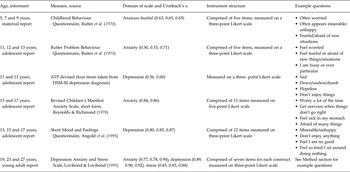
Participants were drawn from the ATP, a large multi-wave longitudinal study of psychosocial development in a representative community sample (Prior et al. Reference Prior, Sanson, Smart and Oberklaid2000). The baseline sample consisted of 2443 infants aged between 4 and 8 months and their mothers recruited from Infant Welfare Centres across the state of Victoria, Australia in 1983. Importantly, Infant Welfare Centres established contact with 94% of Victorian families with a new infant, and the Australian Bureau of Statistics developed the sampling framework to obtain a representative sample. Subsequent analyses demonstrated that the sample exhibited similar demographic characteristics to the Victorian general population (Prior et al. Reference Prior, Sanson, Smart and Oberklaid2000). A total of 15 assessments across the subsequent 27-year period ascertained a range of factors including temperament, behavioural problems, substance use, parenting, sociodemographic indices and health. Informed consent was obtained from all participants and ethical approval was granted by the relevant institutions; further information regarding the sample characteristics and procedures of the ATP are available elsewhere (Sanson et al. Reference Sanson, Prior and Oberklaid1985; Prior et al. Reference Prior, Sanson, Smart and Oberklaid2000). The analysis reported in this paper used three measures of maternal reported child internalizing symptoms from age 5 to 9 years, eight measures of self-reported anxiety and depression symptoms from age 11 to 27 years, and three measures of self-reported stress symptoms in adulthood (see Table 1 for more details). To be included in the study, participants needed at least two measures of childhood internalizing symptoms, at least three measures of anxiety, depression, and stress symptoms in adolescence and/or adulthood, and all covariates resulting in a sample size of 1406.
Summary of variables used in the analyses

ATP, Australian Temperament Project; DSM-III, Diagnostic and Statistical Manual of Mental Disorders, third edition.
Measures of anxiety and depression
Childhood internalizing symptoms were measured through mother-report on the five-item anxious–fearful scale from the Child Behaviour Questionnaire (CBQ) (Rutter et al. Reference Rutter, Tizard and Whitmore1970) at ages 5, 7 and 9 years. At the adolescent and early adulthood follow-ups, three age-appropriate instruments where used to measure self-reported anxiety and depression symptoms among the participants across eight waves of data (11, 12, 13, 15, 17, 19, 23 and 27 years). Each measure of anxiety and depression, including internalizing in childhood, consisted of a number of symptoms rated on Likert scales, with a total score summed and averaged to a range between 0 and 10 for each measure at each time point. Table 1 presents details of all the instruments used in the analyses, including the symptom domains included by the scales, questionnaire structure (i.e. number of items and scale of measure), reliability estimates (Cronbach's α), example questions from each scale and references to the instrument source. In addition, for the three measurements during adulthood, anxiety was further divided into stress (chronic non-specific arousal) and anxiety (autonomic arousal).
Within the Depression, Anxiety and Stress Scales (DASS), ‘anxiety’ assesses situational arousal, including skeletal and muscle effects and subjective experiences of arousal, while ‘stress’ assesses a generalized and chronic predisposition to stress, including a predisposition to over-reactivity, irritability and agitation (Lovibond & Lovibond, Reference Lovibond and Lovibond1995) [example items included: (i) anxiety – I had a dry mouth, heart beating fast with no physical exertion, felt scared for no reason, felt I was close to panic; (ii) stress – I tended to over-react, found it hard to wind down, often got irritated; (iii) depression – nothing to look forward to, couldn't experience any positive feelings, felt life was meaningless]. Lastly, we adjusted for gender and family socio-economic position (SEP) measured at baseline. SEP was calculated as the mean of both parents’ occupational levels (an eight-point scale ranging from professional to unskilled) and highest educational levels achieved (an eight-point scale ranging from postgraduate degree to elementary schooling). Scores ranged from 1 to 8, with higher scores indicating lower SEP.
Constructing the measurement models
All analyses were conducted in Mplus version 6, using the robust maximum likelihood estimator (MLR) appropriate for continuous variables which exhibit non-normality, and using full information maximum likelihood (FIML) to account for missing data (Muthén & Muthén, Reference Muthén and Muthén1998–2010; Byrne, Reference Byrne2012). Model fit was assessed in all models using the root mean square error of approximation (RMSEA), the comparative fit index (CFI) and the Tucker–Lewis index (TLI), for which adequate fit is indicated by RMSEA < 0.06, CFI ⩾ 0.95 and TLI ⩾ 0.95 (Hu & Bentler, Reference Hu and Bentler1998). When a number of alternative models satisfy these criteria, it is normal to compare among them using the Bayesian information criterion to determine the best-fitting model (Nylund et al. Reference Nylund, Asparouhov and Muthen2007), with a decrease of ⩾10 suggesting better fit (Burnham & Anderson, Reference Burnham and Anderson2002).
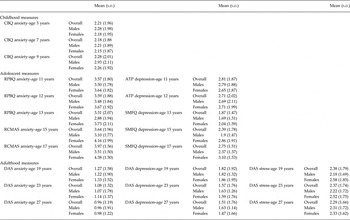
As a first step, parallel processes latent growth modelling (LGM) was used to empirically represent the change in anxiety and depression symptoms across adolescence and adulthood. LGM uses mathematical functions to describe both the average change in symptom levels across time, in our case the correlated symptom trajectories of anxiety, depression and stress, and the individual differences in these trajectories (Duncan & Duncan, Reference Duncan and Duncan2009). It is the distribution of these individual differences or factor scores which are the outcome variables of interest in our study. Prior to conducting the dual processes LGM, examination of the means and correlations of the anxiety and depression measures, and knowledge of the normative trend of both constructs across adolescence and adulthood [i.e. with regards to level of symptom expression and not disorder prevalence, depression and anxiety have been found to rise across adolescence and fall across early adulthood (Gutman & Sameroff, Reference Gutman and Sameroff2004; Wickrama et al. Reference Wickrama, Conger, Lorenz and Martin2012)], we decided to use separate intercepts in adolescence and adulthood. Further, during adolescence we had five measurements of anxiety and depression, meaning that we needed to consider the potential of non-linear trends. We decided to use piecewise LGM to represent non-linearity in the change of either construct during adolescence due to the difficulty of interpreting quadratic terms. In our analyses, piecewise LGM simply refers to the addition of an extra slope without an additional intercept. In addition, we allowed the residual variances of anxiety and depression at each time point to correlate. With regards to the childhood internalizing symptoms, LGM analyses revealed there was no significant mean change across time (reflected in the means presented in Table 2), and thus we instead used a single latent factor to represent stable child internalizing across the three follow-ups.
Scores for each measure of depression, anxiety and stress at each time-point (n = 1406 overall sample; n = 696 male sample; n = 707 female sample)a

s.d., Standard deviation; CBQ, Child Behaviour Checklist; RBPQ, Rutter Problem Behaviour Questionnaire; ATP, Australian Temperament Project (devised for the study); SMFQ, Short Mood and Feelings Questionnaire; RCMAS, Revised Children's Manifest Anxiety Scale; DASS, Depression, Anxiety and Stress Scale.
a Means are a transformed mean on the scale from 0 to 10.
Hypothesis testing
The final structural equation model was then constructed to test the regression relationships among the childhood internalizing factor with the intercept and slope factor variances of the dual processes LGM, adjusted for gender and socio-economic status at baseline. Given our data covered three distinct developmental periods we utilized a step-wise approach. Firstly, we regressed the adult intercepts and slopes on the adolescent intercepts and slopes, noting the relationships that reached significance (using Bonferroni correction such that p ⩽ 0.001). Next, in a separate model we regressed the adult and adolescent intercepts and slopes on the child internalizing factor, noting the relationships that reached significance (using Bonferroni correction such that p < 0.005). In the final step, we constructed the full model incorporating the significant regressions from the two previous models. Importantly, within a single developmental period all factors were allowed to correlate with one another (e.g. adolescent intercepts and slopes were all correlated), but no correlations were allowed between factors across different developmental periods. As such, factors across different developmental periods could only be related by regression. This approach ensured that our model was identified and is most consistent with a traditional path analytic approach, by which potential causal relationships are represented by regression paths, with only significant regressions retained in the final model (Byrne, Reference Byrne2012). Lastly, we used two methods to explore how loss to follow-up may have biased our results by: (i) re-running the analyses with all participants who had at least one measurement of psychopathology risk at any time during the study period of interest (i.e. age 5–27 years) using Mplus FIML; and (ii) we conducted a logistic regression analysis by which the probability of not being included in the final analysis was calculated depending on a number of baseline variables, including child temperament at baseline (described in the online Supplementary material), as internalizing behaviour was not measured with the CBQ (Rutter et al. Reference Rutter, Tizard and Whitmore1970) until the age of 5 years.
Results
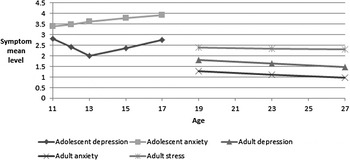
Fig. 1 illustrates the trajectories of depression and anxiety symptoms from age 11 to 27 years, with the parameters of this model shown in Table 3. One change was necessary to our initial dual processes LGM (described in the Method) to ensure acceptable fit statistics. This involved the allowance of non-linear growth in depression symptoms during adolescence, achieved by using piecewise LGM by which the intercept was moved to age 13 years and two slopes were used to characterize depression change in the adolescent years before and after age 13 years. Table 2 shows the means of the measures of depression and anxiety, which support our use of a piecewise depression trajectory in adolescence (i.e. means decreasing from age 11 to 13 years, then increasing from 13 to 17 years), and separate processes in adolescence and adulthood (i.e. adolescent means are consistently greater than adult means). Online Supplementary Table S1 presents a correlation matrix for all the original variables included in the analysis. Online Supplementary Table S2 compares the fit indices among a number of alternative models, confirming that our model provides the best representation of the data. Online Supplementary Table S3 reveals that the individual differences (i.e. the factor variances) of the trajectories are significant in all but two (slope 2 of depression and anxiety). However, non-significant variances are probably due to a lack of power, with increasing precision expected with the addition of covariates (Berkhof & Snijders, Reference Berkhof and Snijders2001; Choukas-Bradley et al. Reference Choukas-Bradley, Giletta, Widman, Cohen and Prinstein2014). This table also shows the correlations among the adolescent and adult intercept and slopes. Lastly, the factor loadings of the latent child internalizing factor were all strong and significant [λ = 0.74 (p < 0.001) age 5 years; λ = 0.79 (p < 0.001) age 7 years; λ = 0.74 (p < 0.001) age 9 years], suggestive of inter-individual symptom stability across time.
Dual processes latent growth model showing the average latent trajectories of anxiety, depression and stress mean score (on a scale ranging from 0 to 10 at each time point) in adolescence and adulthood. Separate processes were used for each developmental stage (i.e. adolescence and adulthood); hence the gap between the ages of 17 and 19 years. All parameters, including the random components (not shown here), and model fit indices are given in Table 3 (n = 1406).

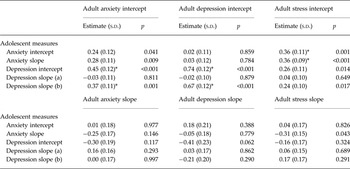
Associations between the random intercept and slope variances of anxiety and depression in adolescence with the random intercepts of anxiety, depression and stress in adulthood (n = 1406)a

Data are given as standardized parameter estimate (s.d.), adjusted for gender and baseline socio-economic status.
s.d., Standard deviation; CFI, comparative fit index; TLI, Tucker–Lewis index; RMSEA, root mean square error of approximation; df, degrees of freedom.
a Model fit was acceptable (CFI = 0.97; TLI = 0.94; RMSEA = 0.043; χ2 = 414.04; df = 115; p < 0.001).
* Estimates with a p value of ⩽0.001 [based on Bonferroni correction of 0.05/(5 × 6) = 0.0017].
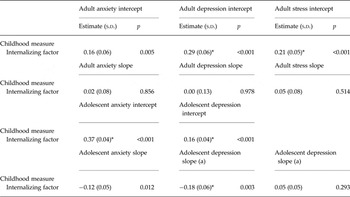
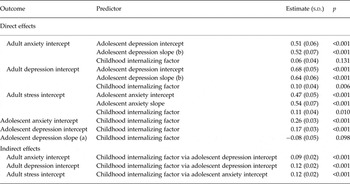
Table 3 shows that the intercepts of adult anxiety and depression were predicted by both the intercept and slope of depression in adolescence, while the intercept of chronic, non-specific arousal in adulthood was predicted by the intercept and slope of anxiety in adolescence. Table 4 shows that the childhood internalizing factor predicted the intercepts of adolescent anxiety and depression in addition to the depression slope (a), and also predicted the intercepts of depression and anxiety in adulthood. Further, as the p value of the estimate of adult anxiety intercept on childhood internalizing was borderline, it was decided to retain this relationship for the final model. The results of the final model are shown in Table 5. The regression relationships between the adult outcomes and adolescent outcomes remained strong and significant, as did the regression relationships between the adolescent outcomes and the childhood internalizing factor [with the exception of depression slope (a)]. However, the regression relationships between the adult outcomes and the childhood internalizing factors were no longer supported as significant at the level specified by the Bonferroni corrected p value. However, estimation of the indirect effects, as shown in the bottom of Table 5, shows evidence of mediation whereby the childhood internalizing factor predicted the adult outcomes via adolescent depression and anxiety.
Associations between the random intercept and slope variances of anxiety, depression and stress on the latent factor of stable childhood anxiety (n = 1406)a

Data are given as standardized parameter estimate (s.d.), adjusted for gender and baseline socio-economic status.
s.d., Standard deviation; CFI, comparative fit index; TLI, Tucker–Lewis index; RMSEA, root mean square error of approximation; df, degrees of freedom.
a Model fit was acceptable (CFI = 0.93; TLI = 0.91; RMSEA = 0.051; χ2 = 913.15; df = 195; p < 0.001).
* Estimates with a p value of <0.005 (based on Bonferroni correction of 0.05/11 = 0.0045). The estimate for adult anxiety intercept was borderline (p = 0.005) and included in further analyses.
Structural equation model of the direct and indirect relationships among childhood internalizing, adolescent anxiety and depression, and adult anxiety, depression and stress (n = 1406)a

Data are given as standardized parameter estimate (s.d.), adjusted for gender and baseline socio-economic status.
s.d., Standard deviation; CFI, comparative fit index; TLI, Tucker–Lewis index; RMSEA, root mean square error of approximation; df, degrees of freedom.
a Model fit was acceptable (CFI = 0.96; TLI = 0.95; RMSEA = 0.037; χ2 = 586.18; df = 203; p < 0.001).
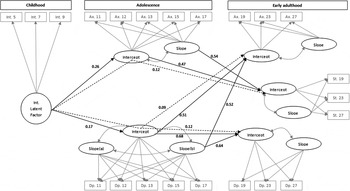
A simplified schematic of the final structural model is shown in Fig. 2, in which the measurement part of the model is presented in grey (with the factor loadings and correlation coefficients omitted due to space limitations) while the structural part is presented in black and includes significant regression estimates. Note that while correlations among the same construct within a single developmental stage are shown (e.g. correlation of adolescent anxiety intercept with adolescent anxiety slope), correlations among different constructs within the same developmental period (e.g. correlation of adolescent anxiety intercept with adolescent depression intercept) were included in the model but omitted from the figure due to space limitations. Lastly, online Supplementary Table S3 shows that when including the larger sample with more missing data the results did not differ substantively, while online Supplementary Table S4 shows those not included in the final model were more likely to be male, have a lower socio-economic status and younger mother, but did not differ on the temperament domain of mood.
Simplified schematic of the final structural equation model including significant path (regression) coefficients as found in Table 5. Indirect paths are shown with broken arrows. Int., Internalizing; Ax., anxiety; St., stress; Dp., depression. The rectangular boxes are the indicator variables (i.e. symptom scores) with the number representing participant age at measurement. Fit indices for the model can be found in Table 5. Factor loadings in addition to correlations among different constructs within developmental periods are not shown due to space limitations. Estimates adjusted for gender and baseline socio-economic status with these regressions also not shown due to space limitations.

Discussion
Our results demonstrate strong continuity in depressive symptoms from adolescence to young adulthood, suggesting that, once established, this mood profile is highly persistent. We also observed a notable developmental relationship between adolescent depressive symptoms and autonomic arousal or fear (i.e. DASS anxiety) in adulthood, suggesting that depressive symptoms have the potential to elaborate into other forms across this period. In contrast, adolescent anxiety was not related to depressive or fear symptoms in young adulthood, but rather effects were limited to an association with non-specific chronic arousal (i.e. DASS stress). We observed only a weak role for childhood internalizing behaviours. Notwithstanding measurement source variance for internalizing symptoms in childhood (i.e. mother-reported) addressed in a later section, results suggest that adolescent and young adulthood internalizing symptoms may be better indicated by a heterogeneous set of earlier effects, rather than child internalizing symptoms alone.
The strength of continuity in depressive symptoms from adolescence to adulthood is notable given that recent research found many adolescent anxiety and depressive disorders resolve before adulthood (Patton et al. Reference Patton, Coffey, Romaniuk, Mackinnon, Carlin, Degenhardt, Olsson and Moran2014). Although understanding syndrome persistence is important, it is equally important to understand persistence of underlying mood regulation profiles (Merikangas et al. Reference Merikangas, Zhang, Avenevoli, Acharyya, Neuenschwander and Angst2003), which are less likely to be subject to fluctuations and therefore better able to demonstrate continuity. For example, individuals who regularly exhibit symptom loads just below the threshold may temporarily surpass the threshold during a measurement period, reducing the disorder continuity demonstrated in the sample. Consistent with this idea, brief adolescent disorders (single episode of <6 months duration) have been shown the most likely to resolve before adulthood (Patton et al. Reference Patton, Coffey, Romaniuk, Mackinnon, Carlin, Degenhardt, Olsson and Moran2014). Importantly, Copeland et al. (Reference Copeland, Shanahan, Costello and Angold2009) found that the relationship between adolescent and adult major depression was accounted for by adolescent oppositional defiance disorders, and thus it is likely that the estimates of the association we found may have been reduced had we included symptoms of adolescent externalizing disorders.
In line with our expectations, the separation of anxiety into autonomic and chronic arousal revealed separate adult psychopathological pathways, depending on the experience of depression or anxiety in adolescence. Contrary to our expectations, however, fear symptoms in adulthood were predicted not by adolescent anxiety but by depression. Elsewhere, primary depression has been found to predict later panic attacks (Kessler et al. Reference Kessler, Stang, Wittchen, Ustun, Roy-Burne and Walters1998). In our study, in which adolescent anxiety included symptoms of acute fear in addition to general chronic stress, the lack of association suggests that fear-based disorders in adulthood exhibit little homotypic continuity from adolescence, but are instead precipitated by depression. Had we been able to separate adolescent anxiety into both autonomic and chronic arousal as we did in adulthood, we may have found evidence for homotypic continuity in fear-based disorders. However, our approach is in line with developmental theory, which posits that internalizing symptoms at the earliest stages consist of a unitary construct, before evolving to form dual and then tripartite constructs as development proceeds (Garber & Weersing, Reference Garber and Weersing2010).
Further, despite not being related to adult fear, adolescent anxiety symptoms were predictive of an increased and sustained level of adult chronic arousal. People who score high on the stress scale in the DASS are characterized by a low threshold for becoming upset and frustrated and experience symptoms of distress which are chronic and non-specific in nature (Lovibond & Lovibond, Reference Lovibond and Lovibond1995). The specificity of this relationship was quite remarkable, suggesting that a meaningful and sustained improvement in young adult coping ability could be achieved by reducing a broad range of anxiety symptoms during adolescence (including somatic symptoms, cognitive symptoms such as feelings of anxious apprehension, and self-evaluation as overly sensitive and fearful) (Rutter et al. Reference Rutter, Tizard and Whitmore1970; Reynolds & Richmond, Reference Reynolds and Richmond1978). Taken together, these findings could potentially explain why different studies provide conflicting results regarding the heterotypic and homotypic continuity of depression and anxiety (Garber & Weersing, Reference Garber and Weersing2010), suggesting that adolescent depression is predictive of adult disorders characterized by anhedonia and fear, while adolescent anxiety may be predictive of adult disorders characterized by non-specific arousal.
Our data also afforded the opportunity to demonstrate a relationship between maternal reported childhood internalizing with self-reported depressive and anxiety symptoms in both adolescence and young adulthood, and non-specific chronic arousal in young adulthood. Importantly, these relationships were weak, and with regards to adult symptoms indirect, suggesting that factors in addition to internalizing are important in establishing early risk for adolescent symptoms. Child measures were parent-report and therefore the lack of association may simply reflect methodological differences. Notwithstanding this possibility, our results suggest that interventions in the early adolescent years, targeted to depression and anxiety (depression in particular), may yield a greater reduction in young adult internalizing symptoms than similar interventions delivered in the latency years. Adolescent interventions may include possible dimensional reformulations of internalizing disorders, including an early focus on patterns of ‘defeat’, enhancing help-seeking behaviour in the adolescent, and aligning the adolescent with better adjustment pathways. Effective intervention earlier than adolescence requires research to using multiple data types and sources during childhood, to identify reliable predictors of adolescent depression and anxiety in childhood.
We employed a unique methodological approach estimating not only the strength of the relationships among internalizing symptoms across three developmental periods but also demonstrating how the longitudinal development of symptoms during one period influenced the longitudinal development during later periods. Most studies with repeated measures of the outcome have employed correlational models (e.g. auto-correlation models), which only allow the prediction of the rank order correlations in symptoms across time (Snyder et al. Reference Snyder, Bullard, Wagener, Leong, Snyder and Jenkins2009), and are unable to observe the impact of a given exposure on the growth (i.e. slope variance) of depression or anxiety independent of the level (i.e. intercept variance). As both anxiety and depression are known to increase across adolescence, before declining across early adulthood (Gutman & Sameroff, Reference Gutman and Sameroff2004; Wickrama et al. Reference Wickrama, Conger, Lorenz and Martin2012), it makes sense to analyse their progression within this natural developmental context.
This approach allowed us to make an important observation about early mental health interventions designed to reduce adult psychopathology by targeting risk in adolescence. Our study finds that the likelihood of an increase in levels of depressive, fear and chronic arousal symptoms across early adulthood (from age 19 to 27 years) comes from two related but separate sources: (i) increased levels of depressive and anxiety symptoms across adolescence; and (ii) increased growth in depressive and anxiety symptoms across adolescence. This suggests that intervention strategies, aimed at (i) reducing pre-existing levels of depressive and anxious symptoms, and (ii) preventing the growth of depressive and anxious symptoms, would lead to largely equal, independent and sustained reductions in early adulthood psychopathology. It is worth emphasizing the sustained nature of the relationships between adolescent and adult symptomatology. We had expected that adolescent psychopathology, though surely related to initial increased levels of adult psychopathology, might also be related to decreasing symptom slopes in adulthood. That is, in a manner conceptually similar to earlier findings among a national sample of adults (Kessler et al. Reference Kessler, Gruber, Hettema, Hwang, Sampson and Yonkers2008), where the impact of adolescent symptoms on adult symptoms diminished throughout young adulthood. However, this was not the case. Instead, the influence of adolescent symptoms was pervasive from age 19 to age 27 years. Thus, we may expect the benefits of both effective adolescent intervention and prevention to be far reaching.
This interpretation of our data must be considered with a number of limitations in mind. First, depression and anxiety were captured using several age-appropriate instruments from age 11 to 17 years, and to some degree the trends in these symptoms during adolescence represented by our trajectories analysis will reflect the differences in instruments. However, we took care to transform all measures to a scale which was the same at each time point, employing an approach which has been used in previous studies using this cohort (Toumbourou et al. Reference Toumbourou, Williams, Letcher, Sanson and Smart2011; Letcher et al. Reference Letcher, Sanson, Smart and Toumbourou2012). Further, the trajectories of depression and anxiety largely reflect what we would expect based on previous literature, including an increase during adolescence and a fall in early adulthood. In addition, evidence supports the notion that pre- and post-pubertal depression are qualitatively different phenomena, with only the latter predicting ongoing and adult depression (Rutter et al. Reference Rutter, Kim-Cohen and Maughan2006). This appears consistent with our LGM, where normative early adolescent depressive symptoms appeared to decline until rebounding and increasing again after age 13 years. Further, individual differences in the decrease and individual differences in the subsequent increase of adolescent depressive symptoms were not related (i.e. uncorrelated factor variances), while the latter was more strongly associated with early adulthood depression level (see online Supplementary Table S3).
Second, although the inclusion of 11 measurement points across 22 years of follow-up was a major strength of our study, we were unable to account for psychological status in the 2-year gaps between measurement occasions. This may have led to the total prevalence of internalizing symptoms being underreported across the 22 years of follow-up. However, this is a commonly acknowledged limitation in similar research (Moffitt et al. Reference Moffitt, Harrington, Caspi, Kim-Cohen, Goldberg, Gregory and Poulton2007; Copeland et al. Reference Copeland, Shanahan, Costello and Angold2009; Patton et al. Reference Patton, Coffey, Romaniuk, Mackinnon, Carlin, Degenhardt, Olsson and Moran2014), and considering that continuity among symptoms is more stable than continuity among diagnoses (Merikangas et al. Reference Merikangas, Zhang, Avenevoli, Acharyya, Neuenschwander and Angst2003), is likely to represent a more serious problem to studies using diagnostic thresholds. Third, informant discrepancies between maternally reported childhood symptoms with self-reported adolescent and adult symptoms are possible. While the convergent validity of parent- and child-reports of mental health are generally found to be acceptable (Achenbach et al. Reference Achenbach, McConaughy and Howell1987), so too, the potential for distortion that occurs through a parent reporting on the internal states of a child is important to consider (De Los Reyes & Kazdin, Reference De Los Reyes and Kazdin2004), with concurrence of parent and child appraisals higher for observable behaviours than for internalized mood states and fears (Nauta et al. Reference Nauta, Scholing, Rapee, Abbott, Spence and Waters2004). Fourth, we lacked data regarding pubertal transitions, and future research into the early life course of internalizing symptoms would benefit from including more specific definitions of development. Fifth, due to the small sample size relative to the model complexity, we were unable to perform a gender invariance test of the model. However, we replicated the final model separately in males and females (online Supplementary Tables S6 and S7) and found that the model and estimates did not substantively differ by gender. Finally, as with all prospective research, biased attrition presents a concern for the generalizability of our results. Importantly, when we reran the analyses including participants with at least a single point of measurement (n = 1844 or 75% of the original sample) the results did not vary substantively (online Supplementary Table S4). The attrition analyses (online Supplementary Table S5) showed that those included were from a higher socio-economic background, had mothers who were older at birth, and were more likely to be female. Importantly, however, though some temperament traits were exhibited at higher levels among those lost to follow-up, the two samples did not differ on the domain of ‘mood’, which is the trait most closely related to internalizing. Having carefully investigated attrition, we may not expect attrition to have biased our results substantively.
In summary, our data provide a detailed picture of the patterning and persistence of internalizing symptoms across three distinct periods of early life, and in doing so provide a number of findings with relevance to early intervention programmes. First, although early childhood internalizing symptoms have a persistent impact on further internalizing symptoms until the age of 27 years, the impact may be modest and not a key driver of the normative increase in adolescent anxiety and depressive symptoms. This suggests that the developmental origins of anxiety and depression in adolescence derive from broader contributions than the same behaviour persisting from childhood. We suggest that greater gains in reducing disorders characterized by internalizing symptoms in early adulthood could come from at least two lines of future research: (1) implementing effective intervention and prevention programmes during adolescence, and (2) making further research investments into understanding the broader childhood determinants of adolescent anxiety and depression symptoms to facilitate earlier intervention. The economy of such investments is suggested by our unique findings that reductions in adolescent depressive symptoms are likely to reduce the prevalence of adult anhedonic and fear-based disorders, and reductions in adolescent anxiety are likely to lead to reductions in adult stress-related disorders.
Supplementary material
For supplementary material accompanying this paper visit http://dx.doi.org/10.1017/S0033291716001495
Acknowledgements
The ATP study is located at The Royal Children's Hospital Melbourne and is a collaboration between Deakin University, The University of Melbourne, the Australian Institute of Family Studies, The University of New South Wales, The University of Otago (New Zealand) and the Royal Children's Hospital (further information available at http://www.aifs.gov.au/atp). The views expressed in this paper are those of the authors and may not reflect those of their organizational affiliations, nor of other collaborating individuals or organizations. We acknowledge all collaborators who have contributed to the ATP, especially Professors Ann Sanson, Margot Prior, Frank Oberklaid, John Toumbourou and Ms Diana Smart. We would also like to sincerely thank the participating families for their time and invaluable contribution to the study.
R.A. is funded by a National Health and Medical Research Council Career Development Award Level 2 in Population Health (APP1012485). C.A.O. is supported by an Australian Research Council Senior Research Fellowship (DP 130101459).
K.S.B. has been designated principal author and was responsible for the bulk of the literature review, drafting, statistical analysis and discussion. C.A.O. provided significant guidance in the study conception and design, in addition to drafting and writing. P.B. provided expert statistical and analytical advice, and helped draft the Method section. J.E.M. provided expert psychological opinion, and was key to interpreting the results from a clinical viewpoint. J.A.M. provided expert knowledge in the ATP study and helped redraft the paper. R.A. provided expertise in life course and longitudinal epidemiology and helped with redrafting. P.L. oversaw data collection over multiple waves and provided expert knowledge in the ATP study and assistance with redrafting.
K.S.B. had access to the complete dataset used in the study and takes responsibility for the integrity of the data and accuracy of the data analyses.
Declaration of Interest
None.