Work represents the central process around which society is structured (Bauman, Reference Bauman1998). On the other side, unemployment rate is a relevant economic indicator and unemployment currently appears to be a global problem affecting society as a whole (Wanberg, Reference Wanberg2012). Since 2007 the unemployment rate has been almost steadily increasing – EU started the crisis with unemployment rate of 6.8%, which increased to 10.4% in April 2014 (Eurostat, 2016a, b). Labor markets in some countries have suffered from the crisis significantly more than others. Spain, Greece, Portugal and Croatia are typical examples of countries with a rapid increase of unemployment rates. In Spain, unemployment rates jumped from 8.2% in 2007 to 24.5% in 2014 (Eurostat, 2016a), out of which 12.9% individuals were unemployed for more than 12 months.
Over the past few decades, numerous studies have examined negative consequences of job loss on an individual. Most studies focus on negative effects of unemployment on mental health and general well-being (Ferreira et al., Reference Ferreira, Reitzle, Lee, Freitas, Santos, Alcoforado and Vondracek2015). Overall, research suggests that, across different countries, unemployment is associated to greater psychological deterioration than the employed have (Álvaro, Guedes, Garrido, de Figueiredo, & Campos, Reference Álvaro, Guedes, Garrido, de Figueiredo and Campos2012), to higher levels of depression (Berrios, Extremera, & Nieto-Flores, Reference Berrios, Extremera and Nieto-Flores2016) and stress-related symptoms such as stomach aches and headaches (Vansteenkiste, Lens, De Witte, De Witte., & Deci, 2004) or lower self-esteem (McIntyre, Mattingly, Lewandowski Jr., & Simpson, 2014). Additionally, emotional and financial stressors associated with unemployment affect their social interactions leading to increased family conflict, loneliness (Åslund, Starrin, & Nilsson, Reference Åslund, Starrin and Nilsson2014) and, in the recent economic crisis, is accompanied by an increase in suicide mortality, particularly in South Europe (Breuer, Reference Breuer2015). In fact, in Spain, as in other countries, negative effects significantly worsen with the economic crisis (Urbanos-Garrido & Lopez-Valcarcel, Reference Urbanos-Garrido and Lopez-Valcarcel2015). However, not all individuals experience negative consequences of their job loss. It could be an opportunity to spend more time on other meaningful activities (Burda & Hamermesh, Reference Burda and Hamermesh2010).
In order to provide a broader perspective of individual differences in experience and coping with unemployment, some researchers turned to the transactional model of stress and coping by Lazarus and Folkman (Reference Lazarus and Folkman1984), which is the basis of this research. This model connects cognitive appraisals, coping resources and coping strategies in trying to explain the relationship between stressful events in the environment and one’s reactions. Stress occurs when individuals perceive a threat to their well-being or resources that exceeds their ability to cope with that event (Probst & Jiang, Reference Probst and Jiang2016). As such, first there is an evaluation of a stressful situation and then the election of the coping strategy to cope with which depends on the coping resources of the individual and the environment.
Coping resources are one antecedent of coping strategies and consist of internal attributes (e.g., self-esteem, positive beliefs) and external resources (e.g., material resources, social support) that influence the way a person copes with involuntary job loss (Solove, Fisher, & Kraiger, Reference Solove, Fisher and Kraiger2015). More specifically, higher self-esteem and self-efficacy, lower neuroticism and internal locus of control were associated to positive cognitive appraisals, which are in turn connected with more effective coping strategies (McKee-Ryan, Song, Wanberg, & Kinicki, Reference McKee-Ryan, Song, Wanberg and Kinicki2005). These individual variables (self-esteem, generalized self-efficacy, locus of control and emotional stability) are often examined as coping resources influencing the choice and persistence of coping strategies. Because of their high intercorrelations, Judge, Locke, and Durham (Reference Judge, Locke and Durham1997) suggested they could be united in a higher order construct, which they named core self-evaluations (CSE), as fundamental premises that individuals hold about themselves and their functioning in the world (p. 154). CSE represent a motivational trait useful for prediction of various goal setting activities and coping strategies (Kammeyer-Mueller, Judge, & Scott, Reference Kammeyer-Mueller, Judge and Scott2009). When dealing with a stressful event, individuals with high CSE typically focus on trying to solve a problem and deal with their negative emotions.
Coping resources have direct and indirect effects (by affecting one’s appraisal of the unemployment) on the selection of coping strategies (Latack, Kinicki, & Prussia, Reference Latack, Kinicki and Prussia1995). Together with cognitive appraisals, they are necessary antecedents of coping, and therefore can be seen as mediators between an event and an individual’s response to it. Coping strategies are cognitive and behavioral efforts made by individuals to deal with a stressful situation (Latack et al., Reference Latack, Kinicki and Prussia1995). Latack (Reference Latack1986) integrated the different strategies to distinguish between control-oriented as actions and cognitive reappraisals that are proactive, and escape-oriented consisting of both actions and cognitive reappraisals that suggest an escapist, avoidance mode coping strategies.
This research investigated coping strategies of job search and job devaluation. Job search, is a control-oriented strategy consisting of proactive and planned activities with reemployment as a final goal (i.e., writing a CV, asking friends about open positions in their companies and searching and applying for job openings online). Meta-analysis by Kanfer, Wanberg, and Kantrowitz (Reference Kanfer, Wanberg and Kantrowitz2001) showed that the active use of this strategy is related to future job acquisition, number of job offers and shorter duration of unemployment. Also, individuals with higher self-esteem, self-efficacy and perceived control over life (components of CSE) show more intensity and effort in their job search (Wanberg, Reference Wanberg2012). However, successful reemployment also depend on other factors, such as labor market (Maslić & Šavor, Reference Maslić and Šavor2011). Other studies on job search focused on its negative relationship with well-being despite it generally increases the chance of reemployment (McKee-Ryan et al., Reference McKee-Ryan, Song, Wanberg and Kinicki2005). Finally, the relationship between active job search and higher levels of distress is reciprocal - not only does job search lead to increased psychological distress, but higher levels of psychological distress also seem to increase job seeking behavior (Song, Uy, Zhang, & Shi, Reference Song, Uy, Zhang and Shi2009).
Job devaluation, is an escape-oriented strategy through which an individual tries to perceive the event of job loss as less negative and cognitively persuade themselves that there are more important things in life than having a job. This implies cognitive revision of goals and attitudes in order to reduce the negative experience of unemployment (Latack et al., Reference Latack, Kinicki and Prussia1995). According to De Witte, Hooge, and Vanbelle (Reference De Witte, Hooge and Vanbelle2010), this strategy is common among long-term unemployed individuals who get tired of constant job search and therefore their commitment decreases. Once the role of work in their life becomes peripheral, psychological distress decreases and their overall well-being improves.
A common point of interest of all theories on the impact of unemployment is individual experience, which varies from extremely negative (e.g., depression) to positive (e.g., leisure time). Previous research mainly focused on positive and negative experience (e.g., De Witte et al., Reference De Witte, Hooge and Vanbelle2010; Vansteenkiste et al., Reference Vansteenkiste, Lens, De Witte, De Witte and Deci2004) confirmed the results of meta-analysis by McKee-Ryan et al. (Reference McKee-Ryan, Song, Wanberg and Kinicki2005). That is, job search coping strategy connects to negative experience of unemployment whereas escape-oriented strategies relate to positive experience.
In this resesarch we go one step further to enable a more thorough insight into the mechanisms of individual variations in coping with job loss. In particular, to examine whether and to what extent CSE predict strategies of coping with unemployment as well as to test the potential moderation effect of job search and mediation effect of job devaluation on the relationship between CSE and experience of unemployment. Practically, investigating the coping resources and coping strategies may help to design more effective interventions to facilitate a successful return to the workforce (Blustein, Kozan, & Connors-Kellgren, 2013).
Specifically, we expect that:
H1. Higher core self-evaluations will be positively related to higher levels of job search, as well as higher levels of job devaluation. CSE will contribute significant additional variance to predicting job search and job devaluation, after the socio-demographic variables (age, gender, level of education, average monthly income) and work characteristics (total period of current unemployment, duration of last tenure) are controlled.
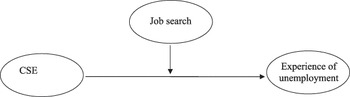
H2. Job search will moderate the relationship between core self-evaluations and experience of unemployment. Thus, people with higher CSE will have more positive and less negative experience of unemployment. However, those who search for a job actively will have a less positive and more negative experience of unemployment (Figure 1).
Expected moderation effect of job search on the relationship between core self-evaluations and experience of unemployment.

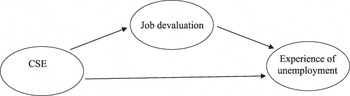
H3. Job devaluation will partially mediate the relationship between core self-evaluations and experience of unemployment. Again, CSE will affect experience of unemployment. People with higher core self-evaluations will have higher levels of positive and lower levels of negative experience of unemployment than low CSE individuals. Also, CSE will be associated to higher levels of job devaluation, which will in turn lead to more positive and less negative experience of unemployment (Figure 2).
Expected mediation effect of job devaluation on the relationship between core self-evaluations and experience of unemployment.

Method
Participants and procedure
Two hundred displaced people in South Spain attending to Andalusian Service of Employment participated in this study. Data gathering consisted of approaching everyone in the waiting room of the agency and asking them to participate in the study. The participation was anonymous and voluntary. As criteria for participation, only individuals who lost their jobs involuntarily and whose current period of unemployment was longer than 1 month were involved. The ones who met the criteria and agreed to participate (74%) were given the questionnaire with further instructions on its first page. Participants took 10 to 20 minutes to complete the questions. The completed questionnaires were left in a box put on a separate table. Nine were discarded for being outliers, and 13 because questionnaires were incomplete.
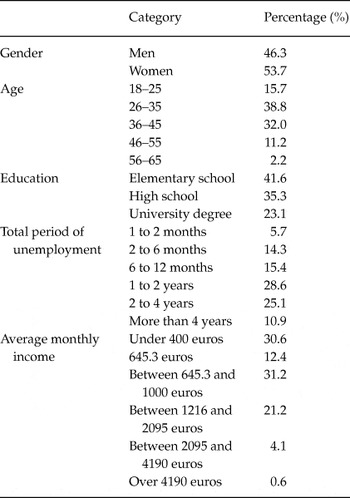
The final sample consisted of 178 participants, with a slightly greater number of female participants (N = 95, 54%). Most participants were between 26 and 45 years old (70.8%). The majority had a total period of current unemployment between one and two years (28.6%) and two and four years (25.1%), and the average duration of last tenure was 28.97 months (SD = 57.62; range = less than a month – 324 months). (See Table 1 for further details).
Socio-demographic variables and work characteristics of participants (N = 178)

In the period of gathering data, (first semester -2015) the social context was characterised with high unemployment rate. According to Eurostat, the average unemployment rate in Spain was around 22% in that period, representing the second highest unemployment rate in the EU, after Greece. In this unfavorable national context, southern provinces were especially affected. In Andalusia, the unemployment rate for the same period was 31.5%, being the worst of the EU (Eurostat, 2016b).
Instruments
Coping strategies (Maslić & Šavor, Reference Maslić and Šavor2011)
This is a Croatian questionnaire based on Kinicki and Latack (Reference Kinicki and Latack1990), Lazarus’s stress theory and qualitative data obtained during counseling work with unemployed people. We followed the International Test Commision test translation and adaptation guidelines (2005) to have a Spanish version. Native individuals with high commandment of both languages made the translation and then the back translation and finally two versions (original and back translated) were compared until the consensus on all items was reached. Participants responded on a 4-point scale (from 1 -never to 4 -always) to 13 items measuring job search (7 items; i.e., “I dedicate a lot of time to job search”, α = .77), and job devaluation (6 items, i.e., “I am telling to myself that there are more important things in life than employment”; α = .70).
Core self-evaluations (CSE; Judge, Erez, Bono, & Thoresen, Reference Judge, Erez, Bono and Thoresen2003; Spanish version by Judge, Van Vianen, & De Pater, Reference Judge, Van Vianen and De Pater2004)
Defined as fundamental premises that individuals hold about themselves and their functioning in the world (Judge et al., Reference Judge, Locke and Durham1997). The scale consisted of 12 items (i.e., I determine what will happen in my life) answered on a 5-point Likert scale ranging from 1 (strongly disagree) to 5 (strongly agree). A composite measure of core self-evaluations showed good realiabily (α = .76).
Experience of unemployment
For the purpose of this study, 14 items related to the positive and negative experience of unemployment were taken from the original questionnaire developed by De Witte et al. (Reference De Witte, Hooge and Vanbelle2010). The items were originally in English, and they were translated into Spanish by a native Spanish speaker with an excellent level of English, then back-translated from Spanish to English by another native Spanish speaker. Finally, the two versions were compared and discussed for consensus. Participants had to respond to each item (I can finally do the things I find important since becoming unemployed) by choosing often, sometimes or never. Items measuring negative experience of unemployment were generally focused on deprivation a person might have experienced (i.e., It feels as if I am no longer part of society). To test the original factor structure, principal components analysis with Oblimin rotation was performed. The rotated solution mostly confirmed the structure, except for one item which was expected to describe positive experience of unemployment, but was found saturated on both factors, and was therefore discarded from further analysis. This resulted in 13 item scale for negative experience of unemployment (8 items; α = .88) and positive experience of unemployment (5 items, α = .65).
Socio-demographic variables included age, gender, level of education and average monthly income in the family, while work characteristics focused on the duration of the current period of unemployment and last organizational tenure in months.
Results
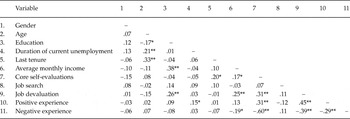
Before focusing on our research objectives, Pearson bivariate correlations between all the relevant variables were tested (see Table 2). Out of socio-demographic variables and work characteristics, age was negatively correlated with the level of education and positively correlated with the duration of current period of unemployment and last tenure, suggesting that older participants were more likely to be less educated and the duration of their current period of unemployment was more likely to be longer, while their last tenure lasted longer as well. Level of education had a significant positive correlation with the average monthly income, indicating that despite losing their job, more educated people were still more likely to have higher incomes than the others. Between all the socio-demographic variables and work characteristics, only average monthly income and duration of last tenure were significantly related to the SCE. People with a longer duration of their last tenure, as well as those with higher average monthly income, show higher levels of core self-evaluations. An interesting observation is that none of the socio-demographic variables or work characteristics were related to the control-oriented coping strategy of job search. However, higher levels of escape-related strategy of job devaluation were connected with higher levels of education, higher average monthly income and higher CSE. As for the outcomes of coping strategies, positive experience of unemployment was positively related to the duration of current period of unemployment, CSE and job devaluation. Furthermore, negative experience of unemployment was negatively related to CSE and job devaluation, implying that individuals with lower core self-evaluations and those who use job devaluation as their strategy less often are more probable to experience their unemployment negatively. Lastly, positive and negative experience of unemployment were negatively correlated.
Intercorrelations of all the observed variables (N = 178)

*p < .05; **p < .01.
Contribution of socio-demographic variables, work characteristics and CSE to the predicting of coping strategies
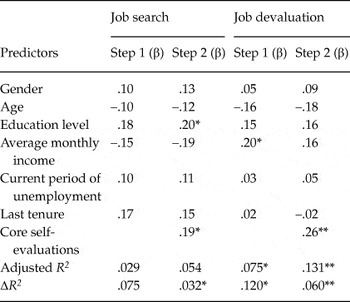
In order to test the H1, a total of two separate linear hierarchical regression analyses were conducted, each one in two steps. The measured coping strategies (job search and job devaluation) were used as the criterion variables. In each analysis socio-demographic variables (gender, age, level of education and average monthly income) were entered in the first step together with work characteristics (duration of current period of unemployment and last tenure in months), while CSE were entered in the second step (see Table 3). Only the second step was near the significancy explaining 5.4% of the total variance F(7, 118) = 2.02; p = .056, with the level of education and CSE being independent predictors. Individuals with higher level of education and a higher level of core self-evaluations are more likely to use the strategy of job search while coping with unemployment.
Results of two linear hierarchical regression analyses with job search and job devaluation as criterion variables (N = 178)

* p < .05; **p < .01.
When job devaluation was used as the criterion variable, 13.1% of the variance was explained F(7, 117) = 3.66; p = .001. Socio-economic variables, entered together with work characteristics in the first step of the analysis, accounted for 7.5% of the total variance F(6, 118) = 2.67; p = .018, and average monthly income was a significant predictor (t = 2.047; p = .043), indicating that individuals with higher average monthly income used this coping strategy more than those with lower income. CSE, added in the second step, were shown to be a significant independent predictor. At the same time, adding them into the regression equation reduced standardized beta coefficient of average monthly income, which became insignificant. According to the analysis, this strategy is more common among individuals with higher CSE.
Moderating effect of job search on the relationship between CSE and experience of unemployment
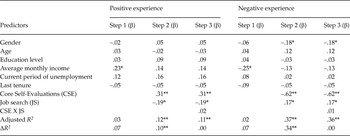
CSE were positively related to positive experience of unemployment and negatively related to negative experience of unemployment (see Table 2). To test the potential moderating effect of job search on these relationships, a total of two hierarchical multiple regression analyses were performed. Socio-demographic variables (gender, age, level of education and average monthly income) and work characteristics (duration of current period of unemployment and last organizational tenure in months) were entered in the first step of each analysis, followed by job search and CSE added in the second step. Experience of unemployment (positive or negative) was used as the criterion variable (see Table 4).
The moderating role of job search on the relationship between core self-evaluations and experience of unemployment: results of the two linear regression analyses (N = 178)

* p < .05; **p < .01.
In general, both analyses rejected the hypothesis of the moderating role of job search on the relationship between CSE and experience of unemployment. Only when positive experience of unemployment was used as the criterion variable, core self-evaluations and job search were significant independent predictors. These results indicated that people with higher levels of CSE and those who search for a job less have more positive experience of unemployment.
The analysis with negative experience of unemployment as a criterion variable had a similar result. Gender, CSE and job search were significant independent predictors of negative experience of unemployment. However, moderating variable was not shown to be a significant predictor, nor did its addition to the regression equation affect the amount of explained variance.
In sum, women and people with lower CSE and higher job search levels are more likely to experience their unemployment negatively.
Mediating effect of job devaluation on the relationship between CSE and experience of unemployment
In order to test H3, the first step was to examine the intercorrelations between CSE, job devaluation and experience of unemployment (Table 2). Job devaluation correlated significantly with both the predictor (CSE) and criterions (positive/negative experience of unemployment). In line with Baron and Kenny (Reference Baron and Kenny1986), we can thus consider job devaluation to be a potential mediator.
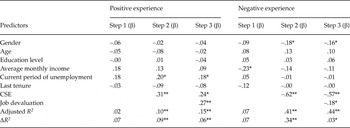
A total of two linear hierarchical regression analyses were conducted. The criterion in each analysis was either positive, or negative experience of unemployment, while core self-evaluations and job devaluation served as predictors. Also, variables of gender, age, level of education, average monthly income, duration of current period of unemployment and last tenure were controlled. Each analysis had three steps: one with control variables, in the second core self-evaluation was added, and lastly job devaluation was entered.
Both CSE and job devaluation appear to be significant independent predictors for positive experience of unemployment as a criterion (see Table 5). After controling socio-demographics and work characteristics, CSE accounted for an additional 9%, and job devaluation for a 6% of the variance. In total, 15% of the criterion variance was explained based on these predictors. Standardized beta coefficient of CSE was reduced after job devaluation was added into the regression equation, but still remained significant, which suggests a potential partial mediation effect of job devaluation on the relationship between CSE and positive experience of unemploment.
The mediating effect of job devaluation on the relationship between CSE and experience of unemployment: results of the two linear regression analyses

* p < .05; **p < .01.
The results were similar when negative experience of unemployment was used as a criterion. Gender and CSE were significant independent predictors after the second step of the analysis, which in total accounted for 41% of the variance. Adding job devaluation to the equation resulted in explaining further 3% of the variance, and this step was also shown to be significant. Both gender and CSE stayed significant predictors, but their standardized beta coefficients decreased, which again indicated a potential partial mediation effect of job devaluation.
Preacher and Hayes (Reference Preacher and Hayes2004) stressed the necessity of such direct testing of the significance of mediation effects in psychological research. When positive experience of unemployment was set as a criterion, the result of Sobel test was 2.07 (SE = .002; p = .038), thus confirming the hypothesis of the effect of partial mediation. In other words, Sobel test supported the idea of job devaluation being a partial mediator of the relationship between core self-evauluations and positive experience of unemployment (see Figure 2). However, the result of Sobel test with negative experience of unemployment as a criterion was -1.698 (SE = .002; p = .090), demonstrating that job devaluation cannot be considered a partial mediator. In this case, it rather has an additive effect and can only be treated as one of the significant independent predictors.
Discussion
This research examined the contribution of several variables to predicting the coping strategies of job search and job devaluation, and their further effect on an individual’s overall experience of unemployment. Our focus was on core self-evaluations, which represented an individual coping resource whereas previous studies focused on other factors that affect the way people deal with involuntary job loss.
Generally, people tend to use control-focused strategies, such as job search, when they believe their actions could cause a change in an unpleasant situation they are facing to. Bearing this in mind, the finding that people with higher levels of education, as well as those with higher CSE tend to use the strategy of job search more often is logical and expected, and confirms previous results in Croatia, a comparable society regarding high unemployment rate registered during current recession (Maslić & Šavor, Reference Maslić and Šavor2012). Unemployed individuals with higher levels of education might believe that they will find a new job easier, and therefore focus to a higher extent on the job search. Since CSE is a construct made of self-esteem, self-efficacy, locus of control and emotional stability, individuals with a higher score tend to see themselves as worthier, confident in their ability to successfully handle various situations, and feel they are in control, all of which leads them to start with and persist in actions related to job search. Even when faced with unsuccessful job search and long-term unemployment, these traits help individuals to keep on searching for a job (Wanberg, Glomb, Song, & Sorenson, Reference Wanberg, Glomb, Song and Sorenson2005). However, individuals with lower levels of CSE see their potential actions as useless and believe that not much can be done in order to obtain reemployment, and because of that they do not use the job search strategy as much. In this sense, our study is in line with international studies that confirmed CSE as a significant individual resource of active problem-focused coping with job loss manifesting through the specific strategy of active job search. In a longitudinal 10-wave study conducted on the U.S. sample of unemployed persons, Wanberg et al. (Reference Wanberg, Glomb, Song and Sorenson2005) showed that individuals with higher CSE demonstrated a higher mean level of job-search intensity over 18 weeks period.
It is, however, interesting to note that none of the other socio-demographic variables or work characteristics were significant predictors of this active coping strategy. Specifically, previous research conducted in Croatia (Maslić & Šavor, Reference Maslić and Šavor2011; Reference Maslić and Šavor2012) also demonstrated the negative relationship between the duration of the last tenure and the use of job search strategy, but this finding was not replicated on Spanish sample. One of the reasons behind it might be the relatively homogeneous group of participants with a quite short duration of the last tenure. Similarly to Solove, Fisher, and Kraiger (Reference Solove, Fisher and Kraiger2015) recent study carried out in U.S., we didn’t find a positive relation between financial hardship and job search intensity which was proved in several international studies (see, Kanfer et al., Reference Kanfer, Wanberg and Kantrowitz2001; Šverko, Galić, Maslić, & Galešić, 2008a; Wanberg, Kanfer, & Rotundo, Reference Wanberg, Kanfer and Rutondo1999). The reasons for this negative result can be twofold: Firstly, we measured financial hardship indirectly through the reported average monthly income, and this measure is not necessarly the indicator of the experienced financial hardship; Secondly, due to the social context characterized with high unemployment rate and lack of job offers, financial hardships could stimulate unemploees to use other problem-focused strategies as it is undeclared occasional work for money (see, Šverko, Galić, Maslić, & Galešić, 2008b). Finally, we didn’t find a negative correlation between age and job search intensity (see, Wanberg, Kanfer, Hamann, & Zhang, 2016). The fact that the connection between job search and these variables was not as expected and rather low can be additionally explained by the distribution of scores. Most participants scored 3 or higher (with theoretical range going from 1 to 4). More precisely, it appears that only 17.8% of the sample had a total score lower than 3 on job search. This small variance of the results could have decreased the correlations with other variables and thus failed to support the hypothesis. One of the possible reasons which could have caused such a distribution of the results is socially desirable responding. People have a tendency to reply to self-report questions in a way that creates an overly positive image of themselves (Holtgraves, Reference Holtgraves2004). Since the data was collected in the official governmental center of employment, it is likely that participants were implied in more active search or replying in a more socially desirable manner.
We didn’t prove the hypothesis on moderation effect of job search on the relationship between CSE and both positive and negative experience of unemployment. It appears that CSE as an individual resource and job search as an active problem-focused strategy independently add to the prediction of both positive and negative experience of unemployment. A positive correlation between CSE and the positive experience of unemployment and a negative correlation to the negative experience of unemployment are in line with literature on the role of CSE in predicting positive work-related well-being (e.g., Dormann, Fay, Zapf, & Frese, Reference Dormann, Fay, Zapf and Frese2006; Judge & Bono, Reference Judge and Bono2001; Zhang & Du, Reference Zhang and Du2011).
Specifically, people who actively search for jobs have a less positive and more negative experience of unemployment, compared to those who do not. Additionally, women are more likely to experience their unemployment negatively. This finding is in line with previous research, which has also shown the connection between active job search and negative experience of unemployment (MyKee-Ryan et al., 2005). Considering that job search is a very stressful activity followed by numerous rejections and often a complete lack of feedback, it is logical that people who look for jobs more frequently have a less positive experience of unemployment than those who do not.
Job devaluation was taken as an example of escape-oriented strategy in this research. Generally, this strategy is manifested in a reduced importance people give to the idea of having a job, and they use it in order to deal with unpleasant emotions, psychological distress and frustration caused by the involuntary job loss (see, Kinicki & Latack, Reference Kinicki and Latack1990; Latak, 1986). This is a contribution of this study as previous research scarcely focused on job devaluation. Our expectation was confirmed as people with higher CSE highly use this strategy. A potential explanation could be that individuals with higher CSE are simply better at handling both their behavior and emotions, and therefore focus not only on job search activities, but also on regulating their emotions in spare time. Note that emotional stability - a trait determining the intensity of one’s emotional reactions and success in managing them - is a part of the core self-evaluations concept. In that vein, our study confirmed CSE as an individual resource and a protective factor in the situation of unemployment. The result can be explained in the framework of approach/avoidance motivation theories. More specifically, as Ferris et al. (Reference Ferris, Rosen, Johnson, Brown, Risavy and Heller2011; Reference Ferris, Johnson, Rosen, Đurđević, Chang and Tan2013) suggested, CSE represents an indicator of approach and avoidance temperaments (i.e., it differentiate individuals who are biologically based on sensitivities to positive and negative stimuli). For these reasons, individuals with higher CSE are more predisponed for positive experiences during life hardships. Job devaluation, as an emotion-focused strategy that they employ while coping with unemployment, could serve as a mechanism that explain the link between CSE and positive experience of unemployment.
Furthermore, in this study, we investigated the potential mediating role of job devaluation on the relationship between CSE and experience of unemployment. The results confirmed that job devaluation indeed mediates the relationship between CSE and positive experience of unemployment, but not the negative experience of unemployment. Generally, this study showed that individuals with longer duration of current period of unemployment and higher CSE will probably have more positive experience of unemployment. These findings are in line with previous studies stating that the long-term unemployed experienced their unemployment more positively (De Witte et al., Reference De Witte, Hooge and Vanbelle2010), and that core self-evaluations had a significant positive relationship with both life satisfaction (McKee-Ryan et al., Reference McKee-Ryan, Song, Wanberg and Kinicki2005) and positive emotional consequences of unemployed people (Kammeyer-Mueller et al., Reference Kammeyer-Mueller, Judge and Scott2009). Job devaluation partially mediated this relationship, by reducing the direct connection between the duration of current period of unemployment, CSE and positive experience of unemployment, but still keeping it significant. In short, it means that people with higher levels of CSE are more likely to have positive experience of unemployment not only because of the direct relationship between these two variables, but also because of the indirect impact of job devaluation.
In contrast, the results did not support the hypothesis of job devaluation mediating the relationship between CSE and negative experience of unemployment. In this case, job devaluation appeared to be only one of the significant independent predictors, along with gender and core self-evaluations. Specifically, women and those with lower levels of core self-evaluations and job devaluation had more negative experience of unemployment. Combined, these variables explained in total 44% of the variance in negative experience of unemployment.
Individual experience of job loss can depend on social and economic context, especially of unemployment rate, amount of job offers or labor mobility. Displacement that occures during recession may be extremely stressfull because of higher probability that it will be followed by intensive financial deprivation, lower chances of fast reemployment and longer unemployment duration (see Brand, Reference Brand2015 for review). On the other hand, a high unemployment rate alleviates the social stigma associated with job loss, and as such can be considered as an external protective factor for individual well-being during unemployment (Clark, Knabe, & Ratzel, Reference Clark, Knabe and Ratzel2010). In the recent study that used data from the Spanish national health survey (SNHS) from two periods: 2006 (before the recession started) and 2011–2012 (during the recession), Urbanos-Garrido and Lopez-Valcarcel (Reference Urbanos-Garrido and Lopez-Valcarcel2015) found that unemployment had a significant impact on individual health and that this impact is especially high for long-term unemployed. Finally, the effects of unemployment on individual health were moderated by the social context – the negative effects were significantly worsened with the economic crisis. In our study, we recorded both positive and negative individual experiences of unemployment and found out some predictors and mechanisms that explained the individual differences.
These findings are relevant not only because they give more information about the processes behind one’s experience of unemployment, but also because they explain previously noticed inter-individual differences in the ways people deal with unexpected job loss.
Coping is a dynamic process, and its components (including coping strategies) keep on changing over time (e.g., Kinicki, Prussia, & McKee-Ryan, Reference Kinicki, Prussia and McKee-Ryan2000; Wanberg et al., Reference Wanberg, Glomb, Song and Sorenson2005) and this is a cross-sectional study. However, this measure was taken in a period of deep recession in Spain and could provide information about the impact of economic crisis on coping strategies. Specifically, individuals could note the difficulties of attaing a job and use the job devaluation as a defense mechanism. Moreover, this context could also influence their expectations of perceived control of getting a job (Piqueras, Rodríguez, & Rueda, Reference Piqueras, Rodríguez and Rueda2008). However, no causal conclusions can be made.
Considering the lack of previous research on coping strategies in Spain, this study provides valuable information about the ways individuals deal with job loss and variables involved in this process. Since the variables used here have not been examined together before, this study also broadens general scientific knowledge. They can be of high importance in the creation of intervention programs for unemployed people. Currently, the majority of such programs focus on developing skills relevant for work (e.g., courses) and soft skills crucial for finding a new job (e.g., communication, language skills, CV writing). However, instead of simply teaching unemployed people how to improve their job applications, these courses should also intervene on their self-esteem, realistic goal-setting and stress management, therefore increasing their core self-evaluations and making their overall experience of unemployment more positive. Furthermore, promoting personal resources and supportive social contexts (Berrios et al., Reference Berrios, Extremera and Nieto-Flores2016) might also promote higher levels of well-being in the unemployed (Rey, Extremera, & Peláez-Fernández, Reference Rey, Extremera and Peláez-Fernández2016).