





Introduction
An estimated 305 million people, globally, need urgent humanitarian protection and assistance (United Nations Office for the Co-ordination of Humanitarian Affairs 2024). Very few of these have access to palliative care (WHO 2018), although the need for palliative care integration into humanitarian settings is increasingly recognized and advocated for by organizations including Doctors Without Borders (MSF) and Palliative Care in Humanitarian Aid Situations and Emergencies (PallCHASE). This is evidenced by the inclusion of palliative care in the Humanitarian Sphere Handbook in 2018 (Sphere Association 2018), the WHO’s guide “Integrating palliative care and symptom relief into the response to humanitarian crises and emergencies” in 2018 and the “Field Manual for Palliative Care in Humanitarian Crises” in 2020 (Waldman and Glass Reference Waldman, Glass, Waldman and Glass2020). While these developments are positive, palliative care is not yet an integral part of humanitarian responses. Aid health workers remain unfamiliar with its crucial role (Marston et al. Reference Marston, Coghlan and Doherty2020), although the standard response in a humanitarian crisis should encompass both saving lives and minimizing suffering (Powell et al. Reference Powell, Schwartz and Nouvet2017). Despite the challenges, momentum is growing and there appears a greater sense of urgency to move toward integrating palliative care into humanitarian responses (WHO 2018). Indeed, a combination of increasing prevalence of chronic multi-morbidity and a rise in complex humanitarian crises are further accelerating the need for integration of palliative care into the humanitarian sector (Coughlan Reference Coghlan2019).
The momentum in this field saw a rapidly increasing body of literature over the years 2012–2022. The year 2012 saw at least 37 armed conflicts, 50% of Manila was submerged by floods caused by unseasonal typhoons, while the African Sahel experienced severe drought. Throughout the decade, global adverse weather events grew in intensity. The most lethal Ebola outbreak recorded resulted in an estimated 11,325 deaths by 2016 (Bell et al. Reference Bell, Damon and Jernigan2016). The majority of these were in Sierra Leone, Guinea, and Liberia. A further estimated 2267 deaths occurred in the 2019/2020 outbreak in the Democratic Republic of Congo (Barbiero Reference Barbiero2020). The Syrian civil crisis resulted in 13.5 million Syrians requiring humanitarian assistance (Doganay and Demiraslan Reference Doganay and Demiraslan2016). Other crises include the Rohingya refugee crisis starting in 2012, the South Sudan conflict (2013), and the Yemen crisis (2015) among others. This decade closed with the COVID pandemic, first starting in China in 2019. These events had disproportionate global distribution and impact with people living in low- and middle-income country (LMIC) settings most likely to experience suffering from them.
This review systematically explored the evidence of context-specific palliative care patient and family needs (WHO 2018; Krakauer et al. Reference Krakauer, Daubman, Aloudat, Waldman and Glass2020; Afolabi Reference Afolabi, Nkhoma and Maddocks2021) in LMIC humanitarian settings between 2012 and 2022. While guidance and texts (WHO, 2018; Krakauer et al. Reference Krakauer, Daubman, Aloudat, Waldman and Glass2020) and systematic and scoping reviews included palliative care needs, it appeared that no systematic or scoping review, before March 2022, had specifically explored palliative care needs of the patient and/or their family in multiple LMIC humanitarian settings as the sole topic.
The review was undertaken to answer 2 review questions:
What are the palliative care needs of those living with serious and/or chronic conditions in humanitarian contexts in LMICs during this decade?
What are the palliative care needs of the families of people with serious and/or chronic conditions in LMIC humanitarian contexts?
Methods
Study design
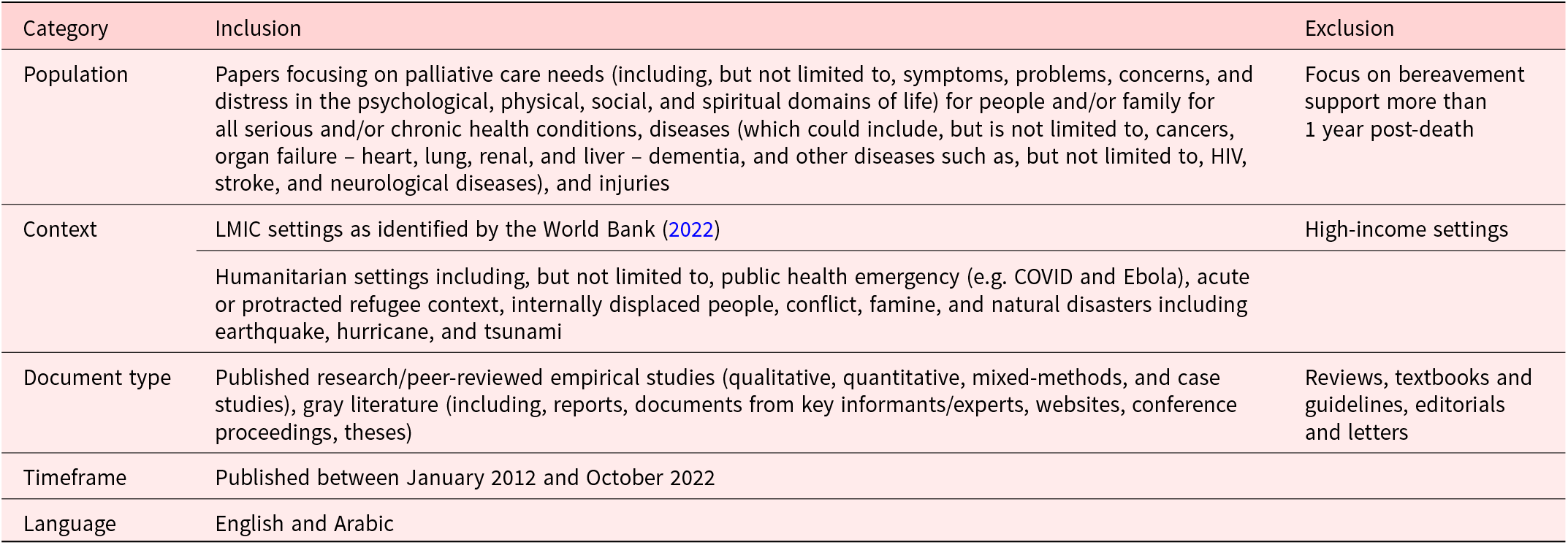
The systematic scoping review methodology was selected to enable a wide-ranging search, of this novel area, to be undertaken, with identified data systematically reviewed. Arksey and O’Malley’s (Reference Arksey and O’Malley2005) scoping review framework, with additions from Levac et al. (Reference Levac, Colquhoun and O’brien2010), was used to guide the methodology, with 5 steps from Arksey and O’Malley’s (Reference Arksey and O’Malley2005) framework broadly utilized: (1) identify the research question, (2) identify relevant studies, (3) study selection, (4) charting the data, and (5) collating, summarizing and reporting the results. Additional methodology from the Joanna Briggs Institute (JBI) (Peters et al. Reference Peters, Godfrey, McInerney, Aromataris and Munn2020) was incorporated to enhance rigor. Eligibility criteria are outlined in Table 1.
Eligibility criteria

Table 1 Long description
Eligibility criteria are organized by category with columns for, Inclusion and, Exclusion. Under, Population, inclusion is papers on palliative care needs for people and or family across serious and or chronic conditions, diseases, and injuries, while exclusion is a focus on bereavement support more than 1 year post death. Under, Context, inclusion is lmic settings identified by the World Bank 2022, and exclusion is high income settings. A separate row lists humanitarian settings as included, including public health emergency such as Covid and Ebola, refugee contexts, internally displaced people, conflict, famine, and natural disasters such as earthquake, hurricane, and tsunami, with no exclusion stated for this row. Under, Document type, inclusion is published research and peer reviewed empirical studies including qualitative, quantitative, mixed methods and case studies, plus grey literature including reports, documents from key informants or experts, websites, conference proceedings, and theses; exclusions are reviews, textbooks and guidelines, editorials and letters. Under, Timeframe, inclusion is published between January 2012 and October 2022, with no exclusion stated. Under, Language, inclusion is English and Arabic, with no exclusion stated.
Search strategy
Eleven databases (Medline, Embase, Global Health, CINAHL Plus, IMF/World Bank, SCOPUS, ASSIA, Web of Science, Policy Commons, Google Scholar, and JSTOR) were searched between January 2012 and October 2022. Search terms were a combination of terms related to both palliative care and humanitarian settings with LMIC descriptors including a list of all LMICs as defined by the World Bank (2022) used for some databases. In addition, 3 preprint databases (F10000research, Preprints, and Med Rxiv) and Google Advanced database were also searched (see Appendix 1 “Search strategies/strings/results – Databases”). Email communication was undertaken with 23 key experts for unpublished reports/studies/data. Websites were identified, adapted from 2 earlier reviews (Nouvet et al. Reference Nouvet, Sivaram and Bezanson2018; DeBoer et al. Reference De Boer, Coghlan and Russell2021) with additional websites included following suggestions by peers and experts (see Appendix 2 “Websites searched” and Appendix 3 “Search strategies/strings/results – Websites”).
Selection of studies/documents
Identified records from the 11 databases plus 1 pre-print database (Med Rxiv) were exported into the programs EndNote and Covidence. Documents retrieved from 2 further pre-print databases (F10000research, Preprints) and Google Advanced database were unable to be exported to EndNote. Duplicates were removed. Title and abstract screening were undertaken by 4 reviewers (M.M., D.F., V.B. and L.G.) with each record being independently reviewed by at least 2 reviewers. The full-text review was undertaken by 2 reviewers (M.M. and D.F.), with input from a third (L.G.) in case of disagreement.
Reference lists of included papers were searched by 1 reviewer (M.M.), with relevant abstracts and subsequent full-text articles being reviewed by a second reviewer (D.F.). The websites listed in Appendix 2 (“Websites searched”) were searched by 1 reviewer (M.M.), and manual de-duplication undertaken, with full-text review of potentially relevant data being undertaken by 2 reviewers (M.M. and D.F.). The email replies from key experts were reviewed by 1 reviewer (M.M.) with potentially relevant literature reviewed by 2 reviewers (M.M. and D.F.). Any unresolved disagreements were discussed with a third reviewer (L.G.).
Data extraction and presentation
The data extraction table was developed using variables adapted from the JBI (Peters et al. Reference Peters, Godfrey, McInerney, Aromataris and Munn2020). Data extraction was undertaken by 1 reviewer (M.M.). Reliability was ensured with another reviewer (D.F.) reviewing a random selection of papers in the data extraction tables. Both peer-reviewed and gray/other literature were included. Palliative care needs were categorized into broad domains, which were adopted and modified from Afolabi et al. (Reference Afolabi, Nkhoma and Maddocks2021), Dehghan et al. (Reference Dehghan, Ramakrishnan and Uddin-ahmed2012), and WHO (2002). Key areas from the included data were succinctly presented under each domain in Table 2, identifying the humanitarian setting. This process was primarily undertaken by 1 reviewer (M.M.), with a second reviewer (D.F.) cross-checking a random sample of categorized needs to ensure consistency and correct interpretation. Three themes from the review findings were subsequently identified by 3 reviewers (M.M., D.F., and L.G.) and presented in narrative form.
Mapping of needs in relation to palliative care domains/sub-domains and humanitarian settings

Table 2 Long description
Needs are organized by domain and subdomain, split between patients and family or relatives, and linked to humanitarian settings including Covid, Ebola, refugee populations, conflict, natural disasters, and multiple settings. Physical needs for patients include pain and other physical symptoms in Covid, Ebola, and refugee populations, plus physical health deterioration in Covid; family or relatives include difficulty sleeping and lack of appetite in refugee populations. Psychological needs for patients include anxiety, depression, sadness, fear of infection, lack of emotional support, grief, isolation, low mood, exposure to death and loss, fear of dying alone, desire to return home, emotional support from healthcare professionals, and trauma impacts, across Covid, Ebola, and refugee populations; family or relatives include psychological support needs, fear of infection, anxiety, sadness, stress, helplessness and guilt, communication about transition to palliative care, questioning and anger, exposure to death and loss, distress watching suffering, and trauma impacts. Socio-economic needs list increased travel costs and financial issues for patients in Covid and refugee populations, and financial support or financial issues for family or relatives in Covid and refugee populations. Impact of restrictions or isolation for patients includes treatment delay or interruption, travel restrictions, medication access or availability issues, reduced primary care appointments, low mood since lockdowns, visiting restrictions, isolation limiting contact, and stigma, across Covid and Ebola; family or relatives include information about Covid, medication access, travel restrictions, treatment delay or interruption, stigma in Covid and Ebola, isolation impacting social support, and visiting restrictions. Spiritual needs for patients and family or relatives include lack of hope, praying, personal religious beliefs for coping and meaning, importance of religion and faith in God, and child-focused items such as why me and anger at God, across Covid, refugee populations, and multiple settings. Information needs include patient needs for cancer treatment information, clear communication, and uncertainty due to limited information in Covid and refugee populations, and family or relatives needs for lack of information and uncertainty in Covid and refugee populations. Practical support needs for patients include lack of support for daily needs including food, reduced support due to displacement, being away from home, need for medical equipment and supply shortages, medication access, food, interruption of homecare services, living alone or family unable to provide care, inability to provide for family, transport to access healthcare, access to care as a refugee, and lack of space or privacy for dying patients in natural disasters; family or relatives include physical demands of caregiving, lack of help, food, and lack of support network away from home country. Socio-cultural needs for patients include inability to complete last wishes, dying without religious rituals, role change, stigma, dying away from home, not being abandoned, and dying away from family in natural disasters; family or relatives include low quality burial, worries about death certificates, incomplete rituals and grief, changes in burial or funeral practices, dying in isolation, dying without religious rituals, and role change.
Results
A total of 10,696 documents were retrieved from the database searches, with an additional 2966 records identified from the website search, and 6 records through email contact with experts. This gave a total of 13,668 documents that were identified. Following the removal of 2891 duplicates, screening and full-text review, 77 documents were eligible: 59 from the database search and 18 from websites. Following a review of reference lists of included documents, a further 11 papers were included. A total of 88 documents were therefore included (see Figure 1).
Scoping review flow diagram, showing phases for data extraction and selection (Adapted PRISMA ScR reporting flow diagram, taken from Moher et al. Reference Moher, Liberati and Tetzlaff2009).

Figure 1 Long description
The flowchart outlines the process of document review in four phases: Identification, Screening, Eligibility and Included. In the Identification phase, records identified through database searches total 10,696, with an additional 2,972 records identified from other sources, leading to a total of 13,668 records. After removing 2,891 duplicates, the Screening phase begins with 10,777 records screened, resulting in 10,458 records excluded. The Eligibility phase involves assessing 319 full-text documents, with 242 excluded for reasons such as not reporting individual palliative care needs, not relating to serious health conditions, not within the specified date range, language barriers and other criteria. This phase results in 77 eligible documents. Further documents are identified through reference list searches, adding 11 more documents. The Included phase concludes with 88 documents included in the review.
Description of included documents
Of the 88 included documents, 63 were peer-reviewed publications in peer-reviewed journals: 51 quantitative, 8 qualitative, 2 mixed methods, and 2 case studies. Other formats were 5 conference abstracts, 4 conference posters, 7 case reports, 5 reports, 2 research snapshots, 1 survey report, and 1 master’s thesis.
Detailed descriptive and demographic data from these documents are provided in Appendix 4 “Overview of Included documents.”
Publications by year
A chronological review of the publications by topic reveals a spiky pattern around significant outbreaks and issues. The majority of the papers addressing Ebola were published in 2015 (n = 7) and 2016 (n = 9), correlating with the 2014–2016 Ebola outbreak with global impact, in contrast to the limited geographical impact of the 2018 and 2020 outbreaks. All documents relating to COVID were published between 2020 and 2022.
Contexts
The review findings comprised 42 documents related to the COVID pandemic examining palliative care needs (n = 33), symptoms only (n = 5), and bereavement needs (n = 4); 30 documents related to Ebola examining symptom burden (n = 28), and wider palliative care needs (n = 2). Three of the remaining 16 documents provided multiple-setting data, 10 were from refugee settings, natural disasters (n = 2), and conflict settings (n = 1).
COVID-related documents predominantly originated from India (n = 21). Ebola documents were mostly from Sierra Leone (n = 13) and Guinea (n = 8). From the documents relating to refugee populations, 4 were from Jordan, and 3 from Bangladesh.
Sampling
Forty-six of the studies examined only adult needs, with 25 examining the needs of both adults and children, and 6 examining only child needs. Eleven papers did not have a clear age specification.
Consideration of needs featured across the included documents. Patient needs were the most common focus of enquiry (n = 64), followed by both patient and family/caregiver needs (n = 17) and focusing on family/caregiver needs only (n = 7), which included needs of the bereaved.
Mapping of palliative care needs
Palliative care is characterized by holistic care, which encompasses physical, psychological, socioeconomic, and spiritual needs of the individual and their family. Cultural competence, communication, and person-centered care feature heavily. Table 2 maps the extent to which the included documents map onto these core palliative care domains.
Themes from review findings
This systematic scoping review facilitates a richer understanding of palliative care in Humanitarian contexts. The review’s findings on the diversity of people’s needs, conditions, and contexts are grouped into 3 themes: (1) practical, financial, and resource challenges – dying with limited resources; (2) pain and physical symptoms experienced by patients; and (3) dying alone in unfamiliar places.
1. Practical, financial, and resource challenges – dying with limited resources
This review identified high rates of financial and practical issues and challenges for patients and caregivers, irrespective of the type of humanitarian crisis. The extent of the literature was weighted toward the COVID pandemic, which caused multiple financial challenges for patients with preexisting serious and/or chronic conditions such as cancer (Singh et al. Reference Singh, Rai and Ishan2021; Krishnan et al. Reference Krishnan2022). Financial losses and distress caused by and experienced in lockdown included loss of work or decreased employment (Krylova Reference Krylova and Gevorgyan2020; Gupta, Sarma et al. Reference Gupta, Sarma and Mishra2020b; Juncker and Namisango Reference Juncker and Namisango2022; Farrant et al. Reference Farrant, Harding and Nkhoma2022a). The shifting nature of care because of lockdown restrictions drove up treatment charges and costs, including increased travel costs, shortage of dressings, and the interruption or unpredictability of services (Atreya et al. Reference Atreya, Kumar and Samal2020; Dhavale et al. Reference Dhavale, Koparkar and Fernandes2020; Jeba et al. Reference Jeba, Thankachan and Jacob2022; Mishra et al. Reference Mishra, Gupta and Bhatnagar2022). Those with cancer during COVID feared disease progression due to treatment delays (Dhavale et al. Reference Dhavale, Koparkar and Fernandes2020; Krishnapriya et al. Reference Krishnapriya, Rathore and Kumar2020; Mishra et al. Reference Mishra, Gupta and Bhatnagar2022). Financial difficulties continued past death with bereaved families continuing to suffer financially due to COVID (Mohammadi et al. Reference Mohammadi, Oshvandi and Shamsaei2021).
The included literature underlined the financial suffering for those with palliative care needs living in refugee settings. For example, in Cox’s Bazaar, Bangladesh, a lack of money was identified by 94.2% of patients with palliative care needs (Doherty et al. Reference Doherty, Power and Petrova2020). In all refugee contexts, there are widespread struggles to access health care, medical supplies, and medications (Isreb et al. Reference Isreb, Kaysi and Rifai2017; Schwartz et al. Reference Schwartz, Wahoush and Kahter2018; Doherty and Khan Reference Doherty and Khan2018a; Doherty et al. Reference Doherty, Power and Petrova2020). Contributing factors included reduced family income from loss of employment due to illness, and increased outgoings with ever-present and increasing healthcare costs associated with the condition. Impacts were not just related to healthcare, with expressed challenges to pay travel costs, pay rent, buy food, and continue their treatment plans (Pinheiro and Jaff Reference Pinheiro and Jaff2018; Guo et al. Reference Guo, Alajarmeh and Alarja2021). Family caregivers in refugee contexts highlighted the impact of being far from their extended family network, the hard work of caregiving, and the stress and difficulty in sourcing sufficient food (Doherty et al. Reference Doherty, Power and Petrova2020; Guo et al. Reference Guo, Alajarmeh and Alarja2021).
Similar themes were evident in the limited literature on conflict and multiple settings, which emphasized the challenges around the lack of access to basic supplies, including medications and medical supplies (De Laat et al. Reference De Laat, Hunt and Nouvet2018, Reference De Laat, Hunt and Nouvet2019; Berhe Reference Berhe, Kidu and Teka2022).
2. Pain and physical symptoms experienced by patients
Pain and physical symptoms were research foci in much of the identified literature, as presented in Table 2. Much of the literature from Ebola settings focused on specific pains, such as abdominal pain, headache, chest pain, fever, anorexia, fatigue, and bleeding congruent with their aims of quantitatively exploring the symptom burdens. All symptoms required palliative care support. Papers explored both the palliative symptoms of COVID, such as breathlessness, and symptoms from other illnesses, such as cancer, which were exacerbated by the pandemic. The symptoms from other illnesses, including cancer, included pain, vomiting (Gupta, Karthik et al. Reference Gupta, Karthik and Rustagi2020a; Adhikari et al. Reference Adhikari, Biswas and Mishra2021; Mishra et al. Reference Mishra, Gupta and Bhatnagar2022), wounds (Dhavale et al. Reference Dhavale, Koparkar and Fernandes2020; Khurana et al. Reference Khurana, Raheja and Dayal2020), pressure sores (Dhavale et al. Reference Dhavale, Koparkar and Fernandes2020), dysphagia (Ghoshal et al. Reference Ghoshal, Singla and Ballari2022), weakness (Daniel et al. Reference Daniel, Devasia and Manuel2021), oral thrush (Khurana et al. 2020), constipation (Mishra et al. Reference Mishra, Gupta and Bhatnagar2022), breathlessness and restlessness (Biswas et al. Reference Biswas, Adhikari and Bhatnagar2020a), and fatigue and malnutrition (Chavarri-Guerra et al. Reference Chavarri-Guerra, Ramos-Lopez and Covarrubias-Gomez2021).
In refugee settings, findings on the prevalence and severity of pain indicate significant levels of suffering, for example, 69% of South Sudanese refugees with palliative care needs in Uganda reported pain scores of 4–5, out 5 (Bagasha et al. Reference Bagasha, Webber and Dirkzwager2019). High levels of pain were also reported in Bangladesh, Rwanda, and Jordan (Pinheiro and Jaff Reference Pinheiro and Jaff2018; Doherty and Khan Reference Doherty and Khan2018b; De Laat and Musoni Reference De Laat and Musoni2020; Doherty et al. Reference Doherty, Power and Petrova2020), with the impact of uncontrolled pain including being unable to eat, sleep, walk, work, or cook food for themselves or their families (Pinheiro and Jaff Reference Pinheiro and Jaff2018). In addition to pain, people in refugee contexts also described experiencing distressing physical symptoms such as insomnia, anorexia, cough, fever, breathing problems, fatigue, and nausea or vomiting (Doherty and Khan Reference Doherty and Khan2018a, Reference Doherty and Khan2018b; Doherty et al. Reference Doherty, Power and Petrova2020).
3. Dying alone in unfamiliar places
The fear of dying alone, away from loved ones and from home, was present in many contexts. Nouvet et al. (Reference Nouvet, Bezanson and Hunt2019, Reference Nouvet, Bezanson and Hunt2021) described the fear of being alone within an Ebola isolation unit in Guinea, especially poignant when there was no family present, and often no health professionals. In addition, some papers described the fear of dying without spiritual rituals being undertaken and the absence of customary post-death rituals (Nouvet et al. Reference Nouvet, Bezanson and Hunt2019, Reference Nouvet, Bezanson and Hunt2021). In India, during the COVID pandemic, patients were frequently unable to enact their last wishes, because families were unable to be with them due to travel and isolation restrictions (Dhavale et al. Reference Dhavale, Koparkar and Fernandes2020). Family members experienced distress as relatives died alone (Wasia and Jahangir Reference Wasia and Jahangir2022).
In refugee populations, many both wished to die and for their death rites to be followed in their home country. Dying away from their home country was a significant difficulty for many (Pinheiro and Jaff Reference Pinheiro and Jaff2018; De Laat and Musoni Reference De Laat and Musoni2020).
In situations of Ebola and in refugee communities, being accompanied and not abandoned were emphasized as important (De Laat et al. Reference De Laat, Hunt and Nouvet2018), with the importance of being able to say goodbye being identified in multiple humanitarian settings (De Laat et al. Reference De Laat, Hunt and Nouvet2018). Dying without privacy and space was also identified as a barrier to quality end-of-life care by health workers in a natural disaster context (Amir et al. Reference Amir, Yantzi and De Laat2020).
The changes in burial or funeral practices because of COVID or Ebola featured in a number of studies. Families were unable to undertake ceremonies in the pre-pandemic format (Motamedzadeh et al. Reference Motamedzadeh, Pazokian and Molaee2021). Descriptions, such as a “low quality of burial” (Shahini et al. Reference Shahini, Abbassani and Ghasemzadeh2022), or a “strange burial” (Mohammadi et al. Reference Mohammadi, Oshvandi and Shamsaei2021), illustrate how the differences in death rites during the COVID pandemic exacerbated existing distress of families (Wasia and Jahangir Reference Wasia and Jahangir2022). Dying without traditional rituals was distressing for many people (Nouvet et al. Reference Nouvet, Bezanson and Hunt2021). This was also magnified by a fear that if patients were taken from hospitals to their homes in order to die, it would be impossible to get death certificates because physicians would refuse, or not be able, to make a home visit (Dhavale et al. Reference Dhavale, Koparkar and Fernandes2020).
Discussion
This review provides an overview of literature spanning a significant decade between 2012 and 2022, as presented in the Results section, gaining insights into the research carried out among some of the world’s most disadvantaged. Findings included how being caught up in humanitarian crises resulted in potentially catastrophic health care and related costs, being away from extended community and family networks and multifaceted financial and practical challenges exacerbated by lockdowns during the COVID pandemic. Pain and wide-ranging physical symptoms featured strongly in the literature, indicating distress and suffering experienced by many. Fear of dying alone, often away from family and community, in addition to changes to post-death and burial rituals, was also prevalent. The majority of documents related to 2 public health emergency settings: the Ebola epidemics in Africa (30 documents) and COVID pandemic (42 documents). The increased threat to high-income countries from both COVID and, to a lesser degree, Ebola, may have contributed to research priorities related to these emergencies, reflecting the concerns of higher income contexts, including their attempts to protect against the risk of Ebola (Bell et al. Reference Bell, Damon and Jernigan2016). The COVID pandemic changed the nature of academic publication and multiple research outputs focused on the pandemic. This has overshadowed and neglected the experiences related to conflict, refugee, natural disasters, and the growing number of climate-related crises. The weighting of data toward public health emergencies has been identified in previous work; in their systematic review on end-of-life care in natural disasters, Kelly et al. (Reference Kelly, Mitchell and Walker2021) found a paucity of literature in the physical natural disaster context. Plagg et al. (Reference Plagg, Ballmann and Ewers2023) identified that there is very little published research on palliative care in natural disasters, outside of epidemics and pandemics. This illustrates the disparity between differing humanitarian settings in the volume of work undertaken that includes patient/family palliative care needs. In a similar theme of seldom heard voices, the experiences of children were underrepresented in the research that this review identified.
The strong research focus on pain and physical symptoms aligns with findings in earlier studies into patient palliative care needs in Africa (Afolabi et al. Reference Afolabi, Nkhoma and Maddocks2021), perhaps because these can be more easily quantitatively or clinically measured compared to more nebulous aspects of palliative care needs. Despite this dominance, there remains a holistic range of research, as seen in the practical support needs section of Table 2. Food and access to medicines were identified as needs in multiple studies and settings. This could be seen as highlighting the diversity of palliative care needs in humanitarian settings, and the value of this was outlined by Sundararaj et al. (Reference Sundararaj, Munday and Duomai2021) in their paper focusing on faith-based hospitals in India during the COVID pandemic, where they state: “Some palliative care teams delivered medicines and were providing food for patients and families as a necessary extension to their normal services” (Sundararaj et al. Reference Sundararaj, Munday and Duomai2021, e423).
The majority of research focused exclusively on the needs of patients, with relatively limited insight gained on the needs of caregivers. A similar focus was found by Afolabi et al.’s (2021) systematic review into palliative care needs in Africa, where 74.8% of their included studies were undertaken with patients only, 12.6% with families only, and 8.2% focusing on both patients and family caregivers. This contrasts with the definition of palliative care, which holds a focus both on patients and their families (WHO 2002). This gap suggests that there is a need for further research into the needs of family members and informal caregivers caring for those with palliative care needs in LMIC humanitarian settings. Furthermore, while being outside the scope of the current review, a specific review of literature relating to the needs of people bereaved in humanitarian settings would be valuable, as there would appear to be significant needs in this population.
Palliative care is often criticized as overly focused on cancer (Rato et al. Reference Rato, Kirkland and Kingston2022). It is interesting to note that this criticism seems to hold weight with the dominance of cancer diagnoses in the research around the COVID pandemic. Exceptions to this are in the Ebola epidemics-related research, and especially in the research from refugee contexts, in which noncancer diagnoses were marginally higher than cancer diagnoses. It is possible that this is related to the rapid race to publish during the COVID pandemic, where research quality has been questioned (Sloane and Zimmerman Reference Sloane and Zimmerman2021). But it could also represent a shift in the understanding of how palliative care is portrayed in low-resource contexts. Traditionally, the definition has focused on a life-limiting condition, which has created a barrier or distraction for many practitioners in the absence of a certified diagnosis due to multiple factors. In contrast, The International Association for Hospice and Palliative Care (IAHPC)’s (2018) new definition of health-related suffering due to serious illness is much more applicable and useful for the contexts represented in this review.
The inclusion of gray literature was a strength of this review, especially as the 2 documents relating to natural disasters, 5 out of 10 documents relating to refugee populations, and 2 out of 3 papers from multiple settings were identified from the extensive website search. Without the inclusion of these data, the review findings would have been far narrower, with an overwhelming focus on COVID and Ebola. This demonstrates that the comprehensive search strategy this review has employed is critical in a scoping review (Arksey and O’Malley Reference Arksey and O’Malley2005), and searching websites is necessary to identify gray literature (Nouvet et al. Reference Nouvet, Sivaram and Bezanson2018). The discrepancy and the role of the traditional pay-wall peer-review route for dissemination of research from humanitarian contexts are worthy areas for further exploration and discussion, although outside the remit of this review.
This systematic scoping review has identified important implications for those involved in this space. These include how the complex, multifaceted, and hard-to-measure suffering (both the internal disease processes and external context and care setting) needs to be considered to be able to deliver high-quality contextually appropriate and compassionate care. The palliative care needs of patients and families, identified in this review, will contribute to the growing evidence base of palliative care education learning needs for health workers in LMIC humanitarian contexts. The decade under review furthermore shows that the unexpected regularly happens and there should not be surprise at future crises, epidemics, and pandemics. Rather, the importance of palliative care preparedness for the inevitable future humanitarian crises, including pandemics, is emphasized, and that resilience planning needs to be undertaken now.
Limitations
As with all systematic scoping reviews, there is a possibility that pertinent literature was missed due to the challenges of identifying patient and family palliative care needs in humanitarian contexts in the searching and screening process. These risks were mitigated by the expert guidance from a librarian in the search design, the involvement of at least 2 reviewers, and the extensive search of the gray literature. The literature review was not a multilanguage review because of translation constraints and access. This potentially excluded literature in other languages, especially as only English-language websites were searched in the gray literature search. A response was not received from all of the experts contacted, thereby potentially reducing the opportunity for identifying new and unpublished data, although this was mitigated by a robust and extensive gray literature search.
The review period (2012–2022) reflects the start of a rapidly increasing body of literature relating to palliative care in humanitarian settings and includes 2 public health emergencies of global significance (the largest ever Ebola outbreak to date and the COVID pandemic). This very specific review period was chosen, which ended with the COVID pandemic, in order to shine a light on very rapid changes happening in this period. We anticipate carrying out a further review of the next decade (2022–2032) where the effects of climate change are unfortunately likely to dominate this space.
Conclusion
This review provided an overview of literature spanning a significant decade between 2012 and 2022 – a decade which was dominated by 2 significant public health emergencies: Ebola and COVID. An extremely small amount of data was found in relation to patients’ palliative care needs in conflict and natural disaster settings, with very limited research in this area in refugee contexts. Data on the needs of families were minimal. This disparity highlights the need for further research in palliative care needs in these settings, to further explore the issues as identified by patients and their families.
The included data were significantly weighted toward the views of adult patients, in all contexts, highlighting a notable under-representation of the voice of the family/caregiver, which starkly contrasts with the WHO (2002) definition of palliative care, which emphasizes the inclusion of both patient and family. The additional lack of literature focusing specifically on the needs of children further highlights areas for future exploration.
Finally, the review found a strong focus on pain and physical symptoms in all settings, with wider holistic needs also found across a variety of palliative care domains, spanning a spectrum of needs ranging from dying away from home to financial difficulties. This emphasizes the wide-ranging diversity of palliative care needs in all LMIC humanitarian settings, including practical, psychosocial, cultural, spiritual, financial, and resource needs.
Supplementary material
The supplementary material for this article can be found at https://doi.org/10.1017/S1478951526103617.
Acknowledgments
Marshall Dozier (Academic Support Librarian, University of Edinburgh) provided invaluable expertise and guidance on the development of all aspects of the protocol and search strategy.
Funding
This review received no specific grant from any funding agency, commercial or not-for-profit sectors. Victoria Barber-Fleming’s role in this research was funded by the Legal & General Group (research grant to establish the independent Advanced Care Research Centre at the University of Edinburgh). The funders had no role in the conduct of the study, interpretation, or the decision to submit for publication. The views expressed are those of the authors and not necessarily those of Legal & General.
Competing interests
The authors declare none.


 Open access

