Introduction
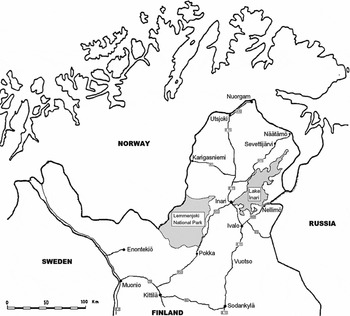
In this paper some aspects of the theoretical anthropological debate on the perception of time are addressed. The overall aim is to make a comparative analysis of some of these anthropological theoretical approaches on the perception of time with some of the ethnographic material gathered in Finnish Sámiland, between 1995 and 1997 and in further visits until 2004. The research was conducted among the Sámi people who were living mainly in the municipality of Inari but also in villages in the municipality of Utsjoki, situated in the northernmost part of Finland (Fig. 1).
Map of Finnish upper Lapland.

The Sámi people are the only recognised indigenous people in Europe. They live in a region that is called in their language Sápmi. It is a region that stretches across the national territories of four states: Norway, Sweden, Finland and the Kola peninsula in Russia. Their population is about 100,000, although a precise number does not exist as the census figures of their respective parliaments are only indicative. They speak nine different languages, three of which, the Northern Sámi, the Inari Sámi and Skolt Sámi, are spoken in Finland. The Sámi population in Finland is about 7000–9000.
Reindeer herding is still an important Sámi livelihood. In Norway and Sweden reindeer herding is practised exclusively by Sámi, in Finland herding can be practised only within the borders of the 56 existing reindeer herding districts situated in the northern part of the Ostrobothnian province and in Lapland, and by both Finnish and Sámi residents. Although, in Finland reindeer herding is nowadays practised only by about 10% of the Sámi population, it still retains a very prestigious position in the political, social and cultural aspects of Sámi life and, in general, represents the main cultural feature that characterises them in the eyes of most people. I concentrated on the community of herders of the cooperative of Sallivaara, some 60 km south of the village of Inari, the territory of which is mostly within the borders of the Lemmenjoki National Park.
Through the ethnographic data presented in this paper I shall argue, following Ingold (Reference Ingold2000), that amongst the Sámi people time is understood as an unfolding of interrelated tasks, rather than as a linear succession of standardised and arbitrary units. Furthermore, I shall also argue that the Sámi perception of time is not opposed to the western perception, but rather it entails a different approach to the significance of clock time.
Outline of theoretical approaches on the concepts of time
The anthropological debate on time perception has mainly focused on the distinction between ‘our [clock-] time’ and ‘their time’, in a dualistic frame of analysis that has long been typical of general anthropological theories. Indeed, this kind of approach runs through the history of anthropology up to the structuralist period. Milestone studies such as those by Evans-Pritchard (Reference Evans–Pritchard1940) and Lévi-Strauss (Reference Lévi–Strauss1974: 236–237), amongst many others, all point in this direction. The logic of the argument is that there exists a clear-cut and structured division between western and non-western understandings of the world, running from the very categorical distinction between modern and traditional societies, to the more subtle difference between a supposedly western understanding of time as linear, cumulative, and irreversible and the non-western notion of time as cyclical, non-cumulative and reversible. However, already during the heyday of structuralism, this distinction was being opposed within anthropology in Bourdieu's study of the Algerian Kabyle people (1963), in which he claims that there exists a fundamental difference between the realm of official social norms and structures and that of actual lived social practices. Peasants may officially claim to do things following certain structured rules, but in real life they engage in the very same tasks in a different way, justifying any discrepancy by reference to a host of concurring contingencies (Bourdieu Reference Bourdieu1990: 102). For a Kabyle peasant ‘awareness of time is not simply one of the dimensions of his life experience, but rather the form in terms of which that experience is organized’ (Bourdieu Reference Bourdieu and Pitt–Rivers1963: 56). Hence the distinction and organisation of experience is not equivalent to its constitution as such, but is one of the strategies adopted to represent it.
As we shall see, this attitude towards time is similar amongst the Sámi and, in general, it marks a different approach to the notion of clock-time from that of western people. The mere presence of clocks or clock-like devices in non-western societies does not necessarily mean that clock-time is attributed with the same social and cultural significance that it has in the west. For example, although amongst the Kabyle peasants alarm clocks and watches had been introduced, they did not come to regulate the peasants’ lives; rather they ‘furnish a system of reference more precise than the traditional’ (Bourdieu Reference Bourdieu and Pitt–Rivers1963:58). Thus these devices, which westerners like to think are at the base of their understanding of time, were not so influential in the Kabyle peasants’ understanding of it. As Ingold eloquently shows, even in the western world clock-time is not so much something people live by as something they have to ‘contend with’ (Ingold Reference Ingold1995: 27). What distinguishes the predicament of western people is:
the mismatch between our shared experience of dwelling in the lived-in world and the demands placed on us by external structures of production and control that seem to leave only a residual space, divorced from culture and social life, where we can truly be ourselves (Ingold Reference Ingold1995: 6–7).
Amongst other scholars who share Ingold's view, Adam highlights how previous anthropological analyses of aboriginal time perception ignore the influence of the observer's interpretative categories; a point already noticed two centuries previously by Kant, in The critique of pure reason (Reference Kant, Guyer and Wood1998 [1781]). Following this line of thought, Adam argues for greater reflexivity. Citing A.P. Cohen, according to whom a ‘selfless anthropology is out of date’ (Adam Reference Adam and Ingold1994: 504), Adam contends that ‘we cannot understand the approaches to time of people of other cultures without drawing on our own understanding’ (Adam Reference Adam and Ingold1994: 505). I agree: there is no other perspective available to any human being other than that grounded in his or her experience. However having criticised western anthropologists, Adam goes on to praise the contribution of an African scholar, Mbiti (Reference Mbiti1969), who offers a fresh analysis of the western approach to time through his own experience. In Adam's words, Mbiti. . .
. . . distinguishes between the need of members of traditional African societies to experience and constitute time and the need of Western and Westernised societies to measure out time in units of days, hours and minutes (Adam Reference Adam and Ingold1994: 507).
As we shall see in the next section, a rather similar comment has been made by a remarkable Sámi artist, Nils-Aslak Valkeapää (Reference Valkeapää1971).
Returning to Adam's critique, it highlights two important points. Firstly, there is a fundamental difference between ‘experiencing and constituting time’ and ‘measuring out time’. Alarm clocks and watches ‘are all “predictive” devices for precipitating time’ (Wagner Reference Wagner1981: 74). Hence, they are posterior to the experience of time itself. Secondly, if we are going to compare western and non-western perceptions of time, we must compare like with like. We may then find that the perception of time, as it is embedded in lived experience, may not be so different for people in western and non-western societies. Nor are these perceptions necessarily altered in any radical way, in non-western societies, through the introduction of clocks and watches.
The difference lies in the extent to which the clock has been incorporated into a regime of control and regulation that imposes its own ‘official’ directives and constraints on people's lives. Thus although the Sámi are thoroughly familiar with clocks and watches, and with the measurement of time in hours, minutes, etc., most of them (apart from those who are ‘trapped’ within official institutions such as schools and offices) are able to keep the ‘officialdom’ of the clock at bay. You can always check your watch if you want to, but you do not have to, and for the most part it makes no difference to how you go about your business.
In the next section I shall give some concrete examples of Sámi people's notion of time and will show how this notion cannot be understood as static but as resulting from a process of phenomenical engagement of the actors with their daily tasks at hand and thus imbued with an attribute of historical embeddedness.
‘If you can't do something this spring, you can do it next spring’
The title of this section comes from a joke that Sámi friends repeated, when I was stressed by my inability to do things according to plan. As we shall see it is symptomatic of the way in which Sámi people relate to the passage of time.
Two terms are used in the Sámi language to connote time: áigi and diibmu (Itkonen Reference Itkonen1984: 490). The first term, áigi, refers to the general notion of ‘time’. It corresponds to the Finnish aika, which is nowadays employed in a way fully consistent with normal western usage. The other term, of Scandinavian origin, diibmu, means ‘hour’ or ‘clock’. This latter term is relatively new to the Sámi language, as we can gather from a comment by Valkeapää. He writes:
Northern nature, its roughness and long distances, have brought up its inhabitants to be grateful, if they can reach a destination three hundred kilometres away on an agreed day. In bad weather it is reasonable to expect to get there within the week. This cannot but impress upon human nature the characteristics of those who are capable of understanding these things. A society that times its affairs to the minutes, and that has invented seconds and even hundredths of a second, seems to belong to a different world (1984: 55–56)
As previously mentioned, this comment is redolent of one made by Mbiti. The need to measure time in such terms was similarly foreign to the Sámi people.
In his work on Finnish Sámi, Itkonen remarked that for the Sámi ‘the passage of time is perceived through the alternation of the day and the night, during the day through the sun, and during the night specially through the Great Dipper, the Pleiades, and the morning star’ (Itkonen Reference Itkonen1984 [1948]: 490). He also referred to the use of the terms áigi and diibmu, with the same meanings that they have nowadays, but he also remarked that the Sámi people would use expressions like käf'fe-vuoš’šâm-pod'dâ, the time needed for making (cooking) coffee, though he noted that amongst reindeer herders, the latter expression would mean about two or three hours (Itkonen Reference Itkonen1984 [1948]: 490–491). During my stay in Inari, the latter measure of time was highly dependent on context. When used in the village it only meant a short break, about fifteen minutes or less, whereas if it was used in the forest or during the separation or earmarking, then it meant a period of about a couple of hours (Mazzullo and Ingold Reference Mazzullo, Ingold, Bærenholdt and Granås2008: 33).
In general, it is still unusual to specify duration in precise terms. When travelling, for example, if anyone asked at what time we would be arriving, or returning, no exact time would ever be given, but only broad temporal indications like early morning (árr'idit), morning (iđđes), evening (eahkes), and so on.
In fact, in this view, given that the journey is an ensemble of tasks that the travellers must perform to reach their given destination, depending on the topographical characteristics of the places and their given climatic conditions, its length is variable and difficult to predict with precision. Hence, unless activities were related to some official timetabling (offices, schools, etc.), people's attitudes towards punctuality are quite relaxed and people would be rather flexible and ready to do something else instead. More than a century ago the Italian ethnographer Sommier wrote in his diary that the Sámi people ‘do not have any idea that time may have value, for it matters little to them whether one arrives an hour earlier or an hour later’ (Sommier Reference Sommier1886: 137).
This approach to time is common to hunters and gatherers, herders, and farmers, as in the case of the Kabyle peasants of Algeria. Referring to the latter, Bourdieu observes that ‘free from the concern for schedules, and ignoring the tyranny of the clock, sometimes called the devil's mill, the peasant works without haste, leaving to tomorrow that which cannot be done today’ (Bourdieu Reference Bourdieu and Pitt–Rivers1963: 58).
I believe that this is the key to understand the statement, which I mentioned earlier, that if one cannot do something this spring then one could do it next spring. It does not refer to an understanding of time as cyclical but rather it suggests ignoring the tyranny of the clock, a tyranny that can be only exerted when it is connected to structures of social and political control. During the two main events of the reindeer herding yearly cycle, the summer calves earmarking and the winter reindeer separation and slaughter, I never saw herders checking their watches to see how long they had been working or to decide when to go to sleep. It was the accomplishment of the tasks that would take precedence, though quick naps could be taken everywhere and anytime, when people would individually regard it as possible (Mazzullo and Ingold Reference Mazzullo, Ingold, Bærenholdt and Granås2008:33). Returning to the characterisation of particular events, amongst Sámi, meals could be taken at any time or whenever they happened to be ready. My initial failure to understand this kept me hungry for a whole day, until I finally surprised my host by asking whether I could eat something. The food was there for anyone who needed it. This applies to children too. Children are not forced to eat on the basis that it is ‘time to eat’, nor put in bed because it is ‘time to sleep’. On the contrary, they are allowed, within sensible limits, to decide for themselves and encouraged to fully participate to these events. This approach is extended also outside these events. Again, the comparison with the Kabyle is close. For them, as well, ‘there are no precise hours for meals; as they are eaten whenever the preparation is complete and eating is leisurely’ (Bourdieu Reference Bourdieu and Pitt–Rivers1963: 59).
Another similarity between the Sámi and the Kabyle approach to time concerns punctuality. For the Kabyle, ‘indifference with regard to punctuality appears in all kinds of behaviour. . . . The notion of an exact appointment is unknown; they agree only to meet ‘at the next market’ (Bourdieu Reference Bourdieu and Pitt–Rivers1963: 59). One conversation I witnessed, between my Sámi host, and a Finnish friend of his, about the different notions of punctuality among Sámi and Finnish people, illustrates the point. The argument hinged on the proposition that, as the Finnish man was arguing, if one says ‘I shall see you tomorrow at 6:00 o'clock in the morning’, then he would be there at six sharp. To this my host replied that whether he would be there at the agreed time would depend on the reasons for his presence and only if that was absolutely necessary. The Finnish man continued to argue, instead, that he would be there regardless of the reasons or of weather conditions: he would just be there on time and that was the most important thing for him. The conversation continued without them reaching any agreement over the matter other than agreeing that Sámi and Finnish people must definitely have different attitudes towards ‘time’.
This trait is not common only to northern indigenous peoples as in the Sámi case or among Kabile peasants in Algeria but, for example, a similar understanding of the notion of punctuality is also highlighted by Harrison when referring to her experience among the Maori community. She comments
In my own case, I have experienced recurrent frustrations over differences in interpretations about time and punctuality. I know that there are differences in the way different groups of people conceptualize time, but I have never been able to adjust my behaviour accordingly. . . . I am compulsively punctual - and therefore I often find myself waiting impatiently and with frustration for others. . .. My punctuality has become something of a joke in the Maori community where I have been working for the past decade, but everyone has graciously recognized my limitations (Harrison Reference Harrison2001: 59).
This attitude towards punctuality is also emphasised amongst younger Sámi. For example, in a conversation with my host's son on this topic, he remarked that all his Finnish friends who know him well never ask when he will come, but only whether he is coming. In his understanding it is useless to concern oneself with deciding meeting times and the related efforts to be punctual, unless absolutely necessary. As we have seen at the beginning of this section, Valkeapää emphasises this aspect by remarking that in the northern arctic regions punctuality is not understood as relevant among its residents, particularly in situations in which it would become a hinder for the travel itself, as for example in connections with harsh weather conditions. People do appreciate the success or the efforts to succeed in one's own plan but would not staunchly wait for a person to show up at the agreed time. They would not regard that as impolite behaviour because is ‘so perfectly in tune with the personal autonomy that is so highly valued among Sámi’ (Mazzullo and Ingold Reference Mazzullo, Ingold, Bærenholdt and Granås2008: 33). Hence it is the limiting of personal autonomy that would instead be seen as inappropriate. The response to unsuccessful scheduling is simply to get on with any other tasks at hand, and to be ready to reschedule the unaccomplished ones if necessary. Appointments times are usually never sharply defined but when agreeing it is common to use the form equivalent to the English ‘sixish’ rather than ‘six’. As Eriksen remarks, punctuality is a side effect of the introduction of clocks so that they became ‘instrumental in making punctuality a virtue’ (Eriksen Reference Eriksen2004: 153) but this precisely what Sámi do not recognise as virtuous.
Amongst the various experiences I had in Sámiland, one was very powerful in demonstrating the unimportance of punctuality and the importance instead of readiness, it was a visit to a Sámi friend in the northernmost village of Nuorgam during the coldest time of the year, in January. After a few days waiting due to temperatures hovering around –35°C I decided to leave for the village of Inari, in order to attend Skábmagovva, the Aboriginal Film Festival. What follows is an extract from my fieldnotes:
On the day I planned to leave the village the temperature was about –26°C so I thought that I could easily make the three and a half hour drive to Inari. However, Laila could not understand my determination to leave, arguing that it was unwise to travel in order to be punctual at an event that was taking place 200 kilometres to the south, when the temperature had been unstable for the past few days. Indeed, she persuaded me to stay a little longer, but when I finally decided to leave, she reminded me again to be careful and not to underestimate nature. I left at about 4pm, feeling worried, but comforted by the fact Inari was only three hours away. Unfortunately, the temperature dropped very quickly and, after about three hours, I had only managed to drive less than 100 kilometres. When the temperature reached -42°C the car finally stopped and left me stranded on the dark and deserted road. I was lucky to have a working mobile telephone and that my host, Matti, managed to borrow a van from his cousin, Salomo, which, luckily, had been in the warmth of the garage and so he was able to rescue me. That night the temperature dropped to a record low of about -51°C. Needless to say, I did not attend the Film Festival. When other Sámi friends heard about the incident, instead of rightly criticising me for my poor judgement, they would rather compliment me about my car that had taken me that far in such harsh weather conditions, while at the same time remarking that nature is the ultimate judge of human deeds (Mazzullo Reference Mazzullo2005: 227–228).
This story is not just about the unimportance of punctuality
Amongst the themes that this story highlights, punctuality is not the only one but more importantly it is about issues related to the primacy of nature over human agency and practices, and about how humans have to content with this. It is also about being alert to changing events and about being ready to time one's own action in relation to them. For example, what my Sámi friend was telling me was that, at the moment I wanted to leave, circumstances were definitely inauspicious for my journey. She was telling me to wait, for as long it takes, until circumstances were right. Only then should I have left, and left immediately. However as it turned out I was rescued, but only thanks to an auspicious conjunction of circumstances.
This reminds me of another passage from Bourdieu, in which he remarks that for the Kabyle peasants, ‘submission to nature is inseparable from submission to the passage of time scanned by the rhythms of nature’ (Bourdieu Reference Bourdieu and Pitt–Rivers1963: 57). During the ten days following the incident described above, despite the temperature remaining unchanged the village schools were open and children had to go to school whereas herders did not go to the forest! In this we see once again the contrast between official scheduling and context-dependent tasks.
These events highlight the way in which Sámi people relate to time, and their understanding of clock time. If, as we have seen, neither clocks and watches nor other devices of measurement in themselves constitute the experience of time, then these examples do not suggest that Sámi experience time in a distinctive way. Rather they suggest a distinctive approach to the way time is organised and represented. On another occasion, during one winter's morning at my host's home, prompted by previous questions on the Sámi understanding of time and tasks, his wife remarked how terrible it is to be in salaried employment, as compared to being a reindeer man. She was working as a teacher at the local elementary school, and was busying herself with things to be done before going to work while her husband was lying on the sofa. She remarked: ‘Look, that's the reindeer men's life. When there is nothing to do they just lay down and do nothing. I have to work a little but every day’! She was not suggesting that her husband was idle since, on the contrary, he is a very successful businessman and herder, but to his different approach to time and work. When reindeer are at the corral, herders work around the clock until all tasks are completed and then they just rest in order to recover. For example, during a break in the forest, after a long day's travelling, everyone in the patrol immediately lay down to rest. Seeing that I was still up, trying to write some notes, a Sámi friend advised me that I had better rest while possible because one never knows when something might happen that will not allow further rest for a long time, or whether situations might occur, which would call for a degree of endurance that, if one were tired, could be really life-threatening.
From these examples we can see that instead of the importance of punctuality, which is certainly at the heart of the ‘official’ meaning of time, embedded in mainstream institutions of education, employment, transport and communications, and administration, Sámi people emphasise the importance of readiness. That is, rather than undertaking to be there at a particular time, one must be ready to be there at any time, which could be in an hour or two, or in several days or weeks, whenever the circumstances are such as to require it. This means that even when resting, one must be constantly alert. Going back to the argument between Matti and his Finnish friend, where the latter says ‘I shall see you at 6 a.m. tomorrow’, a Sámi might say ‘I shall be there when you need me’. One does not know exactly when he or she will need the other person (Mazzullo and Ingold Reference Mazzullo, Ingold, Bærenholdt and Granås2008).
The Sámi understanding of the relation between time and tasks can be introduced through a remark made to me by my Sámi host. Trying to explain that the Sámi do indeed have a different attitude towards time, he put to me the following rhetorical question: ‘Why should one hurry? Reindeer have only one calf a year and to see a new one we have to wait for the whole year’. That is to say, ‘hurry’ is relative to the rhythm of pastoral life.
Evans-Pritchard offers a similar example of a direct relationship between the subsistence cycle and the perception of time, among a pastoral people, the Nuer of the Southern Sudan. As he pointed out, time was understood in relation to the rhythm of daily activities and events. In his words:
the daily timepiece is the cattle clock, the round of pastoral tasks, and the time of the day and the passage of time through a day are to a Nuer primarily the succession of these tasks and their relations to one another (Evans-Pritchard Reference Evans–Pritchard1940: 101–102).
The Sámi changing calendar
For Sámi reindeer herders, the key moments during the year are represented by events that relate to reindeer herding, namely, the autumn separations and the summer marking. Of course, between these major events there are other tasks that prepare for or follow on from them, so that the herding calendar can be broken into smaller divisions. In the past this way of dividing the year used to resonate strongly with the lives of not only reindeer herders, but also people of the Sámi community at large, due to the close association between reindeer herding and Sámi identity. However in the past five decades this association has gradually lost some of its importance.
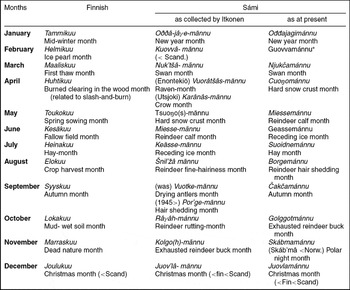
Table 1 shows the names of the months in the current Sámi calendar, and compares them with those used in the past (as collected by Itkonen in the years 1916 to 1945) and with the standard Finnish month names. The calendar I refer to in the table does not take into account the different names from all the Sámi language groups but refers only to the North Sámi language. For example the Skolt Sámi calendar was based much more on the tradition of the Russian Orthodox Church, and shared seven month-names with the North Sámi, whereas the Inari Sámi, as Itkonen remarks, at the time of his research ‘had completely forgotten the old months’ names’ (Itkonen Reference Itkonen1984: 481).
Present Finnish calendar, followed by the Sámi calendar as it was collected by Itkonen (Reference Itkonen1948) and as it is at present.

* The word guovva is of Scandinavian origin and is used in the Sámi language only in this combination (Itkonen Reference Itkonen1984: 481).
As we can see from Table 1, the names of the months in the Finnish calendar are closely related to the annual round of agricultural tasks. One could almost say that the Finnish calendar is the yearly agricultural schedule. In the Sámi case, by contrast, tasks as such are not mentioned at all. Rather, the Sámi calendar focuses on changes both in the landscape and in the reindeer. Whereas the Finnish calendar is in a sense prescriptive, in that it sets out the tasks that must be performed in that particular month, the Sámi calendar is a descriptive one. By knowing what happens naturally and when, one can then decide the best time to accomplish a given task. This lends support to my general contention that, for the Sámi, people's sense of autonomy is fundamental to their understanding of time. The calendar is understood simply as a ‘guideline’ that suggests, given the right conditions, what tasks may or may not be accomplished.
In this respect it is not surprising that, as the natural rhythm has changed, along with changes in climatic conditions and concomitantly in the behaviour of reindeer, the names of the months of the Sámi calendar have changed as well. Because of these changes, tasks that people were able to perform in a given month a hundred years ago cannot be accomplished in the same month any longer. Thus, the ‘hard snow crust month’ used to be the month of May, and it used to be the month when the herding groups or siidat, defined as kin groups of herders together with their reindeer herd and the pastures (Mazzullo Reference Mazzullo, Stammler and Takakura2010: 110–112), would slowly start to move helped by the good travel conditions of the snow, to the calving grounds and then continue to their separate summer grazing grounds. The ‘month of the calves’, Miessemánnu, that is the month in which the calves are born, was, according to Itkonen, in June.
However, the ‘hard snow crust month’, Cuoŋománnu, is now April, whereas May is referred to as the ‘month of the calves’, Miessemánnu. and the month of June has thus taken the name of ‘receding-ice month’, Geassemánnu, which in the Sámi calendar was previously held by the month of July. A similar pattern applies also to the names of the months that describe the changes that happen to the quality of the reindeer hair or that of the antlers, as with August and September, or to its coupling behavioral patterns, as with October and November.
The introduction of the ‘hay month’, Suoidnemánnu, for the month of July, and its overlapping meaning with the corresponding ‘heinakuu’ in the Finnish calendar, is perhaps connected to the growing importance of agricultural practices of hay making (Suoidne means hay), in connection with the artificial feeding of reindeer, and as a result of the increased ice-free season.
Yet despite changes in several month names, like the disappearance of the ‘Raven-month’, Vuorâtšâs-mānnu, and the ‘crow month’, Kārânâs-mānnu, none of the Sámi people I met seriously questioned the stability of their tradition. Expressions like for example, Čakča-ohcan (Finnish syysetto), meaning the autumn search for reindeer before the separation, are still used. If Čakča-ohcan is used to refer to the duration of the autumn search, it can mean a period of about two weeks or more, depending on weather conditions and the terrain. However, it can also refer to the period of the year when the search should start and this in turn depends on the presence of a reasonable coating of snow. Thus the start of the autumn search can vary by several weeks from one year to another. Yet everyone in Sápmi, the Sámi homeland, is sure about the ‘exact’ moment when such a task is supposed to start: ‘when the first snow sets in, then it's time to go’. And the reason is that ‘exactness’ is defined, for the Sámi, in terms of a specific conjunction of circumstances (the weather, conditions, the location of the herds, etc.), and not in terms of a precise chronological instant (for example 6:00 a.m. on 1 November).
Conclusion
In this paper I have focused on how scholars have shifted their approach to the perception of time from theories based on an ontological division between synchrony and diachrony to a more encompassing perspective in which time is understood as constituted through the involvement of people in all those tasks that characterise the rhythm of living.
What I learned from my fieldwork amongst the Sámi lends support to the idea that the basis for people's shared understanding and subjective experience of time lies in the interaction of skilful agents in carrying out diverse but interrelated tasks whose convergence will determine what Ingold defines as ‘an ensemble of tasks’ or the ‘taskscape’ (Ingold Reference Ingold1993: 158).
However, it is not enough to live in a place, belong to a particular ethnic group or be engaged in the same subsistence activity to perceive time in a certain fashion. The perception of time for a Sámi clerk may or may not differ from that of a Sámi herder, just as it may or may not differ between a Finnish reindeer herder and a Finnish clerk. No matter how much we change the combination of actors, the perception of time is generated in each case through situated activity within the landscape. It is not down to any single factor, be it historical, cultural, economic, social, or geographical.
This is in line with Ingold's (Reference Ingold1993) view that an approach of this kind is not exclusively applicable to aboriginal people, and that, if we look closely at the ways in which time is understood in western society, we shall find that it is not so different, or that the difference is not as clear cut, as portrayed in many previous studies of non-western perceptions of time. Indeed, the underlying theme that comes through the ethnographic material presented in this paper is that, among the Sámi, as among people generally, time is understood as ‘time needed to accomplish a given task’. However, the shift in the periods of the calendar year in which these tasks can be performed and the ways of accomplishing them, due to new technologies, resonate both socially and environmentally with some strong influences. In fact if, due to social pressure, Sámi perception of time with respect to official scheduling may slowly adjust itself to western models, also those indirect changes, as with the shift of the names of the months, can be thought of as deriving from the pressure exerted on a global scale by western industrialisation on social structuring, on the environment and on the climate. Nevertheless, the changes in the calendar also show a resilient adaptive pattern, which is deeply entrenched in Sámi daily practices, that goes beyond any rigid definition of the notion of tradition in general and of the Sámi tradition in particular and supports a more dynamic approach to it. Thus, I believe that a phenomenological approach may indeed be helpful in order to shed more light in the understanding of these types of perceptual events.