Rare is the scientist who can claim to have changed the way that an entire discipline regards even one phenomenon. Nicki R. Crick stands out as a researcher whose contributions changed developmental science in more than one major way. It would be difficult to overstate the lasting legacy that Crick has had on the understanding of children's social information processing (SIP) and relational aggression, in particular. As a tribute to her legacy, the present study builds on her foundational work in SIP (e.g., Crick & Dodge, Reference Crick and Dodge1994) and extends it to an international domain that became increasingly important in Crick's later research (e.g., Kawabata, Crick, & Hamaguchi, Reference Kawabata, Crick and Hamaguchi2010), testing for gender differences in aggressive responses, which were a focus of much of her research (e.g., Cullerton-Sen et al., Reference Cullerton-Sen, Cassidy, Murray-Close, Cicchetti, Crick and Rogosch2008).
SIP and Aggressive Behavior
SIP encompasses a set of cognitive steps through which individuals proceed to take in and respond to social stimuli. SIP biases influence how individuals interpret a given set of social cues, generate possible responses, and evaluate those possibilities (Crick & Dodge, Reference Crick and Dodge1994). SIP has emerged as a key factor in understanding social, emotional, and behavioral adjustment, largely because these biases serve as proximal links between individuals’ experiences and their in-the-moment responses. Although a wide array of relatively distal factors can put individuals at risk of behaving aggressively, exposure to violent media (Anderson & Bushman, Reference Anderson and Bushman2002) and community violence (Guerra, Huesmann, & Spindler, Reference Guerra, Huesmann and Spindler2003), for example, SIP biases are likely responsible for whether an individual behaves aggressively in a particular social situation because such biases mediate links between more distal risk factors and aggressive behavior (Dodge, Bates, & Pettit, Reference Dodge, Bates and Pettit1990). Thus, understanding biases in SIP is important to understanding social cognitive mechanisms leading to aggressive behavior.
In a developmental sense, the majority of extant research has focused on children's SIP biases in relation to their aggressive behavior. This research has demonstrated that children who make encoding errors (Dodge et al., Reference Dodge, Bates and Pettit1990), have attribution biases (Orobio de Castro, Veerman, Koops, Bosch, & Monshouwer, Reference Orobio de Castro, Veerman, Koops, Bosch and Monshouwer2002), generate aggressive responses in hypothetical situations (Asarnow & Callan, Reference Asarnow and Callan1985), and evaluate aggressive responses positively (Crick & Ladd, Reference Crick and Ladd1990) are at greater risk of behaving aggressively than are children who do not have such SIP biases. Fontaine, Yang, Dodge, Pettit, and Bates (Reference Fontaine, Yang, Dodge, Pettit and Bates2009) found that response evaluation and decision SIP steps were more strongly related to aggressive behavior during adolescence than during childhood. In a developmental extension of this framework into adulthood, Pettit, Lansford, Malone, Dodge, and Bates (Reference Pettit, Lansford, Malone, Dodge and Bates2010) found that adults’ SIP in relation to peers and romantic partners was related to their aggressiveness.
Of course, adults are sometimes aggressive toward other adults. However, one of the most frequent situations in which adults behave aggressively is in interactions with their own children, particularly in encounters involving harsh discipline or abuse (Straus, Reference Straus2001). Most often, harsh discipline involves the use of corporal punishment, but nonphysical forms of discipline can also be harsh. In particular, making threats or using verbal aggression such as calling the child derogatory names are harsh forms of discipline that in some cases can be even more detrimental to children's adjustment than corporal punishment (Vissing, Straus, Gelles, & Harrop, Reference Vissing, Straus, Gelles and Harrop1991). Parents’ SIP biases may predict both physical and nonphysical forms of harsh behaviors toward children.
To explain parents’ potential for physical child abuse, Milner (Reference Milner1993, Reference Milner and Hansen2000) proposed a four-step model of parents’ SIP that shares many features with the Crick and Dodge (Reference Crick and Dodge1994) model of children's SIP. Namely, Milner's model proposes an initial step of perceiving social behavior, a second step of interpreting and evaluating social behavior, a third step of integrating information and selecting a response, and a final step of implementing the response. Empirically, previous research has documented several social cognitive biases that are related to parents’ use of harsh discipline and abusive behaviors. Azar (Reference Azar1986) proposed a multifactorial model to account for why parents aggress toward their children. The model included both intrapersonal and contextual risk factors for abuse; cognitive disturbances such as making negative attributions and holding developmentally inappropriate expectations about children's behaviors constituted one of the primary intrapersonal risk factors (Azar, Reference Azar1986). Other researchers have highlighted different aspects of cognitive biases. For example, Rodriguez (Reference Rodriguez2010) found that parents who had an external locus of control, believing that their child was responsible for parent–child interactions, were at higher risk for abusing their child and responding with a harsh and angry disciplinary style. Mothers’ hostile attributions have been the most frequently studied aspect of SIP in relation to harsh behavior toward children (e.g., MacBrayer, Milich, & Hundley, Reference MacBrayer, Milich and Hundley2003; Nix et al., Reference Nix, Pinderhughes, Dodge, Bates, Pettit and McFadyen-Ketchum1999). A relatively unstudied aspect of SIP, and the focus of the present study, is parents’ evaluations of hypothetical aggressive responses in parenting situations and how these relate to parents’ harsh discipline toward their own child.
The Importance of International Research
As in most areas of psychological inquiry (Arnett, Reference Arnett2008), the majority of research on SIP and aggressive behavior has been conducted in North America and Western Europe (e.g., all 41 of the studies included in Orobio de Castro et al.'s, Reference Orobio de Castro, Veerman, Koops, Bosch and Monshouwer2002, meta-analysis of the association between hostile attributions and aggressive behavior). The psychological mechanisms linking SIP biases with aggressive behavior may be universal, but without testing these associations in a range of diverse countries, it is risky to make assumptions about the generalizability of such associations across contexts (see Bornstein, Reference Bornstein2010; Henrich, Heine, & Norenzayan, Reference Henrich, Heine and Norenzayan2010).
Even within the United States, cultural differences have been found in SIP. Nisbett and Cohen (Reference Nisbett and Cohen1996) reported that when exposed to provocation by an experimental confederate, male college students from the south were more than twice as likely to experience anger as male college students from the north, and southerners were almost twice as likely to generate an aggressive response to a hypothetical vignette following the provocation compared to northerners. Southerners also were more likely to attribute hostile intent to provocateurs than were northerners. The authors attributed these differences to the “culture of honor” in the southern United States that emphasizes respect and heightened motivation to maintain one's honor and argued that higher levels of violence in the south are consistent with this explanation.
Associations between parents’ SIP and their aggressive disciplinary responses may be especially subject to contextual variation because of large between-country differences in parents’ views about corporal punishment. In a study of nationally representative samples from 24 low- and middle-income countries, Lansford and Deater-Deckard (Reference Lansford and Deater-Deckard2012) found that between 27% and 38% of the variance in parents’ endorsement of the necessity of using corporal punishment to rear a child properly was accounted for by the parents’ country of residence (ranging from a low of 4% of parents in Albania to a high of 93% of parents in Syria believing that it is necessary to use corporal punishment to rear a child properly). In a country in which the large majority of parents endorse using harsh forms of discipline, an individual parent's own use of harsh discipline may be less governed by SIP biases than by internalization of societal norms about the advisability of harsh discipline. However, in a country in which fewer parents endorse using harsh forms of discipline, an individual parent's use of harsh discipline may depend more on his or her own personal SIP biases. Of course, societal norms are also reflected in and reinforced by individuals’ SIP biases.
Although there is wide variability across countries and controversy among parents even within countries about the acceptability and advisability of using different forms of discipline, the research evidence (e.g., Gershoff, Reference Gershoff2002) and international community (United Nations Committee on the Rights of the Child, 2007) have been increasingly clear that corporal punishment is a risk factor for child adjustment problems and is a form of violence against children. For example, the Convention on the Rights of the Child ratified by all except 3 countries in the United Nations, asserts children's right to protection from all forms of physical and mental violence (United Nations, 1989). The United Nations Committee on the Rights of the Child, which oversees and monitors the implementation of the Convention on the Rights of the Child, has been explicit in including all forms of corporal punishment as well as verbally degrading treatment of children in its definition of forms of violence against which children are protected (United Nations Committee on the Rights of the Child, 2007). Corporal punishment has been outright outlawed in 37 countries (http://www.endcorporalpunishment.org) to date. Thus, research investigating the link between parents’ SIP and harsh parenting is particularly important as a starting point for understanding possible intervention points to reduce harsh parenting.
The nine countries (China, Colombia, Italy, Jordan, Kenya, the Philippines, Sweden, Thailand, and the United States) that were included in this study were selected because they were diverse on several sociodemographic and psychosocial dimensions, including predominant religion, economic indicators, indices of child well-being, and parental belief systems. For example, on the Human Development Index, a composite indicator of a country's status with respect to health, education, and income, participating countries ranged from a rank of 4 to 128 out of 169 countries with available data (United Nations Development Program, 2010). To provide a sense of what this range entails, the infant mortality rate in Kenya, for example, is 40 times higher than the infant mortality rate in Sweden. In the Philippines, 23% of the population falls below the international poverty line of less than $1.25 per day, whereas less than 1% of the population falls below this poverty line in Italy, Sweden, or the United States. The purpose of recruiting families from these countries was to create an international sample that would be diverse with respect to a number of sociodemographic and psychosocial characteristics. Ultimately, this diversity provided an opportunity to examine our research questions in a sample that is more generalizable to a wider range of the world's populations than is typical in most research to date (Arnett, Reference Arnett2008; Bornstein, Reference Bornstein2010; Henrich et al., Reference Henrich, Heine and Norenzayan2010) and that provides a wide range of contexts that may have implications for how parents’ SIP is related to harsh discipline.
In a comparative study that included five of the nine countries in the present study, mothers reported using corporal punishment (one form of harsh parenting) most frequently in Kenya, followed by Italy, the Philippines, and China, and least frequently in Thailand (Lansford et al., Reference Lansford, Chang, Dodge, Malone, Oburu and Palmérus2005). A study that included all nine of the countries in the present study in a comparison of authoritarian versus progressive parenting attitudes, in which the operationalization of authoritarian attitudes incorporated beliefs about the appropriateness of harsh parenting, found that the balance between authoritarian and progressive beliefs was, in order from most tilted toward authoritarian to most tilted toward progressive, in Kenya, the Philippines, Colombia, Italy, Jordan, the United States, Thailand, China, and Sweden (Bornstein, Putnick, & Lansford, Reference Bornstein, Putnick and Lansford2011).
To provide a richer picture of the two countries in our sample that anchor the extremes in terms of attitudes and behaviors supportive of harsh discipline, we will provide a more detailed description of the context of harsh discipline in Kenya and Sweden. Corporal punishment is common in Kenya, along with physical restraint and verbal threatening of corporal punishment (Oburu, Reference Oburu2005; Oburu & Palmérus, Reference Oburu and Palmérus2003, Reference Oburu and Palmérus2004). For example, in a study of grandmothers who were parenting their orphaned grandchildren, corporal punishment was the most common and frequently mentioned form of discipline, followed by physical restraint (Oburu & Palmérus, Reference Oburu and Palmérus2003); 57% of grandmothers reported caning, pinching, slapping, tying with a rope, hitting, beating, and kicking as forms of punishment they had used with their grandchildren. An additional 36% of grandmothers reported using a combination of corporal punishment and reasoning. Only 7% of grandmothers reported using reasoning without accompanying corporal punishment. In 2010, shortly after data on corporal punishment were collected for the present study, Kenya outlawed corporal punishment. It remains to be seen what changes will ensue in parenting following this ban.
In 1979, Sweden became the first country to outlaw corporal punishment. Swedish parents’ endorsement of corporal punishment as a necessary discipline method has declined over time, both before and after the ban (from 53% in 1965 to 26% in 1978 to 11% by 1994; Edfeldt, Reference Edfeldt1985; Ziegert, Reference Ziegert1983). Use of corporal punishment in Sweden has declined along with endorsement of its use (Durrant, Reference Durrant1999; Palmérus, Reference Palmérus1999). Almost every child born in the mid-1950s experienced corporal punishment (Stattin, Janson, Klackenberg-Larsson, & Magnusson, Reference Stattin, Janson, Klackenberg-Larsson, Magnusson and McCord1995). This number declined to 49% in 1980 (Edfeldt, Reference Edfeldt1985) and went down to around 40% in 2000 (Durrant, Rose-Krasnor, & Broberg, Reference Durrant, Rose-Krasnor and Broberg2003; Fäldt, Reference Fäldt2000). In spite of the ban and prevailing attitudes, there is still variation in discipline practices and beliefs. Sorbring, Rödholm-Funnemark, and Palmérus (Reference Sorbring, Rödholm-Funnemark and Palmérus2003) examined school-age children's beliefs about the appropriateness of corporal punishment. About one third of the children reported hypothetically that their parents might use physical punishment, and about half felt that corporal punishment was acceptable and indicative of parental love and concern for the child (see Deater-Deckard, Dodge, & Sorbring, Reference Deater-Deckard, Dodge, Sorbring, Rutter and Tienda2005).
It would have been possible to select other countries that would also have been informative, and we do not claim to have sampled all of the potentially relevant subgroups within a given country. Nevertheless, we believe our selection process resulted in a diverse set of cultural groups that will enable us to test our hypotheses well. In addition, most of the cultural groups that will be included in the proposed study are underrepresented in the parenting literature specifically and in psychological literature more generally. It is our contention that macrolevel factors (such as laws and norms within a country) will be related to more microlevel experiences within families through shaping parents’ beliefs about what are appropriate parenting practices and, in turn, their behaviors toward their children.
Mothers’ and Fathers’ Parenting
Historically, in much of the parenting literature, parenting has been synonymous with mothering (Parke, Reference Parke and Bornstein2002). More contemporary perspectives have included fathers, and examined mothers and fathers independently as well as interactions between mothering and fathering (e.g., Kawabata, Alink, Tseng, van IJzendoorn, & Crick, Reference Kawabata, Alink, Tseng, van IJzendoorn and Crick2011; Schaeffer, Alexander, Bethke, & Kretz, Reference Schaeffer, Alexander, Bethke and Kretz2005). The present study offers an unprecedented view of how SIP relates to both mothers’ and fathers’ harsh discipline in nine diverse countries.
Previous research that has examined links between mothers’ and fathers’ SIP and their parenting behaviors typically has either not tested differences between mothers and fathers in those links or has not found gender differences (e.g., Rodriguez, Reference Rodriguez2010). SIP theory proposes a set of relations between social cognition and behavior that would not necessarily be affected by gender. Nevertheless, particularly in an international framework in which roles of fathers and mothers in relation to children may differ (Lansford & Bornstein, Reference Lansford and Bornstein2011), testing whether SIP is related differently to harsh discipline for mothers and fathers is important to investigate.
The Present Study
The present study was guided by the primary question of whether parents’ SIP predicts their harsh discipline. Consistent with previous research demonstrating, primarily in children, that SIP biases predict subsequent aggressive behavior, we hypothesized that parents’ SIP (namely, positive evaluations of aggressive responding) would predict subsequent use of harsh discipline. Stemming from this primary question, we examined whether this link held for both mothers and fathers, and in nine diverse countries. We did not hypothesize specific differences between mothers and fathers, or across countries, but given the importance of replicating findings in social science research (Bonett, Reference Bonett2012; Duncan, Engel, Claessens, & Dowsett, in press), we examined these factors to test the robustness of links between parents’ SIP and harsh discipline.
Method
Participants
Participants included 1,297 families with a target child ranging in age from 7 to 10 years (M = 8.29, SD = 0.66; 51% girls). Mothers (n = 1,277) and fathers (n = 1,030) were interviewed. Families were drawn from Jinan, China (n = 120); Medellín, Colombia (n = 108); Naples, Italy (n = 100); Rome, Italy (n = 103), Zarqa, Jordan (n = 114); Kisumu, Kenya (n = 100); Manila, Philippines (n = 120); Trollhättan/Vänersborg, Sweden (n = 101); Chiang Mai, Thailand (n = 120); and Durham, North Carolina (n = 111 European Americans, n = 103 African Americans, and n = 97 Hispanic Americans).
Participants were recruited through letters sent from schools. The response rates varied across countries (from 24% to nearly 100%) primarily because of differences in the schools’ roles in recruiting. For example, in the United States, we were allowed to bring recruiting letters to the schools, and classroom teachers were asked to send the letters home with children. Children whose parents were willing for us to contact them to explain the study were asked to return a form to school with their contact information. We were then able to contact those families to explain the study and try to obtain their consent to participate, scheduling interviews to take place in participants’ homes. Much higher participation rates were obtained in some of the countries in which the schools had a higher degree of involvement in recruiting the sample. For example, in China, once the schools agreed to participate, they informed parents that the school would be participating in the study and allowed our researchers to use the school space to conduct the interviews. Virtually all of the parents in the Chinese sample agreed to participate in the study once the school informed them of the school's participation.
Most parents (82%) were married, and nonresidential parents were able to provide data. Nearly all were biological parents, with 3% being grandparents, stepparents, or other adults. To maximize representativeness, sampling focused on including families from the majority ethnic group at each site; the exceptions were in Kenya, in which we sampled the Luo ethnic group (third largest, 13% of population), and in the United States, where we sampled self-identified European American, African American, and Hispanic families. To ensure economic diversity, we included students from private and public schools, and from high- to low-income families, sampled in proportions representative of each site. Child age and gender did not vary across sites. At the Time 2 interview, 1 year after the initial interview, 94% of the original sample continued to provide data. The participants who provided Time 2 data did not differ from the original sample with respect to child gender, parents’ marital status, or parents’ education.
Procedures and measures
Measures were administered in the predominant language at each site, following forward translation and backtranslation, and meetings to resolve any item-by-item ambiguities in linguistic or semantic content (Erkut, Reference Erkut2010; Maxwell, Reference Maxwell, Martin and Kelly1996). Translators were fluent in English and the target language. In addition to translating the measures, translators were asked to note items that did not translate well, were inappropriate for the participants, were culturally insensitive, or elicited multiple meanings and to suggest improvements. Site coordinators and the translators reviewed the discrepant items and made appropriate modifications. Measures were administered in Mandarin Chinese (China), Spanish (Colombia and the United States), Italian (Italy), Arabic (Jordan), Dholuo (Kenya), Filipino (the Philippines), Swedish (Sweden), Thai (Thailand), and American English (the United States and the Philippines).
Interviews lasted 1.5 to 2 hr at each wave and were conducted in participants’ homes, schools, or at other locations chosen by the participants. Procedures were approved by local institutional review boards at universities in each participating country; mothers and fathers provided written consent and were interviewed separately to ensure privacy. Parents were given the option of having the questionnaires administered orally (with rating scales provided as visual aids) or completing written questionnaires. Depending on the site, parents were given modest financial compensation for their participation, families were entered into drawings for prizes, or modest financial contributions were made to children's schools.
At Time 1, parents’ SIP was measured with an adapted version of the Extended Concerns and Constraints Questionnaire (Deater-Deckard, Dodge, Bates, & Pettit, Reference Deater-Deckard, Dodge, Bates and Pettit1996; Palmérus, Reference Palmérus1999; Pettit, Bates, & Dodge, Reference Pettit, Bates and Dodge1997; Scarr, Pinkerton, & Eisenberg, Reference Scarr, Pinkerton and Eisenberg1994). The original measure has been found to be reliable and valid with different ethnic groups in the United States and in other countries (Deater-Deckard et al., Reference Deater-Deckard, Dodge, Sorbring, Rutter and Tienda2005; Oburu & Palmérus, Reference Oburu and Palmérus2003). In the adapted version, parents were presented with four vignettes describing child misbehavior (e.g., the child comes home from school with a note from the teacher explaining that the child was disrespectful of the teacher that day and talked back during class). Three hypothetical parental responses were presented after each of the four vignettes, and parents were asked to evaluate each of the hypothetical responses. One of the three hypothetical responses after each vignette was an aggressive response toward the child (e.g., spank or slap the child); analyses for the present study focused on parents’ evaluations of these aggressive responses. Following each hypothetical response, parents were asked how they would feel about themselves if they acted this way (1 = very good, 5 = very bad), how much other adults would like the parent if they saw him or her acting that way (1 = very much, 5 = not at all), and how much the parents thought their child would respect the parent if he or she acted that way (1 = very much, 5 = not at all). A multitrait–multimethod model described below was used to analyze these multiple responses.
At Time 2, harsh discipline was assessed using two measures. The first measure was developed by UNICEF (2006) for its Multiple Indicator Cluster Survey. The items were selected by convening an international panel of 25 experts to identify candidate items from existing validated measures of caregiving; field testing candidate items via cognitive interviews and quantitative surveys in the Americas, South Asia, and Africa; and convening a second international panel of 27 experts to evaluate items’ performance within and across diverse cultures and settings (Kariger et al., Reference Kariger, Frongillo, Engle, Rebello Britto, Sywulka and Menon2012). The items that resulted from this process were adapted from the Parent–Child Conflict Tactics Scale (Straus, Hamby, Finkelor, Moore, & Runyan, Reference Straus, Hamby, Findelor, Moore and Runyan1998) and the WorldSAFE Survey Questionnaire (Sadowski, Hunter, Bangdiwala, & Munoz, Reference Sadowski, Hunter, Bangdiwala and Munoz2004). Mothers and fathers were asked whether anyone in their household (including themselves) had used each of seven forms of harsh discipline in the last month (0 = no, 1 = yes). Harsh physical discipline items included whether anyone in the household had (a) spanked, hit, or slapped the child with a bare hand; (b) hit the child with a belt or other hard object; (c) hit or slapped the child on the hand, arm, or leg; (d) hit or slapped the child on the face; or (e) shook the target child. The nonphysical items included whether anyone in the household had (a) removed privileges or (b) called the child a name like dumb or lazy.
The second measure used to assess harsh discipline was the Discipline Interview (Huang et al., Reference Huang, Malone, Lansford, Deater-Deckard, Di Giunta and Bombi2012; Lansford et al., Reference Lansford, Chang, Dodge, Malone, Oburu and Palmérus2005). Mothers and fathers indicated how frequently they had used each of three forms of harsh physical discipline (spanked, slapped, or hit the child; grabbed or shook the child; and threw something at the child) and each of three forms of harsh nonphysical discipline (told the child he/she wouldn't love him/her; threatened to leave the child; and tried to scare the child into behaving). Each item was coded to reflect whether the parent had never used the form of discipline (coded as 1) or used the form of discipline one or more times in the last year (coded as 2). As with the SIP variables, the multitrait–multimethod model described below accommodated the different measures of discipline.
Results
Our primary research questions were whether parents’ SIP, measured at Time 1, predicts Time 2 harsh discipline, and whether this relation differs between mothers and fathers and across diverse countries. These questions were addressed using Mplus v7.11 (Muthén & Muthén, Reference Muthén and Muthén2013). Full information maximum likelihood estimation with robust standard errors and fit statistics was used to handle missing data from each site (ranging from 0% to 9% for each variable). This method yields parameter estimates that are generally superior to those obtained with listwise deletion or other ad hoc methods (Schafer & Graham, Reference Schafer and Graham2002).
Descriptive statistics
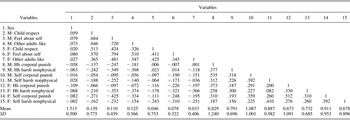
Descriptive statistics and correlations of study variables are shown in Table 1. These statistics represent best estimates of population parameters, after adjusting for missing data using full information maximum likelihood estimation. As shown, the different response evaluation items were moderately to highly correlated for both mothers and fathers. Believing that the child, other adults, and oneself would not like or respect aggressive behavior in hypothetical childrearing situations was related to less harsh discipline toward one's own child.
Descriptive statistics and correlations of study variables

Notes: Sex was coded as 1 = male, 2 = female. M, Mother report; F, father report; Hh, household. Correlations are between manifest variables.
Overall model of parents’ SIP and harsh discipline
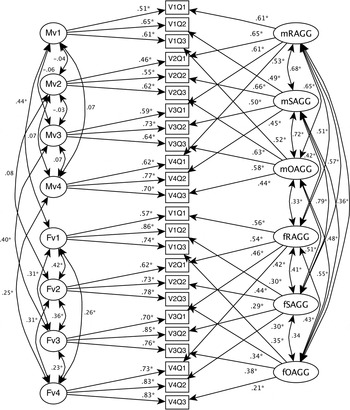
To model Time 1 parent SIP, we estimated a multitrait–multimethod model (Campbell & Fiske, Reference Campbell and Fiske1959; Kenny & Kashy, Reference Kenny and Kashy1992) in which the family was treated as the unit of analysis. The initial model included 14 latent variables as predictors of latent linear slopes in eight latent outcomes, covarying child gender. The predictor variables included 7 from each parent: the three indices of Time 1 SIP (the multitraits) and the four vignettes (the multimethods). There were four latent outcomes for each parent: two were indices of reports of someone in the household engaging in physical and nonphysical harsh discipline, and two were self-reports of engaging in physical and nonphysical harsh discipline. The measurement model, with coefficient estimates, is depicted in Figure 1. A model was considered to have good fit if the χ2 test was nonsignificant (p > .05), the comparative fit index and the Tucker–Lewis index were ≥0.95, the root mean square error of approximation was ≤0.06, and the standardized root mean square residual was ≤0.08 (Hu & Bentler, Reference Hu and Bentler1999), but we gave greater weight to the incremental fit indices than to the significance of the χ2 because the χ2 value is known to be sensitive to sample size (Cheung & Rensvold, Reference Cheung and Rensvold2002). The hypothesized model was an excellent fit to the observed data.
Measurement model showing standardized path coefficients and correlations. Disturbances are not explicitly shown. Mv1, Mother Vignette 1; Mv2, Mother Vignette 2; Mv3, Mother Vignette 3; Mv4, Mother Vignette 4; Fv1, Father Vignette 1; Fv2, Father Vignette 2; Fv3, Father Vignette 3; Fv4, Father Vignette 4; V1Q1–V1Q3, Vignette 1, Questions 1–3; V2Q1–V2Q3, Vignette 2, Questions 1–3; V3Q1–V3Q3, Vignette 3, Questions 1–3; V4Q1–V4Q3, Vignette 4, Questions 1–3; mRAGG, mother report of how much child would respect her if she used aggressive response; mSAGG, mother report of how she would feel about herself if she used aggressive response; mOAGG, mother report of how much other adults would like her if she used aggressive response; fRAGG, father report of how much child would respect him if he used aggressive response; fSAGG, father report of how he would feel about himself if he used aggressive response; fOAGG, father report of how much other adults would like him if he used aggressive response. *p < .05.

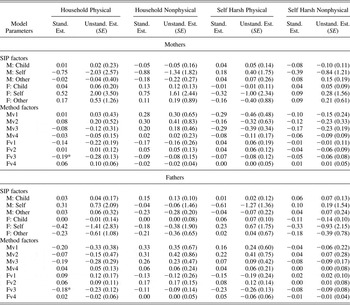
Coefficient estimates and their standard errors for this model are presented in Table 2 (mother harsh discipline and father harsh discipline). Only two of the regression parameter estimates in the structural model were uniquely significant, both from vignette (method) variables. This is possibly due to the high level of correlation among predictor variables. Because of this correlation, a Wald test of parameter constraints was used, constraining all prediction paths from mother and father SIP to harsh discipline to be equal to zero. This null hypothesis was rejected, χ2 (48, N = 2,307) = 72.88, p = .012, indicating that the set of parent SIP predictors was significantly related to the set of harsh discipline outcomes.
Standardized loadings and unstandardized loadings (standard errors) for structural multitrait–multimethod model for mother and father harsh discipline reports
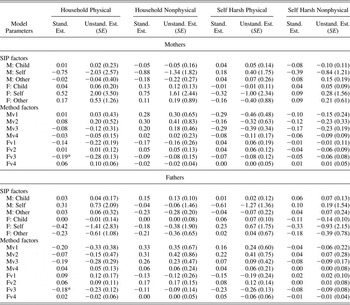
Note: Standardized estimates can be construed as effect sizes. SIP, social information processing; M: Child, mother report of how much child would respect her if she used aggressive response; M: Self, mother report of how she would feel about herself if she used aggressive response; M: Other, mother report of how much other adults would like her if she used aggressive response; F: Child, father report of how much child would respect him if he used aggressive response; F: Self, father report of how he would feel about himself if he used aggressive response; F: Other, father report of how much other adults would like him if he used aggressive response; Mv1, Mother Vignette 1; Mv2, Mother Vignette 2; Mv3, Mother Vignette 3; Mv4, Mother Vignette 4; Fv1, Father Vignette 1; Fv2, Father Vignette 2; Fv3, Father Vignette 3; Fv4, Father Vignette 4.
*p < .05.
Mother/father differences in the relation between SIP and harsh discipline
To test whether this set of relations differed between mothers and fathers, a Wald test constraining their respective prediction paths to be equal was used. No significant difference in prediction between mothers and fathers was found, χ2 (24, N = 2,307) = 18.30, p = .788.
Culture differences in the relation between SIP and harsh discipline
The next step was to test whether the predictive relation differed across the 12 cultural groups (2 in Italy, 3 in the United States, and 1 each in China, Colombia, Jordan, Kenya, the Philippines, Sweden, and Thailand). Testing this model with both mothers and fathers included was not possible because the full set of regression parameters was too numerous to estimate unconstrained in the much smaller culture-level samples. In addition, testing invariance across the 12 groups on mothers and fathers separately eliminated concern about shared within-family variance (i.e., by testing the mother and father models separately, we are not violating the assumption of independent observations). Therefore, the original model was split into two separate models, one for mothers and one for fathers. Model fit results for both are presented in Table 3. These models incorporate metric invariance for the SIP factors; scalar invariance was untenable with respect to fit. Metric invariance is sufficient for comparing structural coefficients. Each model was an excellent fit to the observed data. Again, because of the highly correlated predictors, the Wald test of parameter constraints was used, constraining all prediction paths from SIP to harsh discipline to be equal to zero. For the mothers-only model, this null hypothesis was rejected, χ2 (12, N = 1,277) = 21.76, p = .040, but the null was not rejected for the model with only fathers, χ2 (12, N = 1,030) = 17.07, p = .147. Because these effects were estimated in separate models, any differences between them cannot be easily contrasted. Given that the mother and father effects in the whole-sample analysis did not significantly differ, we are not in a position to interpret any differences introduced by estimating them separately.
Goodness-of-fit indicators for models of social information processing predicting harsh discipline

Note: CFI, Comparative fit index; TLI, Tucker–Lewis index; SRMR, standardized root mean square residual; RMSEA, root mean square error of approximation; CI, confidence interval.
*p < .05.
To test our last research question, whether this relation differed across cultures, a Wald test was used, with the null hypothesis being that all predictive relations were equal across all cultures. This null hypothesis was not rejected for either the mother only, χ2 (132, N = 1,277) = 103.65, p = .968, or the father only, χ2 (120, N = 1,030) = 112.02, p = .686, models, suggesting that the association between parents’ SIP and harsh discipline was consistent across the cultural groups. The father-only model did not include the African American sample from Durham, North Carolina, because of apparent empirical underidentification in its small sample size of fathers.
Model controlling for Time 1 harsh discipline
In a final set of analyses, we investigated the effects on the findings of including harsh discipline at Time 1 in the predictor set. With this addition, Time 1 SIP no longer significantly predicted Time 2 harsh discipline, Wald χ2 (48, N = 1,030) = 49.58, p = .410 (we also omitted the theoretically irrelevant predictive relations from the method factors to facilitate convergence; this model still fit well, Table 3). In probing this difference, we observed that parent SIP and harsh discipline measured concurrently at Time 1 were associated. A model excluding Time 2 outcomes fit the data well and showed a significant concurrent association between the set of SIP variables taken and the set of harsh discipline variables, Wald χ2 (48, N = 1,414) = 245.02, p < .001. Further examination showed that 20 of the 48 covariances were individually significant, all positively, and the standardized residual covariances (correlations after partialing gender) ranged from 0.02 to 0.41, with a median correlation of 0.15.
Discussion
In this study of mothers and fathers in nine countries, we found that parents’ positive evaluations of aggressive responding in hypothetical vignettes designed to assess SIP were related to reports of harsh discipline toward their own child. The finding was consistent for mothers and fathers, and across the nine countries. Several influential calls for replication have been made recently, asserting the need for psychological and developmental science to test the generalizability and robustness of findings (Bonett, Reference Bonett2012; Duncan et al., in press). Underlying these calls for replication is the acknowledgement that psychological processes may not generalize across diverse populations but instead may be dependent on the nature of particular research samples (Bornstein, Jager, & Putnick, Reference Bornstein, Jager and Putnick2013). Norenzayan and Heine (Reference Norenzayan and Heine2005) describe psychological universals as being core mental attributes that are shared by nearly all adults across cultures and argue that understanding what can be considered psychological universals is of great importance to the field of psychology. They state that “[t]he existence of cultural diversity poses a great challenge to psychology: The discovery of genuine psychological universals entails the generalization of psychological findings across disparate populations having different ecologies, languages, belief systems, and social practices” (Norenzayan & Heine, Reference Norenzayan and Heine2005, p. 763). The present study offered such a test regarding the link between parents’ SIP and harsh discipline by examining whether this link held for both mothers and fathers, and in nine diverse countries. Although there are clearly many countries and cultural groups that were not included in our study, given the consistency of the finding in the diverse countries that were included, we conclude with reasonable confidence that the link between SIP and harsh discipline is robust.
Although the nested model comparisons suggest that the SIP variables predict harsh discipline, no single pathway from SIP to harsh parenting was significant. This suggests the potential for a cumulative effect. Previous research has found that each specific SIP step accounts for very small amounts of variance in aggressive behavior but cumulatively the SIP steps have a combined effect (e.g., Dodge, Pettit, McClaskey, & Brown, Reference Dodge, Pettit, McClaskey and Brown1986). In the present study, we did not assess different SIP steps, but assessing different aspects of response evaluation in vignettes describing four distinct hypothetical scenarios may have served a similar function of eliciting responses that, in isolation, would be trivial but that, as part of a broader pattern of positively evaluating aggressive parenting, contribute meaningfully to reported harsh parenting behavior.
Just as a distinction between reactive and proactive aggression can be made in general terms, with reactive aggression as an angry retaliatory response and proactive aggression as a planned instrumental behavior (Dodge, Reference Dodge, Pepler and Rubin1991), the distinction between reactive and proactive aggression might also apply in parenting situations. In some cases, adults may use harsh discipline toward their children because they are acting in the heat of the moment and striking out at the child as an angry, unplanned reaction. In other cases, adults may use harsh discipline toward their children because they believe such responses will be effective in preventing child misbehavior in the future and are an ingredient of being a good parent. If parents are using harsh discipline proactively, one would expect them to have SIP biases pertaining to the positive evaluation of aggressive disciplinary responses, just as response generation and evaluation steps of the SIP model have been related to children's proactive aggression (Crick & Dodge, Reference Crick and Dodge1996). Our finding that positive evaluation of aggressive responding in hypothetical parenting vignettes is related to parents’ harsh discipline suggests that parents do not simply strike out at children in the heat of the moment during angry exchanges but that at least some parents behave aggressively for proactive reasons, perhaps because they believe that harsh discipline will prevent future child misbehavior and will be well respected by other adults. This is a critical finding because the majority of previous research examining parents’ SIP in relation to parenting behavior has focused on parents’ hostile attribution biases (e.g., MacBrayer et al., Reference MacBrayer, Milich and Hundley2003), which would be expected to be related to more reactive aggression toward children.
Contemporary models of aggression have emphasized the importance of distinguishing between the form and function of aggression (e.g., Little, Jones, Henrich, & Hawley, Reference Little, Jones, Henrich and Hawley2003). The distinction between reactive and proactive aggression is primarily one of function (Coie & Dodge, Reference Coie, Dodge, Damon and Eisenberg1998). That is, an identical behavior such as hitting could serve either a reaction function (such as retaliation against a perceived wrong) or a proactive function (such as obtaining some desired outcome). Understanding how parents think about aggression toward children helps clarify parents’ perceptions of the function of aggression in parent–child relationships and provides an important starting point for interventions designed to eliminate parents’ violence toward children.
Conceptually, it makes sense that SIP biases would be as predictive of adults’ aggressive behavior as of children's aggressive behavior, although there are plausible reasons that the link may be weaker during adulthood. In particular, adults may be better at suppressing aggressive responses even if their SIP biases would increase their risk of aggressive responding. Executive functioning continues to develop into adulthood, with improvements even to ages 20–29 years in planning and problem-solving abilities (De Luca et al., Reference De Luca, Wood, Anderson, Buchanan, Proffitt and Mahony2003). Thus, the response evaluation step of the SIP model may be particularly important in understanding adults’ harsh disciplinary responses, because it appears that the response evaluation and decision-making aspects of the SIP model increase in importance with age (Fontaine et al., Reference Fontaine, Yang, Dodge, Pettit and Bates2009). In the present study, as in previous research on response evaluation, this SIP step encompasses several different aspects of evaluations (liking and respect) and perspectives (self, other adult, and child).
Limitations and directions for future research
In this study, we focused on the response evaluation step of SIP and did not have data on other aspects of SIP in the Crick and Dodge (Reference Crick and Dodge1994) model. Thus, it was not possible to investigate whether positive evaluations of aggressive responses to the hypothetical vignettes were more or less predictive of parents’ harsh discipline than were other aspects of SIP. An important direction for future research will be to examine the full SIP model in relation to harsh parenting in diverse countries.
The longitudinal design, with the parent SIP data collected a year before the harsh parenting data, lends support to the directional interpretation we have offered, with parents’ SIP predicting their behavior. However, the data are correlational and the usual cautions to avoid causal interpretations are warranted. The contemporaneous covariation between parents’ SIP and harsh parenting complicates the interpretation, especially insofar as the two variables may be reciprocally causal. For example, parents who use harsh discipline may be more likely to justify their behavior by subsequently changing their thinking to avoid cognitive dissonance (Cooper, Reference Cooper2007). In addition, or alternately, other factors such as an overarching societal norm akin to a culture of honor (Nisbett & Cohen, Reference Nisbett and Cohen1996) might shape parents’ SIP as well as aggressive behavior.
We relied on parents’ reports of their harsh discipline rather than on observations. This was a practical design consideration given that parents could not be observed for long enough periods of time or under circumstances that would be likely to elicit harsh discipline that we could observe. Parents may have underreported their use of harsh discipline, although a large proportion of caregivers in a variety of countries report believing that corporal punishment is necessary and admit to engaging in harsh parenting (Lansford & Deater-Deckard, Reference Lansford and Deater-Deckard2012). Nevertheless, our estimates of the strength of relation between parents’ SIP and harsh discipline could have been inflated by shared source variance because parents reported on their own SIP as well as discipline.
In terms of evaluating the effect of parent gender, the overall model showed no differences between mothers and fathers. However, in the models evaluating culture differences, in which sample limitations precluded us from testing simultaneously for parent gender differences, significant effects were found for mothers but not for fathers. This introduces the possibility of a parent gender by culture interaction. Future research would benefit from examining that possibility.
Although positive evaluations of aggression would be expected to relate to proactive aggression more than to reactive aggression, to our knowledge no one has examined this in the context of harsh discipline. Our measure of harsh discipline did not enable us to determine its function (i.e., whether parents were reacting angrily to their child's misbehavior or using harsh discipline in a more calculated manner). It would be informative for future research to assess proactive versus reactive functions of harsh discipline.
Implications and conclusions
The relation between parents’ SIP and harsh discipline suggests that a promising starting point for interventions to prevent or reduce harsh discipline would be a social cognitive approach targeting parents’ beliefs about harsh disciplinary responses. Interventions designed to reduce children's SIP problems have been found to be effective in decreasing children's aggressive behavior (e.g., Kazdin, Reference Kazdin2003; Runyon, Deblinger, Ryan, & Thakkar-Kolar, Reference Runyon, Deblinger, Ryan and Thakkar-Kolar2004), suggesting this approach might be promising for adults as well. In the 37 countries that have outlawed the use of corporal punishment, as well as in other countries that have been motivated by the Convention on the Rights of the Child (United Nations, 1989) to examine their laws, policies, and norms regarding parents’ treatment of children, desire to promote positive, nonviolent parenting is sometimes coupled with a lack of clarity about how to do that. Social cognitive components could be integrated into parenting programs that already are in place in a number of countries (Lansford & Bornstein, Reference Lansford and Bornstein2007).
Taken together, the findings support the universality of the link between parents’ positive evaluations of aggressive responding and their subsequent use of harsh discipline with their own child. This relation was consistent for mothers and fathers, and for parents in 12 cultural groups in nine countries that vary widely in sociodemographic and psychological factors. An important implication is that international efforts to eliminate violence toward children could target parents’ beliefs about the acceptability and advisability of using harsh physical and nonphysical forms of discipline.