Introduction
Estimating clinical effectiveness of a novel treatment versus a comparator is an essential component of NICE technology appraisals (TAs). For time-to-event (TTE) outcomes such as overall survival (OS) and progression-free survival (PFS), effect size is often summarized by the hazard ratio (HR); a summary statistic describing the relative difference between two survival curves. Most commonly derived from semi-parametric Cox regression modeling, the HR depends on the assumption of proportional hazards (PH). This means that the ratio of the hazard functions of each curve should remain constant with time, or alternatively, that any changes in hazard rates over time in one curve should be accompanied by proportionate changes in the other (Reference Monnickendam, Zhu, McKendrick and Su1). Methodologies for testing the PH assumption include visualization of log-cumulative hazard plots, which demonstrate approximately parallel lines with no crossover in the presence of PH. Alternatively, Schoenfeld residuals (Reference Schoenfeld2), summarized as the observed minus the expected values of the covariates at each failure time, demonstrate whether a covariate coefficient is time-dependent – this should not be the case when the PH assumption holds. Grambsch–Therneau tests are an extension of this - testing for correlation between a covariate’s Schoenfeld residual and a function of time, with a non-zero correlation suggesting PH violation (Reference Metzger3).
The PH assumption in oncology trials
Novel oncology drugs include targeted and immuno-oncology (IO) therapies. Targeted therapies selectively inhibit the growth of cancer cells by interfering with enzymes or cell signaling pathways (Reference Seebacher, Stacy, Porter and Merlot4). Examples of targets include DNA-repair enzymes (e.g., poly-ADP ribose polymerase inhibitors olaparib and niraparib), proteins involved in cell division (e.g., cyclin-dependent kinase 4 and 6 inhibitors palbociclib and abemaciclib), and cytoplasmic tyrosine kinase domains of various receptors (e.g., anaplastic lymphoma kinase, fms-like tyrosine kinase 3, epidermal growth factor receptor, and brigatinib, gilteritinib and osimertinib, respectively). IO therapies such as immune checkpoint inhibitors function by stimulating the immune system to destroy cancerous cells (Reference Seebacher, Stacy, Porter and Merlot4). Examples of targets include inhibitors of the down-regulators of immune T-cell activity such as programmed death receptor 1 (pembrolizumab and nivolumab), and its ligand (atezolizumab, avelumab), and cytotoxic T-lymphocyte-associated antigen 4 (ipilimumab).
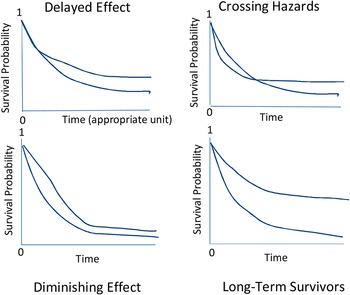
The mechanisms of action of these novel drugs vary both within class, and with the traditional chemotherapies to which they are often compared in randomized controlled trials (RCTs). As a result, the shapes of survival curves in TAs often vary considerably between intervention and comparator, leading to violation of the PH assumption - or non-proportional hazards (NPH). Patterns seen include the following (Reference Ananthakrishnan, Green and Previtali5): (i) Delayed treatment effects, often seen with IO therapies as their impact on stimulating the immune system takes time to build; (ii) Treatment waning effects, often a result of cancer cells developing mutations or molecular bypass pathways which with time allow them to “escape” direct treatment effects or evade the IO-boosted immune system; (iii) Durable survival or cure, whereby survival benefit is maintained in the longer term, even after treatment cessation; and (iv) Crossing hazards, whereby survival curves of intervention and comparator cross (Figure 1).
Examples of survival curves demonstrating non-proportional hazards.
Clockwise from top left: Delayed treatment effect, crossing hazards, long term survival, and diminishing (treatment waning) effect. Reproduced with permission from Ananthakrishnan et al. (Reference Ananthakrishnan, Green and Previtali5).

There are also artifactual reasons (independent of true treatment effects) that may cause an apparent violation of the PH assumption. For example, treatment switching after disease progression can confound OS by diluting observed treatment benefits, impacting on hazard patterns. Alternatively, “pseudo-progression” (an initial perceived increase in tumor volume due to infiltration with immune cells) can occur on commencement of IO therapy (Reference Ma, Wang, Dong, Zhan and Zhang6). This is transient, but if not recognized can be mistaken for true disease progression and impact PFS curves and hazard patterns. Similarly impacting PFS, an apparent (but false) delayed treatment effect can be observed as an artifact of measurement schedule. For example, an initial non-divergence of curves may be seen due to the first follow up not being for some time after randomization. Finally, the presence of subgroups of patients with differing response to treatment can have considerable impact. In the IPASS (Reference Mok, Wu and Thongprasert7) trial (gefitinib vs. carboplatin–paclitaxel for pulmonary adenocarcinoma), crossing hazards were seen in the raw analysis, but resolved when patients were stratified by EGFR status. This treatment effect heterogeneity may be due to unobserved effect modifiers.
The problem with the hazard ratio
In the context of PH, the HR is a meaningful summary statistic describing differences in treatment effect between two groups. However, it is a relative measure with no absolute component, thus requiring other statistics (e.g., percentile or landmark survival) to furnish it with clinical meaning. Some have argued it is unintuitive and poorly understood by clinicians (Reference Saad, Zalcberg and Pcron8), while others contest its value from a causal inference perspective. As described by Stensrud et al. (Reference Stensrud, Aalen, Aalen and Valberg9), in RCTs individuals at high and low risk of experiencing an event should (theoretically) be evenly distributed between treatment and comparator groups at baseline. When a treatment is effective this balance is lost with time, as not only will more individuals survive for longer in the treatment group, but it will accrue a greater proportion of high-risk individuals, who would have died sooner in the comparator group. The result is selection bias; whereby the HR summarizes not only the difference in treatment effect, but also the growing differences in characteristics (known and unknown) between the two populations.
When NPH are observed, whether this is due to true treatment effect or artifact, the HR (by definition) varies with time. Therefore, reporting an “overall” HR loses meaning as it does not describe how events are distributed through the trial follow-up period, giving no information regarding delayed effects, waning effects, or crossing hazards. Moreover, its value will change depending on the (somewhat arbitrary) duration of the trial. Methods within the framework of Cox regression to accommodate NPH have been used including time-dependent covariates (Reference Fisher and Lin10), or the use of multiple piecewise HRs (Reference Roychoudhury, Anderson, Ye and Mukhopadhyay11). However, there are practical difficulties with implementing the former (Reference Monnickendam, Zhu, McKendrick and Su1) (which are seldom used in trial reporting), while the latter is subject to the biases described above.
Alternatives to the hazard ratio
In addition to the HR, many trials report cross-sectional measures of survival including percentile (i.e., the timepoint when
 $ x $
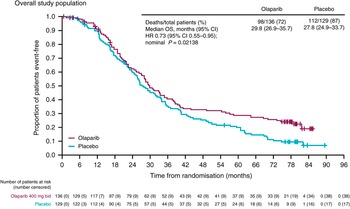
percent of patients have experienced the event, fifty percent being the median) and landmark (i.e., the survival probability at a given time point) survival. Uno et al (Reference Uno, Claggett and Tian12) discuss using ratios or differences in these to describe treatment effect, based on prespecified, “clinically meaningful” milestones. However, these are snapshots of a single point in time, and can be misleading when quoted in isolation in the context of NPH. For example, in TA620 (13) (Figure 2), median survival for intervention and comparator is approximately equal (thirty months); but while this gives the impression of equal treatment effect, the curves clearly diverge beyond this. Similarly, thirty-month landmark survival is equal between groups, but this is not the case later. Which milestone is most informative for decision making?
An example of a delayed treatment effect.
Note how medians are similar, before the curves diverge from around 30 months onwards. Taken from TA620 (13), original image from the Study-19 trial (Reference Friedlander, Matulonis and Gourley40) (open access article).

Alternatively, the log-rank test is a commonly reported non-parametric hypothesis test of treatment effect difference between arms (Reference Collett14). This uses a test statistic derived from the ranks of survival times between two populations, compared with a chi-square distribution. The resulting p-value determines whether evidence exists to reject the null hypothesis of no treatment effect to a predefined significance level. While log-rank is statistically valid under NPH, it loses power in this context (15), increasing the probability of type two error. In response, many authors have advocated for weighted log-rank tests, whereby different parts of the survival curves are given different emphasis. For example, early-emphasis tests (e.g., Wilcoxon (Reference Gehan16)) may be more useful in the context of treatment waning effects, and late-emphasis tests in the context of delayed treatment effects. Others have suggested various combination tests (15). Unlike the HR, it does not describe magnitude of treatment effect; a highly significant p-value could represent strong evidence for a small difference in survival.
Restricted mean survival time (RMST) is an alternative measure, which is neatly summarized as the mean survival up to a given time point (t) and represents the area under the Kaplan–Meier curve up until t (Reference Royston and Parmar17). As a summary of treatment effect magnitude, the ratio or difference in RMST can be reported between two curves. RMST is not dependent on the PH assumption, and is considered by many to be more intuitive than hazard-based measures (Reference Wei, Royston, Tierney and Parmar18). Unlike the median, it summarizes the entire curve up to time t and can therefore describe changes after fifty percent survival probability is crossed. However, since RMST gives equal weight to the later part of the curve where there are fewer subjects at risk, it can be more uncertain - although this can be reflected in broader confidence intervals (Reference Monnickendam, Zhu, McKendrick and Su1). Like milestone estimates, there is subjectivity in defining t, which should therefore be prespecified to avoid selection bias (Reference Uno, Claggett and Tian12). In comparison to the HR, RMST has been shown to be a more conservative measure of clinical effectiveness in oncology trials (Reference Liang, Zhang, Wang and Li19).
Relevance to NICE technology appraisals
With the recent expansion of novel oncology therapies, violation of the PH assumption is being observed with increasing frequency (Reference Monnickendam, Zhu, McKendrick and Su1). This has implications for various aspects of TAs, including clinical effectiveness reporting, indirect treatment comparison (ITC) methodology, and survival extrapolation for economic modeling. While technical support document fourteen (TSD14) (Reference Latimer20) recommends PH testing as routine in NICE TAs with a view to the latter two aspects, there is limited formal guidance on best reporting of clinical effectiveness in the context of NPH.
The goal of this study is therefore to understand how pharmaceutical companies, evidence review groups (ERGs) and appraisal committees (ACs) evaluate and report clinical effectiveness in NICE TAs in the presence of NPH. By reviewing TAs of novel cancer therapies over a two-year period, the aim is to understand: to what extent PH testing is performed, the testing methods used, to what degree the presence of NPH influences clinical effectiveness reporting, and how ERGs and ACs discuss and respond to these issues.
Methods
The methodology used for this review is similar to that used for other reviews of NICE TAs (Reference Bell Gorrod, Kearns and Stevens21). A complete list of appraisals was obtained from the NICE website (22). Single technology appraisals (STAs), including Cancer Drugs Fund (CDF) reviews, of targeted and IO cancer treatments published between 1 January 2020 and 31 December 2021 were included. Appraisals of chemotherapies and hormonal treatments were considered outside the scope as they are less likely to contain NPH. For CDF reviews, priority was given to the review itself, but if full information could not be obtained then the original appraisal was considered in addition. In this instance both the original appraisal and the review were considered as one appraisal.
For simplicity, the focus of data extraction for each TA was limited to OS and PFS in the pivotal RCT presented by the company. Therefore, TAs which did not contain an RCT, for example, those presenting single-arm studies or relying solely on ITC, were excluded. Multiple technology appraisals were excluded on this basis, as the majority rely on meta-analysis. OS and PFS were chosen as these outcomes are most commonly used to evaluate clinical effectiveness, as well as being used for extrapolation and economic modeling. If PFS was not reported as an outcome, a closely related measure such as disease-free survival (DFS) was considered in its place.
Company submissions (CS), ERG reports, and final appraisal determinations (FAD) for each eligible appraisal were downloaded from the web pages in Table 1. This study used thematic analysis to search across these documents in order to inductively identify, analyze and report repeating patterns. The “six steps” defined by Braun and Clarke (Reference Braun and Clarke23) were followed. Step one was to familiarize oneself with the data by reading through (and making brief notes on) the aforementioned documents for each TA. Second, initial codes were generated. These were collated into a data extraction form comprising mostly binary or multiple-choice responses (Supplementary Material – Table 2) and tabulated on an Excel spreadsheet. Third, an initial set of themes were developed, which were then reviewed and refined for accuracy (step four) following a second review of the documents for each TA. Additionally at this stage, a significant amount of free text was captured to explore discussions amongst the company, ERG and committees on issues pertaining to NPH. Step five involved defining the final themes, while step six was the production of the narrative and manuscript.
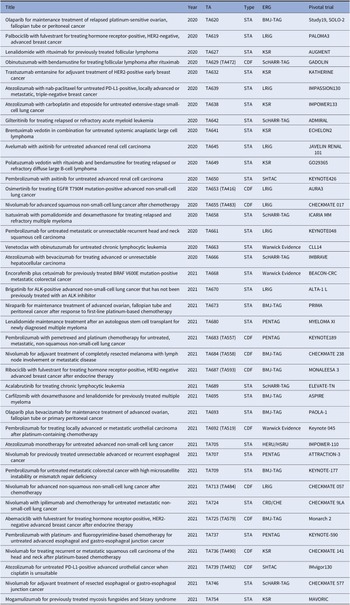
Technology appraisals included in the review

Note for CDF reviews the original appraisal is included in parenthesis. A fully referenced copy of this table can be found in the supplementary material.
Abbreviation: TA = Technology appraisal; ERG = Evidence Review Group; PH=Proportional Hazard; STA = Single Technology Appraisal; CDF = Cancer Drugs Fund review; PENTAG = Peninsula Technology Assessment Group (University of Exeter); ScHARR-TAG = School of Health and Related Research Technology Assessment Group (University of Sheffield); BMJ-TAG = British Medical Journal Technology Assessment Group; LRiG = Liverpool Reviews and Implementation Group (University of Liverpool); SHTAC=Southampton Health Technology Assessment Centre (University of Southampton); KSR = Kleijnen Systematic Reviews; HERU/HSRU=Health Economics Research Unit and Health Services Research Unit (University of Aberdeen); CRD/CHE = Centre for Reviews and Dissemination (CRD) and Centre for Health Economics (CHE) (University of York).
Results
A total of seventy-one STAs assessing cancer immunotherapies or targeted treatments were identified in 2020 and 2021 from the NICE website. Thirty-one STAs were excluded: Of these eighteen were terminated appraisals and ten did not include a comparative pivotal trial. The remaining three exclusions were a rapid review, a rediscussion of an old appraisal due to a change in treatment pathway, and an update of a 2018 appraisal. The remaining forty appraisals, eleven of which were CDF reviews, were considered and are listed in Table 1 (full references in the Supplementary Material – Table 1). These included treatments for hematological, pulmonary, breast, renal/urothelial, esophageal, ovarian, head and neck, colorectal, hepatocellular and dermatological malignancy. Key themes are described and explored using the sub-headings below.
Issues pertaining to PH testing: Frequency, methodology, discussions
PH testing was carried out in 39/40 company submissions where an HR was used as an outcome measure. Of these, it was ubiquitously reported in cost-effectiveness sections to inform survival extrapolation methodology. However, only 10/40 submissions reported this in the clinical effectiveness section; and in the majority of these it was done to inform ITC methodology rather than to support or dispute the validity of the HR as an outcome measure.
After engagement with the ERG, log-cumulative hazard plots were the most frequently used tool (40/40) for testing the PH assumption. In some cases, this was supplemented by Schoenfeld residual plots (20/40), and Grambsch–Therneau tests (4/40). On two occasions the ERG requested further testing with H-H plots during clarification (24;25). In 16/40 TAs, visual inspection of log-cumulative hazard plots alone was felt to be sufficient.
In 3/40 cases (26–28) the ERG and company disagreed on the results of PH testing. In two of these, the ERG critiqued the company’s use of log-cumulative hazard plots alone for decision making (26;28). For example, in TA619 (26), the ERG commented that decision making through visual inspection of log-cumulative hazard plots alone was subjective and requested the company perform additional further testing (e.g., using Schoenfeld residuals). This was at odds with several other TAs (e.g., TA668 (29)) where log-cumulative hazard plots alone were felt to be sufficient. Perhaps conversely, in TA736 (30) the company noted that for OS Schoenfeld residual testing did not provide enough evidence to reject the PH assumption, but still deemed it violated based on visual inspection of log-cumulative hazard plots, and the differing mechanisms of action between intervention and comparator. There was therefore some inconsistency with what was deemed necessary to test the PH assumption.
In several cases, the ERG critiqued the company’s use of log(time) on the x-axis of log-cumulative hazard plots (27;31;32), requesting time as an alternative. For example, in TA629 (27), the company presented plots using log(time). Despite the lines crossing they were deemed otherwise parallel and therefore PH was assumed. The ERG stated: “an assessment of proportional hazards should be of the log-cumulative hazard functions against time, and a plot against log(time) was rightly criticized because the long-term difference is compressed on the log(time) scale” (committee papers, ERG report p24). Based on this plot, the ERG rejected the PH assumption. In reports where plots were available to review, the vast majority (27/31) presented log(time) without criticism.
Reporting and criticism of the HR in the context of NPH
In 28/40 cases, the PH assumption was deemed to be violated in the pivotal trial for key outcomes of OS and/or PFS, either in the initial CS, or following critique by the ERG. In all cases, the HR was still reported as an outcome measure in the CS, along with other measures including log-rank testing, median TTE, and other cross-sectional measures such as percentile or landmark survival. While ERGs performed thorough evaluations of the PH assumption when critiquing ITC and survival extrapolation methodology, criticism of the use of the HR as a measure of clinical effectiveness in the presence of NPH was less consistent (10/28). In these cases where the use of HR was critiqued, it tended to be a straightforward acknowledgement of the limitations, rather than any deeper analysis of the alternatives (Supplementary Material – Box 1). Notably, whether critiqued in the committee papers or not, the HR continued to be widely quoted in FADs as a measure of clinical effectiveness (23/28) without any mention of PH assumption violation.
Use of alternative measures to the HR
In the context of NPH, measures of clinical efficacy ubiquitously reported in addition to the HR included log-rank tests, median and other percentile TTE (where estimable), and landmark survival. RMST was the only other measure used, but was only explored in three TAs (13;33;34). In TA620 (13) a delayed treatment effect was noted (Figure 2) for OS. Median survival was a poor estimate as 50 percent of patients had died prior to separation of the curves, and the ERG suggested: “restricted means analysis gives a more informative and reliable estimate of survival benefit compared with the HR”, and that visualization of survival curves may give the best estimate of treatment effects, followed by event rates at certain timepoints. However, although the HR was presented “for completion”, this was still the key measure reported in the FAD, with no mention of NPH. Similarly, in TA638 (34), a restricted mean analysis was used to assess conformity to end of life criteria, but again was not reported as a primary measure of clinical effectiveness in the FAD. In the CDF review TA484/TA713 (33) the company reported RMST both for the pivotal trial and the indirect treatment comparison, with the ERG noting this being the first use in the ITC setting. Interestingly, the original appraisal (TA484) was one of the few TAs where an HR was available but not mentioned in the FAD, with landmark and median survival quoted to support clinical efficacy claims. However, in the CDF review (TA713) FAD, a statistically significant (albeit confidential) HR was reported, despite no obvious changes to PH testing outcomes.
Discussion
These results confirm that violation of the PH assumption is seen in a majority of recent NICE appraisals of targeted and IO cancer treatments. While PH testing is commonplace, the results demonstrate inconsistency in how companies and ERGs assess the PH assumption, with some preferring visual inspection of log-cumulative hazard plots and others preferring formal statistical testing. There is also some variability as to whether log-cumulative hazard plots should be plotted against (log-time) or (time). Given that this method of assessing the PH assumption depends on visual inspection (which is inherently subjective), it is important that this choice is consistent amongst appraisals.
In most cases, PH testing was done to inform ITC and survival extrapolations rather than to inform clinical effectiveness reporting. As a result, use of the HR for reporting clinical effectiveness was inconsistently critiqued by the companies and ERG. When company submissions or ERG reports are read in order, it can sometimes appear that clinical effectiveness conclusions are drawn before PH testing has been performed, as PH testing is often only discussed in the subsequent cost-effectiveness section. As a result, in the presence of NPH the HR was still ubiquitously reported as a measure of clinical effectiveness, and was reported in the majority of FADs, even when its use was critiqued by the ERG. There is a sense that the HR continues to be reported by convention, rather than as a meaningful parameter.
Does this matter? Firstly, there are some who argue that even when the PH assumption is violated, the HR is still a useful measure of “overall” treatment effect, or as a weighted average of the true hazard ratios over an entire follow up period (Reference Stensrud and Hernan35). However, this is controversial, with many authors highlighting aforementioned issues with confounding (Reference Stensrud, Aalen, Aalen and Valberg9;Reference Aalen, Cook and Røysland36). More importantly, taking the prior example of TA620 (13) (Figure 2), which demonstrates a significant HR of 0.73 (95% confidence interval 0.55–0.95) in favor of treatment but similar median survivals as an example: How can such an “overall” HR be meaningfully interpreted when 50 percent of patients do not get any benefit? Therefore, although some have stated that, to the best of their knowledge, “the use of HRs…as primary analysis tools has not impeded the development, testing, and acceptance of effective oncologic therapies” (Reference Freidlin and Korn37), it is clear that in the context of NPH, the HR is: (i) Lacking meaning as a measure of the magnitude of treatment effect, and (ii) Prone to bias. Moreover, can reporting of the HR in this instance actually be misleading? Previous vignette studies have demonstrated that a trial’s choice of measure to describe clinical effectiveness can bias clinicians’ willingness to prescribe, and how information on treatment choices is presented to patients (Reference Saad, Zalcberg and Pcron8;Reference Marcatto, Rolison and Ferrante38). It is plausible this could influence appraisal committees too, and it could therefore be hypothesized that the reporting of an HR in the context of NPH not only provides no useful additional information beyond that offered by non-parametric (and statistically valid) measures such as log-rank and percentile/landmark-based measures, but could, in fact, have an adverse impact on decision making.
Secondly, the choice of methodology used both in indirect treatment comparison and modeling and extrapolating survival curves for the economic analysis is determined by the presence or absence of NPH (Reference Rutherford, Lambert and Sweeting39). Therefore, it could be argued clinical effectiveness reporting based on trial data alone is somewhat academic from an HTA perspective, as independently fitted parametric models can be used for mean survival estimates used in economic modeling (Reference Rutherford, Lambert and Sweeting39). However, despite an increasing reliance on extrapolation and clinical expert opinion (particularly for the immature data submitted in many TAs (Reference Bell Gorrod, Kearns and Stevens21)), surely we still need some trial-based evidence for clinical effectiveness. The question then is how this data can be reported in a way that is fair and consistent.
One commonly reported barrier to deeper exploration of alternative methods of clinical effectiveness reporting is the requirement to prespecify the primary analysis. For example, in TA619 (26), the company defended their use of a Cox PH model on these grounds, declining the ERG’s request to provide alternative estimators. The uncertainty as to the presence or absence of PH before data collection has implications for choice of statistical testing planned, power calculations, timing of interim and futility analyses, and communicating the results with clinicians and the general public (15). Another barrier is perhaps the lack of clear guidance from HTA agencies on appropriate alternatives.
To our knowledge, this is the first study addressing PH testing and clinical effectiveness reporting practices in NICE TAs. Limitations include the reliance on written summaries of meetings, which may not accurately reflect the actual conversations that took place. While in some committee papers numerical data such as survival curves and summary statistics were redacted the key information regarding testing and identification of NPH, and discussions in this context remained obtainable from the text.
To conclude: Although not ubiquitous, several HTA agencies internationally (of which NICE is one) provide guidelines and recommendations on PH testing (Reference Monnickendam, Zhu, McKendrick and Su1). However, in the UK, there is a lack of consistency amongst companies and ERGs both in how the PH assumption is tested (with some valuing visual inspection over formal statistical testing, or vice versa), and how the HR is critiqued in the context of NPH. Moreover, any critique does not necessarily result in a change to reporting habits; the seemingly routine reporting of the HR in committee papers and FADs should be reconsidered.
The key issue, therefore, is how NPH are managed in terms of clinical effectiveness reporting, and the value of providing the HR or alternative measures in this context. When reporting magnitude of treatment effect, some TAs recommended quoting sequential percentile or landmark estimates, with or without RMST. However, RMST was only used in a minority of appraisals and, despite some arguing it should be more widely reported in NICE TAs (Reference Monnickendam, Zhu, McKendrick and Su1), has its own aforementioned limitations. Indeed, all single summary statistics have limitations, but perhaps the log-rank test is the most informative and least misleading in this situation; it is valid under NPH, and can tell us if there is reliable evidence of a difference between the entirety of the two arms. To ensure fairness of process, the production of guidance or standards on clinical effectiveness reporting in the context of NPH should be considered by NICE.
Supplementary materials
To view supplementary material for this article, please visit http://doi.org/10.1017/S0266462323000119.
Funding statement
This research received no specific grant from any funding agency, commercial or not-for-profit sectors.
Conflict of interest statement
Professor G.J Melendez-Torres is the chief investigator of an NIHR grant to provide HTA advice to NICE.