We are asked also to give up part of our sovereignty and independence and to subject our own will to the will of other nations, if there is a majority against our desires. We are asked, therefore, in a large and important degree to substitute internationalism for nationalism and an international state for pure Americanism.
—Senator Henry Cabot Lodge (R-MA), concerning the League of Nations, 28 February 1919 (Congressional Record, 65th Congress, Third Session, p. 4522)It is a big mistake for us to grant any validity to international law even when it may seem in our short-term interest to do so—because, over the long term, the goal of those who think that international law really means anything are those who want to constrict the United States.
—John Bolton, Special Assistant for National Security, 2018–2019Footnote 1John Ruggie has defined multilateralism as “an institutional form which coordinates relations among three or more states on the basis of ‘generalized’ principles of conduct—that is, principles which specify appropriate conduct for a class of actions, without regard to the particularistic interests of the parties or the strategic exigencies that may exist in any specific occurrence.”Footnote 2 The last two Republican administrations have been notably skeptical of such institutions. Among other things, President Trump withdrew from a number of multilateral agreements and organizations, including the Paris Climate Accord; the United Nations Human Rights Council; the United Nations Educational, Scientific, and Cultural Organization (UNESCO); and the Trans-Pacific Partnership. The Bush administration also ended U.S. participation in several multilateral agreements, including the Kyoto Protocol on climate change and the International Criminal Court. Both administrations had specific concerns about these particular agreements and institutions but objected more broadly to the potential of multilateral rules to constrain American freedom to respond to its “particularistic interests” or “strategic exigencies” as it sees fit.
To proponents of multilateralism, the actions of the Bush and Trump administrations read as shocking departures from longstanding American promotion of a “rules-based” international order. While this level of hostility to multilateralism has rarely been translated into policy since World War II, it does not reflect a new position among conservative Republicans. In fact, a substantial faction within the GOP has generally opposed multilateral institutions for more than a century. Even during the Cold War, members of this group never entirely abandoned the skepticism of multilateralism that Henry Cabot Lodge and other Republican leaders expressed during the debate over the League of Nations. Although they were largely excluded from influence over policy for several decades, opponents of multilateralism nevertheless continued to define conservative orthodoxy on the matter. Relegating a point of view to the fringes of political discussion is not the same thing as changing people's minds.
Because of the critical role of the United States in building and maintaining multilateral institutions, opposition to these institutions within the United States is enormously important for the shape of world politics. We are certainly not the first to discuss this issue. Previous scholars have examined it in several different ways. Some have focused on the decline (or persistence) of bipartisanship in American foreign policy in the last few decades.Footnote 3 Others have discussed the American “exemptionalist” refusal to ratify most multilateral human rights agreements.Footnote 4 Still others have observed the existence of longstanding unilateralist ideological currents in American politics, especially among conservatives.Footnote 5
These works offer many useful insights and nearly all overlap with the argument we will advance here in some respects. However, we depart from them on several points. First, we argue that the unilateralist current in the Republican Party is far older than most discussions of bipartisanship suggest, dating back to the early twentieth century. Moreover, it remained politically important even during the height of the Cold War. Second, contrary to some treatments of the phenomenon, opposition to multilateralism was primarily a Republican position. Many segregationist Southern Democrats embraced it in the 1950s, but they arrived late to this position. There are certainly also critiques from the left of the American-led world order, but to the extent that they target multilateralism, these critiques have had little impact on the Democratic congressional delegation. Third, understanding opposition to multilateralism in ideational terms obscures both its origins in the politics of the early twentieth century and the reasons it persisted. The social dimensions of party and faction, rather than the ideas themselves, offer a more plausible explanation for the constraining effect of ideology over time.
Our claim is not that all Republicans—or even all conservative Republicans—have uniformly opposed multilateralism at every turn but rather that, as a group, they have been more skeptical of multilateralism than were other factions. This pattern has waxed and waned over time but never disappeared. It has grown stronger in recent decades as conservatives have come to dominate the Republican Party. This article's structure is somewhat unconventional because we must first establish the existence and durability of this pattern before explaining it. After setting out our argument about how ideological constraint works and why Republicans initially turned against multilateralism in the early twentieth century, we review the evidence for the persistence of this position. Our analysis covers several complementary sets of data on congressional behavior over the last century:
• Roll call votes on reservations to the Versailles Treaty, 1919–20
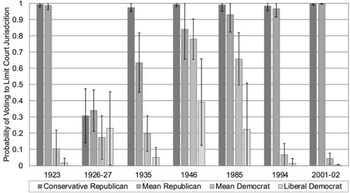
• Roll call votes on international courts in 1923, 1926–27, 1935, 1946, 1985, 1994, and 2001–02
• Roll call votes on the Bricker amendment, 1954
• Roll call votes on the North American Free Trade Agreement (NAFTA) in 1993 and the General Agreement on Tariffs and Trade (GATT) agreement establishing World Trade Organization (WTO) in 1994
• Sponsorship and cosponsorship of bills hostile to the United Nations, 1973–2018
Our goal in selecting these data is to tap objections to multilateralism as an institutional form rather than to its application on specific issues. None of these sources of data do that perfectly, but the strengths of each one help make up for the weaknesses of others. The debates on international courts focused on the institutional form rather than a specific policy issue and have the analytical advantage of raising this question repeatedly over a long period of time. The debate over the Bricker amendment also focused on the nature of international obligations. It occurred during the height of the Cold War, a period when there were no votes on international courts. The votes on NAFTA and the 1994 GATT agreement, which established the WTO, offer a useful comparison because they involved the same substantive issue, but more extensive multilateral rules in the latter case. Most of the same members of Congress voted on both measures. These votes offer a way to test whether conservative concerns about the institutional form persisted even when the members generally supported the substantive issue to which it was being applied. Finally, the data on sponsorships and cosponsorships help compensate for the episodic character of the roll call votes. Whenever they chose, members of Congress could (and frequently did) propose legislation to undermine the United Nations, an especially salient multilateral organization. These data do not cover the entire last century, but they do span roughly half of it.
The second part of the article evaluates the durability of Republican opposition to multilateralism in the face of the changing domestic and international conditions commonly thought to have made this position obsolete. Neither the security demands of the Cold War nor the changing competitiveness of the American economy eliminated conservative Republican skepticism of multilateralism. These changes split the party but left the old position firmly in place within its emerging conservative wing.
Having established the existence and durability of conservative Republican opposition to multilateralism, we propose an explanation for its persistence. We argue that, even though multilateralism carried economic and security benefits for the country as a whole in the postwar era, reversing their long-held opposition to it would have been politically costly for conservative Republicans. Doing so risked alienating conservative activists who thought the issue was important. The strategies of their political opponents gave conservative Republicans little reason to take this risk. For much of the twentieth century, conservative Republicans in Congress were a minority, largely excluded from leadership positions on foreign policy. Congressional leaders chose to avoid high-stakes congressional debates about multilateral rules rather than put conservatives in a position where their opposition to them might have had serious consequences.
1. Why Is Ideology Constraining Over Time?
Our contention that conservative Republicans have tended to be skeptical of multilateral rules since the early twentieth century is an argument about the constraining effect of ideology. Few sources of explanation have received a greater workout by scholars studying congressional behavior, yet the mechanism through which ideology constrains positions across issues or over time is not always clear. Widely used measures of ideology in Congress like DW-NOMINATE identify groups that generally vote together. The question is why. Existing research suggests at least two different sources of ideological constraint. The first is ideational, resting on logical connections among the issue positions comprising the ideology. In this line of argument, core beliefs about the appropriate role of government in the economy imply positions on a wide range of policy issues. The second mechanism is not ideational but social: The glue that holds various issue positions together is the group's traditions and practices rather than the internal logic of the ideas. Leadership and the demands of group solidarity can durably link issues positions even if the logical connections among these positions are weak or ambiguous. Our conjecture that conservative Republican unilateralism is an inheritance from the party's foreign policy stance during the early twentieth century is consistent only with this social mechanism.
In the everyday meaning of the term, as well as most scholarly uses of it to explain political choices, ideology is primarily a set of ideas. The logical relationships among these ideas constrain the ideologues who take them seriously. Left-right ideology—liberalism-conservatism in American parlance—is rooted in contrasting beliefs about the appropriate size and role of government in the economy. These core beliefs imply complementary positions on many issues. Melvin Hinich and Michael Munger summarize this understanding of ideology in stark terms: “the set of ideas comprising the ideology must causally imply the set of policies that citizens associate with the position. It is not enough for an ideology to be a shorthand signal, a correspondence between a name and a set of actions by the government.”Footnote 6
Many explanations for congressional foreign policy positions point to logical connections between the position they wish to explain and core left-right positions on economic policy and the role of government. For example, Robert Bernstein and William Anthony explain conservative support for antiballistic missile systems in terms of their opposition to communism and their belief that “defense is one of the few legitimate concerns of the national government.”Footnote 7 Similarly, Jean-Philippe Thérien argues that conflict over the growth of foreign aid institutions in the postwar era is a direct outgrowth of left-right differences over the government's role in redistribution at home.Footnote 8 Thérien and Alain Nöel explain left parties’ greater support for foreign aid by linking this position to their preference for a strong social welfare state.Footnote 9 In explaining conservatives’ skepticism of the International Monetary Fund (IMF) in Congress, Lawrence Broz ties it to their belief in “a small role for government in the domestic economy.”Footnote 10 The IMF represents a similar interference with market forces by a large and potentially corrupt bureaucracy.
A variant of this account of ideology stresses its psychological roots in the minds of adherents rather than the internal logic of the ideas. Some scholars find that that liberals tend to be more open, tolerant, and drawn to diversity, while conservatives tend to place more emphasis on convention and order.Footnote 11 Others find that conservatism correlates with traits like traditionalism and orderliness, while liberalism is linked to openness, compassion, and egalitarianism.Footnote 12 Brian Rathbun applies this argument to the political debates over the design of the international order in the 1940s.Footnote 13 He finds that liberals tended to be more trusting and community-oriented, while conservatives were generally less trusting and more concerned about the possibility that other states would use multilateral rules to exploit the United States. In these accounts, psychological proclivities take the place of logical coherence in explaining why some positions go together. What the two lines of argument share is an emphasis on the necessity of these connections in the mind of the individual ideologue.
Although it fits with the commonsense meaning of the term, a purely ideational or psychological understanding of how ideology constrains adherents’ foreign policy positions is difficult to sustain when viewing the phenomenon over a long period of time, as we do here. The specific positions associated with particular ideological orientations have changed. Conservatives once held that trade protection and small military budgets followed from the logic of their ideology but reversed themselves over the course of the postwar era.Footnote 14 Finding any consistent ideational content in liberal-conservative ideology is even more difficult when applying it before the New Deal, because the terms themselves were not yet widely used then. As Christopher Ellis and James Stimson note, “prior to the 1930s, the term [“liberal”] was used rarely, if at all, by mainstream politicians of any political persuasion in the United States.”Footnote 15 In its current form, “conservatism” was initially a shorthand for opposition to the New Deal, gradually acquiring other connotations over time.Footnote 16 The term has a longer history in American politics but has not retained the same meaning. Henry Cabot Lodge considered himself a conservative because he sought to build up the reach and power of the American state, a self-conception that would puzzle modern conservatives committed to limited government.Footnote 17
An alternative account of ideology stressing social ties rather than the ideational logic of the position works far better in this context. In this account, ideologues hold common positions across issues because they are part of the same group. The group could be a political party, of course, but it might also be a less formally organized faction within or across party lines. The claim that the mechanism behind ideology in American politics is primarily social rather than ideational does not mean that adherents of these ideologies see no logical connections among the positions they espouse but these connections are loosely drawn. Many different issue linkages could potentially be justified. For example, in relating one's position on the IMF to core conservative beliefs, one could argue either that the organization is a form of big government translated to the international stage, or that it is an international effort to rein in big government and spread free market institutions. Conservatives and their leaders have some leeway in deciding which of these potential connections to espouse, at least initially. This view of ideology is not uncommon in research in the field of American politics, though it is often discussed in elliptical ways. For instance, in their study of the role of ideology in American politics, Ellis and Stimson write that ideology is defined by “social forces and political strategy.”Footnote 18 Similarly, Keith Poole and Howard Rosenthal write that ideological constraint comes about “either through the discipline of powerful leaders or through successful trades.”Footnote 19
There are considerable theoretical stakes in the debate about whether a social or ideational process produces ideological constraint. If the source of the ideological constraint were the internal logic or psychological roots of conservative or liberal thinking, then changing the position would require dispensing with the underlying ideology entirely. Otherwise, ideologues would inevitably return to the old position for the same logical or psychological reasons that they adhered to it in the first place. If ideology is essentially the result of a social process, then the group and its leaders could decide to change their position if they were willing pay the costs of doing so. They would not necessarily have to change their group identity or their other positions.
For our purposes, then, being a “conservative Republican” means belonging to a social group and adhering to its preferred issue positions. This group predates the current meaning of the term “conservative,” but there is continuity in the group's membership over time in Congress as members’ careers overlapped. As we shall see, opposition to multilateralism was once nearly universal among Republicans but persisted most strongly among the group that became known as “conservatives” during the New Deal era. Conservative Republicans changed their positions on some other issues over time but still tended to oppose multilateral rules in spite of international and domestic pressures that led other Republicans to change. We will return to the reasons for this consistency over time in the final section of this article.
2. The Origins and Persistence of Republican Opposition to Multilateralism
Republican skepticism of multilateral rules emerged during the early twentieth century. It was most clearly evident during the debate over the League of Nations, but its roots lie in the policies that Republican administrations had pursued during the quarter century before World War I. The GOP was the dominant political party during this period. Controlling the White House continuously from 1897 through the inauguration of Woodrow Wilson in 1913, Republican policymakers developed a new and logically coherent set of foreign policies. These included the acquisition of colonies, the construction of a battleship fleet, and the forceful assertion of American predominance in the Western Hemisphere, especially the Caribbean Basin. This surge of foreign policy activism is sometimes seen as a harbinger of the country's role after 1945, but it actually served quite different goals. Just as multilateralism played a logical part in American foreign policy after World War II, so unilateralism fit naturally into the foreign policy that Republicans developed before World War I.Footnote 20
The Republican Party's commitment to tariff protection for the manufacturing sector was central to its foreign policy. Individual Republican policymakers occasionally expressed interest in tariff reform, but serious departures from protectionism quickly encountered decisive opposition from other Republicans. While the pursuit of overseas markets and sites for investment was also a priority, just as it would be for later American policymakers, Republican protectionism complicated this effort and made it different from American global activism after 1945. It led to an emphasis on markets in less-developed areas of the world that would not export manufactured products to the United States. Developed trading partners had richer and more promising markets, but they demanded reciprocal tariff concessions that Republican legislators were unwilling to make. Republican policymakers thus became pessimistic about the future of these economic relationships and argued that other areas of the world were more promising.
In pursuing these new markets, American policymakers preferred bilateral trade agreements that maximized their leverage over economically smaller, less-developed trading partners. To avoid generalizing the tariff concessions granted in these bilateral agreements, the United States refused to accept the conventional understanding of most-favored nation clauses in commercial treaties. The “American interpretation,” which persisted until 1923, greatly limited whether states enjoying most-favored nation status would automatically receive the tariff concessions granted to other states.Footnote 21 American foreign economic policy sought unilateral advantages for the United States and did not envision a broader multilateral trading system like the one later American policymakers would pursue after World War II.
In key respects, American foreign policy before 1914 resembled that of most other imperial powers at the time. Under the aegis of the Monroe Doctrine, American policymakers hoped to supplant European trade and investment, as well as European political influence, throughout the Western Hemisphere. This goal was unrealistic in China, where they instead pursued continued American economic access through an open-door policy of nondiscrimination. Achieving these goals in the pre-1914 world of competitive, empire-building great powers required assertive diplomacy and power-projection capability. Republicans supported the construction of a battleship fleet for this purpose. Hawaii, the Philippines, and other territorial acquisitions under Republican presidents provided the bases necessary for effective power projection.
This foreign policy's economic and political premises were inconsistent with schemes for multilateral cooperation. Like high U.S. tariffs, the efforts to build an exclusive American sphere of influence in Latin America and to prevent other states from doing so in East Asia inflicted material harm on other developed states and thus made cooperation with them difficult. The policy also entailed claims of privilege and unilateral exercises of power that would have been inconsistent with just about any plausible set of multilateral rules. Plans for multilateral cooperation discussed before World War I, such as a broad system of international arbitration, would have imposed legal limits on American power that most Republicans proved unwilling to accept, even when offered by members of their own party.Footnote 22 The political constraints on reducing American tariffs also removed a major tool that would later be used to pursue such plans, even if Republican policymakers had been interested in doing so.
It took time for Republicans to fully appreciate the contradiction between their fundamentally unilateralist foreign policy and the multilateral premises of international law. Some key Republican policymakers such as William Howard Taft and Elihu Root were leading advocates of the arbitration of international disputes under international law. However, well before the debate over the League of Nations, other party leaders had turned against this movement. The debate over arbitration treaties that the Taft administration signed with Britain and France is especially revealing. The treaties, signed on August 3, 1911, provided for compulsory arbitration of nearly all disputes. They were intended as models for agreements with other states that would culminate in a broadly multilateral system of dispute arbitration. They omitted the exceptions for national honor and vital interests that had been included in earlier arbitration treaties. Disputes about whether a claim was justiciable were to be settled by a six-member international commission, with three members named by each party to the dispute.Footnote 23
Theodore Roosevelt began attacking Taft's arbitration treaties in print even before they were completed. He objected to the multilateral ambitions of these agreements, arguing that they should only be signed with states where relations had progressed to a point where disputes resulting in war were impossible. In his view, Britain was one of the few states that fit this description. By contrast, Mexico, Germany, and Japan could not be trusted to avoid outrages against American interests “which would immediately demand not arbitration, but either atonement or war.” Until the United States could be certain that these outrages would never happen, certain issues had to be explicitly exempted from arbitration.Footnote 24 As an example, Roosevelt extolled the benefits of an American unilateral action in the Caribbean, the 1904 seizure of customs houses in the Dominican Republic.Footnote 25 In Roosevelt's view, such necessary actions would obviously be subject to arbitration but were unlikely to withstand a legal challenge from the affected state or a third party.
After the treaties reached the Senate, Alfred Thayer Mahan, another intellectual architect of the foreign policy developed over the preceding two decades, wrote to Roosevelt echoing this concern. “The more I think, the more certain I am that the Monroe Doctrine is ‘justiciable,’ that there are settled principles and precedents in international law which apply; and they apply against the Monroe Doctrine. If this is so, the Commission of Inquiry must so decide, if honest; and equally arbitrators when it comes before them must decide against the U.S. This alone, if correct, condemns the treaty as it stands.”Footnote 26 The unilateral claims of privilege embodied in the prevailing understanding of the Monroe Doctrine were vital for the foreign policy Roosevelt and Mahan had spent their careers developing but were inconsistent with multilateral rules.
The Senate debated the treaties in March 1912. Republicans did not unanimously oppose them, but the arguments of those who did prefigured future objections to multilateralism. Republican senators cited a range of cases where the United States had—justifiably, in their view—taken actions that were unlikely to stand up to legal scrutiny. Henry Cabot Lodge (R-MA) discussed the possibility that the United States would be barred from taking military action to prevent the construction of a Japanese naval base in Mexico. Weldon Hayburn (R-ID), in a speech that began with an endorsement of war as the best way to resolve international disputes, expressed concern about the U.S. conflict with Colombia over the independence of Panama. Aldon Smith (R-MI) worried about the special privileges the Platt Amendment gave the United States in Cuba.Footnote 27 Nearly all raised the possibility that the international commission charged with determining justiciability would rule against the United States, obliging it to arbitrate these claims of privilege. In the end, the Senate's reservations in its resolution of ratification were so severe that President Taft chose not to move forward with final ratification. One scholar has aptly characterized the debate as “a dress rehearsal for the later Senate struggle over the League of Nations.”Footnote 28
Did this skepticism of multilateral cooperation really persist through the two world wars and the Cold War? These conflicts revolutionized world politics and presented the United States with very different challenges and opportunities. The old policies arguably no longer made sense. Moreover, once-characteristic conservative Republican positions on other foreign policy issues such as tradeFootnote 29 and military spendingFootnote 30 became indistinct or reversed themselves during the Cold War. There are reasons that their view on multilateral rules should have followed the same course. To assess its continuity over time, we examine five complementary sources of data on congressional support for multilateralism. In each case, we are interested in whether Republicans, especially conservative Republicans, systematically tended to oppose multilateral rules and obligations. It would hardly be surprising to find that some Republicans took this position at every point along the way. The issue here is whether conservative Republicans as a group were much more likely to do so than members of other political factions were. The data suggest that they were, and that this tendency was quite strong.
2.1 Senate Voting on the League of Nations, 1919–1920
The “League fight” was arguably the most extensive public debate about the country's role in the world that the United States has ever had.Footnote 31 As John Milton Cooper put it, “Democrats and Republicans alike believed they were contending for the soul of American foreign policy.”Footnote 32 During the course of the long debate over the treaty, there were more than 160 roll call votes and seventy-two of the ninety-six senators gave at least one speech on the issue. The salience of this debate made opposition to multilateralism into an article of faith among many Republicans for the remainder of the interwar period. Every Republican Party platform from 1920 through 1936 included language explicitly objecting to U.S. membership in the League of Nations.Footnote 33
Pre-1914 foreign policy commitments fueled Republican opposition to the League of Nations. Senator Henry Cabot Lodge (R-MA), the Republican Majority Leader as well as the chair of the Foreign Relations Committee, had been a central figure in developing Republican foreign policy during the McKinley and Roosevelt administrations. Lodge's objections to the League centered on its potential to restrict the freedom of action and claims of privilege on which American foreign policy had rested under previous Republican administrations. The Foreign Relations Committee distilled these concerns into a set of formal reservations about the resolution of ratification. All of these “Lodge reservations” sought to rescind or limit multilateral commitments entailed in joining the League.Footnote 34 For instance, one reservation forbade the League from objecting to American actions taken under the aegis of the Monroe Doctrine or from questioning U.S. interpretation of the doctrine. Another prohibited the League from taking action on issues such as trade and immigration that would have domestic repercussions in the United States. Reservations like these prefigured later conservative Republican objections to multilateral commitments. The Senate considered each of them in November 1919, prior to the final rejection of the treaty in March 1920, taking roll call votes on all but one.
According to Lodge's memoir, Senator William Borah, one of the leaders of the “irreconcilable” faction committed to blocking the treaty regardless of the reservations attached to it, informed him that he intended to vote for all of the reservations, then against the final treaty. Borah reasoned that the reservations would improve the treaty if it passed.Footnote 35 We expect that other senators who opposed the treaty would follow Borah's example, so we take support for each reservation as evidence of skepticism about the multilateral commitments embodied in the League Covenant.
Figure 1 shows the partisan and ideological character of the supporters and opponents of the Lodge reservations. It reports predicted probabilities from a logit model that includes party identification, ideology, and a dummy variable for each roll call taken on these reservations during the November 1919 debate.Footnote 36 As in most studies of roll call voting, we use the first dimension of the DW-NOMINATE score to indicate liberal-conservative ideology.Footnote 37 It ranges from −1 (most liberal) to 1 (most conservative). The mean Republican and Democratic senators in Figure 1 reflect the central tendency of the party. The DW-NOMINATE scores for the conservative Republican and liberal Democrat in Figure 1 are set to 0.5 and −0.5, respectively, and will be used as points of comparison with debates in other Congresses. As Figure 1 indicates, there was a stark party division on the Lodge reservations, with little intraparty ideological difference. Republican support for the reservations exceeded 90 percent on twelve of the fourteen votes and never dropped below 50 percent. Democratic support never rose above 22 percent and was below 15 percent on twelve of the fourteen votes.
Partisan-Ideological Differences in Support for the Lodge Reservations, 1919.
Notes. Predicted probabilities were computed from a logit model including party affiliation, the first dimension of the DW-NOMINATE score, and a dummy variable for each roll call. The predicted probabilities were computed for the closest roll call vote taken during the debate. The whiskers indicate 95 percent confidence intervals adjusted for clustering on the individual member. The Appendix describes each roll call and provides full model results.

Voting on the Lodge reservations offers another reason for questioning ideational accounts of the constraining effect of ideology. The political lineup before the New Deal is inconsistent with the claim that what would later be called “conservative” positions on core economic issues implied opposition to multilateral rules. On the eve of World War I, Republicans were divided between party regulars and insurgent Progressives, who had supported Theodore Roosevelt's third-party campaign for president in 1912. The Progressives took a range of leftist positions on domestic economic policy issues, such as labor rights, antitrust regulation, and consumer protection, that have led some historians to identify them as the antecedents of modern liberals.Footnote 38 David Brady and David Epstein identify twelve progressive Republicans in the Senate during the 66th Congress, when the League fight took place.Footnote 39 These senators had a mean DW-NOMINATE score of 0.22, making them substantially more liberal than party regulars, whose mean was 0.49. Both groups were more conservative than any Democrat, whose DW-NOMINATE scores ranged from −0.03 to −0.48, with a mean of −0.28. Further underscoring the anachronism of the term during this period, the fifteen Democrats with the most liberal DW-NOMINATE scores were Southerners whose views on many issues, particularly race, were far from liberal.
If the issue positions we now consider liberal and conservative logically implied positions on multilateralism, then Progressives should have been less likely to support the Lodge reservations than other Republicans were. In fact, the two factions were indistinguishable on these roll call votes. Models like those used to produce Figure 1 find no statistically significant differences between them.Footnote 40 Indeed, some leading Progressives like William Borah (R-ID) and Hiram Johnson (R-CA) were “irreconcilables,” who would have opposed the League even if all the reservations had been adopted.
2.2 Senate Voting on Adherence to International Courts, 1923–2002
Senate debates on the jurisdiction of international courts offer an opportunity to observe partisan and ideological positions on multilateral rules over a longer period of time. Beginning in the 1920s, the Senate considered whether the country should accept the jurisdiction of, first, the Permanent Court of International Justice, established in the Versailles Treaty; second, the International Court of Justice, established in the UN Charter; and finally, the International Criminal Court, set up by the Rome Statute of 1998. Although there were substantial differences among these courts and in the circumstances surrounding the debates, acceptance or rejection of their jurisdiction always bore on the broader question of whether the United States should accept multilateral rules. All of the debates considered here focused on this issue.Footnote 41
Figure 2 depicts the partisan and ideological character of the courts’ supporters and opponents in each debate. It is based on a series of logit models identical to those we used to produce Figure 1. In spite of the enormous domestic and international political changes that occurred between 1923 and 2002, as well as the important differences in the courts under consideration, Republicans were always more likely to oppose international courts’ jurisdiction than Democrats were. In 1935, 1946, and 1985, there were also statistically significant intraparty ideological differences, with conservatives being more likely to oppose the courts’ jurisdiction. These intraparty differences are not apparent in 1994 and 2002 because the Republican Party had become almost monolithically conservative by this time. Indeed, the mean DW-NOMINATE score among Republicans in 2002 was actually 0.56, slightly to the right of the hypothetical conservative we used as a point of comparison in the other debates (DW-NOMINATE = 0.5).
Partisan-Ideological Differences in Opposition to International Courts, 1923–2002.
Notes. Predicted probabilities were computed from logit models of each debate that include party affiliation, the first dimension of DW-NOMINATE, and a dummy variable for each roll call. The predicted probabilities were computed for the closest roll call vote taken in the debate. The whiskers indicate 95 percent confidence intervals adjusted for clustering on the individual member. The Appendix describes each roll call and provides full model results.

2.3 Senate Voting on the Bricker Amendment, 1954
While Senate debates over international courts show conservative Republican opposition to multilateralism at several points over a long period of time, the fact that there was only one vote on the issue during the entire Cold War era poses a problem. Conservative Republicans were arguably most likely to have abandoned their skepticism of multilateralism during this period. Multilateral institutions played a critical role in cementing the alliance system that the United States used to contain the Soviet Union. The absence of debate on this topic during the Cold War might indicate that Republicans abandoned their opposition to multilateralism after World War II and that its recent resurgence reflects current conditions rather than a continuity from the first half of the twentieth century.
Our third source of data helps address this possibility. It arises from the 1954 debate over a proposed constitutional amendment to limit the legal force of international agreements and the president's power to negotiate them. The amendment, sponsored by Senator John Bricker (R-OH), focused on many of the same issues that concerned opponents of the League of Nations and the international courts, particularly the prospect that these organizations could have jurisdiction over domestic legal matters within the United States. The amendment affected more than just multilateralism, but the issue played a major role in the debate. The nature and timing of the amendment indicate the robustness of conservative Republican opposition to multilateralism. Among other things, the amendment would have required enabling legislation before the provisions of any international agreement could have the force of law. Perhaps most radically, it would have prohibited the president from pursuing executive agreements without Senate ratification. Floor votes on the Bricker amendment took place at the height of the Cold War under a Republican president who strongly opposed the measure. Indeed, at the time Bricker introduced his amendment, the United States was still fighting in Korea under UN auspices.Footnote 42 These conditions should arguably have minimized conservative Republican support for the measure. Nevertheless, the proposed amendment enjoyed the backing of sixty-three cosponsors, and the final version missed the necessary two-thirds threshold by just one vote.
Senate consideration of the amendment involved seven roll call votes. Figure 3 summarizes the results of a logit model of these votes identical to those used for the votes on the Lodge reservations and international courts. It treats agreement with the position of Senator Bricker on these votes as a function of party and ideology. The pattern here resembles what we found for the court votes between 1935 and 1985, with conservatives and Republicans tending to support the measure. Conservative Republicans almost unanimously supported the Bricker amendment, in spite of the Cold War and President Eisenhower's objections. Although some moderate Republicans defected, most also backed the measure. Democrats were far less supportive. The measure's narrow defeat came about only through their opposition.
Partisan-Ideological Differences in Support for the Bricker Amendment, 1954.
Notes. Predicted probabilities were computed from a logit model including party affiliation, the first dimension of DW-NOMINATE, and a dummy variable for each roll call. The predicted probabilities were computed for the closest roll call vote taken during the debate. The whiskers indicate 95 percent confidence intervals adjusted for clustering on the member. The Appendix describes each roll call and provides full model results.

Support for the Bricker amendment is sometimes attributed to segregationist opposition to multilateral human rights agreements then under consideration.Footnote 43 This claim is certainly correct for the Southern Democrats who supported the measure, but conservative Republicans who had other motives devised the amendment and provided the bulk of legislative support for it. Only half of the senators from the eleven former Confederate states chose to cosponsor the amendment when it was introduced in January 1953. By contrast, forty-three of forty-eight Republicans did so. Many of the amendment's Republican supporters, including Bricker himself, would later vote in favor of the Civil Rights Act of 1957. Their opposition to multilateralism long predated the civil rights struggles of the 1950s and 1960s.
In spite of the amendment's near success and the overwhelming Republican support for it, subsequent observers have usually treated it as an aberration. The conventional view is that it was “the last hurrah of conservative isolationism.”Footnote 44 In fact, it set the stage for the persistent American refusal to ratify multilateral human rights agreements.Footnote 45 Conservative Republicans may have failed to seize control of American foreign policy, but they nevertheless got some of what they wanted. Moreover, they did not change their position. The Bricker amendment never again reached the floor of either the Senate or the House, but support for it persisted in conservative political circles. Various versions of the Bricker amendment were reintroduced sixty-five times between its February 1954 defeat and the end of the 115th Congress in 2018. These quixotic efforts have become less frequent over time but still recur. Most recently, Rep. John Culberson (R-TX) introduced such a measure at the beginning of 111th through 114th Congresses (2011–15).Footnote 46
2.4 Sponsorship of Anti-UN Measures in the House and Senate, 1973–2018
Floor debates are informative but episodic. They do not reveal whether conservative Republican opposition to multilateralism was continuous over time or arose only in a few isolated instances. The sponsorship data help address this problem. Sponsorship and cosponsorship decisions tap opposition to multilateralism that failed to get past agenda setting by the congressional leadership. For much of the postwar era, efforts to undermine the United Nations were the province of a persistent minority in Congress. Few of these proposals ever reached the floor. Nevertheless, members were free to introduce them, either alone or with the support of cosponsors. That fact that many of them did so on a regular basis gives us a window onto conservative opposition to multilateral rules that would otherwise be difficult to observe. Data on bill sponsorship are available from the 93rd Congress (1973–74) through the present—a long period that overlaps the end of the Cold War.
Like opponents of the League of Nations, critics of the United Nations have expressed concern that it might limit American freedom of action, empower critics and enemies of the United States, and perhaps even infringe on the country's domestic sovereignty. Suspicion of the UN has been a staple of right-wing rhetoric since the organization's founding. D. J. Mulloy notes that Alger Hiss's role in setting up the UN helped fuel right-wing opposition, “but at a deeper level it was really about the fear that by joining such ‘international monstrosities’ as the UN, the World Health Organization, UNESCO, and NATO, the United States was willingly circumscribing its ability to project its enormous power onto the world stage for its own motives and in furtherance of its own interests—that it was yet another step away from the deserved spoils of victory.”Footnote 47
Using the congress.gov database provided by the Library of Congress, we gathered data from the 1973–2018 period on bills that would have (1) withdrawn the United States from the UN, (2) reduced or eliminated American financial support for the UN, or (3) limited UN authority in other ways. We excluded omnibus measures in which actions against the United Nations were only one of many provisions, as well as measures that criticized UN actions without proposing to undermine the organization itself. We then identified the sponsors and cosponsors of each of the 292 measures we identified using the data gathered by James Fowler and his colleagues.Footnote 48 Most of the 3,402 cosponsorships in the House and 578 cosponsorships in the Senate proposed cutting funds to the UN, but 131 of the House sponsorships were to measures that would have entirely withdrawn the United States from the organization. The Appendix provides a list of these bills and more information about how we identified them.
Figure 4 summarizes the results of a count model of the number of anti-UN bills each member sponsored or cosponsored in each Congress. It compares four hypothetical members identical to those we used to examine the roll call votes, showing the predicted probability that each would sponsor at least one anti-UN bill in a given Congress. The same pattern once again emerges. Conservative Republicans were substantially more likely to sponsor these measures than other Republicans, and many times more likely to do so than almost any Democrat. The patterns are quite similar in the House and Senate. It is worth noting that sponsoring bills to undermine the United Nations was not a rare event among conservative Republicans over the last five decades.
Partisan-Ideological Orientation and the Cosponsorship of Anti-UN Bills, 1973–2018.
Notes. Predicted probabilities were computed from a negative binomial model that included party and ideology. The whiskers indicate 95 percent confidence intervals adjusted for clustering on the individual member. Full results are reported in the Appendix.

2.5 House Votes on the WTO and NAFTA, 1993–1994
One possible objection to the evidence presented thus far is that Republican opposition to international courts and the United Nations might be anomalous. Conservatives could have objected to these institutions for reasons other than opposition to multilateral rules in general. If this is the case, then conservatives should not object when multilateral rules advance a goal they support.
The votes on NAFTA and the Uruguay Round of the GATT offer a way to test this possibility. The House approved both agreements during the 103rd Congress, on November 17, 1993, and November, 29, 1994, respectively. Most of the same members thus voted on both measures. At the time, conservatives generally favored trade liberalization, while liberals were more likely to oppose it. Both agreements lowered trade barriers, but the Uruguay Round agreement also established the WTO, a broad multilateral organization with a quasi-judicial dispute resolution mechanism. The NAFTA agreement also contained a dispute resolution mechanism, but it was not broadly multilateral. Indeed, it was essentially two bilateral trade agreements. As such, NAFTA was less open to the objection that it could erode American sovereignty or constrain American freedom of action. Thus, despite a generally similar set of legislators, we should expect to see differences in voting behavior due to the scope of the multilateral rules in the two agreements.
Figure 5 depicts opposition to NAFTA and the WTO by party and ideology using the House votes on final passage of these two agreements. The models used to produce the chart are similar to those we estimated on other roll call votes, including only party and ideology. In this case, however, we also included a squared term for ideology, allowing it to have a nonlinear relationship to the way House members voted on these agreements.Footnote 49 Ideological voting patterns differed on the two agreements in ways consistent with conservative concerns about the multilateral rules embodied in the WTO. Conservative Republicans were far more supportive of the NAFTA agreement than Democrats were. By contrast, these same conservatives were nearly as likely to object to the GATT agreement setting up the WTO as were liberal Democrats. Support for the WTO was found mainly among relatively moderate members of both parties.
Opposition to the Creation of the WTO and NAFTA, 1993–1994.
Notes. Predicted probabilities were computed from a logit model including party affiliation, the first dimension of DW-NOMINATE, and the square of the DW-NOMINATE score. The whiskers indicate 95 percent confidence intervals. Both roll calls took place during the 103rd Congress. Numerical results are reported in the Appendix.

The floor debate confirms the reason for conservative Republican reluctance to support the WTO. For example, Rep. Howard Coble (R-NC) noted that while he had voted in favor of NAFTA, he “had not yet attained a similar comfort zone regarding the passage of GATT” in part because he worried it might erode American sovereignty. Rep. Duncan Hunter (R-CA) objected to the loss of “bilateral leverage” under the WTO. “Well, we are going to lose all of that in this World Trade Organization because now we are going to give this power away to a committee.” Comparing the WTO to the UN, he raised the specter of the United States being outvoted in the WTO by small countries that could be susceptible to bribery by the Japanese or other American trade competitors.Footnote 50 Coble and Hunter were not alone among conservatives in raising these objections. In spite of their general support for trade liberalization evident on the NAFTA vote, conservative Republicans remained suspicious of multilateral rules and organizations.
In sum, there is overwhelming evidence that conservative Republicans have been the most consistent critics of multilateralism since the early twentieth century. This position followed naturally from the policy positions the party staked out when it controlled the White House between 1897 and 1913. It hardened into party orthodoxy during the debate over the League of Nations in 1919–20. Debates over adherence to the jurisdiction of international courts show the persistence of this pattern over time, though with some intraparty division during the mid-twentieth century. Voting on the Bricker amendment shows that it held even under a Republican president at the height of the Cold War. Sponsorship of anti-UN bills since 1973 shows that the episodic character of the roll call votes was not responsible for this pattern but instead that it held up consistently over time. Finally, the votes on the NAFTA and GATT agreements in 1993 and 1994 show that conservative objections were to the principle of multilateral rules rather than to the substantive issues at stake. Conservative Republicans objected to multilateralism even when it advanced policy goals they supported.
3. The Impact of Changing Domestic and International Conditions
The persistence of conservative Republican hostility to multilateralism is surprising because the conditions that had formed this attitude before World War I changed enormously over the century that followed. These changes help explain why many supporters of the postwar multilateral order have long regarded resistance to it as obtuse and anachronistic. In this section we will evaluate the impact of two considerations that should theoretically have increased support for multilateralism: (1) the security demands of the Cold War and (2) the growing competitiveness of the American manufacturing sector during the mid-twentieth century. We will also examine one condition that should increase opposition to multilateralism and thus provide an alternative explanation for the recent growth in Republican unilateralism: the distributive impact of globalization in recent decades.
3.1 The Cold War
Before World War I, and perhaps even during the interwar period, Republican unilateralism made sense in ways it did not after World War II. It dovetailed with other aspects of American foreign policy. American protectionism and the country's efforts to build and enforce a privileged position in the Western Hemisphere made the acceptance of multilateral rules problematic. This project brought the United States into competition with other major powers, making cooperation with them more difficult. By contrast, American security during and after World War II depended on multilateral cooperation with other developed states. These circumstances should have diminished conservative Republican opposition to multilateral rules.
There are two mechanisms through which the increased importance of multilateralism during the Cold War might have influenced conservative Republicans. First and most obviously, the reliance of American Cold War strategy on multilateral institutions might have directly led them to reconsider their position. After all, these institutions were a means to fight international communism, a goal that they strongly supported. Second, Republican presidential leadership might have reduced conservative opposition to multilateralism. Regardless of their party affiliation, presidents were directly responsible for managing American foreign policy, a task for which multilateral institutions were useful. Republican presidents were arguably in a position to persuade members of their own party to temper or abandon their hostility to multilateralism.
Because the data on sponsorship of anti-UN bills provide continuous coverage through several Republican and Democratic presidents and overlap the end of the Cold War, they allow us to test these two mechanisms. We focus on the House of Representatives here because the larger number of House members provides more explanatory leverage. Figure 6 shows the number of representatives who sponsored or cosponsored at least one anti-UN bill, as well as the total number of sponsorships and cosponsorships, in each Congress from the 93rd (1973–74) through the 115th (2017–18). It suggests that members of Congress were indeed less likely to sponsor anti-UN bills before the end of the Cold War. The Berlin Wall came down during the 101st Congress, and the Soviet Union dissolved during the 102nd.
Cosponsorship of Anti-UN Bills in House of Representatives, 1973–2018.

Figure 7 graphically displays the results of count models using interaction terms to test both mechanisms. It depicts the probability that a very conservative Republican would sponsor one or more anti-UN bills in a given Congress under different conditions. As expected, the Cold War had a substantial impact. Very conservative Republicans were nearly twice as likely to sponsor at least one anti-UN bill per Congress after it ended. Although there is no way to be certain that the end of the Cold War, rather than other historical changes happening around the same time, is responsible for this effect, the evidence is consistent with that claim. Republican presidents also made a difference, especially when they were relatively sympathetic to multilateralism. The most multilateralist Republicans in our sample—Richard Nixon, Gerald Ford, and George H. W. Bush—had substantially larger effects on Republicans in Congress, reducing the probability of sponsoring at least one anti-UN bill to 0.41, compared to 0.59 under Reagan, Trump, and the younger Bush. Under Democratic presidents, this probability rose to 0.71. International conditions thus made a difference, but they did not entirely erode Republican skepticism of multilateral rules.
Political Circumstances and Republican Cosponsorship of Anti-UN Bills, 1973–2018.
Notes. Predicted probabilities were computed for a very conservative Republican (DW-NOMINATE = 0.75). The whiskers indicate 95 percent confidence intervals. Numerical model results are reported in the Appendix.

Our finding that the end of the Cold War was associated with an upsurge in Republican opposition to multilateralism is not new. Previous research on bipartisanship in foreign policy has advanced much the same argument.Footnote 51 However, these writers tend to overstate the extent of the consensus in support of multilateralism and other elements of the mainstream foreign policy consensus while the Cold War was going on. Opposition to multilateralism remained strong within the conservative faction of the Republican Party even during the Cold War. This pattern matters because it determined the direction of the Republican Party on the issue once the Cold War ended and conservatives became the dominant faction within it.
3.2 The Changing Interests of American Manufacturing
Another potentially important source of pressure for change in conservative opposition to multilateralism is the changing competitiveness of the American manufacturing sector. The foreign policy of the Republican Party during the 1890–1914 period was rooted in this sector's demands for trade protection. The unilateralist policy that prevailed before World War I sought to limit the economic impact of competition with other developed states by excluding those states’ manufactured products from the American domestic market. The policy also aimed at carving out an economic sphere of interest in Latin America, and to a lesser extent in East Asia, where American exporters and investors would have privileged access. By contrast, a multilateral order like the one the United States pursued after World War II promised greater access to developed country markets and sites for investment but would have required greater American economic openness than Republicans could countenance. For this reason, Henry Cabot Lodge specifically excluded American tariffs from the jurisdiction of the League of Nations in his reservations to the Versailles Treaty.
The changing international position of the American economy during the last century raises two issues that are important for our analysis. The first concerns in the increasing competitiveness of American manufacturing during the interwar period and especially in the immediate aftermath of World War II. Given the importance of the manufacturing sector to the Republican Party in the early twentieth century, this development should have influenced their position on multilateralism in much the way the Cold War did, making participation in a multilateral order more attractive.
The second issue concerns the distributive impact of globalization in recent decades. Participation in the global economy created winners and losers in American society, especially as it deepened. This development suggests an alternative explanation for the post–Cold War resurgence in Republican skepticism toward multilateralism rooted in current conditions rather than ideological continuity with the past. Evidence that this skepticism was more widespread among Republican members of Congress whose constituents tended to lose from globalization would support this alternative explanation. We will examine several measures of constituent interests to test this possibility.
Indicators of constituent interests such as the size of the manufacturing sector could influence the foreign policy positions of their members of Congress in at least two ways. First, constituent interests could directly shape the views of representatives. Members might consider these interests either because of lobbying or simply because they understood their importance in the economy of their region. This is the direct effect we wish to estimate. Second, constituent interests could indirectly shape members’ positions by affecting the party and ideology of those elected to Congress. For instance, during the early twentieth century, Republicans tended to win elections in areas with large manufacturing sectors, while Democrats had more success in agricultural areas. This indirect effect of constituent interests is less interesting here than it would be in other settings. Multilateralism was rarely salient enough to shape election outcomes, so it makes sense to treat party and ideology as if they were exogenous to constituent economic interests here. With this in mind, we will control for the effects of party and ideology when estimating the impact of constituent interests in this analysis and focus on their direct effect on members’ positions.
Another model specification issue concerns the likelihood that the manufacturing sector had different effects on Republicans and Democrats. This is a common pattern in the analysis of congressional voting because some interests are more important in one party than in the other.Footnote 52 In our previous research, we found that the trade interests of the manufacturing sector were strongly associated with Republican foreign policy positions during the early twentieth century.Footnote 53 We therefore expected its changing interests over time to have a greater impact on Republicans than on Democrats, an expectation the evidence supports.Footnote 54
Figure 8 shows the impact of the manufacturing sector on Republicans in each debate, holding ideology at the party mean. The extent of employment in this sector had little impact on the first two debates. This began to change as American manufacturing became more internationally competitive during the interwar period and later. At this point, Republicans from manufacturing states—mainly located in the Northeast—became more supportive of multilateralism. These changing interests contributed to a substantial rift within the party that persisted through the early Cold War era. The best-remembered internationalist Republicans of the mid-twentieth century, such as Senator Arthur Vandenberg (R-MI), reflected these changing interests. These internationalist Republicans were more active participants in the making of American foreign policy than their more conservative copartisans and thus play a more prominent role in most historical narratives of the early Cold War era. Their prevalence within the party should not be overstated, though. Internationalists were a minority among congressional Republicans.Footnote 55 The intraparty division associated with the manufacturing sector appears to have disappeared by the end of the Cold War. While the size of the manufacturing sector remained statistically significant in the 1994 and 2001–02 debates, its substantive effect was extremely small.
The Manufacturing Sector and Republican Opposition to Multilateralism.
Notes. Predicted probabilities are for a Republican with the party mean ideology score for that Congress. The whiskers indicate 95 percent confidence interval. Low and high manufacturing employment are 1 standard deviation below and above the mean, respectively. Numerical model results are reported in the Appendix.

The data on sponsorship of anti-UN bills offer a better test of the effect of constituent interests for the last five decades. In addition to providing more complete and continuous coverage of legislative opposition to multilateralism during these years, data on House districts provide a more fine-grained picture of constituent interests than do the state-level data we used in our analysis of Senate voting.
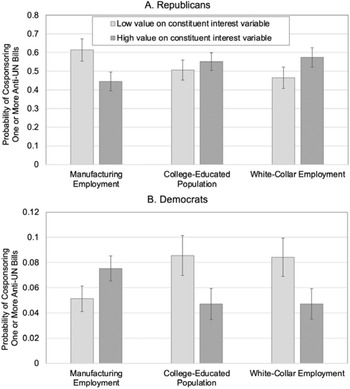
Using these data, we evaluate not only the size of the manufacturing sector but also two other indicators of constituents’ economic stakes in a relatively open world economy, a central goal of postwar multilateralism. While some manufacturing industries have remained highly competitive as the exposure to the world economy grew during the last fifty years, the effect of globalization on manufacturing employment has been a major political concern throughout this period.Footnote 56 We expect manufacturing employment to be positively associated with opposition to multilateralism, especially among Republicans, during the 1973–2018 period. The other two constituent interest variables are factor-based indicators of the distributive impact of globalization. Because high-skill workers in a capital-abundant country like the United States should see their incomes rise with greater participation in the international trading system, we expect representatives from districts with relatively skilled populations to be less skeptical of multilateralism. To capture this effect, we will examine the percentage of college-educated persons and the percentage of persons in white-collar occupations.Footnote 57
Figure 9 shows predicted probabilities of sponsoring at least one anti-UN bill for members of both parties with different constituencies. The size of the manufacturing sector had the expected effect on Democrats, though it was not substantively large. As expected during a time when American manufacturing faced growing international competition, Democrats representing districts with larger manufacturing sectors were somewhat more likely to oppose multilateralism. However, the effects of these constituent interests on Republicans were both large and the opposite of what we hypothesized. Those from districts with small manufacturing sectors were substantially more likely to sponsor at least one anti-UN measure than were Republicans from districts with large manufacturing sectors. While the source of this surprising pattern is unclear, it rules out the possibility that the negative impact of globalization on manufacturing employment explains Republican skepticism of multilateralism in recent decades.
Constituent Interests and Cosponsorship of Anti-UN Bills in the House.
Notes. Predicted probabilities assume the party mean ideology score. The whiskers indicate 95 percent confidence intervals. Numerical model results are reported in the Appendix.

The results concerning college education and white-collar employment in the district population present the same puzzle. Among Democrats, the proportion of persons with a college degree was negatively associated with sponsorship of anti-UN bills, as we expected. This effect is small but meaningful. Among Republicans, though, the effect was the opposite of what we expected. Because college education and white-collar employment capture the same theoretical relationship and are highly correlated, it is not surprising that they produce nearly identical substantive results. In this case, too, the expected relationship occurs among Democrats but not among Republicans. For Republican representatives, white-collar employment in their district is associated with more anti-UN sponsorship activity, not less. As with the results concerning manufacturing employment, this pattern is strikingly inconsistent with the claim that the negative effects of globalization are responsible for continuing Republican opposition to multilateralism in American foreign policy.
Taken together, the evidence concerning constituent interests suggests that they played a role in moving some Republicans away from their traditional skepticism of multilateralism during the middle of the twentieth century. It helped produce the split between nationalist and internationalist Republicans during the early Cold War era. This split had largely disappeared by the end of the Cold War. Results for more recent decades are puzzling but entirely inconsistent with the argument that recent Republican opposition to multilateralism reflects the interests of constituents who lose from globalization. If anything, Republicans from districts that lost from globalization were actually less skeptical of multilateralism than were Republicans from districts that tended to benefit from it.
4. Explaining the Persistence of Republican Opposition to Multilateralism
In the preceding section we reviewed two considerations that arguably should have changed the Republican Party's position on multilateralism. While both the Cold War and changing constituent interests contributed to a party split on the issue, neither led conservatives to reverse themselves. Such broad reversals in partisan or ideological positions have happened on other issues including race,Footnote 58 trade policy,Footnote 59 and military spending.Footnote 60 Why was there no similar change on the question of multilateralism? Our answer has two elements. First, changing a long-held ideological position is costly for social and political reasons, alienating some potentially important supporters. Political leaders will not do so unless maintaining the old position is even more costly. Second, agenda setting by congressional leaders avoided most legislative consideration of multilateralism in foreign policy through the end of the Cold War. This evasion protected multilateral institutions, but it also spared members of Congress from confronting the cost of opposing multilateral rules, removing pressure to revise conservative Republican orthodoxy.
4.1 The Costs of Changing an Ideological Position
Even though the internal logic of an ideology is not tight enough to force its adherents to accept a particular position, abandoning an established position is costly for political and social reasons. Once elites publicly articulate a position, partisan and ideological loyalists in the general public will tend to adopt it as well. This pattern of opinion leadership is well established in previous research.Footnote 61 Changing the position risks alienating supporters who are invested in the old one. It also makes the leader articulating the new rationale appear inconsistent and perhaps insincere. The longer the old position has been held, and the more salient it has been, the more risky changing it is likely to be. Opposition to multilateral rules might appear esoteric, but it has been a staple of conservative rhetoric for a long time, often formulated in terms of national sovereignty or opposition to “globalism.”Footnote 62
The frequent reintroduction of the Bricker amendment illustrates the social processes that reinforce the connection between opposition to multilateralism and membership in the conservative Republican political faction in Congress. By the 1970s, it was surely clear to those who introduced these bills that they had little chance of serious consideration. They nevertheless acted to demonstrate their loyalty to the conservative social circles from which they drew political support and inspiration. These demonstrations of loyalty, in turn, reinforced the faction's commitment to the policy. The remarks of Rep. John Ashbrook (R-OH) on reintroducing the Bricker amendment in January 1978 illustrate the social significance of his action:
Since I first came to Congress, I have introduced at the start of each session the famous Bricker amendment. It bears the name of that great patriot and Senator from my state of Ohio, John W. Bricker. Incidentally, it was my privilege to be present at a meeting of the United Conservatives of Ohio in Columbus last Wednesday night and to introduce Senator Bricker and Senator Lausche when they received the well-deserved recognition the UCO bestowed upon them. Both men are in their eighties but there are few now serving in the US Senate who could match their intelligence, understanding of the issues, clarity of thought and speech and, even more important, patriotism and commitment to American principles. The Senate knows few John Brickers and Frank Lausches today.Footnote 63
Ashbrook was not alone in using the Bricker amendment to demonstrate his commitment to conservative positions to activists in his home state long after its 1954 defeat. Rep. Helen Chenoweth (R-ID) introduced the measure in 1997 and 1999, receiving praise in the right-wing press for doing so.Footnote 64 Earlier in her political career, Chenoweth had served as the chief of staff for Rep. Steve Symms (R-ID), who had introduced the measure four times during his tenure in the House.Footnote 65 The Bricker amendment was not central to the careers of either Symms or Chenoweth—neither chose to discuss the measure on the House floor when they introduced it—but their actions suggest how a policy position can be transmitted socially through time. Abandoning an established position, even one as extreme as the Bricker amendment, is costly. It risks alienating some group members, impugning past and present leaders who espoused the old position, and calling into question the solidity of the group's other ideological commitments. For party leaders, reiterating the old ideological line makes sense unless there is a compelling reason to change it.
4.2 Agenda Setting and Gatekeeping
By itself, the costliness of changing an ideological position is not enough to explain continuing Republican opposition to multilateral rules. Changing the party's orthodox position was not impossible, and adherence to the old position also had costs. By the mid-twentieth century, multilateral rules had become important for managing American relationships with developed allies, as well as offering economic advantages for the American manufacturing sector with its longstanding ties to the Republican Party. The evidence reviewed in the last section suggests that these considerations led some Republicans to modify their position on the issue. Why wasn't this change broader, as it was on other foreign policy issues?
The answer to this question concerns the efforts of party leaders. They engaged in gatekeeping to keep conservative opponents of multilateralism away from leadership positions on foreign policy. They also used their agenda-setting powers to exclude from active consideration measures would have seriously undermined the role of multilateralism in American foreign policy, particularly treaty debates where a minority could prevail. These efforts shielded multilateralism from its domestic political opponents, but also prevented conservative Republicans from confronting the costs of actually repudiating American commitment to multilateral rules. It meant they had little reason to challenge party orthodoxy.
During the Cold War, presidents and congressional leaders generally supported multilateralism in foreign policy more than conservative Republicans did. This was obviously the case for Democrats, who controlled both the House and the Senate for nearly the entire period, but it remained true even when Republicans held congressional majorities. The Senate was especially important because of its treaty-ratification power. When Republicans took charge, members of its internationalist wing occupied key foreign policy positions. For instance, all of the Republicans who chaired the Senate Foreign Relations Committee during the Cold War had DW-NOMINATE scores to the left of the party mean. Indeed, this was true of every Republican Foreign Relations Committee chair between the death of Henry Cabot Lodge in 1924 and the accession of Jesse Helms in 1995. The famously internationalist Arthur Vandenberg, who sponsored the resolution ratifying the UN Charter in 1945, was actually the closest to the Republican mean during this long period. Republican presidential nominees were also more internationalist than the rest of the party during the mid-twentieth century, when the United States made its most important multilateral commitments. Things might have turned out differently if Republicans had chosen an isolationist in 1940, rather than the internationalist Wendell Willkie, or Robert Taft instead of Dwight Eisenhower in 1952.
The nature of the issue made it possible for presidents and congressional leaders to keep the question of multilateral rules off the legislative agenda. Once the United States made its major initial multilateral commitments in the immediate postwar era, multilateralism required less legislative action than military spending, where a vote on the annual budget was unavoidable, or trade policy, where occasional votes were also difficult to avoid. Presidents could use executive agreements to avoid the necessity of Senate treaty ratification. As one account of Senate treaty powers noted, “since the initial post-World War II security treaties … security commitments have been made almost entirely by means other than treaties.”Footnote 66 Indeed, ending this practice was one of the main conservative motives for the Bricker amendment. The central role of the United States in world politics also made it possible for American policymakers to exercise influence over the shape of international institutions even when the United States has not ratified—or even signed—the multilateral agreements that established them.
Avoiding floor votes about multilateral rules no doubt appeared prudent to congressional leaders. The near-passage of the Bricker amendment in 1954 vividly illustrated what might happen if there were a serious debate on the matter. The measures that died in the Foreign Relations Committee included all of the reintroduced versions of the Bricker amendment and nearly all of the anti-UN bills in our sample. Of the 292 anti-UN bills we identified between 1973 and 2018, just 10 (3.4 percent) received floor consideration and only one (0.3 percent) became law. By comparison, of the 15,406 bills related to international affairs introduced during this same period, 21.3 percent received floor consideration, and 3.0 percent became law.Footnote 67 Agenda setting affected not only efforts to turn back multilateralism but also measures that would have advanced American adherence to it. Many multilateral agreements that the Senate might have embarrassingly rejected were instead simply never debated. For example, in a direct response to the Bricker amendment, the Eisenhower administration shelved the Genocide Convention, then before the Foreign Relations Committee.Footnote 68 The same practice extended to other multilateral human rights agreements. As of 2017, the United States had ratified only seventeen of the 46 UN-sponsored human rights treaties it had signed.Footnote 69
While this strategy allowed the executive branch to operate within existing multilateral institutions largely unimpeded during the Cold War, it had the perverse effect of giving conservative Republicans no reason to reconsider their position on the issue. If they had been forced to confront the costly consequences of rejecting multilateral rules, they might have chosen to take a new position and explain it to the party faithful in terms that made it seem consonant with their other partisan and ideological positions. Vandenberg, long considered a leading conservative, did precisely this when supporting the establishment of the United Nations in 1945.Footnote 70 Even though most Republicans ended up supporting some version of the Bricker amendment in 1954, the measure discomfited some who had initially been inclined to support it, especially given the strong opposition of the Eisenhower administration. Some of the sixty-three senators who had sponsored the original measure ended up voting to weaken it, and twelve even voted against its final passage.Footnote 71 If such consequential votes had happened more often, the process might have led to a lasting change in the position associated with the conservative Republican faction.
Congressional gatekeeping and agenda setting to protect American multilateral commitments ended in the 1990s. The Republican Party became increasingly conservative, and, as we have seen, the connection between conservatism and opposition to multilateralism became stronger. The party no longer consistently chose congressional leaders or presidential candidates who supported multilateralism. When Republicans gained control of the Senate following the 1994 elections, Jesse Helms (R-NC) became chair of the Senate Foreign Relations Committee. He sponsored and secured floor passage of a series of measures intended to undermine the functioning of the International Criminal Court, the UN, and other multilateral organizations. These actions are often seen as the end of the bipartisan consensus on American foreign policy. It would be more accurate to understand them as evidence that the bipartisan consensus was never as far-reaching as it sometimes seemed.
5. Conclusion
Republicans, particularly members of the party's conservative faction, have tended to oppose American commitment to multilateral rules since the early twentieth century. They have not opposed multilateralism in every instance, but they have always been more skeptical than members of other political factions. This stance fit logically with the foreign policy that Republican leaders had developed during their period of electoral dominance before World War I. Opposition to multilateralism became party orthodoxy during the debate over the League of Nations in 1919–20. The increasing international competitiveness of the American manufacturing sector during the middle of the twentieth century, as well as the security demands of the Cold War, split the party on the issue and muted conservative unilateralism to some extent. Even so, conservative Republican skepticism of multilateral institutions never entirely disappeared, as the party's old positions on military spending and trade did. With the end of the Cold War and the increasing dominance of conservatives within the party, opposition to multilateralism reemerged as Republican orthodoxy. As the last two Republican administrations suggest, the party's position on this question is not confined to its congressional delegation and has potentially important consequences for American foreign policy and perhaps even for the prevailing world order.
As we noted in our introduction, we are not the first to identify a political current in American politics opposing multilateralism. While the evidence we have reviewed here comports with much of what previous research has found, it suggests at least three departures from some widely shared claims and premises of this work. First, there has been a substantial debate about the breakdown of bipartisanship in American foreign policy in recent decades.Footnote 72 The evidence reviewed here suggests that the premises of this debate are not entirely correct. It implies that there was a bipartisan consensus on the main elements of American foreign policy for much of the postwar era. In fact, conservative Republicans were never fully reconciled to the central role of multilateralism in the American-led world order. If they sometimes appeared to be so, it was only because party leaders held more moderate views on the issue and managed to marginalize the substantial body of conservative dissenters.
A second departure from some previous research on this topic concerns the partisan and ideological character of opposition to multilateralism. Previous research has not always recognized its roots in the Republican Party. Some research on the American “exemptionalist” refusal to ratify most multilateral human rights treaties links it to Southern segregationists’ fears about the impact of these agreements on the Jim Crow system in the 1950s.Footnote 73 While this correctly describes the thinking of many white Southern politicians, nearly all of whom were Democrats, conservative Republicans were the driving force behind opposition to multilateralism. They took this position long before serious debate over legal segregation began and maintained it long after the issue was settled. Other work on “nationalist” or “Jacksonian” opposition to multilateral rules treats these sentiments as a free-floating ideological current or one without a necessary connection to the Republican Party.Footnote 74 In principle, it is certainly true that any political actor could borrow the ideas associated with this line of argument. However, in practice, it has been strongly linked to the Republican Party for more than a century. The ideas do not float freely but are instead attached to a particular political faction.
A third departure concerns the process behind the Republican opposition to multilateralism. Most work that recognizes the party's attachment to this position explains it in terms of the ideas themselves, often logically connecting them to other conservative positions.Footnote 75 Research that does not tie the ideas to the Republican Party is even more prone to explaining them in terms of longstanding and coherent ideological traditions.Footnote 76 This line of argument is attractive because the positions are necessarily explained in terms of ideas. However, the changes in the positions associated with party and ideological labels over time suggests that these logical connections do not provide a satisfactory explanation. There are many plausible connections among issue positions. Which of these connections political leaders choose to emphasize depends as much on the grubby social processes of coalition building and maintenance as it does on the elevated rhetorical justifications these leaders offer to move the process along.
In understanding the positions of these political factions, it is important to consider their development over time. The cost of changing a position associated with a faction's ideological brand means that these positions can persist for a long period of time. Their origins may lie in the past rather than in current conditions. This should not be surprising. Because it has been more than seventy years since the end of World War II, it is easy to forget just how rapidly the world role of the United States changed in the thirty years before that event. The country went from being a marginal player in world politics to a superpower within the careers of many members of the country's political class. Many senators who voted on the Bricker amendment in 1954 had adult memories of the League Fight of 1919–20. The epochal changes of the intervening years must have been all the more bewildering because they were not planned or even widely foreseen at its beginning. Domestic and international shifts that seem permanent to us in retrospect may not have appeared so to them. It is understandable that some would resist abandoning their earlier views and expectations, particularly when their political enemies had developed the policies that constituted the new order of things.
Our findings also suggest that the prospects of reviving the (apparent) bipartisan embrace of multilateralism that prevailed during the Cold War are dim. Not only have the parties moved further apart across a wide range of issues, but also the ideological composition of the Republican Party has changed in a way that makes bipartisan cooperation in support of multilateralism less likely. In the 1940s, the appointment of prominent internationalist Republicans like Henry Stimson and Robert Lovett served as powerful signals and tools for developing policies that were palatable to both Republicans and Democrats. However, this kind of bipartisanship depended on low party polarization and the presence of a substantial number of moderate legislators with whom internationalists could build coalitions.Footnote 77 With the decline of its liberal, internationalist wing, the Republican Party has grown into a homogeneously conservative organization, and one that overwhelmingly rejects multilateral rules. This leaves Democrats, who have become the standard bearers of multilateralism, with few viable partners. And even with a Democratic Party solidly in support of U.S. involvement in multilateral institutions, the lack of a bipartisan compact underpinning that involvement may cause other states to question the long-term reliability of United States.Footnote 78
Is there any way out of this predicament? A comprehensive electoral defeat might relegate conservative Republican opponents of multilateralism to the marginal position they held during World War II and for much of the Cold War. The pattern of the last century suggests that such an outcome would be temporary. As long as the United States remains a democracy, conservative opponents of multilateralism are highly likely to return to power eventually. This is not the only possible outcome. If conservative Republicans are not politically marginalized, there may be a continuing, high-stakes debate about fundamental aspects of American foreign policy, including multilateralism. This debate might force conservative leaders to confront the actual costs of seriously undermining organizations like the UN, NATO, and the WTO, or of abrogating other American commitments under international law. Serious consideration of these costs might lead them to articulate a new position on multilateralism, just as they have done on other issues in the past. Paradoxically, the real possibility that the United States could abandon some of its most central multilateral commitments may be what is necessary to mobilize constituents interested in the issue and persuade conservative Republicans to adjust.
Supplementary material
To view supplementary material for this article, please visit https://doi.org/10.1017/S0898588X22000165.
Acknowledgments
The authors would like to thank James Bisbee, Miles Evers, Jared Finnegan, Scott Guenther, Gerda Hooijer, Elif Kalaycioglu, Katja Kleinberg, Sumin Lee, Helen Milner, Cliff Morgan, Jim Morrow, Rachel Myrick, Glenn Palmer, Francesca Parente, Abigail Vaughn, Jim Vreeland, Mitchell Watkins, Ryan Weldzius, and the participants in colloquia at Princeton University and Rutgers University for their comments and suggestions. Any remaining errors are our responsibility.
Competing Interests
The authors declare none.