Introduction
The significance of social ties to the health and wellbeing of older people has been well documented (Bennett Reference Bennett2002; Giles et al. Reference Giles, Glonek, Luszez and Andrews2005; Vanderhorst Reference Vanderhorst2005). This is particularly so for the residents of nursing homes as social contact, in the form of visiting, has been shown to maintain important relationships and provide a link between residents and their families and communities promoting quality of life (Cook Reference Cook2006; Cummings and Cockerman Reference Cummings and Cockerman2004; Piedhniczek-Buczek, Riorden and Volicer Reference Piedhniczek-Buczek, Riorden and Volicer2007; Thompson, Weber and Juozapavicius Reference Thompson, Weber, Juozapavicius and Schwartz2001). However, over the past 50 years family networks have become more dispersed and the range of available family members has contracted. The extended family has been replaced by the nuclear family and younger people are more geographically mobile, tending to move away from their homes in search of employment (Phillipson et al. Reference Phillipson, Bernard, Phillips and Ogg2001; Uhlmann Reference Uhlmann2005). In Australia this change has been reflected in a shift from family-centred aged care to a strong reliance on publicly funded services (McCallum, Simons and Simons Reference McCallum, Simons and Simons2007). For the rural elderly this situation is exacerbated by the migration of mainly younger people away from rural areas, further reducing the opportunity for social contact (Australian Bureau of Statistics 2006; Keefe and Fancey Reference Keefe and Fancey1997).
Within some rural community settings, the outflow of younger people is coupled with the influx of those who move to the country on retirement. These tend to have moved away from their adult children to a ‘tree change’ retirement and the combined effect is that many people ageing in rural environments are doing so without the local support of their adult children (Barr and Russell Reference Barr and Russell2007; Wenger Reference Wenger2001). In addition, the older person's friends are also ageing and their capacity to provide support is gradually diminished. This means that on admission to an aged care facility the resident's local social network may already be attenuated and as the facility may not be located in the resident's home town this move may constitute a further barrier to frequent visiting.
Aged care reforms in Australia, which emphasise ‘ageing in place’ and community-based aged care, have resulted in an increase in the age, and degree of frailty and dementia among nursing home residents (Australian Institute of Health and Welfare (AIHW) 2004a), a trend that is reflected internationally (McCann, O'Reilly and Cardwell Reference McCann, O'Reilly and Cardwell2009). Therefore, the visits of family and friends have become even more important to the quality of life of residents as they provide the social contact that many are unable to initiate for themselves. If social contact is not initiated and maintained then the possibility of social isolation for these residents becomes very real. The visits of the members of the resident's social network also provide the nursing home staff with an opportunity to benefit from their intimate knowledge of the resident's life history and health status (Robison et al. Reference Robison, Curry, Gruman, Porter, Henderson and Pillemer2007). This knowledge is important to the formulation of personalised care plans by nursing home staff and it is vital that the factors that encourage or discourage family and friends from visiting at the nursing home are identified.
While it has been recognised that residents form relationships within the facility both between themselves and with members of staff (Brown-Wilson, Davies and Nolan Reference Brown-Wilson, Davies and Nolan2009; Cook and Brown-Wilson Reference Cook and Brown-Wilson2010; Hubbard, Tester and Downs Reference Hubbard, Tester and Downs2003), it has also been shown that relationships with staff ‘tend to be functional with a focus on the task of caregiving’ (Cook and Brown Wilson Reference Cook and Brown-Wilson2010: 28). Also, the generally high level of disability among residents, involving hearing and visual impairments and cognitive decline, limits the establishment of new relationships within the nursing home and it has been proposed that social and emotional isolation are common (McKee, Harrison and Lee Reference McKee, Harrison and Lee1999). In addition, residents' most significant relationships are often with those family and friends who live outside the facility (Cook Reference Cook2006; Edwards, Courtney and O'Reilly Reference Edwards, Courtney and O'Reilly2003) and the maintenance of contact with these people is very important to the resident's quality of life. Therefore, this study aimed to focus on relationships with people external to the nursing home and to examine the factors that predict more frequent visiting.
There are three further considerations, unique to the rural setting, which have the potential to further decrease the opportunity for visiting after an older person enters a rural nursing home. First, the greater geographical distance between these facilities decreases the likelihood that the resident is placed near to family members and thereby increases the distance that visitors are required to travel (Gibson, Braun and Liu Reference Gibson, Braun and Liu2002). Second, as a result of this greater distance, more time and expense is required to make the journey. Third, the lack of public transport in rural areas and particularly transport that meets the needs of the frail aged, increases the difficulty of visiting (Corcoran, James and Ellis Reference Corcoran, James and Ellis2005; Nutley Reference Nutley2003).
Literature review
In order to provide a context for this research a comprehensive search of the research literature on families and the residents of aged care facilities published in peer-reviewed journals of gerontology, nursing and the social sciences from 1980 to the present was undertaken. Electronic databases searched were: Proquest, Current Contents, Emerald Fulltext, Australian Bureau of Statistics, Expanded Academic (Infotrac), Health and Medicine Complete, Social Science Plus, Psych Litt, APAIS (Australian Public Affairs Information Service), FAMILY (Australian Family and Society Abstracts), CINAHL (Cumulative Index of Nursing and Allied Health Literature), MEDLINE (MEDical Literature Analysis and Retrieval System onLINE), Family and Society Plus (Informit) and Sociological Abstracts. Key search terms employed were: rural areas, rural ageing, older people, family, family relationships, social networks, social support, nursing homes, institutionalisation, visiting, carers, care-giving, residential aged care, and aged care.
This review of the literature revealed a paucity of recent research on the determinants of frequent visiting at residential aged care facilities and none that examined the rural Australian context. Further, it has been shown that while 90 per cent of older Australians living in their own homes have weekly contact with their family and friends, there is no such data on the social contact received by the residents of aged care facilities (AIHW 2009).
There is some debate in the literature regarding the frequency of visiting at nursing homes. In the 1980s and 1990s, studies conducted in urban Australia, Canada and the United States of America (USA) found a generally high frequency of visiting (Keefe and Fancey Reference Keefe and Fancey1997; Port et al. Reference Port, Gruber-Baldini, Burton, Baumbarten, Hebel, Zimmerman and Magaziner2001) with a reported range of 60–75 per cent of residents receiving at least weekly visits (Hook, Sobal and Oak Reference Hook, Sobal and Oak1982; Minichiello Reference Minichiello1987). The frequency of visits by family members also varied considerably, with 31–80 per cent visiting at least weekly (Keefe and Fancey Reference Keefe and Fancey1997; Ross, Rosenthal and Dawson Reference Ross, Rosenthal and Dawson1997). More recently, Port et al. (Reference Port, Zimmermna, Williams, Dobbs, Preisser and Wallace Willimas2005) have shown that family members visit at least monthly and for a mean of four hours per week. Family and friends maintained contact with residents and the myth of ‘abandonment’ was widely reported to have been dispelled (Port et al. Reference Port, Gruber-Baldini, Burton, Baumbarten, Hebel, Zimmerman and Magaziner2001; Thompson, Weber and Juozapavicius Reference Thompson, Weber, Juozapavicius and Schwartz2001).
On the other hand, studies conducted in the USA show that there has been a significant decrease in visiting following placement in a nursing home (Bitzan and Kruzich Reference Bitzan and Kruzich1990) and that up to 40 per cent of residents received visits less than weekly (Naleppa Reference Naleppa1996). Minichiello (Reference Minichiello1989) found that the proportion of Australian family and friends who saw the older person daily decreased from 16 to 1 per cent following the move to an urban nursing home. It has also been found that visiting is often restricted to only one or two individuals (Bitzan and Kruzich Reference Bitzan and Kruzich1990) and that some Australian residents of urban facilities receive no visitors at all (Moyle, Edwards and Clinton Reference Moyle, Edwards and Clinton2002).
According to US and Canadian authors, the most frequent visitors to residents are their closely related kin: spouse and children (Gaugler, Zarit and Pearlin Reference Gaugler, Zarit and Pearlin2003; Port et al. Reference Port, Gruber-Baldini, Burton, Baumbarten, Hebel, Zimmerman and Magaziner2001; Yamamoto-Mitani, Aneshensel and Levy-Storms Reference Yamamoto-Mitani, Aneshensel and Levy-Storms2002). However, in Australia, grandchildren and friends have also been found to play a role in the social lives of residents (Minichiello Reference Minichiello1987) and US studies have shown that spouses are not frequent visitors (Greene and Monahan Reference Greene and Monahan1982; Hook, Sobal and Oak Reference Hook, Sobal and Oak1982). Hook, Sobal and Oak (Reference Hook, Sobal and Oak1982) found that the majority of visits were made by close relatives: daughters (22.3%), sons (18.5%) and grandchildren (17.0%); and that friends were also well represented (17.2%) while spouses made up only 1.1 per cent of visitors. The remainder of visitors were siblings, cousins, nieces and nephews, parents, and aunts and uncles.
It has also been shown that Australian nursing homes that provide a welcoming and comfortable environment for the family and friends of residents encourage greater family involvement (Kellett Reference Kellett2007; Marquis, Freegard and Hoogland Reference Marquis, Freegard and Hoogland2004). Further, a resident's declining mental health can have an impact on visiting to nursing homes and most researchers agree that family members report feelings of dissatisfaction, discomfort and stress associated with visiting a family member who has a cognitive impairment (McCallion, Toseland and Freeman Reference McCallion, Toseland and Freeman1999; Port et al. Reference Port, Gruber-Baldini, Burton, Baumbarten, Hebel, Zimmerman and Magaziner2001).
Also, other resident and facility variables that have been implicated in frequency of visiting have not been considered in relation to each other and to visitor variables. In addition, research that considers the resident's entire (potential) social network to identify both those members who are frequent visitors and those who are not, has not been undertaken. Therefore, the aim of this study was to gather information on residents' entire social networks, on aged care facilities and on the residents themselves, in order to consider the full context of visiting and identify the major determinants of frequent visiting.
For the purposes of this study the term rural describes those towns whose small population base and geographic location or distance from a metropolitan centre is such that they are considered to be rural by the Rural, Remote and Metropolitan Areas Classification Method (AIHW 2004b).
Design and methods
A survey design was utilised that incorporated structured telephone surveys conducted with two groups of people; the Directors of Nursing at each of the 13 residential aged care facilities in the rural New England area of New South Wales, Australia and a key member of the social networks of the residents of these facilities, who acted as the resident's proxy.
Sampling
The entire population of nursing home residents were invited to participate through an invitation to each resident's designated next-of-kin. All next-of-kin who indicated a willingness to participate were interviewed. Initially, the researcher had planned to gather data from nursing home residents themselves regarding the visiting habits of their family and friends. However, a pilot study revealed that the generally poor health and frailty of the majority of these residents made it difficult for them to participate in such a wide-ranging survey. Therefore, the decision to gather data on the residents' network of family and friends from each resident's designated next-of-kin was taken and 257 proxy participants of a possible 652 were interviewed.
The person responsible for paying the resident's nursing home accounts was chosen as a proxy participant for three reasons. First, it was assumed this person was a trusted member of the resident's social network as he/she was responsible for managing the resident's financial affairs. Second, in the majority of cases this person was also the resident's next-of-kin which confirmed his/her suitability to speak on behalf of the resident, as he/she would have a detailed knowledge of the resident's social network. Third, the researcher was able to make contact with this person easily by including a letter of invitation to participate in the study with the resident's monthly nursing home accounts.
The effectiveness of the use of proxy participants is determined by two factors. First, if more general and less personal information is required the data obtained from the proxy participant is likely to be more valid. Second, if the proxy is closely related to the participant, for example, spouse or adult child, the data are also likely to be valid (Phillips and Goodman Reference Phillips and Goodman2001; Roshwalb Reference Roshwalb1982). As the current study aimed to gather general information from a close family member, the use of a proxy informant was considered appropriate.
Instruments and procedures
Telephone surveys conducted with the Directors of Nursing were a modified version of Minichiello's (Reference Minichiello1989) validated schedule that comprised questions about the facility including its location, bed capacity, number of nursing staff, and the facility's policy and procedures regarding visitors. This modified survey was also tested at the pilot stage of this study.
The content of the telephone survey with residents' proxies was formulated from the literature and Hook, Sobal and Oak's (Reference Hook, Sobal and Oak1982) previously validated measure of frequency of visiting. This survey comprised a composite set of 36 questions that gained a wide range of descriptive data on residents and their social networks and consisted of three sections. Section One obtained a profile of the resident's social network, for example, the composition of the network and its size and interconnectedness. Section Two gathered data on the individual members of that network including age, gender, relationship to the resident and distance travelled to the facility. Section Three focused on the resident and gathered such information as the degree of disability experienced by the resident and the length of time the resident had lived at the facility.
Face validity was first established by using the information gleaned from the review of the literature as a guide (Polit, Beck and Hungler Reference Polit, Beck and Hungler2001). As the majority of questions in this study involved the measurement of simple concepts that required only descriptive responses to single-item scales (Rodeghier Reference Rodeghier1996), the validity of most questions was established during the pilot study by assessing their clarity and determining whether all participants understood the questions in the same way (Parahoo Reference Parahoo1997).
The reliability of this instrument with regard to stability, homogeneity and equivalence could not be established as repeated testing and statistical examination of the majority of items were not possible. The scales that could be examined statistically for reliability, that is, the quality of relationship scales, showed good homogeneity with a Cronbach alpha coefficient of 0.89. Also, as only one researcher collected the data, equivalence or inter-rater reliability was not a concern. However, the reliability of this instrument will require testing in future studies.
Data analysis
Following initial data screening it was necessary to collapse response categories into a smaller number of groupings in order to enable meaningful analysis using multivariate techniques (Tabachnick and Fidell Reference Tabachnick and Fidell2007). The distribution of the dependent variable, frequency of visit, was positively skewed (4.1) with marked positive kurtosis (19.7) and was collapsed into two categories, once and more than once per month, using the median as the point of division (Pallant Reference Pallant2007).
The broad aspects of the data: facility, resident and social network attributes, formed three levels that were structured in a hierarchical manner, with the possibility that the levels within the hierarchy would differentially influence the outcome variable. Therefore, multi-level logistic regression was selected as the most appropriate data analysis technique (Healy Reference Healy, Leyland and Goldstein2001).
Before undertaking multivariate analysis, univariate multi-level logistic regression analysis was performed to test systematically a series of models to determine which of the explanatory variables were significantly related to the outcome variable. This was followed by Chi-square analysis to detect significant correlations between identified predictor variables in order to avoid multicollinearity in the logistic regression analysis (Tabachnick and Fidell Reference Tabachnick and Fidell2007).
Findings
Level Three variables: the nursing home
The size of the aged care facilities varied between 23 and 80 beds (mean 50.9) and the total population of residents was 652. All participating Directors of Nursing reported similar staff to resident ratios and having formal policies that provided for the involvement of family and friends.
Level Two: the resident
Data were received on behalf of 257 residents who ranged in age from 65 to 105 years with a median of 85 years and the majority were female (73.5%) and widowed (64.6%). They had been living at the facility for between one month and 25 years with a median length of stay of two years.
In keeping with the general picture of advanced age, the majority (54.9%) of residents had both a physical disability and dementia. A smaller proportion (27.6%) had only a physical disability while a minority (17.5%) had only dementia. For those who had dementia, 79.1 per cent were rated as moderately to severely affected.
The majority of residents (61.7%) were born within 100 kilometres of the nursing home and had lived in the local area for most of their lives with only 15.7 per cent having moved further than 100 kilometres to live at the facility. Before living at the nursing home the majority (58.4%) had lived either alone or with their spouse or partner.
Level One: the social network
Participants provided information about 3,738 people who formed the potential social networks of 257 residents. The size of these social networks ranged from two to 52 with a mean of 18.7 and a median of 17 people.
The sample of social network members comprised 1,662 (45.1%) males and 2,021 (54.9%) females. Gender was not provided for 55 potential social network members. Their ages ranged from ten weeks to 100 years with a median of 50 years. The age of 28 social network members was not known. Grandsons made up the largest proportion of the whole social network sample (16.3%), ‘others’ was the next largest (15.7%), followed by granddaughters (15.7%), siblings (9.0%), daughters (8.6%), sons (8.1%), friends (7.0%), brothers- and sisters-in-law (7.0%), daughters-in-law (5.5%), sons-in-law (5.5%), and spouses (1.7%). Age was not provided for 28 potential social network members. Friends were defined broadly as any person who had a relationship with the resident other than that of family member. While the majority of a resident's friends were of the same age group as the resident, almost one-third (27.6%) of friends were aged 50–69 years and so were more in the generation of the resident's children. The relationship categories that comprised only a small number of people, less than 5 per cent of the sample, and which did not constitute a significant relationship to the resident, for example cousin, were categorised as ‘other’. A minority of social network members (23.6%) were seen as having a neutral or negative relationship with the resident and the majority (76.4%) had a positive relationship.
The health of over one-third (37.1%) of social network members was reported as excellent. For the remainder, 18.8 per cent were assessed as being in very good health, 22.8 per cent as having good health, 11.8 per cent fair health, and 6.8 per cent as having poor health. In congruence with the proportion of this sample assessed as being in poor health, 244 (6.7%) were reported to require some assistance with their activities of daily living (ADL) due to illness and/or frailty. Twenty-one per cent of residents' spouses, 20.4 per cent of siblings and their spouses, and 16.3 per cent of friends were reported to require such assistance.
Two hundred and forty-seven (6.6%) network members regularly provided care for another person with the majority of carers (62.2%) aged between 50 and 69. The majority of these carers (63.8%) were children and children-in-law and, to a lesser extent (17.1%), friends of the resident.
A large proportion (63.6%) of social network members lived in close proximity (within 100 kilometres) to the nursing home, with 21.0 per cent living within five kilometres, and 42.6 per cent within 100 kilometres. With the exception of spouses and friends, the majority lived more than 100 kilometres from the facility. Sixty-six per cent travelled to the nursing home in their own motor vehicles while 22.8 per cent were either reliant on another person or on public transport. This percentage represents two groups of people, the very elderly who may be too frail to transport themselves (8.4%) and the younger members of the network who were not yet old enough to be independent travellers (11.45%).
Occasional visitors (those who visited fewer than six times per year) made up 72.9 per cent of the sample while very frequent visitors (those who visited weekly or more) constituted 16.1 per cent of this sample. These data represent a wide range of visiting frequency with the largest single group (30.5%) being those who did not visit at all. For each resident, frequent visitors (those who visited monthly or more) constituted a group with a median of 2.4 people.
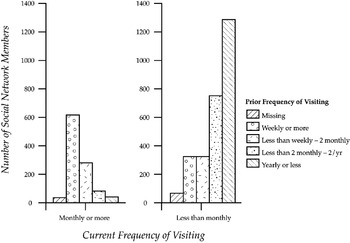
The frequency of contact prior to nursing home placement was generally maintained. However, as Figure 1 shows, a significant number of previously very frequent (weekly or more) visitors reduced their visits after the person entered the nursing home. Many of these people reduced direct contact with the resident to a maximum of six times per year and a significant number did not visit at all. The most notable decrease was in the group of previously daily visitors whose numbers declined from 336 to 91.
Current frequency of visiting compared to frequency of visiting prior to admission to the nursing home.

The length of time the resident had lived at the nursing home was associated with a decline in the number of visitors, which began when the resident had lived at the nursing home for two years and was marked when length of residence was four years or more. The decline was general and applied to both frequent and infrequent visitors.
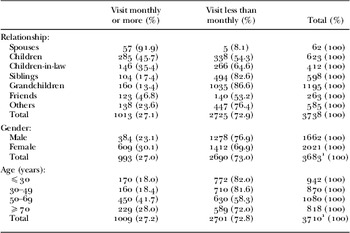
Table 1 presents cross-tabulations of frequency of visiting by age, gender and relationship. These data show that more frequent visitors were older, generally female and more closely related to the resident. In addition, residents' friends, who were unrelated to the residents, were frequent visitors. Less frequent visitors were younger, generally male and less closely related to the resident.
Frequency of visiting by the relationship, gender and age of social network members (N=3,738)

Note: 1. Data missing.
Time and distance constraints were the most often cited barriers to more frequent visiting with 43.6 per cent of responses falling into this category. The next most cited response (14%) was that the person had no constraints on more frequent visiting and this was given to describe two situations. The first was that the social network member was a frequent visitor because there were no constraining factors. The second was that the social network member visits infrequently because he/she did not want more frequent contact.
The third most cited constraint (9.8%) on visiting was transport problems. In the majority of cases these problems involved social network members who did not have their own transport or easy access to public transport. A further 9 per cent of reasons for less frequent visiting were given as a social network member's inability to cope with the resident's circumstances. For example, the person was unable to cope with the resident's dementia or with the nursing home environment in which the resident was living. A final category (8.2%) of response was labelled ‘has own life’ by the researcher as many of the participants responded by using these words. This response involved those social network members whose daily lives did not involve the resident as they were preoccupied with the events in their own lives.
Univariate multi-level logistic regression analysis
At the univariate multi-level logistic regression analysis there were 11 variables that were found to be significant predictors of frequency of visiting. All of these 11 variables were Level One social network variables (relationship to the resident, gender, age, health status, having the responsibility of caring for another, requiring assistance with ADL, quality of relationship with the resident, having constraints of time, having constraints of distance, having constraints of transport, having no constraints). Three variables which were significant predictors of frequency of visiting were also identified as significantly related to each other (χ2=0.000) and, to avoid colinearity in the equation, were excluded from the univariate multi-level logistic regression analysis as redundant. As the social network member's relationship to a resident was significantly related both to the quality of the relationship and the gender of the network member, a decision was made to remove the variable relationship to the resident from the multivariate analysis. (The quality of the relationship was classified using Minichiello's (Reference Minichiello1989) method. This method asks the participant to provide a brief history of the relationship between the resident and the social network member. The response is then coded numerically according to the language used in the response as a positive, neutral or negative relationship.) A social network member's age, health, independence in travel and independence in ADL were also highly correlated with each other. In this case independence in ADL was retained in the multivariate analysis as this variable more directly describes attributes of the social network member that may have an impact on frequency of visiting. As it is essential that predictor variables within the regression model are independent, co-related variables must be removed to minimise colinearity. It is important to note that highly co-related items were not removed from the conceptual model but merely from the regression analysis to improve the precision of the final model.
A parsimonious multivariate logistic regression model was developed following the completion of Chi-square analysis. The model contained nine explanatory variables that had a statistically significant relationship with the outcome variable. A significant positive relationship was found between frequency of visiting and the following social network predictor variables: female gender; independence in ADL; the quality of the relationship with the resident; having constraints of time; having no barriers to the frequency of visiting. A significant negative relationship was found between frequency of visiting and the following social network predictor variables: having the responsibility of caring for another person; the distance the social network member lived from the facility; having distance as a constraint on visiting; having transport problems.
Multi-level multivariate logistic regression analysis
MLwiN software was used to undertake multi-level multivariate logistic regression. At the first modelling run of this analysis, the distance the network member lived from the nursing home was dropped and at the second, transport difficulties as a constraint on frequent visiting was also dropped. The final model included all the variables listed above with the exception of the two that were dropped at the first and second runs of the model.
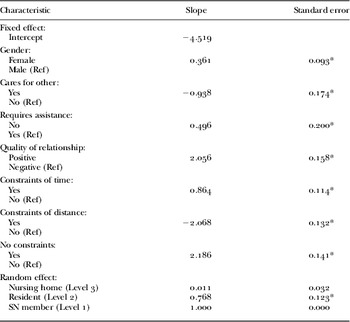
The multivariate multi-level model presented in Table 2 shows seven Level One social network variables are significant predictors of frequent visiting (gender of the social network member, having the responsibility of caring for another person, requiring assistance with ADL, the quality of the relationship with the resident, having constraints of time, having constraints of distance, having no barriers to frequency of visiting). This model also presents the three levels of data and shows a significant variance component at the Level Two (resident level) which represents 43 per cent (0.768/1.779) of the total variance and 98.6 per cent (0.768/(0.011+0.768)) of the variance of the higher level (Level Two (resident) and Level Three (nursing home)) components. Thus, the majority of the variation in frequency of visiting is derived from resident factors rather than nursing home factors. The major factor in predicting frequency of visiting at these nursing homes concerned the resident.
Multi-level multivariate logistic regression analysis

Notes: Ref: reference group. SN: social network.
Significance level: *p<0.05.
In summary, three stages of data analysis have been described; descriptive univariate analysis, univariate multi-level logistic regression analysis and multivariate multi-level logistic regression analysis. At stage one, frequency distributions and measures of central tendency were used to provide a picture of the attributes of the sample of nursing homes, of residents and of social network members. At stage two, significant predictor variables for frequent visiting were identified and the significant contribution that resident variables play in influencing frequency of visiting was recognised. At the third stage of analysis the predictor variables identified at the first stage of analysis were entered into the multivariate multi-level logistic regression model and a final model for predicting frequent visiting at these nursing homes was produced. Seven significant predictors of frequent visiting were identified.
Of the Level One (social network) components of the model, the social network attributes identified as determinants of frequent visiting in the above logistic regression model describes two groups of visitors. These groups have two common attributes; their generally female gender, and their high quality of relationship with the resident. The first is a generally older group who were either infirm themselves and required care (spouses and siblings and their partners) or who provided care for another person (children and children-in-law). They were constrained from frequent visiting by their need to be cared for or to care for another. They were further constrained from visiting by distance, which may be a reflection of their decreased ability to travel in addition to the actual distance involved. This group was likely to involve the spouses and siblings of the resident. The second group was a younger and/or more healthy group who either had no constraints on the frequency of their visits or who felt constrained by a lack of time. This group were more likely to be the children and grandchildren of the resident who were either retired and therefore had no constraints on their time or who were employed and prevented from more frequent visiting.
Resident variables combined with the significant social network variables had a joint impact on frequency of visiting. The profile of frequent visitors described above was influenced by resident factors. More frequent visitors may have been influenced by the quality of their relationship with the resident. In addition, resident factors including the resident's advanced state of dementia, having previously lived alone, having been born in the local area and having lived at the facility for a relatively short period of time exerted a significant influence on the frequency of visits.
Discussion
While the wider, potential, social networks of these 257 residents comprised approximately 17 people and involved a wide range of family and friends, their actual social networks comprised approximately two females, daughters and friends, who had high-quality relationships with the resident and who visited at least once per month. They did not include more distant kin nor the younger members of the resident's social network. The size of residents' actual networks were small compared to the six to seven people in the networks reported by Mugford and Kendig (Reference Mugford, Kendig and Kendig1986), the five to seven people reported by Wenger (Reference Wenger and Jeffreys1989), and 14–35 people reported by Powers (Reference Powers1992). This finding indicates that, over the last two decades, there has been a significant decline in the social contact received by residents and contrary to the findings of a number of studies (Campbell and Linc Reference Campbell and Linc1996; Keefe and Fancey Reference Keefe and Fancey1997; Minichiello Reference Minichiello1987; Thompson, Weber and Juozapavicius Reference Thompson, Weber, Juozapavicius and Schwartz2001; Yamamoto-Mitani, Aneshensel and Levy-Storms Reference Yamamoto-Mitani, Aneshensel and Levy-Storms2002) shows that these residents may be at risk of social isolation.
Females formed the greater proportion of visitors and gender was an important predictor of frequency of visiting. This conclusion is also contrary to the findings of the majority of previous studies which contend that while females form the greater proportion of visitors, males who visit do so as frequently as females (Campbell and Linc Reference Campbell and Linc1996; Hook, Sobal and Oak Reference Hook, Sobal and Oak1982; Keefe and Fancey Reference Keefe and Fancey1997; Kelley et al. Reference Kelley, Swanson, Maas and Tripp-Reimer1999; Penrod, Kane and Kane Reference Penrod, Kane and Kane2000).
The greater participation of females among visitors in this study is attributed to two factors. First, the majority of residents were female and widows. Thus, the population of male spouses who were potentially frequent visitors is greatly reduced. A second contributing factor is the traditional role of female family members. Residents' daughters and female spouses are more likely to have undertaken a caring role prior to nursing home placement and this role was continued following such placement. This traditional role is common among women of the older age groups to which the spouses and daughters of this sample belong (Brody, Dempsey and Pruchno Reference Brody, Dempsey and Pruchno1990; Douglas and Davis Reference Douglas, Davis and Davis1994). In addition, residents and staff are overwhelmingly female (Chappell Reference Chappell, Minichiello, Chappell, Kendig and Walker1996) and this feminisation of the care environment may serve to discourage male participation particularly as such participation in the care of the elderly within the community is already low (Courtney, Minichiello and Waite Reference Courtney, Minichiello and Waite1997).
While the literature reports that wives and daughters provide expressive and physical support (Brody, Dempsey and Pruchno Reference Brody, Dempsey and Pruchno1990), sons have been shown to provide support in the form of household maintenance and financial advice (Campbell and Martin-Matthews Reference Campbell and Martin-Matthews2003). However, the opportunity to undertake these traditional male roles is removed when the older relative moves to a nursing home and sons may feel redundant. The loss of these important roles for male relatives could form a barrier to frequent visiting and account for the decreased number of males who visited the facility. This has implications for rural nursing homes who may need to consider strategies for increasing male participation within their facilities.
While older social network members, such as siblings, were generally shown to be less frequent visitors, in the case of single residents where spouse and children were unavailable, siblings and friends did visit. This implies that older social network members make the effort to visit the resident despite their own age and frailty if there is no other closely related family member available. This supports the proposition that those lower on a resident's social network hierarchy assume the responsibility for visiting when more closely related kin are not available (Penning Reference Penning1990; Phillipson et al. Reference Phillipson, Bernard, Phillips and Ogg2001). This may mean that visitors are motivated by a sense of responsibility rather than a desire to spend time with the resident. Such a pragmatic approach to visiting may be prompted by a resident's level of dementia which may make visiting seem more like a duty than a pleasurable social interlude. Alternatively, Wenger (Reference Wenger2009) has found that older, childless people develop closer relationships with distant kin and place a high value on friendships. In this case the greater frequency of visiting from siblings and friends may be a reflection of the generally high quality of these relationships.
While the majority of a resident's friends were of the same age group as the resident, almost one-third of friends were aged 50–69 years and so were more in the generation of the resident's children. Therefore, as Nocon and Pearson (Reference Nocon and Pearson2000) and Barker (Reference Barker2002) suggest, elderly residents form relationships with younger people as those of their own age group become less available. For example, a resident's daughter may have friends who take on the role of friend to that resident in order to assist with the task of visiting. In addition, visitors may form friendships with other residents when the opportunity arises. That is, in the course of visiting a parent they form a link with the parents' room-mate. Single and childless residents may also have formed relationships with nieces and nephews or friendships with younger people prior to admission to the facility (Wenger Reference Wenger2009) and the quality of these relationships is reflected in their frequency of visiting.
The effect that resident's dementia has on decreased visiting shown in this study is supported by previous research (Keefe and Fancey Reference Keefe and Fancey2000; Port et al. Reference Port, Gruber-Baldini, Burton, Baumbarten, Hebel, Zimmerman and Magaziner2001). Keefe and Fancey (Reference Keefe and Fancey2000) also conclude that family members feel a decreased sense of responsibility to visit a family member who has dementia. It was also found, in this study, that the most significant effect is seen among the younger members of a resident's social network, his/her grandchildren and great-grandchildren. These younger and less closely related family members, who are lower on the family hierarchy of responsibility (Penning Reference Penning1990; Phillipson et al. Reference Phillipson, Bernard, Phillips and Ogg2001), already feel a decreased sense of responsibility to care for an elderly family member. This feeling of responsibility is further decreased if the resident has dementia. In addition, because social interaction with a person who has severe dementia is difficult and can be distressing this serves to further decrease the likelihood of frequent visiting.
A further finding of this study, which is supported by previous research, is that the longer a resident lived at the nursing home the less frequent were visits from actual social network members (Gaugler, Anderson and Leach Reference Gaugler, Anderson and Leach2003; Greene and Monahan Reference Greene and Monahan1982; Hook, Sobal and Oak Reference Hook, Sobal and Oak1982; Stull et al. Reference Stull, Cosbey, Bowman and McNutt1997). This study found that the decline in frequency of visiting began on admission to the facility and was most notable after four years. In addition, those residents who lived at the nursing home for a longer period of time were more likely to have severe dementia, reflecting the progressive nature of this disease. This decline in the frequency of visiting over time is attributed to the small size of a resident's actual social network and the age of its members. As there are only two people who see a resident regularly and as these people are the older members of the network, the passing of time will see increasing debility in this network and a consequent inability to visit as frequently. This finding is supported by Cook (Reference Cook2006) who found that residents have often outlived their friends and that illness and disability in both the resident and his/her friends make the maintenance of contact with friends difficult. In addition, residents' daughters also have the responsibility of caring for others including spouses and grandchildren, further limiting their ability to visit, particularly over long periods of time. As other, younger members of the network are less likely to be involved with a resident there are few to take over the responsibility of visiting when older network members can no longer sustain frequent visits. Therefore, the increasing length of residence and advancing frailty and dementia among residents and visitors is associated with a decrease in the number of social network members who are able to visit.
In addition, a number of potential social network members who had frequent contact with the older person before admission to the nursing home reduced the frequency of this contact following admission. As facility variables were not shown to be significant predictors of frequency of visiting, three possible explanations for this reduction in contact are proposed. First, the social network member shared a home with the resident and therefore saw the resident on a daily basis. Once the resident moved to the nursing home the family member was able to choose his/her frequency of visiting. Second, the resident's frail condition prior to nursing home admission necessitated frequent visiting in order to offer expressive and instrumental support but following admission such frequent contact was no longer required. Third, the resident had moved to a nursing home that was located some distance from the potential social network member, which made visiting more difficult. Further, a large proportion of residents in this study had no options regarding the nursing home they chose, as only one nursing home was available to them. Previous studies have reported this lack of choice as a reflection of the geographical distance between rural nursing homes (Minichiello Reference Minichiello1987) and the shortage of nursing home beds (Gibson, Braun and Liu Reference Gibson, Braun and Liu2002). Also, care-giver strain may have reached a crisis point and the first available bed was accepted regardless of its location. Placing the resident at some distance from previously frequent visitors would account for this decrease in the frequency of their visiting.
In this study, residents who were born in the local area of the nursing home received more frequent visits. This finding is supported by previous studies (Cloutier-Fisher and Joseph Reference Cloutier-Fisher and Joseph2000; McLaughlin and Jensen Reference McLaughlin, Jensen, Coward and Krout1998) which found that the rural elderly who are long-standing residents of the area have larger networks of family, friends and neighbours who were available to be frequent visitors. However, as neighbours are not shown to be frequent visitors in this study and the younger and less closely related social network members are also infrequent visitors, it is concluded that those who lived in the area for the majority of their lives are more likely to have close kin and friends living nearby. In contrast, those who have lived in the area for a shorter time have adult children who are more likely to be living at a greater distance from the nursing home and less able to visit frequently and may not have been living in the area long enough to have formed close friendships with local people (Barr and Russell Reference Barr and Russell2007).
Residents who have lived alone prior to nursing home placement were more likely to receive frequent visits than those who had lived with a spouse, child or other family member. This finding was unanticipated as Wenger (Reference Wenger and Jeffreys1989) found that the rural elderly who live alone have attenuated social networks and are more vulnerable to social isolation. However, in this study, those who were able to live alone may have had lower levels of dementia on admission to the facility and this may have encouraged more frequent visiting. Also, those living alone prior to nursing home placement may have been more likely to receive visitors because they did not have a spouse and visiting patterns established in the community may have been transferred to the nursing home, despite the travel.
While a number of authors (Kellett et al. Reference Kellett, Moyle, McAllister, King and Gallagher2010; Marquis, Freegard and Hoogland Reference Marquis, Freegard and Hoogland2004; Yamamoto-Mitani, Aneshensel and Levy-Storms Reference Yamamoto-Mitani, Aneshensel and Levy-Storms2002) have found that visitors value having a role to play and good communication with staff, nursing home variables were not identified as predictors of frequent visiting in this study. This may be interpreted in two ways. First, the most significant circumstances that determined frequency of visiting in these rural nursing homes were those between the social network member and the resident. Whether or not people are frequent visitors depends on resident attributes, their own circumstances and the quality of their relationship with the resident. The second possibility is that the nursing homes in this area varied so little that they each had a similar effect on visiting. For example, all these nursing homes are located in one region and they have a common rural setting and identity and provide a similar service to residents and their families. The uniformity with which the Directors of Nursing answered the questions on nursing home policy illustrates this point.
Limitations of the study
The researcher recognises the existence of two methodological limitations in this study. First, the use of a non-probability convenience sample is acknowledged as a methodological limitation because an element of bias in the sample cannot be excluded. However, this sampling method allowed the researcher to maximise the number of participants, which increased the range of the data collected.
The second methodological limitation to this study was the use of a single proxy participant who provided data on behalf of the resident and the members of the resident's potential social network. However, this method allowed the collection of data regarding a group of frail elderly people who in the main were unable to speak for themselves. Previous such studies have been limited by a lack of data from this group and the use of proxies in this study allowed an insight into the social lives of these people.
Conclusions and recommendations
As the social networks of nursing home residents are likely to be attenuated, it is important that nursing staff are aware of all the possibilities for social contact for a resident. Therefore, it is vital that nursing homes identify those residents most at risk of low levels of social support and take steps to ensure the maximum social contact possible. For example, nursing homes should include a social network profile in their admission procedures that identifies the resident's actual social network members who are located near to the facility and who have a close relationship with the resident, such as spouses, children and friends. Documenting a resident's social network profile at admission would also make the nursing home staff aware of potential social network members who are likely to be less frequent visitors, such as siblings, grandchildren and great-grandchildren. This would allow the staff to consider possible social contacts for the resident plus the difficulties that these members might face in frequent visiting.
Another strategy for improving the social lives of rural nursing home residents is to address the significant negative impact that dementia has on visiting. It is recommended that nursing homes provide the family members with strategies for communicating with these residents that include alternatives to verbal communication. For example, physical strategies for communicating via touch, such as massage techniques, might be learned (Doherty et al. Reference Doherty, Wright, Aveyard and Sykes2006; Gleeson and Timmins Reference Gleeson and Timmins2004). These strategies may make the time the visitor spends with the resident more meaningful, which would increase their feelings of satisfaction and their involvement in the care of the resident. In addition, the resident would benefit from the extra physical contact and the soothing effect of massage. Strategies for communicating with people who have dementia such as the Augmented and Alternative Communication strategy developed by Bourgeois, Fried-Oken and Rowland (Reference Bourgeois, Fried-Oken and Rowland2010) or the skills training programme for communication with dementia proposed by Judge, Yarry and Orsulic-Jeras (Reference Judge, Yarry and Orsulic-Jeras2010), could be included in a community education programme. This would help family members and the broader community to understand resident behaviours and to cope with the progressive decline in cognitive functioning, which is typical of dementia. Such an educational programme would also serve to reduce any anxiety that younger family members or those taking on roles such as volunteering might experience.
A further strategy for involving family members in the care of the resident is to use a technique known as Family Biography. Kellet et al. (Reference Kellett, Moyle, McAllister, King and Gallagher2010) have shown that involving family members and nursing home staff in building a biography of the person with dementia allowed family to see beyond the disease and remember the whole person. It also provided staff with the opportunity to understand the person within the family context, which had flow-on effects for improved relationships with family members and improved care for the resident as staff knowledge regarding initiating and engaging was enhanced.
Strategies for increasing the participation of males within the nursing home might include considering a campaign to increase the number of male staff within the facility or to make male social network members aware of the more instrumental roles they might play. Such involvement as membership of the facility advisory board or assistance with fund-raising ventures should be considered. In addition, males might be encouraged to be involved in such instrumental activities as massage and manicure and reading to the resident.
Optimising the social contact received by residents of rural nursing homes by addressing the barrier of distance is another strategy. This has implications for the availability of suitable transport for the more dependent members of the resident's social network. For example, the older and more infirm plus the younger and less independent members of residents' potential social networks may require alternative transport options to travel to the nursing home. This could involve organising a car pool among visitors. The availability of community transport that better suits the needs of those who wish to travel to the nursing home should also be considered (Corcoran, James and Ellis Reference Corcoran, James and Ellis2005). This might involve negotiations with the local community transport providers in the area to examine the specific needs of nursing home visitors. A further possibility is the introduction of dial-a-ride services similar to those currently offered in the USA (Roberts and London Reference Roberts and London2007). This service involves a call centre for elderly people, which co-ordinates volunteer drivers who are rostered to transport the frail elderly. Such a service can be linked to an existing taxi service and funded by government grants and funds raised by community groups.
Nursing homes should consider the use of communication technology to help minimise the barriers to social contact and maximise the quality of residents' social lives. The rapid evolution of communication technology is providing many high-quality alternatives to face-to-face contact that are immediate and inexpensive. Current innovations such as email and interactive video allow both audio and visual contact, which greatly enhances the quality of the communication between individuals who are separated by distance (Hensel, Parker-Oliver and Demiris Reference Hensel, Parker-Oliver and Demiris2007; Tsai and Tsai Reference Tsai and Tsai2010). The use of computer technology and particularly email, which is commonplace among the younger generations, is becoming popular with the aged and these innovations in technology present both possibilities and challenges for institutionalised older people (Fozard Reference Fozard, Minichiello and Coulson2005). Nursing homes should gauge residents' attitudes to the use of such technology and this could guide the selection and use of technology and also provide a guide to the technological education requirements of older people, both now and in the future.
In contrast to previous assertions in the literature that nursing home residents have robust support from their family and friends, this study found that the actual social networks of rural residents have dwindled considerably over recent years in both their number and diversity and residents are at risk of social isolation. Strategies that address this problem would have a positive impact on the resident's quality of life, as it would provide the resident with the company of a broader range of family and friends. In addition, through contact with a wider range of visitors the nursing home staff would gain a more complete perspective of a resident's previous life on which to base an individualised plan of care. This would have particular benefits for residents who have dementia and who are often unable to communicate their needs.
Acknowledgement
Approval to conduct this research was granted by the relevant Human Research Ethics Committee prior to the commencement of this research. Ethical clearance was also gained from the executive boards of the participating nursing homes.