


Introduction
Emergency work while rewarding, for many can also be a hazardous occupation, with staff often facing traumatizing situations, long working hours and shift work. Personnel working for the emergency services either bear witness to distressing events, memories, sights, smells and/or sounds or are vicariously exposed to trauma. Individuals who respond to disasters and threats of terror may be more at risk of developing psychological, social and physical reactions (Fullerton et al. Reference Fullerton, McCarroll, Ursano and Wright1992; Harris et al. Reference Harris, Baloglu and Stacks2002), with shame, fear and guilt being common reactions (Lee, Reference Lee and Grey2009).
One of the psychological sequelae of exposure to trauma for emergency-service personnel is post-traumatic stress disorder (PTSD).The lifetime prevalence of PTSD is estimated to be 6.8% (Kessler et al. Reference Kessler, Berglund, Demler, Jin, Merikangas and Walters2005); however, for emergency personnel, such as firefighters, the chance of developing PTSD has been estimated to range from 8% to 24.5% (Wagner et al. Reference Wagner, Heinrichs and Ehlert1998; Haslam & Mallon, Reference Haslam and Mallon2003; Del Ben et al. Reference Del Ben, Scotti, Chen and Fortson2006).
More recently, a systematic review undertaken by Berger et al. (Reference Berger, Coutinho, Figueira, Marques-Portella, Luz, Neylan and Mendlowicz2012) and an in-depth review carried out by Skogstad et al. (Reference Skogstad, Skorstad, Lie, Conradi, Heir and Weisæth2013), demonstrated the importance of preventive work and a thorough follow-up of employees after a critical event. Berger et al. (Reference Berger, Coutinho, Figueira, Marques-Portella, Luz, Neylan and Mendlowicz2012) aimed to estimate the worldwide pooled current prevalence of PTSD in rescue workers and concluded they have a much higher prevalence of PTSD than the general public. The authors suggest that there is a need for pre-employment strategies which aim to select the most resilient individuals for rescue work, and a need to implement preventative and educational measures through which resilience can be built.
PTSD symptoms can include hyperarousal, intrusive thoughts, fear, avoidance of feared situations, flashbacks and nightmares. The DSM-5 (APA, 2013) now recognizes that negative emotions, in addition to fear, may play a role in PTSD (Badour et al. Reference Badour, Resnick and Kilpatrick2015). For example, shame, guilt and self-focused disgust may contribute to the development and maintenance of PTSD. Individuals exposed to traumatic events may report feelings of shame, self-criticism and guilt (Lee et al. Reference Lee, Scragg and Turner2001; Leskela et al. Reference Leskela, Dieperink and Thras2002; Jonsson & Segesten, Reference Jonsson and Segesten2004), particularly if they have failed in their attempt to rescue or help the victim (Jonsson & Segesten, Reference Jonsson and Segesten2004).
Evidence regarding therapeutic approaches in addressing trauma
Trauma-focused CBT (TF-CBT) therapies, for example, Prolonged Exposure (Foa et al. Reference Foa, Hembree, Cahill, Raunch, Riggs, Feeny and Yadin2005), Cognitive Processing Therapy (Resick & Schnicke, Reference Resick and Schnicke1993) and Cognitive Therapy for PTSD (Ehlers & Clark, Reference Ehlers and Clark2000; Ehlers et al. Reference Ehlers, Clark, Hackmann, McManus and Fennell2005), are effective in the treatment of PTSD (Bradley et al. Reference Bradley, Greene, Russ, Dutra and Westen2005; Bisson et al. Reference Bisson, Ehlers, Mathews, Pilling, Richards and Turner2007) and are currently recommended as first-line treatments for this condition (NICE, 2005).
All TF-CBT treatment programmes require the individual to confront trauma memories. Research, however, has highlighted high drop-out rates of between 20% and 35% with trauma-focused PTSD therapies that include exposure to trauma memories (Resick et al. Reference Resick, Nishith, Weaver, Astin and Feuer2002; Foa et al. Reference Foa, Hembree, Cahill, Raunch, Riggs, Feeny and Yadin2005). Moreover, between a third and a half of individuals receiving empirically supported treatments for PTSD do not fully respond to treatment (Bradley et al. Reference Bradley, Greene, Russ, Dutra and Westen2005). Regardless of the above, other studies have demonstrated the effectiveness of TF-CBT and its acceptability to those who experience PTSD (Ehlers et al. Reference Ehlers, Clark, Hackmann, McManus and Fennell2005; Smith et al. Reference Smith, Yule, Perrin, Tranah, Dalgleish and Clark2007). The present study was specifically designed to explore the impact of introducing Compassion-Focused Therapy (CFT) into a highly effective version of TF-CBT (Ehlers et al. Reference Ehlers, Clark, Hackmann, McManus and Fennell2005).
Ehlers & Clark's (Reference Ehlers and Clark2000) cognitive model of PTSD suggests that individuals with PTSD perceive a serious current threat which includes: excessively negative appraisals of the trauma and/or its sequelae, negative self-appraisals, for example, ‘I could have prevented this’, and characteristics of trauma memories that lead to re-experiencing symptoms, such as flashbacks. Therapy aims to modify negative appraisals, correct autobiographical memories that lead to disturbance and remove maladaptive behavioural and cognitive coping strategies (Ehlers et al. Reference Ehlers, Clark, Hackmann, McManus and Fennell2005).
Ehlers & Clarke (Reference Ehlers and Clark2000) suggest idiosyncratic appraisals can maintain the sense of current threat, and associated distress underlying PTSD symptoms. This can include guilt from appraisals/ruminations about one's perceived actions or failings, and/or shame about how one reacted during or after the trauma and what such reactions mean about them as a person and in the views of others. For example, negative ruminations about how colleagues may perceive them. This is relevant to the present study as emergency personnel are exposed to critical incidents on a regular basis and may be more susceptible to feelings of guilt and shame (Jonsson & Segesten, Reference Jonsson and Segesten2004), especially if they feel that they have failed in their attempt to help or rescue. Within this population stakes are high and the risk of making a mistake may ignite a threat response and a fear that colleagues will reject them, which makes considering an intervention that develops self-compassion and compassion for others relevant. Shame can make the individual feel inferior, socially unattractive and powerless (Harman & Lee, Reference Harman and Lee2010), which can lead to self-criticism, isolation and self-blame. Therefore, for some individuals PTSD symptoms may be maintained by shame rather than fear (Lee et al. Reference Lee, Scragg and Turner2001), because individuals may persistently re-shame themselves, maintaining a sense of ongoing current threat (Lee, Reference Lee and Grey2009).
Thompson & Waltz (Reference Thompson and Waltz2008) found that students (n = 210), who had experienced a traumatic event were more self-judgemental and self-critical. The researchers suggest that trauma survivors may benefit from incorporating techniques into treatment, which will help them address self-criticism, shame and increase affiliative feelings. Fire Service personnel (FSP) face life-and-death situations and therefore integrating compassion-based approaches into TF-CBT, may help FSP create self-supportive voices in response to shame and self-criticism and may help them cultivate compassion for the suffering they have experienced (Leahy, Reference Leahy2001; Gilbert, Reference Gilbert2010).
CFT
CFT describes the process and theory of Gilbert's (Reference Gilbert, Gilbert and Bailey2000, Reference Gilbert2010) model and was developed specifically to help individuals who experienced high levels of self-criticism and shame (Gilbert, Reference Gilbert, Gilbert and Bailey2000, Reference Gilbert2010). Compassionate Mind Training (CMT) is an element of CFT, which focuses on activating the self-soothing system using a variety of compassion-focused interventions. Gilbert's model of CFT suggests that compassion is a flow; we can feel compassion from other people, we can direct compassion to other people and we can direct compassion towards ourselves (Gilbert, Reference Gilbert2010). The model incorporates elements of attachment and evolutionary theory, the latter focusing on the evolution of the mammalian affiliative system (Gilbert, Reference Gilbert2010). Interventions aim to increase awareness and understanding of human reactions to internal and external threats. Hence, the idea of incorporating an intervention into TF-CBT to enhance self-compassion could improve FSP's capacity to manage distress through reducing levels of self-criticism, self-blame and shame.
To achieve this, compassion-focused interventions are used which focus on helping individuals to employ self-soothing techniques and create affiliative feelings towards themselves and others (Gilbert & Irons, Reference Gilbert and Irons2004; Gilbert & Proctor, Reference Gilbert and Procter2006; Gilbert, Reference Gilbert2010). Recent research suggests compassion-focused practice can be beneficial for a range of client groups (Beaumont & Hollins Martin, Reference Beaumont and Hollins Martin2015). Particularly, assisting individuals with enduring mental health problems (Gilbert & Proctor, Reference Gilbert and Procter2006; Mayhew & Gilbert, Reference Mayhew and Gilbert2008; Braehler et al. Reference Braehler, Gumley, Harper, Wallace, Norrie and Gilbert2012), eating disorders (Gale et al. Reference Gale, Gilbert, Read and Goss2014), social anxiety (Boersma et al. Reference Boersma, Hakanson, Salomonsson and Johansson2015), alcohol dependency (Brooks et al. Reference Brooks, Kay-Lambkin, Bowman and Childs2012) and help with trauma symptom reduction (Beaumont et al. Reference Beaumont, Galpin and Jenkins2012; Beaumont & Hollins Martin, Reference Beaumont and Hollins Martin2013; Bowyer et al. Reference Bowyer, Wallis and Lee2014).
Bowyer et al. (Reference Bowyer, Wallis and Lee2014) used CMT as an intervention to enhance TF-CBT with a 17-year-old girl, who had suffered sexual assault at the age of 13. Results indicated a significant increase in self-reassurance and reduction in trauma, depression, shame and self-attacking symptoms post-therapy. Likewise, Beaumont et al. (Reference Beaumont, Galpin and Jenkins2012) found that individuals (n = 32) developed more self-compassion post-therapy when CMT was used as a therapeutic intervention.
Further evidence from case study research suggests that CFT may be a useful resource in eye movement desensitization and reprocessing (EMDR; Beaumont & Hollins Martin, Reference Beaumont and Hollins Martin2013). Beaumont & Hollins Martin (Reference Beaumont and Hollins Martin2013) present a case report of a 58-year-old man who presented with psychological and somatic symptoms following a traumatic incident. The individual had struggled to engage with cognitive behavioural interventions and therefore a combined treatment approach was employed to help increase levels of compassion and tackle the ‘bully within’. Thus, the application of a compassion-focused EMDR approach produced a post-therapy reduction in trauma-related symptoms and an elevation in mood and self-compassion. However, the limitation of a case study involving one person raises ambiguity about whether or not adding CFT to EMDR actually added benefit over and above standard EMDR.
Compassion-focused interventions examine the interaction and link between three human affect regulation systems: (1) threat and protection system, (2) seeking and acquiring system, and (3) soothing and contentment system. Therapy aims to help restore balance between the affect regulation systems, with individuals learning to access their self-soothing system in response to threat. Responding to self-criticism by accessing the contentment/self-soothing system therefore helps individuals develop self-compassion in response to their traumatic experience. Within therapy, individuals learn through a variety of interventions, to cultivate a compassionate mind and learn to develop understanding for the suffering they feel (Gilbert, Reference Gilbert2010). Learning to help individuals manage self-criticism, develop a motivation for change and incorporate self-soothing techniques into daily life, plays an important role in therapy. Within therapy individuals learn the key skills required to develop compassionate attributes which include, being motivated to care for and alleviate distress (care for wellbeing), having a sensitivity to distress, responding to suffering with empathy, learning to tolerate difficult emotions (distress tolerance) and responding to distress with non-judgement (Gilbert, Reference Gilbert2010). Therapeutic interventions focus on the skills of compassion which include, compassionate reasoning, compassionate behaviour, compassionate imagery, compassionate feeling and compassionate sensation (Gilbert, Reference Gilbert2010).
Rationale for the study
Early research findings suggests that psychotherapists may find benefit from incorporating CFT into a CBT approach. This is the first study that has investigated CFT as a therapeutic intervention for FSP. The study aimed to explore the effectiveness of using CFT as an adjunct to TF-CBT (Ehlers et al. Reference Ehlers, Clark, Hackmann, McManus and Fennell2005) in reducing symptoms of trauma, anxiety and depression and increasing self-compassion.
Method
The study used a 2×2 mixed-group design with repeated measures on the second factor (data collected from FSP pre-therapy and post-therapy).
Participants
Seventeen participants referred for therapy with symptoms of trauma took part in this study. A Fire Service in England referred participants for therapy. FSP were allocated to one of the two groups prior to the start of therapy. One group (n = 8) received TF-CBT (treatment as usual) for up to 12 weeks and the second group (n = 9) received a combination of TF-CBT and CFT for up to 12 weeks. The initial and final sessions lasted 90 min, with all other sessions lasting 60 min. In the TF-CBT group, seven of the eight participants attended 12 sessions of psychotherapy and one participant attended 11 sessions. In the combined group seven participants completed 12 sessions of therapy, one completed 11 sessions and one completed nine sessions. Individuals who received fewer sessions did so because they were ready to be discharged. The sample in the TF-CBT group consisted of six males and two females with a mean age of 41.3 (range 27–55) years and the combined group consisted of six males and three females with a mean age of 43.2 (range 25–54) years.
Procedure
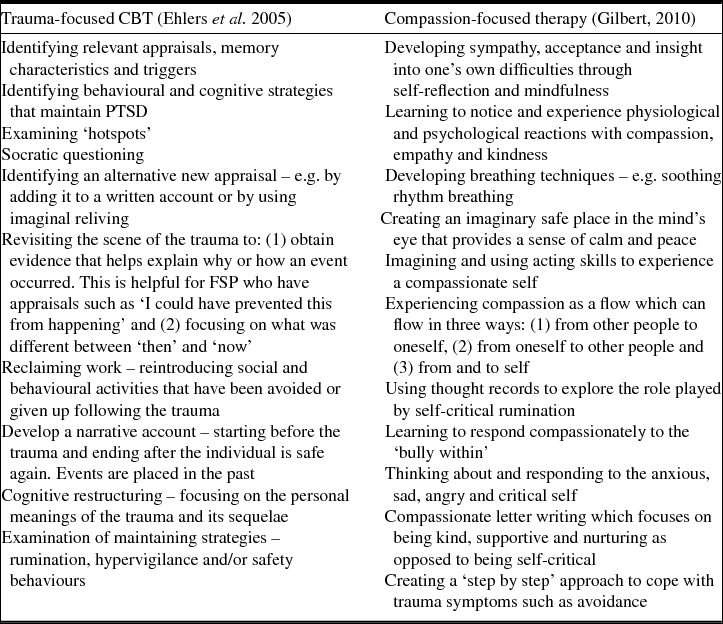
Following the cognitive model of PTSD (Ehlers et al. Reference Ehlers, Clark, Hackmann, McManus and Fennell2005), all individuals received TF-CBT from an EMDR Europe-Approved and BABCP-accredited cognitive behavioural psychotherapist (E.B.). In addition, those in the combined therapy group were taught to use interventions that help provide a supportive and affiliative response to suffering. Psycho-education was used in both groups. In the combined group individuals were introduced both to TF-CBT psycho-education and to the CFT model. The combined group were given explanations regarding how the human brain has evolved to respond to threat and Gilbert's (Reference Gilbert2009) three-circle model was introduced and diagrams presented explaining the model (see Gilbert, Reference Gilbert2014 for an overview of the model). Individual formulations were conducted for all participants in both groups. For example, in the combined group compassion-focused formulations were introduced to explain how early life experiences impact on the development of the threat system, how humans cope with threat and how following trauma the coping strategies utilized may be unhelpful and lead to unintended consequences. Compassion-focused thought records were used in the combined group with a focus on creating encouraging thoughts using warmth and a compassionate tone. Individuals in both conditions wrote accounts of the trauma and focused on ‘hotspots’. However, individuals in the combined group also spent time focusing on compassionate letter writing by connecting with a compassionate self (a compassionate self that understands, supports and validates unconditionally). Table 1 provides examples of some of the interventions used in both conditions.
Some of the treatment interventions incorporated into both conditions

PTSD, Post-traumatic stress disorder; FSP, Fire Service personnel.
Measures
The Hospital Anxiety and Depression Scale (Snaith & Zigmond, Reference Snaith and Zigmond1994). This 14-item questionnaire measures symptoms of anxiety and depression. The scale is easy to administer and is a useful tool to measure symptoms of change over time.
The Impact of Events Scale – Revised (IES-R) (Horowitz et al. Reference Horowitz, Wilner and Alvarez1979; Weiss & Marmar, Reference Weiss, Marmar, Wilson and Keane1996). This questionnaire measures symptoms of trauma and consists of 22 items, which measure avoidance, intrusion and hyperarousal.
The Self-Compassion Scale – Short Form (SCS-SF; Raes et al. Reference Raes, Pommier, Neff and Van Gucht2011). This 12-item questionnaire uses a Likert scale of 1 (almost never) to 5 (almost always) to measure ‘how I typically act toward myself in difficult times’. The SCS-SF is an alternative to the 26-item questionnaire (Neff, Reference Neff2003).
All three scales are reliable measuring tools, having high internal validity (Snaith & Zigmond Reference Snaith and Zigmond1994; Weiss & Marmar, Reference Weiss, Marmar, Wilson and Keane1996; Neff, Reference Neff2003).
Data analysis
To examine outcome measures comparing the efficacy for both conditions, analysis of covariance (ANCOVA) was performed for each outcome measure using post-therapy scores as the dependent variable, group as the independent variable and pre-therapy scores as the covariate. Partial eta squared (η²) was calculated as a measure of the effect size. Data were analysed using SPSS v. 20 (IBM Corp., USA).
Results
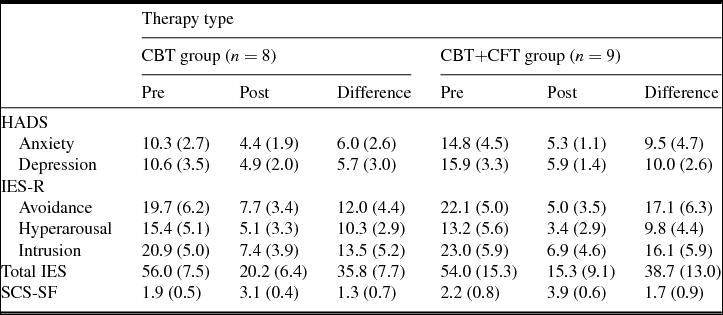
Table 2 reveals the mean and standard deviation scores for both groups pre- and post-therapy. The mean scores suggest a greater improvement in the combined group for symptoms of anxiety, depression, avoidance, intrusion and self-compassion. However, as both groups started with different pre-therapy scores ANCOVA was implemented to control for any possible differences in post-therapy scores and reduce the chance of within-group error variance. When analysing outcomes between groups where differences in the independent variable at the pre-intervention stage could affect the dependent variable outcome ANCOVA is recommended, as it can control for such differences (Lord, Reference Lord1967). Tests of normality and skewness across clinical variables were within acceptable limits. Data were tested for homogeneity of regression and linear relationships. Scores for anxiety and hyperarousal violated the assumptions and therefore were excluded from the analysis. All other variables met the assumptions to proceed with ANCOVA.
Pre- and post-therapy mean scores and standard deviations for the CBT-only group and the CBT+CFT group
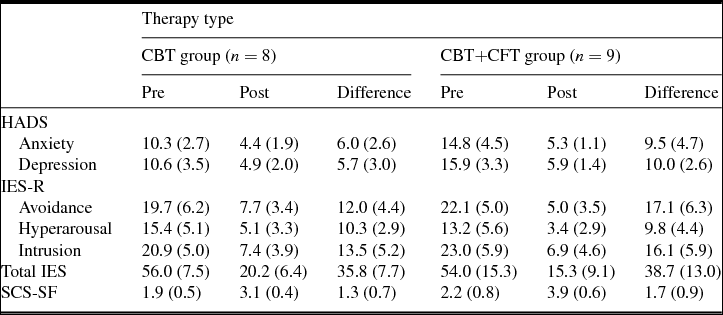
Values given are mean (s.d.).
HADS, Hospital Anxiety and Depression Scale; IES-R, Impact of Events Scale – Revised; SCS-SF, Self-Compassion Scale – Short Form.
After controlling for pre-test scores there was a significant effect of the between-groups factor for self-compassion (F 1,14 = 7.014, p = 0.05, η 2 = 0.334). This suggests that TF-CBT combined with CFT was more effective than TF-CBT alone in increasing self-compassion among this present sample of firefighters.
Although not statistically significant, results from the ANCOVA revealed a trend towards greater reduction in estimated marginal means in the TF-CBT+CFT group for scores of depression (TF-CBT: mean = 5.6, s.d. = 0.60; TF-CBT+CFT: mean = 5.1, s.d. = 0.56), intrusion (TF-CBT: mean = 7.6, s.d. = 1.4; TF-CBT+CFT: mean = 6.6, s.d. = 1.3), avoidance (TF-CBT: mean = 7.3, s.d. = 1.0; TF-CBT+CFT: mean = 5.3, s.d. = 0.96) and the total IES-R (TF-CBT: mean = 19.9, s.d. = 2.6; TF-CBT+CFT: mean = 15.5, s.d. = 2.5). The estimated marginal means scores control for the effect of the covariate for pre-intervention measures by providing an estimate for adjusted means (Field, Reference Field2013). This gives an overall average for the pre-stage scores on all independent variables to further control for extreme differences in pre-therapy scores between the two groups. We must stress that, as the results did not achieve statistical significance, they are reported here only as an indicator of a possible trend warranting further study.
Discussion
The results indicate a statistically significant reduction in symptoms of hyperarousal, avoidance, intrusion, depression and anxiety post-therapy and a significant increase in self-compassion for both groups, with effect sizes high. Analysis of the comparative efficacy of both treatment groups indicates that the combined group was more effective for increasing self-compassion. Indeed, a large effect size was observed in the combined group post-therapy. Both the TF-CBT alone group, and the CFT adjunct group, showed large and statistically significant improvements post-therapy in intrusion, avoidance and hyperarousal symptoms, as well as in anxiety and depression. Analysis of comparative efficacy of the treatment groups found that CFT as an adjunct to TF-CBT improved self-compassion more than TF-CBT alone. However, in this study, adding CFT to TF-CBT did not improve outcomes in trauma-related or depression symptoms. There was, however, some evidence of a non-significant trend favouring the combined CFT group, suggesting a larger study with greater power may be worthwhile in order to clarify the findings.
The present findings are consistent with the results of Thompson & Waltz (Reference Thompson and Waltz2008), who suggest that incorporating techniques into therapy that help create affiliative feelings, may benefit individuals suffering with symptoms of trauma, develop self-compassion. The results are in keeping with the findings of previous studies suggesting that when CFT is incorporated into psychotherapy it can be effective in helping individuals who experience mental health problems (Gilbert & Proctor, Reference Gilbert and Procter2006; Mayhew & Gilbert, Reference Mayhew and Gilbert2008; Beaumont et al. Reference Beaumont, Galpin and Jenkins2012; Braehler et al. Reference Braehler, Gumley, Harper, Wallace, Norrie and Gilbert2012; Brooks et al. Reference Brooks, Kay-Lambkin, Bowman and Childs2012; Beaumont & Hollins Martin, Reference Beaumont and Hollins Martin2013, Reference Beaumont and Hollins Martin2015; Bowyer et al. Reference Bowyer, Wallis and Lee2014; Gale et al. Reference Gale, Gilbert, Read and Goss2014; Boersma et al. Reference Boersma, Hakanson, Salomonsson and Johansson2015).
A strength of the study was that participants in both groups completed therapy which is consistent with the findings of Ehlers et al. (Reference Ehlers, Clark, Hackmann, McManus and Fennell2005). TF-CBT, as a stand-alone therapy, was shown to be acceptable for those experiencing trauma-related symptoms, although as highlighted the absolute therapeutic value of adding CFT for such symptoms has not been demonstrated in the present study. Nevertheless the findings suggest that CFT may be a helpful intervention, that can be integrated into traditional treatments for symptoms of PTSD and that FSP may benefit from utilizing techniques that help them to develop inner caring and compassion for the suffering they have experienced.
Limitations
Within this preliminary study there were a number of methodological challenges. First, participants in the TF-CBT group started their therapeutic journey with fewer symptoms of depression, anxiety, avoidance and intrusion, and this could be viewed as a methodological flaw. This highlights the problems of allocating participants into two separate groups prior to collecting baseline measures, as both groups can start with different pre-intervention scores. A statistical strategy to address this in the current study was to use ANCOVA within the analysis plan. However, a more erudite solution to this fundamental problem is to conduct an adequately powered randomized controlled trial (RCT), with sufficient sample size to detect statistically significant differences between groups and to negate the risk of confound due to low numbers resulting in significant differences between groups at baseline. An RCT as suggested, would require robust randomization procedures and consider carefully the role of blinding procedures within the study paradigm. A further limitation is that this study did not encompass a ‘no treatment’ comparison group. However, we did have a ‘treatment as usual group’. The sample size was adequate for this preliminary pilot and feasibility study; however, the small sample size limits generalizability and may have also occluded potentially meaningful effects of the intervention as highlighted earlier by non-statistically significant improvements in some of the subscale scores. Another limitation is that it is difficult to determine which aspects of TF-CBT and CFT led to the improvements. Consideration also needs to be given to potential ‘dosage’ issues because the therapeutic interventions in both conditions varied, which meant that participants in the combined group received a different dose of TF-CBT than the TF-CBT group. This issue would need to be addressed in larger scale study, particularly if data is collected from a variety of psychotherapists. A potential solution is that a more uniform structure of therapy be delivered and a framework followed that can achieve high implementation fidelity as this may be the best way of replicating success. Carroll et al. (Reference Carroll, Patterson, Wood, Booth, Rick and Balain2007) developed one such framework, which the authors suggest enables better evaluation of intervention outcomes, improves the credibility and validity of the research and may protect against intervention variation. This should be considered in future research studies.
Further research
The addition, of a qualitative arm of inquiry to understand the client's experience of the intervention might illuminate a greater understanding of the impact of CFT at an individual level. This would also help clinicians to evaluate CFT as a stand-alone therapy. Follow-up data is essential for future research as this would help researchers to examine the impact cultivating self-compassion has on relapse rates. Further research investigating the impact CFT has on self-criticism, and the negative coping associated with emergency-service personnel's experience of trauma (Cicognani et al. Reference Cicognani, Pietrantoni, Palestini and Prati2009), would be beneficial to the Fire Service and the therapeutic community.
Conclusion
This study aimed to compare outcome measures from two groups of FSP referred with trauma-related symptoms and low levels of self-compassion. The results indicated that TF-CBT significantly reduced symptoms of trauma whether or not combined with CFT. Adding CFT had no statistical significant effect on trauma-related symptoms or depression, but did improve self-compassion relative to TF-CBT alone. Nevertheless, the study provides some preliminary evidence to suggest that FSP may benefit from therapeutic interventions aimed at cultivating self-compassion. A full-scale adequately powered and with sufficient sample size RCT is recommended to address the limitations inherent in the current preliminary pilot investigation. However, proof of concept would seem to have been demonstrated to a significant degree in the current study thus providing support and justification for such an RCT.
This the first study to examine the effectiveness of incorporating CFT into a TF-CBT programme using a sample FSP. There is a growing body of evidence within the therapeutic community, which suggests that developing feelings of compassion can aid mental wellbeing. CFT can lead to higher levels of self-compassion and a sensitivity to suffering. Learning to self-soothe in response to threat, shame and self-criticism may help FSP who bear witness to suffering on a daily basis. Using CFT as an adjunct to TF-CBT may enhance the use of CBT for FSP. This inaugural paper opens this discussion.
Summary
-
• Compassion-focused interventions focus on helping individuals to employ self-soothing techniques and create affiliative feelings towards themselves and others.
-
• TF-CBT combined with CFT was more effective than TF-CBT alone on measures of self-compassion.
-
• CFT as an adjunct to TF-CBT may be a useful intervention for FSP.
Acknowledgements
This research received no funding. The authors thank Professor Hollins Martin for her continued support and the participants who agreed to take part in this research.
Ethical standards
The University College Research Ethics Committee gave ethical approval. The researchers adhered to the Ethical Principles and Code of Professional Conduct (2009) throughout this study and followed the Ethical Guidelines of the British Association for Behavioural and Cognitive Psychotherapies. The authors assert that all procedures contributing to this work comply with the ethical standards of the relevant national and institutional committees on human experimentation and with the Helsinki Declaration of 1975, and its most recent revision.
Declaration of Interest
The authors have no conflict of interest with respect to this publication.
-
(1) To understand that CFT was developed specifically to help individuals who experienced high levels of self-criticism and shame.
-
(2) To increase knowledge of the number of challenges Fire Service personnel (FSP) face in their day-to-day work, which may lead to symptoms of shame, guilt, blame and self-criticism.
-
(3) To recognize that incorporating compassion-focused interventions into TF-CBT may enable FSP to employ self-soothing techniques and create affiliative feelings toward themselves and others.
-
(4) To identify the interaction and link between three human affect regulation systems: (i) threat and protection system, (ii) seeking and acquiring system and, (iii) soothing and contentment system.
-
(5) To consider that no one therapy is panacea for all. Incorporating interventions that aim to cultivate compassion for self and others into psychotherapy may help individuals who bear witness to the suffering of others and as a result may develop symptoms of PTSD.



Comments
No Comments have been published for this article.