1. INTRODUCTION
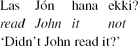
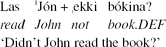
One of the well known differences between Icelandic on the one hand and the Mainland Scandinavian languages (MSc) on the other is the fact that, in Icelandic, full NPs (or DPs) can undergo Object Shift (NPOS) whereas in MSc they cannot. This is often illustrated by sentence pairs like the following (from Icelandic (Ic) and Swedish (Sw), respectively – underline and boldface used here and elsewhere to identify the relevant constituents):Footnote 1
(1)


In their influential work on comparative Scandinavian syntax from around 1990 onwards, Holmberg & Platzack (henceforth H&P) proposed that this difference between Icelandic and MSc should be related to different morphological properties of the two language groups:
Essentially following Holmberg (Reference Holmberg1986) we assume this difference is a consequence of the presence or absence of Case morphology on the DP in the two types of Scandinavian languages. (H&P Reference Holmberg and Platzack1995:168, see also H&P Reference Holmberg, Platzack, Abraham, Kosmeijer and Reuland1991)
As explicit theoretical proposals typically do, this one led to numerous new discoveries and raised new questions, including the following:
- (2)
a. Why doesn't (the morphologically rich) Old Norse (or Old Icelandic) seem to have NPOS (see e.g. Mason Reference Mason1999; Haugan Reference Haugan2000; Sundquist Reference Sundquist and Lightfoot2002)?Footnote 2
b. Why doesn't (the morphologically rich) Modern Faroese seem to have NPOS (see Barnes Reference Barnes, Louis-Jensen and Poulsen1992; Vikner Reference Vikner, Corver and van Riemsdijk1994; H&P Reference Holmberg and Platzack1995; Thráinsson Reference Thráinsson2007, Reference Thráinsson2010a; Thráinsson et al. Reference Thráinsson, Petersen, í Lon Jacobsen and Hansen2012 [2004]:245–246; etc.)?
In this paper I refer to these questions as the Old Norse Puzzle and the Faroese Puzzle, respectively.
In addition, extensive research on Object Shift in Scandinavian, partly triggered by H&P's work, has shown that it is more complex than originally assumed. In particular, it has been demonstrated that Object Shift interacts with information structure (see e.g. the overviews in Thráinsson Reference Thráinsson, Baltin and Collins2001:188ff., Reference Thráinsson2007:75ff.; Vikner Reference Vikner, van Riemsdijk and Everaert2005: Section 5; see also the discussion in Section 4 below and various papers in this issue). But while this discovery has led to a better understanding of the nature of Object Shift in Scandinavian, it does not in itself help solve the variation problem:
• Why is there variation within Scandinavian with respect to Object Shift, how extensive is it and what is it related to?
The purpose of this paper is to reconsider certain aspects of this variation. As the title implies, the paper mostly deals with NPOS in Old Norse and Faroese and disregards pronominal Object Shift (PronOS) for the most part. In the process it will be necessary to discuss NPOS in different stages of Icelandic. The main descriptive claims of the paper are the following:
- (3)
a. There is no reason to believe that the restrictions on NPOS in Old Norse, or other earlier stages of Icelandic, were any different from those of Modern Icelandic.
b. Contrary to standard claims in the literature, NPOS is not completely excluded in Faroese, although not as generally accepted as in Icelandic.
In the process of arguing for these claims, the questions in (2) will be answered. As will be shown, a key element in these questions is the word seem.
The organization of the paper is as follows: In Section 2, I briefly describe the kinds of NPOS that I will be considering. In Section 3, I review the basis for the commonly accepted claim that NPOS is not found in Old Norse, and then show that NPOS appears to be just as infrequent in modern Icelandic texts as it is in Old Norse and other older Icelandic texts. Hence, we cannot conclude that NPOS was not an option in Old Norse although examples of it are hard to come by in texts. In Section 4, I consider some examples of shifted and non-shifted NP objects from (modern) Icelandic texts and show that they are typically consistent with the claim that that shifted objects will have a reading that has been described as strong/specific/defocused/etc. whereas non-shifted NPs can either have a strong or a weak reading (see also Thráinsson Reference Thráinsson, Baltin and Collins2001:193; Reference Thráinsson2007:79).Footnote 3 In Section 5, I demonstrate that if we take the discourse conditions on NPOS seriously and present speakers of Faroese with sentences containing NPOS in the appropriate context, they often accept at least some of these. Finally, Section 6 relates the observed facts to general issues concerning inter-speaker and intra-speaker variation in syntax and the status of Faroese among the Scandinavian languages.
2. THE KINDS OF OBJECT SHIFT CONSIDERED
The typical Object Shift examples discussed in the literature involve a simple sentence with an object preceding the negation (see (1) above) or some (other) adverb that typically precedes the VP and cannot follow it. Thus, the adverb aldrei ‘never’ is often used to illustrate Object Shift in Icelandic since it typically precedes the VP and does not follow it:
(4)
The standard assumption is that in examples like (4c) the finite verb has moved out of the VP and the object has shifted across the adverb aldrei, since this adverb must in general precede the VP, as shown in (4b). Since the same is not true of the adverb oft ‘often, frequently’, as shown in (5b), examples like (5c) cannot be used as a reliable demonstration of Object Shift:
(5)
In (5c), the object may have shifted out of the VP and across the medial adverb oft, but an alternative analysis would be that the adverb oft follows the VP, as it does in (5b), and the object is in situ inside the VP.
In addition to simple examples of this kind, Holmberg (Reference Holmberg1986:222–223) demonstrated that the so-called ‘Raising to Object’ (or Exceptional Case Marking (ECM) or Accusative with Infinitive (AcI)) in Scandinavian obeys the same restrictions as Object Shift and hence arguably ‘is’ Object Shift. His examples include the following (his judgments):
(6)
(7)
(8)
(9)
These examples are meant to show that the acceptability pattern we get for Swedish in the AcI construction in (6) parallels the pattern observed for simple Object Shift structures: In Swedish it is possible to shift pronouns but not full NPs around the quantifier alla ‘all’ whereas both full NPs and pronouns (stressed or unstressed) can be left in situ in these constructions (see (6c) and (7c)). In Icelandic, on the other hand, it is possible to shift pronouns and full NPs around the quantifier in both constructions but an unstressed pronoun cannot be left behind.Footnote 4
This pattern also extends to constructions with causative verbs and perception verbs, as in Vikner (Reference Vikner, van Riemsdijk and Everaert2005: Section 3.3); the following examples are based on his examples and his judgments (Da = Danish):
(10)
(11)
Again, we get the pattern typical for Object Shift in the two languages: In Icelandic it is possible to shift either a pronoun or a full NP across the adverb áreiðanlega ‘undoubtedly’ (examples (10a, b)) whereas only the full NP and not the unstressed pronoun can be left in situ (example (10c)). In Danish, on the other hand, only the unstressed pronoun can shift across the adverb formentlig ‘presumably’ (examples (11a, b)) and only a full NP and not an unstressed pronoun can be left in situ (example (11c)).Footnote 5
Given this, I will also consider examples of Object Shift in constructions of this kind (i.e. sentences containing infinitives after verbs of saying, believing, perception verbs and causative verbs) in the discussion below. When necessary, I will refer to examples of this sort as ‘complex Object Shift’ (or complex NPOS) as opposed to simple Object Shift examples.
3. NPOS IN OLD NORSE AND (OLDER) ICELANDIC TEXTS
3.1 NPOS in Old Norse
In her study of Object Shift in Old Norse (ON), Mason (Reference Mason1999) found one apparent example of NPOS in a corpus of nine Old Norse sagas (here taken from Sundquist Reference Sundquist and Lightfoot2002:332):Footnote 6
(12)

Sundquist maintains (ibid.) that this example does ‘not provide evidence for a full DP Object Shift like in modern Icelandic’. The reason is that Object Shift in double object constructions of this kind is also found in ‘Norwegian [No] and some varieties of Swedish’, according to H&P (Reference Holmberg and Platzack1995:172; see also Sundquist Reference Sundquist and Lightfoot2002:332–333):Footnote 7
(13)
In his study of Old Norse word order and information structure, Haugan (Reference Haugan2000: Section 4.3) looked for instances of NPOS in his corpus and concluded:
I have not been able to find Old Norse examples with both a sentence adverbial and a shifted (full) NP, which might be due to my searching method.
Based on this, and on his own research, Sundquist (Reference Sundquist and Lightfoot2002:333) concludes:
Thus, other analyses of Old Norse agree with the results here: full DP Object Shift is not an option in earlier stages of Mainland Scandinavian.
Thanks to recent developments in corpus linguistics we know, however, that this conclusion is not warranted, at least not with respect to Old Norse (Old Icelandic). Among the corpora established by the project Mörkuð íslensk málheild [A Tagged Corpus of Icelandic] (http://mim.hi.is) is a corpus of 1,659,285 words, based on the text of 44 Icelandic sagas, most of them probably written in the 14th and 15th century. Using this corpus, Rögnvaldsson & Helgadóttir (Reference Rögnvaldsson, Helgadóttir, Sporleder, van den Bosch and Zervanou2011) found (at least) nine examples of clear instances of NPOS in Old Icelandic, including the following (examples (6a, b) in their paper):
(14)
As Rögnvaldsson & Helgadóttir point out, it is unlikely that the nine examples they found are the only ones present in the corpus (a completely exhaustive search of this kind is notoriously difficult in a tagged corpus). As mentioned in Section 2 above, one could also look for complex NPOS in the corpus, such as examples involving causatives or similar infinitival constructions. Then one finds examples like this one:
(15)

I have not searched the corpus extensively for examples of this kind, since the actual frequency is not crucial for my purposes, but even if a few additional ones can be found, the following question obviously arises:Footnote 8
• Aren't nine unambiguous examples of simple NPOS in 44 Icelandic sagas (a corpus of over 1.6 million words) just a negligible number, even if we can find a few additional examples of complex NPOS?
The most straightforward way of answering this question is to compare the frequency of NPOS in texts from different periods in the history of Icelandic, including Old Icelandic (Old Norse) and the modern language. As will be shown in the next section, NPOS is very rare in written texts throughout, even in texts from the 21st century, where there is no question that NPOS is ‘an option’.
3.2 NPOS in the history of Icelandic
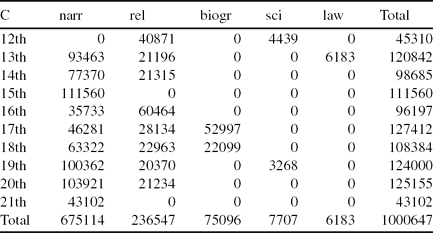
The Icelandic Parsed Historical Corpus (IcePaHC; http://www.linguist.is/icelandic_treebank) is an excellent research tool for the kind of comparison necessary here. It contains approximately 100,000 word text samples from 10 centuries, i.e. from the 12th to the 21st century, and thus a total of roughly one million words. The text samples from the different periods are as comparable as possible with respect to genre. The original goal was that they would contain about 80,000 words from narrative texts plus approximately 20,000 words from religious texts. The researchers came quite close to this, although the exact proportions inevitably vary somewhat as shown in Table 1 below (see Rögnvaldsson et al. Reference Rögnvaldsson, Ingason, Sigurðsson and Wallenberg2011:144).
An overview of the text types in IcePaHC.

C = century, narr = narrative texts, rel = religious texts, biogr = biographies, sci = scientific texts
The annotation and parsing of this corpus makes it possible to do very specific searches. Since previous searches for NPOS in Old Norse had typically looked for objects preceding the negation or the adverb aldrei ‘never’, I decided to do a comparable search in the IcePaHC corpus. The results are shown in Table 2 below, grouped by centuries.Footnote 9
The number of NPOS examples in IcePaHC involving the negation or the adverb ‘never’.

The six examples found in the search are shown in (16) (the sources are listed as in IcePaHC).
(16)
The obvious conclusion is that NPOS is in fact extremely rare in written texts throughout the history of Icelandic, even in modern Icelandic texts.Footnote 11 Since we know that NPOS is grammatical in 20th- and 21st-century Icelandic, the fact that only a handful of NPOS examples can be found in Old Norse corpora cannot be used as an argument for the conclusion that NPOS was ‘not an option’ in Old Norse, as Sundquist (Reference Sundquist and Lightfoot2002:333) maintains.Footnote 12
4. READINGS OF SHIFTED AND NON-SHIFTED OBJECTS IN ICELANDIC
We can now argue that we have managed to get rid of the Old Norse Puzzle (recall (2a) above): It was only apparent – it is not the case that NPOS cannot be found in Old Norse. It is just very infrequent in Old Norse texts, just as it is in more recent and modern Icelandic texts. But in the process of eliminating the Old Norse Puzzle, it looks like we have created a new one:
• If it is the case that NPOS has a special discourse function related to information structure, such as fronting defocused objects (or objects with a ‘strong’ or ‘specific’ or ‘old information’ reading, see below), how can it be so infrequent in texts?
The extent to which this is a real puzzle depends on how the hypothesis about the discourse (or information structure) properties of NPOS is formulated. Two versions are given in (17):
(17) The Information Structure Hypothesis Footnote 13
Strong version: All and only objects that have a definite/specific/strong/defocused/old information/etc. reading must shift (if syntactically possible).Footnote 14
Weak version: Only objects that have a definite/specific/strong/defocused/old/etc. information reading may shift.
Various formulations of the relevant contrasts and the formal implementation can be found in the literature (see e.g. de Hoop Reference de Hoop1990, Reference de Hoop1992; Diesing & Jelinek Reference Diesing and Jelinek1993, Reference Diesing and Jelinek1995; Diesing Reference Diesing, Thráinsson, Epstein and Peter1996, Reference Diesing1997; Vikner Reference Vikner1997, Reference Vikner, Müller and Sternefeld2001, Reference Vikner, van Riemsdijk and Everaert2005; Engels & Vikner Reference Engels and Vikner2007; Andréasson Reference Andréasson, Butt and King2010; etc.). Some of these will be discussed later in this section. But regardless of the exact formulation it should be clear that if objects with the appropriate reading obligatorily have to shift (the strong variant of the Information Structure Hypothesis in (17)), then we would expect to find more examples of NPOS in texts. If, on the other hand, this shift is not obligatory but optional, i.e. if it is the case that NP objects with the relevant reading do not have to shift but can do so (the weak variant of the hypothesis), then the observed infrequency of NPOS could be explained: Objects with the appropriate reading do not necessarily show up as NPOS examples because they can also remain in situ. But if that is true, then we should be able to find examples of such objects in situ in Icelandic texts. The next task is, then, to look more closely at examples of shifted and non-shifted objects in Icelandic texts and study their reading.
For this purpose I used another subcorpus of the Tagged Corpus of Icelandic project mentioned above. This subcorpus was originally created for the purposes of making an Icelandic frequency dictionary (Íslensk orðtíðnibók 1991). This is a tagged corpus of some 500,000 words from 100 texts of different genres from 1980–1989, approximately 5000 words from each.Footnote 15 A search for NPOS in this corpus yielded the following five examples of a full NP object preceding the negation or the adverb aldrei ‘never’ (and some 18 corresponding ones with the order Adverb–Object, i.e. with the object in situ):
(18)
As can be seen, some of these examples are instances of simple NPOS, others of the complex variety (examples (18c, d)). In general, the reading of the shifted objects can be said to be compatible with the Information Structure Hypothesis as outlined in (17). Note, for instance that the indefinite NPs in examples (18b, c) have a generic reading and it has been pointed out before that such NPs can shift in Icelandic (see e.g. Diesing & Jelinek Reference Diesing and Jelinek1993:23–24; Thráinsson Reference Thráinsson, Baltin and Collins2001:190; see also Collins & Thráinsson Reference Collins and Thráinsson1996).
Conversely, many of the non-shifted objects in this corpus arguably have a different reading (focus, new information, etc.), such as the following, for instance:
(19)
Note that although all of these non-shifted objects are formally definite, the suffixed article does not imply that they have been mentioned before in the discourse (i.e. that they are old information in that sense) – and they had not been. These examples could then be said to be compatible with either the weak or the strong version of the Information Structure Hypothesis in (17) above. But now consider the following examples:
(20)
Here it would seem that all the non-shifted objects represent old information (see the preceding boldfaced items). While this is unexpected under the strong version of the Information Structure Hypothesis, facts of this sort have been pointed out before. Consider the following sets of examples (see e.g. Thráinsson Reference Thráinsson, Baltin and Collins2001:193, Reference Thráinsson2007:78–79, and references cited there; the examples are partly based on work by Diesing Reference Diesing, Thráinsson, Epstein and Peter1996 and later, and Vikner Reference Vikner1997 and later):
(21)
(22)
As shown by the idiomatic translations here, the shifted objects in (21) only have the strong or specific reading whereas the non-shifted ones in (22) are ambiguous. This is obviously compatible with the weak version of the Information Structure Hypothesis in (17) but not the strong one.Footnote 16
Having eliminated the Old Norse Puzzle and explained, to some extent at least, why NPOS can be so infrequent despite interacting with information structure, we can now turn to the Faroese Puzzle mentioned in (2b) above.
5. NPOS IN FAROESE
As mentioned in (2b), it has standardly been assumed, at least since Barnes (Reference Barnes, Louis-Jensen and Poulsen1992), that NPOS is ungrammatical in Faroese. Since I will challenge this assumption below, it is necessary to give an overview of the evidence and consider some of the explanations that have been proposed to account for this apparent fact.
5.1 The evidence against NPOS in Faroese
First, it has been reported in several papers and books that NPOS is ungrammatical in Faroese (Fa). The examples provided include the following:
(23)
(24)
(25)



As shown here, these researchers all agree that the NPOS-variants (the (b)-versions of the sentences) are ungrammatical. The above judgments presented by Barnes and by H&P must be those of their informants, whereas the judgments presented by Thráinsson et al. reflect the intuition of the three Faroese co-authors of the book.
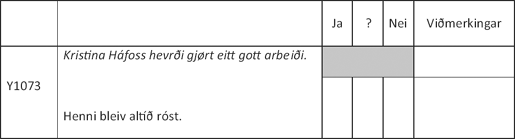
These judgments were by and large confirmed in a pilot study of variation in Faroese syntax conducted by Höskuldur Thráinsson, Jóhannes Gísli Jónsson and Thórhallur Eythórsson in 2006. After an introduction explaining the purpose of the study (e.g. that this was a survey of variation in spoken language and not any kind of a test and that the subjects should base their judgments on their own intuition and not on something they might have been taught in school), the subjects were presented with a number of examples and asked to evaluate them. The most common form of the presentation is shown in Table 3 (other forms included choice between two alternative variants). The subjects were asked to check one of the three boxes (the one labeled in the table ‘Viðmerkingar’ was for comments) and the choices were defined as indicated in (26) (see Thráinsson Reference Thráinsson2009, Reference Thráinsson2010a):
(26) Definition of the possible choices in the Faroese pilot study questionnaire 2006
ja ‘yes’: ‘Common/possible sentence. I could easily have said this.’Footnote 17
?: ‘Doubtful sentence. I would hardly say this.’
nei ‘no’: ‘Impossible sentence. I would not have said this.’
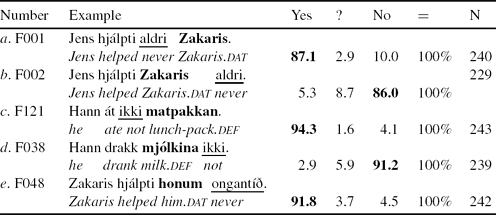
Some results from this questionnaire are shown in Table 4. In this table and in some other tables below, the highest or most notable numbers are in boldface.Footnote 18
The form of the questionnaire in a Faroese pilot study.

Judgments of shifted and non-shifted objects in a Faroese pilot study.
As pointed out above, the standard assumptions about the ungrammaticality of NPOS in Faroese seem to be confirmed by the results shown in this table: 87% of the subjects found the non-shifted example in a to be natural (or ‘common’) and 86% rejected the corresponding shifted version in b. The results are very much the same for the pair represented by c and d: Over 90% accept the non-shifted version (example c) and reject the shifted version (example d). Conversely, over 90% of the subjects accept the PronOS example e.
There would thus seem to be very little reason to question the standard claim that NPOS is ungrammatical in Faroese. Since Faroese syntax is in general not that different from Icelandic syntax, not even with respect to the famous V-to-I (or V-to-T) movement (see e.g. Angantýsson Reference Angantýsson2011:81ff.; Heycock et al. Reference Heycock, Sorace, Hansen, Wilson and Vikner2012; and references cited there), linguists have looked for explanations of this. In the next subsection I will review two of these and show that they do not work.
5.2 Two attempts to explain the Faroese Puzzle
As already mentioned, H&P (Reference Holmberg and Platzack1995) suggested that the availability of NPOS depended on rich (strong) case morphology. Icelandic has the proper kind of case morphology (m-case) but, despite its outward appearance, Faroese has a weak(er) m-case ‘which does not suffice to provide a DP with inherent Case value (in the sense discussed)’ (H&P Reference Holmberg and Platzack1995:173). H&P provide two arguments for this claim.
The first argument has to do with the lack of case preservation in the Faroese passive (see also Thráinsson et al. Reference Thráinsson, Petersen, í Lon Jacobsen and Hansen2012:266ff.). Here there is a clear contrast between passives of verbs like hjálpa ‘help’ in Icelandic and Faroese, as illustrated below:
(27)
(28)
The verb hjálpa ‘help’ takes a dative case object in Icelandic and Faroese (seen in (27a), (28a)). In Icelandic this case is preserved in the passive and hence the subject does not trigger agreement, witness the fact that the past participle shows up in the default neuter singular in the passive although the subject is masculine (see (27b)). In Faroese, on the other hand, the dative object case of hjálpa is not preserved in the passive: The passive subject shows up in the nominative and triggers agreement (see (28b)).
While this is an intriguing and not very well understood difference between Icelandic and Faroese, it can hardly be attributed to some systematic property of Faroese m-case since object case is in fact preserved in the passive of a number of Faroese verbs. This includes the common verbs takka ‘thank’ and trúgva ‘believe’, as shown in (29)–(30) (see also Thráinsson et al. Reference Thráinsson, Petersen, í Lon Jacobsen and Hansen2012:267; Thráinsson Reference Thráinsson2009:4):
(29)
(30)
While this lexical variation is obviously a puzzle in itself, it cannot really be used as a demonstration of some general property of the Faroese case system.Footnote 19
The second argument that H&P (Reference Holmberg and Platzack1995) present for the proposed ‘weakness’ of the Faroese case system has to do with ECM constructions (or ‘Accusative with Infinitive’, AcI). Here, too, H&P claim that there is a clear contrast between Icelandic and Faroese, and give examples like the following to illustrate this (H&P Reference Holmberg and Platzack1995:173):
(31)
(32)
Holmberg & Platzack point out that whereas Icelandic ‘preserves’ the dative subject case mér ‘meʼ in the ECM construction (31b), Faroese apparently does not in the corresponding (32b), where the case of the subject is accusative instead of the expected dative.
As pointed out by Thráinsson (Reference Thráinsson2009:4–5), this argument does not stand up to scrutiny. The reason is the following: Many speakers allow either nominative or dative subjects with dáma ‘like’ and some other verbs. For such speakers we get the following paradigm:
(33)
As (33b) shows, these speakers can either get a (preserved) dative subject in the ECM construction with dáma ‘like’ or else an accusative subject corresponding to the nominative subject in (33a). To put it differently: What H&P believed was a non-preservation of case in the ECM construction with dáma ‘like’ was in fact a normal ECM (or AcI) construction where an accusative subject of the infinitive corresponds to a nominative subject of the finite form of the verb. This account of the apparent non-preservation of case in the ECM construction predicts that if a given verb exclusively takes a dative subject in its finite form, then only dative will be possible in the ECM construction. There are not very many such verbs left in modern Faroese but hóva ‘like’ is one of them. As shown in (34), this prediction is borne out (judgments elicited from six native speakers of Faroese by e-mail):
(34)
Thus, we can conclude that there is no independent evidence for H&Pʼs hypothesis of ‘weak m-case’ in Faroese. Hence, we must look elsewhere for an explanation of the Faroese Puzzle.
Erteschik-Shir (Reference Erteschik-Shir2005, abbreviated to E-S in this section) has made a very different proposal to explain the Faroese Puzzle. According to her, Object Shift is essentially phonological in nature. She maintains that there is a crucial difference between the Icelandic and the Faroese stress and intonation system and that this is the reason why NPOS is acceptable in Icelandic but not in Faroese (E-S:78–80).
The first part of her account goes like this: In PronOS, the weak pronoun typically ‘prosodically incorporates’ into the verb, hence can (or must) precede the adverb.Footnote 20 In Icelandic constructions with a full NP object and an adverb, ‘the negative adverb and the object form a prosodic unit in both orders’, i.e. either as Obj–Adv (shifted) or Adv–Obj (unshifted). After this prosodic incorporation, the stress pattern will be as follows (E-S:79, see her example (64)):
(35)
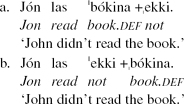
She then presents two intonation diagrams, based on recordings, to support this claim.
The problem with this part of the argument is that while (35a) is a reasonable description of the way examples of this kind are pronounced in Icelandic (i.e., the negation is arguably ‘prosodically incorporated’ into the preceding object), (35b) (and the pronunciation illustrated by the corresponding diagram in E-Sʼs paper) is not at all the normal way of pronouncing this kind of example.Footnote 21 It is much more natural to prosodically incorporate the negation into the preceding verb, which would give something like (36) in E-Sʼs notation, where the verb and the adverb form a prosodic unit (as in Danish, according to E-S), not the adverb and the object:Footnote 22
(36) Jón ˈlas + ˌekki bókina.
Now it might seem that this inaccuracy about the stress and intonation pattern of unshifted constructions in Icelandic cannot really be crucial here since it is the acceptability of the shifted variants (i.e. NPOS) in Icelandic and their unacceptability in Faroese (and other Scandinavian languages) which is the main issue. This is where the second part of E-Sʼs account comes in and it goes as follows: ‘Having initial stress [like Icelandic – and Faroese for the most part] might enable a language to tolerate a longer sequence of syllables without primary stress . . . thus allowing for longer prosodically incorporated strings’ (E-S:79). Hence, prosodic incorporation of full NPs and adverbs in NPOS is possible in Icelandic. But it might not be possible in Faroese because in Faroese there is, according to E-S, a productive rule of stress shift onto the second element of the compound, witness the stress pattern of certain compounds borrowed from Danish (E-S cites Árnason Reference Árnason1996 on this).
The problem here is that this characterization of the Faroese stress and intonation system is not accurate. Although Faroese is somewhat more ‘liberal’ in its stress pattern than Icelandic, the basic rules are the same, namely the following:
• The stress alternation rule
Initial stress with some stress on odd numbered syllables (Árnason Reference Árnason2011:90; Thráinsson et al. Reference Thráinsson, Petersen, í Lon Jacobsen and Hansen2012:28)
• The compound stress rule
Secondary stress on the second part of a compound noun (Lockwood Reference Lockwood1977:8; Árnason Reference Árnason2011:275 ff.; Thráinsson et al. Reference Thráinsson, Petersen, í Lon Jacobsen and Hansen2012:28)
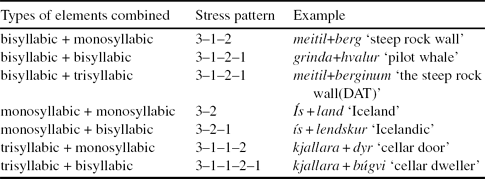
Sometimes these rules clash and then it may vary which one wins out. Faroese is much more liberal than Icelandic in preserving foreign stress patterns in loanwords (see Thráinsson et al. Reference Thráinsson, Petersen, í Lon Jacobsen and Hansen2012:29–30), although it sometimes ‘chooses its own pattern’ (Árnason Reference Árnason2011:281). But there is no evidence for the claim that there is a productive rule that shifts the main stress onto the second element of native compounds. Faroese allows a large number of stress patterns in native compounds but the general rule is that these have initial main stress. This is illustrated in Table 5 below (where 3 = primary stress, 2 = secondary stress, 1 = no stress, see Thráinsson et al. Reference Thráinsson, Petersen, í Lon Jacobsen and Hansen2012:28).
Stress patterns in Faroese compounds.
Compounding is productive, of course, and given the large number of permissible stress patterns in Faroese compounds illustrated in Table 5 it is not likely that prosodic incorporation of the NP and the following adverb in NPOS structures ‘would be unpronunceable’ in Faroese, as suggested by E-S (page 80). They obviously are not unpronunceable in Icelandic, where the compound stress patterns are very similar.
We can thus conclude that neither of the two proposals reviewed here explains the apparent ungrammaticality of NPOS in Faroese. This suggests that the time might be ripe to reconsider the Faroese Puzzle. We will do that in the next subsection.
5.3 Looking at the Faroese Puzzle from a different perspective
Reconsidering the evidence presented for the ungrammaticality of NPOS in Faroese in Section 5.1 above, we can make two observations:
• All the examples judged by native speakers were presented ‘out of the blue’, i.e. none of them included any kind of appropriate context.
• No examples of complex NPOS (see Section 2 above) were included.
Since it has been demonstrated that context and the information structure of sentences are highly relevant for Object Shift, the first point made here is rather unfortunate. And although the conditions for complex NPOS (Object Shift in sentences containing ECM infinitives or infinitival complements of causative verbs or perception verbs) are generally considered to be identical to those of simple NPOS, the complex variants should obviously be tested in Faroese for the sake of completeness. Hence, this section reports on the results of a new empirical study of NPOS in Faroese where the subjects were presented with simple and complex NPOS examples in varying contexts.
In this study the subjects were asked to judge sentences in a written questionnaire.Footnote 23 The general instructions were similar to those described for the Faroese pilot study in Section 5.1 above but this time the examples to be judged included a context sentence as shown in Table 6 below. It was explained to the subjects that they should only judge the second part of the example and that the italicized first part was there just to provide a context. The three possible judgments were defined as set out in (37).
(37) Definition of the possible choices in the Object Shift study in December 2012
ja ‘yes’: ‘A natural sentence. I could easily have said this.’
?: ‘A questionable sentence. I would hardly say this.’
nei ‘no’: ‘An unnatural sentence. I could not say this.’
If we compare these alternatives to those defined for the pilot study above, the most important difference is in the definition of the first alternative, where the word ‘common’ has been eliminated (refer to the comment in note 17).
The form of the questionnaire in a Faroese study of NPOS in 2012.
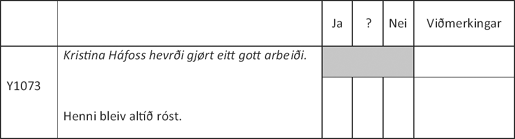
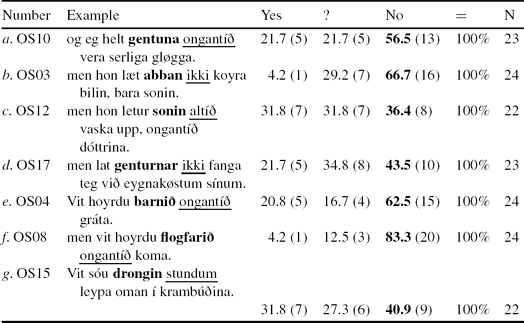
The questionnaire contained 30 Faroese sentences to be evaluated in this fashion plus five examples where the subjects were asked to choose between two alternatives. The example sentences were of different kinds – fewer than 20 of them had anything to do with Object Shift and the rest were fillers or tested something quite different. The examples in (38) involve simple NPOS. In each part of (38), and also (40)–(43) below, the first thee lines represent the context and the bottom three lines provide the Object Shift example.
The following examples involved simple NPOS:
(38)
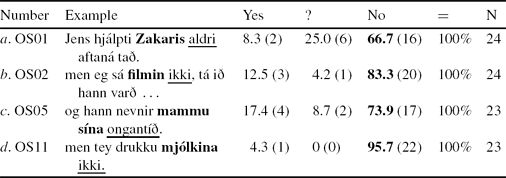
The judgments of these examples are shown in Table 7. In this table and in Tables 8–10 below, the numbers in the columns headed by Yes, ? and No are percentages with the actual number of subjects in parentheses. Note also that sentences a, b, c, etc. in the tables correspond directly to the full examples a, b, c, etc. given in the text. Thus, example c in Table 7 is example c in (38), etc.
Judgments of simple NPOS examples in Faroese, see (38).
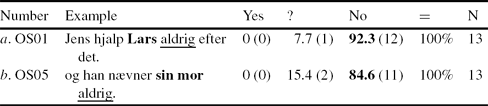
Judgments of simple NPOS examples in Danish, see (39).
Judgments of complex NPOS examples in Faroese, see (40).
Judgments of complex NPOS examples in Danish, see (41).
As can be seen here, all examples are rejected by the majority of the speakers but the results vary considerably from one sentence to another (the rejection rate was 66.7–95.7% and one example was considered ‘questionable’ by 25% of the subjects). But let us look a bit more closely at the two examples that are rejected by the lowest number of speakers, namely a and c.
First, it is interesting to note that example a in Table 7 is now rejected by two-thirds of the subjects (66.7%), but when a corresponding example was presented without any context to the subjects in the pilot study in 2006, it was rejected by 86% of the subjects (see example b in Table 4 above). Two possible explanations suggest themselves. On the one hand it is possible that the context provided for example a in Table 7 is responsible for the more positive judgment (see (37a)): The shifted object has been mentioned in the immediately preceding sentence and is thus old (defocused) information. The other possibility, suggested by one of the reviewers, is that ‘the addition of extra modifiers immediately following aldri . . . might have an ameliorating effect’, i.e. making it possible to interpret the sequence aldri aftan á tað as a heavy adverbial phrase that could occur VP-finally. In the case of example c, the sentence found natural by the highest number of speakers, no such explanation suggests itself, however.
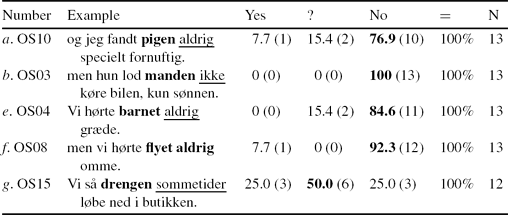
To investigate this further, I conducted a small comparison with Danish. A questionnaire containing examples corresponding to the Faroese ones under discussion here was presented to a number of native speakers of Danish.Footnote 24 These are shown in (39):
(39)
Here, (39a) has the same kind of adverbial modification as its Faroese counterpart in (38a), so if a non-NPOS-interpretation (‘heavy sentence-final adverbial phrase’) is responsible for the relatively positive judgment of (38a) in Faroese, we would expect it to work the same way in Danish. The example in (39b) corresponds to (38c), and here no such interpretation offers itself. Hence, we would expect (38b) to be judged less positively than (39a) if the kind of adverbial interpretation just described played a role in the judgment of (39a) (and (38a)). The judgments of these Danish examples are shown in Table 8.
Comparison of these judgments with those of examples a and c in Table 7 above suggests that speakers of Faroese are more likely than speakers of Danish to accept simple NPOS examples, given a context appropriate for NPOS. But although some contexts can make some simple NPOS examples acceptable to some speakers of Faroese, that is not a very satisfying result in itself. It suggests, however, that it might be worthwhile to look more closely at NPOS in Faroese and vary contexts and types of NPOS.
Let us then look at the examples of complex NPOS tested in the Faroese study, where varius contexts were used. The examples are listed in (40):
(40)
As can be seen here, the contexts vary, and Table 9 shows the results.
With the exception of two examples (b and f), these sentences receive much more positive judgments than the simple ones in Table 5 above.Footnote 25 The reason may be that the context sentences were more appropriate here. Note also that since examples e and f are virtually ‘minimal pairs’, the fact that e is judged much more positively must mean that here the context provided was more appropriate.
The fact that the complex NPOS examples are on the whole more positively judged than the simple ones is somewhat surprising. Hence, it is necessary to try to determine whether some of them might perhaps not involve NPOS at all. One of the things that have to be taken into account is whether it is possible to interpret the crucial adverb (the one that the object is supposed to have ‘shifted’ across) as belonging to the infinitival (or small) clause rather than being a direct part of the matrix clause (recall also the comment in note 8 above). This is typically a very far-fetched or even impossible interpretation when the adverb is ‘not’ or ‘never’ (it is, for example, impossible to hear a child ‘never cry’ as opposed to ‘never to hear’ a child cry, see example e). It is somewhat more plausible to suggest that the adverb ‘sometimes’ in example g can be interpreted in such a way (i.e. the boy was seen to ‘sometimes run’).
Again, comparison with Danish should be helpful here: If speakers of Danish do not have NPOS as a part of their grammar, whereas (some) speakers of Faroese do, then Danish examples corresponding to the Faroese ones in (40) should in general receive a less positive evaluation than their Faroese counterparts and only be judged positively if they can be interpreted as not involving NPOS. As explained above, the most promising candidate for such an interpretation would be an example corresponding to (40g). But if NPOS is neither an option for speakers of Danish nor Faroese, then Danish examples corresponding to the Faroese ones in (40) should be judged in a similar fashion. To test this, the Danish questionnaire mentioned above contained the following examples (where (41a) corresponds to (40a), (41e) to (40e), etc.):Footnote 26
(41)
The judgments of these examples are presented in Table 10.
As Table 10 shows, the only example that is not rejected by almost all the subjects is example g, namely the one where a non-NPOS interpretation is more plausible than in the other instances. Hardly any speakers accept the other examples. This suggests that NPOS is typically not an option for Danish speakers, whereas it is for some speakers of Faroese.
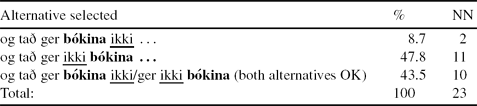
Finally, consider the following. One of the examples that the Faroese subjects were presented with was this:
(42)
The subjects were told that they could select one or both of the alternatives.Footnote 27 The results of their choices are shown in Table 11 below. Here almost half the subjects say that both alternatives are OK. This example is actually taken from a book announcement on the Internet, where the NPOS variant (ger bókina ikki) was the one used.Footnote 28 This is not surprising: The book was obviously defocused (old information) in the context because the book is what the whole announcement was about (this was not as obvious in the limited context given in the questionnaire). A similar example, given here in (43), was included in the Danish questionnaire.
Choice between two alternatives in Faroese: shifted vs. unshifted object, see (42).
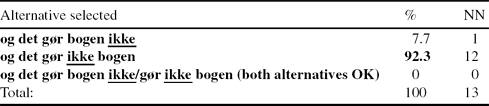
(43)
The results of the Danish survey are shown in Table 12. The contrast with the Faroese results presented in Table 11 is very clear.
Choice between two alternatives in Danish: shifted vs. unshifted object, see (43).
We can thus conclude that NPOS is not in fact excluded in Faroese as has typically been assumed, whereas it seems to be in Danish. Nevertheless, NPOS appears to be more dependent on a proper context in Faroese than it is in Icelandic, witness the fact that speakers of Icelandic presented with NPOS examples ‘out of the blue’ typically agree that they are fine. This difference is a puzzle in itself and we return to it in the final section.
6. CONCLUDING REMARKS
In this paper we have seen evidence for the following:
- (44)
a. NPOS was an option in Old Norse. It is just very infrequent in Old Norse texts, but the same is true of younger Icelandic text, even modern ones. Part of the reason is that even when the information structure conditions (discourse conditions) for NPOS are fulfilled, the movement is optional.Footnote 29
b. NPOS is an option in Faroese but it is heavily dependent on context, much more so than in Icelandic. This has typically been overlooked in the literature and hence linguists have concluded that NPOS is not available in Faroese.
The claim is that this solves the Old Norse Puzzle and the Faroese Puzzle stated in (2) above. This also means that H&P (Reference Holmberg and Platzack1995) may have been on the right track to begin with when they suggested a correlation between m-case and NPOS, and there was thus no reason for them to try to develop an account of why Faroese did not appear to have NPOS. Hence, it is not surprising that their attempt to do so failed.Footnote 30
Based on the empirical results of the paper, I would like to make the following two general claims:
- (45)
a. Completely natural constructions, like NPOS in Modern Icelandic, may be hard to find in corpus searches.
b. While NPOS is an integral part of the grammar of all speakers of Icelandic, it is an exceptional option for most speakers of Faroese, i.e. not a part of their default (or dominant) grammar.
The first claim is straightforward and needs no further explanation but I would like to conclude this paper by elaborating on the second one.
Many recent studies have demonstrated extensive variation in Faroese with respect to the syntactic features that distinguish Icelandic from Mainland Scandinavian. It has been shown, for instance, that some speakers accept (and use) V-to-I movement in embedded clauses to some extent but not all the time, or dative subjects where they are ‘expected’ in some examples but not others (see e.g. Jónsson & Eythórsson Reference Jónsson and Eythórsson2005, Reference Jónsson, Eythórsson, Wiese and Simon2011; Bentzen et al. Reference Bentzen, Garbacz, Heycock and Hrafnbjargarson2009; Thráinsson Reference Thráinsson2009, Reference Thráinsson2010a, Reference Thráinsson, Fernández and Etxepare2013; Angantýsson Reference Angantýsson2011; Heycock et al. Reference Heycock, Sorace, Hansen, Wilson and Vikner2012; and references cited by these authors). These studies have thus shown that the variation involved is not just from speaker to speaker (inter-speaker variation), e.g. in the sense that some speakers have an Icelandic-type grammar whereas others have an MSc-type ‘grammar’, but there is also extensive intra-speaker variation with respect to these features. An adequate description of Faroese syntax will have to take this into account.
A promising approach is to think of this in terms of competing grammars (see e.g. Kroch Reference Kroch1989 and later work; Yang Reference Yang2002, Reference Yang2004, Reference Yang2010; Thráinsson Reference Thráinsson, Fernández and Etxepare2013). To take V-to-I as an example, it seems clear that the typical MSc order (i.e. Adv–Vfin) is the default order for most (possibly all) speakers of Faroese for all clause types, whereas the opposite is true of Icelandic (see the references cited in the preceding paragraph, especially Angantýsson Reference Angantýsson2011). We can then say that the MSc-type ‘grammar’ (or parameter setting or whatever) is the default (or dominant) grammar for speakers of Faroese in this respect, although some of the speakers are more likely than others to accept and use the (Icelandic) Vfin–Adv order, given the appropriate conditions.Footnote 31 For speakers of Icelandic, it is the other way around: The Vfin–Adv order is fine in all types of embedded clauses and something special is needed to make the Adv–Vfin order acceptable (see Thráinsson Reference Thráinsson2010b; Angantýsson Reference Angantýsson2011 and references cited there).
Thinking about NPOS in Icelandic and Faroese along the same lines, we could account for the observed facts as follows: When speakers of Icelandic are presented with NPOS examples, they accept them right away, even when no context is provided. There does not seem to be any inter-speaker nor intra-speaker variation involved and thus no reason to assume ‘competition of grammars’ in this respect. But when speakers of Faroese are presented with NPOS examples ‘out of the blue’, they typically reject them (recall the discussion in Section 5.1 above) since NPOS is not a part of their default or dominant grammar. But when NPOS examples are presented in a context which makes it clear that the shifted object must have the reading typical for such elements (whatever the appropriate definition of this reading may be, recall the discussion in Section 4), then a number of speakers find such examples acceptable. Hence, we would also expect to find examples in Faroese texts, although they should be even less frequent than corresponding examples in Icelandic corpora.
But what kind of a model of grammar competition could account for this behavior of the Faroese speakers? To simplify the presentation, we can think of the NPOS option as a parameter (although that is probably not the correct way). Building on ideas developed by Yang (Reference Yang2002, Reference Yang2004, Reference Yang2010), we could then say that in the grammar of speakers who show no intra-speaker variation with respect to this feature, this parameter has either the value 0 (no NPOS) or 1 (NPOS freely accepted and used). For speakers who show intra-speaker variation the value would then lie somewhere between 0 and 1. According to standard assumptions, and evidence discussed, speakers of Danish will have set this parameter at 0, and speakers of Icelandic at 1. Thus, the results of this paper suggest that the value lies somewhere between 0 and 1 for many speakers of Faroese and the more dominant their Danish-type grammar is (or the Danish-type setting for this ‘parameter’), the closer to 0 this setting will be.
The general claim is that this is a sensible way of modeling variation when we have a ‘change in progress’. In such a situation, we will typically have extensive intra-speaker variation, in addition to inter-speaker variation. Although this would seem to be a non-ideal state of affairs, evidence suggests that it is much more common than often assumed.Footnote 32
ACKNOWLEDGEMENTS
The work on this paper was supported by the Icelandic Research Fund. Thanks are due to Zakaris Svabo Hansen and Victoria Absalonsen for help with correcting the Faroese examples and collecting judgments on them, to Sólgerð Johnsdóttir Færø for help with translating Faroese examples into Danish, to Frans Gregersen and Louise Willemoës Gad for collecting judgments on the Danish examples, to three anonymous reviewers for very helpful and constructive comments, and to the audience and the organizers of the workshop on Scandinavian Object Shift in Gothenburg in March 2012.