The Politics of Death in the Legion’s Ideology of Thanatic Nationalism
When it finally and unexpectedly grasped political power to form the short-lived National Legionary State in the midst of the Second World War, some likened the Romanian Legionary Movement to a potato. This was because, by that time, “the best part of it was under the earth,” buried six feet deep either as political martyrs who had fallen to redeem the nation or as criminal villains who were executed by state authorities (Nagy-Talavera Reference Nagy-Talavera1970, 304). Indeed, by the time the Romanian fascist movement had seized state power, hundreds of Legionnaires—ranging from the most humble rank-and-file members to the movement’s elite, including the so-called “Captain” Corneliu Zelea Codreanu—lay buried in graveyards or mass graves scattered across the country (for the biography of Codreanu, see Schmitt Reference Schmitt2017).
The Legion of the Archangel Michael (Legiunea Arhanghelul Mihail) was founded in 1927 as a radical splinter from the already rabidly antisemitic National-Christian Defense League (Liga Apărării Național-Creștine, LANC) headed by Alexandru C. Cuza (Heinen Reference Heinen1999; Bozdoghină Reference Bozdoghină2012). It emerged from the violent students’ movement of the 1920s, which demanded an ethnic policy of numerus clausus (proportional representation). First applied to university admission, it was later radicalized and extended to the entire nation as a policy of numerus maximus, whereby Jews were to be removed from every sector of the state, from education and industry to politics and employment in the state apparatus (Livezeanu Reference Livezeanu1995, 204–205). By the time a group of radicalized antisemitic youths decided to split from LANC and found a new political organization under the blessing of the Archangel Michael, their leaders, Corneliu Zelea Codreanu and Ion I. Moța, had already acquired impressive criminal records. Besides countless violent acts of antisemitic terror and anti-communist hooliganism, they were both tried—and acquitted—for conspiracy to murder (a group of students organized a plot to kill a wide range of political figures and Jewish bankers in 1923), attempted murder (Moța shot a fellow plotter accused of treason in 1923), and murder (Codreanu shot and killed a police prefect in 1924).
These criminal records are indicative of the function and role of violence within the Legionary Movement. Indeed, violence was ingrained in the political praxis of the movement. However, the acts of violence enacted by the Legionnaires must be situated in a broader societal context marked by structural political violence and state repression. This was especially true during the periods of political campaigns in the 1930s, when the confrontations between the Legion and state authorities brought death to many of the Legionnaires (Clark Reference Clark2015). In the political funerals organized for the victims, the fallen were rendered into hero martyrs, and their deaths were hailed as sacred self-sacrifice endowed with redemptive value (Săndulescu Reference Săndulescu2007).
It was in such a context that violence was further radicalized into ruthless assassinations, by which legionary death squads punished the traitors (Mihail Stelescu, an ex-fellow legionnaire who led a splinter group, was brutally killed in 1936) and executed prime ministers (Ion G. Duca was executed by the so-called “Nicadori” in 1933 and Armand Călinescu by the “Avengers” in 1939). After the movement was banned several times throughout the 1930s and its political organization—the Iron Guard—dissolved, Călinescu’s assassination brought the final wrath upon the movement. King Carol II—who during 1938 imposed a new constitution, abolished all political parties, and installed a regime of royal dictatorship—unleashed a brutal campaign of repression that left behind hundreds of dead and crippled the Legionary Movement (Sandu Reference Sandu2019, 197).
Codreanu and Moța had already died by the time of Carol II’s wrath: Captain Codreanu had been murdered on November 30, 1938, while imprisoned for libel and treason. Codreanu, together with the three death squadristi who assassinated Prime Minister Duca in 1933 (the “Nicadori”) and the ten “Decemviri” who executed Mihail Stelescu in 1936, were strangled to death and then shot by the guards transporting them to Jilava prison (Rusu Reference Rusu2016a, 156). Ion Moța died on January 13, 1937, together with another legionary commander, Vasile Marin, with whom he fought in the Spanish Civil War against the “Bolshevik Satan” (Lumina Satelor 1937, 3). A month later, their bodies were brought home as “holy corpses” (Codreanu Reference Codreanu1981, 118) and carried by a special train across the country in a spectacular itinerant funeral ceremony that culminated on February 13, 1937. On this day, the coffins with the two legionary martyrs reached Bucharest and were laid to rest in a mausoleum constructed specifically to house the precious political relics (Săndulescu Reference Săndulescu2007).
The cult of the dead and the martyrological tradition developed within these political funerals were central to the articulation of a legionary ideology of thanatic ultranationalism. In the funeral rites organized for their fallen, the Legionnaires progressively constructed a redemptive political theology underpinned by the conception of a “self-sacrificial patriotism driven by a messianic thrust and infused with soteriological tropes and martyrological themes” (Rusu Reference Rusu2016b, 249). In this thanatic worldview, death through martyrdom was celebrated as a political sacrament in the movement’s “political religion” (Gentile Reference Gentile1996, Reference Gentile2000; Ioanid Reference Ioanid2004).
The argument in this article situates itself within the well-established “consensus” reached in fascist studies around Roger Griffin’s characterization of fascism as a revolutionary form of ultranationalism driven by the myth of palingenesis (that is, moral rebirth, cultural regeneration, and radical political renewal, all of which were predicated upon an anthropological revolution) (Griffin Reference Griffin2002, Reference Griffin2012). Scholars who have drawn upon this theoretical lens for analyzing the Romanian Iron Guard have usually looked at the fascist movement and its explosive growth during the 1930s at the expense of the fascist regime that was established within the National Legionary State (Săndulescu Reference Săndulescu2007; Platon Reference Platon2012). Moreover, the National Legionary State occupies a fringe position within the scholarship done on the Legionary Movement. Besides a collection of legal documents (Beldiman Reference Beldiman2005) and Horia Sima’s self-serving narrative written as the commander of the Legion (Sima Reference Sima1995a, Reference Sima and Sima1995b), the existing historiography on the National Legionary State is scanty and biased by the communist state’s dogmatic interpretation of the Legion as being “the fifth column” of Hitlerism in Romania (Simion Reference Simion1976). Most works have treated it either tangentially—as a late phase in the history of the movement (Heinen Reference Heinen1999; Veiga Reference Veiga1993; Clark Reference Clark2015; Sandu Reference Sandu2019)—or in relation to other aspects such as the Romanian Holocaust (Solonari Reference Solonari2010), General Ion Antonescu (Deletant Reference Deletant2006), the democratic politician Iuliu Maniu (Haynes Reference Haynes2019), and Hitler’s Germany (Haynes Reference Haynes1999).
Another scarcely charted territory is the Legion’s politics of death enacted during the National Legionary State. Scholars interested in the necrophiliac dimension of legionary ideology and ritual practices have focused almost exclusively on untangling the interplay of politics and religion underpinning the spectacular burial of Moța and Marin in 1937 (Săndulescu Reference Săndulescu2007; Platon Reference Platon2012). Political funerals were only digressively addressed after the Legionnaires had managed to establish the fascist state, either as part of broader discussions of the entanglements of the Orthodox clergy with power (Biliuță Reference Biliuță2013) or as part of a general historiographical account of legionarism in Romania (Nagy-Talavera Reference Nagy-Talavera1970).
This article brings together these two areas of relative neglect and sets out to unravel the theatrics of death staged during the short-lived National Legionary State. In this sense, I probe the Legionary Movement’s worldview by examining its intricate death culture and funeral practices. Delving into the movement’s spectacular necropolitics, consisting of the theatrical staging of burials, exhumations, and reburials for political purposes, provides a privileged perspective for understanding the Legion’s politics of afterlife as being underpinned by mystical ideas, such as symbolic immortality, vicarious atonement, and collective redemption.
The Resurrection from Death: Re-entombing the Legionary Martyrs at Predeal
An unexpected twist of fate brought the Legion to power, transforming its status from an “abortive fascism” into a resurrected political movement (Griffin Reference Griffin1993, 116). In June 1940, Romania ceded Bessarabia and Northern Bukovina to the Soviet Union. A couple of months later, on August 30, 1940, Romania lost Northern Transylvania to Hungary (the Second Vienna Award). These territorial blows caused a nationalist uproar among politicians and citizens alike, forcing King Carol II to abdicate on September 6, 1940. On the same day, the Legionnaires in alliance with General Ion Antonescu seized state power. The National Legionary State was proclaimed on September 14, 1940, with Ion Antonescu as ruler of the state (Conducătorul) and Horia Sima, the movement’s new leader, as commander of the Legionary Movement (Comandantul) (Deletant Reference Deletant2006, 52–68).
From the moment of its proclamation, the new regime was torn by an escalating power struggle over state authority between the Legionnaires on the one hand and General Antonescu on the other (Sandu Reference Sandu2019, 361). The Legionary’s military government immediately passed a series of laws targeting the Jewish population, depriving Jews of their civil rights and stripping them of their properties. The state policy of “purifying the nation” was pursued through the establishment of “commissars of Romanianization” endowed with arbitrary powers of taking over any private enterprises (Solonari Reference Solonari2010). In addition, the newly created Legionary Police—a parallel structure to the state police—instituted a reign of terror and was responsible for countless violent abuses throughout the country. The culture of violence, corruption, and patronage established by the unleashed Legionnaires against Antonescu’s increasingly irate injunctions to maintain order deepened the rift between the two ruling powers. This internal power struggle intensified until it reached fever pitch, and the general’s armed forces cracked down on the Legionnaires’ rebellion in January 1941, thus sealing the fate of the National Legionary State.
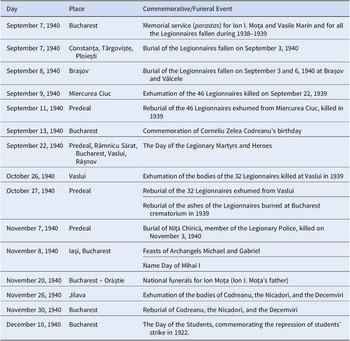
The Legionnaires’ rush to personal enrichment in those months was only surpassed by the regime’s hastiness to bury its fallen, exhuming its martyrs and reburying their remains in ceremonial fashion. The short transitional period from the king’s abdication (September 6) to the proclamation of the National Legionary State (September 14) was marked by a burst of funeral processions (a detailed overview of the new fascist regime’s commemorative calendar is provided in Table 1 below). The Legionnaires who had died during the overthrow of the royal regime were buried as political martyrs. In cities from all four corners of the country–Constanța, Târgoviște, Ploiești, and Brașov–legionary funerals were held for the fallen. Their bodies were hailed as the sacrificial foundation of the new political regime. The Legion’s Commander, Horia Sima, who attended the funerals of Lucian Caramlău and Gheorghe Ștefănescu at Ploiești on September 8, 1940, was greatly impressed by the specter of martyr death that loomed over the coffins. “The aureola of a great historical moment was being projected over their lifeless bodies,” wrote Sima (Reference Sima1995a, 13). The next day, 3,000 people, including civil and military authorities as well as the consuls of Germany and Italy, attended the funerals of two Legionnaires who died on September 3, 1940, in Brașov (Buna Vestire 1940a).
The commemorative calendar of the National Legionary State between September and December 1940

Sources: Almanahul “Cuvântul” (1941); Cuvântul (1940–1941), Buna Vestire (1940–1941)
The region of Brașov in Transylvania would soon be consecrated as the sacred center of a newly established symbolic geography of death and mourning within the National Legionary State. The burial of the legionary heroes fallen at Brașov was soon followed by a massive show of symbolic force and ritual might of unprecedented proportions. In parallel with the funeral procession, 100 kilometers north of Brașov, the bodies of 46 Legionnaires were exhumed. They had been killed and buried in a mass grave a year before in Miercurea Ciuc prison, on the night of September 22, 1939, during the retaliation the state had unleashed after the assassination of Prime Minister Armand Călinescu by a legionary commando. The procedure was carried out by a detachment of soldiers in the presence of legionary commanders who supervised the process and a sobor of priests who performed the religious service at midnight, in the light projected by motorized military units stationed outside the impromptu cemetery (Buna Vestire 1940b).
The remains were identified and sealed in 46 coffins that were loaded in five wagons attached to a special train. On September 10, 1940, the train carrying the remains of the legionary martyrs exhumed from Miercurea Ciuc reached Predeal. A funeral cortège including Orthodox priests, paramilitary legionary formations, state army divisions, local authority representatives, and family members accompanied the coffins from the train station to the cemetery of Predeal monastery. As they entered the monastery’s graveyard, the coffins were met with the Roman salute, performed by a crowd of several thousand. After the final religious service was officiated, the crowd intoned its growing repertoire of legionary songs (collective singing was deemed paramount as a means of binding the legionary community; see Codreanu Reference Codreanu1936, 303; Clark Reference Clark2013). From this moment, the funerary process followed a standard ritual sequence which I will now describe. At midnight, as the 46 coffins were laid in front of the collective graves dug in the graveyard of Predeal monastery, the “supreme rite of fascism”—the roll call that derived from the Italian squadrista tradition—was performed (Gentile Reference Gentile1996, 27). Time and again, the crowd shouted “Present!” for the name of every legionary martyr exhumed from the Miercurea Ciuc prison grounds. As the coffins were lowered to their final resting places, the crowd of mourners took the collective oath, pledging on the bodies of the 46 martyrs that they stood ready to follow them to the grave for the cause of the Legion and the redemption of the nation (Buna Vestire 1940b).
The composition of the cortège is indicative of the significant shift that had occurred in the legionary ritual process and that expressed the new balance of power. A sobor of Orthodox priests led the way, followed by the legionary choir. Behind this Christofascist group, the 46 coffins were transported on motorized platforms. Family members came in their tracks. Fourth in line was the legionary command group, heading a paramilitary unit of 300 Legionnaires dressed in Greenshirts with diagonal belts, the sartorial code of the Iron Guard. A company of elite mountain troops from the Romanian Army followed them, while the cortège was ended by another paramilitary detachment of Legionnaires. Moreover, a cordon of Legionnaires flanked the procession on both sides. This subordinated integration of the state army within the legionary ritual process reflected the shifting status of the Legion’s commemorations from countermanifestations that contested the political status quo to official parades endowed with full state ceremonial pomp. Moreover, the presence of military and civil officials and their incorporation within the legionary ritual structure indicates the growing fascistization of the state.
Three days later, on September 13, 1940, in Bucharest and throughout the country, the new regime celebrated Corneliu Zelea Codreanu’s birthday. However, the celebration occurred under the same funereal signs of death, martyrdom, and recollection. A contingent of 8,000 Greenshirts followed by several thousands of Legionnaires in civil clothes paraded throughout Bucharest in a milieu of “delirious enthusiasm” (Sima Reference Sima1995a, 22). The procession stopped at Sf. Ilie-Gorgani church where the sobor of priests kneeled and prayed for the “triumph of the nation” embodied in Codreanu’s personality. When the procession reached the Mausoleum of Moța and Marin, the crowd too fell on its knees and prayed for the souls of the two martyrs. After the religious services headed by the Metropolitan of Transylvania Nicolae Bălan, the commander Horia Sima called out the dead of the Legion, starting with the captain himself. The crowd shouted “Present!” Then, “Holy Legionary Youth” was sung. The ritual process concluded with Sima taking the pledge of his Legionnaires, who vowed in unison, “I will never betray the Legion or the Captain” (Buna Vestire 1940c). Simultaneously, throughout the country and beyond its borders (in Berlin and Rome), requiems were being officiated for Codreanu, attended by Nazi and fascist state officials (Buna Vestire 1940d, 1940e).
Against this commemorative background, some commentators messianized Codreanu to the point where he even replaced Jesus Christ as the mediator between God and the Romanian people: “For we all live through Him [Codreanu] and we have taken the light only from Him. And through Him from God. Therefore today: ON YOUR KNEES!” (Dancu Reference Dancu1940a, 2). Others have contrasted Codreanu with Mussolini and Hitler and concluded that the Romanian leader had accomplished something extraordinarily: whereas Mussolini and Hitler had seized power while alive, Codreanu is unique and superior since he alone is “the victor from beyond the grave” (Gane Reference Gane1940, 2).
The next day, on September 14, 1940, the National Legionary State was officially proclaimed. Constantin Noica, one of the leading philosophers who gave intellectual respectability to the Legion’s mystical ideology, characterized the moment as a chronogenetic upheaval. With the proclamation of the National Legionary State, a temporal revolution should double the political one, he argued. Following the great revolutionaries from the Jacobins of the 18th century to the Bolsheviks and fascists of the 20th century who all redesigned the calendrical framework by instituting a “year one” to coincide with the beginning of the new regime, Noica wrote that September 14, 1940 marked “Year I, Day I” of a new historical era (Noica Reference Noica1940, 1; on the politics of time, see Zerubavel Reference Zerubavel1981). However, this temporal rupture was not supposed to mean a complete fracture of the present with the Romanian past. The dead of the nation in whose ranks the legionary martyrs had entered bridged the two historical epochs and provided the needed continuity between the past and current political regimes (on the Legion’s fascist temporality, see Cârstocea Reference Cârstocea2015).
The National Legionary State marked its coming into being with a dense sequence of funerary processions that spread an air of celebrative mourning across the country. As soon as they seized power, the new rulers unleashed a massive program of funeral processions that transformed the country into an archipelago of microsites of thanatic memory celebrating martyr death. Overnight, legionary Romania became “the country of the dead,” as funeral parades were on the very top of the state’s agenda (Dancu Reference Dancu1940b, 1). It also inspired some of its detractors, who ridiculed the new political regime as the “National Funerary State” (Veiga Reference Veiga1993, 287). It is not surprising that the new dawn of Romanian history signaled by the proclamation of the new state began in mourning. The very next day, on September 15, 1940, when the Hungarian army occupied Northern Transylvania, General Antonescu decreed national mourning for the lost territory. At 11:45 AM, every Romanian was ordered to kneel wherever they were and pray for the nation, as church bells rang in mourning across the country (Antonescu Reference Antonescu1941).
In this whirl of funeral events that succeeded each other in an accelerating tempo, the legionary commandment proclaimed September 22 as “The Day of the Legion’s Heroes and Martyrs” to commemorate the massacre that had occurred in the previous year. On that day the bells of all the churches in the country rang, and everywhere prayers were offered and requiems were officiated for the eternal rest of the Legion’s fallen. The main sites of collective martyrdom became places of pilgrimage and commemorative rituals (Buna Vestire 1940f, 2; Sima Reference Sima1995a, 47). In Bucharest, thousands of Legionnaires gathered at the site where the nine Avengers had been executed after assassinating Prime Minister Armand Călinescu. Similar processions were held at the prison of Râmnicu-Sărat—which was shortly after declared a historical monument and legionary museum—the camp of Vaslui, the cemetery of Predeal, and other locations across the country (Buna Vestire 1940g, 2). As a prologue to the Day of the Legion’s Heroes and Martyrs, on September 21, 1940, the Predeal cemetery received the exhumed bodies of four Legionnaires fallen during the 1939 persecution and buried in Dobruja, Romania’s region at the Black Sea (Iordachi Reference Iordachi2002). The procession took the by now standardized structure, with a mortuary wagon transporting the bodily remains, tens of priests officiating the service, hundreds of Greenshirts answering “Present!” to the roll call and singing “Hymn of the Fallen Legionnaires” as the coffins were lowered into the graves.
On October 27, 1940, the second part of the reburial drama took place at Predeal cemetery. The exhumation procedures had started three days earlier. Special trains were organized to transport to Vaslui the families of the 32 Legionnaires killed on September 21, 1939, while imprisoned. A team of 20 Legionnaires wearing the green uniforms started digging at seven o’clock in the morning. The shovels were throwing the earth to the sounds of “Hymn of the Fallen Legionnaires” sung by the legionary choir. Peasants arrived from the rural surroundings holding candles, and whispered prayers completed the surreal decorum. Four and a half hours later, the first remains were brought to the fore. As the mutilated bodies were being unearthed, they were identified by their families based on clothing, documents, or teeth. In the evening, the coffins were carried ceremoniously to the train station, embarked on a mortuary train along with their families and comrades toward Predeal (Cuvântul 1940a, 3). The Vaslui exhumations were synchronized with a ritual process performed at the “Cenușa” Crematorium in Bucharest, where the Legionary Police discovered the ashes of 24 bodies burned by the state security. Among them were the nine Avengers who had assassinated—or, from their perspective, punished—Prime Minister Călinescu: legionary commanders Victor Dragomirescu and Nicoleta Nicolescu, university professor Vasile Christescu, along with other unidentified Legionnaires (Buna Vestire 1940h, 8).
In ceremonial fashion, the urns with the ashes of the legionary martyrs were collected and placed on a special train traveling to Predeal. Their removal from the crematorium’s basement where they were stored was rendered through the prism of a symbolic journey into the depths of hell: “this Masonic den is now enlightened with Christian candles, and the cross watches over all of its corners, protected by the faith of the Greenshirts” (Buna Vestire 1940i, 2). The trope of a descent into the underworld resonated well with the Orthodox worldview of the legionary ideology, in whose light the crematorium was a satanic institution. The Legionnaires saluted the 1928 decision taken by the Synod of the Romanian Orthodox Church to forbid its clergy any religious assistance for incinerated people, a measure it reconfirmed in 1933 (Rotar Reference Rotar2013). Of course, the interdiction did not apply to the case of the reburial of Legionnaires who had been cremated by their persecutors in order to destroy their physical existence (Rotar Reference Rotar2010, 3). At two o’clock in the night, 20 monks from Cernica monastery performed the religious service in the crematorium’s courtyard. A large funeral procession of 2,000 Legionnaires carried the urns to the train station.
Predeal train station had become the funeral rendezvous place for the martyrs of the Legion excavated from Vaslui and taken out from the crematorium (Buna Vestire 1940j, 4; 1940k, 3). The 32 coffins from Vaslui and the 24 urns with the ashes from Bucharest were ritually laid on the platform. They were then loaded into several mortuary carts pulled by oxen, and the cortège headed toward the cemetery. A religious service was performed which both General Ion Antonescu and Commander Horia Sima attended along with tens of thousands of Legionnaires who arrived in Predeal. The ritual sequence of the roll call, followed by the legionary funeral hymns, unfolded while the coffins were lowered into the graves and the urns were placed inside the church (Cuvântul 1940b, 3). With these two reburials, Predeal had become the necropolar capital of the National Legionary State, housing the bodies of tens of martyrs fallen for the cause of the Legion.
The Apotheosis of Death: Re-entombing the Captain, the Nicadori, and the Decemviri
Contingent factors overlapped with the legionary program of mass reburials to enhance the Legion’s thanatic culture. The main figures of the legionary pantheon of martyrs—Captain Codreanu, the Nicadori, and the Decemviri—were still buried in the Jilava prison. Until their grand reburial, carefully scheduled to coincide with the biennial commemoration of their death on November 30, 1938, other unplanned, natural, or accidental deaths crowded the already packed calendar of legionary funeral events. On November 3, 1940, a member of the Legionary Police by the name of Niță Chirică was killed by his own colleagues in a shooting while chasing a communist demonstrator. He was buried as a martyr in Predeal cemetery of the Legion’s heroes three days later, at the end of a large procession that started at Sf. Ilie-Gorgani church in Bucharest (Buna Vestire 1940l, 2; Cuvântul 1940c, 3).
Amidst the frenzy of exhumations and reburials, mass death pervaded the National Legionary State in yet another way. On November 10, 1940, the country was struck by a massive earthquake that reached a magnitude of 7.4 on the Richter scale (Calotescu, Neagu, and Lungu Reference Calotescu, Neagu, Lungu, Vacareanu and Ionescu2016, 38). The 45 seconds of shaking were enough to produce heavy damage, with a death toll of 1,000. Bucharest was at the epicenter of the disaster, totaling over 500 casualties—140 of which died in the collapsed Carlton high-rise building (Țurlea Reference Țurlea2009). From an engineering perspective, the November 1940 earthquake constituted “the first moment of truth for modern constructions in Romania” (Petrovici Reference Petrovici, Vacareanu and Ionescu2016, 85). However, the natural calamity also represented a litmus test for the construction of the National Legionary State. Alongside the military personnel, the Greenshirts and especially the Ajutorul Legionar (The Legionary Aid)—who had been established as a benevolent society modeled after the Nazi Winterhilfswerk (Winter Relief) (Clark Reference Clark2015, 225)—were heavily involved in providing assistance to the victims and easing the social aftershocks of the earthquake.
The November 1940 earthquake—which was interpreted in the legionary press as a trial from God and a divine punishment for the sins of the former regime (Buna Vestire 1940m)—had more impact upon the National Legionary States’ pragmatics of death than on its ritual thanatic culture. This was because, first, by the time of this natural calamity a funerary pattern was already firmly in place, especially after the 1937 burial of Moța and Marin. Second, the earthquake did not produce martyr death but victims among the civilian population. Last, the burial of this large number of casualties was a matter of pragmatic urgency (i.e., the disposal of victims’ corpses) and not a symbolic occasion for conveying the legionary ethos of heroism and sacrificial death.
Of different scale and nature were the national funerals proclaimed for the Transylvanian Orthodox priest Ion Moța, the father of legionary martyr Ion I. Moța. Published in mourning edition framed by a thick black border, the newspapers announced the death of the “Magus from Orăștie” that occurred on November 20, 1940 (Buna Vestire 1940n, 1; Libertatea 1940, 1). The deceased was covered with encomia ranging from “the Patriarch of the Romanian people” to the “holy Martyr in front of whose sacred earthly relics we fall on our knees” and the “Apostle of the Nation” (Posteucă Reference Posteucă1940, 2; Opriș Reference Opriș1940, 2). Readers were called to make a pilgrimage to the Sf. Ilie-Gorgani church in Bucharest, where his body was deposed and watched over by a legionary Guard of Honor. The next day, the Council of Ministers decided to organize national funerals for the “great priest of the Nation” (Sima Reference Sima1995a, 210). The funeral procession stretched over two days and 400 kilometers. On November 22, the ceremony started in Bucharest, where tens of thousands paid their last homage to the deceased, including ministers, army officials, diplomats of the Axis Powers, and representatives of the magistracy. The funerary train arrived in his hometown of Orăștie in the morning of November 23, 1940, after ritual stops along the railway route in Ploiești, Predeal, Brașov, Teiuș, and Alba Iulia. The coffin was finally buried after several religious services were performed by high-ranking officials of the Orthodox Church, including Nicolae Bălan, the Metropolitan of Transylvania (Buna Vestire 1940o, 3).
However, the most grandiose funeral event organized during the short-lived National Legionary State was certainly the reburial of the trinity of the Legion’s pantheon of heroes: Captain Codreanu, the three Nicadors, and the ten Decemvirs killed together on the night of November 30, 1938, in the Tâncăbeşti forest and hastily buried in Jilava prison. As a sequel to the reburial of the martyrs of Miercurea Ciuc and Vaslui, Codreanu’s reburial was conceived as the grand finale of a funeral drama in three acts that would spiritually transfigure Romanian society and consecrate a new epoch in Romanian history. The exhumations started only after the entire week had been consecrated to “the everlasting memory, heroism, and sacrifice of the founder of the Legionary Movement” (Sima Reference Sima and Sima1995b, 10). This week of mourning and recollection was labeled as “the Passion of the Captain,” a direct reference to the Holy Week of Christ’s Passion (Stoicănescu Reference Stoicănescu Prof1940, 1–2). The legionary commandment established a program of perpetual services to be celebrated in every church across the country. An announcement published in national newspapers instructed the clergy to officiate requiems for the legionary martyrs. A diptych (pomelnic) with the names of the 14 dead was to be ritually mentioned within the memorial service in the exact order as listed in the announcement (Cuvântul 1940d, 3).
On November 26, 1940, a group of Legionnaires assisted by engineers started lifting the concrete plate weighing 30 tons that had been poured over the 14 bodies. Cranes and shovels moved the ground in “an atmosphere of complete silence,” as the bereaved spectators were watching the earthwork following Codreanu’s law of silence (Cuvântul 1940e, 10; Codreanu Reference Codreanu1934, 4.). At two o’clock in the evening, they managed to remove the plate measuring 35 cm in thickness. During this time, inside the Jilava prison, a legionary commando led by Dumitru Groza assassinated all the 64 political detainees associated with the former regime, in a brutal act of vengeance that was deemed a necessary preface to the symbolic resurrection of the 14 martyrs through their exhumation (Comandamentul Militar al Capitalei 1941). This resurrective vengeance was followed by an apologetics of massacre draped in a biblical rhetoric of divine justice.
Christ has risen! The Captain! But in order to rise from the dead, it was necessary that Judas died first. And Judas was now multiplied. He was not only one. But also the cross and the graves with sacrifices were being multiplied. It was not only one. There were hundreds of them. And this is why Judas’ expiation had to be multiplied. And he did expiate. He paid before the tombstone was removed and the son of the nation rose.
(Posteucă Reference Posteucă1977)The next morning, in the presence of the families and legionary commanders, the bodies were unearthed and identified. Once brought to the fore, the corpses were wrapped in white shrouds and placed in 14 coffins adorned with the national tricolor and the green legionary flag. During the religious service officiated by a sobor of priests, the audience fell to its knees before the bodily remains of the 14 top-ranking Legionnaires. The procession reached Sf. Ilie-Gorgani church at midnight. A permanent Guard of Honor watched over the coffins laid in front of the altar.
The bodies were displayed in a church draped with legionary paraphernalia for the next two days. Perpetual religious services were officiated by hundreds of priests who enlisted in advance with the Legion’s secretariat. A legionary priest was appointed in charge of the liturgical logistics. A master schedule covering the two days and nights of the vigil was posted on the notice board at the Legion’s headquarters (Cuvântul 1940d, 3). During the vigil, thousands flocked in pilgrimage to the church, having to wait for up to four hours to worship the martyrs. In a radio broadcast of November 27, 1940, the public could listen to the voice of philosopher Emil Cioran proclaiming, “From now on, the country will be ruled by a dead man. This dead man has spread a perfume of eternity over our human misery” (Cioran Reference Cioran1940).
On November 29, 1940, the legionary commandant decorated the 14 cadavers postmortem in a morbid ritual that required opening the coffins and attaching a white cross, a symbol of the Iron Guard, on the shirts of the deceased. Horia Sima decorated the Nicadori and the Decemviri, while the first legionary senator, Professor Ion Găvănescul, decorated the Captain Codreanu. In a move meant to legitimize the new commander as the bearer of Codreanu’s legacy, Professor Găvănescul later that day decorated Horia Sima with the same legionary distinction consisting in a small bag of earth taken from various battlefields in Romanian history (Cuvântul 1940f). This telluric ritual was the Legionary Movement’s founding rite, enacted by Codreanu and Moța when they created the Legion of the Archangel Michael in 1927 (Codreanu Reference Codreanu1936, 342).
For the day of the grand reburial, the government decreed a social standstill across the country. During the national day of mourning, all public services, including schools, were closed for the entire day. Shops were not allowed to open their doors to customers, and all other cultural performances and athletic events were suspended due to the preparation for the grand spectacle of death and resurrection that was about to unfold on the streets of Bucharest (Cuvântul 1940g, 12; on the thanatopolitics of national mourning, see Rusu Reference Rusu2020a, Reference Rusu2020b). The funeral drama started with a religious service at the same Sf. Ilie-Gorgani church, which became the martyrium of the legionary political religion as well as the epicenter of the movement’s funeral processions. The large sobor of legionary priests, headed by Metropolitan Gurie of Bessarabia and the Vicar of the Patriarchy, prayed for Corneliu Zelea Codreanu, “the Captain of Romanian History,” as well as for his 13 apostles who followed him in death (Cuvântul 1940h, 1). The massive cortège, which included a thousand clergymen and thousands of Greenshirts, crossed the capital as it headed toward the Green House (the Legion’s headquarter situated at the outskirts of Bucharest). In contrast to the funeral of Moța and Marin, when the two coffins had been transported on a hearse, the 14 coffins were carried on the shoulders of Legionnaires teams working in shifts. Once it arrived in front of the Green House, the coffin containing Codreanu’s remains was placed inside the mausoleum, between those of Moța and Marin. The Nicadori and the Decemviri were buried in 13 graves dug on both sides of the mausoleum. The grand ceremony concluded with the by now standard ritual pattern: the Roman salute, the roll call with thousands shouting “Present!”, singing “Hymn of the Fallen Legionnaires,” and the pledge to assume the Legion’s self-sacrificial ethos epitomized by its celebrated hero martyrs.
Besides the Christofascist rituals enacted as “performative politics” (Rothenberg and Valente Reference Rothenberg and Valente1997), the mystical component of the legionary political religion was even better highlighted in the printed press that covered and commented upon the events. The Christian tropes of collective redemption, vicarious atonement and the expiation of the nation’s historical sins through the sacrifice of a few chosen martyrs (Iordachi, Reference Iordachi and Iordachi2010) were explicitly used in describing the impact of Codreanu, the Nicadori, and the Decemviri. Referring to the 14 legionary martyrs, a columnist of Cuvântul (The Word)—the new regime’s official organ—wrote that “the nation has expiated, in the death of its innocents, all the sins of the past” (Racoveanu Reference Racoveanu1940, 1). He added that it was inconceivable that their blood would not “ransom the sins” of the Romanian people. Another newspaper insisted that Captain Codreanu alone “ransomed [the sins of the nation] before God and History” (Adameșteanu Reference Adameșteanu1940, 1).
Even more spectacular was the strikingly straightforward analogy drawn between Codreanu’s exhumation and Christ’s resurrection, already adumbrated in the proclamation of the “Week of the Captain’s Passion.” “The Captain lives,” wrote Dumitru Groza, the commander of the Legion’s Workers’ Corps, who oversaw the mass killing committed at the Jilava prison. “The Captain has been resurrected for the glory of the Legion and the Redemption of the Nation” (Groza Reference Groza1940, 1). In describing his exhumation as a resurrection, Codreanu had been rendered as a national alter Christus whose suffering not only redeemed Romanian people but whose reburial also marked a new dawn for Romanian history. Vasile Posteucă (Reference Posteucă1977), who witnessed the unearthing firsthand, later wrote that “it was not an unearthing. It was a true Resurrection.”
Who dared believe [. . .] that the Captain will one day set aside the tombstone of two wagons of cement and will march triumphantly through the middle of the nation [. . .] trampling over his own death? [. . .] And nevertheless, the miracle happened. The Captain and his martyrs have resurrected. They have resurrected!
(Posteucă Reference Posteucă1977)The symbolic analogy between Christ’s rising from the dead and Codreanu’s resurrection was doubled by another, more material, sign of holiness. The same Posteucă wrote that “it is in truth a miracle. The Captain did not rot. [. . .] Yes! The Captain was a saint. He did not rot and will never rot” (Posteucă Reference Posteucă1977). The Legionnaires were so entrapped in the rhetoric of martyrdom that they went so far as to request—with no success—the formal canonization of Codreanu as a saint by the Romanian Orthodox Church (Nagy-Talavera Reference Nagy-Talavera1970, 322). Not all institutions proved so reluctant in considering Codreanu’s postmortem status. On the day of the reburial, the High Court of Cassation annulled Codreanu’s 1938 sentences by the Military Court (Sima Reference Sima and Sima1995b, 23). The strategic timing of the judicial exoneration to coincide with the reburial shows the concerted efforts which brought together various state authorities in consecrating Codreanu as a hero martyr.
Conclusions
When the Legionnaires finally and unexpectedly seized power, Christofascist necropolitics were already firmly established within their political culture, which celebrated death and self-sacrifice. From 1933, when the Legionary Movement buried the first of its fallen—the protomartyr Virgil Teodorescu (Biliuță Reference Biliuță2013, 246)—until the grand ceremony staged for the funeral of Ion I. Moța and Vasile Marin in 1937, the movement articulated a peculiar thanatic culture founded upon the cult of death and the celebration of heroic martyrdom. Especially during the early 1930s, these political funerals were staged as ritual means of contesting the status quo and were carried out as acts against the state authorities.
The proclamation of the National Legionary State provided the movement with the opportunity to shift the nature of their political burials from funeral rites of subversion, enacted as oppositional necropolitics, to state-sponsored ceremonies of power (Ben-Amos Reference Ben-Amos2000). During the short-lived National Legionary State, death took center stage, as myriads of exhumations, burials, reburials, memorial services, and other commemorative practices were held in quick succession at an unprecedented pace. The flurry of exhumations was prompted by the urgency of territorial concessions (Northern Transylvania and Dobruja), from where the legionary martyrs had to be relocated before falling under enemy occupation. Despite this rather contingent start, the National Legionary State swiftly carried out a massive program of funeral processions as a ritual expression of its now state ideology of thanatic ultranationalism. It culminated in the exhumation and grand reburial of Codreanu and his thirteen apostles of martyrdom—the death commandos known as the Nicadors and the Decemviri—described in terms analog to the resurrection of Christ.
In a cultural analysis of the temporal dynamics and shifting functions of collective singing in Romanian fascism, Roland Clark (Reference Clark2015) argues that after the establishment of the National Legionary State, the Legionnaires stopped innovating in terms of the songs being sung at various rallies and political gatherings. Instead, the regime relied heavily on the nostalgia of the struggles during the 1930s and commemorations of this period as a means of legitimating itself (264). The massive extent of exhumations and the symbolic stakes attributed to the remains suggest that the movement’s funeral culture during the National Legionary State developed along a similar, backward-looking trajectory. What is beyond doubt is that in the Romanian fascist state, burial rites and funeral music were merged into a powerful repertoire of state-enacted, thanatic cultural practices that were mobilized to legitimize the new political order.
Besides the overarching functions of articulating the Legion’s thanatic worldview and conveying it to the wider society, the spectacular necropolitics staged within the National Legionary State also served as a political distraction. The grandiose liturgies for the dead orchestrated by the regime were ritual means of diverting attention from the increasingly tense relationship between the Legionnaires and General Antonescu. These political funerals, which Ion Antonescu attended dressed in the iconic green shirt, were public occasions to showcase the unity of the bicephalous leadership that was increasingly undermined by the parallel structures of competing power, which eventually reached a breaking point during the failed legionary rebellion (January 21–23, 1941) and brought an end to the National Legionary State.
The fascist past institutionalized in the short-lived National Legionary State, fraught as it was with political violence and spectacular funerals, continues to haunt Romania’s present and historical consciousness. No aspect of this turbulent past is more daunting than Captain Codreanu himself who, as the heroic martyr of the legionary movement, has become an icon of contemporary transnational neofascism. It is intriguing in this regard that a leader of the violent white nationalist rally held in Charlottesville, USA, in 2017 wore a T-shirt emblazoned with the image of Codreanu under which it was inscribed “Present!” (Bloomfield Reference Bloomfield2017).
Just as another major historical figure whose actions defined the National Legionary State—General Ion Antonescu—Codreanu constitutes a prime example of a “ghost hero,” that is, a historical personality who is venerated within national communities despite having been implicated in criminal acts or immoral activities (Eglitis and Kelso Reference Eglitis and Kelso2019). As I documented in this article, the funeral practices and martyrological tradition they shaped, culminating with the master ceremony of exhuming and reburying Codreanu, contributed decisively to establishing the legionary leader as a pseudosacred martyr of the Romanian nation and, beyond national borders, as an iconic symbol of contemporary far-right movements.
Acknowledgments
The author would like to thank the two anonymous reviewers and Prof. Pieter M. Judson for their insightful criticism.
Disclosure
Author has nothing to disclose.
Financial Support
This work was supported by a grant from the Romanian Ministry of Research and Innovation, CNCS-UEFISCDI, project number PN-III-P1-1.1-PD-2016-0466, within PNCDI III.