In the past few decades, many new, grand theatre venues have been, and continue to be, built in China in the national rush for urban modernization. They were modeled first after Hong Kong and Singapore, then directly after European and American metropolises, some designed by top Western architects. Situated in a very different social and cultural context, though, most of these theatres are more often than not empty, especially on weekday evenings. Tao Qingmei noted in her paper “The Models, Problems and Solutions of Construction of Grand Theatres in China”:
Since the opening of the National Center for the Performing Arts [in Beijing] in 2007, there have been waves of construction of grand theatres all over the country. Statistics from 2010 to 2013 show that 40 high-standard theatre complexes were completed or near completion […] while most of [China’s] medium-size and small cities were planning to build “grand theatres,” which refers to huge and luxurious ones costing around 500 million RMB each, occupying at least 70 thousand square meters of land. (Tao Reference Qingmei2016:92)
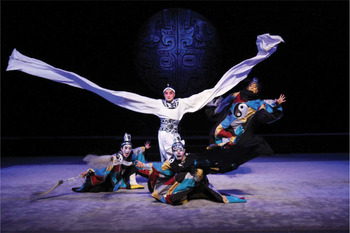
Zhejiang Beijing Opera Troupe’s production of King Oedi, adapted by William H. Sun. Oedi (center) performed by Weng Guosheng 翁 国 生 . Hangzhou, 2008. (Photo courtesy of Weng Guosheng and William H. Sun)

As Huang Changyong explains in his article “Shanghai: The Road to a Modern Performing Arts City,” which appears in this issue of TDR, Shanghai, an exceptional metropolis in terms of Chinese performing arts, was ahead of the national “waves of construction of grand theatres.” Shanghai’s first new grand theatre at People’s Square in the middle of the city opened nine years earlier than its Beijing counterpart at Tiananmen Square. The Beijing model encouraged many other cities to follow its lead. Liao Fanlong reported in a 2018 Beijing conference on Theatre Operation in China that in 2017, 35 new grand theatres were added nationally, raising to 1,171 the total number of professional theatres. The average number of performances annually in each was only 47 in 2017 (Liao Reference Fanlong2018; see also Huang Reference Changyong2021).
With the number of performance venues growing, a huge and increasing amount of tax-payers’ money is spent on not only building them, but also commissioning new plays, sponsoring tours, and inviting international artists to perform in them. Nowadays one can often see an intriguing odd couple staged in many fancy venues: the bright Chinese eulogies of model communists or historical role models, mostly monotonous propaganda pieces, alongside the dark Western plays, especially esoteric pieces associated with some famous avantgarde master. Yet there are two similarities between these ideologically opposite types of theatre: the lack of appeal to common people and very short runs, mostly one or two performances in each city, or for the entire production. That is why most Chinese cities, even those with a population of millions of people—except the two megacities Beijing and Shanghai—have no regular ticket-selling theatre performances, despite the increasing number of grand theatres.
Having seen this odd situation develop for two decades since my return to Shanghai in 1999 after 15 years of studying and teaching theatre in the US and Canada, I keep asking why. Is it because the Chinese people don’t really like theatre as Westerners do, as some Chinese assume?
Catharsis: Purgation or Cultivation?
Since the early 20th century, Chinese scholarly theatre discourse has been largely dominated by Western dramatic theories and terminology. Nevertheless, two crucial aspects of Western theatre have escaped the attention of most Chinese theatre people and scholars. One of them, originating in Greek tragedies and becoming prevalent in the early 20th century when China began to learn about Western theatre, is a preference for the display and purgation of things unclean and undesirable, whose extreme examples include cruel familial killings. This is largely incompatible with Chinese culture, in which most theatre, especially Chinese “opera” in its many variations, tends to showcase positive role models in ultimately uplifting stories. The other ignored aspect is the large portion of Western theatre that parallels the Chinese preference for moral cultivation and/or entertainment. In China, theatre studies has been dominated by the Western discourse on “serious drama,” mostly the theatre of purgation, whereas a considerably larger proportion of Western professional theatre is in fact theatre of cultivation, i.e., certain types of musicals, comedies, and dramas with uplifting themes. Those types of Western theatre, closer to Chinese theatre in terms of theme and social function, have been largely overlooked by most Chinese theatre teachers and scholars. Another intriguingly overlooked similarity between China and the West in the past century or so is that Western theatre comes in two major kinds, dramas and musicals, mirroring the division in China between huaju (spoken drama) and xiqu (Chinese opera). The number of professional productions and theatregoers of drama is not necessarily larger than those of musicals in many cities of the WestFootnote 1 and of Chinese opera in China.
That Chinese opera outnumbers spoken drama, in terms of the number of forms (and companies specializing in those forms), the number of performances, and the size of the audiences, is a fact often overlooked or deliberately ignored by most Chinese theatre scholars who habitually see spoken drama imported from the West as advanced and traditional Chinese opera as dated. A factual yet stunning statement that “only Chinese opera is China’s mainstream theatre in the 20th century” is on the book jacket of a major Chinese book from Reference Jin2016 by Fu Jin, 20世纪中国戏剧史 (A History of Chinese Theatre in the Twentieth Century, English translation 2020). As for comparing the quantity of dramas versus musicals in the West, if we take New York as an example, according to the New York Times listings on one day in February 2015, there are about a hundred ticket-selling professional performances per day (before Covid-19, and not taking into account the multitude of smaller venues not listed in the Times). Many run for a couple of weeks, a few for years at the rate of eight shows per week. In her essay “In Search of Playwrights Being ‘Post-ed:’ One Evening Tour of New York Theatre,” Fei Chunfang examines all the productions on one evening, 7 February Reference Chunfang2015:
On the pages of the theatre section in the New York Times, there are 201 pieces of information about performing arts […] The largest group is theatre. Broadly defined, in a Chinese way, to include all theatrical events, the number is more than 120. That evening there were 27 productions on Broadway. Out of the 18 musicals, 11 were long-running shows or revivals. (Fei Reference Chunfang2015:39– 40)Footnote 2
The productions on Broadway that evening comprised two-thirds musicals and one-third dramas. In the same source, 63 productions were listed for off-Broadway and off-off-Broadway—the majority musicals and dramas. Aside from about 8 hard-to-define performances, the proportion between drama and musical productions was roughly 4:6. Given that Broadway venues are all larger and famed shows run longer than off- and off-off-Broadway productions, the number of spectators for musicals would be much larger than that for dramas.
Nonetheless, the Chinese view of Western theatre over the past hundred plus years is almost exclusively of drama, especially serious drama—from Henrik Ibsen, Arthur Miller, Samuel Beckett, Sam Shepard, to Martin McDonagh, etc.; few Chinese scholars have noticed musicals as an integral part of Western theatre and culture. In the early 20th century, the progressive Chinese, who first saw Western-styled drama with awe and pleasant surprise, wanted to import it to replace the completely different traditional Chinese opera they deemed backward and stale. When Chinese students learned about Western drama in Tokyo and later brought it back with them to China in the 1900s and 1910s, they simply used the Japanese term “new theatre” (新剧 xin ju). It was Hong Shen, the first Chinese to seriously study Western theatre, who coined the name “spoken drama” (话剧 huaju) after returning from Harvard’s 47 Workshop, taught by George P. Baker. He put on the first successful drama production in Shanghai, an adaptation of Oscar Wilde’s comedy Lady Windermere’s Fan (1892). The word “spoken” is the key, as opposed to Chinese opera with its singing and dancing. Hong zeroed in on that most important feature of drama, a unique product of Europe. In the history of performing arts, one can find various types of storytelling and/or song and dance in every culture and society. Yet “spoken drama,” a type of theatre where actors play characters speaking words, occurs only in ancient Greece and Rome, in medieval church theatre, and various modern European and New World European-derived cultures, before Western colonialism and imperialism influenced the rest of the world. China, Japan, and some other countries developed their own types of theatre “presenting stories with song and dance” (Wang Reference Guowei2013:1), but not “spoken drama” until their encounters with the West. India’s Sanskrit drama of about 1,500 years ago was largely spoken, but had all but disappeared long before the modern era.
Greek tragedy has two unique features, diametrically different from Chinese theatre and many other theatrical genres in the world. In terms of form, it depended mainly on only two or three speaking actors to unfold plots. The singing and dancing chorus was largely separate from the actors. In terms of content, the stories were often extremely cruel, such as Oedipus killing his father and marrying his mother, Medea slaughtering her own children, and the serial killings in Agamemnon’s family. Weaving these stories together, Greek tragedy could make today’s “in-yer-face theatre” such as The Beauty Queen of Leenane (Martin McDonagh, 1996) pale, even though the “in-yer-face” playwrights claim to be “rude, vicious and provocative” (Sierz Reference Sierz2001:jacket) in their attempt to top other cruelty advocates in the theatre.
Coincidentally, the simplicity in form and the cruelty in theme are reciprocally cause and effect. Tragedy began with only one or two masked actors. In contrast to the singing and dancing of the larger chorus, it was really hard to hold the attention of the huge audience of 15,000 or more by plain speaking. Tragedians resorted to telling scary and suspenseful stories, such as the vengeful killing cycle in The Oresteia of Aeschylus. Sophocles added the third actor, allowing the dramaturgy to be even more intriguing, the killing more widespread. For example, in Antigone most members of two families die. Medea goes even beyond that because not only are two families destroyed, the heroine has also killed her own brother while escaping from her homeland before the play begins.
It is hard to imagine this kind of cruel plot as the subject, let alone the focus, of performing arts in China before Western culture entered the scene. Since the 1990s Luo Jinlin of the Central Academy of Drama in Beijing has directed several adaptations of Medea as Hebei bangzi opera. Theatre experts liked them very much, and the two actresses playing the title role won the Plum Blossom Prize, China’s top award for acting. Luo told me, however, that when Medea toured in rural areas where the Hebei bangzi opera is rooted many women openly rejected a child-killing Medea. In an interview, he told Chen Rongnu, a professor of Greek theatre and culture: “It is difficult for Chinese theatregoers to accept this kind of woman. After the second run, a deputy head of the provincial Cultural Bureau called me in and asked if I could change the finale. I said no. Should Medea end without killing her children, it would not be Medea” (Chen Reference Rongnu, Yuehong and Hui2016:7). Luckily, the official did not insist. Also luckily, Luo’s production was a Chinese opera version, with a lot more aesthetic distance than spoken drama. Spectators might not experience as much vicarious pain as in a more realistic drama. While Medea is often produced in the West, the play is hardly ever done in China as spoken drama. Some kind of cultural incompatibility is the most likely reason. The only exception was a four-performance production in 2011 in Beijing directed by Yan Yongqi, a Malaysian who finished his PhD at the Central Academy of Drama in 2010.
Compared to killing parents and children, an abandoned woman taking vengeance on the man who deserted her and his children seems to be a far more common motif in world theatre scenes. What seems horrible about Medea in non-Western cultures is not her act of revenge, but her means of enacting revenge: killing her own children. In Kalidasa’s Shakuntala, the heroine of the most famous Sanskrit drama is the other extreme. She does not even complain about her son’s father who deserts her after just one night. Shakuntala believes his action must be her own fault. She raises the child alone and is eventually reunited with the man, who turns out to be the king. The well-known Chinese characters Wang Baochuan in Lady Precious Stream and Zhao Wuniang in Lute Song, each played on Broadway with mainly white actors in 1936 and 1946, respectively, are like Shakuntala in that each woman is eventually reunited with her husband who has been living with his other wife.
Beijing Hebei Bangzi Opera presenting its version of Medea during the Chinese New Year holiday in 2020. Medea (center) played by Wang Hongling 王 洪 玲. (Photo by Luo Jinlin; courtesy of William H. Sun)

Most European theatregoers might find it difficult to accept the kind of “happy ending” Asians traditionally prefer. It would be even harder for Asians to understand the Greek trage-dians’ penchant for presenting such horrible stories. No one would say that Westerners regard people as essentially evil simply because their theatre shows more evil than Asian theatre. Then why were they so eager to fabricate nightmares saturated with “negative energy?” More puzzling still, those evil deeds were not conceived for villains to carry out as negative examples onstage, but as actions of tragic heroes who are supposed to be better than common people. Aristotle states clearly in his Poetics: “As for the [tragic] characters, there are four things to be aimed at. First and foremost, that they be good. The person will have character if in the way previously stated their speech or their action reveals the moral quality of some choice, and good character if a good choice” (Reference Aristotle and Worthen1993:105). Why would good people do such evil and cruel things? That is the mind-boggling question Asians traditionally cannot help asking.
In his Poetics, Aristotle’s answer is catharsis, an effect of tragedy that has troubled scholars for centuries. Luo Niansheng, the first major Chinese translator of Greek classics, including play scripts, and the father of Luo Jinlin, the aforementioned director of Medea, wrote a long essay enumerating various translations of “catharsis” by scholars in different languages. In his Chinese version of the Poetics Luo wrote: “[Tragedy] uses pity and fear to cultivate [taoye] these feelings” (Luo Reference Niansheng1962:19). The Chinese word he chose for catharsis, taoye (cultivate), has a strong positive flavor; its objects are always something positive, such as civility and character. Compared to Aristotle’s “catharsis”—a psychological-physiological process purging something impure or undesirable—Luo’s translation of this word seems just the opposite—a sinified interpretation. Traditional Chinese like to cultivate positive feelings, such as filial duty to one’s parents, affection for children, love for music, etc., oftentimes through prescribed mental, physical, and often artistic exercises. How could familial killing be used to cultivate these desired feelings? Ironically, Luo’s inaccurate translation inspires me to use the words “cultivation” and “purgation” to compare and contrast traditional Chinese theatre and Greek tragedy. Catharsis was originally a medical term. There is a Chinese medical term that is somewhat similar: 以毒攻毒—to fight poison with poison.
While it is hard for most Chinese to understand Greek tragedians’ unique penchant for cruel plots, in my teaching I often use the Chinese analogy of an exceptional medical treatment, using a strictly controlled small amount of poison. More compatible with traditional Chinese theatre—indeed, all traditional Chinese arts—would be the tonic herbs keeping healthy people healthy, or making people healthier. During the times of Greek tragedy, within China’s Spring and Autumn periods (770–221 BCE), Chinese arts (乐 yue), mainly music, were inseparable from the rites (礼 li), a system preserving social hierarchy. The arts, guided by the rites, were intended to cultivate noble feelings. In his pioneering A History of Chinese Opera in Song and Yuan Dynasties (宋元戏曲史), Wang Guowei states:
Ancient exorcists were in fact those who sang and danced to entertain gods and humans. […] Then Lord of Zhou (Zhou Gong, 12th century BCE?) established rites, putting a hundred gods in their right places, and setting up ceremonies. Officials were given long-term posts, rites regulated, and musical rhythms composed. (2013:251)
Confucius (551– 479 BCE) admired the Lord of Zhou and advocated restoring his rites. Over about 500 years, the Chinese developed sophisticated philosophies of Confucianism, Daoism, Legalism, Mohism, etc., the so-called contention of a hundred schools of thoughts, and lyrical poetry, as in the anthology The Book of Songs, which Confucius allegedly collected and edited. The performing arts were still primarily music. Unlike Greek mythology’s intricate, intertwined, and interfamilial conflicts that seemed to be waiting for dramatic adaptations, Chinese mythology was comprised mostly of simple short stories such as “Nvwa Patches the Sky,” “Jingwei Fills the Ocean,” “Houyi Shoots Down the (eight extra) Suns,” and “Yugong Removes the Mountains.” These stories, focusing primarily on relations between humans and nature, were not really suitable for dramatic presentation.
The main reason why there was no narrative theatre in China at the same time that the ancient Greeks developed very sophisticated dramas lies in the Chinese attitude towards the arts. While there were many schools of contending thoughts at the time, the major schools were similar in their narrow views on the arts. Daoists Laozi and Zhuangzi were artistically very advanced; their philosophical writings very poetic. Yet in theory they denied the arts: “Too many colors will make the eyes blind; too many sounds the ears deaf” (Peking University 1980:29). The Legalists prioritized content over style, oppos-ing rites, music, and poetry. The Mohists said simply “no music.” By comparison, Confucians were supportive of the arts, yet they wanted only a certain type of music —“joyous but not indecent, mournful but not distress-ing” (16)—a kind of music that would cultivate the positive feelings they prescribed for people. Unlike conflict-centered drama, harmony-oriented music, sometimes with dance, was the safest artistic genre for the ruling elite and common people alike, very much like today’s “dancing in public squares” mainly in urban areas (see Seetoo and Zou Reference Seetoo and Zou2016), and Hokkien opera (see Chen and Dong Reference Shixiong and Guochen2021) and the like, performed by numerous private itinerant troupes and enjoyed by villagers in many rural areas. In the West today, while there is the theatre of purgation, many musicals are “joyous but not indecent, mournful but not distressing.” When a musical has a dark dramatic core, e.g., Hadestown, West Side Story, Sweeney Todd, or Rent, its music and dance usually makes the conflict look and sound less cruel and more pleasant.
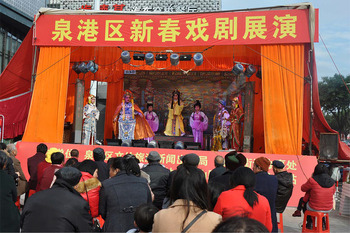
A local troupe’s Hokkien opera performance in rural Fujian province during the Chinese New Year holiday in 2019. (Photo by William H. Sun)

“Too Scary” and “Cover with a Scrim”
Many Chinese scholars see “expression versus mimesis” as the major difference between Chinese and Western arts (see Zeng Reference Fanren2000). Peking University professor Peng Jixiang, author of General Theory of the Arts (艺术学概论, Reference Jixiang2006), selected by the Ministry of Education as the most authoritative textbook on arts theory, states: “Traditional Chinese aesthetics emphasizes expression, lyricism, and presentation of will; while traditional Western aesthetics emphasizes representation, mimesis, and realism. This is a very big difference” (Peng Reference Jixiang2015:11). I believe that Aristotle’s theory of mimesis, which Peng sees as the foundation of Western aesthetics, can apply to both Chinese and Western arts. Greek tragedies are not necessarily closer imitations of life than most Chinese operas. On the other hand, the content and social function of Aristotle’s theory of catharsis shows a much bigger and deeper difference between Western and Chinese theatre: purgation of undesirable feelings versus cultivation of desirable feelings. In general, many Western dramatic classics (not including comedies, which I will discuss later), present scary nightmares as poison to fight poison; most Chinese theatre works, especially Chinese operas, show beautiful dreams where good deeds beget good rewards. In comparison, Western thinking often centers around the redemption of the flawed human being, whereas Confucianism, dominating Chinese culture for more than 2,000 years, sees human nature as born virtuous, focusing on positive ethical cultivation. Chinese narrative arts, which emerged in the Song dynasty (960–1279) as evidenced by extant documents, comprising mainly storytelling and Chinese opera, provided not only entertainment but also history and ethics lessons embodied in exemplary role models. The most salient example is Gao Ming’s Lute Song (琵琶记 Pipa Ji, 14th century). Its characters are all role models: “Super rich and noble Premier Niu; benevolent and loyal Zhang Guangcai; chaste and courageous Zhao Zhennu; loyal and filial Cai Erlang” (in Mao 1958:2). The Ming dynasty’s founding emperor, Zhu Yuanzhang, praised Lute Song highly: “While the five classics and four books are necessities in every household, like food and clothes, Lute Song of Gao Ming is like the best, luxurious dishes that rich and noble families enjoy” (Ye Reference Changhai2014:96). As for dissident playwrights having various problems with the authorities—Guan Hanqing and Tang Xianzu are the best known—they also preferred good, uplifting characters, whose positive spirit never fades away even if their bodies must die. For example, Dou’e gets her death wish at the end of Guan Hanqing’s The Injustice Done to Dou’e (13th cen-tury) and Du Liniang comes back to life after death in Tang’s The Peony Pavilion (1598).
In a broader sense, the Chinese look for good people and good deeds straightforwardly showcasing positive life models. Whenever evil deeds are shown, they serve as a foil to the good role models. Greek tragedians, however, showcase evil deeds and their terrible consequences to highlight negative examples, and/or to prove, as Sophocles writes in Oedipus, “Count no man happy until his life is over.” That is, fate catches up with us; bad things happen unexpectedly; the logic of human life is not always in harmony with the logic of cosmic life. What is surprising and puzzling to many Chinese is, the agents of those bad examples are all supposed to be good people, as Aristotle says, “tragedy is an imitation of persons who are better than average” (Reference Aristotle and Worthen1993:106). Therefore their otherwise unpardonable deeds need very complicated and strenuous explanations.
A complicated concept, catharsis comprises two main things: the process of releasing the impure and/or undesirable; and the result, the purification of the heart/mind, the purgation. Yet only the former is always seen onstage. Therefore, from classical times onward, many people have argued about whether the presentation of cruel actions is really for purgation or to exhibit bad deeds that might entice people to be licentious and self-indulgent. Well before Aristotle, Plato was most ardently against “bad example” art, sounding more Confucian than Greek tragedian in his Republic (c. 375 BCE):
Is it, then, only the poets that we must supervise and compel to embody in their poems the semblance of the good character or else not write poetry among us, or must we keep watch over the other craftsmen, and forbid them to represent the evil disposition, the licentious, the illiberal, the graceless, either in the likeness of living creatures or in buildings or in any other product of their art, on penalty, if unable to obey, of being forbidden to practice their art among us, that our guardians may not be bred among symbols of evil, as it were in a pasturage of poisonous herbs, lest grazing freely and cropping from many such day by day they little by little and all unawares accumulate and build up a huge mass of evil in their own souls. But we must look for those craftsmen who by the happy gift of nature are capable of following the trail of true beauty and grace, that our young men dwelling as it were in a salubrious region, may receive benefit from all things about them, whence the influence that emanates from works of beauty may waft itself to eye or ear like a breeze that brings from wholesome places health, and so from earliest childhood insensibly guide them to likeness, to friendship, to harmony with beautiful reason. (5.401b– 401d)
Or this passage, which seems to specifically target catharsis:
But we have not yet brought our chief accusation against it [art, especially poetry and tragedy]. Its power to corrupt, with rare exceptions, even the better sort is surely the chief cause for alarm. […] Listen and reflect. I think you know that the very best of us, when we hear Homer or some other of the makers of tragedy imitating one of the heroes who is in grief, and is delivering a long tirade in his lamentations or chanting and beating his breast, feel pleasure, and abandon ourselves and accompany the representation with sympathy and eagerness, and we praise as an excellent poet the one who most strongly affects us in this way. […] Do you think, then, that this praise is rightfully bestowed when, contemplating a character that we would not accept but would be ashamed of in ourselves, we do not abominate it but take pleasure and approve? (6.605c–605e)
While Plato asking for art to be policed sounds very like Confucius, unlike Confucius’s ideas, which preemptively put off the inception of drama, Plato’s theory of the arts did not stop drama from burgeoning. Yet Plato’s ideas did not fade away. Many, from the Roman Horace (65–68 BCE) to the neoclassicist Nicolas Boileau (Reference Plato and Shorey1636–1711), from Bertolt Brecht (1898– 1956) to China’s Mao Zedong (1893–1976), follow Plato’s lead in stressing the didactic function of the arts, especially performing arts. We have, for example, Brecht’s Lehrstücke (learning plays), Augusto Boal’s Theatre of the Oppressed, and China’s communist propaganda plays whose extreme examples are the “model operas” that monopolized the entire country’s stage during the Cultural Revolution (1966–1976). The didactic approach also prevailed in the European middle ages, when theatre first declined and then came back primarily as a medium for religious teaching. The English Renaissance playwrights revived the cathartic tradition of tragedy, perhaps unconsciously. Marlowe, Shakespeare, Webster, and others made killing even more exciting because the violent actions happened onstage, instead of in the verbal reports of a messenger. The conclusion of Romeo and Juliet where “A glooming peace this morning with it brings; The sun, for sorrow, will not show his head: Go hence, to have more talk of these sad things; Some shall be pardon’d, and some punished” is similar to the couplet ending of the dramaturgical formula of traditional Chinese opera, for example, the summary of Gao Ming’s Lute Song: “Super rich and noble Premier Niu; benevolent and loyal Zhang Guangcai; chaste and courageous Zhao Zhennu; loyal and filial Cai Erlang” (in Mao Reference Jin1958:2).
For Shakespeare, an ending with a straightforward moral is a rarity. Most of his other tragedies, like Greek tragedies, avoid giving an explicit moral, as do most Chinese plays. In Elizabethan tragedy, spectators do not so much learn a specific lesson as experience catharsis. A great European master well versed in combining purgation and cultivation was Henrik Ibsen who, while like the Greeks exposed the dark side of human nature and societal woes, created solitary but idealist heroes who even when crushed by society were never defeated.
The first half of the 20th century witnessed two cruel world wars. Antonin Artaud’s only play, Spurt of Blood (Reference Aristotle and Worthen1925), is crueler and far bloodier than Greek tragedies. With no human characters or story, only blood and severed body parts, Artaud’s two-page play is rarely performed. Nor did his delirium-like theatre of cruelty theory get much attention when he was alive. The 1920s and ’30s were high times for leftist social action theatre, in sharp contrast to Artaud. In Germany, Erwin Piscator and Brecht developed their Marxist theatre before escaping the Nazis; in the USA, the Federal Theatre Project and the Group Theatre leaned far to the left. Then came WWII, after which the world seemed full of hope. Novelist William Faulkner’s Nobel Prize speech in 1950 epitomized the Horatian arts of cultivation:
I believe that man will not merely endure: he will prevail. He is immortal, not because he alone among creatures has an inexhaustible voice, but because he has a soul, a spirit capable of compassion and sacrifice and endurance. The poet’s, the writer’s, duty is to write about these things. It is his privilege to help man endure by lifting his heart, by reminding him of the courage and honor and hope and pride and compassion and pity and sacrifice which have been the glory of his past. The poet’s voice need not merely be the record of man, it can be one of the props, the pillars to help him endure and prevail. (Faulkner Reference Faulkner1950)
In the same mood, in Reference Kennedy1961 the young American president John F. Kennedy exhorted Americans: “ask not what your country can do for you—ask what you can do for your country.” One could hear echoes of this spirit in every corner of the world. But in 1963, Kennedy was murdered and under Kennedy’s successor, Lyndon B. Johnson, the American involvement in Vietnam escalated into full-scale war. By 1968, 20 years after Artaud’s death, the theatre of cruelty was alive and well on American streets: in April, Martin Luther King Jr. was murdered and street demonstrations erupted in response; in June, Robert F. Kennedy, JFK’s brother and a candidate for the presidency, was murdered; in August, police clashed with protestors outside the national convention of the Democratic Party in Chicago.
Some theatre people responded to the violence by facing the “demons” head on. When an interviewer for American Theatre asked playwright Sam Shepard in 1984, “Is there then something cathartic about the whole process of writing?” Shepard said: “No. Catharsis is getting rid of something. I’m not looking to get rid of it; I’m looking to find it. I’m not doing this in order to vent demons. I want to shake hands with them” (in Lippman Reference Lippman1984).
Cruel and bloody mises-en-scène have always been shunned by Chinese theatre. Even the foremost villain in many traditional operas, Cao Cao, has never been associated with bloody scenes. By traditional Chinese aesthetic criteria, the best Chinese operas do not end with deaths, especially killings. True, The Injustice Done to Dou’e and The Orphan of Zhao (13th century) by Ji Junxiang, the first Chinese plays introduced to the West, have violent conclusions—and they were brought to the West in the 18th century specifically because they seemed closer to Western tragedy. Much more typical of Chinese theatre, with their relatively happy endings, are The West Chamber (late 13th century) and The Peony Pavilion (1598). An even more popular Chinese opera, The Butterfly Lovers (aka Liang Shanbo and Zhu Yingtai), does end with the death of two star-crossed lovers, similar to Romeo and Juliet, but this ending is remedied by an epilogue where the two lovers’ spirits transform into butterflies and live happily ever after, hence the romantic title. Ho Chak Law’s article on this opera’s 1953 film version and its ramifications, “Restaging Zhu Yingtai in Early Communist China: Shaoxing Opera, Color Film, and the ‘New Woman’” in this issue (Law Reference Law2021) vividly tells of its everlasting appeal.
Thunderstorm (Reference Yu1934) by Cao Yu, then a student of Tsinghua University, funded in Beijing with American money, was the very first Chinese play consciously modeled after the Western paradigm and is still China’s closest mirror image of its Western model. Of eight characters, three die, one by suicide and two by accidental electrocution. Feeling this ending was “exces-sively dramatic,” Cao remedied it by “adding a prologue and an epilogue to distance the complicated evil crime to a faraway place. Because the commotions are too scary […] I have to cover them with a scrim” (Cao [Reference Yu1934] Reference Yu1994:187–88). “Cover with a scrim” is an excellent metaphor and shows how deeply Cao understands Chinese culture. Chinese dramatists seldom showed “too scary” plots onstage. Yet how can theatre attract spectators if there is no conflict or if the conflict is tame and banal? In the thousand years of Chinese opera, before spoken drama, all “too scary” conflicts were concealed by “scrims.” Dou’e’s fulfilled death wish that snow fall in the hottest summer to exonerate her, and the two lovers-turned-butterflies are the two best-known “scrims” in the form of plot twists. An even more blatant scrim is the singing and dancing woven into Chinese operas. A similar mechanism operates in many American musicals.
Drama vs. Music
Ancient Athens incubated fierce conflict-centered, purgation-oriented tragedy, a dramatic form mirroring democracy, a unique social system dependent upon publicly enacted verbal conflicts. Direct democracy could be cruel, as seen in the death of Socrates and the exile of Euripides. Greek tragedy flourished in the 5th century BCE and Roman tragedy—a spinoff of the Greek but with its own robust tradition—four centuries later. What came down in Europe—influencing the Elizabethans especially—were the Latin plays of Seneca (4 BCE–65 CE), a Stoic philosopher and orator. Many of Seneca’s plays are Latin versions of Greek tragedies such as Agamemnon, Oedipus, and Medea.
The European medieval theatre told Bible stories and displayed spectacles of Jesus and the saints. The medieval “theatre of cruelty” happened in the public squares where ordinary people enjoyed watching cruel punishments—hangings, flayings, beheadings, dismemberments, and many other tortures—inflicted on criminals, witches, and heretics. The medieval European theatre grew directly out of the desire to disseminate, celebrate, and reinforce Christianity, whereas Chinese theatre derived from traditions of music and storytelling whose mostly secular tales cultivated ethical subjects. The European mystery and morality plays are largely obsolete, but the Chinese traditional theatre is still performed in many parts of China, and in the global Chinese diaspora. The largely dated and irrelevant content of the Chinese operas, including some of the aforementioned “model operas,” are still revived often today because their main attraction is music and dance—the “scrim” concealing “too scary” or too boring plots.
In the 6th and 5th centuries BCE when the Greeks invented their theatre, the Chinese had only music and dance. In the 4th and 3rd century BCE some court jesters (俳优 pai you) similar to the clowns in Shakespeare’s plays emerged. These jesters punned and improvised, poking fun even directly at monarchs. According to Wang Guowei, “Although exorcism bloomed very early in the times of the oldest kings, jesters came much later. […] Exorcists were to please gods, and jesters to please humans. Exorcists mainly sang and danced, and jesters mainly made fun” (Reference Guowei2013:252–53). A kind of variety show full of acrobatics and martial arts called “a hundred shows” (百戏 bai xi) appeared in the Xi Han dynasty (202 BCE–8 CE). But none of this developed into conflict-based narrative dramas.
From Confucius’s time to the Song and Yuan dynasties, the Chinese practiced all the elements needed for sophisticated narrative theatre: song, dance, combat skills, and dramatic stories devised by countless itinerant performers. What was missing were playwrights to tie all the elements together. China was waiting for her own Aeschylus, Sophocles, Euripides, and Aristophanes. But for centuries the monarchs and dominant Confucianism demanded that learned men read and prepare for the imperial examinations to become officials; no one saw the possibility of writing plays to earn a living. Then came the Mongolian invasion interrupting Confucianism and the imperial examinations, which were stopped in 1279, effectively cutting off the livelihood of learned men. Suddenly, plot-woven song and dance flourished. Chinese opera as we understand it today took shape. Playwriting in China was invented. But once conflicts were allowed onstage, there was the danger they would spill off the stage and into society. A struggle ensued over whether or not to ban certain plays. Yet unlike the closing of all theatres by the English Puritans from 1642 to 1660, there was no national ban of theatre in China, only of specific plays. Why were the Chinese rulers who had not allowed dramatic theatre for centuries more lenient beginning with the Yuan dynasty? In fact, the Mongolian ban on the imperial examinations that helped make playwriting possible did not last long. But even after the ban was lifted in 1315, the 44th year of the Yuan dynasty, playwrights continued to ply their craft. Why didn’t the Chinese rulers close the theatres, as the Puritans did?
Because Chinese opera is by and large not drama. Deep down Chinese operas are harmony-oriented musicals, not conflict-centered dramas. While there are usually dramatic elements in them, except some short pieces showing off virtuosic singing, dancing, and/or fighting, it is hard to find Chinese operas with “good” characters carrying out cruel actions. Still using the metaphorical scrim to cover the scary plot, music and dance in Chinese opera are so pervasive and powerful they can disperse the narrative to a certain degree. In China, music preceded opera by more than a millennium. Yuan dynasty opera scripts often contained only the sung lyrics, not the spoken lines deemed unfit to print because they were improvised and less important. Even recently, Beijing opera was still referred to as an art to listen to. “Go listen to an opera” (听戏 ting xi) was the common expression of connoisseurs. Only laypeople would say “go see an opera” (看戏 kan xi)—pretty much the same in Western classical opera. Beijing opera scholar Elizabeth Wichmann’s major book is entitled Listening to Theatre: The Aural Dimension of Beijing Opera (Reference Wichmann1991). “Opera,” as in “Beijing opera” is a good translation. Not long ago, I thought that “opera” was not the right translation of Chinese xiqu because “opera” downplays the dramatic aspect. I have changed my mind, after working with various Chinese opera artists in my own productions for 15 years. Many people argue that xiqu and its various local subgenres should be simply transcribed phonetically as xiqu, jingju, yueju, etc., the way noh and kabuki are. The practical problem is there are hundreds of local Chinese opera genres. How can non-Chinese recognize so many phonically confusing terms, let alone remember them? Even most Chinese cannot tell the difference between Cantonese opera and the other subgenre, Yue opera, based in Shanghai and neighboring Zhejiang province, because they are both pronounced yueju, and with the exact same tones! So, the word “opera,” with its emphasis on music, is the best translation for the overall genre.
In order to ascertain whether Chinese opera is closer to drama or to music, one should look not only on the stage, but also at performer training. Nowadays most theatre schools teach modern skills and some forms of traditional theatre, such as commedia dell’arte or certain Asian forms. In China, however, drama and traditional Chinese opera are taught in strictly separate schools, or at least in separate departments. From the criteria by which students are recruited, to the content and method of training, the discrepancy between drama and Chinese opera is so great no teacher can teach both types of actors for the same reason that music conservatories and theatre schools are set up and taught separately. Music training always starts with etudes repeated by students until they master each one well enough to move up one rung on the curriculum ladder. Drama, however, allows a fair amount of improvisation and encourages individual interpretations of the scripts. It is easy to see where Chinese opera stands.
Since Chinese opera is closer to music than to drama, it is not difficult to see that the imposition of the criteria of Western drama onto Chinese opera—since Chinese modernizers learned Western culture over a hundred years ago—has been largely misguided. Chinese opera fans, like many music fans, enjoy their favorite operas repeatedly; as a common Chinese proverb goes, “listening a hundred times and never bored.” Similarly, fans can sing their favorite numbers “a hundred times and never bored.” Music perfectly suits the Confucian requirement to supply well-behaved people with positive role models, often in the face of negative examples who are rivals, in uplifting stories. Music was the favorite genre of Confucian scholars and rulers before it evolved into qu (曲), songs with narrative, and finally into xiqu (戏曲 theatre with/ and songs)—Chinese opera. With each step toward xiqu, its appeal grew. While now xiqu has to have some dramatic narrative to satisfy its audiences, essentially it is still primarily music. Therefore, conflicts not only need to be covered by the scrim of song and dance, but also need to be satisfactorily resolved in the end to show the audience there is still justice, much like the similar dramaturgical device of many Hollywood movies—what English critic Thomas Rymer in 1678 called “poetic justice.”
Since the early 20th century, however, Chinese opera was severely criticized by most Chinese advocates of “new culture,” referring to the newly imported Western culture epitomized for them by Ibsenism and A Doll’s House (1879). For example, Hu Shi—a Peking University professor (1917), provost (1922), and president (1946– 49), and ambassador to the US (1938– 42)—and Xiong Foxi, a Columbia University alum who founded China’s first modern theatre school in Beijing and later became the first president of the Shanghai Theatre Academy in 1956—have used Western drama to judge Chinese opera, which they have either dismissed as dated or wanted to change to some semblance of Western theatre. While never really eliminating it, Chinese opera’s practitioners have tried very hard to reform it with newly created works like the Beijing opera Story of the White Snake by Tian Han, the Yue opera Dream of the Red Chamber by Xu Jin, along with many pieces using modern stories. Yet the number of really good new works is below the reformers’ expectations, given the amount of time and money spent on these efforts, especially since 1949 when the government got directly involved in planning and funding. The expenditure and effort could have been spared had the government and the reformers taken Chinese opera’s musical essence more seriously, instead of gauging it by the standards of Western drama.
But that does not mean there is no way for Chinese opera to learn something from Western drama, or rather, for the two to work together. There are some acclaimed new works utilizing the best of Chinese opera’s innate strengths in music and dance in support of Western-style plots. For example, Cao Cao and Yang Xiu by Chen Yaxian (Shanghai Beijing Opera Company, 1988) fuses Western dramaturgy and Chinese opera, changing Cao, the most infamous villain on the traditional Chinese stage, into a layered and developed Shakespearean character. The production borrows from Macbeth in depicting how Cao preemptively kills his right-hand man, Yang, justifying the murder to the public as a necessary protection against betrayal. Cao finally regrets his act but still defends it in a private conversation with Yang’s spirit. This progression is presented as a series of duets and soliloquies. A nuanced fusion of best elements from Chinese opera and Western drama, Cao Cao and Yang Xiu is generally recognized as the best Chinese opera of the past few decades.
The Yue opera Hedda Gabler (Hangzhou Yue Opera Theatre, 2006), the Beijing opera Oedipus (Zhejiang Beijing Opera Company, 2008), Miss Julie (Shanghai Theatre Academy, 2010), and the Taiwan version of the Oresteia with classical jingju performers and some postmodern techniques, performed on a circular outdoor stage with 2,500 spectators on the hillside and a Greek-style orchestra (directed by Richard Schechner in Taipei, 1994), belong to a different type of new theatre. Adaptations of Western classics, these productions all have unique key scenes—e.g., Hedda burning Lövborg’s manuscript, Oedipus poking out his eyes, Julie’s festive dance, and Agamemnon’s walk on the purple carpet—in which the actors use their super-expressive operatic skills to highlight the characters’ larger-than-life presence, which is very hard to realize with realistic Western drama acting. It was not easy to reach this win-win from perspectives of both Western drama and Chinese opera, though. Faye C. Fei’s and my first choice for the role of Hedda when we wrote the opera script in the early 2000s turned it down because she saw Hedda as an unsympathetic character who might hurt her reputation as an actress known for playing good women. We gave the role to a then lesser-known actress, Zhou Yujun, who won the Plum Blossom Prize, China’s highest award for actors, in 2017, after playing the role for 11 years. Oedipus was even stopped violently during a performance in a rural village. Weng Guosheng, head of the company, director, and leading actor, describes the tumultuous scene he witnessed and handled:
The old head of the village clan interrogated us angrily: How could you present to us, during the New Year’s holiday, in front of the plaques of our ancestors, such a play of incest and endless death? How could you treat us farmers like this? Worse still, you put this play at the end of the series [of several plays for three days]—what the hell kind of mood do you want us to take home? (in Xiao Reference Lin2015:231)
Hangzhou Yue Opera Theatre, Aspirations Sky-High, adapted by William H. Sun and Faye C. Fei from Hedda Gabler. Hedda played by Zhou Yujun 周 妤 俊 . Hangzhou, 2006. (Photo courtesy of Zhou Yujun and William H. Sun)

The villagers even tried to confiscate the company’s costumes and props. Only after Weng apologized profusely and promised to put on an additional happy traditional play the next morning did they let go of the company’s trunks. Since then, the company has never dared to perform Oedipus during rural festival times. These two incidents, plus the aforementioned one regarding Medea, show the incompatibility of Western tragic drama and traditional Chinese expectations. Many Chinese, especially those living in rural areas, want the mostly easy-going entertainment of not only the centuries-old Chinese operas but also today’s television programs, along with even more explicitly black-and-white propaganda. These theatregoers do not enjoy experiencing ambivalence onstage, as Brecht wanted theatregoers to do. Some hate what they perceive as inscrutable, boring, and offensive. This happens even in major cities if a performance is too different from what spectators expect. On 7 December 2014, at Beijing’s National Centre for the Performing Arts, Robert Wilson began his 70-minute performance of Beckett’s Krapp’s Last Tape (1958) with 20 minutes of silence broken only by the sound effect of rain, which overcame the constant coughing and murmuring in the audience. Throughout the performance, a young spectator shouted alternately in Chinese and English, “Get out!” Then he tore up his ticket and threw it onto the stage as the show ended. Wang Chong, a director who participated in Wilson’s workshops, reports:
This event stirred up heated social media discussions among professionals and theatregoers after the performance. A few blamed some spectators’ poor manners on both evenings. Even though the ushers had checked every person’s cell phone to turn it off, there was still phone-ringing during the show on December 6. Some commentators stood by the spectators, however, blaming those western “Masters” for not matching up to their reputations. Some specifically accused Wilson of delaying the show, which was seen as disrespectful to the audience. What’s particularly noteworthy is, most of the discussions had little to do with the performed work itself. (Wang Reference Wang2014)
When Western classics of purgation are brought to China by Chinese artists, substantial changes are necessary, usually justifying the hero’s actions with more ethical reasons from the Chinese perspective, pumping in more positive energy. For example, in my adaptation of Oedipus, I downplayed the oracle and incest but focused on Oedipus’s heroic motive: in order to save his people from the plague, he never gives up the search for Laius’s killer even if that means sacrificing himself. In adapting Miss Julie, Fei and I turned Christine into a very comic character, even played by a male clown actor, with much stronger action than in the Strindberg original. Her fearless fighting against Julie, urging her to keep away from Jean, got lots of laughs and applause from the audience, somehow balancing the tragic effect. In general, these Chinese opera versions of Western classics have been well received by most people, especially college-educated, relatively new theatregoers, many of whom are lured to Chinese opera for the first time by these classical Western stories. This also shows that the incompatibility between the Western theatre of purgation and traditional Chinese opera can be overcome if theatre people recognize the magic scrim of music, dance and/or comedy, using it to cover conflicts that might otherwise be too challenging for Chinese audiences to endure.
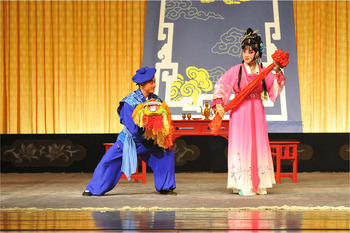
Shanghai Theatre Academy production of the Beijing opera Miss Julie adapted by William H. Sun and Faye C. Fei. Yan Qinggu 严 庆 谷 as Jean (left) and Zhao Qun 赵 群 as Julie. Shanghai Theatre Academy, 2014. (Photo courtesy of Zhao Qun and William H. Sun)

The Elite and the Masses
The configuration of Chinese theatre in the 20th and 21st centuries—mainly Chinese opera and drama—uncannily parallels mainstream theatre in the English-speaking world, also dominated by musicals and dramas. English-language drama can be further divided between serious drama of purgation and theatre of cultivation, certain types of dramas and comedies. To many Western and Western-influenced Chinese scholars, Chinese opera is regarded as much older than musicals, belonging to the museum, while in fact some Chinese opera variants are relatively new. There are older genres like qin opera (Shaanxi province) and kun opera, both at least 600 years old. Then, the more than 200-year-old Beijing opera, jingju. And younger ones like Yue opera, huju (Shanghai local opera), and huajixi (comic opera) all formalized around the same time that spoken drama was imported from abroad. Western modern drama, as well as older Chinese operas, contributed a great deal to the formation of these three young Shanghai-based genres, especially Shanghai opera and comic opera, which can often look and sound like modern spoken drama because their repertories depend on modern plays, such as adaptations of Cao Yu’s Thunderstorm and Oscar Wilde’s Lady Windermere’s Fan. What these younger operas have learned from Western drama is to use less purgation and focus on dramaturgical skills, theatrical techniques, and cultivation in line with traditional Chinese culture. Even when the Communists need to highlight fierce dramatic conflict to serve their agenda of class struggle and violent revolution, they resort to the centuries-old pattern of the theatre of cultivation with a clear-cut line between positive heroes and negative villains, leaving little gray area in between. That is why Cao Yu’s very first spoken drama Thunderstorm remains the only Chinese play faintly resembling Western theatre of purgation. Thunderstorm has a paradoxical status in modern Chinese theatre: it is the best known, most produced, and most anthologized modern drama, yet its stories clearly echo Euripides’s Hippolytus (428 BCE), Racine’s Phaedra (c. 50 CE), Ibsen’s Ghosts (1881), and Eugene O’Neill’s Desire Under the Elms (1924); and its basic dramatic structure echoes Sardou-Scribe-Ibsen’s well-made play. Cao Yu knew he copied Western models, and therefore wrote in the play’s “Afterword” that “it is too much like a drama.” Yet Thunderstorm has attracted so many Chinese theatregoers precisely because of its unprecedented dramaturgy. In terms of the underlying theme, however, this most Ibsenian Chinese play is still far less cathartic than its Western models. It is without a single killing, nor is it a social problem drama like Ibsen’s. While conceiving Thunderstorm, Cao Yu was aware that a dozen years earlier, China’s first attempt at directly copying European problem drama, a supposedly faithful, realistic, and costly Shanghai 1920 production of G.B. Shaw’s Mrs. Warren’s Profession (1893), was a well-known failure with many spectators walking out, whereas Hong Shen’s sinicized adaptation of Wilde’s comedy Lady Windermere’s Fan (1924) won the applause and laughter of many Shanghai theatregoers, and was later even adapted as a Shanghai local opera where it remains in repertoire. Cao’s choice was a middle ground, neither direct problem drama nor comedy.
Later, many Chinese playwrights tried to write social issue plays, or rather, revolutionary plays, addressing pressing sociopolitical problems. This ability to address contemporary issues was seen as the most advantageous feature of modern spoken drama as opposed to Chinese opera. Some of these plays succeeded for a while as propaganda but were short-lived—no challenge to the popular and timeless Thunderstorm. In the past few decades, almost none of the politically conceived plays stayed in any repertoire. The only exceptions are some museum-like revivals, for one or two performances only, in time-specific propaganda campaign galas.
The waning effectiveness of social problem drama is not unique to China. In the West, social problem drama reached its peak in the late 19th century when theatre was a popular mass media. Then the social problems exposed onstage by Ibsenian drama often provoked theatregoers to voice their concerns and protests in other sociopolitical arenas, eventually pushing for social reforms, as demonstrated by the effect A Doll’s House and the like had on women’s emancipation. Some plays were controversial, getting their authors in trouble. For example, Ibsen’s Ghosts, confronting the taboo subject of syphilis, was banned in various countries. Ibsen left Norway and wrote most of his social problem plays abroad, until 27 years later when, with a firmly cemented reputation, he returned to Oslo where he wrote more socially detached sym-bolist plays. In the 20th century, in the USA, the proletarian theatre movement in the 1930s and the civil rights movement in the 1960s inspired highly political works including street theatre that directly called for spectators to join the actors in protests. But soon enough polemic, topical drama dwindled while direct political action—sit-ins, marches, and demonstrations—continued. In the 21st century, political action by means of the internet/social media flourishes. Mobilization on behalf of the Occupy Movement, #MeToo, and #BlackLivesMatter is far more effective using Facebook and Twitter than crowd-rallying plays like Clifford Odets’s Waiting for Lefty were in the 1930s.
In the meantime, Western comic drama has been flourishing. Unlike Shakespeare’s romantic comedies or Molière’s and Gogol’s satirical comedies with specific social targets, today’s middle-class comedy is often full of self-mockery, reflecting the relatively peaceful (compared to most developing countries in the world) yet rapidly changing present era. The receptions of these comedies are intriguingly polarized. For example, the UK’s Alan Ayckbourn, at 81, is the author of 84 plays; he has worked as a director and producer as well. Although Ayckbourn is the most productive and successful living playwright—a large number of theatregoers like his plays—few university professors are interested in him; his plays are rarely taught or even mentioned in English-language schools, let alone in other countries. In many non-Western countries, his name is almost unheard of even in theatre circles. Is the taste of common theatregoers so bad? Are Ayckbourn’s plays so banal? Let us look at just one example, Henceforward, which premiered in 1987 in the UK and won the Evening Standard Theatre Award for best comedy in London, and won the Drama-Logue Award for Outstanding Production in Los Angeles for its US West Coast premiere in 1991 at the Mark Taper Forum, which I saw. This play resonates with the most pressing question asked by Ibsen’s A Doll’s House: What happens after Nora slams the door, leaving her husband and children behind? In Henceforward the wife comes back after four years, with a rebellious teenage girl she has taken with her but can no longer handle. This latter-day Nora finds a seemingly ideal wife living with her ex-husband. That woman handles the teenage girl in a matter of minutes, dismaying the ex-wife. But the “ideal wife” is a robot, and hardly perfect because this best possible robot is designed only to take care of children. That’s where most of the laughs come from. So far in all the productions of Henceforward, the ideal wife-robot has to be played by a human actor. Yet who can say it won’t be played by a robot in the near future? Theatre of cultivation plays like Ayckbourn’s not only attract large audiences in big commercial theatres, but are also favorite choices of amateur community theatres, serving grassroots needs.
Many scholars interested in community theatre focus on plays directly addressing social problems. Western theatre teachers often export those types of theatre to developing countries, as shown in Shen Liang’s case study “Performing Dream or Reality: The Dilemma of Chinese Community-Based Theatre” (Reference Liang2014). These plays, however, are usually uplifting with straightforward positive roles as well as roles exposing bad elements, much like Ibsen’s Enemy of the People (1882) and Odets’s Waiting for Lefty (1935). This kind of theatre is diametrically different from the Greek theatre of purgation. Augusto Boal, after criticizing what he deemed the class-perpetuating theory of Aristotle’s Poetics, invented Forum Theatre as a constructive solution for oppressed people ([1974] Reference Boal1985). In the past half century or so, increasing numbers of marginal-ized groups have created theatres in which they self-consciously and positively represent their own communities. In American theatre, Lorraine Hansberry’s 1959 A Raisin in the Sun celebrated black culture. Fifteen years earlier, Zora Neale Hurston and Dorothy Waring’s black feminist musical Polk County (1944), the subject of Eric M. Glover’s article in this issue, was a predecessor of A Raisin in the Sun. Polk County was ahead of its time—and not produced until 2001 (Glover Reference Glover2021). But even before that, there were long-running popular plays about disenfranchised communities, such as female factory workers, as exemplified by Heather Nathans’s article in this issue about Theodore Kremer’s 1906 Bertha, the Sewing Machine Girl, whose story appeared in various art genres, including a movie version in 1926 directed by Irving Cummings (Nathans Reference Nathans2021).
Thunderstorm by Cao Yu at Beijing People’s Art Theatre. Wang Ban 王 斑 as Zhou Ping (left) and Baihui 白 荟 as Sifeng. Beijing, 2005. (Photo by Li Chunguang; courtesy of William H. Sun)

The hip hop musical Hamilton (2015), 56 years after A Raisin in the Sun, became a highly successful piece of theatre of cultivation. Another example is the musical Come from Away, which opened on Broadway in 2017 after successful runs elsewhere. I saw it on Broadway and then in Shanghai in 2019. Even though the play is set in Gander, Newfoundland, the week after 9/11, all the roles are positive with not a single character doing bad deeds—a good example of theatre of cultivation. This musical is even more explicitly uplifting than Stan Lai’s Chinese language play Ago, also set against the backdrop of 9/11, even though it is of mostly Chinese characters and opened in Shanghai in December 2019, after an English workshop at UC Berkeley. Ago is the main subject of Chiayi Seetoo’s “An Illusion that Mirrors a Dream: The Storytelling of Stan Lai” in this issue (Seetoo Reference Seetoo2021). This Buddhism-influenced play, running for more than five hours with 300 plus characters, also shows how people cope with calamities—an earthquake in China and, 10 years later, 9/11 in New York City, where earthquake survivors have come together. A devastating earthquake is the main subject of another Asian play, Time’s Journey through a Room by Japanese playwright Okada Toshiki, the topic of Carol Martin’s paper in this issue (Martin Reference Martin2021). Set after the earthquake of 11 March 2011 and the subsequent tsunami and nuclear disaster in Fukushima, the play is a love story, a ghost story, and an ecological exposé. While its theme is universal, its aesthetic expresses a unique Japanese fusion of purgation and cultivation.
Compared to conflict-centered, socially aggressive Western drama and Chinese revolutionary plays modeled after this kind of drama, most traditional Chinese music and opera do not have such a specific, direct social function. Most Chinese theatre scholars overlook the more accessible theatre of cultivation. If they had seen more of it, they could have helped the Chinese modern theatre a great deal. The social function of theatre of cultivation is more in line with music and Chinese opera. With the solid base of a mass audience, the Chinese government and artists could help community groups develop their singing and dancing into interactive performances, into operas and dramas of cultivation. When people participate in community theatre activities, they can also learn, in the process, to hone their public speaking skills, learn to work as part of a group, and acquire the skills needed to run a social organization. These abilities, mastered by common people, are potentially even more important than the lessons of a few great social problem plays. This kind of theatre could help people in their efforts to cultivate social skills and character and develop more effective means of self-expression—useful in dealing with the authorities in today’s society.
As I have emphasized, to create more and better works of theatre of cultivation, Chinese artists need to pay more attention to Chinese opera and to Western musicals and comedies. Not so much to producer Cameron Mackintosh’s brand of extravagant mega-musical such as Cats, Les Misérables, and Phantom of the Opera, but to musicals with uplifting messages that can be staged more simply; musicals such as Oklahoma!, Guys and Dolls, Thoroughly Modern Millie, Carousel, My Fair Lady, and Come from Away. Chinese attempts to emulate Mackintosh all failed, resulting in huge economic losses. The huge cast of stars, the large singing and dancing chorus, and the extravagant sets belong to productions that depend on long runs, which is impossible in China now. However, the Mackintosh musicals pleased Chinese theatregoers, with many buying theatre tickets for the first time. To have the best of both worlds, Chinese producers must rely less on extravagant productions and more on uplifting stories like Come from Away, which shows people how they can help each other while turning a disaster into “positive energy.”
There are many other examples from the West the Chinese can learn from, such as Les Misérables, the musical, and the other adaptations of Victor Hugo’s 1862 romantic novel. The story’s universally liked hero, Jean Valjean, is a seriously flawed man—but his flaw, stealing bread to feed his starving sister and her children, is far less harmful and more forgivable than the killings in Greek tragedies. In China, as globally, Les Misérables is extremely popular as a novel, film, musical, and comic book. Its popularity is why my team at the Shanghai Theatre Academy made it our first choice to adapt as a series of short plays of rhyming texts, presented on a much smaller scale than the Mackintosh musical. As Shen Liang’s article in this issue describes, the STA team has circulated its version of Les Mis to Chinese schools as “Drama Etudes for the Classroom” (Shen Reference Liang2021). The “Etudes” have been embraced by schoolchildren and their teachers and parents alike.
An example of “poetic justice” popular in China as well as in the West is the 2011 musical Ghost (Shanghai production 2015), based on the 1990 Jerry Zucker film. After being murdered, Ghost’s hero Sam miraculously returns to life and, with the help of a New York psychic, not only saves his endangered lover but also finds and takes revenge on his murderer. There are numerous Chinese operas with a similar plot, all set in ancient times, and mostly about abandoned women in much worse situations than Medea. Ghost, a suspenseful thriller set in contemporary New York in a realistic and convincing milieu, shows today’s theatre artists that ghost stories are not a dramaturgical device belonging only to ancient history. Tragedies can also be transformed into popular musicals, as West Side Story (1957) demonstrates. Many musicals try to shed light on the dark side of life. Examples include Dear Evan Hansen (2015) and Hamilton (2015). Dear Evan Hansen starts with Hansen’s anxiety disorder and the suicide of a classmate. Hamilton climaxes with Alexander Hamilton’s death in a duel with Aaron Burr. The world is full of unfairness and darkness—and neither of these musicals tries to escape from the imperfect world. Instead, they show their audiences how the two imperfect heroes fight on against all odds towards better lives for themselves and for others. Hamilton is special because its primarily rapped lyrics celebrate the life of a white American “founding father.” But the show makes clear that Hamilton didn’t start on top. He climbed up from the low status of an orphan immigrant. Created and performed by mainly artists of color, Hamilton is unique as a Broadway hit. In Hamilton hip hop music and dance deliver the messages while somewhat “scrimming” issues of class, race, revolution, and dueling. In both of these musicals, deeply purgative stories are transformed into exhilarating and cultivating theatre experiences.
While the musical is generally safer and more crowd-pleasing, it is by no means the only Western model China needs. Many excellent spoken dramas combine purgation and cultivation, the best Chinese example being Guo Shixing’s The Go Master (棋人 Qi Ren, The Central Experimental Theatre, 1995). Guo’s favorite playwright is Friedrich Dürrenmatt, whose use of paradox he admires and emulates. Guo’s Go master quits playing Go on his 60th birthday to start his “real life,” but then his ex-girlfriend—who left him 30 years before because of his obsession with Go—comes back begging him to save her teenage son by teaching him Go. The genius boy suffers from an insatiable intellectual thirst that is driving him crazy. She believes the Go master is her last resort to save her son. After repeated warnings that playing Go will put the boy’s life at risk, the master teaches the boy Go and plays with him until eventually, in a climactic game, he exhausts his young rival. The play is upbeat and full of youthful energy, leaving the audience guessing whether at the end the boy onstage is the live victor or the ghost of the defeated.
By and large, the theatre of cultivation serves common people, while the theatre of purgation serves mostly the intellectual elite. Yet the two aren’t always mutually exclusive. For example, A Chorus Line (1975) is about actors struggling to make it in American musical theatre. It began with actors sharing their theatre experiences and frustrations in a workshop at New York’s Public Theater. This seemingly narcissist group exercise resulted in a popular Broadway musical so appealing that it ran for 15 years. The creators of A Chorus Line did not wipe out the cruelty with a happy ending, but made show business’s ruthless competition not only personal and relatable, but also shining, glorious, and pleasant to watch through the “scrim” of music and dance. Hair (1968), also originating at the Public Theater, is another example of how song and dance can transform a difficult subject into a pleasing product. Originally a rock musical expressing young peoples’ rebellious spirit and anger, Hair coincided with the American civil rights movement, protests against the Vietnam War, and the youth culture revolution. Hair quickly became a national hit, and is still performed both in professional theatres and at schools. While its content is relentlessly antiestablishment and subversive, its lyrics are light and bright, such as “Good Morning Starshine” and “Aquarius/Let the Sun Shine In,” sung nowadays not only by young people but by their nostalgic parents, the targets of Hair’s youth rebellion. Compare Hair and the other musicals I’ve discussed to the grim, killing-centered theatre of purgation, typified by Sam Shepard’s Buried Child (1978), or Martin McDonagh’s The Beauty Queen of Leenane (1996) and The Pillowman (2003), which focus on killings within the family. These dramas are mainly produced at universities and small regional theatres for elite intellectuals.
While I’ve delineated here two different kinds of Western theatre, only the theatre of purgation, a smaller portion of Western theatre, is incompatible with Chinese culture. Despite this, most Chinese theatre scholars focus on only the theatre of purgation. This is because they, and most theatre leaders in other non-Western countries as well, studied theatre at Western universities from professors, members of academia who may be less directly connected to professional theatre practice. Although many Western theatre programs focus on teaching practical skills, not enough take popular theatre seriously. Their non-Western students study there and then introduce what they’ve learned—mainly the theatre of purgation—back home. The problem is most of the returnees are not aware of the great discrepancy between their home countries and the West. In the West, where it is relatively hard for newcomers to break into mainstream theatre, peripheral theatre activities and performance art for small elite audiences make perfect sense. In many non-Western countries, especially China where the amount of theatre performances is incredibly low in relation to the size of the population, the most urgent need is to build mainstream theatre with large repertories of mostly plays of cultivation. In non-Western cultures, especially in China, people would be better served with long runs of popular theatre, not copies of the newest Western avantgarde theatre and performance art.
If there were more popular plays of cultivation, they would not only fill the large theatres but also provide material for many more community theatres. Due to rising living standards in China since 1978, more and more Chinese have the leisure and resources for artistic pursuits. The most popular art forms so far are dancing and singing in public parks and squares. Theatre is not yet very popular. The reason for the lack of theatre in Chinese popular culture is not because it is foreign to China’s cultural tradition, which in fact includes many operas of cultivation, but because of the lack of good plays of cultivation that appeal to common people. New plays of cultivation cannot be created if theatre people are either lured to make propaganda plays to please officials, or misled to take the Western theatre of purgation as their only model. The latter problem derives from the Chinese mindset of the past 40-plus years that newer is better. Old does not necessarily mean obsolete, while new does not necessarily mean good. The types of theatre available ought to depend on local people’s needs, not on officials’ ideological decrees, nor on theatre people’s inaccurate perceptions of their model—Western theatre.
My emphasis on the theatre of cultivation here does not mean the theatre of purgation is less important, nor is the former truer to life than the latter. Everything under the sun has a dark side and a bright side; but one ought not to deny the existence and value of the other. To some intellectual elitists, common people are drunk or blind, oblivious to their suffocating lives, whereas they, the elite, are sober, obligated to wake up the ignorant masses. In the eyes of some optimists, the people are neither drunk nor blind; it is the restive intellectuals who are mad, bent on agitating the common people and deriding their normal lives.
In the developed theatre markets of the West, people can choose all kinds of theatre ranging from commercial theatre supported by ticket sales to “serious drama” subsidized by governments, foundations, and donations. In today’s China, government subsidy plays a much larger role than in the West, which should ensure that common people with low incomes get to enjoy what they prefer, and even get to act their favorite parts, as Chinese opera fans often do. But the fact is that what gets subsidized is what officials and “experts,” including many professors, prescribe for the people, mostly plays of superficial and ineffective “cultivation” with banal and didactic messages, and esoteric dark foreign plays of purgation beyond common people’s comprehension.
There are two reasons why today’s Chinese artists do not create enough good plays of cultivation: 1. More and more lucrative but hastily assembled government projects drain theatre talent by offering quick money; 2. What dominates academic theatre discourse is an inaccurate and partial introduction to Western theories of theatre of purgation, especially antidramatic and postdramatic theatre. These distract artists from creating theatre of cultivation for common Chinese people. The first reason is a purely Chinese phenomenon, which is not the focus of this article written for English readers. The second concerns Western theatre, including not only my discovery of a new way to look at it, but also my suggestion on how Western theatre artists and teachers can better help Chinese theatre. This is why I am putting so much emphasis on the theatre of cultivation, a term I coined to describe Western theatre’s “best kept secret”—and what Chinese theatre needs most urgently now.