Quantitative sociolinguistics is deeply rooted in the facts of covariation. The basic finding that stable variables tend to be socially stratified is an observation of covariation between linguistic behavior and social structure (e.g., Labov, Reference Labov2006 [1966]); the isogloss bundles that reflect dialect boundaries are an example of spatial covariation (e.g., Labov, Ash, & Boberg, Reference Labov, Ash and Boberg2006); multiple variables style-shifting in tandem exhibit intraspeaker covariation (e.g., Rickford & McNair-Knox, Reference Rickford, McNair-Knox, Biber and Finegan1994). The use of implicational scales in sociolinguistics (e.g., DeCamp, Reference DeCamp1971) is a type of covariation analysis; the same could be said about co-occurrence restrictions (e.g., Auer, Reference Auer, Hinskens, van Hout and Wetzels1997). Recently, questions about covariation between speakers have drawn theoretical attention and empirical investigation. For example, Guy asked, “What would it mean to encounter a speaker who uses the prestige forms of variables A, C, and E, while using the nonstandard variants of variables B, D, and F?” (Reference Guy2013:64). Guy and Hinskens posed a very similar question along a dimension of innovativeness rather than prestige: “Are there socially identifiable leaders of change who tend to use all the innovative variants together, or are different innovations subject to differentiated social interpretations and individuated patterns of usage?” (Reference Guy and Hinskens2016:4). These questions deal with covariation between different linguistic features in individuals’ overall behavior, which I refer to as interspeaker covariation. In this paper, I report on an interspeaker covariation study of six vowel changes taking place in the English variety most closely associated with white Philadelphians.
Labov, Rosenfelder, and Fruehwald (Reference Labov, Rosenfelder and Fruehwald2013) showed that the six changes studied here fall into two categories from a community-level diachronic perspective: three of them have been advancing unidirectionally since early in the twentieth century, while the other three exhibit some degree of reversal or withdrawal rather than a continuation. Using conversational speech data from 66 young white Philadelphian women, I find that this diachronic division is reflected in interspeaker covariation analyses. There are significant interspeaker correlations among the reversing changes, but not among the continuing changes or between the continuing and reversing changes. I suggest that the explanation given by Labov et al. (Reference Labov, Rosenfelder and Fruehwald2013) for the diachronic trajectories can be extended to the covariation facts: that the reversing changes are driven by avoidance of saliently local-sounding features and that individual differences in this shared social motivation can give rise to covariation.
PREVIOUS WORK ON INTERSPEAKER COVARIATION
Much of the earliest work on covariation deals with situations of bilingualism (Ma & Herasimchuk, Reference Ma, Herasimchuk and Fishman1972) or bidialectalism (van Hout, Reference van Hout1989), that is, sociolinguistic contexts that might be thought to have relatively strong covariation expectations but that differ somewhat from the sociolinguistic experiences of many white monolingual English-speaking Philadelphians. Guy (Reference Guy2013) raised the question of whether stylistically- or socially-stratified variability within more monolectal speech communities should give rise to covariation as well. He referred to the possible interspeaker covariation of stable sociolinguistic variables as “sociolectal cohesion.” The evidence for sociolectal cohesion is mixed. Of six pairwise comparisons of four variables in Thorburn's (Reference Thorburn2014) study of Inuit English, only one pair (verbal -s and intensifier “right”) correlates. Newlin-Łukowicz found that New Yorkers of Polish descent “display heterogeneous linguistic behavior” (Newlin-Łukowicz, Reference Newlin-Łukowicz2016:101) with respect to three New York City English variables. Oushiro and Guy (Reference Oushiro and Guy2015) and Oushiro (Reference Oushiro2016) found that, of 11 variable pairs in São Paulo Brazilian Portuguese that are not structurally related, five show covariation.
When it comes to language change, studies have also often failed to find interspeaker covariation between simultaneous ongoing changes in a speech community. Maclagan, Gordon, and Lewis (Reference Maclagan, Gordon and Lewis1999) compared speakers’ conservative and innovative behavior across five ongoing sound changes in New Zealand English. They found that a speaker who is innovative with respect to one sound change will not necessarily be innovative with respect to another sound change. In a study of /θ/-fronting and /ð/-fronting in Glasgow, Stuart-Smith and Timmins (Reference Stuart-Smith, Timmins, Llamas and Watt2010) presented speaker averages from which it is possible to calculate a quite low Pearson correlation of 0.22. Nevalainen, Raumolin-Brunberg, and Mannila (Reference Nevalainen, Raumolin-Brunberg and Mannila2011) is a real-time historical sociolinguistics study that looks at how individual letter writers in the Parsed Corpus of Early English Correspondence participated in six morphosyntactic changes in Late Middle and Early Modern English. The authors concluded that “there are few consistently progressive or conservative language users in our real-time data” (Nevalainen et al., Reference Nevalainen, Raumolin-Brunberg and Mannila2011:36). Waters and Tagliamonte (Reference Waters and Tagliamonte2017) found only one statistically significant correlation out of pairwise comparisons between five ongoing morphosyntactic and discourse-pragmatic changes in corpus data from Toronto English.
The basic picture emerging from the results on both change and stable variation is that interspeaker covariation is possible but far from guaranteed. It is unsurprising, then, that the first question raised by Guy and Hinskens in a special issue of Lingua on the theme of “linguistic coherence” is: “Which features correlate and which do not?” (Reference Oushiro2016:4). One partial answer to this question that appears in the literature is that a shared structural relationship between variables can give rise to correlations. For example, a number of canonical sociolinguistic variables in Brazilian Portuguese share some grammatical properties (such as being agreement morphemes) or are otherwise interrelated (as when variable plural marking may bleed variable s-deletion). Guy and Oushiro (Reference Oushiro and Guy2015) and Oushiro (Reference Oushiro2016) found significant correlations between three out of the four variable pairs in their project that have plausible structural relationships (distinct from the 11 unrelated pairs mentioned above). Relatedly, Fruehwald (Reference Fruehwald2013) used observed interspeaker correlations between the non-post-coronal /uw/, /ow/, and /aw/ vowels in Philadelphia to support his argument that their diachronic parallels (fronting and then retracting) are the result of their shared natural class membership. Possible structural relationships do not guarantee covariation, though; recall that, in Stuart-Smith and Timmins (Reference Stuart-Smith, Timmins, Llamas and Watt2010), there is not a strong correlation between /θ/-fronting and /ð/-fronting even though both features are interdental fricatives.
Structural factors are not the only ones that can generate interspeaker covariation. In addition to the possible linguistically related pairs above, Oushiro (Reference Oushiro2016) also found that social factors can lead to overall greater cohesion: “speakers living in more central areas, whose parents are also Paulistanos, and with lower mobility tend to be more cohesive in their patterns of language variation than other groups of speakers” (Oushiro, Reference Oushiro2016:126). When studies of interspeaker covariation do find correlations between ongoing changes, it is often the case that the data contains social stratification or age-based differences that are then reflected in those correlations, consistent with Guy and Hinksens’ conception of coherence as reflecting coincident “sociolinguistic ‘isoglosses’” (Reference Oushiro2016:1). In a study of changes moving away from three salient New York City features (changes similar to the reversing Philadelphia changes I will discuss below), Becker (Reference Becker2016) reported an overall interspeaker Pearson correlation between /r/-pronunciation and Bought-lowering of 0.59, which she termed “community coherence.” This correlation is calculated over an age-stratified sample with strong correlations between age and the linguistic variables, meaning that the covariation analysis may be partly picking up the shared apparent time relationship; Becker pointed out that this correlation is also capturing class- and ethnicity-based differences in the use of the two features. Similarly, Gregersen and Pharao (Reference Gregersen and Pharao2016) found that the raising of (eng) in Denmark correlates with an urban working-class shibboleth (raised /ɑ/) in two locations where (eng) raising is a current generational change but not in two locations where (eng) raising has stabilized. Because their sample of 108 speakers is generationally diverse, a possible interpretation is that the correlations are partly mediated by age differentiation. But again, the presence of social stratification or apparent time differences in sample does not appear to guarantee covariation, as, for example, the lack of correlations found by Waters and Tagliamonte (Reference Waters and Tagliamonte2017) makes apparent. It is still an open question under what circumstances several changes could each covary with age without themselves intercorrelating. Rather than dig deeper into that question, in this paper I will ask whether we can find covariation within a more homogeneous group of speakers.
There has also been previous work on the question of interspeaker covariation in Philadelphia specifically. Labov (Reference Labov2001) correlated different vowel changes and the stable sociolinguistic variables of /ð/-stopping and negative concord. Among the pairwise correlations between different vowel changes, Labov found large and significant correlations between the changes in /æh/ and /aw/, /æh/ and /eyC/, /aw/ and /eyC/, and /owC/ and /uwC/ (Reference Labov2001:372). The remaining vowel pairs are not correlated, but the two stable variables do correlate with each other, and several of the vowel changes also correlate with /ð/-stopping. While these correlations were done over a larger dataset, several more tightly controlled subgroups also exhibit the same correlation between vowel changes and /ð/-stopping. The subgroup of female speakers in the upper working class and middle class shows significant correlations of /ð/-stopping with /ey/, /aw/, and /æh/ (Labov Reference Labov2001:374–377), as does the subgroup of male speakers with the same class background (Labov Reference Labov2001:379–381). Sneller (Reference Sneller2015) showed that speakers who have the traditional Philadelphian split short-a system, rather than the encroaching pan-regional nasal short-a system, also favor more conservative forms of North, Goat, Mouth, and Thought (but not Face, New, Price, or Start). She interpreted this as evidence for general dialect weakening.
COVARIATION OF VOWEL CHANGES IN PHILADELPHIA
In this study of interspeaker covariation, I aim to control for demographic properties like age and gender that have sometimes been identified as the source of correlations in other studies. I would argue that there are slightly different questions at play when we ask whether group-level differences give rise to interspeaker covariation in a stratified sample and when we ask whether there is interspeaker covariation within a single more demographically homogeneous group. While many previous studies have focused on the first question, the second question offers an opportunity to investigate individual differences that go beyond basic group-level properties. However, despite this focus on whether there is individual covariation within a less diverse group, we also still want to be reasonably confident that we are dealing with true changes over time, and, ideally, we might want to know something about the social properties of the changes. Both of these goals require a diverse group of speakers in order to identify real or apparent time trajectories and social stratification.
A good option to reconcile these needs is to look to a community for which the basic demographic and diachronic facts are already established. The speech of white Philadelphians suits this purpose exactly. Philadelphia has been the site of nearly 50 years of continuous sociolinguistic fieldwork from Labov and colleagues, the output of which is collected in the Philadelphia Neighborhood Corpus (PNC) (Labov & Rosenfelder, Reference Labov and Rosenfelder2011). The changes to the vowel system that were identified in the 1970s have been documented extensively in previous work on white Philadelphia English (Labov, Reference Labov1994, Reference Labov2001; Labov et al., Reference Labov, Rosenfelder and Fruehwald2013), providing an established diachronic and sociolinguistic backdrop for further research on individual differentiation. In this paper, I use new conversational speech data from young white Philadelphian women to investigate interspeaker covariation between six ongoing vowel changes.
The vowel changes
I will refer to the changes under investigation using lexical class terms modified from Wells’ (Reference Wells1982) lexical sets: Face, Price, Tooth, Down, Goat, Thought.Footnote 1 Importantly, Labov et al. (Reference Labov, Rosenfelder and Fruehwald2013) showed that the diachronic outcomes of these changes are not uniform. While some of the changes identified in the 1970s have continued to the present day, others have reversed course.
The first three vowel classes—Face, Price, and Tooth—exhibit ongoing change that has continued unidirectionally throughout the twentieth century (Labov et al., Reference Labov, Rosenfelder and Fruehwald2013).
• Face: The Face vowel, when followed by a consonant in the same word (Fruehwald, Reference Fruehwald2013), is raising diagonally along the front of the vowel space. There is no evidence that Philadelphians have any metalinguistic awareness of this change, nor does it exhibit much social stratification (Conn, Reference Conn2005), but it is female-led (Labov et al., Reference Labov, Rosenfelder and Fruehwald2013).
• Price: The nucleus of the Price vowel, when followed by a voiceless consonant, is raising towards the center of the vowel space, accompanied by some rounding and backing in its most extreme forms. Labov identified this as “a new and vigorous change with little social recognition as well as little social differentiation in speech” (Reference Labov2001:201), although later social and experimental evidence suggests that raised Price has associations with masculinity and toughness (Conn, Reference Conn2005; Wagner, Reference Wagner2008) despite lacking a large average difference between men and women (Labov et al., Reference Labov, Rosenfelder and Fruehwald2013).
• Tooth: The Tooth vowel, when following a coronal consonant, is fronting in Philadelphia, as it is in many other English varieties.Footnote 2 This change is not often thought of as characteristically “Philadelphian,” presumably because of its much wider geographic range.
The next three vowel classes—Down, Goat, and Thought—show a move away from the patterns observed in the 1970s: in the first two cases, a midcentury reversal, and, in the case of Thought, a withdrawal from the traditional local form (Labov et al., Reference Labov, Rosenfelder and Fruehwald2013).
• Down: The nucleus of Down originally exhibited raising and fronting along the front diagonal of the vowel space but is now moving back towards its earlier low-central position. Both the raising and the reversal are female-led change (Conn, Reference Conn2005; Labov et al., Reference Labov, Rosenfelder and Fruehwald2013).
• Goat: Goat was fronting and is now backing; Labov, Rosenfelder, and Fruehwald (Reference Labov, Rosenfelder and Fruehwald2013) showed that both the original Goat change and its reversal seem to be driven almost entirely by female speakers. Like Down, Goat has a “moderate” level of social awareness; Labov observed that “in general, Philadephians react to a fronted nucleus in (ow) as local and not suitable for public formal speech” (Reference Labov2001:211).
• Thought: A high, tense Thought vowel is a characteristic feature of the prototypical white working-class Philadelphia accent, presumably the result of a raising process that was nearly completed earlier than the available data can capture. It is now lowering rapidly away from its high point in what Labov et al. call a “withdrawal from stereotype” (Reference Labov, Rosenfelder and Fruehwald2013:52). This withdrawal is also female-led.
The observation that almost all of these changes are led by female speakers motivates the exclusive focus on young women in the current study. Generationally speaking, the young women here pick up just before where the data from Labov et al. (Reference Labov, Rosenfelder and Fruehwald2013) leave off. The youngest speakers in the Philadelphia Neighborhood Corpus were born in 1991; the oldest speaker in the current study, which is not part of the Philadelphia Neighborhood Corpus, was born in 1987, while the youngest was born in 2000.
Data and methods
The 66 young women in this paper were recruited in friendship pairs to visit the Language Variation and Cognition Lab at the University of Pennsylvania over the course of two years. All of the participants were between the ages of 18 and 29 at the time of interview, with an average age of 22.5. They all reported having grown up in the city of Philadelphia or in an adjacent Pennsylvania suburb, and they all self-identified as white women. Each pair of friends was seated in armchairs in a quiet room in the lab, where each speaker was equipped with an individual Zoom H-4n portable digital recorder and an individual lavalier microphone. The pair was then recorded conversing freely, without a researcher present, for 30 minutes. They were given optional conversation prompts focusing on the history of their friendship and current social life, but also told that they could talk about anything they wanted. These recordings were collected as part of a larger project investigating sound change mechanisms from an individual-differences perspective, for which each participant additionally completed a number of experimental psycholinguistic tasks. The conversations took place before any of the other tasks, immediately after the informed consent process.
The recordings were orthographically transcribed in ELAN by research assistants, then force-aligned using FAVE (Rosenfelder, Fruehwald, Evanini, & Yuan, Reference Rosenfelder, Fruehwald, Evanini and Yuan2011). Automated vowel formant measurement was also done with FAVE, using its default settings. Vowel measurements in Hertz were z-score normalized within speaker (I refer to the normalized formant values as F1.n and F2.n). Following Labov et al. (Reference Labov, Rosenfelder and Fruehwald2013), for vowels whose primary direction of diachronic change is along the front diagonal (a combination of raising and fronting), I compute a diag measure of F2.n minus two times F1.n. Lexical frequency counts are taken from SUBTLEX (Brysbaert & New, Reference Brysbaert and New2009) and log-normalized after adding 1 (following Brysbaert & New [Reference Brysbaert and New2009]). Unstressed and secondary-stressed vowels are excluded as are vowels from a short list of high-frequency function words that FAVE takes as default “stop words” (Rosenfelder et al., Reference Rosenfelder, Fruehwald, Evanini and Yuan2011).
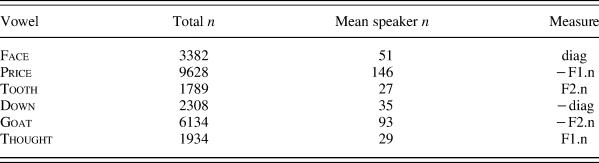
For ease of interpretation, throughout this paper I align all of the change dimensions so that a higher value constitutes advancement in the current direction of the change and the expected correlations are positive. In order to accomplish this alignment where higher values indicate more innovative vowel realizations, three of the vowel classes need to have their normalized formant measurements multiplied by -1, for the following reasons:
• Price: a higher F1.n indicates a lower vowel, less advanced in raising
• Down: a higher diag value is a higher/fronter vowel, less advanced in backing/lowering (i.e., raising/fronting-reversal)
• Goat: a higher F2.n indicates a fronter vowel, less advanced in backing (i.e., fronting-reversal)
The remaining three vowel classes can have their normalized formant measurements retained as-is, with higher values being more innovative:
• Face: a higher diag value is a higher/fronter vowel, more advanced in raising/fronting
• Tooth: a higher F2.n indicates a fronter vowel, more advanced in fronting
• Thought: a higher F1.n is a lower vowel, more advanced in lowering (i.e., stereotype-withdrawal)
Table 1 gives the total number of observations from each vowel class as well as the average number of observations per speaker. The high N for the price class is primarily a result of the inclusion of the discourse marker and quotative forms of “like”; the basic pattern of results is the same even if these highly frequent words are omitted.
Token counts and vowel measure used, by vowel class

Analysis
To analyze whether speakers’ central tendencies correlate across changes, I begin by creating subsets of the data for each of the vowel classes under investigation. For each vowel class, I then use the lme4 package version 1.1–18 (Bates, Mächler, Bolker, & Walker, Reference Bates, Mächler, Bolker and Walker2015) in R version 3.5.1 (R Core Team, 2015) to fit a linear mixed effects regression model that includes a number of key control predictors as well as a random intercept for lexical item. The control predictors are as follows:
• Lexical frequency (ln[SUBTLEX count + 1])
• Vowel duration (ln[token duration in seconds])
• Preceding segment class (vowel, coronal approximant /l/, /r/, coronal obstruent, labial obstruent, velar obstruent, nasal, glide, pause)
• Following segment class (vowel, coronal approximant /l/, /r/, coronal obstruent, labial obstruent, velar obstruent, nasal, glide, pause)
• Speaker age at time of interview
The goal of the models is to control for the known but extraneous sources of variability that we expect to be shared across speakers but that may not be distributed evenly across participants’ sets of observations. The lexical item random intercept additionally captures extra variance from unknown lexical effects. Speaker age was included to control any remaining differences resulting from the progress of the change in the community and general lifespan fluctuations relating to entering and leaving college and entering the workforce.
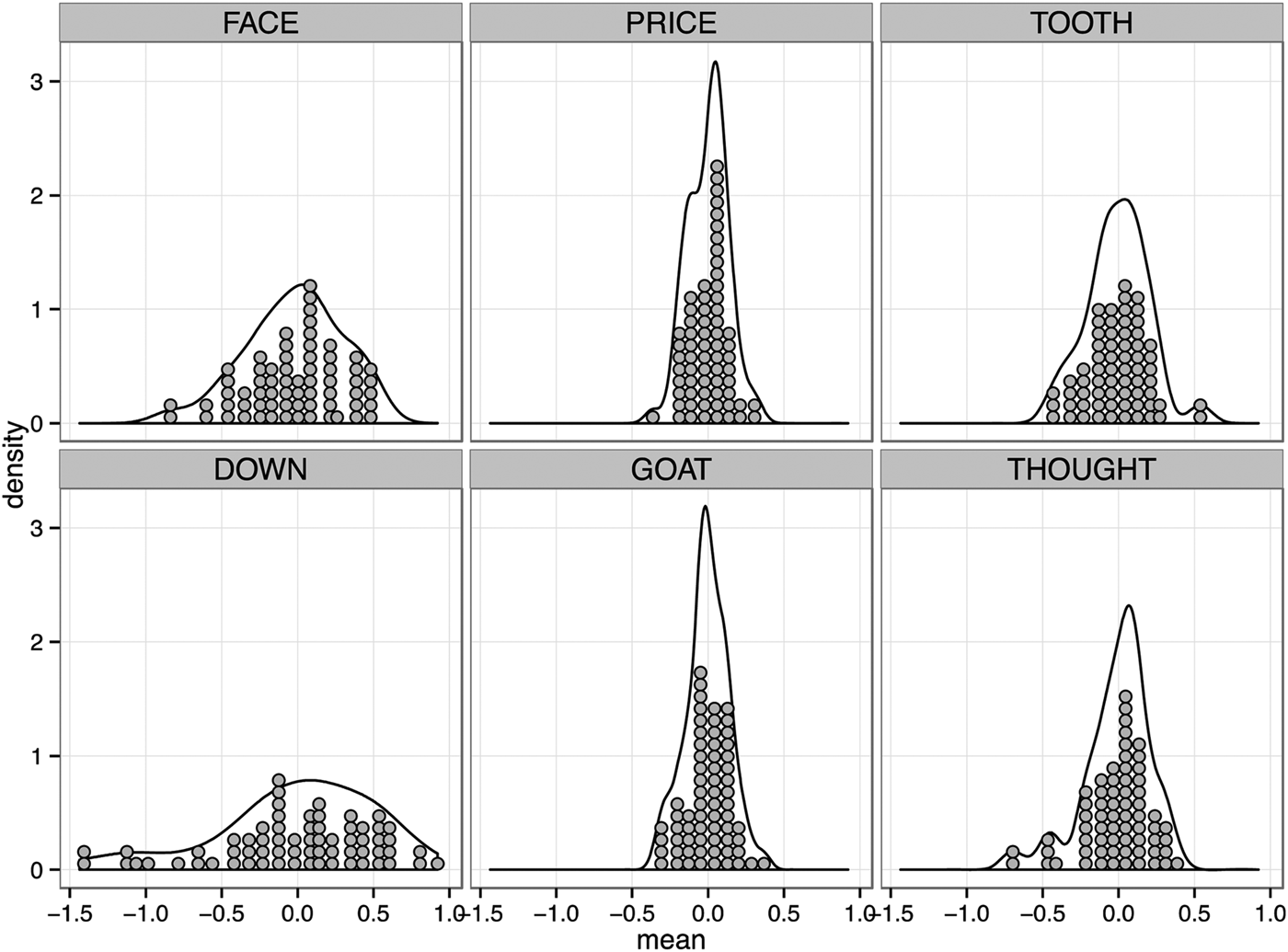
Notice that the model specifications do not include any speaker random effects. I use the models only to control shared sources of variation out of each observation in the dataset. Then, from each vowel class regression model, I extract the residuals, which reflect the variability not captured by the control predictors. I average the residuals associated with each speaker's set of observations to arrive at a measure of speaker central tendency that balances some of the drawbacks of both a raw average (which does not control for unevenly distributed extraneous factors) and a random intercept (which must be drawn from a particular distribution). The distributions of the speaker residual means for each vowel are shown in Figure 1.
Distributions of speaker residual means (dotplots and density distributions).

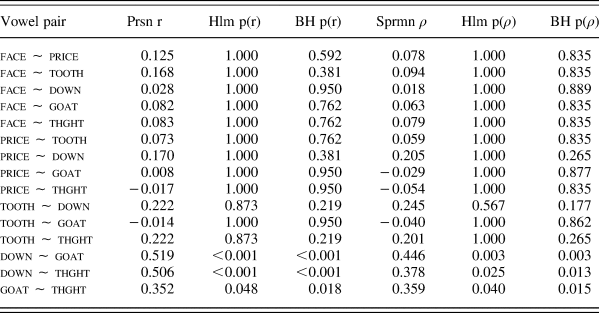
The next step in the analysis is to compute all 15 of the pairwise correlations of the speaker residual means between the six vowel changes. There are two quantitative issues to be dealt with in this approach. One is the question of what correlation coefficient to use. Here I report two types of correlation coefficient: the parametric Pearson's r and the nonparametric Spearman's ρ. The Pearson's r coefficient assumes that both distributions are normal and measures the linear relationship between them. The Spearman's ρ does not make any assumptions about the two distributions and measures a monotonic but not necessarily linear relationship between them. Spearman's ρ is a rank-based correlation and is equivalent to the Pearson's correlation between the speaker ranks. The second quantitative issue is that of correction for multiple comparisons. The more conservative approach is to control the family-wise error rate (FWER), which is the probability of making any Type I error. The more permissive approach is to control the false discovery rate (FDR), which is the proportion of null hypothesis rejections (positive results) that are mistaken. As with the choice of correlation coefficient, I take the approach of reporting both options. I use Holm corrections to adjust the p-values to control the FWER within each correlation statistic, and Benjamini-Hochberg corrections to adjust the p-values to control the FDR within each correlation statistic.
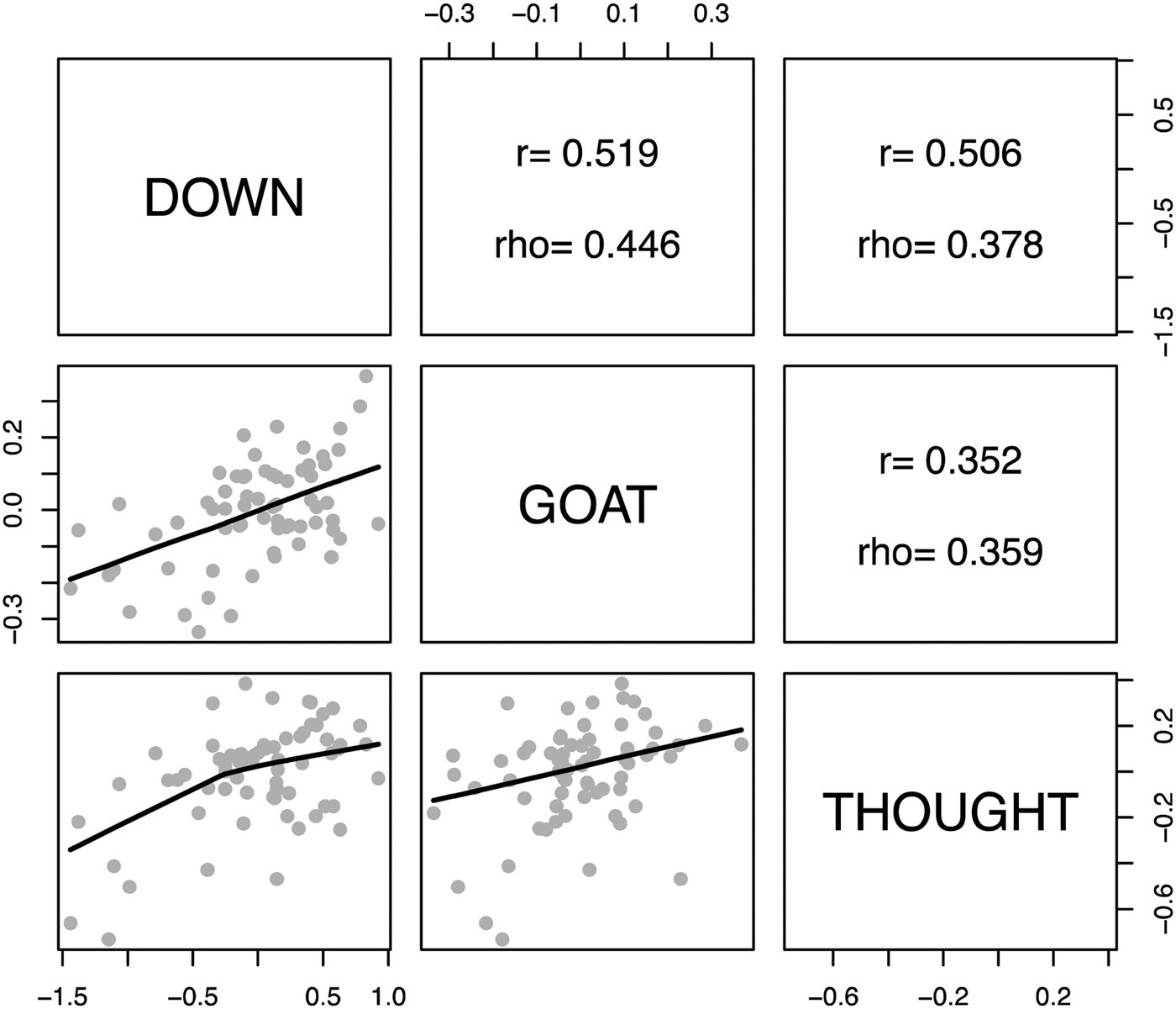
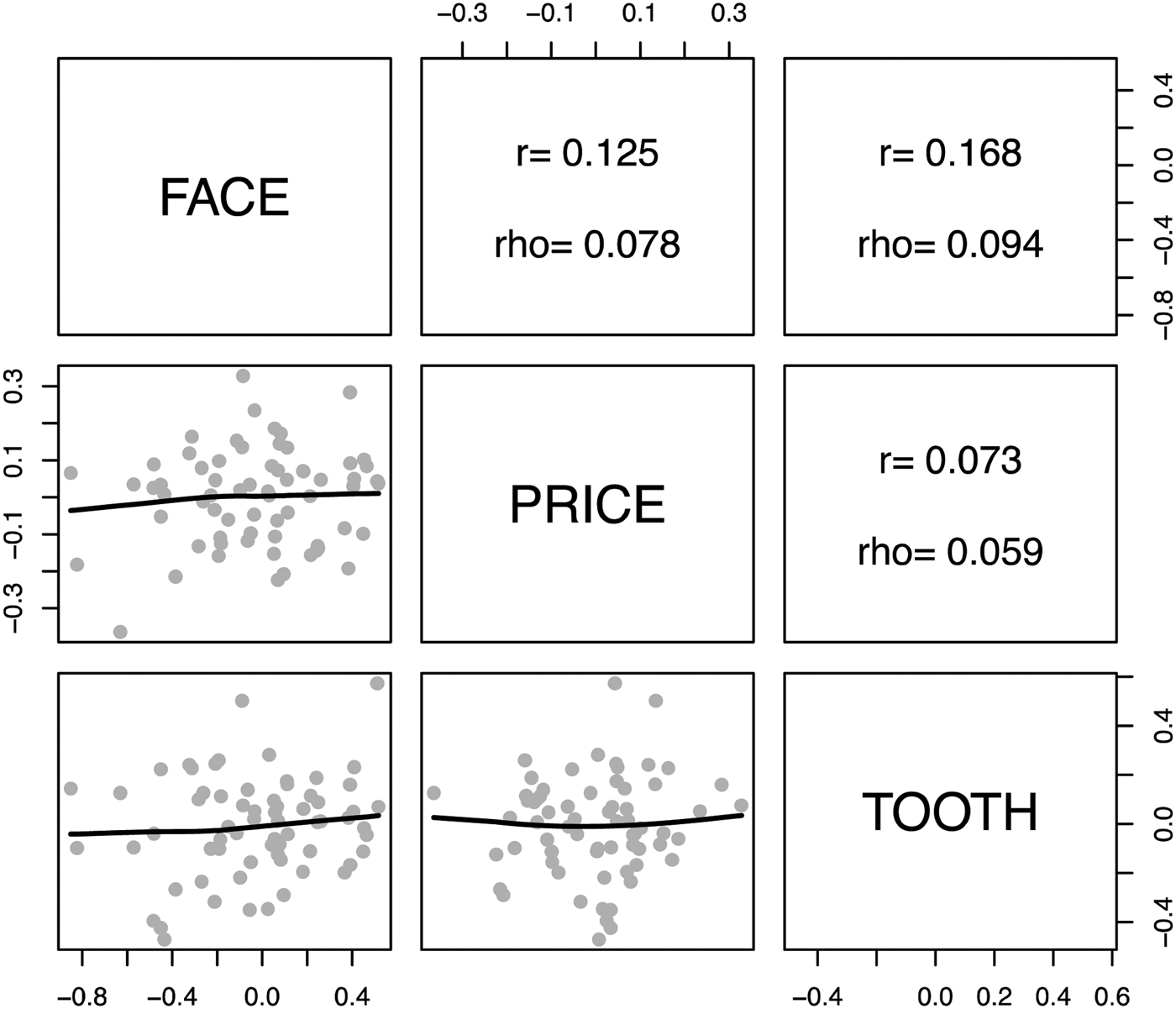
The majority of the pairwise correlations in Table 2 are not statistically significant (many of them close to zero). The exceptions are the three pairwise correlations of Down~Goat, Down~Thought, and Goat~Thought. What is notable about these three pairs is that they are the full set of pairwise comparisons between the three reversing changes (Down, Goat, Thought). The scatterplots for the individuals’ residual means in Figure 2 give a visual impression of these correlations. Although there is still substantial spread in the speakers’ behavior, the relationships indicated by the correlation coefficients are apparent. This can be contrasted with Figure 3, which shows scatterplots of the individual residual means for the three pairwise comparisons between the continuing changes (Face, Price, Tooth). There is no relationship between how innovative any individual is for any pair of these changes. If, for instance, we know that a young woman has a very raised Face vowel, that tells us nothing about the quality of her Price vowel. There are also no significant correlations in the pairwise comparisons between the continuing and reversing changes. The results are the same across both the parametric and non-parametric correlation coefficients, regardless of whether I control the FWER or the FDR. The results are not contingent on making a particular methodological decision.
Pairwise correlations of speaker residual means. “Hlm p()” is the Holm corrected p-value (controls FWER). “BH p()” is the Benjamini-Hochberg corrected p-value (controls FDR)

Correlations between reversing changes, with Pearson (r) and Spearman (ρ) correlation coefficients in the upper panel and scatterplots in the lower panel.

Correlations between continuing changes, with Pearson (r) and Spearman (ρ) correlation coefficients in the upper panel and scatterplots in the lower panel.

DISCUSSION
Among 66 young white Philadelphian women, the broad demographic group that leads the changes examined here, I find evidence for correlations only between a particular subset of the changes: those that Labov et al. (Reference Labov, Rosenfelder and Fruehwald2013) classified as reversals/withdrawals. However, while we can identify which young women are the most innovative with respect to the reversing/withdrawing changes, it is not possible to predict whether those same women are innovative or conservative with respect to any of the continuing changes. Moreover, if we find a young woman who is particularly advanced in one of the continuing changes, we don't learn anything about her innovativeness on any of the other continuing changes. In short, the reversing changes covary within themselves; they do not covary with the continuing changes, nor do the continuing changes covary within themselves. The question of whether there is interspeaker covariation between ongoing changes cannot be answered in a single way for this speech community, but rather is different for different pairs of changes. We might have expected changes that pattern together diachronically to also show interspeaker covariation, and for changes that have different diachronic trajectories to not show interspeaker covariation. But, instead, we see that covariation arises only for the reversing changes, not the continuing ones. The interesting question, then, is to identify when and why particular changes pattern together.
The covariation literature discussed in the literature review has already observed that various circumstances can give rise to covariation in both changes and stable variables. One context where covariation can arise is when there is some structural relationship between two features. Another is when features belong to distinct dialects. Guy's (Reference Guy2013) discussion of sociolectal cohesion reflects an expectation that lects, and the covariation they may engender, can also be based in broad social differences such as class stratification or ethnic differences. Covariation can also reflect apparent time differences within an age-diverse sample. In this study, however, many of these potential sources of covariation have deliberately been controlled out. The participants come from a narrow age window and all identify as white women. Because less effort was made to control socioeconomic class background in recruiting project participants, one possibility is that the pattern seen here reflects class-based differences among the young women. However, this possibility does not offer a straightforward explanation when considered in light of our existing knowledge about class differences in these sound changes. For example, Labov (Reference Labov2001:171) showed that the Face and Down vowels originally had very similar “curvilinear” class stratification patterns, with upper working-class speakers producing the most innovative vowel pronunciations in the original directions of the changes. Although the class distribution of the change reversals is not well documented, an explanation based on cohesive class associations of these vowels might predict covariation between these two changes, which is not the result we see here.
I propose that the reason for covariation between the reversing changes is that the reversals themselves share a particular social motivation, while the continuing changes do not. Labov et al. (Reference Labov, Rosenfelder and Fruehwald2013), in their original observation of the differing diachronic outcomes of the Philadelphia sound changes, argued that the best way to understand the pattern of change reversals they observe is to conclude that Philadelphians are “avoiding those forms that are most saliently associated with local phonology” (Reference Labov, Rosenfelder and Fruehwald2013:61). Under this analysis, the changes in Down, Goat, and Thought share the property of being salient local accent features. It is not entirely clear why Down, Goat, and Thought should be salient local features in contrast to Face, Price, and Tooth. While Tooth is geographically widespread, Face and Price both appear to be endogenous changes that, in fact, distinguish the Philadelphia accent from other neighboring dialects, and the previous work on these changes surveyed above shows that the putatively less-salient features are not entirely devoid of social evaluation. Why they have not gained notice as features that make a speaker sound Philadelphian is a question the current study cannot answer. However, if we accept at face value the analysis from Labov et al. (Reference Labov, Rosenfelder and Fruehwald2013) that salience is at the heart of the reversals and withdrawals seen in Philadelphia, we do potentially get an explanation for the covariation facts: individuals who exhibit the greatest sensitivity to sociolinguistic salience or are most motivated to avoid sounding identifiably Philadelphian might consistently be at the forefront of these locality-attenuating shifts. These individual differences in sociolinguistic awareness, attitudes, or motivations could thus give rise to interspeaker covariation even within a relatively homogeneous group. To assess whether the Labov et al. (Reference Labov, Rosenfelder and Fruehwald2013) analysis of the diachronic patterns is on firm socioevaluative footing, and therefore whether that explanation can be extended to the covariation patterns, experimental work on the comparative social evaluation of these changes is needed. Such work might also fruitfully pursue the question of whether individual differences in evaluation are, in fact, linked to individual differences in production, as the covariation explanation here predicts.
The results and explanation under discussion here have much in common with Becker's (Reference Becker2016) analysis of covariation New York City English. In interpreting the existence of interspeaker covariation between lowering of the Thought vowel and a decrease in nonrhoticity, Becker proposes that young New Yorkers are trying to avoid association with a “‘classic New Yorker’ persona, which describes an older, white ethnic, working-class New Yorker who is mean and aloof” (Reference Becker2016:97). The speakers who are most advanced in Thought-lowering and rhoticity are those who have “the most to gain in distancing themselves from this persona” (Becker, Reference Becker2016:97). Does Becker's “classic” New Yorker have a Philadelphian cousin, as when Tina Fey appears as “Cousin Karen from Philadelphia” on a Saturday Night Live segment titled, “Bronx Beat”? It seems entirely plausible, although, again, further work would be needed to identify the uniquely Philadelphian social traits of such a character and link them to the particular features that pattern together in the current study.
Although framed somewhat differently, the salience/locality-based account given by Labov et al. (Reference Labov, Rosenfelder and Fruehwald2013) and a potential persona-based account along the lines of Becker (Reference Becker2016) need not be seen as at odds with each other. The persona could be thought of as capturing both what it means to sound “local” in a particular community and how a set of linguistic forms could be linked to that percept of locality.
CONCLUSION
The growing literature on interspeaker covariation suggests that covariation is far from pervasive, whether in stable variables or changes in progress. In this study, I found evidence for interspeaker covariation only in a specific subset of pairwise correlations between different ongoing sound changes in Philadelphia. The changes that do show covariation are the same changes that Labov et al. (Reference Labov, Rosenfelder and Fruehwald2013) found to exhibit parallel diachronic reversal or withdrawal patterns. I proposed that the explanation given by Labov et al. for the change reversals/withdrawals—that they are motivated by avoidance of saliently local-sounding accent features—can be extended to the covariation results. This shared social motivation for these reversing changes, not shared by the continuing changes, can give rise to covariation through individual differences in awareness of the salient features or motivation to avoid them. Future work can test the predictions of this analysis by experimentally confirming the ostensible differences in social evaluation between continuing and reversing changes, then linking individual differences in sociolinguistic perception to individual differences in production.