Introduction
The pressure to circumscribe the provision of publicly funded health care has intensified as economic constraints and the politics of austerity have combined with ever-growing demand for complex and expensive health care to create a funding gap (Lafond et al., Reference Lafond, Charlesworth and Roberts2016). However, the radical retrenchment of government provision observed in other sectors remains politically more difficult in health care where the principles of universal services provided according to need remain highly cherished amongst the electorate. In countries such as England, the challenge of reconciling increasing demand with a constrained budget allocation often falls to meso-level decision makers and professionals funding and delivering front line services. Examples of where such bodies have ‘decommissioned’ services include: closure of whole organisations or sub-units thereof; removal of medicines and treatments from an approved medical formulary; and the partial replacement of an intervention or the reinvestment of funds in a cheaper alternative. These activities are a potential response to the need to balance budgets but are also advocated by exponents of evidence-based medicine on quality grounds. The imperative to challenge ‘over-treatment’ decisions for example has become a feature of a number of recent policy initiatives aimed at increasing clinical appropriateness of health services (Hurley, Reference Hurley2014; Malhotra et al., Reference Malhotra, Maughan, Ansell, Lehman, Henderson, Gray, Stephenson and Bailey2015).
Against this background, this paper presents empirical findings from a recent study in the English National Health Service (NHS) where 211 Clinical Commissioning Groups (CCGs) have been charged with leading the local decommissioning of ineffective health care as a means to meet financial challenges (Williams et al., Reference Williams, Harlock, Robert, Mannion, Brearley and Hall2017). This is the first comprehensive assessment of the range of decommissioning activities underway within a national health care system and the challenges this poses for local decision makers. The findings have both national and international significance as other countries grapple with similar issues.
The decommissioning policy and service context
The case for the reconfiguration of NHS services has been thrown into sharper relief over recent years. The rising costs of health care combined with the pressures of an ageing population and increasing numbers of people living with complex and long-term conditions mean that traditional models of funding and delivering care have come under increased political and clinical scrutiny. Reconfiguration of NHS services to meet these challenges was a key feature of the NHS Five Year Forward View published in 2014 (NHS England, 2014). This policy document proposed a range of new health care models, including Multispeciality Community Providers, Primary and Acute Care Systems, and a shift in investment towards primary care, prevention and self-management (see also Monitor, 2013). At the same time, the NHS has been mandated to deliver efficiency improvements of £22 billion by 2020/21 and to do this whilst also dealing with the knock-on effects of severe cuts in adult social services (NHS England, 2014; Lord Carter of Coles, 2016; HM Treasury, 2016). Taking into account population growth and expenditure rates, the period 2009/10 to 2020/21 has been confirmed as the most austere decade the NHS has ever seen (HM Treasury, 2016). The 2017 Spring Budget did little to redress the severity of the financial challenge (HM Treasury, 2017) and most recently the NHS has been asked to develop place-based Sustainability and Transformation Plans (STPs) to cover all areas of health care spending in England (Alderwick et al., Reference Alderwick, Dunn, McKenna, Walsh and Ham2016). STPs require local NHS leaders to work with local government partners to identify how services will evolve and become more sustainable over the next five years, with the expectation that collaboration rather than competition will drive future provision. Given the financial challenge, these plans are likely to generate controversy as they attempt to balance both service and efficiency improvements, and the early signs are that the relative lack of public engagement in the development and implementation of STPs will lead to opposition (Edwards, Reference Edwards2016).
This dual requirement to make financial savings whilst improving and reorganising services has fuelled calls for substantive programmes of health care decommissioning. The term decommissioning encompasses the removal and replacement of health care at the organisational level as well as policies to remove interventions from across wider geographical areas and/or patient populations, and the strategic reconfiguration of services leading to organisational downgrading or closure (Robert et al., Reference Robert, Harlock and Williams2014). Whilst the replacement of (or ‘disinvestment’ in) individual medicines and interventions has been studied, the more substantial and far-reaching change processes remain poorly understood (Williams et al., Reference Williams, Harlock, Robert, Mannion, Brearley and Hall2017). For example, relatively little is known about how and when decommissioning programmes are initiated and what the key determinants are that shape their implementation and outcomes (both intended and unintended). Whereas many other areas of service retrenchment can be traced back to the decisions by national and local government (Pierson, Reference Pierson1994), in health care prime responsibility lies with new and as yet under-researched local CCGs. It is the decommissioning activities of these bodies that form the focus of this study.
CCGs were formed in 2012 as part of the Health and Social Act (2012). This saw the abolition of Primary Care Trusts and Strategic Health Authorities at regional level, and the establishment of 211 GP-led local clinical commissioning groups in their place (Department of Health, 2010; Checkland et al., Reference Checkland, McDermott, Coleman and Perkins2015). In the restructured system, CCGs have responsibility for funding, planning and procuring health care services for their local communities, whilst NHS England has responsibility for commissioning specialised services and some primary care services. CCGs are thus the latest manifestation of a longer standing policy tendency in health care towards imposition of a quasi-market in which a statutory agent is charged with presiding over a competitive market of services including those provided by public, private and third sectors (Klein, Reference Klein2013). There has been much debate over the effectiveness of commissioning since the purchaser-provider split was first introduced in the 1990s (Health Select Committee Reference Committee2010, 2011; Checkland et al., Reference Checkland, Coleman, Harrison and Hiroeh2009, Reference Checkland, Harrison, Snow, McDermott and Coleman2012). Recent research suggests that health commissioners have struggled particularly with the challenge of replacing or removing services once they have become established, in contrast to local government where there have been substantive programmes of service closure (Robinson et al., Reference Robinson, Glasby and Allen2013). However, given the current financial context CCGs are expected to develop similar capabilities for service change.
Challenges to decommissioning
The implementation of decommissioning decisions poses considerable challenges for CCGs. Aside from those initiatives aimed at reducing overuse of ineffective medicines (Malhotra et al., Reference Malhotra, Maughan, Ansell, Lehman, Henderson, Gray, Stephenson and Bailey2015) there is little known about the process and outcome of decommissioning services including, for example, decision making, engagement strategies, implementation and evaluation of impact. Research suggests that CCGs ability to reshape services is likely to be inhibited by organisational ‘memory loss’ and staff turnover as a result of the 2012 restructure, alongside ingrained caution about destabilising local healthcare providers and lack of resources for supporting and implementing change (Smith et al., Reference Smith, Porter, Shaw, Rosen, Blunt and Mays2013; Daniels et al., Reference Daniels, Williams, Robinson and Spence2013). Studies on the experience of commissioning organisations in the NHS meanwhile suggest that they are often perceived as weak in relation to providers (Abbott et al., Reference Abbott, Procter and Iacovou2009) and find difficulty in moving away from historical patterns of service (Bate et al., Reference Bate, Donaldson and Murtagh2007) or in fully implementing prioritisation decisions (Robinson et al., Reference Robinson, Williams, Dickinson, Freeman and Rumbold2012). Checkland et al. (Reference Checkland, Harrison, Snow, McDermott and Coleman2012, Reference Checkland, McDermott, Coleman and Perkins2015) have accounted for these perceived ‘failures’ of NHS commissioning as a lack of ‘fit’ between the concept of commissioning and institutional structures and processes of the NHS, exacerbated by constant NHS reorganisation.
A recent study carried out by the authors indicates that low levels of support from clinical professionals and hostile public and/or media responses are likely to further attenuate the implementation of decisions to decommission (Robert et al., Reference Robert, Harlock and Williams2014). Such cynicism has been compounded by the perceived lack of a robust and balanced evidence base underpinning decommissioning decisions: a common perception in these earlier findings was that decisions are often driven by cost-saving imperatives in a straitened financial climate, and that cost data from provider organisations are prioritised over patient views when ‘building a case’ to decommission (ibid: 13). More broadly, Greenhalgh et al. (Reference Greenhalgh, Howick and Maskrey2014) have provided a trenchant critique of what they perceive as a ‘crisis’ in the evidence-based medicine movement. They point out that the ‘sheer volume’ of evidence regarding (cost and clinically) effective treatments has become unmanageable for clinicians and that there is wide variation in the user-friendliness of evidence produced (particularly for patients and policy makers/managers). Several of the issues they identify resonate strongly with our findings (Robert et al., Reference Robert, Harlock and Williams2014) relating to contemporary approaches to decommissioning decisions. These include the implementation of policies based on political expediency (rather than available evidence), ‘scant attention [being paid] to opportunity costs or unintended human and financial consequences’, and the crowding out of ‘local, individualised’ patient centred care (Greenhalgh et al., Reference Greenhalgh, Howick and Maskrey2014).
There is also evidence that, compared with the design, specification, and procurement of health care services, there is less investment (both human and financial) for monitoring, review and evaluation of the impact of services by commissioners (Smith et al., Reference Smith, Porter, Shaw, Rosen, Blunt and Mays2013). This relates to broader questions about the relationship between commissioning and decommissioning, in both theory and practice. Whilst there has been some attempt to specify the components of commissioning (Checkland et al., Reference Checkland, Coleman, Harrison and Hiroeh2009; Sampson et al., Reference Sampson, O'Cathain, Strong, Pickin and Esmonde2012; McCafferty et al., Reference McCafferty, Williams, Hunter, Robinson, Donaldson and Bate2012), decommissioning as a process has not been subject to the same degree of conceptual or practical interrogation. Uncertainty surrounds the question of whether decommissioning and commissioning are best pursued separately or simultaneously – as part of the same process. In addition, an unbalanced evidence base means that whilst we have some understanding of the challenges facing commissioners – including securing clinical engagement, balancing competition with co-operation, and measuring outcomes – we do not know to what extent the challenges facing ‘decommissioners’ either mirror or depart from these (Wenzl et al., Reference Wenzl, McCuskee and Mossialos2015; McDermott et al., Reference McDermott, Checkland, Coleman, Osipovič, Petsoulas and Perkins2017).
Aims of the study
Irrespective of the normative claims and counter claims in relation to decommissioning in health care, it is important to explore the experiences and perspectives of those charged with its implementation. This study set out to investigate how CCGs have responded to decommissioning challenges in the English NHS. In particular, it provides an empirical exploration of how the current policy context and the role of national and local bodies impact on decommissioning by CCGs. In the rest of this paper we explore how these challenges are playing out in practice for CCGs in their role of (de)commissioners of health care services in an austere financial climate and changed NHS landscape. Our study has two main research questions:
1. What is the influence of national and local relationships in the new NHS system on decommissioning?
2. How are commissioners, in particular CCGs, responding to the challenges of decommissioning?
The aims of the study are:
1. To understand the health policy context and how this informs the decommissioning agenda within CCGs.
2. To identify current CCG decommissioning activity levels and types.
3. To explore the challenges faced by CCGs seeking to carry out decommissioning.
Methods
In order to answer these questions our fieldwork took a sequential multi-method approach (Creswell and Clark, Reference Creswell and Clark2011) over the period June 2013 to May 2014 comprising three component parts, as set out in Table 1. Our approach and specific research questions were informed by a preparatory review and synthesis of the academic and policy literature on decommissioning (Williams et al., Reference Williams, Harlock, Robert, Mannion, Brearley and Hall2017), as well as an international Delphi survey of academic and policy/practice experts (Robert et al., Reference Robert, Harlock and Williams2014), which sensitised us to key issues and research knowledge gaps regarding health care decommissioning in the English context.
Study design

The first mode of data gathering was in-depth, semi-structured interviews with purposefully sampled individuals from 15 national organisations with a role in shaping decommissioning policy and practice. Organisations were identified through the literature synthesis, as well as through desktop searching and nominations from a project advisory group. The identified organisations included NHS membership and/or representative bodies, national regulatory and governance bodies for the health and social care system, scrutiny bodies, and policy and clinical advisory organisations. The organisations were approached using existing research team networks and asked to nominate an appropriate individual(s) for interview, or specific individuals were nominated by the project advisory group. Where initial nominated individuals were unable to take part we asked for alternative suggestions. Adopting this snowballing approach, all 15 organisations identified agreed to take part. The following organisations were interviewed:
1. NHS Clinical Commissioners
2. NHS England Commissioning Development Directorate
3. NHS Specialised Commissioning Area team
4. National Institute for Health and Care Excellence (NICE)
5. NHS Improving Quality
6. Independent Reconfiguration Panel
7. National Clinical Advisory Team
8. NHS Confederation
9. NHS Quality Board
10. NHS Alliance
11. Local Government Association
12. Monitor
13. Care Quality Commission
14. HealthWatch England
15. Local Overview and Scrutiny Committee (Health)
Interviews were conducted by telephone using a semi-structured interview guide and the majority were audio-recorded. One organisation provided a response to the questions by email. Interviews focused on organisational views and experiences of factors affecting the process and outcomes of decommissioning decisions. They also included questions on implementation issues and challenges for CCGs and commissioners, and a request for best-practice recommendations in relation to decommissioning. The interviews also provided information concerning roles and responsibilities of organisations within the restructured English health care system in relation to decommissioning, and the national and local governance of decommissioning processes. The interviews, along with the review of existing literature and Delphi study, helped to sensitise the researchers to the main issues facing CCGs and also helped inform the focus of the questions in the CCG survey.
The second part of the fieldwork was a national online survey of CCGs in England. The purpose of the survey was to explore current practice in relation to the level, scope and outcomes of decommissioning activities. All 211 CCGs in England were invited to take part in the survey between February and May 2014. A list of contacts was compiled via a central Department of Health website. CCG Chief Officers were invited to take part in the survey via an email which included a link to the online survey. This email was, where necessary, followed up with a telephone call and second email to increase the response rate, and hard copies of the survey were also offered as an alternative to CCGs and mailed where this was requested. Survey questions focused on the extent and range of decommissioning activity, drivers and intended outcomes, and factors affecting the implementation and outcome of decommissioning activities. The survey included sixteen closed and six open questions generating both quantitative and qualitative data. The survey was designed using SurveyMonkey and was piloted with local CCG representatives identified through networks of the project team. A total of 56 CCGs completed the survey (27 per cent response rate), which is comparable to other national surveys of CCGs undertaken in the same period (e.g. NHS Confederation, 2014). Feedback from potential respondents indicated that lack of time and capacity was the primary reason for non-participation. The sample of responding CCGs includes a slight over-representation of Midlands CCGs (reflecting the location of the lead research institution); there is also a potential for self-selection bias with those CCGs that are engaged in decommissioning activities being more inclined to respond. However the sample is otherwise typical in terms of size, rural-urban ratio, and performance against financial targets, and it is possible to extrapolate some general observations about CCG activity.
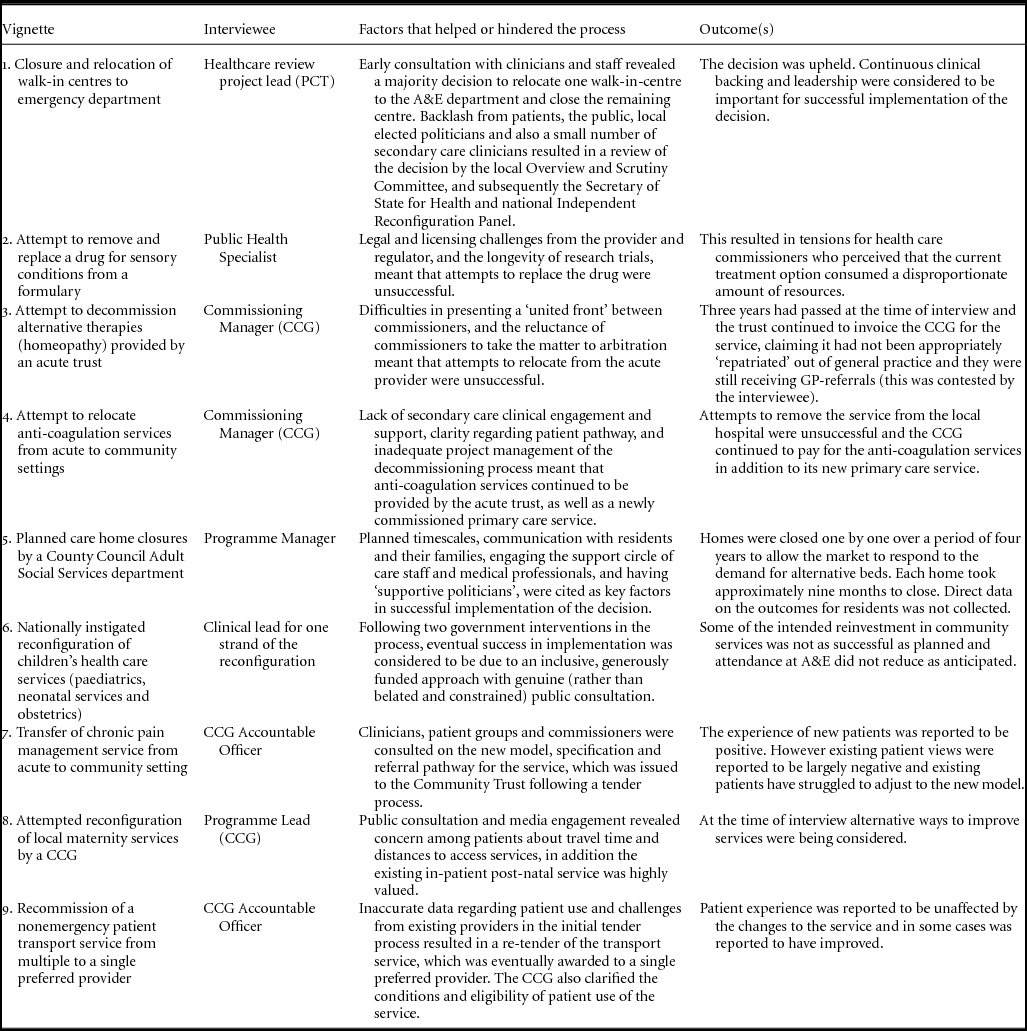
The third fieldwork component involved nine decommissioning ‘vignettes’ collected via semi-structured interviews with individuals that had led recent decommissioning projects. These retrospective vignettes explored, in detail, decommissioning processes and experiences across a range of service types and interventions, at different levels of scale and scope. Interviewees included CCG commissioners, local government leaders and senior NHS clinicians. Interviewees were again identified through a scan of the published grey and academic literature on decommissioning, through nominations from the project advisory group, and from the survey, where respondents indicated they would be willing to be interviewed about their responses. The purpose of the vignettes was primarily to understand the factors that either hinder or help the decommissioning process and the personal experience of negotiating these either successfully or otherwise. A summary of the vignettes is included in Table 2 below.
Decommissioning vignettes

Survey data were analysed using SPSS and generated descriptive statistics about the extent and nature of decommissioning among CCGs. Findings from the policy landscape interviews, the vignettes and qualitative data provided by survey participants were analysed using NVivo software. Key themes were identified by the whole research team within the over-arching structure provided by the research questions. Coding of data was then carried out separately by two members of the research team, who met to share and discuss these themes and further refine the codes. These were then used to interpret the data. Coded qualitative data and survey data were then entered into a spreadsheet matrix organised according to the research questions, in order to elucidate and further analyse key findings around the scope of decommissioning as well as the experiences of those implementing decommissioning processes (Johnstone, Reference Johnstone2004). We sought and obtained ethical approval from the University of Birmingham ethics committee for all aspects of the study (ERN_13-0172).
Findings
Four over-arching themes were identified regarding the experiences of CCGs in responding to the decommissioning challenge: i) national and local relationships; ii) issues of organisational capacity; iii) extent and nature of decommissioning undertaken; and iv) intended outcomes of decommissioning projects. We present and discuss each of these themes in turn below, drawing on findings from across the decommissioning policy landscape interviews, the CCG survey, and decommissioning vignettes.
National-local relationships
The policy landscape interviews revealed that, at the time of research, there was a range of national bodies with responsibilities in relation to decommissioning. However, these national roles and responsibilities were apparently not ‘joined-up’ or mutually informed, and not all interviewees indicated a grasp of the remit of the other bodies in relation to decommissioning. Across the bodies, there was very little in the way of specific resources or good-practice guidance for commissioners on decommissioning and service change. Decommissioning was often considered part of the commissioning function rather than a policy area in its own right. Many of the national bodies included within the policy landscape review, with the exception of one (NICE), were not providing active support for locally-led decommissioning. Others had a responsibility to intervene on a case-by-case basis, for example in a review role as in the case of scrutiny bodies. In addition, the national context was highly fluid during the lifetime of the study with some of the bodies expected to be either merged or discontinued. Nevertheless our policy landscape interviews and vignettes suggested that, as a result of constrained public finances and national ambitions regarding reconfiguration of NHS services, decommissioning was expected to become more common and comprise an increasing proportion of CCG activity:
I think there's a particularly kind of difficult environment with finances at the minute, and then I think the other high level thing which potentially will mean more decommissioning is the national strategy to try and ensure that there is this more concentration of specialist expertise in specialist centres, so I think those are the big ticket issues that are on our horizon, or very imminent. (Policy landscape interview 7)
I think a lot of the strategic direction of the NHS is very much, it will require services to be decommissioned, you know everything that NHS England talks about in terms of its strategy around, I don't know, high quality urgent emergency care, seven day services, wider primary care, integrated care, productive elective care, all that requires an element of service change and as a result some kind of decommissioning, so presumably this will only become more important. (Policy landscape interview 8)
The nature of NHS finance assumptions means the CCG needs to agree bold and ambitious change programmes into the future. (Survey respondent 18)
In determining decommissioning activity to be part of the overall strategic commissioning process, interviewees in the vignettes noted the time required by CCGs to identify, interpret, ‘keep up with’ and put into practice national directives, guidance and policy ambitions, and balance these with locally determined priorities and dynamics. Selectivity appeared to be often practiced by CCGs:
. . . ultimately I think that comes down to the root of it. . .In all the guidance it's aimed at individual patient treatment decisions including for example what NICE do in the absence of the bigger picture on what that means for all the other patients across the healthcare community. And it's only the commissioners that are thinking about all the other services they've got to try and commission and have worked out therefore that means there's less money to spend on other people over here. [Vignette 2]
Participants also insisted upon the importance of CCGs being able to shape local service delivery according to local need, although some were ambivalent about how far the system would facilitate locally driven decision-making:
I think one of the key things which may or may not come out is that it's not a level playing field, in the sense that the government has such an influence, you know, and they set the rules and the right hand and the left hand are doing opposite things, you know, they want the local population to make decisions but they don't, you know, they want to interfere nationally. (Policy landscape interview 3)
Our vignettes revealed that, in the absence of further national precedent and guidance, CCGs appeared to rely on contractual mechanisms, formularies, and consultation processes with stakeholders to implement decommissioning decisions. These varied in their success and were dependent on local context. For example, it appeared that contractual mechanisms could be particularly effective for negotiating changes to services with independent providers, as in the case of vignette 9 (see Table 2 above) where non-emergency patient transport was re-commissioned at the end of the existing provider's contract. However, contractual mechanisms were less successful in vignettes 3 and 4 (regarding the attempted decommissioning of some therapies and anti-coagulation services) where patient pathways were heavily entrenched with the provider and the CCG was reliant on the provider for the majority of acute-care provision locally, influencing negotiations. Consultation processes were viewed as important for securing buy-in to the decision to close care homes and successfully relocate residents in vignette 5, but proved less successful in vignette 8 regarding the attempted reorganisation of maternity services, and plans were abandoned. Vignette 2 reveals how unsuccessful attempts to replace a drug to treat sensory conditions with an effective, but less expensive, alternative within a formulary resulted in tensions between health care commissioners and providers, where commissioners perceived that the existing treatment option consumed a disproportionate amount of resources.
Organisational capacity
Some interviewees expressed the view that decommissioning had the potential to help achieve transformational service change, but in general CCGs and commissioners approached decommissioning with caution and in an incremental fashion. Whilst fears about staff hostility and patient and public negativity were cited, capacity (dedicated personnel and staff time) and resources to manage large-scale change processes also appeared to be significant factors that shaped CCGs’ approach to decommissioning. Survey data suggested that shortages of human and financial resources were considered to be a bigger hindrance than shortages of the necessary skills for decommissioning. Only a small majority of responding CCGs (51 per cent) agreed or strongly agreed that they had sufficient capacity (dedicated personnel and staff time) and 54 per cent that they had sufficient financial resources to undertake decommissioning in our survey, whilst a larger majority (78 per cent) agreed that they had the necessary capabilities (staff skills, expertise and authority).
Our vignettes revealed that CCGs’ ability to manage change was viewed as more likely to occur where they were tackling discrete services or interventions as part of a wider plan for local service delivery, providing that such programmes did not destabilise treatment pathways for patients (as in the case, for example, of vignette 9 regarding the successful recommissioning of non-emergency patient transport). More ambitious programmes of reorganisation were seen as requiring greater coordination and leadership to work through the challenges involved in working across multiple organisations (as in the case of vignettes 6 and 8 regarding the reconfiguration of children's health care and maternity services). However, there was a feeling that these programmes of change promised greater improvements for patients and service sustainability in the longer-term. Interviews and open comments provided by the survey respondents indicated that CCG organisational capacity and capability to undertake decommissioning is likely to be extremely variable overall:
[practice] is really patchy. And it's not surprising. [CCGs] are new organisations. . .in some areas CCGs are making really important strides and actually they have found a great deal of common purpose and common ground with chairs of Health and Wellbeing Board for example. But in others they are still getting to grips with the new health landscape in a very trying financial environment. (Policy landscape interview 10)
I think there are a lot of people whose posts are at risk so they are not going to be fully focussed. . . To start big service change you need a consistent team with consistent clinical leaders. . .The infrastructure is not there yet to support the significant change which needs to be made. You need the horse before the cart. (Vignette 1)
. . . you do need one or two key people, which we lost this time, three of them who'd definitely been there for 10 years, took away a huge amount of knowledge. . . that actually is a negative (Policy landscape interview 6)
Loss of ‘organisational memory’, expertise and staff turnover as a result of the 2012 restructuring that led to the formation of CCGs were key issues highlighted in the policy landscape interviews and vignettes. In some areas Commissioning Support Units (CSUs) had taken on key roles in supporting the commissioning function of CCGs at the regional and sub-regional level, and our survey revealed that 44 per cent of CCGs in our sample had accessed CSUs when undertaking decommissioning.
Their [CCGs] head space is really, really challenged, they are spending so much of their time servicing the day to day demands of operations. . . so they are really relying on their CSU a lot to alleviate pressure, CSUs are being relied on a lot to alleviate pressure points in the system. (Policy landscape interview 3)
Open comments provided by survey respondents and analysis of the interview data revealed that CSUs were approached for assistance with intelligence on the quality and value for money of providers, public health and needs assessment advice, undertaking consultation and engagement activity with patients and the public, analysing patient experience data, and support with modelling and planning future care. Support with managing contractual and invoicing arrangements during times of service change and transition were also expected to be key functions of CSUs. However, some interviewees and survey respondents expressed concern that CSUs themselves were wrestling with their role in the new system, and the precise opportunities for support with decommissioning activities were still unfolding:
The lack of capacity/resources relates largely to CSUs. They have spent so much time reacting to changes relating to their own future rather than developing their own expertise. (Survey respondent 53)
Extent and nature of decommissioning
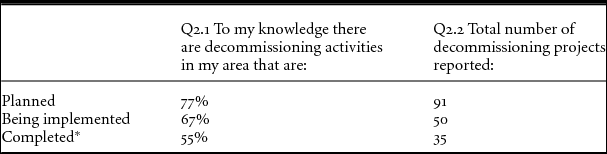
Notwithstanding these issues, a high number of CCGs reported experiences of decommissioning in our survey. Seventy-seven per cent of the respondents had decommissioning activities planned, almost two thirds (67 per cent) were in the process of implementing some decommissioning, and over half (55 per cent) had already completed some decommissioning (see Table 3). The total numbers of reported decommissioning projects planned further suggested that levels of decommissioning activity would be expected to be high in the future amongst the CCGs in our sample (Table 3).
Extent of decommissioning activity

*Completed means fully implemented
The types of decommissioning reported by CCGs in the survey, together with the policy landscape interviews and our vignettes, suggest that decommissioning activity was concentrated around service changes and reconfiguration of services, particularly between acute and primary care:
There are different levels of decommissioning. . . frequently you will decommission on the back of a service review or a strategic direction which says we need less services or we need a reconfiguration of services therefore you will want to potentially decommission from certain places and re-commission so I suppose that's an area of decommission[ing] where you want to change the shape of it rather than decommission it altogether. (Policy landscape interview 7)
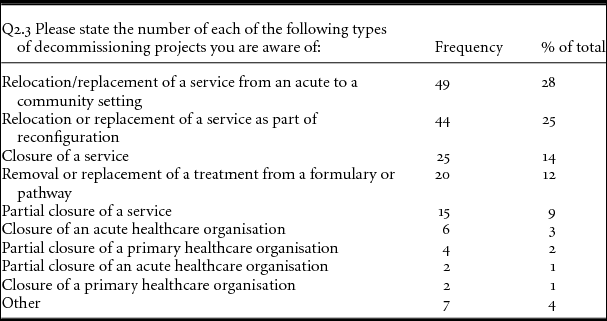
The most common type of decommissioning activity reported by CCGs in the survey was relocation or replacement of a service from an acute to a community setting. The second most common type of activity related to the removal or replacement of a service as part of a reconfiguration of services, and the third most common activity was the planned closure of a service (Table 4):
Types of decommissioning activity

Open comments provided by survey participants suggested that CCGs were aiming to invest more in primary and community care, and provide services closer to home for patients and the public:
Part of our 5 year plan is to shrink back the acute sector and to redesign and re-provide within primary and community care where appropriate. (Survey respondent 38)
The integration agenda means a shift in resource from hospital to community and primary care. (Survey respondent 10)
mostly changing care pathways and setting up intermediary services in the community e.g. cardiology, dermatology, MSK [musculoskeletal] (Survey respondent 43)
Further examples of shifts in provision between acute and primary care were illustrated in vignettes 4 and 7 regarding the relocation of anti-coagulation and pain management services from hospital to community settings. Nationally driven but locally led reconfigurations of services meanwhile featured in vignettes 6 and 8 concerning the reorganisation of children's health care (paediatrics, neonatal services and obstetrics) and maternity services. Probing further, our vignettes revealed that although activity was focused on reorganisation, the precise nature of reconfiguration and service change may mean that some specific parts of services may nevertheless experience a closure or loss in terms of resources and staffing, as in for example the consolidation of children's health care services into fewer units (vignette 6) and the closure and relocation of walk-in centres to acute settings (vignette 1). Other types of decommissioning reported by CCGs in the survey included decommissioning services and recommissioning them to alternative providers, and rationing access to particular services and treatments. This latter type of decommissioning activity featured in vignette 9 concerning the recommissioning and review of patient use of non-emergency transport, and in vignette 7 where referrals for patients to chronic pain management services were reviewed.
Only three CCGs in our survey reported that planned decommissioning activities had been discontinued. Activities reported to be discontinued included one partial closure of a primary health care organisation, two relocation/replacements of a service as part of a reconfiguration, and one removal/replacement of a treatment from a formulary or patient pathway. Reported reasons for discontinuation included:
lack of organisational appetite to disinvest in a service delivered by member practices as this may lead to disengagement (Survey respondent 35)
clinical and patient views in engagement process (Survey respondent 48)
on basis of evidence base (Survey respondent 47)
awaiting impact of new primary care contract – was decommissioning a local enhanced service (Survey respondent 29)
It is of note that the reasons reported for discontinuation reflected relational and political factors, rather than organisational issues. Vignettes 3, 4 and 8 (regarding attempted removal of alternative therapies, anti-coagulation services and the reconfiguration of maternity services) shed further light on these aspects, reporting that lack of united clinical and commissioner backing for plans and patient/public support prevented the implementation of decisions to decommission services.
Intended outcomes
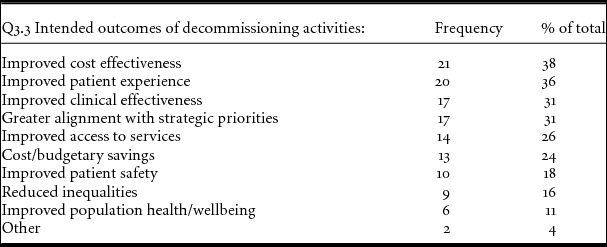
Our survey results indicate that the most common intended outcome of decommissioning was improved cost effectiveness, reported by 38 per cent of CCGs. The second most common was improved patient experience, and the third most common were improved clinical effectiveness and greater alignment with strategic priorities, both reported equally by 30 per cent of CCGs (Table 5):
Intended outcomes of decommissioning

Our survey found that 38 per cent of CCGs agreed and 19 per cent strongly agreed that completed decommissioning projects had achieved their intended outcomes overall, but over a third (38 per cent) of CCGs reported that it was too early to tell. Only a small number (5 per cent) strongly disagreed that completed decommissioning activities had overall achieved their intended outcome. The high number of CCGs reporting that it was too early to tell may be due to the timing of the survey as many decommissioning activities may have only recently been completed, and therefore outcomes were not yet known; this is particularly likely given the recent formation of CCGs and the fact that only 55 per cent of total respondents reported they had fully implemented decommissioning activities overall.
Open comments in the survey and interview data meanwhile elaborated further on some of the difficulties of ascertaining the outcomes of decommissioning activities. Survey respondents indicated that actual outcomes and impacts were often experienced subjectively and varied according to people's position in the health care system:
There have been positives and negatives. From a clinical safety perspective and in evaluating clinical and performance outcomes these have either improved or not been adversely affected. From a public perspective, some people have to travel further so this could be classed as a negative. (Survey respondent 26)
Early feedback indicates that new patients are very happy with the service; existing patients who had a different pathway before, feedback is varied. (Survey respondent 27)
This issue was clearly demonstrated in our vignettes. In vignette 7 for example, existing patients using the service (primarily injections for chronic pain relief carried out in acute settings) reportedly struggled to adapt to the new arrangements which involved a review of acute referrals, training on self-management and coping strategies for patients, psychology, occupational therapy and physiotherapy services. New patients by contrast reported high satisfaction with the services, suggesting that relative expectations shape satisfaction. Different stakeholders’ perspectives on the relative success of decommissioning decisions and their impacts were also rarely reported as aligned. For example, vignettes 1, 6 and 8 (regarding walk-in centre closures, reorganisation of children's health and maternity services) experienced strong patient and public protest to changes and, in the case of 1 and 6, decisions to decommission services underwent judicial review before being implemented (albeit with some changes). Furthermore our vignettes suggested that, where evaluated, intended outcomes were rarely wholly realised. Vignette 6 for example indicated that, whilst services within the consolidated larger units were reported to be performing well, some of the intended reinvestment in community services did not materialise and attendance at A&E did not reduce as anticipated as a result of the reorganisation. The policy landscape interviews meanwhile suggested that some of the challenges in measuring outcomes of decommissioning related to lack of CCG capacity and even willingness to collect and analyse data, differences in reporting systems between providers, and perceived longevity in impacts being realised:
Rarely do commissioners and managers and people who change services answer that question: where is the evidence for what you're doing, those outcomes. . . I'm sorry to say it's not only they don't want to know, but it's also timescales and feeling that sort of, well hang on, you know, it's all going to take an awful long time doing. (Policy landscape interview 3)
I think there's a huge challenge on CCGs and area teams or those that are leading the decommissioning to sort of actually do the review of it afterwards because I think a lot of attention and time and resource is put into the actual decision making and then the doing of it, but actually it's the ‘after’, you know? (Policy landscape interview 12)
Discussion
The study findings revealed important insights with regards to our three research aims and we report against each of these in turn.
Wider health policy context and influence on decommissioning
Our interviews with national bodies suggest that, whilst there is some assistance for CCGs in carrying out their work, very little of this is tailored specifically to meeting the challenges of decommissioning. What's more, survey responses and vignette accounts both indicate a perceived lack of guidance to support decision making and difficulties deriving from NHS restructuring and associated staff turnover and loss of expertise. Our findings indicated a role for CSUs in supporting CCGs with aspects of decommissioning, particularly engagement activities, data analysis and contract management. However responses suggested that CSUs may also be busy reconciling their role in the re-structured system and, alongside new place-based arrangements for inter-organisational working through STPs, it is difficult to draw further conclusions about the interactions between CCGs and CSUs in decommissioning processes. The wider context of austerity was a clear imperative to decommissioning for the respondents in our sample; however, findings appeared to suggest the national political context could also, paradoxically, inhibit progress as pressure for efficiencies could impede the dedication of resources and personnel to expensive implementation processes. To compound this, the mechanisms and levers for implementation of the decommissioning components of service changes appeared to be somewhat nascent and vignettes suggested they could be subject to challenge by various stakeholders.
Current activity and experience of decommissioning among CCGs
Although previous research has suggested that decommissioning at the local level of the NHS is likely to be rare (cf. Daniels et al., Reference Daniels, Williams, Robinson and Spence2013), our sample of CCGs revealed notably higher levels of activity and more ambitious plans. Our study would therefore appear to suggest that (planned) changes to services may be both more prevalent and at a larger scale than previously thought and that financial pressures are among the key factors currently driving this change. Reconfigurations of services involving service removal, relocation or replacement between acute and primary care were common in our sample. Our vignettes indicate that such complex programmes of reorganisation require careful planning, coordination, and strong leadership, but that these may be hampered by wider issues of organisational capacity (dedicated personnel and time) to project-manage decommissioning, fears of destabilisation, and lack of cooperation of stakeholders in the wider health economy. Furthermore our survey responses and vignettes suggest that changes to or closure of discrete services and interventions, while seemingly less complex, can also suffer from political and relational counter-forces and inertia as a result of entrenched local systems. Given these findings, progress with planned decommissioning activity is likely to vary according to local context.
Challenges of decommissioning
Taken together, the survey responses and vignettes draw attention to a number of issues pertinent to the implementation of decommissioning policies. The vignettes demonstrate the importance of engagement with patient groups and the wider public if ambitious decommissioning plans are to be implemented, as well as backing from clinical leaders. Our sample also contains an example (vignette 8) of plans being abandoned following engagement activities. These examples further pointed to the need to have supporting clinical and patient experience data, in addition to evidence about cost-effectiveness, in developing the case for decommissioning of services; however, overall, our survey responses and vignettes raised questions about the balance of evidence used to inform decisions about service changes and their intended outcomes. Our findings further indicate some of the challenges in evaluating the impacts of decommissioning, including (political) appetite, longevity of implementation, and organisational processes and systems for data collection and analysis. These issues, as well as the varying perceptions and interests of constituent stakeholders in a local health system, point to a lack of clarity around what ‘success’ looks like in the context of a decommissioning process. Taking these factors into account, and the turbulent environment that CCGs (as relatively new organisations) are operating in, many of the challenges facing health commissioners discussed earlier in the paper – securing clinical and public engagement, weighing evidence, balancing cooperation and competition between providers, and measuring outcomes – appear to be amplified in the process of decommissioning.
Conclusion
Given the wider health policy context, it is perhaps unsurprising that decommissioning presented considerable challenges to the participants in our study. Whether undertaking relatively modest attempts to withdraw treatments, or more ambitious scaling back and reconfiguration of services, the findings attest to the political and logistical obstacles encountered. The study suggests that those seeking to embark upon programmes of service change involving replacement and removal of health care services currently have little by way of direct prescription or guidance to go on. Furthermore, our research suggests that decommissioning is likely to be driven, at least in part, by the imperative to save money, and this creates political risks given the high societal value placed on a universal health care provided free at the point of delivery. This risk is increased where the outcomes of decommissioning programmes and in particular the impact on patient equity remain unclear. There is a need for in-depth qualitative research into the relational and political dimensions of decommissioning in general, and longitudinal investigation of specific decommissioning activities involving wider service withdrawal, closures or reorganisation and their impacts for patient populations, at different levels. Furthermore the findings we have presented here reflect something of a management bias, drawing disproportionately as they do on views and experiences of health system commissioners and leaders. Investigation of the views and experiences of patients, their carers and the wider public, of both the process and outcome of decommissioning decisions would go some way to improving our understanding of the challenges of decommissioning. Perhaps for these reasons successive UK (or English) governments engaged in welfare retrenchment have conspicuously either exempted health care or else devolved and delegated responsibility for it. However, without political and financial support, it is difficult to see how local decision makers will be able to navigate this contested terrain to greater effect than has been achieved in the past or elsewhere.
Acknowledgements
We are grateful to all our participants and to our project advisory group who were generous with their time and open in their responses. This study was funded by the NIHR Health Services Delivery and Research programme (grant number 12/5001/25). The views and opinions expressed therein are those of the authors and do not necessarily reflect those of the NIHR HSDR programme or the Department of Health.