Studies examining workforce absenteeism during a disaster such as a pandemic have identified a decrease in health care workers’ willingness to report for duty.Reference Chaffee 1 These behaviors can be partially attributed to barriers such as transportation, the need to care for dependents at home, and concerns about personal safety and the safety of the employee’s family.Reference Chaffee 1 ChaffeeReference Chaffee 1 found that absenteeism rates may surpass 50% during certain types of disasters involving contamination or contagion. Balicer et alReference Balicer, Barnett and Thompson 2 found that nearly a third of the hospital workforce would likely not report to work during a severe pandemic scenario. Given such findings, ensuring adequate hospital staffing has become a matter of great concern for hospital administrators and public health preparedness officials.
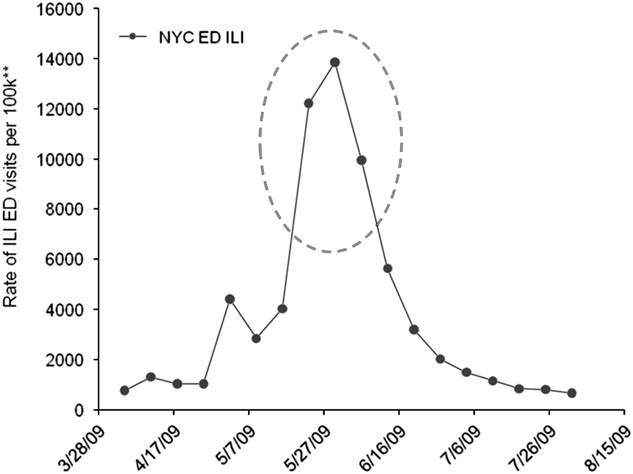
During a disaster such as a pandemic, it is expected that there will be an increase in a community’s need for hospital-based health care, and it is unclear whether an abrupt surge in demand can be adequately managed by the existing number of hospital personnel. During the 2009 H1N1 pandemic, there was a 7-fold increase in the number of patients visiting emergency departments owing to influenza-like illnesses in New York City (Figure 1). 3 Given the abrupt rise in hospital visits and the expected need for additional personnel during a pandemic, identification of factors driving health care workers’ willingness to report to work is critical.
New York City Emergency Department (ED) Influenza-Like Illness (ILI) Visits. The dotted lines represent the peak ILI visits in the New York City ED from April to August 2009. This figure illustrates the surge of ED visits during the height of the H1N1 crisis and raises the issue of hospital workers’ willingness to work during situations of pandemic disaster. Adapted from the New York City Department of Health and Mental Hygiene. 3

This study examined potential barriers, consisting of both external factors (eg, transportation needs, lack of training) as well as personal concerns (eg, personal safety, family safety, child care) that may reduce an employee’s likelihood of reporting to work during a pandemic.Reference Garrett, Park and Redlener 4 , Reference Qureshi, Gershon and Sherman 5 Although the identification of barriers is a crucial step in understanding employee behaviors during a disaster, there are also key intrinsic qualities among workers that make mitigating absenteeism challenging. Studying employee-specific characteristics that influence an individual’s willingness to work may improve our understanding of workers’ behaviors during a disaster and increase the effectiveness of interventions intended to mitigate hospital worker absenteeism.
In 2009, Garrett et alReference Garrett, Park and Redlener 4 evaluated the anticipated effectiveness of interventions intended to mitigate barriers that may impact a worker’s willingness to report to work, both positively and negatively, by using hypothetical scenarios. They tested interventions that ranged from providing additional compensation (ie, bonus pay), vacation (ie, time off), and preferential access to medical prophylaxis such as oseltamivir (Tamiflu; Genentech) and personal protective equipment (PPE; ie, N95 respirator or other protective masks) for hospital employees alone or in conjunction with their family members. Prior studies such as that by Garrett et alReference Garrett, Park and Redlener 4 have focused on identifying interventions to address specific barriers that increase workers’ willingness to report for duty during a pandemic.Reference Garrett, Park and Redlener 4 - Reference Seale, Leask and Kieren 6 Prior studies have also called for more comprehensive analyses of the influence of employee-specific characteristics on behaviors during a disaster.Reference Ives, Greenfield and Parry 7 - Reference Qureshi, Merrill and Gershon 9
The present project reexamines Garrett et al’s study from 2009 by extending the analysis of the workforce to include compositional factors, which are individual-level characteristics, as well as contextual characteristics, which are location-based characteristics, that describe the workforce. These compositional and contextual factors include area of residence, distance from home to hospital, demographics (eg, age and race/ethnicity), hospital type (eg, location and area of service), job role (eg, clinician, administrative, clinical support staff, and nonclinical support staff), and family composition (eg, presence of a child or adults who require care in the household).
In addition to examining the effect of employee-specific characteristics on willingness to work for different interventions, the decision-making processes of workers who (1) shared barriers to report to work and (2) resided in proximal geographic areas were studied. Communities of geographic proximity (neighborhoods) are often occupied by residents with similar socioeconomic status, and this contextual effect may influence their behavior (ie, willingness to work). The study of neighborhoods has been extensively investigated by Sampson et al,Reference Sampson, Raudenbush and Earls 10 , Reference Raudenbush and Sampson 11 where characteristics of residents living in a community were found to have shared behaviors. This study bridges a well-documented series of neighborhood studies to the literature of hospital workers’ willingness to work.
This study had two overall goals: (1) to investigate associations between interventions and barriers with characteristics that describe the workforce and (2) to empirically test whether decision-making processes are similar among hospital workers who share primary barriers to reporting for duty as well as their region of residence. The second goal hypothesized that workers who have homes nearby, or who have similar barriers, may share behaviors that impact their willingness to work. Identifying whether hospital workers share similar decision-making processes in their willingness to work during a disaster by common barriers or region of residence can have valuable implications for how policy makers communicate to employees, adequately plan and prepare for the unanticipated consequences of an emergent situation, and build community resilience.
METHODS
Data
This study examined hospital workers’ improvement in willingness to work following a hypothetical pandemic influenza, with a particular focus on the impact of compositional and contextual factors. A convenience sample was taken from all 17,000 employees in 5 hospitals across 2 major university medical centers to conduct an anonymous survey via an Internet-based survey tool. The study was approved by the institutional review boards at each participating facility.
In the online survey, the participants were presented with a hypothetical moderate pandemic influenza scenario that was causing an increase in demand for hospital-based health care. Employees were asked to report an initial “willingness to work score” (WTWS) by use of a continuous 0 to 100 scale, where 0 represented “absolutely will not report to work” and 100 represented “absolutely willing to report to work.” Once the baseline WTWS was established, participants were asked to select the most important barrier that would prevent them from reporting to work, if one existed. If their choice was not listed, they were given the option to provide a barrier. The options of barriers included family safety concerns, personal safety, transportation needs, a need to provide for dependent care at home, concern about a lack of training, and concern about legal issues. This list was generated through a series of focus groups held during the early phase of the study with hospital employees. On the basis of their selection, respondents were presented with a series of interventions intended to increase their willingness to report for duty and were subsequently asked to re-report their WTWS. The difference in the WTWS from before to after the proposed intervention was the basis for analyzing the effectiveness of the intervention. This was termed the “willingness to work change score” (WTWCS). A positive WTWCS indicated a favorable mitigation effect due to the intervention; a negative or a WTWCS of “0” suggested an ineffective intervention. To ensure response independence for different sequences of interventions, respondents were reminded to compare the effect of the new intervention on their WTWS with their baseline WTWS. Information pertaining to sociodemographics and the hospital workers’ job types was collected from all participants.
WTWCS was calculated for the 6 most commonly specified interventions: (1) bonus pay offered to the employee, (2) time off offered to the employee (3) access to Tamiflu assured for the employee [The brand name product Tamiflu (Genentech), which has widespread public recognition, was used in the survey in reference to the antiviral medication oseltamivir. It was introduced in the survey as a potentially effective medication for the treatment and prevention of the pandemic strain of influenza.], (4) access to Tamiflu assured for the employee and family, (5) a supply of PPE assured for the employee, and (6) a supply of PPE assured for the employee and family. These change scores were recoded as binary values that represented an increase or a decrease in likelihood of reporting to work; positive change scores were coded as “1,” and change scores that were zero or negative were coded as “0.”
The online survey that measured respondents’ willingness to work was designed and administered by using Survey Monkey (www.surveymonkey.com), a web-based survey software, between February and April 2009. On average, the survey took approximately 8 minutes to complete. Based on a sampling frame of about 17,000 hospital workers, 2965 responses were collected (sample size for this study), representing a 17.4% response rate.
Analysis
Logistic Random-Effects Regression Models
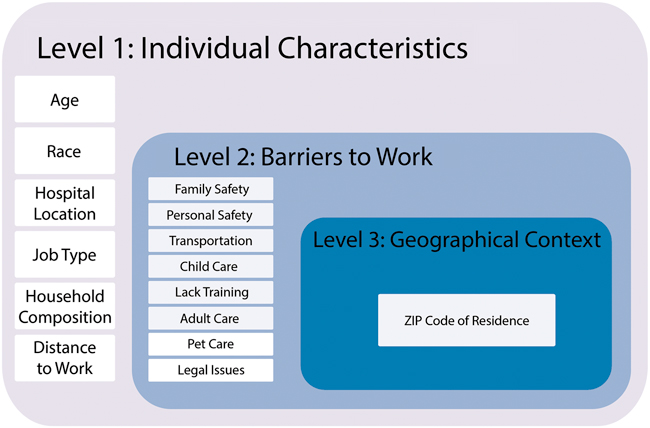
To evaluate differences within the workforce by intervention, 3 logistic random-effects regression models were analyzed (Figure 2). Model 1 used multiple logistic regression to compare characteristics (ie, distance to work, age, race/ethnicity, hospital location, hospital focus, job type [clinician, administrative, clinical support staff, nonclinical support staff], and household composition) across respondents. Clinical support staff refers to health care assistants who help practitioners, nurses, and other health care professionals. Model 2 incorporated differences among barriers as a multilevel framework. Individual responses from hospital workers constituted level 1, whereas barriers that prevented them from coming to work made up level 2 of the model. Model 3 further extended this structure to allow both barrier- and region-specific levels into the model. In model 3, an additional level was supplemented to cluster respondents who lived nearby. As such, 1-, 2-, and 3-level random-intercept logistic regression analyses were analyzed. Maximum log likelihood values were used to determine the best fitting model that described the data. Furthermore, chi-squared asymptotic likelihood-ratio tests were conducted to assess whether the multilevel assumptions were correctly specified.Reference Skrondal and Rabe-Hesketh 12 - Reference Rabe-Hesketh and Skrondal 14 The variance estimates from the random component of the model were estimated to test the significance of variability between barriers and regions. Intraclass correlations (ICCs) were estimated to measure the magnitude of association within clusters of respondents who reported the same barrier or lived in geographic proximity. All analyses were conducted by using Stata 10. 15
Representation of the Three-Level Model With Nested Structure. The three-level model contains clusters within clusters. Respondents are nested within barriers (ie, factors preventing hospital workers from coming to work), which are nested within their area of residence. These models assume shared variability within clusters to explain group differences.

Geographic Analysis
Cartography and geographic analysis were carried out by using ESRI ArcGIS 9.3.1 and Hawth’s Tools for Geographic Analysis. ESRI Data & Maps zip code boundary shapefiles were used for visualization and analysis. The basemap leveraged the ESRI Data & Maps USA basemap. 16 Zip code centroids were derived by using ArcGIS for both work and home locations. Euclidian (straight-line) distances were then calculated from the centroids in units of kilometers to determine a relative distance from home to work. 17 To better visualize the data, a smoothed surface of the zip code centroid change score data (WTWCS) was created by using an inverse distance weighted interpolation procedure. The inverse distance weighted procedure assumes data points in close geographic proximity to have a greater influence on each other than those further away; points closer were weighted more heavily than those further away. This resulted in a continuous predictive surface that allowed for a more intuitive display of the data.
RESULTS
Descriptive Statistics
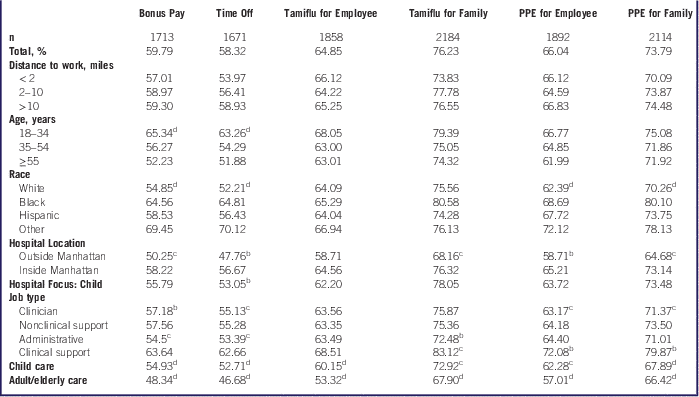
The results of the univariate analysis for the 6 interventions—bonus pay, time off, Tamiflu for employees only, Tamiflu for employee and family, PPE for employee only, and PPE for employee and family—are shown in Table 1. The values represent percentages that correspond with the proportion of respondents who expressed an increase in likelihood to come to work given the intervention. Across all workers, providing interventions for family, such as Tamiflu for family (76.2%) and PPE for family (73.8%), was the greatest motivator for willingness to work during a pandemic. Younger respondents were more receptive to bonus pay and time off; respondents between the ages of 18 and 34 years showed a significantly greater proportion of willingness when given bonus pay and time off than older respondents. By race and ethnicity, African Americans showed a greater willingness for bonus pay, time off, and PPE provision for both employee or employee and family. Employees who worked at a hospital inside Manhattan were more sensitive to all interventions; however, one association (Tamiflu for employee) did not achieve statistical significance. In the hospital that was focused on child health care, only time off was effective.
Descriptive Statistics: Percentage of Respondents Whose Willingness to Work Increased With the Interventiona

Abbreviation: PPE, personal protective equipment.
aSample size (n)=2965. Column headers represent mitigations; values represent percents. Child care and adult/elderly care indicate a child or an adult or elderly friend in the household who requires care. Although these variables were listed as possible barriers, they do not necessarily correspond to the most significant barrier that is preventing the respondents to report to work. As such, they were included here and also in the ensuing regression models to control for the effect of household composition and burden. Tamiflu is a trademark of Genentech for oseltamivir.
b P<0.05.
c P<0.01.
d P<0.001.
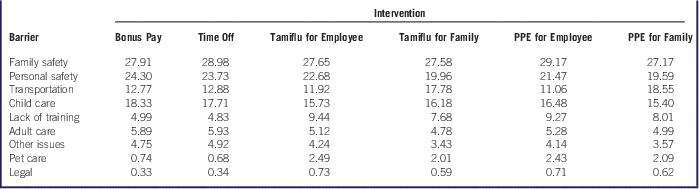
The barriers that hindered an employee’s willingness to work are shown in Table 2. This was combined with the interventions to examine and rank column percentages of interventions that influenced each barrier. Across all interventions, there was an equal trend that showed family safety, personal safety, transportation needs, child care, and lack of training as the top 5 barriers. These proportions were significantly different for all interventions. About 8% of the respondents documented additional barriers not listed in the options, which included current health issues of the respondent. The remaining comments were similar to barriers already listed in the options; as such, additional barriers documented by respondents were excluded from the analysis.
Percentage of Respondents Whose Willingness to Work Increased Given Intervention and Barriera

Abbreviation: PPE, personal protective equipment.
aNote: All mitigations were significant at P<0.001. Tamiflu is a trademark of Genentech for oseltamivir.
Geographic Representation of Respondents’ Willingness to Work
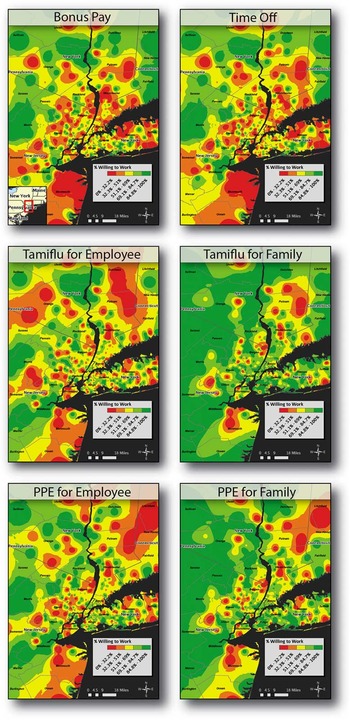
To examine the effect of geographic location and its relationship with the mitigating effect of the interventions, respondents’ home zip codes were mapped with their likelihood to come to work (WTWCS). The role of geography on mitigation is illustrated in Figure 3. These maps were generated to provide descriptive measures of how location affected the level of willingness to work. Darker shades of green indicate a greater likelihood of respondents to be sensitive to the impact of the intervention, whereas darker shades of red indicate a continued unwillingness to report to work. For the 6 interventions, there was a greater concentration of red among respondents who lived inside Manhattan. In areas outside Manhattan and in the suburbs of New York City, there were greater shades of green. This implied that geography and the area of residence played a role in determining an employee’s willingness to work; the further away the respondents lived from New York City, the more receptive they were to most interventions. Specifically, among the 6 diagrams, time off showed a large concentration of red shades centered in the New York City area, meaning that time off had a relatively small effect on improving willingness to work among respondents who lived in Manhattan. Areas north and west of New York City had dark shades of green, which may indicate that the respondents who lived in these areas were more willing to work if offered time off than were employees who lived closer to Manhattan.
Geographic Representation of Respondents’ Willingness to Work. Areas in darker shades of green indicate a greater likelihood of being receptive to interventions. For all 6 interventions, there is a greater shade of green for respondents living outside the New York City area. This is more evident for bonus pay and time off, which have a concentration of red shades centered on New York City. PPE indicates personal protective equipment. Tamiflu is a trademark of Genentech for oseltamivir.

Willingness to Work Considering Barriers and Region of Residence
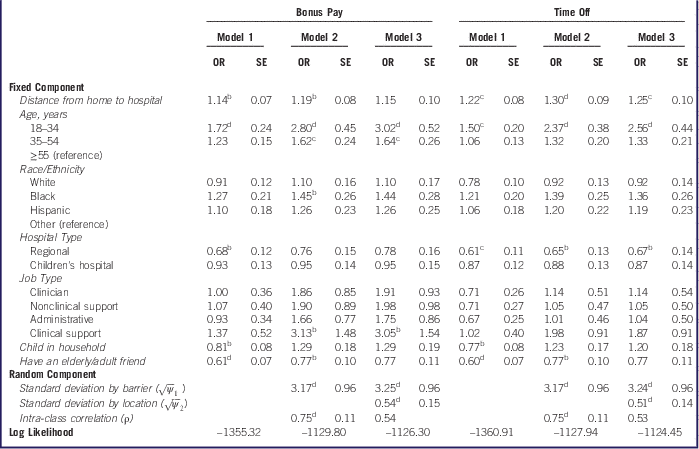
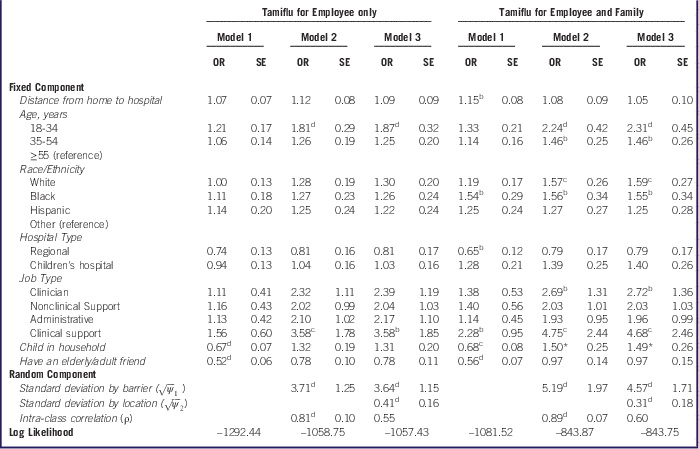
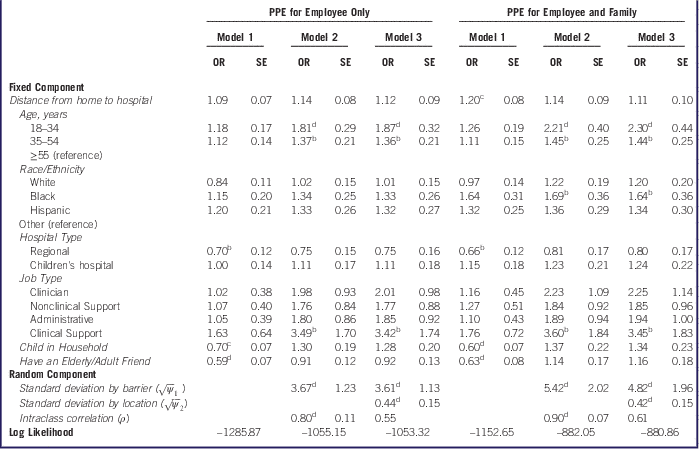
Model 1 presented a simple logistic regression with improved willingness to work due to the intervention as the outcome variable with control for multiple factors: distance from home to hospital, age, race/ethnicity, hospital type, job type, child in household, and the presence of an elderly household member or friend who required care. Model 2 extended this framework with the addition of a second level and took into account the variability of respondents who expressed the same barrier. In other words, the second model grouped respondents by the barrier most likely to prevent them from reporting to work and examined differences in their responses by applying the random-intercept logistic model. Finally, in model 3, this was further extended to include a third level that incorporated location to test the assumption that respondents who lived closer together shared common ability and willingness to work; this was statistically controlled by holding their variance constant (see Figure 2). The results for the 6 interventions for the 3 models are shown in Tables 3-5. As indicated by the log-likelihood values, model 3 described the data best for all 6 interventions, with significant variance in its random components, which shows the variability in the different levels of the model. For likelihood-based estimation models, when the maximum log-likelihood values are higher, the model fits better.Reference Skrondal and Rabe-Hesketh 12 We base our results below primarily on model 3.
Results of the Logistic Regression and Random-Intercept Logistic Regression for Bonus Pay and Time Offa

Abbreviations: OR, odds ratio; SE, standard error.
aThe outcome represents an increased willingness to work; standard deviations in the random components represent variability by barrier and location. Intraclass correlation represents the within-cluster correlation.
b P<0.05.
c P<0.01.
d P<0.001.
Results of the Logistic Regression and Random-Intercept Logistic Regression for Tamiflua

Abbreviations: OR, odds ratio; SE, standard error.
aThe outcome represents an increased willingness to work; standard deviations in the random components represent variability by barrier and location. Intraclass correlation represents the within-cluster correlation. Tamiflu is a trademark of Genentech for oseltamivir.
b P<0.05.
c P<0.01.
d P<0.001.
Results of the Logistic Regression and Random-Intercept Logistic Regression for Personal Protective Equipmenta

Abbreviations: OR, odds ratio; PPE, personal protective equipment; SE, standard error.
aThe outcome represents an increased willingness to work; standard deviations in the random components represent variability by barrier and location. Intraclass correlation represents the within-cluster correlation.
b P<0.05.
c P<0.01.
d P<0.001.
Bonus Pay
The results of the 3 models for bonus pay are presented in Table 3. The models indicated that hospital workers who lived farther away, were younger, worked at a hospital in Manhattan, had a clinical support staff role, had a child, and had an elderly household member or friend who needed care were significantly associated with a greater likelihood of coming to work when provided with bonus pay. However, with control for the hierarchical structure of both barriers that prevent them from coming to work and area of residence, only age and job type among employees with a support role were significantly associated with improved willingness to work after this intervention. Furthermore, the odds ratios increased with the consideration of the nested structure. For example, the odds ratios of respondents aged 18 to 34 years compared with respondents aged 55 years and older increased from 1.72 to 2.80 between models 1 and 2 and increased to 3.02 in model 3. From the random components, the significance of both standard deviation estimates showed that the variance between barrier groups was not zero; that is, there was significant between-group variability for both barrier and location. In other words, the effect of the interventions on willingness to work differed significantly by respondents who lived in different regions and also by barrier by a standard deviation of 0.54 and 3.25, respectively. The ICC presents the level of association among hospital workers who were clustered together. This means that for a given respondent living in the same region and who expressed the same barrier for coming to work, the correlation of their responses was 0.54.
Time Off
When calculating the impact of time off incentives, distance from home to hospital, age (ie, younger respondents), region (ie, Manhattan), having a child, and having an adult who required care were significant predictors (Table 3). However, in the model that included the multilevel structure that had better statistical fit, having a child or an adult who required help no longer affected a workers’ willingness to work. Furthermore, the variability of responses among hospital workers between the clusters differed significantly, as reflected in the intra-class correlations of 0.53.
Tamiflu
The variables that affected an employee’s willingness to work as a result of the interventions of Tamiflu for employee only and Tamiflu for employee and family members are presented in Table 4. For the 2 interventions presented in this table, the changes in log-likelihood values between models 2 and 3 were minimal. This meant that the additional effect of clustering at the residence level added only a relatively small amount of information. This was evident from the similarity in both the odds ratios and standard errors that are presented for both models. Concerning the results for Tamiflu for the employee only, when the hierarchical structure was not considered (ie, model 1), having a child in the household and having an elderly or adult friend who required care were significant. However, these effects diminished in models 2 and 3, which showed significance for younger respondents and employees who worked as clinical support staff. The effect of the predictors changed when considering Tamiflu for employee and family. For this intervention, model 3 showed that younger employees, African Americans, whites, workers with clinical roles, clinical support staff, and workers with children reported a greater likelihood of coming to work when Tamiflu was also provided for the family. For both interventions, the random component had a significant standard deviation estimate, which supported modeling of the multilevel framework. Furthermore, the intra-class correlations were 0.55 and 0.60 for the interventions of Tamiflu for employee only and Tamiflu for employee and family, respectively.
Personal Protective Equipment
For the interventions that involved PPE, the results for PPE for employee only and for PPE for employee and family were similar in that variables that predicted a significantly greater likelihood of reporting to work were associated for both interventions (Table 5). Furthermore, the changes in log-likelihood values between models 2 and 3 were relatively small for PPE. Although the changes in model fit were not significantly different, the results from model 3 for the intervention with PPE for employee only showed that younger employees and clinical support staff were more likely to come to work when given PPE. For the intervention of PPE for both employee and family, age and support job type were significant factors. In addition, African Americans were significantly associated with a greater mitigation of absenteeism. From the random component, the hierarchical structure improved the model fit significantly between models 1 and 2. Moreover, the significance of the standard deviation estimates implied that there were differences in responses among employees who reported a different barrier and among employees who lived in different regions. The intraclass correlations for the 2 interventions were 0.55 and 0.61, respectively, which were consistently similar to other interventions.
DISCUSSION
This study analyzed the effects of barriers to an employee’s level of willingness to work and whether these effects were mitigated by 6 interventions. During a disaster, the sudden increase in patients seeking health care will likely lead to an increased demand for hospital workers. However, owing to factors affecting the hospital employee’s willingness and ability to work, there is uncertainty in hospitals’ ability to meet that increased demand. Such uncertainty in health care worker’s willingness to report to duty raises the need to identify barriers and interventions that can mitigate absenteeism. Previous research has concentrated on various interventions that decreased the likelihood of employee absenteeism. However, there is a paucity of studies dedicated to investigating employee-specific factors that may influence willingness to work in a disaster. In this respect, this study contributes to the current literature not only by providing an analysis of the characteristics that affect employees’ willingness to work but also by incorporating both barrier differences and regional clusters into a simultaneous analysis.
The results from this study showed that the clustering effect of responses among hospital workers expressing the same barriers and living in proximity shared a significant level of correlation, as noted by ICCs ranging from 0.53 to 0.61; these estimates are notably higher than typical ICC effect sizes in the multilevel modeling literature, which usually range from 0.10 to 0.20.Reference Scherbaum and Ferreter 18 – Reference Snijders and Bosker 20 This supports the idea that barrier-specific factors that affect an individual’s ability to work are an important indicator when studying employees’ willingness to work.Reference Chaffee 1 Furthermore, as presented in both Figure 3 and in the models described, geographic area of residence plays an important role. Distance from home to hospital was also significant, but only for employees who expressed an increased likelihood to report to work for time off.
Consistent with prior research, concerns for family and providing interventions for them was effective in increasing workers’ willingness to work during a pandemic.Reference Qureshi, Gershon and Sherman 5 , Reference DiMaggio, Markenson and Loo 21 , Reference Kruus, Karras and Seals 22 Age was an important characteristic that substantially influenced all 6 interventions. Younger respondents were more sensitive and reacted with a greater likelihood to report to work than did older workers. For interventions involving Tamiflu and PPE, this was evident only in the multilevel formations of the model that incorporated an additional level of clustering effects by barrier and by region of residence. Moreover, race and ethnicity affected interventions that involved provision of PPE for both the employee and family members. Among job type, employees who worked as clinical support staff were more likely to report to work when presented with the interventions; however, a specific source as to why interventions were more successful among the clinical support staff has not been identified and could be further examined in future study. Additionally, the response rate (17.4%) could be a limiting factor of this study; however, other studies such as the one by Balicer et alReference Balicer, Barnett and Thompson 2 had similar response rates (18.4%), which resemble responses for online surveys of workers.
Findings suggest that hospital managers may be able to group employees on the basis of their barriers to work or location of residence to more effectively decrease absenteeism in a pandemic situation. They also have implications for improved communication with hospital workers and developing hospital preparedness plans in the context of an influenza pandemic or other emergent communicable disease. Prior studies such as the one by Seale et alReference Seale, Leask and Kieren 6 have emphasized the lack of preparedness in hospitals. Moreover, studies have also noted the importance of resilience and attitudes of health care workers.Reference Imai, Matsuishi and Ito 23 - Reference Baack and Alfred 25 These prior studies and the existing literature in risk communication underscore the need to examine communal and social factors in mitigating hospital absenteeism.Reference Quinn 26 , Reference Gamboa-Maldonado, Marshak and Sinclair 27
The representativeness of the sample for greater populations may warrant a separate study with a higher sample size and a higher response rate, which may be achieved by a different mode of data collection, such as stratified sampling. Moreover, prior studies such as those by Mitchell et alReference Mitchell, Mackie and Aitken 28 and Arbon et alReference Arbon, Ranse and Cusack 29 have noted the importance of family commitments, such as comfort of family, which are beyond family safety; future studies can consider family concerns more broadly to consider these factors. Other limitations that are more difficult to address are the impact of previous disaster experience on willingness to work and the potential differences between hypothetical behavior (as measured in this study) and actual behavior in a disaster situation. Despite these limitations, this research has important implications for those responsible for disaster planning and management.
CONCLUSIONS
Hospital workers at all levels are critical players during a pandemic. They are the first point of contact for the worried well, and the first responders for the ill. As such, controlling disease transmission in a pandemic depends heavily on health care professionals reporting to duty. With the uncertainty surrounding hospital workers’ willingness to report to duty likely to increase in the future, these factors underscore the need to examine additional elements that can mitigate absenteeism. This study concludes that the clustering effect of barriers and region of residence should be a primary consideration among policy makers and researchers when coordinating hospital preparedness. Moreover, this investigation provides an example of how adjustment for clustering can be achieved. Given the large variability across these factors, the behavioral aspects of choices and decisions made by hospital workers during a disaster should continue to be emphasized and reexamined through a clustered approach. Furthermore, identifying factors that influence the willingness of the workforce to work is a fundamental area in research that requires continuous exploration.
The findings from this study are consistent with ongoing literature on risk communication and community preparedness and can be applied within the context of the results described. Policies and guidelines for improving communication and resilience among employees expressing similar barriers or living in geographic proximity are considerations resulting from this study. The mitigation of hospital workers’ absenteeism is a meaningful step towards reducing the impact on the hospital system and its resources as well as improving the level of care during a disaster.