Introduction
Over the past several decades, advances in chemical weed management technology have played an important role in the development of the rice industry, which includes herbicide-resistant rice lines (Carlson et al. Reference Carlson, Webster, Salassi, Hensley and Blouin2011; Masson and Webster Reference Masson and Webster2001; Rustom et al. Reference Rustom, Webster, Blouin and McKnight2018; Webster and Masson Reference Webster and Masson2001). Often, a grower’s weed management program will drive the overall production system depending on the presence and pressure of certain weed species (Norsworthy et al. Reference Norsworthy, Burgos, Scott and Smith2007; Webster Reference Webster2014).
Barnyardgrass is one of the most common and prolific weed species that infests rice in the southern United States (Norsworthy et al. Reference Norsworthy, Bond and Scott2013). Populations of barnyardgrass can reduce rice yields by 30%, and high populations can potentially cause complete crop loss if not properly managed (Bagavathiannan et al. Reference Bagavathiannan, Norsworthy, Smith and Neve2014; Johnson et al. Reference Johnson, Dingkuhn, Jones and Mahamane1998). Barnyardgrass is highly competitive with rice due to its rapid growth, C4 photosynthetic pathway, and ability to produce 39,000 seeds plant−1 in rice production (Bagavathiannan et al. Reference Bagavathiannan, Norsworthy, Smith and Neve2011; Holm et al. Reference Holm, Plucknett, Pancho and Herberger1977; Vengris et al. Reference Vengris, Kacperksa-Palacz and Livingston1966).
Since the early 1960s, propanil has been a staple in rice herbicide programs for its ability to successfully control barnyardgrass along with other annual grasses and broadleaf weeds that are common in rice production (Carlson et al. Reference Carlson, Webster, Salassi, Hensley and Blouin2011; Fish et al. Reference Fish, Webster, Blouin and Bond2015, Reference Fish, Webster, Blouin and Bond2016; Pellerin et al. Reference Pellerin, Webster, Zhang and Blouin2004; Shaner Reference Shaner2014b; Smith Reference Smith1965). By the 1990s, at least one application of propanil was applied on 98% of the rice acreage in the southern United States (Carey et al. Reference Carey, Hoagland and Talbert1995). Propanil-resistant barnyardgrass was identified in Arkansas in the early 1990s, and it was determined that these resistant populations may require 2.5 to 20 times the use rate of propanil in order to achieve control (Baltazar and Smith Reference Baltazar and Smith1994).
In 2000, clomazone was labeled for use in rice. Clomazone is a 1-deoxy-D-xylulose 5-phosphate–inhibiting herbicide that acts by interfering with chloroplast development and reduces the accumulation of plastid pigments in susceptible weed species (Ferhatoglu and Barrett Reference Ferhatoglu and Barrett2005). Clomazone applied PRE to rice on a course, textured soil controlled barnyardgrass 96% to 97%, and when clomazone was applied POST to barnyardgrass at the one- to two-leaf stage, control was 85% (Willingham et al. Reference Willingham, Falkenberg, McCauley and Chandler2008). The first confirmation of clomazone-resistant barnyardgrass occurred in Arkansas in 2008 (Norsworthy et al. Reference Norsworthy, Scott, Bangarwa, Griffith, Wilson and Still2008).
Pendimethalin is a dinitroaniline herbicide that acts by disrupting mitotic cellular division by inhibiting microtubule proteins in susceptible weed species (Shaner Reference Shaner2014a). Pendimethalin is a soil-applied herbicide that is absorbed by germinating plant roots and coleoptiles causing highly susceptible weed species not to emerge or die soon after emergence due to lack of root development. Pendimethalin has shown to be active on grass and small seeded broadleaf weeds prior to emergence when applied delayed PRE or POST in rice (Bond et al. Reference Bond, Walker and Koger2009; Malik et al. Reference Malik, Burgos and Talbert2010; Stauber et al. Reference Stauber, Nastasi, Smith, Baltazar and Talbert1991).
The potential benefits of applying multiple herbicides in a single mixture include a broadened spectrum of weed control, lower application costs due to a single application versus multiple applications, and the prevention or delay of weed species becoming herbicide resistant (Carlson et al. Reference Carlson, Webster, Salassi, Hensley and Blouin2011). Previous research conducted in Louisiana reported that herbicide mixtures used in rice production can broaden the weed control spectrum and increase weed control (Carlson et al. Reference Carlson, Webster, Salassi, Hensley and Blouin2011; Fish et al. Reference Fish, Webster, Blouin and Bond2015, Reference Fish, Webster, Blouin and Bond2016; Pellerin et al. Reference Pellerin, Webster, Zhang and Blouin2004; Rustom et al. Reference Rustom, Webster, Blouin and McKnight2018, Reference Rustom, Webster, McKnight and Blouin2019). Co-applying herbicides in a timely manner in the early growing season can help protect rice yield and prevent weed competition (Webster et al. Reference Webster, Carlson, Salassi, Hensley and Blouin2012).
Multiple herbicides applied in mixture have three possible interactions: additive/neutral, synergistic, or antagonistic (Blouin et al. Reference Blouin, Webster and Zhang2004; Colby Reference Colby1967; Fish et al. Reference Fish, Webster, Blouin and Bond2015, Reference Fish, Webster, Blouin and Bond2016; Flint et al. Reference Flint, Cornelius and Barrett1988; Morse Reference Morse1978; Rustom et al. Reference Rustom, Webster, Blouin and McKnight2018, Reference Rustom, Webster, McKnight and Blouin2019; Streibig et al. Reference Streibig, Kudsk and Jensen1998). Synergism is when two jointly applied herbicides perform greater than the expected outcome of the herbicides applied alone (Colby Reference Colby1967). In contrast, an antagonistic response is an interaction of two or more herbicides such that the effect when combined is less than the predicted effect based on the activity of each chemical applied separately. A neutral response occurs when the observed response of two jointly applied herbicides equals the expected response of each herbicide applied alone.
Colby’s equation has been the benchmark for determining herbicide mixture interactions due to its simple and straightforwardness and its ability to analyze anything from visual observations, dry/fresh weights, weed counts, etc. (Colby Reference Colby1967). Colby’s equation is a statistical linear model in which the expected response is equal to the percent response of each herbicide applied alone, multiplied by one another, and then divided by 100 (Colby Reference Colby1967, Flint et al. Reference Flint, Cornelius and Barrett1988). However, Blouin et al. (Reference Blouin, Webster and Zhang2004) argues that the expected response is defined as a multiplicative, nonlinear function of the means for herbicides when applied alone, and a linear standard model for tests of hypotheses does not directly depict the correct expected response for the herbicide mixture. Thus, Blouin et al. (Reference Blouin, Webster and Zhang2004) developed a nonlinear mixed model that is more sensitive than Colby’s linear model in detecting significant differences in herbicides responses. Blouin et al. (Reference Blouin, Webster and Bond2010) revised his previous model into an augmented mixed model, which proved to be more versatile than his previous model, and this analysis is often referred to as Blouin’s modified Colby’s.
Fish et al. (Reference Fish, Webster, Blouin and Bond2015) reported a prepackaged mixture of propanil plus thiobencarb co-applied with imazethapyr resulted in a synergistic response for red rice and barnyardgrass control. The same model was used to evaluate the interactions of propanil when mixed with imazamox or imazethapyr, and both synergistic and antagonistic responses occurred (Fish et al. Reference Fish, Webster, Blouin and Bond2016; Webster et al. Reference Webster, Telo, Blouin and McKnight2017). Rustom et al. (Reference Rustom, Webster, Blouin and McKnight2018, Reference Rustom, Webster, McKnight and Blouin2019) also employed Blouin’s modified Colby’s and reported antagonism when quizalofop was mixed with acetolactate synthase–inhibiting herbicides or broadleaf herbicides with contact activity in rice.
The objective of this research was to evaluate the interaction between various rates of a prepackaged mixture of clomazone plus pendimethalin along with various rates of propanil in order to control barnyardgrass, rice flatsedge (Cyperus iria L.), and yellow nutsedge (Cyperus esculentus L.). Blouin’s modified Colby’s equation was used to determine whether each mix is either synergistic, antagonistic, or neutral (Blouin et al. Reference Blouin, Webster and Bond2010).
Materials and Methods
A study was conducted in 2017 and 2018 at the Louisiana State University Agricultural Center’s H. Rouse Caffey Rice Research Station (RRS) near Crowley, LA (30.177147°N, 92.3477430°W) on a Crowley silt loam soil with .4% organic matter, pH 6.4. Field preparation consisted of a fall and spring disking followed by two passes in opposite directions with a two-way bed conditioner consisting of rolling baskets and S-tine harrows set to a 6-cm depth in the study area. A preplant fertilizer of 8-24-24 (N-P-K) was applied at 280 kg ha−1 followed by a preflood application of 365 kg ha−1 of urea fertilizer, 46-0-0.
The long grain imidazolinone-resistant rice cultivar ‘CL 111’ and the long grain acetyl CoA carboxylase–resistant rice cultivar ‘PVL01’ were drill seeded at 84 kg ha−1 on 18-cm rows on April 4, 2017, and March 22, 2018, respectively. Plot size was 5.1 by 2.2 m−2. No surface irrigation was applied after planting due to 40 and 20 mm of rainfall occurring within 5 d of planting in 2017 and 2018, respectively. A total of 270 and 150 mm of rainfall was recorded from planting to the establishment of the permanent flood in 2017 and 2018, respectively. An 80-cm permanent flood was established when the rice reached the 1-tiller growth stage and maintained until 3 wk prior to harvest.
The experimental design of the study was a randomized complete block with a factorial arrangement of treatments with four replications. Factor A consisted of a prepackaged mix of clomazone plus pendimethalin applied at 0, 760, 1,145, or 1,540 g ai ha−1, or the equivalent rate of clomazone applied alone at 0, 222, 335, or 450 g ai ha−1 and pendimethalin applied alone at 0, 538, 810, or 1,090 g ai ha−1. Factor B consisted of propanil applied at 0, 1,120, 2,240, or 4,485 g ha−1. Sources of materials are listed in Table 1.
Source of materials for all products used in the study.

a The formulation for halosulfuron is a water-dispersible granule that contains 75% ai by weight.
b The crop oil concentrate is formulated at 17% nonionic surfactant and 83% unsulfonated oil residue.
Herbicide applications were applied using a CO2-pressurized backpack sprayer calibrated to deliver 140 L ha−1 at 190 kPa. The spray boom consisted of five flat-fan 110015 nozzles (Flat Fan AirMix Venturi Nozzle, Greenleaf Technologies, Covington, LA 70434) at 38-cm spacing. All herbicide mixtures were applied when rice reached the one- to two-leaf stage. A crop oil concentrate (COC) at 1% vol/vol was added to the treatment that contained only the prepackaged mixture of clomazone plus pendimethalin (Table 1.). No COC was added to any herbicide mixture containing propanil due to its emulsifiable concentrate formulation. In order to obtain yield data, a standard uniform treatment of halosulfuron was applied at 35 d after treatment (DAT) over the entire area at a rate of 53 g ha−1 to control escaped broadleaf and sedge weeds.
The research area had a natural population of barnyardgrass, rice flatsedge, and yellow nutsedge. At the initial POST application timing, barnyardgrass were one- to two-leaf and 3- to 5-cm in height at a density of 30 to 40 plants m−2. Yellow nutsedge had three-leaf and 3- to 5-cm in height at a density of 20 to 25 plants m−2. Rice flatsedge had three-leaf and 2- to 3-cm in height with 5 to 10 plants m−2. An activating 130- and 30-mm rainfall was recorded within 3 d of the initial POST application in 2017 and 2018, respectively.
Visual evaluations included crop injury, barnyardgrass, rice flatsedge, and yellow nutsedge control on a scale of 0% to 100%, where 0% indicates no injury or control and 100% indicates complete plant death at 14, 28, 42, and 56 DAT. Rice flatsedge and yellow nutsedge were rated only at 14 and 28 DAT due to the uniform standard treatment of halosulfuron applied at 35 DAT. Rice plant height was recorded immediately prior to harvest by measuring four plants in each plot from the ground to the tip of the extended panicle. The center four rows of each plot were harvested utilizing a Mitsubishi VM3 (Mitsubishi Corporation, 3-1, Marunouchi 2-chome, Chiyoda-ky, Tokyo, Japan). Grain moisture was adjusted to 12%.
Control data were analyzed using the Blouin et al. (Reference Blouin, Webster and Bond2010) augmented mixed model to determine synergistic, antagonistic, or neutral responses for herbicide mixtures by comparing an expected control calculated based on activity of each herbicide applied alone to an observed control (Fish et al. Reference Fish, Webster, Blouin and Bond2015, Reference Fish, Webster, Blouin and Bond2016; Rustom et al. Reference Rustom, Webster, Blouin and McKnight2018, Reference Rustom, Webster, McKnight and Blouin2019; Webster et al. Reference Webster, Telo, Blouin and McKnight2017). Rough rice yield and plant height data were analyzed using the MIXED procedure of SAS (SAS 2013). Tukey’s HSD test was used to separate yield means at the 5% probability level. The fixed effects for all models were the herbicide treatments and evaluation timings. The random effects for the model were year, replication within year, and plot. Considering year or combination of years as a random effect accounts for different environmental conditions each year having an effect on herbicide treatments for that year (Carmer et al. Reference Carmer, Nyuist and Walker1989; Hager et al. Reference Hager, Wax, Bollero and Stroller2003; Rustom et al. Reference Rustom, Webster, Blouin and McKnight2018). Normality of effects over all DAT was checked using the UNIVARIATE procedure of SAS. Assumptions of normality were met (SAS 2013).
Results and Discussion
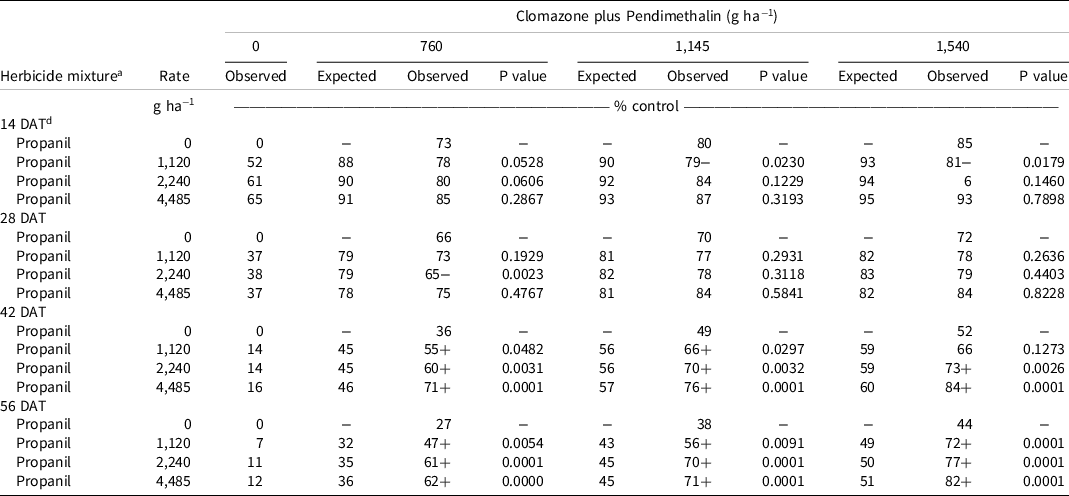
At 14 DAT, antagonism occurred for barnyardgrass control when it was treated with clomazone plus pendimethalin applied at 1,145 and 1,540 g ha−1 mixed with 1,120 g ha−1 of propanil, with an observed control of 79% and 81%, respectively, compared with an expected control of 90% and 93%, respectively (Table 2). However, these same mixtures were synergistic at 56 DAT. A synergistic response occurred when barnyardgrass was treated with 2,240 and 4,485 g ha−1 of propanil mixed with any rate of clomazone plus pendimethalin at 42 and 56 DAT. These data suggest that mixing a prepackaged mixture of clomazone plus pendimethalin with propanil will increase barnyardgrass control later in the growing season compared with applying the herbicides individually. This increase in control is likely due to the residual activity of both clomazone and pendimethalin that provides extended suppression of barnyardgrass after the initial application. Similar results of synergism were observed for barnyardgrass control when propanil was mixed with imazethapyr or imazamox (Fish et al. Reference Fish, Webster, Blouin and Bond2016; Webster et al. Reference Webster, Telo, Blouin and McKnight2017).
Barnyardgrass control and interactions with various rates of a prepackaged mixture of clomazone plus pendimethalin mixed with various rates of propanil using Blouin’s modified Colby’s analysis, 2017 and 2018.b,c

a Evaluation dates for each respective herbicide mixture.
b Observed means followed by a plus (+) are significantly different from Blouin’s modified Colby’s expected responses at the 5% level indicating a synergistic response. A minus (−) indicates an antagonistic response. No sign indicates a neutral response.
c P < 0.05 indicates antagonistic or synergistic response, P > 0.05 indicates an additive response.
d Abbreviation: DAT, days after treatment.
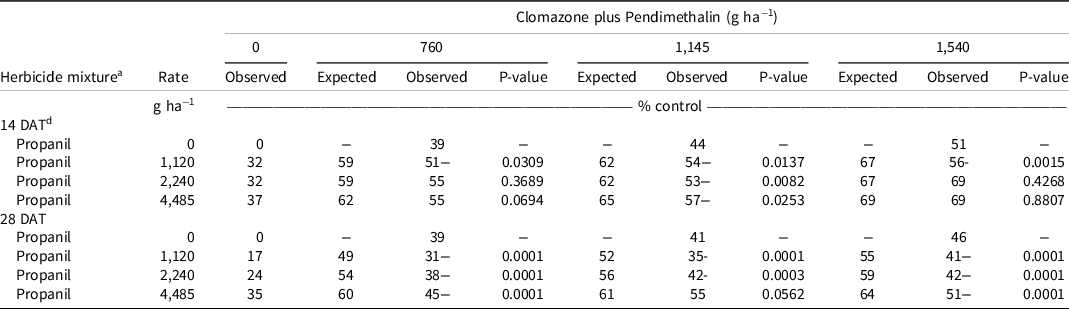
At 14 DAT, antagonism occurred for yellow nutsedge when treated with 760, 1,145, or 1,540 g ha−1 of clomazone plus pendimethalin mixed with 1,120 g ha−1 of propanil with an observed control of 51%, 54%, and 56%, respectively, compared with the expected control of 59%, 62%, and 67%, respectively (Table 3). An antagonistic response occurred for yellow nutsedge control when treated with clomazone plus pendimethalin applied at 1,145 g ha−1 mixed with all rates of propanil. At 28 DAT, antagonism occurred for yellow nutsedge control across all herbicide mixtures except when 1,145 g ha−1 of clomazone plus pendimethalin was mixed with the high rate of propanil applied at 4,485 g ha−1, which resulted in a neutral response. In order to control the yellow nutsedge population and obtain yield data, a standard uniform treatment of halosulfuron applied at 53 g ha−1 was applied over the entire test area at 35 DAT.
Yellow nutsedge control and interactions with various rates of a prepackaged mixture of clomazone and pendimethalin mixed with various rates of propanil using Blouin’s modified Colby’s analysis, 2017 and 2018.b,c

a Evaluation dates for each respective herbicide mixture.
b Observed means followed by a plus (+) are significantly different from Blouin’s modified Colby’s expected responses at the 5% level indicating a synergistic response. A minus (−) indicates an antagonistic response. No sign indicates a neutral response.
c P < 0.05 indicates antagonistic or synergistic response, P > 0.05 indicates an additive response.
d Abbreviation: DAT, days after treatment−
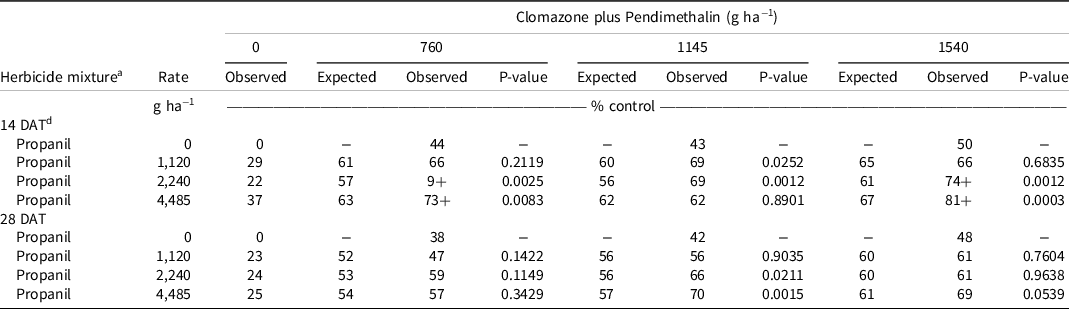
At 14 DAT, synergism occurred for rice flatsedge control when treated with clomazone plus pendimethalin applied at 760 g ha−1 mixed with propanil at either 2,240 or 4,485 g ha−1, with an observed control of 69% and 73% compared with an expected control of 57% and 63%, respectively (Table 4.). Synergism also occurred at 14 DAT when clomazone plus pendimethalin applied at 1,540 g ha−1 was mixed with propanil applied at either 2,240 or 4,485 g ha−1, with an observed control of 74% and 81% compared with an expected control of 61% and 67%. All other herbicide mixtures produced a neutral interaction at 14 and 28 DAT. At 14 DAT, the synergism that occurred may have been due to the higher rates of propanil causing more necrosis on the rice flatsedge leaves. Those same herbicide mixtures that were synergistic at 14 DAT were neutral at 28 DAT.
Rice flatsedge control and interactions with various rates of a prepackaged mixture of clomazone and pendimethalin mixed with various rates of propanil using Blouin’s modified Colby’s analysis, 2017 and 2018.b,c

a Evaluation dates for each respective herbicide mixture.
b Observed means followed by a plus (+) are significantly different from Blouin’s modified Colby’s expected responses at the 5% level indicating a synergistic response. A minus (−) indicates an antagonistic response. No sign indicates a neutral response.
c P < 0.05 indicates antagonistic or synergistic response, P > 0.05 indicates an additive response.
d Abbreviation: DAT, days after treatment
At 14 DAT, rice crop injury was 10% to 15% regardless of the herbicide mixture applied, and injury was less than 5% at 28 DAT through 56 DAT (data not shown). A main effect for propanil rate occurred for rice plant height (Table 5). Rice treated with either 1,120, 2,240, or 4,485 g ha−1 of propanil resulted in heights of 98, 100, and 100 cm, respectively, which was taller than the nontreated rice at 86 cm.
Rough rice yield when treated with different rates of clomazone plus pendimethalin mixed with different rates of propanil and rice plant height when treated with different rates of propanil, 2017 and 2018.b,c

a Respective herbicide mixtures.
b Means followed by a common letter are not significantly different at P = 0.05 with the use of Fisher’s protected LSD.
c Plant height with propanil rate main effect, data averaged over clomazone plus pendimethalin rate.
A clomazone plus pendimethalin rate by propanil rate interaction occurred for rice yield. Rough rice yield was 4,560, 5,360, and 5,350 kg ha−1 when treated with 1,540 g ha−1 of clomazone plus pendimethalin mixed with 1,120, 2,240, and 4,485 g ha−1 of propanil, respectively (Table 5.). Similarly, rice treated with 760 and 1,145 g ha−1 of clomazone plus pendimethalin mixed with the high rate of propanil applied at 4,485 g ha−1 yielded 4,660 and 4,800 kg ha−1, respectively. These mixtures were also neutral or synergistic at each visual evaluation for barnyardgrass control compared with the herbicides applied alone (Table 2.). The rough rice yield data indicate that the synergism at 42 DAT and 56 DAT of clomazone plus pendimethalin mixed with propanil in a postemergence timing on barnyardgrass resulted in the corresponding rough rice yield increase.
In conclusion, the addition of a prepackaged mixture of clomazone plus pendimethalin mixed with propanil is synergistic for control of barnyardgrass. These results are similar to reports by other researchers who noted increased control of barnyardgrass with propanil-containing herbicides mixed with other residual herbicides labeled for use in rice (Carlson et al. Reference Carlson, Webster, Salassi, Hensley and Blouin2011, Reference Carlson, Webster, Salassi, Bond, Hensley and Blouin2012; Fish et al. Reference Fish, Webster, Blouin and Bond2015, Reference Fish, Webster, Blouin and Bond2016; Pellerin et al. Reference Pellerin, Webster, Zhang and Blouin2003; Webster et al Reference Webster, Telo, Blouin and McKnight2017) Applying residual herbicides like clomazone plus pendimethalin along with the POST herbicide propanil offers producers the ability to control small emerged grasses while providing extended control later in the growing season with the residual combination. If a second POST application is needed later in the season, the synergistic control from the prepackaged mixture of clomazone plus pendimethalin mixed with propanil could potentially decrease the weed pressure present at the second POST application. An added benefit of applying multiple herbicide modes of action per individual application will help prevent or reduce the development of herbicide-resistant weeds, which can be part of an overall herbicide resistance management strategy (Norsworthy et al. Reference Norsworthy, Ward, Shaw, Llewellyn, Nichols, Webster, Bardley, Frisvold, Powles, Burgos, Witt and Barrett2012).
Acknowledgments
Published with the approval of the Director of the Louisiana Agricultural Experiment Station and the Louisiana State University Agricultural Center, Baton Rouge, Louisiana, under manuscript number 2020-306-34925. We thank staff members of the Louisiana State University Agricultural Center’s H. Rouse Caffey Rice Research Station. Louisiana Rice Research Board provided partial funding for this project. No conflicts of interest have been declared.