

Introduction
Later prehistoric research in Island South-east Asia is in transition. The orthodox and dominant model which views change in the past as unidirectional and externally driven: first by rice farmers from China via Taiwan and then the Philippines 4000 years ago; and then by the spread of iron tools and exotic goods from India and China 2000 bp (Bellwood Reference Bellwood1997) cannot easily accommodate increasing archaeological, palaeoenvironmental, and genetic data which demonstrate that people, material culture, and economic resources followed multiple historical trajectories (Barker & Janowski Reference Barker and Janowski2011; Denham Reference Denham2004; Larson et al. Reference Larson, Cucchi, Masakatsu, Matisoo-Smith, Robins, Anderson, Rolett, Spriggs, Dolman, Kim, Thuy, Randi, Doherty, Due, Bollt, Djubiantono, Griffin, Intoh, Keane, Kirch, Li, Morwood, Pedrina, Piper, Rabett, Schooter, Bergh, West, Wickler, Yuan, Cooper and Dobney2007; O'Connor Reference O'Connor2006; Soares et al. Reference Soares, Trejaut, Loo, Hill, Mormima, Lee, Chen, Hudjashov, Forster, Macaulay, Bulbeck, Oppenheimer, Lin and Richards2008). Not detracting from the value of Bellwood's original regional synthesis, it was by necessity based on research that was pioneering in design and constructed on widely dispersed data retrieved from small test-pits. This situation, though, is perpetuated as research continues to target the recovery and analysis of increasingly small sized data, with little consideration given to the social and historical context of where the material was found. What has become apparent, though, is that the forces driving the changes in material culture, economies, and burial practice, which swept across the region during the Neolithic were multiple combinations of external (‘immigrant’) and internal (‘local’) influences (Barker et al. Reference Barker, Lloyd-Smith, Barton, Cole, Hunt, Piper, Rabett, Paz and Szabó2011; Higham et al. Reference Higham, Guangmao and Qiang2011).
The question is, where do we go, theoretically and methodologically, from here? Matthew Spriggs (Reference Spriggs2011) has pointed out that part of the problem lies in the fact that not only are there very few Neolithic sites (20+ cave sites and 17 open sites) south of Taiwan (an area comparable in size to Western Europe), but they are often highly disturbed and have poor stratigraphic and chronological parameters. The result is a flattening of assemblages (and I would add the economic and ritual practices that produced them) which span several centuries, followed by comparisons of sites that are often separated in time by half a millennium or more. The current conventional chronology for the Neolithic and Early Metal Age of Island South-east Asia commences c. 2000 bc with Neolithic open sites in the northern Philippines (Hung et al. Reference Hung, Carson, Bellwood, Campos, Piper, Dizon, Bolunia, Oxenham and Chi2011), followed by a cluster of accepted dates starting around 1500 bc from the southern Philippines, Borneo, and eastern Indonesia (Spriggs Reference Spriggs2003). While mainland South-east Asia has a chronologically distinct Bronze Age c. 1000 bc, followed by the start of the Iron Age c. 500 bc (Higham & Higham Reference Higham and Higham2009), it has been thought that both metals reached the island region together c. 500–200 bc (Bellwood Reference Bellwood1997). However, a new date from Niah Cave, discussed below, shows that bronze artefacts had made their appearance sometime between 800 bc and 500 bc.
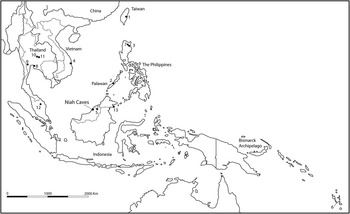
To begin to get to grips with change in the past we need to approach archaeological sites and assemblages in more fine-grained historical terms. To identify and track changes in material culture, economies, and ritual practice requires high resolution temporal and spatial data. The later prehistoric site in the West Mouth of Niah Cave, Sarawak (Fig. 1) now offers both these possibilities. Extensive excavations in the 1950s and 1960s uncovered the largest Neolithic cemetery in the region with over 160 burials, and a large ceramic assemblage (B. Harrisson Reference Harrisson1967). Below the Neolithic strata, excavations to a depth of over 2 m revealed a sequence of human occupation and burial spanning over 40,000 years (T. Harrisson Reference Harrisson1957; Reference Harrisson1958; Reference Harrisson1959). Between 2000 and 2004 the site was the focus of the work of the Niah Caves Project (NCP, directed by Graeme Barker) to investigate Late Pleistocene hunting and gathering strategies in a rainforest environment, and the subsequent Neolithic transition. An early account of the NCP was presented in this journal (Barker et al. Reference Barker, Barton, Beavitt, Bird, Daly, Doherty, Gilbertson, Hunt, Krigbaum, Lewis, Manser, McClaren, Paz, Pipper, Pyatt, Rabett, Reynolds, Rose, Rushworth and Stephens2002a). Ten years on the final syntheses are complete (Barker Reference Barker2013), and include a comprehensive presentation of the Neolithic archaeology and discussion of its regional significance (Lloyd-Smith et al. Reference Lloyd-Smith, Daly, Krigbaum, Barton, Cole, Hunt, Manser and Reynolds2013). The purpose of this present paper is to further lay the foundations for a new socio-historical Neolithic archaeology of Island South-east Asia by providing a detailed account of its richest data set: the West Mouth Neolithic cemetery.
Map of South-east Asia and the western Pacific with areas and locations of sites mentioned in the text indicated. 1. Fengtian jade source; 2. Tabon Caves; 3. Arku Cave; 4. Sa-Hyunh sites; 5. Lobang Angin; 6. Teouma; 7. Nagsabaran; 8. Khok Phanom Di; 9. Ban Kao; 10. Ban Non Wat; 11. Ban Lum Khao; 12. Gua Cha; 13. Bukit Tengkorak (illustration: L. Lloyd-Smith)

Earlier discussion of the West Mouth Neolithic cemetery (eg, Bellwood Reference Bellwood1997, 240–1) was based upon the original classification (B. Harrisson Reference Harrisson1967). While the 1967 classification is a thorough and commendable paper, further interpretation of Neolithic burial practice was restricted by what was seen as the poor controls on the original excavations and the unreliability of the radiocarbon dates. In tackling these problems, this paper builds upon the author's first-hand excavation in the cemetery (Barker et al. Reference Barker, Badang, Barton, Beavitt, Bird, Daly, Doherty, Gilbertson, Glover, Hunt, Manser, McLaren, Paz, Pyatt, Reynolds, Rose, Rushworth and Stephens2001; Reference Barker, Barton, Bird, Cole, Daly, Gilbertson, Hunt, Krigbaum, Lampert, Lewis, Lloyd-Smith, Manser, Menotti, Paz, Piper, Pyatt, Rabett, Reynolds, Stephens, Thompson, Trickett and Whittaker2002b; Reference Barker, Barton, Bird, Cole, Daly, Dykes, Gilbertson, Hunt, Lewis, Lloyd-Smith, Manser, McLaren, Menotti, Paz, Piper, Pyatt, Rabett, Reynolds, Stephens, Thompson and Trickett2003). When these results were checked against the original excavation archive the richness and potential of the Niah Neolithic funerary archaeology became apparent. Armed with these data and over 40 new radiocarbon dates from burial contexts, the result is the first comprehensive examination of the spatial and temporal development of the largest Neolithic cemetery in South-east Asia.
Following a brief introduction to the Niah Caves, their Neolithic archaeology and environmental data, the characteristics of Neolithic mortuary practice and cemetery are described. The problems in radiocarbon dating are discussed and after an evaluation of all dates a six-phase chronology spanning 1500–200 bc is proposed. Radiocarbon dates are calibrated to 95.4% confidence using the OxCal 4.1 programme and presented in bc/ad convention. The core of this paper is a step-by-step account of the history of the West Mouth Neolithic cemetery, in which the ritual processes that lay at the heart of the transitions in burial practice are identified and discussed. In the concluding section key aspects of the new chronology are drawn upon to consider wider implications for how archaeological sites and assemblages in Island South-east may, in the future, be conceived of and investigated to build richer interpretations.
The Niah Caves
The Niah Caves are a series of massive interconnected caverns and smaller caves located in a limestone massif about 15 km from the north Borneo coast (E. 113° 45′ 160.9′′/N. 3° 48′ 10.19′′). The roughly circular massif is 4 km in diameter and its highest peak (Gunung Subis) is 396 m above sea level. Weathering and erosion have created a dramatic karst scenery of vertical cliffs rising up to narrow plateaus which are separated by deep gorges (Wall Reference Wall1967). The surrounding area comprises undulating marl deposits. The contrast between the high, well-drained, limestone massif and the surrounding low-lying and poorly-drained swampland is reflected in the vegetation of the area (Hazenbroek & Morshidi Reference Hazenbroek and Abang Morshidi2000). The cliff edges and peaks of Gunung Subis have arid tolerant plants and succulents. The surrounding low-lying land is covered in dipterocarp rainforest along its higher drier ridges, with swamp-forest covering the areas in between.
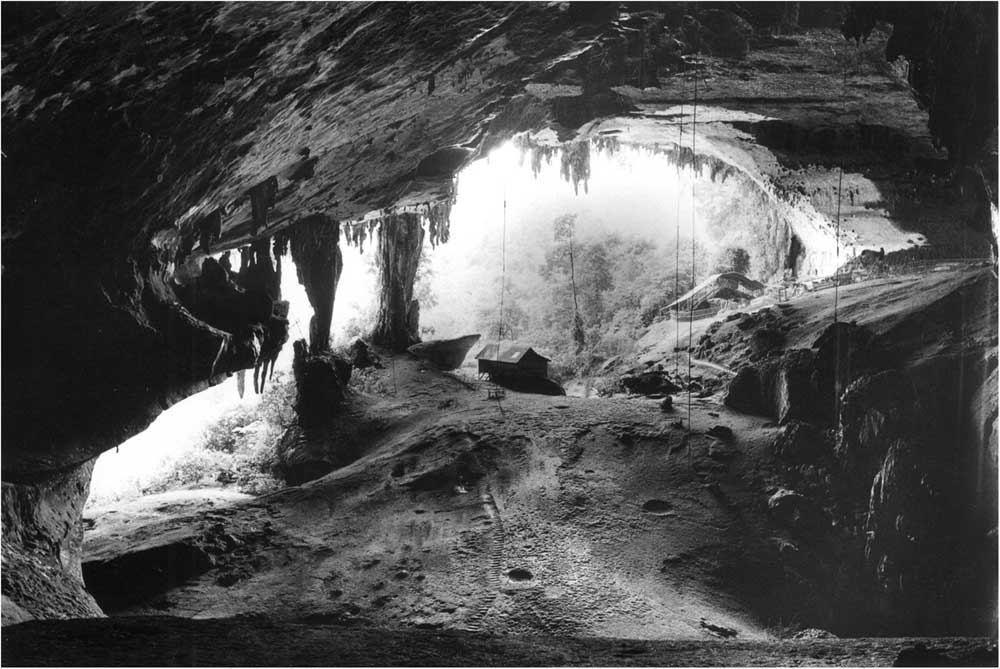
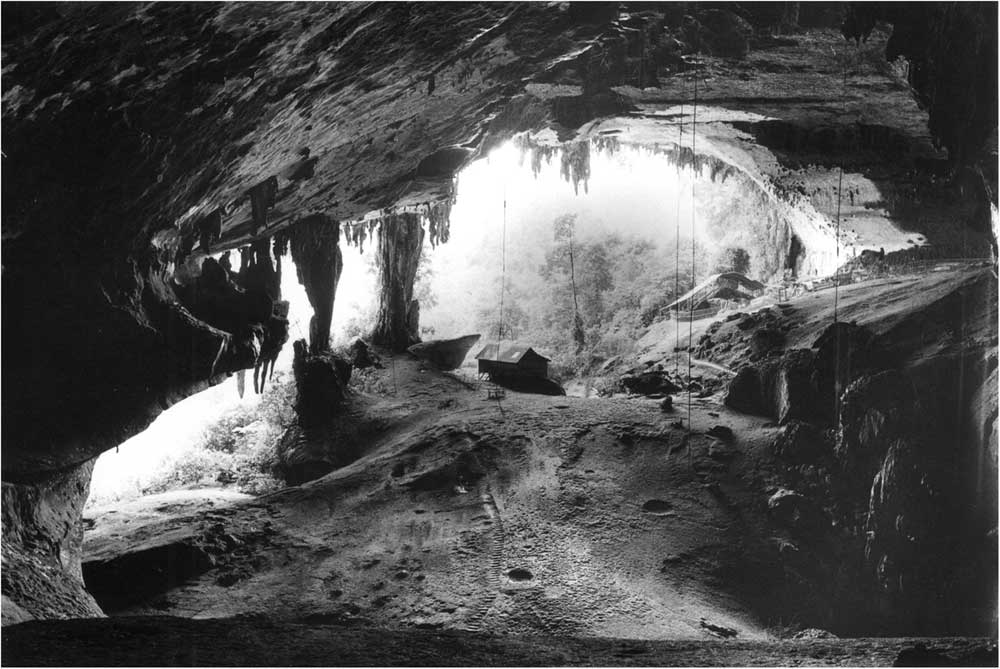
The largest cave system in the massif is an interconnected system of cave passages, chambers, and cave mouths, within a block of limestone, 100 m out from the north-eastern corner of the larger massif. This gigantic cave system is called the Niah Cave Complex; the largest opening of which is the West Mouth. The West Mouth is approximately 160.4 ft (c. 50 m) above sea level (Jee Reference Jee1959) and measures 160 m wide and approximately 60 m high (Fig. 2). The cave entrance is formed by the convergence of two large cave passages, northern and southern. The northern area, where the Neolithic cemetery is located, is formed of a rising pile of guano which provides easy access into the inner system of cave chambers and passages which emerge at five other cave mouths.
The West Mouth of Niah Cave, looking north-west. The Neolithic cemetery is located in the top right of the picture, adjacent to the cave wall and behind the fencing protecting the archaeological site. (photograph: G. Barker)
Neolithic archaeology and environment
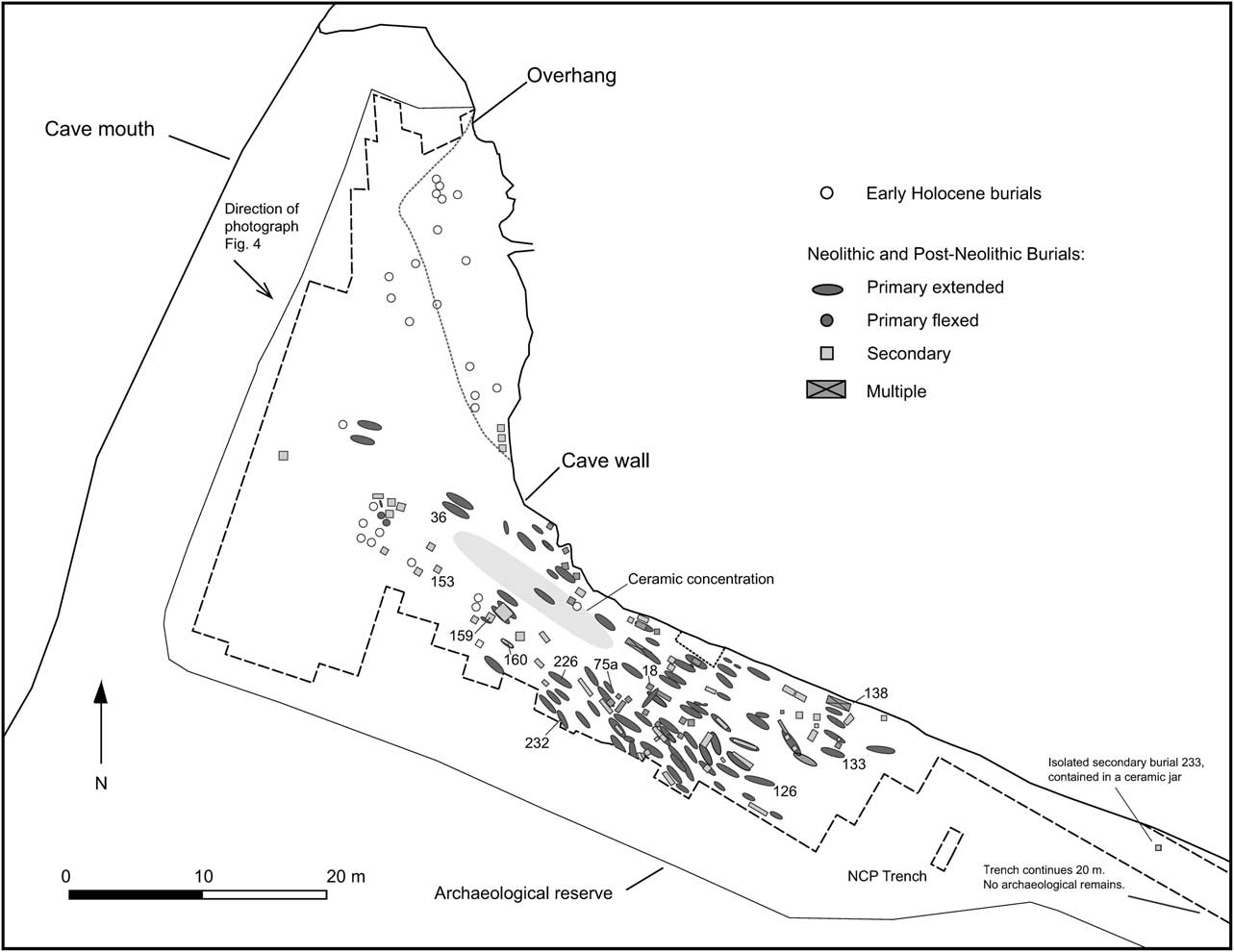
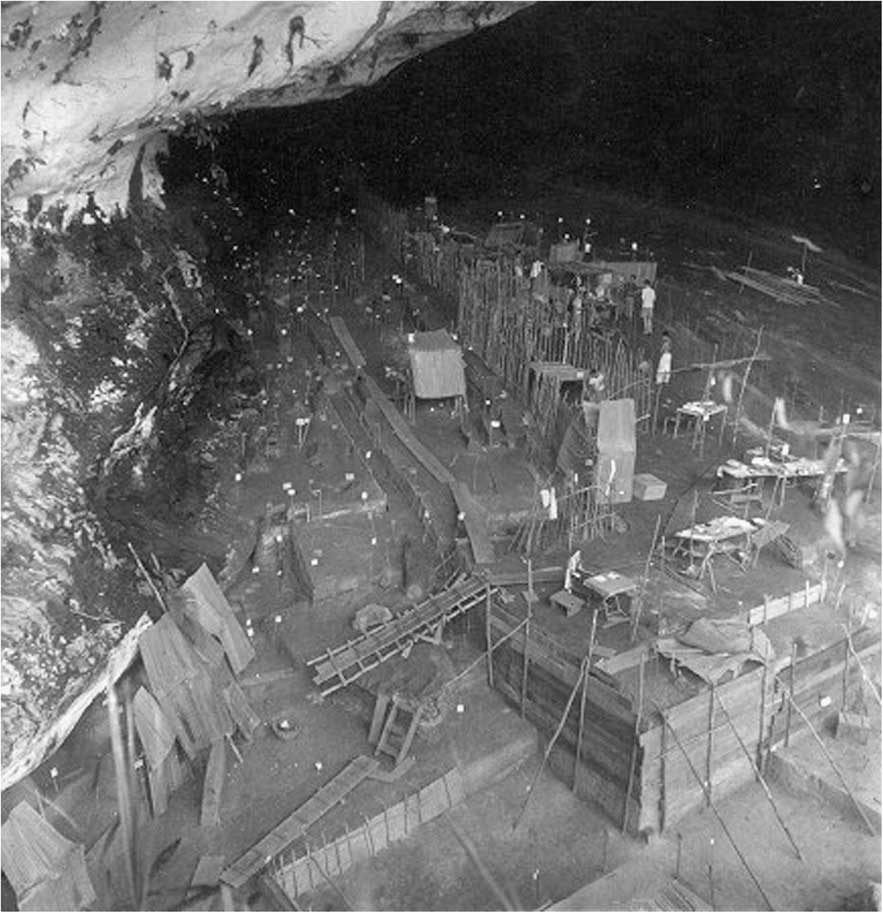
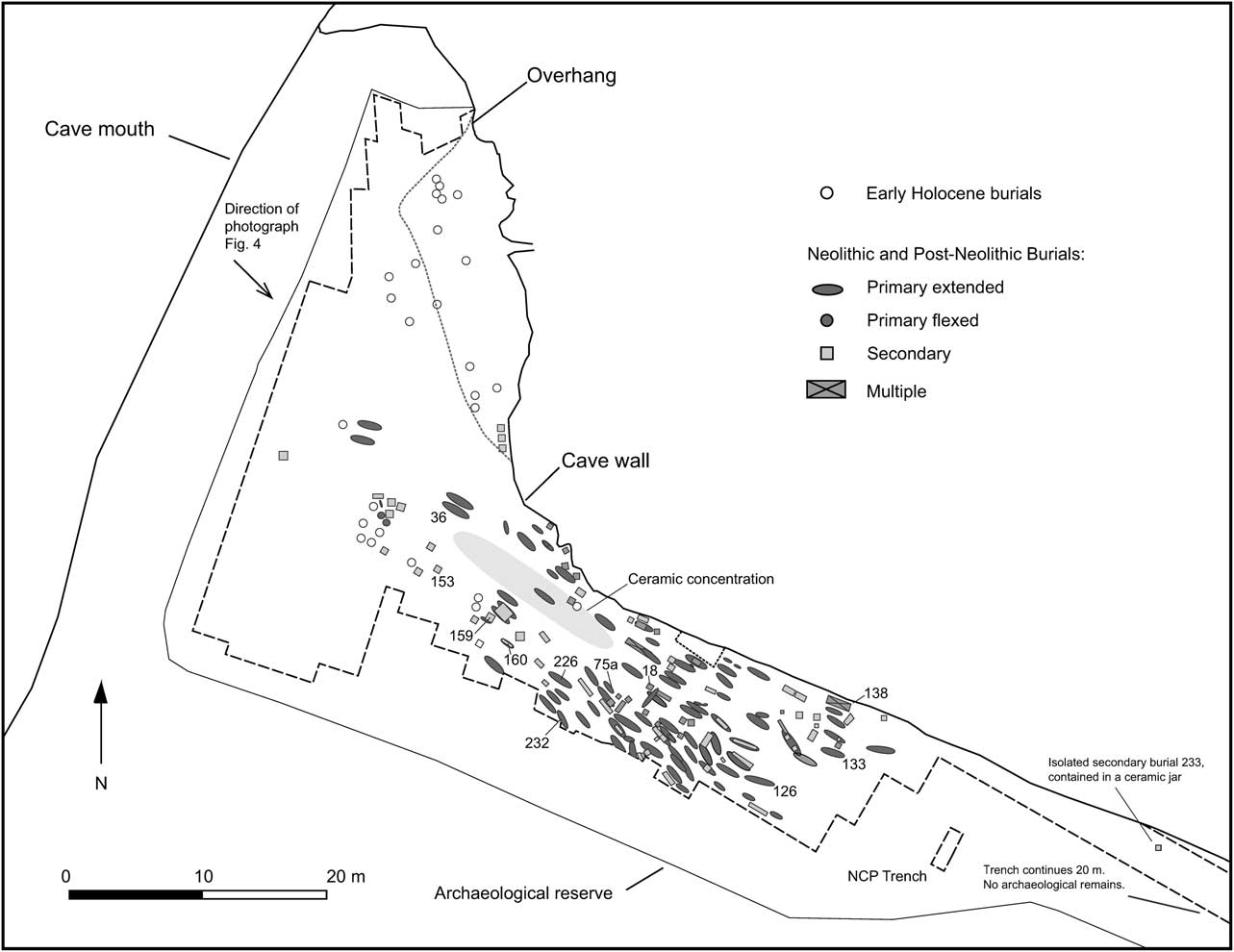
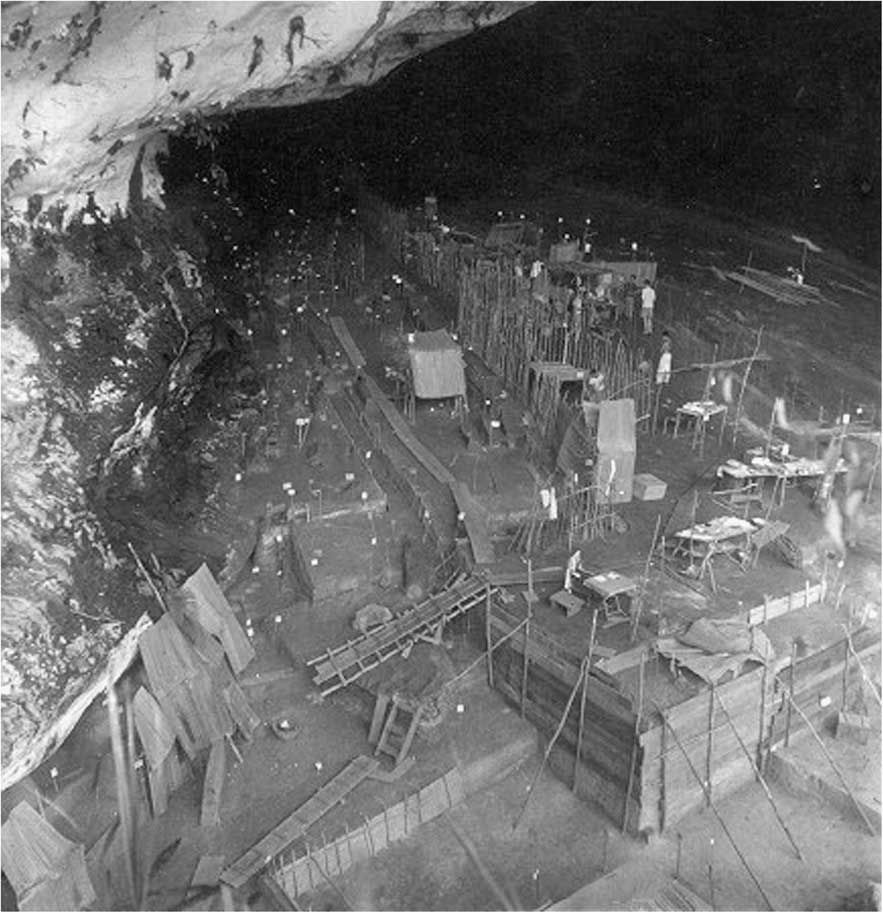
Excavations at numerous caves sites in the 1950s and '60s revealed a long sequence of Pleistocene and Holocene occupation and burial dated from around 40,000 years ago to the present (B. Harrisson Reference Harrisson1967; T. Harrisson Reference Harrisson1957; Reference Harrisson1958; Reference Harrisson1959). The discoveries in the most intensively investigated entrance, the West Mouth, included 25 human burials dating to the Early Holocene, and over 160 Neolithic burials, comprising respectively the largest Mesolithic and Neolithic cemeteries in Island South-east Asia (Figs 3, 4). The programme of renewed fieldwork by the NCP, augmented by an extensive re-dating and archival study, has been able to successfully reconstruct the stratigraphy and occupation history of the site (Barker Reference Barker2013).
Plan of the archaeological site in the West Mouth of Niah Cave showing locations of the later prehistoric burials, the main concentration of the ceramic assemblage, and burials discussed in the introductory sections of the paper (illustration: L. Lloyd-Smith)
Excavation in the Neolithic cemetery in 1965. The cemetery started behind the slanting walkway in the middle of the picture. The positions of burials were marked by white flags (photograph courtesy of the Sarawak Museum)
Taking the presence of charcoal as a proxy for human activity in the cave, the new dates suggests that the Early Holocene use of the West Mouth (c. 10,000–6000 bc) was followed by a gap of some 4000 years (Krigbaum Reference Krigbaum2001; Lloyd-Smith Reference Lloyd-Smith2009, Reference Lloyd-Smith2013). The hiatus in cave use between 6000 and 2000 bc coincides with the mid-Holocene high sea stand identified in two pollen cores taken near the caves which have dark bluish–grey laminated clays at the bottom indicative of tidal mangrove swamps (Hunt & Rushworth Reference Hunt and Rushworth2005). At a transition dated to 5710 ± 80 bp or 4721–4367 cal. bc (Beta-193909) in one core and to 5160 ± 60 bp or 4225–3793 cal. bc (Beta-193910) in the other, these pass into dark brown peaty clays and then into dark brown wood peat, indicative of less saline environments characterised by back mangrove swamp. The more open vegetation that then developed around the caves was associated with repeated evidence for localised burning suggestive of human clearance activities (Hunt & Rushworth Reference Hunt and Rushworth2005).
From inside the cave, fragments of domesticated rice have been found as incidental inclusions in earthenware, dated by optically stimulated luminescence to between 1000 bc and ad 200 (Doherty et al. Reference Doherty, Beavitt and Kurui2000). Other archaeobotanical and archaeozoological data from Niah Cave securely associated with the Neolithic phase are sparse. Deposits excavated by the NCP did not contain the remains of any domesticated plant species (Reference Barton, Victor and CarlosBarton et al. forthcoming). This reinforces the impression that during the Neolithic the cave was not used for habitation or food preparation, but was solely reserved as a place for the burial of the dead.
Artefacts obtained from the cemetery area included a substantial quantity of earthenware (over 18,000 sherds, weighing nearly 200 kg; Reference Cole and DalyCole & Daly forthcoming), and an unknown number of whole and fragmented polished stone adzes. Very little of the ceramic assemblage was found in direct association with burials. Only one extended burial is definitely associated with a complete vessel. Twelve burials were contained in earthenware vessels (Lloyd-Smith & Cole Reference Lloyd-Smith and Cole2010). The distribution of sherds appears to be concentrated in an area with very few burials, just to the north-west, towards the cave mouth, of the cemetery. Edge abrasion of the sherds is minimal and there are few use-wear signatures, such as burning or residues, indicative of domestic usage indicating that vast majority of the ceramic assemblage is related to funerary practices (Cole Reference Cole2007). Small vessel forms include open bowls, globular ‘cooking-pots’, bottles, and carinated pots. Medium and large vessel forms include ‘cooking’ and ‘storage’-type vessels, funnel-necked vessels with globular bases, and the unusual double-spouted and three-colour-ware vessels for which Niah has become renowned (Reference Cole and DalyCole & Daly forthcoming; T. Harrisson Reference Harrisson1971; Solheim et al. Reference Solheim, Harrisson and Wall1959).
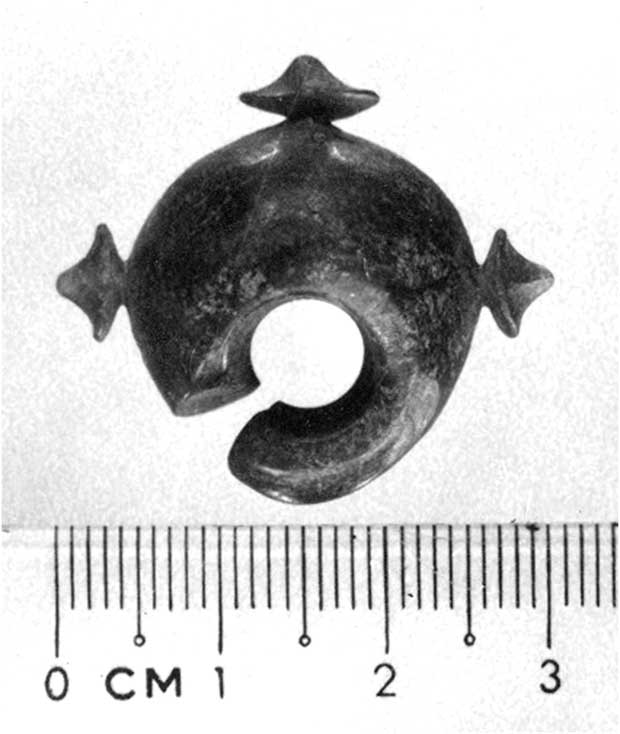
One noteworthy artefact discovered in the 1977 excavations is a ling-ling-o jade pendant found ‘close to a group of [ceramic] sherds about 7” above a body in grid MD3’ (Fig. 5; Zuraina Majid Reference Zuraina1982, 46). This probably overlay burial B226. Mineralogical analysis identified the jade as comparable to that from a major deposit at Fengtian on eastern Taiwan, c. 2500 km from Niah (Iizuka et al. Reference Iizuka, Bellwood, Datan and Hung2005). Similar pendants have been found in Late Neolithic and Early Metal Age contexts at Tabon Caves on Palawan (Fox Reference Fox1970), Arku Cave on Luzon (Thiel Reference Thiel1990), and many Sa-Huynh sites in southern Vietnam where they are dated to 500–0 bc (Iizuka et al. Reference Iizuka, Bellwood, Datan and Hung2005, 27). The Niah Cave example is the only one yet found on Borneo.
Jade ling-ling-o pendant found c. 6 in (15 cm) above extended burial B226 (photograph courtesy of the Sarawak Museum)
Physical anthropological data
Morphometric analysis of 15 Early Holocene and 28 Neolithic burials indicates that, although separated by several thousand years, the two populations were fundamentally of the same physical type, with no statistical differences in the upper and mid-face datasets (Manser Reference Manser2005). A significant reduction in the size of the teeth in the Neolithic skeletons compared with those of the Early Holocene was interpreted in terms of dietary change, possibly associated with changes in food preparation such as new methods of cooking foods in ceramic vessels.
In terms of inferred diet, light isotopic analysis indicates broad changes between the Early Holocene and Neolithic populations (Krigbaum Reference Krigbaum2001; Reference Krigbaum and Manser2005). A shift to less negative δ13C values in Neolithic burials is taken as indicating that the majority of the diet came from horticultural/agricultural practices in open environments (Krigbaum Reference Krigbaum2005, 83–4). This correlates well with the pollen and sedimentary data from outside the cave (Hunt & Rushworth Reference Hunt and Rushworth2005). At the same time, the Neolithic cemetery population as a whole exhibits a wide range of δ13C values and a degree of heterogeneity which suggests a range of dietary regimes, including hunting and gathering, were important (Krigbaum Reference Krigbaum2005, 84). Krigbaum's study employed the original classification of burial types and although reclassification (see below) does not alter the overall conclusions, the new detailed chronology of the Neolithic cemetery illuminates important temporal and spatial patterning in inferred dietary regimes and possible correlations to mortuary practice which are discussed below.
An analysis of strontium and lead isotopes from 34 burials in the Neolithic cemetery identified clusters of isotopic ratios interpreted as different dietary catchments (Valentine et al. Reference Valentine, Kamenov and Krigbaum2008). The strontium (87Sr/86Sr) distribution of the Niah samples is ‘heavily skewed with three peaks’ (Valentine et al. Reference Valentine, Kamenov and Krigbaum2008, 1469). The first and largest peak is comparable to the value of modern sea-water, and when plotted against the lead (206Pb/204Pb) ratios, sub-divides into two distinct, statistically significant, clusters which may represent two settlement areas with coastal/marine influenced dietary regimes. The two lower value strontium peaks may represent more inland dietary catchment areas.
Three of the West Mouth burials (B3, B36, and B160) had significantly different heavy isotopic ratios suggesting non-local origins for these individuals. The signature from an adult male in multiple secondary burial B160 was comparable to samples analysed from Metal Age burials at the site of Lobang Angin, an inland cave site located in the Mulu Caves c. 120 km to the north-east from Niah (Fig. 1). Similarities in distinctive double-spouted vessels and the three-colour-wares, found both at Niah and Lobang Angin (Datan Reference Datan1993; T. Harrisson Reference Harrisson1971; Solheim et al. Reference Solheim, Harrisson and Wall1959), support the possibility that the adult individual in B160 may have originated from the Mulu area (Valentine et al. Reference Valentine, Kamenov and Krigbaum2008).
Mortuary Practice
By the end of the 1967 season at Niah, 181 features allocated burial numbers had been recorded and fully excavated. The intention had been to return for one final season and complete the excavation of the cemetery, however, this never took place and 33 burials (all in the Neolithic cemetery) were left exposed in situ at the site. In the original classification seven burial types were defined by their ‘main physical outline’ (B. Harrisson Reference Harrisson1967, 132). These were: flexed, seated, mutilations, extended, multiple, and secondary burnt and cremated burials (as well as ‘disturbed and doubtful fragments’, ‘timber only’, and one ‘shell and stone offering’). Burial types were grouped into the Mesolithic (flexed, seated, and mutilations) or the Neolithic (extended, multiple, burnt, and cremated burials) depending on their location and depth. However, anomalies to such clean cut phasing were noted (B. Harrisson Reference Harrisson1967).
In 1977, 11 Neolithic burials were exposed (Zuraina Majid Reference Zuraina1982, 46), one of which, now allocated number B232, was lifted in 2004 (Zuraina Majid et al. Reference Zuraina, Lim, Arif, Samsuddin, Nizam, Zafarina and Norazmi2005). Most recently, 19 burials were investigated by the NCP, including seven already exposed; eight burials were completely lifted, the others were only partially exposed and were reburied (Barker et al. Reference Barker, Badang, Barton, Beavitt, Bird, Daly, Doherty, Gilbertson, Glover, Hunt, Manser, McLaren, Paz, Pyatt, Reynolds, Rose, Rushworth and Stephens2001; Reference Barker, Barton, Bird, Cole, Daly, Gilbertson, Hunt, Krigbaum, Lampert, Lewis, Lloyd-Smith, Manser, Menotti, Paz, Piper, Pyatt, Rabett, Reynolds, Stephens, Thompson, Trickett and Whittaker2002b; Reference Barker, Barton, Bird, Cole, Daly, Dykes, Gilbertson, Hunt, Lewis, Lloyd-Smith, Manser, McLaren, Menotti, Paz, Piper, Pyatt, Rabett, Reynolds, Stephens, Thompson and Trickett2003).
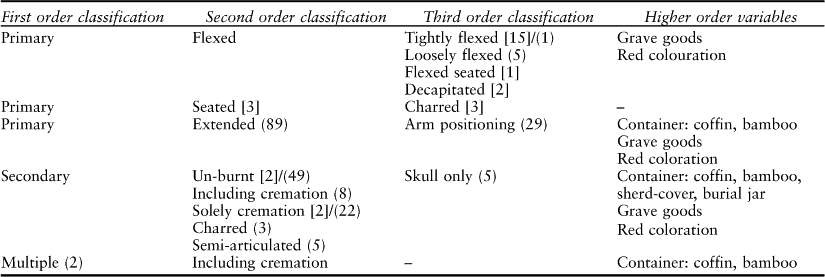
To investigate the spatial and stratigraphic anomalies in the original burial types, a refined classification hierarchically groups all burials from all periods by a number of variables (Table 1; Lloyd-Smith Reference Lloyd-Smith2011). The term ‘burial’ is taken as the deliberate discrete deposition of human remains. In the combined number series there are currently 262 allocated ‘burial’ numbers. After reassessing the burial data, documentary records and, where possible, the skeletal remains, 209 ‘proper’ burials were identified: 25 date to the Early Holocene (Lloyd-Smith Reference Lloyd-Smith2013) and 184 to the Neolithic or later. The main difference between the original and refined classifications is the dispensation of the term ‘mutilations’, which are now defined as types of secondary burial. Many of the ‘disturbed and doubtful fragments’ were also reclassified as proper burials.
Classification of burial types in the west mouth, niah cave
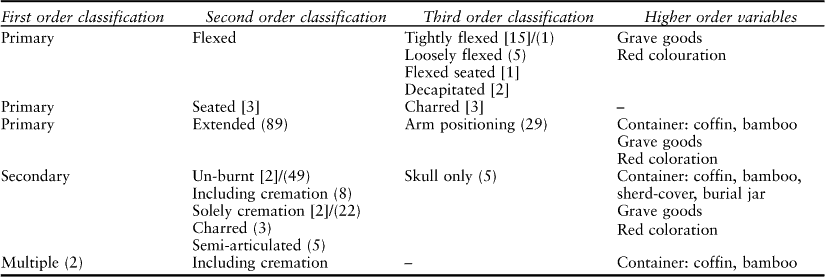
The numbers in square brackets denote Early Holocene burials; total 25. Curved brackets denote burials that date to the Neolithic (170) or Post-Neolithic (14); total 184. This includes all possible burials even when remains have not been relocated. The numbers after ‘Arm positioning, ‘Skull only’, and ‘Charred’ in the third order classification column denote sub-sets of burial types not independent numbers of burials
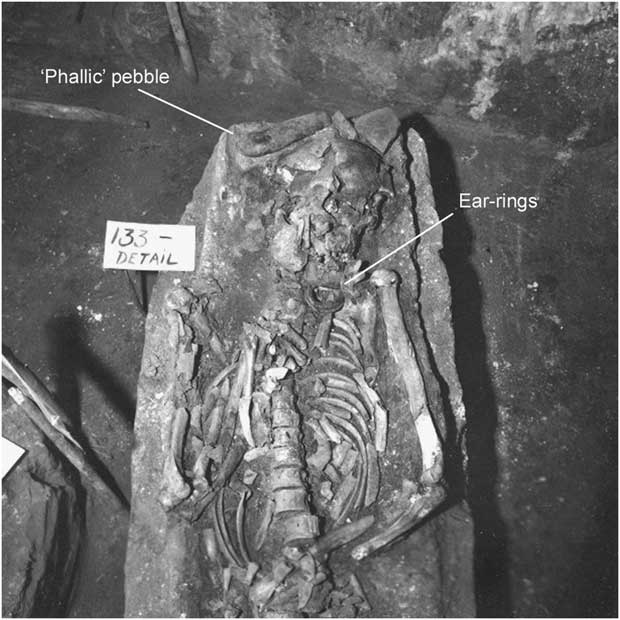
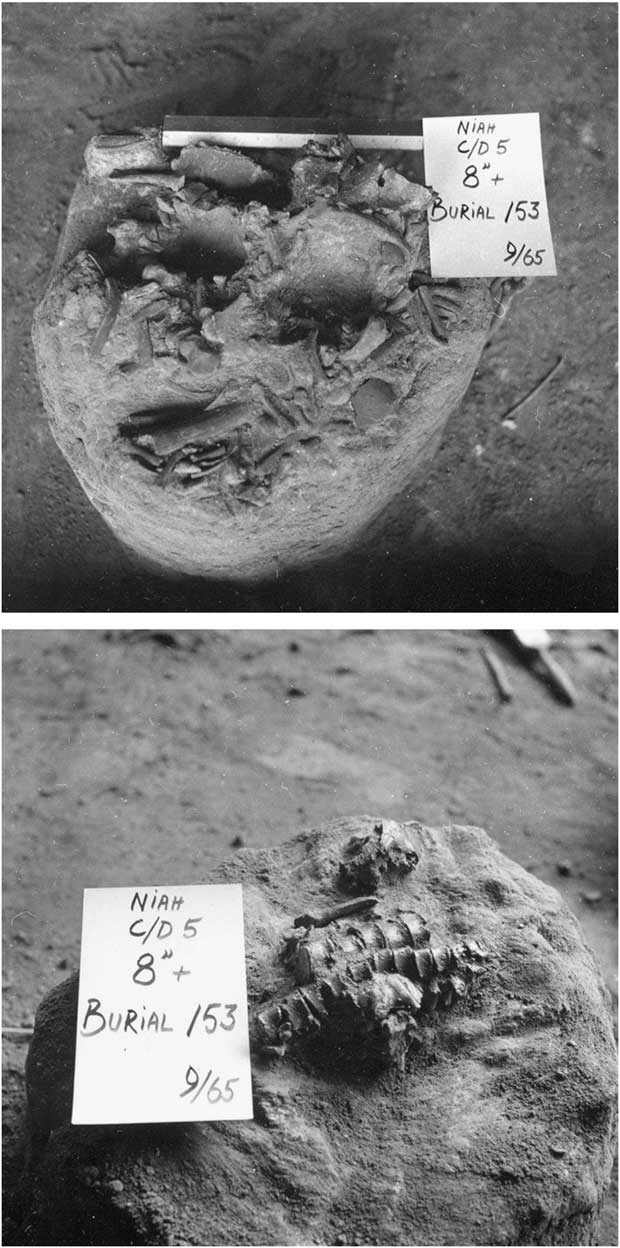
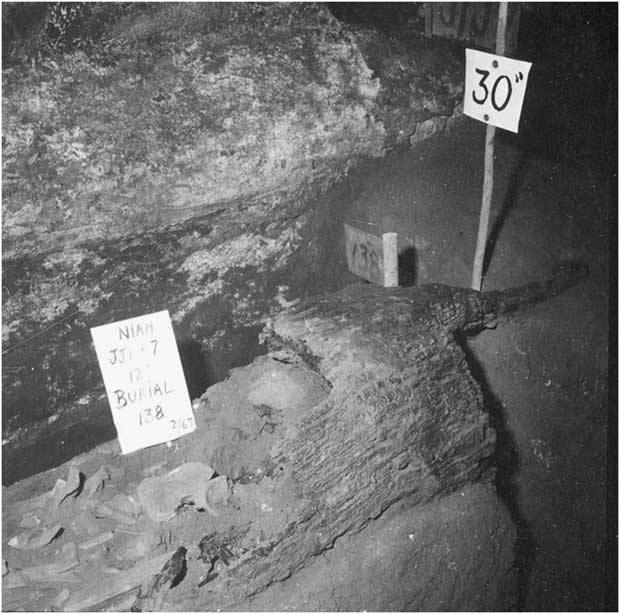
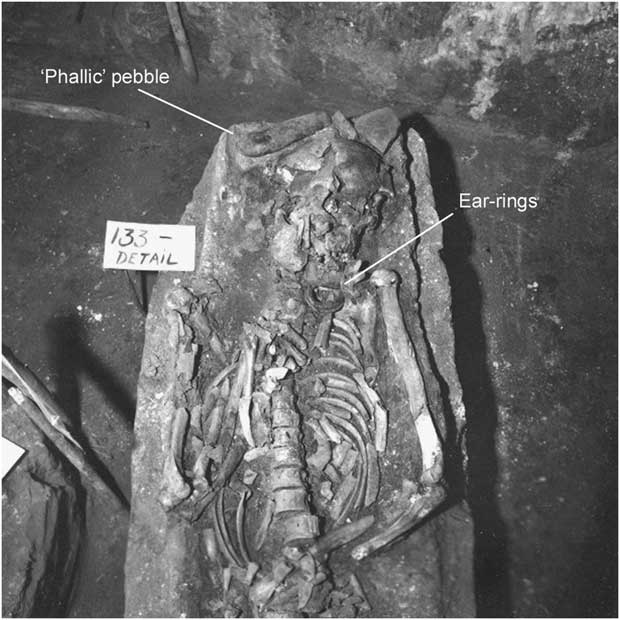
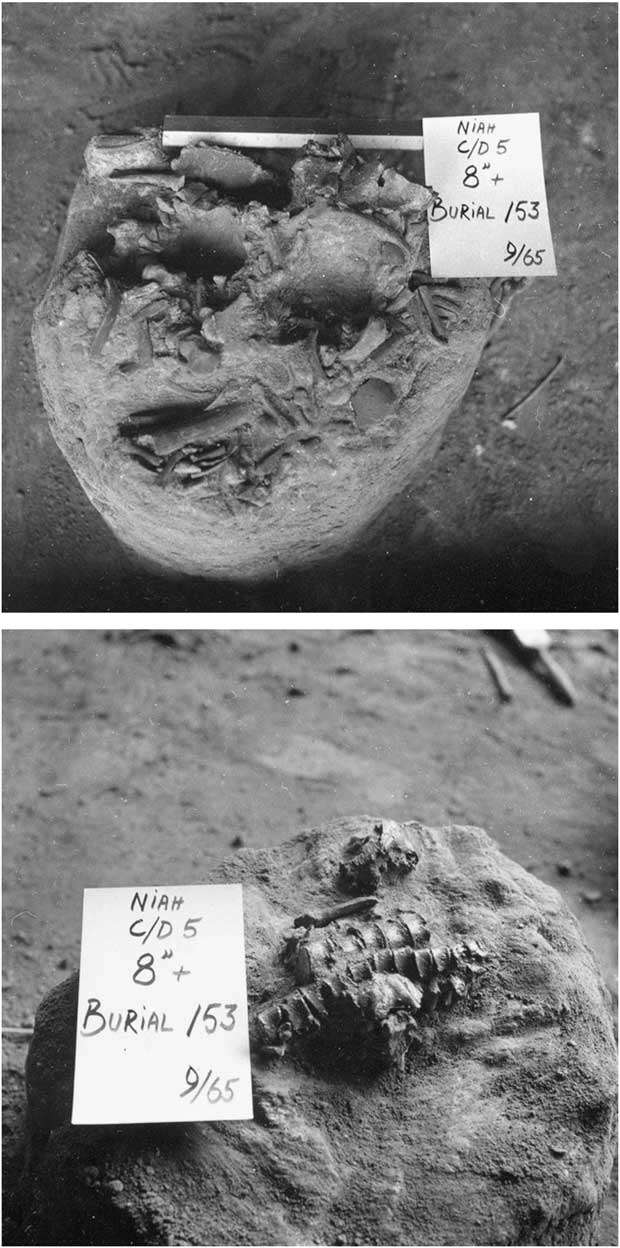
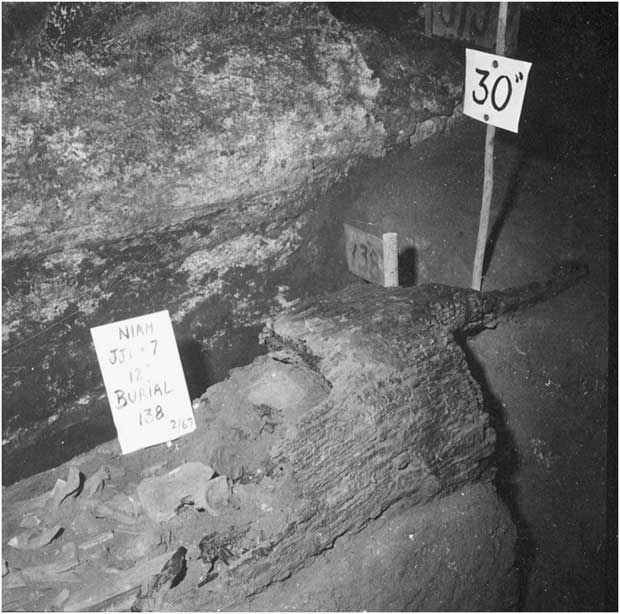
The first order distinction is between primary and secondary burial. Primary burial refers to a single stage funeral for the disposal of the dead, in this case by interment in the ground. Secondary burial implies the transformation of the body, for example through cremation or the exhumation and manipulation of the skeletal remains, followed by a final (secondary) burial. Second order variables include the positioning of primary burials (flexed or extended; Fig. 6) and whether secondary remains were unburnt, cremated, or a mix of semi-articulated and disarticulated remains (Fig. 7). Two oversized coffins, containing primary and secondary burials, retain their original designation as ‘multiple’ burials, as this is felt a useful defining character of these two unique burials (Fig. 8). Third order variables describe further physical manipulation of the burials, in particular the arrangement of the limbs of primary flexed and extended burials, and the selection of skeletal elements (skull) in some secondary burials.
Primary extended burial B133 with the right arm folded up and left hand over the pelvis (Arm Position D). A naturally shaped oval stone pounder, described by the original excavator as a ‘phallic’ pebble, lies above the head, and two shell or bone ear-rings lie next to left side of the chin (photograph courtesy of the Sarawak Museum)
Semi-articulated unburnt secondary burial B153. Above: the upper layer of disarticulated remains; below: the underlying articulated segments of the spinal column (photographs courtesy of the Sarawak Museum)
Log coffin with protruding handle containing multiple burial B138, comprising both primary and secondary burial remains (photograph courtesy of the Sarawak Museum)
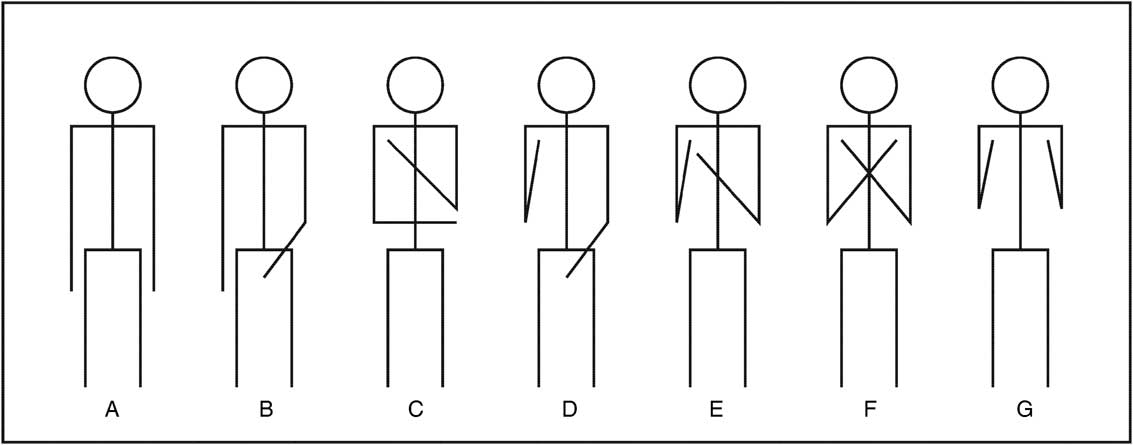
In a study of 18 extended burials, Brooks and Brooks (Reference Brooks and Brooks1968) noted they displayed a limited number of standardised arm positions which appeared to correlate with the sex of the individual. An expanded data set of 29 burials (28 adults, young-adults, or sub-adults, and one infant) broadly corroborates this observation (Lloyd-Smith Reference Lloyd-Smith2009, 130–6). Five arm positions (for both the right and left arm/hand) are recognised in burial terminologies (Sprague Reference Sprague2005, 99): extended parallel to the body; lower arm bent so the hand rests on the pelvic area; lower arm bent at 90° across the stomach; lower arm bent up diagonally across the chest area; and finally, where the arm is folded back so the hand rests on the same side shoulder. The number of combinations of right and left arm positions is therefore 25. In the West Mouth Neolithic cemetery 12 positions are present. The majority of extended burials displayed one of two symmetrical arm positions, either with both hands resting on their respective shoulders (Fig. 9; Position G), or crossed over the chest (Position F). Both these position were displayed equally by male and females. Three burials had both arms extended by the sides of the body (Position A): B75a was younger child; B36 was an adult female located at a distance from the main area of the cemetery towards the cave entrance; and B232, an adult male with congenitally missing radii bones resulting in malformed and shortened forearms (Zuraina Majid et al. Reference Zuraina, Lim, Arif, Samsuddin, Nizam, Zafarina and Norazmi2005). By pooling those positions (seven burials) where one hand rests over the pelvis into a single ‘hand-on-pelvis’ position, and another (five burials) where one arm is folded at 90° over the body, the number of ‘standardised’ positions, is reduced to six (Table 2). The ‘hand-on-pelvis’ position is displayed by five females, one sex unknown, and one male (B126) although here curiously holding a charred and notched stick (Brooks & Brooks Reference Brooks and Brooks1968, 70; B. Harrisson Reference Harrisson1967). The second non-symmetrical position, where the lower right arm is at 90° across the body, is displayed by two adult males and two adults with unknown sex.
Arm positions displayed by extended burials in the West Mouth, Niah Cave (illustration: L. Lloyd-Smith)
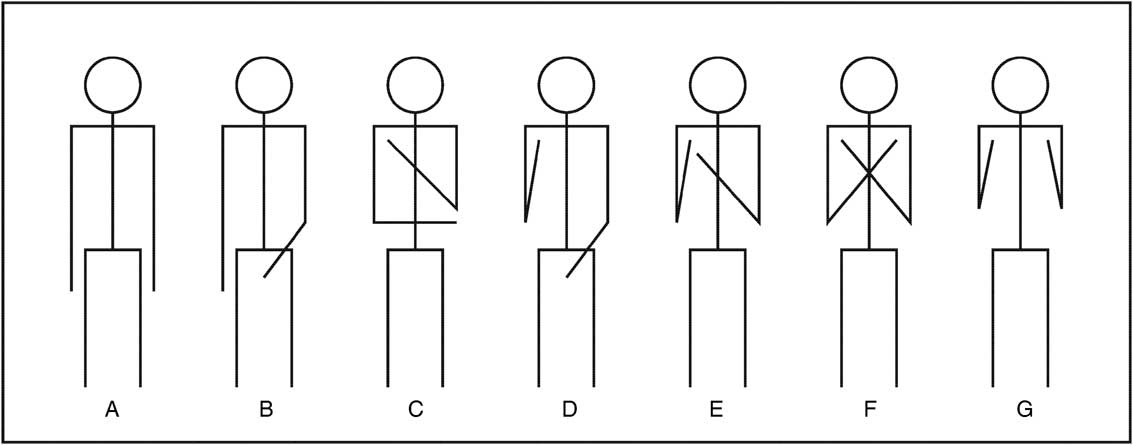
Standard arm positions displayed by extended burials in the west mouth, niah cave

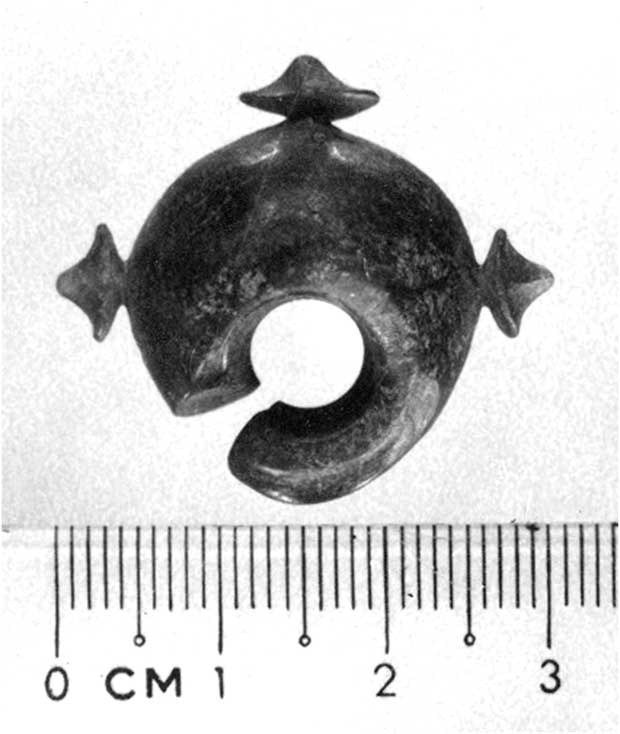
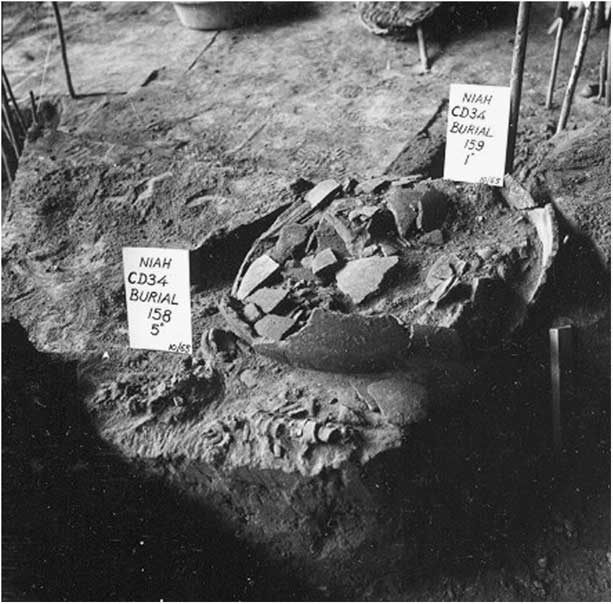
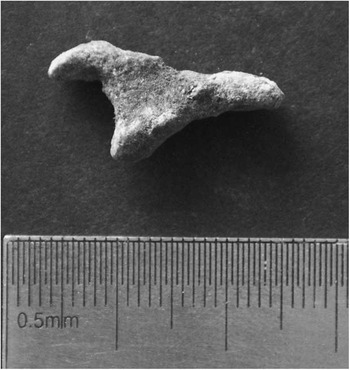
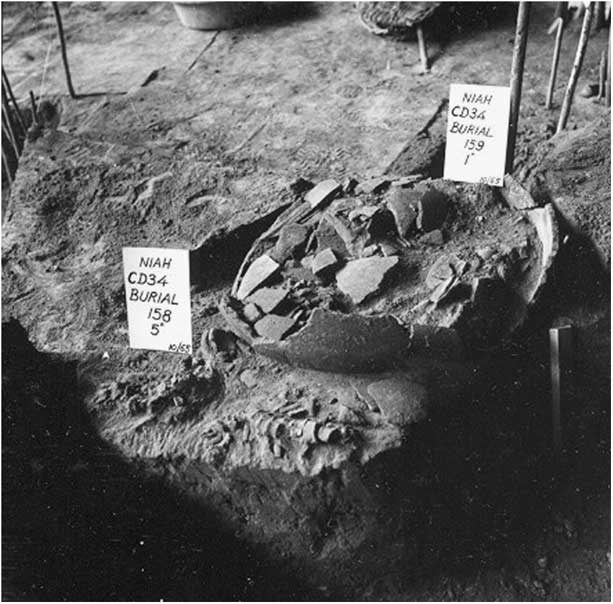
Higher order variables concern the application of red pigmentation and associated material culture, including the burial container (wooden coffins, bamboo matting [sometimes identifiable as completely wrapping the body], and ceramic jars; Fig. 10), and other grave goods (stone pounders and adzes, shell or bone ornaments [Fig. 6], wooden sticks, and organic beads). However, the West Mouth Neolithic burials are not individually rich in grave goods and there is no evidence for significant social differentiation represented in material artefacts. Only 16 of 66 initially investigated extended burials, and 16 of 59 secondary burials were recorded with portable grave goods (B. Harrisson Reference Harrisson1967). It can be noted, though, that cuprous metal is recorded with two burials, including what is described as a ‘bronze knife’ found on the chest area of extended burial B36 (ibid., 159). A radiocarbon date of 3182 ± 26 bp or 1501–1413 cal. bc (OxA-18562) obtained on a sample of coffin wood from B36 probably reflects old wood. However, in 2007 a fragment of a bronze clasp(?) was recovered from the cremated remains of burial B18 (Fig. 11), from which a sample of cremated bone produced a date of 2577 ± 33 bp or 812–564 cal. bc (OxA-22058); the oldest secure date for metal in Island South-east Asia. The bronze artefacts probably originated from mainland South-east Asia, and along with the ling-ling-o pendant, demonstrate that the Niah community, though not spectacularly rich, was part of a regional network around the South China Sea along which material goods, people, and ideas circulated from at least the early 1st millennium bc.
Unburnt secondary burial B159 in a large earthenware jar, during excavation in 1965. Burial B159 is dated to 1195–977 cal. bc (photograph courtesy of the Sarawak Museum)
Bronze clasp or hook found amongst cremated remains of burial B18, dated to 812–564 cal. bc (photograph: L. Lloyd-Smith)

Burial Groups
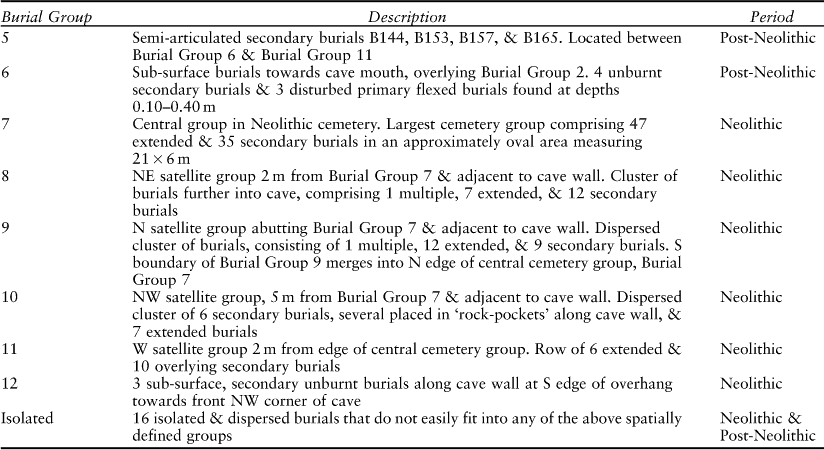
By visual inspection the West Mouth burials can be divided into a number of spatially discrete groups (Table 3; Fig. 12). The rationale for dividing the site thus was as a working tool to explore spatial and stratigraphic patterning in mortuary practice and as a basis for a radiocarbon dating programme to investigate ideas concerning the growth and history of the cemetery. The dating results refined, but did not substantially alter, the integrity of, these spatial groups, supporting the interpretation that the groups are ‘real’ and the product of deliberate and meaningful organisation of the cave for burial. Twenty-five burials (16 flexed, two flexed/decapitated, three seated, and four secondary burials) that form Burial Groups 1–4 date to the Early Holocene (Lloyd-Smith Reference Lloyd-Smith2013) and are not included.
Spatial burial groups in the west mouth, niah cave
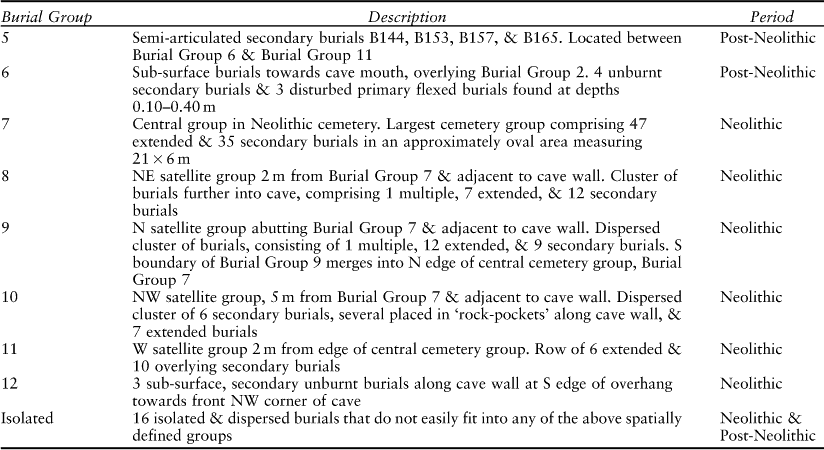
Depths refer to the level at which the burial deposit was first exposed below the cave surface. Burial Groups 1–4 date to the Early Holocene (Reference Lloyd-SmithLloyd-Smith 2013)
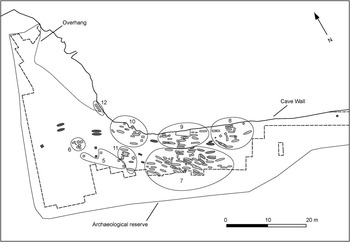
Proposed Neolithic and Post-Neolithic spatial burial groups; Burial Groups 5, 6 ∼ Post-Neolithic; Burial Groups 7–12 ∼ Neolithic; 15 darker indicated burials (four comprising two overlapping burials) are located in isolated positions between the defined burial groups (illustration: L. Lloyd-Smith)

Of the 182 burials that date after c. 1500 bc, the vast majority can be grouped into five discrete groups within the main cemetery area: a central group (Burial Group 7), surrounded at short distances to the north-east, north, north-west, and west, by four satellite groups (Burials Groups 8–11). Beyond these, lie three smaller groups all with shallow, sub-surface burials: Burial Groups 5 and 6 extend from the western edge of the main cemetery; Burial Group 12 comprises three secondary burials tucked under a large overhang in the north-west corner of the cave. There are also 16, more or less, isolated burials.
Radiocarbon Dating
Absolute dating of the later prehistoric burials in the West Mouth, Niah Cave, is problematic. Seven dates from the 1960s on coffin wood (four samples), bamboo matting (one sample), and human bone (two samples) have wide error margins and fall between 2150 cal. bc and cal. ad 600 (B. Harrisson Reference Harrisson1967; 1968). A subsequent series of 20 dates on collagen from human bone also have wide error margins spanning 4000 cal. bc to cal. ad 900 (Brooks et al. Reference Brooks, Helgar and Brooks1977) and are now also regarded as unreliable due to the, then unrecognised, problem of variable bone diagenesis in tropical environments (Spriggs Reference Spriggs1989).
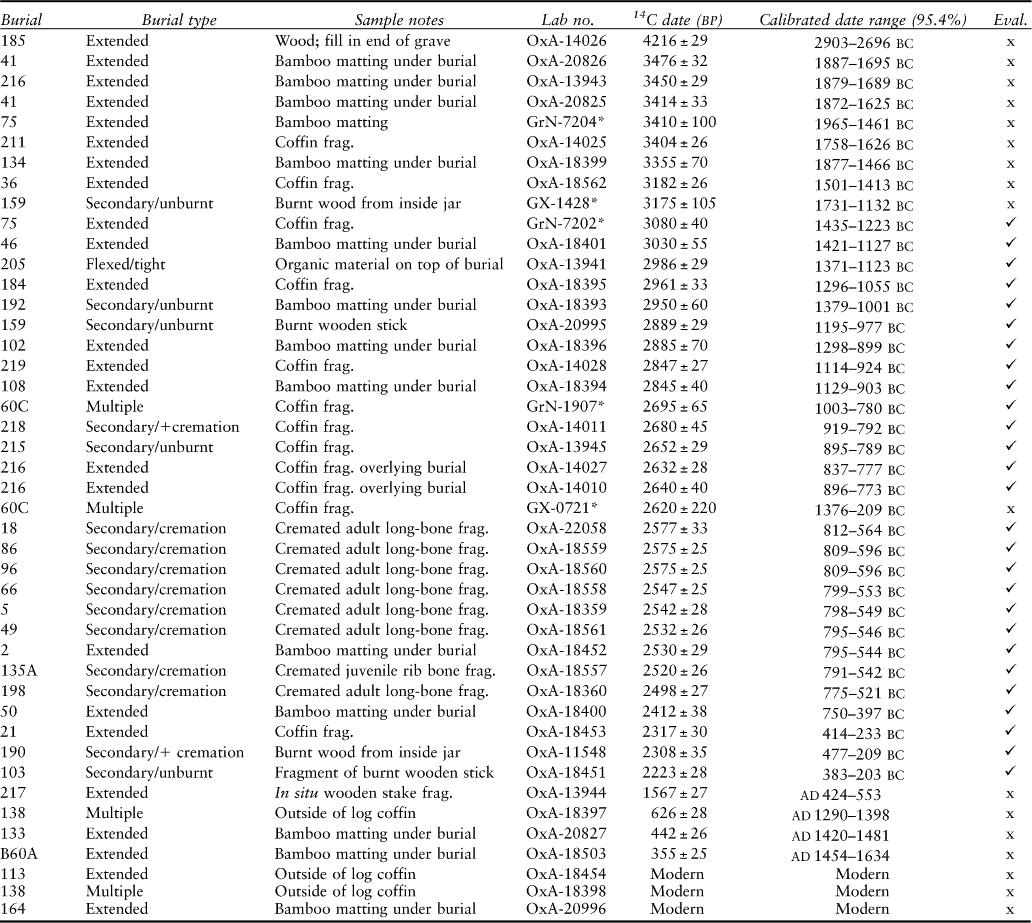
The recent dating programme was also not without problems. Of 27 submitted bamboo samples, 12 failed to produce a result, while eight produced dates that are spurious. What appeared in the field to be preserved bamboo often was only silica and contained insufficient carbon to date. Furthermore, bamboo samples from which dates were obtained, often produced dates which were older than expected from the stratigraphic sequence of burials (securely dated using cremated bone samples). Similarly, of six wood samples taken in 2006 from exposed in situ coffins, three failed to produce a date; two produced modern dates (post-ad 1950); and one a date in the last 500 years (there is no reason to suspect that the any of West Mouth burials belong to the developed Metal Age, as is the case with other Niah Cave sites where burials are found with abundant Chinese ceramics; B. Harrisson Reference Harrisson1958; T. Harrisson Reference Harrisson1959). These results highlight an apparent problem in the diagensis of organic plant material since initial exposure in the 1960s. The most secure of the recently dated samples from burials are those obtained on cremated human bone. In total, including all samples which produced a result, there are 44 dates from 38 burials (Table 4).
Radiocarbon dates from 38 neolithic burials in the west mouth, niah
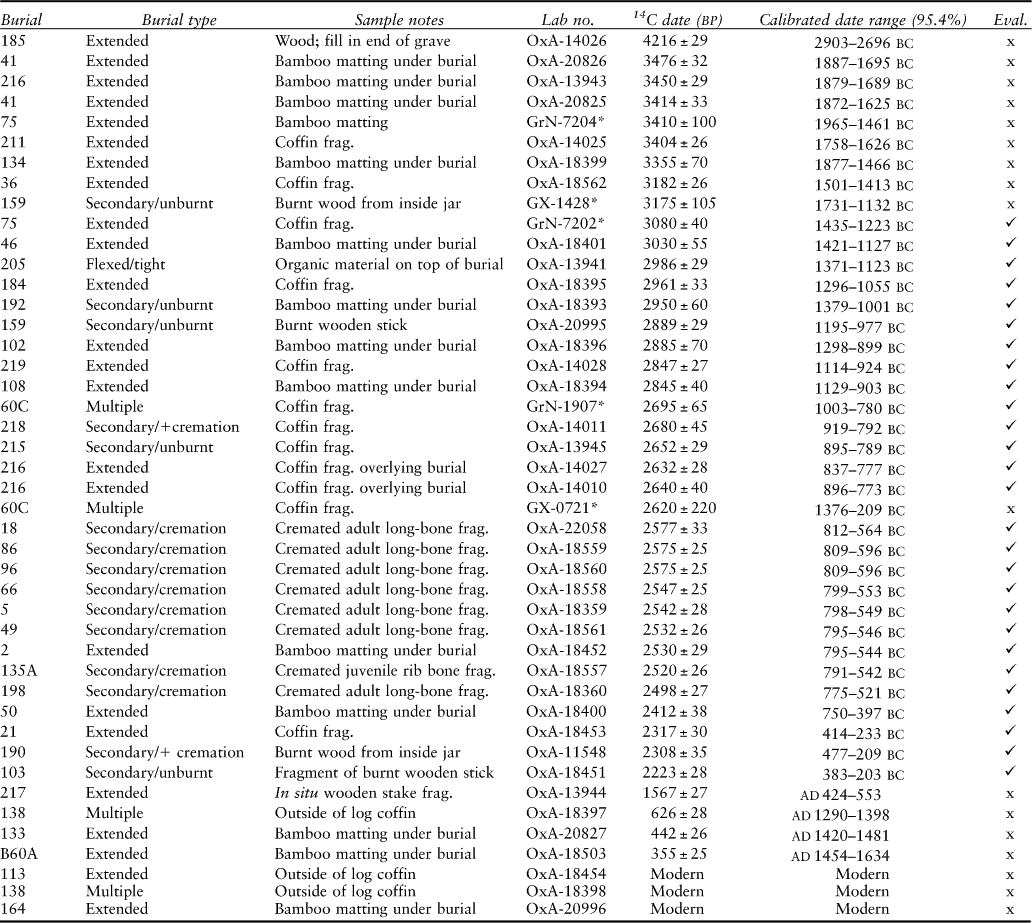
Burial types follow Lloyd-Smith (Reference Lloyd-Smith2011). Dates marked with asterisks published by B. Harrisson (Reference Harrisson1967, 1968). Eval = date evaluation: tick, accepted with caution; cross, rejected
Radiocarbon dates on charcoal indicate a gap in the use of the cave between c. 6000 and c. 2000 bc (Krigbaum Reference Krigbaum2001; Lloyd-Smith Reference Lloyd-Smith2009). The first post-gap charcoal date has a wide error margin, calibrating to 2050–1100 bc (3285 ± 168 bp; AA-27957; Krigbaum Reference Krigbaum2001, 69). It is not until after 1500 bc that there more accurate and abundant radiocarbon dates on stratified charcoal. Before this date, any human presence at the site was ephemeral and sporadic.
In evaluating each burial date, excluded are those with excessive error margins from burials: B60C (GX-0721), B75 (GrN-7204), and B159 (GX-14280). Four dates produced on bamboo samples from burials B41 (sample dated twice), B216, and B134 are also excluded as probably too early due to the apparent problem of bamboo diagensis. The date from burial B36 found with a ‘bronze knife’ is almost certainly the product of old wood. Likewise the date from burial B211 is rejected; B211 was parallel to extended burial B178A which overlay flexed burial B205, found with a polished adze and from which a date of 2986 ± 29 bp was obtained. The earliest radiocarbon date of 4216 ± 29 bp from burial B185 is also thought unreliable. As well as being over 1000 years earlier than all other dates from the cemetery, the sample was a small loose piece of wood from the grave fill. Also rejected are those dates produced on wood and bamboo which date to the last 2000 years. As will be discussed below, there was certainly activity in the West Mouth during the early centuries ad, with which the in situ wooden stake in B217, dated to 1567 ± 27 bp, may be associated, but it is not thought to date the burial itself which is in the centre of the cemetery and is surrounded by burials and a coherent series of dates between 1000 and 200 bc. The recent dates from burials B138, B133, and B60A, along with the modern dates (post-ad 1950) from burials B113, B138, and B164 are rejected as probably the result of plant diagensis since initial exposure.
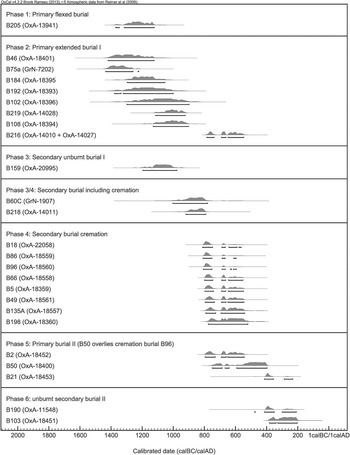
There remain 27 radiocarbon dates on samples of bamboo, wood, and cremated bone from 25 burials that are cautiously accepted to build a conservative but secure absolute chronology for the West Mouth Neolithic cemetery (Fig. 13). It is proposed that the cemetery dates between c. 1500 and c. 200 bc, during which six phases of burial can be discerned: primary flexed (1500–1300 bc), primary extended (1300–900 bc), unburnt secondary burial (1000–700 bc), secondary burial cremation (800–500 bc), followed by a second phase of primary extended burial and final a second phase of unburnt secondary burial (500–200 bc). While such a neat and uniform history of burial practice probably did not exist, this chronology is proposed as representing the major shifts in normative burial practice that took place during the course of the Neolithic c. 1500–200 bc.
Proposed radiocarbon chronology for the Neolithic cemetery

The Neolithic Cemetery Chronology
Phase 1: Flexed burial, c. 1500–1300 bc
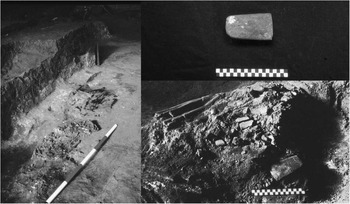
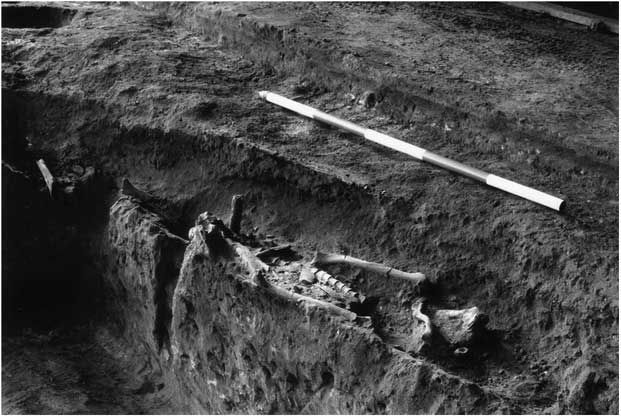
The use of the West Mouth for burial by people with Neolithic material culture began with flexed burials dating to sometime between c. 1500 and c. 1300 bc. Based on stratigraphic evidence, the earliest Neolithic burial dated is B205 (Fig. 14). This was in a tightly flexed position, contracted with knees against the chest, like most of the Early Holocene burials, but was accompanied by a lenticular polished stone axe, a classic item of Neolithic material culture. Compressed plant remains overlying B205, possibly associated with a later extended burial (B178A, Burial Group 9), were dated to 2986 ± 29 bp or 1371–1123 cal. bc (OxA-13491).
Early Neolithic flexed burial B205. Burial B205 was originally discovered at the close of the 1967 excavations and left exposed, after which it became covered over by the accumulation of fresh guano. It was rediscovered in a trampled condition in 2003 during fieldwork of the NCP. Left: re-exposed burial in 2003 looking NE; scale 1 m. Lower right: burial as the skeletal elements were being lifted, at which time the polished adze was discovered on the left chest area with the cutting edge facing towards the feet, looking N; scale 10 cm with 5 mm divisions. Top right: the polished lenticular adze; scale 10 cm with 5 mm divisions (photographs: G. Barker)

The tightly flexed burial position and the inclusion of a complete polished stone adze distinguish B205 from all other primary burials in the Neolithic cemetery. The adze places this burial in the general Neolithic period and thus after the mid-Holocene gap. The earliest possible date for B205 is c. 3000 bc, the lower limit of the radiocarbon date from B185 discussed above. A more conservative estimate based on the abundance of charcoal dates, would place this burial to between 1500 and 1300 bc. On current evidence it appears that this initial period of Neolithic burial was sparse and sporadic. However, it is very likely that further flexed burials remain undiscovered at the site, in particular underneath the centre of the cemetery where the majority of extended burials remain exposed and in situ.
Phase 2: Primary extended burial I, c. 1300–900 bc
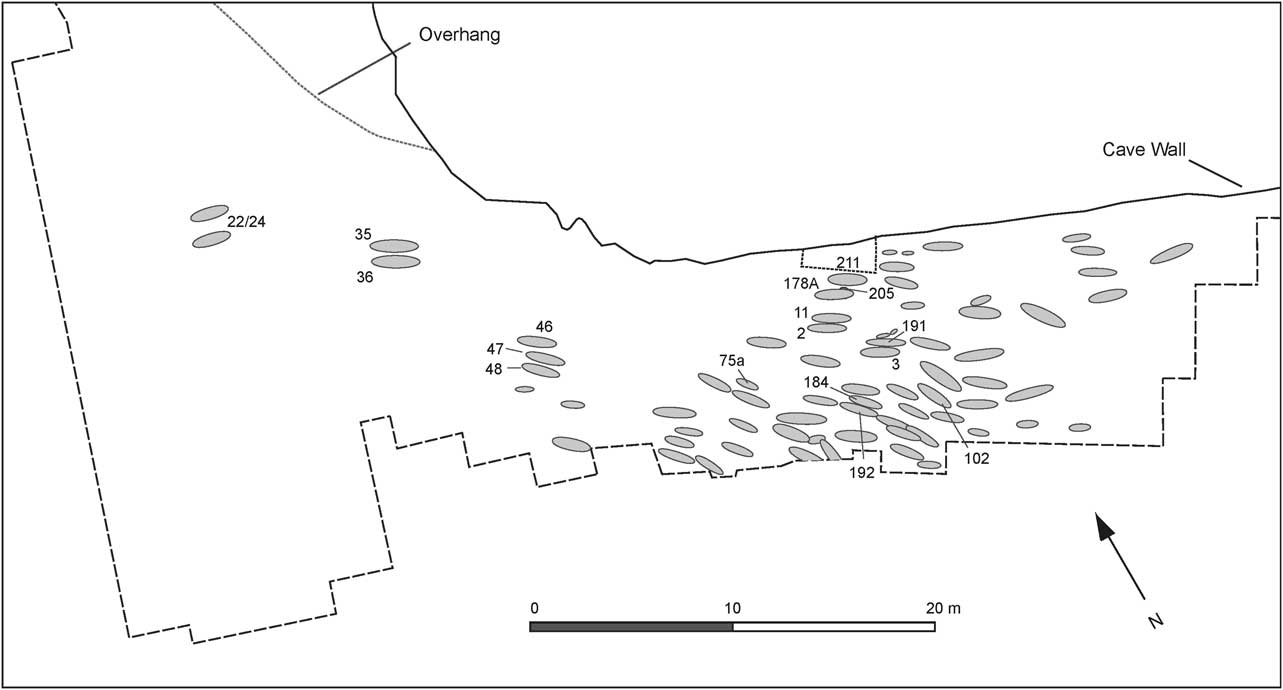
There was a major change in mortuary practice after c. 1300 bc: a formalised and structured cemetery was laid out with rows of extended burials, frequently in wooden coffins or bamboo matting. The establishment of the cemetery appears to have been decisive and once underway expanded rapidly. The earliest secure date for extended burial is c. 1400–c. 1200 bc. Dates which fall in this range are from extended burials B75a, B192, B184, and B102 in Burial Group 7; from plant remains overlying flexed burial B205 under Burial Group 9; and from extended burial B46 in Burial Group 11. These secure dates indicate that extended burial was practised contemporaneously in Burial Groups 7, 9, and 11 (Fig. 15). The extended burials in Burial Group 8 also probably date to this phase, while those in Burial Group 10 date to the fifth phase of the cemetery (see Phase 4).
Phases 1 & 2: Early Neolithic burials with burial numbers discussed in the text indicated. Phase 1 flexed burial B205 is located underneath burial B178A. Phase 2 comprised rows of primary extended burials (illustration: L. Lloyd-Smith)
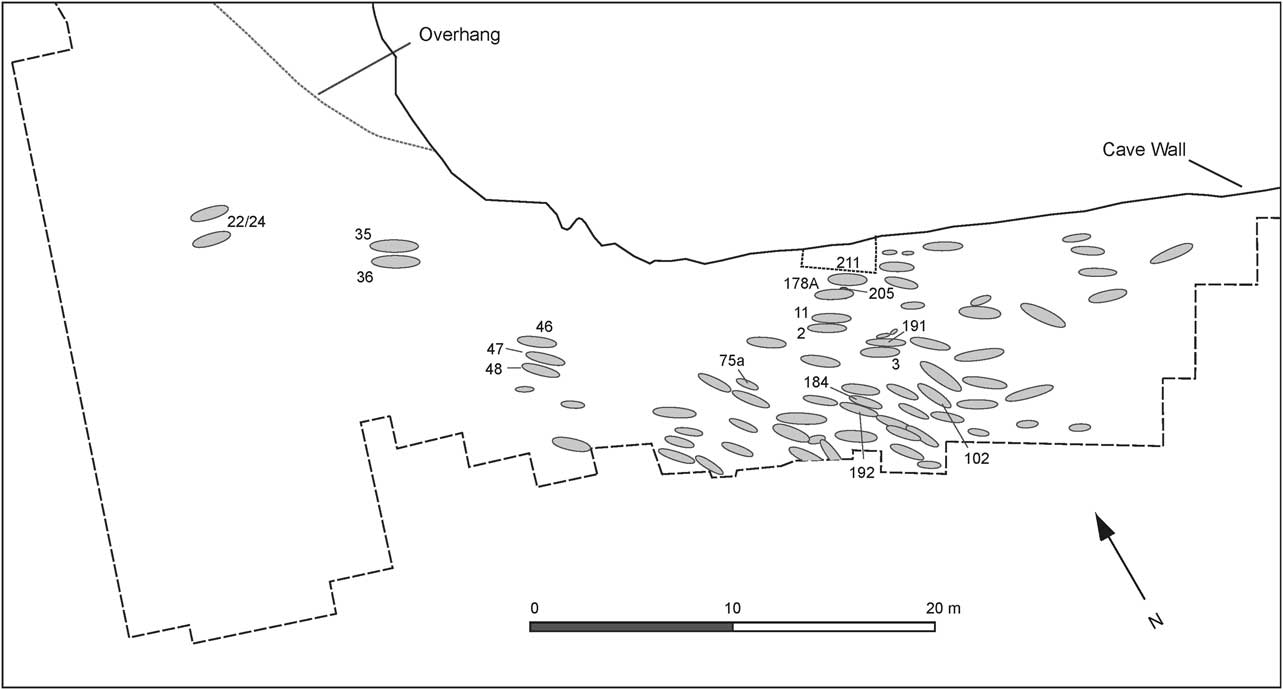
Burial Group 7 occupies a topographically central location from where it is possible to see all other areas in the front of the cave mouth as well as far into the northern and southern passages. Very few of the extended burials overlap or truncate one another and it is reasonable to assume that the cemetery displays a degree of horizontal stratigraphy. Burial Group 7 is by far the largest group in the cemetery, and it follows that it was added to most often and probably in use over the longest period of time. While the radiocarbon dates do not support the interpretation that Burial Group 7 precedes any of the other groups, it was certainly the main focus once the cemetery was established. The earliest accepted date from near the centre of Burial Group 7 is from B192, from which a sample of bamboo produced a date of 2950 ± 60 bp or 1379–1001 cal. bc (OxA-18393). A sample of wood from B219, also in the centre of Burial Group 7, produced a date of 2847 ± 27 bp or 1114–924 cal. bc (OxA-14028).
The extended burials in Burial Group 7 are aligned along six north–south rows. As these grew in length, the overall shape of the cemetery's central area took form. Once the spaces between each row were filled in, burial spread to the periphery, by which time orientation shifted to reflect the oval shape of the combined cluster of burials. This is particularly noticeable on the north-eastern edge of Burial Group 7. Two inferences follow from this interpretation: first, that each row may represent a social group; and second, that these social groups (in Burial Group 7) were more closely associated with each other than with the other burial rows, in Burial Groups 8, 9, or 11.
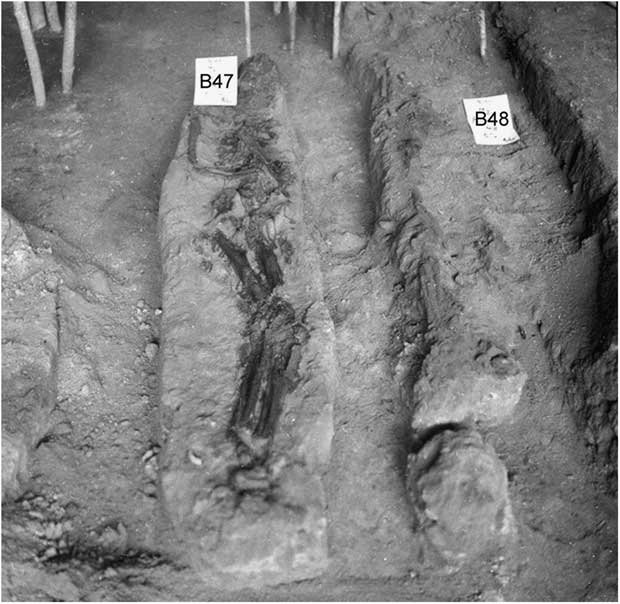
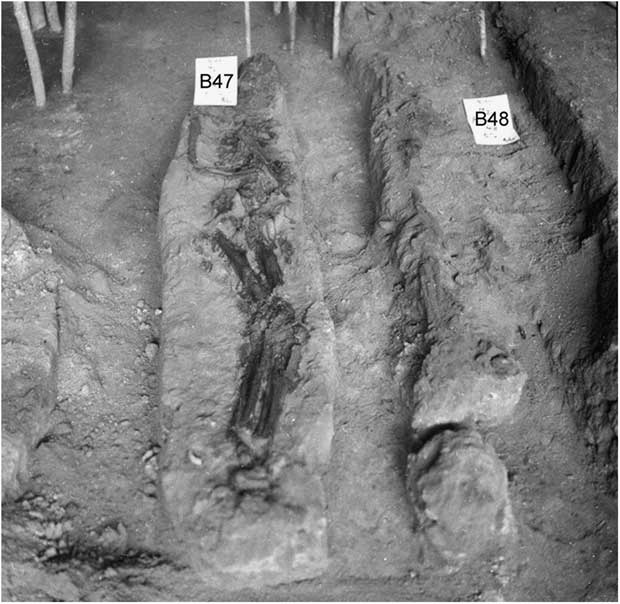
Away from the densely packed central area, it is possible to identify pairs of extended burials: B2/B11, B3/B191, and B178A/B211 in Burial Group 9; and B47/B48 in Burial Group 11. Isolated burial pairs B22/B24 and B35/B36 should also be mentioned here. In the case of Burial Group 11, the row of extended burials appears to focus on, and originate from, the male and female burial pair B47/B48, where the burials even appear to be positioned in the grave so that their bodies were turned to face one another (Fig. 16). Burials B47 and B48 also displayed complementary arm positions. Demographic and arm position data in other burial pairs are patchy, but in the case of B3/B191 we again see an adult male and female. On the basis of these observations it is suggested that the rows of extended burials which over time evolved into the distinct Burial Groups 7, 8, 9, and 11 are likely to represent family lineages, households, or perhaps settlement groups.
Primary extended burials B47 and B48. Burial numbers added to original photograph (photograph courtesy of the Sarawak Museum)
The arm positions of extended burials tentatively correlate with isotopic and demographic data. The burials with both arms laid straight by the sides of the body (Position A) are, in differing ways, abnormal: B36 was an adult female identified as non-local to the Niah area (Valentine et al. Reference Valentine, Kamenov and Krigbaum2008); B75a was a rare infant extended burial; and B232 was an adult with congenitally malformed lower arms (Zuraina Majid et al. Reference Zuraina, Lim, Arif, Samsuddin, Nizam, Zafarina and Norazmi2005). One possibility is that the other arm positions represented some form of social identifier for (‘married’?) adults belonging to the local population. Infants were not assigned an arm position ‘identity’ in burial; the B36 woman clearly did not have such an identity, even though she had moved to, and died at, Niah; and though the individual with malformed arms was cared for into adulthood, their physical disability appears to have negated the positioning of the arms in burial (whether they were ‘married’ or not). The counter to this interpretation is burial B3: an adult male also identified as a non-local individual (Valentine et al. Reference Valentine, Kamenov and Krigbaum2008), buried with the right hand resting on the same side shoulder and left arm bent up across the chest. There is, though, a strong likelihood that B36 was a completely isolated burial. Except being listed in the published original classification, no field records, photographs, or skeletal remains exist for ‘adjacent’ burial B35 (B. Harrisson Reference Harrisson1967), indicating it may in fact simply be a duplicate number. In which case, the other arm positions may indeed display social identities, and B36's ‘non-positioned’ arms highlight the singular nature of this individual: non-local, buried with a bronze knife, and in an isolated location separate from all burial groups.
The most common position, used for both sexes, was with the hands resting on or near their respective shoulders (Position G). The second most common, also used for both males and females, was with the arms crossed over the chest (Position F). The distinctive and pre-dominantly female hands-on-pelvis burials were largely restricted to the eastern edge of Burial Group 7 and the adjacent Burial Group 8, whereas the male burials with one arm at 90° were widely distributed in the cemetery. If, as proposed, the rows of extended burials represent lineages of family descent, the contrasting distributions of the female and male burials indicated by the two asymmetric arm positions, could imply that the Neolithic societies of Niah were organised according to a partial system of matrilocal post-marital residency, whereby the husband moved to the wife's family group or household, with married couples then being buried together, close to the group representing the female line of descent. While the strontium isotope data make it clear, though, that on occasion non-local women (B36) were also joining the community, and her isolated position in burial (with or without B35) suggests that she was not fully incorporated into any of the ‘local’ groups.
Phase 3: Secondary unburnt burial, c. 1000–700 bc
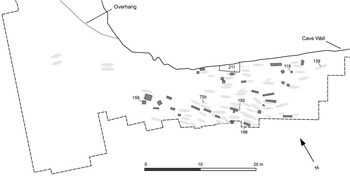
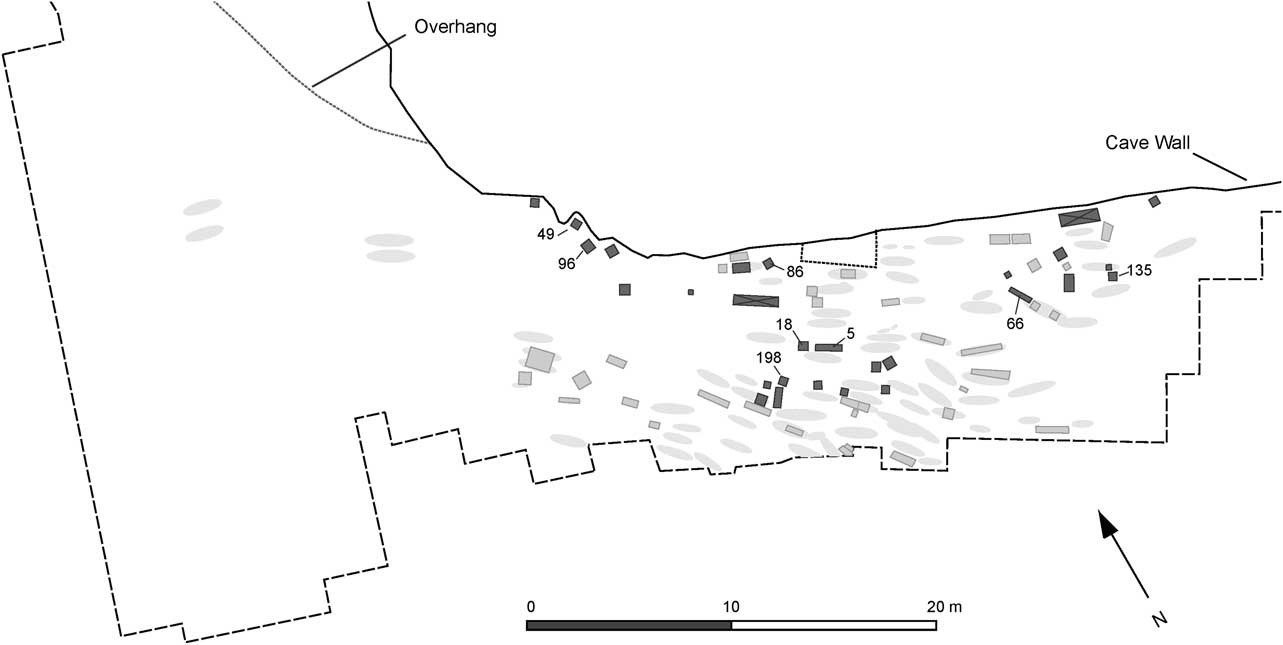
In all areas of the cemetery, except Burial Group 10, secondary burials overlay extended burials (Fig. 17). In many instances there existed a direct spatial correlation between unburnt secondary burials and extended primary burials, which are interpreted as representing historically-linked burial events: that is to say, the grave of the extended burials was re-opened by first or second generational descendants of those interred in the primary burial. In the largest central group, Burial Group 7, many of these re-opened burials are located around the periphery, supporting the hypothesis for a degree of horizontal stratigraphy in the growth of the cemetery and that these extended burials belong to the end of the initial phase of primary burial.
Phase 3: First phase of unburnt secondary burial in the Neolithic cemetery. Burial numbers discussed in the text are indicated. Phase 3 burials indicated by darker shading, overlaying lighter shaded Phase 2 primary burials (illustration: L. Lloyd-Smith)

However, on current data it is not these primary/secondary burial sequences in which the earliest radiocarbon dates for secondary burial occur. Rather, the earliest reliable date for secondary burial is from the largest jar burial B159 (Burial Group 11), from which a sample of burnt wood (a branch with a short internal age) produced a date of 2889 ± 29 bp or 1195–977 cal. bc (OxA-20995). Burial Group 11 is further distinguished by containing the highest (equal) ratio of adults given secondary burial (five) compared with those given primary burials (five) of all burial groups, and by the fact that none of the secondary burials was cremated. In contrast, cremation burials are found in all other burial groups in the main cemetery, all producing radiocarbon dates that calibrate to between 812 and 521 bc. In this light, the early date from secondary burial B159 indicates that Burial Group 11 had ceased prior to the emergence of the practice of cremation.
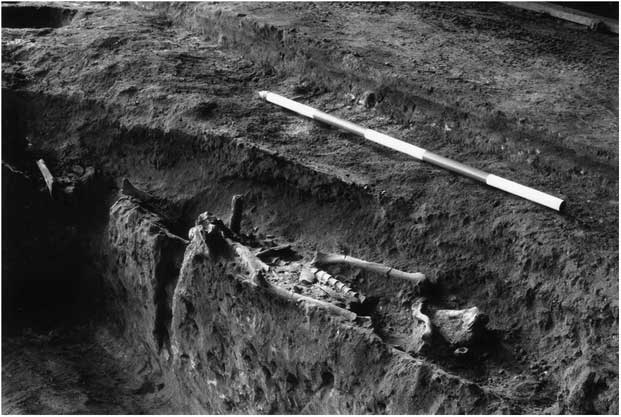
A focus on skulls is seen in a number of extended burials with exhumed (missing or replaced) skulls, including B139, B192, and B211 (Fig. 18), and in a number of secondary burials of intact or partial crania, including B45b, B75b, B119, B153, and B186. Many of the secondary burials, both unburnt and cremated, were lacking cranial remains, suggesting the retention (and curation?) of skulls, while the rest of the skeletal remains were buried in the cemetery. The limited number of extended burials with skulls removed indicates that this change in burial ritual was restricted to certain members of society. In the case of B211 the pit excavated to retrieve the skull was backfilled with a substantial quantity of wild pig bones (Barker et al. Reference Barker, Barton, Bird, Cole, Daly, Gilbertson, Hunt, Krigbaum, Lampert, Lewis, Lloyd-Smith, Manser, Menotti, Paz, Piper, Pyatt, Rabett, Reynolds, Stephens, Thompson, Trickett and Whittaker2002b, 118) suggesting that feasting or offerings were part of these secondary rituals.
Extended burial B211 with skull removed by the excavation of a pit back-filled with wild pig bones (excavated). Scale: 1 m; 20 cm divisions (photograph: G. Barker)
That the skulls exhumed from primary burials, and possibly those retained from the initial secondary burial deposition, were subsequently (re)buried, indicates that the curation the skulls was to serve a particular purpose and at some point in time this function was completed. Alternatively, it might have been that the (re)burial of the skulls was a significant part of the ritual process. The exhumation and retention of skulls suggests that ancestors played an important role in living society. The retrieval and reburial of skulls from extended burials supports the idea that the transition from primary to secondary burial was an historical process. It appears that the transition to secondary burial originated in the practice of retrieving the crania of certain individuals given primary burial. The stratigraphic relationships between primary and secondary burial are the same in the four oldest burial groups (7, 8, 9, and 11), suggesting that the widespread adoption of secondary burial constitutes a distinct phase in burial practice. The implication is that the widespread transition to secondary burial was rapid and occurred within the space of one or two generations.
Phase 4: Secondary burial cremations, c. 800–500 bc
The medial radiocarbon dates produced on eight cremated bone samples varied by only 79 years, and because of a plateau in the calibration curve they produced very similar calibrated dates, all falling within the range 812–521 cal. bc. Cremation burials are located in all central burial groups except Burial Group 11 which probably had ceased prior to the transition to cremation (Fig. 19). Those in the Burial Group 7 form a discrete cluster, where they are spatially independent of the early primary or unburnt secondary burials. Moreover, Burial Group 10 appears to have been initiated by cremation burial. Such a strong spatial discontinuity in cemetery organisation hints at a chronological hiatus in burial activity, with the cremation burials representing the subsequent re-use of the cemetery. Unfortunately, due to the sharp break of slope in the radiocarbon calibration curve at 800 bc, it is difficult to investigate this possibility further.
Phase 4: Secondary burial cremations and two multiple burials. Burial numbers discussed in the text are indicated. Burials including cremated remains indicated with darker shading. Phase 1–3 burials, lighter shading (illustration: L. Lloyd-Smith)
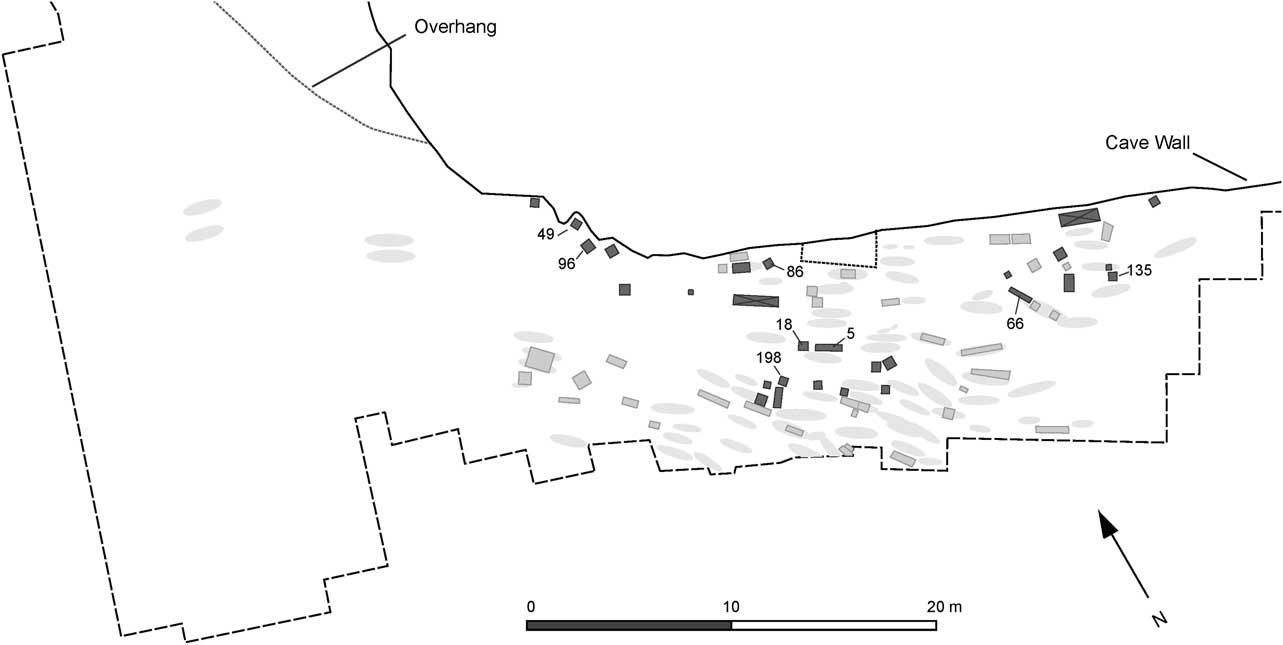
The practice of cremation forms the second phase, and elaboration, of secondary burial at the site. All cremated remains display green-fracturing. The dead were cremated soon after death, rather than the burning of dry skeletal remains at a later date. All the cremated remains from 24 secondary burials in the Neolithic cemetery were also stained red, presumably ochre. This compares with only four instances where red coloration was recorded in the total of 41 unburnt secondary burials. The interior and articular surfaces of cremated bones were coated in a layer of red pigmentation, indicating that the colour was applied to the bones in liquid form. Cremations also have a stronger association with earthenware burial jars than unburnt secondary burials. Of the 24 burials containing cremated remains, seven were in ceramic vessels, compared with five of the 41 unburnt secondary burials (Lloyd-Smith & Cole Reference Lloyd-Smith and Cole2010). ‘Multiple’ burial B60B-D included a discrete cremation deposit on the base of the over-size log coffin, suggesting that this special burial and multiple burial B138 in Burial Group 8 belong to Phase 4 as well.
Phases 5/6: Primary extended burial II/secondary burial II, c. 500–200 bc
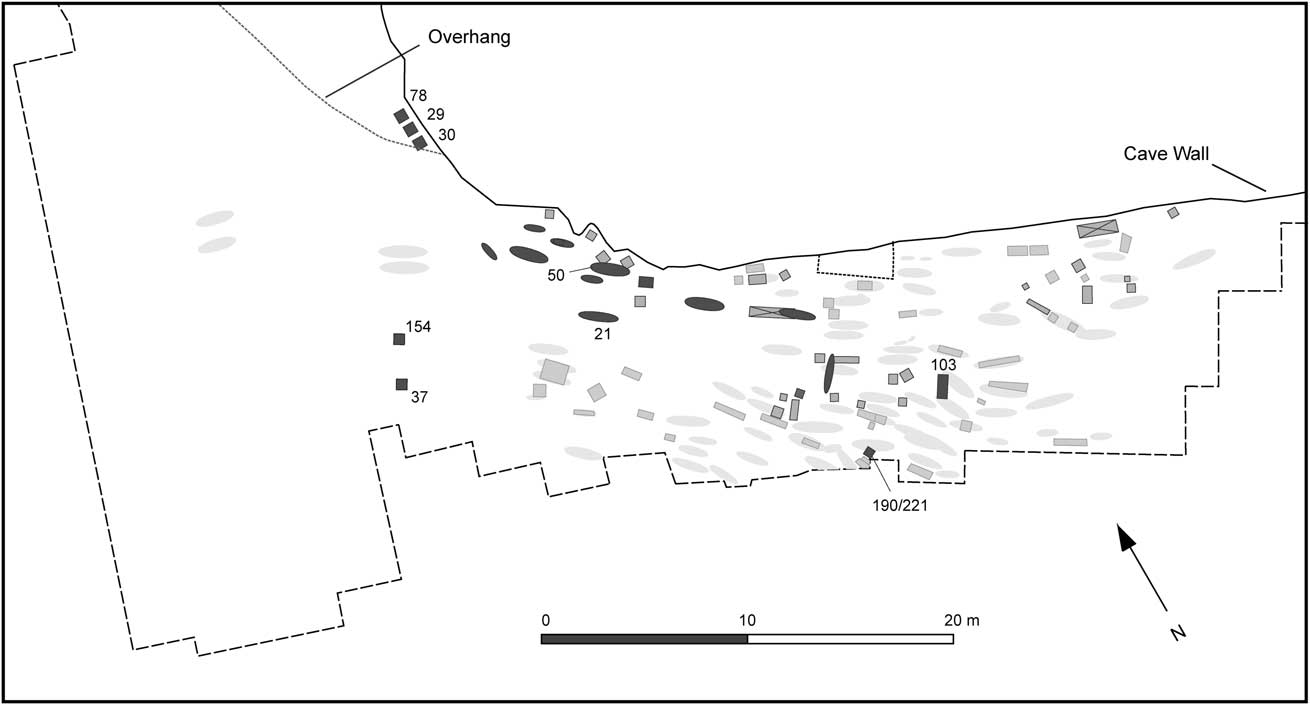
Varied burial activity continued at several different locations within the cemetery after 500 bc (Fig. 20). In Burial Group 10, funerary practice switched back to primary extended burial. A piece of bamboo from extended burial B50 produced a date of 2412 ± 50 bp or 750–397 cal. bc (OxA-18400); B50 overlay two jar burials, B85 and B96 both of which contained cremated remains. Further out from the cave wall, a fragment of coffin wood from B21 produced a date of 2317 ± 30 bp or 414–233 cal. bc (OxA-18453).
Phases 5 & 6: Second phases of primary extended and unburnt secondary burial. Burial numbers discussed in the text indicated. Phase 5 & 6 burials indicated with darker shading. Phase 1–4 burials, lighter shading (illustration: L. Lloyd-Smith)
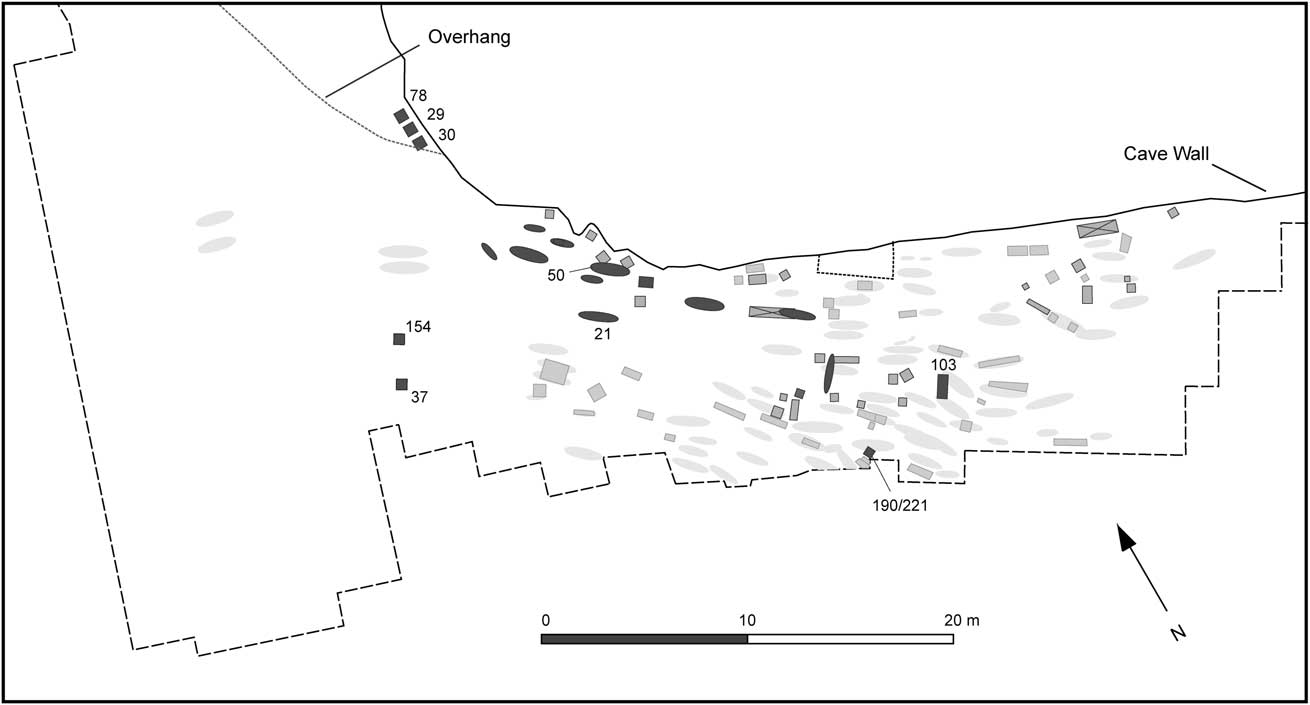
Unburnt secondary burial occurs elsewhere including a sequence of stacked jar burials B221 and B190 placed in the approximate centre of Burial Group 7 (Lloyd-Smith & Cole Reference Lloyd-Smith and Cole2010). A piece of burnt wood, with short internal age, from inside B190 produced a date of 2308 ± 35 bp or 477–209 cal. bc (OxA-11548). Burials B221/B190 appear to be situated on their own and placed at the centre of the cemetery, where the burials in the immediate vicinity date to at least 400 years earlier. The location of the stacked burial jars represents a renewed focus upon what would by that time have been an extremely ancient place of burial.
Elsewhere, we see the beginning of a shift away from the main cemetery area and towards the front of the cave, along the cave wall. Burial Group 12 comprises three sub-surface unburnt secondary burials (B29, B30, and B78) deposited just under the southern edge of the overhang. They have strong ceramic associations, including (possibly re-used) double-spout fragments (Franca Cole, pers. comm.). There are no secure absolute dates for these burials, but the δ13C isotopic data from B30 are comparable with the majority of the extended and secondary burials in the main cemetery (Krigbaum Reference Krigbaum2001, 181). It is proposed that Burial Group 12 represents an expansion along the cave wall during the second half of the cemetery's use sometime between 800 and 200 bc. Here also can possibly be included two isolated jar burials, B233 into the cave passage (Fig. 3), and B154, along with secondary burial B37 (Fig. 20).
The latest radiocarbon date for burial within the Neolithic cemetery is from unburnt secondary burial B103. A sample of burnt wood (a branch with a short internal age) produced a date of 2223 ± 28 bp or 383–203 cal. bc (OxA-18451). As in the case of the stacked burial jars B221/B190, this burial is surrounded by much earlier burials. B103 overlay the western end of two extended burials B102 and B104. A sample of bamboo from the burial byre under B102 produced a date of 2885 ± 70 bp or 1289–899 cal. bc (OxA-18396), at least 500 years prior to B103. Secondary burial B103 was covered by a variety of earthenware sherds, suggesting the deliberate re-use and movement of pottery from elsewhere in the cemetery (Franca Cole, pers. comm.). Such practices would have maintained a direct material link between the members of the funerary party and their ancestors who had been buried at the site for over a thousand years. What distinguishes B103 from the earlier Neolithic burials, though, is a markedly different δ13C isotopic signature. After a thousand years of δ13C values interpreted as representing open-canopy, probably agricultural, subsistence practices (Krigbaum Reference Krigbaum2001, 193), B103 has a value comparable to those of the Early Holocene flexed burials discovered at the front of the cave and under the overhang, possibly indicating the beginning of a shift back to a more varied and mixed subsistence.
Post-Neolithic Burial
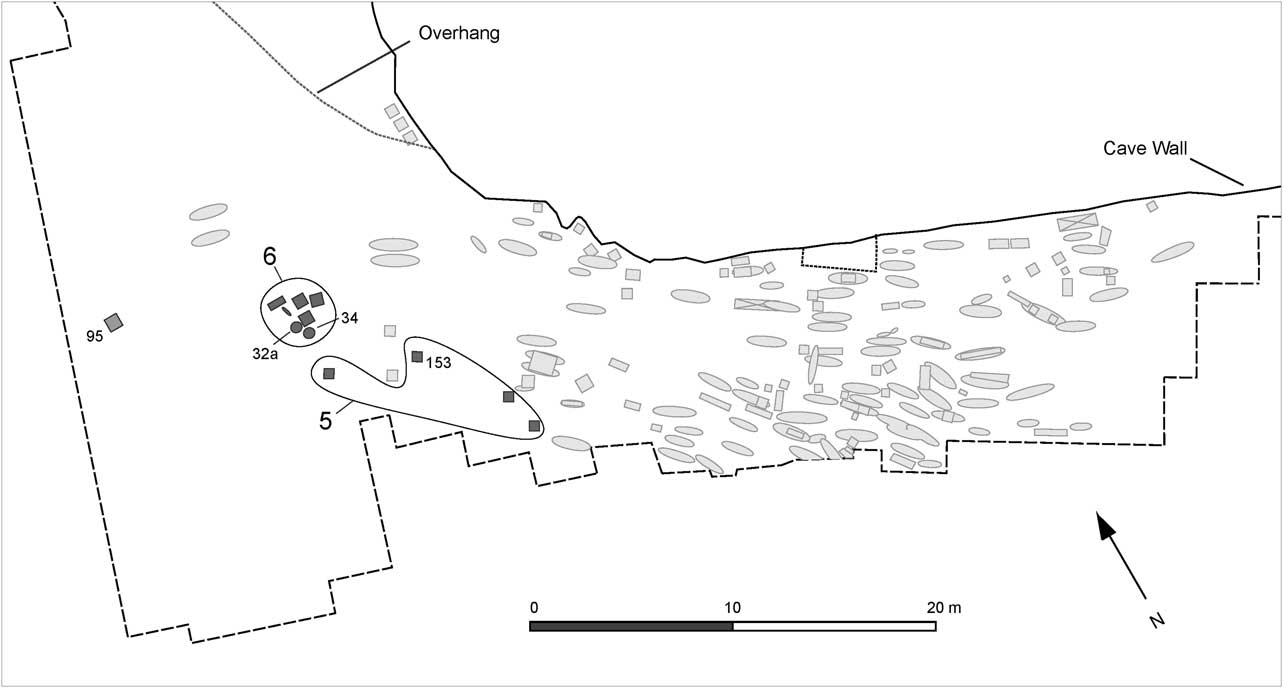
A cluster of sub-surface features towards the front of the cave, originally classed as ‘disturbed/doubtful remains’ (B. Harrisson Reference Harrisson1967, 190), have been reclassified as (disturbed) loosely flexed burials and unburnt secondary burials, including skull burial. Together these burials comprise Burial Group 6 (Fig. 21). The disorganised appearance of Burial Group 6 contrasts with the formalised organisation of the Neolithic cemetery. This and the conspicuous distance between Burial Group 6 and the Neolithic cemetery suggest that the two are not contemporary. Neither do flexed burials B32a or B34 in Burial Group 6 resemble flexed burial B205, which represents the earliest phase of Neolithic burial at the site.
Proposed Post-Neolithic Burial Groups 5 & 6. Burials discussed in the text indicated, Neolithic burials, lighter shading (illustration: L. Lloyd-Smith)
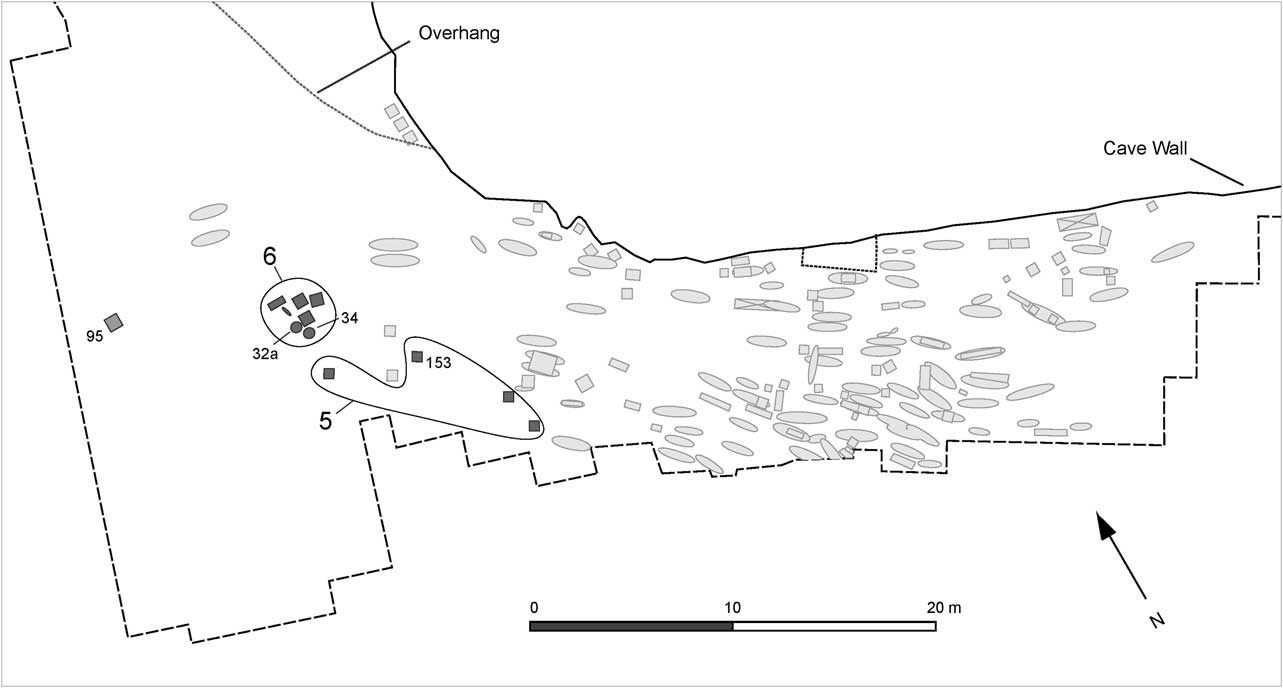
Adjacent to Burial Group 6 and spreading c. 10 m into the cave were the four semi-articulated secondary burials, which comprise Burial Group 5. These burials contained completely disarticulated skeletal remains mixed with, and overlying, articulated sections of a spinal column (see Fig. 7). As such they appear to represent a foreshortened secondary burial rite, whereby the body was retrieved for final burial before the corpse was fully reduced to bones. One possibility is that these features are associated with secondary burials that were given final burial in one of the burial groups in the main cemetery. If this was the case, however, one would expect many more semi-articulated burials. Furthermore, in three of these burials substantial quantities of disarticulated secondary burial remains were included, indicating they represent complete burials in their own right, rather than the residual elements of separate secondary burials placed in the Neolithic cemetery.
The δ13C isotope data reveal interesting correlations between Burial Groups 5 and 6. Flexed burial B34 and skull burial B33 (Burial Group 6), and semi-articulated burial B153 (Burial Group 5), all displayed some of the most negative δ13C values of all burials at the site, strongly indicative of closed-canopy environments and hunter-gatherer subsistence practices (Krigbaum Reference Krigbaum2001, 193).
There are no absolute dates available for Burial Groups 5 or 6, but their shallow depths and mixture of earthenware pottery within and under the burial deposits indicate that they date to the Neolithic or later. The spatial separation of these two burial groups from the main cemetery, the disorganised nature of Burial Group 6 compared with the formalised character of the Neolithic cemetery, and the interpretation that the semi-articulated remains represent on-site transformational burial rites, all suggest that the sub-surface burial activity towards the front of the cave mouth was not contemporaneous with the Neolithic cemetery. The spatial and isotopic similarities of these two burial groups, suggests that they constitute a single phase of burial that is subsequent to the main Neolithic cemetery: what I propose to term the ‘Post-Neolithic’. Here also can possibly be included the sub-surface isolated secondary burial B95 at the very front of the cave mouth.
There are, though, similarities between the practice of secondary burial in the Neolithic cemetery and Post-Neolithic burial. A focus on the skull persists and the spatial association of substantial quantities of pig remains found around the semi-flexed and secondary burials in Burial Group 6 are reminiscent of burials in the Neolithic cemetery. We may also see an overlap, or precursor, to the Post-Neolithic closed-canopy isotopic signatures in the strongly negative δ13C value of B103. While the upper limit of the date of 200 bc from B103 is taken as the earliest possible date for the Post-Neolithic burial phase, the spatial separation between the Neolithic cemetery and Post-Neolithic burial at the site suggests that a chronological hiatus separates the two phases.
Discussion
The West Mouth Neolithic cemetery data are by no means perfect. The original documentation, though extensive, is patchy, likewise the osteological data. There are serious problems in the dating. Nevertheless, the spatial scale of the data is unprecedented in South-east Asian Neolithic archaeology, and in many instances the data are rich and complex in detail. The interpretation offered is an attempt to overcome the intrinsic problems in the archaeology, by giving the benefit of doubt to the data as a whole to see where it could lead. Linking short burial sequences into a complete history highlights the importance of understanding individual burial events as part of a longer historical trajectory of ritual practice. It is then possible to transcend simple phasing of burial types to consider the histories and relationships of individuals and communities buried in Niah Cave. While it is acknowledged that the finer details of the cemetery's history were, no doubt, more complicated than portrayed by the neat and uniform phasing, it is proposed to represent the major shifts in normative burial practice that occurred there during the Neolithic (1500–200 bc), and thence what is termed the Post-Neolithic.
On current data it is supposed that the Early Neolithic flexed burials were sporadic and dispersed. However, it is almost certain that more remain to be discovered, underlying the many exposed in situ extended burials in the centre of the cemetery. Full understanding of the Early Neolithic cemetery awaits further study: what is the precise date of the Early Neolithic flexed burials? Do they form spatial groups? How and why did the practice change from flexed burial to rows of extended burials? Only future excavation will answer these key questions.
The pairs and rows of extended burials are proposed to represent family lineages. The existence of discrete larger burial groups suggests that distinctions between these groups were well defined. At the same time, burial practice followed a formalised pattern and a strict set of funerary rituals were adhered to, suggesting that ritual knowledge was restricted to a limited number of individuals. The notched wooden sticks in four of the extended burials (B101D, B113, B126, and B179) may be an indication of ritual status; the notches perhaps representing a sort of genealogical tally (B. Harrisson Reference Harrisson1967, 157). Into these communities, non-local individuals were moving to Niah in adulthood and being buried there. It is evident that some of these individuals were incorporated into ‘local’ groups, while the ‘otherness’ of one adult female (B36) was maintained in the positioning and location of her burial.
The historically-linked and widespread transition from primary burial, through skull exhumation, to full secondary burial suggests that these changes were desired and sought after by all members of the inter-related communities. Such pervasive and rapid change further supports the idea that funerals were led by ritual specialists who steered the religious practices of society. The focus on skulls and the intensification to full secondary burial further suggest that these religious practices were focused on the veneration of immediate and recent ancestors. Here, data from ethnographically documented societies relates that the intensification of secondary burial rites is often associated with large status gaining funerary feasts (Tillotson Reference Tillotson1989). While there is some evidence at Niah that skull exhumation may have involved feasting, followed by the deposition of faunal remains in place of the skull (B211), little in the final grave structures or grave goods points to significant status differentiation.
Cremation represents an additional intensification in secondary burial, effectively shortening the length of time between death and the preparation of the skeletal remains for their final interment. Its appearance is marked by a pronounced spatial re-organisation of the cemetery. One of the oldest burials groups (Burial Group 11) ceased prior to the commencement of cremation, while another burial group (Burial Group 10) was established. In the centre of the cemetery (Burial Group 7), cremations form a distinct, stratigraphically independent, cluster. These patterns hint at a hiatus in burial at the site, or, a symbolic break with the past.
If intensification in secondary burial was related to an intensification of funerary feasts, this phenomenon was apparently short lived and followed by a return to (less ritually and economically expensive) primary burial. This may imply some sort of economic decline associated with the middle phase of the cemetery's history. In this light it is interesting that while some aspects of ritual knowledge and practice, for example the positioning of the arms, were carried over, other aspects regarding the strict spatial alignment of rows of burials were either forgotten or were, by that time, deemed unimportant. All indications are that during the later phases of the cemetery the number of burials declined and they were more widely distributed, implying a declining population with less strict spatial organisation between social groups and therefore possibly more fluid social histories.
The decline and spatial disintegration of Neolithic burial practice can be seen to foreshadow the Post-Neolithic burials, pre-empted also by the closed-canopy isotopic signature of the latest dated burial in the Neolithic cemetery (B103). Why this happened at Niah at this time is an intriguing and, as yet, unanswered question. Elsewhere in the region, the last centuries bc and the 1st centuries ad were a period of increased interaction and trade as South-east Asia became drawn into the expanding influence of India and China (Bellina & Glover Reference Bellina and Glover2004). The early date for bronze and the jade ling-ling-o pendant bear witness to the fact that the Niah communities had long been part of this network. (Perhaps the non-local B36 adult female, buried with the bronze knife, originated from the mainland; future isotopic or genetic studies may answer this compelling question). As a regional maritime network flourished in the Early Metal Age, seen for example in burial wealth at the Tabon Cave sites on the Island of Palawan, north-east of Borneo (Fox Reference Fox1970), so Niah fades from the picture; the next securely dated burials at Niah are not until the late 1st millennium (Cole Reference Cole2012; Szabó et al. Reference Szabó, Cole, Lloyd-Smith, Barker, Hunt, Piper, Cameron and Doherty2013) and contemporary with the rise of Brunei as a trading centre (Bellwood & Omar Reference Bellwood and Omar1980).
In what ways might this new understanding of the history of Neolithic burial practice at Niah inform wider debates in the region, and what lessons can be drawn from it for mortuary archaeology more generally? Debate over the Neolithic transition in Island South-east Asia is heavily influenced by linguistics and the language-farming dispersal model (Bellwood Reference Bellwood1997; Reference Bellwood2005). This model proposes the southward expansion c. 2000/1500 bc of Austronesian-speaking farmers from South China via Taiwan across Island South-east Asia, and thence into the western Pacific, where they were instrumental in the origins of the Lapita culture and the subsequent colonisation of Remote Oceania (Spriggs Reference Spriggs1997). Today, the Niah Caves area is part of this Austronesian-speaking world. However, as outlined in the Introduction, many scholars view the diversity in the archaeological, genetic, and palaeoenvironmental data as incompatible with a simple demic expansion of Neolithic farmers (see Barker & Richards (Reference Barker and Richards2013) and Denham (Reference Denham2013) for recent summaries). At the same time, the linguistic picture is by no means crystal clear and the possibility for a pre-Austronesian expansion from the South-east Asian mainland of Austroasiatic-speaking farmers to Palawan, north Borneo, and thence to the Malaysian peninsular has recently been proposed (Blench Reference Blench2011). However, as Blench (Reference Blench2012) also points out we should be careful not to associate a prehistoric community represented by archaeological remains with a modern linguist construct. Similarly, when attempting broader interpretations of the prehistoric mortuary practice at Niah we should be careful not to draw lines of direct comparison from the practices of ethnographically-documented Austronesia-speaking communities (eg, Bloch Reference Bloch1974; Hertz Reference Hertz1907; Metcalf & Huntington Reference Metcalf and Huntington1991), across vast gulfs of time and, sometimes, space. In the Pacific for example, an area where historical Austronesian linguistic continuity is more assured, the recent discoveries at the large Lapita cemetery at Teuoma, Vanuata, demonstrate that mortuary practices in this region have undergone several major ‘structural changes’ during the last three millennia (Valentin et al. Reference Valentin, Spriggs, Bedford and Buckley2011).
Leaving aside for the present the question of whether the Neolithic community who buried their dead at Niah were ‘Austronesian speaking’ rice farmers with ancestors from Taiwan, ‘Austroasiatic speaking’ folk ultimately from the South-east Asian mainland, a locally descended community, or a mix of two or more of these possibilities, it is noteworthy that the organisation and ritual practices displayed in the mortuary remains at Niah bear striking similarities, and apparent differences, to contemporaneous sites on the South-east Asian mainland, as well as across the archipelago, and further eastwards to the Lapita sites in the western Pacific.
Two seasons (2004–5) of excavations at the Lapita site of Teouma uncovered the largest Early Lapita cemetery yet discovered, with 26 burial features including 36 individuals, dated to between c. 1150 and 1050 bc (Bedford et al. Reference Bedford, Spriggs and Regenvanu2006; Valentin et al. Reference Valentin, Bedford, Buckley and Spriggs2010). At first glance, the structure of burial practice at Teouma bears striking resemblance to that seen at Niah. The majority of burials were primary inhumations, all of which had had their skull retrieved some time subsequently. It is thought that the burials were positioned in such a way to ease the later retrieval of the skulls, and in some instances (particularly for males) other upper body skeletal elements (Valentin et al. Reference Valentin, Bedford, Buckley and Spriggs2010). Beyond the apparent uniformity in complex burial rituals at the site, there is ‘marked diversity of funerary behaviour’ (Valentin et al. Reference Valentin, Bedford, Buckley and Spriggs2010, 212) including whether the grave was immediately filled in after primary burial, differences in in-grave body manipulation, the varying treatment of skulls and infracranial elements, and the singular occurrence of cremation burial (Scott et al. Reference Scott, Buckley, Spriggs, Valentine and Bedford2010). Viewed together, these practices suggest the ‘importance of individual behaviour within the Teouma community’ (Valentin et al. Reference Valentin, Bedford, Buckley and Spriggs2010, 228). Thus, beyond the exhumation and proposed curation of adult skulls, this picture contrasts with the evidence from the contemporaneous Niah cemetery, where the ubiquitous adoption of cremation suggests that the performance of burial rites and, by inference, ritual knowledge, was controlled by a limited number in the community.
The deliberate positioning of the primary burials and retrieval of the skulls at Teouma indicates that the founding of the cemetery was made by a community with an established set of burial rituals. Isotope analysis identified four non-local individuals (out of 17 individuals analysed), three of which had their head to the south, while the other burials were randomly oriented (Bedford et al. Reference Bedford, Spriggs and Regenvanu2006; Bentley et al. Reference Bentley, Buckley, Spriggs, Bedford, Ottley, Nowell, Macpherson and Pearson2007). Moreover, one of non-local individuals (B10E) had three crania placed over the skeleton. The investigators suggest two possibilities: either the non-local individuals represent members of the founding community, or they represent continued contact with, and movement between, the founding community's ‘homeland’ and Teouma (Bentley et al. Reference Bentley, Buckley, Spriggs, Bedford, Ottley, Nowell, Macpherson and Pearson2007, 654). Whichever the case, the origins of the elaborate burial rituals taking place at Teouma c. 1000 bc are to be found in future discoveries within this ‘homeland’ region.
Headless primary inhumation burials and jar burials with skulls have also been reported from the Early Metal Age phase (100 bc–ad 500) in the Cagayan Valley, northern Luzon, the Philippines (Hung Reference Hung2008: 158). Also, back at Niah, at the Late Metal Age burial cave of Gan Kira, dated on basis of ceramic typology to c. ad 600–1200 (Cole Reference Cole2012, 196), there again we find headless extended primary inhumations (11 of 15 discovered), followed by a subsequent phase of unburnt secondary burial (Cole Reference Cole2012, 150–1).
Turning to mainland South-east Asia, the overall layout the Niah cemetery with its organised rows of extended primary burials, does, on a general level, bear resemblance to the contemporary Neolithic period (2000–1000 bc) and Bronze Age (1000–400 bc) cemeteries there. Furthermore, at the then coastal site of Khok Phanom Di, 2000–1600 bc, there is also one headless extended primary burial, whose grave was re-opened for the interment of another extended primary burial (Higham Reference Higham2002, 70). Structural similarities can also be made with all inland agricultural Neolithic and Bronze Age cemeteries, such as Ban Kao (Sørensen & Hatting Reference Sørensen and Hatting1967), Ban Non Wat (Higham & Kijngam Reference Higham and Kijngam2010), and Ban Lum Khao (Higham & Thosarat Reference Higham and Thosarat2004). Moreover, the initial history at Ban Non Wat of flexed burial between c. 1750 and c. 1050 bc, overlapping with the appearance of extended inhumation after c. 1450 bc (ibid., 23) is reminiscent of that at Niah. At Ban Non Wat also, isotopic analysis has identified non-local individuals, including two unusual Neolithic jar burials that contained complete primary inhumations (King et al. Reference King, Bentley, Tayles, Vidarsdottir, Nowell and Macpherson2013, 1687), again highlighting the abnormal treatment of ‘immigrants’ – seen also in the Niah cemetery where the non-local female (B36) was laid to rest with extended (non-positioned) arms, and buried at a distance from the main cemetery. The Ban Non Wat flexed burials are interpreted as hunter-gatherers who continued to bury their dead at the site even after the founding of the agricultural Neolithic cemetery of extended burials (Higham & Thosarat Reference Higham and Thosarat2012, 25). At the moment data are lacking which might throw light on the subsistence of the Early Neolithic flexed burial at Niah, or whether they were migrants or locals to the area. Nevertheless, it appears that broadly similar histories of changing burial practice were taking place on Borneo and the South-east Asian mainland at this time.
Two conspicuous differences in Neolithic burial practice between Niah Cave and that seen on mainland South-east Asian sites are, first, the separate deposition of the body and ceramic vessels at Niah compared to the placement of ceramic vessels within the grave on the mainland, and second, the dominant emergence of secondary burial at Niah; instances of Neolithic and Bronze Age secondary burials on mainland South-east Asia are the exception rather than the rule (other than the maritime Sa-Hyunh sites in Vietnam, and Gua Cha in Malaysia).
Over the longer term, the Early Holocene burial practice of flexed burial, followed by extended burial during the Neolithic at Niah, exhibits similarity to the sequence at Gua Cha on the Malay peninsular (Adi Taha 1985; Noone Reference Noone1939; Sieveking Reference Seiveking1954). Combined, the excavations unearthed a stratified sequence of 12 Pre-Neolithic flexed and eight secondary burials, followed by 18 Neolithic extended primary burials and seven secondary burials. The Neolithic burials are evenly distributed across the site, and in certain areas tentative rows can be discerned.
Given the geographical position of Borneo in the centre of the South-east Asian archipelago, these regional similarities should come as no surprise. Long distant movement of obsidian is attested between the Bismarck Archipelago in the western Pacific and the Neolithic site of Bukit Tengkorak on north-east coast of Borneo (Bellwood & Koon Reference Bellwood and Koon1989). The jade ling-ling-o found at Niah demonstrates the community there was part of exchange network that also stretched northwards, ultimately to eastern Taiwan (Hung et al. Reference Hung, Iizuka, Nguyen, Bellina, Silapanth, Dizon, Santiago, Datan and Manton2007). From the other direction, metals and, later, metal technology were already being conveyed from the South-east Asian mainland to the archipelago 1000–500 bc, now attested by early date for bronze at Niah. The similarities in ceramic styles between assemblages found at the Sa-Hyunh sites in central Vietnam and sites in the Philippines has long been recognised (Solheim Reference Solheim1959), and recent work has extended this sphere of interaction across the entire southern zone of the South China Sea to sites in southern Thailand (Bellina et al. Reference Bellina, Guillaumel and Favereau2012). Bound up as part of this increased cultural interaction around the South China Sea from 900–800 bc onwards are widespread changes in mortuary practice, in particular the emergence of secondary burial in ceramic jars, in many instances associated with cremation, for instance at Sa-Huynh sites on the coast of central Vietnam and at Niah (Lloyd-Smith & Cole Reference Lloyd-Smith and Cole2010). At Niah, this intensification of secondary burial rites c. 800–500 bc was accompanied by increased grave good wealth and inferred economic intensification, most likely fuelled both by increased agricultural output, trade, and exchange – witnessed by the appearance of metal and the jade ling-ling-o pendant at Niah during this time. In this respect, the one aspect of prehistoric mortuary practice across the region that best spatially correlates with the distribution of ethnographically documented Austronesian-speaking communities is the prevalence and persistence of secondary burial – in all its forms.
The emergence of secondary burial at Niah, whereby first the skull of particular individuals was targeted for exhumation and later reburial, appears to have been repeated independently, at different times and places, across Island South-east Asia and the western Pacific. The relationship, if any, between this wide spread and repeated transformation in mortuary rituals, and the historically recent and wide spread practice of head hunting across Island South-east Asia (Hoskins Reference Hoskins1996), not least on Borneo, is an intriguing questions that warrants further study.
On a general level, a common theme that is emerging from detailed studies of the organisation, structure, and histories of prehistoric cemeteries across all the region, from the mainland to the pacific, is the how ‘relationships’ between ‘locals’ and ‘non-locals’ (individuals as well as communities) were played out in mortuary practice, both at the time of death and/or during secondary treatment of their respective remains. In many instances where non-locals have been identified through isotopic analysis, these individuals received abnormal (special) mortuary treatment. At the same time as these unique, divergent ritual practices stand out from, and took place ‘outside’, local histories of normative burial practice, their performance would have affected both the affirmation of, and stimulated change within, local ritual traditions.
The premise in this study has been that archaeological sites are the culmination of a history of activities (be they funerary, domestic, or economic). What applies to interpreting histories of burial practice, applies to all archaeological material. Only by comprehending a site's history in all dimensions and, fundamentally, the role in it played by different materials and phenomena, can we begin to investigate the nature of past societies. Although similar Neolithic artefacts and practices may be found at sites across South-east Asia, the role they played at each was unique and historically contingent. At the same time, current models of socio-economic change in prehistoric South-east Asia are framed in terms of the appearance of new materials, foods, or technologies. However, these items do not, by themselves, define societies nor do they represent the causal factors driving cultural change. Rather, it is the social contexts of their use, combination, and deposition which illuminate networks of social relationships that better characterise the nature and structure of societies. As this paper demonstrates, these issues can only be addressed by approaching the archaeology in all spatial and temporal dimensions.
Acknowledgements
This paper is based upon Arts and Humanities Research Council funded doctoral research (Lloyd-Smith Reference Lloyd-Smith2009). This research led on from my involvement in the Niah Caves Project, coordinated by Graeme Barker, whom I would like to thank for his supervision and guidance. Research permission was granted by the Chief Minister's Department of Sarawak, and I thank the Director of the Sarawak Museum, Ipoi Datan, for his support. I also express my thanks to Barbara Harrisson for her enthusiasm and support of my renewed interest in the prehistoric burials at Niah. The osteological data on the Niah burials were supplied by John Krigbaum (University of Florida), and I thank him and Benjamin Valentine for discussions on my further interpretation of the isotopic data from the Niah burials. Additional fieldwork grants for the doctoral research were received from the Evans Trust and St Edmund's College (Cambridge).