I. Introduction
Theories of argument structure try to determine how arguments are projected into the syntax and how they are interpreted in accordance with the syntax (e.g. Hale & Keyser Reference Hale, Keyser, Hale and Keyser1993a, Reference Hale and Keyser2002; Borer Reference Borer1994, Reference Borer2005; Harley Reference Harley1995; Marantz Reference Marantz1997; Travis Reference Travis, Tenny and Pustejovsky2000; Pylkkänen Reference Pylkkänen2002, Reference Pylkkänen2008; Cuervo Reference Cuervo2003). Although the specifics of these theories are not the same, they converge on the idea that argument structure is determined by functional syntactic structure. Among those theories, two approaches are of particular interest in this paper. The first is an aspectual projection approach. In this approach, an aspectual projection (e.g. AspP) responsible for telicity is viewed as a predicate of an event. As such, it can be mapped onto an event argument represented by an event node (e.g. EP in Borer Reference Borer2005).Footnote 2 The roles of arguments are interpreted by the whole event structure by entailment, not by direct assignment (e.g. Borer Reference Borer1994, Reference Borer2005; Ritter & Rosen Reference Ritter, Rosen, Butt and Geuder1998). The second approach assumes a separation between an argument and an event (e.g. Pylkkänen Reference Pylkkänen2002, Reference Pylkkänen2008; Cuervo Reference Cuervo2003; Harley Reference Harley2007). Under the separation approach, a functional head v that verbalizes a root also corresponds to an event that a verb phrase denotes. An argument is introduced by an argument-introducer, for instance, Voice (Kratzer Reference Kratzer, Rooryck and Zaring1996). Arguments are licensed as participants of the event. In this paper, through the examination of the distribution of English have, I argue that the separation approach fares better than the aspectual projection approach to argument structure.Footnote 3
It is well known that English have can appear in different contexts denoting different meanings. This paper examines have in three contexts: causative, experiencer, and possessive, illustrated in (1).Footnote 4
- (1)
(a) John had Mary pick up the book. (causative)
(b) John had Mary walk out of his classroom. (experiencer)
(c) John has a hat/a brother. (possessive)
This paper aims to provide a unifying syntactic analysis of have in causative and experiencer constructions. It also extends to have in possession. I argue that have is realized in the context of an applicative head (Appl; Pylkkänen Reference Pylkkänen2002, Reference Pylkkänen2008) that introduces a semantically non-core argument, and an event-introducer v, regardless of the type of v, in a structure like that in (2) (see examples (5)–(7) in Section 3.1 below for more details).
(2) Realization of have


This paper assumes non-core arguments in semantic respects. That is, non-core arguments bear adjunct type meaning, as they are traditionally related to a preposition (P) (see the discussion in Section 3.1 below) receiving, for example, an instrument or an affectee interpretation. Nevertheless, these non-core arguments are not necessarily optional. In Pylkkänen (Reference Pylkkänen2008), these arguments are introduced by Appl, particularly by an applicative morpheme. Once they are introduced, they are not optional anymore. Likewise, a causee or an experiencer in the English have construction is not optional, once it is introduced by Appl, as argued in this paper.
Causative have is spelled out when Appl merges under vCAUSE, and experiencer have when Appl merges under vBE. Possessive have is shown to be licensed in the same way via Appl and vBE (see Section 7). In both causative and experiencer constructions, Appl is event-related, taking an event, vP or VoiceP, as a complement, while in possessive constructions, Appl is entity-related, taking an entity, DP, as a complement.Footnote 5
The proposed account shares with the previous approaches to argument structure the insight argument structure is licensed by functional syntactic structure. In particular, it argues that the relevant functional heads are not aspectual heads, but v and Appl. Moreover, the proposed account provides empirical evidence for expanding the distribution of Appl: (i) a causative can take ApplP as a complement (see (5b) in Section 3.1), which was absent in Pylkkänen's (Reference Pylkkänen2008) typological classification, and (ii) Appl can merge above Voice (see (6b) in Section 3.1), contrary to Pylkkänen's analysis, in which Appl is argued to always merge below VoiceP, never above.
This paper is organized as follows. Section 2 presents the basic properties of English have in the constructions in (1) above. Section 3 is an outline of the analysis. Section 4 discusses previous structural analyses of have: have as the realization of functional structures that provide event structures (Ritter & Rosen Reference Ritter and Rosen1997), and have as P incorporating into be (Harley Reference Harley, Guéron and Zribi-Hertz1998). It is also shown why these approaches fail to unify have. Section 5 outlines the assumptions about applicatives and the event-introducer v. Section 6 details the proposed analysis in causative and experiencer constructions. Section 7 proposes an analysis for have in possession. Section 8 presents the consequences of the proposed account. Section 9 is the conclusion.
2. The uses of have
This section discusses the basic properties of the have constructions illustrated in (1). They are repeated here in (3).
- (3)
(a) John had Mary pick up the book. (causative)
(b) John had Mary walk out of his classroom. (experiencer)
(c) John has a hat/a brother. (possessive)
As noted in previous studies on have (Cowper Reference Cowper1989, Belvin Reference Belvin1996Ritter & Rosen Reference Ritter, Rosen, Butt and Geuder1998), have has a different meaning in each use. In (3a), its meaning is causative, and the subject of have is interpreted as a causer. In (3b), the subject of have is interpreted as an experiencer. Lastly, in (3c), the subject is interpreted as a possessor. These different uses of have also have different types of complements. For causative and experiencer uses of have, have takes a verbal complement, as in Mary pick up the book in (3a), and Mary walk out of his classroom in (3b). In the possessive use, (3c), have takes a nominal complement, a hat/a brother. In other words, for the first two uses of have, have takes an event VP complement, but for the possessive use, it takes a DP complement.
Although both the causative and experiencer uses of have take the same type of complement, they do not always show the same properties. For example, the experiencer use of have usually includes a pronoun (or ethical dative, as in (8c) below) that is coreferential with the subject (Brunson & Cowper Reference Brunson, Cowper, Dick, Gomesh and Wilson1992; Ritter & Rosen Reference Ritter and Rosen1993; Belvin 1994; Harley Reference Harley1995, Reference Harley, Guéron and Zribi-Hertz1998; Belvin & den Dikken Reference Belvin and Dikken1997), as in (3b), where the pronoun his is coreferential with the subject John. By contrast, this is not the case for the causative use of have. Causative and experiencer have constructions show some differences in the types of verbs in the embedded phrases. They both allow either transitive verbs ((3a), (4a)) or unergative verbs ((3b), (4b)). Unaccusatives are not allowed in causative have constructions, as is shown in (4c), while they are permitted in experiencer have constructions, (4d).
- (4)
(a) John1 had Mary punch him1 on the nose. (causative)
(b) John had Mary cry/laugh. (causative)
(c) *John had Mary die/arrive. (causative)
(d) John1 had Mary die on him1. (experiencer)
Both constructions can take other types of complements, such as adjective or passive participle phrases), as shown in Harley (Reference Harley, Guéron and Zribi-Hertz1998) and discussed in Section 4.2 below. Other types of complements are noted in footnote 14 below. This paper focuses on bare infinitival complements.
It has been noted in the literature (e.g. Ritter & Rosen Reference Ritter and Rosen1993, Reference Ritter and Rosen1997; Harley Reference Harley, Guéron and Zribi-Hertz1998) that causative have is eventive (i.e. agentive) but experiencer and possessive have are non-eventive (i.e. stative). It has been argued that the complement of causative have is agentive, while the complement of experiencer have is stative (Harley Reference Harley, Guéron and Zribi-Hertz1998), based on several tests for eventiveness (see discussion on this issue in Section 4.2 below). However, it is shown later in this paper (see (21)–(22) in Section 4.2) that the complement of causative have is non-agentive, and the complement of experiencer have is agentive.
3. An outline of the analysis
I assume a post-syntactic approach to morphology as in Distributed Morphology (DM) proposed by Halle & Marantz (Reference Halle, Marantz, Hale and Keyser1993, Reference Halle and Marantz1994) and subsequent works. In DM, the syntax consists of a set of rules that generate syntactic structures, which are then subject to further operations in the derivation of Phonological Form (PF) and Logical Form (LF) interface levels. Given this view, the phonological expressions of syntactic terminal nodes are inserted after the syntax builds all the relevant semantic/syntactic feature bundles. In other words, the insertion of the phonological expressions adds phonological information but does not add any syntactic/semantic information. In particular, DM assumes underspecification of morphemes with respect to syntactic/semantic information, which can be illustrated with the syncretism of the Greek voice morpheme (Embick Reference Embick1997, Reference Embick1998).Footnote 6 Embick argues that the occurrence of the Greek voice morpheme in the various syntactic contexts – reflexives, passives, and anticausatives – is due to the morpheme being underspecified and thus sensitive to only a certain syntactic environment shared by those syntactic contexts, namely v without an external argument. The point to be stressed is that the morpheme does not carry the semantics of v, but it is sensitive to whether v is in a particular relation with an externally projected argument. In other words, the occurrence of the morpheme depends on the syntax but not the semantics of a relevant head. Like the Greek voice morpheme, have in English is sensitive to a particular structure shared by causative and experiencer constructions (i.e. v and ApplP) but not to the semantics of each context (e.g. causative or experiencer semantics). As noted in Section 3.1, the semantic underspecification of English have in Cowper (Reference Cowper1989) is consistent with underspecification in DM.
3.1 Unifying have
Following previous studies (e.g. Cowper Reference Cowper1989; Ritter & Rosen Reference Ritter and Rosen1993, Reference Ritter and Rosen1997; Belvin Reference Belvin1996; Harley Reference Harley1995, Reference Harley, Guéron and Zribi-Hertz1998), I assume that there is only one have in English. In particular, I assume with Cowper (Reference Cowper1989) that have is underspecified in its semantics, which is in line with the essence of DM discussed above. Cowper (Reference Cowper1989) proposed that have is thematically underspecified, which allows it to appear in various syntactic configurations, such as those in (5)–(7) below. This paper argues that what unifies have is the syntax (i.e. v and Appl), not the semantic context where it appears, which shares the main point of the thematic underspecification approach as well as of the DM approach.
There are similar semantic underspecification approaches in which have is a realization of be and P, as in Freeze (Reference Freeze1992), Kayne (Reference Kayne1993), and Harley (Reference Harley, Guéron and Zribi-Hertz1998), or of two functional heads (Ritter & Rosen Reference Ritter and Rosen1997).Footnote 7 I adopt a core idea of these proposals. However, unlike these approaches, I argue that the two (functional) heads that unify have is v, an event-introducer, and Appl, an argument-introducer, regardless of the type of v (see (5)–(7)). In causative have, v is causative, vCAUSE, but in experiencer and possessive have, v is stative, vBE. In these structures, v provides verbal support to Appl resulting in verbal have (see Section 5.2 below). It is also shown, through the discussion of the structure of the double object construction (also in Section 5.2), that Appl has to be in a local relation to v in order to be spelled out by have.
- (5)
(a) John had Mary pick up the book. (causative)
(b)
- (6)
(a) John had Mary punch him in the nose. (experiencer)
(b)
- (7)
(a) John has a book. (possessive)
(b)
In the vast literature on applicatives (e.g. Marantz Reference Marantz1984, Reference Marantz and Mchombo1993; Baker Reference Baker1988; Bresnan & Moshi Reference Bresnan, Moshi and Mchombo1993, an applicative morpheme is suggested, either implicitly or explicitly, to be equivalent to a P element. I assume that Appl is semantically similar to P, being relational (Hale & Keyser Reference Hale, Keyser, Hale and Keyser1993a, Harley Reference Harley1995). In fact, this is what is indirectly argued in Pylkkänen (Reference Pylkkänen2008). Appl sets up a relation between an entity and an event or between two entities. In the causative (5b), it denotes a relation between a causee, Mary, and the event vP. In the experiencer (6b), it denotes a relation between an experiencer, John, and the event VoiceP. In the possessive (7b), it denotes a relation between a possessor, John, and a possessee, a book.
Under the proposed account, the semantic underspecification of have can be viewed as follows. The different meanings of the constructions associated with have are the workings of the structures where it appears. That is, the various meanings in have constructions do not come from have itself.
An issue related to the underspecification of the semantics is the general presence of a coreferential item in experiencer have constructions, but not in causative have constructions. As mentioned previously, in Section 2, it has long been noted in the literature on English have that an experiencer subject generally requires in the embedded predicate either a coreferential item, as in (8a), or an ethical dative, as in (8c). However, a coreferential item is not always required (Ritter & Rosen Reference Ritter and Rosen1993). Even if it is absent, as in (8b), the subject is interpreted as an experiencer, and it is understood that the class is John's.
- (8)
(a) John1 had the student walk out of his1 class. (experiencer)
(b) John1 had the student walk out of pro1 class. (experiencer)
(Ritter & Rosen Reference Ritter and Rosen1997: 315)
(c) Asterix1 had the Romans capture Obelix on him1. (experiencer)
(Harley Reference Harley, Guéron and Zribi-Hertz1998: 200)
Given the proposed structure in (6), a coreferential item can be viewed as contributing to the interpretation of experiencer have, but it does not itself derive an experiencer have. Moreover, in the causative (5), coreferential items are neither necessary nor required. Thus, the general restriction of a coreferential item in the complement of experiencer have does not significantly affect the unifying account of have in (5)–(7). Following the previous observation, I assume that experiencer have requires a coreferential item, be it overt or covert, and the coreferential item facilitates an experiencer reading. However, I remain agnostic on the issue of whether the coreferential item is syntactically or semantically licensed.Footnote 8
The proposed account fares better than the analysis that views have as the realization of two functional heads related to event structure (Ritter & Rosen Reference Ritter and Rosen1997). The current proposal can unify the causative use of have (i.e. causative) and the stative use of have (i.e. experiencer). It also provides a more accurate account of the semantic properties of have constructions than does Harley (Reference Harley, Guéron and Zribi-Hertz1998), who proposes that the complement of causative have is agentive and the complement of experiencer have is non-agentive.
4. Previous unifying syntactic analyses of have
The purpose of this section is to present previous syntactic analyses that unify have in the causative and experiencer constructions, and to show why they fail to do so.Footnote 9 Furthermore, this section provides a basis for the discussion in the subsequent sections, where it is shown how the current proposal provides a better account than the analyses in this section.
4.1 Have and event structure
Ritter & Rosen (Reference Ritter and Rosen1997) provided a unified syntactic analysis of causative and experiencer have, illustrated in (9), in which have is a realization of two functional heads, F1 and F2. When have combines with an eventive VP, as in the causative (9b), the authors argue that have receives its interpretation in the event structure (Borer Reference Borer1994). Event structure is provided by functional heads in which one functional category, F1, identifies an originator of the event, and the second, F2, a lower functional category, measures out (or delimits) an event. An argument in the specifier of F2 is thus an event measure.
- (9)
(a) John had the students read three articles. (causative)
(b)
In the causative in (9), the subject John in the specifier of F1 refers to an originator, and is thus interpreted as a causer. The students, which refers to the causee, moves to the specifier of F2, which seems to suggest that it measures out the event.Footnote 10 However, as illustrated in (10), it is not always the case that the event in a causative is delimited.
- (10)
(a) John had Mary drive the car (*in an hour/for an hour). (causative)
(b) John had Mary walk/dance/swim (*in an hour/for an hour). (causative)
One might argue that F2 does not have content in (10). However, this type of argument makes the presence of F2 unnecessary. If F2 does not provide any content or play any role in the structure, it is not clear why it has to be present.
Unlike causative have in (11), experiencer have in (12) is non-eventive, or stative, as the following two tests demonstrate (Ritter & Rosen Reference Ritter and Rosen1997): only eventives appear in the progressive and only eventives can occur in pseudocleft contexts like ‘What happened was ___’ (Jackendoff Reference Jackendoff1983: 170). With causative have like that in (11a), the results of these two tests are grammatical (11b–c). With experiencer have like that in (12a), on the other hand, both tests result in ungrammatical sentences, (12b–c), suggesting that experiencer have is not eventive.
- (11)
(a) John has the students read three articles. (causative)
(b) John is having the students read three articles.
(c) What happened was that John had the students read three articles.
- (12)
(a) John had the students walk out of his class. (experiencer)
(b) *John is having the students walk out of his class.
(c) *What happened was that John had the students walk out of his class.
As the experiencer have construction is non-eventive, Ritter & Rosen (Reference Ritter and Rosen1997) argue that unlike causatives, experiencer constructions have no event structure.Footnote 11 In other words, with experiencer have, there is neither an originator role nor an event measure, which leaves the roles of F1 and F2 in experiencer constructions like that in (13) unexplained. Nevertheless, as illustrated in (13b), the embedded subject, the student, moves to the specifier of F2P, which suggests that F2P plays a role in this construction. However, the authors offer no comment on this matter. Thus, it remains unclear how F1 and F2 in causatives such as (9) above are unified with those in experiencer have like that in (13a).Footnote 12
- (13)
(a) John2 had the student walk out of his2 class. (experiencer)
(b)
To summarize, Ritter & Rosen (Reference Ritter and Rosen1997) proposed that have in causative and experiencer constructions can be unified in terms of two functional heads, F1 and F2. The analysis claims to unify the two uses, but in fact this is not fully the case. In causatives, F1 and F2 involve event structure and host a DP in their specifiers. In experiencer constructions, it is argued that there is no event structure. Nevertheless, F1 and F2 are present without clear motivation.
Have as P
Harley (Reference Harley, Guéron and Zribi-Hertz1998) also provides a unified syntactic approach to causative and experiencer have. Have in both causative and experiencer constructions shares a small clause (SC) complement and the upper head P, which is notated with HAVE in (14).Footnote 13 The embedded subject in each construction merges as a sister of XP under SC.
(14)
(Harley Reference Harley, Guéron and Zribi-Hertz1998: 197)
In Harley's approach, have is a relational element without its own meaning, like a prepositional element in the proposals of have as be+P (Freeze Reference Freeze1992, Kayne Reference Kayne1993). Along with Cowper (Reference Cowper1989) and Ritter & Rosen (Reference Ritter and Rosen1993, Reference Ritter and Rosen1997), Harley (Reference Harley, Guéron and Zribi-Hertz1998) assumes that in English there is only one have, whose semantics is underspecified.
Harley examined causative and experiencer have constructions with various types of complements: bare infinitive, progressive or passive participle (ppl), adjective phrase, and preposition phrase, as illustrated in (15)–(16). In her proposed structure (14) above, XP is the position where these various types of complements appear. For instance, with an adjective phrase complement like that in (15d) and (16d), XP is AdjP.
(15) Causative
(a) Asterix had [VP Obelix deliver a menhir to Getafix].
(b) Asterix had [VP (ppl) Obelix running errands for him].
(c) Asterix had [VP(ppl) Obelix locked in his hut].
(d) Asterix had [AdjP Obelix red in the face].
(e) Asterix had [PP Obelix on the leftmost horse].
(16) Experiencer
(a) Asterix1 had [VP Obelix drop a menhir on him1].
(b) Pinnochio1 has [VP(ppl) Gepetto spilling paint all over him1].
(c) Pinnochio1 had [VP(ppl) milk spilled all over him1].
(d) Pinnochio1 has [AdjP Gepetto crazy on him1].
(e) Pinnochio1 has [PP Gepetto on his1 foot]. (Harley Reference Harley, Guéron and Zribi-Hertz1998: 199, 213)
Unlike Ritter & Rosen (Reference Ritter and Rosen1997), who argue that the interpretation of have comes from an event structure or a coreferential item, Harley (Reference Harley, Guéron and Zribi-Hertz1998) argues that the interpretation of have in causative and experiencer constructions depends on the interpretation of a complement in each construction. This argument is based on tests for eventiveness like those described in the previous section, illustrated in (11) and (12) above. As shown in (17) with a bare infinitival complement, the progressive and the pseudocleft tests make only the causative reading available. The same result is found with a passive participle complement (see examples in Harley Reference Harley, Guéron and Zribi-Hertz1998: 211).
- (17)
(a) Pinnochio is having [Gepetto step on him]. (progressive)
(no experiencer reading, causative OK)
(b) What Pinnochio did was have [Gepetto step on him]. (pseudocleft)
(no experiencer reading, causative OK)
(Harley Reference Harley, Guéron and Zribi-Hertz1998: 211)
By contrast, with a progressive participle, an adjective phrase, or a PP complement, neither the causative nor the experiencer reading is available. Examples with a progressive participle are shown in (18).
- (18)
(a) *Pinnochio1 is having [Gepetto stepping on him1]. (progressive)
(b) *What Pinnochio1 did was have [Gepetto stepping on him1]. (pseudocleft)
(Harley Reference Harley, Guéron and Zribi-Hertz1998: 211)
In sum, with bare infinitival and passive participle complements, the causative reading is possible, but the experiencer reading is not. With other possible complements, both readings are impossible. That is, causative have has an eventive interpretation only with bare infinitival and passive participle complements. Causative have with other types of complements and experiencer have are always stative. According to Harley (Reference Harley, Guéron and Zribi-Hertz1998), this is because bare infinitives and passive participles are the types of complements that may denote events. Given this reasoning, Harley concluded with Belvin (1993) that the interpretation of have relies on the eventiveness of its complement.
As mentioned earlier, this paper focuses on the analysis of causative and experiencer uses of have with bare infinitival complements, and I discuss here Harley's structures for these constructions.Footnote 14 Given the conclusion drawn above, Harley (Reference Harley, Guéron and Zribi-Hertz1998: 221) proposed the following structures for causative and experiencer have constructions:
- (19)
(a) John1 had [Mary paint his1 hair black]. (causative)
(b)
- (20)
(a) John1 had [Mary step on his1 arm]. (experiencer)
(b)
Assuming Travis (Reference Travis1994) and Harley (Reference Harley1995), eventiveness is structurally represented by a little v that merges above VP. Importantly, v introduces an agent in its specifier. Given the conclusion that the interpretation of have relies on the interpretation of its complement, Harley (Reference Harley, Guéron and Zribi-Hertz1998) proposed that in causative constructions like that in (19b), the complement phrase is an agentive vP while in experiencer constructions like that in (20b), the complement phrase is a VP without an agentive vP. In causative have, (19b), have is eventive as its complement is also eventive. In experiencer have, (20b), on the other hand, have is stative as its complement is stative (i.e. an agentive v is absent).
However, the complement of a causative is not fully agentive, and a complement of an experiencer construction is fully agentive, as is shown in (21) and (22), respectively, in contrast to Harley (Reference Harley, Guéron and Zribi-Hertz1998). Contrary to Harley's prediction, these examples suggest that the interpretation of causative have is agentive even though the complement of causative have is non-agentive (see (21)). Likewise, the interpretation of experiencer have is stative, although experiencer have is agentive (see (22)). In Harley's analysis, the contrast shown in (21)–(22) remains unexplained.Footnote 15 The contrast shown in (21)–(22) is discussed in Section 6.
- (21)
(a) John1 had Mary2 read the article on purpose 1/*2. (causative)
(b) John1 had Mary2 pick up a book deliberately1/*2. (causative)
- (22)
(a) John1 had Mary2 walk out of his class on purpose*1/2. (experiencer)
(b) John1 had Mary2 punch him in the nose on purpose*1/2. (experiencer)
5. Assumptions
5.1 The syntax and semantics of applicatives
Central to the analysis proposed in this paper is the syntax and semantics of applicatives, as outlined in Pylkkänen (Reference Pylkkänen2008). Building on the previous studies on Bantu applicatives (Baker Reference Baker1988, Bresnan & Moshi Reference Bresnan, Moshi and Mchombo1993, Marantz Reference Marantz and Mchombo1993), Pylkkänen (Reference Pylkkänen2008) proposed two distinct types of applicatives, high applicatives and low applicatives, according to whether the applicative head relates the DP in its specifier to an event, VP, as in (23a), or to an individual, an object DP, as in (23b).
- (23)
(a) High applicative
(b) Low applicative
In both types of applicatives, an applied argument asymmetrically c-commands a direct object, which is a well-known asymmetry across languages (Barss & Lasnik Reference Barss and Lasnik1986, Marantz Reference Marantz and Mchombo1993). Relevant to this asymmetry is a scope property in which the applied argument scopes over the theme argument but no inverse scope is allowed (e.g. Marantz Reference Marantz and Mchombo1993).
The syntax and semantics of high applicatives is of particular interest to the proposed analysis. As illustrated in (23a), high Appl licenses the applied DP in a position external to VP, in a parallel manner to Voice introducing the external argument in its specifier position. Semantically, the applicative head adds a participant to the event by the rule of Event Identification, as a Voice head does. Within this view, a high applicative denotes a relation between a DP in its specifier and an event (VP), in contrast to a low applicative, (23b), which denotes a transfer of possession relation between two DPs in terms of recipient (e.g. John and some cookies in I baked John some cookies) or source (e.g. a ring and Mary in A thief stole a ring from Mary). In principle, the relation in a high applicative can be maintained without the object DP, as the possibility of high applicatives appearing with unergatives indicates (Pylkkänen Reference Pylkkänen2002, Reference Pylkkänen2008). Given the semantic difference between high and low applicatives, (in)compatibility with static verbs like hold and unergatives (e.g. cry) is proposed as a test for distinguishing the two types of applicatives. As these verbs do not denote a transfer of possession relation between two DPs, they are compatible only with high applicatives and not with low applicatives. These tests are used later to determine the category of the complements of causative have.
Another important syntactic property of high Appl noted by Pylkkänen is that high Appl must merge below Voice, as is shown in (24a), not vice versa, as is shown in (24b). However, I show that (24b) is in fact possible in a natural language, which is evidenced by the experiencer have constructions in Section 6.2.Footnote 16
- (24)
(a)
(b)
Thus, there are two types of Appl that take an event complement. One is high Appl, which merges below Voice as proposed in Pylkkänen (see (24a)). The other is peripheral Appl in (6) above, which can merge above VoiceP, as proposed in this paper. When no distinction is necessary, high Appl and peripheral Appl are generally referred to as event-related Appl.
Event-introducer v
Following recent work on argument structure (Pylkkänen Reference Pylkkänen2002, Reference Pylkkänen2008; Cuervo Reference Cuervo2003; Alexiadou, Anagnostopoulou & Schäfer Reference Alexiadou, Anagnostopoulou, Schäfer and Frascarelli2006; Alexiadou & Schäfer Reference Alexiadou and Schäfer2007; Harley Reference Harley2007), I assume that Voice (Kratzer Reference Kratzer, Rooryck and Zaring1996) and v are not the same. That is, Voice is an external argument-introducer (specifically, an agent-introducer), and v is a verbalizing head that combines with a lexical root (Marantz Reference Marantz1997). Adopting a core idea of event representation following Harley (Reference Harley1995), Cuervo (Reference Cuervo2003), and Folli & Harley (Reference Folli, Harley, Kempchinsky and Slabakova2005), I further assume that v combines with a root syntactically to build event predicates.Footnote 17 In particular, for English have constructions, I assume that there are two types of v that correspond to two basic types of events, vCAUSE and vBE. The former, vCAUSE, corresponds to the event type of a cause, and vBE corresponds to the event type of a state. For example, an argument merged in the specifier of a VoiceP that combines with vCAUSE is interpreted as a causer. This precludes Voice combining with vBE, as they are not compatible: an agent cannot be stative.
6. Little v and Appl in causative and experiencer constructions
6.1 Causative have
I assume that causative have takes a verbal complement (Cowper Reference Cowper1989, Ritter & Rosen Reference Ritter and Rosen1993). More specifically, I assume that there are no inflectional projections in the complement of causative have, following Ritter & Rosen (1993).Footnote 18 The question is: What type of verbal complement is projected in causative have? I argue that non-agentive high ApplP is the complement of causative have, as in (25). Little vCAUSE is projected above high ApplP, introducing a causing event to its complement, as the main event of a clause is causative. The structure for causative have given in (5b) above is repeated here in (25b) for convenience.
- (25)
(a) John had Mary pick up the book.
(b)
Ritter & Rosen (Reference Ritter and Rosen1993) argued that the predicate in the complement of have must involve an agent of the action. In other words, the predicate must include a cause function of its own, which is also noted by Harley (Reference Harley, Guéron and Zribi-Hertz1998). This accounts for the ungrammaticality of causative readings with unaccusatives, illustrated in (Footnote 26).Footnote 19
- (26)
(a) *Ralph had Sheila/his goldfish die.
(b) *Ralph had Sheila fall down.
(c) *Ralph had the plants grow. (Ritter & Rosen Reference Ritter and Rosen1993: 526)
Although it is not incorrect to say that a causee is an agent, the causee does not show deliberateness. An agent generally exhibits deliberateness. On the other hand, a causee is not able to act deliberately: it is not a full-fledged agent. In (27b), Mary, referring to the causee, cannot be modified by the agent-oriented adverb deliberately. In fact, in Givón (Reference Givón and Kimball1975), it is argued that the predicate in the complement of English causative have is active (i.e. a causee must be capable of acting) but not deliberate. Givón further notes that by being embedded under causative have, the causee loses its deliberateness. Interestingly, unlike Ritter & Rosen, he attributes the ungrammaticality shown in (26) to the fact that in unaccusatives there is no active causee:
- (27)
(a) Mary picked up a book deliberately.
(b) John1 had Mary2 pick up a book deliberately1/*2.
I argue that a causee is active in that it can perform the event described by a verb, but that it is not deliberate. In this regard, it is important to note that an agent-introducing head vDO (Folli & Harley Reference Folli and Harley2007) or Voice (Pylkkänen Reference Pylkkänen2008) (see Section 8.1 below) fails to capture this semantic property of a causee (Kim Reference Kim2011). I argue that the non-agentive property of a causee can be likened to an instrument, following Nilsen (Reference Nilsen1973). In his study of the instrumental case in English, Nilsen draws a distinction between an agent and an instrument in terms of deliberateness: an agent can act deliberately, but an instrument cannot. In this sense, he notes, an instrument is used by an agent to perform the action of the verb, as also pointed out in Gruber (Reference Gruber1965) and Talmy (Reference Talmy and Shibatani1976). Importantly, in this sense of use, an agent is always acting deliberately. Further, we note that the instrument used by the agent merely performs the action described by the verb. That is, it does the action non-deliberately. I argue that causatives can be viewed along the same lines: a causer deliberately uses a causee as an instrument to initiate the causing event, and a causee performs the action non-deliberately.Footnote 20
I propose that a causee is semantically similar to an instrument and is introduced by high Appl.Footnote 21 A causee is not a canonical agent, being non-deliberate. Like an instrument, it carries out the event described by the verb. That is, the complement of causative have denotes a relation between a DP (i.e. a causee) and an event, which is exactly what the semantics of event-related Appl denotes (see Section 5.1 above).
Cross-linguistic data on causatives and applicatives support the present claim that a complement of a causative is an instrumental applicative. The homophony between a causative and an instrumental applicative is a well-known phenomenon in Bantu (Marantz Reference Marantz and Mchombo1993, Peterson Reference Peterson2007). For example, in Kinyarwanda, a causative and instrumental high applicativeFootnote 22 share the morpheme, -iish-, as illustrated in (28) (Kimenyi Reference Kimenyi1976).Footnote 23
(28) Kinyarwanda
(a) úmwáálimu a-ra-andik-iish-a íbárúwa íkárámuteacher sb.pre-write-appl.inst.asp letter pen‘The teacher is writing a letter with the pen.’
(b) umugabo á-r-úubak-iish-a abanntu inzuman sb.pre.build-cause.asp people house‘The man is making the people build the house.’
Further morphological evidence that supports the Appl analysis for causatives is found in Niuean, a Polynesian language of the Tongic subgroup. In this language, an instrumental high applicative is employed as a tool to extend the argument structure of a causative verb, see (29a) (Gould, Massam & Patchin Reference Gould, Massam and Patchin2009: 6). Gould et al. (Reference Gould, Massam and Patchin2009) proposed that the causative morpheme faka- selects ApplP as a complement, which is headed by an applicative morpheme aki. The structure is shown in (29b).
(29) Niuean
(a) kua faka-totō aki e ia e kato e tama haakuperfcause-hold appl.insterg.p 3sgabs.c basket abs.c child 1sg.gen‘She made my child hold the basket.’
(b) she faka [ApplP basket [vP child hold]]
The structure in (29b) is similar to the proposed structure of English have causatives (25b). Like vCAUSE in English, the causative morpheme in Niuean faka- takes ApplP as a complement. The Niuean case provides clear morphological evidence for the high applicative analysis of causatives, as the applicative morpheme aki is visible. Importantly, in both Niuean and Kinyarwanda, a causee is shown to be non-agentive (see Kimenyi Reference Kimenyi1976 and Gould et al. Reference Gould, Massam and Patchin2009 for details), similarly to English causees.
Like high Appl, the complement of causative have also shows an asymmetric c-commanding relation between two DPs. There is an asymmetric c-commanding relation between a causee and a theme object. The causee has scope over the theme object, not vice versa, as is shown in (30). Two applicative diagnostics (Pylkkänen Reference Pylkkänen2008) support a high Appl complement of a causative. Unergatives and static verbs like hold, which are compatible with high applicatives but not with low applicatives, can appear in the complement of causative have, as is shown in (31).
- (30)
(a) Mary had [each author]1 read his1 book.
(b) *Mary had its1 author read [each book]1.
- (31)
(a) John had Mary cry/laugh/dance/swim.
(b) John had Mary hold the book.
The applicative analysis of causative have can account for the restriction on unaccusative verbs noted previously, see (26) above, which is similar in spirit to the work of Givón (Reference Givón and Kimball1975) mentioned above. Under the proposed account, causative have takes an instrumental Appl complement whose subject is an active participant of the event described by the verb. In (26), however, the active participant of the event that can be interpreted as an instrument is absent.Footnote 24 In other words, unaccusatives do not have an instrument participant, which causative have requires. As a result, unaccusatives are not possible in a causative have.Footnote 25,Footnote 26
6.2 Experiencer have
The complement of experiencer have, like that of causative have, is verbal (Cowper Reference Cowper1989; Ritter & Rosen Reference Ritter and Rosen1993, Reference Ritter and Rosen1997). However, is this complement non-agentive like that of causatives? I argue that the complement in experiencer have is agentive, contrary to Harley (Reference Harley, Guéron and Zribi-Hertz1998), as the following data demonstrate:
- (32)
(a) John1 had Mary2 walk out of his1 class on purpose*1/2.
(b) John1 had Mary2 punch him1 in the nose on purpose*1/2.
(c) John1 had Mary2 step on his1 foot on purpose*1/2.
The argument Mary, which is the subject of the complement of have, can be modified by an agent-oriented adverb, but the experiencer ‘John’ cannot. This suggests that Mary is introduced by Voice but John is not. Assuming that an argument merged in Voice is agentive (e.g. Hale & Keyser Reference Hale, Keyser, Hale and Keyser1993a, Harley Reference Harley1995, Pylkkänen Reference Pylkkänen2008), and drawing on a cross-linguistic pattern where an affectee is introduced by Appl that takes an event complement (Bantu in Pylkkänen Reference Pylkkänen2002, Spanish in Cuervo Reference Cuervo2003, German in McIntyre Reference McIntyre, Hole, Meinunger and Abraham2006, Balkan in Rivero Reference Rivero2009, Korean and Japanese in Kim to appear), I argue that an experiencer in English have constructions is introduced by an event-related Appl, as is shown in (33b) below. In particular, Appl in (33b) is a peripheral Appl as it is the highest argument-introducing head. Importantly, note that peripheral Appl is different from high Appl in Pylkkänen in that it can merge above Voice, although both peripehral Appl and high Appl are non-agentive.Footnote 27 That is, contra Pylkkänen's claim that event-related Appl must merge below Voice, English provides evidence that an event-related applicative can merge above VoiceP. Thus, the current proposal relaxes the restrictions on the hierarchical relation between Voice and Appl argued in Pylkkänen, and provides evidence for extending the domain of Appl to above Voice.
As the experiencer have construction is stative (see (11)–(12) above and Ritter & Rosen Reference Ritter and Rosen1997, Harley Reference Harley, Guéron and Zribi-Hertz1998), I argue that vBE, which introduces a stative event to its complement, is projected above peripheral ApplP, see (33b).Footnote 28
- (33)
(a) John1 had Mary punch him1 on the nose.
(b)
Unlike causative have, experiencer have is able to occur with unaccusatives, as in (34), as previously mentioned (brackets are mine).
- (34)
(a) Ralph had [Sheila/his goldfish die on him].
(b) Ralph had [his daughter fall and break her leg].
(c) Ralph had [the walls crack in the recent earthquake].
(d) Ralph had [a student go crazy on him].
(Ritter & Rosen Reference Ritter and Rosen1993: 527)
In fact, peripheral Appl (33) denotes a relation between an entity and an event. It can appear with any type of verbal event, either VoiceP, see (32) above, or unaccusative vP, as in (34).Footnote 29 I argue that in English, peripheral Appl can take either of the verbal event type.
Morphological evidence provides further support to the peripheral Appl analysis of experiencer have. In Georgian, malefactives similar to English experiencers are introduced by an applicative morpheme (McGinnis Reference McGinnis1997, Reference McGinnis1998):
(35) Georgian dedeb-s nino da-ečr-a-tmothers-dat Nino-nomprev.appl+v-cut-aro.pl‘The mothers had Nino wounded on them.’
In (35), e results from the merger of an applicative morpheme a and an unaccusative verbal morpheme i (McGinnis Reference McGinnis1998). What is important for the present discussion is the fact that a malefactive in Georgian, similar to an experiencer in English, is the last element introduced to the clause, and it is introduced by (peripheral) Appl. Also note that in Georgian, as in English, unaccusative vP is a possible complement of peripheral Appl.Footnote 30 A pattern of an applicative morpheme in Georgian also provides some insight into one of the roles of v in English have. According to Nash (Reference Nash1994), an applicative morpheme in Georgian needs a verbal base; for example, in a possessive construction, an applicative morpheme appears prefixed to dummy verb stem, -kv-:
(36) Georgianbavšvs cigni a-kv-schild.dat book.nomappl-stem-3sg‘The child has a book.’
(Nash Reference Nash1994: 166)
I argue that like Appl in Georgian, Appl in English experiencer have and causative have constructions needs verbal support, and v provides verbal support to Appl to yield a verbal have (see the discussion in footnote 34 below).Footnote 31
7. Appl in possessive have and double object constructions
The goal of this section is to show the possibility for the extension of the proposed account to possessive have by reinterpreting Harley's (Reference Harley1995), correlation between possessive and double object constructions under an applicative theory (Pylkkänen Reference Pylkkänen2008).
As we recall from the discussion in the previous section, an interesting parallel between Georgian and English emerges. In both languages, possessive and malefactive constructions involve Appl. Another interesting aspect of both languages is that double object constructions in both languages involve Appl, as discussed below.
7.1 Structural correlation between possessive have and double object constructions
Harley (Reference Harley1995) proposed that PHAVE is present in the English possessive have constructions such as that in (37) below, based on the proposal that the verbal have is derived from be plus a prepositional element marked on the possessor (e.g. Freeze Reference Freeze1992, Kayne Reference Kayne1993). PHAVE is a prepositional element, not a verbal element, and it is relational, indicating a certain relation between two things (see Section 4.2 above). In (37), it indicates a relation between two entities, a possessor and a possessee.
- (37)
(a) John has a book.
(b)
In particular, PHAVE in (37) involves a configuration where a possessor c-commands a possessee. An interesting aspect of the PHAVE proposal in possessive constructions is that PHAVE is also present in double object constructions, such as (38). Unlike the possessive construction (37), the double object construction (38) has vCAUSE.
- (38)
(a) I wrote John a letter.
(b)
Harley (Reference Harley1995: 116) argues for a structural correlation between a possessive construction and a double object construction in terms of PHAVE, as follows:
If a language lacks the PHAVE, in which the possessor c-commands the possessee, and if double object give is correctly represented in the syntax as CAUSE X PHAVE Y, then languages that lack PHAVE should lack double object give.
In other words, the double object construction and the possessive construction share the structural element PHAVE. Harley showed that the correlation holds across languages either negatively or positively (see Harley Reference Harley1995 for details). For example, in English and Georgian, both possessive constructions and double object give type constructions are available and both constructions share PHAVE. The details of these two languages are presented in the following section (but in terms of Appl, not in terms of PHAVE).
7.2 Reinterpreting the correlation in terms of Appl
Assuming the applicative theory in Pylkkänen (Reference Pylkkänen2008), I argue that PHAVE in Harley can be represented by Appl. Pylkkänen argues that English double object constructions involve a low applicative structure, such as (39b). It has been shown that, contrary to Harley, a causative approach to the double object construction is inappropriate, as double object constructions like those in (40) do not entail a resultant state, unlike causatives like those in (41).
- (39)
(a) I wrote John a letter
(b)
(40) Double object construction
(a) I threw John the ball but he didn't catch it.
(b) I sent Bill the letter but he never got it.
(c) I wrote Sue a letter but she never got it.
(41) Causative
(a) #I flew the kite over the field but it didn't fly.
(b) #I broke the vase but it didn't break.
(c) #I cooked the meat but it didn't cook.
(Pylkkänen Reference Pylkkänen2002:20)
It is argued that in the English double object construction, the indirect object is the intended recipient of a direct object. This intended recipient relation is represented by a low Appl in (39). I assume that the low Appl analysis of the double object construction is correct. If so, the correlation argued for in Harley can be restated in terms of Appl: a double object and possessive construction share the same element, namely (low) Appl. This can be confirmed by data from Georgian, one of the languages that Harley provides as evidence for the correlation. In this language, both the possessive and double object construction are expressed by an applicative morpheme on the verb:
(42) Georgian
(a) bavšvs cigni a-kv-schild.dat book.nomappl-stem-3sg‘The child has a book.’
(Nash Reference Nash1994: 166)
(2) nino-m gela-s tav-is deida a-nax-a sarKeSi.Nino-erg Gela-dat self-gen aunt.nomappl-show-aor mirror.in‘Nino showed Gelai his aunt in the mirror.’ (adapted from McGinnis Reference McGinnis, Costa, Goedemans and van der Vijver1995: 12)
In (42a), the possessor, bavšvs ‘child (dat)’ is introduced by an applicative morpheme, and in (42b), the indirect object gia ‘Gia (dat)’ is introduced by an applicative morpheme as well. Given the morphological evidence from Georgian, and assuming that Harley's correlation is correct, I argue that the English possessive construction also has low Appl, such as in (43). Specifically, have is a realization of two functional heads, v and Appl, where v provides a verbal support to Appl, as with causative and experiencer have. With possessive constructions, an event is stative, vBE.
(43)
Notably, the structure for the double object construction in English further refines the proposed v and Appl approach. The prediction of this approach is that have would appear if v and Appl were present. The double object construction in (42b) involves v and Appl; however, it is not realized by have. I argue that this is due to the fact that the relation between v and Appl in (42b) is non-local, in contrast to the possessive structure in (43) (or causative (25b) or experiencer structure (33b)). That is, in (39b), a root intervenes between v and Appl, and v provides a verbal support for the root, not for Appl.Footnote 32
In sum, a reinterpretation of Harley's correlation in terms of Appl provides a unifying analysis for possessive have and other have constructions discussed in this paper.Footnote 33 Furthermore, v and Appl need to be in a local relation in order for have to be realized. It should be noted here that the spell-out condition of have proposed in this section is specific to English, and it remains to be seen whether it holds for other languages.Footnote 34
8. Consequences
8.1 Expanding the distribution of Appl
The current proposal that have is inserted into causative constructions when v and Appl are present posits that English have causatives take high ApplP structure as complement. If the present proposal is correct, it provides supporting evidence for expanding the typology of the complement selection of causatives in Pylkkänen (Reference Pylkkänen2002, Reference Pylkkänen2008): high ApplP is a complement that causatives can select, in addition to VoiceP.
Pylkkänen (Reference Pylkkänen2002, Reference Pylkkänen2008) proposes that the size of the complement of the causative head, vCAUSE, can vary: there are phase-selecting causatives that select a constituent that has an external argument (e.g. VoiceP), as in (44a), and there are verb-selecting causatives that select vP without an external argument, as in (44b).
- (44)
(a) Phase-selecting causative
(b) Verb-selecting causative
The causative head vCAUSE in (44) introduces a causing event to its complement. In (44a), it selects a VoiceP complement, which introduces an external argument, and is thus called a phase-selecting causative, adopting Chomsky's (Reference Chomsky, Martin, Michaels and Uriagereka2000, Reference Chomsky and Kenstowicz2001) term ‘phase’, as used by McGinnis (Reference McGinnis2001a, Reference McGinnisb). In (44b), on the other hand, vCAUSE selects vP headed by a verbalizing head v; thus, it is called a verb-selecting causative. For Pylkkänen, v is merely a verbalizing head (as well as an event-introducer), and is assumed not to introduce an (external) argument, which this paper also assumes (see Section 5.2 above).
In phase-selecting causatives, Voice introduces a volitional agentive causee. For example, consider the Luganda example in (45). The embedded phrase in which the causee ‘Katonga’ is a subject can be modified by an agent-oriented adverb, which suggests that it is introduced by Voice. Thus, Luganda causatives are argued to be phase-selecting causatives.
(1) LugandaOmusomesa ya-wandi-s-a katonga ne obu nyikivuteacher 3SG.PAST-write-CAUSE-FV Katonga with the dedication‘The teacher made [Katonga write with dedication].’
(Pylkkänen Reference Pylkkänen2002:109)
In verb-selecting causatives, on the other hand, the embedded phrase cannot be modified by an agent-oriented adverb, which suggests that there is no VoiceP in the complements of verb-selecting causatives, as proposed in (44b). That is, a causee in a verb-selecting causative is non-agentive, in contrast to causees in phase-selecting causatives.
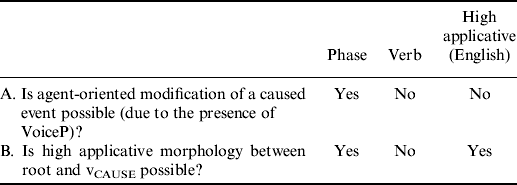
Based on the interaction between causatives and agentivity discussed above, Pylkkänen argued that phase- and verb-selecting causatives are different with respect to how the following two properties correlate (set out in Table 1): (i) whether an agent-oriented adverb can modify a caused event, property A, and (ii) whether vCAUSE can embed a high applicative, property B, as is illustrated in Table 1.
The correlation of complement selection in causatives (adapted from Table 9 in Pylkkänen Reference Pylkkänen2002: 96)
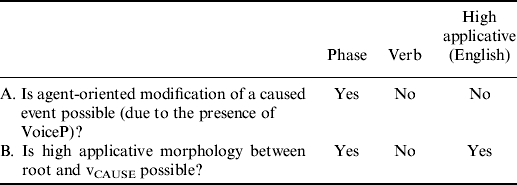
Pylkkänen argues that there is a correlation between properties A and B. Causativization can embed a high applicative, property B in table 1, if agent modification of the caused event is possible, property A, and vice versa. Importantly, according to Pylkkänen, satisfying A indicates that the complement in causatives include VoiceP. Given this, she further argues that causativization can embed a high applicative (B) if it can embed VoiceP (A), and vice versa. In phase-selecting causatives, high applicative morphology between the root and vCAUSE is possible (B) if agent-oriented modification of the caused event is possible (A), and vice versa. In contrast, in verb-selecting causatives, the correlation holds negatively in both directions: B is not possible if A is not possible, and A is not possible if B is not possible.
However, the evidence for the structure for causatives proposed in (5), repeated as (46) below, shows that this correlation does not hold in English, which is also indicated in Table 1: English have causatives embed a high applicative, property B, without embedding VoiceP, Property A. That is, causatives in English are not phase-selecting causatives; nevertheless, they can embed a high applicative, contrary to Pylkkänen's claim.
- (46)
(a) John had Mary pick up the book.
(b)
We also note that English have causatives do not belong to the class of verb-selecting causatives. Although English causatives do not allow agent-oriented modification of a caused event (property A in Table 1) like a verb-selecting causative, vCAUSE can embed a high applicative as a complement (property B in Table 1), unlike a verb-selecting causative. I argue that the complement of English causative have is neither phase- nor verb-selecting, but applicative-selecting. A causative have construction in English takes ApplP as a complement. English causative have constitutes empirical evidence for a new type of a complement selection, expanding the distribution of Appl to causatives.Footnote 35
8.2 Argument-structure licensing by functional heads
Syntactic theories of argument structure suggest that argument structure is licensed by functional syntactic structure (Hale & Keyser Reference Hale, Keyser, Hale and Keyser1993a, Reference Hale and Keyser2002; Borer Reference Borer1994, Reference Borer2005; Harley Reference Harley1995; Marantz Reference Marantz1997; Ritter & Rosen 1998; Travis Reference Travis, Tenny and Pustejovsky2000; Pylkkänen Reference Pylkkänen2002, Reference Pylkkänen2008; Cuervo Reference Cuervo2003; Folli & Harley Reference Folli and Harley2007, although the specifics of functional structure are not the same in all of these works. Aspectual projection approaches argue that functional structure that is interpreted as event structure determines the syntax and the interpretation of arguments (e.g. Borer Reference Borer1994, Reference Borer2005; Ritter & Rosen Reference Ritter and Rosen1997, Reference Ritter, Rosen, Butt and Geuder1998). In such an approach, for example, an aspectual projection (e.g. Asp) responsible for telic interpretation of the event is projected in the syntax. The particular role of an argument as an agent or non-agent is an entailment of the entire event structure.
However, as shown in this paper, the syntax of English have constructions cannot be determined by an aspectual projection: the event involved in causatives is neither always telic nor always atelic. In addition, according to the aspectual head theory, experiencer have does not bear any event structure, which makes a unified approach difficult. I argue that with English have, v and Appl are the syntactic elements at the core of argument structure and not Asp. This does not mean that the aspectual projection approaches to argument structure are entirely incorrect, but it does show that argument-licensing functional structure is not always aspectual. The conjunction of an event-introducer v and an argument-introducer Appl can also play a role in argument licensing. The present account supports the theoretical claim that v and Appl can play a role in argument structure as shown in Pylkkänen (Reference Pylkkänen2008) and in Cuervo (2003), and also that argument structure is licensed by functional syntactic structure.
9. Conclusion
This paper has argued, through the examination of the distribution of English have, that argument structure can be licensed by functional structure, as proposed in many syntactic approaches to argument structure. In particular, this paper argues that the relevant functional heads are an event-introducer v and an argument-introducer Appl, rather than aspectual projections. Moreover, it expands the domain of applicatives: Appl can be a complement in causatives, which was lacking in Pylkkänen's (Reference Pylkkänen2002, Reference Pylkkänen2008) typological classification, and it can merge above Voice, contrary to Pylkkänen (Reference Pylkkänen2002, Reference Pylkkänen2008).
One of the general conclusions that can be drawn from this study is that Appl is an argument-introducing head distinct from Voice, which is also argued in Kim (Reference Kim2011, to appear). Although both Appl and Voice introduce an external argument to vP, in contrast to Voice, Appl allows non-agentive arguments to merge in its specifier. That is, agentivity is specified for Voice, but it is not specified for Appl. Appl has been frequently argued to introduce various types of arguments since the work of Pylkkänen (Reference Pylkkänen2002, Reference Pylkkänen2008). An interesting property of these arguments is that they are all non-agentive. For instance, unintentional causers are found in Spanish (Cuervo Reference Cuervo2003), and affectees in German (McFadden Reference McFadden2004). This supports the conclusion drawn in this paper. Although further research on this issue is needed to reach a firm conclusion, it is clear that the semantic distinction between the two heads is important to the domain of argument structure.