


Introduction
Psychosis is characterised by ‘positive’, ‘negative’ and ‘disorganised’ symptoms (APA, 2013) and affects 3% of people (Kirkbride et al., Reference Kirkbride, Errazuriz, Croudace, Morgan, Jackson, Boydell, Murray and Jones2012; Moreno-Küstner et al., Reference Moreno-Küstner, Martín and Pastor2018; Morgan et al., Reference Morgan, McGrath, Jablensky, Badcock, Waterreus, Bush, Carr, Castle, Cohen, Galletly, Harvey, Hocking, McGorry, Neil, Saw, Shah, Stain and Mackinnon2014; Perälä et al., Reference Perälä, Suvisaari, Saarni, Kuoppasalmi, Isometsä, Pirkola, Partonen, Tuulio-Henriksson, Hintikka, Kieseppä, Härkänen, Koskinen and Lönnqvist2007). Positive symptoms include hallucinations and delusional beliefs. Negative symptoms refer to diminished socialising, pleasure, speech, motivation and emotional affect. Disorganised symptoms encompass challenges with memory, planning, attention and decision-making. Symptoms of psychosis can manifest across several broader diagnostic categories, such as schizophrenia, depression and bipolar disorder, which has implications for treatment.
It should be noted that, whilst psychiatric diagnostic terms, such as ‘psychosis,’ are used in this paper, there are issues with the validity and reliability of these constructs (Scull, Reference Scull2021). Where used, these terms should be regarded as succinct references to individuals that have received a diagnosis of psychosis.
Psychosis symptoms can also present in substance use disorder (SUD), referring to persistent substance use despite adverse consequences, diminished interest in other activities, and the development of tolerance, withdrawal symptoms and intense cravings (APA, 2013). The 12-month prevalence rate of illicit SUD has risen in recent years (Seitz et al., Reference Seitz, Lochbühler, Atzendorf, Rauschert, Pfeiffer-Gerschel and Kraus2019) to 3% (Merikangas and McClair, Reference Merikangas and McClair2012). Moreover, 38% of people with psychosis use substances (Archie et al., Reference Archie, Rush, Akhtar-Danesh, Norman, Malla, Roy and Zipursky2007), and those with more severe psychosis symptoms are at greater risk of SUD (Lechner et al., Reference Lechner, Dahne, Chen, Pickover, Richards, Daughters and Lejuez2013). The relationship between psychosis and substance use (SU) is typically regarded as bi-directional (Masroor et al., Reference Masroor, Khorochkov, Prieto, Singh, Nnadozie, Abdal, Shrestha, Abe and Mohammed2021), with the formulated directionality having significant clinical implications. In some cases, substance use precedes psychosis, and can abate upon abstinence. Indeed, there has been the suggestion that substances can alter dopaminergic neural pathways, elevating risk of psychosis symptoms (Howes and Kapur, Reference Howes and Kapur2009). In others, individuals with psychosis may self-medicate distressing symptoms using substances, such that the removal of substances may increase symptom intensity. Psychosis and SU are both independently associated with poor quality of life (Simirea et al., Reference Simirea, Baumann, Bisch, Rousseau, Di Patrizio, Viennet and Bourion-Bédès2022; Watson et al., Reference Watson, Zhang, Rizvi, Tamaiev, Birnbaum and Kane2018), health problems (Moreno et al., Reference Moreno, Nuevo, Chatterji, Verdes, Arango and Ayuso-Mateos2013; Onyeka et al., Reference Onyeka, Høegh, Eien, Nwaru and Melle2019; Sleurs et al., Reference Sleurs, Dubertret, Pignon, Tebeka and Le Strat2023) and interpersonal difficulties (Daley, Reference Daley2013; Stain et al., Reference Stain, Galletly, Clark, Wilson, Killen, Anthes, Campbell, Hanlon and Harvey2012), underscoring the importance of developing effective interventions for people with co-morbid psychosis and SUD.
Research implicates five processes in SU (West, Reference West2001; West and Brown, Reference West and Brown2013), each with treatment implications. First, substance use is positively reinforcing, as substances can produce pleasant emotions (Wise, Reference Wise2008). This indicates that reducing the extent to which substances are pleasurable may lead to more effective treatments. Second, substance use is negatively reinforcing, as it facilitates avoidance of aversive withdrawal symptoms (Koob and Le Moal, Reference Koob and Le Moal2008). This elucidates the importance of attenuating withdrawal symptoms. Third, substance-related stimuli can become highly salient, elevating desire to use substances when presented with substance-relevant stimuli (Berridge and Robinson, Reference Berridge and Robinson2016). This indicates a need to reduce cravings in response to substance-related cues. Fourth, SU may stem from impaired inhibitory control over impulses (Perry and Carroll, Reference Perry and Carroll2008), highlighting the importance of training clients in self-control. Finally, rational choice theories argue SU represents a logical choice (Lussier et al., Reference Lussier, Heil, Mongeon, Badger and Higgins2006). For example, using substances may avoid unpleasant emotions. This suggests clinicians may wish to support clients to re-evaluate cognitions regarding substance use, perhaps by providing incentives for abstinence and consequences for use.
NICE (2007) guidelines advocate using cognitive behavioural therapy (CBT) to treat SUD. CBT aims to attenuate the positively and negatively reinforcing effects of substances by rewarding abstinence and building coping skills to diminish use and/or maintain abstinence (Brady et al., Reference Brady, Levin, Galanter and Kleber2021). It entails formulating the reasons and triggers for substance use, before altering beliefs regarding substance use and improving interpersonal, emotion regulation and problem-solving skills (McHugh et al., Reference McHugh, Hearon and Otto2010).
Narrative and meta-analytic reviews of randomised controlled trials (RCTs) suggest that CBT produces small, but reliable, improvements in both alcohol and illicit SUDs (Mehta et al., Reference Mehta, Hoadley, Ray, Kiluk, Carroll and Magill2021; Zamboni et al., Reference Zamboni, Centoni, Fusina, Mantovani, Rubino, Lugoboni and Federico2021), with sustained effects 12 months after treatment (Magill and Ray, Reference Magill and Ray2009). Also, meta-analytic reviews of RCTs suggest CBT is an effective intervention for psychosis (Berendsen et al., Reference Berendsen, Berendse, Torren, Vermeulen and de Haan2024). However, individuals with co-morbid SUD and psychosis are typically excluded from treatment trials for SUD, resulting in limited evidence for CBT for SU in people with psychosis (Siddiqui et al., Reference Siddiqui, Mehta, Coles, Selby, Solmi and Castle2024). Whilst one study suggested CBT can reduce cannabis and alcohol use (Kemp et al., Reference Kemp, Harris, Vurel and Sitharthan2007), others indicate CBT is no more effective than treatment as usual for cannabis use (Edwards et al., Reference Edwards, Elkins, Hinton, Harrigan, Donovan, Athanasopoulos and McGorry2006; Naeem et al., Reference Naeem, Kingdon and Turkington2005).
No studies have investigated the efficacy of CBT for use of substances other than cannabis and alcohol in people with psychosis (Kampman, Reference Kampman2019). Investigating stimulant use is particularly critical, as substances like cocaine directly amplify dopaminergic transmission (Howes and Kapur, Reference Howes and Kapur2009), which may uniquely precipitate/exacerbate the positive symptoms of psychosis. Accordingly, this case study reports the outcomes of CBT for cocaine use in an individual with psychosis.
Presenting problem
Referral history
Pascal (pseudonym) was a 50-year-old, white, heterosexual, atheist man from southern England. He was referred to an Early Intervention for Psychosis Service following auditory hallucinations of a woman masturbating and paranoia that his partner was having an affair. These symptoms ceased following stabilisation on psychotropic medications. Pascal had struggled with cocaine use for 30 years and had received support from a local specialist service, in which a support worker attempted to help him abstain from cocaine. He was referred to psychology due to continued difficulties with cocaine use.
Assessment
Across two 1-hour sessions, Pascal disclosed regular cocaine use. Pascal described using increasing quantities of cocaine over time, such that it was occupying large amounts of his time as he was using multiple times a week, and described a reduced ability to resist using cocaine. He felt ashamed because of strong urges to use cocaine. Whilst this started in a social context, he had started using cocaine alone too. Also, he described negative effects of cocaine use on his relationships with his partner and friends, including feeling isolated and lonely. Additionally, Pascal discussed feeling unmotivated to exercise, sleeping for extended periods and regularly napping. Ultimately, these difficulties left him feeling empty and low in confidence. Whilst Pascal no longer experienced symptoms of psychosis, he reflected that his first episode of psychosis appeared to be drug-induced, as it coincided with increasingly high rates of cocaine use. Accordingly, he was concerned that continued use would culminate in another episode of psychosis.
Goals
Pascal hoped to achieve several goals by the end of therapy, each of which were made specific, measurable, achievable, realistic and time-limited (Kennerley et al., Reference Kennerley, Westbrook and Kirk2016). First, Pascal wanted to reduce his cocaine use from weekly to complete abstinence and stop his urges to use cocaine. Second, he wanted to understand the effect of his past experiences on his substance use. Third, Pascal wanted to reduce the amount of time he spent sleeping to 9 hours per night and reduce the duration of naps to 30 minutes per day. Fourth, he wanted to improve his connectedness with both his partner and friends. Fifth, Pascal wanted to reduce his feelings of shame, loneliness, emptiness and low confidence. Finally, he wanted to exercise more frequently, but did not consider this a priority. As Pascal’s positive symptoms of psychosis had remitted by therapy onset, he did not feel it necessary to work on this.
Formulation
Beck’s (Reference Beck1979) longitudinal formulation was used to collaboratively conceptualise the influence of Pascal’s experiences on his SU (see Fig. 1).
Formulation.

As a child, Pascal’s mother used alcohol and would tell Pascal that he was responsible for her mental health difficulties. When he was eight, Pascal’s mother was admitted to a psychiatric hospital for four years. During this time, Pascal was repeatedly sexually abused by his uncle. When Pascal disclosed this to his parents, they did not believe him. As an adult, Pascal was also a victim of business fraud, which left him feeling guilty because his staff became unemployed.
Feeling blamed for his mother’s mental health problems appeared to culminate in Pascal’s core beliefs, ‘I am selfish and to blame for the problems of myself and others’. This was reinforced by the guilt he felt following losing his business. Also, being accused of lying about sexual abuse and a victim of fraud seemingly left Pascal with the core belief of ‘others could not be trusted’ and ‘I am unimportant and useless’.
Believing ‘I am selfish and useless’ appeared to culminate in the assumption that he would make the lives of others worse. Accordingly, Pascal withdrew from his friends, family and partner, so as to avoid risking making their lives worse. Relatedly, Pascal believed ‘others’ problems are my fault’. These assumptions contributed to Pascal ending his marriage, as he thought his family were ‘better off without him’. Also, after his parents did not believe his allegations of sexual abuse, he was seemingly left with the assumption ‘others will not care and/or believe me if I disclose problems’. Moreover, Pascal voiced expecting to feel worse after disclosing upsetting emotions, which he attributed to feeling isolated and blamed following attempts to seek support for sexual abuse. In light of these assumptions, Pascal refrained from expressing his difficulties and emotions to himself and others, in part through the use of cocaine to diminish upsetting emotions.
Regarding triggers, Pascal identified increased urges to use substances when having upsetting memories of his mother or sexual abuse and/or experiencing guilt, regret, shame, emptiness, anxiety and grief, which often accompanied these upsetting memories. Also, as Pascal had used substances for many years, he had associated many contextual cues with using drugs, including locations and times of the week.
Upsetting memories culminated in negative automatic thoughts (NATs) that Pascal could not trust others and that the sexual abuse and his mother’s difficulties were his fault. Accompanying negatively valanced emotions also left Pascal with the NAT that he needed cocaine to cope with these upsetting emotions. These NATs left Pascal feeling ashamed, aggrieved and regretful. These feelings were often associated with low arousal and tiredness. Furthermore, the NAT that he cannot trust others or cope with upsetting emotions typically left Pascal feeling anxious, due to uncertainty of what will happen if he does and does not use cocaine.
Ultimately, Pascal coped by using cocaine and sleeping excessively to suppress negatively valanced emotions and upsetting memories. The stimulating effects of cocaine seemingly attenuated physiological symptoms of low arousal and tiredness. Also, Pascal discussed withdrawing from others to avoid confronting upsetting emotions. However, these behaviours appeared to reinforce beliefs that he is selfish and to blame for his problems, as SU and excessive sleeping upset his partner. Moreover, substance use reinforced the belief that he is useless, as he felt under-skilled to cope with negatively valanced emotions and upsetting memories. Indeed, Pascal recognised that these safety-seeking behaviours served to avoid upsetting beliefs that ‘others could not be trusted’ and ‘I am unimportant and useless’.
Alternative explanations for Pascal’s difficulties were considered. For example, Pascal’s upsetting memories of his mother and sexual abuse may have indicated post-traumatic stress disorder (PTSD). However, these memories did not resemble flashbacks, as they were not involuntary, vivid, multi-sensory experiences and Pascal did not lose awareness of his surroundings (Ehlers and Clark, Reference Ehlers and Clark2000). Therefore, a PTSD-based formulation was regarded as a weaker explanation of his difficulties.
Outcome measures
Pascal completed the Drug Use Disorder Questionnaire (DUDQ; Scherer et al., Reference Scherer, Furr-Holden and Voas2013) during the first and final sessions. The scale consists of four and eight items measuring substance use and dependence, respectively. Higher scores indicate more severe SU. Unfortunately, studies have not identified ‘reliable change thresholds’, resulting in difficulty determining whether meaningful changes occurred. Evidence for the validity of the DUDQ comes from reports that higher scores are associated with greater cocaine use (Scherer et al., Reference Scherer, Furr-Holden and Voas2013). Support for the scale’s reliability comes from factor analytic demonstrations that items load onto appropriate latent variables, suggesting use and dependence represent distinct constructs, and reports that Cronbach’s (Reference Cronbach1951) alpha indicated strong internal consistency (Scherer et al., Reference Scherer, Furr-Holden and Voas2013).
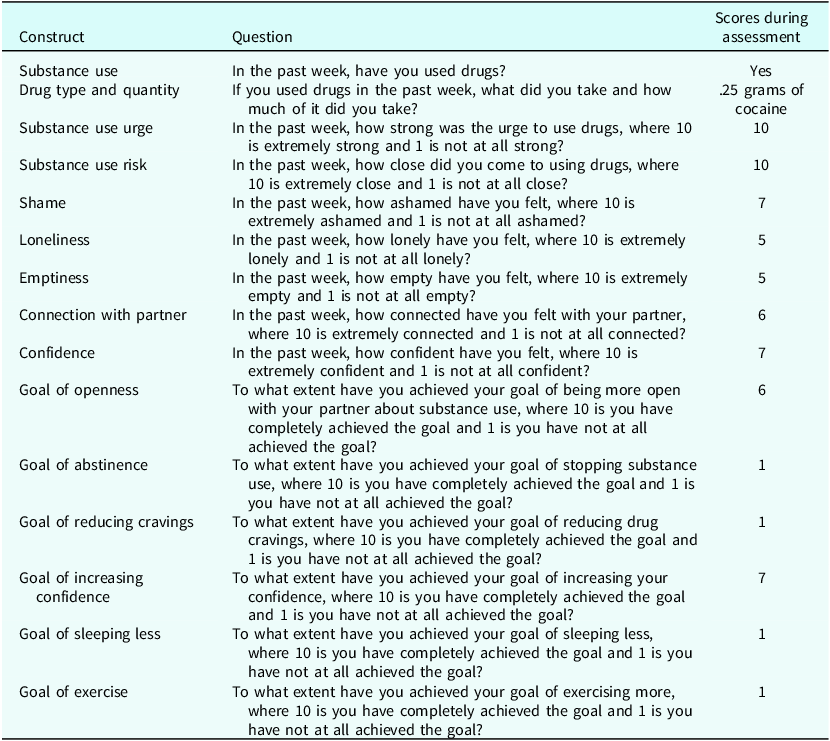
Idiographic measures were collaboratively devised to measure Pascal’s progression towards his goals. These questions and the constructs they aimed to examine are detailed in Table 1. Each construct was unambiguously operationalised through definitions. The relevance of the measures to Pascal’s goals substantiates their criterion validity. Also, the test‒retest reliability of the items is supported by their relative stability during baseline (see Table 2). Importantly, baseline stability was unlikely to be influenced by measurement insensitivity, as most changed during the intervention.
Idiographic measures

Table 1. Long description
A table with 14 rows and 3 columns detailing idiographic measures for substance use and related goals. The columns are labeled Construct, Question, and Scores during assessment. The table includes constructs such as Substance use, Drug type and quantity, Substance use urge, Substance use risk, Shame, Loneliness, Emptiness, Connection with partner, Confidence, Goal of openness, Goal of abstinence, Goal of reducing cravings, Goal of increasing confidence, Goal of sleeping less, and Goal of exercise. Each row provides a specific question related to the construct and the corresponding score during assessment. For example, the first row under Substance use asks if drugs were used in the past week, with a yes or no answer, and the score is .25 grams of cocaine. The table captures various aspects of substance use and personal goals, providing a detailed assessment of the individual’s progress and feelings.
Quantitative analyses

Table 2. Long description
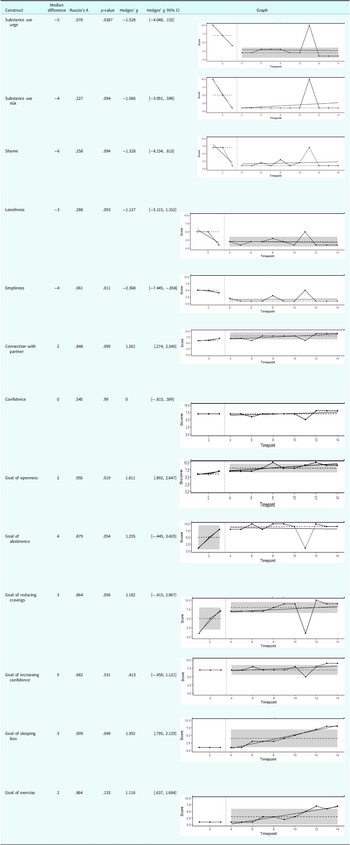
The image contains a table and multiple line graphs. The table lists constructs, median differences, Ruscio’s A, p-values, Hedges’ g, and Hedges’ g 95% CI. The line graphs plot scores over time for each construct. Panel A shows substance use urge, risk, shame, loneliness, emptiness, and connection with partner. Panel B shows confidence, goal of openness, and goal of abstinence. Panel C shows goal of reducing cravings, goal of increasing confidence, goal of sleeping less, and goal of exercise. Each graph has timepoints on the x-axis and scores on the y-axis. Trends and patterns vary across constructs, with some showing increases and others decreases over time.
‘Median difference’ refers to the change in median scores between the baseline and intervention phases. ‘Hedges’ g 95% CI’ refers to the 95% confidence interval (CI) of the effect size. Graphs display scores in each session. Median scores in baseline and intervention phases are displayed using a dotted line. Trend lines are also depicted for each phase. The median absolute deviation from the median is shown in shaded regions.
During the assessment, Pascal scored 10/12 on the DUDQ. His scores on idiographic measures are shown in Table 1. Collectively, these measures suggested Pascal was struggling with severe SU.
Design
An AB design was used, with ‘baseline’ and ‘intervention’ phases. As idiographic measures were introduced in session 3, scores for earlier sessions were retrospectively estimated by Pascal; they were administered in every session thereafter. These goal-based idiographic measures were introduced in the third session because Pascal’s goals were only established in the second session. Baseline measures were collected for three sessions, spanning the assessment and psychoeducation sessions; the intervention phase spanned the 11 subsequent sessions. The assessment and psychoeducation sessions were included in the baseline phase as these sessions were not expected to change Pascal’s thoughts, feelings or behaviours. Also, extra-therapy events were assessed in each session (e.g. relapses), to identify relevant confounds. To avoid burdening Pascal with too many measures, the DUDQ was not administered each session.
Inspection of scores on idiographic measures (see Table 2) suggests Pascal’s scores were relatively stable during the baseline phase. This indicates that factors such as spontaneous recovery, high measurement variability, regression to the mean and alterations to the measure’s sensitivity over time and/or with repeated use are unlikely to underpin any significant changes in scores across therapy (Morley, Reference Morley2017; Myles and Jones, Reference Myles and Jones2024).
Analysis
Inspection of DUDQ scores was used to examine whether Pascal exhibited changes across phases. Given the low inter-rater reliability of visual inspection (Ximenes et al., Reference Ximenes, Manolov, Solanas and Quera2009), Ruscio’s (Reference Ruscio2008) ‘A’ with 10,000 bootstrapped samples, a non-parametric test examining the probability that a randomly selected data point in the baseline phase is lower than a randomly selected data point in the intervention phase, elucidated whether there were statistically significant (p < .05) differences in idiographic measures between phases (Hussey, Reference Hussey2019). Hedges’ (Reference Hedges1981) g was reported, with values of .2, .5 and .8 considered small, medium and large effects, respectively (Cohen, Reference Cohen1988). The median absolute deviation from the median is shaded on graphs depicting the data.
Hypotheses
It was hypothesised that, following the introduction of the intervention, Pascal would demonstrate statistically significant improvements across both standardised and idiographic self-report measures, compared with the baseline period.
Primary hypothesis
The primary hypothesis was that the intervention phase would be associated with a cessation of self-reported cocaine use and a measurable reduction in self-reported urges and risk of drug use.
Secondary hypotheses
It was further hypothesised that the intervention phase would yield significant improvements in broader psychosocial and lifestyle domains. Specifically, it was hypothesised that the intervention phase would yield reductions in his self-reported feelings of shame, loneliness and emptiness, alongside decreased sleep duration (approximating 9 hours per night with a maximum of a 30-minute nap). Also, greater self-reported connection with his partner and friends, confidence and exercise were predicted.
Course of therapy
Consistent with NICE (2007) guidelines, Pascal received two assessment sessions and 11 sessions of CBT using the protocols of Brady et al. (Reference Brady, Levin, Galanter and Kleber2021) and McHugh et al. (Reference McHugh, Hearon and Otto2010).
Session 3: Psychoeducation
The CBT model was introduced, emphasising its collaborative and time-limited approach (Kennerley et al., Reference Kennerley, Westbrook and Kirk2016). Two illustrative examples were used to consolidate his understanding, whereby Pascal formulated both irrelevant (dog phobia) and relevant (apprehensions about attending therapy) scenarios to his difficulties. For homework, Pascal independently formulated a scenario.
Sessions 4–6: Formulation
To understand the effect of his experiences on substance use, the formulation was collaboratively devised. Socratic questioning and downward arrowing were used to elucidate the effects of Pascal’s experiences on his core beliefs and assumptions (Westbrook et al., Reference Westbrook, Kennerley and Kirk2011). As Pascal found the size of the formulation overwhelming, Kennerley et al.’s (Reference Kennerley, Westbrook and Kirk2016) ‘Blobby’ model was used to simplify the formulation (see Supplementary material 1), which Pascal found helpful. Formulation was intended to reduce Pascal’s shame for substance use (Gilbert, Reference Gilbert2014), by highlighting he was not solely responsible for his difficulties, and elicit motivation to change.
Sessions 7–8 and 11: Relapse prevention
In line with his goals of abstinence and reducing urges to use cocaine, Pascal was supported to problem solve individual (e.g. cognitive, emotional, physical and behavioural) and interpersonal risk and protective factors for substance use. Coping and emotion regulation strategies that lowered his risk of substance use were collaboratively identified to mitigate the negative reinforcing effects of abstinence and enhance his confidence in coping without drugs. These included connecting with his partner, discussing difficult emotions in therapy, regular home drug testing to aid accountability, having structure and stability in his day-to-day life, seeing his children and supporting others with their difficulties. For homework, Pascal ordered home drug test kits, so that he could share their results with his partner, to enhance his openness and accountability. Following successful weeks of abstinence, Pascal was praised and prompted to reflect on the benefits to reinforce abstinence.
Prior to session 11, Pascal relapsed. This relapse was formulated, and Pascal was prompted to reflect on the parallels with previous relapses (Gumley, Reference Gumley2007). He wrote a letter for himself to read when craving substances to promote inhibition. This anticipated his thoughts, feelings and urges and reminded him of the consequences of SU, the benefits of sobriety and that using drugs makes him feel worse. Pictures of his partner and children were included, and alternative actions were suggested. Also, the risk of accessing drugs was reduced, as Pascal asked his friends not to use drugs when with him and we rehearsed declining offers of drugs. This aimed to reduce the likelihood he would buy drugs, promote inhibition of urges and challenge beliefs drugs will be pleasurable. Finally, Pascal was encouraged to delete the contact information of drug dealers.
Session 9: Relationships
In accordance with his goal of improving his connectedness with his partner, systemic techniques were used to support Pascal to identify the relationship between his actions and his partner’s thoughts, feelings and actions (Dallos and Draper, Reference Dallos and Draper2015; Dallos and Vetere, Reference Dallos and Vetere2018). Using the reciprocal CBT formulation (Graham and Reynolds, Reference Graham and Reynolds2013; see Supplementary material 2), Pascal concluded that telling his partner she ‘is barking up the wrong tree’ when she voiced worries about him relapsing exacerbated her worries. Role-playing alternatives led Pascal to subsequently respond by empathising with his partner’s concerns and offering reassurance that he is not using substances. This aimed to reduce his withdrawal from his partner when experiencing upsetting emotions, and thus his risk of substance use. Also, Pascal withdrew from friends during psychosis. Following encouragement to contact these friends, he began regularly socialising with them. This aimed to attenuate Pascal’s sense of loneliness and emptiness, by increasing his connection with others (Gilbert, Reference Gilbert2014).
Sessions 10–13: Sleep
Consistent with his goal of reducing his sleep to 9 hours per night with one 30-minute nap per day, diaries were used to examine Pascal’s sleep. Various strategies were discussed to establish a more stable sleep cycle, including setting a bedtime of 22:00, setting a wake time of 07:00, playing music and turning on his lamp when waking up, avoiding alcohol during the week, and using a high lux light, going for a walk, cooking, going outside, watching TV, wetting his face, stretching and reading the news when he was tired too early in the evening (Freeman and Waite, Reference Freeman and Waite2025).
Session 14: Ending session
By session 14, Pascal said his goals had been achieved. A letter summarising the assessment, formulation, intervention and outcomes was read to him, and he had the opportunity to reflect on the progress made across therapy.
Feedback
At the end of each session, Pascal was asked for feedback and improvement suggestions. For example, when Pascal voiced feeling apprehensive about discussing difficult emotions, a ‘buzzer’ was developed that Pascal could ‘press’ if he did not want to answer a question. Also, after Pascal voiced finding formulation sessions upsetting, the therapist more regularly checked how he was feeling.
Outcomes
Whilst Pascal used .25 g and 3 g of cocaine prior to sessions 1 and 11, he did not use drugs at any other point during therapy. He ‘had not abstained for this long in 20 years’ and described ‘feeling in control of urges to use substances’. Also, Pascal said formulation sessions ‘helped him to understand the relationship between his trauma and SU’. Furthermore, by session 13, Pascal was regularly going to sleep at 22:00 and waking at 07:00, having naps lasting 30 minutes approximately twice a week. Finally, Pascal described feeling ‘more confident and connected with others’, citing examples of ‘reconnecting with friends’. Relatedly, he discussed feeling ‘more connected’ with his partner ‘after being open about substance use’, which he believed helped his partner to ‘feel less worried about relapse’. Finally, Pascal reported no resurgence of symptoms of psychosis across therapy.
Quantitatively, Pascal’s DUDQ scores reduced from 10/12 pre-therapy to 0/12 post-therapy. Quantitative analyses examining changes in idiographic measures are shown in Table 2. By the end of therapy, Pascal said he was ‘satisfied with scores across all measures’ and had ‘achieved his goals’. Statistically significant improvements were observed for Pascal’s urges to use drugs, feelings of emptiness, openness with his partner and sleep. Trends towards significant improvements were identified for his risk of SU, cocaine abstinence, cocaine cravings, connection with his partner and feelings of shame and loneliness. No significant differences were observed for Pascal’s self-reported confidence or exercise; however, scores numerically improved for exercise.
Discussion
This case study investigated the efficacy of CBT for SU in an individual with psychosis. The results suggest that CBT improved his urges to use drugs, feelings of emptiness, openness with his partner and sleep. Also, there was tentative evidence that CBT improved his risk of SU, cocaine abstinence, cocaine cravings, connection with his partner and feelings of shame and loneliness. Moreover, qualitative reports indicated CBT improved his understanding of the effect of his past experiences on his SU. However, CBT did not produce statistically significant changes in his self-reported confidence or exercise. Nevertheless, Pascal achieved his longest period of abstinence in 20 years and reported feeling more confident and connected with others, including his partner.
These findings are consistent with previous research indicating that CBT effectively attenuates SU (Kemp et al., Reference Kemp, Harris, Vurel and Sitharthan2007; Magill and Ray, Reference Magill and Ray2009; Mehta et al., Reference Mehta, Hoadley, Ray, Kiluk, Carroll and Magill2021; Zamboni et al., Reference Zamboni, Centoni, Fusina, Mantovani, Rubino, Lugoboni and Federico2021). This suggests attenuating the positively and negatively reinforcing effects of substance use by rewarding abstinence and building coping skills to maintain abstinence improves SU (Myles et al., Reference Myles, Connolly and Stanulewicz2020; Myles et al., Reference Myles, Merlo and Obele2021). Also, these results are consistent with previous studies suggesting that CBT attenuates feelings of emptiness (Hayes, Reference Hayes2019), relationship difficulties (Epstein and Falconier, Reference Epstein and Falconier2014; Kavitha et al., Reference Kavitha, Rangan and Nirmalan2014; Maleki et al., Reference Maleki, Madahi, Mohammadkhani and Khala’tbari2017) and sleep difficulties (Maurer et al., Reference Maurer, Schneider, Miller, Espie and Kyle2021; Maurer and Kyle, Reference Maurer and Kyle2022; Taylor and Pruiksma, Reference Taylor and Pruiksma2014). Moreover, Pascal’s relapse in session 11 may have been helpful in reinforcing the use of previously discussed coping strategies (e.g. limiting exposure to those using substances), as well as develop new coping strategies to attenuate the risk of subsequent relapses (e.g. writing the letter to himself).
The results also provide indirect support for theories of SUD on which CBT is based. Specifically, as positive reinforcement, promotion of inhibitory control and alterations to cognitions attenuated SU (Lussier et al., Reference Lussier, Heil, Mongeon, Badger and Higgins2006; Perry and Carroll, Reference Perry and Carroll2008; Wise, Reference Wise2008), this tentatively suggests these processes may entail a role in SU. However, further experimental research is required before causality can be inferred.
Importantly, these results are not readily attributable to changes in measurement sensitivity or measurement error across sessions, as most scores were relatively stable during baseline and at the end of therapy. Nevertheless, extraneous factors may underpin some results (Myles and Merlo, Reference Myles and Merlo2022; Myles and Johnson, Reference Myles and Johnson2023). For example, deleterious changes in scores in session 11 are likely attributable to his relapse.
However, statistically significant changes were not observed for Pascal’s self-reported risk of SU, feelings of shame, feelings of loneliness, confidence or exercise. Consistently low/high ratings on some of these measures (e.g. risk of substance use) may account for the lack of change. Also, large variance in baseline scores may have obfuscated changes in his shame, risk of SU and loneliness. This interpretation is supported by notable reductions in median scores from the baseline to the intervention phase, including a 6-point drop in shame, a 4-point drop in risk of SU risk, and a 3-point drop in loneliness. Relatedly, as therapy focused on some difficulties only later in therapy (e.g. exercise, as part of sleep work), inclusion of earlier sessions in the intervention, rather than baseline, phase may have resulted in large variance in intervention scores, erroneously inflating p-values. For example, whilst Pascal rated his exercise as 1/10 for the first 6 weeks of therapy, his scores increased to a mean of 6.66/10 in the final three sessions, but this change did not reach the threshold for statistical significance. Furthermore, whilst Pascal’s connection with his partner and exercise increased across therapy, their smaller effect sizes may have diminished statistical power. Again, this proposition is supported by improvements in median scores from the baseline to the intervention phase, reflected in 2-point increases in both his connection with his partner and engagement in exercise.
Other interventions could have improved Pascal’s risk of SU, feelings of shame, feelings of loneliness, confidence and exercise. For example, compassion-focused therapy may have attenuated shame (Gilbert, Reference Gilbert2014), behavioural experiments to expand his social network may have reduced loneliness and CBT to bolster self-esteem may have improved his confidence (Fennell, Reference Fennell2016).
Limitations and future research
This case study entails several limitations. First, as Pascal retrospectively estimated scores during assessment sessions, their validity is compromised, as he may have failed to accurately remember how he felt in previous sessions. Indeed, retrospective estimation of some scores may have increased the stability of scores during baseline. Second, as the onset of the intervention was not systematically manipulated, factors unrelated to therapy, but coinciding with the intervention, may have contributed to improvements. Relatedly, as this study reports findings from a single case, the generalisability of these results is limited. Randomised controlled trials should determine whether CBT represents an effective and generalisable therapy for SU in those with psychosis. Third, as some tests were under-powered, future replications would benefit from longer baseline phases. Relatedly, as changes in scores were predominantly incremental, the range of scores in the intervention phase may have diminished effect sizes, limiting the detection of significant differences between phases. Fourth, the lack of measurement of psychotic symptoms across phases precludes the examination of potential confounding effects of psychosis symptoms on SU. Finally, Pascal’s understanding of each measure may have changed across therapy. However, definitions of scale constructs were regularly reviewed to circumvent these issues. Nevertheless, future replications should standardise measures by clearly defining the criteria for each point on the scale.
Conclusion
This case study tentatively suggests CBT is an effective intervention for SU in those with psychosis.
Key practice points
-
(1) Cognitive behavioural therapy (CBT) should be considered a viable intervention for substance use (SU) in clients with psychosis, as it can lead to significant improvements in urges, abstinence and quality of life.
-
(2) Clinicians should consider using idiographic measures to track client-specific goals alongside standardised measures, as this allows for the detection of meaningful personal change.
-
(3) Incorporating systemic techniques, such as the reciprocal CBT formulation, can be effective in breaking negative interpersonal cycles that reinforce substance use, thereby enhancing social support.
-
(4) Addressing lifestyle factors, particularly sleep hygiene, can be a crucial component of therapy for clients with psychosis and SU.
-
(5) A shared formulation that normalises difficulties and links them to past trauma can help reduce shame and facilitate a strong therapeutic alliance.
Supplementary material
To view supplementary material for this article, please visit https://doi.org/10.1017/S1754470X26100890
Data availability statement
All raw data are presented in the paper.
Acknowledgements
I would like to thank Dr Emmeline Goodby for her valuable and insightful comments on the draft of this manuscript.
Author contributions
Liam Alexander MacKenzie Myles: Conceptualization-Equal, Data curation-Equal, Formal analysis-Equal, Investigation-Equal, Methodology-Equal, Project administration-Equal, Resources-Equal, Software-Equal, Visualization-Equal, Writing - original draft-Equal, Writing - review & editing-Equal.
Financial support
There was no funding associated with this paper.
Competing interests
The author has no competing interests.
Ethical standards
This paper abided by the Ethical Principles of Psychologists and Code of Conduct as set out by the British Association of Behavioural and Cognitive Psychotherapists and the British Psychological Society. Also, the client provided informed consent for this case report to be published as an academic paper. No further ethical approval was provided because this paper reports the outcomes of routine clinical practice. Nevertheless, strict governance arrangements were in place and the work was conducted in accordance with Oxford Health NHS Foundation Trust’s clinical governance guidelines.



 Open access


Comments
No Comments have been published for this article.