


America is a suburban nation.1
By suburb, we mean generally any incorporated municipality or township that is within or very close to a metropolitan area but not in a central city.
Nowhere is this information gap greater than with respect to local elections. Every year, thousands of suburban municipalities, townships, and special districts in the United States hold elections for local councils, mayoral offices, board members, and other posts. Although these elections arguably represent the most immediate democratic experience for a majority of Americans, political scientists have little understanding of what determines vote choice in these settings. Among the voluminous literature on electoral choice since the beginning of American National Election Studies (ANES), the vast majority of articles and books have concentrated on national and, particularly, presidential elections.2
Berry and Howell (2006) estimate that 99% of articles in the leading political science journals that investigated the dynamics of elections (i.e., campaigns, electoral behavior, and electoral system) focused on presidential, congressional, or gubernatorial elections.
Nor have local elections figured prominently in the field of urban politics. Outside of research on political machines and ethnic coalitions in large cities (e.g., Erie 1988; Jones-Correa 2001), previous studies of urban politics have relegated the topic of vote choice to a place of minor consideration. The most prominent studies of local politics have focused primarily on the role of elites (Dahl 1961; Stone 1989), the impact of municipal competition (Peterson 1981), or the potential of minority empowerment (Browning, Marshall, and Tabb 1997; Welch and Bledsoe 1988), with research drawn largely from bigger cities. Indeed, some theories, such as Tiebout's (1956) seminal public choice model, discount the local electoral process entirely, assuming that citizens in fragmented metropolitan areas express their preferences by voting “with their feet” rather than at the ballot box. Among the few studies of suburban politics (e.g., Dreier, Mollenkopf, and Swanstrom 2001; Lewis 1996), none have examined local electoral behavior, focusing instead on institutions and their relationships with the larger metropolis.
This paucity of research actually reflects a much larger gulf in the political science literature on democracy in a variety of smaller contexts. In voluntary civic associations, in many workplaces, corporate boards, churches, and schools, and in countless smaller social units within American society, people are called on to participate and vote in democratic elections. Such micro-elections may be the “schoolrooms of democracy,” the places where citizens learn the basics of collective decision making (Putnam 2000), but as with suburban municipal elections, political scientists know very little about how people make their vote choice, especially when partisanship or economic evaluations are not germane.
Looking to explain how democracy works in such smaller contexts, this article develops and tests new theories about voter behavior in American suburban elections. After reviewing the literature on both vote choice and suburbanization, we question whether prevalent vote choice models will be germane in most local elections and theorize on how a community's political institutions and social composition will affect its electoral politics. Contrary to popular stereotypes, we find that suburban voters represent a highly engaged, yet unrepresentative portion of the citizenry. Like voters in other contests, suburban voters base their choices on issue positions, subjective candidate evaluations, partisanship, and general evaluations of administrative performance. These patterns of citizen engagement and voter behavior differ, however, with the social and institutional composition of the place. From these findings, we update perspectives on suburban politics in particular and on electoral behavior in micro-contexts in general.
WHAT DIFFERENTIATES SUBURBAN ELECTIONS FROM OTHER ELECTIONS
Most of our knowledge about the way ordinary people vote comes from the vast body of literature on presidential elections. Ever since the development of the “Michigan model,” scholars have explained national voting, to a greater or lesser extent, relative to four factors: partisan affiliation, evaluations of national economic conditions, the candidates' stances on salient issues, and candidate likeability (Campbell et al. 1960; Miller and Shanks 1996). There are many reasons, however, to question whether this robust model of presidential voting is applicable for most local elections in the United States. First, over three-quarters of its municipalities have nonpartisan elections (Wood 2002). Although nonpartisan elections do not necessarily preclude the formation of local political organizations, such groups tend to be local coalitions of various neighborhood groups or slates of candidates that have little relationship to the national parties (Lee 1960). In the absence of a party moniker, one of the most salient cues for voters on the ballot, and a fundamental predictor of vote choice, is gone.
Second, suburban electoral decisions may reflect voter evaluations of incumbent performance, but the criteria they will utilize to make their judgments are hard to know. In national elections, such retrospective judgments hinge primarily on the economy and foreign military involvement (Aldrich, Sullivan, and Borgida 1989; Nadeau and Lewis-Beck 2001), yet it is unlikely that concerns of “peace and prosperity” will have the same impact on local contests. Some evidence suggests that local economic circumstances, such as a deflated real estate market, may be harmful to local incumbents (Mondak, Mutz, and Huckfeldt 1996), but it is doubtful that suburbanites will hold their local council officials accountable for the deteriorating economy or unsuccessful wars. Although some locally elected officials have specific responsibilities, such as with mosquito zones or school boards, most mayors and council members are responsible for a wide range of tasks, thus making it difficult to specify any one barometer of incumbent performance, barring a particular scandal or malfeasance, that would hold across all municipalities at all times.
Third, the influence of specific issues or subjective candidate appraisals in suburban elections is also questionable given the low visibility of politics in most localities. The American citizenry is already notoriously underinformed about national issues, candidates and their policy positions, or politics in general (Delli Carpini and Keeter 1996); thus it is hard to imagine that they would be any more attentive to or informed about local issues. And even if voters can overcome information shortfalls (Sniderman, Brody, and Tetlock 1991), it is unclear how well citizens can recognize candidate positions on pedestrian issues as zoning ordinances, bond issues, road maintenance, and so forth (Lowery and Lyons 1989; Teske et al. 1993). This information deficit may be exacerbated in suburban places without indigenous news sources or local political organizations.
In short, for electoral contests where partisan cues are usually absent, candidates have few resources for self-promotion, and issues are of questionable salience, the “classic” determinants of vote choice may simply be irrelevant. If this is the case, then what factors might be shaping voter behavior? Studies of city and congressional elections have identified other factors relating to vote shares, including incumbency advantages (e.g., Jacobson 2001; Krebs 1998), campaign spending (e.g., Arrington and Ingalls 1984), and support of local party organizations and newspapers (e.g., Ansolabehere, Lessem, and Synder 2006; Lieske 1989). In addition, racial and gender cues also exert considerable influence over local voting decisions, with black, white, or female voters typically choosing black, white, or female candidates, respectively (Svara 1991; Welch 1990). Although it is likely that incumbency and some of these other factors are also important for suburban elections, it is not self-evident that they will operate across all suburban locales in the same manner as in large cities or congressional races. Most suburban communities do not have their own papers or news sources; many are racially homogeneous (thus removing racial cues), and campaign spending would be less important where television advertising is not a prerequisite for electoral success.
The existing literature on local elections provides few other clues about what might drive vote choice in suburban contests. Partly, this is because the distinct patterns of individual voting behavior in local elections are largely unknown: most studies of local elections utilize aggregate vote shares in precincts or council districts (e.g., Lieske 1989) and any individual inferences drawn from such data are subject to ecological fallacy (Achen and Shively 1993). Meanwhile, the few studies that have data on individual voters are nearly all of one or two cities (e.g., Kaufmann 2004; Sonenshein 1993), thus making it impossible to gauge the impact of different electoral or social environments. Scholars of big-city elections rightly presume a plurality of interests, significant divisions along racial or economic lines, a relatively large electorate, and high political coverage by local news sources; yet, such assumptions may not be met in many suburban locales, which are highly varied in their population sizes, racial and economic composition, land usages, age, and institutional arrangements (Oliver 2001).
Given these considerations, it is essential to identify factors specific to electoral politics in suburban locales or other micro contexts that would, in turn, affect the suitability of existing models or demand the formation of new hypotheses. The first of these is the social and institutional composition of the suburb itself. Suburbanization has had seemingly contradictory effects on the local political life of metropolitan America. On the one hand, it has fragmented America's sprawling urban areas into a patchwork of small and independent polities. This fragmentation tends to draw people into local politics: residents of smaller places tend to participate more and be more engaged in community affairs (Oliver 2001). On the other hand, political fragmentation has created a number of communities that are quite homogeneous in their racial and economic composition. When suburban municipalities use zoning codes, deed restrictions, and other mechanisms to exclude large portions of the metropolitan population, they effectively preempt much of the political conflict that occurs within larger cities. As a result, residents of more homogeneous communities are typically less interested in local politics and less active in civic affairs (Oliver).
These internal dynamics are also affected by the institutional arrangements of the suburban governments. Many suburban municipalities have adopted “reform-style” practices of governance: replacing mayors with councils and professional managers, eliminating council districts for at-large jurisdictions, and holding nonpartisan elections. Forged in response to the perceived corruption of urban machines, these reform practices also serve to pacify local politics, making it difficult for local interests to organize political campaigns, mobilize key constituents, and practice patronage politics (Bridges 1997). Not surprisingly, voter turnout in places with reform-style institutions is usually lower than turnout in places with pre-reform governments (Hajnal and Lewis 2003). Because the social and institutional composition of a suburb has such profound effect on its political life, these factors should also influence both the dynamics of local campaigns and elections and the residents' electoral decisions.
Therefore, our first hypothesis is that the impact of traditional determinants of vote choice (i.e., incumbency evaluations, partisanship, candidate issue positions, and likeability) will vary in relation to two contextual dimensions of the particular suburb: its population size and the amount of internal political conflict it encompasses. In larger places, voters will be less interested or informed about local elections and thus more likely to support incumbents, in the absence of any other information (Zaller 2004). In smaller places, voters should be more interested and informed, thus more likely to know and support challengers to office. In places with more articulated conflict (i.e., more socially diverse suburbs with mayoral and partisan elections), we expect political campaigns to be more active, candidates and political groups to be more visible, and voters to be more interested in the elections and mobilized by partisan groups. As a result, they will be less likely to reflexively support incumbents and more likely to have particular issue positions that inform their vote choices. Conversely, in places with less articulated conflict (i.e., more homogeneous suburbs with reform-style institutions), voters are probably less likely to be interested or aware of local political controversies, more likely to support incumbents, and be less informed by issues positions.
Suburban electoral behavior also should be differentiated by the particular character of the suburban electorate. Electoral turnout is significantly lower in local elections, particularly when they are nonconcurrent with presidential or congressional election cycles (Hajnal and Lewis 2003; Wood 2002). Voters in off-cycle elections are less representative of the general population and are more likely to be those “stakeholders” within their communities, that is, parents of school-age children and older, home-owning, long-term residents (Fischel 2001). These nonrepresentative distortions may be exacerbated in many suburbs that have reform-style political arrangements, which serve to depress turnout even further. Thus our second hypothesis is that the distinctive composition of the electorate will have a major impact on the determinants of vote choice. “Stakeholders” are likely to be more informed and interested in local politics, and they are more likely to have their vote choices shaped by particular issues or knowledge about the different candidates. In other words, the greater the level of selective differences in participation, the more likely that information shortfalls and lower levels of political mobilization will be offset. This higher level of information will tend to benefit challengers who otherwise suffer from poor name recognition or other disadvantages relative to incumbents.
DATA
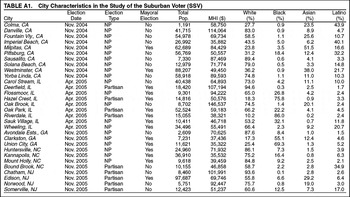
To test these hypotheses, we utilize data from the Study of the Suburban Voter (SSV), a survey of voters we administered in 30 different suburban municipalities from five different states (California, Georgia, Illinois, New Jersey, and North Carolina) in the period immediately following their elections in 2004 and 2005. The SSV selected municipalities that had competitive elections and that provided a wide range of social and institutional forms.3
Social characteristics of each city are extracted from the 2000 U.S. Census (SF1 and SF3). For simplicity's sake, we excluded the municipalities with district elections for city council. Also, an election was classified as concurrent only if it included a national race.
Political parties in the suburbs of Illinois are local parties, whereas those in the suburban locales of New Jersey are identical to two major national parties (i.e., Democratic and Republican parties).
Although the forms of city government can be roughly categorized into either mayor-council or council-manager type, they vary depending on several structural characteristics, for example, whether the mayor has veto power, whether the mayor is a regular member of city council, whether the mayor is full time, or whether the chief administration officer is mayor, a council member, or city manager (Frederickson and Johnson 2001; Wood 2002). In this paper, we distinguish the suburbs that had mayoral elections from those that had only city council elections. This is a reasonable distinction because when mayoral elections did not occur, the patterns of city council elections in the cities with mayor-council form of government may not significantly differ from those in the cities with council-manager type of government.
Edison had two separate city council elections in 2005: one for four-year term and the other for 2-year term. We did not count the latter to simplify our analyses.
Once the cities were selected, a phone survey was conducted by the Roper polling firm among randomly selected lists of registered voters. All interviews were conducted by telephone (CATI) at interviewing facilities on November 3–24; 2004, April 6–22; 2005; and November 11–29, 2005. Each interview took approximately 10 minutes, on average, to administer. In the fall 2004 and fall 2005 waves, the sample was drawn on an “nth” name basis from lists of registered voters maintained by and purchased directly from the counties surveyed. In the April 2005 wave, lists were used in most selected cities, but random digit dial (RDD) was used in three communities (Deerfield, Oak Park, and Sauk Village) because such lists were not available for their respective counties. In 27 of the 30 suburbs, interviews were conducted until 50 respondents were gathered. In three places, however, the small size of the community precluded that ability to gather all 50 interviewees.7
These were Colma, California (23 respondents), Sauk Village, Illinois (43 respondents), and Norwood, New Jersey (47 respondents). In the following five cities, we gathered 51 respondents: Yorba Linda, California, Union City, Georgia, Mount Holly, North Carolina, Bound Brook, New Jersey, and Chatham, New Jersey.
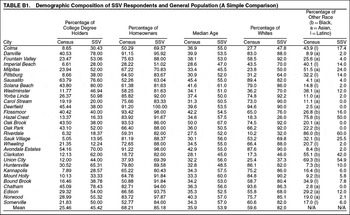
Because the SSV survey only sampled among registered voters and only interviewed those who had reported voting in the previous local election, the demographic composition of the study is distinct from that of the general population. Comparing the survey sample with 2000 Census data on each of the suburbs, as illustrated in Appendix B, we find that the differences between the survey respondents and the general population of the suburb tend to replicate the differences between voters and nonvoters in most general elections (Wolfinger and Rosenstone 1980). The respondents in the SSV survey are better educated, more likely to be homeowners, are older, and are disproportionately white: on average, 25% of the residents have a college degree, compared to 45% of the SSV sample; 68% of the residents are homeowners, compared to 85% of the SSV sample; the median age of the population in the communities is 36, whereas the median age of the SSV sample is 54; and 60% of the residents are white, compared to 82% of the SSV sample, whereas as a corollary, non-white residents are generally underrepresented in the data.8
A simple comparison of the median age between the Census and the SSV data does not make sense because the SSV sample is limited to people whose age is at least 18. Unfortunately, it is not possible to calculate the median age among the residents who are older than 18 in the 2000 Census because the number of people is available not per age but per several sets of age brackets. However, we can say that relatively older people were sampled because the additive value (the median age from the Census plus 18, which indicates the most extreme case) is smaller than the median age from the SSV sample in most cities.
Despite these differences, the sample appears to be representative of the voters in each of these jurisdictions, because the distribution of reported vote choice among the SSV sample generally reflects the actual distribution of votes in each election. For example, 161 out of 165 council candidates in the SSV had reported vote percentages that within 10 percentage points of the actual vote percentages they had received; 146 out of 165 candidates had reported vote percentages within 6 percentage points. Thus, although the SSV sample may not be representative of the general population of the communities that were surveyed, it appears to be representative, at least by the barometer of vote choice, of the voters in each community.
SUBURBAN ELECTORAL CULTURE
To understand how suburban voters make their decisions, it is important first to identify any systematic differences in the nature of electoral politics across suburbs or differences among the voters themselves. Therefore, we start our analysis with some descriptive statistics of the respondents' reported knowledge of local candidates, interest in local affairs, and patterns of political mobilization. In each of the 30 suburbs, respondents were asked a series of questions about their familiarity with each of the council candidates and, where applicable, mayoral candidates and some questions about their interest and feelings about local politics.9
The interviewer said, “I'm going to read the names of some candidates who ran in the last election. After I say the name, I'll ask you a few questions about him or her. First is [Candidate Name]. How much would you say you know about that candidate? Would you know a lot, a fair amount, only a little, only know the name, or never heard of [Candidate]?.” If the respondent had never heard of the candidate, the questioner would move to the next candidate. If the respondent had heard of the candidate, they were asked (1) if they liked him or her as a person, (2) if they agreed with him or her on the issues, (3) if they knew him or her personally, (4) if they were in the same political party as the candidate, and (5) if they voted for the candidate. The respondents were also asked questions of how interested they were in the political campaign (very interested, somewhat interested, not very interested, or completely uninterested) and whether anyone from an organization or a candidate contacted them about supporting a particular local candidate during the campaign. Finally, respondents were asked a series of open-ended questions about the most important problems facing their community (they could list up to two). They were then asked follow-up questions as to whether that problem was an important issue in influencing their voting.

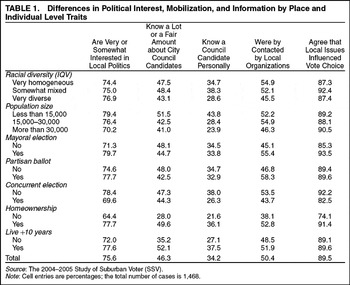
Given the nature of the sample and the responses to these items, it would appear that the typical suburban voter (at least as represented in the SSV sample) is someone who is politically active, fairly knowledgeable about local politics, and concerned about some particular issues. Of course, there is an inherent problem with such generalizations: it is nearly impossible to call any one person a typical suburbanite. Partly, this is because of the diversity of people who live in suburbs, and partly this is because of the diversity of places that fall under the heading of suburb—the sample communities in the SSV are all technically suburbs, yet vary considerably in their size and social composition. Consequently, the rest of Table 1 lists the percentage of responses to the questions above across five community- and institution-level characteristics, that is, racial diversity (see Appendix C), population size, type of government, type of ballot, and timing of election (whether it was concurrent with a national election in the fall of 2004 or not), and two individual-level traits, that is, homeownership and length of residence.
At the community level, the largest differences occur by population size. Residents of smaller suburbs are generally more interested in politics, more likely to recognize local candidates, and more likely to know a candidate personally. For example, comparing residents in suburbs under 15,000 in population to those over 30,000 in size, we find a 9-percentage-point increase in political interest, a 10-point increase in candidate name recognition, and a 20-point increase in personal acquaintance with a city council candidate. Residents of smaller places are also more likely to be mobilized by a political organization or candidate. There are no consistent patterns in the cross-tabulations along the racial diversity scale, but there are some important differences by virtue of the institutional arrangements in the community. People who live in places that had mayoral elections are more likely to be interested in politics and be contacted by local organizations. Also, people who live in places with partisan ballots are far more likely to be mobilized during the campaign. Similarly, people whose elections were concurrent with the national elections of 2004 are less interested in local politics, less likely to know a candidate personally or be mobilized, and less likely to say that an important problem influenced their vote choice. At the individual level, the differences in these items generally conform to conventional wisdom: homeowners and, to a lesser extent, long-term residents are more likely to be interested in local politics, know about candidates, be mobilized, and report that issues influenced their vote choice (Verba, Schlozman, and Brady 1995; Wolfinger and Rosenstone 1980).
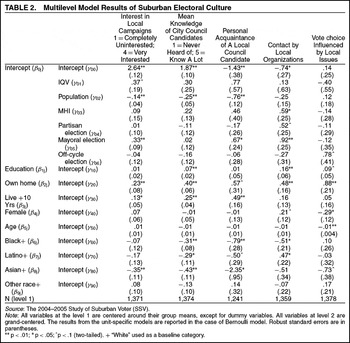
Although these results suggest that suburban voters' political experiences differ across environmental and individual traits, it is impossible to determine, from these cross-tabulations, which of these traits is more important or how they compare with other factors. To examine the relative effects of both the contextual and the individual-level variables, we employ a set of hierarchical linear models (HLM) with some additional controls, that is, individuals' education, race, age, and gender, in conjunction with the log of the median household income (MHI) of the community. The specifications of the models are reported in Appendix C, and the results are listed in Table 2.

Even when the individual-level characteristics and other demographic characteristics of the suburbs are taken into account, the patterns illustrated in the cross-tabulations remain: the social characteristics of the suburb and the individual characteristics of the suburban voter relate to interest, information, and mobilization levels. As in the cross-tabulations, community size remains one of the most important determinants of local electoral politics. People in larger suburbs are, on average, less interested in politics, less knowledgeable of city council candidates, and are less likely to be mobilized during the campaign. The multivariate analyses suggest that people in more racially heterogeneous suburbs are more interested in local politics. Furthermore, the institutional structure of the suburb makes a difference: voters in places with mayoral elections are more interested in local politics, more likely to know a city council candidate personally, and more likely to be mobilized; voters in places with partisan elections (also, those in relatively affluent cities) are more likely to be mobilized, and voters in places with off-cycle elections have particular issues that shaped their vote choice.
At the individual level, the biggest factors relating to voters' local political engagement were homeownership, length of residence, education, and race. As in the cross-tabulations, homeowners exhibited greater interest in politics, more knowledge of local candidates, higher mobilization rates, and more animation from local issues. Given that the models controlled for length of residence in the community (which is also positively related to political interest and knowledge of candidates), the effects of homeownership seem even more impressive. Education is also correlated with political knowledge, mobilization, and attention to local issues, which is unsurprisingly consistent with the existing literature (Verba, Schlozman, and Brady 1995; Wolfinger and Rosenstone 1980). Interestingly, racial minorities reported less knowledge of candidates, Asian Americans were less interested in local campaigns, and African Americans were less mobilized during local elections (although Latinos in the sample were more mobilized).
In sum, these findings suggest that suburban electoral politics vary in relation to the community's social composition and municipal institutions, even after controlling for several individual-level determinants. Even though larger places presumably have more community issues before them, their bigger populations seem to be a deterrent to their residents' interest in local politics. This can be offset, to some extent, by their institutional design. Local governments that provide more structure to local elections, either through partisan ballots or mayoral elections, enjoy greater voter interest and more active candidates and local organizations. In other words, where the institutional structures allow for more political organization, political activity increases and voters become better informed.
Suburban electoral politics also vary in relation to a person's individual status in the community. Stakeholders in the community, that is, older, educated, homeowners; and long-term residents, are more engaged by local affairs, familiar with candidates, and mobilized in local politics. Thus these people not only are more likely to vote, but also are at the center of democratic life. This bias in the suburban electorate presumably shapes the local political agenda, putting concerns of homeowners and long-term residents to the forefront of any electoral contest. The SSV data also reveal a racial bias to suburban electoral politics—minorities are generally less informed about local candidates and are less likely to be recruited. Even in racially mixed places, as the ones we sampled from, electoral politics in suburbia is circumscribed by race.
DETERMINANTS OF INCUMBENCY SUPPORT
So, how does the electoral culture of these suburban communities translate into particular voting behavior? In suburbs, as in many local and congressional elections, incumbency is perhaps the most important factor shaping people's ballot decisions. Incumbent candidates have numerous benefits of office, including opportunities to enhance their name recognition, to perform various acts of retail politics, and to link with various constituencies, and, by one estimate, are overwhelmingly favored by local newspapers (Ansolabehere, Lessem, and Synder 2006). Not surprisingly, they also do a good job at getting reelected. In the municipalities of the SSV sample, 47 of 56 incumbents running for reelection in city council elections were returned to office as were 10 of the 11 mayoral incumbents. Depending on the amount of conflict within the suburb and the information and interest levels of the particular voter, it is reasonable to assume that local elections are, first and foremost, referendums on incumbent performance (Zaller 2004).
If evaluating of the status quo, and hence incumbents, is the default voting position of people in low information contexts, then the central question for explaining electoral behavior is what drives suburbanites to deviate from this trend and vote for challengers. Is it because of some general dissatisfaction with the way the suburb is being governed? Does it reflect a particular concern with local economic conditions? Or, do other determinants of vote choice, such as partisanship, community issues, or candidate likeability come into play?
To answer these questions, we examine city council races in the SSV sample where at least one incumbent was running and where all the elections were for at-large seats.10
By doing so, we lose three cities, that is, Oak Brook, Oak Park, and Pittsburg, where no incumbent ran for reelection.
When constructing vote choice variables, we exclude all invalid votes, which means that a respondent reported to cast more than the number of votes allowed in the city council election: for instance, if a respondent reported to vote for three city council candidates when only two seats were open, then his or her vote is considered invalid. Also, the votes of the respondents whose number of vote in city council election is zero are considered invalid. The percentage of valid vote in city council elections ranges from 42 (Hazel Crest) to 86 (Milpitas and Solana Beach).
SSV respondents were asked about their impression of local economic conditions over the past year whether it had gotten better, stayed the same or gotten worse. Respondents were also asked how well they thought, “local government in [their community] is working: very well, somewhat well, somewhat badly, or very badly.” For the later measure, the variable was recoded into two categories.
Table 3 lists cross-tabulations showing the differences in incumbent support for city council elections by various evaluations of candidate traits as well as community conditions. As expected, candidate likeability, issue agreement, and shared partisanship correspond with voting patterns—the more a voter liked or agreed with challengers or incumbents, the more likely he or she voted for challengers or incumbents, respectively. For example, among respondents who only voted for incumbents, 51% liked incumbent candidates more, 66% agreed more with incumbents on issues, 26% knew incumbents personally, and 35% shared party affiliations with incumbents. Among those who voted only for challengers, 47% personally liked more challengers, 66% agreed more with challengers on issues, 21% knew more challengers personally, and 33% were closer to challengers in terms of partisanship. From these simple cross-tabulations, it appears that many of the same factors shaping voting behavior in national elections (partisanship, candidate likeability, issue positions) are also present in suburban elections. Their relative effects, however, are different. Whereas presidential elections hinge largely on partisan affiliations and subjective appraisals of candidate likeability (Miller and Shanks 1996), in suburban elections, the candidates' issue positions seem to be the most important determinant of voter support: a significantly higher percentage of voters were likely to share issue positions with the candidates they supported than to know candidates personally, like candidates or share a party affiliation with them.

Suburban voting behavior is also similar to national voting behavior in another key respect: evaluations of local economic conditions or government performance correspond with incumbent support. The overall impact of retrospective evaluations are comparatively small because, unlike in national politics, most suburban voters seem pretty happy with their communities. In the SSV sample, 76% of the respondents thought their city economy had done the same or better in the past year and about 80% thought that local government performance was good. Although such contentment may be a function of the higher social status of voters compared to nonvoters, it nevertheless shows that suburban voters are a generally satisfied lot. And, among the large majority who are more satisfied with the economy or government performance, incumbent support is higher; conversely, among the small percentage who are dissatisfied with local government performance, support for challengers is greater.
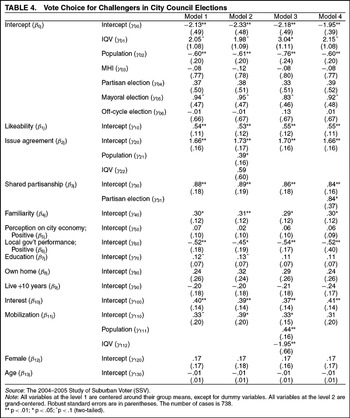
To compare these various influences, we return to multivariate analysis using a hierarchical generalized linear model predicting support for challengers. Once again, the dependent variable is a three-point scale of challenger support (1 = incumbents only; 3 = challengers only). For explanatory variables, the baseline model (Model 1) includes the three-point measures of likeability, issue agreement, and shared partisanship in conjunction with a five-point scale variable of candidate familiarity, and several other individual-level measures including perceptions of the city economy, local government performance, homeownership, length of residency, interest in local campaigns, mobilization, education, age, and gender. We also added institution-related measures (off-cycle, mayoral, and partisan elections), and measures of the suburbs' social composition (racial diversity and the natural log of its population size and median household income). The model specifications are in Appendix C, and the results are presented in Table 4.

As in the cross-tabulations, results from the hierarchical linear models show that voters' perceptions of the candidates were related to their vote choices. Voters who were more familiar with challengers or who thought that challengers were either more likeable or shared their party affiliations or issue stances were more likely to vote for challengers. Among these four variables, shared issue positions exhibit the strongest relationship to support for challengers: compared to voters who preferred incumbents, voters who personally liked challengers were, according to our estimates, 15% more likely to vote for only challengers; those who shared partisanship with challengers were 19% more likely to vote for only challengers; meanwhile, those who agreed with challengers on issues were 45% more likely to vote for only challengers.13
These predicted probabilities are calculated from ordered probit models estimated in Stata, using CLARIFY software (King, Tomz, Wittenberg 2000; Tomz, Wittenberg, and King 2003). The probit models used the same set of variables as the HLM models, although the coefficients do not taken into account the biases arising from a limited set of contexts. Nevertheless, they provide a convenient way of generating some predicted probabilities.
Other individual-level factors also had a relationship to voting for challengers. For example, voters were more likely to support challengers if they were more interested in local campaigns: voters who reported being very interested in the local campaigns were 10% more likely to vote for only challengers than those who were completely uninterested in the campaigns. The multilevel analyses confirm a finding from the cross-tabulations that voters who have negative perceptions on local government performance were more likely to vote for challengers, although evaluations of economic conditions had no impact.
Support for challengers was also related to the social composition and institutional structure of the suburb. Voters were more likely to vote against incumbents if they lived in a suburb that was racially diverse or was smaller in population size: compared to people in the least racially diverse cities, residents of the most diverse cities were 11% more likely to support only challengers; compared to those in largest places, residents of the smallest places were 19% more likely to support only challengers according to predicted probabilities calculated separately. The multilevel analyses also show that, compared to voters in council-manager governments, and voters living under mayor-council governments were more likely to support challengers, although these differences were small.
The biggest surprise in the multivariate models is the absence of differences among the individual-level demographic traits. Although homeowners, the educated, and long-term residents were more interested in local affairs and more knowledgeable about candidates, thus presumably more likely to be supportive of challengers, there were no significant differences in the challenger support scale along any of these dimensions (except for education). Nor were there any significant differences in incumbency support between voters in off-cycle versus concurrent elections, which is probably the result of the sampling screens (respondents were taken only if they said they voted in local elections) and voter roll-off (only those interested in local elections continued voting past the national ticket; see Wattenberg, McAllister, and Salvanto 2000).14
In the SSV sample, the proportion of the respondents who participated in the November 2004 presidential election, but did not cast valid votes in the local council election was 27%. Among those who did not vote in local elections, 48% were reported that they were “somewhat” or “very” interested in local campaigns, which is significantly smaller than the 77.7% who cast votes in both presidential and local election.
In addition to these individual-level effects, we also hypothesized that the differences in challenger support would be related to the local political climate, which, as we saw earlier, is affected by the social and institutional composition of the community. Because people in smaller places are more involved in local politics, more informed about local issues, and more familiar with candidates, they should be more likely to support challengers. Similarly, in places with more political conflict, voters are more likely to know candidates, be animated by particular issues, or mobilized to vote in particular ways. As a result, we would also expect them to be more likely to support challengers than to reflexively support incumbents. To test these ideas more directly, we ran additional multilevel models with interaction terms between three key individual variables (shared issue positions, shared partisanship, and mobilization) and three contextual variables (population size, partisan elections, and racial heterogeneity). The results from these equations are listed in the remainder of Table 4.
The first equation (listed as Model 2) measures the effect of shared issue positions relative to the suburb's population size and racial diversity. In this equation, the relationship of voters' issue perceptions to vote choice do not change with the racial composition of their community (voters were no more or less likely to support challengers if they agreed with them on issues as the racial diversity of their community increased), but they do work to counteract the impact of population size. The strong correlation between incumbency support and population size attenuates among voters who express more issue agreement with challengers. The second set of interaction terms (Model 3) measure the relative impact of voter mobilization (i.e., was the voter asked to vote a particular way by a group or candidate). Voters who were mobilized tended to support challengers more often, although this effect varies with the size and racial diversity of the community. In larger cities, mobilization offsets the positive impact of population size on incumbency support. Mobilization also attenuates the impact of racial diversity on challenger support—voters in diverse cities typically are more likely to support challengers except when they have been mobilized. The third interaction term (Model 4) examines the relative impact of partisanship across partisan and nonpartisan elections. In general, partisanship seems most important for challengers—voters who share party affiliations with candidates are much more likely to support challengers than those who do not. This effect, not surprisingly, is higher in places with partisan elections.
These tests demonstrate the importance of campaign dynamics for suburban elections. As in all elections, challengers in suburban contests face greater hurdles than incumbents for getting elected. Their ability to clear these hurdles depends on whether they can link themselves to salient issues or shared partisan affiliations (even in nonpartisan elections) or to mobilize their supporters. The impact of these campaign dynamics varies, however, with a community's social composition. In larger places, challengers seem to have a harder time, possibly because voters are less interested or more difficult to reach, thus making credible campaigns more difficult and expensive to run. Such handicaps require challengers in larger places to expend even more resources mobilizing voters and finding issues to connect with.
Conversely, in racially diverse places, it is the incumbents who may face greater electoral difficulties. Challengers in racially diverse places consistently do better, possibly because there are more readily available social divisions to exploit, although these divisions do not seem to be based around any particular issues. As in many larger contests, electoral politics in racially diverse suburbs may hinge more on “symbolic” issues of race and ethnicity. Unfortunately, testing these ideas with data on the racial characteristics and specific issue positions of candidates is beyond the scope of this paper and awaits further research. Nevertheless, the findings suggest that, as in many large cities, racial and ethnic politics may be operative in suburban elections and that such patterns may offset some of the typical advantages of incumbency.
CONCLUSION
Taken together, these findings provide an interesting picture of both suburban politics in particular and voting behavior in micro-elections more generally. Vote choice in suburban elections has some important similarities and differences to vote choice in presidential, congressional, and big-city contests. Like these larger races, suburban electoral decisions are based partly on a combination of subjective appraisals of candidates, candidates' stances on issues, and cues regarding salient groups, although suburban voters are more likely to base their decisions on the candidates' stances on specific issues rather than party affiliation or personal traits. Much of this is due to the particular character of the suburban voter. As turnout in local elections is often under 25% of the population, suburban voters overrepresent populations with more resources and greater stakes in their communities, that is, educated, older, homeowners and long-term residents. Because the selected differences in local participation are so great, suburban voters end up sharing many behavioral patterns of voters in more visible contests—they have greater knowledge of candidates, associate their votes with particular issues, and, perhaps most remarkably, a very high percentage tend to know candidates personally.15
Interestingly, nearly all the respondents who reported knowing a candidate personally also reported having a favorable opinion of the candidate. This would suggest that suburban politics are not as personally vindictive as some accounts would suggest.
Such findings dispel some common misperceptions about suburban politics. In many popular commentaries, suburbanites are often criticized for being disinterested and apolitical while suburbs writ large are accused of destroying the vibrancy of local democracy in the United States (e.g., Langdon 1994). These views are informed largely by personal feelings, anecdotes, or aesthetic biases. When looking at actual evidence, however, political life in suburbia is more complicated than the common stereotypes suggest. On the one hand, suburban voters exhibit very high levels of interest and involvement in local affairs. Among this group of active participants, vote choice is driven more by specific issue concerns than either subjective impressions of candidates or knee-jerk adherence to party positions. In that such pro-democratic tendencies are heightened in smaller places, suburbanization, which is functionally the fragmentation of metropolitan areas into smaller political units, would seem to be a boon to democracy in America.
On the other hand, most suburbanites are not so active in politics; in fact, participation is limited typically to a small fraction of the voting age population. The social homogeneity and reform-style political practices that often accompany suburban political fragmentation are a further deterrent to both citizen involvement in local politics and to issue-driven voting. According to the SSV data, this disengagement is born most heavily among minorities, the uneducated, and renters, who are all less informed about community issues and less active in local politics. Thus suburbanization may empower one element of the population (i.e., stakeholders) but further disenfranchise the already most marginalized portions of the citizenry.
These findings also allow for some initial generalizations about voting patterns in micro-elections. In sofar as the suburbs in the SSV represent a sample of different smaller democracies, we might conclude that voting in micro-elections hinges primarily on the characteristics of the particular context. In settings that are smaller or more diverse, or that allow for the articulation of more conflict, voters are more likely to be interested, informed, and motivated by particular issues. In contests that are larger or less diverse, or where the rules inhibit the articulation or coalescence of different partisans, voters will be less engaged, challengers, will have a harder time mounting credible campaigns, and, with less information or fewer viable choices, voters will be more likely to reflexively support incumbents. We might also conclude that micro-elections are shaped by selective differences in participation. Where turnout is low, elections will be driven more by the concerns of motivated stakeholders rather than by the general group membership. In other words, the lower the turnout, the less likely that an election will hinge on a “median voter” and the more likely that it will be determined by a highly motivated group. Although these conclusions await testing across a variety of different electoral contexts, if suburban voting is any indication, the politics of small democracies can be as issue specific, partisan, and candidate centered as many larger elections.
APPENDIX A

APPENDIX B

APPENDIX C
Model Specification
Racial diversity is measured by index of qualitative variation (IQV), based on the number of racial groups and the proportion of each group in a suburb. The formula of IQV is as follows: (k(N2−Σf2))/(N2(k−1)), where k denotes the number of race categories, N indicates the total number of cases across all race categories, and f indicates the number of cases for each race category. The 2000 Census allows people to choose more than one racial identity, but we use the single-race-only category, which is a justifiable choice because almost 98% of the population selected single-race only option (Grieco and Cassidy 2001). When calculating the index, we do not use the total population as N. Instead, we compute N by adding the number of four racial groups (whites, blacks, Asians, and Latinos). The computed N is normally smaller than the total population, which also includes other racial groups such as Native Indians, Native Hawaiians, and so forth.
In our models, all the coefficients except for the intercept are fixed. In Table 2, the level-1 model can be written as follows (an example of political interest as the dependent variable): INTERESTij=β0j+β1j(EDUCATION)ij+β2j(HOMEOWNERSHIP)ij+β3j(LENGTH OF RESIDENCE)ij+β4j(GENDER)ij+β5j(AGE)ij+β6j(BLACK)ij+β7j(LATINO)ij+β8j(ASIAN)ij+β9j(OTHER RACE)ij +rij, where i indexes individuals, j denotes suburban city, and rij represents the residual for individual i in suburb j. At the city level, we model β0j as a function of six level-2 variables: β0jj=γ00+γ01(IQV)j+γ02(ln(POPULATION))j+γ03(ln(MHI))j+γ04(PARTISAN ELECTION)j+γ05(MAYORAL ELECTION)j + γ06(OFF-CYCLE ELECTION)j+uoj, and βpj = γp0 (for p = 1–9). We obtain the full model by substituting the second equation into the first one. When the dependent variable is dichotomous (personal acquaintance, mobilization and vote choice due to local issues), we employ hierarchical generalized linear model (HGLM) with Bernoulli choice model as a link function instead of conventional HLM (Raudenbush and Bryk 2002, 291–309).
For Table 4, the level-1 model can be written as follows (an example of model 3 in Table 4): VOTE CHOICEij=β0j + β1j(LIKEABILITY)ij + β2j(ISSUE AGREEMENT)ij + β3j(SHARED PARTISANSHIP)ij+β4j(FAMILIARITY)ij+β5j(PERCEPTION ON CITY ECONOMY)ij+β6j(LOCAL GOVERNMENT PERFORMANCE)ij+β7j(EDUCATION)ij+β8j(HOMEOWNERSHIP)ij + β9j(LENGTH OF RESIDENCE)ij+β10j(INTEREST)ij+β11j(MOBILIZATION)ij+β12j(GENDER)ij+β13j(AGE)ij + rij, where i indexes individuals, j denotes suburban city, and rij represents the residual for individual i in city j. At the city level, we model β0j as a function of six level-2 variables: β0jj=γ00+γ01(IQV)j+γ02(ln(POPULATION))j+γ03(ln(MHI))j+γ04(PARTISAN ELECTION)j+γ05(MAYORAL ELECTION)j +γ06(OFF-CYCLE ELECTION)j + uoj, and βpj = γp0 (for p = 1–10, 12–13). Additionally, the level-1 coefficient of MOBILIZATION is modeled like this: β11j=γ110+γ111(ln(POPULATION))j+γ112(IQV)j. We obtain the full model by substituting the second and third equations into the first one.
We gratefully acknowledge the Financial support of a National Science Foundation career award (SES-0332139) and comments from the American Politics Workshop at the University of Chicago.




Comments
No Comments have been published for this article.