Introduction
The family Channichthyidae (icefish or white-blooded fish) is composed of 12 genera, with 25 species (Iwami & Kock Reference Iwami, Kock, Gon and Heemstra1990). Most live in the cold waters of the Southern Ocean shelf and slope at depths of 0–1000 m (Kock Reference Kock2005a, Eastman Reference Eastman2017), with the exception of Champsocephalus esox (Günther, 1861), which inhabits southern Patagonia and the Falkland Islands (Islas Malvinas). Icefish are peculiar among vertebrates in that they lack the presence of haemoglobins and their blood is nearly colourless. This implies that icefish possess several adaptations such as reduced metabolic rate, increased blood volume, low blood viscosity and a large heart, among others (Kock Reference Kock2005a).
Morphologically, channichthyids are fusiform fish with large, crocodile-shaped heads and mouths, demonstrating considerable morphometric and meristic interspecific variation (Kock Reference Kock2005b). This morphospace reflects their role as krill and mesopelagic fish predators during pelagic and semi-pelagic stages, and as demersal fish and epibenthic crustacean predators in older, larger specimens (Kock Reference Kock2005b). Some species show sexual dimorphism, expressed as differences in colouration and dorsal fin height, as well as a thicker anal fin epithelium in the males of species such as Champsocephalus gunnari, Chaenodraco wilsoni and Chionodraco hamatus (Gerasimchook Reference Gerasimchook1989, Kock Reference Kock2005b, Ferrando et al. Reference Ferrando, Castellano, Gallus, Ghigliotti, Masini, Pisano and Vacchi2014). Additionally, some species exhibit dimorphism in size (i.e. Cryodraco antarcticus; Kock & Jones Reference Kock and Jones2002). However, there is no information concerning gender differences in the morphospace and the relationship of the morphospace with diet composition.
The pike icefish C. esox habitat ranges from shallow subtidal waters to depths of 250 m throughout the southern Chilean and Argentinian Patagonia, with adults reaching total lengths (TLs) of 35 cm (Eastman Reference Eastman2017, Reference Eastman2019). They are sexually mature from January to September, with an absolute fecundity of 3300–8600 oocytes (Calvo et al. Reference Calvo, Morriconi and Rae1999). This species is a carnivorous predator, preying upon fishes (nototheniids) and crustaceans (mysids, squat lobsters, copepods; Isla Reference Isla1993). Recent studies using stable isotopes indicate that pike icefish are a top predator that may compete with the invasive salmon species Oncorhynchus tshawytscha in southern Patagonia (Hüne et al. Reference Hüne, Davis, Murcia, Gutiérrez and Haro2018).
Using landmark-based geometric morphometrics, Fulton index and gut content analysis, we studied the shape, condition and diet of the pike icefish C. esox, including the variability between males and females, from southern Patagonia.
Materials and methods
Specimens were collected in Última Esperanza sound (51°39.0'S, 72°39.5′W), Magellan region, between 10 March and 11 May 2008, as bycatch in the Patagonian blenny Eleginops maclovinus and pejerrey Odontesthes regia fisheries. All of the fish were captured using a gill net (length 60 m, height 3 m, mesh size 2.5 cm), deployed from the bottom to the surface with a 12 h set period. Specimens were preserved in 10% formalin.
All specimens were sexed, measured in length (TL from anterior tip of the premaxilla to posterior margin of the tail), weighed (total weight; TW) and photographed from a lateral view with a Sony DSC-H300 camera. Then, specimens were eviscerated, and the viscera were preserved in 96% ethanol for subsequent examination. Length-weight relationships were fitted separately for males and females. Afterwards, data were log-transformed and then compared using a multiple slope test. Additionally, the Fulton index of condition was estimated separately for each specimen. Subsequently, comparisons were made between males and females using a t-test, due to the normal distribution of the data (Shapiro-Wilk test, females: W = 0.94, P = 0.249; males: W = 0.97, P = 0.668).
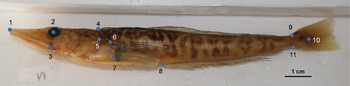
For the geometric morphometric analysis, a database with images of 36 well-preserved individuals was created using the program TpsUtil 1.60 (Stony Brook Morphometrics, https://life.bio.sunysb.edu). An 11-landmark configuration (Fig. 1) was then digitized onto each photograph using the software TpsDig 2.17 (Stony Brook Morphometrics, https://life.bio.sunysb.edu/morph). This landmark configuration aimed to reflect shape changes in the mouth gape (LM 1 and 3), eye, head and trunk (LM 2, 5 and 8), insertion of the fins (LM 4, 6 and 7) and caudal peduncle (LM 9, 10 and 11). Geometric morphometric analyses were carried out using MorphoJ 1.07a (Klingenberg Reference Klingenberg2011). A generalized Procrustes analysis was performed, in which coordinates were scaled, translated and rotated onto a common coordinate system to extract the shape variation from each individual and remove size and rotation influences (Rohlf & Slice Reference Rohlf and Slice1990). Residuals from the consensus configuration were modelled with the thin-plate spline (Bookstein Reference Bookstein1991).
Landmark configuration utilized on adult pike icefish Champsocephalus esox. LM 1, anterior-most portion of the premaxilla; LM 2, centre of the eye; LM 3, posterior-most portion of the maxilla; LM 4, insertion of the first dorsal fin; LM 5, posterior-most portion of the opercle; LM 6, dorsal insertion of the pectoral fin; LM 7, ventral insertion of the pectoral fin; LM 8, anus; LM 9, dorsal portion of the tail; LM 10, centre of the caudal fin; LM 11, ventral portion of the tail.

A principal component analysis was performed using the shape coordinates to identify the main axes of shape variation, as well as specific changes in the body. For the visualization, a warping transformation grid was used following Klingenberg (Reference Klingenberg2013). To explore an ontogenetic effect in the shape change, linear regressions between principal components (PCs) and TL were performed. In addition, the ontogenetic allometry was estimated by multiple regression between Procrustes coordinates (a proxy of shape) and log centroid size (a proxy of size) (Loy et al. Reference Loy, Mariani, Bertelleti and Tunesi1998). The allometry corresponds to the proportion of variation for which the regression accounts as a percentage of the total variation (Zavala-Muñoz et al. Reference Zavala-Muñoz, Landaeta, Bernal-Durán, Herrera and Brown2016). The morphospaces of males and females were compared using a canonical variate analysis (CVA) based on the Procrustes distances. Significant differences were tested using a permutation test (10 000 permutation rounds).
The gut of each specimen was opened lengthwise. Prey items were counted and identified to the lowest possible taxon under an Olympus SZ61 microscope. Every prey item was weighed. The feeding incidence (FI) was calculated as a percentage of the total number of specimens with gut contents out of the total number of individuals examined, separately for males and females. Comparison of FI between males and females was carried out using χ2 tests.
The frequency of occurrence (%F) of each prey item, the percentage of the total number (%N) of diet items and the percentage of weight (%W) of each item out of the total volume of prey items were estimated. The index of relative importance (%IRI) was calculated following Hyslop (Reference Hyslop1980). Finally, a one-way permutational multivariate analysis of variance (PERMANOVA; 9999 iterations) using the Morisita similarity index was run to test the differences in diet between males and females. All multivariate tests of the diet data were done using Past 4.0 software.
Results
Fish morphometrics and condition
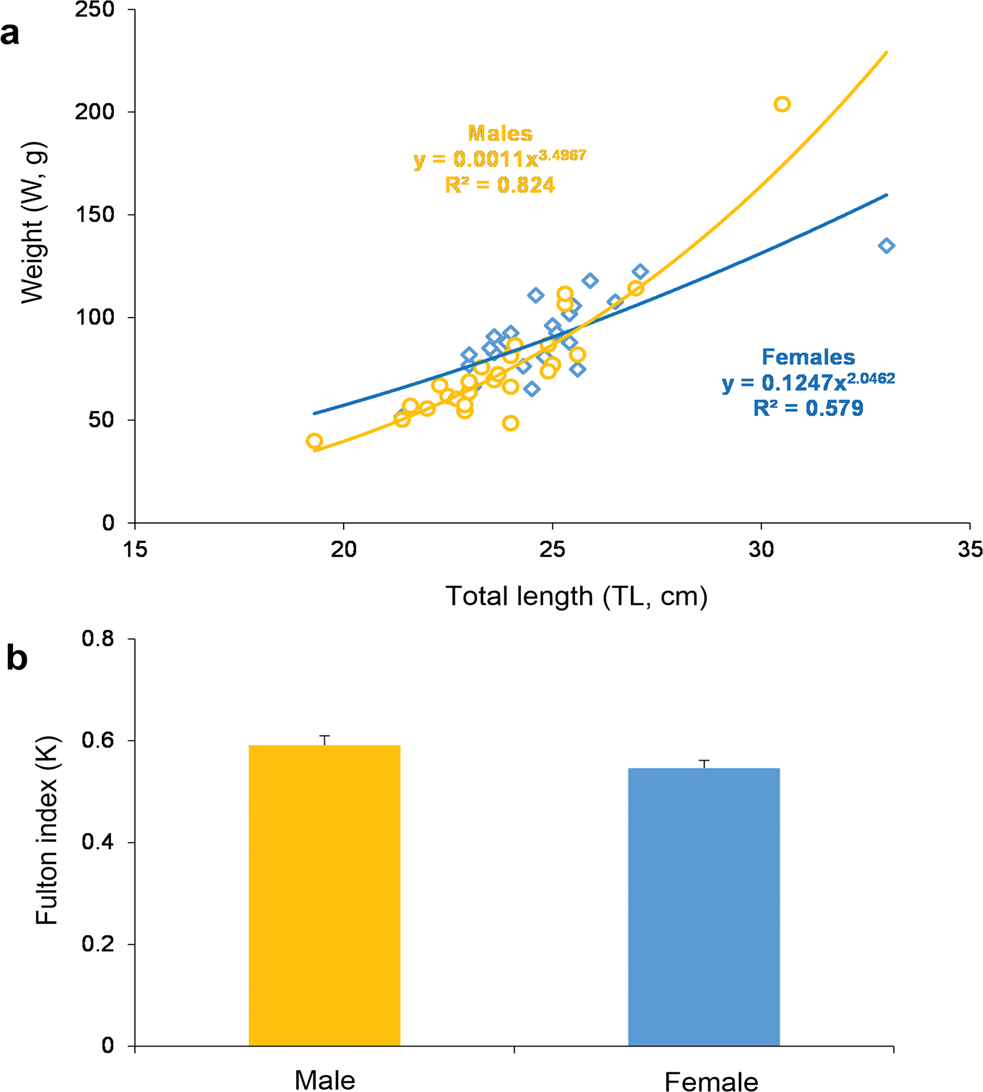
The 49 specimens varied from 19.3 to 33.0 cm TL (mean ± SD, 24.3 ± 2.2 cm) and from 39.9 to 203.8 g TW (83.3 ± 27.5 g). The potential models of length-weight relationships explained the size variability better for males (R 2 = 0.824) than for females (R 2 = 0.579) (Fig. 2a). These differences were caused by the small sample size of specimens > 30 cm TL. In order to compare the length-weight relationships between sexes, a similar size range was selected (21.4–27.1 cm TL) and both variables were log-transformed. A one-way analysis of covariance (ANCOVA), using TL as the covariate, indicated that the females had greater weight at length than the males (F 43,1 = 6.17, P = 0.016).
a. Length-weight relationship for male (yellow) and female (blue) pike icefish Champsocephalus esox, with their respective potential models. b. Comparison of the Fulton index of condition between males and females. Bars correspond to +1 SE.

The Fulton index of condition varied from 0.37 to 0.74 in females (mean ± SE, 0.59 ± 0.01) and from 0.35 to 0.72 in males (0.54 ± 0.01), being similar between sexes (t-test, t = 1.88, P = 0.065) (Fig. 2b).
Body shape variability in C. esox
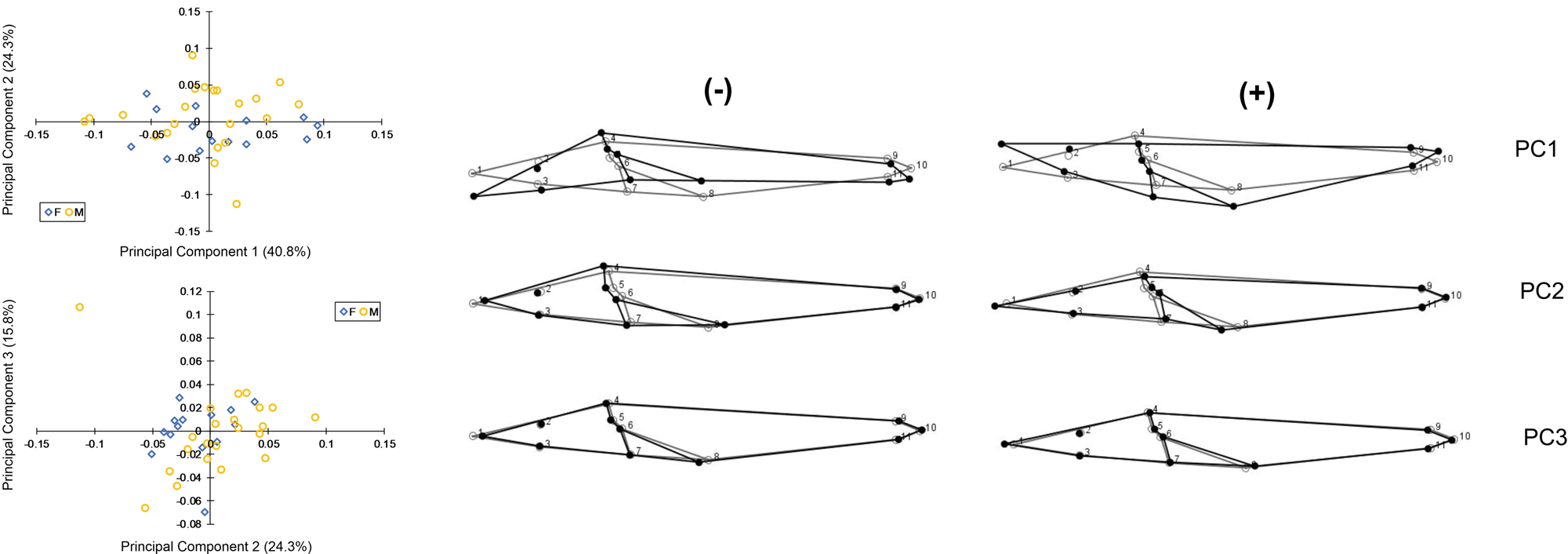
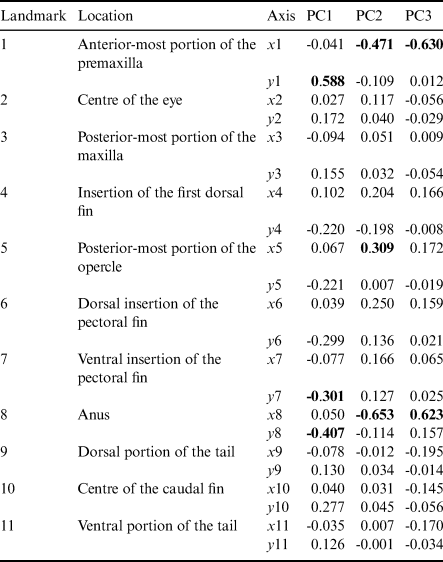
Shape variability was explained by 18 of the PCs, with the first five PCs explaining > 90% of the variance. PC1 explained 40.8% of the variance (Fig. 3), representing a relative dorsoventral displacement of the tip of the snout (LM 1 coefficient = 0.588, Table I), anus (LM 8 coefficient = -0.407) and the ventral insertion of the pectoral fin (LM 7 coefficient = -0.301). Body bending in the x-axis may represent the effects of fixation of the formaldehyde. PC2 described 24.3% of the variance, explaining the relative anteroposterior displacement of the premaxilla (LM 1 coefficient = -0.471), opercle (LM 5 coefficient = 0.309) and anus (LM 8 coefficient = -0.653) (Table I). This indicated the presence of specimens with larger jaws and heads and shorter trunks, as well as specimens with shorter jaws and heads and larger trunks (Fig. 3). In addition, 15.8% of the variance was explained by PC3, which was also related to the horizontal displacement of the jaw (LM 1 coefficient = -0.630) and anus (LM 8 coefficient = 0.623) (Fig. 3 & Table I).
Principal component analysis of the body shape of pike icefish Champsocephalus esox. Blue diamonds correspond to females and yellow circles to males. The black wireframes show the morphospace variability in the first three principal components and the grey wireframes indicate the consensus (= mean) shape.

Factor loadings of the first three principal components (PCs) of body shape. Bold numbers correspond to extreme values (in magnitude) of loadings for each PC and indicate the landmarks that contribute most to body shape variation across Champsocephalus esox males and females. The x and y values correspond to movements in the anteroposterior and dorsoventral axes, respectively.

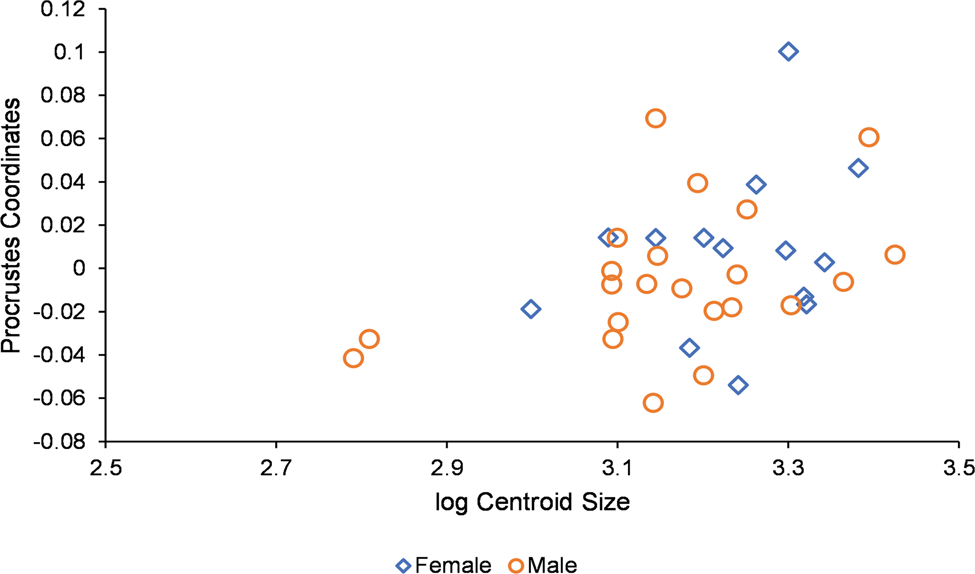
Shape changes expressed in PC1, PC2 and PC3 were independent of the individual's size (PC1 vs TL, R 2 = 0.001, P = 0.81; PC2 vs TL, R 2 = 0.005, P = 0.64; PC3 vs TL, R 2 = 0.049; P = 0.17). The ontogenetic allometry was low (2.89%), and shape changes were independent of log centroid size (permutation test, P = 0.39) (Fig. 4).
Regression of the Procrustes coordinates and log centroid size for ontogenetic allometry estimation of pike icefish Champsocephalus esox.

The morphospaces between males and females were similar (CVA). Procrustes distance between groups was 0.026, P = 0.424) and therefore no sexual dimorphism in the body shape was observed within the studied size range (19–33 cm TL).
Trophic ecology of C. esox
The FI values were relatively low for both males (34.1%) and females (47.2%) and were similar between sexes (χ2 test, χ2 = 0.88, P = 0.347).
All specimens with gut contents had only one prey item per gut; therefore, the %N and %F were the same (Table II). The diet of C. esox was exclusively fish (Table II). Males showed higher %N and %F of unidentified fish (fish with a slight degree of digestion, precluding their identification), unidentified fish remains and P. cornucola. However, in weight the most important prey were unidentified fish and P. tessellata (Table II). In addition, the most relevant prey items were unidentified fish (%IRI = 55.68%) and unidentified fish remains (%IRI = 29.83%). For females, both numerically and in %F, P. cornucola, unidentified fish and unidentified remains were the most significant prey items. Nevertheless, in terms of weight, the most important prey were P. cornucola and P. sima. However, the %IRI indicated that P. cornucola (56.81%) and unidentified fish remains (15.59%) were the most relevant prey items for females (Table II).
Diet composition of male and female pike icefish Champsocephalus esox from southern Chile. %N = numeric percentage; %F = frequency of occurrence percentage; %W = gravimetric percentage; %IRI = index of relative importance percentage.

The multivariate analyses indicated a similar composition in the diets between males and females, with the specimen's sex showing little influence on diet composition (one-way PERMANOVA, pseudo-F = 0.97, P = 0.44).
Discussion
The pike icefish C. esox has a streamlined, laterally compressed body with a relatively large head and strong jaws and teeth, characteristics observed in the majority of the channichthyids (Voskoboinikova Reference Voskoboinikova1997, Eastman Reference Eastman1999). Body shape analysis of C. esox indicated the presence of specimens with larger, pointed heads and shorter trunks, as well as individuals with shorter, blunter heads and larger trunks. The variability of the morphospace was size independent, indicating low ontogenetic allometry, and unrelated to the specimen's sex. Nonetheless, the low FI precluded the covariance analysis between shape and diet changes.
According to Mayr & Ashlock (Reference Mayr and Ashlock1991), the existence of morphologically different individuals within a local population where all members are products of the same gene pool and belong to a single taxonomic unit reflects intraspecific variation. In the case of C. esox, all studied specimens were collected from the same location, Última Esperanza sound, and can therefore be considered part of a local population. Thus, the shape variation detected in adult C. esox may be regarded as phenotypic plasticity.
Phenotypic plasticity has been previously described for the nototheniid fish Trematomus newnesi (Eastman & DeVries Reference Eastman and DeVries1997, Piacentino & Barrera-Oro Reference Piacentino and Barrera-Oro2009, Barrera-Oro et al. Reference Barrera-Oro, Eastman and Moreira2012). According to these authors, the ecological significance of the phenotypic plasticity in T. newnesi is still unclear, as it has not been related to divergence in habitat or diet, although it has an ontogenetic component (Piacentino & Barrera-Oro Reference Piacentino and Barrera-Oro2009). In this regard, a study on the buoyancy of T. newnesi did not exhibit differences between any of the morphs and therefore cannot support ecological diversification in benthic and semi-pelagic morphs based on buoyancy measurements (Eastman & Barrera-Oro Reference Eastman and Barrera-Oro2010). On the other hand, in Arctic charr (Salvelinus alpinus), differences in head and jaw morphology between the morphs appear during embryonic development and are influenced by feeding behaviour (Parsons et al. Reference Parsons, Sheets, Skúlason and Ferguson2011, Guðbrandsson et al. Reference Guðbrandsson, Franzdóttir, Kristjánsson, Ahi, Maier and Kapralova2018). For example, benthic and pelagic diets in S. alpinus promoted the development of benthic and pelagic head morphs, respectively (Parsons et al. Reference Parsons, Sheets, Skúlason and Ferguson2011). Furthermore, it has been found that the trophic niche of polymorphic European whitefish (Coregonus lavaretus) populations were larger than monomorphic populations, increasing the specialization between morphs of pelagic and littoral habitats in subarctic lakes (Thomas et al. Reference Thomas, Harrod, Hayden, Malinen and Kahilainen2017).
In our study, trophic differences between morphs were not identified. However, we cannot discard potential selective feeding among morphs, as differences in diet could be masked by the low FI, as well as the degree of prey digestion in the stomach contents from the specimens analysed. The trophic niche breadth reported for C. esox was smaller than for other coastal fish in the Barbara Channel, close to the Strait of Magellan (Hüne et al. Reference Hüne, Davis, Murcia, Gutiérrez and Haro2018). These results do not support an increase in intraspecific specialization in C. esox, as seen in the polymorphic populations of C. lavaretus from subarctic lakes. Nevertheless, these results for C. esox should be taken as referential, because Hüne et al. (Reference Hüne, Davis, Murcia, Gutiérrez and Haro2018) did not perform a morphological analysis and the environmental conditions were dissimilar to those of our study area (lower salinity and higher turbidity than in the Barbara Channel). According to Skúlason et al. (Reference Skúlason, Parsons, Svanbäck, Räsänen, Ferguson and Adams2019), plasticity can produce phenotypic variation due to environmental changes (e.g. temperature, oxygen, habitats and introduction of species). Taking this into account, our study area is characterized by high seasonal variability in temperature and oxygen (M. Hüne, unpublished data 2008), as well as species-poor ichthyofauna. The latter has been considered a common factor in morphological diversification, allowing niche expansion thanks to the absence of competition (Robinson & Wilson Reference Robinson and Wilson1994, Eastman & DeVries Reference Eastman and DeVries1997). However, the introduction of exotic salmon species (O. tshawytscha) during the 1970s–1990s could have changed the low-level interspecific competition scenario, as O. tshawytscha may compete for food resources with C. esox owing to their similar trophic levels and niche overlap (Hüne et al. Reference Hüne, Davis, Murcia, Gutiérrez and Haro2018).
There was a relatively low FI in the specimens collected, which has been a frequent feature in previous studies of this species (50–60%; Isla Reference Isla1993, Hüne et al. Reference Hüne, Davis, Murcia, Gutiérrez and Haro2018), as well as in other Channichthyidae. In Chaenocephalus aceratus from the South Shetland Islands, most of the stomachs (76–85%) were empty (Flores et al. Reference Flores, Kock, Wilhelms and Jones2004). Some species, such as C. gunnari, largely reduce or even stop feeding when approaching spawning (Kock Reference Kock2005b). In the case of C. esox, the collection period of the specimens (autumn) fell in the spawning season described by Calvo et al. (Reference Calvo, Morriconi and Rae1999) (January to September), which may have influenced the low FI observed.
The diet of C. esox was exclusively piscivorous, predating mainly on Patagonian nototheniids with a high trophic level (TL = 3.02; Hüne et al. Reference Hüne, Davis, Murcia, Gutiérrez and Haro2018). This pattern was different from that of channichthyids from Antarctic waters, which rely on krill (Euphausia superba, Thysanoessa macrura), hyperiid amphipods, mysids and myctophids (as in the case of C. gunnari and C. aceratus; Flores et al. Reference Flores, Kock, Wilhelms and Jones2004) or predating on other channichthyids and nototheniids (Reid et al. Reference Reid, Clarke, Collins and Belchier2007). On the other hand, the larval and post-larval icefish C. hamatus feeds almost exclusively on notothenioid fish larvae (La Mesa et al. Reference La Mesa, Catalano and Greco2011).
Three ecotypes have been described in Channichthyidae (Kock et al. Reference Kock, Gröger and Jones2013): 1) species that undertake regular diurnal migrations in the water column to feed on krill, mysids and amphipods, 2) species that exploit the lower part of the water column when young, consuming krill and mysids, and then switch to a benthic mode of life when older, feeding on demersal fish and krill, and 3) species in between the first two groups, feeding on krill and myctophids and exploiting both the water column and the near-bottom/bottom layers. According to our results and previous studies (Isla Reference Isla1993, Hüne et al. Reference Hüne, Davis, Murcia, Gutiérrez and Haro2018), the icefish C. esox belongs to the second ecotype. The green algae in the gut contents of C. esox described by Hüne et al. (Reference Hüne, Davis, Murcia, Gutiérrez and Haro2018) appear to be incidental.
There were similarities in the diets of both males and females, although their main prey differed. The higher frequency of prey observed in males compared with females (30 vs 22%; see Table II) may suggest that both sexes were predating in different hours of the day. Nonetheless, it seems that the pike icefish has nocturnal solitary predator behaviour with low levels of movement during the day (Moreno & Jara Reference Moreno and Jara1984).
Finally, the pike icefish C. esox is the second notothenioid species, and the first outside of Antarctica, to display phenotypic plasticity in its body shape.
Acknowledgements
We thank Veronica Aros for the photographs of specimens and her cooperation. We give special thanks to the fisherman Juan Ángel Hernández (RIP) for fish collections. An anonymous reviewer and Professor J.T. Eastman improved an early version of the manuscript. We appreciate the English revision by Francesca Search.
Author contributions
AV analysed the gut contents and the diet data. MH collected the specimens and wrote part of the manuscript. MFL performed the geometric morphometrics analyses and wrote part of the manuscript.
Details of data deposit
The data that support the findings of this study are available from the corresponding author upon reasonable request.