Introduction
It is well established that psychotherapy is effective for the treatment of depression in younger as well as in older adults. Dozens of well-designed studies have shown that cognitive behavior therapy (CBT) (Gloaguen et al., Reference Gloaguen, Cottrauxa, Cucherata and Blackburn1998), behavioral activation treatments (Cuijpers et al., Reference Cuijpers, van Straten and Warmerdam2007a), interpersonal psychotherapy (Churchill et al., Reference Churchill2001), problem-solving treatment (Cuijpers et al., Reference Cuijpers, van Straten and Warmerdam2007b), and psychodynamic therapy (Leichsenring, Reference Leichsenring2001) are effective in adults with depression. These therapies are also effective in several other populations, including adolescents (Weisz et al., Reference Weisz, McCarty and Valeri2006), women with postpartum depression (Lumley et al., Reference Lumley, Austin and Mitchell2004), adults with subthreshold depression (Cuijpers et al., Reference Cuijpers, van Straten and Smit2007c), and patients with both depression and general medical disorders, including multiple sclerosis (Mohr and Goodkin, Reference Mohr and Goodkin1999), stroke (Hackett et al., Reference Hackett, Anderson and House2004), and cancer (Sheard and McGuire, Reference Sheard and McGuire1999).
Since the late 1970s and early 1980s (Gallagher, Reference Gallagher, Upper and Ross1981; Gallagher and Thompson, Reference Gallagher and Thompson1982), a considerable number of controlled studies have shown that these psychotherapies are also effective in older adults. Several meta-analyses have been conducted to integrate the results of these studies (Scogin and McElreath, Reference Scogin and McElreath1994; Koder et al., Reference Koder, Brodaty and Anstey1996; Engels and Verney, Reference Engels and Verney1997; Cuijpers, Reference Cuijpers1998; McCusker et al., Reference McCusker, Cole, Keller, Bellavance and Berard1998; Gerson et al., Reference Gerson, Belin, Kaufman, Mintz and Jarvik1999; Cuijpers et al., Reference Cuijpers, van Straten and Smit2006; Pinquart et al., Reference Pinquart, Duberstein and Lyness2006), and all of these show that the overall mean effect sizes of these psychotherapies are comparable to those found for younger adults.
Whether these psychotherapies are actually equally effective in younger and older age groups has not been examined comprehensively in meta-analytic research. Until now, we can only compare the results of meta-analytic studies concerning younger adults to those concerning older adults. However, such a comparison assumes that the designs, target groups and interventions of these two groups of studies are comparable, which may not necessarily be the case, possibly precluding meaningful comparisons. When conducting a meta-analysis such differences must be taken into account. By implication, one has to identify variables that confound the relationship of interest and then adjust for confounding using multivariate techniques.
We decided to conduct such a meta-analytic study. We used a database of 112 studies in which psychotherapy for depression (in younger and older adults) was compared to a control group. In this dataset we first identified possible confounders and then conducted a meta-regression to control for the confounding variables (differences in the population, treatment provided, and study designs) while evaluating the efficacy of psychotherapy in younger versus older populations.
Method
Identification and selection of studies
We began by using a large database of studies on the psychological treatment of depression in general. This database has been described in detail elsewhere (Cuijpers et al., Reference Cuijpers, van Straten and Warmerdam2007a; Reference Cuijpers, van Straten and Warmerdam2007b; Reference Cuijpers, van Straten and Smit2007c; Reference Cuijpers, Brännmark and van Straten2008a; Reference Cuijpers, van Straten, van Oppen and Andersson2008b). It was developed through a comprehensive literature search (from 1966 to December 2007) in which we examined 8,861 abstracts in PubMed (1,403 abstracts), Psycinfo (2,097), Embase (2,207), the Cochrane Central Register of Controlled Trials (2,204), and Dissertation Abstracts International (950). We identified the abstracts by combining terms indicative of psychological treatment and depression (both MeSH-terms and textwords). For this database we also collected the primary studies from 22 previous meta-analyses of psychological treatment of depression (Cuijpers and Dekker, Reference Cuijpers and Dekker2005). In total we retrieved 882 journal articles, chapters and dissertations. These papers and dissertations were studied, and we selected the ones which met our inclusion criteria (see below). The next step was to examine references from earlier reviews and meta-analyses. Finally, the references of retrieved papers were checked in order to detect any potential missing references.
Inclusion criteria
The included studies dealt with the effects of a psychological treatment on adults (younger or older, see below) with a depressive disorder or an elevated level of depressive symptomatology, who were compared to a control condition in a randomized controlled trial.
Psychological treatments were defined as interventions in which verbal communication between a therapist and a client was the core element, or in which a psychological treatment was contained in book format (bibliotherapy), while the client worked through it more or less independently, but with some kind of personal support from a therapist (guided by telephone, email, or otherwise).
We excluded studies on children and adolescents below 18 years of age. Also excluded were those studies in which the psychological intervention could not be discerned from other elements of the intervention (managed care interventions and disease management programs); studies in which a standardized effect size could not be calculated (mostly because no test was performed to examine the difference between the experimental and control group); studies of psychiatric inpatients (because all inpatients receive intensive treatment and no-treatment or placebo control conditions are difficult to realize in this population); studies aimed at maintenance treatments and relapse prevention; and studies which included both participants with depression and anxiety. Comorbid general medical or psychiatric disorders were not used as an exclusion criterion. No language restrictions were applied.
Data extraction
Studies were coded according to three groups of characteristics:
Characteristics of the participants
• Age group: the study was conducted with younger adults or was restricted to older adults.
• Mean age: most studies reported the mean age of the participants in the study.
• Recruitment method: open community recruitment; recruitment from clinical samples; other.
• Definition of depression: depressive disorder diagnosed with a formal diagnostic interview, such as the Composite International Diagnostic Interview (CIDI) or the Structured Clinical Interview for Depression (SCID); other (usually depression defined as scoring above a cut-off score on a self-report scale).
• Severity of the depression at pretest: in 86 comparisons (including seven with older adults) the mean pretest score on the Beck Depression Inventory (BDI; Beck et al., Reference Beck, Ward, Mendelson, Mock and Erbaugh1961) was given. We used this score to assess the severity of depression at pretest (Beck et al., Reference Beck, Steer and Carbin1988): mild to moderate (BDI < 19), moderate to severe (19–29), or severe (≥30).
Characteristics of the intervention
• Type of treatment: cognitive behavior therapy; or other therapies.
• Format of the therapy: individual; group; guided self-help.
• Number of sessions: <8; 8–11; ≥12.
General characteristics of the studies
• Type of control group: waiting list; care-as-usual; other.
• Type of analyses: intention-to-treat analyses; completers-only analyses.
Analyses
We first calculated effect sizes (Cohen's d) for each study by subtracting (at post-test) the average score of the control group (Mc) from the average score of the experimental group (Me) and dividing the result by the pooled standard deviations of the experimental and control group (SDec). Effect sizes of 0.80 and higher are regarded as large, while effect sizes of 0.50 to 0.80 are moderate, and lower effect sizes are small (Cohen, Reference Cohen1977). In the calculations of effect sizes, only those instruments were used that explicitly measure depression (Table 1). If more than one depression measure was used, the mean of the effect sizes was calculated, so that each study (or contrast group) had only one effect size. Where means and standard deviations were not reported, we used other statistics (t-value, p-value) to calculate effect sizes.
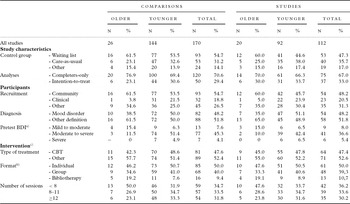
Selected characteristics of studies (and comparisons) examining the effects of psychotherapy compared to control groups in younger and in older adults

a) Only a limited number of studies reported the pretest score on the BDI.
b) In one study (Miranda et al., Reference Miranda, Chung, Green, Krupnick, Siddique and Revicki2003) respondents could participate in an individual or group treatment; this study was omitted from these analyses.
c) The total number of studies in the categories of interventions can be higher than the actual number of studies because some studies included more than one intervention. BDI = Beck Depression Inventory; CBT = cognitive behaviour therapy.
We only used the effect sizes indicating the difference between experimental and control condition at post-test (immediately after treatment). No effect sizes indicating differences at follow-up were calculated, because the number of available effect sizes was relatively small, the follow-periods differed considerably, and help-seeking behavior during follow-up was not examined in most studies.
To calculate pooled mean effect sizes, we used the computer program Comprehensive Meta-analysis (version 2.2.021), developed for support in meta-analysis. Because we expected considerable heterogeneity between studies, we conducted all analyses using a random effects model (Higgins and Green, Reference Higgins and Green2006).
As indicators of heterogeneity, we calculated the Q-statistic and the I2-statistic (Higgins et al., Reference Higgins, Thompson, Deeks and Altman2003). A I2 of 0% indicates no observed heterogeneity, while 25% indicates low, 50% moderate, and 75% high levels of heterogeneity.
Publication bias of the included studies (in older and younger adults) was examined in a separate study (in preparation). In brief, this study did not find significant differences between published studies and 15 unpublished dissertations, although several indicators pointed at significant publication bias.
Differences between studies in younger and older adults
In the next step, we calculated whether there was a difference between studies examining psychotherapy for younger adults and those for older adults. Such differences may act as confounders for the relationship between outcome and the contrast between studies in younger versus older adults.
In these analyses, we used the procedures for subgroup analyses as implemented in Comprehensive Meta-analysis version 2.2.021. In these subgroup analyses it can be tested whether there are significant differences between the effect sizes in different categories of studies. In these analyses, we used the mixed effects model, which pooled studies within subgroups with the random effects model, but tested for significant differences between subgroups with the fixed effects model.
First, we compared all studies with older adults to those with younger adults. Then we made a series of comparisons in which we selected one subgroup of studies with a specific characteristic. Within each of these subgroups of studies, we again examined whether there was a difference between studies with younger adults and those with older adults.
Multivariate meta-regression analysis
We conducted a multivariate meta-regression analysis with the effect size as the dependent variable. As predictor we entered a dummy variable indicating whether the study was aimed at younger or older adults, and a series of dummy variables indicating the characteristics of the participants, the interventions and the design of the included studies.
In order to avoid collinearity among the predictors of the regression model, we first examined whether high correlations were found among the variables that could be entered into the model. Correlations between all variables described in Table 1 were calculated. No variables were found to correlate stronger than 0.60, and we concluded that all variables could be included simultaneously in the multivariate analysis.
Because comprehensive meta-analysis does not support multivariate regression analyses, these analyses were conducted in STATA/SE 8.2 for Windows, the downloadable “metareg” procedure developed by Stephen Sharp (London School of Hygiene and Tropical Medicine).
Results
Characteristics of the included studies
A total of 112 studies were included. In these studies, 170 psychotherapy conditions were compared to a control condition. A total of 7,845 depressed people participated in the studies (4,588 in the experimental and 3,257 in the control groups). Twenty studies (26 comparisons between psychotherapy and a control group) were aimed at older adults. These studies included 1,472 people (839 in the experimental groups and 633 in the control groups). A description of the 170 comparisons for the studies on younger adults and those on older adults is presented in Table 1. A full list of references is available from the first author.
There were some important differences between the studies examining older participants, compared to those examining younger participants. Only one of the studies on older adults recruited participants from a clinical sample, while a considerable number of studies in younger adults used clinical samples (23 studies, 20.5%).
The most used instrument to assess the severity of depression was the BDI (56 studies; 50.0%; but only 5 studies in older adults). Most of these studies included participants with moderate to severe depression (41 studies, 73.2%).
Furthermore, there were some differences between the interventions used in the two groups of studies. In both groups of studies, CBT was the most used treatment (42.3% of the comparisons in older adults, and 48.6% of those in younger adults). However, few studies on older adults examined interpersonal psychotherapy (3 comparisons, compared to 9 in younger adults), problem-solving therapy (3 comparisons in older, 11 in younger adults), non-directive supportive therapies (0 comparisons in older, 13 in younger adults), behavioral activation treatments (1 comparison in older, 9 in younger adults). In five comparisons in older age groups, life review therapies were examined, but these were not examined in younger age groups.
Most studies (106; 94.6%) reported the mean age of the participants; this ranged from 19.10 years to 81.40 (mean 41.81). In the studies aimed at older adults, the mean ages ranged from 54.00 years to 81.40 (mean 69.28), and most comparisons (N = 15) examined samples of older adults with a mean of 70 years or lower.
Overall mean effect sizes of studies in younger and older adults
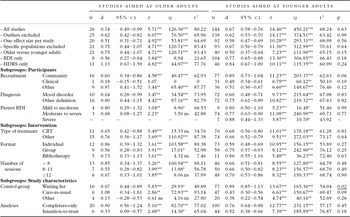
We analyzed all comparisons in younger to those in older adults. As can be seen in Table 2, the effect sizes of both groups of comparisons did not differ significantly from each other (older adults: d = 0.74; 95% CI: 0.49~0.99; younger adults: d = 0.67; 95% CI: 0.58~0.76), although heterogeneity was high in both groups.
A meta-analytic comparison of psychotherapy for depression in younger and older adults

BDI = Beck Depression Inventory; CBT = cognitive behaviour therapy; HDRS = Hamilton Depression Rating Scale. ns = not significant; a=p<0.1; *=p<0.05; **=p<0.01; ***=p<0.001.
Because the overall mean effect sizes may be distorted by outliers, we excluded the comparisons with effect sizes of 2.0 and larger, and again compared the remaining effect sizes in younger and older adults. This resulted in comparable outcomes, with no significant difference between psychotherapies for younger and older adults (Table 2).
In a considerable number of studies, more than one comparison between psychotherapy and a control group was examined. This means that multiple comparisons from one study were included in the same analysis. These multiple comparisons are, however, not independent of each other, possibly resulting in a distortion of the mean effects or heterogeneity. Therefore, we conducted an additional analysis, in which we included only one comparison per study. From the studies with multiple comparisons we included only the comparison with the smallest effect size. As can be seen in Table 2, the mean effect sizes were reduced somewhat both in studies with younger adults and those with older adults, but again there was no indication of a difference between the two groups.
A considerable number of studies were not aimed at adults in general, but at specific populations, such as student cohorts, women with postpartum depression, or patients with a general medical disorder having depressive symptoms. We also examined whether exclusion of these studies resulted in different outcomes. In these comparisons we only included studies in which all younger or older adults could participate, and did not necessarily have to belong to a specific population. No indication of a difference between younger and older adults was found in this subgroup of studies.
In a number of studies aimed at adults, being an older adult (usually older than 60 or older than 65) was an explicit exclusion criterion. We also compared these studies to the studies aimed at older adults (while excluding specific populations). Again, no significant difference was found between these two groups of studies (Table 2).
The BDI and the Hamilton Depression Rating Scale (HDRS) were the most frequently used instruments in the included studies. When we calculated the effect sizes based on the BDI only, we again found no significant difference between studies in younger and those in older adults. The same was true for analyses based on the HDRS only.
Subgroup analyses
A series of analyses was conducted in which we first selected a subgroup of studies based on a specific characteristic (Table 2), and then examined whether there was a significant difference between studies in younger and older adults within this subgroup of studies. The results of these analyses are presented in Table 2.
In most subgroups of studies, there was no significant difference between the effect sizes in younger and those in older age groups. The only significant difference was found in the subgroup of studies in which waiting list control groups were used. These analyses indicated that among the studies using a waiting list control group, the mean effect size for older adults was significantly lower (d = 0.67; 95% CI: 0.44~0.89) than the mean effect size for younger adults (d = 0.99; 95% CI: 0.85~1.13; p < 0.05). There was also a trend (p < 0.1) indicating that the effects for older adults were larger than for younger adults in studies in which care-as-usual control groups were used.
These subgroup analyses also indicated that heterogeneity was high in almost all subgroups.
Multivariate analysis
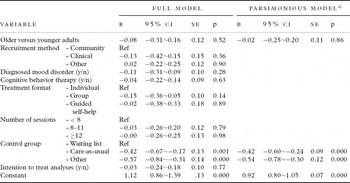
We conducted a multivariate meta-regression analysis with the effect size as the dependent variable and all variables presented in Table 1 as predictors. We also added a dummy variable indicating whether the study was conducted with older or with younger adults as predictor. The results of these analyses are presented in Table 3.
Regression coefficients of characteristics of the interventions, target population, and design of the studies in relation to the effect size of psychological interventions for depression: multivariate meta-regression analyses

a) In the parsimonious model, the least significant variable was dropped in each step of a backwards regression analysis, until only significant predictors were retained (while retaining the dummy variable indicating older versus younger participants).
y/n = yes/no.
After controlling for the characteristics of the population, the intervention, and the design of the included studies, no significant difference was found between studies in younger and those in older adults, at p < 0.05 and even at p < 0.10. The only significant predictor was type of control group – with care-as-usual and other control groups being associated with considerably lower effect sizes.
We also conducted a (manual) back-step meta-regression analysis. In this analysis, we retained the dummy variable indicating older versus younger participants, but dropped the least significant variable in each step, until only significant predictors were retained in the model. The results of this parsimonious model indicated that the difference between studies in older and those in younger adults was very small and not close to any level of significance (p = 0.86).
Several studies were aimed at general medical patients (with depression). Some of these studies were not specifically aimed at older adults, although the mean age of the patients was high (in two studies in general medical patients, the mean age was higher than 60). Therefore, we conducted another multivariate meta-regression analysis with effect size as the dependent variable, and the variables from Table 1 as predictor, but this time we added the mean age as dependent variable (instead of the dummy variable indicating older versus younger participants). The results were comparable to those of the first multivariate analysis, with the mean age not significantly associated with effect size (and type of control group as the only significant predictor).
We repeated the two analyses once more, with the same dependent variable and predictors, but this time we added the pretest score on the BDI as predictor. These analyses were conducted separately because only a limited number of studies reported the pretest BDI score. The results of these analyses again resulted in comparable outcomes.
Discussion
We conducted a meta-regression analysis to examine whether psychotherapy for depression in older adults is less effective than in younger adults. We found no indication that this is the case. Therefore, we must conclude that the evidence so far does not suggest that psychotherapy is less effective in either of these two groups. However, given the null hypothesis character of this finding and the correlational design, this evidence cannot be regarded as definite.
In fact, we did notice several differences between the set of studies examining psychotherapy in older adults compared to younger adults. First, only one study recruited older participants from a clinical sample, while a considerable number of studies in younger adults used clinical samples. In addition, the studies in clinical samples resulted in considerably smaller effect sizes than other studies. More research is needed to examine whether psychotherapy for older adults in clinical samples is as effective as psychotherapy for younger adults in clinical settings. Effectiveness studies with high external validity would be a welcome addition to the literature on psychotherapy for depression in older adults.
All the studies in older adults were aimed at participants with mild to moderate depression. No study has examined the effects in severely depressed older adults. It has to be mentioned here that most studies in younger adults were aimed at mild to moderate depression as well, and that the evidence in respect of more severely depressed participants is rather limited.
Most studies examined the “younger” old. The majority of studied groups had a mean age of 70 or younger. That means that the evidence that psychotherapy is also effective in older age groups (older than 70) is very limited. Therefore, this meta-regression analysis does not exclude the possibility that psychotherapy is less effective in the older old.
Apart from these limitations in the sample of studies on older adults, this study has several other limitations. First, the number of studies among older adults was relatively small, especially compared to the number of studies in younger adults in this field. Second, a meta-regression analysis cannot replace experimental research in which the association between age and treatment effects is examined in a direct head-on comparison, although even this remains correlational in character. Third, the treatments that have been developed for depression in older adults differ from those in younger adults. For example, several studies examined life review and reminiscence treatments for depression in older adults, while this intervention has not been examined in younger adults. This also relates to the possibility that depression in older adults is phenomenologically different from depression in younger adults, not least because of different comorbid problems. Older adults are, for example, much more likely to suffer from a chronic health condition (La Rue and McCreary, Reference La Rue, McCreary, Sweet, Rozensky and Tovian1991). Another aspect relates to losses and the fact that older adults are more likely to have suffered the loss of a significant other (e.g. spouse). And fourth, heterogeneity was high in most analyses. This suggests that the effects of therapies may be associated with, and perhaps confounded by, other characteristics than the ones we examined in our subgroup and meta-regression analyses. Therefore, the results of this study have to be interpreted with caution.
Despite these limitations, the results of our study clearly suggest that psychotherapy for depression is probably equally effective in younger and older age groups. Although more research is needed on representative clinical samples, in older old adults, and in more severe forms of depression, our study shows that currently there is no reason not to apply psychotherapy for depression in old age.
Conflict of interest
None.
Description of authors' roles
Pim Cuijpers designed the review, collected the data, conducted the analyses, and wrote the paper. Annemieke van Straten helped in collecting the data and reviewed the texts critically. Filip Smit helped with the analyses and reviewed the texts critically. Gerhard Andersson helped in designing the review and reviewed the texts critically.