





1 Main results
1.1 Introduction
Given a natural number
$d\geq 2$
 and a real number
$\beta>1$
 , the d-ary
$\beta $
 -free shift space
$X_{\beta }^d$
 is the set of all bi-infinite strings
$x\in \{1,\ldots , d\}^{\mathbb {Z}}$
 such that no subword of x is an
$\alpha $
 -power for any rational
$\alpha \geq \beta $
 (see §1.2 for precise definitions). Similarly,
$X_{\beta ^+}^d$
 consists of all x that avoid
$\alpha $
 -powers for
$\alpha> \beta $
 . It is known that these shift spaces have positive topological entropy for many choices of
$(d,\beta )$
 . The main result of this paper is the following theorem.
Theorem 1.1. For every
$d\geq 2$
 and
$\beta> 12$
 , the shift spaces
$X_{\beta }^d$
 and
$X_{\beta ^+}^d$
 both have a unique measure of maximal entropy (MME).
In the course of the proof, we establish the following counting bounds.
Theorem 1.2. Given a shift space from Theorem 1.1, let
$\mathcal {L}_n$
 be the set of length-n words in its language (the set of extendable
$\beta $
 -free d-ary words of length n), and
${h = \lim _{n\to \infty }(1/n)\log \#\mathcal {L}_n> 0}$
 its topological entropy. Then, for every
$n\in \mathbb {N}$
 , we have

Remark 1.3. The set of parameter values
$(d,\beta )$
 in these results is not optimal and neither is the upper bound in (1.1). When
$\beta>3$
 and d is sufficiently large, a result of Pavlov [Reference PavlovPav22, Theorem 7.2] can be used to deduce uniqueness of the MME together with counting bounds analogous to (1.1), as described in Theorem 2.7. See also Remarks 1.3 and 2.8 for more on the relationship between Pavlov’s arguments and the approach used here. Using more combinatorial techniques, Bui and Rosenfeld have also established a stronger version of (1.1) [Reference Bui and RosenfeldBR25]. See §2.2 for more discussion of these and other related results in the literature.
Beyond the question of which parameter values lead to uniqueness of the MME, we would like to understand the ergodic properties of that MME. Pavlov uses a result of Ledrappier to show that the unique MME in [Reference PavlovPav22] has the K property and it seems reasonable to expect this to hold in Theorem 1.1 as well. However, moving beyond the K property, the power-free shifts
$X_\beta ^d$
 lack the periodic orbits that are characteristic of local product structure, a key ingredient in the proof of the Bernoulli property in hyperbolic smooth dynamics, and thus the following question seems particularly intriguing.
Question 1.4. Is the unique MME in Theorem 1.1 measure-theoretically isomorphic to a Bernoulli process?
1.2 Main definitions
To define
$X_{\beta }^d$
 and
$X_{\beta ^+}^d$
 more carefully, we recall some basic notions from symbolic dynamics and from combinatorics on words. Let A be a finite set (the alphabet),
$A^{\mathbb {Z}}$
 the set of all bi-infinite strings of symbols in A, and
$\sigma \colon A^{\mathbb {Z}} \to A^{\mathbb {Z}}$
 the left shift map defined by
$\sigma (x)_n = x_{n+1}$
 . Equipping
$A^{\mathbb {Z}}$
 with the product topology, a (two-sided) shift space is a closed set
$X \subset A^{\mathbb {Z}}$
 that is shift-invariant in the sense that
$\sigma (X) = X$
 .
A (finite) word is an element
$w\in A^n$
 for some
$n\in \mathbb {N} \cup \{0\}$
 ; we will write
$|w| = n$
 to denote the length of
$w$
 . The set of all finite words is
$A^* := \bigcup _{n\geq 0} A^n$
 . Given a shift space
$X \subset A^{\mathbb {Z}}$
 , the collection of words

is the language of X and we will write
$\mathcal {L}_n := \mathcal {L} \cap A^n$
 for the set of words of length n in the language. The language
$\mathcal {L}$
 of a shift space is factorial (closed under passing to subwords) and extendable (given
$w\in \mathcal {L}$
 , there exist
$a,b\in A$
 such that
$awb\in \mathcal {L}$
 ).
It is often convenient to describe a shift space and its language via a set of forbidden words: given
$\mathcal {F} \subset A^+ := \bigcup _{n\geq 1} A^n$
 , the associated shift space is

That is,
$X(\mathcal {F})$
 is the set of all infinite sequences over A that have no subword in
$\mathcal {F}$
 .
Given
$n\in \mathbb {N}$
 , a word
$w\in A^n$
 , and a rational number
$\alpha> 1$
 such that
$\alpha n\in \mathbb {N}$
 , the
$\alpha $
 -power of
$w$
 is the word
$w^\alpha $
 formed by the first
$\alpha n$
 symbols of
$w^\infty = wwww\cdots $
 . For example, we have

Definition 1.1. For a natural number
$d\geq 2$
 and a real number
$\beta>1$
 , the d-ary
$\beta $
 -free shift space
$X_{\beta }^d$
 is the shift space defined by the set of forbidden words,

In other words,
$X_{\beta }^d = X(\mathcal {F}_\beta )$
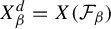 consists of all
$x\in A^{\mathbb {Z}}$
 that remain after we remove all strings containing an
$\alpha $
 -power for any
$\alpha \geq \beta $
 . Replacing
$[\beta ,\infty )$
 with
$(\beta ,\infty )$
 in (1.2) gives a set
$\mathcal {F}_{\beta ^+}$
 of forbidden words that determines a subshift
$X_{\beta ^+}^d$
 .
If
$\beta \in \mathbb {R} \setminus \mathbb {Q}$
 , then
$X_{\beta ^+}^d = X_{\beta }^d$
 . From now on,
$\beta $
 will denote either a real number or a ‘rational number with a
$+$
 ’. The set of possible
$\beta $
 carries the obvious order, so we could write Theorem 1.1 as: ‘For every
$d\geq 2$
 and
$\beta \geq 12^+$
 , the shift space
$X_{\beta }^d$
 has a unique MME’. (In fact, for
$d\geq 3$
 , we prove the result for
$\beta = 12$
 as well; see Theorem 2.1.)
Remark 1.5. Given
$\mathcal {F} \subset A^+$
 and writing
$\tilde {\mathcal {L}}(\mathcal {F})$
 for the set of all
$w\in A^*$
 that have no subword in
$\mathcal {F}$
 , we have
$\mathcal {L}(X(\mathcal {F})) \subset \tilde {\mathcal {L}}(\mathcal {F})$
 , but the inclusion can be proper: the language
$\tilde {\mathcal {L}}(\mathcal {F})$
 is factorial, but need not be extendable, and
$\mathcal {L}(X(\mathcal {F}))$
 is its extendable part, characterized as the set of all
$w\in A^*$
 that can be extended to a bi-infinite sequence
$x\in A^{\mathbb {Z}}$
 with no subword in
$\mathcal {F}$
 . The ratio
$\#\tilde {\mathcal {L}}_n / \#\mathcal {L}_n$
 is subexponential in n [Reference ShurShu08], but can be unbounded. In particular, we stress that when
$X = X_{\beta }^d$
 is the d-ary
$\beta $
 -free shift space, its language
$\mathcal {L}$
 consists of the extendable
$\beta $
 -free words, and it is to this set that the bounds in Theorem 1.2 apply.
1.3 Overview of paper
See §2.1 for a discussion of entropy in the context of symbolic dynamics, and for two results that together imply Theorems 1.1 and 1.2:
-
• Theorem 2.1 formulates a weak analog of Bowen’s specification property that is satisfied by $X_{\beta }^d$
 and which quickly leads to the counting estimates that establish Theorem 1.2;
-
• Theorem 2.3 uses this specification-type property to obtain uniqueness of the MME, proving Theorem 1.1.

Theorems 2.1 and 2.3 are proved in §§3 and 4, respectively.
See §2.2 for a review of some prior work on power-free languages and a description of the set of
$(\beta ,d)$
 for which
$X_{\beta }^d$
 is known or conjectured to have positive entropy; as indicated in Remark 1.3, this set is somewhat larger than the set of parameters to which Theorems 1.1 and 1.2 apply. See §2.3 for a discussion of this issue and some other open problems. With this in mind, both of these main results should be regarded in some sense as ‘proofs of concept’ demonstrating the utility of specification-type techniques in this setting, rather than as attempts to wring out the strongest possible results from these ideas: to present the main ideas as efficiently and readably as possible, no serious attempt has been made here to push these techniques to the fullest extent.
2 Background, definitions, and related questions
2.1 Entropy
We describe the main concepts that we will need from thermodynamic formalism, as they appear in symbolic dynamics. See [Reference WaltersWal82] for an introduction to entropy and the variational principle, and [Reference Climenhaga and ThompsonCT21] for a survey of the development of specification-type properties in the study of thermodynamic formalism.
Given a finite alphabet A and a shift space
$X \subset A^{\mathbb {Z}}$
 , recall that
$\mathcal {L} \subset A^*$
 denotes the language of X, with
$\mathcal {L}_n = \mathcal {L} \cap A^n$
 denoting the set of words of length n in the language. Equivalently,
$\mathcal {L}_n$
 is the set of words
$w\in A^n$
 for which the cylinder

is non-empty. The topological entropy of X is

where the limit exists by Fekete’s lemma since
$\#\mathcal {L}_{n+k} \leq (\#\mathcal {L}_n)(\#\mathcal {L}_k)$
 .
An invariant measure on X is a Borel probability measure
$\mu $
 such that for every Borel set
$E\subset X$
 , we have
$\mu (\sigma ^{-1}E) = \mu (E)$
 . The measure-theoretic entropy of
$\mu $
 is

the existence of the limit is again a consequence of Fekete’s lemma and the subadditivity property
$H_{n+k}(\mu ) \leq H_n(\mu ) + H_k(\mu )$
 . Writing
$\mathcal {M}_\sigma (X)$
 for the space of invariant measures, the variational principle says that

A measure achieving the supremum is called a measure of maximal entropy (MME). Every shift space on a finite alphabet has an MME because the function
$\mu \mapsto h_\mu $
 is upper semi-continuous in the weak* topology, in which
$\mathcal {M}_\sigma (X)$
 is compact.
It is an important question in ergodic theory and thermodynamic formalism to understand for which classes of shift spaces the MME is unique, and to describe its properties; see §2.3 for more. There are examples of shifts with multiple MMEs, but uniqueness is known to hold for every topologically transitive subshift of finite type (including the full shift), every transitive sofic shift, and many other examples.
We will focus our attention on a variant of Rufus Bowen’s specification property. For a shift space, this property reduces to

(Here, we use the notation
$w^{(j)}$
 for an element of an indexed set of words, reserving the notation
$w^j$
 for the power of
$w$
 obtained by concatenating j copies, and the notation
$w_j$
 for the jth symbol of a word
$w$
 . We point out that there are many versions of the specification property in the literature; see [Reference YamamotoYam09, Reference Kwietniak, Ła̧cka and OprochaKLO16] for overviews. The property in (2.4) is a uniform specification property that imposes no a priori requirement on existence of a periodic shadowing orbit.) It can quickly be seen that this is equivalent to

Every topologically mixing sofic shift (in particular, every topologically mixing subshift of finite type) has specification. Bowen proved [Reference BowenBow75b] that every shift space with specification has a unique MME.
Specification produces periodic orbits: writing
$P_n := \{ x\in X : \sigma ^n(x) = x\}$
 , one can prove that
$(1/n) \log \# P_n \to h$
 whenever (2.5) is satisfied. (To see this, use [Reference BertrandBer88] to get a synchronizing word
$v$
 and then for each
$w\in \mathcal {L}_n$
 , use (2.4) to get
$u,u' \in \mathcal {L}_\tau $
 such that
$vuwu'v \in \mathcal {L}$
 , which implies
$x := (vuwu')^\infty \in P_{n+2\tau +|v|}$
 .) Since the power-free shifts
$X_{\beta }^d$
 have no periodic orbits, they cannot satisfy Bowen’s specification property. To formulate a weaker property that they do satisfy, recall that a prefix of
$w\in A^n$
 is a word of the form
$w_{[1,k]} := w_1 w_2 \cdots w_k$
 for some
$k \in \{1,\ldots , n\}$
 , and a suffix of
$w$
 is a word of the form
$w_{[k,n]}$
 . The following theorem will be proved in §3.
Theorem 2.1. Fix
$(d,\beta )$
 such that
$d\geq 3$
 and
$\beta \geq 12$
 , or
$d=2$
 and
$\beta \geq 12^+$
 . Let
${X = X_{\beta }^d}$
 be the corresponding d-ary
$\beta $
 -free shift and
$\mathcal {L} \subset \{1,\ldots ,d\}^*$
 its language. Define
$\mathcal {C}^p,\mathcal {G},\mathcal {C}^s \subset \mathcal {L}$
 as

(Here,
$\mathcal {A}^*$
 uses the Kleene star to denote arbitrary finite (possibly empty) concatenations of words from
$\mathcal {A}$
 , just as
$A^*$
 denoted arbitrary concatenations of symbols from the alphabet.) That is,
$\mathcal {C}^p = \mathcal {C}^s$
 is the set of words in
$\mathcal {L}$
 that can be written as a concatenation of
$4$
 -powers. Then, the following are true.
-
(I) (Decomposition): for every $w\in \mathcal {L}$
, there exist
$v\in \mathcal {G}$
and
$u^{p,s} \in \mathcal {C}^{p,s}$
such that
${w=u^p v u^s}$
. -
(II) (Entropy gap): $h(\mathcal {C}^p \cup \mathcal {C}^s) := \varlimsup _{n\to \infty } ( 1/n) \log \#(\mathcal {C}^p \cup \mathcal {C}^s)_n < h(X)$
. -
(III) (Variable-length specification): there exists $T\in \mathbb {N}$
such that for all
$u,v,w,x\in \mathcal {G}$
, there are
$p,q,r \in \mathcal {L}_{T}$
such that
$upvqwrx\in \mathcal {L}$
. -
(IV) (Same-length specification): there exists $\tau \in \mathbb {N}$
such that for every
$v,w\in \mathcal {G}$
with
$|v| = |w|$
, there exists
$u\in \mathcal {L}_\tau $
such that
$vuw\in \mathcal {G}$
.





Moreover,
$\#\mathcal {L}_n$
 satisfies the bounds in (1.1).
Conditions (I) and (II) require a decomposition of the language in which the prefix and suffix collections
$\mathcal {C}^p$
 and
$\mathcal {C}^s$
 do not carry full entropy. Conditions (III) and (IV) are weakenings of the specification properties (2.4) and (2.5). In particular, shifts with specification satisfy Conditions (I)–(IV) by taking
$\mathcal {C}^p=\mathcal {C}^s=\emptyset $
 and
$\mathcal {G} = \mathcal {L}$
 .
We will prove that every shift space satisfying Conditions (I)–(IV) has a unique MME. Our argument will use a slightly weaker version of Condition (IV): the following is proved in §3.3.2 by iterating Condition (IV).
Lemma 2.2. Let
$\mathcal {L}$
 be the language of a shift space X and suppose that
$\mathcal {G} \subset \mathcal {L}$
 satisfies Condition (IV). Then,
$\mathcal {G}$
 satisfies the following.
-
(IV′) There exists $\tau \in \mathbb {N}$
such that for every
$k,n \in \mathbb {N}$
and
$w^{(1)},\ldots , w^{(k)} \in \mathcal {G}_n$
, there exist
$u^{(1)},\ldots , u^{(k-1)} \in \mathcal {L}_{\tau }$
such that
$w^{(1)} u^{(1)} w^{(2)} u^{(2)} \cdots u^{(k-1)} w^{(k)} \in \mathcal {L}$
.




Our general uniqueness result will also use the following consequence of Condition (II) instead of Condition (II) itself.
-
(II′) The quantity $Q := (\sum _{i=0}^\infty \#\mathcal {C}^p_i e^{-ih})(\sum _{k=0}^\infty \#\mathcal {C}^s_k e^{-kh})$
is finite.

The following theorem is proved in §4. Together with Theorem 2.1 and Lemma 2.2, it completes the proof of Theorem 1.1.
Theorem 2.3. Let X be a shift space on a finite alphabet with language
$\mathcal {L}$
 . Suppose that there exist
$\mathcal {C}^p,\mathcal {G},\mathcal {C}^s \subset \mathcal {L}$
 satisfying Conditions (I), (II
${}^{\prime }$
 ), (III), and (IV
${}^{\prime }$
 ). Then, X has a unique measure of maximal entropy. Moreover, we have
$e^{nh} \leq \#\mathcal {L}_n \leq Q e^{(n+\tau )h}$
 for all n, where Q and
$\tau $
 are as in Conditions (II
${}^{\prime }$
 ) and (IV
${}^{\prime }$
 ).
Remark 2.4. (Other non-uniform specification results)
Conditions analogous to those appearing in Theorem 2.3 were introduced by the author and Dan Thompson in [Reference Climenhaga and ThompsonCT12]. In that paper, Conditions (III) and (IV
$^{\prime }$
 ) were replaced by the stronger (but simpler to formulate) condition that ‘the specification property is satisfied for words in
$\mathcal {G}$
 ’, in the sense that

This condition, together with Conditions (I) and (II
$^{\prime }$
 ), implies uniqueness of the MME. This was proved in [Reference Climenhaga and ThompsonCT12, Reference Climenhaga and ThompsonCT13] modulo an extra assumption on ‘extending to words in
$\mathcal {G}$
 ’. This extra condition was ultimately proved to be unnecessary by Pacifico et al [Reference Pacifico, Yang and YangPYY22]. Theorem 2.3 is another generalization of the result from [Reference Climenhaga and ThompsonCT12]: observe that Conditions (III) and (IV
$^{\prime }$
 ) are weakened versions of (2.7), obtained by restricting to the case
$k=4$
 in Condition (III), and to words of the same length in Condition (IV
$^{\prime }$
 ).
It is also worth comparing Theorem 2.3 with [Reference PavlovPav22, Theorem 3.2], where Pavlov uses ideas from his earlier work in [Reference PavlovPav19] to prove uniqueness of the MME under the following conditions:
-
• there exists $C \geq 1$
such that
$\#\mathcal {L}_n \leq C e^{nh}$
for all n; -
• there exists $\mathcal {G} \subset \mathcal {L}$
satisfying a weaker version of Condition (III), which only requires the ability to glue two words (instead of four); -
• the collection $\mathcal {G}$
can also be chosen to have the property that for every ergodic MME
$\mu $
, there exists a syndetic set
$S \subset \mathbb {N}$
such that
$\inf _{n\in S} \mu (\mathcal {G}_n)> 0$
.


Pavlov’s argument for uniqueness is rather different from the one given here; his proof uses the maximal ergodic theorem and does not rely on establishing any sort of Gibbs property. Indeed, he proves a Gibbs bound after proving uniqueness, whereas we proceed in the opposite order. It would be interesting to understand whether his techniques could be used to sharpen the results here.
Remark 2.5. Echoing the comments preceding Theorem 2.1, we emphasize that the absence of periodic points in the power-free shifts
$X_{\beta }^d$
 stands in stark contrast to prior applications of specification-type properties, such as [Reference Climenhaga and ThompsonCT12, Reference ClimenhagaCli18, Reference Burns, Climenhaga, Fisher and ThompsonBCFT18], where periodic orbits are abundant and grow as quickly as the topological entropy.
2.2 Growth in power-free languages
Power-free languages have been well studied. For a full introduction to these languages and other topics in combinatorics on words, we refer to [Reference Lothaire, Perrin, Berstel, Choffrut, Cori, Foata, Pin, Pirillo, Reutenauer, Schützenberger, Sakarovitch and SimonLot83, Reference Allouche and ShallitAS03]. We will focus on the growth properties of power-free languages; overviews of the literature on this topic can be found in the surveys by Berstel [Reference BerstelBer05] and Shur [Reference ShurShu11, Reference ShurShu12].
2.2.1 Repetition threshold and Dejean’s conjecture
A natural first question is to ask when
$X_\beta ^d$
 is non-empty. One quickly sees that it is empty when
$d=2$
 and
$\beta \leq 2$
 : the only non-empty words over
$A = \{\mathsf {0,1}\}$
 that do not contain a square are

However, the Thue–Morse sequence (this sequence is
$\mathsf {0 1 10 1001 10010110\cdots }$
 , where the first
$2^n$
 symbols determine the next
$2^n$
 symbols via the morphism
$\mathsf {0\leftrightarrow 1}$
 ) does not contain any subword that is an
$\alpha $
 -power for any
$\alpha> 2$
 (it is overlap-free), so
$X_{2^+}^2 \neq \emptyset $
 . Thus,
$\beta = 2$
 is the repetition threshold for the alphabet size
$d=2$
 : writing

we have
$\mathsf {RT}(2) = 2$
 . In 1972, Dejean proved that
$\mathsf {RT}(3) = \frac 74$
 and conjectured that

This was eventually proved for all d through a combination of work by Pansiot [Reference PansiotPan84], Moulin-Ollagnier [Reference OllagnierMO92], Mohammad-Noori and Currie [Reference Mohammad-Noori and CurrieMNC07], Carpi [Reference CarpiCar07], Currie and Rampersad [Reference Currie and RampersadCR11], and Rao [Reference RaoRao11].
2.2.2 Entropy and the exponential conjecture
With the repetition thresholds known, it is natural to ask for which values of
$(\beta ,d)$
 with
$\beta> \mathsf {RT}(d)$
 the topological entropy of
$X_\beta ^d$
 is positive. (The literature in combinatorics on words tends to use the term exponential complexity rather than positive topological entropy, but the meaning is the same.) That is, we want to determine the set

Early results in this direction were given by Brandenburg, who proved that
$X_3^2$
 and
$X_2^3$
 have positive topological entropy [Reference BrandenburgBra83].
In the other direction, Restivo and Salemi [Reference Restivo and SalemiRS85] proved that
$h(X_{2^+}^2) = 0$
 by characterizing elements of this shift space via the Thue–Morse morphism; this was extended to
$X_\beta ^2$
 for
$2 < \beta \leq \frac 73$
 by Karhumäki and Shallit [Reference Karhumäki and ShallitKS04]. (Both [Reference Restivo and SalemiRS85, Reference Karhumäki and ShallitKS04] actually obtained more explicit polynomial bounds on
$\#\mathcal {L}_n(X_\beta ^2)$
 , but the subexponential nature of the growth is the main phenomenon in which we are interested here.)
This turns out to be sharp: Karhumäki and Shallit also proved that
$h(X_\beta ^2)> 0$
 for all
$\beta> \frac 73$
 . When
$d\geq 3$
 , no analog of the ‘polynomial plateau’
$(2,\frac 73] \times \{2\}$
 has been observed. Ochem proved that for
$d=3,4$
 , every non-empty
$X_\beta ^d$
 has positive entropy, and conjectured that this is true for all
$d\geq 3$
 [Reference OchemOch06, Conjecture 4.4]. An equivalent formulation of this exponential conjecture is that, writing
$\beta = \mathsf {RT}(d)$
 , the shift space
$X_{\beta ^+}^d$
 has positive topological entropy. This has now been proved for all
$d\geq 3$
 except for the even numbers from
$12$
 to
$26$
 [Reference Kolpakov and RaoKR11, Reference Tunev and ShurTS12, Reference Currie, Mol and RampersadCMR20].
2.2.3 Uniqueness of the MME
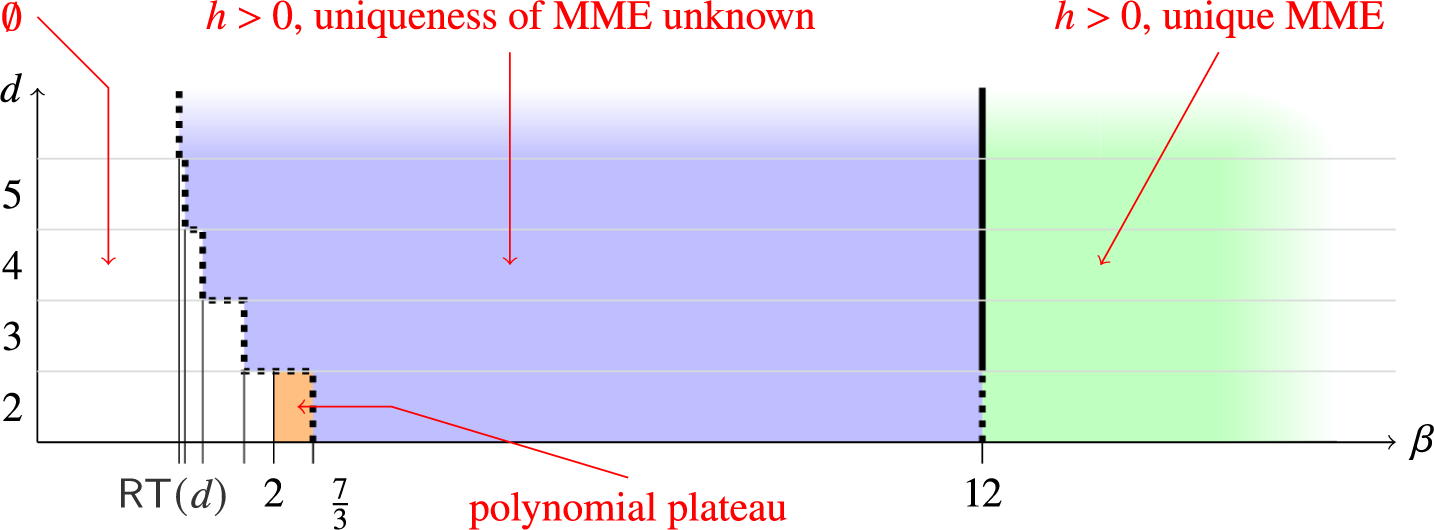
The discussion so far is summarized in Figure 1, which illustrates how Theorem 1.1 can be viewed as a step towards answering the following question.
Question 2.6. Does every power-free shift space
$X_\beta ^d$
 with positive topological entropy have a unique MME?
A map of parameter space for
$X_{\beta }^d$
 (color online).

Figure 1 Long description
The diagram uses a horizontal x-axis labeled beta and a vertical y-axis labeled d with integer markings from 2 to 5.
* The leftmost region is white and labeled with a null symbol, indicating an empty set.
* Moving right, a stepped boundary defined by R T (d) transitions into a large blue shaded region. A red arrow points to this area with the text: h > 0, uniqueness of M M E unknown.
* At the bottom of this blue region, between beta values 2 and 7 over 3, there is a small orange rectangular area. A red arrow points to this labeled: polynomial plateau.
* A thick vertical black line at beta equals 12 marks the transition to the final region.
* The rightmost region is shaded green. A red arrow points into this area with the text: h > 0, unique M M E.
As mentioned in Remark 1.3 and §1.3, the arguments given in §3 have been written down with brevity and readability in mind, rather than with the goal of finding the largest set of
$(\beta ,d)$
 to which these specification-type techniques can be applied.
The conclusions of Theorems 1.1 and 1.2 hold for many smaller values of
$\beta $
 , at least when the alphabet is sufficiently large. For example, Pavlov has shown that if X is a subshift on a d-letter alphabet A defined by a set of forbidden words that contains at most
$b_n$
 words of length n, and if

then X has a unique MME, which has the K-property [Reference PavlovPav22, Theorem 7.2]. The brief argument establishing the following consequence of this result was provided to the author by Ronnie Pavlov.
Theorem 2.7. (Pavlov)
For every
$\beta>3$
 , there exists
$d_0\in \mathbb {N}$
 such that for all
$d\geq d_0$
 , both
$X_{\beta }^d$
 and
$X_{\beta ^+}^d$
 have a unique MME, and this measure has the K-property. Moreover,
$\#\mathcal {L}_n \leq 4e^{nh}$
 for all sufficiently large n.
Proof. First, observe that given any
$N\in \mathbb {N}$
 , the number of non-empty words with length
$\leq N$
 is at most
$\sum _{\ell =1}^N d^\ell = d (({d^N - 1})/({d-1})) \leq 2d^N$
 . Now, given
$n\in \mathbb {N}$
 , a forbidden word of length n must have the form
$w^{p/q}$
 , where
$ p/q \leq \beta $
 , and thus
$|w| \leq n/\beta $
 . Thus, we can take
$b_n = 2d^{n/\beta }$
 and the sum in (2.8) becomes

provided
$\unicode{x3bb} _d \in (0,1)$
 . Since
$\beta>3$
 , we have
$\unicode{x3bb} _d \to 0$
 as
$d\to \infty $
 , so (2.8) is satisfied for all sufficiently large d. Together with [Reference PavlovPav22, Theorems 4.3 and 7.2], this proves the result.
Remark 2.8. There are many similarities between the arguments in [Reference PavlovPav22] and the arguments here. In both cases, the overall approach is to formulate abstract conditions that are satisfied by the class of subshifts to be studied: subshifts with slow forbidden word growth in [Reference PavlovPav22] and power-free shifts here. The similarity between the abstract conditions was discussed in Remark 1.3. The arguments that Pavlov uses to verify his conditions for subshifts with slow forbidden word growth are based on ideas of Miller [Reference MillerMil12] and his own prior work on coded systems [Reference PavlovPav20]. In the specific case of power-free shifts, there are strong parallels to the approach here. The following observation is indicative: if we consider the case
$\beta =12$
 , so that
$\mathcal {F} = \{ v^{12} : v\in \mathcal {L}\}$
 , then the collection of words
$\mathcal {A}$
 defined in (2.6) is precisely the set of heavy subwords in the sense of [Reference PavlovPav22, Definition 5.1], and the collection
$\mathcal {G}$
 in (2.6) agrees with the set of words G from [Reference PavlovPav22, Definition 5.2].
Regarding the range of parameters that one could hope to treat using Theorem 2.3, we make the following observations. For
$d\geq 3$
 and
$\beta \geq 16$
 , taking
$\mathcal {A} = \{v^4 : v\in \mathcal {L}\}$
 will let us verify Conditions (III) and (IV) with transition times
$T=0$
 and
$\tau =1$
 , while going all the way to
$d=2$
 and
$\beta = 12^+$
 requires
$T=\tau =2$
 . It seems likely that the same choice of
$\mathcal {A}$
 could be made to work for at least some smaller values of d and
$\beta $
 at the cost of increasing the transition times and the lengths of the proofs, and one might also try to go further by replacing
$v^4$
 with a smaller power in the definition of
$\mathcal {A}$
 .
For purposes of the uniqueness argument, the exact values of the constants in the counting bounds (1.1) are not important; the crucial thing is that such constants exist. One might hope to improve these bounds using the approach here by making more careful estimates of
$\#(\mathcal {A}^*)_n$
 and
$\#\mathcal {G}_n$
 . It deserves to be mentioned that improved bounds can also be obtained by other methods: this was done by Bui and Rosenfeld [Reference Bui and RosenfeldBR25], using combinatorial techniques introduced in [Reference RosenfeldRos25]. The crucial ingredient is an explicit estimate of a constant
$C \in (0,1)$
 such that
$\#\mathcal {L}_{n+m} \geq C \#\mathcal {L}_n \#\mathcal {L}_m$
 for all
$n,m\in \mathbb {N}$
 [Reference Bui and RosenfeldBR25, Theorems 10 and 11]. These results apply to a broader range of parameters than Theorems 1.2 or 2.7, and it would be interesting to see if they could be used to study uniqueness of the MME for these parameters as well.
2.3 Related questions
The surveys [Reference BerstelBer05, Reference ShurShu11, Reference ShurShu12] describe related results and questions concerning growth in power-free languages. These include techniques for numerically approximating
$h(X_\beta ^d)$
 ; see [Reference ShurShu12, §§3–5] for a discussion of these and of the continuity properties of
$\beta \mapsto h(X_\beta ^d)$
 . It would be interesting to study the continuity properties not just of the topological entropy, but also of the dependence of the MME on the parameter
$\beta $
 .
Another direction that has been studied is to consider repetition-free languages and shift spaces defined by variants of the power-free condition. For example, one could allow powers of short words but not of longer words [Reference Entringer, Jackson and SchatzEJS74, Reference DekkingDek76, Reference Fraenkel and SimpsonFS95, Reference Rampersad, Shallit and WangRSW05], or could impose a restriction that we avoid patterns other than pure powers [Reference DekkingDek79, Reference Chiniforooshan, Kari and ZhiCKX12]. It seems likely that the methods developed in this paper could be useful in at least some such examples.
We conclude this section by mentioning some further questions drawn from the theory of uniformly hyperbolic dynamical systems, where thermodynamic formalism was developed and where the specification-type properties used in Theorem 2.3 assume their strongest form. In this setting, uniqueness of the MME is only the beginning of the story. For example, given a shift space X with the specification property (2.4), the following are true.
-
• The unique MME $\mu $
is fully supported: it gives positive weight to every open set [Reference BowenBow75b]. Moreover, the system
$(X,\sigma ,\mu )$
is measure-theoretically isomorphic to a Bernoulli shift [Reference BowenBow75a, Reference DaonDao13, Reference ClimenhagaCli18]: in particular, it has the K property [Reference LedrappierLed77] and is mixing. (The K (Kolmogorov) property follows from Bernoullicity and implies mixing; it is equivalent to completely positive entropy, meaning that
$(X,\sigma ,\mu )$
has positive entropy over any partition.) -
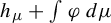
• For every Hölder continuous function $\varphi \colon X\to \mathbb {R}$
, there is a unique equilibrium state
$\mu $
that maximizes the quantity
$h_\mu + \int \varphi \,d\mu $
. This equilibrium state is fully supported and Bernoulli. -
• The space of invariant measures $\mathcal {M}_\sigma (X)$
is very rich: its set of extreme points (ergodic measures) is entropy-dense [Reference Eizenberg, Kifer and WeissEKW94, Reference Pfister and SullivanPS05], which implies that
$\mathcal {M}_\sigma (X)$
is linearly isomorphic to the Poulsen simplex; moreover, it contains measures isomorphic to every ergodic aperiodic transformation with entropy less than h [Reference KriegerKri75, Reference Quas and SooQS16].




Question 2.9. Fix
$d,\beta $
 as in Theorem 2.1 and let
$\mu $
 be the unique MME on
$X_\beta ^d$
 .
-
(a) Is $\mu $
fully supported? -
(b) Does $\mu $
have the K property? Is it Bernoulli?


The question of full support is closely related to what Shallit and Shur call the Restivo–Salemi property [Reference Shallit and ShurSS19, §4], after a question posed in [Reference Restivo and SalemiRS85, Problem 4]: this is the condition that given any
$u,v\in \mathcal {L}(X_\beta ^d)$
 , there exists a word
$w$
 such that
$uwv \in \mathcal {L}(X_\beta ^d)$
 . In the terminology of dynamical systems, this is the property that
$(X_\beta ^d,\sigma )$
 is topologically transitive, which must be true whenever there exists a fully supported ergodic measure; in particular, a positive answer to Question 2.9(a) would imply the Restivo–Salemi property. Numerical evidence suggests that the Restivo–Salemi property should hold for every
$X_\beta ^d$
 ; see [Reference ShurShu09, Conjecture 1] and [Reference Shallit and ShurSS19, Conjecture 42]. However, the author is not aware of a proof of this property for any
$X_\beta ^d$
 with positive entropy.
For the parameters
$d,\beta $
 in Theorem 2.7, Pavlov’s result from [Reference PavlovPav22] establishes the K property for the unique MME and one may hope to obtain a similar result for the parameters in Theorem 1.1. It is less clear to the author whether to expect the Bernoulli property to hold. As mentioned in Remark 1.3, Bernoullicity of the MME in hyperbolic dynamics is generally proved using local product structure. This same local product structure is also associated to the abundance of periodic orbits in hyperbolic dynamics. Since these are absent in
$X_{\beta }^d$
 and there is no obvious product structure to use, it is not clear how to approach the question of Bernoullicity.
Moving beyond the MME, the results mentioned previously for uniformly hyperbolic systems suggest the following questions.
Question 2.10.
-
(a) Under what conditions does a Hölder continuous potential function $\varphi \colon X_\beta ^d \to \mathbb {R}$
have a unique equilibrium state? -
(b) Is the set of ergodic measures entropy-dense in $\mathcal {M}_\sigma (X_\beta ^d)$
? That is, given any invariant
$\mu $
, is there a sequence of ergodic measures
$\mu _n$
such that
$\mu _n\to \mu $
in the weak* topology and
$h_{\mu _n} \to h_\mu $
? If not, is there at least a weak*-density result, so that
$\mathcal {M}_\sigma (X_\beta ^d)$
is linearly isomorphic to the Poulsen simplex? -
(c) Does the space of invariant measures $\mathcal {M}_\sigma (X_\beta ^d)$
contain measures isomorphic to every ergodic aperiodic transformation with entropy less than h? If not, does it at least contain measures achieving every entropy between
$0$
and h?


3 Specification-type properties for power-free shifts
This section is devoted to the proof of Theorem 2.1. Fixing d and
$\beta $
 , we write
${A = \{1,\ldots , d\}}$
 and consider the following collections of words as in (2.6).
-
• Let $\mathcal {G}$
be the set of all words
$w\in \mathcal {L} = \mathcal {L}(X_{\beta }^d)$
such that
$w$
does not begin or end with a word of the form
$v^4$
for any
$v\in \mathcal {L}$
. -
• Let $\mathcal {A} = \{ v^4 : v\in \mathcal {L} \}$
and let
$\mathcal {C}^p = \mathcal {C}^s = \mathcal {A}^* \cap \mathcal {L}$
.



We quickly see that
$\mathcal {C}^p,\mathcal {G},\mathcal {C}^s$
 satisfy the decomposition property in Condition (I): given any
$w\in \mathcal {L}$
 , let
$u^p$
 be the longest prefix of
$w$
 that can be written as a concatenation of words in
$\mathcal {A}$
 , and
$u^s$
 the longest suffix of
$w$
 that can be written in this way and that has length at most
$|w| - |u^p|$
 . Then, we have
$w = u^p v u^s$
 , where
$v$
 does not begin or end with a word in
$\mathcal {A}$
 (by maximality of
$u^p$
 and
$u^s$
 ) and, thus,
$v\in \mathcal {G}$
 . Note that
$v$
 could be the empty word.
With Condition (I) verified, it remains to prove that
$h(\mathcal {A}^*) = \varlimsup ( 1/n) \log \#(\mathcal {A}^*)_n < h(X)$
 so that Condition (II) is satisfied, and to verify that
$\mathcal {G}$
 satisfies the specification-type Properties (III) and (IV). After establishing some basic lemmas in §3.1, we will prove Conditions (III) and (IV) in §3.2. Then, in §3.3, we will use Condition (IV) to obtain uniform bounds relating
$\#\mathcal {G}_n$
 ,
$e^{nh}$
 , and
$\#\mathcal {L}_n$
 , which we use to prove Condition (II) and (1.1).
3.1 Periods of words
Given
$w=w_1 \cdots w_n \in A^n$
 , an integer
$\ell $
 is a period of
$w$
 if
${1\leq \ell \leq n}$
 and
$w_i = w_{\ell +i}$
 for all
$1\leq i\leq n-\ell $
 ; equivalently, if
$w = (w_1 \cdots w_\ell )^{n/\ell }$
 . The set of all periods of a word
$w$
 will be denoted
$\Pi (w)$
 and the smallest element of
$\Pi (w)$
 will be called the period of
$w$
 .
Theorem 3.1. (Fine and Wilf [Reference Allouche and ShallitAS03, Theorem 1.5.6])
If
$w$
 is a word of length n and
$\ell ,k$
 are periods of
$w$
 such that
$\ell + k - \gcd (\ell ,k) \leq n$
 , then
$\gcd (\ell ,k)$
 is a period of
$w$
 .
Corollary 3.2. If
$w\in A^n$
 has a period in
$[1,\lceil n/2 \rceil ]$
 , then every such period is a multiple of the least such period.
Given
$w\in A^*$
 and
$\ell \in \mathbb {N}$
 , let
$\mathbf {p}_\ell (w)$
 be the number of times the word
$w_{[1,\ell ]}$
 is repeated as a prefix of
$w$
 . That is,
$\mathbf {p}_\ell (w) := k/\ell $
 , where k is maximal with the property that
$w_{[1,k]}$
 is a prefix of
$(w_{[1,\ell ]})^\infty $
 . Similarly, let
$\mathbf {s}_\ell (w)$
 be the number of times the length-
$\ell $
 suffix of
$w$
 is repeated.
Remark 3.3. In the context of
$X_{\beta }^d$
 , we see that given
$w\in \mathcal {L}$
 , we have
$w\in \mathcal {G}$
 if and only if
$\mathbf {p}_\ell (w) < 4$
 and
$\mathbf {s}_\ell (w) < 4$
 for all
$1\leq \ell \leq |w|$
 .
Lemma 3.4. For all
$n\in \mathbb {N}$
 and
$v\in A^n$
 , there exists
$a\in A$
 such that given any
$u\in A^+$
 with
$u_1 \neq a$
 , we have
$\mathbf {p}_\ell (vu) = \mathbf {p}_\ell (v)$
 for all
$\ell \in \{1,\ldots , \lceil n/2 \rceil \}$
 .
Proof. Observe that if
$\ell \in \{1,\ldots ,\lceil n/2\rceil \}$
 is not a period of
$v$
 , then
$\mathbf {p}_\ell (vu) = \mathbf {p}_\ell (v)$
 for every
$u\in A^+$
 . In particular, if
$P := \prod (v) \cap [1,\lceil n/2 \rceil ]$
 is empty, then any
$a\in A$
 fulfills the conclusion.
If
$P\neq \emptyset $
 , then let
$k = \min P$
 . Writing
$x= (v_{[1,k]})^\infty = (v_1 \cdots v_k)^\infty $
 for the corresponding periodic infinite string that has
$x_{[1,n]} = v$
 , let
$a = x_{n+1}$
 be the next symbol following
$v$
 in this periodic repetition. By Corollary 3.2, every period
$\ell $
 of
$v$
 in
$[1,\lceil n/2 \rceil ]$
 is a multiple of k and thus has
$(v_{[1,\ell ]})^\infty = x$
 . It follows that a has the desired property: given any
$u\in A^+$
 such that
$u_1 \neq a = x_{n+1}$
 , we see that
$\ell $
 is not a period of
$vu_1$
 , so
$\mathbf {p}_\ell (vu) = \mathbf {p}_\ell (v)$
 .
Lemma 3.5. Given
$v,w\in A^*$
 , there exist
$a_1,a_2 \in A$
 such that for every
$\tau \in \mathbb {N}$
 and every
$u\in A^\tau $
 satisfying
$u_1 \neq a_1$
 and
$u_\tau \neq a_2$
 , we have

Proof. It suffices to apply Lemma 3.4 twice: once to
$v$
 to obtain
$a_1$
 and once to the reversed word
$w_{|w|} \cdots w_2 w_1$
 to obtain
$a_2$
 .
3.2 Specification-type properties
The following lemmas verify Conditions (III) and (IV) for all values of
$\beta $
 and d given in Theorem 2.1; in fact, we will see that Condition (IV) holds for some smaller values of
$\beta $
 as well. The lemmas will also show how T and
$\tau $
 can be chosen smaller when
$\beta $
 and d are larger.
Lemma 3.6. Given any
$d\geq 2$
 and
$\beta \geq 16$
 , the collection
$\mathcal {G}$
 satisfies Condition (III) with
$T=0$
 : for every
$u,v,w,x\in \mathcal {G}$
 , we have
$uvwx \in \mathcal {L}$
 .
Proof. Suppose
$s = t^\alpha $
 is a subword of
$uvwx$
 for some
$t\in A^+$
 and some rational
$\alpha> 1$
 . If s is a subword of any of the four words
$u, v, w, x$
 , then we have
$\alpha < \beta $
 , since each of these words lies in
$\mathcal {L}$
 .
If s is not a subword of any of these words, then by the definition of
$\mathcal {G}$
 , each of these words accounts for less than
$4|t|$
 of the indices in s, so
$|s| < 16|t|$
 . This again implies that
$\alpha <16\leq \beta $
 , proving the lemma.
We will prove Condition (III) for the smaller values of
$\beta $
 after first showing how Lemma 3.5 can be used to ‘glue words in
$\mathcal {G}$
 together’.
Lemma 3.7. Given any
$d\geq 3$
 and
$\beta \geq 8$
 , the collection
$\mathcal {G}$
 satisfies Condition (IV) with
$\tau = 1$
 . Indeed, given
$n\in \mathbb {N}$
 and
$v,w\in \mathcal {G}_n$
 , let
$a_1,a_2\in A$
 be given by Lemma 3.5: then for any
${b\in A \setminus \{a_1,a_2\}}$
 , we have
$vbw \in \mathcal {G}$
 .
Proof. First, we must show that
$vbw \in \mathcal {L}$
 . Arguing as in the proof of Lemma 3.6, observe that if
$s=t^\alpha $
 is a subword of
$vbw$
 , then either:
-
• s is a subword of $v$
or
$w$
, in which case
$\alpha < \beta $
since
$v,w\in \mathcal {L}$
; or -
• each of $v$
and
$w$
accounts for at most
$4|t|-1$
of the indices in s, in which case
${|s| \leq 2(4|t|-1) + 1 = 8|t| - 1 < 8|t|}$
, implying that
$\alpha < 8 \leq \beta $
.


Recalling Remark 3.3, to show that
$vbw \in \mathcal {G}$
 , it suffices to prove that
$\mathbf {p}_\ell (vbw) < 4$
 and
$\mathbf {s}_\ell (vbw) < 4$
 . For every
$\ell \leq \lceil n/2 \rceil $
 , we have
$\mathbf {p}_\ell (vbw) = \mathbf {p}_\ell (v) < 4$
 and
$\mathbf {s}_\ell (vbw) = \mathbf {s}_\ell (w) < 4$
 by Lemma 3.5. Moreover, if
$\ell> \lceil n/2 \rceil $
 , then
$\ell \geq \lceil n/2 \rceil + 1 \geq (n+2)/2$
 , so
$4\ell \geq 2n + 4> |vbw|$
 and, thus,
$\mathbf {p}_\ell (vbw) < 4$
 and
$\mathbf {s}_\ell (vbw) < 4$
 . We conclude that
$vbw \in \mathcal {G}$
 , as claimed.
Lemma 3.7 does not establish Property (IV) when
$d=2$
 , since in this case, the set
${A \setminus \{a_1,a_2\}}$
 might be empty. Thus, we need to allow the use of a
$2$
 -symbol word to ‘disrupt the shorter periods’. This extra symbol requires us to exclude the case
$\beta = 8$
 .
Lemma 3.8. Given
$d=2$
 and
$\beta> 8$
 , the collection
$\mathcal {G}$
 satisfies Condition (IV) with
$\tau = 2$
 . Indeed, given
$n\in \mathbb {N}$
 and
$v,w\in \mathcal {G}_n$
 , let
$a_1,a_2\in A$
 be given by Lemma 3.5: then for any
$u\in A^2$
 satisfying
$u_1 \neq a_1$
 and
$u_2 \neq a_2$
 , we have
$vuw \in \mathcal {G}$
 .
Proof. We mimic the proof of Lemma 3.7, with minor modifications. To show that
${vuw \in \mathcal {L}}$
 , observe that if
$s=t^\alpha $
 is a subword of
$vuw$
 , then either:
-
• s is a subword of $v$
or
$w$
, in which case
$\alpha < \beta $
since
$v,w\in \mathcal {L}$
; or -
• each of $v$
and
$w$
accounts for at most
$4|t|-1$
of the indices in s, in which case
${|s| \leq 2(4|t|-1) + 2 = 8|t|}$
, which implies that
$\alpha \leq 8 < \beta $
.




So, it suffices to prove that
$\mathbf {p}_\ell (vuw) < 4$
 and
$\mathbf {s}_\ell (vuw) < 4$
 , which follows as before: given
$\ell \leq \lceil n/2 \rceil $
 , Lemma 3.5 gives
$\mathbf {p}_\ell (vuw) = \mathbf {p}_\ell (v) < 4$
 and
$\mathbf {s}_\ell (vuw) = \mathbf {s}_\ell (w) < 4$
 ; and given
$\ell> \lceil n/2 \rceil $
 , we have
$\ell \geq \lceil n/2 \rceil + 1 \geq (n+2)/2$
 , so
$4\ell \geq 2n + 4> |vuw|$
 and, thus,
$\mathbf {p}_\ell (vuw) < 4$
 and
$\mathbf {s}_\ell (vuw) < 4$
 , which completes the proof.
Now, we extend Lemma 3.6 to smaller values of
$\beta $
 by increasing T.
Lemma 3.9. Given any
$d\geq 3$
 and
$\beta \geq 12$
 , the collection
$\mathcal {G}$
 satisfies Condition (III) with
$T=1$
 : for every
$u,v,w,x\in \mathcal {G}$
 , there exist
$a,b,c\in A$
 such that
$uavbwcx \in \mathcal {L}$
 . If
$d=2$
 and
$\beta> 12$
 , then
$\mathcal {G}$
 satisfies Condition (III) with
$T=2$
 .
Proof. First, suppose that
$d\geq 3$
 and
$\beta \geq 12$
 . Given
$u,v,w,x\in \mathcal {G}$
 , apply Lemma 3.5 to
$u,v$
 to get
$a_1,a_2 \in A$
 such that fixing
$a\in A \setminus \{a_1,a_2\}$
 , we have

Obtain
$b = b(v,w)$
 and
$c = c(w,x)$
 similarly. Now, suppose
$s = t^\alpha $
 is a subword of
$uavbwcx$
 . If s is a subword of any of
$u,v,w,x$
 , then
$\alpha < \beta $
 since each of these words lies in
$\mathcal {L}$
 . So, we can restrict our attention to the case when s includes either the beginning or the end of every word in
$\{u,v,w,x\}$
 that it intersects. Let z denote any of these four words that is intersected by s; then, one of the following occurs:
-
• $|t| \leq \lceil |z|/2\rceil $
, in which case Lemma 3.5 guarantees that s does not extend past both endpoints of z; or -
• $|t|> \lceil |z|/2\rceil $
, in which case
$|t| \geq ({|z|}/2) + 1$
, so
$|z| \leq 2(|t|-1)$
.




The first of these two cases can occur for at most two distinct z and for each such z, the word s crosses at most
$4|t|-1$
 of the symbols in z. We conclude that

so
$\alpha < 12\leq \beta $
 , which completes the proof of the lemma when
$d\geq 3$
 . For the case
$d=2$
 , we replace the symbols
$a,b,c$
 with words
$p,q,r\in A^2$
 once again provided by Lemma 3.5 in just the same way (following the procedure in Lemma 3.8). The rest of the argument is the same, except that in the final inequality, we obtain
$|s| \leq 12|t|$
 instead of
${|s| \leq 12|t|-3}$
 .
3.3 An entropy gap
3.3.1 Upper bound on prefixes and suffixes
Since
$\mathcal {C}^p = \mathcal {C}^s = \mathcal {A}^*$
 , we must obtain an upper bound for
$\#(\mathcal {A}^*)_n$
 to prove Condition (II). Every element of
$\mathcal {A}$
 is a
$4$
 -power, so
$\#(\mathcal {A}^*)_n = 0$
 if n is not a multiple of
$4$
 . Given
$w\in (\mathcal {A}^*)_{4k}$
 for some
$k\in \mathbb {N}$
 , we can write
$w = (v^{(1)})^4 \cdots (v^{(\ell )})^4$
 , where
$v^{(1)}, \ldots , v^{(\ell )} \in \mathcal {L}$
 and
$\sum _{i=1}^\ell |v^{(i)}| = k$
 . Writing

and using the bound
$\#\mathcal {L}_{k_i} \leq d^{k_i}$
 , we have

There is a bijection between
$\mathbb {J}_\ell $
 and subsets of
$\{1,\ldots , k-1\}$
 with
$\ell -1$
 elements, obtained by mapping
$\mathbf {k}$
 to
$\{s_1,\ldots , s_{\ell -1}\}$
 , where
$s_j = \sum _{i=1}^j k_i$
 . Thus,
$\#\mathbb {J}_\ell = \binom {k-1}{\ell -1}$
 and
$\sum _{\ell =1}^k \#\mathbb {J}_\ell = 2^{k-1}$
 , which gives the bound

3.3.2 General results on specification and growth
To prove a lower bound on
$h(X)$
 , which we do in §3.3.3, we first prove some general results about shift spaces. The first of these is Lemma 2.2, which stated that the ‘one-step’ specification Property (IV) implies the ‘multi-step’ Property (IV
$^{\prime }$
 ). Following this, we prove that Property (IV
$^{\prime }$
 ) gives a uniform relationship between
$\#\mathcal {G}_n$
 and
$e^{nh}$
 , which can be extended to
$\#\mathcal {L}_n$
 using Conditions (I) and (II
$^{\prime }$
 ).
Proof of Lemma 2.2.
Given
$k\in \mathbb {N}$
 and
$\mathcal {D} \subset \mathcal {L}$
 , let
$\mathbf {S}(k,\mathcal {D})$
 be the statement that:
-
• for every $n\in \mathbb {N}$
and
$w^{(1)},\ldots , w^{(k)} \in \mathcal {G}_n$
, there exist
$u^{(1)},\ldots , u^{(k-1)} \in \mathcal {L}_\tau $
such that
$w^{(1)}u^{(1)}w^{(2)}\cdots u^{(k-1)} w^{(k)} \in \mathcal {D}$
.




Then, the hypothesis of the lemma is that
$\mathbf {S}(2,\mathcal {G})$
 is true and (IV
$^{\prime }$
 ) is the condition that
$\mathbf {S}(k,\mathcal {L})$
 is true for every
$k\in \mathbb {N}$
 .
First, observe that if
$\mathbf {S}(k,\mathcal {L})$
 is true, then
$\mathbf {S}(j,\mathcal {L})$
 is true for every
$1\leq j\leq k$
 , since given any
$w^{(1)}, \ldots , w^{(j)} \in \mathcal {G}_n$
 , we can simply add
$k-j$
 copies of
$w^{(j)}$
 to the list, apply
$\mathbf {S}(k,\mathcal {L})$
 to obtain
$w^{(1)} u^{(1)} w^{(2)} \cdots u^{(j-1)} w^{(j)} u^{(j)} w^{(j+1)} \cdots u^{(k-1)} w^{(k)} \in \mathcal {L}$
 , and then truncate to obtain the desired word.
To prove Condition (IV
$^{\prime }$
 ), it thus suffices to prove that
$\mathbf {S}(2^\ell ,\mathcal {L})$
 is true for every
$\ell \in \mathbb {N}$
 . We will prove the stronger statement
$\mathbf {S}(2^\ell ,\mathcal {G})$
 by induction. The base case
$\ell =1$
 is given. Suppose that
$\mathbf {S}(2^\ell ,\mathcal {G})$
 is true for some
$\ell \in \mathbb {N}$
 . Given
$w^{(1)},\ldots , w^{(k)} \in \mathcal {G}_n$
 for
$k = 2^{\ell +1}$
 , apply
$\mathbf {S}(2^\ell ,\mathcal {G})$
 twice:
-
• first, to $w^{(1)},\ldots , w^{(2^\ell )}$
, getting connecting words
$u^{(1)},\ldots , u^{(2^\ell -1)} \in \mathcal {L}_\tau $
such that
$v^{(1)} := w^{(1)} u^{(1)} w^{(2)} \cdots u^{(2^\ell -1)} w^{(2^\ell )} \in \mathcal {G}$
; -
• second, to $w^{(2^\ell +1)},\ldots , w^{(2^{\ell +1})}$
, getting
$u^{(2^\ell +1)},\ldots , u^{(2^{\ell +1}-1)} \in \mathcal {L}_\tau $
such that
${v^{(2)} := w^{(1)} u^{(1)} w^{(2)} \cdots u^{(2^{\ell +1}-1)} w^{(2^{\ell +1})} \in \mathcal {G}}$
.




Then, apply
$\mathbf {S}(2,\mathcal {G})$
 to the words
$v^{(1)},v^{(2)} \in \mathcal {G}_{2^\ell n + (2^\ell - 1)\tau }$
 , obtaining
$u^{(2^\ell )} \in \mathcal {L}_\tau $
 such that
$v^{(1)} u^{(2^\ell )} v^{(2)} \in \mathcal {G}$
 , which proves that
$\mathbf {S}(2^{\ell +1},\mathcal {G})$
 is true.
Lemma 3.10. Let
$\mathcal {L}$
 be the language of a shift space and h its topological entropy. If
$\mathcal {G} \subset \mathcal {L}$
 satisfies Condition (IV
$^{\prime }$
 ), then writing
$C_1 = e^{\tau h}$
 , we have

Proof. Fix
$n{\kern-1pt}\in{\kern-1pt} \mathbb {N}$
 . Given
$k{\kern-1pt}\in{\kern-1pt} \mathbb {N}$
 , use Condition (IV
$^{\prime }$
 ) to define a map
$(\mathcal {G}_n)^k \to \mathcal {L}_{kn+(k-1)\tau }$
 by
$(w^{(1)},\ldots , w^{(k)}) {\kern-1pt}\mapsto{\kern-1pt} w^{(1)} u^{(1)} w^{(2)} \cdots u^{(k-1)} w^{(k)}$
 , where the connecting words
${u^{(i)} {\kern-1.5pt}\in{\kern-1pt} \mathcal {L}_\tau }$
 depend on the words
$w^{(i)}$
 . This map is injective, so

Taking logs and dividing by k, we get

Taking exponentials proves the lemma.
For the next lemma, we recall from Condition (II
$^{\prime }$
 ) that
$Q := (\sum _{i=0}^\infty \#\mathcal {C}^p_i e^{-ih})(\sum _{k=0}^\infty \#\mathcal {C}^s_k e^{-kh})$
 . By convention, we include the empty word in both
$\mathcal {C}^p$
 and
$\mathcal {C}^s$
 , so
$\#\mathcal {C}^p_0 {\kern-1pt}={\kern-1pt} \#\mathcal {C}^s_0 {\kern-1pt}={\kern-1pt} 1$
 , and one can also write

Lemma 3.11. Let
$\mathcal {L}$
 be the language of a shift space and h its topological entropy. Suppose
$\mathcal {C}^p,\mathcal {G},\mathcal {C}^s \subset \mathcal {L}$
 satisfy Conditions (I) and (II
$^{\prime }$
 ), so that
$Q<\infty $
 . If
$\mathcal {G}$
 satisfies (3.2), then we have

Proof. By Condition (I), we have
$\mathcal {L}_n \subset \bigcup _{i=0}^n \bigcup _{k=0}^{n-i} \mathcal {C}^p_i \mathcal {G}_{n-(i+k)} \mathcal {C}^s_k$
 , so

3.3.3 Lower bounds on growth
Returning to the shift spaces
$X_{\beta }^d$
 , fix
$(\beta ,d)$
 such that
$d\geq 3$
 and
$\beta \geq 8$
 , or
$d=2$
 and
$\beta \geq 8^+$
 . For these parameter values, we saw in Lemmas 3.7 and 3.8 that
$\mathcal {G}$
 satisfies Condition (IV) with
$\tau =1$
 when
$d\geq 3$
 , and
$\tau =2$
 when
$d=2$
 . (We did not prove Condition (III) for
$\beta < 12$
 , but that will not matter for the results in this section.) By Lemma 2.2,
$\mathcal {G}$
 satisfies Condition (IV
$^{\prime }$
 ), so Lemma 3.10 gives

Observe that

Thus, when
$d\geq 3$
 , we can use (3.5) to get

Since
$d^3 - 1> 2d$
 for all
$d\geq 3$
 , we can deduce from (3.1) and (3.6) that

which verifies Condition (II) when
$d\geq 3$
 . We can also prove the second upper bound in (1.1) using Lemma 3.11 and the fact that (3.1) and (3.6) give

It remains to verify Condition (II) when
$d=2$
 . Here, using
$\mathcal {G}_4$
 as in (3.6) produces the weaker bound
$d^4 - d \leq d^2 e^{4h}$
 because of the weaker inequality in (3.5), and it turns out that this is not enough to establish Condition (II). Thus, we work instead with
$\mathcal {G}_8$
 , observing that

from which we conclude that

Using this together with (3.5) and the fact that
$e^{2h} \leq d^2 = 4$
 gives

so we can establish Condition (II) using (3.1) to write

Now, the first upper bound in (1.1) follows from Lemma 3.11 and

since
$(1+ {2}/({\sqrt {47}-4}))^2 \leq 2.892$
 .
4 Proof of the general result
4.1 Structure of the proof
We will prove Theorem 2.3 via three propositions, which we state in the following and prove in §§4.2–4.4. These propositions use different combinations of the Conditions (I), (II
$^{\prime }$
 ), (III), and (IV
$^{\prime }$
 ). If all four conditions hold, then all three propositions apply and combine to establish Theorem 2.3.
Observe that Lemmas 3.10 and 3.11 already proved the bounds on
$\#\mathcal {L}_n$
 claimed in the statement of Theorem 2.3. Writing
$C_2 := Q e^{\tau h}$
 , we will record these as

Given
$i,k,n\in \mathbb {N}$
 such that
$i+k \leq n$
 , define a map
$\varphi _{i,k} \colon \mathcal {L}_n \to \mathcal {L}_{n-(i+k)}$
 by

That is,
$\varphi _{i,k}$
 truncates
$w$
 by removing the first i and last k symbols. Also, given a collection of words
$\mathcal {D}_n \subset \mathcal {L}_n$
 , we will write
$[\mathcal {D}_n] = \bigcup _{w\in \mathcal {D}_n} [w] \subset X$
 for the union of the corresponding cylinders.
Proposition 4.1. Let X be a shift space with topological entropy h whose language
$\mathcal {L}$
 contains collections
$\mathcal {C}^p,\mathcal {G},\mathcal {C}^s$
 satisfying Conditions (I) and (II
$^{\prime }$
 ), and for which (4.1) holds.
Then, there exist
$\theta>0$
 and
$M\in \mathbb {N}$
 such that given any collection of words
$\mathcal {D}_n \subset \mathcal {L}_n$
 satisfying
$\nu [\mathcal {D}_n] \geq \frac 12$
 for some
$n> 2M$
 and some MME
$\nu $
 , there exist
$i,k \in \{0,1,\ldots , M\}$
 such that

In particular, there exists
$j\in [n-2M, n] \cap \mathbb {N}$
 such that

The next proposition does not require Condition (I) or (II
$^{\prime }$
 ), but does require Condition (III).
Proposition 4.2. Let X be a shift space with topological entropy h whose language
$\mathcal {L}$
 satisfies (4.1) and contains a collection
$\mathcal {G}$
 satisfying Condition (III). Suppose that
$\mathcal {G}$
 satisfies (4.4) in the following sense: there are
$\theta>0$
 and
$M \in \mathbb {N}$
 such that for every
$n\in \mathbb {N}$
 , there exists
$j\in [n-2M, n] \cap \mathbb {N}$
 such that
$\#\mathcal {G}_j \geq \theta e^{nh}$
 .
Then, there exists an MME
$\mu $
 on X that has the following Gibbs-type property: there is
$c>0$
 such that

and such that with
$T\in \mathbb {N}$
 as in Condition (III), we have


4.2 Uniform counting bounds
In this section, we prove Proposition 4.1.
Proposition 4.4. Let X be a shift space with topological entropy h whose language
$\mathcal {L}$
 satisfies (4.1). Then, for all
$\gamma \in (0,1)$
 , there exists
$\alpha>0$
 such that for every
$\mathcal {D}_n \subset \mathcal {L}_n$
 satisfying
$\nu ([\mathcal {D}_n]) \geq \gamma $
 for some MME
$\nu $
 , we have
$\#\mathcal {D}_n \geq \alpha e^{nh}$
 .
Proof. We use the following general facts about probability vectors [Reference WaltersWal82, Corollary 4.2.1 and Theorem 4.3(ii)]: first, if
$\mathbf {p} := (p_1,\ldots , p_k)$
 is a probability vector, then

and second, if given
$I \subset \{1,\ldots , k\}$
 , we write
$p_I := \sum _{i\in I} p_i$
 and
$\mathbf {p}_I = (p_i / p_I)_{i\in I}$
 for the corresponding probability vector of conditional probabilities, then we have

where
$I^c = \{1,\ldots , k\} \setminus I$
 . In the setting of the proposition, the partition into n-cylinders is generating for
$\sigma ^n$
 , so we have

where the last inequality uses (4.8) and (4.7) with
$k=2$
 . Applying (4.7) to the two sums and using the fact that
$\#\mathcal {D}_n^c \leq \#\mathcal {L}_n$
 , we get

where the last inequality uses (4.1). This implies that

since
$\nu [\mathcal {D}_n] \geq \gamma $
 and the logarithm is non-positive. We obtain

and since
$\#\mathcal {L}_n \geq e^{nh}$
 by (4.1), this proves Proposition 4.4 with
$\alpha = (2C_2)^{-1/\gamma }$
 .
Taking
$\alpha $
 corresponding to
$\gamma = \frac 12$
 in Proposition 4.4, the proof of Proposition 4.1 is completed by the following lemma.
Lemma 4.5. Let X be a shift space with topological entropy h whose language
$\mathcal {L}$
 contains collections
$\mathcal {C}^p,\mathcal {G},\mathcal {C}^s$
 satisfying Conditions (I) and (II
$^{\prime }$
 ), and for which there exists
$C_1>0$
 such that
$\#\mathcal {G}_j \leq C_1 e^{jh}$
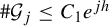 for all
$j\in \mathbb {N}$
 .
Then, for every
$\alpha \in (0,1)$
 , there exist
$M\in \mathbb {N}$
 and
$\theta \in (0,1)$
 such that given any
${n> 2M}$
 and
$\mathcal {D}_n \subset \mathcal {L}_n$
 satisfying
$\#\mathcal {D}_n \geq \alpha e^{nh}$
 , there exist
$i,k \in \{0,1,\ldots , M\}$
 such that (4.3) holds:
$\#(\varphi _{i,k}(\mathcal {D}_n) \cap \mathcal {G}) \geq \theta e^{nh}$
 .
Proof. Given
$M\in \mathbb {N}$
 , let
$\mathbb {I}(M) := \{ (i,k) \in (\mathbb {N} \cup \{0\})^2 : \max (i,k)> M\}$
 , and observe that by Condition (II
$^{\prime }$
 ), we have
$\delta (M) := \sum _{(i,k) \in \mathbb {I}(M)} (\#\mathcal {C}_i^p e^{-ih}) (\#\mathcal {C}^s_k e^{-kh}) \to 0$
 as
${M \to \infty }$
 . Also, consider for each
$n>2M$
 the quantity

We must prove that there exists
$M\in \mathbb {N}$
 and
$\theta>0$
 such that
$r_n(M) \geq \theta e^{nh}$
 for all n. As in the proof of Lemma 3.11, we use Condition (I) to get

Writing
$\mathbb {I}_n(M) := \{ (i,k) \in \mathbb {I}(M) : i+k \leq n\}$
 and using the upper bound on
$\#\mathcal {G}_j$
 , we obtain for each
$M\in \mathbb {N}$
 the inequality

Writing
$S(M) = (\sum _{i=0}^M \#\mathcal {C}^p_i)(\sum _{k=0}^M \#\mathcal {C}^s_k)$
 , we use the inequality
$\#\mathcal {D}_n \geq \alpha e^{nh}$
 to get

Since
$\delta (M) \to 0$
 as
$M\to \infty $
 , we can take M sufficiently large that
$\delta (M) C_1 < \alpha $
 and obtain

which proves the lemma.
4.3 A Gibbs-type measure
In this section, we prove Proposition 4.2 by constructing an MME that has the Gibbs-type properties (4.5) and (4.6). Note that the first of these is a special case of the second, by taking
$v$
 to be the empty word, so we will only give the proof for (4.6).
The construction of
$\mu $
 , as well as the proof that it is invariant and is an MME, follows the usual argument from Misiurewicz’s proof of the variational principle: for each
$n\in \mathbb {N}$
 , let
$\nu _n$
 be a Borel probability measure on X with the property that
$\nu _n[w] = 1/\#\mathcal {L}_n$
 for every
$w\in \mathcal {L}_n$
 ; then let
$\mu _n := (1/n) \sum _{k=0}^{n-1} \sigma _*^k \nu _n$
 and let
$\mu $
 be any weak*-limit point of the sequence
$\mu _n$
 . See [Reference WaltersWal82, Theorem 8.6] for the argument that
$\mu $
 is invariant and is an MME.
It remains to prove (4.6). The following argument can be extracted from [Reference Climenhaga and ThompsonCT12, Lemma 5.15], but since the hypotheses are stated differently here, we give the details. Figure 2 illustrates the bookkeeping involved in the following computations by showing which indices are included in which words.
Getting the Gibbs bound from Property (III) (color online).

Figure 2 Long description
The diagram is bounded by a horizontal line from 0 on the far left to n on the far right.
From left to right, the segments are organized as follows.
First segment. A red double-headed arrow labeled k spans the top. Below it is a green block labeled w. Underneath w, there is a small gray block y on the left, a large yellow block w prime in the center, and a small gray block q on the right. A red double-headed arrow labeled k prime spans the width of w prime. A blue double-headed arrow labeled T spans the width of q.
Second segment. A solid pink block labeled u.
Third segment. A blue double-headed arrow labeled T spans a gap at the top. Below the gap is a gray block labeled p.
Fourth segment. A solid purple block labeled v.
Fifth segment. A red double-headed arrow labeled j spans the top. Below it is a green block labeled x. Underneath x, there is a small gray block r on the left, a large yellow block x prime in the center, and a small gray block z on the right. A blue double-headed arrow labeled T spans the width of r. A red double-headed arrow labeled j prime spans the width of x prime.
Observe that given
$u,v\in \mathcal {G}$
 and
$n\in \mathbb {N}$
 , for each
$0 \leq k < n-|u|-T-|v|$
 , we can write
$j = n - k - |u| - T - |v|$
 and obtain

If
$k,j\geq 2M$
 , then (4.4) gives
$k' \in [k-T -2M, k-T]$
 and
$j' \in [j-T-2M, j-T]$
 such that

For every
$w'\in \mathcal {G}_{k'}$
 and
$x' \in \mathcal {G}_{j'}$
 , Condition (III) gives
$q,p,r \in \mathcal {L}_T$
 such that
$w'qupvrx' \in \mathcal {L}$
 . Thus, there exist
$y,z\in \mathcal {L}$
 such that

Together with (4.10), (4.11), and the bound
$\#\mathcal {L}_n \leq C_2 e^{nh}$
 from (4.1), this gives

where
$c := \theta ^2 e^{-3Th} C_2^{-1}$
 . This bound holds for all
$2M \leq k < n - |u| - T - |v| - 2M$
 , so upon averaging over all
$0\leq k < n$
 , we get

Sending
$n\to \infty $
 along an appropriate subsequence proves (4.6).
4.4 Uniqueness
In this section, we prove Proposition 4.3. This is where the new ideas from [Reference Pacifico, Yang and YangPYY22] become essential; the arguments in §§4.2 and 4.3 closely mirror those in [Reference Climenhaga and ThompsonCT12] (although the map
$\varphi _{i,k}$
 and the estimate (4.3) did not appear there), but to prove that
$\mu $
 is ergodic and that there is no other MME, the arguments in [Reference Climenhaga and ThompsonCT12] required an extra condition. Thus, we now follow [Reference Pacifico, Yang and YangPYY22], although with substantial simplifications, since that paper is written for flows on compact metric spaces and deals with equilibrium states for a broader class of potential functions.
The key innovation leading to the improvement over [Reference Climenhaga and ThompsonCT12] is the next lemma, which follows [Reference Pacifico, Yang and YangPYY22, Lemma 7.3] and holds in any shift space.
Lemma 4.6. Given any mutually singular
$\nu _1,\nu _2 \in \mathcal {M}_\sigma (X)$
 and any
$\zeta>0$
 , there is a collection of words
$\mathcal {U} \subset \mathcal {L}$
 and
$n_0\in \mathbb {N}$
 such that:
-
(1) $\nu _1([\mathcal {U}_n]) \geq 1-\zeta $
for all n; and -
(2) $\nu _2([\varphi _{i,j} \mathcal {U}_n]) \leq \zeta $
for all
$i,j,n$
satisfying
$n \geq 2(n_0 + \max (i,j))$
.


Proof. Since
$\nu _1 \perp \nu _2$
 , there are disjoint Borel sets
$P_1,P_2 \subset X$
 such that
$\nu _\ell (P_\ell )=1$
 for
$\ell =1,2$
 . Fix compact sets
$K_\ell \subset P_\ell $
 such that
$\nu _\ell (K_\ell ) \geq 1-\zeta $
 . The distance between
$K_1$
 and
$K_2$
 is positive, so there exists
$n_0\in \mathbb {N}$
 such that given any
$u\in \mathcal {L}_{2n_0+1}$
 , the centered cylinder
$\sigma ^{n_0} [u]$
 intersects at most one of
$K_1$
 and
$K_2$
 .
We claim that
$\mathcal {U}_n = \{ w \in \mathcal {L}_n : [w] \cap \sigma ^{-\lfloor n/2 \rfloor } K_1 \neq \emptyset \}$
 satisfies the conclusions of the lemma. Clearly,
$[\mathcal {U}_n] \supset \sigma ^{-\lfloor n/2 \rfloor }K_1$
 and since
$\nu _1$
 is invariant, we get

which proves the first claim. For the second claim, we write
$k = \lfloor n/2 \rfloor $
 , and start by showing that given any
$i,j \leq k - n_0$
 and any
$w\in \mathcal {U}_n$
 , we have

Writing
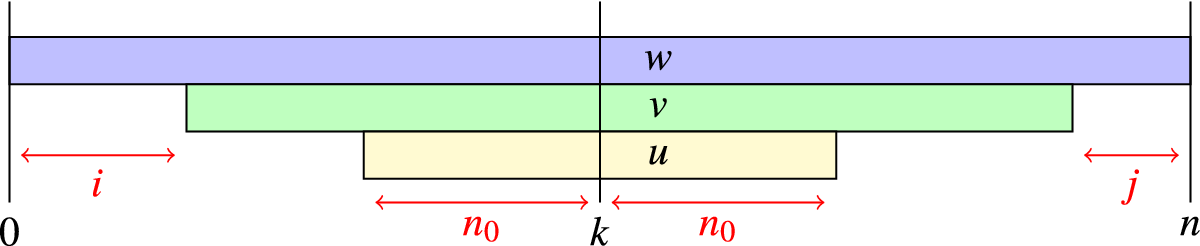
$v = \varphi _{i,j}(w)$
 and
$u = w_{[k-n_0,k+n_0]}$
 , as shown in Figure 3, we have

Since
$\sigma ^k[w]$
 intersects
$K_1$
 , we see that
$\sigma ^{n_0}[u]$
 does as well, so
$\sigma ^{n_0}[u] \cap K_2 = \emptyset $
 by our choice of
$n_0$
 . This proves (4.12), which gives
$\sigma ^{k-i}[\varphi _{i,j}\mathcal {U}_n] \subset X \setminus K_2$
 . By our choice of
$K_2$
 and invariance of
$\nu _2$
 , we now have

Words in
$\mathcal {U}_n$
 miss
$K_2$
 (color online).

Now, we prove uniqueness of the MME
$\mu $
 by showing that there is no MME
$\nu \perp \mu $
 and that
$\mu $
 is ergodic (so the only MME
$\nu \ll \mu $
 is
$\mu $
 itself). The first of these follows [Reference Pacifico, Yang and YangPYY22, Proposition 7.2]. Recall that c is the constant in the lower Gibbs bounds (4.5) and (4.6), and
$\theta ,M$
 are given by Proposition 4.1.
Proposition 4.7. Under the hypotheses of Proposition 4.3, there is no MME
$\nu \perp \mu $
 .
Proof. Suppose for a contradiction that
$\nu \perp \mu $
 is an MME. Fix
$\zeta < \min (\frac 12, c\theta )$
 , and apply Lemma 4.6 with
$\nu _1 = \nu $
 and
$\nu _2 = \mu $
 to get
$\mathcal {U}\subset \mathcal {L}$
 and
$n_0\in \mathbb {N}$
 such that
$\nu ([\mathcal {U}_n]) \geq 1-\zeta $
 for all n, and

for all
$i,j,n$
 satisfying
$n \geq 2(n_0 + \max (i,j))$
 .
Since
$\zeta <\frac 12$
 , we have
$\nu ([\mathcal {U}_n])> \frac 12$
 for all n and since
$\nu $
 is an MME, Proposition 4.1 gives
$i,j\in \{0,1,\ldots , M\}$
 (depending on n) with

thus, the Gibbs property (4.5) on
$\mathcal {G}$
 gives

For all
$n\geq 2(n_0 + M)$
 and this choice of
$i,j$
 , we also have (4.13), which leads to

This contradicts our choice of
$\zeta $
 and completes the proof of Proposition 4.7.
The proof of ergodicity follows [Reference Pacifico, Yang and YangPYY22, Proposition 7.4].
Proposition 4.8. Under the hypotheses of Proposition 4.3,
$\mu $
 is ergodic.
Proof. Suppose for a contradiction that
$P\subset X$
 is invariant and
$0 < \mu (P) < 1$
 . Let
$\nu $
 and
$\nu '$
 be the normalizations of
$\mu $
 restricted to P and
$P^c$
 , respectively. Fix
$\zeta < \min (\frac 12, \frac 12 c\theta ^2)$
 and apply Lemma 4.6 twice—once with
$\nu _1=\nu $
 and
$\nu _2=\nu '$
 , and once with the roles reversed—to obtain
$\mathcal {U},\mathcal {U}' \subset \mathcal {L}$
 and
$n_0 \in \mathbb {N}$
 such that
$\nu ([\mathcal {U}_n]) \geq 1-\zeta $
 and
$\nu '([\mathcal {U}^{\prime }_n]) \geq 1-\zeta $
 for every n, and moreover,

for all
$i,j,n$
 satisfying
$n \geq 2(n_0 + \max (i,j))$
 .
Each of
$\nu $
 and
$\nu '$
 is an MME since entropy depends affinely on the measure, and the MME
$\mu $
 is a convex combination of
$\nu $
 and
$\nu '$
 . Thus, we can apply Proposition 4.1 to both
$\mathcal {U}$
 and
$\mathcal {U}'$
 , obtaining
$i,j,i',j' \in \{0,1,\ldots , M\}$
 (depending on n) such that

both have cardinality at least
$\theta e^{nh}$
 .
Let
$k = n-(i+j) + T$
 , so that
$|v| + T = k$
 for every
$v\in \mathcal {V}(n)$
 . Given any such
$v$
 and any
$v' \in \mathcal {V}'(n)$
 , the ‘two-step’ Gibbs property in (4.6) gives

Summing over all such
$v$
 and
$v'$
 gives

We will bound this measure above, for a contradiction. Given
$x\in [\mathcal {V}(n)] \cap \sigma ^{-k}[\mathcal {V}'(n)]$
 , we either have
$x\in P^c$
 or
$x\in P = \sigma ^{-k} P$
 (since P is invariant) and, thus,

Observe that whenever
$n\geq 2(n_0 + M)$
 , (4.14) gives

and similarly

so that by (4.16), we have

Comparing this with (4.15) gives
$2\zeta \geq c\theta ^2$
 , which contradicts our choice of
$\zeta $
 and completing the proof of Proposition 4.8.
Acknowledgments
The author is grateful to Ronnie Pavlov for helpful discussions concerning the application of the result in [Reference PavlovPav22] to power-free shifts, and in particular for providing the proof of Theorem 2.7.
Funding
This material is based upon work supported by the National Science Foundation under Award No. DMS-2154378 and DMS-2453314.






 Open access

