INTRODUCTION
According to some estimates, 84% of people encounter a traumatic event during their lives (Vrana & Lauterbach, Reference Vrana and Lauterbach1994), and 15% to 24% of these develop posttraumatic stress disorder (PTSD; Breslau, Reference Breslau2001). The reality is that they, like all of us, eventually will die. Some may carry the effects of past trauma as they enter the last phase of life (Macleod, Reference Macleod1994; Payne & Massie, Reference Payne, Massie, Chochinov and Breitbart2000), while others may experience PTSD symptoms for the first time related to a life-threatening or terminal illness (Butler et al., Reference Butler, Koopman and Classen1999; Kangas, Henry & Bryant, Reference Kangas, Henry and Bryant2005). Indeed, there appears to be heightened prevalence of PTSD in patients with such illnesses (Hamann et al., Reference Hamann, Somers and Smith2005; Kangas, Henry & Bryant, Reference Kangas, Henry and Bryant2005; Martinez et al., 2002). And, the United States Census Bureau projects that, as the baby boomers age, the “elderly population” (65 and over) will expand considerably, and many males of that generation suffer lasting effects of Vietnam combat (Weiss et al., Reference Weiss, Marmar and Schlenger1992). Nonetheless, health care providers may not be adequately trained to address this issue (Samson et al., Reference Samson, Bensen and Beck1999) and may misinterpret PTSD symptoms as general anxiety, depression, or delirium (Samson et al., Reference Samson, Bensen and Beck1999; Woods, Reference Woods2003).
Feldman (2011) has proposed an approach to treating PTSD in individuals with life-limiting and terminal illnesses — Stepwise Psychosocial Palliative Care (SPPC) — which is based on a psychosocial palliative care philosophy. This model is new, however, and relatively untried. Thus, it is important to explore issues related to implementing this model in the complex settings in which providers encounter patients at the end-of-life. This article contains three case studies specifically geared toward this issue. A second purpose of this article is to provide concrete guidance regarding treating PTSD at the end-of-life in diverse palliative care settings.
WHY IS A NEW APPROACH NEEDED?
Although numerous psychotherapies have been successfully applied to PTSD (e.g., Bleiberg & Markowitz, Reference Bleiberg and Markowitz2005; Meichenbaum, Reference Meichenbaum1985; Resick & Schnicke, Reference Resick and Schnicke1992), much research supports two: exposure-based cognitive-behavioral therapy (CBT) approaches and eye movement desensitization and reprocessing (EMDR). Despite differences and controversies related to treatment mechanisms, research suggests that both function at least partially through exposure (Davidson & Parker, Reference Davidson and Parker2001); prompting patients to re-experience memories or PTSD triggers with the goal that symptoms will diminish.
Both treatments were developed for use with physically healthy individuals. Although we do not question their excellent efficacy with healthy populations, neither treatment (as originally developed) seems optimally suited to PTSD in dying patients. In his review of the literature regarding PTSD at the end-of-life, Feldman (2011) provides six reasons for this assertion.
First, these treatments require more time than is usually available in palliative care and hospice settings. Because these interventions often are delivered in 8–16 weekly sessions (Rothbaum, Foa & Hembree, Reference Rothbaum, Foa and Hembree2007; Shapiro, Reference Shapiro1995), many patients will die before treatment is completed. The median length of stay in Hospice according to the National Hospice and Palliative Care Organization (2011) is 19.7 days in the United States Pharmacologic treatment of PTSD (generally with SSRI or Tricyclic antidepressants) confers a similar disadvantage, often requiring six or more weeks to alleviate symptoms (see Feldman & Periyakoil, Reference Feldman and Periyakoil2006). Second, typical 50–90 minute sessions may be too lengthy for many patients at the end-of-life, for whom fatigue is common (Teunissen et al., Reference Teunissen, Wesker and Kruitwagen2007). Third, because vivid recall of trauma memories is a necessary element of both exposure-based CBT and EMDR, temporary increases in PTSD symptoms may result. In one study (Nishith, Resick & Griffin, Reference Nishith, Resick and Griffin2002), female victims of rape who underwent either prolonged exposure or cognitive processing therapy (both with exposure-based elements) reported that trauma re-experiencing symptoms increased by session six, after which they steadily declined. Thus, patients who die soon after treatment initiation may die in greater distress than if they had not received therapy. Fourth, in their review of the research, Devilly, Gist and Cotton (Reference Devilly, Gist and Cotton2006) conclude that, to maximize effectiveness and avoid the risk of re-traumatizing patients, exposure-based CBT should be applied two to six weeks after a traumatic event. This delay obviously is not possible in terminal illness, where the trauma may involve an ongoing set of health-related circumstances. Fifth, because terminally ill patients are medically compromised, the strong autonomic arousal that can result from exposure-based therapies may exacerbate physical symptoms and discomfort (Hankin, Reference Hankin and Maercker1997). Finally, traditional PTSD treatments do not address issues unique to the end-of-life, such as doctor-patient communication and anxiety surrounding medical issues, which may interfere with a “good” dying process (see Feldman, 2011).
Feldman (2011) suggests that the above treatments' fundamental difficulty is that they fail to follow a palliative care philosophy. According to the World Health Organization (2009), “palliative care” is “an approach that improves the quality-of-life of patients and their families … through the prevention and relief of suffering.” In contrast, “curative care” entails treatment to eliminate disease. Although palliative care may indirectly cure an illness and curative care may indirectly relieve suffering, their primary goals differ. Curative care, at times, may even lead to side effects that decrease quality-of-life (e.g., nausea or hair loss from chemotherapy), though these effects are often deemed acceptable given the expectation of long-term cure. Traditional PTSD treatments follow a curative model. The time required and the short-term discomforts they may cause are considered acceptable to bring about long-term remission of the disorder. This makes sense when applied to physically healthy individuals. When patients are dying, however, an approach based on a palliative care philosophy may be more appropriate. Such an approach would actively target immediate emotional suffering, but de-emphasize long-term cure of PTSD.
THE SPPC MODEL
The SPPC model (Feldman, 2011) helps to compensate for the disadvantages of existing PTSD interventions by setting treatment within a palliative care philosophy. The model relies on cognitive and behavioral techniques, nearly all of which are drawn from evidence-based approaches to PTSD. However, these techniques are deployed in a stepwise manner designed to maximize quality-of-life in every therapeutic interaction. This staged deployment is essential to the model and allows for interventions that track with patents' needs and prognoses.
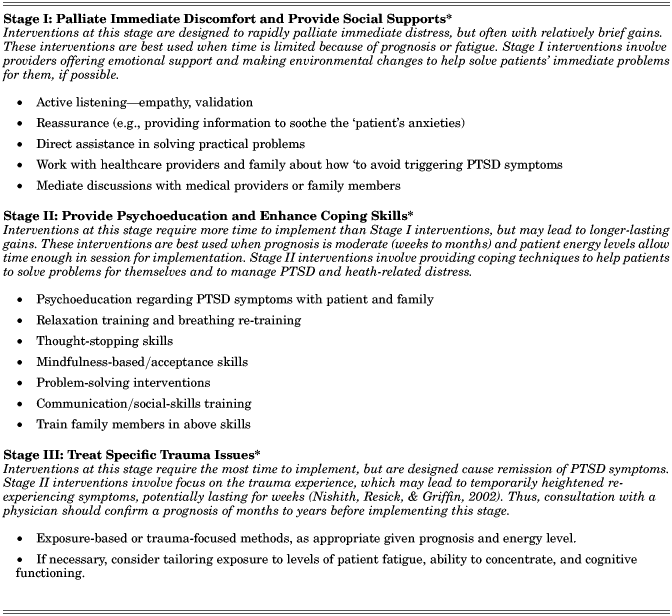
Treatment begins by addressing short-term concerns (Stage I: Palliate immediate discomfort and provide social supports), then proceeds to medium-range (Stage II: Provide psycho-education and enhance coping skills) and long-range concerns (Stage III: Treat specific trauma issues). At each stage, therapists assess progress and gather information regarding the prognosis of the patient. Therapists move to later stages only when: (1) earlier stages were not effective, and (2) the patient's medical prognosis and energy levels allow time to implement later stages. In addition to the descriptions below, see Table 1 for a summary of the model.
Summary of the SPPC Model
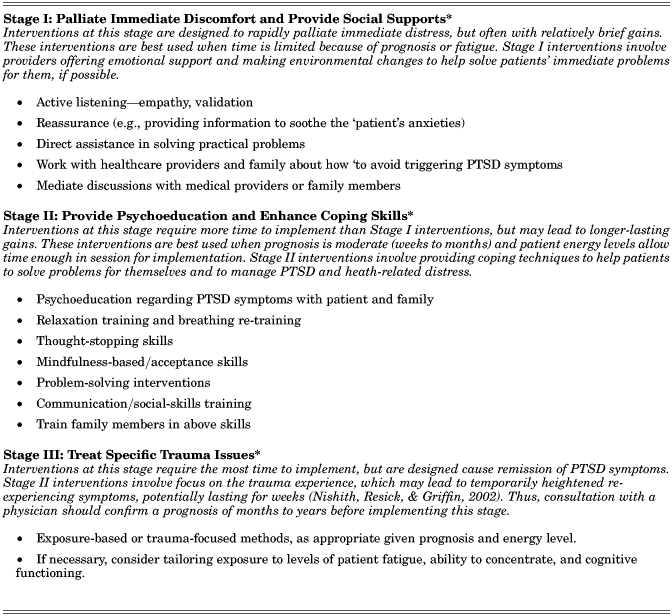
* Note: After implementing any stage, therapists assess the degree of symptom palliation. Therapists proceed to later stages only when: (1) earlier stages were not effective at reducing symptoms, and (2) the patient's medical prognosis and energy levels allow sufficient time to implement later stages.
Stage I: Palliate Immediate Discomfort and Provide Social Supports
Because patients may have only weeks to live, Stage I techniques are designed to maximize short-term quality-of-life. The therapist focuses on making changes in the patient's environment to rapidly reduce distress and discomfort.
As in all forms of therapy, the therapist first attempts to develop a trusting therapeutic relationship. Active listening and validation are widely recognized as necessary for all providers working with dying patients (Larson, Reference Larson1993). As trust is established, providers may discover practical concerns that distress patients. Stage I interventions are aimed at solving these practical problems for patients. Helping patients make funeral arrangements, re-establish contact with estranged family, or rearrange their immediate environments can dramatically improve quality-of-life, at least in the short term. Providers may work with family members and other caregivers (including other providers) to help them make similar changes. Additional Stage I interventions may include mediating conversations with medical providers, finding answers to health/dying questions, and educating providers and family on how to avoid triggering PTSD symptoms. This stage's emphasis on solving problems for patients conflicts with traditional psychotherapeutic wisdom, which holds that teaching people to solve their own problems is superior. This assumption, however, follows from a curative philosophy in which patients have the necessary time, energy, and health to solve their own problems, which dying patients often do not.
Stage II: Provide Psycho-education and Enhance Coping Skills
In Stage II, therapists offer psycho-education and teach patients strategies to improve their own quality-of-life. Although these strategies are designed to provide more durable gains than the previous stage, they also require more time to implement. As mentioned, therapists thus should not continue to Stage II unless the patient's medical prognosis provides sufficient time.
In Stage II, consistent with most evidence-based treatments (e.g., Foa & Rothbaum, Reference Foa and Rothbaum1998; Shapiro, Reference Shapiro1995), the provider should offer psycho-education to the patient and family, if appropriate, regarding the symptoms of PTSD. Such information helps the symptoms seem more predictable and manageable, and can be helpful to secure cooperation in ongoing treatment. This component is included in Stage II rather than Stage I because detailed psycho-education is likely not the most effective use of time if quantity of life is severely limited by prognosis.
Stage II interventions may include any of the following techniques: relaxation training (Goldfried & Davison, Reference Goldfried and Davison1994) and breathing retraining (Guell et al., Reference Guell, Resqueti and Sangenis2006) to reduce somatic symptoms of anxiety; thought-stopping (Wolpe, Reference Wolpe1973) and cognitive restructuring (Beck, Reference Beck1995) to target distorted thinking regarding both past events and current health conditions; acceptance-based techniques drawn from acceptance and commitment therapy (ACT; Hayes, Strosahl & Wilson, Reference Hayes, Strosahl and Wilson2003), Mindfulness-Based Stress Reduction (MBSR; Kabat-Zinn, Reference Kabat-Zinn1990), or dialectical behavior therapy (DBT; Linehan, Reference Linehan1993) to addressing negative thoughts, emotions, and somatic symptoms; and problem-solving skills training, communication training, or social-skills training (Liberman, DeRisi & Mueser, Reference Liberman, DeRisi and Mueser1989; McKay, Davis & Fanning, Reference McKay, Davis and Fanning1995) to address particular skills deficits and improve relationships with healthcare providers and others.
Stage III: Treat Specific Trauma Issues
Because a sizable proportion of terminally ill patients may die prior to completion of Stage II, in order to prevent unnecessarily increasing distress, neither of the preceding stages has included in-depth discussion of the trauma. In Stage III, however, the focus is placed on the trauma through the use of exposure-based techniques. As with the transition to Stage II, therapists only proceed to Stage III when earlier interventions have been ineffective at adequately alleviating suffering and prognosis permits the use of longer-term strategies.
Any exposure-based or trauma-focused approach may be utilized. Given that many such techniques exist (e.g., Foa & Rothbaum, Reference Foa and Rothbaum1998; Resick & Schnicke, Reference Resick and Schnicke1992; Shapiro, Reference Shapiro1995), thought should be given to the pros and cons of each. For instance, careful consideration should be given to patient prognosis and energy levels before a standard course of prolonged exposure is undertaken, due to its aforementioned potential for temporarily increased distress (Nishith, Resick & Griffin, Reference Nishith, Resick and Griffin2002). Therapists may also wish to alter the procedures of existing exposure therapies to accommodate patients' current levels of functioning and help prevent heightened distress, perhaps by shortening session duration to avoid fatiguing patients and instead considering meeting more frequently. To ensure that shortened sessions are long enough for distress ultimately to diminish (i.e., for extinction to occur), therapists can consider exposing patients very gradually to trauma memories, increasing intensity and detail of exposure more slowly from session to session than with physically healthy individuals.
CLINICAL APPLICATION OF THE SPPC MODEL
We offer four cases illustrating the application of the SPPC model based on patients in two distinct palliative care settings within a medium-sized VA Medical Center. VA sites are particularly relevant due to the aging population of veterans of the Vietnam War, many of whom suffer from trauma-related mental health issues. Within this medical center and elsewhere in the VA system, the purpose of the palliative care consult team (PCCT) is to respond to needs of patients receiving care anywhere in the hospital. The PCCT team consists of physicians, nurses, psychologists, and social workers. The psychologist's role is comprised of a variety of functions, including directly addressing patient concerns, helping others to problem-solve patient care issues, and enhancing team dynamics. In some cases, the PCCT refers patients to a second care setting — the inpatient palliative care unit (PCU) — to palliate symptoms or to arrange for transition home. The PCU is an eight-bed dedicated palliative care unit staffed by an interdisciplinary treatment team. Usual stay on the PCU is two weeks. The PCU provides services to patients and families that need additional assistance dealing with end-of-life care.
Across different health systems, palliative care teams and palliative care units may have varying limitations, of course, such as restrictions placed on length of stay and limited availability of care from particular disciplines. As illustrated in the following cases, the SPPC model can be adapted to a variety of patient concerns and treatment settings.
The Application of Stage I
The first case illustrates the application of Stage I of the model. It was chosen particularly to illustrate difficulties often experienced regarding patient refusal of care and focuses on the involvement of the treatment team. We begin by describing the case and then offer a discussion.
Stage I Case
“JT,” a 65-year-old male veteran, was referred to the PCCT. He had been diagnosed with lung cancer and was refusing all further care, which included palliative care. JT's cancer was advanced, and he reported intense uncontrolled pain. His physicians indicated that with medical intervention, he could live up to six months longer than the four-to-six months anticipated without medical intervention. Furthermore, due to his lack of pain control, palliative care services could reduce his present suffering and provide an alternative care option. In team meetings, his physicians shared concern about his refusal of all further medical care. Staff members experienced significant emotional reactions to JT, including frustration and anger. Furthermore, they were uncertain about how to communicate with him to address his medical needs. A comprehensive chart review was conducted by the PCCT psychologist and revealed a past diagnosis of PTSD. Although he had received psychiatric medications for his symptoms sporadically during the past 12 years, there was no indication of previous psychotherapy.
According to the SPPC model, Stage I interventions are designed to quickly alleviate distress by helping solve problems for patients. Because the patient was unwilling to engage with most members of the treatment team directly, the psychologist engaged with the team on his behalf. First, he shared the diagnosis of PTSD with the PCCT. Psycho-education was provided to the team regarding various ways PTSD can complicate end-of-life care, many of which were exhibited by JT, including anxiety and anger, poor medical adherence, difficulty engaging in direct problem-focused communication regarding care, and distrust of authority (see Feldman & Periyakoil, Reference Feldman and Periyakoil2006). This information also was documented in his chart for future providers.
In the context of this information, the psychologist facilitated a problem-solving discussion to identify various approaches his physicians could use to better understand JT's motivation for refusing treatment. Ideas explored included taking an egalitarian “patient-focused” approach by asking JT about his goals, using empathetic statements and reflective listening, as well as asking him to share his understanding of his medical diagnosis and prognosis. His primary physician and other staff members then utilized these strategies, allowing them to clarify information and build rapport. After such rapport was built, the physician then further utilized these strategies to engage in a discussion regarding his medical care, through which the patient gained trust in the physician, was open to learning about care options, and ultimately decided to be discharged to his home with the support of home hospice care.
Discussion of Stage I Case
JT largely refused to engage with staff members. It is nearly impossible to implement Stage II or III interventions with a disengaged patient because both require significant trust and effort. Thus, the psychologist decided not to move beyond Stage I, which can be more passively assented to. Stage I interventions are characterized by the goal of making changes for the patient to quickly palliate distress. A useful aspect of Stage I is that it can be implemented even without significant contact with patients, provided accurate information is received from others. Of course, even Stage I interventions are inappropriate if refused by patients. In our experience, however, these interventions are most likely to be seen as helpful to patients, even reticent ones.
To help the team engage in problem-solving regarding this patient, team members first needed to better understand the reasons for his resistance to treatment. The team was offered psycho-education regarding the ways PTSD can impact people at the end-of-life. Although education provided directly to the patient is considered a Stage II intervention, education to providers is considered a Stage I intervention because its goal is to supply information useful in solving immediate problems for the patient. In this case, the goal was to help with staff/doctor-patient communication. This education led to a collaborative problem-solving discussion that enabled all team members to generate and acquire practical solutions for use with JT.
Only Stage I interventions were utilized in this case because they appeared to adequately address the patient's problems. However, this patient's prognosis would have allowed for Stage II interventions if his difficulties were not appropriately addressed by Stage I interventions. In this case, the psychologist did not have face-to-face contact with the patient at any point, but as part of an interdisciplinary team, the skills and information the psychologist provided helped create environmental changes to palliate his distress. Further cases illustrate Stage I interventions when direct patient contact is more possible.
The Application of Stage II
The next case illustrates Stage II. Recall that therapists move to Stage II only when earlier interventions are ineffective and patients' prognoses provide sufficient time. You will notice that the therapist does not abandon Stage I interventions even as she applies Stage II interventions. Stages of the SPPC model are not meant to be discontinuous, but rather to build on one another.
Stage II Case
“HJ,” a 65-year old Caucasian, single male, was referred to the Palliative Care Unit for pain management. He was diagnosed with squamous cell carcinoma and was receiving chemotherapy and radiation. He had a history of type II diabetes, COPD, congestive heart failure, and PTSD, as well as current tobacco use and previous substance abuse.
HJ's pain was related to his radiation treatment. He reported that his pain rating was 10 out of 10 and typically ranged from 8 to 10. When asked about psychological symptoms, he indicating recently experiencing what he called “hallucinations,” difficulty sleeping due to nightmares, intrusive thoughts about combat experiences, flashbacks, a tendency to isolate himself from others, and intense anxiety whenever reminded of his experiences in the military. He was seen by a psychiatrist who determined that his hallucinations were related to a combination of analgesic and psychiatric medications. Adjustments to his medication regimen quickly alleviated these hallucinations, though the other symptoms persisted.
He shared that he had been diagnosed with trauma-related problems while in the service but had never received treatment. His primary physician informed the psychologist that the patient was expected to live for several months or more. This length of time would be sufficient to utilize all three stages of the SPPC model if this were desired by the patient and if his symptoms were not sufficiently palliated by earlier stages of the model.
According to Stage I of the model, initial sessions with HJ should focus on palliating immediate discomfort and providing social support. The psychologist spent nearly the entire first session building rapport. During this conversation, HJ said that he didn't trust his medical providers. He stated, “I know they are not telling me everything and I think they are hiding something from me about my condition.” With his permission, the psychologist spoke with HJ's primary physician. She shared the patient's PTSD diagnosis, including the ways his trauma symptoms were impacting his medical treatment (i.e., distrust of medical providers, poor medical adherence, difficulty engaging in direct communication regarding medical issues). She encouraged the physician to initiate his conversations with the patient by asking what the patient hoped to have addressed in their meeting, as well as what his understanding of his medical condition was, so he could be sure to address anything about which the patient felt suspicious.
After a week, staff members reported that HJ was more cooperative and trusting of them. Because he continued to experience the re-experiencing and hyper-arousal symptoms of PTSD noted earlier, however, Stage II of the model was initiated. Recall that Stage II focuses on providing patients with psycho-education as well as skills to better cope with PTSD symptoms.
Due to HJ's previous diagnosis of PTSD, the psychologist asked for his thoughts regarding the relationship between his diagnosis of PTSD and his current symptoms. This conversation was augmented by psycho-education regarding the symptoms of PTSD, primarily with the purpose of normalizing his experiences. Because the psychologist chose to focus on a variety of cognitive-behavioral techniques, she also provided information on the nature of PTSD from a CBT perspective, focusing on the connections between thoughts, feelings, and behaviors. This explanation helped to render his symptoms more predictable, lowering his anxiety somewhat. To further address his anxiety, calm (diaphragmatic) breathing, and thought-stopping were introduced. These techniques were explained, demonstrated, and practiced with the patient.
To address his tendency to isolate himself, time was spent exploring what social activities HJ enjoyed doing previously, many of which his medical condition no longer enabled him to do. The psychologist then modeled a problem-solving approach for identifying ways around these problems and guided the patient to use this approach. As a result, HJ developed the following solutions: ask a staff member to assist him to the dining area where he could socialize with other patients and ask staff to assist him in going outside for a few minutes when he is physically able.
Given that HJ was to be discharged home, the psychologist guided him to identify situations that he anticipated would be difficult for him upon discharge and use his newly acquired problem-solving skills to generate ways of coping. Feedback from the medical team indicated that his PTSD symptoms had reduced considerably. Staff reported that his mood had improved and he was establishing more amiable relationships with them. HJ reported increased quality and quantity of sleep, fewer intrusive thoughts, and no flashback episodes. His geriatric depression scale (GDS) score dropped from 10 to 3. Because his symptoms appeared to be palliated adequately, Stage III of the model was not utilized.
Discussion of Stage II Case
Recall that, within the SPPC model, stage of intervention is partially determined by prognosis. HJ's primary care physician had noted that he would likely live several additional months, allowing sufficient time for both Stage I and Stage II interventions.
It often seems tempting to skip Stage I interventions. Nonetheless, therapists should not move to later stages unless earlier stages do not adequately palliate symptoms. There is a pragmatic reason for this rule: Research shows that physicians tend to overestimate life expectancy by a factor of five (Christakis & Lamont, Reference Christakis and Lamont2000). Thus, it is wise to begin with the quick-to-implement techniques of Stage I regardless of prognosis, then to assess their effectiveness carefully before moving to later stages that may require more time to implement. Nonetheless, the length of Stage I, like all stages of the SPPC model, can be highly variable.
In this case, the psychologist began by applying Stage I interventions. In particular, she built rapport and noted practical issues that were distressing to HJ. The patient reported that one of his most pressing problems was his distrust in his medical providers regarding his health status. Although distrust is not technically a symptom of PTSD, it often accompanies the disorder, especially in combat veterans (Kubany et al., Reference Kubany, Gino and Denny2005). As such, the psychologist intervened to help solve this problem by coaching his physician on ways to more effectively communicate with HJ, build trust, and assess HJ's wishes. She then monitored the effects of these interventions through conversation with the patient and staff.
Although Stage I interventions appeared to reduce HJ's overall distress, his PTSD intrusion and arousal symptoms remained undiminished. As such, the psychologist initiated Stage II interventions by offering psycho-education about PTSD and teaching cognitive-behavioral coping techniques. As with all Stage II interventions, these were implemented with the intension of helping the patient to help himself. Unlike Stage I interventions that palliate distress quickly but whose effects are fleeting, Stage II techniques can take somewhat longer for therapists to teach and for patients to practice, but may be useful for the remainder of life.
Again, the psychologist paused to assess the effectiveness of the interventions. The patient and staff reported that his PTSD symptoms had reduced substantially and his mood had improved. Due to this improvement, the therapist deemed Stage III interventions unnecessary. Of course, if this were a physically healthy patient likely to live many more years, it would not make sense to stop here. After all, problem-solving, breathing, and thought-stopping techniques are unlikely to cure PTSD. However, given the prognosis of under a year of life, it may not be worth the “cost” of potentially temporarily increased distress to implement exposure-based Stage III techniques given that his trauma symptoms have already been adequately palliated.
The Application of Stage III
This final case illustrates the application of Stage III. In addition to demonstrating how each stage builds upon earlier stages, this case also illustrates how family may be involved in care.
Stage III Case
“TR,” a 61-year-old Caucasian man was referred to the PCU for pain management after spinal surgery. He was diagnosed with renal cell carcinoma five years earlier that led to paraplegia, had a history of chronic kidney disease, depression, and PTSD. He was cared for primarily by his adult daughter along with his loving wife. Although TR had a history of mild-to-moderate chronic pain, upon admission to the hospital he began experiencing intense pain. No medical reason could adequately explain his pain, which ranged in intensity from 8 to 10 on a 10-point scale. Furthermore, he was having difficulty sleeping due to nightmares and intrusive thoughts about his military combat experience. The patient scored within the clinical range for depression and PTSD on the GDS and PTSD Symptom Checklist-Military Version (PCL-M). He shared that he had received psychotherapy for PTSD on two occasions from two different sites within in the past 15 years, and was still being prescribed antidepressant medication. TR's primary physician indicated that he was likely to live for at least several months, and possibly a year or more. Given this prognosis, all three stages of the model potentially could be utilized.
According to Stage I of the SPPC model, initial sessions should focus on palliating immediate discomfort and providing social supports. As in the previous cases, the focus of the initial session was on building rapport. This was fostered through contact with both the patient and his daughter. One therapist met with TR individually, while a second met with his daughter to address caregiver concerns. At this point, TR reported distrust of his medical providers regarding his prognosis. As mentioned in the previous case discussion, although trust issues are not necessary for a diagnosis of PTSD, they are common in trauma-exposed veterans.
Consistent with Stage I, the therapist gathered information to identify ways that she could make environmental changes to help solve problems and alleviate distress. She wrote down his questions pertaining to his medical status in detail and asked for permission to share these with his physician. The therapist also shared with the doctor that PTSD may be interfering with the patient's ability to trust medical providers. The therapist offered to directly facilitate a conversation between the patient and physician about the listed questions. During this discussion, the therapist used reflections to highlight and clarify questions asked by TR and information offered by his physician. The therapist repeatedly paused to check with TR about his understanding and provide support. These Stage I interventions resulted in decreased distress and improved mood. His physician reported that her relationship with TR had also strengthened.
At a follow-up visit, the patient shared that he had been spending time examining his life, which evoked distressing memories. At this point, Stage II of the model was implemented. Psycho-education was provided regarding PTSD and specific end-of-life issues. TR was concerned about the impact his PTSD had on his family members. Thus, issues related to the impact of PTSD on loved ones were identified as targets for therapy. Time was spent identifying family members he would like to talk with and what he would like to say to each of them. Discussion also touched on what he would like the remainder of his life to be like. Finally, his current therapist attempted to ascertain what was helpful from therapy he had received in the past for PTSD. TR noted that breathing techniques has been useful in managing his symptoms. Thus, time was spent reviewing “calm breathing” as he had learned it previously.
At a follow-up visit, TR shared that his pain rating had reduced to 0 at most times. However, he continued to experience periodic acute pain crises. Thus, time was spent discussing the pattern of his pain, particularly identifying the connection between emotional pain and physical pain. For instance, he noticed a connection between having nightmares and experiencing a pain crisis the following morning. Increases in pain level also were associated with the following situations: being alone, seeing children, hearing the sound of large trucks, and smelling fuel burning. He agreed to allow this information to be shared with the treatment team in an effort to decrease these experiences while he was on the unit. His daughter and wife agreed to inform staff if they were not going to be present, so staff could make more frequent visits. Leaving the television on and closing the door to his room were identified as ways to decrease traffic noise. It is worth noting that the interventions in this paragraph revert to Stage I. As mentioned previously, a shift to Stage II should not mean abandoning earlier strategies.
A continued focus of treatment was identifying topics he would like to talk about with his family. He mentioned that he had always coped with stressful topics by avoiding them. The use of avoidance coping is common among individuals with PTSD (Tiet et al., Reference Tiet, Rosen and Cavella2006). One of his primary concerns was that this coping style had prevented him from addressing longstanding issues with his family and others, leaving significant “unfinished business.” TR's daughter shared with the other therapist that he had expressed this concern to their family previously. Although she and several other family members had attempted to communicate to TR that his symptoms had not negatively impacted them, she admitted that she often cut these conversations short in an attempt to decrease her father's distress, preventing him from verbalizing his concerns. Consistent with the Stage-II emphasis on teaching skills, the therapist conducted brief communication training with TR's daughter, particularly focusing on words and phrases that “open up” conversations (e.g., “Tell me more”) rather than “shut down” conversations (e.g., “Don't worry about it, everything is fine”), as well as ways to make others feel heard. She helped his daughter to practice these phrases through role-play. The therapist also suggested that it may be helpful to her father to allow him to share all of his concerns before she shared her experiences, to avoid inadvertently interrupting or side-tracking the conversation.
In a follow-up session, TR again reported a pain level of 0. He stated that he had been using the calm breathing technique and that it had been helpful in reducing his stress and helping him sleep at night. TR also mentioned that he had shared his concerns with his family, and that his daughter had listened openly. His family shared with him that they had different perceptions of his PTSD than he did, and his PTSD had not significantly negatively impacted them. TR was moved by this conversation, stating that it was “healing” for him and for the family.
Despite a reduction in stress and pain, TR continued to experience intrusive trauma memories. Thus, the therapist determined that Stage III interventions were warranted. She asked the patient whether he would be willing to talk about his trauma more directly, to which he agreed. In the next few sessions, she guided him to relate the stories of his combat experience in increasing detail with an emphasis on cognitive processing and meaning making. Throughout this discussion, he referred to intense feelings of guilt due to the number of lives lost in the war.
The therapist chose to use cognitive restructuring to help him to examine thoughts associated with his trauma experience. A prominent thought was, “I didn't deserve to live when so many others lost their lives.” A major cognitive technique utilized by the therapist was reframing; for instance, she guided him to explore how he thought those who lost their lives would want him to feel about his opportunity to continue to live his life. This led to a discussion of ways he could use what time he had left to honor the lives of fallen service members.
By the final session, remembering those who died before him led TR to consider his own dying process. He shared that a way he could ensure that his fellow service members did not die in vain was to be grateful for whatever time was left. He indicated being generally at peace with death and said he was looking forward to asking the friends who died before him some questions. TR was discharged home the next week with his pain well controlled.
Discussion of Stage III Case
This case offers an example of family involvement within the SPPC model. The treatment team had the luxury of two therapists, one to meet with the patient and one to meet with his daughter. Both therapists worked with their respective “clients” beginning with Stage I techniques like active listening and practical attempts to solve problems, then continuing to Stage II interventions involving teaching particular skills and offering psycho-education. The daughter's involvement was important, because her tendency to cut emotional conversations short was creating a challenge for her father to communicate his feelings and to complete unfinished business. Thus, her therapist provided psycho-education on skills for keeping conversations open.
Simultaneously, TR's therapist was working with him to determine what he would like to say to his daughter and wife, and how he would like to say it. The fact that the therapists were working with the patient and daughter within the same stage allowed for a kind of synergy. Though not required by the model, our experience is that this simultaneity of stage is useful, at least until Stage III is reached, when treatment becomes much more focused on the patient.
Although the interventions just discussed substantially palliated the patient's distress and improved family functioning, the patient continued to experience intrusive trauma-related memories. As such, the therapist chose to offer Stage III interventions to the patient. As with the transition from Stage I to Stage II, this transition requires that two criteria are met: (1) previous stages did not adequately palliate symptoms, and (2) prognosis and energy levels allow sufficient time to implement the next stage's interventions. Practically speaking, however, a third criterion almost always is associated with Stage III: The patient must express a willingness or desire to discuss the trauma in detail. This generally means asking the patient directly if he or she would be open to speaking about this topic. In our experience, about half of patients accept this invitation. Some treatment protocols for PTSD advocate attempting to educate patients about the necessity of revisiting trauma memories, essentially trying to convince them to do so. These approaches, of course, assume that patients are healthy and will live for many years longer; in the case of such healthy individuals, temporarily increased distress due to revisiting such memories is not considered to be a significant consideration. For patients like TR with only about a year to live, however, avoiding distress potentially caused by focusing on the trauma becomes a reasonable choice that therapists should honor. In this particular case, the patient consented and therapy proceeded by helping the client to gradually expose himself to trauma memories and using cognitive restructuring to address thoughts associated with trauma-related guilt.
Finally, this case illustrates how issues of dying can be intertwined with PTSD symtomatology. According to the Diagnostic and Statistical Manual of Mental Disorders (DSM-IV-TR; American Psychiatric Association, 2000), a feature of PTSD is that stimuli and situations that remind individuals of the original trauma will trigger symptoms. For TR, it is likely that living with a terminal illness served as such a reminder. It should not be surprising, then, that conversation about memories related to the death of his fellow soldiers would lead to a discussion of his own mortality. A discussion of how to speak with patients about terminal illness and their own dying process is complex and beyond what can reasonably be accomplished in this article, but has been covered in depth by others (Larson, Reference Larson1993). Nonetheless, it is important to note that this issue often seems to arise in Stage III, and therapists should be trained in addressing it. In this case, TR's therapist guided him to identify the areas of control he could still exercise as he faces the end of his life as well as how he would like to use the remainder of is time to honor his fallen friends.
IMPLEMENTATION CONSIDERATIONS: SETTING AND PATIENT CONSTRAINTS
As a way of concluding, we should highlight some overall feasibility and implementation considerations regarding the SPPC model. Although similar types of care are provided across palliative care services, the model will be implemented somewhat differently depending on the details of the setting. For example, a consult team setting may only allow for 1–2 sessions with a patient, while length of stay in a hospice unit or home-care service can last until the end-of-life, allowing for much more intensive treatment. Such differences in setting place de facto limits on the stages of the SPPC model that can be utilized. In addition, interdisciplinary teams may be limited to medicine, nursing, chaplaincy, and social work or consist of a much wider array of disciplines including dietary, psychology, occupational therapy, physical therapy, and recreation therapy. The training and competency levels of treatment team members regarding psychosocial issues may differ by discipline and setting. Thus, staff-focused components of the SPPC model will be emphasized differently depending on which health care disciplines are present. Obviously, if mental health staffing is low, emphasis will need to be placed on working with providers of other disciplines through which psychosocial issues can be addressed.
The cases presented here have illustrated additional constraints related to patient characteristics. As mentioned, energy level and stamina as well as life expectancy can and should constrain which stages of the model are implemented. In addition, application of the model must be determined at least in part by patients' goals. Respecting patients' wishes concerning their mental health treatment plan is akin to respecting their wishes about advance care directives. Regardless of provider opinion, after receiving adequate information, it is the patient's choice.
Although excellent treatments for PTSD in physically healthy adults exist, these do not optimally apply to patients at the end-of-life. Due to limited life expectancy, significant fatigue, and other concerns of terminally ill patients, an approach based on a palliative care philosophy is necessary. In this article, we have shown how the SPPC model is implemented in three cases displaying distinct concerns. The major strength of the SPPC model's stage-wise approach is that regardless of setting and patient constraints, treatment can be applied to enhance quality-of-life.