INTRODUCTION
The studies made so far about benthic and pelagic amphipods in the Canary Islands are firstly the results of long oceanographic cruises or ones which included the Canary Islands ('Challenger', ‘L'Hirondelle', ‘Melita', ‘Travaillier', ‘Talisman', ‘Siboga', ‘Atlantide Report’ and ‘Discovery Sond Cruise') (Stebbing, Reference Stebbing1888; Chevreux, Reference Chevreux1888, Reference Chevreux1889, Reference Chevreux1891, Reference Chevreux1900, Reference Chevreux1927; Pirlot, Reference Pirlot1930, Reference Pirlot1933, Reference Pirlot1934, Reference Pirlot1938; Ruffo, Reference Ruffo1935; Reid, Reference Reid1951; Furnestin, Reference Furnestin1957; Thurston, Reference Thurston1976a, Reference Thurstonb, Reference Thurstonc). Secondly, cruises made recently, investigated the littoral and benthic amphipods of the Gammaridea suborder (Cejas, Reference Cejas1982; Cejas et al., Reference Cejas, Brito and Lozano1983; Riera et al., Reference Riera, Monterroso and Núñez2004; Ortíz et al., Reference Ortiz, Riera and Ramos2006; Ramos & Riera, Reference Ramos and Riera2010; Riera & Ramos, Reference Riera and Ramos2011) and Caprellidea suborder (Riera et al., Reference Riera, Guerra, Brito and Núñez2003). Thirdly, there were another group of studies of this group about the specific composition in the Canary Islands waters (Lozano-Soldevilla & Hernández, Reference Lozano-Soldevilla and Hernández1991; Ortiz et al., Reference Ortiz, Riera, Núñez and Pascual2002; Riera et al., Reference Riera, Guerra, Brito and Núñez2003; Núñez, Reference Núñez, Moro, Martín, Garrido and Izquierdo2003; Monterroso et al., Reference Monterroso and Riera2004; Lozano-Soldevilla et al., Reference Lozano-Soldevilla, Landeira, Espinosa, Izquierdo and Mingorance2006). These studies recorded approximately 200 species, all of them included by Martin & Davis (Reference Martin and Davis2001) in the four orders currently recognized (Gammaridea, Caprellidea, Hyperiidea and Ingolfiellidea).
The Platysceloidea are exclusively warm-water crustaceans that may enter temperate latitudes with warm currents but are confined there to the warmest regions, under the direct influence of warm tropical or subtropical waters (Vinogradov et al., Reference Vinogradov, Volkov and Semenova1996).
The genus Platyscelus is represented by four species in the Atlantic Ocean: P. ovoides, P. serratulus, P. armatus and P. crustulatus. In the Canary Islands, there are only reports of the first two species (Thurston, Reference Thurston1976a): P. ovoides and P. serratulus. Both were collected during the Sond Cruise (1965). Platyscelus armatus has been recorded in the Azores and in Trinidad & Tobago (Zeidler et al., Reference Zeidler and De Broyer2009). Platyscelus crustulatus has been collected in the Gulf of Mexico, the Atlantic Ocean and the Zanzibar Islands in the Indian Ocean.
Although P. ovoides is a large, moderately common, widespread species, very little is known of its vertical range and migration (Thurston, Reference Thurston1976b). During the Sond Cruise (1965) eight specimens were obtained from Isaacs–Kidd midwater trawl samples. A single specimen was obtained at 650–550 m, the others from the 50–0 m layer down to the 350–290 m horizon; all of them in day hauls. There are a few records of specimens caught at the surface, but most have come from ‘through’ hauls from considerable depths (Thurston, Reference Thurston1976b). Reviewing the studies of Stephensen (Reference Stephensen1925), P. ovoides is most common from 100–270 m depth although sometimes it is possible to catch them from 75–35 m, and eventually at shallower depths.
Platyscelus serratulus was collected in the same cruise in the 40 m day haul (3 specimens) and in the 250 m night haul (only one specimen). Platyscelus serratulus is an epipelagic species inhabiting the near surface layers (Thurston, Reference Thurston1976c). Its distribution in the Atlantic Ocean covers: Fuerteventura (Canary Islands) and Gulf of Cádiz, both in the north-east Atlantic; and Gulf of Mexico and the Bahamas in the north-west Atlantic.
Platyscelus armatus is widely distributed in the Pacific (Australia, Indonesia, China Sea, Chile, Perú, Colombia (Gorgona Island) and Hawaii Islands) (Brusca, Reference Brusca1973; Zeidler, Reference Zeidler1992; Jinghong et al., Reference Jinghong, Mingda and Ruixiang1996; Lowry, Reference Lowry2000; Valencia & Giraldo, Reference Valencia and Giraldo2005; Yin et al., Reference Yin, Chen, Zhang, Huang and Li2006), Indian (Zeidler, Reference Zeidler1992; Sterley, Reference Sterley2008) and Atlantic Oceans, the Lesser Antilles, Venezuela (Isla Trinidad) and even the Falkland Islands (Tarling et al., Reference Tarling, Ward, Sheader, Williams and Symon1995; Nelson et al., Reference Nelson, Reynal, Rambally, Punnett, Oxenford and Fanning2007). In the eastern Atlantic this species was previously unknown.
Data on depth distribution of P. armatus are limited. Zeidler (Reference Zeidler1992) and Vinogradov et al. (Reference Vinogradov, Volkov and Semenova1996) describe P. armatus as mainly in surface waters (21 m, in Indonesia) and occasionally between 500 and 800 m depth. In Hawaii, Brusca (Reference Brusca1973) records depths between 260 and 930 m, but due to the limited data he could not confirm that P. armatus performs vertical migrations.
Three specimens of P. armatus (Claus, Reference Claus1879) were taken off El Hierro and Tenerife, which represent the first record of this oceanic hyperiid from the Canary Islands. We also provide morphological and morphometric measurements of the specimens, geographical and bathymetric distribution of this species, and a key to species of the genus present in waters of the Canaries.
MATERIALS AND METHODS
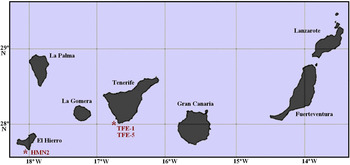
In April 2012, the oceanographic vessel ‘Cornide de Saavedra’ trawled three specimens of P. armatus, while conducting the CETOBAPH mesopelagic survey, capturing one specimen from the south-western slope of El Hierro (Station HMD2, 27°39.0′N–18°03.421′W) and two specimens from similar slopes of Tenerife (Station TFE1, 28°05.681′N–16°50.305′W and Station TFE5, 28°04.670′N–16°49.440′W), Canary Islands. Data on the station reference, position (decimal degrees), depth (m), trawling speed (knots) and time are shown in Table 1.
Specimens captured during the CETOBAPH oceanographic cruise.

Three specimens (called A, B and C) were captured during the CETOBAPH oceanographic cruise in waters of the Canary Islands (Figure 1).
CETOBAPH (April 2012) oceanographic cruise in waters of the Canary Islands.

Data on specimens code and morphometric measurements of the specimens captured are shown in Table 2. The trawls were carried out with a pelagic net with doors, 1 cm Ø mesh size. A cover was fitted over the codend.
Some meristic characters of the specimens captured.

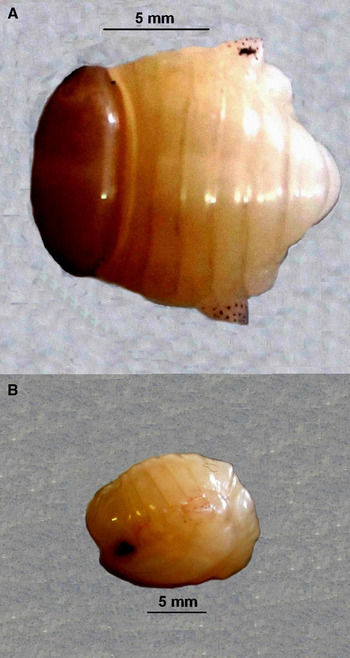
The three specimens were fixed in 4% formalin, preserved in 70% ethanol and stored in the collection of the Museo de Ciencias Naturales de Tenerife (TFMC), reference number TFMCZP/03131; AF/00092 (specimen A), TFMCZP/03132; AF/00093 (specimen B) and TFMCZP/03133; AF/00094 (specimen C). The specimens were measured to the nearest mm, following the taxonomic keys of Vinagrodov et al. (Reference Vinogradov, Volkov and Semenova1996) and Vinogradov (Reference Vinogradov and Boltovskoy1999) (Figure 2).
Dorsal view (A) and lateral view (B) of Platyscelus armatus specimen collected in the Canary Islands.

RESULTS AND DISCUSSION
Diagnosis
The external morphological characters of the specimens studied are consistent with previous descriptions (Stebbing, Reference Stebbing1888; Zeidler, Reference Zeidler1992; Vinogradov et al., Reference Vinogradov, Volkov and Semenova1996; Vinogradov, Reference Vinogradov and Boltovskoy1999).
The head is approximately 2.5 times higher than long, its width four times its length. The flagellum of antennae I in males consists of a broad basal segment and three distal segments, of which the first is also rather densely pubescent in the distal part. Antenna II in males is folded zigzag four times; the two distal segments are almost 1/4 the length of the two proximal segments. All somites of the pereon and the pleon bulge from the dorsal side, coxal plates V and VI are longer than the rest. Coxal plate V has a pointed lateral process whereby P. armatus can be readily distinguished from other species of the genus. The 2nd segment of pereopod I has a bulged anterior margin bearing rather sparse setae and an almost straight posterior margin; the 5th segment without the distal process is longer than its width (in the other species of the genus, vice versa); the distal process is broader than in other species of the genus.
SYSTEMATICS
Subphylum CRUSTACEA Brünnich, 1772
Class MALACOSTRACA Latreille, 1802
Subclass EUMALACOSTRACA Grobben, 1892
Superorder PERACARIDA Calman, 1904
Order AMPHIPODA Latreille, 1816
Suborder HYPERIIDEA Milne Edwards, 1830
Infraorder PHYSOCEPHALATA Bowman & Grunner, 1973
Superfamily PLATYSCELOIDEA Bate, 1862
Family PLATYSCELIDAE Bate, 1862
Genus Platyscelus Bate, 1861
Platyscelus armatus (Claus, Reference Claus1879)
Platyscelus crustulatus (Claus, Reference Claus1879)
Platyscelus ovoides (Risso, 1816)
Platyscelus serratulus Stebbing, Reference Stebbing1888
KEY TO SPECIES OF THE GENUS RECORDED IN THE CANARY ISLANDS
-
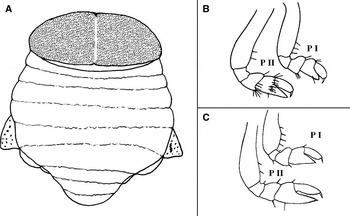
1a. Coxal plate V forms spiniform lateral processes, variably developed but always noticeable. Head 2.5 times as high as long, 4 times as wide as long. Adults between 12 and 16 mm length………Platyscelus armatus (Claus, Reference Claus1879) (Figure 3A).
-
1b. Coxal plate V does not form spiniform process………2
-
2a. Abdomen tucked under pereon and pereopods under body so that crustacean acquires on oval shape. Head twice as high as long, 3 times as wide as long. In pereopods I and II, 6th segment denticulate at least in distal half of anterior margin. Adults large (10–20 mm)………Platyscelus ovoides (Risso, 1816) (Figure 3B).
-
2b. No ovoid shape. Head more than twice as high as long. 6th segment of pereopods I and II smooth along anterior margin. 5th segment of pereopod II, not including distal process, wider than long. Adults small (<6 mm length)………Platyscelus serratulus Stebbing, Reference Stebbing1888 (Figure 3C).
(A) Platyscelus armatus: dorsal view; (B) Platyscelus ovoides: pereopods I and II (Vinogradov, Reference Vinogradov and Boltovskoy1999); (C) Platyscelus serratulus: pereopods I and II (Vinogradov, Reference Vinogradov and Boltovskoy1999).

Geographical and bathymetric distribution
As Zeidler (Reference Zeidler1992), Vinogradov et al. (Reference Vinogradov, Volkov and Semenova1996) and Vinogradov (Reference Vinogradov and Boltovskoy1999) described, this species is distributed mainly in surface waters and occasionally between 500 and 800 m depth. In the Hawaiian Islands, Brusca (Reference Brusca1973) reported a distribution in depth between 260 and 930 m, but due to the limited data vertical migrations of P. armatus could not be confirmed. In this study the first specimen (TFMCZP/03131; AF/00092) was captured off south-west of El Hierro during the day (285–381 m). However, the other two specimens (TFMCZP/03132; AF/00093 and TFMCZP/03133; AF/00094) from off south-west of Tenerife, were captured during the night (98–160 m). Although due to the limited data we could not confirm that P. armatus performs vertical migrations, these new records suggest this vertical migration could exist.
ACKNOWLEDGEMENTS
This work was supported by the project Cetáceos, Oceanografía y Biodiversidad de las Aguas Profundas de La Palma y El Hierro (grant number CETOBAPH-CGL2009-1311218) funded by the Ministerio de Ciencia e Innovación of the Spanish Government. We thank the crew of the vessel BO ‘Cornide de Saavedra’ for help in collecting specimens and J. Escánez for translating the abstract into English.