As Schattschneider (Reference Schattschneider1960: 60) famously attests: ‘The outcome of the game of politics depends on which of a multitude of possible conflicts gains the dominant position.’ In general, political parties seek to politicize issues where they stand to gain electoral advantage; correspondingly, they seek to dampen the salience of others. Although questions of whether and how issues are politicized are critically important, scholars have generally paid little attention to where issues are addressed within the political system. The fact that issues can be addressed within several institutional (i.e. functional) domains and levels within the political system – general elections, parliament, referenda, courts, local government, etc.Footnote 1 – implies that political parties may address an issue and interact with one another in consequentially different ways, depending on the institutional arena in which they are competing. I argue that incumbent political elites often seek to take advantage of the relevant functional domain in which an issue is addressed, thereby affecting issue salience and policy outcomes. The functional domain wherein an issue is engaged is itself a critical political choice.
Leveraging evidence from the Irish case, this article examines the multidimensional strategies parties employ to confront contentious issues; in this case, the highly controversial issue of abortion. Empirically, the Irish case is puzzling because abortion has been a salient and divisive issue within Irish society ever since the passage of the 1983 referendum on the Eighth Amendment inserted a provision into the Constitution (Article 40.3.3) that provided protection of the life of both the ‘mother’ and the ‘unborn’. Hotly contested referenda in 1992 and 2002 continued the debate over abortion rights, especially over whether the threat of suicide constituted grounds to permit abortions in Ireland. Yet, despite its salience, abortion has been conspicuously absent in most Irish elections. Irish legislators have essentially ignored the issue in parliament until a highly publicized event in 2013 led to intense efforts to amend Irish abortion law. Battles over abortion policy have not altered overall patterns of Irish party competition in any major way and the issue remains largely unresolved. Curiously, the Labour Party and other left-leaning minor parties have been unable to take advantage of evolving attitudes within Irish society on abortion to enhance their election fortunes. Thus, the cleavage structure has not shifted towards one divided between religious versus secular interests, as might have occurred given the salience of the issue.
Therefore, this article addresses a puzzle: why has no party capitalized on changing voter attitudes towards abortion, and how have the major parties managed to dodge it? The article demonstrates how the institutional framework and structure of public opinion have greatly influenced the strategies Ireland’s party leaders have employed to engage abortion that have ultimately depoliticized it. Although parties in Ireland may not have set out to create a set of state institutions purposely to remove difficult issues from the electoral realm, these institutions, once created for other ends, have provided party leaders with convenient institutional vehicles that supported this outcome. Although the Irish Constitution requires a national referendum any time a change is proposed to it, which mandates a referendum in the case of abortion, the various choices party leaders have made before, during and after referendum campaigns have affected how abortion has been translated into the political arena.
Employing referenda to deal with abortion enables major parties to navigate the uncertainty of evolving public opinion on the issue. While very few Irish citizens support abortion on demand or want to ban abortion altogether, an increasing percentage of Irish voters support abortion in limited circumstances. Referendum campaigns empower voters to have their say while simultaneously insulating major parties from alienating significant sectors of potential voters. Ultimately, major parties appear to benefit electorally the most. The availability of two separate institutional domains – referenda vs. general elections – has facilitated the ability of major parties to deprive minor parties of successfully mobilizing voters on an issue during elections that poses a threat to the major parties’ support base.
Institutional context matters greatly in how parties behave. In referendum campaigns, many of Ireland’s minor parties have supported more ‘progressive’ positions on abortion and have taken advantage of these campaigns to elevate their visibility. However, although these same minor parties stand to benefit most electorally from the higher salience of abortion and other moral issues, they have generally declined the opportunity to mobilize voters based on this issue during elections. Ireland’s proportional representation-single transferable vote (PR-STV) electoral system induces minor parties to moderate ideological appeals to attract lower preference votes to get elected. The combination of incentives provided by Ireland’s electoral formula, together with the perception among voters that they have already ‘had their say’ on abortion during referenda, mitigates the salience of abortion during elections. These factors reinforce the distinct dynamics of the two separate institutional domains.
This article underscores the importance of identifying the specific institutional domain where an issue is addressed to understand whether and how it is politicized and, consequently, what the impact is on broader patterns of partisan competition. I begin with a brief treatment of the party literature to discuss how major and minor parties compete over contentious issues. My analysis emphasizes how institutional context shapes party strategy in multiple institutional domains (Bardi and Mair 2009). I highlight the range of strategies available to major parties and their leaders when confronted with the emergence of disruptive issues that have the potential to undo long-standing patterns of electoral competition. Second, I set forth reasons why Ireland serves as a useful case study, underscoring dramatic shifts among the electorate in attitudes on moral issues and describing how parties attempt to navigate this uncertain environment. Next, I provide evidence to demonstrate how political parties position themselves relative to abortion during elections and referendum campaigns. The conclusion draws lessons from the Irish case, highlighting the importance of appreciating the dynamic interplay of party strategies and institutional contexts for understanding how contentious issues are addressed within competitive party systems.
The article draws upon multiple sources of empirical evidence to support the argument, including data from two parliamentary surveys where nearly two-thirds of Irish Teachtaí Dála (TDs – members of the Dáil, Ireland’s lower house of parliament) were interviewed after the 2007 and 2011 election campaigns. Additional evidence from opinion surveys, the Irish National Election Study (INES), party manifestos, legislative activity and media coverage combine to reveal an important and often ignored story about the strategies party leaders employ in Ireland’s different institutional domains.
DYNAMIC PARTY STRATEGIES WITHIN MULTIPLE INSTITUTIONAL DIMENSIONS
Political parties have a number of choices to make when determining whether and how they will address salient issues within society. Such choices become even more complex in circumstances when the most salient issues are not predetermined. For example, in situations where founding cleavages diminish in salience, partisan identities decline, and/or access to state resources becomes more limited, major parties can find it difficult to maintain party unity. When faced with such challenges, major party leaders have four main choices. First, they can choose to embrace new cleavages or issue dimensions pre-emptively before they are salient, even when doing so is risky. Second, they can gamble that an issue will subside, and can simply attempt to sidestep it. However, major party leaders do not always have the luxury of sidestepping an issue; sometimes issues gain traction within the electorate too quickly for this strategy to be viable. Third, major party leaders can seek to transform value-related issues, matters such as corruption, law and order, and the environment, into resource-related ones, focusing less upon the merits of the policies and more on resource allocation, thereby dampening and bureaucratizing the debate (Maor Reference Maor1997: 35). Fourth, in cases where an issue has already become a burning platform, party leaders are sometimes faced with no alternative but to adopt a decided position and assume the attendant risk associated with alienating key constituents.
Additional choices confront party leaders once a decision is made to engage a salient issue. An established party generally has two options when responding programmatically. It can adopt the position taken by a challenger party or civil society group, effectively co-opting the issue. Alternatively, established parties can assume an adversarial position, directly confronting the challenger party or civil society group. But an established party follows this latter path at its peril, since niche parties and activist groups can often gain credibility and ownership over their position and increase their vote as a result. Meguid (Reference Meguid2008) has persuasively shown that the survival of niche, or minor, parties depends largely on the choices larger parties exercise to accommodate or challenge minor parties’ ideological positions.
My analysis extends Meguid’s arguments in two ways. First, I argue that parties can influence issue salience beyond programmatic responses. Parties can complement ideological shifts by relegating controversial issues to referenda and other extra-parliamentary institutions. This ‘institutional displacement’ of issues allows major party leaders to appear responsive, while effectively avoiding a direct electoral confrontation. Relying on extra-parliamentary institutions such as referenda also provides a tool to foster broad political consensus and mitigate perceived differences among parties, an outcome that favours the electoral status quo (McGraw Reference McGraw2015). The prevalence of civil society groups in referendum campaigns further lessens the need for parties to be the primary citizen mobilizers within this institutional domain.
Secondly, I analyse the structure of public opinion to demonstrate how levels of support for certain issues also greatly influence major party strategic choices. In a context wherein only a quarter of the electorate adopts outlier positions supported by minor parties at either end of the ideological spectrum, and about half the electorate adopts centrist or ambivalent positions, Ireland’s major parties do not have to assume similar positions to their minor party challengers to succeed. The institutional contexts, namely the Irish electoral system and use of referenda, combine to insulate major parties from engaging abortion directly and limit the electoral reach of minor parties.
IRELAND AS A TELLING CASE
The Party System
Ireland’s three historical parties have maintained their relative electoral predominance despite increasingly competitive elections and a dramatically altered social context. Since the consolidation of the party system in the 1930s until the 2011 election, Fianna Fáil, Fine Gael and Labour managed to attract an average of over 80 per cent of the total vote despite dramatic social, economic, cultural and political change. It was only in 2016 that Sinn Féin switched places with Labour as the third largest party in Ireland. Unlike many other Western European party systems, the Irish party system did not emerge from sharp social divisions such as class, but rather from a split emanating from within Sinn Féin during the Civil War (1922–3). Key founding conditions strengthened the cross-class nature of partisan ideological appeals and contributed to the overall weakness of the left in Irish electoral politics (Marsh et al. Reference Marsh, Sinnott, Garry and Kennedy2008: 32).
In recent years the underlying cleavage structure in Ireland, as well as the political value system and the issue dimensions relevant for elections, have shifted in critical ways. The demographic composition of the electorate has dramatically changed as Ireland has transitioned from one of the poorest to one of the wealthiest European countries in less than a generation. Historical cleavage patterns have largely lost their hold. Partisan identities have declined precipitously: the percentage of voters in the Irish electorate reporting that they lack a close relationship with any party has more than doubled from 34 per cent in 1978 to over 77 per cent in 2011 (Marsh et al. Reference Marsh, Sinnott, Garry and Kennedy2008: 59–79; McGraw Reference McGraw2015). A rapidly changing Irish society and an increasingly competitive electoral marketplace combine to increase the prospects for electoral volatility.
The Changing Salience of Moral and Religious Issues
In addition to the foregoing changes, a fundamental shift in Irish society has occurred with respect to a key strategic social actor, the Catholic Church. Although most Irish citizens, 87 per cent, still identify themselves as Roman Catholic, the practice of Catholicism in contemporary Ireland has undergone radical change (Irish Times 2008a, 2008b). Religious practice, defined in terms of regular mass attendance has fallen from 91 per cent in 1974 to 34 per cent in 2012, and below 20 per cent among the young, the large working-class areas of Dublin and other urban concentrations.Footnote 2 Yet, other indicators of religiosity, such as belief in God, have remained at 90 per cent among Irish citizens. The central issue for many Irish Catholics does not pertain to diminished core religious beliefs, but rather to a bruising loss of confidence in the institutional Catholic Church, plummeting from 51 per cent in 1981 to 20 per cent in 2008.Footnote 3
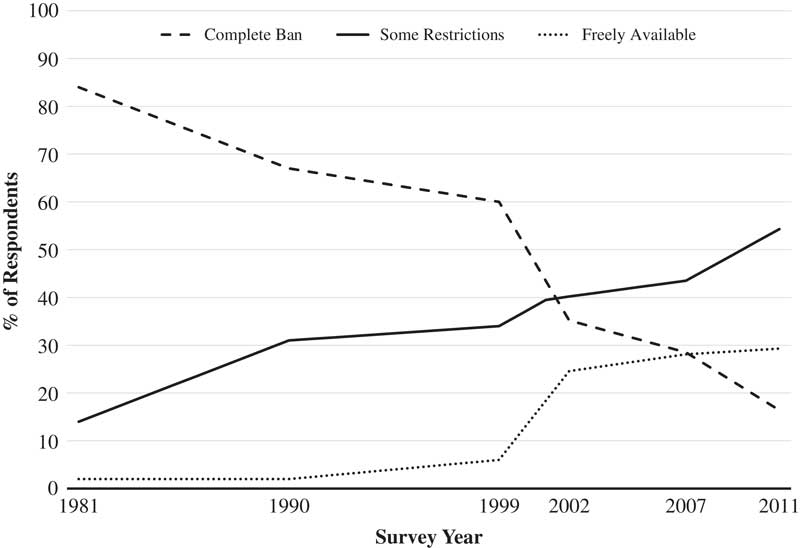
These shifts have been accompanied by attendant changes in attitudes towards religious and moral issues which became the sources of anguished public debate throughout the 1980s and 1990s. Analysts often describe religious vs secular splits existing within the electorate that divide Irish society into three relatively evenly proportioned groups: conservatives, pragmatic/centrists and progressives/liberals (Girvin Reference Girvin1994; Sinnott Reference Sinnott1995). A closer look reveals that a strong liberalizing trend on moral issues exists, as evidenced by Ireland becoming the first country in the world to pass a constitutional amendment permitting same-sex marriage, via referendum in 2015. A similar although less pronounced shift has occurred regarding abortion in Ireland as a majority of voters have adopted ‘centrist’ attitudes (compared to the progressive views adopted in most affluent democracies). For example, 53 per cent of Irish respondents in 2011 believed that abortion was acceptable in some circumstances, a decisive change from 1981 when only 14 per cent held this view (see Figure 1). Likewise, the number of those who considered abortion as always wrong/never justified has declined dramatically over this period, falling from 84 per cent in 1981 to 18 per cent in 2011.Footnote 4
Attitudes towards Abortion in Ireland, 1981–2011 Source: European Values Survey (1981, 1990, 1999); INES (2002, 2007, 2011).

Although high percentages of Irish citizens support allowing abortions in certain cases (e.g. rape, incest, life at risk), traditional views grounded in Catholicism remain relatively conservative. For example, only 37 per cent of citizens support legalizing abortion simply when a woman deems it to be in her best interest emotionally or financially (Collins Reference Collins2013).
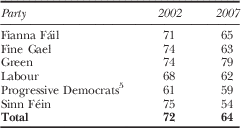
Though abortion continues to be a contentious issue within Irish society, its apparent salience among voters varies depending on whether it is addressed in elections as opposed to referenda and courts. When asked how important the issue of abortion was to them personally, nearly three-quarters of respondents in the INES reported that abortion was very or fairly important to them in 2002 and 64 per cent declared this to be the case in 2007 (Table 1).
Percentage of Voters Viewing Abortion as an Important Issue by Party (INES)

And yet, abortion rarely emerges as important during Irish elections. When asked to identify the issues that were ‘most important’ to them during elections – as opposed to whether the issue was important to them personally – Irish voters have consistently ignored abortion. In fact, Irish voters included abortion among their most important issues only once between 1969 and 2011, when only 12 per cent of respondents highlighted abortion in the 2002 election.Footnote 6
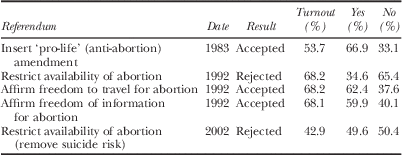
There is a different pattern of public opinion in referenda. As attested to by the data in Table 2, abortion has significantly divided the electorate in referendum campaigns. Turnout in these five referenda varies, but there is a clear trend towards heightened division over the issue.
Abortion Referenda in Ireland

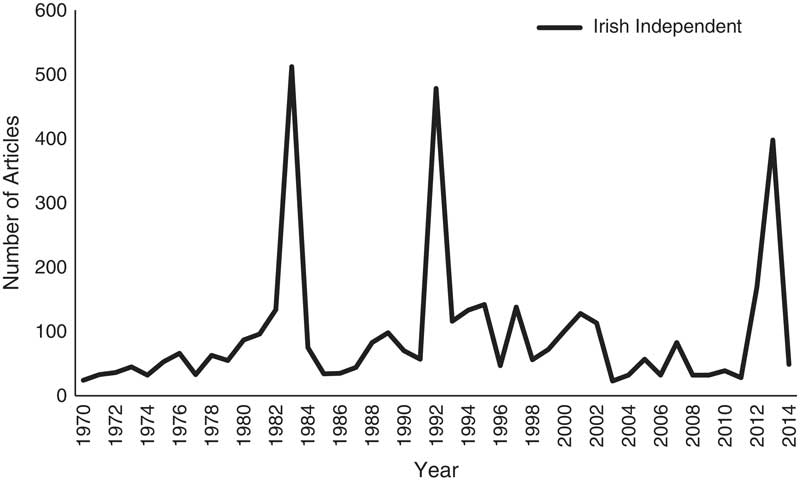
Thus, if one were to examine voter attitudes towards abortion only during elections, one would conclude that it is not a particularly salient issue. This would discount the intense battles that have been and continue to be fought over abortion in referenda and the courts, as well as ignoring the survey data in Table 1 showing that two-thirds of Irish citizens consider abortion important to them personally. These contrasting patterns invite further explanation, suggesting that voters and parties behave differently within diverse institutional contexts. A brief snapshot of how abortion has been covered in the Irish media underscores a similar pattern: abortion assumes greater salience during referendum campaigns and then retreats to the backburner, with only slight increases during elections (Figure 2).Footnote 7
Number of Newspaper Stories in the Irish Independent on Abortion, 1970–2014

Fewer than 100 stories on abortion were published annually in the Irish Independent, the most widely read Irish daily newspaper, in most years since 1980, including election years. Yet, when abortion referendum campaigns heated up, as in 1983 and 1992, coverage increased 500 per cent. The only comparable spike in media coverage occurred in 2013 when public outcry over the death of 31-year-old Savita Halappanavar, an Indian citizen living in Ireland who died in an Irish hospital after complications from a miscarriage, brought abortion policy to the forefront again. Although abortion clearly matters to Irish citizens, voters are led to engage the issue in the domain of referenda. Abortion is less salient to the public – and to the media – during non-referendum periods, including during elections.
Partisan Attitudes of TDs and Voters Towards Abortion
TDs and voters from all parties – although especially major parties – evince varying levels of religiosity and fairly diverse attitudes towards abortion, which could influence party leaders’ strategic choices. Data from this author’s parliamentary surveys point to considerable variation in individual levels of religiosity among TDs, which in turn affect TDs’ attitudes towards abortion. The views of party supporters are similarly varied.
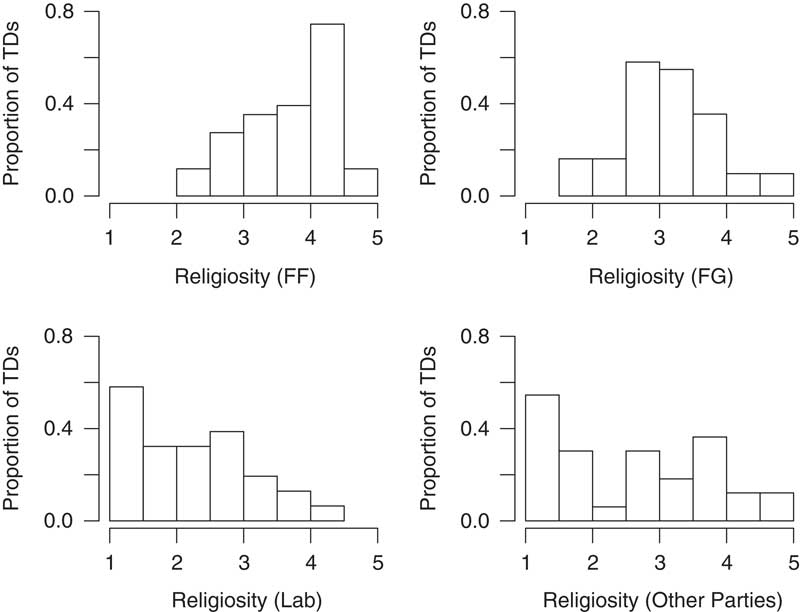
Unsurprisingly, TDs who scored highest on a religiosity index were also most opposed to liberalizing abortion, whereas those with the lowest levels held more neutral or less restrictive views, with a correlation between religiosity and views towards abortion of 0.52 in 2007 and 0.70 in 2011.Footnote 8 The findings indicate the presence of a positive, moderate linear relationship between the two variables, and a bivariate regression shows that fairly religious TDs (the 75th percentile on the religiosity index) were about 2.55 points more ‘pro-life’ than fairly secular TDs (the 25th percentile on the religiosity index). In terms of overall levels of religiosity among TDs, Fianna Fáil and Fine Gael TDs recorded overall positive religiosity scores, whereas the mean religiosity scores for Labour and minor party TDs were neutral or negative (see Figure 3). Labour and minor party TDs might be more inclined to advance less restrictive positions on abortion and progressive attitudes on morality politics more generally. And yet, at least in the electoral arena, they have not made abortion a priority.
Histogram of TDs’ Religiosity by Party Note: FF=Fianna Fáil; FG=Fine Gael; Lab=Labour.

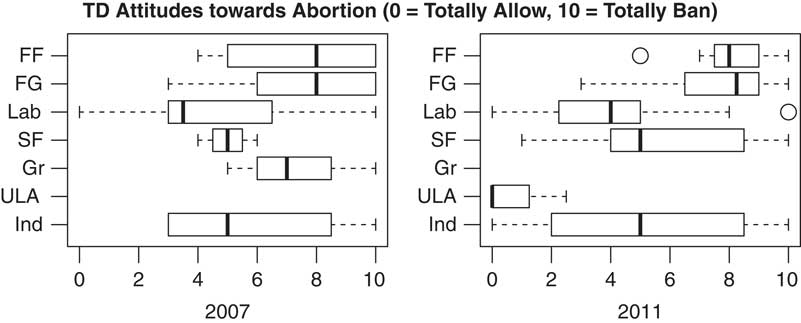
Heterogeneous views on abortion, as well as religious practice, exist among party elites within most Irish parties. Evidence from this author’s parliamentary surveys reveals this intra-party dispersion on abortion (Figure 4).Footnote 9 The thick, vertical grey lines in Figure 4 represent the middle 50 per cent of TD positions in each party (the interquartile range) such that longer, horizontal bars indicate greater diversity of views among TDs within a party; the thin horizontal lines represent the range of attitudes outside the party’s middle 50 per cent and the smaller dots outside the box plots represent outliers.Footnote 10 Diverse views on abortion are held among TDs within all parties except the United Left Alliance (People Before Profit and Socialists). For these other parties, TDs differ in their views between 5 and 10 points, with smaller differences for Sinn Féin in 2007 (1 point) and Fianna Fáil in 2011 (2.5 points).
TD Self-Placement on Abortion in 2007 and 2011 Elections

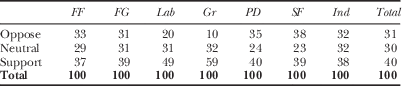
Finally, party supporters have increasing heterogeneity in terms of the religiosity – and relatedly, attitudes towards abortion. Self-identified practising Catholic voters are somewhat more likely to vote for Fianna Fáil, and to a lesser extent, Fine Gael in elections. Labour, Green Party and Sinn Féin supporters were somewhat more likely to support legalizing abortion than supporters of other parties. Yet, every party except the Greens (and Labour in 2011) derived at least a quarter of its electoral support from voters who generally opposed abortion and another quarter from voters who openly supported abortion. Table 3 shows citizens’ attitudes, by party, towards abortion from the 2007 INES, recoded on a three-category scale (oppose, neutral and support).
Abortion Attitudes by Party Supporters (%)

Source: INES 2007.
Therefore, any party that took a stronger stance on abortion during elections – one way or another – would experience a risk of losing critical support among its own rank and file.
IRISH PARTIES’ STRATEGIC CHOICES ON ABORTION
Ireland’s political institutional framework creates different incentives for parties – and voters – in terms of whether and how they engage abortion. There are several factors that powerfully incentivize party leaders to address abortion differently in elections and referenda. In elections, there exists an imperative to attract broader support among an increasingly heterogeneous electorate. Adopting clear-cut positions on abortion could jeopardize support for parties of all stripes during Irish elections, but especially major parties. The challenge for minor parties appears greater as they seek to balance competing incentives during referendum and election campaigns. On the one hand, minor parties have previously benefited from visibility gained during second-order campaigns like referenda. The potential to mobilize more progressive voters is therefore appealing. On the other hand, doing so might alienate moderate and conservative voters whose lower preference votes they may require to get elected in general elections.
Therefore, the combination of Ireland’s partisan cleavage structure, PR-STV electoral system, and the growing heterogeneity of attitudes towards abortion among citizens and politicians has led most parties to downplay the importance of abortion during elections. Parties consistently shift their positions and tone on abortion during elections to sidestep, frame or accommodate issues that diminish the salience of abortion. However, major party leaders also employ extra-parliamentary institutions, in this case referenda, to block minor parties from capturing newly emerging issues. In this institutional domain, civil society groups take the lead and minor parties can support more progressive or controversial views without jeopardizing their electoral fortunes.
Ireland’s PR-STV electoral system further reinforces the incentives faced by parties, especially for minor parties. Candidates need to secure only 5,000 to 8,000 votes to win a seat, but 80 per cent of winning candidates rely on transfer votes from other candidates to gain their seats. Only 19 per cent (32/166) of elected TDs in 2007, 12 per cent (20/166) in 2011 and 14 per cent (22/158) in 2016 won on the first count, thereby not requiring transfers from other candidates. Therefore, unless a strong geographic concentration of support exists within a constituency, smaller parties have an incentive to moderate their appeals to attract lower-preference votes from competing parties’ supporters. The overwhelming majority of candidates require transfers to be elected. Minor parties could benefit electorally from the growing segment of society who express a preference for less restrictive attitudes on abortion, but their candidates are generally more dependent on lower preference transfers, thereby disincentivizing position-taking on hot-button issues.
Consider the circumstances of a progressive candidate in an urban constituency like Dublin South Bay. In the 2002 referendum on abortion, 48 per cent of the constituency voted, with nearly 67 per cent of voters – approximately 20,000 citizens – supporting the more ‘pro-choice’ position. During the 2002 election, three minor party candidates were elected and received nearly 18,000 first-preference votes. Although each of these candidates supported more progressive views on abortion, they did not campaign explicitly on this issue during the election. Even in a constituency where there is greater support for progressive views, many of the voters are conservative or ambivalent on the issue. In order to win an election campaign focused on abortion, smaller-party candidates would need to win 18,000 out of 20,000 first-preference votes amongst ‘pro-choice’ citizens – and overcome some ‘pro-choice’ voters’ established loyalties to the major parties.
Irish citizens appear to be divided into similarly sized conservative, liberal and moderate segments on the issue. Thus, neither a conservative nor a progressive policy platform on abortion would capture a majority of the vote. Likewise, while a majority of the Irish public expresses the view that abortion is important to them, only about half of the public turned out in the 1983 and 2002 referenda – implying that about half the population simply does not care enough to vote. Another half of the public holds centrist attitudes, ambiguous attitudes or simply does not care. This suggests that a progressive or conservative policy platform on abortion is likely to capture no more than a quarter of the vote during an election.
Therefore, the structure of public opinion combines with the incentives created by the electoral system to help explain why major parties have been unwilling to ‘gamble’ on a realignment that might alienate existing supporters but draw in new ones. A small number of progressive or conservative voters could be drawn to a ‘pro-life’ or ‘pro-choice’ platform, but a large number of centrist voters might find the party’s focus on abortion alienating or overly strident. Major parties appear to have navigated this political minefield by implicitly mobilizing anti-abortion activists through close personal relationships in the 1983 referendum when public opinion was more skewed in that direction (Hesketh Reference Hesketh1990), and subsequently more quietly engaging the issue in later campaigns (even though leaders like Bertie Ahern maintained anti-abortion positions). Because opposition to abortion in all cases has been falling, allying with anti-abortion activists has become more risky in the contemporary period. Electoral incentives provided by the electoral formula combine with the evolving structure of public opinion to influence both major and minor party strategies on abortion during elections.
The dynamics that characterize competition over abortion within elections and referenda are quite distinct. During elections, parties compete over a wider set of issues. Again, since powerful incentives exist for both major and minor parties to refrain from over-politicizing divisive issues during elections, both sets of parties look to a convenient alternative path – the referendum, to allow for more open competition on abortion.
Abortion Policy During General Elections
One useful measure of a party’s programmatic position is its election manifesto. In theory, a party places greater weight on certain issues or combinations of issues, based both on what matters to the electorate and where the party perceives it will gain the most traction with voters (Budge and Bara Reference Budge and Bara2001: 3–7). The Comparative Manifesto Project (CMP) allows us to identify how much space any given party allocates to different policy dimensions over a series of elections (Volkens Reference Volkens2001: 93–109; Volkens et al. Reference Volkens2014).
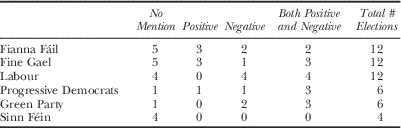
The evidence illustrates how Ireland’s major parties have sought to take advantage of the unusual degree of ideological flexibility they enjoy. The manifesto data include two opposing categories that capture party positions along the moral issue dimension: Traditional Morality Positive and Traditional Morality Negative (Budge et al. 2001: 227).Footnote 11 On these indicators, the major parties displayed deep ambivalence on issues pertaining to morality, fluctuating between advancing no position, to including either positive or negative positions, or at times even embracing contradictory positions in their manifesto in the same election (Table 4).
Number of Election Manifestos that Include Morality Issues, 1973–2011

Ireland’s major parties have spent on average less than 1 per cent of their manifestos on positive and negative moral attitudes between 1973 and 2011. Irish parties have practised moral ‘mugwumping’ – espousing both sides simultaneously – on several occasions. In the 1997 election, for example, Fianna Fáil’s total manifesto was 2.5 per cent positive and 2 per cent negative regarding traditional morality; Fine Gael 4.3 per cent positive and 3 per cent negative; Labour 0.8 per cent positive and 2.4 per cent negative.
The minor parties, despite being more socially ‘progressive’ than Fianna Fáil and Fine Gael, also de-emphasized moral issues during elections. The Progressive Democrats (PDs), slightly more socially conservative than the other minor parties, devoted less than 2 per cent of their manifestos to morality issues. The Greens virtually abandoned mentioning moral issues, moving from devoting 4 per cent of their manifesto to progressive social values in 1989 to not mentioning them at all in 2002.Footnote 12
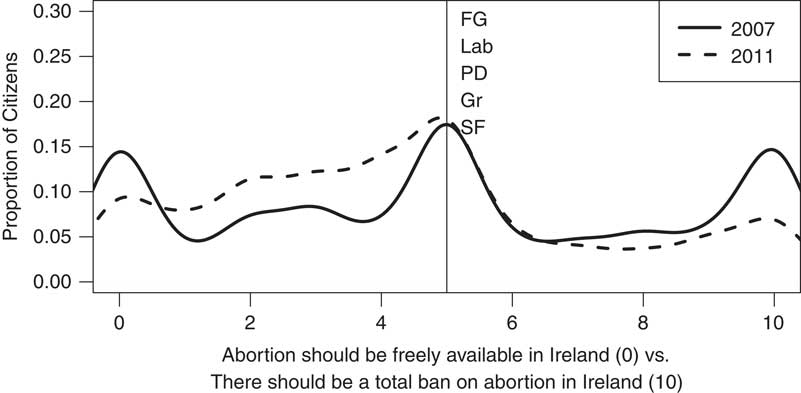
The relative silence of parties on abortion during elections may help explain why a significant percentage of Irish citizens were unable to determine party positions on abortion. INES evidence from 2007 allows us to observe the distribution of voters and their perception of party positions on the issue in Figure 5. The dashed line indicates the median position at which survey respondents place a given party’s position on abortion, and shows that voters perceived all parties to have identical median positions.
Distribution of Voters’ Self and Party Placement on Abortion in 2007 Source: INES (2007).

Between one-third and one-half of respondents declared that they ‘did not know’ where to place political parties on the abortion policy scale. In sum, despite increasingly diverse attitudes on abortion, a relatively broad distribution of views on these issues among voters, and support for more progressive abortion policies among several minor parties, none of Ireland’s political parties has successfully made abortion a wedge issue during elections.
Abortion Policy During Referenda
The very existence of referenda provides major parties with a powerful tool when circumstances do not allow for avoidance. The tendency to relay on referenda has mitigated the impact of significant changes in society upon long-standing patterns of party competition. Minor parties have at times successfully employed referenda as a bully pulpit to challenge major parties. However, referendum campaigns focus on single issues, which limits their longer-term transformative impact over the political landscape, especially when parties decide not to politicize the same issues during elections.Footnote 13
The first abortion referendum, in 1983, was held largely because of the influence of the anti-abortion lobby, which sought to ensure that no law or court decisions would make abortion legal. Although abortion had not been particularly salient during any of the three elections over the previous 18 months, leaders of the two leading parties were fearful of losing additional votes during this electorally volatile period. Both leaders promised Ireland’s powerful ‘pro-life’ lobby that they would hold a referendum on abortion once elected, and Fine Gael fulfilled its promise once in government with Labour (O’Mahony Reference O’Mahony1998). There was confusion over the wording of the actual amendment, which led to Fianna Fáil supporting it, Fine Gael and Labour being divided over it, and the Workers Party opposing it. Bowing to pressure from factions within the party, especially from Young Fine Gael, Taoiseach Garret FitzGerald encouraged a ‘no’ vote. Ultimately, none of the major parties campaigned vigorously for or against the measure (Sinnott Reference Sinnott2002). Two-thirds of voters supported including a ‘pro-life’ statement within the Constitution; the referendum passed. The debate, however, was far from over.
Abortion surfaced again in 1992 as a result of debates surrounding the Maastricht Treaty and its effect on Ireland’s abortion policy. Attention was also heightened because of a controversial court case, Attorney General v. X, in which the Irish Supreme Court determined that a suicidal pregnant teenager possessed the right to travel overseas for an abortion, since it was argued that her life was endangered by the pregnancy. Public and political debate flared over the court’s decision, and legal confusion ensued as to what the court’s decision meant for the availability of abortion in Ireland. The public debate over abortion continued to intensify, leading the government to hold another referendum with three separate questions on the ballot later that autumn. Some members of Fianna Fáil with close ties to leading anti-abortion activists wanted to fight the issue in an electoral context, but party leaders ultimately decided in favour of holding a referendum. A majority of party TDs believed that the referendum was the better place to handle the concerted lobbying of the Catholic Church and the ‘pro-life’ activists (Girvin Reference Girvin1994).
Fianna Fáil’s coalition partner, the Progressive Democrats, made its own choices on the matter. The PD party leader at the time wished to preserve the consensus over retaining Ireland’s abortion policy in the face of liberalizing EU social legislation. He warned that another divisive debate on abortion would hinder the government’s attempts to recover economically and to establish peace in Northern Ireland – two key components of the PDs’ policy platform. Not wanting to bring down the government, the PDs reluctantly supported holding a referendum, but held their peace during the campaign (Girvin Reference Girvin1994).
The three hotly contested referenda held on the same day sought to uphold the right to access information regarding abortion, the right to travel to another country to procure an abortion, but also sought to prohibit abortions from being performed in Ireland on the grounds of suicide risk. Fianna Fáil strategically crafted fuzzy wording, which left voters confused about what constituted a threat to the pregnant woman’s health, and the timing of this referendum powerfully shaped the campaign, its outcome and the longer-term legacy of the abortion debate for partisan politics in Ireland. The choice to hold the three referenda on the same day as the election was deliberate. Although the eight months before the election had been consumed by trenchant public debate regarding abortion, the parties were more silent on the issue during the election campaign itself. Fine Gael was a relative exception, as it devoted nearly 5 per cent of its manifesto to positive positions on traditional morality, whereas Fianna Fáil and Labour spent only 1.7 per cent and 1.0 per cent respectively. A fractious Fine Gael was fearful of internal divisions on the issue and equivocated on the issue for much of the referendum campaign, in the end supporting a ‘no’ vote in the final week of the campaign. The PDs, Labour, the Workers Party and Democratic Left rejected all three abortion referenda (Girvin Reference Girvin1994).
Referendum campaigns provide an opportunity for groups in civil society to provide voters with a choice independent of party positions. Yet, activist groups who proved most influential in dealing with issues such as abortion and divorce during referenda have not become viable parties or developed strong links with them. For example, leaders of the Pro-Life Amendment Campaign (PLAC) in the 1980s met with overwhelming defeat when they ran candidates in elections, despite their effective voter mobilization during the 1983 referendum. Unlike in Switzerland, where women’s groups and religious groups closely aligned with secular and religious parties to fuel the conflict over morality politics in both referenda and elections for over 30 years, Irish parties have maintained only implicit relationships with civil society groups, and even these tend to be stronger in referendum campaigns and largely absent during general elections (Engeli and Varone Reference Engeli and Varone2012: 88–113). Leading Irish social groups in referenda have proved to be transient single-issue groups.
With the issue of abortion still unsettled, yet another referendum followed in 2002, again concerning the removal of the threat of suicide as grounds for legal abortion in Ireland. Despite divisions over whether to hold a referendum, the availability of the referendum as an alternative domain for dispute resolution once more kept abortion out of election campaigns (Kennedy Reference Kennedy2002). The referendum battle was intense, but it was also rejected by a narrow margin of 50.4 per cent to 49.6 per cent. The result signalled continued deep divisions within Irish society over abortion, despite its lack of salience during elections.
Despite the court’s 1992 ruling and intense media pressure to act, mainstream parties in the Dáil simply refused year after year to legislate on abortion, avoiding the risk of alienating the electorate. During the quarter-century between 1980 and 2015, there were only 10 bills concerning abortion debated in parliament, three of which were required prior to holding a referendum (1982, 1992 and 2001), and six were private members’ bills, none of which passed. Additionally, there were only 18 motions/statements/oral questions about abortion in parliament and another 376 written questions over the entire period.Footnote 14
The primary exception to this pattern was the passing of the Protection of Life during Pregnancy Act in 2013. The introduction of the bill was partly in response to the outcry over the Savita case and partly to the European Court of Human Rights judgment in the A, B, and C v. Ireland [2010; ECHR 2032] case that demanded Ireland provide a credible procedure by which a woman could determine whether she is eligible for an abortion in Ireland. This marked the first time that abortion was debated openly and aggressively within parliament. After a gruelling all-night parliamentary session, the bill passed, but not before splits within several parties. Nearly half of Fine Gael TDs disagreed with its leadership’s position to pass the bill and six of its TDs were expelled from the party for voting against it. Sinn Féin’s Peadar Tobin, TD, was temporarily suspended from his party for his vote against the bill. After heated internal debate, Fianna Fáil leader Micháel Martin allowed a ‘free vote’ on the bill, which prevented potentially equally damaging splits within his party.
Abortion policy did not find resonance with voters in the 2016 election. Those candidates who sought to capitalize on their positions towards abortion, irrespective of whether they promoted clearly defined ‘pro-life’ or ‘pro-choice’ positions, did not fare well electorally. For example, Renua Ireland, a new party which was formed by a number of ‘pro-life’ TDs who had been expelled from Fine Gael after the 2013 Protection of Life Act, did not succeed in electing any of its three TDs. By contrast, Labour advanced a more expansive ‘pro-choice’ agenda, hoping to catch the cultural winds of the same-sex marriage referendum in 2015 and reverse its dismal standing in the polls. Its call to repeal the Eighth Amendment gained no discernible traction and the party experienced its worst electoral defeat ever. Although its poor election results were not attributable solely to its stance on abortion, Labour’s stringent positions on this issue clearly did not bolster its appeal among the broader electorate. The 2016 results seem to confirm a longer-term pattern that, when it comes to abortion policy in Ireland, parties are more successful in elections when they seek consensus or avoid the issue altogether, leaving it to be addressed within non-electoral domains.
CONCLUSION
This analysis has relied on multiple sources of data, much previously unavailable, to demonstrate how party leaders can engage a hotly contested issue by employing different strategies within separate institutional domains. Ireland’s major parties have sustained longer-term electoral effectiveness by employing varied strategies across multiple institutional domains. If, when and how salient issues in Irish society such as abortion are translated into the political arena is partly dependent on institutional context. The availability of different institutional vehicles to – at different times – sidestep, frame, engage and/or accommodate issues has enhanced the major parties’ abilities to maintain their long-term electoral predominance while denying minor parties the opportunity to capture key electoral constituencies.
The desire to insulate themselves from powerfully divisive issues is not unique to Irish parties. As the adage from Schattschneider cited at the outset attests, parties everywhere generally make every effort to dampen the salience of issues where competing parties have the edge. In the case of Ireland, major party leaders have sought to avoid internal party disputes and maintain loyalty among rank and file by generally relegating a hot-button moral issue, abortion, to an extra-parliamentary arena. For different reasons, smaller challenger parties have also embraced referenda on abortion, mobilizing support during referendum campaigns to increase their visibility and public profile, but de-emphasizing the issue during election campaigns.
Comparative studies have generally failed to account for how parties address salient issues across the political system in distinctive ways. Parties can behave one way in elections; another way in parliament, and still another during referendum campaigns. The strategic choices parties make in deciding where and how to engage an issue can have long-term consequences on patterns of party competition. This article has focused on abortion politics in a single-country case to underscore the relevance of different institutional mechanisms, in this case referenda, to address (or avoid) hot-button moral issues. Comparatively, there exists a wide variety of responses to sharply contested moral issues. In the neighbouring United Kingdom, or Scandinavian countries, for example, morality issues have never become prominent enough to become deeply salient. In contrast, abortion is a deeply salient and politically divisive issue in other advanced industrialized democracies as diverse as the Netherlands, Spain, Switzerland and the US. The US provides an interesting case because – since the Civil Rights movements – there has existed no similar persistent moral conflict that has so galvanized party politics. In that country, political party leaders, and powerful actors within civil society, helped make abortion a virtual litmus test dividing Republicans and Democrats.Footnote 15 The mobilization around abortion since the 1970s in the US has virtually transformed elite and mass attitudes and reshaped overall partisan competition (Adams Reference Adams1997). The potentially explosive power of personal moral issues to reshuffle party politics points to the need for a closer look at the array of strategies and institutional vehicles parties employ to politicize, or deliberately depoliticize, a broad spectrum of conflicts.
Future comparative studies would benefit from focusing on how parties in other country contexts employ an array of strategies across electoral, parliamentary, governmental and extra-parliamentary institutions such as referenda to frame the demand side of politics, thereby shaping patterns of party competition. Countries that appear on the surface to be characterized by relative electoral ‘stasis’ may in fact be masking other strategically relevant behaviours undertaken by party elites that reinforce the electoral status quo. Further attention to party strategies across institutions within a system will provide a rich analytic vein for future exploration.