1. Introduction
Parabolic pits, alias the trace fossil Oichnus paraboloides Bromley, Reference Bromley1981, are a common feature of echinoderm tests in certain parts of the Phanerozoic succession, such as Wenlock (Silurian) and Mississippian (Carboniferous) crinoids and holasteroid echinoids of the chalk (Late Cretaceous; Donovan, Reference Donovan2015; Donovan, Hammond & Tenny, Reference Donovan, Hammond and Tenny2015; Donovan & Tenny, Reference Donovan and Tenny2015; Hammond & Donovan, in press). The Palaeozoic occurrence of O. paraboloides on crinoids has now been extended into the early Permian Period of Timor, southeast Asia. However, observations have also indicated that analogous infestations of parabolic pits may be the result of inorganic processes, discussed in the following.
2. Localities and horizons
RGM 792 285. ‘Indonesia, Timor, Ajer Mati, Permian’ (specimen label), city of Kupang, West Timor. Probably part of the Bobonaro Scaly Clay Mélange Complex (Charlton et al. Reference Charlton, Barber, Harris, Barkham, Bird, Archbold, Morris, Nicoll, Owen, Owens, Sorauf, Taylor, Webster and Whittaker2002, p. 726, fig. 3), possibly “lost beneath urban development” (Charlton et al. Reference Charlton, Barber, Harris, Barkham, Bird, Archbold, Morris, Nicoll, Owen, Owens, Sorauf, Taylor, Webster and Whittaker2002, p. 740). Early (Cisuralian) or middle Permian (Guadalupian).
RGM 792 286. ‘Indonesia, Timor, Noil [ = River] Simaam, Permian’ (specimen label). Most probably (Donovan & Webster, in press) from the late Artinskian Stage (Charlton et al. Reference Charlton, Barber, Harris, Barkham, Bird, Archbold, Morris, Nicoll, Owen, Owens, Sorauf, Taylor, Webster and Whittaker2002, p. 738), Cisuralian Series, early Permian (Gradstein et al. Reference Gradstein, Ogg and Smith2004). This determination may not apply to the crinoids, however, which rarely occur preserved with associated cephalopods in Permian deposits of Timor; that is, they may come from strata higher or lower in the succession. Uncertainly, Noil Simaam may be in the western part of East Timor.
3. Description
Terminology of the crinoid endoskeleton follows Ubaghs (Reference Ubaghs, Moore and Teichert1978) and Moore et al. (Reference Moore, Ubaghs, Rasmussen, Breimer, Lane, Moore and Teichert1978). The specimens discussed here are deposited in the Naturalis Biodiversity Center, Leiden (prefix RGM).
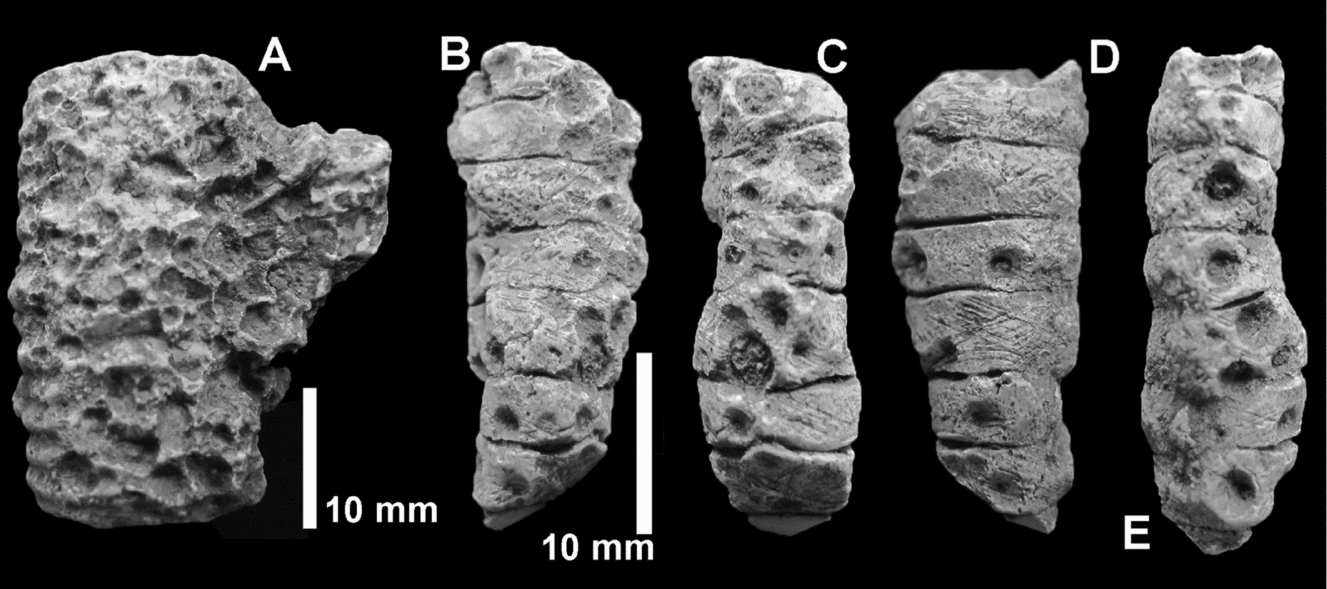
RGM 792 285. Crinoid sp. indet., probably a cladid or camerate. Crinoid pluricolumnal of circular section, about 29.9 mm long and 15.5 mm in diameter, composed of 15 columnals, with a small piece of limestone cemented on one side which contains a second, small, poorly preserved pluricolumnal (Fig. 1a). Lumen moderately broad, central, circular; other features of articular facet not preserved (articulation was most probably symplectial). Latera convex, unsculptured, latera convex. Column hetermorphic, nodal about centre, noditaxis long, but incompletely preserved; at least three orders of internodals. Small, conical, cemented attachment structures (juvenile crinoids?) quite common on one side of pluricolumnal (not illustrated). Other side (Fig. 1a) altered by numerous parabolic pits in close association, extending onto contiguous limestone.
Pitted crinoid pluricolumnals from the Permian of Timor. (a) RGM 792 285, crinoid sp. indet., pitted side of pluricolumnal with pits extending onto the limestone (right). (b–e) RGM 792 286, platycrinitid sp. Four lateral views, each rotated 90° to the left from the previous image, showing the pattern of pits, Oichnus paraboloides Bromley. Specimens uncoated.

RGM 792 286. Platycrinitid monobathrid camerate (compare with Ausich, Reference Ausich, Hess, Ausich, Brett and Simms1999, figs 158, 162). Crinoid pluricolumnal of elliptical section, 27.1 mm long and 7.1–11.1 mm in diameter, composed of eight columnals or parts of columnals (Fig. 1b–e). Articular facets elliptical, offset between either end within some columnals; lumen central, small and rounded; other features of facet not preserved (but articulation was certainly synarthrial). Latera planar to gently convex, unsculptured. Latera bearing common parabolic pits, particularly common on two sides of pluricolumnal (Fig. 1c, e); essentially limited to columnals and not overlapping sutures; pits either solitary or in close association, some with raised rims; identified as trace fossil Oichnus paraboloides Bromley, Reference Bromley1981. Some columnals appear to have become deformed in response to pitting, particularly that just below centre, best seen in Figure 1c.
4. Discussion
The two specimens described here show styles of preservation that are typical of fossils that have been exposed to humid tropical conditions. The shallow pits on platycrinitid sp. (Fig. 1b–e) are interpreted as the trace fossil O. paraboloides, an infestation that occurred on the stem during the life of the crinoid. At least some of the pits have raised rims, a growth reaction by the crinoid, and at least one columnal shows a growth deformity in reaction to a pit(s). Further, the pits are limited to columnals and do not cross-cut between adjacent columnals. Platycrinitid columns are interpreted as being highly flexible, with a synarthrial (‘see-saw’) articulation, the movement of which would have dissuaded any pit-former from straddling a suture between columnals. This is analogous to the limitation of encrusters to the latus of one ossicle on the similarly flexible cirri of extant comatulid crinoids (compare with Donovan, Reference Donovan1993, fig. 2C).
In contrast, the densely spaced pits on crinoid sp. indet. (Fig. 1a) are interpreted as inorganic in origin, despite their similarity to those on platycrinitid sp., due to the distribution of pits being both dense and cross-cutting between adjacent columnals. Although this pluricolumnal almost certainly had a symplectial articulation of radiating crenulae and would not have been as flexible as the column of a platycrinitid, there would still have been some necessity for slight flexure in life. There are no raised rims to pits as such; rims in this example are the result of close spacing of pits. Pits are limited to one side of the specimen only; none occur on the reverse of that shown in Figure 1a. While such a distribution may be explained by palaeoecological criteria (Donovan & Tenny, Reference Donovan and Tenny2015), it is nonetheless peculiar in such a densely infested specimen. The column shows no other signs of swelling, another feature commonly seen in infested columns. Most critically, the pits continue from the pluricolumnal onto the adjacent limestone; that is, they are a post-depositional, probably Holocene phenomenon and not ancient trace fossils. Rather, they are interpreted as a microkarstic solution feature.
This short note is a cautionary tale. Both specimens come from the large and previously undescribed collection of crinoid pluricolumnals from Timor in the Naturalis Biodiversity Center, currently being surveyed. Pits are not uncommon in these specimens. This paper defines our criteria for separating ancient infestations by pit-forming invertebrates (O. paraboloides) from modern microkarstic solution features, which we consider generally applicable to interpretation of similar material.
Acknowledgements
Many thanks to my two anonymous, but very positive, reviewers.