


Integration of immigrant populations is an urgent and fundamental policy challenge in many countries in Europe and the Americas that have experienced dramatic increases in the size and diversity of their immigrant populations in recent decades. There is agreement that it is economically wasteful and democratically deficient if immigrants remain marginalized. From a purely economic framework, where returns to the free movement of labor are strongly positive, we should not observe integration failure once transition costs are paid. But this theoretical expectation is not uniformly realized across countries and immigrant groups (Dancygier and Laitin Reference Dancygier and Laitin2014). Instead, the extraordinary influx of migrants has led to severe social tensions and stark signals of integration failures. We see alienation and hardship among immigrants who face social exclusion and discrimination (Algan et al. Reference Algan, Bisin, Manning and Verdier2012; Bloemraad, Korteweg, and Yurdakul Reference Bloemraad, Korteweg and Yurdakul2008) and anti-immigrant backlash among natives who fear that the new waves of immigrants will threaten their jobs, security, and national culture (Fetzer Reference Fetzer2000; Hainmueller and Hopkins Reference Hainmueller and Hopkins2014).
Faced with this dilemma, policy makers are struggling with the design of policies to facilitate integration and ease social tensions, but we know distressingly little about the impacts of these policies. One of the key debates involves immigrants’ access to citizenship and the consequences that naturalization has for integrating the growing immigrant populations into the political, social, and economic fabric of the host democracies. The citizenship rules are under much scrutiny by legislators, scholars, and members of civil society who engage in heated debates about the merits of policies that promote or limit opportunities for naturalization (Dancygier Reference Dancygier2010; Goodman Reference Goodman2010; Howard Reference Howard2005).
These debates are often characterized by two opposing paradigms that view naturalization as a catalyst or crown, respectively. The catalyst paradigm—often advanced by parties on the left—is that naturalization should be made fairly accessible since it provides immigrants with the necessary incentives and resources to integrate and invest in a future in the host country. Citizenship is seen as an important catalyst that propels the integration process. The opposing crown paradigm—often advanced by parties on the right—holds that naturalization has no independent effect on enhancing integration. Quite the opposite, once you hand over the host country passport, immigrants lose the incentive to integrate because they can no longer be excluded from the benefits that are associated with citizenship. Following this logic, naturalization is not a catalyst but merely a reward for immigrants who have reached the end point of the integration process. As Dutch Minister of Home Affairs Piet Hein Donner recently put it in defense of tightening naturalization rules, “citizenship is the crown on participation and integration into society.”Footnote 1 Accordingly, there should be a high bar that restricts access to citizenship to only those immigrants who earned this reward by successfully completing the integration process.
In this article we contribute to the ongoing debate by providing empirical answers to three unresolved questions: Does naturalization promote the long-term social integration of immigrants into the host country society? Is naturalization more or less effective for more marginalized immigrant groups? Is naturalization more or less effective when immigrants naturalize earlier rather than later into their residency period? Answering these questions is crucial to test scholarly theories and inform ongoing debates about the design of naturalization policy. But despite the immediate importance of these questions for theory and policy, there is a paucity of research that provides reliable evidence on the causal impacts of naturalization or the impact of the timing of naturalization on the social integration of immigrants. The large majority of studies of naturalization only examine its impact on economic outcomes, and the few existing studies that move beyond economic outcomes almost exclusively focus on political integration, but do not examine social integration specifically. Social integration of immigrants is important for at least two reasons. First, social integration—understood as the removal of all barriers to full participation in the host society—is a key factor for the successful settlement of immigrants and their children. Social integration opens the door to economic mobility, civic engagement, and political participation and thereby improves the lives of immigrants and helps to unlock their potential to contribute to the host country society and economy. Second, the increased influx of immigrants has raised concerns that diversity might have a negative effect on the receiving countries’ social capital (Putnam Reference Putnam2007) and social cohesion (Giddens Reference Giddens2007). Here, social integration of immigrants is widely seen as the most important factor for the maintenance of social cohesion in times of increasing diversity (Hooghe et al. Reference Hooghe, Reeskens, Stolle and Trappers2009; Kesler and Demireva Reference Kesler and Demireva2011). Furthermore, existing studies also only consider short-term effects and, most importantly, they do not employ experimental or quasi-experimental strategies that would allow them to isolate the independent effect of naturalization from the nonrandom selection into naturalization or the nonrandom selection into the timing of the naturalization (Hainmueller, Hangartner, and Pietrantuono Reference Hainmueller, Hangartner and Pietrantuono2015).
The key problem faced by all studies of naturalization is that naturalized citizenship is not randomly assigned, but results from a complex double selection process. Immigrants first apply for naturalization based on unobserved characteristics such as motivation or information, and then decision makers screen applicants based on another set of unobserved characteristics such as the immigrant's language ability or the impression made during the application interview. As a result of this double selection bias, the group of naturalized and non-naturalized immigrants differ on a myriad of omitted variables that independently affect integration, but are difficult to measure and control for in any statistical analysis. Unless we remove the differences in the omitted variables, we cannot attribute differences in integration outcomes to the effect of naturalization.
In this article we contribute to the ongoing debate by providing new causal estimates of the effects of naturalization on the long-term social integration of immigrants, estimates of how the naturalization effect varies across immigrant groups, and estimates of the effect of the timing of the naturalization. Our study design is based on a natural experiment in Switzerland where, until 2003, some municipalities used secret ballot referendums to decide on the naturalization applications of their immigrant residents. Leaflets that described the applicants were sent out to all local voters who then voted with a “yes” or “no” decision to accept or reject each individual applicant, and immigrants that gained a majority of yes votes received Swiss citizenship. Our data combine the leaflets and voting records with a recently administered survey that measures the current integration levels of the applicants who faced naturalization referendums prior to 2003. Given the long time gap between the referendums and our survey, immigrants in our sample received Swiss citizenship about 15 years ago on average. As we explain in detail below, this original data and unique setting allows us to get at long-term effects of naturalization and remove the bias from the double selection process using two complementary identification strategies that are based on an instrumental variable design and a fuzzy regression discontinuity design, respectively. Moreover, it allows us to apply an identification strategy to estimate the effect of an early versus late timing of the naturalization. In a companion study we also examine the impact of naturalization on the long-term political integration of immigrants in this setting (Hainmueller, Hangartner, and Pietrantuono Reference Hainmueller, Hangartner and Pietrantuono2015).
Our study yields three main results. First, we find that naturalization strongly improved the long-term social integration of immigrants as measured by our integration scale that combines a variety of outcomes, including whether immigrants have plans to permanently stay in Switzerland, are a members of a local social club, feel discriminated against, and read Swiss newspapers instead of newspapers from their origin countries. These positive effects of naturalization on social integration persist for more than a decade and a half and are robust across various robustness checks. The effects are also sizable. For example, when using our summary scale of social integration that combines all outcome measures, the results suggest that naturalization causes about a full standard deviation unit increase in the social integration scale.
Second, we find that the naturalization effect strongly varies by the immigrant group. In particular, the estimates show that the large positive effects of naturalization on integration are concentrated among the most marginalized immigrant groups, including immigrants from Turkey and the former Yugoslavia and immigrants born abroad as opposed to those born in Switzerland.
Third, we find that the integration returns are larger when immigrants naturalize earlier, rather than later in their residency. Comparing otherwise similar applicants, we find that receiving Swiss citizenship about three years earlier translates into about one sixth of a standard deviation unit increase in the social integration scale. This suggests that receiving the host country citizenship just a few years faster can have a lasting impact on enhancing the long-term social integration of immigrants.
Our study makes four main contributions. First, our findings contribute to the ongoing heated debates about the effects of naturalization on immigrant integration. In particular, our new causal estimates are supportive of the paradigm arguing that naturalization is an important policy instrument that has a strong and lasting independent effect on improving the social integration of immigrants. Naturalization acts as a catalyst, rather than merely a crown on the completed integration process. Moreover, in stark contrast to the political rhetoric advocating for limiting access to host country citizenship with longer residency periods and stricter naturalization criteria, we find that the positive effects of naturalization are in fact larger for the most marginalized groups and when immigrants naturalize earlier, rather than later, in their residency. Taken together, these findings suggest that for Switzerland—and perhaps other countries with similarly restrictive or more restrictive naturalization regimes—marginally lowering the long residency requirements and stringent naturalization criteria may help to reap the full integration gains from the citizenship policy.
When interpreting our results it is important to emphasize that our estimates capture the effects of naturalization only among immigrants who have applied for citizenship. Among this sample, which is arguably the most relevant for current policy, we find that naturalization promotes long-term social integration and that these effects are larger for more marginalized immigrants and those who apply earlier. This pattern suggests that our results could provide a lower bound of the naturalization effects that we might expect if policy-makers were to slightly lower the naturalization threshold for immigrants who are somewhat less integrated or have somewhat shorter residency.
Second, while existing work is focused on economic and political integration, our study broadens the scope and shows that citizenship also has important consequences for the social integration of immigrants. This is an important result given the persistent marginalization of immigrants and rising social tensions between immigrants and natives that are visible in many European countries.
Third, given that the average naturalized immigrant in our sample obtained Swiss citizenship about 15 years ago, our study goes beyond short-term effects to consider the lasting impacts of naturalization. Importantly, the long-term effects of naturalization are key elements for evaluating theories and the full integration gains from citizenship policy.
Fourth, our study fills an important gap by providing evidence on the effects of naturalization in Switzerland specifically, a country where the issue of naturalization is particularly pressing: there is an unusually large immigrant population of about 27%, and heated policy debates have seen right wing parties like the Swiss People's Party mobilize against mass naturalization of immigrants.
DOES NATURALIZATION LEAD TO BETTER IMMIGRANT INTEGRATION?
Immigrants who naturalize gain access to important legal rights and privileges that are often restricted to citizens of the host country (Aleinikoff and Klusmeyer Reference Aleinikoff and Klusmeyer2011; Bauböck et al. Reference Bauböck, Ersboll, Groenendijk and Waldrauch2006; Joppke Reference Joppke2010; OECD 2011). For example, while non-naturalized immigrants who are permanent residents typically have some security of residence and protection against expulsion, only immigrants who become citizens enjoy the full protection by the state at home and abroad and gain unrestricted access to the territory of the state with the right to permanent abode and return. By naturalizing, immigrants also acquire other important privileges such as the right to vote in federal elections and run for political office, access to restricted public sector jobs, access to various government benefits for welfare, education, or health care that might be restricted to citizens, and increased travel mobility afforded by the host country passport. Naturalization often makes it easier for immigrants to sponsor other family members and secure citizenship for them. For example, in countries such as Switzerland that do not award citizenship based on place of birth, immigrant children obtain Swiss citizenship at birth only if their parents are naturalized. In sum, “national citizenship is the highest standard of equal treatment because immigrants become citizens with all the same rights, same responsibilities, and same voice in a democracy” (Bauböck et al. Reference Bauböck, Honohan, Huddleston, Hutcheson, Shaw and Vink2013; 40).
A growing literature has investigated how naturalization might affect the subsequent integration of immigrants. The overwhelming majority of these studies examine the effects of naturalization on economic outcomes such as employment, wages, or welfare reliance (see, for example, Bevelander and DeVoretz (Reference Bevelander and DeVoretz2008); Dancygier and Laitin (Reference Dancygier and Laitin2014); OECD (2011)). Naturalization may improve the economic outcomes of immigrants through several mechanisms given that citizenship has both an instrumental and a psychological dimension (Bloemraad, Korteweg, and Yurdakul Reference Bloemraad, Korteweg and Yurdakul2008). Both of these dimensions are not mutually exclusive. Instrumentally, naturalization gives immigrants access to jobs that are only open to citizens. Citizenship can also act as a signal that may convince employers that an immigrant applicant has higher levels of human capital (such as language skills) or has a lower likelihood of return migration. As a result, employers might be more likely to hire or promote naturalized immigrants and invest in their training. On the psychological dimension, naturalization might affect the identity of immigrants such that they feel a greater attachment to the host country, feel more security and higher self-efficacy, and change their time horizons towards investing in a future in the host country. This could empower immigrants to demand higher wages or search for better jobs (Bevelander and DeVoretz Reference Bevelander and DeVoretz2008). Consistent with these mechanisms, many studies find that naturalization tends to improve the economic prospects of immigrants, although some findings have shown quite limited or no effects.Footnote 2
While numerous studies have examined economic outcomes, the effects of naturalization on the social and political integration of immigrants remains relatively underexplored even though there are several theoretical mechanisms through which naturalization might affect these other important dimensions of immigrant integration (Avitabile, Clots-Figueras, and Masella Reference Avitabile, Clots-Figueras and Masella2013; Bauböck Reference Bauböck2004; Bevelander and Spang Reference Bevelander and Spang2014; Bloemraad, Korteweg, and Yurdakul Reference Bloemraad, Korteweg and Yurdakul2008; Geddes Reference Geddes2003; Just and Anderson Reference Just and Anderson2012; Kesler and Demireva Reference Kesler and Demireva2011; Turcotte Reference Turcotte2011). Similar to the mechanisms that can lead to better economic integration, naturalization might provide immigrants with the necessary incentives and resources to invest more heavily in their political and social integration to build a better future in the host country for themselves and their children. On the instrumental dimension, naturalization gives immigrants the right to vote and thereby provides an incentive and opportunity for immigrants to become more politically engaged and informed to voice their preferences and grievances in the democratic process (Bevelander and Pendakur Reference Bevelander and Pendakur2011; Bevelander and Spang Reference Bevelander and Spang2014; Hainmueller, Hangartner, and Pietrantuono Reference Hainmueller, Hangartner and Pietrantuono2015; Just and Anderson Reference Just and Anderson2012). Similarly, naturalization might give immigrants an incentive to invest into improving their social integration as their time horizons shift and they can now be certain about enjoying the long-term gains from better social integration in the host country. These investments could be in the form of higher civic engagement, social capital, and increased interactions with natives as immigrants start putting down deeper roots in the host country (Bevelander and Veenman Reference Bevelander, Veenman, Bevelander and DeVoretz2008; Kesler and Demireva Reference Kesler and Demireva2011; Westholm, Montero, and van Deth Reference Westholm, Montero, van Deth, van Deth, Montero and Westholm2007). On the psychological dimension, naturalization might “encourage people to internalize the democratic ideals of active citizenship” (Just and Anderson Reference Just and Anderson2012; 7) and therefore result in more active political and social engagement of immigrants. Moreover, naturalization can also act to signal acceptance and thereby lead to increased attachment to the host country because immigrants feel recognized by state authorities as on par with rooted natives. On the flip side, citizenship might lead natives to recognize immigrants as their equals, and if immigrants feel less discriminated against they might be more likely to interact with natives socially, increase their community participation, and develop a shared sense of belonging to the country (Aptekar Reference Aptekar2015; Bauböck et al. Reference Bauböck, Honohan, Huddleston, Hutcheson, Shaw and Vink2013; Bevelander Reference Bevelander2011; Keller, Gathmann and Monscheuer Reference Keller, Gathmann and Monscheuer2015; Kesler and Demireva Reference Kesler and Demireva2011; Westholm, Montero, and van Deth Reference Westholm, Montero, van Deth, van Deth, Montero and Westholm2007; Wunderlich Reference Wunderlich2005). As Banulescu-Bogdan(Reference Banulescu-Bogdan2012) puts it “citizenship is a significant milestone for immigrants: a ‘rite of passage’ to signal that newcomers take their rights and responsibilities seriously, and are to be recognized as full members of the community.” And lastly, better economic integration might also lead to more social integration as immigrants can climb the social ladder and gain access to jobs, social activities, or residential areas that are typically dominated by rooted natives, and increased economic status might lower the reservations of rooted natives against immigrants (Dustmann Reference Dustmann1996; Keller, Gathmann and Monscheuer Reference Keller, Gathmann and Monscheuer2015).
But there are also various theoretical reasons to expect that naturalization itself might do little to improve or may even reduce the social and political integration of immigrants (Bloemraad Reference Bloemraad2006; DeSipio Reference DeSipio1996; Oers and Hart Reference Oers and Hart2006). First, immigrants who are eligible for naturalization typically hold permanent resident permits which already give them a high degree of certainty that they can remain in the host country for as long as they wish. Given their status as permanent residents they also often have many of the same benefits and rights as citizens (Dancygier and Laitin Reference Dancygier and Laitin2014). For example, in Switzerland, permanent residents have access to the same educational, health, and welfare benefits and social rights, the right to choose their employers, the right to travel and return, and the responsibility to pay taxes. Therefore, naturalization might do little to shift immigrants’ time horizons even further towards investing in a long-term future in the host country. More broadly, some have argued that in a postnational era where rights and privileges are increasingly extended to noncitizens on the basis of personhood and human rights, naturalization has become epiphenomenal since citizenship is no longer required for immigrants to exercise their rights and duties as active social, political, and economic actors in the host polity (Soysal Reference Soysal1994).
Second, much research has shown that habits for social and political engagement are fairly sticky and often form during adolescence, and therefore we might expect little change later in life just because immigrants obtain the host country passport (Galston Reference Galston2001; Jennings and Niemi Reference Jennings and Niemi2014). Even though naturalization might give immigrants new opportunities to participate, this does not mean that they will actually make use of these opportunities.
Third, one might argue that naturalization, if anything, knocks out the incentive of immigrants to further integrate into the host society, because once they are naturalized they enjoy the same rights as natives and are no longer incentivized to further integrate by the prospect of earning access to these rights (Banulescu-Bogdan Reference Banulescu-Bogdan2012).
Finally, if discrimination against immigrants is deeply entrenched in the host country society then we expect that simply awarding immigrants the host country passport will do little to eradicate the marginalization that immigrants face. In fact, the rooted natives might not view naturalized immigrants as true equals, especially in a jus sanguinis citizenship regime like Switzerland where “true” citizenship is passed on by the citizenship of Swiss parents.Footnote 3 If naturalized immigrants—like the rhetoric of some right wing parties suggests—are simply regarded as undeserving foreigners who “stole” a Swiss passport then we would not expect that barriers to social integration are easily overcome by naturalization.Footnote 4 In fact, it might even backfire if newly naturalized immigrants grow increasingly disappointed and alienated as they learn that even with the Swiss passport they are still regarded as inferior by the mainstream host country society.
These opposing theoretical perspectives echo in the heated policy discussion about the design of naturalization policy. These debates are characterized by two conflicting policy paradigms (see, for example, Banulescu-Bogdan (Reference Banulescu-Bogdan2012); Bauböck et al. (Reference Bauböck, Honohan, Huddleston, Hutcheson, Shaw and Vink2013); Ersanilli and Koopmans (Reference Ersanilli and Koopmans2011); Oers and Hart (Reference Oers and Hart2006)). In the first paradigm, naturalization is seen as a catalyst that promotes integration because it gives immigrants the resources and incentives to integrate into the host country society. This logic suggests that immigrants should be given fairly easy access to citizenship by having low requirements for naturalization. In the opposing paradigm, naturalization itself does nothing to improve integration, but it is the prospect of obtaining the host country citizenship that motivates immigrants to integrate in the first place. In other words, naturalization is not regarded as a catalyst for promoting integration, but a crowing achievement awarded to immigrants for successfully completing the integration process. This reasoning suggests that there should be a high bar such that only well integrated immigrants are eligible for naturalization. As one Swiss politician recently put it, the path to naturalization should be a “marathon,” not a “short distance run,” and the Swiss passport is simply the “tittle on the i of integration” for immigrants who successfully completed the long and arduous integration process.Footnote 5
The theoretical and policy discussions also raise the important question of potential effect heterogeneity. It might well be that the effect of naturalization is not uniform across immigrants, but contingent upon the immigrants’ characteristics (Avitabile, Clots-Figueras, and Masella Reference Avitabile, Clots-Figueras and Masella2013; Bloemraad Reference Bloemraad2006; Just and Anderson Reference Just and Anderson2012). For whom might naturalization be most or least effective? On the one hand, it might be that naturalization is particularly beneficial for immigrants who are socially marginalized prior to naturalization, since they otherwise lack the necessary resources to invest in social integration. Similarly, if naturalization enhances integration because it reduces discrimination from natives who are more likely to recognize naturalized immigrants as equals, then we might expect that naturalization has a stronger positive effect for more marginalized immigrants who face more discrimination in the absence of naturalization. On the other hand, it might be that naturalization is least effective for the most marginalized immigrants because they are not yet sufficiently well equipped to take advantage of the rights and benefits that come with naturalization. Moreover, less marginalized immigrants might benefit more from naturalization if they face fewer barriers and are able to invest more heavily into integration and reap higher returns from their investments.
Another important underexplored issue is the effect of the timing of the naturalization. Countries vary considerably in the length of the required residency period for naturalization, and there are vibrant debates about the likely consequences of giving immigrants earlier or later access to the host country citizenship. The catalyst paradigm argues for easy access and early naturalization, because if naturalization acts as a catalyst for integration, then getting it earlier rather than later is more effective to foster the integration of immigrants because they are incentivized early on to integrate and have a longer time to benefit from having citizenship. The crown paradigm argues for long residency requirements and a high bar for access to naturalization because only immigrants who are well integrated deserve the host country passport and are sufficiently well equipped to take advantage of host country citizenship. If citizenship simply acts to knock out the incentive for immigrants to integrate in order to earn access to naturalization, then handing out citizenship too early will, if anything, lower the expected integration compared to the scenario where naturalizations are restricted to immigrants who have been in the country long enough to have achieved at least some integration level.
In sum, there are opposing theoretical expectations and heated policy debates about the potential effects of naturalization and the effects of the timing of the naturalization on the integration of immigrants. The existing literature on the impacts of naturalization has mostly focused on economic outcomes, and the smaller literature that goes beyond economic outcomes mostly focuses on the effects of naturalization on political integration. We still know distressingly little about how naturalization affects the social integration of immigrants, let alone what the long-term effects are on social integration or how the effects vary across groups or with the timing of the naturalization.
EMPIRICAL STRATEGY
Double Selection Bias
Perhaps the major shortcoming of the existing evidence is that it suffers from potentially severe selection bias (Dancygier and Laitin Reference Dancygier and Laitin2014; Hainmueller, Hangartner, and Pietrantuono Reference Hainmueller, Hangartner and Pietrantuono2015; Kesler and Demireva Reference Kesler and Demireva2011). In order to isolate the causal effect of naturalization, we need to compare two groups of immigrants that differ in their naturalization status, but are otherwise similar on all other characteristics that can independently affect integration. The fundamental problem is that such a comparison is hard to come by empirically with typical observational data, because there is a complex two stage selection bias that determines which immigrants obtain citizenship.
Figure 1 illustrates the two stages in the double selection process. In the first stage, immigrants choose to apply for naturalization and this decision is based on a whole host of reasons that have independent effects on integration. For starters, only immigrants who are sufficiently motivated and have the resources to apply for naturalization will obtain citizenship, while the group of non-naturalized immigrants contains many immigrants who lacked the resources or motivation to apply for citizenship in the first place. Arguably, the motivation and resources to apply are among the most important confounders when trying to estimate the effects of citizenship because the resources and motivation to apply are strong determinants of integration into the host country. In addition, there are many other potential differences that explain why immigrants choose to apply. Plenty of evidence suggests that those who choose to apply typically have resided in the country for a longer period of time (in part simply due to residency requirements), and are better informed, better integrated, and perhaps more educated or more fluent in the local language (see, for example, Chiswick and Miller (Reference Chiswick and Miller2009)). Immigrants who apply might also identify more strongly with the host country and its culture or have differences in other traits, such as their intention to stay or political interest, that lead them to seek citizenship, compared to the group of immigrants who do not (see, for example, Yang (Reference Yang1994)). The unadjusted comparison of non-naturalized and naturalized immigrants is therefore one of apples and oranges.
Double Selection Bias

In the second stage, decision makers then review the applications and often interview the applicants to decide who gets citizenship and who is denied. The problem here is that decision makers typically have much more information about the applicants than is observed by the researcher, and they would typically use this information to decide on the applicants. For example, applicants who fail to make a “good impression” in the application interview (in terms of appearance, language skills, familiarity with the host country, etc.) might be more likely to be rejected because they are perceived to have a low potential to integrate. As a result of this screening, the comparison between accepted and rejected applicants is again like comparing apples and oranges because the reasons that determine why an applicant is rejected might be correlated with the integration outcomes of interest. For example, those who are judged to have a lower integration potential might, in fact, be less likely to integrate successfully. Overcoming this double selection bias with typical observational data is a fairly hopeless endeavor. We cannot measure the myriad unobserved confounders that determine immigrants’ selection into applying as well as all the unobserved confounders that determine the decision makers’ selection among the applicants. In fact, we typically have little information about whether and why immigrants applied and also much less information about the applicants than the decision makers when they make their screening decisions. But unless we can control for all the confounding characteristics that determine the selection in both stages, we will end up with biased estimates of the effect of citizenship since the unmeasured confounding characteristics are correlated with the outcomes and the application decision.
Note that a similar selection bias applies when trying to estimate the effect of the timing of the naturalization. The timing of when immigrants naturalize is again far from randomly assigned, and there are many potential differences that explain why some immigrants choose to apply early and others choose to apply only later into their residency period. For example, more motivated or better informed immigrants might apply right after they become eligible, while less motivated or informed ones delay their naturalization until they have been in the host country for a long time.
In order to eliminate the double selection bias and isolate the causal effect of citizenship from the effect of differences in background characteristics, the ideal design would involve an experiment where we randomly assign citizenship among a group of eligible immigrants. Random assignment forms the gold standard for causal attribution, because it ensures that the treatment group of immigrants who obtain citizenship is similar to the control group of immigrants who do not obtain citizenship on all measured and unmeasured characteristics in expectation. Our research design exploits a natural experiment in Switzerland that mimics this ideal experiment.
The Swiss Naturalization Regime in Comparative Perspective
Naturalization has been a divisive issue in Switzerland for many decades given its unusually large immigrant population. To compare the Swiss naturalization regime with that of other European and North American Countries, Figure 2 plots the Citizenship Policy Index (CPI) for various countries for the year 2005.Footnote 6 The CPI is a standard measure developed by Howard (Reference Howard2005) that uses an additive formula to measure a country's citizenship policy between very liberal (6) and highly restrictive (0). It is based on the three main components of citizenship policy: whether citizenship is granted by place of birth or by citizenship of the parents, the length of the residency requirement for naturalization, and the acceptance of dual citizenship for immigrants (see Howard (Reference Howard2005) and the Online Appendix for details).
Citizenship Policy Index for European and North American Countries

The plot reveals that the score for the Swiss citizenship regime is the modal category on the CPI, on par with other restrictive countries like Germany or Italy that also use the jus sanguinis principle (i.e., citizenship is passed on from the parents’ citizenship). While Switzerland does require a fairly long residency period, its regime is more liberal insofar as it allows dual citizenship in contrast to many of the more restrictive countries.Footnote 7
Naturalization Referendums
Naturalization applications in Switzerland are decided at the municipal level. An immigrant who has cleared the eligibility requirements and seeks naturalization is required to apply with the municipality in which he or she resides. The municipal authorities then process and green light the application until it is eventually put to a vote (see Hainmueller and Hangartner (Reference Hainmueller and HangartnerForthcoming) for an overview). We focus on the group of so called ballot box municipalities who until 2003 used secret ballot referendums to decide on the applications.Footnote 8 , Footnote 9 A naturalization referendum typically had two phases. In the first phase, a voting leaflet was mailed to all Swiss voters in the municipality that informed the voters about the pending naturalization requests with a short résumé that described each applicant. The résumés typically included information about the applicant's origin, gender, marital status, number of children, year of arrival, education, occupation, and an assessment of their language skills and integration levels based on the application interview.Footnote 10 In the second phase, voters then cast a secret ballot where they voted “yes” or “no” on each applicant, and Swiss citizenship was awarded only to applicants who received a majority of positive votes. Note that voting on referendums occurred in regular intervals, and naturalization referendums appeared on the ballot alongside other questions about municipal matters that are all typically decided via referendums in Switzerland, such as decisions about the local budget, infrastructure, urban planning, etc. The use of naturalization referendums ended in 2003 when the Swiss federal court ruled that secret ballot referendums can no longer be used for naturalization decisions (see Hainmueller and Hangartner (Reference Hainmueller and HangartnerForthcoming) for details).
The naturalization referendums allow us to devise two identification strategies that overcome the thorny double selection bias and get at the long-term effects of naturalization. The identification strategies guard against selection bias in two ways. First, we can avoid the selection into applying by limiting the analysis to only those motivated immigrants who applied and cleared the eligibility criteria such that they faced a naturalization referendum. Second, we can remove the second stage selection into who is accepted for naturalization using two strategies that exploit the use of voting leaflets and the occurrence of close referendums, respectively.
Instrumental Variable Strategy
In the first strategy we utilize the fact that we can measure and control for all the applicant characteristics that were reported to voters in the voting leaflets when they decided on the applicants and therefore rule out omitted variable bias. In contrast to the situation where an immigration official decides on the applicants based on information that is unobserved to the researcher, here we do observe all the relevant applicant characteristics that were reported to voters who decided on each request. Once we adjust for the reported characteristics and compare applicants who applied in the same municipality, in the same time period, have the same gender, country of origin, marital status, number of children, education, occupational skill, years of residency, assessed integration level, and language proficiency, such matched applicants are observably equivalent to voters, and therefore voters cannot systematically discriminate between applicants based on their unobserved characteristics. Therefore, among such observably equivalent applicants who are matched on the characteristics that voters see on the leaflets, who wins and who loses is not driven by systematic differences in the integration potential of the individual immigrants, but by idiosyncratic shocks that affect the aggregate vote outcomes such as what else appeared on the ballot or the weather on the day of the referendum. Hainmueller and Hangartner (Reference Hainmueller and Hangartner2013) provide substantial evidence for this selection on observables assumption. For example, they show that the effect of the reported applicant characteristics on the vote outcomes are similar in large and small municipalities which rules out the possibility that private information about the applicants might have a systematic effect on the outcomes of the referendums.
One remaining issue that we have to address with this strategy is the issue of noncompliance, by which we mean the fact that a sizable proportion of applicants who lost their first naturalization referendum reapplied and subsequently obtained citizenship. Fortunately, we can directly address the issue of reapplications by exploiting the exogenous variation in naturalization status that results from winning or losing the first referendum that each applicant faces. For this we apply the instrumental variable (IV) framework with heterogeneous treatment effects as developed in Angrist, Imbens, and Rubin (Reference Angrist, Imbens and Rubin1996) which allows us to treat the outcome of the first referendum like a randomized encouragement design experiment where those applicants who win their first referendum are encouraged to get citizenship, while those who do not win their first referendum are encouraged not to get citizenship.
Employing the framework of Angrist, Imbens, and Rubin (Reference Angrist, Imbens and Rubin1996) the population of applicants is made up of two subgroups. The subgroup of so-called compliers are the applicants who comply with the encouragement. In other words, they get naturalized if they win their first referendum but do not get naturalized if they lose their first referendum. The other subgroup are the so-called always-takers. These are the applicants who always get naturalized; even if they lose their first referendum, they reapply and subsequently get citizenship.Footnote 11
To identify the local average treatment effect of naturalization (LATE) for the subgroup of compliers we compute the intention-to-treat effect (ITT), which is the effect of wining the first referendum on social integration, and divide it by the proportion of compliers in our sample, which is given by the first stage effect of winning the first referendum on the probability of naturalization or equivalently the difference between the proportion of winning applicants who do get Swiss citizenship and the proportion of losing applicants who nonetheless get citizenship through a reapplication.
To estimate the LATE, we code a binary treatment indicator that captures whether the immigrant is naturalized or not and a binary instrument that captures whether the immigrant won or lost his or her first referendum. We then run a two-stage least squares model regressing the integration outcome on the reported applicant characteristics from the leaflets, municipality and time period fixed effects, and the treatment variable which we instrument with the instrumental variable (Angrist, Imbens, and Rubin Reference Angrist, Imbens and Rubin1996). Importantly, this strategy relies on the fact that we have enough compliers in our sample and therefore the first stage effect is sufficiently strong. Below we test this assumption and find that the instrument is indeed sufficiently strong.
Fuzzy Regression Discontinuity Design Strategy
We also apply a second, complementary, empirical strategy based on a fuzzy regression discontinuity (RD) design which similarly removes the second stage selection into who is approved for naturalization. The fuzzy RD design exploits the exogenous variation that is generated among the subset of applicants who barely won or lost their first naturalization referendum by just a few votes. In narrowly decided referendums, the outcome of the referendum is largely decided by random factors, such as the weather on election day or other agenda items that appeared on the ballot, rather than the characteristics of the applicants. In other words, who loses and who wins is as good as randomly assigned and we can therefore isolate the causal effect of citizenship on the downstream integration outcomes just like in a randomized experiment. The required identification assumption in the RD design is that the potential integration outcomes of the immigrants are continuous at the threshold (Hahn, Todd, and Van der Klaauw Reference Hahn, Todd and Klaauw2001). This assumption could fail if immigrants could sort around the threshold such that barely rejected and barely accepted applicants would differ systematically. However, sorting around the threshold would require that individual immigrants have precise control over the aggregate referendum outcome, which is not plausible in the large, secret ballot referendums under study (see Eggers et al. (Reference Eggers, Fowler, Hainmueller, Hall and Snyder2015) for support for the no sorting assumption in a wide variety of elections).
Figure 3 illustrates the logic of the fuzzy RD design. The top left panel plots a balance test where the vertical axis is the applicants’ vote share margin from the first naturalization referendum and the horizontal axis is the applicants’ years of education—as reported on the voting leaflet. The vote margin is computed as the difference between the applicants’ share of yes votes and the threshold of 50% of yes votes that the applicant had to exceed to win the referendum and thereby receive Swiss citizenship. The plot is focused on the sample of “competitive” applicants who are within a ± 15% window around the threshold of winning. The grey and black line summarize the average years of education on both sides of the threshold, respectively. We see that in close referendums, which are decided by just a few votes, who loses and who wins is as good as random and therefore the education level of close winners and close losers are similar on average at the threshold. Given this local random assignment, we expect close winners and close losers to be similar on all other observed and unobserved confounders, just like in a randomized experiment and this covariate balance allows us to remove the selection bias. Figure B.2 in the Online Appendix shows that close winners and close losers are similarly balanced on other background characteristics; the distribution of p values from the balance tests closely approximates the uniform distribution as expected given randomization at the threshold.Footnote 12
Fuzzy Regression Discontinuity Design: Identification Checks and the Effect of Naturalization on Long-Term Social Integration

The top right panel shows another important identification check for the fuzzy RD design where we follow McCrary (Reference McCrary2008) and explicitly test for the no sorting assumption by computing the density of the vote margin variable. If applicants had precise control to manipulate their voting results we should see an unusually large (small) number of applicants who barely won (lost). Instead, we see that the density is smooth across the threshold, which implies that there is no evidence for sorting of applicants around the threshold. This is what we expect given that it is implausible for applicants to precisely control the outcome of referendums that involve thousands of voters.
The plot in the bottom left panel previews the main result for the ITT effect. The lines summarize the applicants’ average score on the social integration scale, the summary measure of social integration measured in our recently administered follow-up survey, as a function of the vote share margin. We see that levels of social integration jump considerably at the threshold such that applicants who barely won their first referendum and received Swiss citizenship are today much better integrated on average compared to otherwise similar applicants who barely lost their first referendum. Given the local random assignment at the threshold, we can attribute this effect to winning the referendum as opposed to differences on omitted variables.
Note that this ITT effect, which amounts to about a 0.14 increase on the social integration scale, understates the effect of naturalization for compliers because many applicants who lost their first referendum eventually naturalized by way of re-applications and therefore also received the treatment. To correct for this noncompliance and identify the LATE of naturalization for compliers at the threshold, we need to scale the intention-to-treat effect by the inverse of the compliance ratio at the threshold (Hahn, Todd, and Van der Klaauw Reference Hahn, Todd and Klaauw2001).
The bottom right panel visualizes the first stage effect. The lines show the share of naturalized applicants as a function of the vote margin. The probability of naturalization increases sharply by about 0.28 at the threshold, and therefore the LATE of naturalization for compliers amounts to about 0.14/0.28 = 0.5. Note that the social integration scale has a standard deviation of 0.5 so the LATE estimate implies that naturalization considerably increased the long-term social integration of immigrants by about a full standard deviation unit. In the results section below we formally estimate the fuzzy RDD effect at the threshold by fitting a similar two-stage least squares model which regresses the integration outcome on the treatment indicator and instrument this indicator with a binary instrumental variable that captures whether applicants succeed in their first referendum or not. To this regression we also add the vote margin and the interaction of the vote margin with the instrumental variable such that the LATE of naturalization is identified for compliers only right at the threshold of winning.
Note that the two empirical strategies are complementary to each other in that they identify the same naturalization effect based on slightly different assumptions. However, there is an important difference in the external validity between the two designs since they identify this effect for different subgroups of applicants. The IV design offers higher external validity because it identifies the LATE of naturalization for the subgroup of compliers in general, while the fuzzy RD design is limited in its external validity as it only identifies the LATE of naturalization for the subgroup of compliers who are right at the threshold of winning. Because of this local identification we also lose precision in the fuzzy RD design and have less power to detect potential naturalization effects.
DATA
Sample and Covariates
We draw on a variety of original data to implement our empirical strategies. The basis for our sample is the data compiled by Hainmueller and Hangartner (Reference Hainmueller and Hangartner2013) based on the voting leaflets and voting outcomes for all 2,225 applicants who faced naturalization referendums between 1970 and 2003 in all the 46 ballot box municipalities that used secret ballot referendums with voting leaflets (see Online Appendix for details).
Our covariates capture the applicants’ characteristics reported on the leaflets. They include the applicants’ gender, age, number of children, country of origin, marital status, highest educational attainment, occupational skill, years of residency prior to the application (including an indicator for immigrants born in Switzerland), language proficiency, and integration status. The Online Appendix describes the coding of all variables used in our analysis and provides the descriptive statistics (Tables B.2 and B.3).
To measure the social integration outcomes, we administered a survey of all immigrants who faced naturalization referendums. We first extracted the addresses of these immigrants at the time of their naturalization referendum and then tracked down the applicants to the best of our abilities and administered a survey by phone. As expected, several of the addresses were outdated as immigrants had moved, died, or left the country. Nonetheless, we interviewed 768 applicants, which amounts to a cumulative response rate 3 (RR3) as defined by the American Association for Public Opinion Research of 34.5%. Among competitive applicants who were within a ± 15% vote margin of winning, the response rate was even higher, and we interviewed 474 applicants for an RR3 of 45.9%. This is a higher response rate than is typically achieved by phone surveys in Switzerland or the United States, let alone for surveys of immigrants (see Online Appendix for details).
One potential concern might be that the probability of being interviewed is correlated with naturalization and integration. In the Online Appendix we provide evidence that this is not a concern in our study. In particular, we find that the probability of being interviewed as well as the characteristics of those being interviewed are no different for immigrants who were narrowly accepted and narrowly rejected for naturalization (see Figure B.1 and Table B.1). Moreover, in our context we would expect that differential attrition would, if anything, lead to an attenuation bias in our effect estimates if naturalized immigrants are more likely to stay in Switzerland than non-naturalized immigrants and, among the non-naturalized, those with lower levels of integration are more likely to leave than those with higher levels of integration.
Outcome Measures
Immigrant social integration is a latent and multifaceted concept that involves several dimensions such as social inclusion, social engagement, intergroup contact, social capital, and discrimination (Berry Reference Berry1997; Carens Reference Carens2005; Castles et al. Reference Castles, Korac, Vasta and Vertovec2002; OECD 2012). Studies have used different measures to capture these various dimensions of social integration, and there is no single commonly agreed upon measure that is consistently applied in the literature. Given this, our study takes a pragmatic approach to measurement and combines four existing measures in a social integration scale to obtain a summary measure of social integration. The use of a scale ensures that the results are not driven by a single survey question that might only tap into one dimension of social integration. Averaging across multiple measures also addresses the well-known problem of potentially serious measurement error that typically arises in survey research when trying to measure a latent concept with single survey questions (Achen Reference Achen1975; Ansolabehere, Rodden, and Snyder Reference Ansolabehere, Rodden and Snyder2008).Footnote 13
Our scale is generated from four survey questions that have been used in prior work and tap into various dimensions of social integration. The first item, Plans to stay in Switzerland, is a question that measures whether immigrants are planning to stay in Switzerland permanently or whether they have plans to leave Switzerland. It is coded with values 1, 0, and − 1, for immigrants who have plans to stay forever, those who are not sure, and those who say they plan to eventually leave Switzerland, respectively (the Online Appendix provides all the question wordings). This item captures whether naturalization has changed the long-term attachment and settlement plans of immigrants and thereby increased their incentive to invest into a future in Switzerland and reduced the uncertainty associated with potential return migration (Dustmann Reference Dustmann1996). This measure is of theoretical importance because it directly taps into the theoretical mechanisms through which naturalization might increase social integration by shifting the time horizons of immigrants towards a long-term future in the host country. It is important to emphasize that the immigrants in our sample who did not naturalize still have fulfilled the long residency requirements that make them eligible for naturalization, and they all hold a permanent residency permit which allows them to stay in Switzerland for as long as they wish. This comparison group therefore provides a rather high bar for finding an effect of naturalization on changing long-term settlement plans. Permanent residents who have been in Switzerland for a long time can be expected to already have a fairly long time horizon and a high likelihood of wanting to stay in Switzerland for good. It is therefore far from obvious whether naturalization would have enough of an effect to shift time horizons even further towards permanently settling in Switzerland.
The second item, Discrimination, is a standard measure of perceived discrimination that is coded as 1 for immigrants who describe themselves as being a member of a group that is discriminated against in Switzerland, and 0 if not (Kesler and Demireva Reference Kesler and Demireva2011). Discrimination is an important barrier to social integration and a potent source of marginalization and strained intergroup relations between immigrants and host country nationals. As Kesler and Demireva (Reference Kesler and Demireva2011; 215) put it, “perceptions of discrimination are therefore likely to be important in generating a sense of social cohesion among immigrants.” This measure also taps into the psychological mechanisms discussed above where naturalization might act as a signal of acceptance and increases a sense of belonging among immigrants and the recognition of naturalized immigrants as equals by natives.Footnote 14
The third item, Club membership, is a measure of social capital that captures whether immigrants are currently active members of a social club or association in which they participate in regular meetings. The answer options included several potential organizations such as a youth organization, social club, volunteer firefighters, carnival club, political association, a local charter of a charitable organization, or “other,” and we code the measure as 1 for immigrants who actively participate in at least one of these organizations and 0 otherwise.Footnote 15 These clubs form an essential part of the social life in Swiss communities, and are a standard measure of social integration in official statistics in Switzerland and many other European countries (Kesler and Demireva Reference Kesler and Demireva2011; Avitabile, Clots-Figueras, and Masella Reference Avitabile, Clots-Figueras and Masella2013; Kristensen Reference Kristensen2014). This item therefore taps into whether naturalization increased the social capital and community engagement of immigrants and thereby their exposure to and interaction with natives, which is another relevant dimension of social integration.
The fourth item, Swiss newspaper, is a question that measures whether immigrants read newspapers from Switzerland or foreign newspapers from their home country. The answers are coded on a five-point scale ranging from 5 for immigrants who read exclusively Swiss newspapers to 1 for immigrants who exclusively read newspapers from their home country. This item also taps into the theoretical mechanisms and captures whether naturalization has indeed shifted the orientation of immigrants towards Switzerland and away from their homelands in the sense that immigrants feel the need to acquire information and knowledge about the host country environment as opposed to their country of origin (Avitabile, Clots-Figueras, and Masella Reference Avitabile, Clots-Figueras and Masella2013; Dustmann Reference Dustmann1996).
To construct the social integration scale from these four items, we extract the first principal component from a polychoric principal component analysis (PCA), which has the advantage that it takes into account the binary and categorial distribution of the items (see Online Appendix for details). To aid the interpretability, we rescale the first principal component, which explains about 45% of the total variance, to have a mean zero and standard deviation of 0.5. Note that the results of all models are virtually identical if we use a simple equal weighted average of the four items instead.
It is important to emphasize that in contrast to other studies of naturalization, our outcomes capture the long-term effects of naturalization. Given that the use of naturalization referendums ended in 2003, at the time of our survey, the average naturalized immigrant had possessed Swiss citizenship for about 15 years. Our design therefore enables us to examine whether naturalization had any lasting effects in promoting the long-term social integration of immigrants, rather then resulting in only temporary short-term changes.
RESULTS
For the effect estimations, we focus on the sample of competitive applicants whose vote share margin is within a ± 15% window around the victory threshold. Figures B.3 and B.4 in the Online Appendix show that the estimated naturalization effects are fairly insensitive to varying the width of the estimation window.
First Stage
To check if the instrument is strong enough to create sufficient variation in naturalizations, we run the first stage regression and regress the naturalization indicator on the instrument that measures whether applicants narrowly won or lost their first referendum. To mimic the IV design, we add the full set of reported applicant characteristics and time period and municipality fixed effects. For the fuzzy RD design we add the margin of victory and its interaction with the instrument. We find that winning the first referendum did indeed strongly increase the probability of naturalization between 0.28 and 0.42 depending on the model, and this first stage effect is significant at conventional levels (Table B.4 in the Online Appendix). In fact, the Stock and Yogo (Reference Stock, Yogo, Andrews and Stock2005) F-test against the null hypothesis that the instrument had no effect on the treatment is about 94 for the IV model and 21 for the fuzzy RD model and therefore much higher than the typical threshold of 10. For robustness, we also estimate the fuzzy RD design adding all applicant characteristics, and the results are virtually identical to the fuzzy RD results without adding the extra covariates, which is expected given the local random assignment at the threshold.
Effects of Naturalization
Figure 4 shows the effect estimates with cluster robust 90% and 95% confidence intervals for both identification strategies. The grey estimates marked with filled circles refer to the IV models, which control for all the applicant characteristics reported on the leaflets as well as a full set of time period and municipality fixed effects to focus the identification on applicants who are matched on all characteristics and applied in the same municipality and time period (Table B.5 in the Online Appendix reports the regression table). The black estimates marked with filled triangles refer to the fuzzy RD models where we adjust for the vote margin and its interaction with the treatment to identify the effect at the threshold only (Table B.6 in the Online Appendix reports the regression table).
Estimates of Effect of Naturalization on Long-Term Social Integration

Our main finding is that naturalization considerably improved the long-term social integration of immigrants. Looking at the social integration scale that combines all the integration outcomes in a single measure, we find that among otherwise identical immigrants, naturalization increases the social integration scale by about 0.51—about a full standard deviation unit—according to the IV model (p < 0.0001). The effect is also similar when we look at the fuzzy RD strategy that focuses only on compliers at the threshold. If anything the naturalization effect is slightly bigger at 0.74, although the estimate is also less precise (p < 0.033), as expected given that the fuzzy RD identifies the effect only at the victory threshold.
Apart from the main naturalization effect on the social integration scale, we also see that the effects are fairly consistent across the single items that make up the scale despite the fact that the estimates are less precise. Looking at the IV estimates we find that naturalization makes applicants much more likely to have plans to stay in Switzerland forever, a 0.49 increase on the three point scale (p < 0.003). Similarly, we find that naturalization causes a 28 percentage point decrease (p < 0.016) in the likelihood that applicants report being the victims of discrimination, which corresponds to a 140 percent decrease over the sample average. We also find that naturalization strongly shifts newspaper readership towards Swiss newspapers, as compared to home country newspapers, with an increase of about 0.51 on the five point scale (p < 0.023). This corresponds to a about a 13 percent increase over the sample average. We also see that naturalization increases the probability that applicants are members of a social club by about 12 percentage points but the estimates are not significant at conventional levels (p < 0.23) and not robust across specifications. Overall the fuzzy RD results for the single items are similar to the IV estimates although less precise, as expected.
As a robustness check, we also replicated the fuzzy RD strategy while adding the full set of covariates and the full set of municipality and period fixed effects to control for any common shocks and unobserved factors that vary at the level of the municipalities (Table B.7 in the Online Appendix). The estimates are similar to the fuzzy RD design without the covariates with naturalization improving long-term social integration by about 0.63 (p < 0.045) on the social integration scale. This check corroborates the identification strategy and suggests that the covariates are controlled for by design—just like in a randomized experiment—given that the local random assignment of citizenship in close referendums resulted in two groups of applicants, those who barely won and those who barely lost, that are otherwise similar on observed covariates.
In stark contrast to the view that naturalization is merely the crown on a completed integration process, these results overall suggest that naturalization in fact has a substantial and lasting causal impact on improving the long-term social integration of immigrants. The estimates are similar in both identification strategies. Two immigrants who are just separated by a few yes votes in their naturalization referendum, but otherwise identical in terms of their prereferendum characteristics (including motivation, resources, origin, residency, language skills, integration status, age, gender, marital status, education, occupation, etc.) develop remarkably different integration outcomes such that more than a decade and a half later, those who barely won and received Swiss citizenship are much better integrated into the social fabric of the Swiss society than those who barely lost and therefore did not get Swiss citizenship. This boost in integration outcomes is especially striking given that the applicants had spent a long time in Switzerland already prior to their application. Overall these results are consistent with Hainmueller, Hangartner, and Pietrantuono (Reference Hainmueller, Hangartner and Pietrantuono2015) who find similarly strong effects of naturalization on the long-term political integration of immigrants.
Alienation versus Integration
What mechanisms might drive this positive effect of naturalization on integration? Several of the mechanisms outlined in the theoretical discussion are likely at play, and conclusively distinguishing between all the specific mechanisms is nearly impossible unless we impose strong modeling assumptions or can obtain (quasi-)randomized variation for each of the mechanisms. That said, it is worth trying to distinguish between two broad classes of mechanisms that would lead us to interpret the effects differently. The first class of mechanisms is based on the idea that the integration returns are driven by the acquisition of citizenship. In other words, citizenship provides naturalized immigrants with the identity, incentives, recognition, and resources to increase their long-term social integration. The second class of mechanisms is based on an alienation story where the effects of naturalization are driven by those immigrants whose naturalization applications are denied. In other words, it might be that applicants who are denied became more alienated from Swiss society than they would have become had they never applied for naturalization in the first place. Distinguishing between these two mechanisms is not trivial given that both mechanisms are two sides of the same coin, i.e., they are possible effects of the same causal treatment which is the ultimate naturalization decision. Conditional on applying, naturalization decisions always imply that the application is either denied or accepted.
From a theoretical standpoint, one might argue that it is implausible to expect that an alienation effect, even if it exists for some applicants, would be powerful enough to explain both the large magnitude and long-term nature of the naturalization effects that we find. In stark contrast to the accepted applicants who do experience a change in their legal status and acquire the citizenship of the host country, being denied does not change anything about the applicants’ legal status compared to a situation where they never had applied in the first place. Unsuccessful applicants retain their permanent residency permit and can still remain in Switzerland for as long as they wish. And even though denied applicants presumably are initially annoyed at or disappointed about the outcome of the referendum, it seems somewhat unlikely that this would impact their long-term social integration more than a decade and a half later, which is what our integration measure captures.
One way how we can empirically distinguish which of the two broad mechanisms can best account for our findings is to consider alternative outcomes that are especially sensitive to one specific mechanism. In particular, if applicants become alienated because their applications have been denied, then we expect that they would develop a higher level of distrust of the local authorities who handled the applications and did not avert the potentially discriminatory rejections. We also expect that they would develop a higher level of distrust of the judicial system more broadly because the courts did not overturn a discriminatory rejection upon appeal. Finally, we expect them to grow more distrustful of other people in their community given that a majority voted against their application. In order to test for this alienation mechanism we replicated the models using measures of distrust of the local authorities, distrust of the judicial system, and distrust of other people, accordingly (see the Online Appendix for the question wording).
The results, shown in Figure 5, suggest that naturalization had no effect on raising levels of distrust for all three measures. The point estimates are close to zero and precisely estimated.Footnote 16 The fact that accepted and denied applicants show identical levels of distrust long after the application decision suggests that the long-term naturalization effects are mainly driven by accepted immigrants becoming more socially integrated once they get citizenship, rather than through an alienation effect where denied applicants become less socially integrated than they would have had they never applied for naturalization. Note that this interpretation is also consistent with the other finding presented below which shows that the effects of naturalization on integration are larger if immigrants naturalize earlier rather than later into their residency period. In other words, even only comparing among those who do eventually get citizenship and therefore should be less affected by a potential rejection effect, a higher “dose” of the treatment of Swiss citizenship does enhance social integration through the cumulative effects of holding Swiss citizenship.
Estimates of Effect of Naturalization on Long-Term Distrust

Naturalization Effects by Immigrant Group
As explained above, one important question for policy design and theory is how the effects of naturalization on integration might differ across different types of immigrants, in particular groups of immigrants who are more or less marginalized to begin with. To investigate this question we now replicate the analysis and estimate the naturalization effects while splitting the sample in two ways.
First, we consider how the effects of naturalization vary by the immigrants’ origin, distinguishing between applicants from Turkey and the former Yugoslavia with those from other origins. The other origins mostly include applicants from western, northern, and southern European countries like Germany, Austria, and Italy. These two groups differ strongly on their levels of marginalization. In particular, immigrants from the former Yugoslavia and Turkey typically face the most severe discrimination and native backlash in Switzerland (Hainmueller and Hangartner Reference Hainmueller and Hangartner2013).
Second, we examine how the effects of naturalization vary for immigrants who are born in Switzerland and those who are born abroad. Recall that Switzerland does not award citizenship based on birthright and therefore second-generation immigrants who are born in Switzerland to foreign parents do not get Swiss citizenship unless they apply through the regular naturalization procedure and succeed. However, since these immigrants are born and raised in Switzerland they are typically much better integrated and less marginalized on average compared to immigrants who are born abroad and arrive in Switzerland later in life (Hainmueller and Hangartner Reference Hainmueller and Hangartner2013).
The results for these subgroup analyses are shown in Figure 6.Footnote 17 We find that across both comparisons, the positive effects of naturalization on long-term social integration are concentrated among the marginalized origin groups. For example, naturalization increases the social integration scale by about 0.52 (p < 0.001) for immigrants from Turkey and the former Yugoslavia, while the effect is 0.06 (p < 0.723) for immigrants from the other origins; the difference between the two effects is marginally statistically significant (p < 0.053). Similarly, the naturalization effect on the social integration scale is about 0.59 (p < 0.001) for immigrants who are born abroad while the effect is merely 0.09 (p < 0.611) for immigrants born in Switzerland, and the difference between the effects is again statistically significant (p < 0.045).
Effects of Naturalization on Long-Term Social Integration by Origin Group

Taken together, these results suggest that the long-term social integration returns to naturalization are higher for the more marginalized groups of immigrants from Turkey and the former Yugoslavia and immigrants who are not born in Switzerland. From a policy standpoint, these results starkly contrast with the view that naturalization should be restricted to only the most well integrated immigrants since only they are well equipped to take advantage of citizenship. Quite to the contrary, we find that for these groups the effects of naturalization on integration are, if anything, much more modest. From a theoretical standpoint, the results beg the question of what might explain this heterogeneity in the effects of naturalization. Why are the integration returns to naturalization larger for more marginalized immigrant groups? As we discussed in the theory section above, one possibility is that naturalization enables more marginalized immigrants to overcome their resource constraints and invest in integration, but for less marginalized immigrants naturalization might be less critical given that such immigrants face fewer resource constraints and are better able to invest into integration even in the absence of naturalization. Another possibility is that naturalization affects integration by mitigating discrimination from natives. In this logic, we see higher integration returns among more marginalized immigrants because they typically face the strongest discrimination unless they naturalize. We see lower integration returns among less marginalized immigrants because they face less discrimination and are more likely to be recognized as equals by natives even in the absence of naturalization.
It is important to recognize that in our study we do not have sufficient data and sample sizes to conclusively distinguish between the investment and discrimination channel as well as other mechanisms that might account for the effect heterogeneity. But in order to shed some light on this issue we can examine how the effect of naturalization varies within the marginalized origin groups between immigrants who have fewer resources and therefore face more binding constraints on their investments. To do so we focus on the two marginalized immigrant origin groups from above—immigrants from Turkey and former Yugoslavia and those not born in Switzerland—and in each group further split the sample according to whether the immigrants, at the time of their naturalization referendum, worked in low or medium and high skilled occupations.Footnote 18 If the heterogeneity in the naturalization effect is driven predominantly by a personal investment mechanism, then we would expect that the integration returns from naturalization are higher for immigrants in low skilled occupations because they face more resource constraints than immigrants in medium and high skilled occupations who tend to have more resources in the form of higher educational backgrounds, better language skills, and other economic advantages despite belonging to the same marginalized origin group. Alternatively, if the heterogeneity in the naturalization effect is predominantly driven by a discrimination mechanism, then we would expect that the integration returns to naturalization are fairly similar across low and high skilled immigrants since they belong to the same marginalized group and are at the same risk of discrimination by natives.
The results from this test are displayed in Figure 7. We find that the effects of naturalization on long-term social integration are uniform across skill levels, and this holds in both of the marginalized immigrant groups. The point estimates of the effects for the low and medium/high skilled are similar in substantive terms, and the differences in the effects are not significant (at p < 0.84 for immigrants from Turkey and former Yugoslavia and p < 0.80 for immigrants who are not born in Switzerland). The fact that within the marginalized groups immigrants benefit equally from naturalization despite the differences in their skill levels suggests that—at least in our context—the variation in the effects of naturalization on integration might be more driven by reducing the discrimination from natives rather than enabling immigrants to overcome resource constraints. However, it is important to recognize that this evidence is suggestive at best given that we are dealing with increasingly small sample sizes and lack high frequency measures that would allow us to directly capture how personal investments respond to naturalization over time. Moreover, the evidence about the mechanisms might be rather specific to our case given that most immigrants who have completed the lengthy residency requirements and apply to naturalize have already reached a fairly high threshold level of integration. Therefore, there might be less room for potential investments than could be observed for immigrants in other contexts who naturalize at an earlier stage.
Effects of Naturalization on Long-Term Social Integration for Marginalized Origin Groups by Skill Level

Early versus Late Naturalization
As explained above, another important question apart from the effect heterogeneity is whether naturalization is more or less effective when immigrants naturalize earlier or later into their residency period. Testing for an effect of early versus late naturalization is difficult empirically because the timing of the naturalization is typically endogenous. The ideal experiment would be to consider a group of immigrants and to randomly assign the time at which they receive Swiss citizenship such that the group of immigrants who get it earlier are identical to the group of immigrants who get it later in terms of all confounding characteristics. This would allow one to isolate the effect of having Swiss citizenship for a longer period on the subsequent integration.
Fortunately, in our setting we can conduct an empirical strategy that approximates this ideal experiment. We focus on the group of naturalized applicants and exploit the fact that the outcome of the first referendum provides an exogenous shock to the timing of the naturalization. Among applicants who are otherwise similar in their characteristics—including the year they arrived in Switzerland, the year in which they faced their first naturalization referendum, and the total number of years in Switzerland—those who get lucky and win their first referendum immediately become Swiss while those who get unlucky and lose their first referendum are denied and have to reapply to subsequently get Swiss citizenship years later. To exploit this exogenous variation we trim the sample to only those who (eventually) received Swiss citizenship and apply an IV design where winning or losing the first referendum is used as an instrument for the number of years that applicants have possessed Swiss citizenship.Footnote 19
As a first step, we run the first-stage regression where the (logged) number of years with Swiss citizenship is regressed on the full set of covariates (applicant characteristics plus municipality and time period fixed effects) and our instrument that captures whether applicants won or lost their first referendum. We also add six categorical indicators to flexibly control for the total prior residency in Switzerland. We find that winning the first referendum increases the number of years with Swiss citizenship by about 60 percent—roughly nine more years on average—and this effect is significant with a Stock and Yogo (Reference Stock, Yogo, Andrews and Stock2005) F value of about 48 (see Table B.16 in the Online Appendix).
Next, we examine how this exogenous increase in the number of years with Swiss citizenship affects social integration. To do so we fit a two-stage least square model where we regress the integration outcome on the full set of covariates, the six categorical indicators to flexibly control for the total prior residency, and the (logged) number of years with Swiss citizenship and this endogenous variable is instrumented for by winning or losing the first referendum. From the perspective of those who advocate for early naturalizations, we would expect a positive effect of naturalizing early versus late, while from the perspective of those who advocate for late naturalizations, we would expect a negative effect. Figure 8 shows the estimated effects of naturalizing early versus late as measured by a 20% increase in the years with Swiss citizenship. We find that the integration returns to having Swiss citizenship earlier, rather than later, are mostly positive. Comparing applicants who are otherwise identical in their characteristics—including the year of arrival, year of the first application, and the total number of years in Switzerland—a 20% increase in the number of years being Swiss increases the social integration scale by about 0.08 (p < 0.005), which is about a sixth of a standard deviation unit. This is a sizable effect given that a 20% increase is roughly equivalent to only three more years of Swiss citizenship.
Effects of Early versus Late Naturalization on Long-Term Social Integration

In the Online Appendix we present a variety of additional checks that underscore the robustness of these findings. In particular we show that the results are not driven by an unwarranted linearity assumption for the (logged) number of years with Swiss citizenship (see Figures B.5 and B.6). Taken together, these results suggest that naturalization earlier, rather than later, is more effective in terms of increasing the long-term social integration of immigrants, and this effect is strong in the sense that even a few years earlier can make a real difference for long-term social integration.
CONCLUSION
In this study, we contribute to the ongoing debates about the theories and design of citizenship policies by providing new causal evidence about the effect of naturalization on the long-term social integration of immigrants in Switzerland. We exploit the quasi-random assignment to citizenship that occurs in naturalization referendums to isolate the effect of naturalization from the nonrandom selection into naturalization. We find that naturalization strongly improved the long-term social integration of immigrants. Comparing otherwise identical immigrants who only differ in that they barely won or lost naturalization referendums a decade and a half ago, we find that those who won and therefore received Swiss citizenship develop higher levels of social integration such that today they are about one standard deviation higher on our summary measure of the social integration scale. These lasting effects are robust across two identification strategies and across a variety of robustness checks.
Turning to the questions of effect heterogeneity, we find that the integration returns to naturalization are higher for more marginalized immigrant groups, such as immigrants from Turkey and the former Yugoslavia and those who are not born in Switzerland. In fact, the positive effects of naturalization on long-term social integration are concentrated among these most marginalized groups. Last but not least, we exploit exogenous variation in the timing of the naturalization and find that the integration returns from naturalization are higher if immigrants naturalize earlier rather than later in their residency period.
These findings have important implications for theory and policy. The findings run counter to the paradigm that argues that naturalization is merely a reward for successfully completing the integration process. Instead, the findings support those who argue that naturalization acts as an important catalyst for integration by providing immigrants with the identity, incentives, recognition, and resources to integrate and invest in a future in the host country society. Contrary to those who argue for high hurdles for access to naturalization, the findings also demonstrate that the returns to naturalization are higher for more marginalized groups and when naturalization occurs earlier, rather than later in the residency period.
Our estimates only capture the effects of naturalization among immigrants who have applied for citizenship and therefore speak most directly to the impacts of naturalization given the current policy. However, the patterns that the catalytic effects of naturalization are stronger for more marginalized groups and those naturalizing earlier rather than later carry an important implication for policy reform. In particular, the findings suggest that our results provide a lower bound for the naturalization effects we might expect if Swiss policy-makers were to slightly lower the stringent criteria to open the door to naturalization for immigrants who are slightly less integrated or have slightly shorter residency and therefore might realize even larger catalytic benefits from naturalization. While it remains an open question what the optimal threshold for naturalizations is, our results suggest that if the goal is to maximize integration, the current Swiss requirements appear to be too restrictive, especially the long residency period which acts to strongly reduce the number of years that naturalized immigrants can enjoy host country citizenship and reap the social integration benefits associated with it.
While our results have high internal validity due to the quasi-random assignment to citizenship, the generalizability of our results beyond Switzerland is more difficult to assess. One guide to assess the external validity is to examine how the Swiss citizenship regime compares to the regimes in other European and North American countries, as done in an earlier section of this study. There, we found that the Swiss regime was at the sample mode in terms of the Citizenship Policy Index, with many countries having similarly restrictive regimes (e.g., Germany and Italty) and even more restrictive regimes (e.g., Austria and Denmark). Our results therefore might well generalize to these other important cases where the citizenship rules are similarly or even more restrictive.
At this point we can only speculate how the results might generalize to other countries with much more liberal citizenship regimes where the eligible population includes many immigrants who have been in the country for a shorter period of time. On the one hand, one might argue that our results from Switzerland could provide a lower bound for the effects of naturalization on integration. Since the requirements in Switzerland are higher, most immigrants who apply to naturalize have already reached a high level of integration, and those who do not naturalize already have access to many of the same rights and privileges as citizens so that there should be less room for further improvements in integration. But despite such a possible ceiling effect, we still find sizable impacts of naturalization. This suggests that the effects might be more pronounced in more liberal countries where the prenaturalization levels of integration are lower on average and therefore there is more room for improvement. Moreover, the higher residency requirements mean that naturalized immigrants have fewer years as naturalized Swiss citizens and as our results show, there are higher integration returns to getting naturalized earlier rather than later into the residency period, at least in the Swiss context. This suggests that in more liberal regimes, where immigrants tend to naturalize earlier and they therefore have more time with the host country citizenship, the returns to integration could be even higher.
On the other hand, it could be that there exists a critical threshold in terms of restrictiveness of the citizenship regime below which the naturalization effects become very different. If that is the case, then the results might be quite different in the countries that have much more liberal regimes than Switzerland. In the end, we advise against over- or undergeneralizing our results from Switzerland to other contexts. External validity is best examined by replicating the results from multiple internally valid studies in other countries and other time periods, and so we hope that our study will stimulate future research that examines the causal effects of citizenship on economic, political, and social outcomes. Further research is also clearly needed to better understand how the mechanisms through which naturalization propels integration might vary across groups, time, and local context.
SUPPLEMENTARY MATERIAL
To view supplementary material for this article, please visit https://doi.org/10.1017/S0003055416000745.
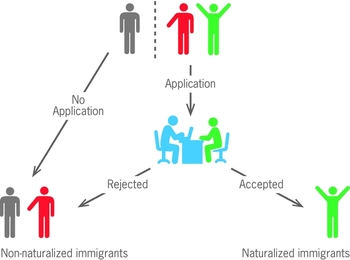
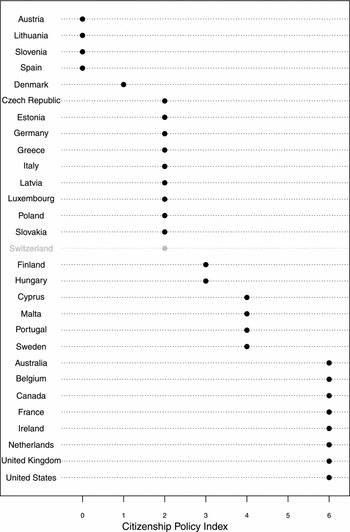
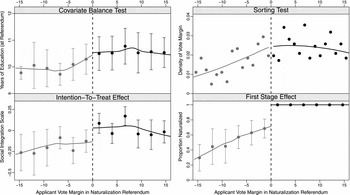
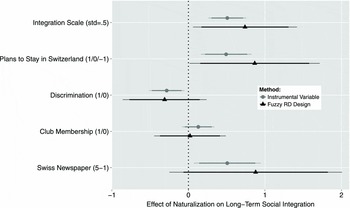
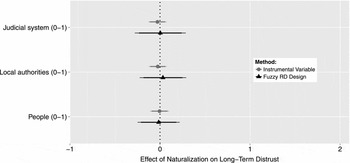
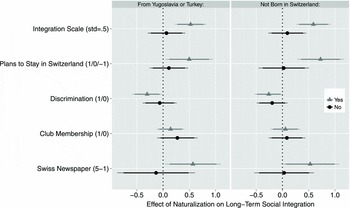
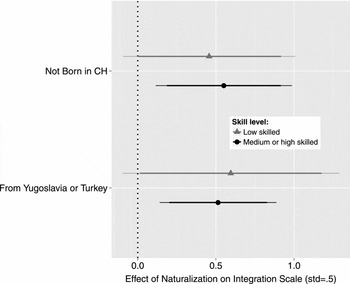
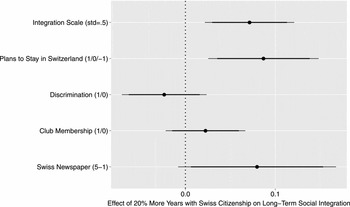




Comments
No Comments have been published for this article.