Introduction
Members of the genus Lymnaea are hermaphrodite pulmonate gastropods with dextrally coiled shells lacking operculi. The genus has a cosmopolitan distribution and approximately 40 species are known worldwide (Hubendick, 1978). These snails are the intermediate hosts of Fasciola hepatica and play an important role in the epidemiology of fascioliasis. Various studies have reported that geographical variation influences the susceptibility of Lymnaea spp. to infection by F. hepatica; that is, in the development of the life cycle stages of this parasite in the snail (Dacal et al., Reference Dacal, Costa and Leite1988; Gasnier et al., Reference Gasnier, Rondelaud, Abrous, Carreras, Boulard, Diez-Banoz and Cabaret2000; Goumghar et al., Reference Goumghar, Dreyfuss, Rondelaud, Benlemlih and Cabaret2001) or snail survivorship (Vignoles et al., Reference Vignoles, Favennec, Dreyfuss and Rondelaud2001).
Brazil has an area of 8,514,877 km2 and is divided into eight regions and 26 states with a variety of different climates and topographies. Bovine fascioliasis is caused by F. hepatica, as the presence of F. gigantica has not yet been reported in the country. It occurs principally in the southern, south-eastern and midwestern regions of the country (Coelho & Lima, Reference Coelho and Lima2003; Faria et al., Reference Faria, Cury and Lima2005). The geographical distribution of the three known lymnaeid snails (L. columella, L. viatrix and L. cubensis) is wide, the first of these species being the intermediate host of F. hepatica in southern and south-eastern Brazil (Paraense, Reference Paraense1982a, Reference Paraenseb, Reference Paraense1983, Reference Paraense1986; Amato et al., Reference Amato, De Rezende, Gomes and Da Serra Freire1986; Coelho & Lima, Reference Coelho and Lima2003; Mas-Coma et al., Reference Mas-Coma, Bargues and Valero2005; Cardoso et al., Reference Cardoso, Caldeira, Lovato, Coelho, Berne, Müller and Carvalho2006). The south-eastern state of Minas Gerais is one of the principal cattle-raising states of the country, with nearly 20 million head of cattle distributed within an area of 586,000 km2. Only isolated cases of fascioliasis have been reported from this state, with the municipality of Itajubá having the highest prevalence (Coelho & Lima, Reference Coelho and Lima2003; Faria et al., Reference Faria, Cury and Lima2005).
The dispersal of fascioliasis to other areas is influenced by the transport of infected animals and depends on the populations of Lymnaea present in these localities. The geographical race to which parasites and hosts belong may influence the result of infections. Associations may be sympatric if the hosts and parasites are from the same area, or allopatric if they involve parasites and hosts from different localities (Goumghar et al., Reference Goumghar, Dreyfuss, Rondelaud, Benlemlih and Cabaret2001). The influence of sympatric and allopatric host–parasite associations has been investigated in other countries (Gasnier et al., Reference Gasnier, Rondelaud, Abrous, Carreras, Boulard, Diez-Banoz and Cabaret2000; Goumghar et al., Reference Goumghar, Dreyfuss, Rondelaud, Benlemlih and Cabaret2001) but there have been no studies investigating this effect in snail populations from distinct regions of Brazil. The objective of this study was to compare the susceptibility of L. columella from the southern and south-eastern regions of the country to infection with F. hepatica in sympatric and allopatric host–parasite relationships. This was the first attempt to test the influence of sympatry in the infections of snails and flukes from Brazil.
Methods
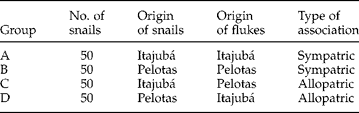
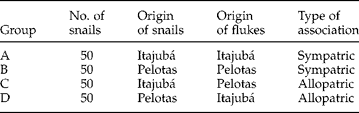
Specimens of L. columella from the municipalities of Pelotas, in the southern state of Rio Grande do Sul, and Itajubá, in the south-eastern state of Minas Gerais, both of them in Brazil, were reared separately in the laboratory in aquaria containing 1 litre of dechlorinated water, at 20°C. The snails were fed on lettuce and the water of the containers was changed weekly. The efficiencies of sympatric and allopatric associations were compared based on experimental infections with four groups (A, B, C and D) of 50 snails each. Groups A and B consisted of L. columella from Itajubá and Pelotas respectively, each infected with F. hepatica from the same locality (sympatric associations). Snails of groups C were from Itajubá and were infected with F. hepatica from Pelotas, while in those of group D the origins of snails and parasites were reversed (allopatric associations). Details of these associations are summarized in table 1.
Associations of groups of Lymnaea columella and Fasciola hepatica used in the present study.
Eggs of F. hepatica were obtained from faeces of naturally infected cattle in the same areas as snails were collected. Cattle faeces were diluted in water and strained through four nested sieves (Faria et al., Reference Faria, Cury and Lima2005). The strained material was then placed in a sedimentation vessel and washed seven times at 20-minute intervals, the supernatant being removed with a pipette and the remaining sediment deposited in Petri dishes. Eggs of F. hepatica were removed with a Pasteur pipette and transferred to other Petri dishes containing dechlorinated water to be incubated at 28°C.
After 14 days' incubation, the Petri dishes with eggs were placed 50 cm under a light source (60 W lamp) for up to 4 h to stimulate eclosion of the miracidia. These were detected under the 10 × objective of a stereomicroscope and collected using a Pasteur pipette.
Each snail was placed in a small 20 ml glass tube containing 10 ml dechlorinated water, to which was added four miracidia obtained as described above. The neck of each tube was stoppered with gauze and tape and the snails maintained in these sealed containers for 24 h before being transferred to a 1.5 litre plastic tank containing dechlorinated water and reared on a diet of lettuce leaves.
After 49 days, each snail was squashed by pressing the shell against a Petri dish with a glass rod. The internal organs were examined under the 20 × objective of a stereomicroscope to confirm the presence of F. hepatica life cycle stages. These were identified, based on their morphological characteristics, and counted.
Results
The results of experimental infections involving sympatric and allopatric host–parasite relationships are presented in table 2, and the logistic regression results are summarized in table 3.
Results of infections involving sympatric or allopatric associations between snails (Lymnaea columella) and liver flukes (Fasciola hepatica) from Itajubá and Pelotas, Brazil.

Logistic regression results for the comparison between allopatric combinations of L. columella from Itajubá with F. hepatica from Pelotas (reference combination) and the other combinations.

Sympatric associations between parasite and host were more efficient than allopatric ones when snails from Itajubá were used, but the opposite was observed in infections involving snails from Pelotas. All the associations presented P values close to 0.016, except the allopatric one between snails from Itajubá and F. hepatica from Pelotas (P = 0.032). Thus, the probability of succesful infection in a sympatric association between L. columella and F. hepatica from Itajubá was significantly higher than in the other combinations.
The infection rate of snails from Pelotas infected with flukes from the same locality was significantly lower than that for all other combinations. The rates for the two allopatric associations were not significantly different between each other. Chi-squared analysis did not reveal significant differences in mortality between any of the groups tested.
Discussion
In this study, different results were obtained when the host and parasites used originated in different regions. Thus, conclusions regarding the influence of sympatry on the efficiency of infections should be analysed with precaution, since results may vary depending on the areas from which parasites and hosts originated. Gasnier et al. (Reference Gasnier, Rondelaud, Abrous, Carreras, Boulard, Diez-Banoz and Cabaret2000) and Goumghar et al. (Reference Goumghar, Dreyfuss, Rondelaud, Benlemlih and Cabaret2001) carried out experimental infections of L. truncatula from different regions of France with F. hepatica, and observed that allopatric associations were more likely to be successful than sympatric ones.
The susceptibility of different species and geographic races of lymnaeid snails to F. hepatica infection is being investigated by many researchers. In Australia, the native species Lymnaea tomentosa was shown to be a more efficient intermediate host than the exotic species L. viridis, L. auricularia rubiginosa and L. peregra (Boray, Reference Boray1978). Vignoles et al. (Reference Vignoles, Favennec, Dreyfuss and Rondelaud2001) compared the susceptibility of L. truncatula from highland and lowland areas in France and found no differences in the outcome of the infection, but infected snails from the highlands survived significantly longer. In Brazil, the presence of L. columella has been reported in many locations (Paraense, Reference Paraense1982a, Reference Paraenseb, Reference Paraense1983, Reference Paraense1986), and it has been shown that the susceptibility of snails from different regions may vary (Dacal et al., Reference Dacal, Costa and Leite1988). Cardoso et al. (Reference Cardoso, Caldeira, Lovato, Coelho, Berne, Müller and Carvalho2006) demonstrated that L. columella populations from different regions of Brazil show significant genetic variability, which might influence the outcome of infections with F. hepatica. Nevertheless, little is known about the susceptibility of snails from most regions where they are present. Moreover, there is a lack of data about F. hepatica genetic variability among different regions of the country. In Cuba, a resistant strain of L. columella presented genetic and phenotypic differences from the susceptible ones, and it was shown that non-susceptibility resulted from resistance rather than physiological unsuitability (Gutiérrez et al., Reference Gutiérrez, Pointier, Yong, Sánchez and Théron2003a, Reference Gutiérrez, Pointier, Fraga, Jobet, Modat, Pérez, Yong, Sanchez, Loker and Théronb).
According to Gasnier et al. (Reference Gasnier, Rondelaud, Abrous, Carreras, Boulard, Diez-Banoz and Cabaret2000), parasites are able to undergo host-dependent life cycle changes, due their brief life spans, short generation times and high fecundity. These changes may be reflected in the interactions between populations of parasites and hosts that coexist in the same area for many generations, although it is still unclear whether sympatry most favours the hosts or parasites with respect to the result of the infection. However, Gasnier et al. (Reference Gasnier, Rondelaud, Abrous, Carreras, Boulard, Diez-Banoz and Cabaret2000) recommended that movement of herds infected with F. hepatica to other localities should be carefully monitored, since it could result in the introduction of more efficient parasites. In the present study, we demonstrated that the host–parasite relationship between L. columnella and F. hepatica may vary according to the geographical origin of the snails and flukes involved, a finding that should be studied in more detail.