Background
Over 850,000 people are currently living with dementia in the United Kingdom (UK) (Knapp and Privette, Reference Knapp and Privette2007). Two-thirds of National Health Service (NHS) beds are used by people over the age of 65 years and dementia affects 42% of people over the age of 65 years with unplanned medical admission (Bourne, Reference Bourne2007; Sampson et al., Reference Sampson, Blanchard, Jones, Tookman and King2009). Every year, a quarter of people with dementia will have one acute hospital admission (Young et al., Reference Young, Hood, Woolley, Gandesha and Souza2011). Dementia significantly increases the length of hospital stay (Mukadam and Sampson, Reference Mukadam and Sampson2010), complications, and the risk of iatrogenic harm (Watkin et al., Reference Watkin, Blanchard, Tookman and Sampson2012).
Numerous concerns have been raised regarding the quality of care received by people with dementia in acute hospitals (Royal College of Psychiatrists, 2005; Alzheimer's Society, 2009). The National Audit of Dementia Care in General Hospitals (2011) found that two-thirds of staff (across all job roles) felt they had insufficient skills in caring for people with dementia (Young et al., Reference Young, Hood, Woolley, Gandesha and Souza2011) and this finding has been replicated in other studies of hospital staff (Griffiths et al., Reference Griffiths, Knight, Harwood and Gladman2014).
In 2013, to support the delivery of improved care, the UK Department of Health defined a Commissioning for QUality and INnovation (CQUIN) target for acute hospitals that included having a named clinician (dementia lead) in each hospital and that healthcare providers submit a planned training program. In the UK, dementia training for health and social care staff can range from the principles of basic dementia “awareness” to more complex specialist curricula. “Tier 1” dementia training is defined as
Dementia Awareness (essential information) highlights the basic, essential competencies relevant to all sections of workforce and society. This could also form part of mandatory induction training for all health and social care staff.
Subsequently, the UK Government issued a mandate to Health Education England, to train 100,000 UK health and social care staff in “Tier 1” dementia awareness. Across North London, this resulted in the requirement to train approximately 12,000 healthcare staff. In this paper, we describe the development and evaluation of this training program at the point when the first 2,000 healthcare staff had been trained.
Our aim was to evaluate the impact of a system-wide training program in dementia care for acute hospital staff. Specific objectives were:
-
1. to assess the numbers and types of staff trained;
-
2. to examine changes in dementia care practice in trusts before and after training through the use of (a) pathways and tools and (b) PIE (Person, Interaction, and Environment) observations; and
-
3. to measure before training and three months after, staffs’ sense of competency in dementia care
Methods
Setting
This project was set within UCLPartners (UCLP), an academic health science partnership with over 40 higher education and NHS members covering a population of over six million people in north east and north central London, south and west Hertfordshire, south Bedfordshire, and south west and mid Essex. The central team provides operational support and member organizations work on quality improvement (QI) in healthcare by enhancing already existing systems.
Development of the training program
The dementia QI program was part of the UCLP Mental Health & Wellbeing Strategy and sought to formulate a pragmatic and systematic “community of practice” approach – “groups of people who share a concern or a passion for something they do and learn how to do it better as they interact regularly” (Lave and Wenger, Reference Lave and Wenger1991).
-
1. Establishment of expert working group (January 2011): This comprised clinical experts and representatives from all participating NHS organizations, usually an old age psychiatrist, consultant neurologist, or geriatrician. This group planned the dementia consensus working conference.
-
2. Dementia consensus working conference (June 2011): This established consensus between 90 representatives from NHS organizations, the Royal College of Nursing and charities including Alzheimer's Society, Dementia UK and Jewish Care. Using nominal groups, ideas were noted, discussed, and voted on to produce a shortlist of four key themes for improving dementia care.
-
3. Dementia consensus workshops (September 2011): Senior clinicians from acute, community, and mental health settings met to establish consensus on actions needed to improve care and measure outcomes. Actions identified as key to change were the provision of information and advice, use of delirium care pathways, a system of improved access to relatives in hospital (carer passports), the gathering of information on the patient to improve person-centered care, and dementia training across a wide range of staff roles.
-
4. Development of project actions (January 2012): Working groups met to exchange experiences with participating hospitals and agree on the actions identified above.
-
5. Development of training curriculum (July 2011 to July 2012): A new curriculum of dementia training was developed by a general hospital lead nurse and a dementia training specialist with clinical working groups consisting of 40 clinicians from across London. This consisted of 24 targeted, interactive, and experiential dementia training modules, taking between 30 minutes and an hour to deliver. These included a basic “Tier 1” level training module for all staff using “Barbara's Story” (Guys and St Thomas’ NHS Foundation Trust, 2013). Modules were further developed by project leads and clinicians over eight consultation meetings. Training was standardized to allow participating Trusts to be compared but could be tailored to the specific job role or area(s) of responsibility. This involved classroom teaching, on the ward training, or one-to-one coaching in practice.
-
6. Engaging local senior managers (July 2012): Hospital medical and nursing directors were contacted. Funding was made available for trainer backfill.
-
7. Train-the-trainer program (July–October 2012): Organizations identified key staff to deliver dementia training locally. Workshops were delivered by an experienced dementia trainer, with nominees attending for two full days of coaching before being signed-off as competent.
-
8. Staff training (December 2012–August 2013): Each participating hospital developed a bespoke package. The initial target was to train 2,000 staff across UCLP at a minimum of 1 hour at “Tier 1” level. The community of practice held regular meetings during this period to share and learn from experiences.
Evaluation of the training program
The training program was led through the Research and Development Department at North East London NHS Foundation Trust and independently evaluated. We took a multi-level, mixed methods approach using a change framework (Ferlie and Shortell, Reference Ferlie and Shortell2001). This proposes that successful programs should be targeted at four levels: (1) individual, (2) group/team, (3) organization, and (4) system or environment.
Individual level evaluation
We collected anonymized demographic information on staff participants including age, gender, ethnicity, and role; doctor, nurse, facilities (domestic, housekeeper, porter, and receptionist), and allied health professional (occupational therapist, physiotherapist, physiotherapy assistant, speech, and language therapist). Participants indicated how many years’ experience they had of working with people with dementia and, if relevant, their clinical specialism.
The Sense of Competence in Dementia Care staff questionnaire (SCIDS): This self-completed scale measures the perceived sense of competence in dementia care (Schepers et al., Reference Schepers, Orrell, Shanahan and Spector2012). It comprises 17 items categorized into four subscales: professionalism, building relationships, care challenges, and sustaining personhood each rated as “Not at all” (1 point), “A little bit” (2 points), “Quite a lot” (3 points), and “Very much” (4 points). Scores range between 17 and 68 points, higher scores indicating a greater sense of competency. Internal consistency and test–retest reliability of the full scale and the subscales are acceptable to good and there is evidence of predictive and convergent validity.
SCIDS questionnaires were given to each participant prior to each session. Participants were informed that completion of the questionnaires was voluntary and that all information would be kept confidential. Three months after training, they were sent the questionnaire via email and answered an online version of the SCIDS tool. Participants were sent two further reminder emails at monthly intervals until they replied. If participants’ email addresses were no longer valid, we attempted to contact them with letters via the dementia lead at each hospital.
Group/team (ward) level evaluation
Wards were assessed using the Person, Interactions, and Environment (PIE) qualitative tool as used in the UK National Audit on Acute Hospital Dementia Care (Young et al., Reference Young, Hood, Woolley, Gandesha and Souza2011). PIE is a practice development tool that describes the culture of care experienced by people with dementia or confusion, in general hospital wards and helps the ward team reflect on and develop their approach to this.
Following training, a member of staff from the project team, paired with the dementia lead for the hospital, conducted observations over at least two key times of the day in 2-hour time periods (4 hours in total), one in the morning and one during a mealtime. In total, observers spent a complete 8 hour shift in each ward. This allowed introductions to the ward team, observational data collection, reflection on the findings between observers, and brief feedback to the ward team. We observed the same care of the elderly ward at each participating trust twice – September 2012 prior to when the project started and in December 2013 at the end of the evaluation period.
Observations occurred in three domains.
-
1. Person: whether staff are using what is known, or not known, about the individual patient as a person to personalize their care; observing what the patient is doing and how they are affected.
-
2. Interactions: a person-centered care culture is particularly evident in the context of relationships, or, through day-to-day interactions with staff.
-
3. Environment: the modifiable ward environment and its impact on people receiving care.
The dementia lead or nurse in charge identified rooms or bays in the wards where people with dementia were cared for. Thus, no specific patients were selected but the staff and the patients in the room were observed as a whole. This is a QI tool and we did not obtain individual written consent or agreement from patients, visitors, or staff. However, they were informed beforehand and given the opportunity to have any questions or concerns addressed. On entering the room or bay, observers introduced themselves to all patients, staff, and visitors and explained what they were doing. They gained the agreement of those being observed and this process was ongoing. Observations were stopped if the patient or their visitors requested or if patients showed signs of being uncomfortable with the observations. Observers aimed to be as unobtrusive as possible and respected patient privacy, i.e. withdrawing during personal care. Following reflection, feedback, and discussion with the ward team, two one-page summary reports were completed (areas of achievement and areas for action). These were given to the ward and the trust dementia lead.
Organization (hospital trust) level evaluation
Data at hospital trust level were collected using a questionnaire (pre- and post-training), completed by the local dementia lead, on: information and advice available to patients with dementia and their carers; use of “This Is Me” (a document that helps staff to get to know their patients and personalize care), information leaflets for people with dementia and their carers “carer passport” (allows carers to visit outside of normal visiting hours), non-drug treatment approaches, memory boxes, color-coded doors or good signage, brightly colored eating and drinking utensils, delirium screening scales, and implementation of a delirium pathway. For each item, participants selected their response from a “Yes” or “No” category.
System level evaluation
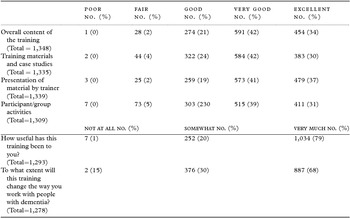
We collected data on how many individuals completed the train-the-trainer course and the number that delivered training sessions, a total number of training sessions delivered across UCLP, the total number of pre-training questionnaires distributed by trainers and the total returned. After the first training session, participants were asked to indicate their opinion of the training: (1) the overall content, (2) the quality of the training materials, (3) the presentation of material by the trainer, and (4) the usefulness of the training (all questions answered as “poor,” “fair,” “good,” “very good,” and “excellent”). Finally they rated “to what extent will this training change the way you work with patients with dementia” (rated as “not at all,” “somewhat,” and “very much”).
Data analysis
Quantitative data
After the follow-up questionnaires were returned they were linked to the data from the pre-training questionnaire with an anonymized code and all personal information was permanently removed from the database. The database was cleaned and transferred to the statistical package Stata version 12 (StaCorp Ltd, 2011) for analysis. We calculated return rates from survey forms completed after the training session and the three month follow-up. Changes in competency, using the SCIDS scale, were estimated using the paired t-test. The primary analysis was based on observed outcome values (complete case). A similar model was fitted for the four subgroups of the SCIDS scale: professionalism, building relationships, care challenges, and sustaining personhood.
In order to explore heterogeneity of the intervention effect, we tested for a difference in treatment effect in subgroups by trust in which the participant works. Intervention effect estimates by subgroup are displayed graphically using a forest plot. The number of missing observations is reported. We used descriptive comparisons and χ 2 tests to see if those who completed the follow up questionnaire were different compared to those who only completed the baseline questionnaire. We performed sensitivity analysis for the missing questionnaire data using mean imputation. If participants were missing over 50% of the questionnaire, we did not impute the missing values.
PIE observational data
Written PIE observations were transcribed verbatim and entered onto the qualitative software programme NVivo for coding and management of the data. The researcher read through each observation to gain familiarization with the dataset. Data from each PIE observation were broken down into units (each individual comment or observation noted). We used a coding frame developed by the Royal College of Psychiatrists National Audit on Acute Hospital Dementia Care (Young et al., Reference Young, Hood, Woolley, Gandesha and Souza2011) – a thematic content analysis approach (Miles and Huberman, Reference Miles and Huberman1994). Each observation (unit) identified was assigned to a key theme and subtheme.
-
1. Interaction: subthemes-frequency, initiation, consistency of approach across staff, inclusivity of the person with dementia, responding to patient cues.
-
2. Connecting in a meaningful way: subthemes-knowing the patient as a person, helping the person to participate in care.
-
3. Environment: subthemes-orientation and support (including mobility, hearing, toilet and bathing, privacy and dignity, allowing to walk around and flooring).
Coding was initially completed by one researcher (NM) and then independently checked by a second coder (ELS). Discrepancies in coding were resolved through discussion.
Ethics and governance
This evaluation of a large training program was jointly commissioned by UCLP and their participating hospitals and no person identifiable data were used. Thus, we did not require ethics committee permission. We did however seek ongoing consent from trust dementia leads for their approval to work in the participating trusts.
Results
Individual level data
Characteristics of training participants
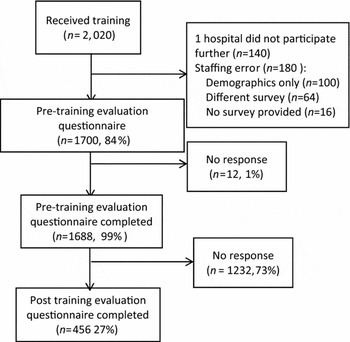
Of the 2020 pre-training questionnaires, 1,700 (84%) were returned giving demographic information on the participants (see Figure 1).
Flow chart of participants in a system wide dementia training program.

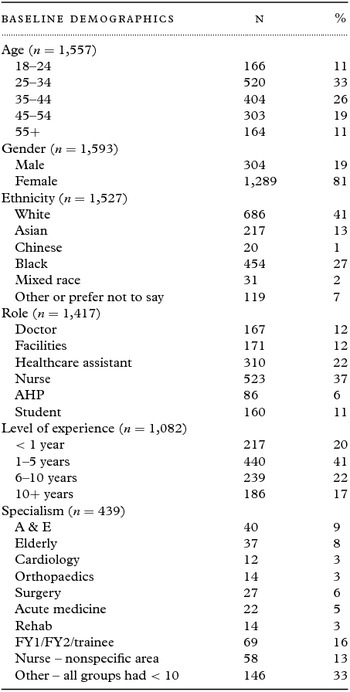
Most participants were female (81%), described themselves as white (41%) and aged between 25 and 54 years (see Table 2). Nurses were the largest group receiving training (37%), followed by healthcare assistants (22%), doctors (12%), and then facilities staff (12%). The majority of participants (41%) had between one and five years of experience in working with people with dementia in their day-to-day role.
Sense of Competence in Dementia Care (SCID) scale
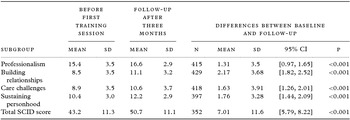
The pre-training SCID questionnaire was completed by 1,688 staff. The mean total score was 43.2 (SD 11.3). Respondents scored themselves most highly on “professionalism” (mean 15.4, SD 3.5) and “sustaining personhood” (mean 10.4, SD 3.0). The SCID questionnaire was completed at three month follow-up by 456 staff (27% of the sample who answered the pre-training questionnaire). There were 353 linked before and after training questionnaires included in the analysis. Using complete case analysis, competency scores on the SCIDS increased significantly between pre-training and three month follow-up, by 7.01 points (p < 0.001). There was a significant improvement from pre-training to three month follow-up on each of the four subscales: the largest on the “building relationships” subscale with an increase of 2.17 (95% CI: 1.82, 2.52); on the “sustaining personhood” subscale, there was an increase of 1.76 (95% CI: 1.44, 2.09); on the “care challenges” subscale, there was an increase of 1.63 (95% CI: 1.26, 2.01); and the smallest increase was seen on the “professionalism” subscale with an increase of 1.31 (95% CI: 0.97, 1.65). Results were almost unchanged on sensitivity analyses using mean imputation with a significant increase of 6.92 points in overall sense of competency (95% CI: 5.86, 7.97, p < 0.001) (see Table 2). There were no significant differences in terms of gender, ethnicity, or staff role between those who did or did not return the three month questionnaire.
Group/team level evaluation
PIE observations
A total number of eight wards were observed at the seven hospitals (in one, two wards were observed) at the beginning of the training program in July 2012 and just prior to the end of this evaluation in March 2014, a total of 18 individual observation periods. Wards were identified by the dementia lead at each participating hospital with a focus on the care of the elderly wards (N = 5).
Initiation of interaction
Before training, we noted that “patients were not getting any attention from staff, even though their room was next door to the nurses’ station” and that there seemed to be particular issues with ancillary and paramedical staff; “transport staff did not introduce themselves,” and “pharmacist and cleaners go in and out of rooms without saying anything.” After training, it was noted that across staff groups, confidence in initiating interaction had improved: “nurse started a brief and friendly conversation,” “many positive examples were observed,” and “cleaner and housekeeper were excellent at initiating conversations.”
Consistency of approach
This was broadly person centered both before and after the training in most observations but non-person-centered interactions reduced and person-centered interactions increased. Staff engaged with patients particularly during care and clinical tasks, such as when nurses washed patients, doctors were examining patients, “kind and caring interaction between doctor and patient started, and doctor touched patient's hand while talking to her” or during physiotherapy. Ancillary staff used their daily work to engage consistently with patients, “the housekeeper who delivered the food said hello to each patient.” Before training there was “less reassurance and interaction with patients with cognitive impairment,” “when person with shop trolley items comes by, he does not go into the patient's room.” After training, we found it was more common for all patients to be treated equally, “nurse engaged with all patients in the room.”
Non-verbal cues
Before training, there were more examples of ignoring and not acting upon verbal cues: “patient was sitting on a chair, with his gown half off his body, and healthcare assistant did not address this for 1 hour,” “lack of positive non-verbal communication such as smiles and eye contact was observed,” and “patient clearly said ‘I have niggling pain’ and was ignored by two staff nurses standing next to her.” After training, there was better use of non-verbal cues; “when patient was looking for her box of tissues, nurse helped her look for it, healthcare assistant kept her calm,” “. . .friendly, even when patient displayed challenging behavior,” “smiled and made eye contact.”
Connecting in a meaningful way
Before training approaches such as “This Is Me” were used less consistently and patients were not facilitated in using them: “No help in completing the “this is me” form,” “calling patient ‘darling’, not knowing his name.” We found difficulties with person-centered care, “they started spooning food into patients’ mouth without explaining,” and again, ancillary staff were noted to find this more challenging, “ambulance staff got into an argument with patient who was verbally aggressive, ambulance man responded ‘if you talk to me like this I won't take you home’.”
After training, there was more consideration of individual needs “nurse offered to wash patient, asked his preferences” but errors were still noted “dementia identification scheme was not consistently used,” “sign above bed was named wrong.” In general, however, the number of person-centered interactions and the quality and quantity of explanation given to patients increased after training, “nurse was assisting patient with meal, asked whether he would like salt or pepper, and gently encouraged him to drink water,” “nurse explained what she was doing,” “nurse explained what would happen when the patient went home, checked they understood, and asked if they needed anything else at home that would help them when discharged home.” But some issues remained around helping patients engage with managing their own health and care, “no chats, no discussion with patient about their health.”
Environment
Both before and after training, the general environment was highly variable with many noted to be “bright and airy,” “atmosphere calm and relaxed,” “spacious, clean, and tidy,” whereas other were noted to be “cramped and cluttered,” with “little space.” Most patients were noted to have their table and belongings within reach.
Staffing levels did not change with observers noting “lack of staff,” “the room sometimes had no staff in it.” Noise levels were not noticed to have changed over the period of the training program with frequent comments on ward alarms, blood pressure machines “frequent beeping sounds,” “loud beeping constantly,” “people always talking on the phone,” and “phones ringing loudly.” The training seemed to make little change in the level of activity offered on wards noting that there were “no activities for patients, no newspapers, magazines, TV, or radio,” “patient just sat in her chair most of the time, looked bored,” “for long periods nothing happened” and this did not improve. Neither the use of aids to assist with eating and drinking, such as colored cups and jugs or specialist cutlery, changed nor the signage or labels around the ward, for example, picture symbols for showers and toilets.
Organization (hospital or trust) level evaluation
Evaluation questionnaire
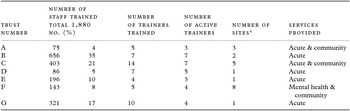
An evaluation questionnaire was sent to dementia leads at the seven participating hospital trusts that act as management organizations for 21 individual hospital sites (for description of these see Table 3). Five hospital trusts (71%) replied. Improvements included the provision of carer information leaflets on dementia (40% before training and 80% after) and leaflets for people with dementia (improved from 80% to 100%), the gathering of personal information through the use of “This Is Me” documentation (improved from 40% to 80%), environmental changes such as better signage (improved from 40% to 80%), the use of tailored eating and drinking utensils (improved from 30 to 50%), and carers passports (improved from 40% to 80%). Routine delirium screening and the use of a delirium care pathways increased from 30 to 60%. The use of memory or rummage boxes did not change, remaining at 20% before and after the project.
Competency scores on the SCIDS improved in all hospitals. The greatest improvement was seen at hospital C where there was an increase of 11 points (95% CI of mean difference 7.9, 13.6) on the SCIDS scale, the smallest improvement of two points was seen at hospital A (95% CI of mean difference –7.3,11.3) (for Forest plot see supplementary Figure 1 at www.journals.cambridge.org/jid_IPG).
System level evaluation
Eight NHS hospital trusts (organizations) comprising 13 hospitals participated in the training program. One chose not to participate in the evaluation, leaving seven participating trusts. Train-the-trainers courses were completed by 52 staff and 33 of these (63%) became active trainers (Table 1). A total number of 2,020 dementia training sessions were delivered to individual staff and 1,700 questionnaires were distributed (see Figure 1). Overall the training content, materials, presentation, and activities were rated as good to excellent by over 80% of participants. The training was rated as being “very” useful by 79%, and 68% thought it was “very” likely to change the way they worked with people with dementia (Table 4).
Characteristics of participants in the system wide dementia training program

Change in Sense of Competency in Dementia scale (SCIDS) sub-scale and total scores before the first training session and after three months of a system wide dementia training program

Characteristics of participating hospital trusts in a system wide dementia training program

aData from July 2014 – some trusts have merged since this date.
Staff evaluation of the dementia training sessions

Discussion
The development of a community of practice and use of a train-the-trainer program across a single academic health and science network facilitated the training of over 2,000 staff hospital and community healthcare staff to at least “Tier 1” level and improved a range of dementia care indicators. Staff rated the training highly and there was a highly significant seven-point increase in staff sense of competency in dementia care across the network with increases in individual hospitals. Dementia leads also noted increased provision of carer information leaflets and personal information schemes. PIE observations suggested that the quality and quantity of person-focused interactions improved, as did inclusivity of people with cognitive impairment and dementia. In particular, and perhaps reflecting findings from the SCID questionnaire, which showed greatest improvement in the “building relationships” subscale, staff appeared more confident at being sensitive and responding to non-verbal cues in people with dementia, knowing patients better as individual people and explaining processes and healthcare procedures to help involve them in their care. Possible drivers of these changes include the experiential nature of our training particularly the use of the emotionally powerful “Barbara's Story” and the way that modules were developed “bottom-up” with dementia leaders at local hospitals. The ward environments changed the least when comparing observations before and after the training period and this may be because this is an area over which individual staff have little control.
Despite a dramatic increase in the amount of dementia training delivered to hospital staff, there is little literature on the success of these program and particularly their impact over time. Reports from a similar initiative suggest that the train-the-trainer model is effective (Elvish et al., Reference Elvish2014) and a published evaluation of this model involving training 607 acute hospital staff showed significant improvements on the Confidence in Dementia Scale and a Knowledge In Dementia scale (Elvish et al., Reference Elvish2016) before and immediately after training. Our paper demonstrates effectiveness over a much larger health economy with improved sense of competency in dementia care maintained at three months post-training. Another study of a person-centered training program involving 40 acute hospital staff (mainly nurses) demonstrated an improvement in attitudes toward and satisfaction in caring for people with dementia after basic training in person-centered care but that more in-depth training was required to have an impact on staff feelings of caring efficacy (Surr et al., Reference Surr, Smith, Crossland and Robins2016); however, the mechanisms underlying these changes and how best to promote them, in practice, remain unclear.
Encouragingly nearly two-thirds of those who attended the train-the-trainers course became “active trainers.” Advantages of this approach include low cost and local trainers’ better understanding of the internal nuances and culture of their organizations. Importantly, informal networks exist between staff within organizations and these working relationships can be a powerful tool when promoting training attendance.
Strengths and limitations
Our evaluation has a number of strengths including mixed methods to examine the training program at a number of levels, for example, across the system and at multiple hospital sites. We used a validated tool (Schepers et al., Reference Schepers, Orrell, Shanahan and Spector2012) on perceived sense of competence in dementia and direct observations on wards. Gaining feedback was built into the teaching process, with trainers being supplied with questionnaires to give before training, and used a quick centralized process to receive and collect data from these. Limitations include the pre- and post-methodology and low response rate to the follow-up questionnaire that highlights the difficulties of contacting hospital staff by email. Many staff did not regularly access their email accounts and at the time of the evaluation there was the implementation of the nationally rolled out “NHS.net” scheme; many individuals changed their email addresses and were not contactable. Other studies in similar settings have experienced difficulties with post-training follow-up (Galvin et al., Reference Galvin, Kuntemeier, Al-Hammadi, Germino, Murphy-White and Mcgillick2010). When local dementia leads hand delivered the follow-up questionnaires to staff they found considerable staff turnover. The method of PIE observations has been used extensively in the national dementia audit but interpretation of these findings is subjective and may not be as robust as other methods such as Dementia Care Mapping (Kitwood and Bredin, Reference Kitwood and Bredin1992). However, we believe that that they provided useful contextual data with which to triangulate findings. It is more challenging to measure direct benefits to patient care. Although dementia leads reported increased provision of use of “This Is Me” documentation and information leaflets, we do not know how frequently these were actually used in practice. Further work should explore the impact of training on other important factors such as length of acute hospital stay or decreasing adverse events for people with dementia. This could be challenging at the system level as coding of dementia in Hospital Episode Statistics is often suboptimal (Alzheimer's Society, 2009), and external factors may increase hospital stay, for example, the availability of care packages or care home places after hospital discharge.
Conclusions
There is robust evidence that acute hospital staff from all disciplines require more training in caring for confused older people, including those with dementia (Griffiths et al., Reference Griffiths, Knight, Harwood and Gladman2014). Our train-the-trainer model based within a community of practice could be replicated and implemented elsewhere across the healthcare sector. To date, (Summer 2016), over the last three years, the UCLP dementia program has trained over 12,480 staff in health and social care across the academic health and science network. Future challenges include ensuring staff receive more specialized “Tier 2” training and how to maintain momentum, although there are considerable financial and staffing pressures on healthcare services.
Conflict of interest
None.
Description of authors’ roles
ELS and MO designed the study, SL oversaw the data collection and contributed to study design and analysis. VV designed and completed the data analysis. ES, MO, SL and VV assisted with the drafting and approval of the final publication.
Acknowledgments
We would like to thank Dr Nita Gorasia and Mr G Smith for their help in collecting data for the evaluation. This project was funded by North East London Foundation Trust.
Supplementary material
To view supplementary material for this paper, please visit https://doi.org/10.1017/S1041610216002222.