High morbidity and mortality has resulted from coronavirus disease-2019 (COVID-19), caused by severe acute respiratory syndrome coronavirus-2 (SARS-CoV-2). Although SARS-CoV-2 likely spreads primarily via airborne transmission, Reference Greenhalgh, Jimenez, Prather, Tufekci, Fisman and Schooley1 layered mitigation still includes high-touch surface disinfection. Our research and that of others indicates that airborne particles can travel several meters and land on (i.e., contaminate) surfaces. Reference Eilts, Li, Pope and Hogan2,Reference Lednicky, Lauzardo and Fan3 Environmental hazard elimination and removal most effectively limits individual exposure. 4 As viable SARS-CoV-2 persists on plastic and stainless steel for >72 hours, Reference van Doremalen, Bushmaker and Morris5 disinfecting high-touch surfaces is important, particularly because it is difficult to control how often individuals touch their mouths, noses, and eyes after touching potentially virus-contaminated surfaces (fomites).
Viral shedding of replication-competent SARS-CoV-2 can occur for several days after COVID-19 onset, Reference Correa, Leal and Boas6 and replication can occur when the virus is contracted by susceptible individual(s). Replication-competent SARS-CoV-2 strain use in surface disinfection research can help discern disinfectant efficacy at eliminating virus presence and viability when following manufacturer recommendations. We examined the presence, viability, and subsequent replication of replication-competent SARS-CoV-2 after disinfection with two disinfectants on three surface types.
Methods
Biosafety
Experiments were performed in a biosafety level-3 facility at Mayo Clinic (Rochester, MN), following approval and protocols from the Mayo Clinic Institutional Biosafety Committee.
Cells and viruses
VeroE6 cells (ATCC, CRL-1586) were maintained in Dulbecco’s Modified Eagle Medium (DMEM) supplemented with L-glutamine and sodium pyruvate (Thermo-Fisher Scientific, Waltham, MA) supplied with heat-inactivated fetal bovine serum (FBS; Thermo-Fisher Scientific) and penicillin-streptomycin (MilliporeSigma, Burlington, MA). Infectious SARS-CoV-2 (human/USA/USA-WA1/2020 MN985325.1) was provided by the World Reference Center for Emerging Viruses and Arboviruses at the University of Texas Medical Branch (Galveston, TX). Virus stock was propagated on Vero E6 cells. Virus infectivity was titred by the 50% tissue culture infectivity dose (TCID50) assay using Vero E6 cells.
Disinfectants
We tested two wipe disinfectants. First, we tested Super Sani-Cloth Germicidal Disposable wipes, composed of two quaternary ammonium compounds (each 0.25% by weight) and isopropyl alcohol (55.5% by weight). The manufacturer’s recommendations state that a 2-minute contact time is required. This disinfectant is used at the Mayo Clinic. We also tested Oxivir Tb wipes, which are hydrogen peroxide-based (>0.1% to <1% by weight) and benzyl alcohol-based (1%–5% by weight). They are used in industry due to their eco-friendliness. The manufacturer’s recommendations state that a 1-minute contact time is requried. Although both disinfectants are now on the EPA List N, investigating disinfectant efficacy against SARS-CoV-2 in a simulated real-world manner is important.
Surfaces and recovery experiments
We placed SARS-CoV-2 on three prevalent public surfaces: (1) stainless steel (Alloy 304, T-300 Series; Penn Stainless Products, Quakertown, PA), (2) laminate wood (Mannington Laminate Wood; High Point, NC), and (3) porcelain (RENSTRAGRIS1224 Porcelain; Renaissance Tile & Bath, Chicago, IL). Each tested surface was 5 cm × 5 cm. We completed pilot testing to ensure adequate virus recovery. We seeded VeroE6 cells in 96-well plates at 2×10⁴ cells per well the day before recovery testing. We inoculated 100 µL of SARS-CoV-2 at titer of 8.89×10⁷ TCID50/mL onto 9 autoclaved surfaces (3 per surface type) and incubated them for 2 minutes at room temperature—mimicking maximum incubation time after disinfectant application. Surfaces did not become dry after this 2-minute period. Sterile swabs were used to swab the 3 surfaces and were placed into 1 mL Dulbecco’s PBS (DPBS) and spun in a vortexer 3 times for 5 seconds each. We then made 10-fold serial dilutions up to 10−8 dilution of the recovered virus in serum-free DMEM, with 20 µL virus placed into 180 µL media. Following serial dilutions, we removed growth media from the wells via pipetting and inoculated 20 µL virus into the wells using undiluted virus through the 10−8 dilution. Plates incubated for 1 hour at 37°C and 5.0% carbon dioxide, and the plates were rocked every 10–15 minutes. We then added 100 µL of 2% FBS DMEM to the wells and incubated them further at 37°C for 7 days while monitoring for cytopathic effect (CPE) formation. We employed the Spearman and Kärber algorithm Reference Hierholzer, Killington, Mahy and Kangro7 to calculate TCID50/mL based on observed CPE.
Cytotoxicity experiments
We had performed cytotoxicity experiments on both disinfectants previously Reference Pope, Kottke, Shah, Vile and Rizza8 to ensure that any CPE observed was virus-borne and not introduced by the disinfectant. Neither disinfectant contributed to CPE.
Main disinfection experiments
Disinfectant efficacy was examined at a SARS-CoV-2 titer of 8.89×10⁷ TCID50/mL. We autoclaved all surfaces before the experiments. On each of 9 surfaces of a given type, we deposited 100 µL of SARS-CoV-2 (no soil load) as a single droplet <30 minutes after final inoculum preparation. For each surface type, 3 surfaces were swabbed with a sterile swab after 2 minutes without disinfection (controls). We placed these swabs into 1 mL DPBS and spun in a vortexer for 5 seconds each. One Super Sani-Cloth Germicidal Disposable wipe disinfected the next 3 surfaces. We employed 1 folded wipe and made 2 back-and-forth strokes (4 passes) on the inoculated side of the surface. The wipe was properly discarded and the surface air dried during the manufacturer-recommended 2-minute contact time. At 2 minutes, we used sterile swabs to swab these 3 surfaces, placed swabs into 1 mL DPBS, and spun in a vortexer for 5 seconds each. An Oxivir Tb wipe disinfected the final 3 surfaces, using the same wiping methodology outlined above. Surfaces air dried for the manufacturer-recommended 1-minute contact time, and we then used the aforementioned surface swabbing procedures.
SARS-CoV-2 inactivation determination
We seeded 96-well plates with VeroE6 cells at 2×10⁴ the day before infection. We then made 10-fold dilutions up to 10−8 in serum-free DMEM of virus recovered from swabs in 1 mL DPBS, with 20 µL virus into 180 µL media. Following serial dilutions, we removed growth media from the wells via pipetting and inoculated 20 µL virus into the wells using undiluted virus through the 10−8 dilution. Plates incubated for 1 hour at 37°C and 5.0% carbon dioxide, with plates rocked every 10–15 minutes. We then added 100 µL FBS DMEM to the wells and incubated further at 37°C for 7 days while monitoring for CPE. We employed the Spearman and Kärber algorithm Reference Hierholzer, Killington, Mahy and Kangro7 to calculate TCID50/mL based on observed CPE and the Microsoft Excel LOG10 function to calculate log base 10 (log10) reduction in TCID50/mL. When ≥3-log10 reduction in TCID50/mL was observed during all experiments for a surface type, we considered the disinfectant efficacious.
Results
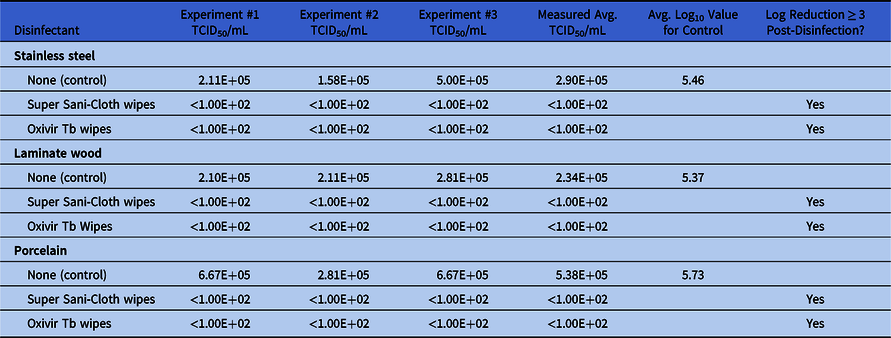
Virus recovery with and without disinfection by surface type is within Table 1. Manufacturer-recommended application of both disinfectants resulted in >3-log10 reductions in viable replication-competent SARS-CoV-2 during all experiments, with all postdisinfection TCID50 values after 7 days <1.00E+02 (lower detection limit for TCID50 infectivity assay) and no CPE observed. Although we cannot say all SARS-CoV-2 was inactivated on each surface given this lower detection limit, any virus still present was likely inactivated.
Disinfection Data for SARS-CoV-2 100 uL Spot on Stainless Steel, Laminate Wood, and Porcelain

Notes. TCID50/mL, 50% cell culture infectious dose; <1.00E+02 is the lower limit of detection for the TCID50 infectivity assay used.
Discussion
Both wipes eliminated the presence of replication-competent SARS-CoV-2, with no CPE observed 7 days after disinfection—indicative of nonviability. The current investigation agrees with other coronavirus disinfection research. Reference Xiling, Yin and Ling9,Reference Meyers, Kass, Goldenberg, Milici, Alam and Robison10 Therefore, although SARS-CoV-2 likely primarily spreads via airborne transmission, Reference Greenhalgh, Jimenez, Prather, Tufekci, Fisman and Schooley1 layered mitigation approaches should consider using these or similar disinfectants to lower incident illness—particularly important for high-touch clinical surfaces.
Our study had several limitations. First, only hard nonporous surfaces were used, limiting the generalizability of our results. Second, a neutralizer was not used and a nonblinded investigator employed our own standardized wiping approach approximating real-world use. Third, a soap-and-water control was not used given concerns about consistent solution formulation and application. Finally, although unmeasured, we acknowledge that absorption of SARS-CoV-2 inoculum into each wipe may have contributed to observations. Notably, our preliminary research used Oxivir Tb spray per manufacturer recommendations. No virus was present or viable after disinfection on any surface, with no replication 72 hours later, Reference Pope, Kottke, Shah, Vile and Rizza8 suggesting the disinfectant’s chemical composition was effective at surface disinfection. Future studies are warranted.
Acknowledgments
The authors thank Mayo Clinic’s COVID-19 Task Force for their assistance and review of the study.
Financial support
This work was supported by Delos Living. However, Delos Living had no input on any part of the study process.
Conflicts of interest
All authors report no conflicts of interest relevant to this article.