INTRODUCTION
Private sector development (PSD) has emerged as a core component of recent donor strategies aimed at making free markets work for ‘the poor’. Institutions such as the Organisation for Economic Co-operation and Development (OECD) (2007: 11), USAID (2008: 3), the UK Department for International Development (DfID) (2008: 23) and the European Commission (EC) (2003: 2) have uniformly articulated the merits of PSD initiatives in support of pro-poor economic growth in developing states. This donor PSD support involves assistance to business competitiveness in low-income countries in areas including product development, technological upgrading, marketing strategies, social and environmental standards, and capacity-building in sector associations. Taken together PSD initiatives have additionally been portrayed by donors as an effective means of aligning trade liberalisation agendas in the World Trade Organisation (WTO), as well as in bilateral trade negotiations, to human development objectives. Improved business sector performance will, according to donor PSD frameworks, enable low-income countries to take advantage of market liberalisation and to achieve poverty reduction through ‘an equitable distribution of the fruits of [private sector] growth’ (ACP–EU CPA [2000] 2006: 6).
PSD agendas cannot be understood, however, as mere technical exercises aimed solely at improving business competitiveness and enhancing the well-being of vulnerable citizens in developing countries. PSD initiatives serve a highly strategic role as ‘norm-laden’ (normative) concessions through which developmentally questionable market-opening has been rationalised by donors in pursuit of lucrative commercial opportunities in emerging economies (Langan Reference Langan2009: 426).Footnote 1 Donor PSD frameworks, moreover, often work to construct public legitimisations of unequal trade systems while failing to materially assist business development. Taking the example of the EU – a leading proponent of PSD strategies – this article examines the symbolic functions of donor PSD commitments within Europe's bilateral trade and ‘development’ co-operation with the African, Caribbean and Pacific (ACP) countries. Assessing Europe's PSD framework in the timeframe of the ACP–EU Cotonou Partnership Agreement (CPA) and the European Commission's vigorous pursuit of market-opening in ACP states under Economic Partnership Agreements (EPAs), the article draws attention to the political weight of PSD normative concessions. Specifically, PSD discourse is understood as a highly effective tool in the ‘development branding’ of EPAs through egalitarian narratives that inoculate the European Commission from critical contestation of its asymmetric trade arrangements with ACP former colonies (ibid.: 426).
Through an overview of Europe's key PSD mechanisms, notably the ACP–EU Centre for the Development of Enterprise (CDE), the article then contrasts the effectiveness of EU PSD frameworks in the establishment of a legitimising ‘pro-poor’ discourse with the failure of Europe's PSD interventions to facilitate meaningful business development in ACP former colonies. In this assessment, the article explores the example of CDE assistance to textiles operations in East Africa as a useful illustration of how Europe's modest PSD funds are directed in such a way as to deny revenues to ACP business sectors that could possibly generate the broad-based social prosperity enshrined in Europe's PSD discourse. The focus on East African textiles also demonstrates how the limited PSD finances that are distributed by Europe's ‘development’ institutions often serve as de facto subsidies to European commercial actors whose business activities, in many cases, result in regressive outcomes for indigenous firms, workers and host communities in ACP states.
The article, in this analysis, raises important questions regarding the nature of the broader PSD agenda in the ‘post-Washington’ Consensus. Contrary to donors' strategic discursive alignment of asymmetric free trade agendas to human development outcomes, it demonstrates how recent attempts to ‘reform’ market processes in favour of ‘the poor’ have proven illusory. As in the case of ACP–EU co-operation, PSD initiatives sustain a legitimising discourse of poverty reduction through free market activities. Nevertheless, the reality of asymmetric trade structures combined with anaemic donor PSD resources bears little material resemblance to donor-constructed images of pro-poor business sector growth. Consequently, PSD initiatives are understood to serve primarily as legitimising concessions for asymmetric trade arrangements. Nominal goals of materially supporting pro-poor business sector growth meanwhile lag as a secondary and mostly unrealised function. The article accordingly questions whether PSD initiatives promote poverty alleviation through equitable economic development or whether, paradoxically, PSD policies in fact work to (re-)embed poverty through the diffusion of a legitimising discourse that immunises developmentally dubious trade systems from genuine reform.
The article, in this discussion, is structured as follows. It first explores the political potency of discourse in the context of North–South trade relations and examines the significance of contemporary pro-poor PSD narratives in their public representations of free markets working for vulnerable citizens in developing states. It then focuses on the strategic utilisation of PSD discourse in Europe's bilateral relations with the ACP countries and the symbolic significance of PSD initiatives as normative concessions in the rationalisation of developmentally questionable EPAs. Finally, the article examines the material capacities of Europe's main PSD instruments, and assesses the chief objectives and primary functions of PSD as a policy platform in ACP–EU relations as well as within the broader ‘post-Washington’ consensus.
PSD INSTRUMENTS: FROM TECHNICAL EVALUATION TO DISCURSIVE ANALYSIS
PSD frameworks have been firmly advocated by ‘policy entrepreneurs’ in donor institutions as the means of making free markets work for ‘the poor’ (DfID 2008: 23; EC 2003: 2; OECD 2007: 11; USAID 2008: 3). Ostensibly promoting vibrant and innovative business sectors in low-income states, PSD initiatives have been portrayed as an essential route for encouraging livelihood creation in the global South. In addition, they have been lauded for facilitating spin-off employment and (hence) social prosperity in vulnerable communities and for generating revenues conducive to the creation of socially responsive welfare states (DfID 2008: 9–12). Donor institutions have accordingly sought to undertake PSD interventions in a number of areas, including efforts to overcome supply-side constraints at the micro-level of the firm, as well as to establish a business ‘enabling environment’ at the meso-level of domestic institutions and at the macro-level of international trade negotiations.
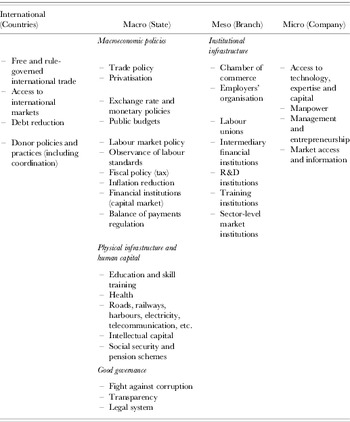
Schulpen and Gibbon (Reference Schulpen and Gibbon2002: 3) offer a comprehensive breakdown of these various levels of possible donor PSD interventions (see Table 1). As their table indicates, PSD assistance at the micro-level can take the form of direct support to businesses, for instance, through assistance to marketing strategies and the development of new product varieties. At the meso-level PSD interventions can include assistance to business lobbying associations, for instance, through donor provision of training to management staff. At the macro-level, meanwhile, PSD assistance can be rendered to national trade ministries in order to promote a domestic development programme that pays adequate policy attention to business sector growth in free market conditions.
Levels and elements of private sector development

Source: Schulpen & Gibbon Reference Schulpen and Gibbon2002: 3.
To date considerable attention has been paid to the technical assessment of donor PSD initiatives. This policy-focused literature has developed with a view to improving donor efficiency in the delivery of PSD assistance as well as the current effectiveness of PSD programmes. The growing literature includes Kurokawa et al. (Reference Kurokawa, Tambo and te Velde2008), which offered detailed assessment of the Japanese development agency's ‘One Village One Product’ (OVOP) programme and that initiative's role in supporting poorer entrepreneurs through attention to niche markets. It also includes Brewster and Njinkeu (Reference Brewster, Njinkeu, Njinkeu and Cameron2008), who assessed PSD initiatives in the context of donor institutions' broader Aid for Trade agenda.Footnote 2 They provided a ‘summary of lessons from various efforts to strengthen the capacity of the private sector in low-income countries’, and drew attention to a lack of bona fide co-operation amongst donor institutions (ibid.: 369). In addition, the literature includes ADE (2005), a detailed technical investigation of the European Commission's PSD measures which highlighted barriers to policy implementation including a lack of strategic vision on the part of Commission staff.
PSD initiatives cannot be understood, however, as mere technical instruments aimed solely at promoting poverty alleviation through improvements to business competitiveness in low-income states. PSD concessions constitute a highly strategic platform upon which donors have publicly insisted that politically contentious rounds of multilateral and bilateral trade liberalisation will facilitate developing countries' ‘smooth and gradual’ integration into ‘globalised’ markets (ACP–EU CPA [2000] 2006: 28). Donors' repeated emphasis on the importance of PSD interventions in support of pro-poor business growth has established a series of legitimising narratives that together comprise a regularised discourse. This PSD discourse has served as a politically potent device able to nominally ‘bridge’ donors' trade liberalisation agendas to legitimising moral goals of poverty alleviation (Langan Reference Langan2009: 425). Beyond technical analysis, therefore, critical attention to the discursive elements of PSD frameworks is a necessary concern for those wishing to understand the full relevance of ‘private sector development’.
Critical focus upon the political potency of words, texts and statements has, in fact, a distinguished history in the study of North–South ties. As Wilkinson (Reference Wilkinson2009: 599) explains in his analysis of power relations within the WTO: ‘It has long been acknowledged that language – the words, phrases, metaphors, linguistic constructions that we use and the visual images that they conjure up – is not merely a politically neutral means of communicating or a medium that is separate from hierarchies and relations of power … rather, language is an important tool in shaping the social, cultural and political make-up of a society.’
Linguistic constructions have received particular attention when the thematic content of policy makers' utterances have become regularised within a governing ‘discourse’: that is, when the language of institutional stakeholders has become governed by dominant ideological ‘rules’ that define the limits of ‘acceptable speech’ and, consequently, the limits of acceptable policy practice within a hegemonic ‘discursive formation’ (Butler Reference Butler1997: 128) This critical focus on the political significance of discourse derives from the work of Foucault ([1969] Reference Foucault2009: 28), who sought to banish the ‘natural’ and apolitical veneer of discourse and to disturb its ‘tranquillity’ in constructions of power.
Many notable contributions to the study of North–South power asymmetries have, in this vein, utilised modes of discourse analysis. Escobar (Reference Escobar1988: 439), for example, has explored how ‘development’ discourses have brought ‘problems’ into being by constructing certain social issues as falling within the legitimate purview of donors. Cox (Reference Cox1981: 144), meanwhile, working broadly within a neo-Gramscian analysis of international hegemony, has considered the ‘fit between power, ideology and institutions’. He has emphasised the significance of ideological narratives in the maintenance of power within core–periphery divisions. More recently, as mentioned above, Wilkinson (Reference Wilkinson2009: 598), from what he terms a ‘critical’ historical institutionalist perspective, has examined the ‘crisis discourse’ in the WTO and the ways in which this has discursively compelled developing countries to acquiesce to further rounds of trade liberalisation. Kothari (Reference Kothari, Cooke and Kothari2001: 142) in similar fashion has critiqued the discourse of ‘participatory development’ and, with reference to Foucault, has considered participatory narratives as a means of entrenching donors' control over the lives of ‘the poor’.
Within this critical tradition, it is possible to explore how donor PSD discourse has been used to ‘encode’ legitimating moralities within donor institutions' developmentally questionable economic engagement with former colonies (Bernal Reference Bernal1997: 448). This requires attention to the ways in which PSD discourse perpetuates donor power through analysis of how, as Van Djik (Reference Van Djik1993: 249) states, discursive formations may entail ‘support, enactment, representation, legitimation, denial, mitigation, or concealment of dominance’. In addition, it is necessary to recognise the way in which legitimising PSD narratives, in this task of concealing or rationalising dominance, can construct conceptual images that bear little resemblance to the social ‘reality’ that they claim to represent. Articulating this point, Fairclough (Reference Fairclough2005: 6) emphasises that ‘discourses include representations of how things are, and have been, as well as imaginations – representations of how things might or could be, should be … [discourses may act as] projections of possible states of affairs, “possible worlds”’ (emphasis added).
It is necessary to stress that these possible worlds may be illusory – in the sense that they portray sanitised or stylised accounts of how systems ought to operate yet fail to accurately reflect existing social relations. These illusions may be also be strategic in that they work to publicly claim that normatively rightful states of affairs do (or will soon) exist in a manner that veils existing social and economic inequalities within operating systems. It is necessary to consider these strategic illusions and veiling functions of discourse fully when assessing PSD instruments. Attention to discourse can illustrate how PSD instruments provide a veritable ‘Rosetta Stone’ through which donors' pursuit of rapid market-opening in developing countries is publicly translated as a vehicle for pro-poor development conducive to the social well-being of vulnerable people in the global South (Langan Reference Langan2009: 418).
PSD AND THE ‘POST-WASHINGTON’ CONSENSUS: FREE TRADE AS EQUITABLE DEVELOPMENT?
The strategic role of PSD concessions in the creation of a legitimising pro-poor discourse of equitable trade liberalisation can be seen clearly within donor communications. The publications of the OECD, notably, have provided the ‘policy entrepreneurship’ behind the recent emergence of PSD agendas within the broader donor network.Footnote 3 The OECD Development Assistance Committee (DAC), in particular, has vigorously advocated PSD agendas as a means of fusing free market-led economic models with moral goals of poverty reduction. For example, its recent (OECD 2007: 11) publication Business for Development: fostering the private sector reiterates clear pro-poor narratives of equitable business sector growth. Legitimising ‘development’ themes are repeated time and again: ‘Private sector development is an essential component of economic growth and poverty reduction in developing countries… A vibrant and competitive private sector can also empower poor people by providing them with better goods and services at more affordable prices’ (emphasis added). PSD interventions, in these public narratives, are presented as a vital component within donor strategies aimed at giving ‘poor people’ the resources to improve their own lives. Providing a historical justification for private sector-focused approaches to international development, the OECD (2007: 21) publication goes on to explain that:
Over the years different paradigms have prevailed in development thinking; emphasis has shifted from basic needs, to capabilities, to structural adjustment programmes and the provision of a market-friendly business environment … nowadays the development of the private sector is regarded as essential. The logic behind this statement is simple: poverty reduction is the main objective of development co-operation … economic growth is essential for development, and growth is best achieved through the private sector, which in turn needs to be adequately promoted [emphasis added].
PSD initiatives are thereby presented as a logical and ‘common sense’ solution to the problem of poverty that fits modern approaches to ‘development’ in the global South (cf. Wilkinson Reference Wilkinson2009: 600). A ‘market-friendly’ business environment is viewed as an unchallenged vehicle for poverty reduction while alternative development paradigms are viewed as historical anachronisms. In these terms, the OECD DAC-constructed discourse of PSD facilitates the development branding of donor-sponsored free market-led growth strategies and rationalises associated private sector initiatives in developing countries as ‘the only game in town’ in pro-poor development processes (cf. Clement Reference Clement2003: 359).Footnote 4
Moreover, PSD frameworks – through discursive emphasis on linkages between liberal economic policies and pro-poor development objectives – have acted as a lynchpin of the ‘post-Washington’ Consensus (Langan Reference Langan2009: 422). Specifically, PSD initiatives have provided a policy platform on which donors have insisted that they now recognise the need to assist economic growth in developing countries through market-friendly interventions – in contrast to strict laissez-faire approaches to economic liberalisation in the allegedly defunct ‘Washington Consensus’ (Stiglitz Reference Stiglitz2004: 2, 10–3). Accordingly, PSD policies seek pro-market solutions to poverty alleviation while also ensuring that the state does not unduly interfere with the decisions of private sector agents. In a rejection of developmental approaches to economic growth, the OECD (2007: 17), for instance, insists that developing countries must refrain from interventionist policies that might perpetuate ‘an anti-private sector bias’. In this context, PSD frameworks encourage states to perform ‘“enabling” or even regulatory tasks … [yet] refrain from tasks or interventions which either jeopardise the functioning of the private sector or which “crowd it out”’ (Schulpen & Gibbon Reference Schulpen and Gibbon2002: 2).Footnote 5 PSD interventions, in this manner, sit firmly within ‘post-Washington’ Consensus notions of the need to correct (rather than replace) free markets and to make them work more effectively for the well-being of ‘the poor’.
Within this consensus, donor PSD discourse does not, therefore, represent private sector growth as the sealed domain of entrepreneurs seeking to accumulate personal profit for themselves and their shareholders. Instead, the private sector is wholly envisaged as a source of social prosperity and as a tool for improving public welfare. This essential narrative concerning the social role of the private sector is clearly expressed throughout the PSD communications of the wider donor community. DfID (2008: foreword), for example, in its Private Sector Development Strategy, has stated that ‘it is the private sector that creates wealth and helps individuals and nations lift themselves out of poverty … if we want to achieve the MDGs [UN Millennium Development Goals] and make a difference to the lives of the poorest we need to work with businesses – small and large – to create jobs, to drive growth, and raise the income of the poorest’ (emphasis added). PSD language, in this fashion, incorporates ‘trickle-down’ narratives regarding the filtration of business profits to employees, their dependents, and to local communities. The Chief Executive of SABMiller, one of many corporate partners within the UK initiative Business Action for Africa, has provided an even more thorough synopsis of the trickle-down rationale of PSD endeavours. In a contribution to the Business Action for Africa network (BAA 2008: 25), he emphasised:
There is now a broad consensus across the development community that business has an essential role in generating growth and reducing poverty in developing countries, through the jobs and wealth we create, the opportunities we provide for suppliers, the investment capital we contribute, the taxes we pay, the infrastructure improvements we make and the workers we train and develop [emphasis added].
Importantly, these legitimising discursive constructions are not limited to donor institutions alone. Keen to align domestic policy communications with the prevailing policy ethos of major global governance institutions, the Kenyan government, for example, in its own Private Sector Development Strategy has closely mirrored donor PSD discourse and has echoed trickle-down understandings of the filtration of business wealth to the broader community:Footnote 6
The private sector is the epitome of development. Responding to the profit motive, entrepreneurs invest in facilities and ideas and open up opportunities for people to employ their talent and improve their general well-being. Firms also provide goods and services … [and] are the main sources of tax revenue … the business climate becomes a crucial building block for economic growth, development, and overall prosperity (RoK 2006: 2, emphasis added).
Again, in this instance of PSD discourse, ‘private sector development’ is publicly constructed as a ‘common sense’ endeavour that recognises the role of the business sector in poverty alleviation, and enables entrepreneurs to operate effectively for social gain in the free market.
Most significantly, donor PSD discourse explicitly constructs egalitarian images of developing countries' participation in the ‘globalised’ economy. PSD contributions are publicly represented as a means to ‘close the global competitiveness gap’ and to allow ‘globalisation’ and trade liberalisation to create ‘more winners’ (cited in BAA Reference Clement2008: 7, 27). Specifically, trade liberalisation agendas are presented as sitting in conformity with development ambitions since donor PSD assistance will ostensibly enable low-income states to take advantage of market-opening and to generate the profits on which poverty alleviation can be realised. Stiglitz (Stiglitz & Charlton Reference Stiglitz and Charlton2006: 6), a prominent advocate of ‘post-Washington’ Consensus policies, has notably argued that donor assistance to the redress of supply-side constraints in developing countries will promote fairer, more humane outcomes in global trade negotiations. In order to tackle this supply-side problem – and to achieve pro-poor trade liberalisation – he has recommended that the ‘primary instruments to achieve [equitable trade liberalisation] … should focus on private sector development by facilitating the improvement of the business environment for exporters’ (emphasis added). PSD assistance, in this context, will facilitate more equitable trade regimes that will work towards fulfilment of the UN Millennium Development Goals (MDGs).
Following Stiglitz, amongst other proponents of pro-poor trade liberalisation, PSD frameworks have, in some circles, been presented as a veritable panacea to the travails of developing countries' participation in global trade systems. PSD initiatives attached to Aid for Trade packages have ‘increasingly [been] … seen as the missing link that will help to make trade a true engine of growth for poorer countries’ (Sunassee Lam Reference Sunassee Lam, Njinkeu and Cameron2008: 273). In particular, PSD efforts are seen by donors as tangible proof that the lessons of past structural adjustment programmes (and their relative failure to generate pro-poor outcomes) have been learned, and that ‘new’ avenues are being pursued to ensure that markets function in a socially progressive manner.Footnote 7 However, if we consider more closely the strategic placement of PSD concessions in the case of the EU (one of the principal discursive proponents of contemporary PSD frameworks) in its bilateral trade and development ‘partnership’ with the ACP countries, it becomes clear that PSD instruments do not necessarily promote pro-poor outcomes. Instead, financially anaemic PSD instruments often serve as normative concessions through which asymmetric trade ties are inoculated from critical contestation and genuine reform.
PSD DISCOURSE AND THE ‘MORALISATION OF LIBERALISATION’ IN EU–AFRICA TRADE RELATIONS
The EU is one of the chief donor advocates of private sector development, notably in its trade and development co-operation with the ACP countries. EU officials, in congruence with donor narratives of PSD explored above, have repeatedly spoken of the need for PSD assistance to allow ACP states to participate fairly in the ‘globalised’ economy and to take advantage of market-opening for the relief of ‘the poor’ (Langan Reference Langan2009: 422). The European Commission (1998: 1) in its publication A European Strategy for Private Sector Development in ACP Countries, for example, has emphasised:
The European Community considers the private sector as a leading actor in development, and thus as a major partner in its development co-operation … the proposed [PSD] strategy is intended to make a powerful contribution to poverty elimination, and to the beneficial integration of ACP countries into a world economy which is rapidly becoming more globalised [emphasis added].
EU donor assistance to the business sector is accordingly presented as a means of ensuring ACP countries' equitable ‘integration’ into the global economy. ‘Integration’, in this sense, is understood by the Commission to entail market-opening in ACP states amidst the consolidation of on-going economic liberalisation. In this context, PSD initiatives are seen as a ‘second-generation’ complement to earlier phases of structural adjustment reforms in ACP countries:
Much progress has been achieved in liberalising markets, in removing regulatory obstacles facing private investors and adapting taxation systems in order to improve investment incentives. However, progress has been slower in identifying and achieving institutional changes helpful to private enterprises … such so-called ‘second generation’ reforms … involve a substantial element of ‘capacity building’ … ACP countries will predominantly be market economies … their development prospects depend on making full use of opportunities for export growth … and improved competitiveness of companies (EC 1998: 8, emphasis added).
The European Council meanwhile has similarly expressed that EU donor assistance to business competitiveness in the ACP countries will enable development-friendly processes of market ‘integration’. In fact market-opening is viewed as an essential component of human development strategies:
The increasing globalisation and the ensuing need for developing countries to improve their competitiveness in order to integrate successfully in the world economy strengthen the need for private sector development. Support for the development of the private sector is therefore an important area of the development co-operation policy of the European Union, playing an overall role in poverty eradication through contributing to economic growth and by creating employment (cited in Langan Reference Langan2009: 425, emphasis added).
The Council's policy communication thereby reiterates one of the primary public messages within donor PSD discourse, namely that trade liberalisation or, in the words of the Council, ‘integration’ into ‘globalised’ markets will take place in an equitable manner.
Interestingly the European Commission (2003: 2) has articulated these trickle-down narratives of equitable trade liberalisation within an explicit recognition of the broader ‘post-Washington’ Consensus surrounding PSD interventions, legitimising its own PSD policy agenda as falling within the wider constellation of donor PSD frameworks. Again PSD programmes are presented as ‘common sense’, as an ‘objective’ truth beyond doubt and contestation:
The … evidence … is now abundant … the United Nations… the Bretton-Woods Financial Institutions, as well as the OECD-Development Assistance Committee and NGOs are all now agreed on the importance of business and private sector support [in development processes]. This wide consensus reflects the perception that economic growth creates the resources to combat poverty and that business development and a dynamic private sector are essential for economic growth providing as they do, the main source of employment in developing countries [emphasis added].
Despite these legitimising narratives, however, the EU's recent advocacy of PSD agendas has emerged in the midst of highly controversial changes to the terms of its trade and development co-operation with ACP countries. Indeed, Europe's discursive embrace of PSD initiatives has coincided with the Commission's attempts to reform the ACP–EU relationship (a long-standing bilateral association with former colonies dating back to 1957) from economic ties based on trade preferences and mixed-market interventions to a partnership based on trade reciprocity and mutual market liberalisation (Langan Reference Langan2009: 422).Footnote 8 This EU movement from non-reciprocity to WTO-compliant forms of free trade in its relations with ACP states was notably reflected in the framework of the contemporary ACP–EU Cotonou Agreement (2000–20). It is against this transition from trade non-reciprocity to Cotonou-era trade reciprocity, therefore, that Europe's recent emphasis on PSD interventions has emerged as a means of reassuring critics of economic liberalisation agendas that the reform of the ACP–EU partnership will be an equitable process (ibid.: 422).Footnote 9 Keen to maintain historically embedded egalitarian images of the ACP–EU bilateral relationship and to reassert Europe's commitment to an allegedly benevolent role on the global stage, PSD initiatives have assumed a central position as norm-laden concessions through which EU institutions have sought to bring about a discursive ‘marriage’ of bilateral trade liberalisation agendas to legitimising pro-poor ‘development’ objectives (ibid.: 435).
Specifically, Europe's strategic embrace of PSD frameworks and associated PSD discourse has allowed EU policy makers to publicly argue that trade reciprocity will work in the favour of ACP countries, since donor revenues will be directed to ensuring that ACP business sectors will be able to compete effectively in the post-liberalisation phase. In this vein, Europe's embrace of PSD discourse has aligned with, and reinforced, the Commission's broader narrative that processes of market liberalisation in ACP countries are chiefly aimed at achieving pro-poor outcomes in the former colonies: ‘The European Union's primary concern must be the integration of the poor into the economic and social life and the integration of the ACP countries into the world economy. This is why our development framework should be extensible to fresh areas of cooperation and other agents of development in civil society, especially the private sector’ (EC 1996: 55; emphasis added). PSD initiatives provide a normative concession through which these legitimising public representations and narratives of ACP countries' equitable ‘integration’ can be discursively maintained and, ostensibly, materially realised.
Most notably, PSD initiatives have served as normative concessions in the European Commission's vigorous pursuit of Economic Partnership Agreements (EPAs) with sub-regions of the ACP grouping. EPAs – vehicles for the transformation of ACP–EU economic ties towards full trade reciprocity – have been rationalised on the basis of allowing ACP developing countries to prepare themselves for gradual integration into the multilateral trade system. It is within EPA negotiations that Europe's PSD initiatives have taken on particular symbolic significance as ‘development’ concessions (Langan Reference Langan2009: 425). PSD mechanisms have enabled figures such as Pascal Lamy, former EU Commissioner for Trade, now Director-General of the WTO, to claim that donors have realised the need to supplement market-opening in low-income states with assistance to business capacity-building. PSD mechanisms and broader Aid for Trade measures are seen as key to enhancing productivity in developing countries and allowing them to participate, in a fairer fashion, in the international economy: ‘Trade opening is necessary, but it is not sufficient in itself. It also implies assistance to help the least-developed countries to build up their stocks and therefore adequate productive and logistical capacity; to increase their capacity to negotiate and to implement the commitments undertaken in the international trading system’ (cited in WTO 2006; emphasis added). For Lamy, trade liberalisation – in conjunction with appropriate donor assistance to the capacity of developing countries – is thus publicly translated into a global public good aimed at the well-being of ‘humanity’: ‘trade is only a tool to elevate the human condition; the ultimate impact of our rules on human beings should always be at the centre of our consideration. We should work first for human beings and for the well-being of our humanity’ (ibid.).Footnote 10
Crucially, however, this ‘moralisation of liberalisation’ – facilitated by PSD normative concessions and PSD discourse – does not reflect the material realities of Europe's trade agenda with ACP countries (Langan Reference Langan2009: 421). EPAs, in particular, do not appear to establish conditions in which indigenous business sectors in ACP countries can thrive – quite the contrary.Footnote 11 Notably, ACP civil society and European non-governmental organisations (NGOs) have issued strong moral condemnations of the EU's attempts to impose ‘premature’ liberalisation on less developed partners through EPAs. According to these critics of reciprocal trade, the EU is pursuing its commercial interest in ACP countries' potentially lucrative industries, including ‘telecommunications, construction, and financial services’, in a manner that will effectively blunt the social gains of economic growth to host ACP nations (Faber & Orbie, cited in Langan Reference Langan2009: 417).Footnote 12 Business proceeds in these emerging sectors, once subject to mergers and takeovers, will be repatriated to European commercial centres, and through them to foreign shareholders, rather than retained and reinvested domestically to the advantage of poorer citizens within a sustainable cycle of national economic and social development (cf. Chang Reference Chang2007: 14–18).
In this context, EPAs are not seen as pro-poor development ventures but are widely viewed as vehicles through which the EU is pursuing its economic and political interests through the entrenchment of asymmetric trade ties with former colonies. As such, the imposition of EPAs has been understood to ‘kick away the ladder of development’ and, in the case of emerging sectors (above), to deprive ACP decision-makers of necessary policy space to create home-grown ACP industries that provide comprehensive backward linkages into the wider economy (Chang Reference Chang2003: 140; Nunn & Price Reference Nunn and Price2004: 210). Moreover, in traditional agricultural sectors, the prospect of European import flooding under EPAs is understood to threaten fledgling ACP production in economic areas that currently contribute significant revenues to national development. The potential of unrestricted entry of EU goods such as textiles, beef, poultry, tomatoes, cereal and dairy products into ACP markets, it is claimed, will undermine domestic enterprises in ACP countries leading to business closures, economic stagnation, and the loss of livelihoods for ‘the poor’ (The Courier 2008).
These criticisms of EPA trade liberalisation, founded on the same moral ‘development’ terrain on which the EU has explicitly justified its trade relationship with the ACP countries, have posed a serious concern for the EU. They have not only challenged the asymmetric structure of ACP–EU trade relations but have also publicly undermined the EU's self-image as a benevolent ‘normative power’ in its relationship with former colonies (Manners Reference Manners2002: 252; Storey Reference Storey2006: 332). The African Social Forum in 2004 (cited in Bilaterals.org 2005), for example, expressed its grave moral concern that Europe's EPA agenda with ACP countries would jeopardise the long-term well-being of citizens in developing states and challenged the ‘development’ auspices of the EU in its ‘partnership’ with former colonies: ‘Under the guise of a “development partnership”, the EU is aggressively imposing its trade and investment liberalisation agenda on African countries. The EPAs – if implemented – will lead to loss of livelihoods, food insecurity, increased unemployment and social inequality in Africa.’
Significantly, many ACP governments themselves appear to be deeply sceptical as to the pro-poor nature of EPAs. Despite the passing of the December 2007 deadline for the signing of reciprocal trade agreements, the majority of ACP countries have not signed full EPAs. Instead most have reluctantly acquiesced to ‘interim’ EPAs and have yet to agree full terms with the EU regarding market-opening in services industries and other lucrative emerging sectors. Only one full EPA has been signed (as of 2010) between the EU and CARICOM (the association of the Caribbean Community). This EPA itself is being retrospectively resisted by many Caribbean officials. President Jagdeo of Guyana, for example, has been particularly vocal in his unease with the CARICOM–EU deal (The Jamaica Gleaner 2010). Meanwhile interim agreements, falling a good deal short of full EPAs, have been initialled or signed with twenty-two ACP counties including Ghana, Kenya, Uganda, Tanzania, Comoros, Mauritius, Zambia, Madagascar and the Seychelles (EC 2010).
Furthermore, these critical narratives sit in uncomfortable juxtaposition to the legitimating images of ACP–EU relations as constructed within Europe's PSD discourse, jarring with strategic narratives of pro-poor market integration that have sought to inoculate EPAs from critical contestation. It is necessary, therefore, to explore in more detail these discrepancies between Europe's normative images of pro-poor ‘private sector development’ and critics' visions of social distress amidst premature market-opening in ACP countries. In particular, it is necessary to assess Europe's PSD normative concessions in relation to the material resources of operating EU PSD instruments. This underscores serious concerns that Europe's PSD normative initiatives appear to reupholster public legitimisations of ACP–EU relations, and to rationalise developmentally questionable EPA trade agendas, rather than to tangibly fulfil nominal human development objectives.
EUROPE'S PSD INTERVENTIONS IN ACP STATES: REALISING PRO-POOR DEVELOPMENT?
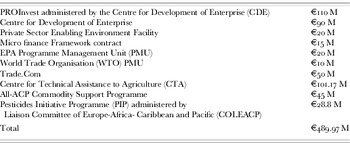
Given the strategic placement of PSD normative concessions in nominally legitimising EPA trade reciprocity in Europe's bilateral relations with ACP states, it is important to consider whether EU instruments are capable of fulfilling the legitimising ‘development’ objectives constructed within PSD discourse. Table 2 illustrates the main institutions with a mandate to pursue PSD initiatives as part of the EU's wider commitment to Aid for Trade. As it indicates, EU financial assistance to ACP private sector initiatives was marginal in proportion to the extensive donor PSD discourse in the timeframe of the Ninth European Development Fund (EDF) from 2000 to 2007. The total of €489.97 million amounts to just over €1 million per year per ACP country (Langan Reference Langan2009: 429).
All-ACP European Commission funded programmes in timeframe of the 9th EDF

Source: Sunassee Lam (Reference Sunassee Lam, Njinkeu and Cameron2008), amended and extended, cited in Langan Reference Langan2009: 423.
Note: The finances of the European Investment Bank's (EIB) Investment Facility (IF) are not included since they are not strictly directed to capacity-building in indigenous ACP business sectors as per the pro-poor rationale of PSD. Instead EIB IF monies provide de facto subsidies for European commercial ventures in ACP countries. These investments do not assist ACP domestic entrepreneurs to develop business capacity but instead often contribute to the crowding-out of domestic ACP businesses under EU monopolisation of lucrative emerging sectors (Langan Reference Langan2009: 423). In many cases the projects are based in the mining sector and have been heavily criticised for their regressive impact upon both workers and local communities in ACP states (Counter-Balance 2008). Bracking (Reference Bracking2009) provides a convincing and detailed analysis of the ‘predatory’ interventions of development finance institutions, such as the EIB, in low-income countries. The FLEX scheme is also not included for lack of reliable data.
In the context of the ACP states' adjustment costs for EPA liberalisation, moreover, these PSD concessions were remarkably frugal. Milner (Reference Milner, Grynberg and Clarke2006: 113), for instance, calculates that the adjustment costs of EPA transitions will amount to approximately €9 billion across the ACP countries including €1.454 billion (net) for production and employment adjustment and €2.089 billion (net) for trade facilitation and export diversification (Langan Reference Langan2009: 429).
Accordingly, Europe's PSD contributions under Aid for Trade packages will only represent approximately 5·3% of the total adjustment costs to be borne by low-income ACP countries under EPA reforms. This modest percentage stands in stark contrast to egalitarian images of European largesse maintained within PSD discourse, and additionally points to the sheer magnitude of the costs incurred by low-income ACP states under EU bilateral trade liberalisation agendas (ibid.: 429).
Furthermore, when the capacity of individual ACP–EU development institutions is considered, it is soon evident that Europe's financial modesty seriously inhibits the ability of PSD instruments to fulfil legitimising ‘development’ objectives. The CDE, for example, stands as one of Europe's hallmark PSD normative concessions to ACP countries under the Cotonou Agreement.Footnote 13 The CDE derives most of its resources from the EDF and has been established as a funding body for ACP private sector enterprise and investment. Its mandate is to facilitate ACP–EU joint business partnerships by increasing awareness of business opportunities that could be pursued on a joint ACP–EU private sector basis. The institution may provide partial funding for such initiatives, and may also provide support to ACP firms to market themselves more effectively within European markets. Additionally, it can support new commercial opportunities in ACP countries by offering technical support or financial contributions towards business capacity-building (Commonwealth Secretariat 2004: 118). Significantly, the CDE is also active in promoting Europe's PSD discourse, emphasising the EU's commitment to socially equitable business growth in the context of wider ACP–EU relations. The CDE (2004: 4) explains that it is ‘an institution of the ACP Group of States and the European Union in the framework of the Cotonou Agreement. It forms part of the general system of support the European Commission created for promoting the private sector and thus helping to combat poverty’ (emphasis added). The Centre additionally emphasises that it is an ‘excellent tool for promoting development and eradicating poverty’ (CDE 2008a; emphasis added).
However, as Table 2 illustrates, the CDE budget is exceptionally modest for an institution that seeks to build private sector capacity across seventy-nine low-income ACP countries. Within the timeframe of the Ninth EDF (2000–7), this budget only came to approximately €12·8 million per annum. While te Velde (Reference te Velde and Page2006: 133) has previously calculated that CDE contributions represent approximately €250,000 per ACP state per annum, the above budget estimate indicates this could be as low as €163,000 per ACP state per annum. Given this restricted budget, the CDE has had to focus on a very select few priority business sectors that nominally offer greatest potential for economic and social development in ACP countries (CDE 2008b: 8). Although firms outside the CDE's selected sectors can receive funding at the discretion of the Centre, the vast majority of CDE PSD assistance remains within the selected areas, ring-fencing resources to the chosen industries. These prioritised trade areas ‘currently include the timber sector, cotton and textiles, livestock, fisheries, the mineral sector, environmental treatment facilities, horticulture, tourism and regional trade facilities’ (Commonwealth Secretariat 2004: 118). Focussing on these trade sectors, the CDE (2010: 30) meanwhile claims that in the period 2000–2010 it has assisted 4,000 ACP businesses in over 6,500 separate interventions. Over half of these applications, however, represent CDE contributions of less than €5,000, although projects up to €50,000 can be considered (Commonwealth Secretariat 2004: 119). Additionally, the budget for these prioritised sectors is itself very limited. In 2008, for instance, the CDE (2008c: 5) allocated €4,079,080 in total commitments to its sector programmes, again a very modest sum in contrast to the discursive significance of EU PSD language in the legitimisation of EPA liberalisation.
Meanwhile, if the activities of the CDE are considered in terms of a specific prioritised sector programme, it is possible to underscore the limitations of the institution and those of Europe's PSD contributions more generally. Notably, the CDE's assistance to ACP firms under its current cotton and textile programme indicates considerable grounds for contestation of the ‘development’ orientation of EU PSD assistance. According to the CDE (2008b: 15), its assistance to textiles firms in ACP countries facilitates market linkages and marketing know-how on a joint ACP–EU basis. In the case of Kenya, for example, the CDE claims that it has worked to promote ‘export market development’ involving the ‘organisation of buyer visits to Kenyan clothing companies, [while giving] information on the applicable EU trade regime and technical assistance’. The apparent vigour of the CDE in its interventions in ACP cotton-textiles is, however, again undermined by the financial capacity of the institution. As the CDE (2008b: 14) notes, ‘over the 3-year period from 2004 to 2006, the CDE contributed Euro 1·9 m towards the implementation of the textile programme with additional third party financing of around Euro 1 m, excluding the participating companies’ contribution which has been significant'. This €1·9 million figure is extremely marginal, given the historical significance of textiles sectors in establishing a necessary first step for industrialisation with backward linkages into agriculture in developing countries (Traub-Merz Reference Traub-Merz, Jauch and Traub-Merz2006: 10). It is also, once more, particularly limited in contrast to the rhetorical heights of PSD language and the scope of Europe's ‘partnership’ with seventy-nine ACP developing countries.
More worryingly, the direction of the sparse PSD funding allocated to textiles and cotton programmes under the CDE indicates that the Centre's resources often serve more as de facto subsidies for Europe's commercial interests than as genuine ‘development’ concessions to ACP countries. The CDE 2005 Annual Report (2005a: 45–7), for example, noted that €515,000 was made available by the Centre for ‘textiles and clothing’ in eastern Africa. In that year, however, the CDE, in this East African context, appears to have contributed as much as €333,000 to one project in Madagascar alone.Footnote 14 This venture, Text'île Mada, is a textiles industrial cluster comprising approximately twenty-four companies and employing a total of 9,000 people (CDE 2008b: 14). Its firms serve clients such as Disney and JC Penny and other large multinationals, and are in many cases registered under Madagascan export processing zone (EPZ) legislation (Le Site de Text'île Mada Reference de Text'île Mada2010). Significantly, there is heavy French commercial investment in the cluster, with the French development agency (AFD) providing €800,000 over three years in conjunction with CDE resources, with a combined project value of €1,800,000 for 2005–8 (CDE 2005a: 45–7). This CDE/AFD funding has had clear advantages for European investors seeking to invest in profitable textiles enterprises in ACP former colonies. Notably, the Text'île Mada cluster in 2006 generated approximately €50 million in turnover, delivering high rates of return for its European investors (EUROPEAID 2006: 9). CDE funding in this case worked as a de facto subsidy for European commercial actors.
However, the daily realities of business activities in industrial clusters such as Text'île Mada do not correspond to donors' discursive constructions of equitable and pro-poor economic growth in developing countries – quite the contrary. PSD narratives, in these contexts, instead represent strategic illusions which publicly divorce EU interventions from the uncomfortable social implications of competitive business practices for poorer citizens in ACP countries. In the Malagasy case, for example, the CDE (2005b: 2) literature itself emphasises that its donor investments are based on ‘the fact that its [Madasgascar's] production costs are among the lowest in the world’ and that the country, on this basis, possesses great potential for success in the global textiles market. Yet Madagascar's comparative advantage in low-cost production derives from the low-waged nature of employment in its textiles industry, and the industriousness and productivity of a largely low-skilled female workforce who do not receive the lion's share of business proceeds enjoyed by European commercial investors. Rather than providing ‘an equitable distribution of the fruits of [private sector] growth’ envisaged within the ACP–EU CPA ([2000] 2006: 6), economic expansion in Madagascar's textiles industry has not been translated into widespread poverty alleviation. As Nicita (Reference Nicita2006: 1) in his analysis of the welfare creation effects of economic growth in Madagascan textiles makes clear, ‘the impact of [an] … export surge [in Madagascan textiles] has been very large in terms of employment and wages; albeit less so in terms of poverty reduction … [since] a large majority of the poor are unable to enjoy the new employment opportunities … most of the poor reside in rural areas, where the employment effect is very small’. This lack of trickle-down to Madagascan citizens owes much to the EPZ model of textiles operations that bestows low tax rates upon foreign investors, limiting the contribution of business prosperity to the wider citizenry through the generation of government revenue conducive to the funding of national welfare services.
Meanwhile, the ‘development’ contribution of low-waged, export-focused textiles operations is highly questionable even in the context of the direct ‘beneficiaries’ of private sector expansion, that is, the textiles employees. As mentioned, average wages in Madagascan textiles firms are very low and currently remain around US$2 per day, with recent wage increases mainly benefiting male management rather than the majority female labour force. These low wages, moreover, are likely to persist given the ‘large reserve unskilled labour force and continued high turnover in unskilled textile jobs’ in Madagascar (Nicita Reference Nicita2006: 22). Further undermining the ‘development’ potential of Madagascar's export-driven textiles plants, many female labourers not only find that wages are not sufficient to meet their own human needs, let alone those of their family dependents, in stark contrast to the pro-poor image of wealth filtration inherent in PSD discourse, but also experience regressive workplace conditions. One worker in a Belgian knitwear and embroidery company located in Madagascar, for example, complained:
I make jumpers using a machine, but I don't have a protective mask. I can normally make five jumpers, but when my boss tells me to make nine, I can't do it and I sometimes have to work until 10pm. I earn MGF 252,000 [about 22 Euros] per month. It's very little, as my rent costs MGF 150,000. I can no longer afford rice or meat, and I have to walk to the factory because I can't afford the bus ticket (ICFTU 2004: 37).
The ‘development’ potential of the CDE's funding to Madagascan textiles under PSD remits is also undermined by the insecure nature of textiles investments in that country, owing to the fact that the export model operated by most foreign investors largely depends on temporary African Growth and Opportunity Act (AGOA) preferences into the US market. These preferences were withdrawn from Madagascar by the US authorities in 2009 in response to a domestic coup d'état (AGOA.info 2010). Even without the current sanctions, moreover, the Madagascan textiles sector would face serious challenges to its long-term sustainability. Significantly, AGOA preferences are based upon the US government's policy rationale that textiles manufacturers in sub-Saharan Africa will make progress towards domestic sourcing of cotton in beneficiary African states. Most textiles investors in countries such as Madagascar, however, have not based their export model on domestic sourcing and will exit their host nation on the expiration of the AGOA third-country fabric waiver (which currently allows the importation of raw materials from China and Southeast Asia).Footnote 15
Ironically, and again in uncomfortable juxtaposition to Europe's pro-poor PSD discourse, EU PSD assistance to ACP countries, while directed towards profitable European business investments in low-wage textiles operations, is simultaneously denied to large scale cotton initiatives that could establish a viable cotton-textiles value chain conducive to the broad-based poverty reduction nominally enshrined in the Cotonou Agreement. In the case of Kenya, for instance, the European Commission rejected a proposal from the Kenyan government to provide PSD assistance to the Kenyan cotton sector in the creation of backward linkages between Kenyan textile manufacturing and domestic agriculture. Following a report conducted on behalf of the European Commission by the UK consultancy firm HTSPE (2003), the EU delegation in Kenya opted not to assist cotton production. The HTSPE consultants' report (2003: iv) claimed that
the international competitiveness of the Kenyan cotton and textile sector is low … only lint production for export and [EPZ] garment manufacture under the AGOA Act are promising in future … there is little promise of long-term high volume international sales of Kenyan-made fibres and cloth to the main consuming countries as well as of garment sales outside the preference regulations of the AGOA Act.
In one short passage the viability of Kenyan cotton production was effectively dismissed, leading to the Commission's decision not to offer PSD support to a sustainable cotton-textiles value chain in Kenya. Viewing the immediate profitability of EPZ manufacturing as a more promising venture for European investment, the alleged lack of a comparative advantage in Kenyan cotton production was cited as a barrier to EU PSD investment. This is despite the clear advantages that could be obtained for thousands of low-income rural workers in cotton-producing areas in Kenya from investment in rural–urban backward linkages; despite the on-going insecurity of EPZ investments given their aforementioned reliance on transitory AGOA preferences; and despite wide-ranging concerns that EPZ activities in Kenya have resulted in ill-treatment of workers and a definitive lack of ‘an equitable distribution of the fruits of growth’. The Kenyan Human Rights Commission, in a publication entitled The Manufacture of Poverty, has firmly criticised what it describes as the ‘poverty wages’ of EPZ enterprises and their failure to deliver genuine pro-poor development for Kenya's citizenry (cited in IPS 2005).
This focus on immediate business profitability, accepted by the Commission, underscores Europe's apparent primary interest in lucrative commercial investments in ACP former colonies, even if the private sector activity involved does not represent a suitable avenue for genuine poverty reduction. It is perhaps not surprising, therefore, that EU PSD concessions, as in the Madagascan case, have often served as de facto subsidies for highly profitable European investments which either fail to deliver, or else actively undermine, the social well-being of vulnerable citizens and host communities in ACP countries. This in turn gives rise to serious questions surrounding the ‘development’ credentials of Europe's PSD agenda, as well as that of broader donor PSD strategies within the ‘post-Washington’ Consensus. While PSD discourse publicly constructs legitimising images of equitable trade liberalisation conducive to the well-being of vulnerable citizens in ACP countries, the material realities of PSD assistance are in fact highly questionable in terms of pro-poor outcomes. PSD concessions, as in the context of ACP–EU relations, are often financially anaemic. Meanwhile, the limited available funds are predominantly directed to business activities that align with donors' economic interests, yet do not correlate with low-income states' long-term development needs.
Central to an understanding of ‘private sector development’ in contemporary North–South relations, therefore, PSD discourse can be understood to perform a ‘double-veiling’ over asymmetric trade regimes and developmentally dubious business activities in the global South (Langan Reference Langan2009: 418). In the context of ACP–EU ties, PSD discourse not only provides ‘normative cover’ for reciprocal trade deals through nominal pledges to developing states' supply-side constraints, but additionally works to veil the uncomfortable realities of private sector practices (often those undertaken by foreign investors in pursuit of short-term profits) in developing countries whose current export-oriented industries revolve around the ‘comparative advantage’ of low-cost labour. This double-veiling is, however, central to the development branding of market-opening in low-income states and works to rationalise reciprocal trade deals (such as EPAs) as opportunities for pro-poor gain within the free market. In this process, PSD normative concessions, through PSD discourse, construct strategic illusions that downplay existing economic and political inequalities between Northern and Southern partners. Narratives of pro-poor trade liberalisation, an ‘equitable distribution of the fruits of growth’, and equitable trickle-down establish imaginary worlds that legitimise the status quo yet disguise the regressive consequences of entrenched North–South power relations for vulnerable citizens in developing countries. Accordingly, PSD concessions can be understood to (re)embed poverty through the diffusion of a legitimising discourse that immunises developmentally dubious trade systems from genuine reform. Attached to developmentally regressive trade deals, PSD resources are directed towards consolidating donor interests through de facto subsidies to commercial investments rather than tangibly assisting genuine avenues of pro-poor business growth.
Critical attention to the political potency of PSD discourse in trade negotiations, combined with civil society and NGO public concerns regarding the impact of premature market liberalisation on ‘the poor’, can, however, help to un-blur donors' strategic marriage of economics and ethics as facilitated by PSD normative concessions (Langan Reference Langan2009: 426). Attention to the usages of PSD discourse can illustrate the way in which moral norms of development and poverty reduction have been used to rationalise inequitable forms of economic relations in the ‘post-Washington’ Consensus. When this is then considered in terms of an assessment of donor PSD instruments, as in the context of Europe's bilateral partnership with ACP states, it can also underscore discrepancies between moral language and material outcomes in order to highlight the injustices of private sector models based on low wages and (prematurely) open markets.
* * *
PSD concessions are a central component of recent donor agendas aimed at making markets work for ‘the poor’ and at aligning trade liberalisation processes to equitable development outcomes. Notably, PSD discourse serves a crucial role in providing legitimising narratives of low-income countries' ‘smooth and gradual’ integration into globalised markets, of a fair trickle-down of business sector wealth to vulnerable workers and host communities, and of donor recognition of possible market failures in the era of the ‘post-Washington’ Consensus. Despite these egalitarian images of liberalised trade systems working in the interest of the poorest within developing countries, however, PSD discourse can be better understood to construct strategic illusions that perform a ‘double-veiling’ of the inequities of asymmetric North–South relations. Rather than deliver meaningful assistance to private sector activities that could potentially generate the social gains nominally enshrined in donor agendas, PSD concessions are, in many cases, financially anaemic, and do more to publicly rationalise developmentally questionable reciprocal trade deals than to materially provide the resources necessary for developing countries' equitable participation in globalised markets.
As the above examination of PSD normative concessions in the context of Europe's bilateral trade and development co-operation with ACP countries demonstrates, PSD instruments provide a policy platform upon which donors' trade liberalisation agendas have been partially inoculated from critical contestation and public dispute. In the case of EPAs, notably, EU PSD assistance has rationalised the reform of ACP–EU economic ties and portrayed sanitised and stylised accounts of how reciprocal trade systems ought to, and allegedly will, work to improve the social well-being of vulnerable people in the ACP countries. Nevertheless, Europe's extremely modest PSD allocations, standing at just over €1 million per ACP state per annum, fall far short of the rhetorical heights of ‘private sector development’ and its strategic significance in the rationalisation of unequal trade ties.
Moreover, as in the case of the ACP–EU Centre for the Development of Enterprise, the limited available EU PSD funds are in many situations directed to European donors' commercial investments in developing countries. PSD concessions, in this context, often serve as de facto subsidies for European business interests in low-income states, providing resources to entrepreneurial activities even where these do not promote, or indeed where they actively undermine, pro-poor development objectives in ACP states. As the article's focus on CDE contributions to cotton and textiles in ACP countries illustrates, PSD revenues are often channelled to low-waged industries that generate significant profit for European investors but result in dubious outcomes for the well-being of a predominantly feminised workforce in developing states. Meanwhile, investments that might possibly generate widespread social gains, such as the funding of a sustainable cotton-textiles value chain, are often overridden on the grounds of immediate profitability without full regard for the long-term development gains that could be derived from donor assistance.
PSD concessions cannot therefore be understood, in this ACP–EU context, as technical instruments aimed solely at promoting human development agendas through appropriate donor assistance to business competitiveness in low-income countries. Instead, critical attention to the discrepancies between donor discourse and the tangible realities of donor programmes points to the strategic utilisation of PSD mechanisms in perpetuating regressive forms of North–South relations. In the case of ACP–EU relations, PSD initiatives work more to entrench existing power asymmetries between European and ACP ‘partners’ through the articulation of public narratives that veil dominance and help to sanitise unequal trade systems as ‘pro-poor’. This is a considerable paradox given that these reciprocal trade relations work to (re)embed poverty by denying ACP governments the necessary policy space to pursue sustainable forms of national economic development.
Through this ‘double-veiling’ performed by PSD discourse, meanwhile, the consequences of premature market-opening in ACP countries are downplayed amidst Europe's strategic visions of donor PSD assistance establishing a more level playing field for former colonies and facilitating their fair integration into globalised markets. Moreover, the on-going implications of export-driven commercial models and EU foreign direct investment in terms of labour conditions and of social well-being in ACP states are veiled within pro-poor representations of an ‘equitable distribution of the fruits of [private sector] growth’ (ACP–EU CPA [2000] 2006: 6). Unfortunately, Europe's PSD instruments can be better understood as (re)embedding poverty through strategic discourse rather than as genuine mechanisms for pro-poor private sector development. PSD mechanisms, under-resourced and tied to EPAs, do not work to reform or correct existing inequalities, but instead reinforce them through the moralisation of premature liberalisation and the rationalisation of regressive forms of North–South ties. Critical attention must therefore be paid to the strategic utilisation of donor PSD frameworks in the broader ‘post-Washington’ Consensus.