INTRODUCTION
In light of their popularity with naturalists and scientists, and of the ecological role they play in marine benthic habitats, little quantitative data have been gathered on nudibranchs worldwide (Karlsson, Reference Karlsson2001). The feeding habits, reproductive cycles and larval biology of most species have yet to be fully elucidated, and this relative scarcity of published data may in part be due to the sporadically explosive breeding mode of most opisthobranchs (Beeman, Reference Beeman, Giese and Pearse1977; Hamel & Mercier, Reference Hamel and Mercier2006).
While nudibranchs are perhaps the best studied group among the opisthobranchs (Hadfield & Switzer-Dunlap, Reference Hadfield, Switzer-Dunlap and Tompa1984), publications on the reproduction, development and feeding of these molluscs in the north-west Atlantic remain limited, and even less information is available on species from eastern Canadian waters. The few accounts published in the literature include life history observations of Onchidoris bilamellata in Nova Scotia (Bleakney & Saunders, Reference Bleakney and Saunders1978), the effect of temperature on the development of egg masses of Dendronotus frondosus in New Brunswick (Aiken, Reference Aiken2003; Watt & Aiken, Reference Watt and Aiken2003), and general zoogeographical studies by Franz (Reference Franz1970) and Meyer (Reference Meyer1971).
Extreme feeding specificity is typical of nudibranchs, with diets frequently limited to a single prey species (Thompson, Reference Thompson1964). According to Swennen (Reference Swennen1959) the relationship of nudibranchs to their prey species often approaches ecto-parasitism. Reproductive structures of nudibranchs are rather complex, and their mating behaviours can be very elaborate (Hyman, Reference Hyman1967; Hadfield & Switzer-Dunlap, Reference Hadfield, Switzer-Dunlap and Tompa1984; Karlsson & Haase, Reference Karlsson and Haase2002), although reports of these behaviours are commonly reduced to anecdotal statements (Karlsson, Reference Karlsson2001).
The nudibranch Palio (=Polycera) dubia (Sars, 1829) can be found in the north-west Atlantic, from the Arctic down to Connecticut, USA (Clark, Reference Clark1975), as well as in the north-east Atlantic (Jensen, Reference Jensen2005), in the north-east Pacific (Goddard, Reference Goddard2004), and in the White Sea, Russia (Mileikovsky, Reference Mileikovsky1970). This species is poorly known, with information limited to a study by Clark (Reference Clark1975) suggesting that its diet includes the bryozoan Cryptosula pallasiana, its settlement occurs in March, and that individuals grow to sexual maturity by April and die in June. Observation of larvae in the plankton in the White Sea when the seawater temperature is around 6.5–7.5°C suggests that spawning occurs in July and August (Mileikovsky, Reference Mileikovsky1970). Finally, Thompson & Brown (Reference Thompson and Brown1984) mentioned that P. dubia possessed oocytes of 79 µm in diameter, which developed into a planktotrophic larvae, while Rivest (Reference Rivest1984) described their copulation via hypodermal injection. Investigations conducted on other temperate species related to P. dubia include a recent account of the development of Polycera aurantiomarginata and P. quadrilineata in Spain (Martinez-Pita et al., Reference Martinez-Pita, Sanchez-Espana and Garcia2006), and research on the damage caused to arborescent bryozoans by P. hedgpethi in Australia (Bone & Keough, Reference Bone and Keough2005).
The present study combined field observations and laboratory experiments to assess the feeding preferences, aggregative behaviour, reproduction, development, larval settlement and growth of Palio dubia, thus shedding new light on the biology and ecology of north-west Atlantic nudibranchs. This work also demonstrates the role played by the lunar cycle in the breeding periodicity of P. dubia, providing a good example of exogenous control of reproductive processes in a coastal marine invertebrate.
MATERIALS AND METHODS
Collection and maintenance
Specimens of Palio dubia were observed and collected in Logy Bay along the east coast of the Avalon Peninsula, Newfoundland and Labrador, Canada (47°37′30″N 52°39′50″W) at a depth of ~6 m. Upon diving, location and general state/behaviour of the specimens (i.e. presence of egg masses, mating and egg-laying) were recorded. Adults of P. dubia measuring between 1.5 and 3.5 cm long (N = 19) were transferred to an experimental setup consisting of three enclosures of 3 l, partially screened with 500 µm mesh to allow for a continuous water exchange, placed within a 50 l tank under flow-through conditions. This setup was designed to retain the larvae that would eventually hatch from egg masses. All experimental trials were conducted in running seawater (~40 l h−1) at a salinity of ~35 and a temperature of 5.5–7.5°C under natural light intensity (~20–45 µmol m−2 sec−1) and ambient photoperiod (15.5–13.5 light:8.5–10.5 dark).
Feeding preferences
Feeding experiments were designed to determine whether P. dubia could discriminate between and show a preference for any species of bryozoan (Eucratea loricata, Flustrellidra hispida and Idmonea atlantica), hydrozoan (Sertularia pumila and Halecium halecinum) and algae (Ptilota serrata, Rhodymenia palmata and Lithothamnium sp.) found in their natural habitat. Trials were conducted simultaneously in triplicate using 19 nudibranchs distributed in three 4 l tanks after all individuals had been starved for 3 d. The nudibranchs were first exposed to each of the food items independently, and subsequently to pair-wise combinations of food items that gave positive results during the independently run experiment. In pair-wise trials, the food items were prepared to offer a similar surface area of ~5 cm2 and spread randomly in the tanks. The trials were repeated on three separate occasions. The feeding state was monitored a minimum of twice a day for a maximum of 7 d. To be considered as ‘feeding’, a nudibranch had to be observed grazing on a potential prey.
Aggregative behaviour
Aggregative behaviours were recorded daily between early May and the end of August 2006. Observations were carried out in the tank systems described earlier in the ‘Collection and maintenance’ section. The number of specimens occurring singly, in pairs or in larger groups was noted. Aggregation was considered to occur when individuals were ≤10 mm apart. Courtship and copulation behaviours were noted separately, as described below.
Reproduction and development
Occurrences of courtship, copulation, egg-laying and hatching were recorded during regular monitoring described above, as well as during a series of night time observations made at the peak of the breeding period. Each behaviour was described as precisely as possible, including position and duration. Water temperature and salinity were recorded daily throughout the experiment.
Development was monitored in 6 separate egg masses from egg-laying until the juvenile stage was reached. Samples were collected from egg masses at regular intervals (i.e. every 10 minutes during and after egg-laying, twice a day up to larval settlement, and once a week after settlement). Each stage was described and measured using a light stereomicroscope, Nikon SMZ 1500, coupled to a Nikon DXM1200F digital camera and Simple PCI Imaging System®. A new stage of development was considered attained when ~50% of the embryos/larvae reached it.
Juveniles originating from the larval culture were measured every week for 3 months and fed ad libitum with the bryozoans E. loricata.
Settlement preferences
Behaviour of larvae in the water column was monitored, especially the searching behaviour, when intimate contact with the substratum (generally bryozoan branches) occurred on a regular basis.
One of the first goals of this research was to determine if P. dubia larvae were able to demonstrate a preference toward any of the substrata observed in habitats where adults are found. The study was conducted using thirty-two 50 ml glass beakers distributed in four larger 4 l beakers placed in two thermostatic baths maintained at a temperature of 5°C. The experimental unit was maintained under natural light regime and intensity. Settlement preferences of P. dubia larvae were tested using three independent replicates of each substratum to determine the settlement of larvae in the absence of other substrata. Different substrata were also tested against each other in pair-wise comparisons to allow determination of preferred settlement under reciprocal influence. A total of 50 larvae were released into each container. The larvae were fed three times a day throughout the experiment, using 2 ml of a mixed diet of diatoms, Chaetoceros muelleri, Tetraselmis suecica and Nannochloropsis oculata, to obtain and maintain a concentration of ~10,000 cells ml−1 in each container. Fifty per cent of the water was changed daily.
The competent larvae of P. dubia (i.e. fully developed and exploring the substrate) were exposed to the following substrata, always providing a surface area of ~1 cm2: the bryozoans Eucratea loricata (on which most adults where found in the field), Flustrellidra hispida and Membranipora tenuis; two common hydrozoan species, Sertularia pumila and Halecium halecinum; and the algae Ptilota serrata, Rhodymenia palmata and Lithothamnium sp. These species were usually found close to the nudibranchs in the wild, often entangled in the bryozoans E. loricata. Beakers with bare pebbles and with no substratum were used as controls. To minimize the possibility of an orientation effect, the three replicate containers were each oriented differently. All containers were distributed randomly within the water bath. In addition, each experiment lasted less than 96 h to minimize the confounding effect of bio-films developing on the various substrata tested.
Statistics
Feeding and settlement preferences were analysed using analysis of variance (ANOVA). Normality and homogeneity of variance were evaluated using the Kolmogorov–Smirnov and Cochran's tests, respectively, and data were transformed using root of x where necessary. Student–Newman–Keuls (SNK) multiple range tests were used for a posteriori comparisons between treatments when appropriate. Paired and Student's t-tests were used to compare settlement and feeding between paired food items or substrata. For these tests, normality was determined by the Kolmogorov–Smirnov test and homogeneity of variance was evaluated using Levene's test. In cases where heterogeneity of variances occurred, a Mann–Whitney U-test was performed.
RESULTS
Feeding preferences
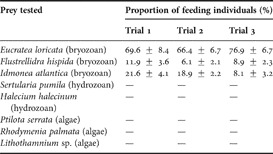
Results for independently tested food items showed a higher percentage of Palio dubia feeding on the bryozoan Eucratea loricata compared to all other species of bryozoans, hydrozoans and algae tested (Table 1). When exposed to E. loricata, 100% of the 6 or 7 nudibranchs being tested in each replicate were observed to feed on this prey on five occasions over the course of the experiment. On average, when pooling the daily observations, between 66 and 77% of the nudibranchs were found to feed on E. loricata in each of the three separate trials, with no significant difference between the trials (one-way ANOVA, P = 0.245). This percentage decreased significantly to ~8–22% for Idmonea atlantica (one-way ANOVA, P = 0.008) and 6–12% for Flustrellidra hispida (one-way ANOVA, P = 0.009) compared to E. loricata (Table 1). No significant difference was found between the three replicated trials of I. atlantica or F. hispida, nor between the average proportion of feeding nudibranchs on these two prey species (one-way ANOVA, P > 0.1). All other potential food items tested including the hydrozoans and algae gave negative results as no nudibranch was ever observed to prey on them (Table 1).
Feeding of adult Palio dubia on various prey offered independently for 4–7 d. The results are expressed as mean ± SE (N = 12–21).

SE, standard error.
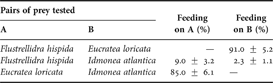
The results of pair-wise comparisons showed that when E. loricata was present, 85 to 91% of the nudibranchs fed on it and none were ever found to feed on another prey (Table 2). All of the 19 nudibranchs were seen feeding on E. loricata on six occasions. However, when E. loricata was absent, a few P. dubia were observed feeding on other species. When given the choice between F. hispida and I. atlantica, ~9% of P. dubia favoured the first species and ~2% the second, with no detectable preference between the two (one-way ANOVA, P = 0.067; Table 2).
Feeding preferences of adult Palio dubia exposed to pair-wise assemblages of potential prey. The results are expressed as mean±SE (N = 7).

SE, standard error.
Aggregative behaviour
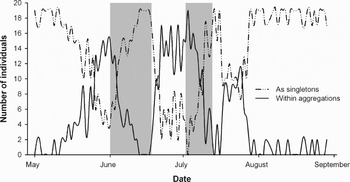
Figure 1 shows that most nudibranchs did not display any aggregative behaviour outside of the reproductive season (i.e. before 24 May and after 26 July). Toward the period when courtship was first observed, the proportion of animals occurring singly decreased progressively and the number of pairs and larger groups increased. Pairing was first observed three weeks before courtship, whereas the maximum proportion of aggregated P. dubia was noted one week or less before the beginning of courtship in both reproductive cycles studied (i.e. one started on 24 May, the other on 22 June) as well as during the courtship/copulation weeks (Figure 1). However, a period of lower aggregative behaviour was observed between the June and July reproductive periods, in the week of 15 June, which was characterized by a higher number of individuals occurring singly.
Number of Palio dubia individuals occurring singly or within aggregations (pairs and larger groups) from early May to late August 2006. Areas shaded grey correspond to periods of courtship and copulation.

Reproduction and development
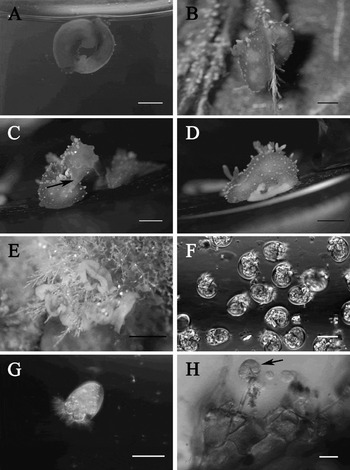
Copulation was preceded by a series of close interactions between two or more individuals (i.e. courtship behaviour), which included contact of the head, the tentacles and the margins of the mantle. The most striking courtship behaviour was expressed by paired individuals moving in a circle one behind the other (Figure 2A). This behaviour lasted ~120 minutes before the individuals finally settled side by side, immobile, head to tail with their body contracted for a period of 4 to 8 h (Figure 2B), before separating and resuming their activities. Overall, 51 ± 12% (means ± SD) of the courting pairs went on to copulate. Those that did not copulate simply separated and moved away from each other. Copulation (Figure 2C) generally occurred in the head-to-tail position, although sometimes individuals were almost at a 90° angle. Although Palio dubia is hermaphrodite, only three cases of reciprocal copulation were observed, whereas 23 of the recorded copulations involved a unilateral exchange. Copulatory behaviour typically lasted ~60–75 minutes. Copulation was initiated by the extension of the dart (Figure 2C) and inspection of the partner's posterior end. It was followed by the transfer of sperm through the body wall in one hypodermic impregnation that lasted <5 minutes, although it was difficult to precisely determine the time needed for gamete transfer. The individuals separated within 15 minutes following copulation. On several occasions, a third individual was attracted by the copulating pair but no record was made of more than two P. dubia interacting together.
Palio dubia. (A) Courtship; (B) two individuals in the head-to-tail position typical of pre-copulation; (C) copulation with visible dart of one of the partners (arrow); (D) egg-laying; (E) egg mass on the bryozoan Eucratea loricata; (F–G) newly hatched veliger larvae; and (H) a larva (arrow) exploring the substratum a few hours before settlement. The scale bars in A, B, C, D and E represent 1 cm; the scale bars in F, G and H represent 100 µm.

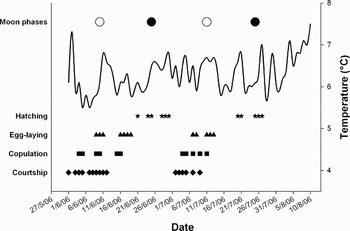
The first indications of courtship in both months were observed ~10 d before the full moon and courtship was recorded up to 2 d after the full moon (Figure 3). Incidences of copulation were noted ~7 d before the full moon and up to 7 d after it in June and July. Copulation was observed both during the day and at night. The earliest egg-laying was recorded 2 d prior to the full moon and never later than 10 d after it (Figure 3). Egg-laying mostly occurred between 11:00 h and 17:00 h. Most individuals that laid eggs in June were also involved in the courtship, copulation and spawning of July. Field observations confirmed laboratory results with egg-laying on E. loricata recorded during the same period by divers.
Reproductive activity of Palio dubia between May and October 2006 with corresponding lunar phase and seawater temperature. Open circles represent the full moon and filled circles represent the new moon.

Egg-laying (Figure 2D) by individuals was generally initiated one week after the onset of courtship, most of the eggs being deposited on the bryozoan E. loricata. When this substratum was not available, the nudibranchs laid eggs on other surfaces, including the side of the tank. The pale pink string of egg capsules formed an irregular spiral (Figure 2E). The duration of egg-laying was between 2.3 and 4 h. Spawned masses seemed to attract other individuals to lay their eggs in close proximity. Multiple spawnings were observed in certain areas of the bryozoans or the tanks. Incidences were noted of repetitive egg-laying in some individuals, however, the size of successive egg masses gradually decreased. Fertilization rates remained very close to 100% in all masses observed. Each mass consisted of capsules embedded in a gelatinous matrix. The typical egg mass was about 60 mm long and 2 mm wide and contained 4 layers of capsules, with one embryo per capsule.
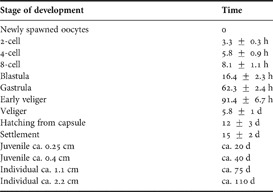
The first cleavage occurred 3.3 h after egg-laying, the early veliger was first seen after 91.4 h and hatching of the pelagic planktotrophic veliger took ~12 d (Figure 2F & G; Table 3). Hatching exclusively occurred at night, mostly a few days before, during or a few days after the new moon in June and July (Figure 3). Hatching was highly synchronized among all capsules within a given egg mass with the release of all veligers being completed within 30–60 minutes. Dispersal of the larvae after hatching was very low; most of them remained entangled among the bryozoan branches.
Development and growth of Palio dubia in running seawater at 5–7.8°C under natural light and photoperiod. A new stage was considered attained when 50% of embryos or larvae reached it. Data were compiled from the observation of 6 different egg masses (mean±SD).

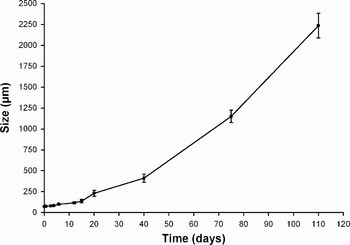
Survival rates varied from 5 to 7% after 2 weeks post-hatching. Growth rates were generally uniform among individuals, with juveniles reaching 2.5 cm in ~110 d (Table 3; Figure 4).
Growth rate of Palio dubia from fertilization to the adult size (mean ± SD, N = 5–47).

Settlement preferences
When the larvae hatched from the capsules, ~50–60% of them remained close to the bryozoan colony that harboured the egg mass and settled on it within 24–76 h. When not swimming, the veligers were negatively buoyant. Competent larvae were generally observed exploring the substratum by repetitively touching the surface of the bryozoan with their velum (Figure 2H). Bursts of swimming activity generally lasted 5 to 12 seconds, just enough for them to lift into the water column. When a competent larva found a suitable substratum, it attached to the surface via the velum (almost grabbing the surface) and started using its foot to touch and grab the bryozoan's appendices. The onset of metamorphosis was recorded shortly thereafter.
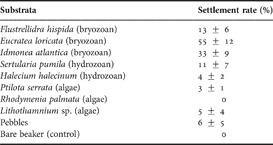
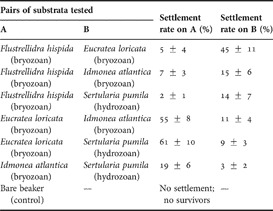
In independent trials, settlement success was significantly higher on E. loricata (one-way ANOVA, P < 0.001) than on all other substrata offered including other species of bryozoans tested (Table 4). The results showed that all species of bryozoans offered were preferred over other substrata tested including the hydrozoans, algae and pebbles. Some of the latter substrata showed settlement rates similar to the bare container control (Table 4). The larvae typically delayed settlement except when E. loricata was present, remaining pelagic for a maximum of 8 d when only algae, pebbles and bare beakers were offered. In pair-wise comparisons (Table 5), a clear preference was expressed for E. loricata over all other species of bryozoans and substrata tested (one-way ANOVA, P < 0.0001).
Settlement rates of Palio dubia on different substrata offered independently. The experiment was performed at 6.5°C in a thermostatic bath, under natural light and photoperiod for a maximum of 5 d. Data are based on the release of 50 larvae per container (N = 3) and expressed as mean±SD.

Pair-wise comparison of settlement rates of Palio dubia on four different substrata. The experiment was performed at 6.5°C in a thermostatic bath, under natural light and photoperiod for a maximum of 5 d. Data are based on the release of 50 larvae per container (N = 3) and expressed as mean±SD.

DISCUSSION
The present study revealed that the nudibranch Palio dubia is a specialized predator of bryozoans; that its reproductive cycle is controlled by environmental factors; and that it displays a complex social behaviour and preferentially settles and develops in association with its favourite prey species.
Feeding preferences
Like many other nudibranchs, P. dubia has a very specific diet typical of highly specialized predators (Clark, Reference Clark1975; Todd, Reference Todd1981, Reference Todd and Russell-Hunter1983; Allmon & Sebens, Reference Allmon and Sebens1988; Rudman & Willan, Reference Rudman, Willan and Breesley1998). During the feeding trials, P. dubia expressed a clear preference for the bryozoan E. loricata over all other bryozoans, hydrozoans, and algae offered, which were typically observed in its natural habitat. Other nudibranchs have been observed to feed on bryozoans (Todd & Havenhand, Reference Todd and Havenhand1989). As mentioned by Clark (Reference Clark1975) the feeding relationship between nudibranchs and various fouling organisms is often intimate, as observed in the present study. However, the fact that P. dubia is able to feed on other species of bryozoan when E. loricata is absent suggests that a certain degree of plasticity can be expressed when required, as noted in a few other studies (Allmon & Sebens, Reference Allmon and Sebens1988; Todd & Havenhand, Reference Todd and Havenhand1989). Nonetheless, whether P. dubia can survive for an extended period when deprived of E. loricata remains to be determined. Allmon & Sebens (Reference Allmon and Sebens1988) indicated that the European nudibranch Tritonia plebeia is a specialist feeder of the soft coral Alcyonium digitatum, however when this nudibranch was found as an invasive species along the eastern coast of the USA, it fed on another species of soft coral, A. siderium. Similarly, the nudibranch Coryphella verrucosa preys preferentially on hydroids but can shift its diet toward soft coral in winter when the preferred prey becomes less abundant (Sebens, Reference Sebens1983, Reference Sebens1986).
Palio dubia appears to depend largely on its ‘host’ to provide food, a substrate for spawning as well as a settlement site for the larvae. When it was present in a tank, E. loricata attracted all co-inhabiting P. dubia. However, in New England, Clark (Reference Clark1975) noted that P. dubia preferred to prey upon Cryptosula pallasiana, although the investigator stated that there was no verification of feeding preference under controlled conditions. It is possible that P. dubia displays a shift in its favoured diet based on local availability of prey species.
Aggregation, courtship and copulation
Palio dubia was found in the wild almost exclusively in association with the bushy bryozoan E. loricata on which the divers also observed egg masses. Observations from the field also confirmed the patterns and timing of egg-laying, development and hatching observed under laboratory conditions, thus strongly supporting the life history traits gathered on the species during this study.
The vast majority of opisthobranchs cross-fertilize obligatorily and must therefore find mates with which to copulate. In many species, the number of animals found paired or in groups increases during the breeding season (Audesirk, Reference Audesirk1979; Todd, Reference Todd1979). Our data indicate that adults of P. dubia express a well-defined reproductive pattern, with an increase in pairing and aggregation beginning about three weeks before the first signs of courtship and with two distinct peaks of aggregation in June and July. Before the onset of courtship, individuals began to form clusters, gathering close together but generally did not directly touch each other. This social behaviour was never observed outside the reproductive season. At other times of the year, P. dubia adults found on the same bryozoan colony remained away from each other or got closer for very brief periods.
Species recognition is apparently accomplished by contact chemoreception. The mucous trail in some species can be considered a pheromone as suggested by Murray (Reference Murray1971), as it carries information between conspecifics (Brown, Reference Brown1975). The observed pre-courtship behaviour suggests that P. dubia is exchanging information, possibly in the form of a chemical signal, to acquire information on the sexual status of potential reproductive partners or to fine tune the final stages of gametogenesis. A similar pre-mating behaviour was observed in another opisthobranch, Hydatina physis, from the Solomon Islands (Hamel & Mercier, Reference Hamel and Mercier2006). A similar mechanism could also be involved in attracting more individuals to the same location just before the beginning of the reproductive season. Aiken (Reference Aiken2003) also observed a tendency for the nudibranch Dendronotus frondosa to gather in groups of two to eight individuals in the late spring/early summer mating season.
Secondly, our data suggest that pre-copulatory behaviour (i.e. courtship) in P. dubia is characterized by multiple contacts between two potential reproductive partners, which help them find a suitable mate. Courtship interactions are common in aeolid nudibranchs (Schmekel, Reference Schmekel1971; Rutowski, Reference Rutowski1983; Karlsson & Haase, Reference Karlsson and Haase2002). When they finally come into contact, many opisthobranchs touch one another with tentacles, mouth, and other parts of their body (Schmekel, Reference Schmekel1971; Christensen, Reference Christensen1977; Eyster, Reference Eyster1979; Hamel & Mercier, Reference Hamel and Mercier2006) as observed in the present study. Courtship apparently serves to communicate willingness to copulate and to coordinate the partners' behaviour so that copulation can be achieved (Leonard & Lukowiak, Reference Leonard and Lukowiak1985). However, P. dubia did not always proceed with copulation after the courtship; in some cases, the partners moved away from each other. This observation suggests that individuals may exchange chemical signals (as during the pairing and aggregation discussed earlier), perhaps pheromones, which help them establish readiness for copulation and compatible gonadal maturity levels. Similar descriptions of ‘failed’ courtship were reported for other nudibranchs/opisthobranchs such as Aeolidia glauca (Karlsson & Haase, Reference Karlsson and Haase2002) and Hydatina physis (Hamel & Mercier, Reference Hamel and Mercier2006).
Like in P. dubia, mating in other opisthobranchs occurs in the head-to-tail position, side by side, following the general pattern described for other opisthobranchs, most of which are hermaphrodites that undergo reciprocal internal copulation and sperm storage (Hadfield & Switzer-Dunlap, Reference Hadfield, Switzer-Dunlap and Tompa1984; Karlsson & Haase, Reference Karlsson and Haase2002; Hamel & Mercier, Reference Hamel and Mercier2006). In this study, copulating P. dubia were often approached by a third individual, however this third individual never participated in the copulation. Both chemical and tactile cues have been implicated in eliciting copulation when mature nudibranchs are in close proximity (Gohar & Soliman, Reference Gohar and Soliman1963). Copulating or ovipositing animals often stimulate similar behaviour in conspecifics sharing the same water. For instance, a reciprocally copulating pair of Hexabranchus sanguineus was often approached by a third individual with a swollen genital papilla that it placed on the genitalia of the copulating pair (Gohar & Soliman, Reference Gohar and Soliman1963). Although no such behaviour was observed in P. dubia, simultaneous copulation was commonly noted in all tanks and in several individuals observed.
As described by Rivest (Reference Rivest1984) for both Palio zosterae and P. dubia, copulation of P. dubia in the present study involved the penetration of the partner's body wall by a penial cirrus. Palio dubia become sexually aroused upon touching each other, and usually align head-to-tail with right sides opposing. Hadfield & Switzer-Dunlap (1984) indicated that the sperm can be injected almost anywhere on the body surface, whereas our data on P. dubia strongly suggest that the hypodermic impregnation occurs predominantly around the base of the gill.
Egg-laying
Once an opisthobranch has started spawning, it usually continues to do so at frequent intervals (Hadfield & Switzer-Dunlap, Reference Hadfield, Switzer-Dunlap and Tompa1984). Indeed, individuals of Palio dubia that spawned once generally continued to do so several days in a row, although they released increasingly smaller egg masses. Similar deposition of smaller egg masses toward the end of a given reproductive period has been observed in other opisthobranchs of the genera Haminaea (Schaefer, Reference Schaefer1996) and Hydatina (Hamel & Mercier, Reference Hamel and Mercier2006). Rutowski (Reference Rutowski1983) indicated that with Hermissenda crassicornis a single copulation is sufficient to fertilize 2 to 3 egg masses. The advantage of multiple egg releases may lie in a better repartition of the reproductive effort.
The time it takes to lay a complete egg mass varies widely among opisthobranchs species, from less than 1 h to more than 10 h (Hadfield & Switzer-Dunlap, Reference Hadfield, Switzer-Dunlap and Tompa1984). Egg-laying in P. dubia lasts approximately 2.3 to 4 h, whereas it takes approximately 45 minutes in Haminaea solitaria (Schaefer, Reference Schaefer1996). Chia & Koss (Reference Chia and Koss1978) reported that it took 2 to 6 h for the deposition of a single spiral of eggs in Rostanga pulchra.
According to Hadfield & Switzer-Dunlap (Reference Hadfield, Switzer-Dunlap and Tompa1984), the interval between copulation and spawning is usually 12–24 h and may represent the time necessary for activation of exogenous sperm. A similar delay between copulation and egg-laying was found in P. dubia (~48–72 h).
Reproductive periodicity and environmental factors
During this study, copulation occurred around the same lunar phase (full moon) in both months, making the lunar cycle the most probable environmental cue responsible for the timing of courtship and copulation in P. dubia, a period during which temperature and salinity varied little. Egg-laying also occurred shortly thereafter, also during the full moon, when other environmental factors recorded remained stable. Based on the consistent spacing between courtship/copulation and egg-laying, it seems probable that the lunar cycle entrains an endogenous biological cycle. External factors such as changes in illumination, tidal cycle, lunar phase, relative abundance of food and interactions with conspecifics have been proposed to influence the timing of the spawning events in opisthobranchs (Hadfield & Switzer-Dunlap, Reference Hadfield, Switzer-Dunlap and Tompa1984). Although egg-laying in our study occurred when surface water temperatures were between ~6–7°C, similar to the results reported by Mileikovsky (Reference Mileikovsky1970) in the White Sea (Russia), this rather constant factor cannot account for the precise timing observed along the coast of Newfoundland in the present study and should be discarded as a proximal cue.
Hatching of the larvae from the capsules generally occurred after sunset or at night around the new moon of both months (Figure 3), in accordance with descriptions provided for other nudibranch species such as Berghia verrucicornis (Carroll & Kempf, Reference Carroll and Kempf1990). Whether directly or indirectly, the lunar cycle may thus influence the timing of hatching. Again, it is possible that hatching, which occurred roughly 11 d after egg-laying, is simply scheduled from the time of copulation and is therefore not triggered directly by the moon phase. Emerging at night during the darkest phase of the moon cycle may be viewed as advantageous as it decreases the predatory pressure and increases the chance of survival for a greater number of larvae.
Development and growth
The development of Palio dubia through planktotrophic larvae is similar to that of numerous other species, including Polycera aurantiomarginata and Polycera quadrilineata (Martinez-Pita et al., Reference Martinez-Pita, Sanchez-Espana and Garcia2006). However, the planktonic veliger stage is reportedly 34 d in Hermissenda crassicornis cultured at 13–15°C (Harrigan & Alkon, Reference Harrigan and Alkon1978), compared to 1–3 d for P. dubia reared at ~5°C during the present study. Chia & Koss (Reference Chia and Koss1978) stated that it takes 16 d to reach hatching in Rostanga pulchra. An average of ~11 d from egg-laying to hatching is reported for opisthobranchs (Hadfield & Switzer-Dunlap, Reference Hadfield, Switzer-Dunlap and Tompa1984), which is consistent with our study of P. dubia.
Like other opisthobranchs, P. dubia displays a very rapid growth rate. According to our data, it would take three months to reach the adult size, which is consistent with the generally accepted paradigm that most opisthobranchs reach maximum size, reproduce and die within one year (Hadfield & Switzer-Dunlap, Reference Hadfield, Switzer-Dunlap and Tompa1984; Gibson & Chia, Reference Gibson and Chia1989). Clark (Reference Clark1975) suggested that P. dubia in New England settled in March and grew to sexual maturity by April, which would entail a faster growth rate than recorded for the same species here in colder waters along the coast of Newfoundland.
Settlement preferences
For many molluscs, only a non-toxic surface is necessary to stimulate the settling events that probably trigger metamorphosis. Other molluscs will not metamorphose in any numbers unless the larvae receive a specific biological or chemical stimulus (Hadfield, Reference Hadfield, Chia and Mary1978). The present results indicate a strong selectivity for the bryozoan E. loricata for the settlement of P. dubia larvae.
Larvae of P. dubia began to explore the substratum at the onset of their free-swimming stage, exploring a bryozoan colony by brushing their velum on its surface. Similarly, the larvae of Adalaria proxima swim near the surface for 1–2 d before entering the searching phase (Thompson, Reference Thompson1958). Hadfield & Switzer-Dunlap (Reference Hadfield, Switzer-Dunlap and Tompa1984) noted that many opisthobranch larvae display this so-called ‘searching behaviour’, which refers to alternate periods of swimming and settlement. Such larvae are usually capable of undergoing metamorphosis when a substratum is deemed suitable in some subtle way, and are thus referred to as competent larvae (Hamel & Mercier, Reference Hamel and Mercier2006).
Multiple-choice experiments demonstrated that P. dubia could delay settlement in order to find a proper substratum. The results also demonstrated a strong preference for a specific substratum during settlement, namely the bryozoan E. loricata, which was preferred to all other substrata tested. In independent tests, settlement rate was also greatest on E. loricata, although the larvae also settled on other species of bryozoan but in much fewer numbers. Many marine mollusc larvae can delay settlement for extended periods and thereby increase the possibility of reaching a suitable substratum (e.g. Scheltema, Reference Scheltema1961; Hadfield, Reference Hadfield, Chia and Mary1978; Heslinga, Reference Heslinga1981; Widdows, Reference Widdows1991). Thompson (Reference Thompson1958) and Gurin & Carr (Reference Gurin and Carr1971) suggested that opisthobranch larvae select substrata by means of sensitive chemoreception. Indeed, larval metamorphosis can be triggered by chemicals or other factors associated with a specific aspect of the habitat, often the presence of the food of adults (e.g. Chia & Koss, Reference Chia and Koss1978; Hadfield, Reference Hadfield, Chia and Mary1978, Reference Hadfield1984; Burke, Reference Burke1986; Gibson & Chia, Reference Gibson and Chia1989; Carroll & Kempf, Reference Carroll and Kempf1990; Buckland-Nicks et al., Reference Buckland-Nicks, Gibson, Koss and Young2002; Hamel & Mercier, Reference Hamel and Mercier2006). The preference of P. dubia for E. loricata could thus be explained by the fact that these bryozoans are among the preferred prey of the adults of this species. When exposed independently to suboptimal substrata, P. dubia larvae sometimes delayed settlement until death, suggesting that they were searching for precise cues or components. Hadfield (Reference Hadfield, Chia and Mary1978) indicated that Phestilla sibogae perceived the inducer molecule apparently as a dissolved substance. Palio dubia seems to increase its chance to ‘smell’ the substratum by brushing and scraping the target surface, most probably to increase the release of a chemical that can help them to decode the nature of the surface.
Acknowledgements
We thank the Ocean Sciences Centre Field Services of Memorial University (Newfoundland and Labrador) for collecting the nudibranchs. This research was partly funded by a NSERC Discovery Grant and a CFI Leaders Opportunity Fund to A. Mercier.