1 Introduction
By the year 2020, the British Council (2014) estimates that there will be two billion English language learners. Some learn in the classroom; some learn online. Some may even learn through their phone or in an online class. Regardless of the medium, computational tools to enhance this educational experience will be valuable. Automatic scoring of essays—not only for grammar, but also fluency—would contribute greatly to second-language learners’ understanding. User personalization for online services (including search engines and social networks) would benefit from improved user profiling. More relevant books or news articles could be recommended if the user’s background and competency of English were known.
Due to these many motivating examples, research in non-native text analysis has prospered. This field encompasses any textual task that deals with words written in a language other than the writer’s native tongue. We call the native language L1 and the second, learned language L2. Throughout this survey, we will usually assume that L2 is English, though most (but not all) techniques discussed in this survey are general and could function with any pair of L1 and L2.
Existing work in non-native text analysis is somewhat scattered, appearing in workshops and shared tasks more frequently than standard proceedings. In this survey, we provide a systematic overview of these scattered works to make it easier for researchers to digest the state of the art in this emerging area.
1.1 Scope
The current work on non-native text analysis generally falls into two main categories:
(1) Native Language Identification (NLI): Classifying L1 based on text written in L2. Techniques can be categorized into feature-based (using a classifier) or likelihood-based (using a probabilistic model).
(2) Non-native Grammatical Error Correction (GEC): Detecting and correcting grammatical errors in L2 text. Techniques can be categorized into targeted (correcting specific errors) or general (correcting all errors).
Other subareas such as fluency scoring, non-native essay scoring, and text simplification for non-native speakers also exist, but we focus this survey on the two much larger areas explained above.
An excellent overview of GEC with a focus on non-native learners is available (Leacock et al. Reference Leacock, Chodorow, Gamon and Tetreault2014). This short book is a concise collection on the topic and consists of many recent advances since 2010. If the reader wishes to delve into more detail in this subtopic, we suggest referencing their work, whereas our paper is a broader outline and thus not able to go into as much depth in one particular area.
Spelling correction described in Kukich (Reference Kukich1992) is a potentially relevant task, though we choose to focus on the grammar correction aspect instead. This is not to say that spelling features do not play a role in (e.g.) NLI; rather, the method of spelling correction is not relevant to non-native text analysis. Correcting speech is also an important issue: besides the obvious speech recognition challenges in computer science and electrical engineering, speakers tend to voice their words much differently than when writing. Therefore, we do not include any investigation into these works in this paper.
Shared tasks provide a common goal and dataset to a wide array of researchers. This enables quick and accurate comparison of different methods, while simultaneously increasing interest and producing exposure for the problem in hand. Thus, we detail two relevant shared tasks in this survey that deal with non-native writers of English. Author profiling, authorship attribution, and plagiarism detection at PAN 2014 (Rangel et al. Reference Rangel, Rosso, Chugur, Potthast, Trenkmann, Stein, Verhoeven and Daelemans2014) are also related, but we do not focus on those here, instead considering them related works since there is no specific component of non-native analysis.
Shared tasks have even started to evolve for L2s besides English. For example, the Techniques for Educational Applications Workshop had a shared task on GEC for Chinese as a foreign language (Yu, Lee and Chang Reference Yu, Lee and Chang2014).
1.2 Organization
We now review the structure of this paper. In each section, a figure briefly summarizes the papers discussed and the methods used. If applicable, a comparison of performance is also included. In this survey, we have a particular preference for system papers as demonstrated by our sections on shared tasks. By system papers, we mean research that immediately puts theory into practice, giving real-world results which allow for better interpretation of effectiveness by the reader.
First, in Section 2, we introduce common datasets used in works described throughout the rest of this survey. They should give some perspective on the task in hand and create a mental baseline for the reader. We feel that it is important to make note of these datasets here since any future work will most likely be making use of these corpora.
In Section 3.1, we start with an introduction to NLI, usually formulated as a classification problem. Observed data is text written in L2 (where L2 means English: the second or foreign language), and a classifier predicts the writers’ L1 (the native language). Although this may be considered a standard classification problem, the features chosen to target non-native writer discrimination distinguish different approaches. These range from simple unigram word counting to parse tree reranking descriptions. In future sections, we will see how classifiers themselves may be adapted or configured to take advantage of this specific domain.
Section 3.2 discusses the NLI Shared Task 2013 from the Building Educational Applications workshop. This shared task uses a corpus detailed in Section 2.
Section 4.1 discusses correcting grammatical errors, such as articles and prepositions. These techniques are usually framed as classification problems; a classifier determines if there is an error or not, and if so, predicts what the best solution would be given a fixed set of candidates. Some methods go beyond a simple classification setup and rely on more NLP-heavy techniques such as language models and grammatical parse trees to find the best corrected sentence.
Then, Section 4.2 covers the CoNLL 2013 and 2014 shared task on GEC. This task also uses a corpus described in Section 2, and systems find and correct errors in text written by non-native English speakers.
Finally, we end with a discussion and conclusions in Section 5, reflecting on what issues may still be unaddressed.
2 Non-native corpora
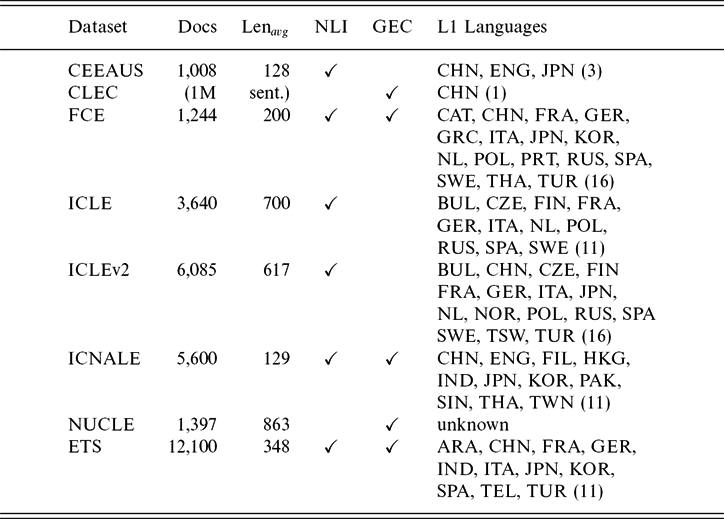
All the work on non-native text analysis uses some kind of non-native text corpus. In this section, we give an overview of the major datasets used in existing work, which we will survey in the next few sections. As shown in Table 1, the sizes of these corpora vary from around 1,000 to 12,000 documents with an average length of 128 to over 800 words. They cover a wide L2 range, geographically focused in Europe and Asia. Abbreviations used in the table are ARA (Arabic), BUL (Bulgarian), CAT (Catalan), CHN (Chinese), CZE (Czech), ENG (English), FIL (Filipino), FIN (Finnish), FRA (French), GER (German), GRC (Greek), HKG (Hong Kong Cantonese), IND (Indian languages), ITA (Italian), JPN (Japanese), KOR (Korean), NL (Dutch), NOR (Norwegian), PAK (Urdu), POL (Polish), PRT (Portuguese), RUS (Russian), SIN (Singapore languages), SPA (Spanish), SWE (Swedish), TEL (Telugu), THA (Thai), TSW (Tswana), TUR (Turkish), and TWN (Taiwanese). We now give a detailed description of each dataset.
Comparison of non-native English datasets: corpus statistics, and whether they can be used for NLI or GEC. Web links to each dataset are included in the text. Note that average document length may vary depending on tokenization method

ICLE (Granger Reference Granger2003), the International Corpus of Learner English, is an early popular dataset used to investigate NLI. Its popularity is mostly due to the fact that no other large NLI corpora existed at the time the ICLE was released. It is a collection of essays on ‘extremely varied’ topics written by undergraduate students studying English. Additional metadata for each essay is part of the ICLE—such as gender and age—though these features are rarely used by researchers. Commonly, a five-language subset of Russian, Czech, Bulgarian, French, and Spanish languages is used, popularized by Koppel, Schler and Zigdon (Reference Koppel, Schler and Zigdon2005). These subsets caught on because the L1 distribution is quite unbalanced; the subsets have a more uniform distribution of native languages. Thus, it is important to note if a subset of the ICLE is used so accurate comparisons may be made. The corpus is publicly available, but requires a license.Footnote 1
ICLEv2 (Granger et al. Reference Granger, Dagneaux, Meunier and Paquot2009) is an expanded version of the ICLE. There are no major differences in the text files themselves (aside from the fact there are more), since the ICLE is a subset. Version two additionally comes with a concordancer, a graphical interface that allows easy search and simple exploratory analysis over the dataset. However, when running experiments detailed in future sections of this paper, researchers tend to use the raw text data from the corpus instead of any built-in software. The corpus is publicly available, but requires a license.Footnote 2 The maintainers of ICLEv2 are currently working towards releasing a third version.
CEEAUS (Ishikawa Reference Ishikawa2009) is the Corpus of English Essays written by Asian University Students. Unlike the ICLE, the essays are restricted to two topics: It is important for college students to have a part-time job and Smoking should be completely banned at all restaurants in the country. A common vocabulary for each prompt emerges due to this fact, perhaps allowing a more meaningful word usage analysis to occur. Further restrictions attempt at creating the most uniform testing conditions as possible: spell checking is required, but dictionary use is prohibited; the writers have twenty to forty minutes to complete their task. Aside from its small size, the main downside to this corpus is that 77 per cent of the essays are from native Japanese speakers, establishing a rather high classification baseline for NLI. A Website exists for the corpus, but it is no longer available to downloadFootnote 3 since it is a subset of ICNALE.
CLEC (Gui and Yang Reference Gui and Yang2003) is the Chinese Learner English Corpus. It consists of one million error-tagged sentences and is mainly used for GEC. While there is no differentiation in L1, the dataset is segmented into levels of English fluency. So while NLI classification is not possible, an analysis on the skill level is feasible. Although free, the CLEC is only available to members of the university that created it.Footnote 4
FCE, created by Yannakoudakis, Briscoe and Medlock (Reference Yannakoudakis, Briscoe and Medlock2011), is the First Certificate of English dataset—a corpus of essays written by students studying English that took the Cambridge Assessment’s English as a second or other language exam. The dataset was compiled as a benchmark for automated essay scoring systems, and contains about eighty types of correction annotations in each essay. Like the ICLE, additional metadata is also included, such as grade, age, and native language. There are ten different prompts, each with a varying number of responses. This corpus may be downloaded freely online.Footnote 5
ICNALE (Ishikawa Reference Ishikawa2013), the International Corpus Network of Asian Learners of English, is an expanded version of CEEAUS. Like the ICLEv2, the previous version is a subset of this one. Aside from adding more Asian L1 languages, the language distribution of the dataset is much more balanced. Professional proof readers corrected the part-time job essays, and their revised versions are also included. This provides an opportunity to see how the non-native text is translated into sounding more native—with this information, it is possible to do much more than NLI. The last segment of the ICNALE is a collection of 1,900 recorded speeches and their transcripts. After registering online, the corpus is availableFootnote 6 to freely download.
NUCLE (Dahlmeier, Ng and Wu Reference Dahlmeier, Ng and Wu2013), the National University of Singapore Corpus of Learner English is also a collection of essays on a wide variety of subjects. The essays were written by students studying English at the Center for Language Communication at NUS and annotated and corrected by English instructors. Overall, nearly 47,000 errors were detected by the instructors with good rater agreement. Findings on the corpus revealed that overall errors in non-native text are actually quite rare (at least in this corpus), on the order of around four per one hundred words. Since this corpus was not intended for NLI, there is no information about the L1 language of each essay. This is the dataset used by the CoNLL 2013 shared task described in Section 4.2, and is available for download online.Footnote 7
ETS (Blanchard et al. Reference Blanchard, Tetreault, Higgins, Cahill and Chodorow2013) is a collection of essays from the Test of English as a Foreign Language, a component of the Educational Testing Service. It is a standardized test measuring English proficiency for students seeking to enroll in college. There are 1,100 essays per L1, sampled from eight prompts. The purpose of the corpus was to further enable work in NLI, and was used by the BEA8 shared task described in Section 3.2. ETS is publicly available, but requires a license.Footnote 8
From our comparison, we have two datasets that are subsets of another (CEEAUS and ICLE). There is likely no reason to prefer CEEAUS over ICNALE or ICLE over ICLEv2, since the newer versions are simply expanded. This leaves six main datasets: CLEC, ETS, FEC, ICLEv2, ICNALE, and NUCLE. Of these six, CLEC, ETS, FCE, ICNALE, and NUCLE, could be used for error analysis since they contain annotations. All except CLEC and NUCLE can be used for NLI since the L1 information is part of the datasets.
As for content, all are essays written by university students, but only ICNALE and ETS have the choice of essay topics strictly controlled—though the former has two prompts and the latter has eight. ICNALE L1s are clearly focused in Asia; NUCLE writers are most likely from Singapore, while FCE, ICLEv2, and ETS L1s are more evenly distributed across the globe. Of course, CLEC consists of all native Chinese authors.
Considering these differences, we need to think about the following questions when interpreting results. What is the baseline accuracy? How difficult is it to distinguish L1s? Does the number of documents (and document length) have any bearing on an impression of the results?
Although not a standardized corpus, the website Lang-8Footnote 9 is also a popular location to retrieve non-native English. This is a site where users write in a second language and get corrections from native speakers. Corpora derived from this site have been used for NLI (e.g. Brooke and Hirst (Reference Brooke and Hirst2011)) and GEC (e.g. Tajiri, Komachi and Matsumoto (Reference Tajiri, Komachi and Matsumoto2012)).
In the next sections, we systematically review the two areas of non-native text analysis.
3 Native language identification
NLI is usually the first step in any second language error correction or author profiling system. Identifying the native language of an anonymous text was first popularized by Koppel et al. (Reference Koppel, Schler and Zigdon2005). Brooke and Hirst (Reference Brooke and Hirst2012) does an extensive survey of NLI feature efficacy, and develops a robust model that works well when used across corpora. NLI tasks are most commonly evaluated solely on a small learner corpus usually consisting of student essays (as shown in Section 2). It was previously thought that lexical features would be biased or overfit towards essay topics, but a cross-corpus evaluation showed that this was not the case (Brooke and Hirst Reference Brooke and Hirst2012).
For a more in-depth discussion of authorship attribution, we recommend the reader consult two well-known surveys (Stamatatos Reference Stamatatos2009) (Koppel, Schler and Argamon Reference Koppel, Schler and Argamon2009). Many techniques common to authorship attribution and author profiling are also relevant to NLI.
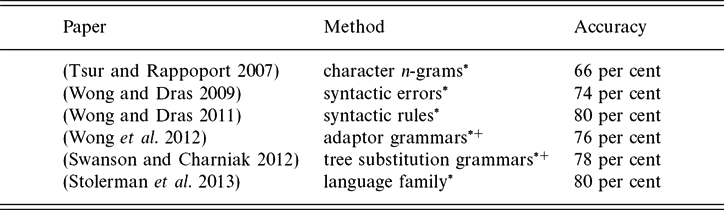
As mentioned in Section 2, the ICLE was an early popular dataset to evaluate NLI tasks, especially using a subset of five European languages partitioned by Koppel et al. (Reference Koppel, Schler and Zigdon2005). A table has been created (Table 2) to portray the summary described in Brooke and Hirst (Reference Brooke and Hirst2012). In addition to the results displayed in the table, Wong and Dras also attempted to perform dimensionality reduction with LDA (Blei, Ng and Jordan Reference Blei, Ng and Jordan2003) as feature generation; however, this was not a successful method.
Summary of native language identification results listed in (Brooke and Hirst Reference Brooke and Hirst2012) for the ICLE corpus; accuracies added to chart. * indicates feature-based methods and + indicates likelihood-based methods
Techniques for NLI can be categorized into two methods: feature-based and likelihood-based. Feature-based methods rely on informative features derived from the text and are fed to standard machine learning algorithms (usually SVM or MaxEnt). Likelihood-based methods learn a probabilistic model (usually a grammar or language model) for each L1 and assign a label based on the maximum likelihood model. We now move onto specific techniques applied in NLI.
3.1 Techniques in native language identification
The first feature-based method (Tsur and Rappoport Reference Tsur and Rappoport2007) found that incredibly simple top 200 frequent bigram character features fed to SVM led to 66 per cent accuracy on the five native languages. They claimed that word choice of non-native speakers is influenced by the phonology of their native language (as evidenced by the effectiveness of the character features). This approach is compared to a unigram words baseline which achieved only 47 per cent accuracy. They finally hypothesized that using a spoken-language corpus would achieve even stronger results favoring character bigrams. Their reasoning was that much less conscious effort is put into speaking than writing. For analyzing transcripts of spoken words, the ICNALE corpus may be applicable, described in Section 3.
NLI has also been approached through contrastive analysis (Wong and Dras Reference Wong and Dras2009): the idea that errors in text are influenced by the native language of the author. They investigated three error types as features: subject-verb disagreement, noun-number disagreement, and determiner misuse. These error types are then used as ‘stylistic markers’ for NLI features with an SVM classifier. To find these errors in text, they used an open source grammar checkerFootnote 10, as opposed to professionally edited text. Interestingly, ANOVA showed that the features had a measurable effect, but after combining their contrastive features with existing methods, they were not able to significantly increase the classification accuracy from Koppel et al. (Reference Koppel, Schler and Zigdon2005).
The previous authors (Wong and Dras Reference Wong and Dras2011) follow their work on contrastive analysis, attempting to amend its shortcomings. Instead of error types, they use two different features obtained from grammatical parse trees: horizontal slices (production rules) and parse rerankings. They claim these are the first pure syntactic features used in NLI. For the production rules, they immediately applied information gain dimensionality reduction. The reranking features are those contained in the Charniak parserFootnote 11 and Stanford ParserFootnote 12 trained on the Wall Street Journal. Unlike the previous two attempts, the authors found MaxEnt to outperform SVM as the classifier. Additionally, five-fold cross validation was performed (as opposed to ten-fold), which means the accuracies cannot be precisely compared with previous work. In any event, they report a final accuracy of 80 per cent, which was the highest reported as of 2012.
Wong, Dras and Johnson (Reference Wong, Dras and Johnson2012) explore the last author’s—Mark Johnson’s—adaptor grammars (Johnson, Griffiths and Goldwater Reference Johnson, Griffiths and Goldwater2006) to generate features. Simply, adaptor grammars are a non-parametric extension to PCFGs (probabilistic context free grammars). They can learn arbitrary-length word sequences (collocations); for example, gradient descent and cost function were learned as phrases in a machine learning topic. These adaptor grammars are used in two ways: in the first, collocations are used as features in a MaxEnt classifier. In the second, the grammar is trained on each class (representing native language). At test time, the most probable grammar to have generated the text is selected. For both tasks, the authors use five-fold cross validation on seven native languages. In the feature-based classification, they achieved 76 per cent; in the language model-based classification, they achieved only 50 per cent, a performance similar to the unigram word baseline from Tsur and Rappoport (Reference Tsur and Rappoport2007).
Swanson and Charniak (Reference Swanson and Charniak2012) made use of tree substitution grammars (TSGs) (Blunsom and Cohn Reference Blunsom and Cohn2010). TSGs are a tree-rewriting formalism that defines operations on partial (parse) tree objects. For example, subtrees may be added or removed from a base tree. Benefits of using this method are priors which prefer smaller production rules and the ability to capture long-range dependencies. Various induction methods are compared to generate features, and five-fold cross validation on seven native languages is performed. All TSG features outperformed the CFG baseline (at 73 per cent). The highest TSG induction method was Bayesian induction at 78 per cent.
Massung, Zhai and Hockenmaier (Reference Massung, Zhai and Hockenmaier2013) also make use of grammatical parse tree features, but mainly focus on their structural aspects as opposed to the syntactic category labels. In one classification task, they found these features to work well in determining the nationality of student essay writers from the CEEAUS dataset. These structural parse tree features may be applicable in other tree-based objects such as adaptor grammars, TSGs, and dependency parses, but this has yet to be explored.
Lastly, Stolerman, Caliskan and Greenstadt (Reference Stolerman, Caliskan and Greenstadt2013) use language family as a feature for NLI. Specifically, they took ICLEv2 documents classified with low confidence using unigram features and reclassified them into one of the Germanic, Slavic, or Romance language families. From there, the document was classified as an L1 using a subset of training data only from the language family it was classified as. This method is a type of hierarchical classification problem, and achieved about a 6 per cent increase over the baseline in NLI accuracy when using information gain feature selection.
In summary, Table 2 lists the comparable accuracies from experiments run on the ICLE/ICLEv2 subset of five European languages. In general though, accuracies between 70 per cent to 80 per cent are standard for a wide variety of techniques and corpora.
3.2 Shared task in native language identification
The eighth Building Educational Applications workshop held a shared task dedicated to NLI (Tetreault, Blanchard, and Cahill Reference Tetreault, Blanchard and Cahill2013). Its goal was to increase visibility of the problem and standardize results on a larger dataset: ETS. In total, twenty-nine teams participated in the shared task.
There were three separate subtasks, differentiated by what data was allowed for training:
• Closed Training: Use only the ETS corpus for training. All twenty-nine teams attempted this task.
• Open Training I: Use any data except the ETS corpus for training; the evaluation is still done on the ETS test set. Only three teams attempted this task.
• Open Training II: Use any data including the ETS corpus. Only four teams attempted this task.
Overall results for the closed training were relatively close; the top thirteen teams had between 80–83.6 per cent accuracy. The open training I subtask teams performed much lower (probably as expected) at around 33 per cent, 38 per cent, and 57 per cent accuracy. Finally, in the open training II subtask, none of the four teams were able to beat the highest closed score. The most useful results for evaluating models are probably those of the closed task, since all training data is uniform, though it is interesting to see approaches employed to increase the amount of training data. For example, in the open subtasks, other NLI datasets were used such as ICLE, FCE, and ICNALE (all described in Section 2). Additionally, some teams crawled Lang-8, also described in Section 2.
The most common features used were n-grams of lexical tokens such as words or part-of-speech tags; Figure 1 compares the n-grams used by all teams. Aside from these, some less common features were grammatical: dependency parses, TSGs (Blunsom and Cohn Reference Blunsom and Cohn2010), parse tree rules, and adaptor grammars (Johnson et al. Reference Johnson, Griffiths and Goldwater2006) were used. Spelling error features were also captured by three of the teams. These features are all described in work in Section 3.1. Below, we outline a few of the more unique feature representations.
Number of teams using particular n-gram features (left) and number of teams using a particular machine learning algorithm (right). DFA and PPM refer to discriminant function analysis and prediction by partial matching.
Skipgrams (Guthrie et al. Reference Guthrie, Allison, Liu, Guthrie and Wilks2006) were an n-gram variant feature used by several teams. Instead of considering an n-gram to consist of n adjacent words in the text, a k-skip n-gram allows up to k words total to be skipped in a sequence of tokens. Given the sentence ‘They all studied statistics Monday evening’, normal 3-grams would be {They all studied, all studied statistics, studied statistics Monday, statistics Monday evening}. A few possible 2-skip 3-grams are {They all studied, They studied statistics, They statistics Monday}. This attempts to capture important phrases without regard to interspersed function words. Using skipgrams was shown to reduce perplexity on a testing set, as well as offer a viable alternative to increase the corpus size (which is usually not feasible). Since most NLI datasets we have examined are relatively small, using skipgrams could help improve language modeling. While interesting, none of the teams in the top third used skipgrams in their systems.
For one feature type, the system by LIMSI used a form of machine translation called ‘back translations’ (Lavergne et al. Reference Lavergne, Illouz, Max and Nagata2013). A back translation attempts to capture a writer’s lexical preference for a word sense. For example, LIMSI found that the English word sense for awkward is more likely to be written as clumsy by native Spanish speakers. These word preferences were used as features in addition to other features: word n-grams, spelling mistakes, and grammatical mistakes. Adding the back translation features slightly increased the task’s overall classification accuracy, but the team still performed poorly overall.
The CMU-Haifa team used a ratio of passive to active verbs in their system (Tsvetkov et al. Reference Tsvetkov, Twitto, Schneider, Ordan, Faruqui, Chahuneau, Wintner and Dyer2013). They operated under the common assumption that English uses passive voice more frequently than other languages, and the amount of passive use may vary based on the writer’s L1. Recall that passive voice is a literary technique that shifts attention away from the one performing an action. ‘The passive voice is often used’ is a sentence in the passive voice; ‘English speakers often use the passive voice’ is a sentence in the active voice. The passive voice is characterized by the verb to be and the past participle of the verb. In the previous sentences, we have is used and use conjugated differently. Using the passive ratio feature exclusively yielded a 12 per cent accuracy on a 9 per cent baseline. In combination with four other main features, the accuracy was not significantly improved. However, further investigation could be warranted to examine the usefulness of such stylistic composition features.
SVM was by far the most prevalent classifier employed by the teams, as displayed in Figure 1. Below, we outline some of the more uncommon classifiers.
Discriminant function analysis from statistics was used for increased interpretability over other methods (Kyle et al. Reference Kyle, Crossley, Dai and McNamara2013). Using this model, they were able to find correlations between different L1s. For instance, Japanese and Korean L1s were highly correlated in their underuse of the words {all, any, but, different, or, person, this, your}. Unsurprisingly, languages of similar origin were also correlated—the Romance languages were often misclassified as one another due to increased correlation of n-gram tokens. Unfortunately, this team performed poorly overall.
Originally designed to operate on DNA sequences, the string kernel model (Popescu and Ionescu Reference Popescu and Ionescu2013) is given a stream of characters. Specifically, a kernel based on local rank distance is used for NLI. The simplest string kernel function f(w 1, w 2) counts the number of substrings of a particular length that w 1 and w 2 share. It is also quite intuitive to introduce a normalized version that is not biased by long words. Local rank distance is then an extension that counts the sets of similar n-grams between w 1, w 2. In their NLI context, each word was actually a character n-gram. This method has the advantage that no syntactic information is needed; no parsing or even sentence or word segmentation is required. In training, they found that n ∈ [5, 8] gave the best results, allowing them to take third place overall in the closed task.
Similar to the string kernels previously, Bobicev (Reference Bobicev2013) uses a method which requires very little text processing: prediction by partial matching, a statistical compression method. The output of prediction by partial matching is a language model which can be used to find the highest likelihood L1 given some unknown text. Both words and characters were used as tokens, though character features performed much worse than words, obtaining a precision of 37 per cent (compared to 70 per cent from the word tokens) on the 9,900-document training set. This performance placed the prediction by partial matching features in the bottom third of contestants.
In conclusion, most methods used by teams in the NLI shared tasks were very standard (e.g. n-grams of words with SVM). In fact, the winning team (Jarvis, Bestgen and Pepper Reference Jarvis, Bestgen and Pepper2013) with 83.6 per cent accuracy used SVM with unigram to trigrams of log-entropy weighted lexemes, lemmas, and POS tags. A small number of teams investigated some unique text representations and classification techniques. Given options between feature-based and likelihood-based strategies, most teams focused on features. While not always successful, these new methods can be further explored and analyzed in future work. Table 3 summarizes the results discussed on the ETS dataset. After the contest ended, others have surpassed the highest-scoring Jarvis et al. team.
Increasing state-of-the-art NLI accuracy results for the ETS dataset
First, Bykh and Meurers (Reference Bykh and Meurers2014) considered an ensemble of various features, consisting of context-free grammar rules and forty n-gram representations of words, POS tags, and lemmas for n ∈ [1, 10]. They found training a separate classifier for each feature type gave definite advantages over concatenating feature vectors.
Second, Ionescu, Popescu and Cahill (Reference Ionescu, Popescu and Cahill2014) improved over Bykh and Meurers (Reference Bykh and Meurers2014) by using only character-based features. However, the way that the character features are used is advanced. They combined various string kernels with two learning methods, kernel ridge regression and kernel discriminant analysis. We suggest that the reader consult their paper for a more in-depth description of these tools. Their best results were when string lengths were in the range [5, 8]. Seven of their kernel and learning combinations outperformed the first place shared task team (Jarvis et al. Reference Jarvis, Bestgen and Pepper2013), and their best two combinations best the Bykh and Meurers score. Their highest-scoring setup was kernel discriminant analysis on a weighted combination of a presence bits kernel (dot product of occurring characters) and the intersection string kernel.
4 Non-native grammar correction
We now transition from NLI to non-native grammar correction. While the former is often tackled as a one-step task, the latter usually relies on classification as a component, but also consists of other parts that are able to capture a deeper syntactic meaning (such as dependencies or language modeling). Correcting machine translated text is a related issue, but we do not discuss it here; instead, please see Corston-Oliver, Gamon and Brockett (Reference Corston-Oliver, Gamon and Brockett2001) or Gamon, Aue, and Smets (Reference Gamon, Aue and Smets2005).
In the Section 4.1, we discus some key papers that display a wide variety of techniques. We also briefly touch on training data issues as well as evaluation of corrected text. Section 4.2 outlines the CoNLL shared task in GEC for 2013 and 2014.
4.1 Techniques in non-native grammar correction
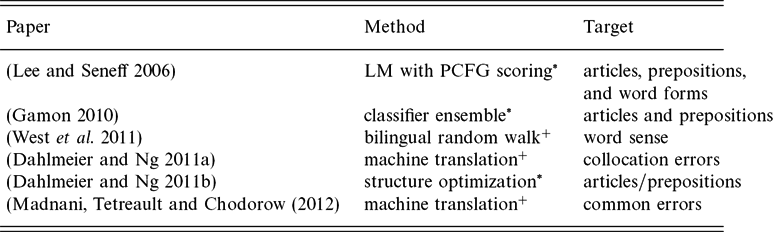
Some grammar correction methods are targeted towards a very specific subset of errors, often categorized by the corpus; others attempt to solve more general errors concerning word sense or collocations. Evaluation for grammar correction is much more varied and unstandardized in comparison to the configurations from NLI seen in the previous section. Which non-native corpus is used also dictates the types of errors that can be corrected. Table 4 compares the different methods discussed in this section and categorizes them as either targeted or general approaches.
Comparison of grammatical error correction strategies. * indicates targeted approaches and + indicates general approaches
Lee and Seneff (Reference Lee and Seneff2006) train a trigram language model on a lattice of alternatives, where ‘alternatives’ are prepositions, articles, and auxiliaries that may or may not occur between words in the original text. For example, the sentence I want flight Monday can be corrected by inserting two tokens as such: I want a flight on Monday. Their algorithm first strips all such alternatives from the original sentence. So far, this is not much different from the article and preposition corrections. However, they additionally change each remaining word in the input sentence to be a set of related words to the base form: want → {want, wants, wanted, wanting}. Their language model then outputs the k-best candidates. Next, these candidates are given to a PCFG and reranked. The final output is the top-ranked sentence from the PCFG. Across all experiments, they found that reranking the language model candidates significantly increased the F measure.
West, Park and Levy (Reference West, Park and Levy2011) use bilingual random walks between L1 and L2 word senses. For example, on one side of a bipartite graph are L1 words. There are connections from a word w ∈ L1 to a word w′ ∈ L2 if a w could be translated into w′. w could be the English word head, and be translated into a physical head, head of an organization, or the verb to head. This model was used to correct non-native sounding phrases such as entire stranger to the more natural complete stranger. This bipartite graph was combined with a language model to correct non-native sentences. In these experiments, the native language was Korean. Evaluation was performed with Amazon Mechanical TurkFootnote 13 where workers chose between the corrected sentence and the original sentence. Results were not strongly positive, since sometimes the corrected errors changed the meaning of the sentence or made it ungrammatical. In future work, the authors suggest using a richer probabilistic model such as a PCFG.
Dahlmeier and Ng (Reference Dahlmeier and Ng2011a) use the NUCLE corpus to find and correct collocation errors via machine translation. Here, a collocation is a phrase commonly used by native speakers. The authors propose that when a writer mentally translates from L1 to L2, some unnatural phrases result due to word choice. They give an example, ‘I like to look movies’ that might be written by a native Chinese speaker since watch and look are very similar in the L1. It would be possible to correct this to the more grammatical ‘I like to look at movies’, but it still does not sound natural. Instead, look is replaced by watch, resulting in the more fluent collocation watch movies. For their experiments, they assume the unnatural collocations have already been identified; this mimics a system where a user may ask for improvement suggestions for a snippet of writing. They train a statistical machine translation model on a parallel Chinese–English corpus to correct collocation errors in the NUCLE corpus. A log-linear model was used to score the candidate phrases which allows additional spelling, homophone, and synonym features to be incorporated. They evaluated their method as a retrieval task, where they returned the top k suggestions to fix each collocation error. Two native-English speakers judged results from 500 corrections with good rater agreement. Finally, they performed an analysis of errors and found that the main reason top-ranked phrases were not correct was due to out-of-vocabulary words.
Dahlmeier and Ng (Reference Dahlmeier and Ng2011b) introduce an alternating structure optimization approach to GEC. In short, alternating structure optimization is able to leverage a common structure between multiple related problems; see Ando and Zhang (Reference Ando and Zhang2005) for a more detailed description. In this case, the related problems are selection (find features from native text) and correction (fix the errors in non-native text). Targets were article and preposition errors, again using the NUCLE corpus. It was shown that alternating structure optimization significantly outperformed a simple linear classifier as well as two unnamed commercial grammar checkers. Features included part-of-speech tags, hypernyms from WordNet, named entities, and shallow parsing tags.
Gamon (Reference Gamon2010) combined a language model and classifier into a ‘meta-classifier’ that detected errors in both article and preposition use. Additionally, they investigated how much more training data is needed for the individual methods to approach the accuracy of the meta-classifier. Features for the classifier were a window of six tokens to the right and left of errors, POS tags, and lexical head features. The classifier was actually split into two steps: first, determine the likely presence of a preposition or article. Then, determine which article or preposition should be chosen. The language model is trained on LDC’s Gigaword corpus and log-likelihood was used (normalized by sentence length). The meta-classifier uses features generated from the two primary models such as ratio of likelihood scores from the language model and classifier decisions. As expected, the meta-classifier outperformed the two simpler models. Prepositions were harder to classify than articles and they required more training data to reach a specific level of accuracy. Future work would be including more primary models to feed features into the meta-classifier.
Madnani, Tetreault and Chodorow (Reference Madnani, Tetreault and Chodorow2012) applied ‘round-trip’ machine translation to correct generic errors in L2 text. A round-trip translation used the Google Translate APIFootnote 14 to translate the candidate text from L2 to eight different languages and back again to L2. Since it is not guaranteed that the translations will preserve the meaning of the sentence, they assert that using a language model to select the most fluent choice is not acceptable. Instead, they combined alignments between the source and each round trip translation to create the final answer. This method had a better likelihood of maintaining the sentence’s original meaning. In order to evaluate their system, they had human graders check whether the fixes were fluent as well as retaining the original meaning.
The next two papers we discuss consider alternatives to standard acquisition of training data for GEC. Usually, a dataset with annotated areas as described from Section 2 is used, but these papers create or acquire their own non-native errors.
Instead of training directly on non-native text, Rozovskaya and Roth (Reference Rozovskaya and Roth2010) took native text and intentionally inserted article errors. In order to create a realistic error distribution, they generated the article errors with the same observed distribution as the non-native corpora. Advantages to training data generation in this style are avoiding expensive data annotation, circumventing small corpus sizes, and tailoring the classifier to a particular language. Most of all, their method was shown to be superior to only training a classifier on purely native data. One final note they make is that previous baselines used in the literature are not always appropriate; baselines mentioned before are simply the majority class. While this is acceptable for a selection task, this ignores the actual error rate in the data. Usually, the error rate is much lower (shown to be about 10 per cent in their experiments) than the majority class. Therefore, they argue, a more fair comparison would be the error reduction, and this is indeed the measure they use to report their results. They reduced the error detection in native Chinese, Czech, and Russian text by 10 per cent, 5 per cent, and 11 per cent respectively.
The next authors (Cahill et al. Reference Cahill, Madnani, Tetreault and Napolitano2013) obtained their grammatical errors from Wikipedia revisions. They filtered the article revisions dataset looking for single-word changes that corresponded to correcting article and preposition errors. Using this method, they obtained over one million corrections. They compared their mined corpus with standard error correction corpora as well as artificially-inserted errors like Rozovskaya and Roth’s approach. They found that the larger ‘somewhat clean’ Wikipedia edits were much better in increasing the F 1 of the grammar corrector as opposed to other common datasets, including a smaller ‘more clean’ version of their Wikipedia data. Furthermore, they found that artificial error insertion methods trained on their Wikipedia revisions data increased system accuracy compared to training on smaller corpora, and even generalized across datasets.
In sharp contrast to NLI evaluation, Chodorow et al. (Reference Chodorow, Dickinson, Israel and Tetreault2012) describe many issues regarding evaluation for GEC, with a focus on non-native sentences. This is a valuable paper for those engaging in any GEC task. Their main issue is the ‘three-way contingency’ between the original sentence, the human correction, and the system output (let alone the evaluation scripts themselves). Mentioned later (Rozovskaya and Roth Reference Rozovskaya and Roth2013), this report also emphasizes the significance of the relatively low error rates in non-native sentences—this phenomenon suggests using more interpretable measures such as true and false positives and negatives. Furthermore, how is the severity of an error taken into account? For example, most native English speakers often misuse who and whom. Their conclusion from these observations is to develop a robust evaluation system based on raw error type counts. This allows bias and error skewness to be perceived by the reader while simultaneously permitting the reader or other evaluator to map the raw error data into another form such as precision, accuracy, prevalence, or bias.
4.2 Shared task in non-native grammar correction
We continue our discussion on GEC with the introduction of the CoNLL-2013 shared task (Ng et al. Reference Ng, Wu, Wu, Hadiwinoto and Tetreault2013) and the CoNLL-2014 shared task (Ng et al. Reference Ng, Wu, Briscoe, Hadiwinoto, Sustano and Bryant2014). The training data was the NUCLE corpus, containing annotations categorized by five error types in 2013 along with the corrected text. In 2014, there were a total of twenty-eight error types, many of which were subcategories of the 2013 types. Some systems first classified potential errors by error type and then corrected errors while others made no such distinction. Additionally, the teams received preprocessed input: sentence segmentation, word tokenization, and part-of-speech tagging were all performed.
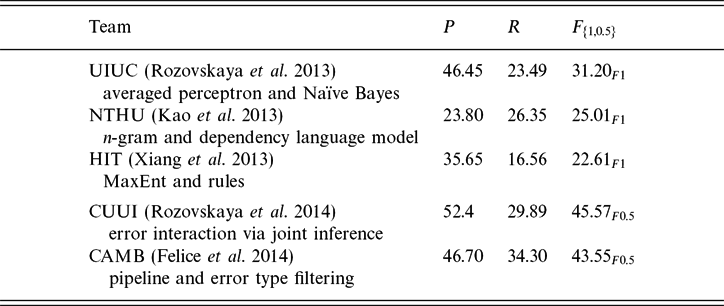
In all, there were 1,397 essays consisting of 57,151 total sentences. Article and determiner errors were most prevalent. Testing data was considerably smaller with only fifty essays each year. Teams were also allowed to use any external resources that were non-proprietary and publicly available. Table 5 shows the methods of the top teams from both years. The five error types from 2013 are listed below:
• Article or determiner: ‘In late nineteenth century, there was a severe air crash happening at Miami international airport.’ Correction: replace late with the late.
• Preposition: ‘Also tracking people is very dangerous if it has been controlled by bad men in a not good purpose. Correction: replace in with for.
• Noun number: ‘I think such powerful device shall not be made easily available.’ Correction: replace device with devices.
• Verb form: ‘However, it is an achievement as it is an indication that our society is progressed well and people are living in better conditions.’ Correction: replace progressed with progressing.
• Subject-verb agreement: ‘People still prefers to bear the risk and allow their pets to have maximum freedom.’ Correction: replace prefers with prefer.
Top teams from the CoNLL-2013 and CoNLL-2014 GEC shared task
While the contest setup and evaluation does not completely mimic real-life scenarios, it does provide useful information for those interested in GEC. Since the errors are categorized into groups, it is possible to perform an error analysis on the results.
As mentioned previously, even performing the evaluation is not a trivial task; suggested corrections—while completely valid—may not actually match the ‘official’ corrections. To mitigate these issues, the contest organizers permitted the contestants to submit their own gold standard corrections if they disagreed with the provided answers. Of course, the corrections were reviewed. It is also worth noting that the training and test data contained errors other than those in the five categories, but these additional errors were not taken into consideration in the final scoring.
The 2013 third-place team (Xiang et al. Reference Xiang, Yuan, Zhang, Wang, Zheng and Wei2013) from Harbin Institute of Technology, split their system into two parts: a machine learning module (article vs determiner, prepositions, and noun errors) and a rule-based module (verb form and subject-verb agreement). As indicated in Table 5, the classifier used was a Maximum Entropy classifier with additional feature selection via genetic algorithms and confidence tuning based on the maximum entropy score. The rules were first preprocessed with the frequent pattern mining algorithm FP-growth to find common incorrect phrases. These common phrases were then removed from the candidate set to be corrected. A list of these common phrases was provided and may prove useful for future work. In their results, they found that their models were very sensitive to the parameters and that the confidence tuning had the largest positive effect in their pipeline.
National Tsing Hua University (Kao et al. Reference Kao, Chang, Chiu, Yen, Boisson, Wu and Chang2013) finished in second place in 2013 with a system that was very similar to theirs from the previous year. In the CoNLL-2013 shared task, subject-verb agreement was not a labeled error type so the National Tsing Hua University system ignored these errors. In the seemingly current trend, a module was created for each error type, though their modules were more similar to each other than the previous systems. Each module used a moving window of words up to length five—five here because they leverage the Google 5-gram corpus as well as their previous tool Linggle.Footnote 15 Linggle is a linguistic search engine in which the user can specify wildcards for nouns, verbs, and adjectives (Boisson et al. Reference Boisson, Kao, Wu, Yen and Chang2013). Results were returned with those wildcards filled in ordered by increasing likelihood in the dataset. These likelihoods were used to score candidates generated by their system in each module. Their candidate voting system was created using a backoff model of lower-order n-grams. Verb-form errors were really the only significantly different module by including pointwise mutual information.
The University of Illinois at Urbana-Champaign (Rozovskaya et al. Reference Rozovskaya, Chang, Sammons and Roth2013) had the best-performing system in 2013. They made use of previous work for article errors (with averaged perceptron) and preposition errors (with Naïve Bayes). The remaining three error classes were dealt with Naïve Bayes with priors trained on the same Google corpus that National Tsing Hua University used. Although the CoNLL corpus already contained part-of-speech tags, they reparsed the dataset with their own tools in addition to running a shallow parser for feature generation. There was no pipeline in the system, meaning that corrections of each model were pooled together to create the final output sentence. In their error analysis, they found that an incorrect verb form can cause parsers to break, which greatly hindered rule-based methods. Since the errors were so sparse, they hypothesize, less-complicated machine learning algorithms would be more robust to the large amount of noise. This analysis provided much insight and would be useful for future work.
After the contest ended, University of Illinois at Urbana-Champaign (Rozovskaya and Roth Reference Rozovskaya and Roth2013) returned to the CoNLL-2013 shared tasks with a joint learning and inference approach. Based on their observations from the shared task, they reasoned that individual (read: independent) classifiers per word do not capture interactions between errors and word choice. They accomplish this by combining individual classifiers using integer linear programming—a model which is able to jointly learn the error occurrences. They thus increased the F 1 score on the CoNLL-2013 data to 42 per cent, significantly higher than their first place score. They do note though, that F 1 may not be an appropriate measure; it is indeed more intuitive to measure the increase in correctness of the original data since it is quite likely that the grammar correction systems actually introduce errors themselves.
Cambridge University (Felice et al. Reference Felice, Yuan, Andersen, Yannakoudakis and Kochmar2014) was the second-best team in 2014. Without additional error suggestions for evaluation, they were in first place. They used a pipeline-based system which first ran rule-based corrections with a tool designed for English learners at their school. A language model selected the best candidate sentences from the rule-based edits. Then, those candidates were sent to a statistical machine translation system trained on parallel English data, which included NUCLE and FCE (see Section 2). Then, a large 5-gram language model from Microsoft was used to select candidates for the final stage. This is the main novelty of their system: with these final candidates they filter the error correction types to ignore unnecessary corrections. Their classifier was able to label almost 70 per cent of error types correctly on development data. They filtered out the labeled types that had zero precision, which consisted of reordering errors, run-ons, comma splices, and acronyms. Although the filtering did increase their F 0.5 score, the difference was not statistically significant. This is an example of how evaluation metrics play an integral part in system design.
Columbia University and the University of Illinois at Urbana-Champaign (Rozovskaya et al. Reference Rozovskaya, Chang, Sammons, Roth and Habash2014) was the top team in 2014. They improved upon their system from the previous year, and also included their joint inference work (Rozovskaya and Roth Reference Rozovskaya and Roth2013). The last addition was the inclusion of new classifiers for the different error types; in total they had sixteen classifiers targeting the twenty-eight error types. The classifier learning algorithm for each error type was one of Naïve Bayes, Naïve Bayes with priors, and averaged perceptron.
In conclusion, we saw a variety of techniques for correcting grammatical errors, which can be categorized into targeted vs general strategies. Targeted strategies focus on errors of only specific types (such as the shared task) which general correctors try to improve the overall fluency of the L2 text.
5 Conclusions
We realize that support for dealing with non-native text is becoming increasingly important; many applications benefit from automatic author profiling and GEC. We call this collection of challenges and tasks non-native text analysis. This survey detailed common datasets and covered the two main applications in non-native text analysis: NLI and GEC.
In Section 2, we saw the main corpora used by researchers for NLI and GEC. Compared to other text datasets, these are relatively small and only consist of essays written by students. A larger corpus would be beneficial, as would a corpus of text other than essays such as blogs, social media, or research papers. Finally, the availability of such datasets are directly proportional to the amount of impact they may have; freely available corpora are much more likely to be used than their proprietary counterparts.
Section 3.1 detailed NLI as a classification problem. We also saw how a shared task was able to elicit many quality works from the community in an organized fashion. We subdivided NLI approaches into two techniques: feature- and likelihood-based. Much more effort has been put into feature-based methods using standard machine learning algorithms. Instead of classifiers and probabilistic models, is it possible to use other text mining algorithms? For example, can clustering methods be optimized for use with NLI? What is the significance of outliers and dense subclusters? How do collaborative filtering systems change when additional information about learning styles of users are known?
GEC was discussed in Section 4.1. We saw how most approaches used a targeted strategy: first classify errors from a limited list and then attempt to fix them. In future work, we would like to see more general approaches applied that are not restricted to specific error types. Aside from grammaticality, fluency can also be considered: exactly what phrases or syntactic structures make an essay sound ‘native’? Are specific topics handled with different grammar? Or are some differences inherently cultural? How are ethnicity, culture, and race related in our context? Just because one’s text may seem like native English, does that mean it is American English? If American, is it Northeastern or Southern? Dialect plays a very important role in fluency.
Finally, almost all work surveyed covered English as L2. We mentioned a few works and shared task in the introduction where English was not the target, and many techniques were general in terms of L1 and L2, but in order to prove the effectiveness of a technique, it is essential to showcase it in a direction other than L1 to English. Of course, a main issue with this is the popularity of non-native English datasets, but given other L2 corpora, an evaluation should be possible.
In time, the field non-native text analysis will evolve into non-native text mining. Aspects from this area discussed will be combined into unified algorithms and intelligent applications. For example, an NLI system can determine a user’s L1, and use that knowledge to offer sophisticated annotations and corrections to their own text in L2 while simultaneously summarizing and condensing text from other sources. Indeed, other areas aside from these will arise to further the understanding of non-native writing or to help non-native speakers better understand their second or third language.