The cosmopolitan genus Steatoda Sundevall is one of the most familiar genera in the Theridiidae (Araneae). This genus includes over 120 recognised species, distributed around the world (World Spider Catalog 2015), including many cosmopolitan species that are found among human populations worldwide. Many spiders of the genus are often mistaken for widow spiders (Latrodectus Walckenaer; Araneae: Theridiidae), and are known as false black widows; however Steatoda are significantly less harmful to humans (Isbister and Gray Reference Isbister and Gray2003). Steatoda species are small to medium-sized spiders characterised by the presence of a large colulus and the abdomen is generally dark, often with a light band around the anterior margin (Levi Reference Levi1957).
The spider S. nobilis (Thorell) (Araneae: Theridiidae) is an invasive species native to the Canary Islands and Madeira, and has been introduced across Europe (Kulczycki et al. Reference Kulczycki, Legittimo, Simeon and Di Pompeo2012). This spider first arrived in the United Kingdom before 1879, perhaps through cargo sent to Torquay, United Kingdom (Jackson Reference Jackson1907; Snazell and Jones Reference Snazell and Jones1993) and later expanded its distribution to other countries in Europe. In the United Kingdom, it has a reputation as one of the few local spider species which is capable of inflicting a painful bite to humans with most bites resulting in symptoms similar to a bee or wasp sting (Warrell et al. Reference Warrell, Shaheen, Hillyard and Jones1991).
Since arriving in the United Kingdom, this spider has been reported in Spain (Melic Reference Melic1994), Portugal (Cardoso Reference Cardoso2000), southern France (Kovoor and Muñoz-Cuevas Reference Kovoor and Muñoz-Cuevas2000), and Italy (Kulczycki et al. Reference Kulczycki, Legittimo, Simeon and Di Pompeo2012). Recently this spider has been reported as an established invasive species in Ventura County, California, United States of America, where the route of introduction into North America was presumably by sea transportation, possibly through the goods brought from Europe (Vetter and Rust Reference Vetter and Rust2012). This spider is strongly synanthropic and is most commonly found on the undersides of trash cans, horizontal supports of wooden fences, potted plants, and patio furniture in buildings (Kulczycki et al. Reference Kulczycki, Legittimo, Simeon and Di Pompeo2012; Vetter and Rust Reference Vetter and Rust2012), which facilitates their establishment and subsequent dispersion by the humans.
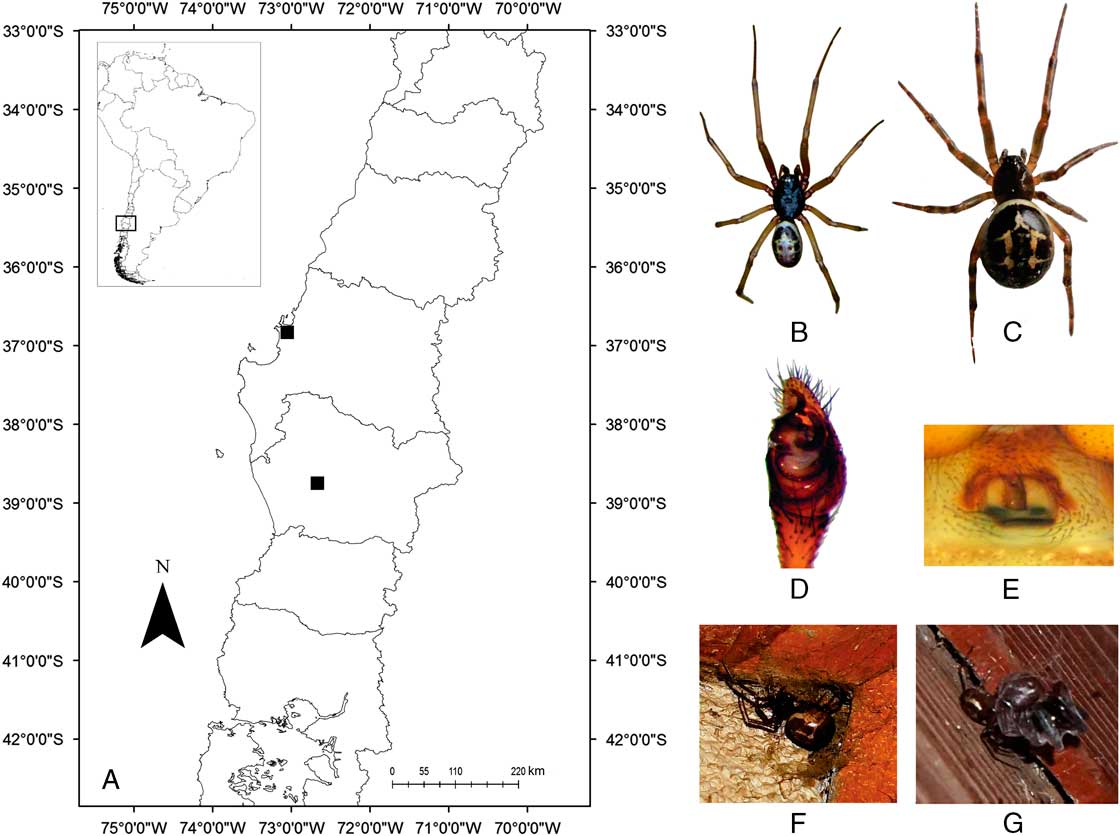
Although S. nobilis is a widely recognised invasive species and has dispersal ability, this species has not been reported from South America. In this context, the objective of this work is to record the arrival and establishment of S. nobilis in Chile (Fig. 1), the first record for the Southern Hemisphere.
(A) Distribution of Steatoda nobilis in Chile. (B) Male of Steatoda nobilis showing the conspicuous dorsal abdominal pattern. (C) Female of Steatoda nobilis. (D) Palp of male in ventral view. (E) Epigynum of Steatoda nobilis. (F) Female of Steatoda nobilis in a house from Temuco. (G) Steatoda nobilis eating the native spider Ariadna maxima.
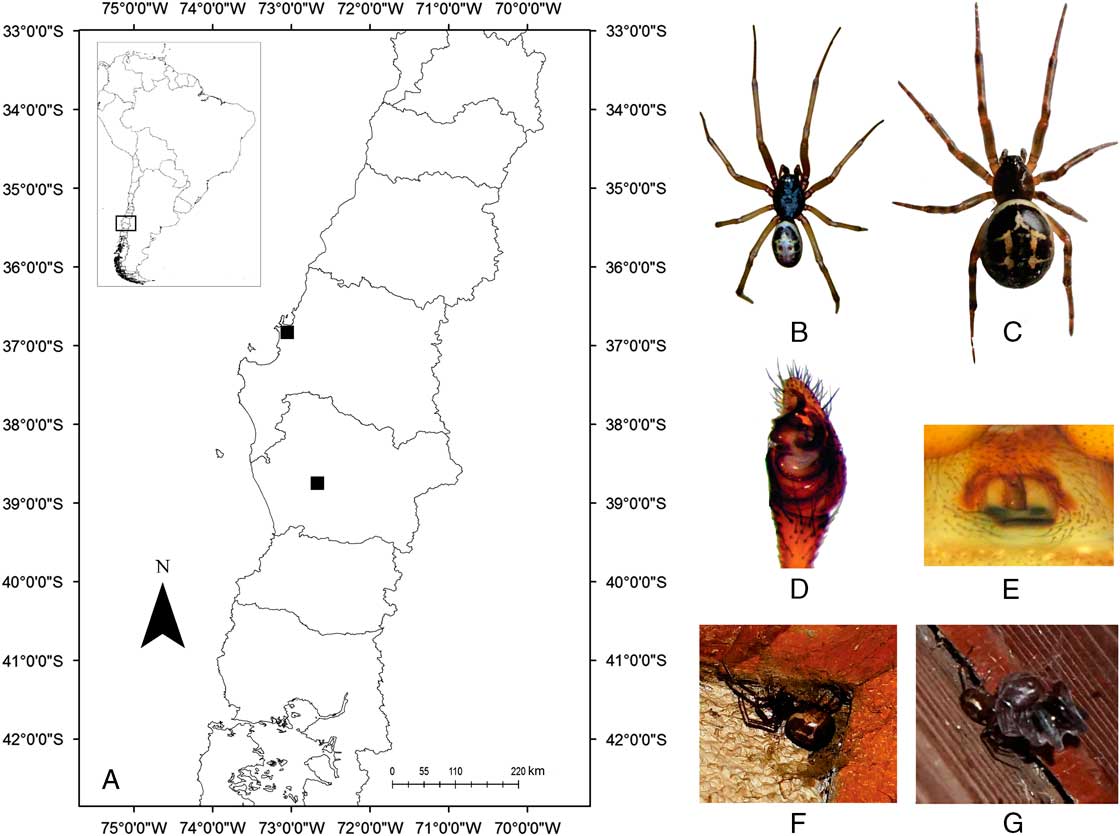
Steatoda nobilis specimens were observed in Concepcion-Talcahuano (36°50'S, 73°3'W) and Temuco (38°45'S, 72°40'W) in south-central Chile, cities are separated by ~300 km (Fig. 1A). The specimens were preserved in 75% alcohol and deposited in the Museo Nacional de Historia Natural, Santiago, Chile. Specimens were identified as S. nobilis based on the external morphology (Figs. 1B–1C) and shape of genitalia (Vetter and Rust Reference Vetter and Rust2012) (Figs. 1D–1E). Specimens examined: VIII Región del Biobío: Concepción, Tres Pascualas Lagoon, 30.vi.2015, Alvaro Zúñiga and Daniela Mardones (one male, one female); 10.vii.2015, Alvaro Zúñiga (two females); 23.vii.2015, Alvaro Zúñiga and Daniela Mardones (two males, two females); Talcahuano, 1.viii.2015, Alvaro Zúñiga and Daniela Mardones (one female). IX Región de La Araucanía: Temuco, 10.ix.2014, Fernando Tellez (one male, two females); 10.vii.2015, Fernando Tellez (two females, three juveniles); Temuco, 30.vii.2015, Fernando Tellez (two females and one egg sac with newly emerged spiderlings).
The introduction of this species may have been through any of the six ports near Concepción, including the Talcahuano, from where the spider later could be spread by human activity to other locations (Fig. 1F). Similar conclusions have been found to explain the introduction and subsequent widespread of this invasive spider in California and Europe, where ports and coastal towns seem to be the main point of introduction (Snazell and Jones Reference Snazell and Jones1993; Kulczycki et al. Reference Kulczycki, Legittimo, Simeon and Di Pompeo2012; Vetter and Rust Reference Vetter and Rust2012). On the other hand, the arrival of this invasive species in Chile is a potential threat to native spiders and insects. In Italy, S. nobilis appears to be disturbing local populations of other indigenous spiders with its sufficiently overlapping ecological niche (Kulczycki et al. Reference Kulczycki, Legittimo, Simeon and Di Pompeo2012). In this context, this alien spider can harm endemic species through competitive displacement, or depredatory on other spiders, as has been seen in other cases with invasive Steatoda species (Nyffeler et al. Reference Nyffeler, Dondale and Redner1986). In Chile, this spider preys on Ariadna maxima (Nicolet) (Araneae: Segestriidae), a native species with nocturnal activity (coinciding with the alien spider activity), an indication of possible intraguild predation (see Fig. 1G).
The arrival of this spider deserves greater attention in Chile and it is possible this spider expand its distribution in other localities near the coast. Field observations suggest the presence of this spider from several years ago, but have never been officially reported in the country (Fernando Tellez, Temuco, Chile; personal communication). These spiders are very common in homes from the localities sampled, where it is able to reproduce and generate stable populations, as indicated by the presence of eggs and immatures in the collected material. Therefore, probably this spider is a widespread invasive species and is well established in Chile, and presence in other countries in the region should be investigated.
Acknowledgements
The authors thank Fernando Tellez for collect the first specimens of this species in Chile and the photographs provided in this work. We thank Antonio Melic and Rick Vetter for critical comments on the manuscript. The first author thanks La Comisión Nacional de Investigación Científica y Tecnológica (CONICYT) grant 21130014 for national doctoral studies. A.Z.R. thanks to the scholarship CONICYT 21110367 and CONICYT No 8355/2014.