Introduction
The use of lichens in global biomonitoring surveys has shown that the most sensitive species suffer a decline in the most polluted areas, while tolerant species remain (Nimis et al. Reference Nimis, Lazzarin and Gasparo1991; Vokou et al. Reference Vokou, Pirintsos and Loppi1999; Geebelen & Hoffman Reference Geebelen and Hoffman2001; Giordani et al. Reference Giordani, Brunialti and Alleteo2002; Pirintsos & Loppi Reference Pirintsos and Loppi2003). These studies have been implemented in rural and forested areas (Wolseley & Pryor Reference Wolseley and Pryor1999; Vilsholm et al. Reference Vilsholm, Wolseley, Søchting and Chimonides2009; Giordani et al. Reference Giordani, Incerti, Rizzi, Ginaldi, Viglione, Rellini, Brunialti, Malaspina and Modenesi2010; Svoboda et al. Reference Svoboda, Peksa and Veselá2010; Pinho et al. Reference Pinho, Dias, Cruz, Sim, Sutton, Martins-Loução, Máguas and Branquinho2011) as well as urban areas (Loppi et al. Reference Loppi, Ivanov and Boccardi2002; Paoli et al. Reference Paoli, Guttová and Loppi2006; Isocrono et al. Reference Isocrono, Matteucci, Ferrarese, Pensi and Piervittori2007; Llop et al. Reference Llop, Pinho, Matos, Pereira and Branquinho2012). The study of lichen communities and their specific composition is a powerful tool for biomonitoring programmes (Giordani Reference Giordani2007; Pinho et al. Reference Pinho, Augusto, Martins-Loução, Pereira, Soares, Máguas and Branquinho2008a , Reference Pinho, Augusto, Máguas, Pereira, Soares and Branquinho b , Reference Pinho, Bergamini, Carvalho, Branquinho, Stofer, Scheidegger and Máguas2012).
The current forests in the Mediterranean Basin are the result of the combined action of climate and man since the last glaciations (Barbero et al. Reference Barbero, Bonin, Loisel and Quézel1990; Zavala et al. Reference Zavala, Espelta and Retana2000; Ciancio & Nocentini Reference Ciancio, Nocentini and Marchetti2005), and the Iberian forests are no exception (Valladares Reference Valladares, Bravo, Le May, Jandl and von Gadow2008). The management applied to evergreen woods has usually resulted in an impoverishment in terms of diversity (Aragón et al. Reference Aragón, Martínez, Izquierdo, Belinchón and Escudero2010a ), and recently several issues regarding how to conserve and promote the biodiversity in the Mediterranean area have been examined (Ciancio & Nocentini Reference Ciancio, Nocentini and Marchetti2005; Valladares Reference Valladares, Bravo, Le May, Jandl and von Gadow2008). The main threats come from agricultural activities and fires. The Common Agricultural Policy (CAP) of the European Union has promoted the intensification of arable and livestock activities, thereby increasing deposition of nitrogen in its reduced forms (NH3 and NH+ 4) along adjacent unmanaged areas (Asman et al. Reference Asman, Sutton and Schjørring1997). In rural environments, arable and livestock forming are the main human activities influencing lichen species richness and community composition (Suding et al. Reference Suding, Collins, Gough, Clark, Cleland, Gross, Milchunas and Pennings2005; Phoenix et al. Reference Phoenix, Hicks, Cinderby, Kuylenstierna, Stock, Dentener, Giller, Austin, Lefroy and Gimeno2006), as shown in Atlantic and Central Europe (e.g. Ruoss Reference Ruoss1999; van Herk Reference van Herk1999, Reference van Herk2001) and in the Mediterranean Basin (Aragón et al. Reference Aragón, López and Martínez2010b ; Giordani et al. Reference Giordani, Incerti, Rizzi, Ginaldi, Viglione, Rellini, Brunialti, Malaspina and Modenesi2010; Pinho et al. Reference Pinho, Dias, Cruz, Sim, Sutton, Martins-Loução, Máguas and Branquinho2011). As well as agricultural activities affecting epiphytic lichens directly, they also affect lichens indirectly due to eutrophication (Pinho et al. Reference Pinho, Dias, Cruz, Sim, Sutton, Martins-Loução, Máguas and Branquinho2011) which alters the bark chemistry and pH (Ruoss Reference Ruoss1999; van Herk Reference van Herk1999, Reference van Herk2001). Additionally, changes in land use can modify atmospheric ammonia levels, thus altering the chemical properties of tree bark and the associated lichen flora (Frati et al. Reference Frati, Caprasecca, Santoni, Gaggi, Guttová, Gaudino, Pati, Rosamilia, Pirintsos and Loppi2006). Pinho et al. (Reference Pinho, Dias, Cruz, Sim, Sutton, Martins-Loução, Máguas and Branquinho2011, Reference Pinho, Bergamini, Carvalho, Branquinho, Stofer, Scheidegger and Máguas2012) and Llop et al. (Reference Llop, Pinho, Matos, Pereira and Branquinho2012) have demonstrated that the use of lichen functional groups is an accurate, robust and universal tool for assessing the impact of nitrogen compounds on lichen diversity in Mediterranean areas.
The consequences of fire as a factor causing environmental stress on lichen communities have received little attention (Fos et al. Reference Fos, Calatayud and Barreno2001). In the east of the Iberian Peninsula, fire has led to the decline of holm oak forests, reducing the range to less accessible sites as well as upland strips. Studies on the lichen communities in these locations make it possible to assess the conservation status of the forest landscape and help to discern what should form the basis of land management programmes (Sanz et al. Reference Sanz, Calatayud and Sánchez2000).
Previous work in this Mediterranean area have focused on assessing the effects of forest management, agriculture and livestock on holm oak lichen diversity (Aragón et al. Reference Aragón, Martínez, Izquierdo, Belinchón and Escudero2010a , Reference Aragón, López and Martínez b ). We have adopted a standardized sampling protocol in order to show those responses in a ‘non-model’ area of study in the Mediterranean region. Thus, the present study constitutes a first approach for comparing the effect of agricultural management and fires on holm oak epiphytic lichen communities in a rural area of the eastern Iberian Peninsula.
Materials and Methods
Study area
The study was carried out in the Vall d'Albaida region (Valencia, eastern Iberian Peninsula) in early 2012. The region configures a natural valley, orientated west to east, with an extension of 722 km2, surrounded by mountains reaching up to 1104 m. The climate is Mediterranean with a dry to subhumid ombroclime, average annual temperatures between 15·5°C and 17°C, and rainfall between 450 mm and 750 mm (Conca & García Reference Conca and García1994; Benavent-Alberola Reference Benavent-Alberola1996). The bioclimate ranges from Thermomediterranean to upper Meso-mediterranean. The climax vegetation of all the territory surveyed is the holm oak forests (Rubio longifoliae-Querceto rotundifoliae Costa, Peris & Figuerola). Historical forest management and repeated fires have reduced the presence of this vegetation to small fragments scattered throughout the territory.
Experimental design
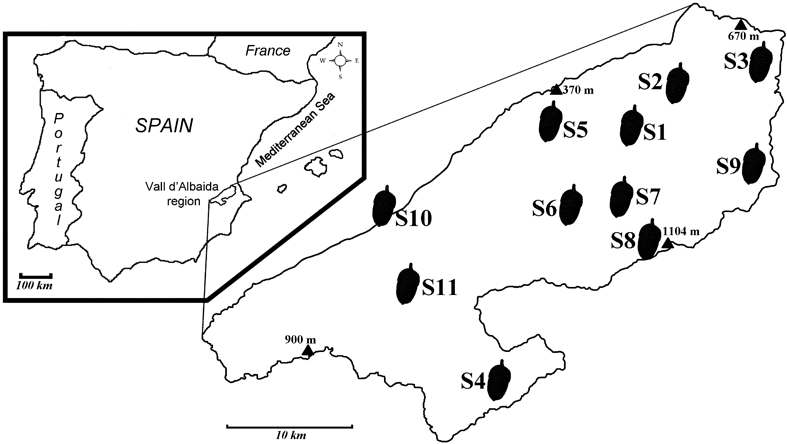
The valley is strongly affected by agriculture, and what little forested area is left has probably suffered a wildfire periodically. A thorough survey across the valley allowed us to establish 11 sampling stations which were all forested sites in the area that had suitable trees for our study, and could be linked with a single anthropogenic activity (Fig. 1). Regarding agriculture, two main farming systems were evaluated: irrigated crops, mainly orchards (stations S1, S6, S7, S9), and non-irrigated crops, such as vineyards and olive groves (S2, S4, S5, S10, S11). These stations were located no further than 50 m from the fields. The forested areas affected by fires that occurred 20–21 years ago were located at least 500 m from agricultural areas (S3, S8). Most putative stations affected by fire did not have suitable trees for sampling (i.e. damaged trunks, young saplings, too small holm oak trees, etc.). The survey was carried out only on holm oak, Quercus ilex subsp. rotundifolia (Lam.) Tab. Morais; Q. ballota Desf. and Q. rotundifolia Lam. are considered synonyms according to Flora Europaea. Sampling on just one phorophyte has allowed us to standardize the bark physicochemical properties, avoiding conflicts when interpreting final results. We studied a total of 112 holm oak trees. At each sampling station, 10 suitable trees were randomly selected and sampled according to Asta et al. (Reference Asta, Erhardt, Ferretti, Fornasier, Kirschbaum, Nimis, Purvis, Pirintsos, Scheidegger, van Haluwyn, Nimis, Scheidegger and Wolseley2002), with the exception of S11 where 12 trees were sampled. For each tree, the following descriptive information (tree variables) was recorded: location in terms of longitude (X), latitude (Y) and altitude, tree trunk diameter value (dbh) and lichen cover coefficient. The latter is divided into five states and is only applied to the sampled surface: 1 (0–10% of the surface covered with thalli), 2 (11–20%), 3 (21–35%), 4 (36–50%) and 5 (>50%).
Location of the Vall d'Albaida (province of Valencia, eastern Spain). The acorn symbols refer to the placement of each sampling station (numbers preceded by S). Stations located near irrigated crops (S1, S6, S7, S9) and non-irrigated crops (S2, S4, S5, S10, S11); forested areas affected by fires (S3, S8).

Lichen diversity
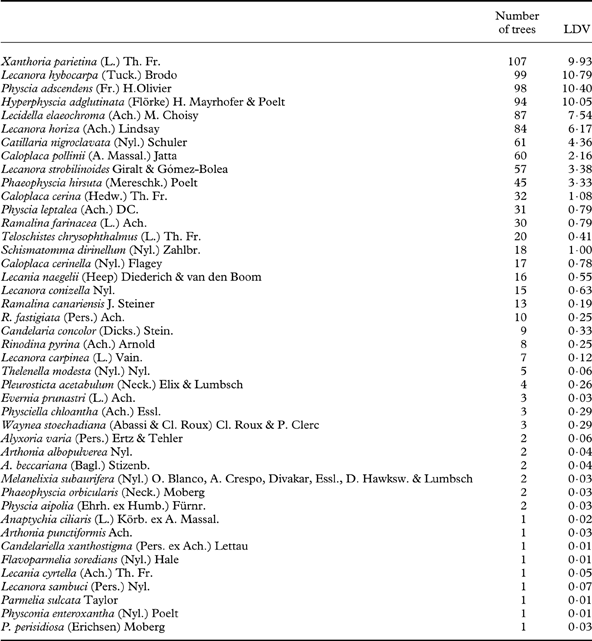
We sampled epiphytic lichens from the trunk. For each tree, we compiled total species richness and calculated Lichen Diversity Value (LDV) according to Asta et al. (Reference Asta, Erhardt, Ferretti, Fornasier, Kirschbaum, Nimis, Purvis, Pirintsos, Scheidegger, van Haluwyn, Nimis, Scheidegger and Wolseley2002). In particular, four sampling ladders 10×50 cm, each divided into five contiguous quadrats, were attached to the trunk at the cardinal points. The frequency of each lichen species in the 5-quadrat ladder was recorded for each orientation and the sum of frequencies within each sampling unit constituted the LDV of the tree. A list of the lichen species recorded, their abundance and average LDV is given in Table 1. Besides total LDV (regarding all the species), we calculated LDV values for different functional groups related to: growth form (crustose, foliose and fruticose), photobiont type (trebouxioid alga vs. Trentepohlia), reproductive strategy (sexual vs. asexual) and response to different environmental factors (eutrophication, water requirement, pH of substratum and solar irradiation). Additionally, we classified the species in terms of poleophoby, which is a parameter indicating the tendency of a lichen to occur in areas with different degrees of human disturbance (Nimis & Martellos Reference Nimis and Martellos2008). Thus, three different classes were defined: natural, for species growing in natural habitats; semi-altered, when growing in moderately disturbed areas; and altered, for those occurring in heavily disturbed areas. The values for each functional group were determined according to the ecological indicators proposed by Nimis & Martellos (Reference Nimis and Martellos2008) which assign each species to the value of the maximum category that can be achieved. Moreover, after analyzing the species sampled and their associated functional categories, we grouped those states into classes according to Llop et al. (Reference Llop, Pinho, Matos, Pereira and Branquinho2012): for tolerance to eutrophication, we distinguished between oligotrophic (class 1), mesotrophic (classes 2 and 3) and eutrophic (classes 4 and 5); for water requirement, we considered hygrophytic (classes 1 and 2), mesohygrophytic (class 3) and xerophytic (classes 4 and 5); regarding the pH of the substratum, we distinguished between acidophilous (classes 1 and 2), neutrophilous (class 3) and basophilous (classes 4 and 5); finally, when considering solar irradiance, we took into account whether each lichen species sampled developed in a shaded environment (classes 1 and 2), in a location with diffuse light (class 3), in an exposed site but avoiding extreme solar irradiance (class 4) or if they tolerated direct sunlight (class 5). Based on personal observations and recent literature (Giralt Reference Giralt1996; Boqueras Reference Boqueras2000), we modified the category state for Lecanora hybocarpa (Tuck.) Brodo from weakly eutrophic (Nimis & Martellos Reference Nimis and Martellos2008) to mesotrophic. The latter authors have not yet treated Lecanora strobilinoides Giralt & Gómez-Bolea, so we suggest this species to be mesotrophic, mesohygrophytic, neutrophilous and associated with illuminated exposures avoiding direct solar irradiance, based on the microhabitat features observed at the sampling site. LDV values of functional groups were transformed from absolute to relative values (in %) in order to determine the contribution of each functional group to the total LDV of each tree (Llop et al. Reference Llop, Pinho, Matos, Pereira and Branquinho2012), and estimate the possible variation in these diversity components with regard to agricultural management and fire.
Epiphytic species of lichens identified on the examined holm oak trees arranged according to their abundance. LDV refers to the average value of each species among all the trees where they were present.

Statistical analysis
The exploration of variables related to tree features, LDV and functional groups showed that regression residuals did not follow a normal distribution. Therefore, we applied non-parametric methods to analyze the relationships between these variables, avoiding transformations that could alter their ecological meaning.
Two data matrices were built: a main matrix containing data on LDV and proportion of functional groups, and a second matrix which included data regarding tree variables (X, Y, altitude, dbh and lichen cover coefficient). Subsequently, the relationships between these and the two classes of stress (agricultural management and fire) were revealed by implementing a non-metric multidimensional scaling (NMS) in the software PC-ORD v.6 (McCune & Mefford Reference McCune and Mefford2011). The NMS was run using relative Euclidean as the distance measure, and the number of runs was 500. A final stability of 0·00 was achieved after 32 iterations, with a final stress for the two-dimensional solution of 8·93528. The significance for axis ordination was investigated using a Monte Carlo test, where P=0·004.
The presence of differences in terms of abundance of functional groups, depending on agricultural management (irrigation, non-irrigation) and fire, was analyzed by implementing a multi-response permutation procedure (MRPP) using relative Euclidean as the distance measure in the software PC-ORD v.6.
Additionally, two different statistical tests were performed to evaluate the differences in LDV within the most important functional groups, depending on land use and fire. Differences for each particular group were analyzed using the Kruskal-Wallis test. Subsequently, the Mann-Whitney test was applied to determine which differences were significant. Analyses were implemented in the software STATISTICA (Statsoft 2013).
Results and Discussion
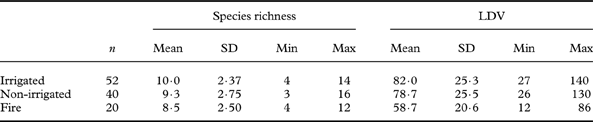
Values of lichen diversity varied in terms of species richness and LDV. The pool of species identified included 43 taxa. The species richness of holm oak trees had an average of 9·5 species with a standard deviation of 2·58, and a minimum of three species and a maximum of 16. Trees from sites affected by fire showed lower species richness than those from sites located in agricultural areas (Table 2); however, only the differences between those trees affected by fire and non-irrigated sites were statistically significant after a Mann-Whitney test. In addition, no differences were evident between trees from both sorts of management (irrigated and non-irrigated crops).
Species richness and LDV values on holm oak from the defined stress areas. For each variable we indicate mean, standard deviation (SD), minimum (Min) and maximum (Max) values. We also give the total number of trees sampled (n).
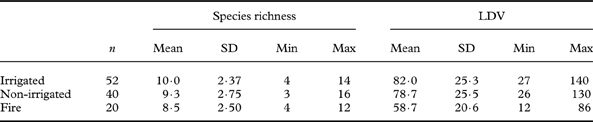
The values of LDV had a similar pattern to species richness but with a higher heterogeneity. The average value among trees was 76·6, with a standard deviation of 25·8; the lowest value was 12, and the highest 140. The trees on sites affected by fire showed lower LDV values than those located in agricultural areas (Table 2), and Mann-Whitney tests showed that differences are statistically significant between trees from areas affected by fire and both sorts of agricultural management. Otherwise, there were no differences in LDV between trees located in irrigated and non-irrigated sites.
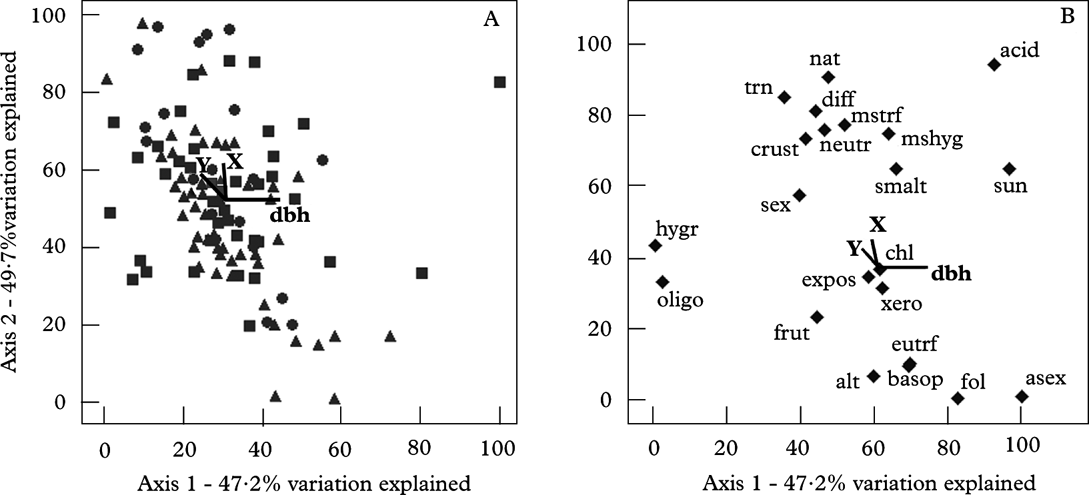
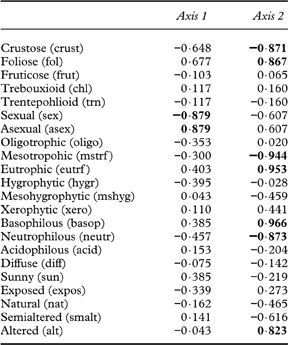
The ordination of trees based on the percentage of functional groups by NMS suggests that the effect of agriculture and fire on the epiphytic lichen diversity of holm oaks does not differ greatly. The coefficients of determination for the correlations between the ordination distances and distances in the original dimensional space are 0·472 for axis 1 and 0·497 for axis 2. Both axes explain 97% of the variation in functional groups at tree level. The ordination of trees shows that there is a continuous variation, without a well-defined clustering, within the study area (Fig. 2A). Otherwise, functional traits cluster in two main groups (Fig. 2B). A group located in the lower part of the graph includes traits associated with disturbed environments, where xerophytic, eutrophic, basophilous or altered are significantly correlated with axis 2 (Table 3). A second group located in the upper part of the graph integrates traits associated with low disturbance, but only mesotrophic and neutrophilous species show a significant correlation with axis 2 (Table 3). Functional traits such as oligotrophic, hygrophytic or acidophilous do not show any significant correlation with any axis; assignment of species to these categories does not help to explain major patterns for those epiphytic lichen communities. Tree variables show no correlation with the distribution of trees, except for trunk diameter (Fig. 2).
NMS ordinations showing the distribution of trees (A) and functional traits (B). Overlays of tree variables are given for those with a Pearson correlation coefficient above 0·200: X (longitude), Y (latitude) and dbh (tree trunk diameter value). ▴, trees located in irrigated zones; ▪, trees located in non-irrigated zones; •, trees located in burnt areas. Abbreviations of functional traits are as indicated in Table 3.

Pearson correlation coefficients of the abundance of each functional group with both ordination axes of the NMS. Significant coefficients are marked in bold (Pearson square correlation coefficient above 0·750). In brackets we indicate the abbreviation used in the NMS ordination.

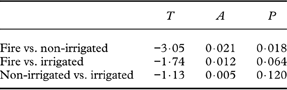
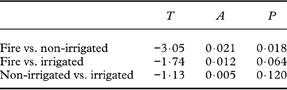
Although the pattern suggested by the NMS does not follow a priori classification depending on agriculture management and fire, the MRPP based on the abundance of functional groups reported differences between three stress categories (T=−2·83, A=0·015, P=0·017). The pairwise comparisons indicate a difference between those trees affected by fires and those influenced by both sorts of agricultural management (irrigation and non-irrigation). Otherwise, no differences arose between trees from both managements (Table 4).
Pairwise comparisons between stress areas based on abundance of functional groups using MRPP. The test statistic, T, indicates the degree of differentiation between groups; the A statistic refers to the chance-corrected within-group agreement. Significant values are indicated in bold.
Diversity variables (LDV and species richness) are higher in agriculture-managed areas than in areas affected by fire. Among the stress factors considered, fire seems to have a greater effect on lichen diversity on holm oak trees; lichen richness has not recovered yet, 20 years after fires. In addition, it is inferred that post-fire colonization of epiphytic lichens is slow, perhaps due to the prevailing Mediterranean climate conditions (Longán et al. Reference Longán, Gaya and Gómez-Bolea1999; Fos et al. Reference Fos, Calatayud and Barreno2001). On the other hand, although agricultural activities cause a decrease in lichen diversity, as suggested by a number of studies in the Mediterranean region (Nimis et al. Reference Nimis, Lazzarin and Gasparo1991; Vokou et al. Reference Vokou, Pirintsos and Loppi1999; Giordani et al. Reference Giordani, Brunialti and Alleteo2002, Reference Giordani, Incerti, Rizzi, Ginaldi, Viglione, Rellini, Brunialti, Malaspina and Modenesi2010; Loppi et al. Reference Loppi, Ivanov and Boccardi2002; Pinho et al. Reference Pinho, Augusto, Máguas, Pereira, Soares and Branquinho2008b , Reference Pinho, Dias, Cruz, Sim, Sutton, Martins-Loução, Máguas and Branquinho2011; Aragón et al. Reference Aragón, López and Martínez2010b ), the impoverishment in such diversity in the trees near crops seems to be comparatively lower than in fire-influenced areas. In fact, Pinho et al. (Reference Pinho, Bergamini, Carvalho, Branquinho, Stofer, Scheidegger and Máguas2012) detected increased LDV and species richness values due to increasing land use intensity and this was explained by the Intermediate Disturbance Hypothesis, whereby intermediate stress levels rather than strong ones (as fire could be) promote the coexistence of species with contrasting ecological requirements (Huston Reference Huston1979). It has been impossible to find virgin areas with holm oak forests in order to calculate and compare its LDV because of the strong human impact on the study area.
The main differences in abundance of functional groups between the types of stress were found in eutrophication tolerance and affinity for the presumed pH of the substratum. Trees located near to agricultural areas had a higher proportion of eutrophic and basophilous lichens, which corresponds with previous work carried out in the Mediterranean region (Loppi & De Dominicis Reference Loppi and De Dominicis1996; Giordani et al. Reference Giordani, Brunialti and Alleteo2002; Pinho et al. Reference Pinho, Augusto, Máguas, Pereira, Soares and Branquinho2008b ; Aragón et al. Reference Aragón, López and Martínez2010b ). The actual pH range for basophilous species, as well as for acidophilous and neutrophilous lichens, is not defined by Nimis & Martellos (Reference Nimis and Martellos2008). It would be interesting to obtain values for pH intervals, either for bark of different phorophytes or for other common lichen substrata, in order to obtain a real specificity of the pH for lichens. NH3 emissions from agricultural activities, mainly through the use of fertilizers (Bleeker & Erisman Reference Bleeker and Erisman1998), enrich atmospheric dust particles that eventually settle on holm oak bark thus increasing its pH (Ruoss Reference Ruoss1999; van Herk Reference van Herk1999, Reference van Herk2001; Pinho et al. Reference Pinho, Dias, Cruz, Sim, Sutton, Martins-Loução, Máguas and Branquinho2011). Moreover, crop fertilization increases in summer (when temperatures are high) in this Mediterranean region which enhances NH3 volatilization, as suggested by Huber & Kreutzer (Reference Huber and Kreutzer2002). This situation probably explains a transition to eutrophic-basophilous lichen communities that are dominated by species of Xanthorion parietinae Ochsn. (Hedenås & Ericson Reference Hedenås and Ericson2004; Frati et al. Reference Frati, Caprasecca, Santoni, Gaggi, Guttová, Gaudino, Pati, Rosamilia, Pirintsos and Loppi2006). In fact, Xanthoria parietina, Physcia adscendens, Hyperphyscia adglutinata and Lecidella elaeochroma were abundant on holm oak trees located near crops in our study area.
Apparently, the major abundance of eutrophic and basophilous species in non-irrigated crops compared to irrigated crops seems confounding given that emissions of nitrogen compounds are directly proportional to the intensity of agricultural activities (Ruisi et al. Reference Ruisi, Zucconi, Fornasier, Paoli, Frati and Loppi2005; Frati et al. Reference Frati, Caprasecca, Santoni, Gaggi, Guttová, Gaudino, Pati, Rosamilia, Pirintsos and Loppi2006; Wolseley et al. Reference Wolseley, James, Theobald and Sutton2006). A plausible explanation is based on the fact that different agricultural managements produce dust particles of variable sizes, as observed in dry Mediterranean regions (Loppi & Pirintsos Reference Loppi and Pirintsos2000; Pinho et al. Reference Pinho, Augusto, Martins-Loução, Pereira, Soares, Máguas and Branquinho2008a ). A careful examination of irrigated-crop management reveals that using drip irrigation systems from early spring to late summer produces a more moist and compressed soil and, despite being frequently fertilized, reduces the release of N-enriched earthy particles reaching nearby holm oaks. By contrast, non-irrigated crops, mainly vineyards and olive groves, depend on precipitation for water intake implying that soil remains dry during most of the year. Consequently, the cloud of eutrophic agents has a greater volume, density and dispersal ability and would more easily reach the nearby holm oaks.
The smaller quantities of nitrogen compounds reaching the bark of holm oak trees situated in wild burnt areas account for a greater abundance of mesotrophic and neutrophilous species, such as Caloplaca pollinii, Lecanora carpinea, L. horiza, L. hybocarpa, Physcia leptalea and Ramalina fastigiata. However, a non-negligible presence of eutrophic taxa on phorophytes located in these areas suggests lasting and long-distance effects of agriculture in the Vall d'Albaida region. There are also minor differences in thallus growth form, although not significant. Thus, the lichen community on trees affected by fire has a higher proportion of crustose lichens compared with trees from agricultural areas. This difference is inconsistent with the suggestion that crustose species dominance is associated with greater environmental pollution, as proposed by Branquinho (Reference Branquinho1997, Reference Branquinho and Prasad2001) and Paoli et al. (Reference Paoli, Guttová and Loppi2006), since these holm oak forests are situated furthest from cultivated areas. By contrast, this pattern suggests that crustose epiphytic lichens have been favoured in the post-fire colonization process (Wolseley & Aguirre-Hudson Reference Wolseley and Aguirre-Hudson1997; Longán et al. Reference Longán, Gaya and Gómez-Bolea1999). Crustose thalli are more inconspicuous; occasionally they are endophloeic which confers shelter in different sized fissures of the tree and enhances recolonization (Fos et al. Reference Fos, Calatayud and Barreno2001). The current distribution of lichen growth forms may indicate that trees from burnt areas are still recovering from the stress produced by fires.
The level of stress determined by anthropogenic activities, such as agriculture, sometimes increases biodiversity, as compared to more severe phenomena such as wildfires. However, the effect on the composition of lichen epiphytic communities is more obvious in agricultural areas, where the increase in diversity is due to a higher proportion of lichens associated with high levels of eutrophication on the environment. By contrast, burnt areas, far from the agricultural stress, recover slowly but with a species composition associated with low levels of eutrophication.
The lack of previous data from this area prevents comparison of the effects caused by human activity on forest communities, including epiphytic cryptogamic communities. Our work contributes to understanding the response of lichen diversity and community structure to strong human influence, by adopting a standardized sampling protocol in order to reveal those responses in a ‘non-model’ area of study from the Mediterranean region. This study establishes some bases for comparing changes associated with global warming and anthropogenic activities in future scenarios in rural environments under the dry Mediterranean climate.
We are grateful to Francisco Tejedor (Head of the Forest Fire Department, Generalitat Valenciana) and Antoni Conca (botanist from the Vall d'Albaida region) for providing the dates and useful comments regarding the latest fires to have occurred in our sampling stations. Susan Will-Wolf and two anonymous referees are acknowledged for their valuable comments and suggestions which have improved this manuscript.