




No CrossRef data available.
An approach to the analysis of design concepts using the rough set theory
Published online by Cambridge University Press: 07 June 2005
Abstract
This paper describes an approach to the analysis of design concepts (DCs) using the rough set theory. The proposed approach attempts to extract design knowledge from past designs, and used the knowledge obtained to perform DC–capability mapping in a dynamic design evolution environment. The mapping enables designers to estimate the feasibility of a DC to meet stipulated design specifications. The proposed approach encompasses two algorithms, namely, the dissimilar objects algorithm and the attribute decomposition algorithm, to deal with an information system with unavailable information and multidecision attributes, respectively. The details of these algorithms are presented. A case study on the design of vacuum cleaners is used to illustrate the capability of the proposed approach.
Information
- Type
- Research Article
- Information
- Copyright
- © 2004 Cambridge University Press
1. INTRODUCTION
In recent years, many organizations have realized the importance of integrating diverse design knowledge, expertise, and experience to create innovative products to satisfy customer needs. In developing a new design for such products, design concepts (DCs) are frequently adapted from existing designs that are known to be able to support the required functions. However, during the analysis process, some of these DCs that can be represented by design attributes may be relevant to the new design but not to some of the existing designs. For example, when designing a dual-purpose vacuum cleaner with the capability of mopping and vacuuming, some of the DCs that are relevant to the dual-purpose vacuum cleaner may not be applicable to conventional vacuum cleaners. This discrepancy creates a new type of incomplete information, which is termed “unavailable information” [unavailable attribute (UA)] in some of the DCs. It is important to note that UA is different from another type of incomplete information that is caused by missing data (Khoo & Zhai, 2001). Further, a recent review reveals that efforts to address this type of information is lacking.
The rough set theory (Pawlak, 1982) provides an avenue to tackle UA. It can be used to extract concepts or decision rules from an information system comprising condition and decision attributes. The rough set theory has been successfully used in many application domains (Komorowski et al., 1999). As a knowledge extraction method, it offers the benefits of efficiency, ease of understanding, and ability to generate results that can be interpreted directly (Pawlak, 1996). In the domain of design, the rough set theory can be employed to realize an approach for the analysis of DCs, where design decision rules are extracted from past design information. DCs can then be analyzed against design specifications using these design decision rules.
Generally, the process of decision making involves a set of condition and decision attributes. Analogous to this, analysis of DCs aims at evaluating DCs (condition attributes) in relation to design capabilities (CPs, decision attributes). In a creative design process, design criteria and design constraints evolve dynamically. This evolution may lead to numerous design changes and design alternatives (Wills & Kolodner, 1994). An approach that it is able to facilitate decision making in a dynamic design evolution environment is thus necessary. This paper is organized as follows: Section 2 provides the basic notions of analysis of DCs. It briefly describes the interrelationship between DC and CP. Section 3 provides an overview of the rough set theory. It briefly discusses the effect of UA on the analysis of DCs and multiple decision attributes. An approach embodying two novel algorithms to handle a multidecision attributes information system with UA is described in Section 4. Section 5 presents a case study on the design of vacuum cleaners to illustrate the capability of the proposed approach. The last section, Section 6, summarizes the main conclusions reached in this work.
2. ANALYSIS OF DCs
2.1. DC–capability mapping
Product design comprises three main stages, namely, conceptual design, embodiment design, and detail design (Ulrich & Eppinger, 2000). Among them, conceptual design is the most important stage, where 60% of the resources needed to manufacture a product are committed (Hundal, 1997). In reality, after a product has been designed, design changes can still be expected and are done iteratively. These design changes may lead to unnecessary delays in the launching of a new or improved product, wastage of resources, and increased costs. One way to minimize design changes is through a proper analysis of the capabilities of DCs with respect to product specifications (SP).
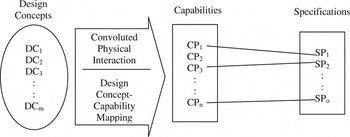
During the conceptual design stage, a design is often represented by a set of DCs that provides a rough description of the technology, procedures, and the shape of a target product (Ulrich & Eppinger, 2000). In this work, CP refers to the actual performance of the final product in relation to a design specification. For example, a vacuum cleaner may have a 150-in. water lift of suction head as its CP, and at least a 140-in. water lift of suction head as its design specification. The suction head of 150-in. water lift is the actual performance that meets the design specification of the vacuum cleaner. Accordingly, the relationships between DC and CP domains, and between CP and SP domains can be easily formalized (Fig. 1).

The relationships of design concepts, capabilities, and specifications.
As shown in Figure 1, the set of concept (DCi) embodied in the DC domain decides the capabilities (CPj) of a product in the CP domain through physical interactions among the various DCs. The relationships between DC and CP domains are highly convoluted, as many factors affecting the CP domain are not apparent. Using the proposed approach, these relationships can be represented by a so-called DC–capability mapping process. The CP domain embodies the actual performance parameters that may or may not be required by the specifications (SPk) denoted in the SP domain. For the purpose of design analysis, a one–one relationship has to be established for each capability required by a specification so as to facilitate comparison. This implies that every design specification needs to be satisfied by a CP. Conversely, those CPs that are not associated with any of the design specifications are not needed for design analysis. More specifically, the transformation of DCs into CPs can be realized through the aforementioned DC–capability mapping process. Because of the vague description of conceptual design, experienced designers need to be engaged to evaluate the feasibility of the mapping. As a result, it is desirable to establish an approach that is able to extract design rules from past design information to support the mapping process, handle the vague descriptions of conceptual design, and deal with the incomplete information arising from UA. In this respect, the rough set theory can possibly be used to extract the necessary design decision rules for DC–capability mapping, and facilitates early design analysis of a creative design, in which the relationship between DCs are not apparent. Further analysis shows that even for a very simple product, it may have more than one design specifications. Consequently, because each design specification needs to be fulfilled by a CP, more than one CPs can be expected. Thus, it is imperative for the proposed approach to acquire the abilities to handle multiple CPs and deal with multidecision attributes in design decision rules extraction.
2.2. Selection of DCs
Essentially, the purpose of product design is to realize a design that is able to satisfy a set of design specifications (Ulrich & Eppinger, 2000) derived from customer needs. At the conceptual design phase, DCs are formulated and analyzed. Those DCs that can possibly meet design specifications are selected for further treatment. Basically, the analysis of DCs involves the establishment of CPs, which embody the expected performance of a product through the above-mentioned DC–capability mapping process. The suitability of a DC can be evaluated by comparing SPs with corresponding CPs. If all the SPs have been satisfied, designers will then proceed to the next phase of design. Otherwise, the DC is reviewed and modified.
In practice, without a prototype, it would be difficult to determine CPs during the conceptual design phase, as the relationship between DCs and CPs can be fairly complex. However, even with such a prototype, designers may still experience difficulties in determining CPs due to the vague descriptions of conceptual designs. As not all the design parameters can be explicitly determined during the conceptual design stage, only the main components of a design are often specified, making it highly ineffective for the realization of a prototype. In reality, an experienced designer may be able to identify suitable DCs. However, the decision made is often based on a combination of past design experience, intuition, and engineering knowledge. Using past design experience in deriving DCs implies that past designs may contain potentially useful knowledge for the design of a new or similar product. Thus, it would be advantageous if this knowledge could be extracted to provide the basis for the analysis of DCs.
3. ROUGH SET THEORY AND ANALYSIS OF DCs
3.1. Basic notions
The rough set theory provides the mathematical basis for the extraction of concepts from a data set called information system. Mathematically, an information system (I) can be expressed as follows:

where U is a nonempty finite set of objects and A is a nonempty finite set of attributes.
The set of attributes A can further be denoted as

where C is a nonempty set of condition attributes and D is a nonempty set of decision attributes.
Rough set theory has been widely used to solve problems in different domains such as data-driven decision making (Kusiak et al., 2000; Nguyen et al., 2001; Lee & Vachtsevanos, 2002) where decision rules were derived based on historical information. These decision rules were then used to classify newly acquired information. Mollestad and Komorowski (1999) employed the notions of indiscernibility provided by the rough set theory to derive decision rules. Zhai et al. (2001) proposed a hybrid technique that combined the strength of genetic algorithms and rough set theory for the classification of concepts. In the domain of conceptual design, Arciszewski et al. (1993) applied the rough set theory to realize a learning system for the design of wind bracings in tall buildings. The rough set based learning system had demonstrated the capability of extracting the dependencies in the design of wind bracings that were poorly understood. Essentially, the aforementioned approaches were developed to enable the extraction of decision rules based on an information system with complete information. They are not able to handle the UA that is prevalent in the process of creative DC generation. Furthermore, as multiple decision attributes need to be dealt with simultaneously, changes in any of the attributes will require the entire rules set to be regenerated. The work of Mollestad and Komorowski (1999) is extended to extract decision rules from an information system with UA. For clarity, it is summarized as follows:
Step 1.
Based on the data registered in an information table, form a decision relative discernibility matrix comprising n columns and n rows, where n is the number of objects.
Step 2.
Complete the n × n decision relative discernibility matrix. A decision relative discernibility matrix is used to identify the attributes that discern a pair of objects if the corresponding decision(s) of the pair of objects are different. More formally, for each row and column (i, j) of the discernibility matrix, insert the condition attributes that discern objects i and j, where i ≤ n, j ≤ n, if the value of the decision attribute for objects i and j are different.
Step 3.
Form an antecedent clause of a rule by combining the condition attributes for each of the rows using Boolean operators. For each of the cells in the information system, combine all the entries using the OR Boolean operators to form a term. Subsequently, join all the terms in a row with the AND Boolean operators.
Step 4.
Simplify the antecedent clause obtained in Step 3 using Boolean algebra, if necessary.
Step 5.
For each of the antecedent clauses obtained in Step 4, form a rule by incorporating the decision attributes. Subsequently, insert the value registered by the condition and decision attributes corresponding to each row.
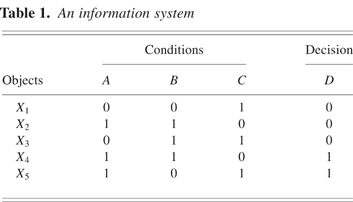
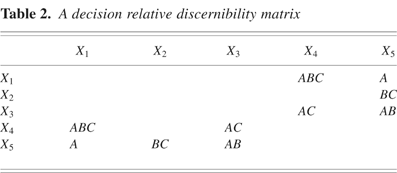
As an example, consider an information system (Table 1) comprising five objects such as five different designs of vacuum cleaners with four attributes each (three condition and one decision attribute). For simplicity, it is assumed that each attribute possesses two possible values, 0 and 1, which are identical to TRUE and FALSE, respectively, in a binary information system. Step 2 is then applied to form a decision relative discernibility matrix (Table 2).
An information system

A decision relative discernibility matrix

Note that the entries of the diagonal cells are empty because the same objects are being compared. Pairwise comparisons are then carried out. For example, on Row 1, Object X1 is compared with other objects. Columns 2 and 3 are empty because Objects X1, X2, and X3 have the same decision attribute. Columns 4 and 5 are expected to have entries because Object X1, and Objects X4 and X5 have different decision attributes. Thus, Column 4 has a value of ABC because the values of the condition attributes A, B, and C of Object X4 are different from those of Object X1. Hence, Objects X1 and X4 can be discerned using the set of condition attributes A, B, and C. Similarly, Column 5 has a value of A, because the values of A of Objects X1 and X5 are different. From Tables 1 and 2, the antecedent clauses for the rules can be formed for each of the rows according to Step 3 as follows:
Row 1: (A + B + C)A; Row 2: B + C; Row 3: (A + C)(A + B); Row 4: (A + B + C)(A + C); and Row 5: A(B + C)(A + B).
Consider the antecedent clause of Row 1, (A + B + C)A. By applying the dual of absorption theorem of Boolean algebra, it can be readily shown that (A + B + C)A ≡ A. Thus, based on Step 4, the antecedent clauses can be simplified as follows:
Row 1: A; Row 2: B + C; Row 3: (A + C)(A + B); Row 4: A + C; and Row 5: A(B + C).
Based on Step 5, the complete rule set is given as follows:

More specifically, Rule 1 states that for an object N, if the value of Attribute A (condition) is 0, then the value of Attribute D (decision) is 0. Similarly, Rule 2 states that for N, if either the value of Attribute B (condition) is 1 or the value of Attribute C (condition) is 0, then the value of Attribute D (decision) is 0. These mappings are useful to relate the condition attributes to corresponding decision attributes, and can be used to classify new objects. As previously mentioned, the condition and decision attributes registered on an information system represent the DCs and CPs, respectively. In so doing, the mapping of DCs and CPs can be achieved.
3.2. Unavailable information (UA)
In product design, analogy is frequently used to generate DCs. Thus, DCs can be adapted from existing designs that are known to be able to perform the required functions. However, existing designs may not be able to meet all the requirements of the design specifications. Additionally, the attributes of some of the DCs may not be relevant to the new design. These discrepancies, as previously mentioned, create a different type of incomplete information, known as UAs, within the information system that is constructed based on the information obtained from existing designs.
In the rough set theory, Grzymala–Busse and Hu (2000) proposed a simple method based on the probability of occurrences of attribute values to repair an incomplete information system. Such a method requires prior knowledge of data distribution, which may not be readily available for most data sets. In addition, data with a small population may yield erroneous results that are caused by the inaccuracy in estimating the probability. Kryszkiewicz (1998, 1999) assigned a “null” value to replace all the incomplete attribute values. The null value represents all the possible values attainable by the attribute with incomplete value. Subsequently, the original indiscernibility relation is expanded into a tolerance relation known as similarity relation. Rules can then be derived from the incomplete information system by replacing the indiscernibility relation with a similarity relation. Felix and Ushio (1999) solved the incomplete information problem by introducing rough discernibility relations, that is, surely discernible and possibly indiscernible. These relations were used for rules derivation in an incomplete information system to replace the original indiscernibility relation. Wang (2002) proposed a similar approach to the handling of information by extending the relations of rough set theory. Interestingly, Pawlak (1998) cautioned researchers not to complicate the operations of the rough set theory unnecessarily, as it might lead to mathematical complications and philosophical problems resulted from classification without sharp boundaries. Liang and Xu (2000) used the information entropy theory to facilitate the handling of incomplete information. The incomplete variable was able to take any possible values. Khoo and Zhai (2001) employed pseudo-objects to replace objects with incomplete information. Basically, a pseudo-object is created for every combination of possible case. After the information system has been repaired, standard rough set operations can be performed. The approaches reviewed above appear to be able to handle incomplete information. However, they are based on the same basic assumption that the incomplete attribute values exist but are not known. Thus, they are not able to tackle situations where the incomplete information is due to nonrelevant attributes, that is, UA, where the incomplete attribute value does not exist. In such situations, no actual value could be assigned to the nonrelevant attributes. This phenomenon is relatively common in DCs generation, where existing DCs are used to generate new or modified designs. This work introduces a so-called dissimilar objects algorithm (DOA) to tackle the UA.
Further analysis shows that the work of Mollestad and Komorowski (1999) can be used to extract design decision rules from an information system with multidecision attributes, that is, multiple CPs. However, for an information system with many decision attributes, it becomes unnecessarily cumbersome. Accordingly, this work also proposes a so-called attribute decomposition algorithm (ADA) to simplify the rules extraction process.
4. THE ALGORITHMS
4.1. DOA
The proposed DOA extends the work of Mollestad and Komorowski (1999) to deal with UA. The algorithm is summarized as follows:
- Replace any unavailable information in the information system with “UA.”
- Derive the rules using the approach proposed by Mollestad and Komorowski by treating “UA” as a new value for the attributes.
More specifically, consider an information system that consists of n + p objects. The first n objects are complete, that is, all the attributes of each object have corresponding values. The remaining p objects contain one or more attributes with UA.
4.1.1. A complete information system
Consider a simplified information system comprising the first n objects. Mathematically, the information system can be expressed as

where C and D denote the condition and decision attribute sets, respectively.
It is important to note that there is no UA here. Based on the work of Mollestad and Komorowski, an n × n discernibility matrix (M[C,D]) with respect to Decision Attribute D can be formed. An entry in the matrix, m[C,D], in row i and column j is given by m[C], if the decisions of Objects Xi and Xj (i ≠ j) are not the same. Otherwise, a 1 is assigned. Thus, m[C] is the condition attribute that discerns Objects Xi and Xj, while the value 1 represents the Boolean value TRUE. More formally, the relative discernibility matrix with respect to Decision Attribute D can be expressed as

where m[C,D](Xi, Xj) is defined by Eq. (2).

where m[C](Xi, Xj) is defined by Eq. (3).

for 1 ≤ i ≤ n, 1 ≤ j ≤ n.
Based on the established matrix, a set of rules, R[C,D], can be derived. Essentially, the antecedent clause of a rule, r[C,D]i, in the rules set is formed by first combining the entries in each cell of Row i into a term using an OR operator as mentioned in Section 3.1. Subsequently, these terms are joined using the AND operators to form a rule.
The rule set derived from the matrix can thus be expressed as


4.1.2. UA in an information system
Mathematically, Eqs. (1)–(5) summarize the basic notions of the work by Mollestad and Komorowski, which are targeted at a complete information system. For an n + p objects information system with p nonrelevant attributes, Eqs. (1)–(5) can be extended and rewritten as follows [Eqs. (6)–(10)].

where m[C,D](Xi, Xj) is defined as

where m[C](Xi, Xj) is defined as

for 1 ≤ i ≤ n + p, 1 ≤ j ≤ n + p;


Rules are then generated by treating UA as valid value of attributes according to the DOA. In other words, Eqs. (6)–(10) have taken into account the additional objects with UA. Now, let those rules that contain UA be eliminated from the rules set R. This results in n + q number of rules remaining in the rules set where 0 ≤ q ≤ p such that
- q = 0 when all the rules corresponding to the objects with UA are eliminated and
- q = p when all the rules corresponding to the objects with UA are retained.
Hence, there are at least n rules remaining, as there are n objects without any UA entry. If those rules with a UA entry are eliminated, Eq. (9) can be rewritten as follows:

where 0 ≤ q ≤ p.
Hence, the set of rules derived from the information system containing p additional objects with UA entry has at least the same number of rules as those derived previously [Eq. (4)]. Each of the rules of Eq. (10) is then examined. By grouping the first n terms, Eq. (10) can be rewritten as follows:

The antecedent clause of Eq. (12) is then given by

It is important to note that the first term in Eq. (12a),

, is identical to the antecedent clause of Eq. (5). As the first and second terms of Eq. (12a) are joined using an AND operator, it can be deduced that the antecedent clause of Eq. (12) is indeed a subset of that of Eq. (5). Hence, the rules derived from such an information system with objects having UA based on the proposed DOA is more stringent compared to those obtained by Mollestad and Komorowski, that is, without UA. Accordingly, it is likely to be more robust, and potentially more useful for the evaluation of CP. It appears that by including objects with some nonrelevant attributes would result in a larger search space for the analysis of novel conceptual designs. A larger search space, in turn, is likely to provide a means to explore DCs beyond the domain application, which is important for the generation of innovative design solutions or, perhaps, more robust DCs.
4.2. ADA
The ADA postulates that it is possible to decompose an information system with n number of decision attributes into n information systems with single decision attribute each, and subsequently combine the rules obtained using Boolean operators into decision rules for DC–capability mapping.
The ADA is summarized as follows:
Step 1.
Form m decision relative discernibility matrices, where m is the number of decision attributes. Each matrix consists of n columns and n rows, where n is the number of objects.
Step 2.
Complete the n × n discernibility matrices. For each row and column (i, j) of the discernibility matrix, insert the condition attributes that discern objects i and j where i ≤ n and j ≤ n, if the value of decision attributes for objects i and j are different, that is, discernable. Otherwise, insert Boolean expression 1 that represents TRUE. Note that a Boolean expression 1 is introduced for consistency.
Step 3.
Form an antecedent clause of a rule by combining the condition attributes for each of the rows using Boolean operators. For each of the cells in the information system, combine all the entries using the OR Boolean operators to form a term. Subsequently, join all the terms in a row with the AND Boolean operators.
Step 4.
Simplify the antecedent clauses obtained in Step 3 using Boolean algebra, if necessary.
Step 5.
For each of the antecedent clauses obtained in Step 4, form a rule by incorporating the decision attributes. Subsequently, insert the value registered by the condition and decision attributes corresponding to each row.
Step 6.
Combine the rules using the AND Boolean operators.
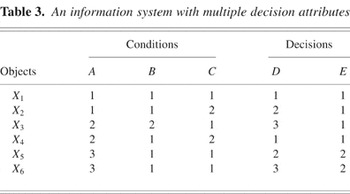
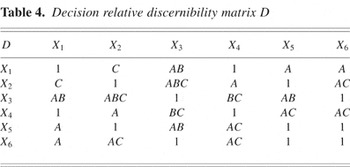
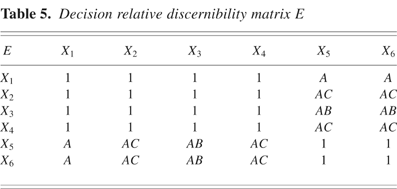
Intuitively, the ADA can be employed to simplify the procedure used to treat the multidecision attributes discernibility matrix. For clarity, consider an information system (Table 3) with six objects such as six different vacuum cleaner designs and five attributes (three condition and two decision attributes). Compared with the information system depicted in Table 1, it has nonbinary values 1, 2, and 3, representing the three possible values that Attributes A and D may take. As for Attributes B, C, and E, they may have two possible values, 1 and 2. Based on the proposed algorithm, two decision relative discernibility matrices can be constructed (Tables 4, 5).
An information system with multiple decision attributes

Decision relative discernibility matrix D

Decision relative discernibility matrix E

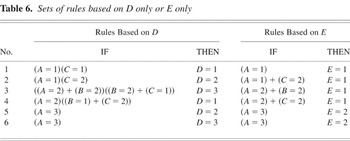
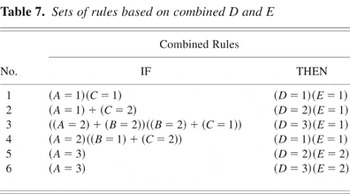
These matrices can be obtained by considering Decision Attributes D and E separately using the work of Mollestad and Komorowski with the exception of filling up the blank space with 1, which denotes the situation where two objects have the same decision value. Decision rules are then derived based on each of the matrices. The rules derived from Decision Attributes D and E relative discernibility matrices using ADA after Step 5 are tabulated in Table 6. Subsequently, they are combined using the AND operator and treated using Boolean algebra to form a composite rule (Table 7). For clarity, consider Rule 2 of Table 6: IF [(A = 1) AND (C = 2)] THEN (D = 2) and IF (A = 1) OR (C = 2) THEN (E = 1) are combined using an AND operator to form the composite rule, IF {[(A = 1) AND (C = 2)] AND [(A = 1) OR (C = 2)]} THEN {(D = 2) AND (E = 1)}. Subsequently, the composite rule is simplified using the dual of absorption theorem of Boolean algebra to form the rule, IF [(A = 1) AND (C = 2)] THEN {(D = 2) AND (E = 1)}.
Sets of rules based on D only or E only

Sets of rules based on combined D and E

4.2.1. Theoretical basis of the ADA
Consider an information system I = {U, (C, D)} comprising n number of objects where C and D denote the sets of condition and decision attributes, respectively. Based on the work of Mollestad and Komorowski, an n × n discernibility matrix, M[C,D], with respect to Decision Attribute D can be formed. Let the entry, m[C,D], in Row i and Column j be given by m[C], if the values of decision attributes of Objects Xi and Xj are different. Otherwise, let the entry of m[C,D] be 1. Here, m[C] is the attribute that discerns Objects Xi and Xj. More formally, the relative discernibility matrix with respect to Decision Attribute D can be expressed as


for 1 ≤ i ≤ n, 1 ≤ j ≤ n;

for 1 ≤ i ≤ n, 1 ≤ j ≤ n.
From the established matrix, a rule set, R[C,D], can be derived. Basically, a rule, r[C,D]i, in a rule set can be derived by first combining the entries in each of the cells of Row i into a Boolean expression using the OR operators. These Boolean expressions are then combined using the AND operators to form a composite rule in accordance to the work of Mollestad and Komorowski. More formally, the rule set derived from the matrix can be expressed as


For an information system with q number of decision attributes, Eq. (14) can be rewritten as

for 1 ≤ i ≤ n, 1 ≤ j ≤ n, 1 ≤ k ≤ q.
Similarly, Eq. (17) can formally be expressed as

for 1 ≤ i ≤ n, 1 ≤ j ≤ n, 1 ≤ k ≤ q.
For simplicity, let D = {d1, d2}. This implies that D comprises two decision attributes d1 and d2. Hence, the rules derived from an information system with two decision attributes simultaneously can be expressed as follows:


Accordingly, based on the ADA, the rules extracted from the information system with one decision attribute, d1, are given by


To show that the rules derived from the information system with two decision attributes simultaneously based on the work of Mollestad and Komorowski and those derived using the ADA are indeed the same, it is necessary to prove that their antecedent and consequent clauses of the rules are identical, namely,

The consequent clauses are the same because those rules derived using the ADA yield d1(Xi) _ d2(Xj) [Eqs. (23) and (24)], and the work of Mollestad and Komorowski produces d1(Xi) AND d2(Xj) [Eq. (21)]. Thus, only the antecedent clause needs to be examined further.

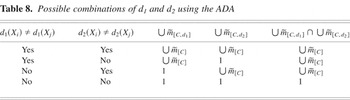
Rearranging the left-hand side of Eq. (25) by pairing each of

,

The possible pairing combinations are depicted in Table 8.
Possible combinations of d1 and d2 using the ADA

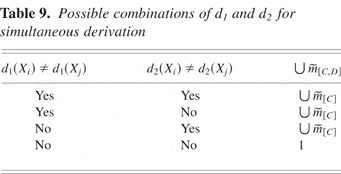
For the rules derived simultaneously from an information system with two decision attributes, there are also four possible cases (Table 9). It is apparent that the rightmost column of Tables 8 and 9 are identical for all the possible cases.

Possible combinations of d1 and d2 for simultaneous derivation

Because both the antecedent and consequent clauses of the rules are identical, it can be deduced that Eq. (24) is true. In other words, the rules derived by both methods are identical for an information system with two decision attributes.
The above can be extended to an information system with more than two decision attributes. Consider an information system with q decision attributes, where q > 2. The information system can be split into two information systems with q − 1 and one decision attribute, respectively. For an information system with q decision attributes, m[C,D] is given by Eq. (18), while r[C,D] is given by Eq. (19). For an information system with q − 1 decisions, m[C,D] and r[C,D] are respectively defined as

for 1 ≤ i ≤ n, 1 ≤ j ≤ n, 1 ≤ k ≤ q − 1.

for 1 ≤ i ≤ n, 1 ≤ j ≤ n, 1 ≤ k ≤ q − 1.
The above process is performed repeatedly until it is left with an information system with two decision attributes, which was earlier shown to be valid.
5. A CASE STUDY
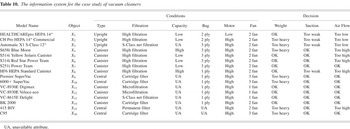
Sixteen vacuum cleaner designs available in the market were examined. As shown in Table 10, each of the 16 objects comprises nine attributes (six condition and three decision attributes). The six condition attributes represent the following DCs:
- type: the type of the vacuum cleaner;
- filtration: the type of the filtration;
- capacity: the capacity of the filter (only relevant for high filtration type);
- bag: the number of bag layers;
- motor: the rating of the motor; and
- fan: the number of fans.
The information system for the case study of vacuum cleaners

The three decision attributes denote the following capabilities:
- weight: the overall weight of the vacuum cleaner;
- suction power: the suction power in terms of water lift (inches); and
- air flow: the rate of air flow in terms of cubic feet per minute (cfm).
Assume that a new “light-weight and strong suction power” vacuum cleaner with the following specifications is to be designed:
- weight: weight < 17 lb;
- suction: suction > 90-in. water lift; and
- air flow: 90 cfm < air flow < 120 cfm.
The values of decision attributes (capability) shown in Table 10 correspond with the values given in the design specifications. Note that DC and capacity only applies to high filtration type of vacuum cleaners. For other types, the values are denoted by UA.
A cross-validation “leave-one-out” test (Reich & Barai, 1999) was performed by leaving one object (test object) out of the objects set and generating a set of rules based on the remaining objects. The rules generated were then tested against the test object. This was carried out successively for all the objects to complete the cross-validation. It was assumed that the designers had generated a set of DCs, that is, the test object, and they were required to estimate the performance of the final products based on the DCs in relation to the stipulated design specifications.
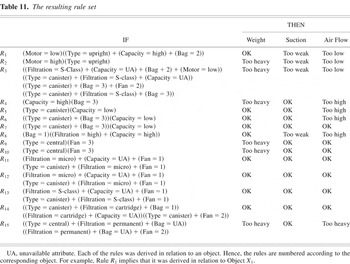
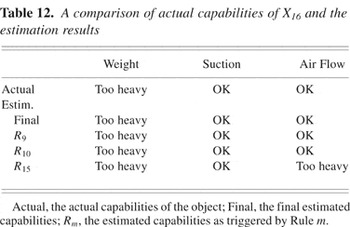
To illustrate, Object X16 was adopted as the test object. The ADA was then used to derive the rules set, as there was more than one decision attributes. The composite information system was first decomposed into three single-decision information systems. The rules derived from each information system using the DOA were then combined to produce the complete rules set as depicted in Table 11. Subsequently, the rule set was used to estimate the capability of Object X16, that is, the test object. As shown in Table 12, three rules were triggered by Object X16.
The resulting rule set

A comparison of actual capabilities of X16 and the estimation results

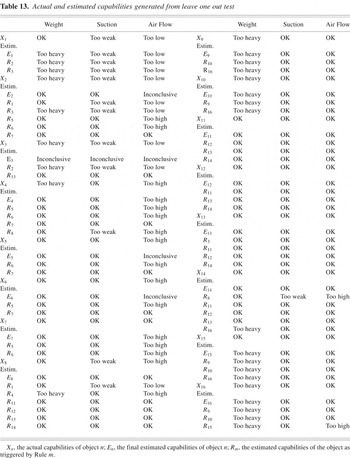
The results show that the rule set obtained was able to accurately estimate the capabilities of Weight and Suction for Object X16. However, the capability of Air Flow yielded two different results: OK and Too High, respectively. From the rules derived, Air Flow with an OK flow rates had two supporting rules, whereas Air Flow with Too High flow rates had only one supporting rule. Thus, Air Flow with an OK flow rate was selected. This was in good agreement with the actual capability. Table 13 depicts the results of the leave-one-out test.
Actual and estimated capabilities generated from leave one out test

For each of the leave-one-out tests, more than one set of estimation may be generated. For example, Object X1 yielded two sets of estimations, which were identical. It is apparent that Suction and Air Flow were in good agreement with the actual capabilities. However, the estimation for Weight yielded an erroneous result, as it deviated from the actual value attained. Similarly, consider Object X5, which produced three sets of estimations. The final estimations for Weight and Suction were both OK. Thus, they were in good agreement with the actual capabilities. However, the final estimation for Air Flow was inconclusive, as all the estimations yielded different results. It is important to note that Air Flow with a Too High flow rate was one of the estimations. More specifically, from Table 13 it is apparent that about 70% of the capabilities were estimated accurately. Out of the 30% inaccurate estimations, 12.5% were inconclusive. In summary, the case study shows that the proposed approach is able to provide fairly good estimations of the capabilities of an entirely new design. The results generated were found to be reasonably accurate despite the vague descriptions of DCs, which were expressed as condition attributes. Itis envisaged that the accuracy in estimating the capabilities can be further improved if more data are made available.
The proposed approach provides an effective means for designers to explore and evaluate innovative design. For example, consider the scenario where a group of designers intend to explore the possibility of using S-class filtration for a canister type of vacuum cleaner, that is, Object X13 in Table 13. It is assumed that the capabilities of such a vacuum cleaner are not known. Using the proposed approach, a rough estimation of the capabilities of the new vacuum cleaner with S-class filtration can be easily obtained. Based on the estimation, innovative DCs can be developed. This implies that the proposed approach enables designers to be more enterprising in exploring new DCs without being restricted by preconceived thoughts that some DCs are not feasible or cannot meet the stipulated design specifications.
6. CONCLUSIONS
This work presented an approach to the analysis of DCs using rough set theory. It introduces a DC–capability mapping process, which can be employed to assist designers in estimating the capability of a design and synthesizing past DCs. The proposed approach enables design decision rules, which are used in the mapping process, to be extracted from past design information. Using these design decision rules, designers are able to evaluate the possibility of a conceptual design in meeting design specifications. A case study on the design of vacuum cleaners was used to illustrate the capability of the proposed approach. The design decision rules extracted from past designs were reasonable and effective in estimating the capabilities of a design. It can be deduced that the accuracy of the estimation is likely to improve if more past design information are made available. Thus, the proposed approach provides an avenue for designers to predict the ability of a conceptual design in meeting design specifications when it is being finalized. As a result, designers can afford to be more enterprising in exploring new or innovative DCs. This, in turn, can help in shortening the product development life cycle, thus improving productivity.
References
REFERENCES
Arciszewski, T.,
Ziarko, W., &
Khan, T.L.
(1993).
Learning conceptual design rules: A rough set approach. In
Rough Sets, Fuzzy Sets and Knowledge Discovery
(Ziarko, W.P., Ed.), pp.
444–449.
New York:
Springer–Verlag.
Felix, R. &
Ushio, T.
(1999).
Rules induction from inconsistent and incomplete data using rough
sets.
Proc. IEEE Int. Conf. Systems, Man, and Cybernetics,
Vol. 5, pp.
154–158,
Tokyo,
October 12–15.
Grzymala–Busse, J.W. &
Hu, M.
(2000).
A Comparison of several approaches to missing attribute values in
data mining.
Second Int. Conf. Rough Sets and Current Trends in
Computing, pp. 340–347,
Banff, Canada,
October 16–19.
Hundal, M.S.
(1997).
Systematical Mechanical Designing: A Cost and Management
Perspective.
New York:
American Society of Mechanical Engineers.
Khoo, L.P. &
Zhai, L.Y.
(2001).
Multiconcept classification of diagnostic knowledge to manufacturing
systems: analysis of incomplete data with continuous-valued
attributes.
International Journal of Production Research
39(17),
3941–3957.CrossRefGoogle Scholar
Komorowski, J.,
Pawlak, Z.,
Polkowski, L., &
Skowron, A.
(1999).
Rough sets: A tutorial. In
Rough Fuzzy Hybridization
(Skowron, A., Ed.), pp.
3–98.
New York:
Springer–Verlag.
Kryszkiewicz, M.
(1998).
Rough set approach to incomplete information systems.
Information Sciences
113,
39–49.CrossRefGoogle Scholar
Kryszkiewicz, M.
(1999).
Rules in incomplete information systems.
Information Sciences
112,
271–292.Google Scholar
Kusiak, A.,
Kern, J.A.,
Kernstine, K.H., &
Tseng, B.T.L.
(2000).
Autonomous decision-making: a data mining approach.
IEEE Transactions on Information Technology in Biomedicine
4(4),
274–284.Google Scholar
Lee, S. &
Vachtsevanos, G.
(2002).
An application of rough set theory to defect detection of automotive
glass.
Mathematics and Computers in Simulation
60,
225–231.CrossRefGoogle Scholar
Liang, J. &
Xu, C.
(2000).
Uncertainty measures of roughness of knowledge and rough sets in
incomplete information systems.
Proc. Third World Congr. on Intelligent Control and
Automation, pp.
2526–2529,
Hefei, China,
June 28–July 2.
Mollestad, T. &
Komorowski, J.
(1999).
A Rough set framework for mining propositional default
rules. In
Rough Fuzzy Hybridization
(Skowron, A., Ed.), pp.
233–262.
New York:
Springer–Verlag.
Nguyen, H.P.,
Le, L.P.,
Santiprabhob, P., &
De Baets, B.
(2001).
Approach to generating rules for expert systems using rough set
theory.
Joint 9th IFSA World Congr. and 20th NAFIPS Int.
Congr., Vol. 2, pp.
877–882,
Vancouver, Canada,
July 27.
Pawlak, Z.
(1982).
Rough sets.
International Journal of Computer and Information Sciences
11,
341–356.CrossRefGoogle Scholar
Pawlak, Z.
(1996).
Why rough sets?
Proc. Fifth Int. Conf. Fuzzy Systems,
Vol. 2, pp.
738–743,
New Orleans, LA,
September 8–11.
Pawlak, Z.
(1998).
Granularity of knowledge, indiscernibility and rough sets.
Proc. IEEE World Congr. Computational Intelligence and IEEE
International Conf. Fuzzy Systems,
Vol. 1, pp.
106–110,
Anchorage, AK,
May 4–9.
Reich, Y. &
Barai, S.V.
(1999).
Evaluating Machine learning models for engineering problems.
Artificial Intelligence in Engineering
13,
257–272.Google Scholar
Ulrich, K.T. &
Eppinger, S.D.
(2000).
Product Design and Development.
New York:
McGraw–Hill.
Wang, G.
(2002).
Extension of rough set under incomplete information systems.
Proc. IEEE Int. Conf. Fuzzy Systems,
Vol. 2, pp.
1098–1103,
Honolulu, HI,
May 12–17.
Wills, L.M. &
Kolodner, J.L.
(1994).
Towards more creative case-based design systems.
Proc. 12th National Conf. Artificial Intelligence,
Seattle, WA,
August.
Zhai, L.Y.,
Khoo, L.P., &
Fok, S.C.
(2001).
Derivation of decision rules for the evaluation of product
performance using genetic algorithms and rough set theory. In
Data Mining for Design and Manufacturing
(Braha, D., Ed.), pp.
337–353.
Boston:
Kluwer.
The relationships of design concepts, capabilities, and specifications.
An information system
A decision relative discernibility matrix
An information system with multiple decision attributes
Decision relative discernibility matrix D
Decision relative discernibility matrix E
Sets of rules based on D only or E only
Sets of rules based on combined D and E
Possible combinations of d1 and d2 using the ADA
Possible combinations of d1 and d2 for simultaneous derivation
The information system for the case study of vacuum cleaners
The resulting rule set
A comparison of actual capabilities of X16 and the estimation results
Actual and estimated capabilities generated from leave one out test
 You have
Access
- 3
- Cited by