Age-related hearing loss, known as presbycusis, is characterised by a gradual decline in hearing associated with advancing age. This disorder involves difficulties in understanding speech, reduced hearing sensitivity, slower processing of auditory signals and challenges in pinpointing the direction of sounds(1). It is the most prevalent sensory impairment among the elderly, affecting 30–50 % of individuals aged 65 years and older and exceeding 80 % in those aged over 85 years(1). Globally, more than 430 million people could benefit from management of this condition, with projections indicating that by 2050, over 700–900 million individuals will face disabling hearing loss(2). In the USA, nearly one in four individuals experience hearing loss, with one in seven having hearing loss in both ears (bilateral), and at least one-third of those over 70 are affected(Reference Goman and Lin3,4) .
Hearing loss profoundly impacts quality of life, affecting multiple domains(Reference Alrasheed, Junaid and Ardi5,Reference Dalton, Cruickshanks and Klein6) . Older adults with hearing impairment face increased difficulties in social communication and are more prone to psychosocial challenges, including higher risks of depression(Reference Li and Gopinath7), social isolation(Reference Mick, Kawachi and Lin8,Reference Shukla, Harper and Pedersen9) , greater loneliness and a higher prevalence of frailty(Reference Kamil, Betz and Powers10). They may also experience difficulty comprehending medical advice or nutrition counselling, responding to warnings and detecting auditory signals such as alarms(4). Public health initiatives have primarily focused on reducing noise exposure to prevent hearing loss, emphasising the importance of preserving hearing health for overall well-being(Reference Saunders, Vercammen and Timmer11).
Age-related hearing loss results from a combination of changes in blood flow and inner ear structures, alterations in the auditory nerve and modifications in the brain’s processing of speech and sounds(1). Given these multifaceted causes, it is crucial to consider how overall health – especially central nervous system health – can alleviate changes affecting the auditory system.
Nutrition is vital for overall health and central nervous system ageing(Reference Bigman, Shea and Marius12). A well-balanced diet rich in essential nutrients may reduce age-related auditory decline(Reference Schneider, Gopinath and McMahon13–Reference Emami15). Research has shown that certain nutrients, such as n-3 fatty acids, vitamins A, C, D and E, Mg and Zn, are essential for the proper functioning of the auditory system(Reference Choi, Miller and Tucker16–Reference Bigman19). A deficiency in these nutrients can lead to hearing loss, tinnitus and other auditory disorders. In contrast, diets high in saturated fats, cholesterol and sugar increase the risk of hearing loss, while those rich in fruits, vegetables, whole grains and lean protein are associated with a lower risk(Reference Schneider, Gopinath and McMahon13–Reference Emami15,Reference Ghosn, Azadbakht and Esmaeilpour20) .
Polyphenols are plant-based compounds with antioxidant properties that benefit health in ageing populations. Polyphenols are found in foods like berries, apples, grapes, dark chocolate, nuts, olive oil, green tea, red onions and beans. Among polyphenols, flavonoids are particularly beneficial for the central nervous system(Reference Faysal, Dehbia and Zehravi21), which is crucial for processing auditory information. Flavonoids are typically classified into subclasses such as flavan-3-ols, flavanones, anthocyanidins, flavonols, flavones and isoflavones(Reference Vieux, Maillot and Rehm22). Each subclass has unique anti-inflammatory properties. However, research examining relationships between flavonoids or their subclasses with hearing loss is limited(Reference Gopinath, McMahon and Lewis23,Reference Tang, Tran and Shekhawat24) .
Most studies on polyphenols and hearing loss involve animal models and suggest that flavonoids like resveratrol may play a protective role in alleviating hearing loss(Reference Sánchez-Rodríguez, Cuadrado and Riestra-Ayora25–Reference Bahaloo, Rezvani and Farashahi Yazd27). However, only a few population-based studies have explored this relationship(Reference Gopinath, McMahon and Lewis23,Reference Tang, Tran and Shekhawat24) . One study found that participants with the highest isoflavone intake had a 36 % lower risk of hearing loss over a 10-year follow-up compared with those with the lowest intake, though no significant associations were observed between other flavonoid subclasses and hearing loss incidence.
Further research is imperative to explore modifiable risk factors associated with hearing loss and to elucidate the potential role of flavonoid intake in mitigating this condition. We analysed US national survey data to evaluate the association between total flavonoid intake – including six flavonoid subclasses – and audiometrically assessed hearing impairment in older adults.
Materials and methods
Data source
Data were used from the National Health and Nutrition Examination Survey (NHANES) 2009–2010 and 2017–2018, conducted by the National Center for Health Statistics at the Centers for Disease Control and Prevention. NHANES is an ongoing biennial series of nationally representative surveys. The survey employs a complex, multistage probability sampling design to assess the health and nutritional status of non-institutionalised civilians using interviews, examinations and laboratory measurements. This study utilised data from the 2009–2010 and 2017–2018 survey cycles because flavonoid data collection coincided with audiometry examinations among adults. The National Center for Health Statistics Research Ethics Review Board approved the protocols (#2005-06 for 2009-2010 and #2011-17 for 2017-2018). Detailed information about NHANES can be found at https://www.cdc.gov/nchs/nhanes/index.html (28).
Study participants
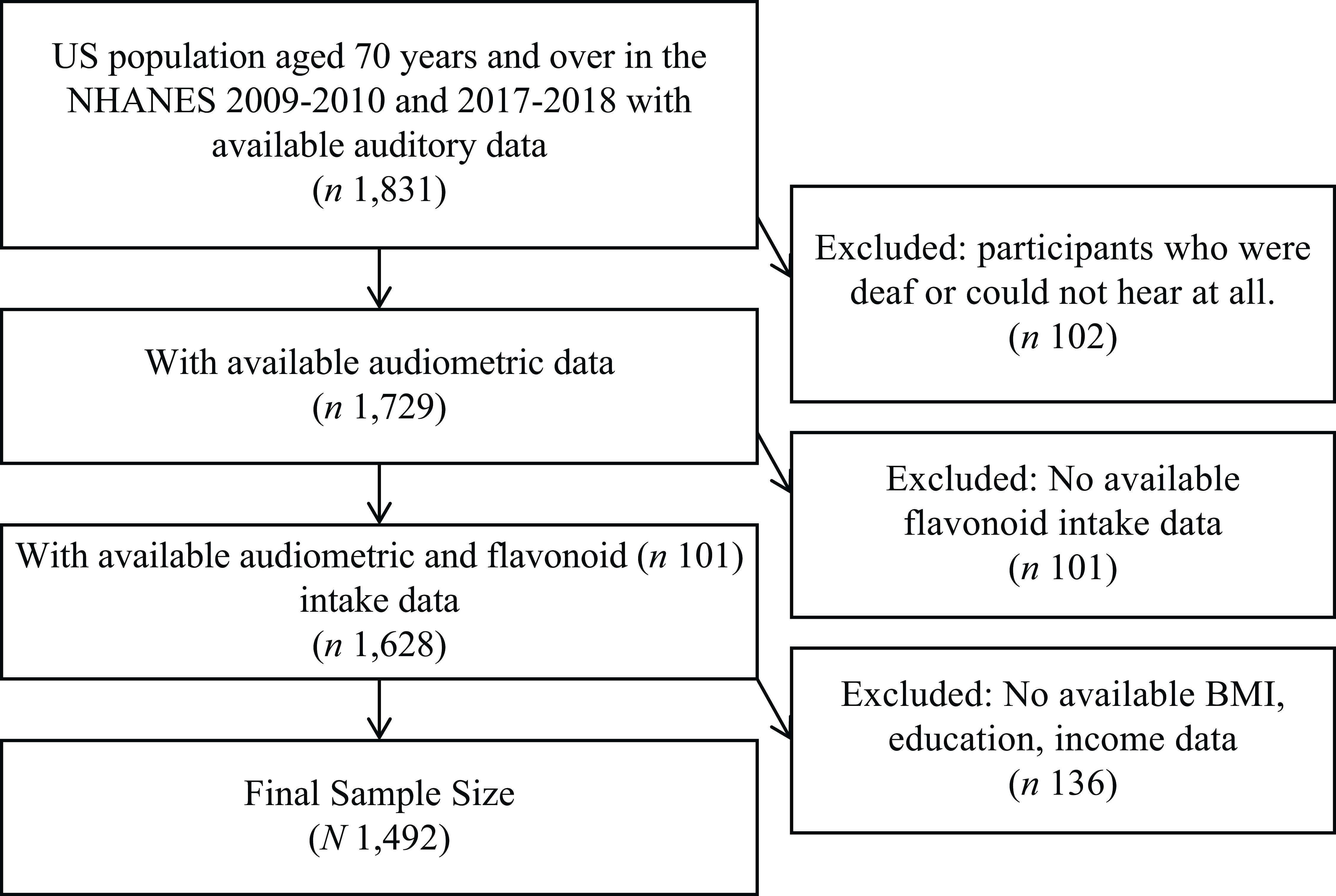
The initial study sample included 1831 adults aged 70 years or older who underwent an audiometry examination in either survey. Participants were excluded from the analysis if they were deaf (n 102), had missing flavonoid intake data (n 101) or had missing data on study covariates such as income, BMI or educational attainment (n 136). The final analytical sample consisted of 1492 participants. All study participants provided informed consent (Fig. 1).
Flow chart of the study sample showing selection of eligible participants for the final analytic sample.

Assessment of hearing impairment
Hearing impairment was assessed by an audiometry examination. Before the audiometry examination, several preparatory procedures were conducted:
-
(1) Pre-examination Audiometric Assessment: Participants were classified based on conditions experienced in the past 24 h, such as a cold, sinus problems or an earache.
-
(2) Exposure to Loud Noise: Participants were classified if they had been exposed to loud noise or listened to music with headphones in the past 24 h.
-
(3) Otoscopic Screening: A brief physical examination of the ear canals and eardrums was performed to check for excessive or impacted earwax, physical abnormalities or collapsing external ear canals.
-
(4) Tympanometry: This objective assessment of middle ear function tested the mobility of the eardrum in response to changes in air pressure within the ear canal to identify middle ear pathologies that might contribute to hearing impairment.
The audiometry examination involved air-conduction pure-tone audiometry tests conducted in a sound-attenuating booth. These tests were administered through earphones, varying the signal intensity until the participant’s hearing threshold at each frequency was determined. Hearing thresholds were tested on both ears at seven frequencies in decibels (dB) hearing level (0·5, 1·0, 2·0, 3·0, 4·0, 6·0 and 8·0 kHz). Trained audiometric technicians conducted the testing using a calibrated Interacoustics Model AD226 audiometer in a sound-treated booth meeting the American National Standard Maximum Permissible Ambient Noise Levels for Audiometric Test Rooms (American National Standards Institute S3·1–1991)(29). The effective range for automated audiometric testing was from –10 to 120 dB hearing level. In cases where the pure-tone audiometric signal was sufficiently loud to be heard by the opposite ear via bone conduction, a crossover retesting protocol was performed using insert earphones. Detailed measurement protocols are available on the NHANES website(30).
Hearing impairment was classified according to the following definitions based on hearing thresholds(Reference Olusanya, Davis and Hoffman31): no impairment (25 dB or lower), slight impairment (26–40 dB), moderate impairment (41–60 dB), severe impairment (61–80 dB) and profound impairment including deafness (greater than 81 dB). The pure-tone average (PTA) was calculated by averaging the thresholds at speech frequencies of 0·5, 1·0, 2·0 and 4·0 kHz, which are crucial for communication.
Participants were categorised into mutually exclusive groups:
-
Bilateral hearing impairment: PTA > 25 dB in both ears
-
Unilateral hearing impairment: PTA > 25 dB in one ear only
-
Normal hearing: PTA ≤ 25 dB in both ears
This classification allowed us to distinguish between types of hearing loss while ensuring that each participant was assigned to only one category. High-frequency PTA was calculated as the average of thresholds at 3000, 4000, 6000 and 8000 Hz. Participants were classified into mutually exclusive categories: no, unilateral or bilateral high-frequency hearing loss (PTA > 25 dB). This variable was used descriptively due to limited variability.
Assessment of dietary flavonoid intake
Total flavonoid intake values were obtained from the US Department of Agriculture Food and Nutrient Database for Dietary Studies (FNDDS), which was linked to the dietary intake survey data. These dietary intake data were gathered using two 24-h recall interviews. The initial recall occurred during an in-person visit, while the second was conducted via a telephone interview within a 3–10 d period following the initial recall. The average value from the two 24-h recalls was used to determine intake. If only one recall was available, data from that single day were used. A total of twenty-nine types of flavonoids were captured. These flavonoids were categorised into six major subclasses: isoflavones, anthocyanidins, flavan-3-ols, flavanones, flavones and flavonols, as well as catechins. Participants’ total flavonoid intake, flavonoid subclasses and catechins were categorised into low and high intake groups based on sample-specific median cutoffs, due to the absence of established dietary recommendations or physiological thresholds. As data were pooled from two NHANES cycles (2009–2010 and 2017–2018), we examined temporal changes in flavonoid intake by cycle and observed only modest differences by cycle (208·8 mg/d v. 188·2 mg/d, P-value = 0·331). Therefore, we used a single median cutoff (85·4 mg/d) to define intake categories, consistent with standard practices in nutritional epidemiology. Estimates from a single 2-year NHANES data cycle are generally considered less reliable than estimates from 4 years of data.
Study covariates
Demographic characteristics and health behaviours known or suspected to be associated with flavonoid intake and hearing impairment were taken into account(Reference Gopinath, McMahon and Lewis23,Reference Tang, Tran and Shekhawat24) . Demographic characteristics were gathered during participant interviews: sex, age (categorised as 70–74 years, 75–79 years and 80+ years), race/ethnicity (categorised as non-Hispanic White, non-Hispanic Black, Hispanic Americans and Asian/other) and educational attainment (categorised as < includes 12th grade with no diploma, high school graduate/general educational development certificate or equivalent, some college or associate’s degree, college graduate or above). ‘Annual family income’ indicates total annual family or individual income, collected through interviews, categorised into the following ranges based on tertiles: below $25 000, $25 000–$54 999 and $55 000 or above.
Health behaviours were assessed during participant interviews and included cigarette smoking status (categorised as ever or never) and alcohol intake based on the 24 h recalls (categorised as tertiles). BMI was calculated as weight in kilograms divided by height in metres squared and was categorised based on the WHO definition: BMI < 25 (normal weight), 25–29·9 (overweight), 30–34·9 (obese) and ≥ 35 (severely obese). Diabetes status was self-reported (yes v. no). Depression was assessed using the Patient Health Questionnaire, a nine-item instrument for screening depression, and was categorised as having mild or severe depression with a Patient Health Questionnaire-9 score of 5 or above. Two additional dietary measures were considered: total energy intake (kcal/d) and the Healthy Eating Index-2020 score, which was used to assess dietary quality(Reference Bigman and Ryan32,Reference Shams-White, Pannucci and Lerman33) . Both measures were obtained from dietary recalls over 24 h and were analysed by categorising them into tertiles. Extreme values of energy intake (< 500 or > 5000 kcal/d) were excluded (n 9).
Statistical analysis
The study utilised STATA 18·0 (StataCorp LP) for all analyses. Responses categorised as ‘do not know’, ‘refused’ or ‘missing’ in the original NHANES surveys were treated as missing (Fig. 1). In accordance with NHANES analytic guidelines, nationally representative estimates were derived by integrating primary sampling units (SDMVPSU), stratification (SDMVSTRA) and sampling weight (WTDR2D, dietary 2-d sample weight). The final weight used in the analysis was calculated by dividing the individuals’ original dietary 2-d sample weight by two, as this study combined data from two survey cycles. Descriptive statistics, including sample sizes and weighted proportions, summarised the characteristics of the study sample, focusing on the prevalence of flavonoid intake and hearing impairment status to illustrate distributions of covariate variables. For the primary analysis, total flavonoid intake was dichotomised at the median (85·4 mg/d) to define low and high intake groups, as quartile categorisation did not show a clear or consistent pattern and the median split provided a more stable and interpretable contrast.
Multivariable analyses employed weighted multinomial regression models to assess the crude and adjusted associations between hearing impairment (reference category: no hearing impairment v. unilateral or bilateral), primary exposures (flavonoid intake and its subscales as well as catechins) while adjusting for associated covariates. The final results were presented as follows: the crude model examined the unadjusted association between flavonoid intake and hearing impairment; model 1 adjusted for age, sex, race/ethnicity, education and annual family income; and model 2 further adjusted for depressive symptoms, BMI, diet quality (Healthy Eating Index-2020), total energy intake, diabetes status, smoking and alcohol intake.
Covariates were excluded from the models if they did not significantly contribute based on the adjusted Wald test P-value or if they did not change the effect measure by more than 10 %. Adjusted OR with 95 % CI were reported, considering a significance level of < 0·05 to test the study’s hypothesis. In the reduced model, interaction terms between total flavonoid intake and age category, sex and race were tested using the ‘testparm’ command in survey-weighted multinomial logistic regression. Statistically significant interactions were further examined using stratified analyses.
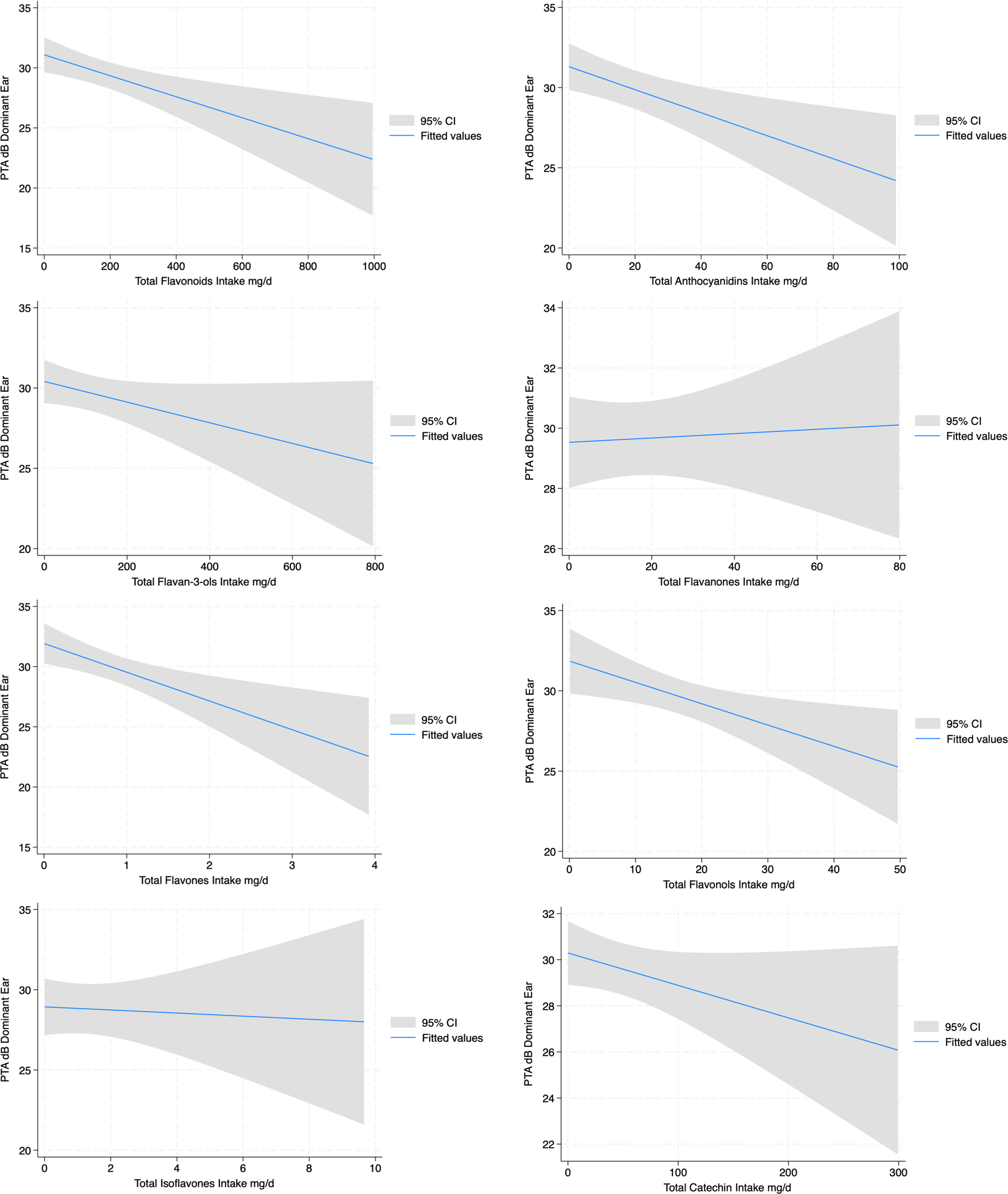
Two-way linear prediction plots with 95 % CI were generated to visualise the association between PTA in decibels (dB) of the dominant ear and total flavonoid intake, as well as major subclasses. To improve interpretability, extreme values (the highest 3 % of the intake distribution) were excluded from these visualisations.
A large language model (ChatGPT-4·0) was used to refine the manuscript text drafted by the authors. The prompt provided was: ‘Improve the text below for clarity, coherence, flow, and grammar for an academic audience’.
Results
Overall, 1492 participants aged 70 years or older with a mean age (mean (sd)) of 75·5 (sd 3·7) years were included in the final study sample. Among the 1492 participants, 904 (55·7 %) had bilateral hearing impairment, 196 (15·6 %) had unilateral hearing impairment and 382 (28·7 %) had normal hearing. These mutually exclusive categories were based on speech-frequency PTA (0·5–4·0 kHz) and defined by the presence or absence of hearing impairment in one or both ears. Based on high-frequency PTA (3000–8000 Hz), 5·2 % of participants had no high-frequency hearing loss, 8·5 % had unilateral loss and 86·3 % had bilateral loss. No further analyses were conducted due to the small normal-hearing subgroup.
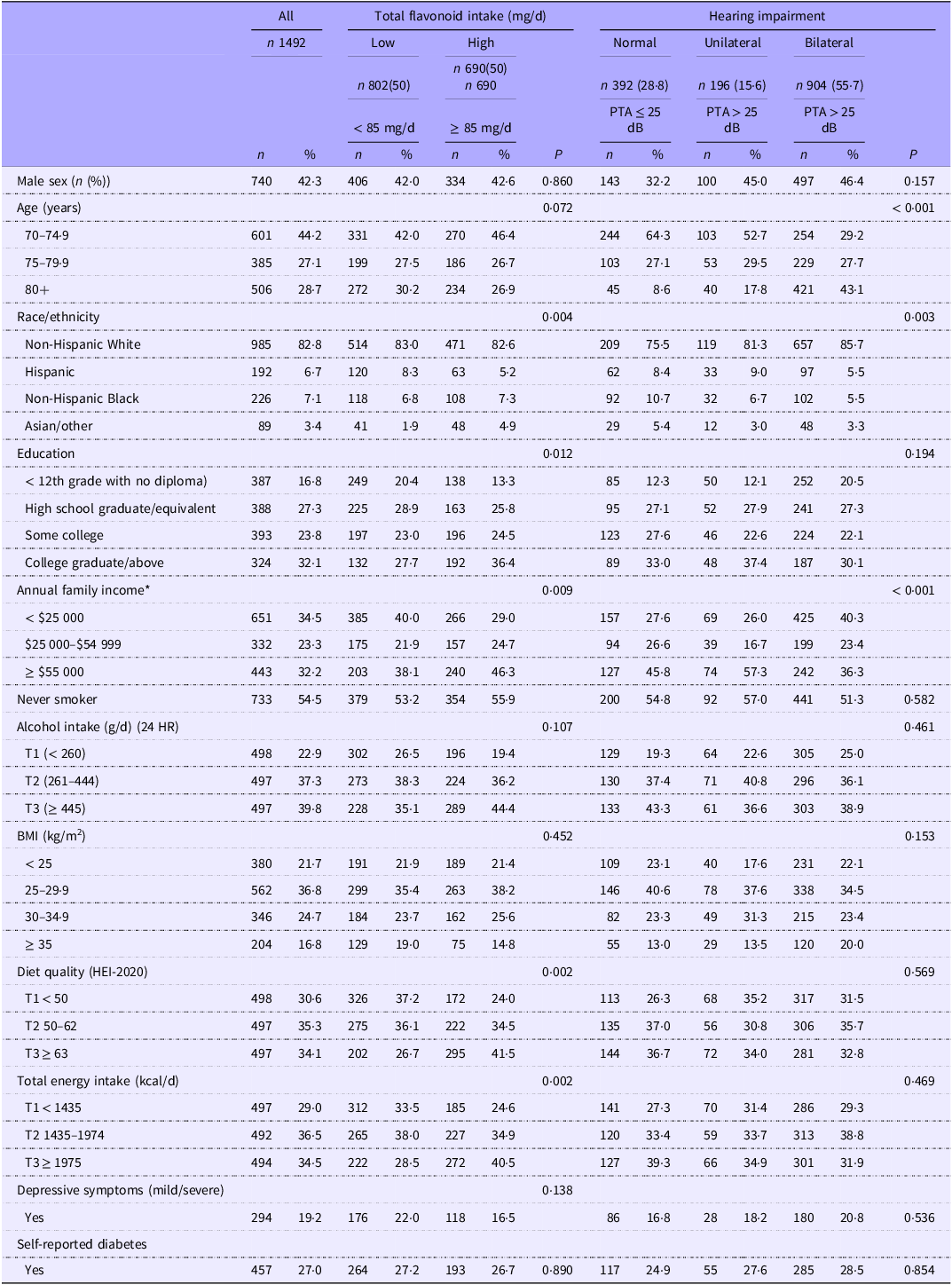
Compared with participants with normal hearing, participants with bilateral hearing impairment were significantly older (43·1 % were aged 80 years or older compared with only 8·6 %), more likely to be male and more likely to be non-Hispanic White (Table 1). Additionally, participants with bilateral hearing impairment were more likely to have low socio-economic status based on education and family income. In terms of health behaviours, there was no meaningful difference in smoking status, alcohol levels, diet quality or energy intake categories.
Summary statistics of study sample characteristics by total flavonoid intake and hearing impairment assessments in American adults aged 70 years or older

NHANES, National Health and Nutrition Examination Survey; PTA, pure-tone average; HEI, Healthy Eating Index; 24 HR, 24-h dietary recalls. Low v. high based on the median cut point of 85·4 mg/d. The values are percentages or means and are all weighted from the NHANES sampling weights. The percentages add up to100 % for a column. *Contains missing values.
Participants with a total flavonoid intake below 85·4 mg/d, compared with those with an intake of at least 85·4 mg/d, were older, more likely to be male, less likely to have higher education and family income and had lower diet quality as assessed by the Healthy Eating Index-2020.
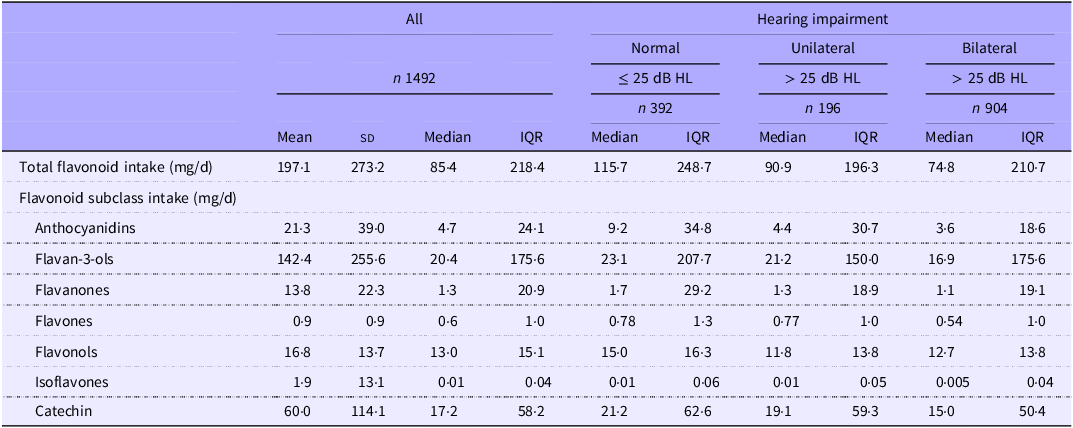
Measures of central tendency for total flavonoid intake and flavonoid subclass distributions across categories of hearing impairment are shown in Table 2. The mean overall total flavonoid intake is 197·1 mg/d. Participants with normal hearing have the highest mean intake (115·7 mg/d), followed by those with unilateral (90·9 mg/d) and bilateral hearing impairment (74·8 mg/d). This pattern of decreasing dietary intake across groups of normal hearing, unilaterally impaired and bilaterally impaired is also observed for flavonoid subclasses, such as anthocyanidins, flavan-3-ols and flavonols. The flavonoid subclasses and their percentage contributions to total flavonoid intake are flavan-3-ols (72·1 %), anthocyanidins (10·8 %), flavonols (8·5 %), flavanones (7·0 %), isoflavones (1·0 %) and flavones (0·5 %).
Mean and median total flavonoid intake and its subclasses across levels of hearing impairment assessment

dB HL, decibels hearing level; IQR, interquartile range. The values are means and are all weighted from the NHANES sampling weights.
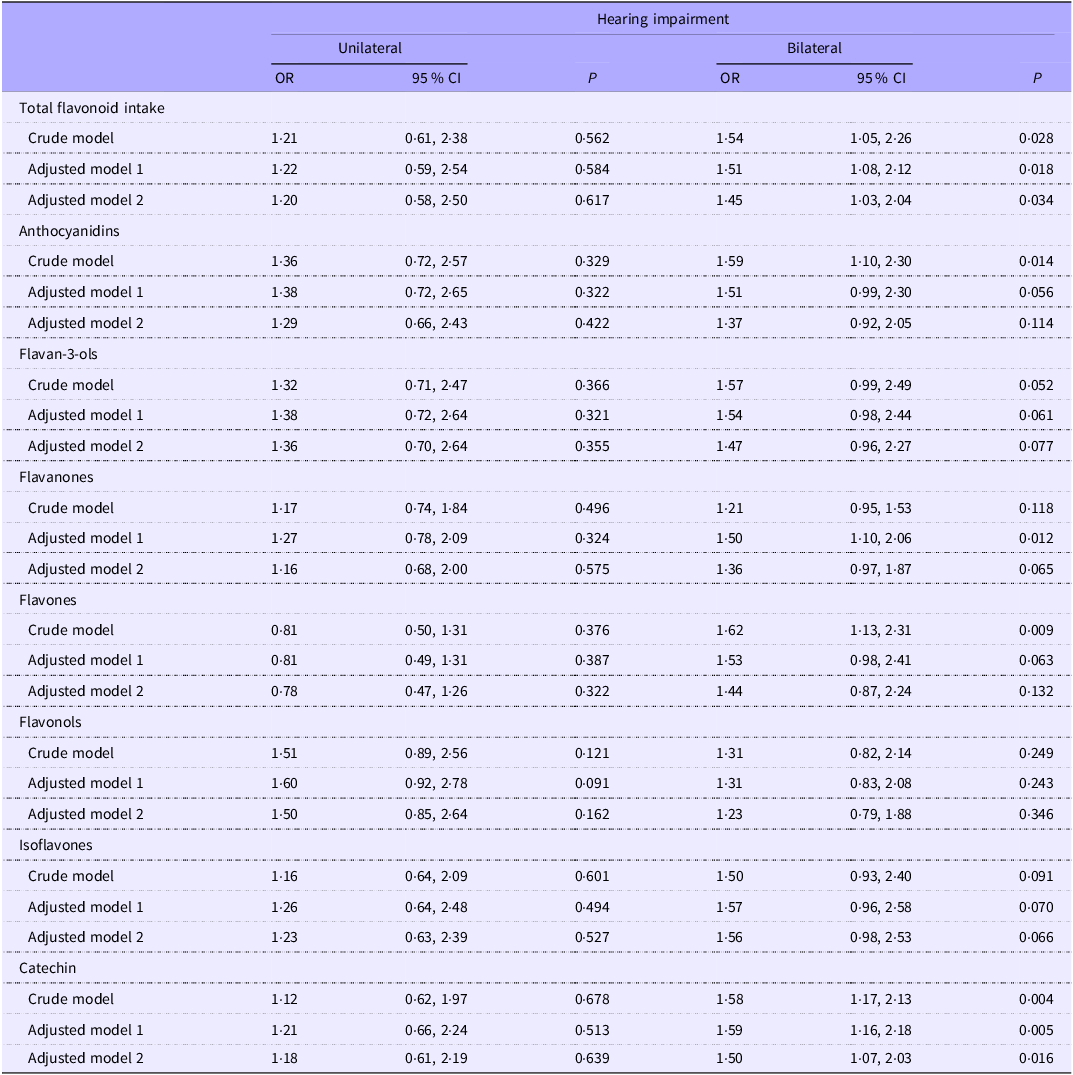
The results for the independent associations between total flavonoid intake and hearing impairment (bilateral and unilateral) and the corresponding associations for intake of flavonoid subclasses are presented in Table 3. Lower total flavonoid intake is significantly associated with 45 % greater odds of having bilateral hearing impairment (adjusted OR = 1·45; 95 % CI 1·03, 2·04; P = 0·034). Some flavonoid subclasses showed marginal associations with bilateral hearing impairment (i.e. flavan-3-ols, flavanones, isoflavones, as well as catechin). No significant associations were observed between unilateral hearing impairment and total flavonoid intake or its subclasses. As illustrated in Fig. 2, there is a relationship between higher flavonoid intake and lower PTA, indicating better hearing function.
Crude and adjusted OR with 95 % CI for the association between total flavonoid intake, its subclasses and unilateral and bilateral hearing impairment in American adults aged 70 years or older n 1492

Model 1: Adjusted for age, sex, race/ethnicity, education and annual family income.
Model 2: Adjusted for age, sex, race/ethnicity, education and annual family income, depressive symptoms, BMI, diet quality (HEI-2020), energy intake, smoking, diabetes status and alcohol intake.
Two-way linear prediction plots with 95 % CI showing the association between pure-tone average (PTA) in decibels (dB) of the dominant ear and total flavonoid intake, its subclasses and catechins intake (mg/d). Note: For visualisation purposes, extreme values (top 3 % of intake distribution) were excluded to improve interpretability. Plots were generated in Stata using the two-way lfitci command, which overlays fitted regression lines with 95 % CI.

We observed a statistically significant interaction between flavonoid intake and age (P = 0·006). In age-stratified analyses, the positive association between flavonoid intake and bilateral hearing impairment was evident only in the 70–75 year age group (OR = 2·91; 95 % CI 1·64, 5·17; P = 0·001). No significant interactions were detected between flavonoid intake and sex (P = 0·23) or between flavonoid intake and race (P = 0·15).
Discussion
Summary of key findings
Age-related hearing loss is a degenerative condition impacting millions globally. It often leads to social withdrawal, isolation and depression. The high prevalence of hearing loss, coupled with its significant effect on the well-being of the elderly and the considerable costs associated with rehabilitation, makes it a major public health concern. Investigating the potential role of nutrition, particularly flavonoids, in alleviating this condition could offer a cost-effective approach to addressing this growing public health issue.
In this nationally representative sample of US adults aged 70 years and older, lower dietary flavonoid intake (< 85 mg/d) was associated with greater odds of bilateral hearing impairment, but not unilateral impairment. The association was particularly evident for catechins, a flavan-3-ol subclass primarily found in green tea. Importantly, an age interaction was observed: the association between flavonoid intake and hearing thresholds was significant only among participants aged 70–75 years. These findings suggest that flavonoid intake may represent a potentially modifiable dietary factor relevant to age-related hearing health.
Comparison with previous studies
Our results differ from those of Gopinath et al., who reported no association between total flavonoid intake and 10-year risk of hearing impairment in an Australian cohort aged 50 years and older(Reference Gopinath, McMahon and Lewis23,Reference Tang, Tran and Shekhawat24) . Their findings were limited to isoflavones (P-trend = 0·03), with marginal associations for flavones (P-trend = 0·06), while proanthocyanidins, anthocyanidins and flavanones did not show significant associations. Several methodological differences may explain the discrepancy. First, our study population was older (≥ 70 years), when hearing loss is more prevalent, and associations may be easier to detect. Second, we used 24-h dietary recalls, which provide detailed short-term intake estimates, whereas Gopinath relied on an FFQ, reflecting long-term habitual intake. Third, flavonoid intake levels were markedly different, with much higher reported intakes in the Australian cohort (∼800 mg/d) compared with our US sample (∼85 mg/d). Finally, our models accounted for diet quality, energy intake and multiple health behaviours, and our outcome classification distinguished unilateral from bilateral impairment, enhancing interpretability.
Recent studies have increasingly recognised the role of broader lifestyle factors – beyond nutrients – in age-related hearing loss(Reference Jin, Tanaka and Reed14,Reference Ivey, Hodgson and Croft34–Reference Szulc, Wiśniewska and Żabińska42) . For instance, Yevenez-Briones et al. reported that adherence to healthy dietary patterns was associated with better hearing thresholds, supporting the plausibility of diet as a modifiable risk factor for hearing loss(Reference Jin, Tanaka and Reed14,Reference Yévenes-Briones, Caballero and Banegas38) . Similarly, Liu et al. reported that healthy dietary patterns were associated with a significantly lower risk of developing hearing loss, whereas adherence to a Western diet was associated with a higher risk and an earlier onset of hearing loss by up to 14 months(Reference Liu, Akhtar and Beck39). Curhan and colleagues found that both body weight and dietary factors were independently associated with self-reported hearing loss in large cohort studies of US women, highlighting the interplay between metabolic health and auditory outcomes(Reference Curhan, Eavey and Wang40). Additionally, research by Martinez-Amezcua et al. (Reference Martinez-Amezcua, Garcia Morales and Gabriel41) linked physical activity and cardiovascular fitness to better hearing function, underscoring the shared vascular and inflammatory pathways across multiple modifiable lifestyle factors. These findings are consistent with our proposed mechanisms through which flavonoids may influence cochlear health, and together they emphasise the importance of considering diet within a broader framework of sensory ageing and lifestyle risk modification(Reference Jin, Tanaka and Reed14,Reference Ivey, Hodgson and Croft34–Reference Szulc, Wiśniewska and Żabińska42) .
Biological plausibility and mechanisms
Flavonoids are plant-based compounds that have shown potential in protecting hearing through various biological mechanisms. Common food sources of flavonoids include kale, onion, broccoli, berries, citrus fruits, cocoa and some nuts, which are often emphasised as part of a healthy dietary pattern(Reference Faysal, Dehbia and Zehravi21,Reference Vieux, Maillot and Rehm22,Reference Tang, Tran and Shekhawat24) . We hypothesised that dietary intake of flavonoids would have an observable impact on hearing loss due to their potential to mitigate oxidative stress, inhibit pro-inflammatory cytokine production and modulate inflammatory pathways associated with ageing of the vascular system(Reference Tang, Tran and Shekhawat24,Reference Bahaloo, Rezvani and Farashahi Yazd27,Reference Szulc, Wiśniewska and Żabińska42) .
The main contributors to total flavonoid intake (> 90 %) – anthocyanidins (berries), flavan-3-ols (tea) and flavones (tea, peppers and celery) – demonstrated similar effect measures and marginally reached significant levels. Only catechins (monomeric flavan-3-ols found in green tea rather than in fermented black tea, which is more common in the USA)(Reference Vieux, Maillot and Rehm22,Reference Ivey, Hodgson and Croft34,Reference Yuan, Zhang and Sun43) showed a significant association with hearing impairment.
Catechins and other flavan-3-ols may plausibly explain our findings. Epigallocatechin gallate, a major catechin, crosses the blood–brain barrier, where it neutralises reactive oxygen species, reduces oxidative stress, mitigates neuronal damage, supports cellular resilience and may modulate neuroinflammatory responses, processes that could extend to cochlear protection(Reference Kamboj, Sharma and Kumar36,Reference Khan and Mukhtar37) .
The effect of antioxidants/flavonoids on the ageing vascular system has been tested in experimental studies. For instance, Ginkgo biloba leaves extract, which contains Ginkgo flavonoids, has shown effects in promoting blood circulation. A meta-analysis of twenty-seven studies examined the effects of Ginkgo biloba extract on hearing loss. Among the 720 participants from fifteen studies on the effects on pure-tone hearing threshold, Ginkgo biloba extract supplements were found to be effective in improving pure-tone hearing threshold in Chinese populations compared with those in the general treatment group(Reference Yuan, Zhang and Sun43).
Evidence from animal studies suggests that antioxidant supplementation attenuated the preservation of auditory sensitivities by acting on reactive oxygen metabolites and preserving mitochondrial function in an ageing rat model(Reference Fujimoto and Yamasoba44). Flavonoids have shown beneficial effects in preserving endothelial function and vascular health. Proper blood flow to the inner ear is essential for maintaining hearing function. Aging-associated reduced blood flow to the cochlea leads to the formation of reactive oxygen metabolites, which directly affect inner ear structures. Antioxidants improve endothelial function by enhancing nitric oxide availability, which is crucial for vasodilation and blood flow(Reference Li and Zhang45–Reference Kishimoto-Urata, Urata and Fujimoto47). Improving endothelial function can maintain the vascular health of cochlear capillaries. Although there is a lack of direct evidence supporting the effects of flavonoids on hearing function through preserving endothelial function, there is ample evidence supporting the protective effects of flavonoids in reducing CVD risk through vascular and inflammatory pathways(Reference Chen and Zhang48,Reference Ciumărnean, Milaciu and Runcan49) .
Interpretation of age interaction
The significant association between flavonoid intake and hearing thresholds was observed only in adults aged 70–75 years. Several explanations are possible. This age group may represent a critical window in which dietary factors exert stronger protective effects before irreversible auditory damage occurs. Alternatively, measurement challenges – such as recall accuracy or selective survival bias – may attenuate associations in older age groups. Further longitudinal research is warranted to determine whether flavonoids delay the onset or progression of hearing loss in earlier stages of ageing.
Strengths and limitations
The significance and novelty of our work lie in its focus on the elderly population, a group at higher risk of hearing loss. This research addresses a critical gap in understanding how dietary factors contribute to sensory health in older adults. Additional strengths include a thorough evaluation of dietary intake of total flavonoids and its six subclasses, including catechins, as well as associated dietary factors such as diet quality, alcohol intake and energy intake from the same reports. The data were collected from a nationally representative sample, allowing the results to be generalised to the non-institutionalised US population aged 70 years and older.
However, the major limitation of our study is the observational and cross-sectional nature of the design, which precludes the ability to establish causal relationships between flavonoid intake and better hearing sensitivity. Longitudinal studies and randomised controlled trials, including those investigating dose–response relationships, would strengthen the argument for a causal link and provide a more robust basis for recommending increased consumption of flavonoid-rich foods in public health messaging for hearing loss prevention. Hearing loss has also been associated with cognitive decline, which may affect dietary reporting and its accuracy(Reference Kamboj, Sharma and Kumar36,Reference Khan and Mukhtar37) . Dietary recalls, such as those used in NHANES, encounter challenges in elderly populations due to factors like memory decline, complex diets and health conditions. Despite these issues, NHANES employs methodologies such as the multiple-pass 24-h recall, trained interviewers and portion size aids to enhance reliability(50). Furthermore, studies suggest that collecting a minimum of 6 d of weighed food records is recommended to minimise the impact of within- and between-individual variability on total flavonoid intake assessments in this population(Reference Kent, Charlton and Lee51). Although potential covariates were carefully examined, residual confounding may exist due to incomplete classification of covariates, including missing categories for some covariates, or other unmeasured factors such as medication use that may have influenced risk estimates. Additionally, while our analysis pooled data from two NHANES cycles (2009–2010 and 2017–2018), we found only modest differences in mean total flavonoid intake between cycles (208·8 mg/d v. 188·2 mg/d), justifying the use of a single median cutoff to define low v. high intake. Nonetheless, potential secular trends in dietary habits may influence flavonoid consumption over time and should be considered in future longitudinal analyses. Lastly, while NHANES includes data on supplement use, medications and co-morbidities, our models adjusted for overall dietary quality, diabetes and alcohol intake; other co-morbidities and medications were not included to maintain parsimony and avoid overadjustment, though residual confounding is possible.
Public health implications and future directions
Despite these limitations, our findings support the plausibility that dietary flavonoids contribute to auditory health in older adults. Given that hearing loss affects quality of life and social functioning and is linked to cognitive decline, dietary modification represents a potentially cost-effective prevention strategy. Increasing intake of flavonoid-rich foods – such as berries, tea, citrus fruits and green leafy vegetables – may offer benefits not only for vascular and cognitive health but also for hearing preservation. Future longitudinal and interventional studies should evaluate dose–response relationships, mechanisms and timing of exposure to clarify causal links and inform dietary guidelines for sensory health.
In conclusion, low flavonoid intake was associated with higher odds of bilateral hearing impairment in older US adults, with the strongest evidence observed among those aged 70–75 years. While causality cannot be established, these results highlight dietary flavonoids as a potentially modifiable factor for sensory ageing. Further research, including prospective and experimental studies, is warranted to establish causality and guide public health recommendations.
Acknowledgements
We thank all individuals at the National Center for Health Statistics of the Centers for Disease Control and Prevention who were responsible for the planning and administering of NHANES and for making the datasets of NHANES available on their website.
The authors received no non-financial support related to this work.
G. B. conceived the study; performed the analysis, including the creation of tables and figures; and drafted the original manuscript. All authors contributed to the interpretation of results, manuscript writing and revisions. All authors have reviewed and approved the final manuscript.
The authors declare that there is no conflict of interest.
The data presented in the study are deposited in the Centers for Disease Control and Prevention: https://www.cdc.gov/nchs/nhanes/index.html