Malignant melanoma is associated with an excellent long-term prognosis when detected and treated at an early stage. Surgery alone is sufficient for patients with thin melanomas. Patients with thicker tumors or with ulcerated lesions, who are at higher risk for metastasis, may benefit from additional therapy beyond surgical removal of the tumor. Adjuvant and neo-adjuvant chemotherapies are designed to reduce the risk of melanoma recurrence. Adjuvant chemotherapy is used after surgical excision for the primary lesion with nodal biopsies, and neo-adjuvant chemotherapy is used before surgery for the primary lesion (Eigentler, Caroli, Radny, & Garbe, Reference Eigentler, Caroli, Radny and Garbe2003; Shah & Chapman, Reference Shah and Chapman2007; Stein & Brownell, Reference Stein and Brownell2008; Thirlwell & Nathan, Reference Thirlwell and Nathan2008; Verma et al., Reference Verma, Quirt, McCready, Bak, Charette and Iscoe2006; Zell et al., Reference Zell, Cinar, Mobasher, Ziogas, Meyskens and Anton-Culver2008).
Demographic and tumor characteristics, quality-of-life variables, patient’s preference and attitudes, and physician’s patient’s preference and attitudes are considered potential explanatory variables for chemotherapy use in melanoma (Du & Goodwin, Reference Du and Goodwin2001a, Reference Du and Goodwin2001b; Koedoot et al., Reference Koedoot, de Haan, Stiggelbout, Stalmeier, de Graeff and Bakker2003; Richards et al., Reference Richards, Ramirez, Degner, Fallowfield, Maher and Neuberger1995). It is generally assumed that patients form preferences and make decisions after they have been informed by their physician. Preferences for treatment are thus usually assessed after patients have received information concerning their treatment options. However, patients also have information from family, friends, media, or the Internet. Based on these sources of information, most patients may already have an idea about chemotherapy and whether they want it for themselves (Koedoot et al., Reference Koedoot, de Haan, Stiggelbout, Stalmeier, de Graeff and Bakker2003; Richards et al., Reference Richards, Ramirez, Degner, Fallowfield, Maher and Neuberger1995). To what extent these preferences translate into treatment decisions, and particularly for melanoma, are unknown.
Socioeconomic status (SES), as measured by individual- or area-level income, education, or occupation, may affect access for cancer treatment in conjunction with a patient’s preference or presence of oncology specialists (Gross, Filardo, Mayne, & Krumholz, Reference Gross, Filardo, Mayne and Krumholz2005; Sateren et al., Reference Sateren, Trimble, Abrams, Brawley, Breen and Ford2002). Studies have shown a relationship between SES and chemotherapy use and other treatment choices for breast, lung, and colon cancer (Earle, Neumann, Gelber, Weinstein, & Weeks, Reference Earle, Neumann, Gelber, Weinstein and Weeks2002; Gorey et al., 201!; Schrag, Rifas-Shiman, Saltz, Bach, & Begg, Reference Schrag, Rifas-Shiman, Saltz, Bach and Begg2002). Chemotherapy use is highly correlated to high aggregate and areal SES measures, and high SES is correlated to other markers for access to cancer treatment such as access to a medical oncologist (Luo, Giordano, Freeman, Zhang, & Goodwin, Reference Luo, Giordano, Freeman, Zhang and Goodwin2006). Indeed, most chemotherapies are administered in a community or outpatient setting (≥ 70%), thus areal SES also captures chemotherapy availability (Luo et al., Reference Luo, Giordano, Freeman, Zhang and Goodwin2006). Additionally, SES may determine access to chemotherapy by patients with various types of cancer (Earle et al., Reference Earle, Neumann, Gelber, Weinstein and Weeks2002; Gorey et al., 2010; Schrag et al., Reference Schrag, Rifas-Shiman, Saltz, Bach and Begg2002). However, there is limited information on the association between SES and chemotherapy use for melanoma (Zell et al., Reference Zell, Cinar, Mobasher, Ziogas, Meyskens and Anton-Culver2008).
Some studies have shown that among persons aged 65 and older covered by Medicare in the United States, those with higher SES or those who purchase supplemental health insurance are more likely to undergo cancer screening than those with low SES or those without supplemental insurance (Blustein, Reference Blustein1995; Ostbye, Greenberg, Taylor, & Lee, Reference Ostbye, Greenberg, Taylor and Lee2003; Reyes-Ortiz & Markides, Reference Reyes-Ortiz and Markides2010). Thus, we expect variations on chemotherapy use associated with SES even if older patients are covered by Medicare.
The objective of this study was to explore the association between SES and chemotherapy use to treat invasive melanoma. The hypothesis was that residing in high-SES areas is associated with a greater likelihood of chemotherapy use in older patients with invasive melanoma and covered by Medicare.
Materials and Methods
Data Sources
The cohort of this analysis was derived from the linked SEER (Surveillance Epidemiology and End Results)-Medicare database. The SEER-Medicare database was created in 1992 through collaboration of the National Cancer Institute (NCI), the SEER registries, and the Center for Medicare and Medicaid Services (CMS) to measure cancer costs, services, variation, and outcomes (Freeman et al., Reference Freeman, Klabunde, Schussler, Warren, Virnig and Cooper2002; National Cancer Institute, 1994; National Cancer Institute and the Centers for Medicare and Medicaid Services, 2007; Ries et al., Reference Ries, Eisner, Kosary, Hankey, Miller and Clegg2005; Warren, Klabunde, Schrag, Bach, & Riley, Reference Warren, Klabunde, Schrag, Bach and Riley2002). This database provides accurate and precise tumor staging, tumor characteristics (i.e., thickness, ulceration, nodes, site, histology), and date of diagnosis information from SEER and long-term diagnostic, procedure, cost, utilization, and comorbidity information from Medicare (National Cancer Institute, 1994; National Cancer Institute and the Centers for Medicare and Medicaid Services, 2007; Ries et al., Reference Ries, Eisner, Kosary, Hankey, Miller and Clegg2005).
Cases reported by the SEER registries from 1973 to 1993 have been matched against Medicare’s master enrollment file. Of persons 65 years of age or older appearing in the SEER records, Medicare eligibility could be identified for 94 per cent of cases (Potosky, Riley, Lubitz, Mentnech, & Kessler, Reference Potosky, Riley, Lubitz, Mentnech and Kessler1993). Although SEER maintains a standard case ascertainment of 98 per cent (Ries et al., Reference Ries, Eisner, Kosary, Hankey, Miller and Clegg2005; Warren et al., Reference Warren, Klabunde, Schrag, Bach and Riley2002), the SEER-Medicare link captures 88 per cent of melanoma cases (Barzilai et al., Reference Barzilai, Koroukian, Neuhauser, Cooper, Rimm and Cooper2004). The Medicare claims data used in the study included the following: (a) Medicare Provider Analysis and Review file, which contains in-patient hospital claims, available from 1988; (b) the Hospital Outpatient Standard Analytic File, which contains Medicare claims for outpatient facility services; and (c) the 100% Physician/Supplier file, which contains claims for physicians and other professional services (Health Care Financing Administration, 2000). These last two data sets were available for all beneficiaries from 1991, and Medicare claims were available through mid-year 2000. To identify complete claims for chemotherapy after diagnosis, we chose cases diagnosed from1991 to 1999.
Study Population
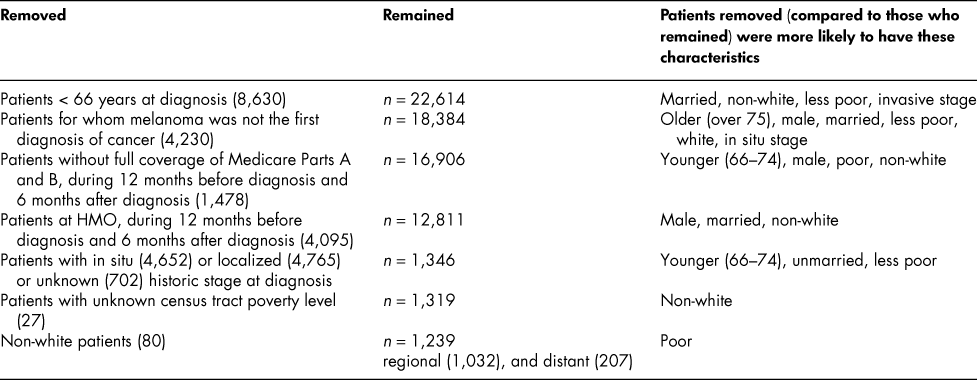
The initial study population consisted of all male and female patients who were diagnosed with melanoma from 1991 to 1999 (n = 31,244), in the SEER-Medicare database (see Table 1). Patients were restricted to those aged 66 and older, which allowed identification of co-morbid conditions one year prior to diagnosis, since most patients are eligible for Medicare coverage at age 65. Patients for whom melanoma was not the first diagnosis of cancer were also excluded, since they may have received chemotherapy for other cancers. Patients who did not have full coverage of both Medicare Part A and Part B or who were members of health maintenance organizations (HMOs) were also excluded because claims from these patients may not have been complete at the time of our study. Also excluded were patients with in situ and localized-stage cancer at diagnosis since they were not likely to receive chemotherapy, or those with unknown historic-stage cancer at diagnosis, which could have led to uncertainty or could have included in situ cases. Patients with an unknown census tract poverty level (the primary variable of interest) were excluded. Finally, non-white patients (Hispanics = 41; blacks = 14; other = 25) were excluded because it is not clear that melanoma is the same disease in people with different degrees of baseline pigmentation.
Selection of patients with diagnosis of cutaneous melanoma, years 1991–1999 (n = 31,244)
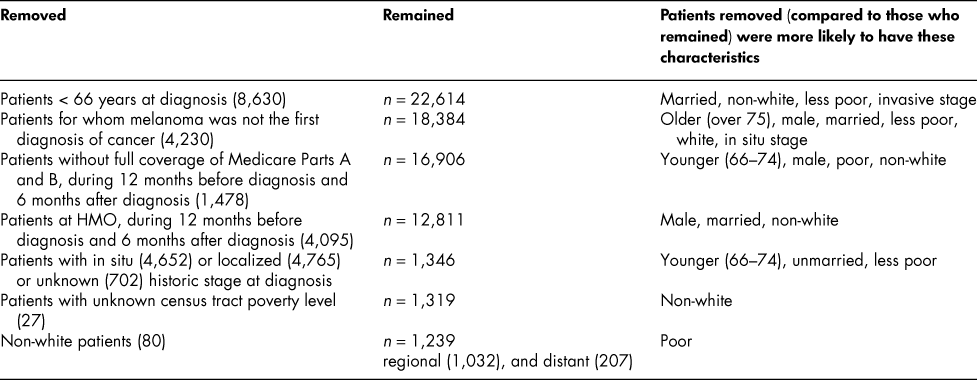
HMO = health maintenance organization
Ultimately, 1,239 patients with invasive melanoma (regional and distant stages) were available for our analyses. We focused the primary analyses and discussion on patients with regional-stage diagnosis since the standard of care is mostly related to this group, and because patients with distant-stage diagnosis of melanoma may receive systemic treatment for palliative purposes; additionally, these patients may have transitioned through earlier stages of disease but were not identifiable from the SEER database which records only the stage at diagnosis (Eigentler et al., Reference Eigentler, Caroli, Radny and Garbe2003; Shah & Chapman, Reference Shah and Chapman2007; Stein & Brownell, Reference Stein and Brownell2008; Thirlwell & Nathan, Reference Thirlwell and Nathan2008; Verma et al., Reference Verma, Quirt, McCready, Bak, Charette and Iscoe2006; Zell et al., Reference Zell, Cinar, Mobasher, Ziogas, Meyskens and Anton-Culver2008).
Outcome
Chemotherapy use was defined as at least one claim for chemotherapy (any systemic anti-cancer therapy) within specified time periods after diagnosis of melanoma (6 months) (Du & Goodwin, Reference Du and Goodwin2001a, Reference Du and Goodwin2001b), and dichotomized into yes and no. The procedures and revenue center codes for chemotherapy administration made within 24 months of melanoma diagnosis were assessed. These codes included the following International Classification for Diseases (9th revision, clinical modification [ICD-9-CM]) procedure or revenue codes: 9925 for a hospital in-patient or outpatient facility claim of chemotherapy (injection or infusion of cancer chemotherapeutic substance) (US Public Health Services, 1996); 96400 to 96549, J9000 to J9999, and Q0083 to Q0085 for a physician or outpatient claim of chemotherapy administration (American Medical Association, 1993; Health Care Financing Administration, 1994); and 0331 (chemotherapy injected), 0332 (chemotherapy oral), and 0335 (chemotherapy intravenous) for an outpatient claim of chemotherapy (Health Care Financing Administration, 1999; Luo et al., Reference Luo, Giordano, Freeman, Zhang and Goodwin2006).
The ICD-9-CM V codes (National Cancer Institute and the Centers for Medicare and Medicaid Service, 2007s) of V58.1, V66.2, or V67.2 for follow-up examination or care after chemotherapy were also used. We arbitrarily defined the day of diagnosis in SEER as the 15th of the month because SEER reported only the month and year of melanoma diagnosis. For in-patient claims for chemotherapy, diagnosis was defined as the date of admission. For outpatient and physician claims, diagnosis was defined as the earliest date of service.
Socioeconomic Status
Investigators have pointed out the need for both individual and aggregate socioeconomic measures to establish the influence of socioeconomic factors in health (Diez Roux & Mair, Reference Diez Roux and Mair2010). There is an important literature on how a neighborhood’s SES affects health outcomes particularly in the United States (Diez Roux & Mair, Reference Diez Roux and Mair2010; Gorey et al., Reference Gorey, Holowaty, Fehringer, Laukkanen, Richter and Meyer2000). Other investigators have reported that aggregate census data may be considered a close proxy of both individual- and areal-level socio-economic data (Gorey et al., Reference Gorey, Holowaty, Fehringer, Laukkanen, Richter and Meyer2000; Krieger, Reference Krieger1992; Krieger, Chen, Waterman, Rehkopf, & Subramanian, Reference Krieger, Chen, Waterman, Rehkopf and Subramanian2003). Thus, in our study, we used aggregate SES for two reasons: (a) to overcome the absence of individual SES information in SEER health records, and (b) to include a marker of both individual and areal SES. Because patient-level economic data are not collected by the SEER cancer registries, the SEER-Medicare data we used contained the SES of the patient’s census tract residency area at the time of diagnosis and was measured in terms of the percentage of residents living at or below the poverty level (Bach, Guadagnoli, Schrag, Schussler, & Warren, Reference Bach, Guadagnoli, Schrag, Schussler and Warren2002).
Because the time period of our study was from 1991 through 1999, these census poverty estimates were calculated as average values for the 1990 and 2000 census years. Poverty levels were used both as quartiles (see Tables 2 and 3) and as a continuous variable (see Table 4).
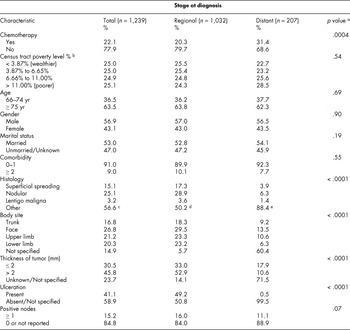
Characteristics of older white men and women with invasive cutaneous melanoma in the total population and across stage at diagnosis categories (regional and distant), 1991–1999

a Differences for each characteristic across the two categories of stage at diagnosis (regional and distant) were tested and calculated using the Pearson’s χ2 test.
b Quartiles for average percentage from 1990 and 2000 US Census data Other histology category included acral lentiginous:
c 2.6%
d 3.0%
e 0.5%
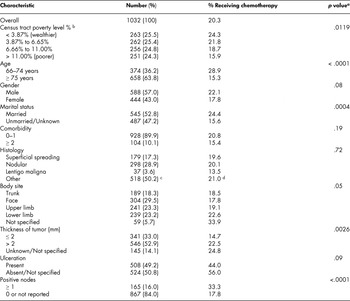
Characteristics of older white men and women with regional stage at diagnosis of cutaneous melanoma and percentages receiving chemotherapy, 1991–1999

a To test differences for receiving chemotherapy across categories or variables, p values were calculated using the Pearson’s χ2 test.
b Quartiles for average percentage from 1990 and 2000 US Census data Including acral lentiginous:
c n = 31 (3.0%); receiving chemotherapy:
d 16.1%
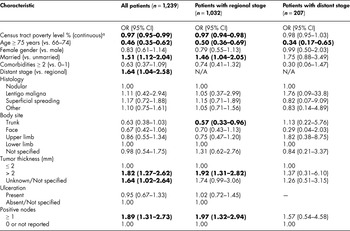
Multivariate logistic regression analyses for receiving chemotherapy as a function of socioeconomic status after diagnosis of cutaneous melanoma in older white men and women, 1991–1999

a Average percentage from 1990 and 2000 US Census data OR = odds ratios, CI = confidence intervals. In bold are significant (p < .05) odds ratios.
N/A = does not apply; — = no data
Other Measures
Age was divided into two categories: 66 to 74 years, and 75 years and older. Other variables were gender (male, female), and marital status (married, and unmarried/unknown).
Historic stage at diagnosis was categorized as in situ, localized, regional, distant, and unknown. After exclusion of in situ, localized, and unknown, the remaining sample included regional and distant stages (as previously discussed in Table 1). Tumor thickness (Breslow depth) was categorized as ≤ 2.00 mm, > 2.00 mm, and unknown. Ulceration was categorized as present, and absent or not specified. Number of positive nodes was categorized as one or more (≥ 1) and none (= 0) or not reported. Histology was categorized into nodular, lentigo maligna, superficial spreading, and other (including acral lentiginous). Site of the tumor was categorized into trunk, face, upper limb, lower limb, and not specified.
Comorbidity was ascertained from Medicare claims data through diagnoses or procedures made one year before the diagnosis of melanoma. We used the comorbidity index created by Charlson, Pompei, Ales, & MacKenzie (Reference Charlson, Pompei, Ales and MacKenzie1987) and later validated by Romano, Roos, and Jollis (Reference Romano, Roos and Jollis1993) using ICD-9-CM diagnosis and procedure codes. Medicare in-patient and outpatient claims were searched for comorbid conditions. Comorbidity was categorized into 0 to 1 and ≥ 2.
Statistical Analyses
Pearson’s χ2 test was used to evaluate (a) the relationship between chemotherapy use and patient characteristics with stages at diagnosis (regional vs. distant; see Table 2), and (b) to test the difference in rates (%) for receiving chemotherapy across SES (poverty quartiles), and across patient and tumor characteristics in those patients with regional stage disease (see Table 3). Logistic regression analyses were used to examine the relationship between SES (poverty as a continuous variable) and chemotherapy use, while controlling for other variables considered likely to affect the use of chemotherapy in subjects with melanoma (see Table 4) (Eigentler et al., Reference Eigentler, Caroli, Radny and Garbe2003; Shah & Chapman, Reference Shah and Chapman2007; Stein & Brownell, Reference Stein and Brownell2008; Thirlwell & Nathan, Reference Thirlwell and Nathan2008; Verma et al., Reference Verma, Quirt, McCready, Bak, Charette and Iscoe2006; Zell et al., Reference Zell, Cinar, Mobasher, Ziogas, Meyskens and Anton-Culver2008). The Breslow-Day test for homogeneity of odds ratios showed no significant difference related to chemotherapy use between the regional and distant stages at diagnosis. For all analyses, a significance level of p < .05 was used for a two-tailed test. All computer programming and analyses were completed using Version 9.1 of the SAS system for Windows (SAS Institute, Cary, NC).
Results
Table 2 presents key characteristics of older patients with invasive cutaneous melanoma in the total population and according to stage at diagnosis categories (regional and distant), between the years 1991 and 1999. In the total population, 22 per cent of patients received chemotherapy. Patients with a distant stage at diagnosis had higher percentages for receiving chemotherapy compared to those with a regional stage at diagnosis. Most distant-stage cases did not have thickness reported (71.5%); this affected the distribution of the percentages of distant-stage melanoma by thickness categories in the table. Indeed, distant-stage melanoma spreads beyond the original area of skin and nearby lymph nodes to other organs such as the lung, brain, or liver, or to distant areas of the skin and lymph nodes (Stein & Brownell, Reference Stein and Brownell2008; Zell et al., Reference Zell, Cinar, Mobasher, Ziogas, Meyskens and Anton-Culver2008). Neither the lymph node status nor thickness was considered in this stage but typically is thick and has also spread to lymph nodes.
Table 3 presents the characteristics of older patients with regional-stage cutaneous melanoma at diagnosis and also shows the percentages receiving chemotherapy. Patients who reside in wealthy areas, who were younger (66–74 years), and who reported being married – as well as those with thicker lesions or with one or more positive nodes – were more likely to receive chemotherapy.
Table 4 presents the multivariate logistic regression analyses for receiving chemotherapy as a function of SES after a diagnosis of cutaneous melanoma, in the total population and by each category of stage at diagnosis. Patients residing in poorer SES areas were less likely to receive chemotherapy than those residing in wealthier SES areas. This was true for patients in the overall sample and those with regional-stage melanoma at diagnosis, but not those with distant stage at diagnosis. Other factors associated with having chemotherapy were younger age compared with older age, and being married compared with unmarried. In additional multivariate analyses, with no exclusion of HMO patients, we obtained similar results for poverty’s predicting the likelihood of a patient’s receiving chemotherapy, wherein patients residing in poorer areas had lower odds for receiving chemotherapy among those of the total sample (OR = 0.97, 95% CI 0.95–0.99) or those classified as having regional-stage melanoma at diagnosis (OR = 0.97, 95% CI 0.94–0.98).
Discussion
In this study, chemotherapy use for invasive melanoma was associated with SES, and this association remained after adjusting for relevant factors. Overall, the prevalence of chemotherapy use for treatment of melanoma was lower in patients living in poorer SES areas compared with patients living in wealthier SES areas. In multivariate analyses, SES was an independent predictor of chemotherapy use.
The decreased chemotherapy use among non-Hispanic white patients residing in poorer areas is probably related to worse access to health care. There is one report in the literature on melanoma research to compare with our results. When analyzing factors associated with survival among patients with invasive cutaneous melanoma in California, Zell et al. (Reference Zell, Cinar, Mobasher, Ziogas, Meyskens and Anton-Culver2008) found a significant association between high SES and treatment with chemotherapy and immunotherapy. Other studies have also shown that socioeconomic conditions may mediate cancer care in the United States (Earle et al., Reference Earle, Neumann, Gelber, Weinstein and Weeks2002; Gorey et al., Reference Gorey, Luginaah, Bartfay, Fung, Holowaty and Wright2011; Schrag et al., Reference Schrag, Rifas-Shiman, Saltz, Bach and Begg2002).
On the other hand, other studies agree that SES affects the enrollment of subjects in clinical cancer trials. In one study using data from the US National Cancer Institute–sponsored cancer treatment clinical trials (including colorectal, lung, lymphoma, and leukemia), Sateren et al. (Reference Sateren, Trimble, Abrams, Brawley, Breen and Ford2002) reported that geographic areas with higher socioeconomic levels (measured at a county level: mean income, mean poverty, and mean education) had significantly higher levels of clinical trials accrual. In a case-control study, using the National Cancer Institute cooperative group breast cancer trials and the linked SEER-Medicare databases, Gross et al. (Reference Gross, Filardo, Mayne and Krumholz2005) reported that low SES (measured by % below poverty level within the zip code area, and Medicaid coverage) was associated inversely with trial enrollment for older women with breast cancer. By contrast, in a population-based study, Polednak (Reference Polednak2004) reported that the poverty rate of area of residence in Connecticut was not associated with chemotherapy use in non-elderly breast cancer patients.
Older age was associated with low chemotherapy use in this study. There are no population studies related to age and chemotherapy use for melanoma in the literature, but this study may reflect in part what happened in the recruitment of melanoma patients for treatment in general patient care or clinical trials. Melanoma clinical trials usually do not have age as an exclusion criterion (Chiarion-Sileni et al., Reference Chiarion-Sileni, Del Bianco, De Salvo, Lo Re, Romanini and Labianca2003; Cocconi et al., Reference Cocconi, Passalacqua, Foladore, Carlini, Acito and Maiello2003; Di Lauro et al., Reference Di Lauro, Scalone, La Mura, Zanetti, Nigri and Freschi2005; Falkson et al., Reference Falkson, Ibrahim, Kirkwood, Coates, Atkins and Blum1998); however, some have age limits (e.g., < 75 years) (Atzpodien et al., Reference Atzpodien, Neuber, Kamanabrou, Fluck, Bröcker and Neumann2002; Jungnelius et al., Reference Jungnelius, Ringborg, Aamdal, Mattsson, Stierner and Ingvar1998), and others consider “significant illnesses” as an exclusion criterion (Eton et al., Reference Eton, Legha, Bedikian, Lee, Buzaid and Hodges2002; Ridolfi et al., Reference Ridolfi, Chiarion-Sileni, Guida, Romanini, Labianca and Freschi2002). Many older patients, therefore, may not qualify for inclusion in a melanoma clinical trial.
Among tumor characteristics, thickness and number of positive nodes were independent predictors of chemotherapy use for treating melanoma. This finding agrees with some previous studies (Atzpodien et al., Reference Atzpodien, Neuber, Kamanabrou, Fluck, Bröcker and Neumann2002; Chiarion-Sileni et al., Reference Chiarion-Sileni, Del Bianco, De Salvo, Lo Re, Romanini and Labianca2003; Eton et al., Reference Eton, Legha, Bedikian, Lee, Buzaid and Hodges2002; Falkson et al., Reference Falkson, Ibrahim, Kirkwood, Coates, Atkins and Blum1998; Jungnelius et al., Reference Jungnelius, Ringborg, Aamdal, Mattsson, Stierner and Ingvar1998; Ridolfi et al., Reference Ridolfi, Chiarion-Sileni, Guida, Romanini, Labianca and Freschi2002). Histology and site, with the exception of unknown site or location in lower limb, were not associated with chemotherapy use.
This study has some limitations. Subjects enrolled in HMOs were excluded because claims were not generated or were incomplete for chemotherapy use. Historically, HMOs have not been required by the CMS to submit claims or other service information received by their Medicare enrollees (Warren et al., Reference Warren, Klabunde, Schrag, Bach and Riley2002); therefore, the lack of claims data for HMO enrollees is a significant limitation of the SEER-Medicare database. This could introduce a bias in our selected population. However, we did not find differences across poverty levels comparing HMO enrollees to non-enrollees, and we showed that, when including HMO in our statistical model, we achieved similar results for poverty levels predicting chemotherapy use for melanoma.
Another study limitation is that we measured SES by census area poverty levels because there is no method available to measure individual poverty, as we mentioned in discussing our methods; however, areal-level SES is an indicator of both individual and areal SES. Due to inherent selection biases for treatment and diagnosis, retrospective data from SEER must be evaluated with caution. For example, surgery, especially in earlier stages at diagnosis, is the best treatment and most frequently used choice to treat patients with melanoma, whereas chemotherapy is used in very selective cases with invasive melanoma (Zell et al., Reference Zell, Cinar, Mobasher, Ziogas, Meyskens and Anton-Culver2008). The data did not allow us to distinguish between therapy with interferon, interleukin, other biological agents, dacarbazine, and other cytotoxics. Finally, we could not control for clinical trials enrollment criteria and physician bias that may affect the decision on systemic therapy for melanoma patients.
This study also has its strengths. It was derived from the linked SEER-Medicare data, a population-based tumor registry. Chemotherapy-use comparisons for other cancers have been considered on the basis of this database (Du & Goodwin, Reference Du and Goodwin2001a, Reference Du and Goodwin2001b; Luo et al., Reference Luo, Giordano, Freeman, Zhang and Goodwin2006), and Administrative Medicare claims data appear to be a valid source of information for chemotherapy administered to older Medicare beneficiaries with cancer (Lamont et al., Reference Lamont, Herndon, Weeks, Henderson, Lifenbaum and Schilsky2005). This study estimates disparities related to SES after adjusting for relevant demographic factors and tumor characteristics. To our knowledge, this is the first report in the literature on melanoma focused on the association between chemotherapy use and SES. Other studies have reported disparities in survival from melanoma related to SES among older persons (Reyes-Ortiz, Goodwin, Freeman, & Kuo, Reference Reyes-Ortiz, Goodwin, Freeman and Kuo2006).
The results of this study may have applications in public health. First, although all patients in this study are covered by Medicare, those residing in low-SES areas are less likely to receive chemotherapy. This suggests that, beyond Medicare insurance coverage, which is considered part of the affordability dimension of health care access (Penchansky & Thomas, Reference Penchansky and Thomas1981) and coordinated care-payment, residing in low-SES areas may influence other dimensions for access to chemotherapy and other chemo-related health care among older patients with melanoma. These include availability (e.g., oncologist supply), accessibility (e.g., transportation, distance to clinic), accommodation (e.g., appointment systems), and acceptability (e.g., attitudes between providers and patients) for chemotherapy procedures that should be explored in further studies. For example, since more than 70 per cent of chemotherapies are administered in a community setting (outpatient), a low-SES area is likely placing a given community in a marketplace that few chemo-providers are likely to serve. A subsequent observation is that health providers may want to deliver appropriate information on options for chemotherapy treatment among patients and their families residing in low-SES areas.
In conclusion, SES was found to be associated with chemotherapy use in older white patients with melanoma. Indeed, subjects residing in poorer SES areas had lower odds of receiving chemotherapy than subjects residing in wealthier SES areas. This reflects a disparity across SES groups among older white patients in the United States.
Acknowledgements
An earlier version of this work was presented as a poster at the 2006 American Geriatrics Society meeting in Chicago, Illinois. This study used the linked SEER-Medicare database. The interpretation and reporting of these data are the sole responsibility of the authors. The authors acknowledge the efforts of the Applied Research Program, NCI; the Office of Research, Development and Information, CMS; Information Management Services (IMS) Inc.; and the Surveillance, Epidemiology, and End Results (SEER) Program tumor registries in the creation of the SEER-Medicare database.