


Introduction
Almost all people in the USA will experience a potentially traumatic event during their lifetime (89.7%; Kilpatrick et al., Reference Kilpatrick, Resnick, Milanak, Miller, Keyes and Friedman2013), the majority of whom experience multiple events. Exposure to potentially traumatic events is most commonly associated with post-traumatic stress disorder (PTSD), yet only a minority experiencing traumatic events will meet diagnostic criteria (e.g. Kilpatrick et al., Reference Kilpatrick, Resnick, Milanak, Miller, Keyes and Friedman2013). However, a significant proportion of this group experience clinically meaningful distress, including subthreshold PTSD symptoms, mood and anxiety symptoms, impaired functioning, impaired interpersonal relationships, suicidality, and hopelessness (e.g. Iverson et al., Reference Iverson, McLaughlin, Gerber, Dick, Smith, Bell, Cook and Mitchell2013; Kessler et al., Reference Kessler, Chiu, Demler, Merikangas and Walters2005; McLaughlin et al., Reference McLaughlin, Koenen, Friedman, Ruscio, Karam, Shahly and Kessler2015). Although there are efficacious trauma-focused treatments (Forbes et al., Reference Forbes, Bisson, Monson and Berliner2020), the majority target PTSD and not general psychological distress or sub-threshold PTSD symptoms. Considering the significant amount of drop-out from trauma-focused treatments (Najavits, Reference Najavits2015), adjunctive intervention to help manage emotions prior to initiating a trauma-focused protocol may be helpful.
For psychological treatment to influence broad and heterogenous trauma-related problems, it is important to assess underlying mechanisms that may contribute to the development and maintenance of trauma-related symptoms. Emotion regulation (i.e. attempts to change, manage or control an emotional experience in a goal-directed manner) may be one such process with relevance to trauma-informed interventions (Fruzzetti et al., Reference Fruzzetti, Crook, Lee, Murphy, Worrall, O’Donohue and Fisher2009). Emotion dysregulation occurs when emotional arousal interferes with effective self-management. The lack of sufficient regulation strategies can lead to the development of maladaptive coping behaviours that function to avoid or escape negative emotions (Fruzzetti et al., Reference Fruzzetti, Shenk and Hoffman2005; Gratz et al., Reference Gratz, Weiss and Tull2015), as well as psychopathology associated with trauma sequelae, such as dissociation, self-harm, substance abuse, mood disorders, anxiety disorders, and problematic social behaviours (e.g. Bradley et al., Reference Bradley, DeFife, Guarnaccia, Phifer, Fani and Ressler2011; Cisler et al., Reference Cisler, Olatunji, Feldner and Forsyth2010; Dutcher et al., Reference Dutcher, Vujanovic, Paulus and Bartlett2017; Kring, Reference Kring, Lewis, Hayiland-Jones and Barrett2008).
For survivors of trauma, dysregulation can occur when emotional arousal associated with their traumatic experience (e.g. feeling in danger) interferes with self-management. Empirical findings support that difficulties with emotion regulation are associated with post-traumatic stress symptom severity (Bradley et al., Reference Bradley, DeFife, Guarnaccia, Phifer, Fani and Ressler2011; Ehring and Quack, Reference Ehring and Quack2010; Lilly and Lim, Reference Lilly and Lim2013; Tull et al., Reference Tull, Barrett, McMillan and Roemer2007; Weiss et al., Reference Weiss, Tull, Davis, Dehon, Fulton and Gratz2012a; Weiss et al., Reference Weiss, Tull, Viana, Anestis and Gratz2012b). Emotion dysregulation is also associated with symptoms of PTSD, depression and somatization in women survivors of interpersonal violence (Lilly and Lim, Reference Lilly and Lim2013; Ruork et al., Reference Ruork, McLean and Fruzzetti2022). In women with histories of childhood abuse, emotion regulation and interpersonal problems were associated with functional impairment, equal to that of PTSD severity (Cloitre et al., Reference Cloitre, Miranda, Stovall-McClough and Han2005). Above and beyond the effects of childhood trauma, emotion dysregulation was associated with PTSD symptoms, depression, alcohol and drug abuse, adaptive functioning, and history of suicide (Bradley et al., Reference Bradley, DeFife, Guarnaccia, Phifer, Fani and Ressler2011). It is thus plausible that emotion regulation is a transdiagnostic mechanism underlying the development and maintenance of trauma-related problems and may be an efficient way to intervene.
Dialectical behaviour therapy (DBT), originally developed for borderline personality disorder (BPD) and suicidal and self-injurious behaviours, is built on a model that suggests that emotion regulation deficits contribute to and maintain problematic behaviours (Linehan, Reference Linehan1993). Research suggests that DBT skills are an active treatment ingredient (e.g. McMain et al., Reference McMain, Guimond, Barnhart, Habinski and Streiner2017), which are effective and feasible to implement with a range of symptoms (Neacsiu et al., Reference Neacsiu, Eberle, Kramer, Weismann and Linehan2014) that may present in trauma-exposed individuals. Data support DBT’s use with trauma-exposed populations, including augmenting PTSD treatment (e.g. Harned et al., Reference Harned, Jackson, Comtois and Linehan2010; Harned et al., Reference Harned, Korslund and Linehan2014; Harned et al., Reference Harned, Schmidt, Korslund and Gallop2021), and combining DBT principles with trauma-focused cognitive behavioural therapy (Bohus et al., Reference Bohus, Dyer, Priebe, Krüger, Kleindienst, Schmahl, Niedtfeld and Steil2013). A DBT group programme was effective for women survivors of intimate partner violence with multiple transdiagnostic problems (Iverson et al., Reference Iverson, Shenk and Fruzzetti2009). Research suggests that emotion regulation may be a mediating factor in DBT-based treatments (see Gratz et al., Reference Gratz, Weiss and Tull2015 for a review). In a sample of women with BPD and suicidality who received DBT for two years, time-lagged modelling showed that women with high emotion dysregulation reported poorer psychosocial functioning at the subsequent assessment period (Wilks et al., Reference Wilks, Korslund, Harned and Linehan2016). Moreover, meta-analytic evidence demonstrates that emotion regulation mediates the effect of other mindfulness-based treatments (e.g. mindfulness-based stress reduction) on improvements in mental health (Gu et al., Reference Gu, Strauss, Bond and Cavanagh2015). Early evidence from a small trial of the unified protocol for emotional disorders found that emotion regulation mediated decreases in anxiety and depression (Khakpoor et al., Reference Khakpoor, Saed and Armani Kian2019).
DBT skills training may be an efficient and effective intervention for trauma-related problems that are tied to emotion dysregulation. Identification of effective components of DBT (or which components might be more important for which clients) may aid in better developing and refining treatments. However, to date, research on DBT skills trainings has employed the entire package of DBT skills (delivered as four modules: mindfulness, interpersonal effectiveness, distress tolerance, and emotion regulation) and less is known about the efficacy of particular skills. Evaluating specific treatment components and their influence on the proposed mechanism of change is a way to isolate possible effects. The DBT emotion regulation skills module specifically includes strategies for: (1) allowing and accepting emotions; and for (2) changing negative emotions and the tendency to respond in a dysregulated manner. In particular, emotion regulation skills might be a key component in targeting emotion dysregulation to alleviate the vast array of problems related to trauma exposure, consistent with the impact of DBT skills overall in alleviating a range of difficulties. While not in the context of DBT, Diedrich and colleagues (Reference Diedrich, Grant, Hofmann, Hiller and Berking2014) conducted an experimental comparison of emotion regulation strategies – cognitive reappraisal, acceptance, and self-compassion – in a sample of depressed individuals. After undergoing a mood induction, no significant differences were observed between these conditions; however, those with higher depressed mood at baseline moderated the comparative effectiveness. For those with high depressed mood at baseline, self-compassion was significantly more effective than reappraisal and trending to be more effective than acceptance (Diedrich et al., Reference Diedrich, Grant, Hofmann, Hiller and Berking2014).
Internet-based dissemination of mental health interventions offers advantages to traditional face-to-face delivery. Programmes can potentially reach a large population at relatively low cost, can reduce logistical barriers to accessing care, and can address barriers such as stigma (Amstadter et al., Reference Amstadter, Broman-Fulks, Zinzow, Ruggiero and Cercone2009). Internet dissemination is an effective and viable form of treatment for trauma-related problems (Paul et al., Reference Paul, Hassija and Clapp2012). Utilizing internet-based delivery may offer some advantages to reaching populations of trauma-exposed individuals, such as those who demonstrate mild or moderate difficulties and who may not think their symptoms warrant in-person clinical intervention. Prior work suggests that DBT skills can be effectively delivered through brief video programmes disseminated in a research laboratory (Waltz et al., Reference Waltz, Dimeff, Koerner, Linehan, Taylor and Miller2009), as an 8-session online format (Wilks et al., Reference Wilks, Lungu, Ang, Matsumiya, Yin and Linehan2018), as an 11-session online format adjunct to a 2-day DBT workshop (Newlands and Benuto, Reference Newlands and Benuto2021), and to undergraduates for 14 successive days via smartphone app (Rizvi et al., Reference Rizvi, Finkelstein, Wacha-Montes, Yeager, Ruork, Yin, Kellerman, Kim, Stern, Oshin and Kleiman2022). Internet-based delivery of the trainings is also more time and cost effective compared with in-person group training. Moreover, this helps to minimize any therapist or group effects, providing a more direct comparison of the skills trainings. Ultimately, these skills trainings may support individuals as part of a stepped care model, by helping to support those not requiring intensive psychotherapy or those who need additional emotion regulation skills prior to engaging in trauma-focused treatment.
The current study seeks to examine the feasibility and initial impact of two brief emotion regulation skill trainings (acceptance and change) compared with an active control (psychoeducation on stress). The specific aims of this study are to: (1) evaluate the feasibility and acceptability of the two skill programmes, as indicated by attrition rates, and participant-rated measures of acceptability and satisfaction; (2) examine the efficacy of both types of emotion skill trainings (acceptance and change) compared with the control condition on improving emotion regulation, mindfulness, and affect intensity (psychological outcomes); and (3) test whether there is an interaction between training condition and baseline PTSD symptom severity on changes in psychological outcomes.
Method
Participants
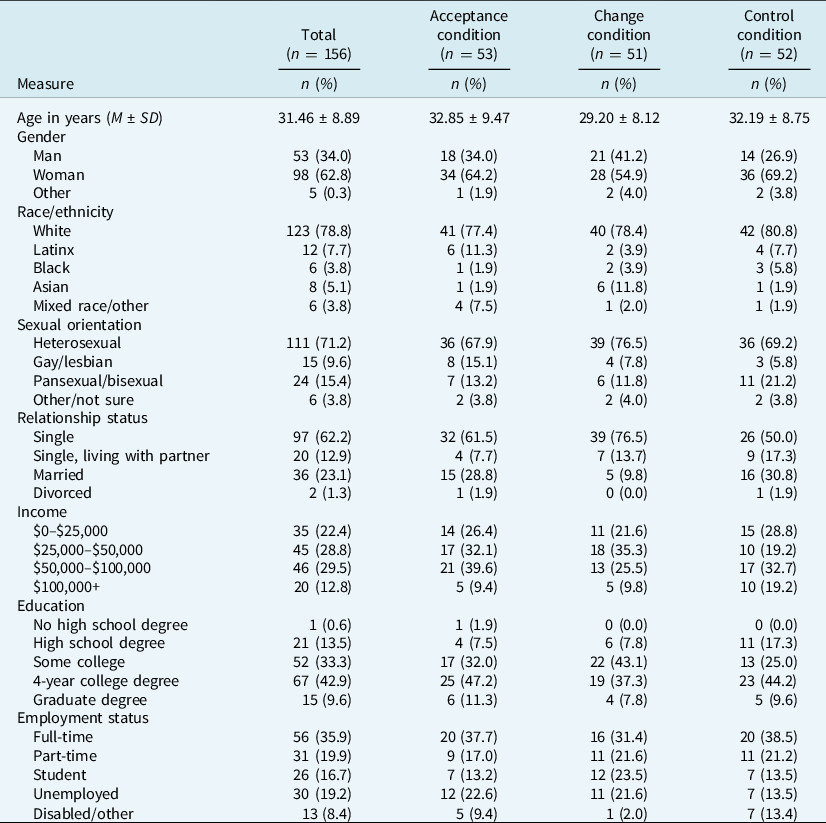
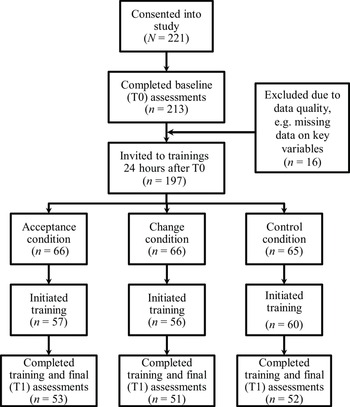
Subjects were 221 people recruited via Prolific, an online crowdsourcing platform. Of these, 197 completed the baseline and were invited to the intervention portion of the study. Three participants were removed for taking considerably longer than average (>2SD) on the training portion of the study (M = 51.61 minutes; SD = 27.26), resulting in a final sample of 156. Demographics are reported in Table 1.
Participant characteristics

Data are given as a number (valid percentage), except where indicated otherwise.
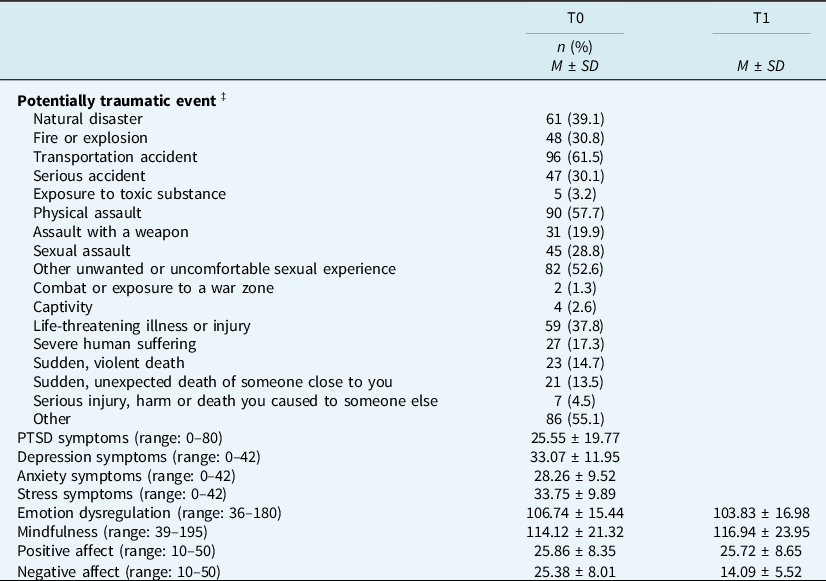
Nearly all participants (94.2%; n = 146) endorsed exposure (i.e. responded ‘happened to me’ or ‘witnessed it’) to at least one potentially traumatic event on the Life Events Checklist (LEC; Weathers et al., Reference Weathers, Blake, Schnurr, Kaloupek, Marx and Keane2013a; Table 2). The mean number of types of traumatic events endorsed on the LEC was 4.70 events (SD = 3.00; IQR = 2.25–6.00). Participants endorsed distress at levels higher than a normative sample (Table 2). Thirty-two per cent (n = 50) of participants met symptom cut-off for a provisional PTSD diagnosis (using endorsed exposure on the LEC and the PTSD Checklist-5 cut-off of 33+; Wortmann et al., Reference Wortmann, Jordan, Weathers, Resick, Dondanville, Hall-Clark, Foa, Young-McCaughan, Yarvis, Hembree, Mintz, Peterson and Litz2016). Sixty-one per cent (n = 95) of participants fell into ‘severe’ or ‘extremely severe’ symptom range across one or more measures of depression (43.6%, n = 68), anxiety (42.3%, n = 66), or stress symptoms (34.0%, n = 53; Depression Anxiety and Stress Scale-21 item; Lovibond and Lovibond, Reference Lovibond and Lovibond1995). Despite the relatively high level of distress, only 44 participants (28.2%) identified having seen a therapist in the past 6 months. Of those who did see a therapist in the past 6 months, participants averaged attending 7.18 sessions (SD = 5.50).
Summary statistics of types of potentially traumatic events, psychological distress, and outcome measures (n = 156)

‡ Participants were coded as a positive response if they endorsed either ‘happened to me’ or ‘witnessed it’. Data are cumulative percentages, as participants were able to endorse experiencing multiple types of potentially traumatic events.
Sample size
An a priori power analysis using G*Power (Faul et al., Reference Faul, Erdfelder, Lang and Buchner2007) showed that a total of 159 participants would provide 80% power to detect a medium effect size (d = 0.5) between three conditions for primary outcomes. Prior studies of multiple weekly skills trainings for emotion dysregulation found large effect sizes (Cohen’s d = 0.8 or above on most outcomes; Neacsiu et al., Reference Neacsiu, Eberle, Kramer, Weismann and Linehan2014); however, due to the brief single-session intervention here, we projected for a smaller, or moderate, effect size. For a final sample of 159 participants, we assumed 90% participant retention for those who initiated the trainings, leading to a recruitment target of 177.
Randomization
The first 30 participants were randomly assigned to the three conditions. High-medium-low scores on the PCL-5 were determined according to the mean and standard deviation of scores of the first 30 participants. Subsequent participants were blocked according to these high-medium-low scores on the PCL-5, and then block randomized using Sealed Envelope (Sealed Envelope Ltd, 2022) list generator, to ensure even distribution across conditions.
Procedure
This study protocol was approved by the local Institutional Review Board/ethics committee for human subjects research, and research has conformed to the Declaration of Helsinki. Data collection was completed in 2019. Informed consent was obtained digitally from all participants. Inclusion criteria for participation in this study were: (1) 18+ years of age; (2) current residence was the USA; and (3) fluent in English. Participants were pre-screened for these inclusion criteria (e.g. needed to meet these criteria to be able to access the study) using a filtering criteria function on Prolific. All individuals who self-selected into the study based upon the recruitment materials were invited to participate. Recruitment materials described the study as a 40-minute internet-based skills training that focused on ‘reducing feelings of overwhelm and difficulties with emotions related to stressful life experiences’. Participants were paid $1.73 for completing the baseline assessments and $5.00 for completing the training and post assessments, corresponding to Prolific’s hourly rate of $6.50.
Upon completion of the baseline assessment (T0), participants were block randomized to receive one of three brief interventions (see the ‘Trainings’ section below for details). Twenty-four hours later, participants were invited via email to complete the training. Participants then completed follow-up measures as well as questions regarding program acceptability. Figure 1 depicts participant flow.
Participant flow.

Trainings
The three conditions were: (1) skills training focused on acceptance of emotions; (2) skills training focused on change of emotions; and (3) stress psychoeducation control group. In each condition, participants were guided through a 40-minute internet-based training. Content for the conditions was developed by the first author, with input and review from DBT skill experts. To increase consistency and reduce non-specific effects, all three internet-based video programmes were consistent in length, formatting and number of interactional tasks, and were taught by the same two presenters. The two emotion regulation skill trainings focused on emotion regulation skill development and generalization with an emphasis on practising new skills and activities in daily life.
Acceptance of emotions skills condition
Skills focused on how to (1) accurately identify and name emotions and learn the difference between primary ‘justified’ and secondary ‘un-justified’ emotions, (2) observe and describe emotions, and (3) allow present emotions to come and go with body awareness to help allow emotions without attempting to escape them (by practising emotion surfing exercise, body scan). Examples for specific emotions focused on fear, shame and anger, and descriptions of how the participant could use the skill in the future. Participants were asked to identify an emotion that they struggled with (fear, shame, or anger) to focus and reflect on during the training, such as completing a typed response of how they might use a particular skill in their life for that emotion. Participants were invited to practice a guided 5-minute-long emotion surfing exercise during the training.
Change of emotions skills condition
Skills focused on how to actively change emotions, through (1) changing body chemistry (by cooling one’s body temperature, intense exercise, paced breathing, and progressive muscle relaxation), (2) distraction using the five senses, and (3) opposite action to current emotion (Linehan, Reference Linehan2015). Opposite action included practising engaging in body language (completely different from that which would facilitate acceptance) that is directly opposite to a felt emotion urge in an active effort to change the current emotion. Examples focused on the emotions of fear, shame and anger, and descriptions of how the participant could use the skill in the future. Participants were asked to identify an emotion that they struggled with (fear, shame, or anger) to focus and reflect on during the training, such as completing a typed response of how they might use a particular skill in their life for that emotion. Imaginal exercises to create competing, positive emotional experiences, and other aspects of ‘opposite action’ to negative emotion urges were also included. Participants were invited to practise a guided 5-minute-long progressive muscle relaxation exercise during the training.
Stress psychoeducation control condition
Content provided standard psychoeducation on stress and stress management provided by the National Institute of Mental Health, Centers for Disease Control and Prevention, and a general psychology textbook (Feldman, Reference Feldman2012). Participants received information on stress, including the nature of stressors (eustress vs distress), different types of stressors (i.e. cataclysmic events, personal stressors, background stressors, and potentially traumatic events), how responses vary across individuals, and biological factors that affect stress and how to minimize stress (e.g. sleep, eating healthily, minimizing drugs and alcohol, and getting exercise).
Baseline distress measures
These measures were used exclusively as indicators of distress for the sample. This was done for two reasons: (1) to reduce assessment burden and (2) due to the brief nature of the intervention, it was viewed as unlikely that these measures would change in such a short period.
The LEC (Weathers et al., Reference Weathers, Blake, Schnurr, Kaloupek, Marx and Keane2013a) screens for exposure to 17 different traumatic events across the lifetime. Follow-up questions assess for an index trauma. The LEC DSM-IV version demonstrates adequate psychometrics for measuring potentially traumatic event exposure (Gray et al., Reference Gray, Litz, Hsu and Lombardo2004).
The PTSD Checklist-DSM-5 (PCL-5; Weathers et al., Reference Weathers, Litz, Keane, Palmieri, Marx and Schnurr2013b) consists of 20 items that assess DSM-5 (American Psychiatric Association, 2013) symptom clusters (i.e. reexperiencing, avoidance, negative alterations in cognitions and mood, and hyperarousal) associated with PTSD. The PCL-5 measures symptoms in relation to the participant’s most distressing event identified on the LEC (see above) during the past month. Items are scored on a 5-point scale from 0 (not at all) to 4 (extremely) and summed for a total symptom severity score (range: 0–80). The current sample had good internal consistency (Cronbach’s α = .96).
The Depression and Anxiety Stress Scale (DASS-21; Lovibond and Lovibond, Reference Lovibond and Lovibond1995) contains 21 items that measure symptoms common to depression, anxiety and stress. Participants rate how much each statement applied to them over the past week on a 4-point scale ranging from 0 (did not apply to me at all) to 3 (applied to me very much, or most of the time). Items are summed separately for each subscale and multiplied by two (all subscale ranges: 0–42). The current sample had adequate reliability for depression (α = .92), anxiety (α = .82) and stress (α = .85) subscales.
Feasibility and acceptability measures
The DBT Ways of Coping Checklist (DBT-WCCL; Neacsiu et al., Reference Neacsiu, Rizvi, Vitaliano, Lynch and Linehan2010) is a 59-item measure for coping styles that align with DBT-specific skills. For this study, only questions relevant to acceptance of emotions and change of emotions were retained and adapted with higher scores indicating more skill knowledge (range: 0–10).
Programme satisfaction was assessed using agreement with four items: (1) The duration of the training was appropriate; (2) The language and examples used were clear; (3) I would recommend this training to others; and (4) I enjoyed the content of the training. Items were rated from 1 (disagree) to 5 (agree).
Outcome measures
The Difficulties in Emotion Regulation Scale (DERS; Gratz and Roemer, Reference Gratz and Roemer2004) is a 36-item measure of emotion regulation, including the lack of awareness and clarity surrounding emotional responses, non-acceptance of emotions, difficulty controlling impulsive behaviours when experiencing negative emotions, and limited access to emotion regulation strategies. Items are rated on a 5-point Likert scale ranging from 1 (almost always) to 5 (almost never) and summed for a total score (range: 36–180). There was good internal consistency in the current sample (α = .81).
The Five Facet Mindfulness Questionnaire (FFMQ; Baer et al., Reference Baer, Smith, Lykins, Button, Krietemeyer, Sauer, Walsh, Duggan and Williams2008) is a 39-item measure of five domains of mindfulness: non-reactivity to inner experience, observing and noticing, acting with awareness, describing, and non-judging of experience. Items are measured using a 5-point Likert scale ranging from 1 (never or very rarely true) to 5 (very often or always true) and summed to yield a total score (range: 39–195), reflecting a global measure of mindfulness. The current sample had good internal consistency (α = .92).
The Positive and Negative Affect Schedule (PANAS; Watson et al., Reference Watson, Clark and Tellegen1988 ). The PANAS is designed to measure emotional responding and consists of two mood scales (i.e. Positive and Negative affect). Participants respond to 20 items on a 5-point scale from 1 (very slightly or not at all) to 5 (extremely). Each subscale is scored separately (range: 10–50). Internal consistency was good for Positive affect (α = .91) and for Negative affect (α = .88).
Data analysis
Feasibility and acceptability included attrition from trainings, along with descriptive statistics of skills knowledge and satisfaction questions. Initial exploratory data analyses were conducted to note data patterns and to examine underlying distributional assumptions. Normality of dependent variables was assessed by examining means, standard deviations, skewness and kurtosis. A series of chi-square and t-tests was conducted to identify differences at baseline of participants who did and did not complete the trainings. To test if randomization was successful, chi-square tests and one-way analysis of variances (ANOVAs) were conducted to evaluate differences between conditions on any demographic or baseline distress measure.
Repeated measures multivariate analysis of variance (MANOVA) was conducted to examine condition effects and changes over time on the various outcome measures. Multiple linear regressions were conducted to evaluate trauma-related distress, condition, and the interaction on each of the outcome measure change scores, while controlling for baseline outcome scores. Lastly, one-way ANOVAs were used to evaluate differences between conditions on satisfaction questions and skill knowledge. Post-hoc Tukey’s tests were used to examine differences between active conditions.
Results
Completers vs non-completers
Sixty-five (29.4%) participants fell into the non-completer status and 156 (70.6%) into the completer status. Non-completers were included in all analyses where they had responded to relevant variables. Individuals who completed the trainings had significantly higher baseline scores on the PCL-5 t 210 = 2.03, p = .044, DASS-anxiety t 215 = 2.34, p = .020, and DASS-stress t 215 = 2.30, p = .022, compared with those who did not complete, and thus reported more distress overall. All other dependent measures were not significantly different between completers and non-completers, all p > .082. There was no differential drop-out between the three conditions, χ2(2,173) = 1.39, p = .499.
Baseline differences of the sample
Randomization was successful with regard to balancing the scores on the PCL-5, with no significant differences among the three groups, F 2,153 = .008, p = .99. Chi-square tests or ANOVAs revealed no significant differences between conditions on any demographic or baseline distress measures, all p > .105.
Feasibility and acceptability
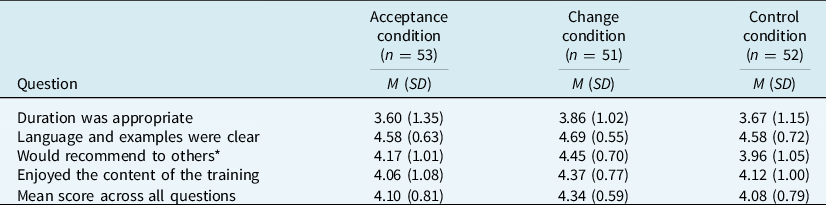
Of the 197 participants invited to the intervention portion, 173 (87.8%) participants initiated training and, of those, 156 (91.9%) completed the programme. Acceptability questions are presented in Table 3. On average, participants generally endorsed high satisfaction, rating with most aspects of the programme above 4 on a 5-point scale (M Grand = 4.17, SD = 0.74). A one-way ANOVA yielded significant differences between conditions on the statement ‘I would recommend to others’, F 2,153 = 3.38, p = .036. A Tukey post hoc test for the statement ‘I would recommend to others’ revealed that the Change condition was significantly higher than the Control condition, p = .028. There were no other statistically significant differences between conditions, p > .333. Overall, the Change condition was rated as the most acceptable, followed by the Acceptance and Control conditions, which were similar to one another. No other differences between questions were found, all F < 1.37, all p > .252.
Satisfaction questions and ratings of training conditions

Items rated from 1 (disagree) to 5 (agree). *p < .05.
Training condition comparisons
A between-group repeated measures MANOVA was used to test the effect of the skills training conditions on emotion dysregulation (DERS), mindfulness (FFMQ), and affect intensity (Positive and Negative) from T0 to T1. The analysis revealed a main effect for Time, F 4,150 = 101.43, p < .001, Wilks’ Λ = .27, partial η2 = .73, but no main effect for Condition, F 8,300 = 0.44, p = .898, Wilks’ Λ = .98, partial η2 = .01. There was no significant effect for the two-way interaction, F 8,300 = 0.84, p = .568, Wilks’ Λ = .96, partial η2 = .02, indicating that changes on outcome measures were not significantly different between Condition.
Planned comparison univariate tests for the effect of Time and Condition on specific outcome measures demonstrated main effects for Time on the DERS, F 1,153 = 5.86, p = .017, partial η2 = .04, on the FFMQ, F 1,153 = 8.81, p = .003, partial η2 = .05, and on Negative affect, F 1,153 = 346.24, p < .001, partial η2 = .69, but not for Positive affect, p = .837. There were no significant Time × Condition interaction effects (all p > .283), and thus no differential outcomes for the two skills conditions compared with the Control condition.
A one-way ANOVA yielded significant overall differences between conditions on skill knowledge, F 2,153 = 3.41, p = .036. A Tukey’s post hoc test revealed that skill knowledge was significantly higher in the Change condition compared with the Control condition, p = .027. There were no statistically significant differences between the Acceptance condition and either the Change, p = .448, or Control condition, p = .335, on skill knowledge.
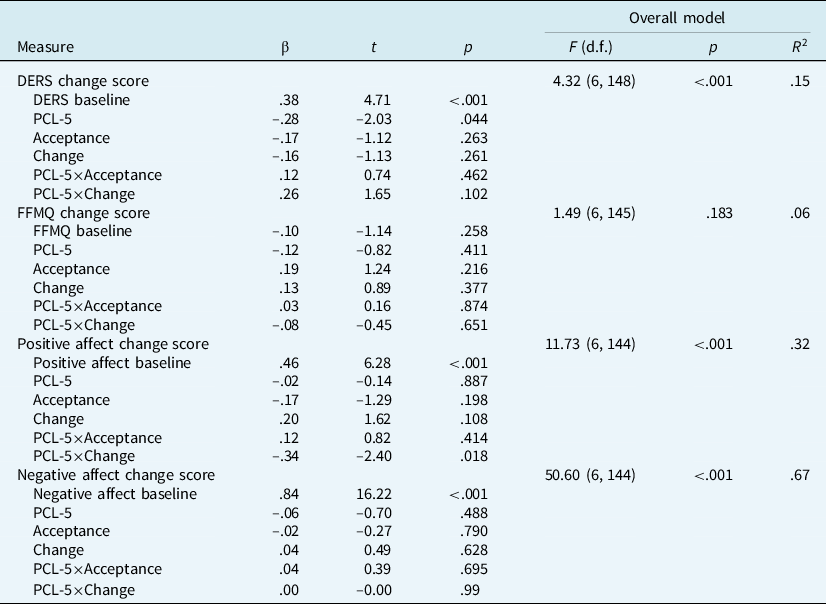
Moderation of PTSD symptoms
Multiple linear regressions were used to evaluate the main effect of PTSD symptoms (PCL-5) on each of the outcome measure change scores. As Table 4 shows, the overall models for Positive affect and Negative affect were significant, p < .016. Analyses indicated that 15% of the variance in Positive affect and 9% of the variance in Negative affect were explained by their respective models. In the Change condition, individuals with higher PCL-5 scores showed significantly greater improvements in Positive affect compared with those with lower PCL-5 scores, b = 0.24, p = .044. No other predictors were significant across all models, all p > .076.
Linear regressions of PTSD symptoms by condition on outcome measure change scores (n = 156)

DERS, Difficulties in Emotion Regulation Scale; FFMQ, Five Factor Mindfulness Questionnaire; Positive affect, positive affect subscale on the Positive and Negative Affect Schedule; Negative affect, negative affect subscale on the Positive and Negative Affect Schedule; PCL-5, Post-traumatic Stress Disorder Checklist – DSM-5 version.
Post hoc analyses
To aid in understanding how higher levels of PTSD symptoms impacted changes on outcome measures, a repeated measures MANOVA was run with participants who met the provisional PTSD cut-off of 33+ on the PCL-5 and endorsed exposure on the LEC. Comparison univariate tests for the main effects of Time and Condition found main effects for Time on Positive affect, F 1,47 = 6.46, p = .014, and Negative affect, F 1,47 = 156.65, p < .001, but not DERS nor FFMQ, all F < 3.47, all p > .068. There was a main effect of Condition for Positive affect, F 2,47 = 5.97, p = .005, but no other outcome measures, all F < .78, p > .466. There were no significant Time × Condition interaction effects, all F < .67, all p > .518. A Tukey’s post hoc test revealed that Positive affect change was significantly greater in the Change condition compared with the Acceptance condition, p = .044. In other words, for individuals who met the cut-off for provisional PTSD, those in the Change condition had significantly greater improvements in positive affect compared with the Acceptance condition.
Discussion
Results suggested that a single-session internet-based training programme is feasible; however, improvements on outcomes did not vary across conditions, suggesting that the approaches were equally effective. Our three 40-minute internet-based trainings were feasible and acceptable for participants. Of those invited to participate, 87.8% initiated training, suggesting that there is interest in these types of interventions. Almost all participants (more than 90%) completed the training programme to which they were randomized. However, rates of attrition for internet-based interventions for psychological disorders have been found to vastly range from 2 to 83% (Melville et al., Reference Melville, Casey and Kavanagh2010), so our results should be interpreted with caution. Provision of compensation and the programmes’ brief nature may both have contributed to low attrition rates, although further testing is required to explore these hypotheses. Participants also rated them highly (mean scores of greater than 4 out of 5 for all three conditions) on clarity of the presentations and enjoyment of the content, as well as stating that they would recommend the programme to others. The change condition was rated as the most acceptable, with individuals in this condition also more willing to recommend the programme to others relative to the control condition. With the recent popularity and proliferation of mindfulness practice, the Change condition may have taught more novel skills. Skills conditions may ultimately result in more continued skill use and subsequently better outcomes (Edwards et al., Reference Edwards, Kober, Rinne, Griffin, Axelrod and Cooney2021), even though they did not demonstrate immediately better outcomes. Their internet-based, self-guided nature offers promising avenues for future dissemination and implementation of DBT-informed interventions.
We examined whether the two emotion regulation skill trainings (accepting or changing painful emotions) would have a greater impact on emotion regulation, mindfulness and affect intensity, compared with an active control condition (i.e. a standard psychoeducational curriculum). We found moderate reductions in emotion regulation difficulties, increases in mindfulness, and reductions in negative affect after engaging with the trainings, although the three conditions did not differ from each other. A number of hypotheses deserving further testing may explain this finding. For instance, there is the possibility that the control condition functioned as a form of brief intervention that was as helpful as the skills conditions. Simply having participants focus on their distress and emotions, through psychoeducation and validation of their distress and experiences, may help to improve affect intensity in the short run. Avoidance of situations and emotions is a common reaction to trauma and acknowledging one’s own current emotions may function as a form of emotional acceptance (and/or exposure), if only immediately. Similarly, the psychoeducational training may have functioned as a form of distraction from momentary worries or concerns, resulting in similar changes over a short period of time on difficulties in emotion regulation, mindfulness and negative affect compared with the skills conditions. Future studies would benefit from a follow-up assessment evaluating whether these changes are lasting.
Despite lack of differences in main effects across conditions, skills knowledge was significantly greater in the active conditions compared with the control condition. Given the interventions’ brief nature and pre–post study design, it is possible that individuals in the active conditions would, in fact, practise the emotion regulation skills in a real-world environment following completion of the programme. Longitudinal studies with follow-up time points that evaluate internet-based trainings prospectively on future action (e.g. evaluating the skill behaviors in real life and in ongoing skills practice), would be critical to ascertaining the extent of potential long-term and differential effects.
Interestingly, findings demonstrated a significant change across all conditions for reducing negative emotion, but not for improving or increasing positive emotions. Individuals in the Change condition with higher baseline PTSD symptom scores showed greater increases in positive affect, suggesting its utility to more distressed sub-populations in need of intervention.
This finding suggests that for more distressed individuals something about the change-oriented skills condition might be more beneficial in increasing positive emotions, at least in the short-term. This may be attributable to the Change condition training being more focused on active skill strategies (‘active’ even being an item in the Positive affect scale) to change painful emotions, which may have felt empowering for participants (and thus lead to increases in positive affect). As effective PTSD intervention involves an optimal level of activation (e.g. Rauch and Foa, Reference Rauch and Foa2006), the Change condition strategies may have required more engagement in the process than the Acceptance condition strategies. Change strategies may be more fruitful to practise during a single session compared with acceptance. Dismantling RCTs of a mindfulness-based Monitor and Accept Training found that, in stressed community adults, Monitoring + Acceptance training was more effective for increasing positive emotions compared with the Monitoring Only training and control groups (Lindsay et al., Reference Lindsay, Chin, Greco, Young, Brown, Wright, Smyth, Burkett and Creswell2018). These findings held constant across different training lengths and delivery methods, although interventions were at minimum two weeks in length. As such, acceptance may need to be practised over a longer period of time to see beneficial effects on positive emotion. Future research would benefit in exploring how, for individuals with trauma-related distress, practising change skills may be especially helpful early in treatment to engage and empower individuals. In addition, attention to how the skills are framed could prove beneficial (e.g. framing all skills as active ways to reduce suffering).
Similarly, as previously mentioned, Diedrich and colleagues (Reference Diedrich, Grant, Hofmann, Hiller and Berking2014) found that for individuals with higher depressed mood, the self-compassion condition (which was comparable to the present change of emotions condition) was more effective than reappraisal and trending when comparing with acceptance. If further research supports these findings, potential clinical implications are that it may be beneficial to start treatment with change strategies to increase initial engagement and help improve positive affect. Additionally, change strategies may be particularly beneficial to individuals with elevated PTSD criterion D symptoms (negative alterations in cognitions and mood) and/or co-occurring depression. Taken together, an extension of this study would ideally include an additional module to help support learning of the material and more advanced concepts. Considering DBT skills use is linked to better outcomes (e.g. Rudge et al., Reference Rudge, Feigenbaum and Fonagy2020), an additional module would provide more opportunity to support skills practice and could include more personal reflection prompts with expanded emotion examples. Yet, a strength to this study was the brief 40-minute format with most individuals completing the condition to which they were randomized and individuals who wish for or perceive a need for more intensive skills training may be better suited for more traditional group delivery.
A number of limitations also accompany these findings. Recruitment utilized Prolific, a crowdsourcing community with members who may be differently motivated than those recruited via other means (e.g. a community mental health clinic). In particular, while a large portion of the current sample (61%) endorsed high severity symptom levels of depression, anxiety, stress, and possible PTSD, in total this current sample likely has a lower level of distress than a treatment-seeking population. This lower distress may have decreased engagement with the programmes and thus explain lack of differences in main effects across conditions. A large majority of participants identified as white (79%) and heterosexual (71%), limiting generalization of findings to more diverse populations experiencing heterogeneous forms of distress (e.g. minority stress). Additionally, 75% of the sample identified as ‘single’ or ‘single living with partner’ and 53% had a 4-year college degree or higher and may not generalize to broader community samples. The study also exclusively utilized self-report data, and future studies may benefit from more objective measurement.
Overall, this study investigated both whether this type of intervention (internet-based video programmes) is a viable means of intervention, and whether different approaches to skill training (vs a control) might prove differentially useful. This study provides initial evidence that brief emotion regulation skills and psychoeducation, in an internet-based delivery format, may have a positive impact on reducing negative affect. For individuals with trauma-related distress, Change skills may be particularly helpful in increasing positive affect. Present results provide motivation and direction for future studies both to continue to develop brief, internet-based interventions and to evaluate the delivery of emotion regulation skills in individuals with trauma-related distress.
Data availability statement
The data that support the findings of this study are available from the corresponding author (C.L.M.), upon reasonable request.
Acknowledgements
None.
Author contribution
Caitlin McLean: Conceptualization (lead), Data curation (lead), Formal analysis (lead), Funding acquisition (lead), Investigation (lead), Methodology (lead), Project administration (lead), Writing – original draft (lead), Writing – review & editing (lead); Allison Ruork: Methodology (supporting), Project administration (supporting), Writing – review & editing (supporting); Megan Ramaiya: Writing – review & editing (supporting); Alan Fruzzetti: Conceptualization (supporting), Methodology (supporting), Project administration (supporting), Supervision (supporting), Writing – review & editing (supporting).
Financial support
This research was partially funded by the International Society for the Improvement and Teaching of Dialectical Behavior Therapy Student Research Award awarded to Caitlin L. McLean.
Competing interest
The authors declare none.
Ethical standard
The study was approved by the University of Nevada Reno institutional review board (Protocol: 1250918-1). Research has conformed to the Declaration of Helsinki. Informed consent was obtained from all participants.



Comments
No Comments have been published for this article.