We live in a so-called age of austerity. The period prior to 2008 had already been termed the ‘silver age of permanent austerity’,Footnote 1 and the advance of austerity and welfare retrenchment accelerated following 2008 as states in advanced industrial democracies sought to reduce the public debt they incurred in responding to the global economic crisis.Footnote 2 Accounts of this move into the post-crisis age of austerity have focused on the policy consensus built in favour of austerity and the impact this has had on democracy and social inequality. As Streeck explains, ‘in order to behave “responsibly”, as defined by international markets and institutions, national governments will have to impose strict austerity, at the price of becoming increasingly unresponsive to their citizens’.Footnote 3 Whilst austerity has indeed become the order of the day, the present article argues that previous contributions to the austerity literature have focused too heavily on the imposition and impact of austerity. We also need to understand and explain the impact of the range of opposition and acts of refusal of austerity that have emerged since the crisis. This article explores anti-austerity activity in two countries – the UK and Japan – both of which are typically considered to be ‘low-resistance’ models of capitalism and finds that austerity is rarely uncontested in both countries. Using fuzzy set Qualitative Comparative Analysis (fsQCA), it highlights two ‘causal recipes’ that are sufficient for anti-austerity activity to have a significant impact on austerity proposals and one route to the smooth (unobstructed) imposition of austerity. From this perspective, the politics of austerity is shown to be better understood as an iterative interaction between austerity proposals and acts of refusal, rather than the consensus view within the political economy literature, which depicts a relatively smooth and straightforward imposition of austerity enabled by a crisis context.
AUSTERITY POLITICS: WHAT ROLE FOR RESISTANCE?
Since 2008, we have witnessed a consistent and near-universal attempt across the advanced industrial democracies to reduce public debt and deficits by decreasing welfare spending.Footnote 4 A burgeoning literature has also emerged to discuss this age of austerity.Footnote 5 We seek here to make an alternative contribution to the austerity, and anti-austerity, literatures. In doing so, we recognize that austerity itself is a contested term, which can refer to reduced welfare spending, welfare generosity, the move towards privatization and/or the de-democratization of public service provision.Footnote 6 For the purposes of this discussion, we follow Konzelman and define austerity as a process whereby public spending is reduced and/or tax revenues are increased, often in an attempt to improve the fiscal health of the government.Footnote 7 As Heald and Hood point out, however, ‘austerity’ can sometimes refer to the financial outcome of policy-making processes, rather than the political effort that goes into promoting and achieving, in their terms, a ‘fiscal squeeze’.Footnote 8
Austerity might therefore be better considered an attempt to reduce or remove the state provision of resources that supplement those allocated through market exchange, or to increase the costs to the taxpayer (normally in a regressive way) of funding those supplementary resources, all in the context of (perceived) heightened pressures to be competitive and therefore reduce costs.Footnote 9 In this sense, austerity is the opposite of Esping-Andersen’s well-known definition of ‘decommodification’.Footnote 10 Austerity might therefore be viewed as part of the broader project of neoliberalism, although we view austerity measures as part of (but not exhausted by the definition of) neoliberalism. Neoliberalism in this sense is a broader project that also includes an ever-greater emphasis on the market, a move towards financialization, the disarticulation of institutions representing the ‘left’ or ‘labour’, a more explicitly disciplining role for the state and a consistent espousal of the need to accept the (substantial) limits of democracy.Footnote 11
We argue that the austerity literature has focused on the imposition and impact of austerity, and in some cases on the normative and/or empirical question of whether austerity was the right decision for policy makers to adopt. Debates have focused on whether austerity is necessary,Footnote 12 ethically sound,Footnote 13 and/or likely to have an expansionaryFootnote 14 or contractionaryFootnote 15 effect. The literature has also considered the importance of identifying and discussing alternatives to the dominant austerity agenda,Footnote 16 especially those that focus on growth rather than austerity.Footnote 17 We have also witnessed discussions of the communicative method and the effectiveness with which the austerity agenda has been sold to the public,Footnote 18 and the impact that this has on the electoral popularity of its advocates.Footnote 19 In addition to the focus on domestic politics, we have seen a number of attempts to chart and explain the degree to which international institutions,Footnote 20 including the European Union,Footnote 21 have contributed to the imposition of austerity on national welfare states. Accounts have also highlighted the role of historical and national political economy traditions,Footnote 22 and motives of statecraft.Footnote 23 The effect of austerity has also been assessed in terms of its impact on party systems, and especially populist parties,Footnote 24 public administration,Footnote 25 welfare and redistributive policies,Footnote 26 and its detrimental effect on gender,Footnote 27 classFootnote 28 and/or racialFootnote 29 inequality.
What unites much of this literature is the claim that the post-2008 crisis has witnessed the smooth imposition of austerity measures, despite what critics consider to be a lack of evidence that austerity is necessary, desirable or indeed likely to produce the intended effects.Footnote 30 Rather than being based on sound evidence or reason, the age of austerity is considered to reflect the interests of those empowered by neoliberal capitalism.Footnote 31 Put briefly, the consensus view is that the post-2008 crisis provided a golden opportunity to consolidate (rather than challenge) neoliberalism, creating a fiscal crisis that political and economic elites have seized upon as an opportunity to further hollow out the welfare state.Footnote 32
Whilst these trends and observations are clearly important for understanding and questioning the push for austerity measures throughout the post-2008 period, the obstacles experienced by advocates of austerity are also of interest, but have received considerably less attention. As a result, we argue, the age of austerity has been discussed in terms that suggest its smooth and unproblematic imposition on advanced industrial democracies and societies. Research that has been conducted on the obstacles to austerity suggests that social opposition, trust (or its absence) and clientelistic linkages all affect the likelihood that austerity measures will be implemented.Footnote 33 However, there remains a general sense that austerity has been successfully imposed in most contexts. Strike action and industrial disputes have also been identified as potential factors that might have an effect on welfare reform; however, they have tended to be considered ineffective against austerity,Footnote 34 as have other, more non-traditional, forms of protest such as the Occupy movement.Footnote 35 This is surprising, especially as much of the broader literature on welfare reform – outside the post-2008 age of austerity – has tended to highlight a range of obstacles that austerity advocates are likely to encounter, including electoral vulnerability,Footnote 36 fear of protest,Footnote 37 partisan opposition,Footnote 38 mobilization by welfare state beneficiariesFootnote 39 and a lack of institutional capacity, especially when there is institutional fragmentation and greater numbers of institutional veto points.Footnote 40 This lack of attention to the obstacles to imposing austerity measures is also surprising because post-2008 austerity proposals have clearly not gone unopposed,Footnote 41 and we can expect that advocates of neoliberalism have been affected by this opposition.Footnote 42 The aim of the present article, therefore, is to shift our attention more towards the refusal of austerity, the obstacles to austerity policy making that this creates, and the outcomes that result from this concrete interaction between austerity proposals and the acts of refusal that they encounter.
REFUSAL AND OBSTACLES TO AUSTERITY
We draw on insights from the comparative political economy, critical political economy and political sociology literatures to develop a framework through which to consider the iterative interactions between austerity proposals and opposition to them. The central assumption underpinning our research is that opposition, contestation and refusal are unavoidable aspects of unequal social relations. This draws on the insights of the autonomist Marxists of the 1960s and 1970s and echoes some of the insights made by James C. Scott.Footnote 43 According to this perspective, it is not the case that opposition to domination is sometimes mobilized and at other times replaced by consent. Rather, the control or consent of subordinated classes, groups and minorities is never fully achieved, leaving open the opportunity for different ‘weapons of the weak’ to disrupt concrete socio-economic and political configurations. In following this approach, we seek here to consider a range of forms of refusal in order to ascertain the types of outcomes with which they are associated. It is in the light of different forms of opposition to austerity, therefore, that we should understand the final form that proposals for austerity eventually result in. In particular, we seek to understand the conditions under which austerity proposals are substantially modified or reversed as a result of opposition to them, as well as the conditions under which they appear to be implemented smoothly and without significant obstruction.
Socio-economic Content and Context Matters
Before we turn to the effects of different types of refusal, we also consider the socio-economic content of particular austerity proposals and the context within which they are made. We expect the content of austerity proposals to vary in terms of the degree to which they represent a retrenchment of the welfare state, as well as the extent to which they target ‘insiders’ (and are therefore potentially progressive in terms of their net effect) or ‘outsiders’ (and are therefore regressive), and whether they are focused on specific sectoral groups or have a more universal impact.Footnote 44 We anticipate that the groups that are most directly targeted by welfare retrenchment measures will be the most likely to mobilize in opposition,Footnote 45 although the degree to which particular groups are able to mobilize will also be influenced by their socio-economic status.Footnote 46
In addition, the socio-economic context matters. We therefore distinguish between how austerity proposals proceed within liberal market economies vs. coordinated market economies; the latter are likely to experience a stronger tendency towards policy stasis and stability, with a greater number of organized and in-built veto points obstructing the process of austerity-focused welfare reform. In doing so, we select our cases from two country contexts – the UK and Japan – which are typically viewed as exemplary cases of liberal market economy (LME) and coordinated market economy (CME) contexts, respectively. This allows us to compare the different effects that different forms and institutions of market coordination (liberal and negotiated) might have on the process of austerity policy making. The use of only two country contexts clearly does not allow us to control for other country-level differences (for instance, electoral system, party system, and so on), or to separate out country-specific effects from the effect of the particular variety of capitalism within that country. Nevertheless, we choose to distinguish between different varieties of capitalism (rather than alternative types of national difference) on the grounds that this is both most relevant and of most interest, due to the centrality of issues related to political economy in contemporary debates on austerity and welfare restructuring. Put simply, we expect that, of the relevant national differences, in terms of both proposals for, and contestation of, austerity measures, it is the difference in how relations of the political economy (especially firm–state–employee relations) are structured that will be of most interest, and that this is best encapsulated by distinguishing between different varieties of capitalism.Footnote 47
Varieties of Refusal, and Obstacles to Austerity
We identify four types of refusal in the political sociology literature: imperceptible dissent, non-disruptive public opposition, disruptive public opposition and militant refusal.
Imperceptible forms of dissent
Imperceptible forms of dissent include everyday acts of opposition and resistance, such as foot-dragging, ‘hidden transcripts’ (and other ways in which those in power are denigrated), attempts to identify escape routes and routine forms of insubordination.Footnote 48 These forms of refusal are involved in the everyday contestation of hierarchies and relationships of control and domination, yet only sometimes solidify into more widespread and/or organized forms of dissent. Nevertheless, such acts are likely to have significant effects on policy makers, although they may be difficult to perceive. Thus we might expect that everyday imperceptible forms of dissent are associated with non-compliance, minor acts of rebellion, insubordination and criminality, refusal to adequately follow instructions, and a breakdown of the trust in (and support for) elites that might otherwise enable more straightforward instances of policy making. Each of these forms of everyday refusal, moreover, is likely to make it difficult to implement policies and/or secure smooth policy changes, as the intended policy consequences become increasingly unlikely to be realized in a context in which everyday levels of obedience and the predictability of individual-level behaviour are both low.Footnote 49
Public opposition (non-disruptive and disruptive)
Acts of refusal also tend under certain circumstances to be more organized, more public and more specifically focused on raising grievances against authorities and demanding that those in authority comply with the demands being made. Through these more organized and visible forms of refusal, subjugated actors seek to make their demands heard, in order that they might be met. This might include public demonstrations and attempts to highlight particular acts or processes of injustice. Sometimes these types of opposition are conducted in a form that coheres with the established and accepted routines for expressing preferences (non-disruptive public opposition), whilst in other cases protesters use methods that break established rules in order to increase the likelihood of being noticed and/or listened to (disruptive public opposition).Footnote 50 Public demonstrations of grievances are difficult for policy makers to ignore, especially if they threaten the popularity of the government. Most obviously, unpopular decision makers risk not getting re-elected. But beyond that, a context of high levels of public and visible dissent can be associated with questioning the legitimacy, wisdom or efficacy of the political elite.
Militant refusal and the active prevention of austerity
Under certain circumstances, acts of refusal can adopt a more active form than either everyday levels of dissent and disobedience or visible attempts to express and demonstrate particular demands. Rather than seeking to dissuade political decision makers from implementing austerity measures, these more militant forms of opposition represent an attempt to actively and directly prevent such outcomes from occurring. Such methods might include, for instance, sustained strike action to prevent wage cuts from taking place, or physically preventing the implementation of housing eviction orders.Footnote 51 These forms of militant refusal are relatively rare, especially within the ‘low resistance’ models of capitalism such as those examined here. Indeed, in the cases selected and discussed below, we find only two instances in which substantial levels of militant refusal have been displayed. This low incidence of acts of militant refusal in our study poses a number of potential problems, particularly in terms of the conclusions that we can draw from our comparative analysis and the degree to which we can reach dependable conclusions with such a limited number of ‘positive’ cases. Nevertheless, we consider it important to include consideration of this condition, due to the heightened interest amongst citizens in more innovative, radical and prefigurative forms of political participation (perhaps most obviously exemplified by movements such as Occupy). Further, recent research suggests that this type of political mobilization has a degree of efficacy that has largely gone unnoticed within the relevant literature.Footnote 52
Indirect obstacles to austerity
A number of indirect obstacles arise from the interaction between austerity proposals and instances of refusal. They often occur when political elites experience difficulties in responding to protests against austerity proposals. For instance, inter-elite disagreements, institutional inertia, institutional incapacity and unintended consequences might all indirectly occur as the result of an attempt to respond to resistance.Footnote 53
There is therefore a complex interaction between austerity proposals, instances of resistance and opposition, obstacles that stand in the way of welfare reforms, the final outcome of those reforms and any subsequent consequences that arise following their adoption. It is this complex process that this study seeks to explore.
METHODS AND DATA
We employ a qualitative case study approach to compare the impact of different types of refusal on fourteen attempts to impose austerity measures in post-2008 Japan and the UK. In each case we seek to explore the process through which austerity proposals were made, the types of acts of refusal observed, the responses witnessed to those acts of refusal, and the outcomes and effects of this interaction between the refusal of austerity measures and responses to those acts of refusal. The approach adopted is therefore one of qualitative process tracing, which following Bennett and Checkel we view as ‘the analysis of evidence on processes, sequences, and conjunctures of events within a case for the purposes of either developing or testing hypotheses about causal mechanisms that might causally explain the case’.Footnote 54
Here we explore the impact of the mechanisms of refusal noted above, as well as the responses to them by those advocating austerity. The country contexts from which the cases are selected are typically considered to have low levels of refusal – due either to the longstanding construction of a relatively obedient and passive workforce (Japan) or to a more recent process whereby subordinate groups (especially organized labour) have been quietened through a process of disorganization, disarticulation and repression (the UK). Both country contexts therefore allow us to select a series of ‘least likely crucial case studies’, in the sense that evidence of a significant impact of refusal on austerity proposals in these contexts would suggest that there will be similar or more pronounced effects where levels of refusal are typically considered to be higher. That is, if refusal of austerity produces a significant impact upon the outcome of the austerity process in ‘low resistance’ countries, then we can plausibly expect that such instances of refusal and their impacts will also be likely to occur in ‘more likely’ cases, with typically higher levels of refusal.
The fourteen cases that we focus on are the key proposals for austerity measures witnessed in both countries between 2010 and 2015, under both the Democratic Party of Japan (2009–12) and Abe (2012 onwards) governments in Japan, and under the Conservative-Liberal Democrat Coalition Government in the UK (2010–15). The period since 2010 is chosen as this was when austerity measures were initiated in most OECD countries, following the initial post-2008 increase in public spending that was undertaken in order to avoid the collapse of the financial industry.Footnote 55 In the Japanese context we have included a number of market liberalization measures (for both the labour and agricultural markets) on the grounds that these represent significant attempts to reform the Japanese welfare model, which is commonly noted to be based on the notion that both the firm and the extended (rural) family serve as welfare providers. In Estevez-Abe’s terms, ‘Japan uses industrial policy as a form of social policy’, which includes ‘functional equivalents’ to conventional welfare, such as ‘public works, subsidies to rural farmers, market-restricting regulations, and employment protections’.Footnote 56
Austerity measures in such a context therefore include attempts to remove these forms of market regulations and practices that protect certain groups. We rely on a combination of official documents and journalistic reports to present a narrative that traces the process of austerity policy making based on the following stages: austerity proposal, instances of refusal, obstacles, outcome and subsequent consequences for those implementing austerity measures. Due to space constraints we discuss here only the summary findings, alongside the more interesting cases that illustrate some of the key findings. We present each of the narratives in full in a website that accompanies the article.Footnote 57 Each of these online narratives presents a detailed explanation of our evaluation and scoring for each of the conditions and outcomes studied. The results are therefore both transparent and replicable.
Summary of Findings
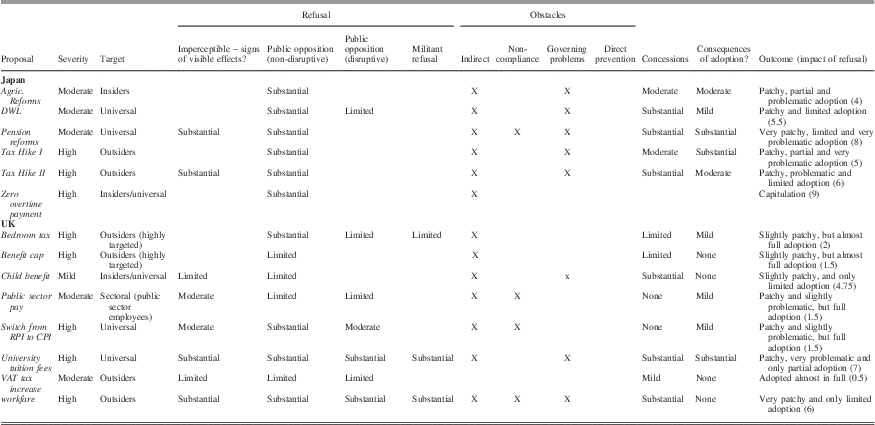
As Table 1 shows, each of the fourteen austerity proposals experienced at least some form of refusal. As such, any narrative of austerity policy making that makes no reference to instances of refusal is lacking in that it overlooks the opposition that austerity proposals seem destined to encounter. As Table 1 makes clear, non-disruptive public opposition was by far the most popular form of refusal undertaken. All of the austerity proposals experienced some non-disruptive public opposition. In ten of the fourteen cases (71.4 per cent) this was of a substantial nature, including in response to all of the proposals in Japan. The higher proclivity to undertake non-disruptive forms of public opposition in Japan is perhaps unsurprising given that it is a CME: these economies tend, by their very nature, to have more formal institutional means of incorporating subordinate groups into the political decision-making process. This includes trade unions, which generally have higher membership rates, and more established channels for political input, than in LMEs. For this reason, we might expect public opposition to be expressed through these formal (non-disruptive) channels. Indeed, most of the instances of non-disruptive public opposition witnessed in the Japanese case were coordinated by the formal trade union organization, Rengo, or by the formal organization representing farmers (JA) in the case of agricultural reforms.
Main Findings

Source: For full details see the online appendix.
Alternative forms of refusal (apart from non-disruptive public opposition) were much more likely in the UK than Japan, with all proposals except the benefit cap experiencing at least one other form of refusal in addition to non-disruptive public opposition. Moreover, the severity of the proposal was the best indicator of the likelihood of alternative forms of refusal in the UK case. Thus, the three proposals that experienced the most substantial opposition (in terms of the range and scale of forms of refusal) – university tuition fees, workfare and the switch from the Retail Price Index (RPI) to the Consumer Price Index (CPI) – were all ‘high-severity’ cases.
Fuzzy Set Qualitative Comparative Analysis
In order to assess the impact of particular types of refusal, we conduct a fsQCA of the fourteen key proposals for austerity during the 2010–15 period in the UK and Japan. Ragin developed the fsQCA method as a means of performing configurational analysis, meaning an exploration and identification of the causal conditions that produce particular outcomes.Footnote 58 The method has subsequently been the subject of considerable discussion and development as it has been revised, refined and improved.Footnote 59 In contrast with standard linear quantitative analysis, fsQCA enables the researcher to consider the complex interaction between different causal conditions, including when the number of cases under investigation is relatively small.Footnote 60 It is therefore well suited to in-depth case study research, in which the researcher relies upon knowledge of the complexities of particular cases to produce accounts and explanations of concrete outcomes. This type of research often considers causality to be a process whereby multiple conditions combine in a particular way to produce certain configurations of conditions that in turn give rise to particular outcomes. Quantitative analysis often cannot deal with this level of qualitative complexity. However, in conducting qualitative research it is difficult to proceed as systematically as with quantitative approaches, or to consider whether conditions are present or absent in particular contexts, and how they combine. fsQCA therefore offers a ‘middle ground’: it can consider the configuration and combination of multiple conditions, and retains a degree of systematicity. This method is especially well suited to our present research, because we seek to uncover the impact of, and complex inter-relationships among four different types of refusal as well as the socio-economic context and content of the austerity proposals under investigation.
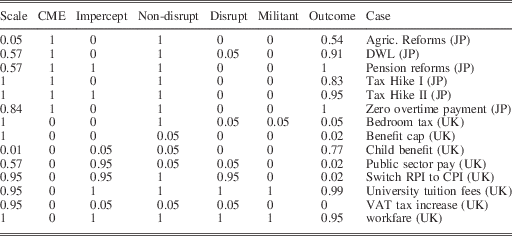
In contrast to much qualitative research, fsQCA explicitly compares cases in terms of the degree to which they are located within the set of cases displaying particular causal conditions and outcomes (whereas this is often implicit within much qualitative research). The method requires the researcher to develop a ‘score’ for each case, which indicates the degree to which it is located within the set of cases displaying potentially causal conditions and the outcome of interest. This relies in part upon a process of calibration that requires the researcher to use their own substantive and theoretical knowledge to assess the degree to which a case should be considered to be a member of a particular set of cases in which the conditions/outcome of interest in question are present.
This is subsequently used to consider whether a (configuration of) causal condition(s) is necessary for the occurrence of the outcome (that is, whether the degree of membership in the set of cases in which the outcome of interest occurs is equal to or smaller than the degree of membership in the set of cases in which a particular causal condition or configuration of conditions is present) and/or sufficient (that is, whether the degree of membership in the set of cases in which the outcome of interest occurs is equal to or greater than the degree of membership in the set of cases in which a particular causal condition or configuration of conditions is present, and therefore constitutes a ‘causal recipe’, the sum of which constitute a ‘solution’).
One of the main advantages of fsQCA is that it is able to deal with both the fact that case studies are causally complex, and that causation in social science is typically asymmetrical (that is, claims regarding the efficacy of causal conditions are not negated by the existence of multiple routes to a particular outcome, nor by the fact that the non-occurrence of a particular configuration of conditions need not coincide with the non-occurrence of an outcome in question in order for the configuration’s causal efficacy to be verified). Further, fsQCA (in contrast to crisp-set QCA) recognizes that cases can be partially in (or out) of a particular set of cases, and therefore calculates the degree to which any one case is a member of any one set of conditions or outcomes. This is subsequently used to calculate the extent to which the degree of membership of a case in any one configuration of conditions is equal to or smaller than its membership in the set of cases that displays the outcome of interest (in the case of sufficiency), or equal to or greater than its fuzzy-set membership in the set of cases displaying the outcome of interest (in the case of necessity).Footnote 61
Our discussion of the selected instances of austerity is therefore well suited to fsQCA because we have a limited number of cases (fourteen) in which causality is complex and involves multiple conditions of interest. Table 2 presents the fuzzy scores for each of these conditions/outcomes, and the online appendix provides information on how each score was calculated. Ragin recommends combining conditions, where possible – especially when doing so does not produce theoretically perverse indicators.Footnote 62 The scale condition therefore represents a combination of severity and targeting (see Table 1), and measures the degree to which the austerity proposal in question threatens socially regressive outcomes. The outcome of interest is a measure of the degree to which acts of refusal have a substantial impact on the eventual policy outcome. It combines measures of the impact of refusal in terms of obstacles, concessions and consequences.
Fuzzy Set Data: Austerity and Anti-austerity

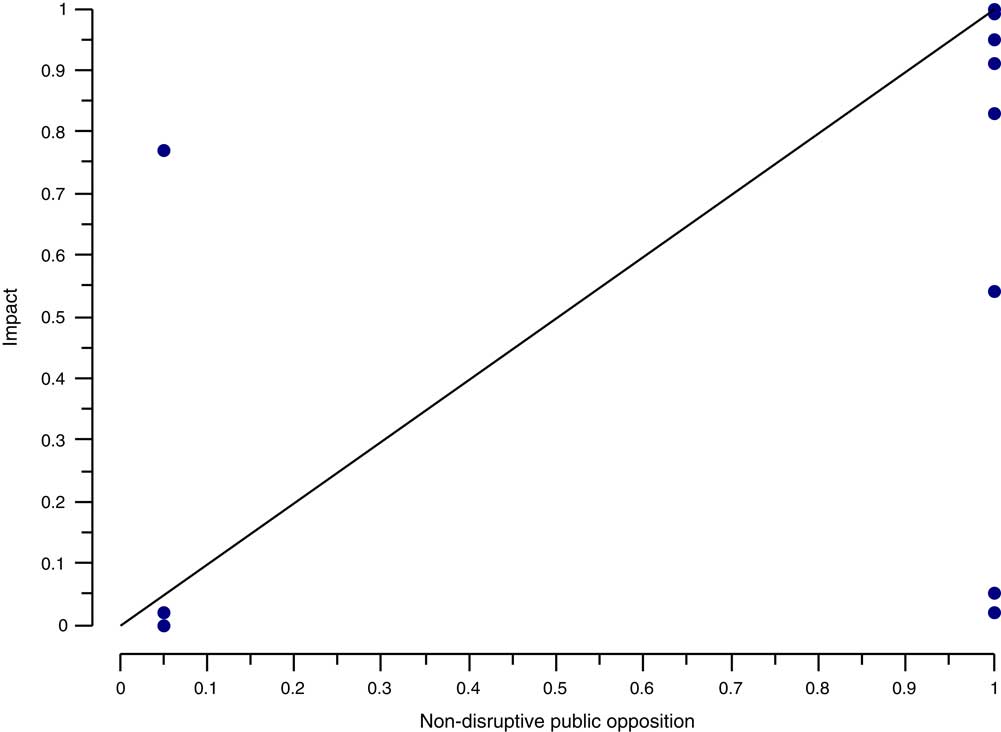
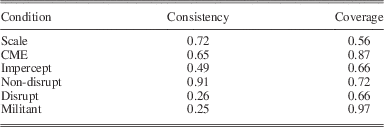
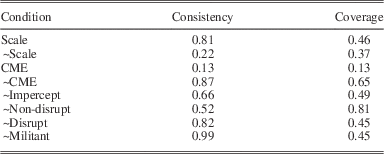
The fsQCA 2.0 software developed by Ragin et al. enables us to conduct fuzzy-set analyses of the relationship between causal conditions and the outcome of interest, in terms of both necessity and sufficiency.Footnote 63 The figures presented in Table 3 measure both the consistency and the coverage for each condition, in terms of their necessity for the outcome of interest to occur. As is conventional, we set the necessity threshold at 0.9 consistency,Footnote 64 referring to conditions for which a very high proportion of the cases meets our definition of necessity (that is, for each case, membership in the set with the causal condition is invariably equal to or greater than its membership in the set with the outcome of interest).Footnote 65 As Table 3 shows, only non-disruptive public opposition was found to be necessary in order for an austerity proposal to be substantially affected. This has a coverage score of 0.72, indicating that it is a potentially relevant finding. However, as Schneider and Wagemann highlight, the degree of relevance can be more firmly established by consulting an XY plot of the relationship. As Figure 1 shows, there is a considerable degree of clustering around the vertical right axis, which calls into question whether this is a trivial necessary condition.Footnote 66
XY plot: Condition, non-disruptive public opposition; outcome, substantial impact upon proposal for austerity

Analysis of Necessary Conditions for Substantial Impact upon Austerity

We can use Schneider and Wagemann’s alternative formula to calculate the relevance of necessity. This yields a value of 0.56 (on a scale of 0 to 1). While there is no clear benchmark below which a necessary condition is considered irrelevant, clearly this is lower than the coverage score and therefore suggests that non-disruptive public opposition might not be a relevant necessary condition (that is, it might be an effect resulting from the commonly high values of non-disruptive public opposition). Put differently, given that most forms of austerity experience some kind of non-disruptive public opposition, it is relatively unsurprising that a significant share of those instances in which austerity proposals are substantially affected are also those that experience non-disruptive forms of protest. That said, the XY plot shows that there are also instances in which non-disruptive opposition does not occur and correspondingly low levels of impact occur, as would be expected for a necessary condition. Again, therefore, on a case-by-case basis there seems to be an intuitive reason to retain an interest in this finding, not least due to the high frequency of non-disruptive public opposition and the ongoing question within the literature regarding its efficacy (or otherwise).Footnote 68 The degree to which non-disruptive acts of public opposition are necessary in order for a substantial impact on austerity to occur would therefore benefit from further research with additional cases.
In order to assess which conditions or configurations of conditions are sufficient in order for the outcome to occur, we use the fuzzy-set truth table algorithm developed by Ragin et al.Footnote 69 This identifies the configuration(s) of conditions that are sufficient for an outcome of interest to occur, based on the systematic comparison of the degree to which cases are members of particular sets with a presence/absence of particular conditions and outcomes of interest across the range of cases under investigation.
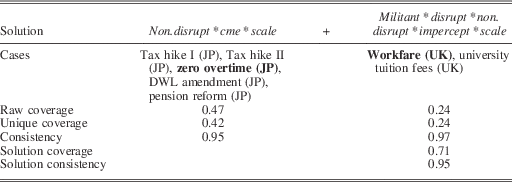
Table 4 presents the results of the fuzzy truth table algorithm. The results displayed are all ‘intermediate’, in the terms of the algorithm.Footnote 70 This refers to the way in which so-called counterfactuals or ‘logical remainders’ (the permutations of conditions/outcomes that are not included in our range of case studies) are dealt with. The intermediate analysis includes only ‘easy’ counterfactuals; that is, those non-occurring instances of conditions/outcomes that do not represent a surprise on the basis of existing knowledge. For the present analysis the assumption is that the occurrence of each of the four types of refusal is associated with a greater likelihood of impact on austerity proposals. The fuzzy truth table algorithm involves a process whereby each configuration of conditions is assessed in terms of its consistency with (and coverage of) a particular outcome. This shows that two configurations of conditions are sufficient to produce the outcome that we are interested in (substantial impact).
Intermediate Analysis of Sufficient Conditions for Substantial Impact upon Proposals for Austerity67

Note: bold cases will be discussed in more detail below.
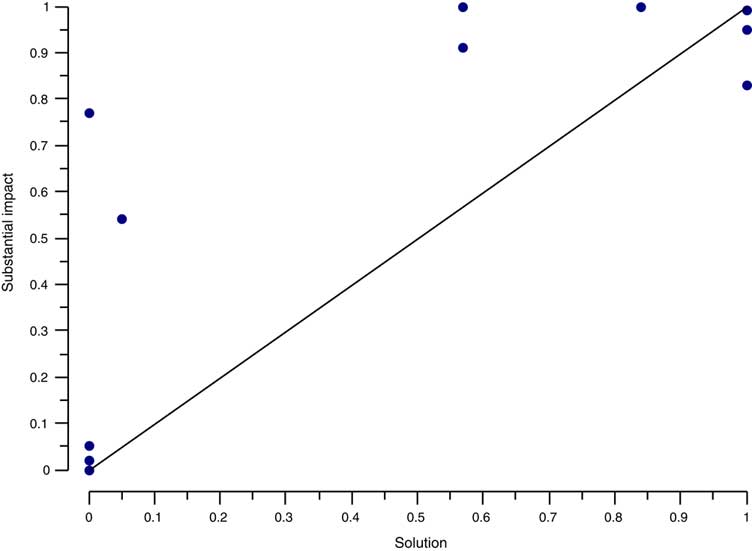
As expected, non-disruptive public opposition is present in both configurations (as it is a necessary – albeit potentially trivial – condition), but in both cases additional conditions are also required. In particular, in both routes to impact, the austerity proposal must be substantially regressive in order for subsequent impact to occur. Two alternative routes to impact then exist: either when non-disruptive public opposition to substantially regressive austerity occurs in the CME context, or when it occurs in combination with all of the other three types of refusal.Footnote 71 As we can see, each of these two alternative routes to impact has a consistency of at least 0.95, meaning that we can say with near certainty that when one of these two causal recipes occurs, then austerity will be substantially obstructed in the cases under investigation. Further, the coverage of this solution (0.71) means that 71 per cent of the outcome is covered (or explained) by the solution (Figure 2 provides the XY plot for the solution). We can also use the parameters given for unique coverage of each of the different routes to impact to see that the non.disrupt×cme×scale route is nearly twice as empirically important as the alternative route.
XY plot of routes to substantial impact

Table 5 considers the necessary conditions for no impact on austerity proposals, or what we term ‘unobstructed austerity measures’. As the table shows, an absence of militant refusal is necessary in order for austerity to be smoothly imposed, although this only covers around 45 per cent of those instances (with a value of 0.25 according to Schneider and Wagemann’s alternative formula for the relevance of necessity), suggesting that this is a trivial finding. In addition, an LME context (~CME) is also close to being a necessary condition for the smooth imposition of austerity.
Analysis of Necessary Conditions for Unobstructed Austerity Measures

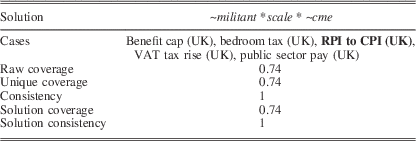
Finally, Table 6 presents the results of the fuzzy truth table algorithm for the intermediate analysis of sufficient conditions for unobstructed austerity measures to be adopted. Here it is assumed that the absence of significant levels of any of the four types of refusal (~refusal) is likely to be associated with a greater likelihood of austerity being imposed unobstructed. As can be seen, only one route to unobstructed austerity was found in our fourteen cases: this is the configuration of cases in which we see instances of significantly regressive austerity being proposed in LME contexts, with an absence of militant refusal. This has a consistency of 1, meaning that under these conditions it is certain that austerity will be unobstructed in our observed cases. Put differently, militant refusal in LME contexts is necessary if there is to be a chance of having an impact on significantly regressive austerity measures. With a coverage score of 0.74, this is an empirically important finding.
Intermediate Analysis of Sufficient Conditions for Unobstructed Austerity Measures
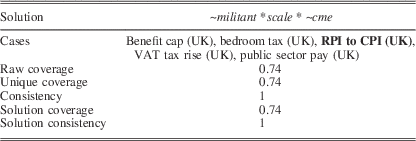
Note: bold cases will be discussed in more detail below.
ALTERNATIVE ROUTES TO OBSTRUCTED AND UNOBSTRUCTED AUSTERITY
We now consider in more detail the concrete cases that display each of the causal recipes (or the discrete part of each solution term), as discussed above. This allows us to consider the mechanisms and processes through which each of the routes to the two outcomes of interest has operated in concrete circumstances. We consider three cases, each displaying one of the routes to impact/non-impact identified in the analysis above, with greater than 50 per cent membership in: (1) the first part of the solution for impact (non.disrupt*cme*scale), (2) the second part of the solution for impact (militant*disrupt*non.disrupt*impercept*scale) and (3) the solution for no impact (~militant*scale*~cme).
First, we consider the case of zero overtime payment in Japan as an instance of a non-disruptive public protest, in a CME context, in response to a proposal of significant scale, which resulted in substantial impact on the austerity proposal (non.disrupt*cme*scale). Here, in the face of considerable (non-disruptive) public opposition, we witness Japan’s Abe administration capitulate in its attempts to impose austerity in the form of significant labour market reforms. Secondly, we consider the movement against workfare in the UK, a case that displays each of the different forms of refusal in response to a proposal of significant scale, and which resulted in substantial impact on the austerity proposal (militant*disrupt*non.disrupt*impercept*scale). Here, widespread opposition resulted in considerable obstacles, modification and consequences for the Coalition Government. Finally, we consider the UK Coalition Government’s decision to switch from RPI to CPI in calculating inflation indexes for the purposes of pensions and benefits as a case that witnessed no militant refusal, in an LME context, in response to a proposal of significant scale, and which resulted in no substantial impact on the austerity proposal (~militant*scale*~cme). In each case, we see in more concrete terms how the ‘causal recipes’ discussed above result in particular processes and outcomes in the cases studied.
Significant Impact I: Non-disruptive Public Opposition in the CME Context – The Case of the Zero Overtime Payment
A proposal to introduce a Zero Overtime Payment Bill was originally mooted by Abe during his first period as prime minister in 2007, originally under the title ‘white-collar exemption’. This sought to introduce a system of ‘zero overtime payment’ in order to flexibilize working hours for high-income workers and enable employers to avoid their legal obligation to pay overtime to those workers. Abe was forced to abandon the proposal in 2007 due to a lack of support from members of the public, opposition parties, trade unions and his own party members.Footnote 72 Upon his second election to office in 2012, however, Abe again sought to introduce a bill to remove employers’ responsibility to pay overtime (Zangyoudai Zero, or Zero Overtime Payment) as part of a more general attempt to liberalize Japanese labour markets. This move was supported by business interests, including the national business association, Keidanren. Following a series of deliberations within the administration, the Cabinet eventually adopted a formal proposal to introduce the necessary legislation for the scheme on 2 April 2015. It was to apply to all those earning an annual income of 10.57 million yen, thereby limiting its impact to those on higher salaries (or so-called insiders). The regressive impact of the proposal would have been substantial. The removal of overtime payment would represent a considerable reform to the Japanese labour market, where working long hours is part of the culture. Further, while the proposal targeted high-income earners (insiders), there was concern that once it was adopted it would require little effort for future governments to remove or lower the threshold.
In response to the proposal, the Abe administration faced a wave of public opposition, which was largely undertaken by workers and coordinated by trade unions. The opposition was mainly non-disruptive in nature, taking the form of regular public demonstrations, usually as part of the annual May Day union demonstrations. The scale of public opposition, however, was exceptional in terms of both the numbers of participants and the frequency: Rengo for the first time organized simultaneous rallies in all forty-seven prefectures to oppose the government’s proposal, with an estimated 22,000 people taking part in the protests across the country. Demonstrations focused especially on the way in which the Zangyoudai Zero (Zero Overtime Payment) would contribute to a worsening of the working environment.Footnote 73 As part of May Day 2015, protests continued across the country; 3,500 people joined a rally in Aichi protesting the Zero Overtime Payment and the flexiblization of working hours.Footnote 74 Similar events took place in Nara, Osaka and Ehime.Footnote 75
Perhaps one of the clearest consequences of these protests was the way in which it highlighted declining public support for the Abe Government and especially its economic policies.Footnote 76 It also exposed divisions within the government itself; the Ministry of Health, Labour and Welfare (MHLW) was the most vocal department opposing the scheme.Footnote 77 This was one of the key indirect effects of the resistance – creating division within the government over how it should respond to opposition to the reform. In particular, it exacerbated concerns within the MHLW over the level of workplace discontent: the number of labour disputes increased for seven consecutive years from 2008 onwards to more than one million cases. In part as a result of these developments, by June 2015 the Abe Government had reached its lowest level of popularity since entering office (41 per cent), and in July 2015 a survey showed that 47 per cent of the population disapproved of his handling of the economy (compared with 40 per cent who approved). This was largely attributed to the decline in real wages experienced by Japanese workers as a result of Abenomics.
In seeking to respond to the opposition and obstacles faced by the government in its proposal for Zero Overtime Payment, Abe initially tried to persuade critics of the benefits of the move. Notably, in 2014 he attended Rengo’s May Day event in Yoyogi Park in Tokyo – the first time in thirteen years that a prime minister had attended the event – where he appealed to workers on the grounds that Abenomics was contributing to a recovery in the Japanese economy.Footnote 78 A range of concessions was also announced in an attempt to appease critics. These included encouraging firms to voluntarily increase wages and proposals to increase the threshold above which zero overtime payments would begin.Footnote 79
Despite these attempts to improve public support, however, public opposition continued throughout 2015 and eventually the Abe Government announced in July 2015 that it was abandoning the scheme. This was largely due to the large-scale public protests conducted by Rengo in May 2015, which drew attention to (and acted to consolidate) the decline in support for the Abe Government in the opinion polls.Footnote 80 The case therefore clearly highlights the impact of non-disruptive forms of public opposition on austerity measures in the Japanese (CME) case. Moreover, the fact that this opposition was largely conducted by institutionalized trade unions – utilizing a form of opposition that has become part of the country’s coordinated model of capitalism (the May Day rallies are a standard feature of both the annual pay negotiations and a visible expression of formal organized labour in Japan) – highlights the impact of the ongoing coordinated nature of the Japanese model of capitalism on the prospects for change, and the capacity of instances of refusal to oppose measures that threaten to bring about substantial welfare retrenchment.
Significant Impact II: The Full Spectrum of Refusal – The Case of Anti-workfare
After its election in 2010 the Conservative–Liberal Democrat Coalition Government adopted a ‘Workfare’ scheme that consisted of three main initiatives: the Work Programme, the Work Experience Scheme and the Community Work Placement Scheme. The Department for Work and Pensions launched the Work Programme in June 2011. It represented both a privatization and an intensification of the previous workfare (Welfare-to-Work) scheme introduced by the preceding New Labour Government.Footnote 81 It was a form of privatization in that it made private sector providers – such as A4e, Serco, G4S and Avanta – responsible for finding work placements. It was also an intensification of the previous workfare scheme because it increased the use (or threat) of sanctions on those who refused to participate. In addition, the Work Experience Scheme was launched as a voluntary programme of short-term unpaid voluntary placements for people aged sixteen to twenty-four who had been unemployed for between three and nine months, with a sanction of two weeks’ non-payment of benefits for those who finished the placement early.Footnote 82
As the final element of the workfare scheme, in April 2014 an additional Community Work Placement programme began, which required the long-term unemployed to do unpaid voluntary work placements in order to receive unemployment benefits. In addition to these schemes, the Government’s Welfare Reform Act 2012 considerably tightened up the sanctions system used to punish those suspected of purposefully avoiding work. In sum, therefore, the Coalition Government’s workfare programme introduced a range of measures that would significantly increase the compulsion placed upon the unemployed to take up work placements (regardless of the degree to which they were suitable in terms of career progression), leading some critics to describe the scheme as a form of forced labour. Further, the use of sanctions ensured that some of the poorest members of society would be targeted for punitive measures. The measures therefore represented a highly regressive form of austerity, both in terms of severity and the way in which it targeted those who were especially vulnerable.
The workfare programmes were highly controversial, sparking instances of refusal across the full range of types discussed above. In terms of imperceptible forms of dissent, the most obvious instances were with regard to the activity of those most stubbornly resistant to accepting new work placements. Thus, the unemployed workers who proved most difficult to place in the scheme often found themselves ‘parked’ by private placement firms who sought to maximize the ratio of long-term placements (for which they were financially rewarded) to effort. It therefore became possible for those who sought to refuse work placements to ‘game’ the system, creating sufficient obstacles for placement firms so that they would effectively be left alone.Footnote 83
In addition, the scheme experienced a substantial amount of militant refusal. Workfare became increasingly notorious throughout the course of its implementation. Instances of militant refusal included a series of attempts to publicly disrupt the retail employers who were taking part in the scheme in an attempt to directly discourage their participation and therefore prevent the operation of the scheme. One high-profile incident included the occupation of the Tesco Express near Parliament. As a result of the publicity arising from this event (and in combination with the fallout arising from an online advertisement for an unpaid job) Tesco began to put pressure on the government to ensure that the scheme would be genuinely voluntary. Holland and Barrett also pulled out of the scheme following a similar disruption of its stores by protests organized by Boycott Workfare, a group formed to coordinate anti-workfare protests.Footnote 84 The work placement scheme also prompted some high-profile individual acts of militant refusal. For instance, John McArthur, fifty-nine, refused to attend his work placement in 2014 on the grounds that it was a job he had previously been paid to do. In protest, and as an act of direct refusal of the instruction he received to attend the placement, he paraded outside the company for two hours a day for three months, with signs saying ‘Say no to slavery’.Footnote 85
The scheme also attracted both disruptive and non-disruptive forms of public opposition. This included a week of action in July 2012 that saw protest events in cities across the country, some of which involved barricading the entry to, or entering the premises of, participating businesses. Perhaps the most high-profile form of public opposition to the government’s workfare programme, however, was the legal challenge brought against it by two benefit claimants who were forced to do unpaid work in order to continue to receive their benefits. Cait Reilly was forced to give up her voluntary work placement in order to work in Poundland, and Jamie Wilson was required to do unpaid cleaning and renovation work. In bringing their challenge against the government, they sought to challenge the legislative basis under which the scheme had been introduced, and argued that it represented a human rights violation because it constituted forced/compulsory labour.Footnote 86 Despite losing their initial claim, upon appeal the scheme was deemed unlawful (although the claim of forced/compulsory labour was not upheld by any of the courts).
The high level of opposition to workfare, including substantial levels of each of the types of refusal, caused a number of problems and obstacles for the scheme. The legal ruling against the government in the case of Cait Reilly required the introduction of emergency legislation and prompted a significant decline in the popularity and perceived acceptability of the scheme. The implementation of the scheme also became increasingly problematic. In response to several of the rounds of physical and online (‘Twitter storm’) protests, many firms pulled out of the scheme – including Sainsbury’s, Waterstones, Matalan, Holland and Barrett, and TK Maxx. In the case of Holland and Barrett, the firm directly cited ‘bad press and in-store protests’ as its reason for pulling out of the scheme.Footnote 87 A number of charities that had initially participated in the scheme, including the British Heart Foundation, Cancer Research, Age UK and Scope, also publicly announced their disengagement from the scheme on the grounds that it forced the unemployed and/or disabled to do unpaid work.Footnote 88
The government indirectly acknowledged the impact of this adverse publicity on the operation of the scheme. In seeking to avoid a legal instruction to make public the names of participating businesses, the government claimed that ‘if the public knew exactly where people were being sent on placements political protests would increase, which was likely to lead to the collapse of several employment schemes and undermine the government’s economic interests’. Moreover, at the same tribunal the Department for Work and Pensions confirmed that some of the UK’s biggest charities, ‘including the British Heart Foundation, Scope, Banardo’s, Sue Ryder, and Marie Curie’ had withdrawn from the scheme, causing a significant loss of placements.Footnote 89 Indeed, Boycott Workfare consistently sought to add to this pressure by submitting freedom of information claims in an attempt to make the names of the organizations benefiting from the employment of unpaid benefit claimants publicly known, prompting the almost immediate withdrawal of Scarborough council from the scheme.Footnote 90 The government was eventually forced to capitulate in 2012 over its commitment to sanctions for its work experience scheme, as a result of pressure from employers that did not want to be associated with the sanctions and the related compulsion to undertake unpaid labour.Footnote 91
In sum, therefore, the Coalition Government’s workfare scheme represented a highly regressive austerity proposal. Thus while non-disruptive public demonstrations proved sufficient to prompt substantial modifications in the CME context of Japan, an alternative route to impact is one in which the full range of types of refusal – imperceptible, public opposition (disruptive and non-disruptive) and militant – is present and produces the significant implementation problems, concessions and consequences detailed above.
No Impact: The Absence of Militancy in an LME Context – The Switch from RPI to CPI
Soon after its formation, in June 2010 the Coalition Government announced in its Emergency Budget its decision to switch from the RPI to the CPI to calculate inflation. This was subsequently to be used to calculate spending on inflation-linked benefits, state pensions and public pensions. As Timmins notes, this was ‘by far the biggest cut [of the 2010 Emergency Budget], though almost a silent one in terms of its public impact’ – a silence that in part resulted from the complexity involved and the stealthy way in which it systematically skimmed money off benefits over a number of years without the need for public announcements or policy decisions.Footnote 92 By the end of the Coalition’s period in office, the Institute for Fiscal Studies estimated that the CPI indexation resulted in a £4.26 bn reduction in public spending for 2015/16, which was one-quarter of the entire net savings produced as a result of the Coalition’s benefit reforms, which had a substantial impact on public (and private) pensions.Footnote 93 The proposal to switch from RPI to CPI therefore represented a substantial instance of welfare retrenchment, with a broad (universal) impact on all benefit recipients and upon pensions.
The response to the measure was, however, relatively muted. As noted, the fact that this was a relatively technical change in part explains why there were few direct challenges or opposition to the move. Indeed, many felt that the technical nature of the changes was such that the benefits/pensions recipients who were affected by the move were not directly aware of them. It also meant that opposition to the change, such as it was, tended to come from similarly technical quarters – for instance, the Royal Statistical Society wrote to the independent UK Statistics Authority in 2010 warning that the CPI ‘is not necessarily the best index for all purposes’, and calling for more prominence to be given to alternative inflation measures.Footnote 94 Over the course of the Coalition Government, however, opposition began to grow as trade unions and pensions groups began to more fully appreciate the impact of the move. In particular, the proposal encountered significant levels of two of the three types of refusal (not acts of militant refusal). Thus moderate levels of imperceptible dissent were experienced, in the form of growing recruitment problems resulting from worsening pay differentials with the private sector from 2010 onwards.Footnote 95
The proposal to switch from RPI to CPI also met with both non-disruptive and disruptive forms of public opposition, particularly from public sector trade unions and other associations representing public sector employees, including the Forces Pension Society, the Civil Servants Pensioners’ Alliance and the National Federation of Occupational Pensioners. Public and Commercial Services Union member Jim Singer launched an e-petition in 2012 calling on Parliament to discuss the switch. The petition drew attention to the fact that the switch to CPI would ‘mean a steady reduction in spending power for pensioners as they progress into their retirement’ and demanded that ‘the RPI measure should be reintroduced without delay to ensure that the spending power of these Public and Private pensioners is maintained’. The e-petition rapidly reached the 100,000 votes needed to force a request for parliamentary debate. The government also faced a legal challenge by public sector trade unions – including Unison, Unite, the Fire Brigades Union (FBU), teachers’ union NASUWT, the National Union of Teachers (NUT), the National Association of Retired Police Officers and the Civil Service Pensioners’ Alliance – although the challenge was unsuccessful.
Disruptive public opposition was also witnessed in relation to the public sector pay dispute of 2011: public sector unions (including the NUT, FBU, the Chartered Society of Physiotherapy and the FDA) regularly noted the switch from CPI to RPI as part of the reason for considering, balloting for or undertaking strike action. Likewise, in welcoming the strike action scheduled to take place in November 2011, and which included several unions striking at the same time – including Unison, UCU, Unite, RMT, PCS and the teaching unions (it was estimated that up to two million people took part in the strike) – the Trades Union Congress referred to the RPI/CPI switch, highlighting objections (in the negotiations prior to the strike action) to the ‘proposed contribution increases, increases in the pension age, and the impact of the indexation change from RPI to CPI on which the government’s position remains unchanged’ (emphasis added).Footnote 96 Similarly, in announcing the strike action the TUC stated that, ‘without any negotiation, the government decided to change the indexation method for pensions – from the RPI to the CPI inflation measure, wiping 15 per cent off the value of public sector pensions at a stroke’.Footnote 97 The strike was, however, more a disruptive form of public opposition than a militant act of refusal. Militant refusal would have involved an attempt to impose a major and direct impediment to the operation of the government, yet the strike actions were always one- or two-day strikes that posed little substantial threat to the operation of the government and instead represented an attempt to draw attention to the demands being made by those going on strike.
In response to the instances of refusal outlined above, the government was largely intransigent. It fought the legal challenge raised by the trade unions (and won). It also consistently claimed that the proposal was merely a technical change – that is, the best way in which to measure inflation (and not an attempt to reduce costs). For instance, in defending the move, Pensions Minister Steve Webb argued that, ‘what you want is not a high number or a low number, but the right number, a fair number that reflects the inflation experience of the people you are indexing for’. Similarly, in the half-day parliamentary debate held in response to the e-petition, Webb claimed that:
One of the big differences between CPI and RPI in regard to the basket of goods is that the CPI does not include mortgage interest. It is worth pointing out that only 8 per cent of pensioners have a mortgage. Why would we insist on using a basket that gives huge weight to mortgages for a population that hardly ever has a mortgage?Footnote 98
Without instances of militant refusal occurring, which would have signalled a more general level of public anger at the switch, and without any sign that the move could be effectively opposed (such as that which was witnessed with the direct acts of refusal against the workfare scheme), the switch was successfully imposed without significant obstructions. Much of the opposition to the switch from RPI to CPI was ineffectual; the opposition that did occur focused largely on the impact it would have on pensions and tokenistic one-off strikes, neither of which was able to pose a significant problem for the government.
CONCLUSION
This article has sought to shift our attention away from the unobstructed imposition of austerity in the post-2008 crisis context, and towards the acts of refusal that austerity proposals have attracted. As we have sought to document, such proposals have rarely gone unchallenged, and in a number of cases they have been substantially affected by different types of refusal. By selecting what are typically considered to be ‘low-resistance’ models of capitalism, moreover, we suggest that the impact of acts of refusal on austerity proposals is likely to be more substantial still where resistance is more commonplace. As such, the study of the austerity policy-making process would benefit from greater attention to the impact of anti-austerity activity across a broader range of cases. Whereas the political economy of austerity policy making has thus far focused predominantly on the injustices, irrationality and/or ineffectiveness of the ‘age of austerity’, therefore, there is a risk that this mode of analysis overplays the smoothness with which austerity and welfare retrenchment has been imposed upon advanced industrial democracies.
Instead, we argue, adopting a viewpoint that stresses the iterative relationship between austerity proposals and the obstacles that acts of refusal place in their way provides more fine-grained insight into the impact of different types of refusal. As the present article highlights, obstacles to austerity appear more straightforward to activate in what are typically referred to as coordinated models of capitalism, although (perhaps as a consequence of this) LMEs tend to generate more innovative forms of dissent, which – provided they are sufficiently militant – provide an alternative way in which to obstruct austerity.
Specifically, we find that non-disruptive public opposition is required in order to have a substantial impact on austerity proposals. Further, within the CME context of Japan, considerably regressive austerity measures experienced substantial obstruction as a result of non-disruptive public opposition. In addition, when all four forms of refusal were combined – imperceptible, non-disruptive and disruptive opposition, and militant refusal – this had a substantial impact on the initial austerity proposal. In contrast, the smooth imposition of austerity measures required an absence of militant refusal, and when this was coupled with substantially regressive austerity proposals in the LME context the combination was sufficient to ensure that this smooth imposition would occur.
One objection to this argument might be that advocates of austerity will already consider likely opposition when making their austerity proposals. Indeed, this is the case.Footnote 99 We have sought to take this possibility into account by including the ‘scale’ condition. Thus we might anticipate that advocates of austerity will adjust the scale of their proposals depending on the level of refusal anticipated. One possibility is that ‘ambitious’ proposals for austerity are advanced, with the expectation that they will be scaled down in response to predictable episodes of refusal – in which case the ‘success’ of refusal might be somewhat less than the present study appears to suggest. In contrast, however, as the present study shows, it is an absence of militant refusal (in LME contexts) that results in austerity measures going ahead unimpeded. As such, those advocating austerity appear to push ‘ambitious’ austerity measures through to completion if there is a lack of militant opposition. That is, even if refusal is anticipated, its non-activation (and therefore also its activation) nevertheless appears to affect the final outcome of the austerity process.
Finally, with regard to the potential for further research, there remains a question of both limited diversity and generalizability. With fourteen cases and six causal conditions there is unavoidably an issue with limited diversity and a relatively large number of logical remainders in this comparative analysis. We partly deal with this problem by using theory-guided expectations regarding so-called easy counterfactuals, which enables us to achieve a plausible ‘intermediate’ solution that is neither excessively complex (as in the conservative solution) nor based on unfounded assumptions (as in the parsimonious solution). Nevertheless, extending the study to a greater number of cases or country contexts would clearly improve the analysis further still. It is unclear, moreover, the degree to which the findings represent country-specific or variety of capitalism-specific effects – that is, whether we could expect the same kinds of processes to occur in other CMEs, such as Germany, or LMEs, such as the United States. In a comparison of only two country contexts this limitation is unavoidable, and therefore also suggests that further research of alternative country contexts would be warranted. The considerably more vibrant experience of innovative movements such as Occupy in the US case suggests that there might be similarities across particular varieties of capitalism. This would require us to engage in further, and more sustained, qualitative comparative analysis of the process of austerity, and especially the acts of refusal that constitute the process of anti-austerity.