1. Introduction
The early-medieval trade on the European–Asian Silk Road, perhaps the most important inter-continental and inter-cultural trade route in those times, contributed much to the cultural exchange and economic development of the Mediterranean area, Central Asia, and China (e.g., Elisseeff, Reference Elisseeff2000). When foreign traders encountered each other on such long-distance routes, and particularly in those (then) remote central Asian areas, neither family and kin ties nor a common ethnicity and culture nor a formal legal-power background (state, courts, police/military, or currency) were existent yet to sustain sufficient trust, commitment, and cooperation for the trade to emerge and the Silk Road to get completed. Sufficient trust and institutionalized cooperation would have been required to make agents deliver any advance goods or service and to possibly wait for many months, sometimes a year or two, to receive their equivalent performance. In the absence of any such enforcement, formal or informal, uncertainties would have encouraged opportunistic behavior in such collective-good or social-dilemma settings (e.g., Elsner and Schwardt, Reference Elsner and Schwardt2014; Greif and Mokyr, Reference Greif and Mokyr2016; North, Reference North1981), and trade could not be expected to take off, as it in fact did. Institutionalized cooperation must, under such conditions, have emerged through some particular private mechanism.
A number of case studies in economic history, together with some formal, mostly game-theoretic, reconstructions, have become bridge builders among economic history, theory, and formal modeling in the last couple of decades. For instance, the relational contracting among Maghribi merchants and their overseas agents in the medieval Mediterranean trade is well known (e.g., Greif, Reference Greif1989). Overseas agents and Maghribi merchants were modeled as parts of a principal-agent problem in that trade. The contractual problem did involve here, too, that ‘agency can't be solved neither by the legal system nor by the market’ (ibid: 858). It was solved by forming a reputation mechanism of overseas agents and Maghribi merchants, collectively punishing any agent infringing their collaborative commercial code. Likewise, Milgrom et al. (Reference Milgrom, North and Weingast1990) argued that repeating interactions could be analyzed as a factor supporting trade in Europe during the 12th and 13th centuries. They concluded that community enforcement was established without common formal institutions, which in fact did not exist yet. So, historical cases and their theoretical analyses have offered relational mechanisms established to overcome trust and contractual problems, when long-distance trade emerged in legal voids.
Turning to another important historical case, the early and very long-distance trade on the Silk Road in central Asia during the 7th to 9th centuries C.E., this paper adds to the existing literature a particular relational and ‘reputational’ mechanism among alien merchants, which we call social leverage. Different cases may require a somewhat different model and theorizing, as Hodgson (Reference Hodgson2002) emphasized with respect to historical analysis in economics and the problem of historical specificity.
We reconsider archaeological documents, already well known to historians and political and legal scientists, and formally reconstruct the social leverage with a game-theoretic model. The historical records refer to the so-called Sogdian merchants and their role in establishing trade from central Asia to, and even within, China.
Other than Greif (Reference Greif1989), we explicitly discuss the latent role of courts and find a differentiated relevance of courts for private versus criminal law issues (i.e., different for contracts than for possession rights). Brief theoretical discussions will also include property versus possession rights, transactions costs, and price implications, and the eventual sudden end of the Sogdian ‘connection’ to China, in times when the land-borne trade had to give way to an emerging maritime Silk Road.
The paper proceeds as follows: The second section sets out the trust and cooperation problem for the trade in the remote areas and long distances of central Asia of that early time of the Silk Road. Section 3 describes the social-leverage mechanism in some historical cases. Section 4 provides a formal reconstruction of that mechanism and identifies some conditions of trust and institutionalization of cooperation. Section 5 generalizes conditions for private mechanisms for nowadays and concludes.
2. The particular uncertainty in the remote parts of the early Silk Road – and the social organization of the Sogdian merchants
Origins of the sogdians
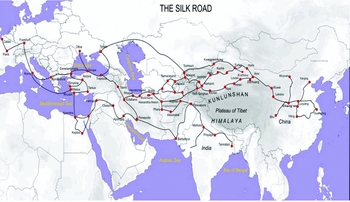
Sogdia, people of Iranian origin, speaking the Sogdian or Iranian language, are considered to have emerged in the Samarkand and Bukhara regions, in today's areas of Uzbekistan and Tajikistan in central Asia (see map, Figure 1 below). Sogdian religious beliefs are considered to have been diverse: Zoroastrianism, Buddhism, Hinduism, and others, but most of them were Zoroastrianists (e.g., Grenet, Reference Grenet2007). Historically, Sogdian activities are divided into three periods, the Achaemenid, Hellenistic and ‘Silk Road’ periods. Their culture reached a peak in the early Silk Road period, reflected by increased intercultural exchange and their monopolization of the central Asian trade. In their Silk Road period, 7th–9th century C.E., the Sogdian merchants were the most important merchant group on the Silk Road (e.g., Henning, Reference Henning1948: 8). They generated a considerable economic performance and virtually monopolized the commerce with China, not the least through their strong social organization and their social-leverage contracting.
The Europe–China Silk Road in the 7th–9th centuries C.E.

The historical records from the Silk Road
Five of the most important documents of the Sogdian history, so-called ancient letters, discovered by Aurel Stein, a British archaeologist, in a Chinese watchtower just west of the Jade Gate near the city of Dunhuang (see map, Figure 1; also, e.g., Yamamoto and Ikeda, Reference Yamamoto and Ikeda1987, who spell it Tun-huang) in 1907, provide extensive information about the social life and commercial activities of these merchants (e.g., Hansen, Reference Hansen1995). Together with documents from the city of Turfan (map) during the Tang Dynasty (618–907 C.E.), they provide a detailed picture of socio-economic mechanisms employed, under conditions of fundamental uncertainty. The Turfan documents, a series of trade contracts reflecting social and business mechanisms in the Turfan oasis, serve as excellent documents of the Silk Road trade at that time (e.g., Hansen, Reference Hansen2010).
Uncertainties in early medieval long-distance caravanning
Inter-cultural long-distance trade in early medieval times was generally characterized by much uncertainty regarding the quality of goods, fluctuation of prices, and length of time of delivery (e.g., Greif, Reference Greif1989: 860). Sogdian merchants carried valuable and rare goods, such as gold, silver, brass, ammonia, medicinal plants, or perfumes (Vaissière, Reference Vaissière2005), traded by them as intermediary merchants. They spent particularly long times on their routes, sometimes walking thousands of miles, from central Asia to the Tang region (e.g., there are 3,000 miles between Samaragand and Luoyang). The preservation of non-durable goods was only one particular problem; arrival times in general, were difficult to estimate, as they were dependent on weather and road conditions, assaults on the way, etc. Thus, also the exact final prices of the goods were uncertain at the destination – if goods were not traded anyway several times on the way.
The eastern spread of the Sogdians and their social organization in the diasporas
Around 300 C.E., Sogdian merchants began to push their domain gradually from their original Persian communities east to China and into the city of Luoyang (map). However, their main activities were concentrated close to the western border of China, in the city of Turfan (Hansen, Reference Hansen2010: 2). During that time, also other foreign merchants became (temporarily) residents of Turfan, but most of them were Sogdians (e.g., Skaff, Reference Skaff2003: 476). These increasingly dominated the trade with China after 300 C.E. (Henning, Reference Henning1948). And the social organization in their diasporas became crucial.
It can be seen from the records that Sogdian merchants were esteemed and considered nobles in the Tang Dynasty: First, because of their custom of gift exchange. They swapped precious goods (e.g., golden pots and spices) with the Tang government in return for (mostly) silk, a custom which established and sustained privileges for them. In Chang'an (map) and Luoyang, the courts continuingly received gifts from Sogdian cities, including, e.g., ‘golden peaches’ (made of gold) of Samaragand (now Samarkand; map), various medical herbs, carpets, indigo, gold, objects embellished with jewels, coats of mail, etc. (e.g., Vaissière, Reference Vaissière2005). This indicates that Sogdian merchants were rich and had good relations with the Tang system (e.g., Dohi, Reference Dohi1988: 420). Second, Sogdians not only exerted influence on general Chinese officials, but also engaged in Chinese political and military affairs. That went even as far as some rebellion eventually, led by a Sogdian general in Tang military service, An Lu-Shan, which may have ended the Sogdian period (e.g., Pulleyblank, Reference Pulleyblank1955: 5; more below).
The Sogdian ancient letters mentioned showed that already in the 4th century, Sogdian communities existed in Dunhuang and Luoyang (e.g., Skaff, Reference Skaff2003: 476). Sogdian established religion-based communities, particularly based on Zoroastrianism and officially called Sabao in the Tang system, which supported the long-distance caravan trade and facilitated Sogdian expansion into China (e.g., Feng, Reference Feng, Juliano and Lerner2001; Sims-Williams, Reference Sims-Williams, Cadonna and Lanciotti1996; Vaissière, Reference Vaissière2005). None of these communities was a simple sum of individual merchants, but was organized hierarchically (Vaissière, Reference Vaissière2005). When the number of Sogdians in a community reached around hundred households, they built a Zoroastrian temple and formed a Sabao (Hansen, Reference Hansen2003). The small size of a Sabao supported group identity and an atmosphere of trust, which could be maintained even when moving to a new place (Hansen, Reference Hansen2010). These communities were in fact rather ‘closed’, due to the same religion and social behaviors. Such ‘closure’ usually helps maintaining identity and reputation through the limitation of membership and a clear definition of its borders (e.g., Coleman, Reference Coleman1990: 219). The Tang government even entitled the Sabao system to self-administer their daily affairs and punish deviating behaviors (Ikeda, Reference Ikeda1981).
The Tang Code denying legal court enforcement for private contracting
Trade on the Silk Road was inter-continental and inter-cultural exchange of goods between the western world and the Tang domain of East Asia. In the Turfan documents, 250 out of 1,600 contracts show signatories that were not Chinese, of which most were from Sogdian merchants (Hansen, Reference Hansen1995: 44; Yamamoto and Ikeda, Reference Yamamoto and Ikeda1987: 29). But all contracts were not mainly enforced by the legal system of the Tang state. This can be inferred, on the one hand, from the legal framework of the Tang state, the Tang Code (e.g., Hansen, Reference Hansen2003, Reference Hansen, Goetzmann and Rouwenhorst2005, Reference Hansen2010).
In contrast to the general recognition of the Sogdians in Tang China, Tang officials had to avoid meddling with private contracts, according to the Tang Code. When officials and private individuals lent money or goods, the transaction was officially considered purely private, and officials would not intervene, as long as two conditions were met: First, the interest charged would not exceed 6%, and second, the cumulated interest payments would not exceed the value of the original item, independent of how much time had passed (e.g., Gernet, Reference Gernet1957: 299f.; Hansen, Reference Hansen1995: 43; MacCormack, Reference MacCormack1985: 46f). Therefore,
people drawing up contracts did not anticipate going to court. All of the Turfan contracts describe ideal scenarios in which purchasers are able to come up with the money [. . .] and in which debts will be repaid (Hansen, Reference Hansen1995: 44).
But that ideal presumption, of course, very often was not reality (e.g., Yamamoto and Ikeda, Reference Yamamoto and Ikeda1987: 29). So, obviously, there was a massive requirement, given that particular high level of uncertainty, to provide a private enforcement mechanism for contracting, since this might easily have made the Silk Road trade entirely impossible.
Thus, while courts did exist, they were hardly considered an enforcement reducing the uncertainties in private transactions by the private agents. According to the reluctant Tang Code, the contracts discovered in Turfan often said ‘Office has government law and do not accept private agreement as conclusive’ (Ikeda, Reference Ikeda1981: 78; see also further below). Although the merchants were not completely unable to invoke the courts, and perhaps could take it as a last resort, they would not have expectations to solve their uncertainty problems in court, when the contracts were signed.
In Greif’s (Reference Greif1989) original Maghribi traders’ case study and model, the existence of state courts was completely neglected, and monitoring and enforcement were allegedly performed solely by the traders themselves. However, courts did exist in the Maghribi world and, in fact, were used as a last resort (e.g., Goitein, Reference Goitein1988: 303). Greif's work was criticized for overlooking this fact, as already the mere existence of courts would probably have shaped the incentive structure of the private agents. Thus, here we try to briefly specify this important institutional detail for the case of the Silk Road transactions.
In the Silk Road records, there is little evidence indeed that the parties appealed to the courts in the core questions of the contracts, i.e., the trade business as such. Examples of going to court for solving transaction problems among merchants are truly rare in the Turfan documents. The relatively few cases where courts were invoked are those where criminal issues emerged, such as when unclear or mock property rights transpired.
Thus, the situation we may imagine is that agents did have a consciousness of the existence of courts as a last resort, but less so in the core aspects of contracts and more in the more extreme issues of criminal aspects transpiring. In the Turfan documents, we can find some court cases such as whether possession exchanged would be legal or not, for example, whether girls exchanged would come from common people or not.
Having specified the Silk Road case this way, we must leave it to future research on other historical and/or geographical cases to provide further evidence about the more or less tacit role of courts in a mainly privately governed business culture.
However, we will specify a formal criterion in the formal model below of when the existence and invoking of courts may change incentives and decisions of private agents, even under a predominantly privately governed contract culture (see section 4).
Lack of money, and barter trade as further particular sources of uncertainty
However, Sogdian merchants were facing even more severe uncertainty, beyond the conditions of traveling and the lack of legal court protection, further arising from the asymmetric information endogenous to bartering. Barter trade always comes into being, when there is lack of money. This, in fact, appeared in the Tang dynasty: Although the Tang government issued large amounts of copper coins to meet the commercial needs, a big gap was left for long periods – not the least, perhaps, due to the rising transcontinental trade carried by the Sogdians. While illegal mints began to issue those coins too, major price fluctuations and thus an additional uncertainty emerged, which might have easily restrained trade further (e.g., Hansen, Reference Hansen1995). Thus, the early central Asian Silk Road trade largely had to remain bartering.
Barter, obviously, causes particular commitment and trust problems. It required that several parties got involved as one-to-one bartering could rarely meet the needs of both parties simultaneously. So the trade usually involved crediting, brokering, and multilateral agreements (circular trade), in order to work smoothly and facilitate goods exchange at all.
Many Turfan documents, for instance, are about the money lender Zuo Chongxi, showing that debt and credit always were involved because the lack of money. In these cases, the merchants had to commit on the quality of the commodities that would have to be returned in the future. Asymmetric information thus more or less applied to all goods traded, particularly when credit and future delivery was involved. The opportunism problem, obviously, was considerable.
Prohibitive transaction costs and cost/price impacts?
In all, and as indicated before, the level of general uncertainty might easily have cumulated so that transaction costs would have become prohibitive against any trade emergence in the early remote parts of the later Silk Road. But this, obviously, did not occur. From the Tang records, rather, we can see that only few contract documents indicate mechanism costs at all. For instance, contracts rarely mentioned any claims of guarantors or witnesses, which indicates that approving a contract would not involve payments for guarantors and witnesses. Because of the weak evidence, however, we cannot generally presume that guarantors/witnesses did not make some profit from social-leverage contracting, which in turn would raise costs and prices of traded goods and services. This might especially explain the relatively high interest rates in the cases of crediting involved, considerably deviating from the prescriptions of the Tang Code, which, in turn, presumed intra-Chinese safer situations.
Economists, different from historians and law researchers, still have made little investigation into these rich documents, and this particular space-time case of the Silk Road has not been fully explored in economic history yet. But for this paper, we may assume that transaction costs were ‘endogenized’ in the strong expectations of future cooperative interactions among all involved in a specific contract. So we will not explicitly model transaction costs (more below).
A first generalization: the barter dilemma on the early remote Silk Road
For a more logical, formal analysis, a game-theoretical mapping seems appropriate, as exchange (under ‘imperfect’ conditions, compared to the neoclassical standard model) can be represented as a prisoners’ dilemma (PD) (e.g., Hardin, Reference Hardin2006). We apply the usual terminology: R, reward for mutual cooperation, P, punishment for mutual defection, and S, sucker's payoff, T, temptation to defect, both for one-sided cooperation and defection, resp.:
 $$\begin{equation*}
\begin{array}{c} R,\;R\quad\quad S,\;T\\ T,\;S\quad\quad P,\;P \\ \end{array}
\end{equation*}
$$
where T > R > P > S.
The dilemma structure for the merchants on the Silk Road, with both court enforcement and legal money missing, was particularly strong: Asymmetric information, and thus fundamental strategic uncertainty, was ubiquitous in the bartering over long distances and long time periods. So it would have to be expected that cheating, exploitation, and free-riding strategies, i.e., defection, would dominate cooperation strategies (thus in all, in fact, a PD). Any spontaneous, decentralized, anonymous, arm's length system with just price-coordination (a ‘market’) would have been locked-in in the basic collective-good problem, where trader A could not have been excluded from the benefit, if trader B would provide his good or service. Such non-exclusion would have made trade infeasible.
Without a private informal institution to justify trust and thus to enforce commitment and cooperation, merchants would have known that any promise that goods will be delivered in proper quality and after an agreed period, would be dominated by incentives to defect. Accordingly, as is well-known, a ‘commitment device’ (e.g., Frank, Reference Frank1987; James, Reference James2002) is required in such settings. Pledges in terms of goods impawned would have been a ‘commitment device’. However, they would have been extremely inconvenient in the long-distance trade, as caravans would have been overloaded with extra commodities to be used as pledge. So other ‘commitment devices’ were required.
3. The Sogdian merchants’ social-leverage contracting
The Turfan documents indeed reveal the mechanism, by which the commitment problem was overcome by the Sogdians. They show that a specific, and purely private, arrangement was generated to support sufficient trust and cooperation. With the strong social organization of the Sogdian communities, as mentioned, an important social condition for such a mechanism to evolve did exist.
Examples of private contracting and trust generation
As an example, we consider a contract between a Sogdian merchant named Kangwu Poyan, who was not a resident in the Tang state, and a Chinese merchant, Du [] [first name not identifiable in the records]. Du [], an army leader in Qianting (about 45 kilometers southeast of Turfan), Xizhou area, offered 14 bolts of silk to buy a yellow camel, 10 years of age, from Kangwu. They agreed that once the camel and the cloth were exchanged, the transaction should be completed. If someone would make a claim to the camel later, it were up to Kangwu, and to the guarantors to be involved in the contract, to clarify or to provide compensation to the claimant, if so, and Du would not be bothered with that. But if the camel would not drink water or eat grass for 3 days, Du [] could return it to Kangwu. While the guarantors of the contract had not gathered yet, the contract was already drawn up. It was agreed that when they would be present, one would issue a certificate. So the contract was signed (Hansen, Reference Hansen1995: 40; Yamamoto and Ikeda, Reference Yamamoto and Ikeda1987: 29).
The contract did not make reference to legal enforcement, should one side fail to fulfill his obligation. Were the seller and guarantors really going to pay compensation in the case of third-party claims against the seller or buyer? Would the seller accept if the camel were to be returned? Although guarantors were required to provide compensation, if the contract would have been based on a wrongful claim of the seller: Criteria and amounts of compensation were not determined in the contract. Was this just neglect or naïveté, or was it warranted trust?
Generally, in fact, many private contracts would not have met the requirements of the Tang Code mentioned above: Some contract clauses were illegal or incomplete, implying that, even if they could have been brought to court, disputes were difficult to solve. So, obviously, contractors usually did not consider the court system at all.
Another contract dated 661 C.E. between the money lender mentioned, Zuo Chongxi, and a man named Long Hainu further illustrates such incompleteness and illegality of contracts. Long, resident of Anxi (map), received 30 bolts of bleached silk on credit from Zuo. The monthly interest agreed was four bolts (13.3%, more than double of the Tang Code limit of 6%). If the interest were not paid monthly, an extra fine of one bolt would have to be paid to Zuo for each month of arrears. Should the borrower abscond, it would be up to his wife and children, and to the witnesses or guarantors, whose names followed in the contract, to redeem his debt. The following put their finger prints (or finger joints) on the contract as a sign of good faith (Hansen, Reference Hansen, Goetzmann and Rouwenhorst2005: 51):
-
(1) contractor Zuo Chongxi,
-
(2) contractor Long Hainu,
-
(3) guarantor Long Xu,
-
(4) guarantor Kang Wenxi,
-
(5) witness Wei Zuo,
-
(6) witness Fan Shide.
Although the agreed interest rate would have been illegal according to the Tang Code, such practice was widespread in the Turfan records: Interest rates usually were 10% (Hansen, Reference Hansen, Goetzmann and Rouwenhorst2005: 52), perhaps some reflection of a high level of uncertainty. And the deviation from public law was deliberate. At the bottom of this particular contract was noted (For more details about part of these citations, you can refer to the Hansen (Reference Hansen, Goetzmann and Rouwenhorst2005)):
Official has the government law, and the common people follow private contracts.
Similar clauses appeared in many contracts, sometimes even more clearly:
Officials have government, while the people have their own ways (cited from Yamamoto and Ikeda, Reference Yamamoto and Ikeda1987: 2)
or
Office has government law and do not accept private agreement as conclusive (Ikeda, Reference Ikeda1981: 78).
It confirms that private contracts in the remote areas of the early Silk Road were largely independent of public regulations and did not expect public interference (including potential protection) based on the law.
A private mechanism in the absence of a public frame of reference, courts, or money
Historical analyses have confirmed that when informally institutionalized cooperation provides gains to both sides of an exchange agreement, such private-order institutions may indeed emerge (e.g., Greif, Reference Greif1989). Since trust, commitment, institutionalized cooperation, and thus trade, increasingly flourished among the foreign merchants in that part of the early Silk Road, some ‘private-order’ mechanism, obviously, could successfully be established.
Variants of such ‘relational’ mechanisms to enforce private contracting in the absence of a public legal frame have been discussed in the literature. Some considered institutionalization of cooperation based on the expected future value of the relationship (e.g., Milgrom et al., Reference Milgrom, North and Weingast1990: 7). Some stressed already emerged, pre-existing institutions as a normative framework (e.g., Macneil, Reference Macneil1980: 4). Others emphasized the building and use of reputation (e.g., Greif, Reference Greif1989). In fact, these variants are not particularly distinctive, as all such ‘relational’ mechanisms are based on recurrent interactions in populations.
The Turfan documents, particularly, suggest a social-leverage mechanism, where merchants conduct a transaction under the private enforcement of guarantors and/or witnesses involved, as mentioned. The Tang Code, in fact, reflected such practice, determining that a private contract needed to display five guarantors, or one guarantor and two witnesses for smaller exchange values. Guarantors and witnesses thus substituted pledges as commitment devices, when alien merchants met first.
For instance, in 731 C.E., the Sogdian merchant Li Lushan sold an 11-year-old girl to a Chinese resident of Chang'an, Tang Rong, for 40 bolts of silk (Hansen, Reference Hansen2010: 301). Four Sogdian merchants and one from Tokharistan (nowadays northwest Afghanistan) vouched, as witnesses and guarantors, that the girl was legitimate to be exchanged. As another instance, in 733 C.E., Shi Randian, a Sogdian, swapped a horse for 18 bolts of silk from Kang, another Sogdian. Three guarantors testified that the horse was not stolen. Two of the guarantors were even non-resident merchants, one of them from Bukhara (map) (see below on the issue of possession and property). But even if they were local residents, why would guarantors and witnesses trust the contract partners (and v.v.) and be willing to step in in case of doubt?
But as Skaff (Reference Skaff2003) already mentioned, it is ‘most likely [that] the guarantors were merchants who knew one another's business activity’ (p. 510). They most likely had business relationships with both contractors, so that both trusted them, while the guarantors or witnesses trusted the core contractors.
One of the Turfan documents, concerning five merchants, particularly illustrates the relationship between witnesses/guarantors and contractors. That particular contract on credit, concluded in Turfan (Hansen, Reference Hansen2010: 292), involved:
-
(1) Li Shaojin (also called Li San), a Chinese merchant resident in Chang'an (or: Jingshi Han), borrower;
-
(2) Cao Yanyan, a non-resident Sogdian merchant, trustor;
-
(3) Cao Lushan, Yanyan's younger brother, resident in Chang'an, witness;
-
(4) Cao Guoyi; and
-
(5) Cao Bisuo, two Sogdians, temporarily resident in Chang'an, witnesses.
Evidently, all five were non-residents of Turfan, most of them residing in Chang'an, a very distant location (map). They contracted to execute some trade in Gongyuecheng (map), again a very distant location. The Chinese, Li, borrowed 275 bolts of silk from the Sogdian Cao Yanyan, and agreed to meet him later in Kucha, about 300 kilometers southwest (map).
Note again that the two contractors did not even speak a common language (Hansen, Reference Hansen2010: 293), but nevertheless concluded such a highly valuable contract, with credit and long distances involved. To appreciate the value of the contract, remember that a horse had a value of 18 bolts. But the witnesses each had commercial relationships with the contractors on their own and therefore would be willing to leverage that contract.
Such mutual, circular or network-like commercial relations are not particularly surprising, as evidence from the documents suggest that we are talking of a relatively densely connected trade network in that part of the Silk Road of probably only several hundred, and certainly but below 1,000 merchants (Rong, Reference Rong and Xingyuan1999). Given the strong social structure, as mentioned above, within the Sogdian (but also the Chinese) communities, with the Sogdians operating on both sides of the western border of the Tang state, a reputation mechanism could plausibly be established and operated.
Possession and property rights: private rule approval versus public law
A final remark is due on the formal/legal versus informally institutionalized/private conception of possession and property (for legal versus economic property in general, e.g., Hodgson, Reference Hodgson2005). In our case, it again reflects and corroborates the particular ‘state-free’ environment of contracting and trading on the early central-Asian Silk Road as already explained above. Examples of contracts above showed that ‘possession’ and ‘property’ (and related ‘proper rights’) were attested and ‘legitimized’ just by contract witnesses. For example, attesting possession, even of people, as ‘legitimate’ through the witnesses constituted a legal property for transaction in accordance with the Tang law. That is, with this private attestation, humans to be bought or sold were defined as slaves rather than common people. Should it turn out, however, that this was not justified, this would have been considered a criminal act under the Tang Code. So the law just constituted a rough frame, while ‘property (rights)’ could be constituted within private contracting.
A second generalization: multiple trade relations – multi-agent contracting
To generalize that social-leverage mechanism, consider the relations among the three types of parties of a social-leverage contract: (1) sellers (or creditors), (2) buyers (or debtors), and (3) witnesses and guarantors. (We do not make a particular distinction between witnesses and guarantors, although their economic/financial involvement was different.)
Consider a Sogdian merchant A and a Chinese merchant B, being about to conclude a contract, each having pre-existing commercial relationships with merchants C, D, and E. Under the prevailing adverse conditions – different cultural backgrounds, no common language, no legal reference frame or court support, no common money, long geographical distances, long time periods to bridge, barter relations, and some credit relation required – A and B may generate sufficient trust against each other only under the condition that both are sufficiently known by C, D, and E and expect future interactions with them. If A or B defect, C, D, E would be able to exert some additional ‘second-order’ punishment, on top of the ‘first-order’ punishment that the cheated contractor might exert against the other. C, D, E might terminate future commercial cooperation, on their part, with either, A or B, and damage the defector's reputation. Such extra punishment, obviously, would be costly for C, D, and E in the same way as in the first-order punishment, and thus, would be subject to the same intricate incentive structure as the first-order interaction, a PD (see section 4 below).
Historical evidence of the Turfan records indeed shows that, in any community on the Silk Road, particularly non-resident Sogdian merchants regularly made use of the social-leverage mechanism. As mentioned, when Sogdian merchant Kangwu Poyan wanted to swap a camel with unit leader Du [], who was as a travelling merchant, he asked local merchants, the Sogdian Kang and the Chinese Du, to serve as guarantors, in an effort to overcome dominant incentives to defect in such a one-shot PD among strangers. And some contracts show that even conversely non-resident Sogdian merchants leveraged local trade as guarantors or witnesses. For instance, local merchants Shi Randian and Kang concluded a barter contract, where two non-resident Sogdians, Luo and An (last names were ruined), acted as guarantors (Hansen, Reference Hansen2010: 299; Jiang, Reference Jiang1994).
Greif et al. (Reference Greif, Milgrom and Weingast1994: 751) argued for the case of Mediterranean trade that, when a large volume of trade was turned over among foreign merchants, ‘a bilateral reputation mechanism cannot resolve the commitment problem’. In our case, the particular social-leverage mechanism of multi-lateral contracting generated a multiplication of the reputation effect and, thus, of the credible threats of punishment, as guarantors and witnesses involved were parts of some ‘networked’ commercial relations.
4. A game-theoretical reconstruction: the institutionalization of cooperation under ‘social leverage’
For a more formal analysis of conditions of overcoming the trust, commitment, and cooperation problem, we consider three interconnected aspects of the social-leverage mechanism involved: (1) a change of future expectations through repeated secondary interactions; (2) a second-order threat of punishment for a defecting contractor and a related change of the payoff structure; (3) a superiority of cooperation in a population in an evolutionary game-theory perspective.
In the following, we assume just one guarantor/witness, A, having commercial relations with two core contractors, B and C.
Social leverage through the ‘shadow of the future’
For the solution of a repeated PD, the well-known ‘shadow of the future’ in a ‘single-shot’ (Axelrod, Reference Axelrod2006) has been widely applied. This refers to evolutionary process and evolutionary game theory. It reflects conditions under which agents have a sufficiently high expectation that interactions (with the same, or, in a wider sense, with a ‘knowing’ third agent in a population) will continue (Elsner and Heinrich, Reference Elsner and Heinrich2009). (The other one is more obvious: changing only the payoff structure, and perhaps even the game type, i.e., ‘changing the preferences of agents’, James, Reference James2002: 292).
In the present case, B and C have a ‘shadow of the future’ determined also by the ‘leverage’ merchant A, and the probability of meeting each other is contingent on the probability of either of them (or both) meeting A in the future. Suppose that through A, β BC (0 < β BC ⩽ 1) indicates B’s expectation to meet C and β CB (0 < β CB ⩽ 1) v.v.
The minimally responsive strategy required, tit-for-tat (TFT; critical on the usual TFT-based solutions in trade: Barbara, Reference Barbara2016), and ALL-D are considered (in evolutionary game theory) to be applied by the agents in many random-paired interactions, with the common discount factor δ. We apply the usual solution to our social-leverage setting.
For B, this exemplarily develops into the following current capital values of future payoffs of the two alternative strategy combinations (that stem from the well-known invadability criteria of evolutionary game theory):
 $$\begin{equation*}
{\pi _{TFT/TFT}}\ = R + \delta R{\beta _{BC}} + {\delta ^2}R{\beta _{BC}} + \cdots = \frac{{R{\beta _{BC}}}}{{1 - \delta }} + R - R{\beta _{BC}}
\end{equation*}
$$
and
 $$\begin{equation*}
{\pi _{ALL - D/TFT}} = T + \delta P{\beta _{BC}} + {\delta ^2}P{\beta _{BC}} + \cdots = \frac{{P{\beta _{BC}}}}{{1 - \delta }} + T - P{\beta _{BC}}.
\end{equation*}
$$
When π TFT/TFT > π ALL − D/TFT , B will cooperate. This condition holds, when
 $$\begin{equation*}
\delta > \left( {T-R} \right)/[T-R + (R-P){\beta _{BC}}].
\end{equation*}
$$
For C, we may use the same algorithm to obtain her condition.
This indicates that the social-leverage mechanism can enhance cooperation between two strangers, dependent on the probability of meeting the leverage merchant. The higher this probability, the easier the institution of cooperation will be socially learned in an evolutionary process in a population of primary traders.
Threat of second-order punishment in repeated ‘social-leverage’ interaction
A’s businesses with B and C are considered repeated interactions, while B interacts with C strictly in a one-shot contract relation. The possibility (and expectation) of cross-contract punishment (or reward) from a (presumably) repeated social-leverage interaction (of B and C with A) then may create additional incentives to overcome the commitment problem.
If B or C defects, although they could obtain higher defection payoffs in the one-shot, a negative payoff component from the potentially repeated interaction with A will change their overall incentive structure (and the game type into a less intricate coordination game, or even a completely obvious social-optimum game, see below). We assume a PD to exist in both relations, between B and C, and A and B or C. B’s and C’s payoffs π from cooperative interaction with A then are as follows:
 $$\begin{equation*}
\begin{array}{@{}l@{}} {\pi _{B - A}}\ = R + \delta R + {\delta ^2}R + \cdots = \frac{R}{{1 - \delta }}\;{\rm{and}}\\ {\pi _{C - A}}\ = R + \delta R + {\delta ^2}R + \cdots = \frac{R}{{1 - \delta }}\ \ . \end{array}
\end{equation*}
$$
The parameter δ (0 ⩽ δ < 1) is a common discount factor to calculate the present value of future payoffs. Also, as is well-known, when it is larger, the relationship is closer, or the probability in an interaction that the interaction (with the same, or a similarly well-informed third one) will continue is higher.
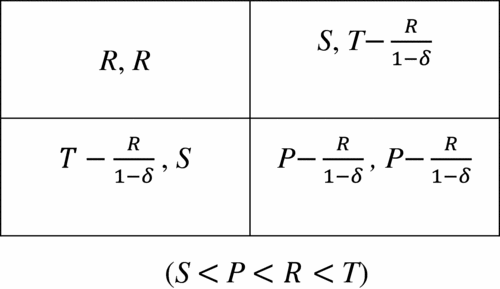
The payoff structure for the core contractors, when the contract involves guarantor A, results as follows (see Figure 2):
PD with social-leverage (second-order) punishment.

Obviously, the payoff relation R ≫ P − R/(1 − δ) shows that the mutual advantage from choosing the cooperation strategy further increases over mutual defection. Also, in order for cooperation to become the dominant strategy for the contractors, the payoff relationships
 $$\begin{equation}
R > T - R (1 - \delta )\; {\rm{and}}
\end{equation}$$
 $$\begin{equation}
S > P-\frac{R}{{1 - \delta }}
\end{equation}$$
must hold. These imply
 $$\begin{equation}
\delta \ > 1 - \frac{R}{{T - R}} = {\delta _1}\;{\rm{and}}
\end{equation}$$
 $$\begin{equation}
\delta {\rm{\ }} > 1 - \frac{R}{{P - S}}\ \ = {\delta _2}\ .
\end{equation}$$
A social-optimum game would result in that first-best result and cooperation were always the first-best choice for the contractors. Put differently, if any δ in any specific contract situation would be δ ⩾ max {δ1, δ2}, mutual cooperation would always appear. If only condition (1) or (1a) would hold (and (2) or (2a) would not), the dilemma would be transformed into a coordination game, where the cooperative solution might at least be easier achieved than in the dilemma.
It can also be seen that δ1 increases with the decline of the incentive of unilateral defection, T, while δ2 increases with the growth of the payoff from unilateral cooperation, S. Thus, for instance, when the defection incentive increases, or the unilateral-cooperation payoff decreases, the two long-term relationships in the social-leverage mechanism must become closer in order to make cooperation emerge with sufficiently high probability.
Conditions for superiority of cooperation in a population (or evolutionary game-theory) perspective
If Figure 2 were a coordination game with two Pareto-different Nash equilibria, the following relation would hold
 $$\begin{equation*}
R\ > T - R/\left( {1 - \delta } \right){\rm{\ }} > P - R/\left( {1 - \delta } \right) > S,
\end{equation*}
$$
due to the punishment from the social leverage. This may be considered (a variant of) a stag-hunt game with two equilibria, one risk-dominant (common cooperation), one payoff-dominant (defection, defection). This usually raises the problem of equilibrium selection. Here, we apply the standard solution of how the core contractors under social-leverage contracting may get sufficient trust to choose the risk-dominant equilibrium.
Assume that the column contractor chooses cooperation with probability p and defection with (1–p), while the row contractor is cooperative with probability q and defects with probability (1–q). Accordingly, for the row merchant, expected payoffs of strategies are as follows:
 $$\begin{eqnarray*}
&& {\rm For\; cooperation\!:}\; Rp+S(1-p). \nonumber \\
&& {\rm For\; defection\!:}\; [ {T - R/( {1 - \delta } )} ]p + [ {P - R/( {1 - \delta } )} ](1 - p).
\end{eqnarray*}$$
Thus, in order for the row player to cooperate, i.e., π(coop.) > π(defect), the column player must be expected to cooperate with probability
 $$\begin{equation*}
\ p > (P - S - R/(1 - \delta )/(R + S + P - T).
\end{equation*}
$$
Similarly, the column player will cooperate, when
 $$\begin{equation*}
\ q > (P - S - R/(1 - \delta )/(R + S + P - T).
\end{equation*}
$$
Under these conditions, the Nash equilibrium emerging (in an assumed underlying evolutionary replication mechanism in a population with these two types of strategies) will be {cooperation, cooperation}.
This shows, among others, that a larger expected duration of the relationship (or probability of future interaction) of the primary contractors with the leverage merchant(s), δ, will make the right side of the equation smaller so that the required probabilities p and q are easier met, c.p., i.e., the inequalities hold easier.
For the Silk Road cases, thus, two primary merchants with a priori low expectations to meet a cooperator may nevertheless achieve cooperation through the social-leverage mechanism, and the easier so the closer their relationships with the leverage guarantors or witnesses are.
The existence of courts as enforcement for private contracts
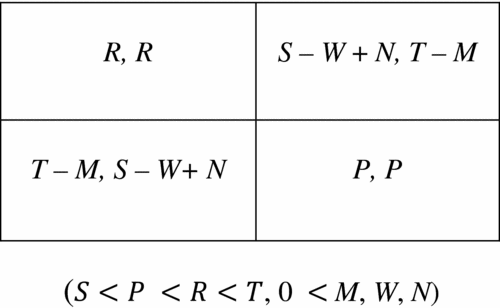
As explained above, the Turfan documents provide evidence of the existence and activity of courts as enforcement against criminal acts that might have transpired from private contracts. Find an illustration in Figure 3 below. Let W the cost of both merchants, if they go to the court, M a sanction inflicted by the court to merchants, who did the criminal act (defection), and N a possible compensation from the guarantors (A or other relational merchants) in the court. When
 $$\begin{equation*}
R > \left( {T-M} \right)\ {\rm{\ }} \ge P{\rm{\ }} > \ \left( {S-W + N} \right),{\rm{\ }}
\end{equation*}
$$
as M and N change, the PD may transform into a Stag-Hunt game. When
 $$\begin{equation*}
R > \left( {T-M} \right),P{\rm{\ }} > \ \left( {S-W + N} \right),
\end{equation*}
$$
the PD is altered into a simple coordination game. As is well known, in both game types, two equilibria exist: One is risk-dominant {cooperation, cooperation}, one payoff-dominant {defection, defection}. This raises the problem of equilibrium selection.
Barter exchange (PD) with court activity.

We particularly consider a Stag-Hunt transformation through court activity to solve the original PD in a one-shot. Assume that the column merchant B with probability p chooses cooperation and with (1 – p) selects defection. The row merchant C with q is a cooperative person, and (1 – q) is a defector. Accordingly, for B,
 $$\begin{equation*}
{\pi _{{\rm{cooperation}}}} = Rp + \left( {S-W + N} \right)\left( {1-p} \right),
\end{equation*}
$$
 $$\begin{equation*}
{\pi _{{\rm{defection}}}} = \left( {T-M} \right)p + P\left( {1-p} \right).\
\end{equation*}
$$
If πcooperation > πdefection, namely,
 $$\begin{equation*}
\ p > \left( {W + P - S - N} \right)/\left( {R + M + W + P - S - N - T} \right),
\end{equation*}
$$
B will choose cooperation. Similarly, when
 $$\begin{equation*}
\ q > \left( {W + P - S - N} \right)/\left( {R + M + W + P - S - N - T} \right),
\end{equation*}
$$
C will choose cooperation. In all, when both conditions are met, the Nash equilibrium will be {cooperation, cooperation}.
Second-order dilemmas of costly punishment for guarantors and witnesses
When we derive conditions for a workable social leverage from social-dilemma formalism, the same formalism applies to the second-order dilemmas that guarantors and witnesses are involved in, and to their costly punishment. As is well-known in the economic literature of institutional emergence, explicit punishment on top of the endogenous punishment in repeated PDs of the first order (exerted through trigger strategies, such as TFT) creates a second-order dilemma. In our case, explicit punishment is ‘outsourced’ to the third parties of the ‘social-leverage’ contract, guarantors and witnesses. But formally, their PDs follow the same algorithms as for the first-order PDs of the primary contractors. And as they have expectations of repeated interactions with the primary contractors (and perhaps among each other) on their part, the same formal analysis would apply.
A full-fledged demonstration of institutional emergence in a population under social leverage, though, would require appropriate multi-agent-based modeling with games on network structures and simulations. But this is far beyond the present paper.
Why did a successful trade culture disappear?
Having established a considerably effective culture of social-leverage trading, why did the Sogdians dominance in the early central Asian Silk Road end relatively suddenly? The fate of Sogdian merchants after the 9th century, in fact, is unknown. But apparently, they did not vanish endogenously, e.g., because of some decreasing success. Rather, documents indicate an exogenous factor of collapse of their trade system. They show that many Sogdians supported the An Lushan rebellion against the Tang dynasty and suddenly had to escape from China back to central Asia. But nothing is left since that time (Rose, Reference Rose2010: 418).
But considering transaction costs again, knowing that they always were considerable, although perhaps only tacitly, under the conditions of very high uncertainty in the case investigated here, they may have eventually affected the relative efficacy of the land-borne trade versus alternative technologies coming up. Specifically, the land-borne Silk Road had to change, and perhaps lost relevance, when big (Chinese) sailing ships emerged, with lower costs than those of camel caravans, facilitating a maritime Silk Road after another 100 years. We may only speculate that the Lushan rebellion of the Sogdians, in fact, was their last fight against a new techno-organizational system, the new Chinese super vessels, which brought them as far as to the African and Arabian shores.
5. Conclusions
This paper investigated into how the alien merchants overcame the particularly considerable trust, commitment, and cooperation problem in their inter-cultural long-distance trade in the most remote central Asian areas of the early medieval Silk Road. We showed how a particular mechanism of ‘relational’ contracting, a ‘social leverage’, was developed. These contracts became somehow self-enforcing.
To formally analyze the historical records, a game-theoretical model of social leverage was developed. We concluded that a social-leverage mechanism can indeed explain conditions for large-scale trade on the Silk Road.
Generalizations of social-leverage contracting from our cases and formal analysis may apply to all current and future new economic developments, where a proper legal frame has not been developed (yet). This has been generalized in economics to all kinds of experience or credence goods, which entailed ‘market failures’ such as adverse selection and moral hazards in earlier times when there still was little legal customer protection.
Examples from the 1990s and 2000s were the early problems of valuation of software and similar intangibles and services of software firms in the dot.com industry for accounting and taxation, when there were no clear accounting rules set up yet for the new industry. Furthermore, since the 1990s, when e-commerce exploded, the particularly extensive uncertainties of the early internet trade could, in the absence of sufficient internet law and adapted business law, be remedied only through private reputation mechanisms and rankings, as established and supported by big hierarchies, such as eBay or Amazon, through chat groups or product tests made public, or by other remedies like online payments protected by PayPal and the likes.
Nowadays, under increasing ‘balkanization’ of the internet, breaking down the internet into well-arranged and manageable smaller networks, how staged and interlinked ever, similar private reputation and social-leverage mechanisms with witnesses, guarantors, or relational advocates are established, be it for applying debtors in crowd funding, or for future internet banking of the upcoming FinTechs.
Such techno-economic developments will usually have a temporal lead over legal regulations, which typically will lag behind. In such legally undefined domains and phases, often more or less transitional, tacit social dilemmas are ubiquitous, and private social-leverage mechanisms of learned and institutionalized cooperation will always have a role to play, in order to let techno-economic developments proceed, or even make them take off at all (how insufficient those private solutions ever may be).
Finally, and more generally, not only when formal-legal solutions cannot catch up, or have not caught up yet on technical-organizational private developments, private social-leverage solutions may play a permanent role in substitution of formal-legal ones – and then may even be supported proactively by public policy to come into a strong existence. Public policy then has a whole range of critical factors to shape (as should have become clear from the above) in order to support such private social solutions and to make public ones perhaps completely redundant (except for such a framework regulation as mentioned).
Thus, there would be a lot to learn from the Silk Road.