Introduction
Heritagisation of music proliferates. Since 2008, over 300 music-related “elements” have been inscribed in the UNESCO (2026) lists of intangible cultural heritage. These range from ones “in need of urgent safeguarding” such as “Sega tambour Chagos” of Mauritius, to globally widespread idioms representative of humanity, as in the case of “Reggae music of Jamaica.” At the same time, the notion of heritage is exploited frequently in urban branding in local settings. The initiative for such action may originate from municipal economic interests, but is sanctioned on a global level again by UNESCO through its Creative Cities Network that “promotes cooperation with and among cities that have identified creativity as a strategic factor for sustainable urban development” (CCN 2026a). While there is a steady emphasis on diversity in the presentations of the cities, often certain genres and phenomena occupy the centre stage: “Home to … one of the most influential rock bands in history, music is at the heart of Liverpool’s cultural identity” (CCN 2026b).
Scholarly debate about music heritagisation is equally on the increase. On the basis of a quick search into relevant databases, roughly two-thirds of the peer-reviewed articles that mention “music heritage” have been published after 2010 (see Figure 1). Additionally, in the International Journal of Heritage Studies, for instance, special issues have been devoted to popular music (2014) and jazz festivals (2020). Such tendencies point to a variety of institutional and disciplinary levels and settings of music heritagisation, ranging from global organisations and national authorities to local tourist boards and idiosyncratic whims of scholarship. Crucially, these levels are interconnected, especially through the reliance on scholarly expertise in global and national decision-making in the matter. Within scholarship, this is sanctioned on a disciplinary level, as for instance a key ethnomusicological organisation, the International Council for Traditions of Music and Dance (ICTMD), is in formal consultative relations with UNESCO.
The number of peer-reviewed articles mentioning the phrase “music heritage” in “international e-materials” of the National Library of Finland (as of 1 October 2020).

Figure 1. Long description
The vertical Y-axis represents the number of articles, ranging from 0 to 200 in increments of 20. The horizontal X-axis lists chronological time periods. The data is presented as follows.
* pre 1950s: 3 articles
* 1950s: 4 articles
* 1960s: 3 articles
* 1970s: 24 articles
* 1980s: 9 articles
* 1990s: 22 articles
* early 2000s: 31 articles
* late 2000s: 98 articles
* early 2010s: 130 articles
* late 2010s: 187 articles
The trend remains relatively flat and low (under 30 articles) from the pre 1950s through the 1990s, with a slight peak in the 1970s. A sharp upward trajectory begins in the late 2000s, nearly tripling from the previous period and reaching its peak in the late 2010s.
The diversity of institutional and disciplinary settings begs the question of whether there are significant similarities or drastic differences between them. How does music heritage become conceptualised and constructed in these surroundings? Are certain genres and styles of music treated as heritage more readily than others, and what kind of explicit and implicit motivations and goals are involved when constructing music as heritage in different disciplinary environments? A broader aim here concerns exploring the ways in which the notion of heritage relates to ideals of multi-, inter-, and transdisciplinarity, especially as ethnomusicology, popular music studies, and critical heritage studies alike tend to be celebrated as such (see e.g. Smith Reference Smith2006; Bennett and Waksman Reference Bennett, Waksman, Bennett and Waksman2015; Post Reference Post and Post2018).
It is indeed notable that while scholarly literature about music heritage abounds, the volumes in question tend to be limited within singular disciplines, regardless of their alleged interdisciplinary qualities. In other words, those who approach music heritage from within ethnomusicology (e.g. Howard Reference Howard2012; Norton and Matsumoto Reference Norton and Matsumoto2019) do not converse with like-minded popular music scholars (e.g. Cohen et al. Reference Cohen, Knifton, Leonard and Roberts2014; Bennett Reference Bennett2022), regardless of methodological similarities. In addition, when disciplinary questions are addressed, they remain either equally monodisciplinary or go beyond music scholarship, leaving the latter’s internal disciplinary boundaries unchallenged. To be sure, the implications of preservationist and applied ethnomusicology to heritage have been discussed (e.g. Grant Reference Grant2012; Neale Reference Neale2018), yet not in relation to musicology or popular music studies. For instance, in the rare takes on how ethnomusicology and heritage relate to recordings and radio, there are no references to either popular music or media studies (e.g. Landau and Fargion Reference Landau and Fargion2012; Western Reference Western2018). An exception to these trends is provided by Stanton and Schofield (Reference Stanton and Schofield2019:1038), as they foreground musicology as a methodology in heritage studies and note how “analysing music itself is surprisingly rare in the field of music heritage.”
A terminological caveat is in order. For analytical purposes, I use the formulation “music heritage” as a catch-all term for all instances where music is treated as (intangible cultural) heritage. This is to recognise its semantic as well as political differences from “musical heritage” or “music as heritage,” inasmuch as in the latter two, music is conceptually subservient to heritage. In my first language, Finnish, the distinctions are more obvious: musiikkiperintö is one word (like “lorry”), as opposed to musiikillinen perintö or musiikki perintönä (cf. “single-unit truck”). Concerning English, one can exemplify the conceptual quandaries by juxtaposing “popular music heritage” with “popular musical heritage”—that is, whether the emphasis is on popular music or popularity of music heritage. Moreover, on the basis of a basic phrase search into the Taylor and Francis online repository of the International Journal of Heritage Studies, the terms are used more or less interchangeably, with the outcome of 31 articles for “music heritage” and 25 for “musical heritage” in volumes 1–35 (1994–2025, as of 29 October 2025). With respect to the heritage elements inscribed in the UNESCO lists, in turn, the number of hits in the nomination files from 2009 to 2024 is eight for “music heritage” and 28 for “musical heritage.” Thus, given the terminological fluctuation, I have treated the phrases as interchangeable when producing the corpus.
Labelling, institutionalising, publishing
The range of contexts of disciplining heritage is broad indeed, and it may be argued that since the 1970s there has been “an increase in ‘unofficial knowledge’ about the past alongside the ‘official knowledge’ of state and academic discourses,” implicated in seeking differentiated legitimacy “for novel ways of knowing the past” (Hodges Reference Hodges2011:360). The co-existence of and dialogue between such knowledges may result in administratively desirable “impact” and “public engagement” where “indigenous” interpretations become integrated with scholarly ones. Still, the weight of academic knowledge-production should not be underestimated: “Without the disciplinary processes … aligned on the trajectory of scholarly differentiation rather than collaborative objectives or public accountability, no fertile distinction might exist from which impact—with its implication of an abrupt closure of distance—could be generated” (Hodges Reference Hodges2011:369).
Thus, my examination concentrates on the academic disciplines and their subdivisions that relate to the construction of music heritage. As no such disciplinary label as “music heritage studies” exists thus far, apart from incidental references to “the field of popular music heritage studies” (Cantillon et al. Reference Cantillon, Baker and Nowak2020:4), the key disciplines include musicology, ethnomusicology, popular music studies, and heritage studies. One might consider adding music sociology to the list, yet its status as a discipline in its own right is more contested. Many popular music scholars have, in fact, their background in sociology, and, methodologically, music sociology overlaps with ethnomusicology as well as with “critical” and other more recent strands of musicology (see e.g. DeNora Reference DeNora2000:4–24; Tagg Reference Tagg2012:133–144). Given the emphasis on scholarly differentiation, as opposed to vocational or scientific ones, educational, mathematical, and medical strands of music research, such as music theory, music psychology, and music therapy, remain outside my scrutiny (cf. Bergesen Schei et al. Reference Schei, Tiri and Stige2012:27–28). Such a demarcation is warranted also on the basis of social constructionism inherent in the aim to interrogate how “music heritage” is conceptualised and created discursively, though admittedly constructivist approaches have been widely adopted within music education in particular. There is, in fact, a growing body of heritage-related research emerging from within music education, though more often with a preservationist than constructivist approach (e.g. Grant Reference Grant2017; Cores Torres and Rodríguez Reference Cores Torres and Rodríguez Rodríguez2023). Also, the profile of music education is closer to applied than pure research, as it serves the needs of music schools and basic education directly by educating music teachers instead of heterogeneous humanists or social scientists.
To discipline is to punish, even if during the modern era there has been an important shift from physical torture to a variety of control mechanisms based on surveillance and, indeed, education. Following the influential lead set by philosopher Michel Foucault (Reference Foucault1977:211), disciplines operate as “techniques of making useful individuals” through “flexible methods of control” that include, especially in the scholarly environment, “the transmission of knowledge” and “the diffusion of aptitudes and skills.” Considering academic disciplines in more detail, the issue is the institutional division of intellectual labour with its organisational space and regularised set of collective practices (Chandler Reference Chandler2009:734). In such institutionalisation of knowledge, universities are central establishments, alongside academic publications, as “gatekeepers of disciplinary norms” (Post Reference Post2009:751–753). In the “knowledge economy” of scientific research, peer-reviewed journal articles in turn are “generally considered the gold standard of publishing” (Nygaard and Bellanova Reference Nygaard, Bellanova, Curry and Lillis2018:46, 51; see also Levy Reference Levy2023). The journals themselves are, and have been since the late eighteenth century, pivotal in establishing learned societies and the professionalisation of science through disciplinary specialisation (Fyfe et al. Reference Fyfe, Moxham, McDougall-Waters and Røstvik2022:11–13).
Thus, in anticipation of departments of music heritage studies to emerge, I probe the key peer-reviewed journals in the four main disciplines mentioned. To separate top journals from the less prestigious ones is to engage in academic politics for sure, but luckily enough one—as an individual scholar—does not have to rely on one’s own estimations, let alone predilections. In the academic knowledge economy, journals are ranked continuously, and “gaming the metrics” has become a standard aspect of manipulating research funding (e.g. Biagioli and Lippman Reference Biagioli and Lippman2020). In Finland, the “rating and classification system” Julkaisufoorumi (“Publication Forum”) was launched in 2010 “to support the quality assessment of research output,” taking also into account “the different publication cultures characteristic of various disciplines” (PF 2025). The system has become instrumental and integrated in how public funding is distributed to universities. In the system, journals, series, and publishers are rated on a scale from zero to three. To get a grade above zero requires peer review, and:
The Levels 2 and 3 are awarded to a limited number of academic journals, conferences and book publishers of the highest level and impact as judged by the Expert Panels. They are mostly international publication channels but in Humanities and Social Sciences, Level 2 also includes Finnish and Swedish-language forums. (PF 2025)
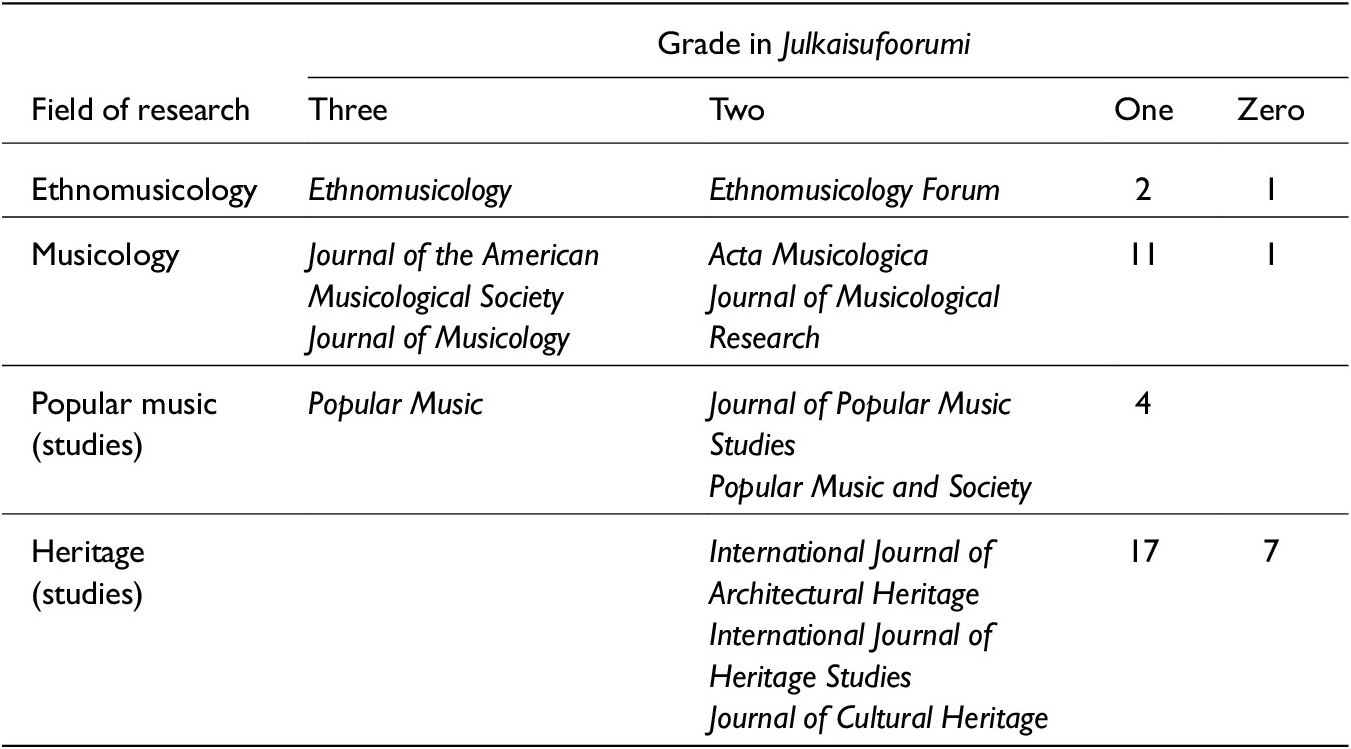
To separate the top music heritage journals, as it were, is not straightforward either. First of all, if and when a discipline becomes fully established only after there is a journal carrying its name, the study of music heritage is still in its infancy. In fact, there are no top-tier journals listed in Julkaisufoorumi with the word “heritage” in their title (as of 1 October 2020). Three “heritage journals” thus defined have received grade two, namely the International Journal of Architectural Heritage, the International Journal of Heritage Studies, and the Journal of Cultural Heritage. The situation evinces pertinent implications as regards disciplining music heritage. One of the most crucial of these concerns the difference in the disciplinary status of both music studies and heritage studies; on the basis of the classificatory system adopted in Finland, the former clearly is more established as a field of academic research. Regarding the disciplinary strands or subfields in question, nine music studies journals emerge as the key publication channels. The top grade has been awarded to Ethnomusicology, the Journal of the American Musicological Society, the Journal of Musicology, and Popular Music. The runner-ups are Acta Musicologica, Ethnomusicology Forum, the Journal of Musicological Research, the Journal of Popular Music Studies, and Popular Music and Society.
Such a demarcation is limited to be sure, as the emphasis on disciplinary labels leads to excluding a number of potentially relevant journals of high standard, notably the Journal of Folklore Research and Traditions of Music and Dance (formerly the Yearbook for Traditional Music). This caveat notwithstanding, the treatment of music heritage in the selected journals offers an indication of the institutionalised dynamics at stake without any further requirement to justify or explicate the disciplinary connection. Moreover, to ensure a balanced comparative setting, I deal with the fully available volumes published in the 2010s.
The temporal demarcation reflects the politics of academic publishing as well. Apparently, many “papers subsequently regarded as groundbreaking [are] rejected multiple times before finally finding a home” (Levy Reference Levy2023:1). I hesitate to deem my analysis groundbreaking by any standards, but the fact remains that there has been a significant delay in publishing this article because the manuscript was originally rejected by leading journals of heritage studies and cultural studies alike. The dissection of the (inter)disciplinary dynamics at issue will have to wait.
Quantities, canons, and genres
I commence with a quantitative probe by counting the annual numbers of relevant research articles between 2010 and 2019 (Figure 2). The criteria of relevance are simple: the corpus comprises heritage journal articles where “music” is mentioned and, conversely, music journal articles where “heritage” is mentioned, even if in passing. This yields a total number of 672 articles. As a subset, there are altogether 68 articles where the phrases “music heritage” or “musical heritage” are used.
Annual numbers of relevant research articles in the 2010s in the key journals in ethnomusicology, musicology, popular music studies, and heritage studies (as of 1 October 2020).

Figure 2. Long description
The X axis lists years from 2010 to 2019. The Y axis represents the number of articles, ranging from 0 to 35 in increments of 5. Four data series are represented by colored bars arranged in depth from front to back.
Front row (blue): ethnomusicology. Values fluctuate between 10 and 20, peaking in 2012 and 2015.
Second row (orange): musicology. Values remain relatively stable between 10 and 25, with a peak in 2018.
Third row (grey): popular music studies. Values show a slight upward trend, peaking at approximately 25 in 2012 and 2016.
Back row (yellow): heritage studies. This series shows the most significant growth, starting at 20 in 2010 and rising to a peak of 35 in 2017 and 2019.
Overall, heritage studies shows a strong upward trajectory while the other three disciplines maintain more consistent, lower annual volumes.
Concerning the full corpus, a number of observations can be made. First of all, the number of annual articles in a given journal remains fairly steady, disrupted by occasional peaks here and there. For some reason, in 2012, there was a surge upwards in the music journals. The exception confirming the rule of steadiness is constituted by the International Journal of Heritage Studies, whose annual amount of research articles with the word “music” in them doubled in 2014 from 10 or so to 20 or so and has remained rather constant since. This leads to another observation, namely that the percentual share of heritage journal articles has doubled overall during the decade; in 2010, ethnomusicology, musicology, popular music studies, and heritage studies occupied each roughly a quarter of the total output, but since 2013 heritage studies have taken the lead with a share of more than a third (see Figures 2 and 3).
Annual percentages of relevant research articles in the key journals in ethnomusicology, musicology, popular music studies, and heritage studies (as of 1 October 2020).

Figure 3. Long description
The X axis represents years from 2010 to 2019. The Y axis represents the percentage share of research articles. The chart is divided into four colored layers, from bottom to top.
* Ethnomusicology (blue): Starts at 28 percent in 2010, fluctuates slightly between 24 percent and 29 percent, and ends at 20 percent in 2019.
* Musicology (orange): Starts at 21 percent in 2010, dips to 15 percent in 2011, peaks at 28 percent in 2018, and ends at 20 percent in 2019.
* Popular music studies (gray): Starts at 26 percent in 2010, peaks at 33 percent in 2011, drops significantly to 11 percent in 2018, and ends at 21 percent in 2019.
* Heritage studies (yellow): Starts at 26 percent in 2010, reaches its lowest point of 16 percent in 2012, then shows a general upward trend to peak at 44 percent in 2017, ending at 39 percent in 2019.
Each data point is labeled with its specific percentage within the colored bands.
A third observation concerns the average annual number of relevant research articles per journal. This is to say that in the ethnomusicological journals, one is likely in one year’s time to encounter eight articles mentioning heritage, while in the musicological and popular music studies journals the expected rate is halved, give or take a decimal. Conversely, in the heritage studies journals, the anticipated annual number of music-related articles is seven. This, in turn, has two implications in particular. The first one is that the discussion over music heritage takes place mostly within ethnomusicology and heritage studies. Second, given the history of musicology extending back to the late nineteenth century as well as the resulting breadth of scholarship, explicit concerns about heritage appear to be relatively limited, at least in quantitative terms.
Admittedly, the above observations and implications are speculative in nature, and their quantitative validation would necessitate a more nuanced approach based on a larger corpus and careful definition of numerical variables. In the anticipation of such analyses, it is instructive to examine the qualitative emphases and differences at issue, particularly in relation to conceptualisations of music heritage and to methodologies involved. In this task, a central analytical concept is the canon, not least because of its etymological reference to a straight bar or rod (Gr. κανών), and the subsequent meaning as a rule. Additional historical layers to the concept are provided through its adoption first within Christianity as the sanctioned collection of biblical books on one hand, and the list of acknowledged saints on the other, and later in the realm of art in the form of similar listings of most revered works and their authors. Regarding music, musicologist Katherine Bergeron (Reference Bergeron, Bergeron and Bohlman1992:4–5) stresses the importance of the canon as the epicentre of “panoptical” disciplinary power and control that constitute the boundaries and standards of excellence of a given field of scholarship as a site of “training” and continuous collective surveillance (see also Foucault Reference Foucault1977). Elaborating on the idea, musicologist Don Michael Randel (Reference Randel, Bergeron and Bohlman1992:11–13) in turn notes the centrality of constructing and sustaining acceptable topics and methods of research, particularly as these become evident in the utilisation of generic labels in a circular manner, as if the type of music determined the appropriate analytical approach and vice versa. At issue for him are also the dynamics of expansion and appropriation, or the tension between broadening the horizon of investigations through methodological redevelopment and what may be termed methodological imperialism, “a process of colonization that imposes traditional methods on new territories” (Randel Reference Randel, Bergeron and Bohlman1992:15, 17).
The notion of genre is indeed instrumental when considering disciplining music, whether in academia or at the marketplace. Alongside canons, genres operate in identity formation, albeit on a more abstract level; one cannot teach or buy a genre as such, but representatives of it, the most valuable of which are then collected in anthologies and history tomes. Both genres and canons are nonetheless central musical markers of identity and social value hierarchies (Bohlman Reference Bohlman1988; Frith Reference Frith1996). Canons and genres are equally pertinent notions in matters relating to cultural heritage, not only with respect to the construction of canons of both universal and national art (e.g. Locher Reference Locher2014:34–35) but also to the extent that transnational and global forms and structures of heritage administration may be considered as “hypercanonisation” because of their geopolitical reach and managerial resources (Rodríguez-Ortega Reference Rodríguez-Ortega2018:2–3). Also, as in music studies, in heritage studies there is a scholarly canon in its own right, even if extending no further back in time than the 1980s (see Albert Reference Albert, Albert, Berneker and Rudolff2013; Gentry and Smith Reference Gentry and Smith2019). Thus, it roughly coincides with the emergence of popular music studies, while the scholarly and scientific foundations of musicology were laid a century earlier, and the modern classics of ethnomusicology were released in the 1950s and the 1960s (see Bohlman Reference Bohlman, Bergeron and Bohlman1992; Bates Reference Bates2013). An additional temporal overlap is the gradual appearance of both “new musicology” and “new museology” in the early 1990s, both exhibiting affinities to the critical theorisation of cultural studies (e.g. Cook and Everist Reference Cook, Everist, Cook and Everist1999: viii–ix; Witcomb and Buckley Reference Witcomb and Buckley2013:568–569). Regarding types and genres of music as a research topic, these disciplinary realignments are significant inasmuch as they signal a shift from repertoire-based approaches to an emphasis on methodological reflection and application across genres. Their impact is, of course, another matter, and thus one way to interrogate the ways of disciplining music heritage is to chart the dispersion of music genres, whether explicitly mentioned or implicit, on the basis of instrumentation in particular, in the relevant research articles.
A conventional assumption in this respect would be that in ethnomusicological journals, various types of folk or traditional music dominate, while in musicology, the category of classical or art music prevails. In popular music studies, the question of genre may appear even more redundant, whereas heritage studies journals are potentially all-inclusive. The importance of canonisation is worth recognising, though, in which case one might expect a certain presence of the “rockist” emphases of much popular music historiography (see Grier Reference Grier2013) on the one hand, and of phenomena associated with the Central European masterpieces of classical music on the other. This carries further crucial methodological and epistemological implications inasmuch as the monumentalising and textualising effects of canonisation suggest an emphasis on textual reading—both literally and as a synonym for interpretation—rather than ethnographic participation. Moreover, with respect to academic canonisation, one may hypothesise that in the more recently established disciplinary fields of popular music studies and (critical) heritage studies, references to the key journals in other fields are more recurrent than vice versa.
Music heritage (un)defined
Regardless of whether one pays attention to genres, methodologies, or cross-disciplinary references, after browsing through the key journals, it soon becomes evident that there is a variable amount of references to music heritage, not to mention conceptual or theoretical discussion over definitions. Perhaps not very surprisingly, in the International Journal of Architectural Heritage and the Journal of Cultural Heritage, the notion of music heritage is fairly rare. In those few occasions when mentioned, it is associated with either intangible cultural heritage in general (Di Giulio et al. Reference Di Giulio, Boeri, Longo, Gianfrate, Saveria and Mariotti2019:5) or historical uniqueness and rarity in a museumifying and elitist manner (Le Conte et al. Reference Le Conte, Le Moyne, Ollivier and Vaiedelich2012:S162). The difference between these and the International Journal of Heritage Studies is drastic, actually, as in the latter, 22 research articles mentioning music heritage have been published in the 2010s.
Within this group of articles, more than three-quarters deal with “popular music heritage” in one form or another, either on a general level or with a focus on a particular genre, artist, or group. Also, in comparison to music journals, the International Journal of Heritage Studies stands out unmistakably, with Popular Music and Society as the runner-up with 14 hits, followed by Ethnomusicology Forum and the Journal of American Musicological Society with nine and eight respectively. Overall, between the four disciplinary fields, the differences are less dramatic; in heritage studies, there are 24 relevant articles, in popular music studies 18, in musicology 13, and in ethnomusicology 10. When examined on an annual basis (Figure 4), certain years become noticeable: 2012 for ethnomusicology, 2014 and 2015 for heritage studies, and 2016 for popular music studies. The simple explanation for this, with the exception of 2015, is the release of special thematic issues, with an emphasis on “ethnomusicology, archives and communities” (Ethnomusicology Forum 2012, issue 2), on “popular music as cultural heritage” (International Journal of Heritage Studies 2014, issue 3) and on “popular music, cultural memory, and heritage” (Popular Music and Society 2016, issue 1).
Annual numbers of research articles mentioning either “music heritage” or “musical heritage” in the key journals in ethnomusicology, musicology, popular music studies, and heritage studies in the 2010s (as of 1 October 2020).

Figure 4. Long description
The chart uses a grid layout where the horizontal X-axis represents years from 2010 to 2019 and the depth represents four fields. From front to back, the fields are ethnomusicology (blue), musicology (orange), popular music studies (grey), and heritage studies (yellow).
* Ethnomusicology (Front row): 1 in 2010, 0 in 2011, 5 in 2012, 0 in 2013 and 2014, 1 in 2015, 0 in 2016, 1 in 2017, 2 in 2018, and 1 in 2019.
* Musicology (Second row): 1 in 2010, 1 in 2011, 3 in 2012, 0 in 2013, 1 in 2014, 1 in 2015, 1 in 2016, 2 in 2017, 1 in 2018, and 3 in 2019.
* Popular music studies (Third row): 1 in 2010, 2 in 2011, 0 in 2012 and 2013, 1 in 2014, 2 in 2015, 0 in 2016, 7 in 2017, 1 in 2018, 2 in 2019, and 4 in 2019.
* Heritage studies (Back row): 0 in 2010, 2011, and 2012, 1 in 2013, 0 in 2014, 9 in 2015, 5 in 2016, 2 in 2017, 2 in 2018, and 3 in 2019.
The highest peak is in heritage studies in 2015 with 9 articles, followed by popular music studies in 2017 with 7 articles.
Regarding theorising music heritage, it is more commonplace to encounter alluding references to the processual, institutional, and participatory qualities of the phenomenon rather than explicit definitions. In their take on country music heritage, Stanton and Schofield (Reference Stanton and Schofield2019:1036) find heritage studies aligning with popular music studies in that both are “characterised by scholars increasingly avoiding what they consider overdone conventional tangible heritage formats—including the protection or official recognition of buildings, birthplaces, tourist sites—in favour of an approach built on the principles of ‘enacted culture’[.]” According to them, this entails an emphasis on community-led practices and initiatives which centre on the wishes and values of local communities, and which can be rather removed from official or otherwise authorised stances.
To the extent this is so, there are evident methodological implications. Recalling Stanton’s and Schofield’s (Reference Stanton and Schofield2019:1038) remark about the scarcity of music analysis in music heritage research, their combination of musicological subgenre comparison, cultural mapping, and ethnographic approaches is admittedly unique as far as the 68 music heritage articles are concerned. This notwithstanding, the preference towards unofficial forms of heritage as enacted culture all but necessitates a substantial reliance on ethnographic approaches, especially in the absence of registers of documentation. Of the 22 International Journal of Heritage Studies articles in question, in a dozen various ethnographic methods are utilised, especially structured interviews with curators, archivists, and other heritage agents. Also, systematic observation and documentation of museum exhibitions is fairly common in this group of articles, complemented by a couple of more idiosyncratic takes based on bureaucratic autoethnography (Chocano Reference Chocano2019) and “conversations” during a research seminar with select metal musicians as guests (Ashby and Schofield Reference Ashby and Schofield2015). What is somewhat peculiar regarding the prevalence of ethnographic approaches is that in this limited corpus it increases towards the end of the decade, with seven out of eight articles published since 2016 relying explicitly on such a methodology (Baker et al. Reference Baker, Istvandity and Nowak2016; Lee and Wong Reference Lee and Wong2017; Strong et al. Reference Strong, Cannizzo and Rogers2017; Fairchild Reference Fairchild2018; Joyce Reference Joyce2018; Chocano Reference Chocano2019; Stanton and Schofield Reference Stanton and Schofield2019). During the first half of the decade, there are half a dozen articles with a conceptual or theoretical orientation (Brandellero and Janssen Reference Brandellero and Janssen2014; Roberts and Cohen Reference Roberts and Cohen2014; Bendrups Reference Bendrups2015; Grant Reference Grant2015; Mortensen and Madsen Reference Mortensen and Madsen2015), and a similar amount of those relying on variants of discourse and content analysis of select public documentation or media representations (Reitsamer Reference Reitsamer2014; Roberts Reference Roberts2014; Stanković Reference Stanković2014; Zevnik Reference Zevnik2014; Baker and Collins Reference Baker and Collins2015).
Towards ethnoheritomusicology
Such a shift in emphasis may suggest certain disciplinary maturation inasmuch as the issue is complementing and even challenging earlier theoretical postulations and possible generalisations with empirical ethnographic evidence. One might relate this to processes of disciplinary canon formation and even paradigm shifts (see Kuhn Reference Kuhn1966), though the evidence in favour of such fundamental changes is tendential at best. A related question concerns the extent to which scholars’ claims about such shifts function as a justification of the approach they have chosen, possibly even somewhat complacently so. In this respect, the issue may pertain more profoundly to the methodological axioms and entrenchments of the disciplinary fields in question, particularly as regards the distinction between ethnomusicology and popular music studies. An agent provocateur might generalise that the methodological fixation on anthropological ethnography within the former and on sociological structural and textual analysis in the latter is furthermore intertwined with generic and stylistic preferences: ethnomusicologists study folk or non-Western musics while popular music scholars study whatever popular music may be. As the methodologies themselves are not genre-specific and all types of music can be popular depending on the definition, there are obvious overlaps in these disciplinary fields that result notably from the emphasis on socio-cultural contextualisation. These overlaps have been recognised from the very beginning of both disciplines; one of the most common ways to define popular music is to stress its reliance on mass production and mediation, and such dimensions of songwriting in the USA were analytically discussed in the early volumes of Ethnomusicology (Cray Reference Cray1961; Etzkorn Reference Etzkorn1963). Conversely, the very first volume of Popular Music is devoted to definitional issues and includes a number of articles with explicit linkage to ethnomusicological research (Baily Reference Baily1981; Blacking Reference Blacking1981; Kubik Reference Kubik1981). Given these initial points of convergence, it is instructive to note how discussion about cross-disciplinary contributions in and between these two fields has re-emerged in recent years, albeit implicated in an axiomatic—and Anglocentric—equation of ethnomusicology with “ethnographic and/or anthropological approaches” (Bates Reference Bates2013:16; see also Dawe Reference Dawe, Bennett and Waksman2015).
As a consequence, then, the ethnographic emphasis in studies about music heritage would surely deem such studies a subfield of ethnomusicology rather than popular music studies, would it not? One may also note that in his brief response concerning the “directions for the future of heritage studies,” Tim Winter (Reference Winter2013:395) recognises the existence of ethnomusicology among the academic disciplines across which heritage studies is fragmented—and it remains for the reader to consider if popular music studies is included in his “and-so-on” insinuation. Nevertheless, judging by the lists of references in the articles in the International Journal of Heritage Studies in the 2010s, the situation becomes reversed. Citing the key popular music studies journals is twice as common as (and somewhat more consistent than) to draw from ethnomusicological ones (see Figure 5). One may note how the emergence of these references is linked to the release of the special thematic issue on popular music in 2014 (volume 20, issue 3); incidentally, before that, popular music is mentioned in the journal only once (Voase Reference Voase2007), and ethnomusicology not at all.
Annual amounts of references in the International Journal of Heritage Studies to the key ethnomusicological and popular music studies journals listed in Table 1 below (as of 1 October 2020).

Figure 5. Long description
The vertical y-axis represents the number of references, ranging from 0 to 14 in increments of 2. The horizontal x-axis lists the years from 2014 to 2019. A legend at the bottom identifies blue bars as ethnomusicology and yellow bars as popular music studies.
* In 2014, popular music studies has 13 references, while ethnomusicology has 0.
* In 2015, ethnomusicology peaks at 9 references, while popular music studies drops to 3.
* In 2016, ethnomusicology has 1 reference and popular music studies has 0.
* In 2017, ethnomusicology has 0 references and popular music studies has 3.
* In 2018, ethnomusicology has 0 references and popular music studies has 7.
* In 2019, ethnomusicology has 6 references and popular music studies has 8.
Key journals of disciplining music heritage on the basis of Julkaisufoorumi, the classificatory system adopted in Finland for academic publications (as of 1 October 2020)

Table 1. Long description
The table consists of five columns. The first column lists the Field of research, while the subsequent four columns represent the Grade in Julkaisufoorumi: Three, Two, One, and Zero.
* Ethnomusicology: Grade Three includes Ethnomusicology. Grade Two includes Ethnomusicology Forum. Grade One has 2 journals and Grade Zero has 1 journal.
* Musicology: Grade Three includes Journal of the American Musicological Society and Journal of Musicology. Grade Two includes Acta Musicologica and Journal of Musicological Research. Grade One has 11 journals and Grade Zero has 1 journal.
* Popular music studies: Grade Three includes Popular Music. Grade Two includes Journal of Popular Music Studies and Popular Music and Society. Grade One has 4 journals. Grade Zero is empty.
* Heritage studies: Grade Three is empty. Grade Two includes International Journal of Architectural Heritage, International Journal of Heritage Studies, and Journal of Cultural Heritage. Grade One has 17 journals and Grade Zero has 7 journals.
Regarding the role of different fields of music scholarship as possible “parent disciplines” of heritage studies (cf. Winter Reference Winter2013:395), the respective results for musicology are even fainter. Apart from the methodological emphasis given to it by Stanton and Schofield (Reference Stanton and Schofield2019), it is mentioned only in passing when listing disciplines that coalesce at heritage conferences or complement archaeology and architecture, “the main disciplines in the field” (Lixinski Reference Lixinski2015:203; Smith Reference Smith2012:533). Interestingly enough, in those few instances where “classical” music is discussed, references to musicology do not surface. The discussion nonetheless points to the longer-standing processes of constructing national culture and official music heritage on the foundation of classical music in Europe (Reitsamer Reference Reitsamer2014; Zevnik Reference Zevnik2014), as well as to more recent official applications within the European Union that foreground and aestheticise “sublimity and pathos in the idea of heritage” (Lähdesmäki Reference Lähdesmäki2017:719).
Some of that jazz
References to jazz are equally marginal in the 2010s’ issues, though frequently exhibiting certain fickleness with respect to its status either as a historical and often conditional part of popular music (e.g. Kift Reference Kift2013; Stanković Reference Stanković2014; Baker and Collins Reference Baker and Collins2015), or as a form of avant-garde art and “high culture” (e.g. Afinoguénova Reference Afinoguénova2010:424; Delgado Marín Reference Delgado Marín2019). A somewhat different case concerning the role of jazz in music heritagisation is present in Jerome Camal’s (Reference Camal2016:396) exploration into the dissonances, frictions, and “awkward engagements” in the “patrimonialisation” of gwoka, an African-derived form of Guadaloupean drum music and dance. He refers to jazz as a crucial ingredient in the musical mixtures that constitute gwoka modènn (i.e., modern gwoka), but also as a marketable “cosmopolitan” generic label as opposed to gwoka itself that risks becoming lost amidst myriad other local genres of world music (Camal Reference Camal2016:397, 404). The role of jazz in the heritagisation processes and projects of gwoka remains tangential. Moreover, with respect to academic disciplines Camal (Reference Camal2016:403–406) gives more weight to ethnomusicological expertise within the zones of awkward engagements as they manifest themselves in a particular postcolonial context and in an “emergence of a practical form of postnationalism” implicated in desires to seek both external validation and channels of diffusion for local purposes, while also balancing with the politics of regionalism of the European administrative centre (in this case France).
Outside my temporal demarcation, a separate instance indicating increased interest in jazz heritagisation is provided by the 2020 International Journal of Heritage Studies special issue on “the cultural heritage of jazz festivals” (volume 26, issue 6). In the editorial of the issue, it is asserted that “European jazz festivals in particular offer a distinctive lens through which to explore key issues in heritage research, given their complex relationship to questions of race and diaspora, national identity, and cultural politics” (Whyton and McKay Reference Whyton and McKay2020:543). Yet the distinctiveness in question remains opaque, both in relation to other racialised genres of music and with respect to festivals in general, musical or not. Regarding the weight of racialisation—and racism—in heritagisation, the editors further claim that “jazz encapsulates and even dramatises questions of intangible and tangible heritage alike,” particularly with respect to the scarcity of early recordings and lack of maintenance of key heritage sites (Whyton and McKay Reference Whyton and McKay2020:543–544). While this serves as an appurtenant reminder of the effects of structural racism on access to commercial reproduction technologies and on acknowledging cultural significance, one may ponder if jazz is radically different in this respect from other forms of cultural expression associated with the history of slavery in the Americas, and to some extent that of the lower estates and classes basically everywhere. This quickly leads to further musings about the relationship between jazz as heritage and jazz as art, or to what extent these dimensions of institutionalised discourses consolidate each other. Such cogitation is absent from the editorial, but intriguingly the editors add to the perplexity by stressing the non-existence of research that, “[d]espite the growing interest in the popular music and heritage themes and festivalisation of culture,” would consider “jazz and its festivals within the broader contexts of heritage studies and the discourses surrounding place-making, the marketisation of heritage, urban governance, and cultural policy” (Whyton and McKay Reference Whyton and McKay2020:543; emphasis added). A page later, the implied position of jazz as a type of popular music is, in fact, made explicit, and a similar vernacularising statement about the allegedly broad appeal of jazz is made by co-editor Tony Whyton (Reference Whyton2020:548) in his own article:
The presence of jazz feeds into discussions of music as a racialised and gendered discourse, as well as the shifting cultural status of art forms. Indeed, jazz in Europe today challenges traditional distinctions between high culture and vernacular practices, as the music exists in both concert hall settings and a range of underground venues, bars, clubs and everyday contexts.
There is no denying this, though the same could be said of basically any type of music, depending on the underground entrance in question and whose everyday is at issue. More revealing, nevertheless, is the fact that references to jazz education are conspicuously absent from Whyton’s (Reference Whyton2020) treatment, especially when considering studies of musical taste that reveal a positive correlation between higher education and the appreciation of jazz and classical music (e.g. Savage Reference Savage2006:169; Wilks Reference Wilks2013). In eminent educational institutions such as the Juilliard School of Music, one can enrol in a (renowned) jazz programme, while popular music is not recognised similarly as a separate field of study. The same applies to my institution, Sibelius Academy of the University of the Arts, Helsinki.
The academic disciplinary confines of jazz and its heritage constitute another set of perplexing possibilities. As music historian Gary Tomlinson (Reference Tomlinson, Bergeron and Bohlman1992:77) remarks, in the universities, jazz has been institutionalised, aestheticised, and canonised by following the model provided by European classical music. Crucially, this has resulted in “repeating … Western myths of the non-contingency of artworks,” privileging “artistic purity untouched by function and context, and the elite status of artistic expression,” without much consideration of “nondominant cultural strains, such as African-American traditions, that have developed in multivalent interaction with hegemonic cultures around them” (Tomlinson Reference Tomlinson, Bergeron and Bohlman1992:77–79). As a consequence, the disciplinary status and position of jazz research is a contested one, as on the one hand its early forms tend to be amalgamated with popular music of the early twentieth century, and on the other hand the post-World War II developments are customarily associated with the notion of art. In academia, this often leads to a disciplinary hesitation between cultural studies, ethnomusicology, and musicology, depending also on whether one’s analytical interest lies in societal structures, ethnicity, or formal musical details respectively (e.g. Bowie Reference Bowie, Harper-Scott and Samson2009; Kajanová Reference Kajanová2013:348–355). Be that as it may, in the International Journal of Heritage Studies special issue, the methodological specificity of jazz as a topic of heritage studies remains undisclosed. Instead, extending the words of Whyton (Reference Whyton2020:550) to the issue as a whole, there is an emphasis on “mixed methodology” that comprises “historical and archival research, ethnographic fieldwork, audience engagement activities, and qualitative interviews.” Thus, the approaches align with those adopted in the critical heritage studies of musical phenomena in recent years, whether framed as “popular music heritage studies” or ethnomusicology.
Instrumentalising music as heritage
With respect to the three key journals of heritage studies, one should be wary of their differences in sub-disciplinary orientation. A rather blatant indication of this is that while the International Journal of Heritage Studies embraces interdisciplinarity and “encourages debate over the nature and meaning of heritage as well as its links to memory, identities and place” (IJHS 2026), the International Journal of Architectural Heritage “provides a multidisciplinary scientific overview of existing resources and modern technologies useful for the study and repair of historical buildings and other structures” (IJAH 2026). The Journal of Cultural Heritage, in turn, defines itself as “A Multidisciplinary Journal of Science and Technology … for studying problems concerning conservation and awareness of cultural heritage in a wide framework” (JCH 2026; emphases added).
The explicit, if not exclusionary, dedication of the International Journal of Architectural Heritage to architecture and the preservation of the built environment results—hardly surprisingly—in general indifference towards the conceptual nuances of music heritage. Apart from an incidental reference to it as a dimension of intangible cultural heritage (Di Giulio et al. Reference Di Giulio, Boeri, Longo, Gianfrate, Saveria and Mariotti2019:5), the relevance of music in matters relating to architectural heritage is mainly instrumental or contextual. Regarding the former stance, in some studies, the “acoustic performance of music” and the vibration caused by some instruments have been measured and discussed in terms of the effects on structural stability (e.g. Caselles et al. Reference Caselles, Clapés, Sagasti, Gracia and Santana2019; Macieira et al. Reference Mónica, Mendonça, Guedes and Carvalho2020). With respect to the contextual relevance of music, at issue is mostly the said stability in either current or anticipated circumstances that provide a setting for a variety of cultural activities, including music schools, concerts, and music-related tourism (e.g. Di Gangi and Monti Reference Di Gangi and Monti2016; Vecchiattini Reference Vecchiattini2019; Nuno Martins et al. Reference Martins, Alfonso, Forbes, João and Matos2020). Different types of contextual relevance are present in studies where music is considered as a “qualitative asset” or “intangible information” collated together with tangible one in the process of “semantic enrichment” within (Historic) Building Information Modelling (Liu Reference Liu2018:282; Bruno et al. Reference Bruno, Musicco, Fatiguso and Dell’Osso2019:3). Relatedly, in some articles the physical shape of a building is discussed in relation to models derived from music, either on the basis of theories of “musical harmony” or by imitating the contours of an instrument (De Naeyer Reference De Naeyer2019:27; Liu et al. Reference Liu, Cai and Zhang2020:204).
In the Journal of Cultural Heritage, a similar nonchalant attitude towards defining music heritage prevails by and large, regardless of the “wide framework” of awareness mentioned in the journal’s aims and scope (JCH 2026). The term itself is to be encountered only once, in relation to mechanical modelling of a harpsichord made in 1652, “a unique piece of musical heritage and French furniture[, and] one of the rare examples of the work of Ioannes Couchet” (Le Conte et al. Reference Le Conte, Le Moyne, Ollivier and Vaiedelich2012: S162), now belonging to the collections of the Musée de la musique in Paris. Otherwise, musical phenomena are fairly recurrent in the journal, and in fact exhibit a similar increase in the number of relevant research articles as in the International Journal of Heritage Studies. While there are 10 articles published in the noughties that mention music, in the first half of the 2010s, there are 13, and since then, 30. In 2012, “musical instruments” were allotted a separate section in a special supplementary issue on “wood science for conservation,” comprising four articles that deal with functional rehabilitation, hygro-thermal conditions, mechanical modelling, and computational structural investigation of wooden instruments (Bonamini Reference Bonamini2012; Goli et al. Reference Goli, Fioravanti, Busoni, Carlson and Mazzanti2012; Le Conte et al. Reference Le Conte, Le Moyne, Ollivier and Vaiedelich2012; Saft and Kaliske Reference Saft and Kaliske2012). In 2017 in turn, an entire special supplementary issue was released on wooden musical instrument conservation and knowledge, with the aim of introducing “the complexity and multidisciplinar[it]y of the field” (Le Conte Reference Le Conte2017: S1). Regarding disciplining music heritage, it is indeed instructive how, in the editorial of the special issue, notions of multi- and interdisciplinarity are utilised frequently. In addition, in the end it is maintained that the “loose collection of articles” in question are intended “to stimulate further future collaborations between makers, curators, conservators, scientists and engineers” that will, with “an interdisciplinary and multidisciplinary approach” as the starting-point, “develop further into a transdisciplinary methodology in order to be able to develop the field in an integrative manner” (Le Conte Reference Le Conte2017: S1).
As the above list of professionals indicates, the continuum between multi-, inter-, and transdisciplinarity is conceived as a phenomenon firmly situated within natural and technical sciences. Overall, such disciplinary labels as ethnomusicology, popular music studies or critical heritage studies are not to be found in the research articles of the Journal of Cultural Heritage; musicology in turn is mentioned once, in relation to the relevance of the distinction between the natural sciences and humanities for the work of museum curators, particularly as this involves describing “the role of historical instruments within a framework of musical and cultural history” with the publishing of a collection catalogue in mind (Bär Reference Bär2017: S9). The article in question is quite unique among the music-related ones in the Journal of Cultural Heritage due to its research material and approach; instead of physiological measurements or modelling of either instruments or environments, the aim is to document “examination methods” used in “a corpus of 84 more recent catalogues edited between 1968 and 2016,” or, in “the era of modern musical instrument catalogues” (Bär Reference Bär2017: S8). Thus, while never explicated, at issue is a meta-analysis of sorts. Also, even if the methodological principles of such meta-analytical documentation remain opaque, there is certain affinity to the contextualising approaches prevalent in ethnomusicology, popular music studies and critical heritage studies, inasmuch as the ultimate contribution of documenting technical methods used in cataloguing is to improve the socio-cultural contextualisation of a musical instrument by facilitating “interdisciplinary collaboration with researchers from the humanities and the natural sciences” (Bär Reference Bär2017: S11). Similar affinities are evident also elsewhere, and even more so especially when discussing the transformation of a violin rescued from the Titanic, from a musical utensil to a heritage “relic” and a form of “prosthetic memory” on the basis of the media coverage of the havoc, by paying particular attention to ethical implications of the negotiations concerning the instrument’s historical, emotional and economic value (Perez-Alvaro and Manders Reference Perez-Alvaro and Manders2016:869, 871).
Pressure of heritage and the violent musician
Otherwise, and in general, the treatment of music in the Journal of Cultural Heritage is predicated on a number of interconnected ontological, epistemological, and methodological axioms that amalgamate in the idea of cultural heritage as an innate property of an antiquated artifact. Quite crucially, here, cultural heritage is imbued with a degree of autonomy that results in such a “pressure” that “replacing the playing of the instrument with alternative measurements” is required (Le Carrou et al. Reference Le Carrou, Le Conte and Dugot2017:S112). As the implied instrumentalist conception of playing as a form of measurement indicates, the pressure at stake is furthermore straightforwardly associated with preservationist and restorative agendas that serve “efficient” conservation of “great cultural achievements” (e.g. Saft and Kaliske Reference Saft and Kaliske2012:S165, S174). The ideological weight of these achievements may be so extensive that even when there is a recognition of a “conflict between conservation of the original substance and maintenance of the original use,” the “eminent importance” of the preservation of the “wooden cultural heritage” in question is left unexplained (Konopka et al. Reference Konopka, Ehricht and Kaliske2019:210). Moreover, the ulterior motives at issue may also be implicated in an emphasis on and a desire for unearthing “technical evolution” (Eveno and Le Conte Reference Eveno and Le Conte2016:615; Le Carrou et al. Reference Le Carrou, Le Conte and Dugot2017:S118), as well as in the quest of provenance and authenticity (Čufar et al. Reference Čufar, Beuting, Demšar and Merela2017:S47), sometimes with rather explicit financial interests:
The information derived by [non-invasive microstructural analysis with synchrotron radiation X-ray microtomography] has an important role in the valuation, insurance, and identification of valuable stringed instruments such as violins, violas and cellos. The economic value of a historical instrument, for example, may decrease considerably if a defect or repair is discovered. A violin with a crack in the sound post region of the back plate is conventionally valued at only 50% of the same instrument without the defect. … [T]his approach will be of fundamental importance in the evaluation and the definition of the restoration and conservation protocols for instruments of great historical, artistic and economic importance. (Sodini et al. Reference Sodini, Dreossi, Chen, Fioravanti, Giordano, Herrestale, Rigon and Zanini2012:S44, S48.)
By all appearances, then, a crack in a violin is more a matter of money than music, as if the artifacts in question existed only because of prestige and not as sonorous devices to be tampered with. Indeed, occasionally the value ascribed to the mere existence of the odd historical contraption may result in statements that border on absurdity in their hostility towards actual usage: “the musician, blowing into the instrument, causes a violent thermo-hygro gradient that could damage this cultural heritage” (Eveno and Le Conte Reference Eveno and Le Conte2016:615). For such proponents of perpetual preservation, the solution presents itself frequently in the form of non-invasive microstructural measurements and digital modelling, yet raises vital epistemological quandaries. How can one know or be sure that what is achieved by modelling a musical instrument yields the same results as if playing it? As long as the conservation rules prohibit usage and thus render such a comparison impossible (or an act of crime), the answer to this question hinges on a belief in scientific precision (or imprisonment) rather than on any certainty such precision may offer.
The epistemological qualms notwithstanding, there are research articles in the Journal of Cultural Heritage where the dynamics between regulating use and improving conservation are discussed with less anxiety over the chemical reactions induced by the violent musician, however rhetorical the trepidation may be. A case in point is an “assessment of mechanical loading on the sound properties” of a “precious” violin still in active use, one that “history endows with a role in cultural heritage,” namely the Cannone favoured by none other than Niccolò Paganini (Fioravanti et al. Reference Fioravanti, Goli and Carlson2012:145–146). Moreover, questions about the importance of actually hearing the heritage instruments in their intended use are raised in relation to the possible “sonority value” they may inhibit: “Of all artefacts preserved, musical instruments incur the hardest feelings if they are kept silent. Playing them is the touchstone to sensations that transcend its [sic] material being” (Perez-Alvaro and Manders Reference Perez-Alvaro and Manders2016:872; see also Vaiedelich and Fritz Reference Vaiedelich and Fritz2017).
Conclusion
On the basis of the investigation into the ways in which music heritage as a type of cultural heritage becomes conceptualised and constructed within the disciplinary confines of key heritage journals, one can first of all note a prevalent dualism where critical heritage studies align with popular music, and the scientific approaches to heritage with European classical music. Furthermore, explicit cross-disciplinary connections are non-existent: in the 2010 volumes, critical heritage studies are not mentioned in the peer-reviewed research articles in either the Journal of Cultural Heritage or the International Journal of Architectural Heritage. In the International Journal of Heritage Studies, in turn, references to classical music remain incidental and ancillary in critical treatments of official heritage management (see Reitsamer Reference Reitsamer2014; Zevnik Reference Zevnik2014; Lähdesmäki Reference Lähdesmäki2017). The dualist division between the fields manifests itself furthermore in a methodological emphasis on qualitative ethnographic approaches in critical heritage studies, as opposed to quantitative physical measurements on the other side.
With respect to the disciplinary divisions in music research, it is more common to encounter at least some explicit reliance on ethnomusicology or popular music studies than musicology. Recent references to the emergence of “popular music heritage studies” as a research field in its own right (e.g. Strong et al. Reference Strong, Cannizzo and Rogers2017:86; Cantillon et al. Reference Cantillon, Baker and Nowak2020:4) nevertheless suggest there will be some debate in the near future about the overlaps, connections, and breakaways concerning both heritage studies and popular music studies. Given the dearth of reliance on ethnomusicological and musicological literature within the key heritage studies journals, as well as the dominant affinity to critical heritage studies when discussing popular music, one may ponder, additionally, to what extent is “music heritage studies” conceivable as a research area that is based on the study of popular music from a critical heritage studies stance.
While I have not delved in detail into the key (ethno)musicology journals, a further implication is that ethnomusicology and musicology sustain their individual conditions and spheres of disciplining music heritage. This is linked to issues of canonisation in both fields, and thus an appurtenant pursuit in future research would be to interrogate in more detail the extent to which heritage might function as a canonising mechanism in ethnomusicology, while the classical canon is discursively situated beyond heritage, as it were. Such an investigation would effectively foreground the increasing centrality of heritage in cultural policy, whether one emphasises the centrality of the classical canon in music education or the weight of vernacular practices in the ubiquitous national inventories of intangible cultural heritage. Moreover, in both cases, the future scholar of disciplining music heritage might ponder whether or not “music heritage” implies canonising tendencies of generic reification, while “musical heritage” would connote communities, both real and imagined.
Acknowledgements
The article is based on research funded by the Research Council of Finland (project# 265668) and Kone Foundation (project# 202205849). I wish to extend my thanks to the participants in the Critical (Music) Heritage Studies research seminar at the University of the Arts Helsinki for their constructive and critical feedback on the manuscript.