Non-technical Summary
Shorebirds and allies form the avian order Charadriiformes and have a poor early Cenozoic fossil record. We report charadriiform and charadriiform-like birds from the early Eocene London Clay of Walton-on-the-Naze (Essex, UK). A partial skeleton of a small modern-type charadriiform is described as a new species, Charadriisimilis essexensis n. gen. n. sp., and most closely resembles species of the Charadrii, the group including plovers, stilts, oystercatchers, and other “wader-like” shorebirds. With an age of about 53 million years, this is one of the geologically oldest charadriiform species known to date. The new material also includes fossils of the charadriiform-like taxon Scandiavis, which was before known only from the early Eocene Fur Formation in Denmark. Scandiavis is the best-represented archaic charadriiform bird, and together with the more “modern-type” Charadriisimilis, it informs the evolutionary history of charadriiform birds.
Introduction
According to studies of molecular data (e.g., Paton et al., Reference Paton, Baker, Groth and Barrowclough2003; Prum et al., Reference Prum, Berv, Dornburg, Field, Townsend, Lemmon and Lemmon2015; Kuhl et al., Reference Kuhl, Frankl-Vilches, Bakker, Mayr, Nikolaus, Boerno, Klages, Timmermann and Gahr2021; Černý and Natale, Reference Černý and Natale2022), the Charadriiformes (shorebirds and allies) include three extant higher-level taxa, the Charadrii (plovers and allies), Scolopaci (jacanas, sandpipers, and allies), and Lari (gulls, terns, and allies). Although the interrelationships of these taxa are now congruently resolved in sequence-based analyses, their evolutionary history remains elusive owing to a poor early Paleogene fossil record, which consists mainly of fragmentary remains of uncertain affinities (Mayr, Reference Mayr2022).
Harrison and Walker (Reference Harrison and Walker1977) described three putative charadriiform birds from the early Eocene British London Clay as Precursor parvus, Precursor litorum, and Precursor magnus. The holotype of Precursor parvus is a distal humerus from Bognor Regis (Sussex); a referred proximal humerus belongs to the Halcyornithidae, a taxon of zygodactyl psittacopasserine birds (Mayr, Reference Mayr2002, Reference Mayr2022). The holotypes of Precursor litorum and Precursor magnus—a distal humerus and a distal tarsometatarsus, respectively—are from the Isle of Sheppey (Essex). These fossils were tentatively referred to the Glareolidae (Lari) in the original description, but owing to their fragmentary nature, they were largely ignored by subsequent authors.
Articulated wing and pectoral girdle elements of an unnamed charadriiform bird are known from the latest early or earliest middle Eocene (~48 million years ago [Ma]) of the Messel fossil site in Germany (Mayr, 2000), and partial humeri of charadriiforms were reported from the early Eocene (53‒54 Ma) Nanjemoy Formation in Virginia, USA (Mayr, Reference Mayr2016a; Mayr et al., Reference Mayr2022) and the early Eocene (~55 Ma) of Mongolia (Hood et al., Reference Hood, Torres, Norell and Clarke2019). Although these fossils represent unambiguous modern-type (i.e., crown-group-like) charadriiforms, their exact affinities are difficult to determine (an analysis by Musser and Clarke, Reference Musser and Clarke2020 recovered them as part of crown group Charadriiformes, but in our opinion the fragmentary nature of the fossils and their generalized morphology impede a well-founded phylogenetic placement).
Jiliniornis huadianensis Hou and Ericson, Reference Hou and Ericson2002 from the middle Eocene of China is based on a humerus and was tentatively assigned to the Charadriidae (Charadrii; Hou and Ericson, Reference Hou and Ericson2002). However, in its overall morphology, and especially with regard to the proximally protruding caput humeri, the humerus of Jiliniorni huadianensis also resembles that of the glareolid taxon Rhinoptilus (compare Hou and Ericson, Reference Hou and Ericson2002, fig. 1 with De Pietri et al., Reference De Pietri, Mayr and Scofield2020, fig. 1m).
In addition to the preceding specimens, there are a few early Paleogene charadriiform-like birds of uncertain affinities (Mayr, Reference Mayr2022; see also Panteleyev, Reference Panteleyev, Batashev, Makarov and Martinovich2011 for the description of unnamed fragmentary remains from the middle Eocene of the Crimea Peninsula, which were overlooked by Mayr, Reference Mayr2022). A well-preserved partial skeleton from the early Eocene Fur Formation in Denmark was described as Scandiavis mikkelseni Bertelli et al., Reference Bertelli, Lindow, Dyke and Mayr2013 (see also Heingård et al., Reference Heingård, Musser, Hall and Clarke2021, who referred a partial skull to the species). A similar bird, Nahmavis grandei, was reported from the early Eocene Green River Formation, Wyoming, USA (Musser and Clarke, Reference Musser and Clarke2020). Both species are based on partial skeletons, which lack the wing and pectoral girdle bones. Scandiavis was likened to the Charadriiformes by Bertelli et al. (Reference Bertelli, Lindow, Dyke and Mayr2013) and resulted as the sister taxon of crown group Charadriiformes in an analysis by these authors. Scandiavis and Nahmavis were obtained as successive sister taxa of the charadriiform Turnicidae in some analyses of Musser and Clarke (Reference Musser and Clarke2020, fig. 4) and Heingård et al. (Reference Heingård, Musser, Hall and Clarke2021, fig. 6). In other analyses, a clade formed by Scandiavis and Nahmavis was recovered as the sister taxon of either the gruiform Messelornithidae (Musser and Clarke, Reference Musser and Clarke2020, fig. 5B) or the taxon Pluvianus (Charadrii; Heingård et al., Reference Heingård, Musser, Hall and Clarke2021, fig. 7A), or Scandiavis and Nahmavis were obtained as successive sister taxa of crown group Charadriiformes (Heingård et al., Reference Heingård, Musser, Hall and Clarke2021, fig. 7B). However, these analyses used a “phylogenomic supertree” as a backbone constraint and did not recover phylogenetic placements that are congruently supported by current sequence-based analyses, such as a position of the Turnicidae within the Lari (e.g., Paton et al., Reference Paton, Baker, Groth and Barrowclough2003; Prum et al., Reference Prum, Berv, Dornburg, Field, Townsend, Lemmon and Lemmon2015; Kuhl et al., Reference Kuhl, Frankl-Vilches, Bakker, Mayr, Nikolaus, Boerno, Klages, Timmermann and Gahr2021; Černý and Natale, Reference Černý and Natale2022).
Here we describe charadriiform and charadriiform-like birds from the London Clay of Walton-on-the-Naze (Essex, UK). In addition to a partial skeleton of a modern-type charadriiform, we report the first records of Scandiavis from the London Clay. These fossils are among the earliest remains of charadriiform and charadriiform-like birds and provide new insights into the early diversification and ancestral morphology of the Charadriiformes.
Materials and methods
Repositories and institutional abbreviations
The fossils are deposited in the Moler Museet, Mors, Denmark (FU); the Natural History Museum, London, UK (NHMUK); the National Museums Scotland, Edinburgh, UK (NMS); the Senckenberg Research Institute Frankfurt, Germany (SMF); and the National Museum of Natural History, Smithsonian Institution, Washington D.C., USA (USNM).
A phylogenetic analysis was performed on the basis of the character matrix of Mayr (Reference Mayr2011), with one new character added (see Appendices for character descriptions and character matrix). A second analysis was run in which a molecular backbone was enforced on the basis of the recent study of Černý and Natale (Reference Černý and Natale2022). The data were analyzed with the heuristic search modus of PAUP*4.0a169 (Swofford, Reference Swofford2002). Outgroup comparisons were performed with the Columbiformes. Bootstrap support values were calculated with 200 replicates.
Systematic paleontology
Aves Linnaeus, Reference Linnaeus1758
Charadriiformes Huxley, Reference Huxley1867
cf. Charadrii Strauch, Reference Strauch1978; sensu Paton et al. (Reference Paton, Baker, Groth and Barrowclough2003)
Charadriisimilis new genus
Type species
Charadriisimilis essexensis n. sp.
Diagnosis
As for the type species by monotypy.
Etymology
From similis (Latin)—meaning similar, like—in reference to the resemblance of the new taxon to members of the charadriiform clade Charadrii.
Remarks
As detailed in the following, the new taxon shows a resemblance to unnamed charadriiform fossils from the Nanjemoy Formation in Virginia, USA.
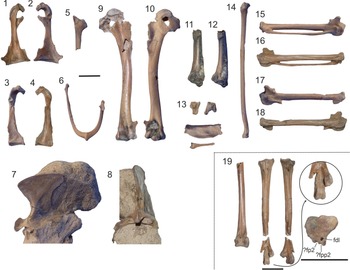
Holotype
NMS.Z.2021.40.93 (Fig. 1.1‒1.18; partial skeleton, including furcula, both coracoids, extremitas cranialis of left scapula, partial sternum, right humerus, proximal portion of left ulna, left radius, complete right and partial left carpometacarpus, left os carpi radiale, left os carpi ulnare, and wing phalanges), collected in 1991 by M. Daniels (original collector's number WN 91676).
(1‒18) The holotype of Charadriisimilis essexensis n. gen. n. sp. (NMS.Z.2021.40.93). (19) Leg bones of a similar-sized undetermined charadriiform species (NMS.Z.2021.40.94) from the early Eocene London Clay of Walton-on-the-Naze (Essex, UK). (1‒4) Right (1, 2) and left (3, 4) coracoid in ventral (1, 4) and dorsal (2, 3) views; (5) extremitas cranialis of left scapula in medial view; (6) furcula; (7, 8) sternum in lateral (7) and cranial (8) views; (9, 10) right humerus in caudal (9) and cranial (10) view; (11, 12) proximal portion of left ulna in cranial (11) and cranioventral (12) views; (13) ossa carpalia and wing phalanges; (14) left radius; (15‒18) right (15, 16) and left (17, 18) carpometacarpus in ventral (15, 17) and dorsal (16, 18) views. (19) Charadriiformes gen. indet. sp. indet. (NMS.Z.2021.40.94), distal end of left tibiotarsus and left tarsometatarsus in plantar and dorsal views, and proximal end of tarsometatarsus in proximal view; the arrow denotes a detail of the distal tarsometatarsus in plantar view. fdl = sulcus for tendon of musculus flexor digitorum longus; fp2 = sulcus for tendon of musculus flexor perforatus digiti 2; fpp2 = sulcus for tendon of musculus flexor perforans et perforatus digiti 2. Scale bars = 5 mm.

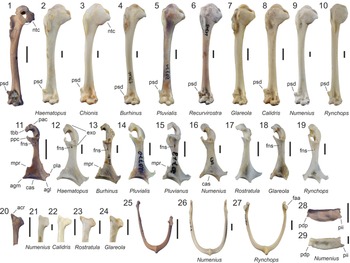
Right humerus (1‒10), right coracoid (11‒19), extremitas cranialis of left (20; medial view) and right (21‒24; lateral view) scapula, furcula (25‒27), and left phalanx proximalis digiti majoris (28, 29) of Charadriisimilis essexensis n. gen. n. sp. from the early Eocene London Clay of Walton-on-the-Naze (Essex, UK) and extant charadriiform birds. (1) Charadriisimilis essexensis (NMS.Z.2021.40.93); the dotted line indicates the reconstructed shape of the crista bicipitalis. (2) Haematopus ostralegus Linnaeus, Reference Linnaeus1758 (Charadrii; SMF 3521). (3) Chionis alba (Charadrii; SMF 5910). (4) Burhinus capensis (Lichtenstein, Reference Lichtenstein1823) (Charadrii; SMF 10767). (5) Pluvialis apricaria (Charadrii; SMF 20770). (6) Recurvirostra avosetta Linnaeus, Reference Linnaeus1758 (Charadrii; SMF 21345). (7) Glareola pratincola (Linnaeus, Reference Linnaeus1766) (Lari; SMF 1913). (8) Calidris canutus (Linnaeus, Reference Linnaeus1758) (Scolopaci; SMF 254). (9) Numenius arquata (Linnaeus, Reference Linnaeus1758) (Scolopaci; SMF 6311). (10) Rynchops niger Linnaeus, Reference Linnaeus1758 (Lari; SMF 4755). (11) Charadriisimilis essexensis (NMS.Z.2021.40.93). (12) Haematopus ostralegus (Charadrii; SMF 2697). (13) Burhinus capensis (Charadrii; SMF 18302). (14) Pluvialis apricaria (Linnaeus, Reference Linnaeus1758) (Charadrii; SMF 20770). (15) Pluvianus aegyptius (Linnaeus, Reference Linnaeus1758) (Charadrii; SMF 20773). (16) Numenius arquata (Scolopaci; SMF 6311). (17) Rostratula benghalensis (Linnaeus, Reference Linnaeus1758) (Scolopaci; SMF 16060). (18) Glareola pratincola (Lari; SMF 1913); the processus supracondylaris dorsalis of this specimen is broken. (19) Rynchops niger (Lari; SMF 4755). (20) Charadriisimilis essexensis (NMS.Z.2021.40.93). (21) Numenius arquata (Scolopaci; SMF 6311). (22) Calidris canutus (Scolopaci; SMF 254). (23) Rostratula benghalensis (Scolopaci; SMF 16060). (24) Glareola pratincola (Lari; SMF 1913). (25) Charadriisimilis essexensis (NMS.Z.2021.40.93). (26) Numenius arquata (Scolopaci; SMF 6311). (27) Rynchops niger (Lari; SMF 4755). (28) Charadriisimilis essexensis (NMS.Z.2021.40.93). (29) Numenius arquata (Scolopaci; SMF 6311). acr = acromion; agl = angulus lateralis; agm = angulus medialis; cas = crista articularis sternalis; exo = extremitas omalis; faa = facies articularis acrocoracoidea; fns = foramen nervi supracoracoidei; mpr = medial projection; ntc = notch; pac = processus acrocoracoideus; pdp = proximocaudally directed process; pii = processus internus indicis; pla = processus lateralis; ppc = processus procoracoideus; psd = processus supracondylaris dorsalis; tbb = tuberculum brachiale. Scale bars = 5 mm.

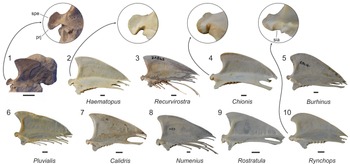
Sternum of Charadriisimilis essexensis n. gen. n. sp. from the early Eocene London Clay of Walton-on-the-Naze (Essex, UK) and extant charadriiform birds. (1) Charadriisimilis essexensis n. gen. n. sp. (NMS.Z.2021.40.93); the arrow denotes an enlarged detail of the spina externa. (2) Haematopus ostralegus (Charadrii; SMF 3521); the arrow denotes an enlarged detail of the spina externa. (3) Recurvirostra avosetta (Charadrii; SMF 21345). (4) Chionis alba (Charadrii; SMF 5910); the arrow denotes an enlarged detail of the spina externa. (5) Burhinus capensis (Charadrii; SMF 10767). (6) Pluvialis apricaria (Charadrii; SMF 20770). (7) Calidris canutus (Scolopaci; SMF 254). (8) Numenius arquata (Scolopaci; SMF 6311). (9) Rostratula benghalensis (Scolopaci; SMF 16060). (10) Rynchops niger (Lari; SMF 4755); the arrow denotes an enlarged detail of the spina externa. prj = craniodorsally projecting dorsal portion of spina externa; sia = septum interarticulare; spe = spina externa. Scale bars = 5 mm.

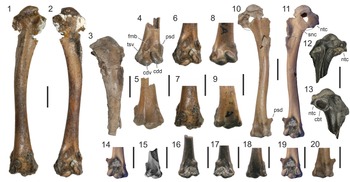
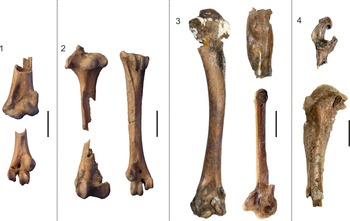
Humeri of early Eocene charadriiform and charadriiform-like birds from the London Clay (UK) and the Nanjemoy Formation (Virginia, USA). (1, 2) Left humerus of a Scandiavis-like bird from Walton-on-the-Naze, Essex (NMS.Z.2021.40.97): (1) caudal view; (2) cranial view. (3) Proximal portion of left humerus of a Scandiavis-like bird from Walton-on-the-Naze (NMS.Z.2021.40.98) in cranial view. (4, 5) Scandiavis cf. mikkelseni from Walton-on-the-Naze (NMS.Z.2021.40.95), distal end of left humerus: (4) cranial view; (5) caudal view. (6, 7) Distal end of left humerus of a Scandiavis-like bird from Walton-on-the-Naze (NMS.Z.2021.40.97): (6) cranial view; (7) caudal view. (8, 9) Mirrored distal end of right humerus of Precursor litorum from the London Clay of the Isle of Sheppey, Essex (holotype; NHMUK A 3135): (8) cranial view; (9) caudal view. (10, 11) Right humerus of Charadriisimilis essexensis n. gen. n. sp. from Walton-on-the-Naze (holotype; NMS.Z.2021.40.93): (10) caudal view; (11) cranial view. The dotted lines indicate the reconstructed shape of the crista bicipitalis. (12, 13) Proximal left humerus of an unnamed charadriiform from the Nanjemoy Formation (USNM PAL 771602): (12) caudal view; (13) cranial view. (14) Distal end of right humerus of Charadriisimilis essexensis (holotype; NMS.Z.2021.40.93) in cranial view. (15) Distal end of right humerus of an unnamed charadriiform from the Nanjemoy Formation (SMF Av 619) in cranial view. (16‒18) Distal end of left humerus of Precursor parvus from London Clay of Bognor Regis, Sussex (holotype; NHMUK A 3684): (16, 17) cranial view; (18) caudal view. In (17) and (18) the bone is mirrored. (19, 20) Distal end of right humerus of Charadriisimilis essexensis (holotype; NMS.Z.2021.40.93): (19) cranial view; (20) caudal view. The dotted lines in (17) and (19) indicate the shapes of the condylus dorsalis and tuberculum supracondylare ventrale. cbt = crista bicipitalis; cdd = condylus dorsalis; cdv = condylus ventralis; fmb = fossa musculi brachialis; ntc = notch; psd = processus supracondylaris dorsalis; snc = sulcus nervi coracobrachialis; tsv = tuberculum supracondylare ventrale. Scale bars = 5 mm.

Diagnosis
Coracoid with foramen nervi supracoracoidei and slender shaft, medial margin of extremitas sternalis forms a process, and crista articularis sternalis is long and only weakly concave; scapula with long and pointed acromion; spina externa of sternum much farther cranially projected than apex carinae; humerus with well-developed processus supracondylaris dorsalis. Differs from Precursor parvus Harrison and Walker, Reference Harrison and Walker1977, the type species of the taxon Precursor Harrison and Walker, Reference Harrison and Walker1977, in that humerus shaft is proportionally wider, condylus dorsalis shorter and more rounded, tuberculum supracondylare ventrale proportionally longer, and processus supracondylaris dorsalis much more pronounced. Distinguished from Jiliniornis huadianensis Hou and Ericson, Reference Hou and Ericson2002 in that caput humeri is less strongly proximally protruding, crista bicipitalis reaches less far distally. The new species is distinctly smaller than Scandiavis mikkelseni and Nahmavis grandei, and the humerus has a larger processus supracondylaris dorsalis than that of Scandiavis mikkelseni (the wing and pectoral girdle elements of Nahmavis grandei are unknown). Distinguished from all crown group Charadriiformes in that acromion of scapula is very long and pointed, spina externa of sternum is strongly projected and with craniodorsally protruding dorsal portion. Furthermore differs from all extant Scolopaci in that coracoid with foramen nervi supracoracoidei and crista articularis sternalis proportionally longer and only weakly curved, caudal surface of crista deltopectoralis concave; distinguished from all extant non-turnicid Lari in that coracoid has proportionally longer and weakly curved crista articularis sternalis, and phalanx proximalis digiti majoris has short processus internus indicis. Unlike in most extant Charadrii, the processus extensorius of the carpometacarpus is short and cranioproximally (rather than cranially) directed, and the humerus is without a second (dorsal) fossa pneumotricipitalis (also absent in the Burhinidae and some Recurvirostridae; Mayr, Reference Mayr2011).
Occurrence
Walton-on-the-Naze, Essex, United Kingdom; Walton Member of the London Clay Formation (previously Division A2; Jolley, Reference Jolley, Knox, Corfield and Dunay1996; Rayner et al., Reference Rayner, Mitchell, Rayner and Clouter2009; Aldiss, Reference Aldiss2012), early Eocene (early Ypresian, 54.6‒55 Ma; Collinson et al., Reference Collinson, Adams, Manchester, Stull, Herrera, Smith, Andrew, Kenrick and Sykes2016).
Description and comparisons
The coracoid has a hook-like processus acrocoracoideus of similar shape to that of the Burhinidae, Ibidorhynchidae, and Recurvirostridae. As in the Recurvirostridae, the tuberculum brachiale is narrow in the sterno-omal direction (Fig. 2.11), whereas it is more expanded in, for example, the Glareolidae (Fig. 2.18) and other Lari (Fig. 2.19). However, the extremitas omalis is proportionally shorter than in the Burhinidae (Fig. 2.13), Haematopodidae (Fig. 2.12), Ibidorhynchidae, and Recurvirostridae, and corresponds to that of the Charadriidae in its relative length. The processus procoracoideus is well developed; unlike in many Lari, its tip is not strongly omally directed. The shaft of the bone is slenderer than in most crown group Charadriiformes (except Burhinidae). A foramen nervi supracoracoidei is present. The medial margin of the sternal extremity of the right coracoid forms a marked medial projection, which is also present in the Burhinidae (Fig. 2.13) and in Pluvianus (Fig. 2.15; Mayr, Reference Mayr2011); in other Charadrii (Haematopodidae, Recurvirostridae, Charadriidae, and Chionidae), this projection is likewise present but much less developed. In the Lari and Scolopaci, it is absent or vestigial. As in extant Burhinidae, Ibidorhynchidae, Haematopodidae, Recurvirostridae, and Pluvianus (all Charadrii), the crista articularis sternalis is long and only weakly concave (Fig. 2.11), whereas this crista is proportionally shorter and more curved in the Charadriidae, Chionidae, and Pluvialis (Fig. 2.14; all Charadrii) as well as in all Scolopaci (Fig. 2.16, 2.17) and Lari (Fig. 2.18, 2.19). Because a long crista articularis sternalis is found in most non-charadriiform birds, this condition is likely to be plesiomorphic for the Charadriiformes. The processus lateralis is short and forms a small process; its lateral margin is sigmoidally curved. The angulus lateralis is less developed than in crown group Charadriiformes.
Only the cranial extremity of the scapula is preserved (Fig. 2.20). The long, straight, and pointed acromion distinguishes Charadriisimilis from all extant Charadriiformes (in Rostratula [Rostratulidae; Fig. 2.23], the acromion is elongated, but proportionally shorter and not as straight, and in Glareola [Glareolidae; Fig. 2.24] and Pluvialis [Charadrii], it is pointed but proportionally shorter).
The right scapus claviculae of the furcula (Fig. 2.25) is fractured and its omal portion displaced at an angle of 90° (this appears to be a taphonomic artifact rather than a pathological condition). Unlike in some Lari (Fig. 2.27; Mayr, Reference Mayr2011), the extremitas omalis does not bear a pronounced, laterally projected facies articularis acrocoracoidea. The sternal portion of the bone is wide, and the apophysis furculae is a small, ridge-like process.
The sternum (Fig. 3.1) has a dorsoventrally deep carina sterni with an only weakly cranially projected apex carinae. The spina externa is proportionally longer than in most extant Charadriiformes and protrudes much farther cranially than the apex carinae; unlike in extant charadriiforms, it has a craniodorsally projected dorsal portion. The ventral margin of the spina is markedly bulging. In most extant Charadriiformes (Fig. 3.2‒3.10), the spina externa is proportionally smaller and shorter, with a broadly convex rostral margin. Furthermore, unlike in many extant charadriiforms (e.g., Chionidae, Charadriidae, Jacanidae, Thinocoridae, Scolopacidae, and most Lari), a septum interarticulare, which is formed by the dorsal portion of the base of the spina externa and separates the sulci articulares coracoidei, is absent. The caudal portion of the sternum is broken.
The humerus (Fig. 2.1) is a moderately long and fairly robust bone with a sigmoidally curved shaft and a comparatively large proximal end. Overall, it is similar in shape and proportions to the humerus of the Haematopodidae (Fig. 2.2) and Chionidae (Fig. 2.3), whereas the humerus of many other charadriiforms (including the Burhinidae and Recurvirostridae) is more elongate and has a smaller proximal end (Fig. 2). As in most other Charadriiformes, the sulcus transversus is marked and the fossa pneumotricipitalis lacks pneumatic openings. A second (dorsal) fossa pneumotricipitalis is absent; this fossa is present in all Charadrii except the Burhinidae and some Recurvirostridae (Mayr, Reference Mayr2011). The caput humeri is ventrally well delimited from the incisura capitis (in the Charadriidae, it merges into the incisura; Ballmann, Reference Ballmann2004). The incisura capitis lacks a transverse ridge, which characterizes the humerus of the Scolopaci and Turnicidae (Ballmann, Reference Ballmann2004; Mayr, Reference Mayr2011). There is a shallow sulcus nervi coracobrachialis; in extant Charadriiformes, this sulcus is often partially closed (Ballmann, Reference Ballmann1979). Unlike in some Lari, the impressio coracobrachialis is wide and shallow (similar to the condition in, e.g., Haematopus), and the dorsal margin of the intumescentia humeri is not sharply offset from this impressio. The crista deltopectoralis, whose dorsal margin is broken, measures about one-third of the humerus length and has a concave caudal surface; an equally long crista deltopectoralis occurs in, for example, the charadriid taxon Vanellus. The crista bicipitalis is broken. The proximal end of the bone resembles a proximal humerus of an unnamed charadriiform from the Nanjemoy Formation (Fig. 4.12, 4.13), which was described by Mayr et al. (Reference Mayr, De Pietri and Scofield2022). In particular, both bones share a distinct concave notch in the distal margin of the proximal humerus, immediately ventral to the crista bicipitalis (Fig. 2.1). Among extant Charadriiformes, a less-pronounced notch occurs in Chionis alba (Gmelin, Reference Gmelin1789) (Chionidae), whereas we could not identify a notch in Chionis minor Hartlaub, Reference Hartlaub1841 and non-chionid taxa. On the distal end of the bone is a large processus supracondylaris dorsalis, which is of similar size to that of, for example, the Scolopacidae (Scolopaci), Charadriidae (Charadrii), and Glareolidae (Lari); in the Jacanidae, Rostratulidae, and Pedionomidae (all Scolopaci), in the Burhinidae (Charadrii), and in the Turnicidae and Alcidae (both Lari), the processus supracondylaris dorsalis is distinctly smaller or absent. The fossa musculi brachialis is large and well marked, but its exact depth cannot be determined owing to overlying pyrite encrustations. The condylus dorsalis is of subovate shape, whereas it is narrower and longer in Precursor parvus (Fig. 4.16–4.18), Precursor litorum, and many extant charadriiforms. The tuberculum supracondylare ventrale is proximodistally longer than in Precursor parvus (Fig. 4.16). As in many other charadriiform birds, the attachment site of musculus pronator superficialis forms a small ventral projection.
The proximal end of the ulna (Fig. 1.11) shows a rather unspecific morphology and resembles that of extant members of the Charadrii (and other charadriiforms). The radius is not much longer than the humerus.
The long and narrow carpometacarpus (Fig. 1.15‒1.18) corresponds well to that of the Recurvirostridae in its proportions and morphology. The processus extensorius is of average size, craniocaudally narrow, and its tip is cranioproximally directed; in the Charadriidae, Ibidorhynchidae, Burhinidae, and some Lari (e.g., Rynchopidae), the extensor process is longer and straighter.
The phalanx proximalis digiti majoris (Fig. 2.28) lacks fenestrae (these are present in the Laridae, Sternidae, Stercorariidae, Rynchopidae, and some Glareolidae; Mayr, Reference Mayr2011) and has only a short processus internus indicis (sensu Stegmann, Reference Stegmann1963). This process is much longer in some Scolopaci (Fig. 2.29) and non-turnicid Lari; within the Charadrii, its development is variable, and the processus internus indicis is fairly long in the Haematopodidae and Chionidae but short in the Burhinidae and Charadriidae. The proximal end of the phalanx bears a distinct proximocaudally directed process (process 1 of Ballmann, Reference Ballmann1979, fig. 14). The os carpi ulnare exhibits a tubercle at the insertion site of the ligamentum humerocarpale, which is an apomorphy of charadriiform birds (Mayr, Reference Mayr2011).
Etymology
The species epithet refers to the geographical location of the type locality.
Measurements (maximum length in millimeters)
Right coracoid, 14.7; left coracoid, 14.6; right humerus, 31.7; left radius, 32.9; right carpometacarpus, 20.8; left carpometacarpus, 20.8.
Remarks
The new species was about the size of the extant common ringed plover, Charadrius hiaticula Linnaeus, Reference Linnaeus1758.
Charadriiformes Huxley, Reference Huxley1867
Charadriiformes gen. indet. sp. indet.
Figure 1.19
Occurrence
Walton-on-the-Naze, Essex, United Kingdom; Walton Member of the London Clay Formation, early Eocene (early Ypresian).
Material
NMS.Z.2021.40.94 (Fig. 1.19; distal portion of left tibiotarsus, partial left tarsometatarsus); collected in 1976 by M. Daniels (original collector's number WN 76156).
Remarks
The tibiotarsus corresponds to that of the Charadriiformes in that the condylus medialis is distinctly smaller than the condylus lateralis and in that both condyli are widely separated. The tarsometatarsus is identified as that of a charadriiform bird by the short and plantarly deflected trochlea metatarsi II and the morphology of the hypotarsus, which agrees with that of some Scolopaci (Scolopacidae, Jacanidae) and Lari (Sternidae) in that there is a medially situated small canal for the tendon of musculus flexor digitorum longus and two shallow sulci that, on the basis of comparisons with extant Charadriiformes (Mayr, Reference Mayr2011, fig. 6), were presumably for the tendons of m. flexor perforans et perforatus digiti 2 and m. flexor perforatus digiti 2. By contrast, the hypotarsus of crown group Charadrii exhibits a more centrally located sulcus or canal for the musculus flexor digitorum longus, which is usually situated lateral to the sulcus for m. flexor perforans et perforatus digiti 2 (Mayr, Reference Mayr2011).
Whether the leg bones of NMS.Z.2021.40.94 belong to Charadriisimilis essexensis cannot be said. The hypotarsus morphology may be plesiomorphic for the Charadrii. However, there may as well have been a higher diversity of charadriiform birds in the paleoenvironment of Walton-on-the-Naze, and only future specimens with overlapping skeletal elements will allow an unambiguous association of the Charadriisimilis essexensis holotype with hindlimb bones.
Charadriiformes Huxley, Reference Huxley1867
Scandiavis Bertelli et al., Reference Bertelli, Lindow, Dyke and Mayr2013
Type species
Scandiavis mikkelseni Bertelli et al., Reference Bertelli, Lindow, Dyke and Mayr2013, by original designation.
Scandiavis cf. mikkelseni Bertelli et al., Reference Bertelli, Lindow, Dyke and Mayr2013
Figures 4.4, 4.5, 5.1, 5.2, 6.2–6.5, 6.12–6.15
Occurrence
Walton-on-the-Naze, Essex, United Kingdom; Walton Member of the London Clay Formation, early Eocene (early Ypresian).
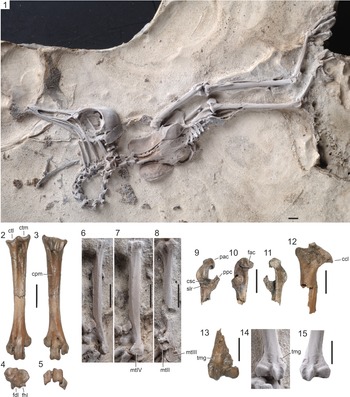
Scandiavis and Scandiavis-like birds from the early Eocene London Clay of Walton-on-the-Naze (Essex, UK). (1) Scandiavis cf. mikkelseni (NMS.Z.2021.40.95); distal ends of left humerus (cranial view) and left tarsometatarsus (plantar view). (2) Scandiavis cf. mikkelseni (NMS.Z.2021.40.96); proximal end of left tibiotarsus (lateral view), distal end of left femur (plantar view), and right tarsometatarsus (plantar view). (3) cf. Scandiavis (NMS.Z.2021.40.97); left humerus (cranial view), left carpometacarpus (ventral view), and left phalanx proximalis digiti majoris (dorsal view). (4) cf. Scandiavis (NMS.Z.2021.40.98); extremitas omalis of left coracoid (dorsal view) and proximal portion of left humerus (caudal view). Scale bars = 5 mm.

Scandiavis and Scandiavis-like birds from the early Eocene Fur Formation (Denmark) and the London Clay (UK). (1) The holotype of Scandiavis mikkelseni from the Fur Formation (FU 171x). (2‒5) Right tarsometatarsus of Scandiavis cf. mikkelseni from the London Clay of Walton-on-the-Naze (NMS.Z.2021.40.96): (2) dorsal view; (3) plantar view; (4) proximal view; (5) distal view. (6‒8) Right (6, 7) and left (8) tarsometatarsus of the Scandiavis mikkelseni holotype (FU 171x): (6) lateroplantar view; (7) lateral view; (8) medial view. (9‒11) Extremitas omalis of left coracoid of a Scandiavis-like bird (NMS.Z.2021.40.98) from Walton-on-the-Naze: (9) dorsal view; (10) medial view; (11) ventral view. (12) Proximal end of left tibiotarsus of Scandiavis cf. mikkelseni (NMS.Z.2021.40.96) in cranial view. (13) Distal end of left femur of Scandiavis cf. mikkelseni (NMS.Z.2021.40.96) in caudal view. (14, 15) Distal end of right femur of the Scandiavis mikkelseni holotype (FU 171x) in caudal view; in (15) the bone is mirrored, and surrounding matrix was digitally removed. ccl = crista cnemialis lateralis; cpm = crista plantaris medialis; csc = cotyla scapularis; ctl = cotyla lateralis; ctm = cotyla medialis; fac = facies articularis clavicularis; fdl = sulcus for tendon of musculus flexor digitorum longus; fhl = sulcus for tendon of musculus flexor hallucis longus; mtII = trochlea metatarsi II; mtIII = trochlea metatarsi III; mtIV = trochlea metatarsi IV; pac = processus acrocoracoideus; ppc = processus procoracoideus; slr = sternolateral rim; tmg = tuberculum musculi gastrocnemialis lateralis. Scale bars = 5 mm.

Description and comparisons
The distal humerus of NMS.Z.2021.40.95 (Fig. 4.4, 4.5) exhibits a processus supracondylaris dorsalis, which forms a dorsal bulge-like projection extending distally along the dorsal surface of the bone; the shape of this process corresponds to the processus supracondylaris dorsalis of Chionis (Charadrii, Chionidae; Fig. 2.3). The bone shows a resemblance to the distal humerus of Precursor litorum (Fig. 4.8, 4.9); however, in Precursor litorum, a processus supracondylaris dorsalis is absent and the processus flexorius is more projected. In Charadriisimilis essexensis, the processus supracondylaris dorsalis is much better developed. The condylus dorsalis of NMS.Z.2021.40.95 is elongate and narrow, and the condylus ventralis is large and rounded. The pronounced fossa musculi brachialis is oriented obliquely to the longitudinal axis of the humerus. The processus flexorius is short, and its distal end forms a step on the caudal surface of the bone.
The distal end of the femur (Fig. 6.13) closely resembles that of the Scandiavis mikkelseni holotype (Fig. 6.14, 6.15). As in the latter, there is a marked, subovate tuberculum musculi gastrocnemialis lateralis, which is not much raised above the bone surface (this structure was erroneously considered to be the impressio ansae musculi iliofibularis by Bertelli et al., Reference Bertelli, Lindow, Dyke and Mayr2013). This feature, as well as a close overall similarity, allow an unambiguous referral of NMS.Z.2021.40.96 to the taxon Scandiavis.
Only the proximal end of the tibiotarsus is preserved in NMS.Z.2021.40.96 (Figs. 5.2, 6.12). The crista cnemialis lateralis is well developed and forms a pointed projection, and the crista cnemialis cranialis is broken.
As far as comparisons are possible, the comparatively short tarsometatarsus (Fig. 6.2‒6.5) closely agrees with that of the Scandiavis mikkelseni holotype (Fig. 6.6‒6.8) in size and morphology. On the proximal end of the bone, the cotyla medialis projects much farther proximally than the cotyla lateralis. The hypotarsus (Fig. 6.4) differs from that of all crown group Charadriiformes in that it exhibits two shallow sulci for musculus flexor digitorum longus and m. flexor hallucis longus, respectively (Mayr, Reference Mayr2016b). On the plantar surface of the bone is a distinct crista plantaris medialis. The foramina vascularia proximalia are situated closely together. The foramen vasculare distale is of average size, neither unusually small nor very large; its dorsal opening is located in a wide fossa. A fossa metatarsi I is present. The trochlea metatarsi II is plantarly deflected and very short, reaching distally only to the base of the trochlea metatarsi IV. The trochlea metatarsi III has a symmetrical plantar articular surface. The distal margin of the trochlea metatarsi IV slants laterally.
Material
NMS.Z.2021.40.95 (Fig. 5.1; distal end of left humerus, distal end of left tarsometatarsus); collected in 1977 by M. Daniels (original collector's number WN 77185). NMS.Z.2021.40.96 (Fig. 5.2; distal end of left femur, proximal end of left tibiotarsus, right tarsometatarsus); collected in 1983 by M. Daniels (original collector's number WN 83433).
Measurements (in millimeters; in parentheses the dimensions of the Scandiavis mikkelseni holotype)
NMS.Z.2021.40.96: Tarsometatarsus, maximum length, 27.1 (25.5‒25.4).
Remarks
These specimens can be unambiguously assigned to the taxon Scandiavis. However, our assignment of the fossils to Scandiavis mikkelseni is tentative because the tarsometatarsus is slightly shorter than in the holotype (see preceding measurements).
cf. Scandiavis Bertelli et al., Reference Bertelli, Lindow, Dyke and Mayr2013
Figures 4.1–4.3, 4.6, 4.7, 5.3, 5.4, 6.9–6.11
Occurrence
Walton-on-the-Naze, Essex, United Kingdom; Walton Member of the London Clay Formation, early Eocene (early Ypresian).
Description and comparisons
The coracoid of NMS.Z.2021.40.98 (Fig. 6.9‒6.11) lacks a foramen nervi supracoracoidei. The long processus procoracoideus projects toward the processus acrocoracoideus, and its tip is ventrally deflected. The processus acrocoracoideus is relatively small, and the facies articularis clavicularis is ventrally projected. The deeply excavated cotyla scapularis has a subcircular shape, and its sternolateral margin forms a rim.
The distal end of the humerus of NMS.Z.2021.40.97 (Fig. 4.6, 4.7) corresponds to that of NMS.Z.2021.40.95 in size and overall morphology but lacks a processus supracondylaris dorsalis and has a more obliquely oriented fossa musculi brachialis. The distal humerus of NMS.Z.2021.40.97 resembles that of Precursor litorum (Fig. 4.8, 4.9), for which charadriiform affinities were assumed by Harrison and Walker (Reference Harrison and Walker1977), but the condylus dorsalis is oriented less obliquely to the longitudinal axis of the bone, and the ventrodistal portion of the distal humerus with the processus flexorius is more broadly rounded. NMS.Z.2021.40.98 closely corresponds to NMS.Z.2021.40.97 in the morphology of the proximal humerus. Owing to the poor preservation of the corresponding area in both proximal humeri (NMS.Z.2021.40.97 and NMS.Z.2021.40.98), it is not discernable whether a sulcus nervi coracobrachialis is present. The sulcus transversus is marked, and the tuberculum dorsale is large.
The carpometacarpus is present in NMS.Z.2021.40.97 (Fig. 5.3). The distal end is damaged, but as preserved, the bone measures about 60% of the humerus length and therefore has a similar relative length to the carpometacarpus of Charadriisimilis essexensis. However, it is stouter than the carpometacarpus of Charadriisimilis essexensis, and the proximal extremity is proportionally larger. Unlike in Charadriisimilis essexensis the processus extensorius merges into the facies articularis alularis.
Material
NMS.Z.2021.40.97 (Fig. 5.3; left humerus, partial left carpometacarpus, left phalanx proximalis digiti majoris), collected in 1978 by M. Daniels (original collector's number WN 78209). NMS.Z.2021.40.98 (Fig. 5.4; omal extremity of left coracoid, proximal portion of left humerus), collected in 1978 by M. Daniels (original collector's number WN 78210).
Measurements (in millimeters)
NMS.Z.2021.40.97: left humerus, maximum length, 40.4; left carpometacarpus, length as preserved, 25.1.
Remarks
The differences in the shape of the distal end of the humerus suggest that the preceding specimens are not conspecific with the material we refer to Scandiavis cf. mikkelseni even though we consider close affinities likely.
Discussion
Affinities of Charadriisimilis.—Charadriisimilis n. gen. exhibits derived charadriiform characteristics, including a hook-shaped processus acrocoracoideus of the coracoid, a humerus with a well-developed processus supracondylaris dorsalis, and an os carpi ulnare with a tubercle at the insertion site of the ligamentum humerocarpale. With an age of 54.6‒55.0 Ma, Charadriisimilis essexensis pre-dates the divergence dates of crown group Charadrii (~48 Ma), Scolopaci (~49 Ma), and non-turnicid Lari (~44.5 Ma) as estimated from the most recent calibrated molecular analysis (Černý and Natale, Reference Černý and Natale2022). However, these molecular divergence estimates have to be regarded with caution, and an analysis by De Pietri et al. (Reference De Pietri, Worthy, Scofield, Cole and Wood2021) found slightly earlier dates within large confidence intervals (in this analysis, the divergence date of crown group Charadrii—represented in the analysis by the Burhinidae and Recurvirostridae—was estimated at ~52 Ma, that of crown group Lari at ~53 Ma, and that of crown group Scolopaci at ~50 Ma).
The new taxon is clearly distinguished from all crown group Scolopaci, which lack a foramen nervi supracoracoidei and have a humerus with a convex caudal surface of the crista deltopectoralis and an incisura capitis that exhibits a transverse ridge. At least the latter two features are derived ones that developed within the Charadriiformes, and their absence in Charadriisimilis precludes a position of the fossil taxon within crown group Scolopaci. Non-turnicid Lari are characterized by a humerus with a marked impressio coracobrachialis and a phalanx proximalis digiti majoris that bears a long processus internus indicis. These derived (by outgroup comparison with non-charadriiform birds) features are absent in Charadriisimilis, and there is no character evidence, which suggests closer affinities between Charadriisimilis and the Turnicidae.
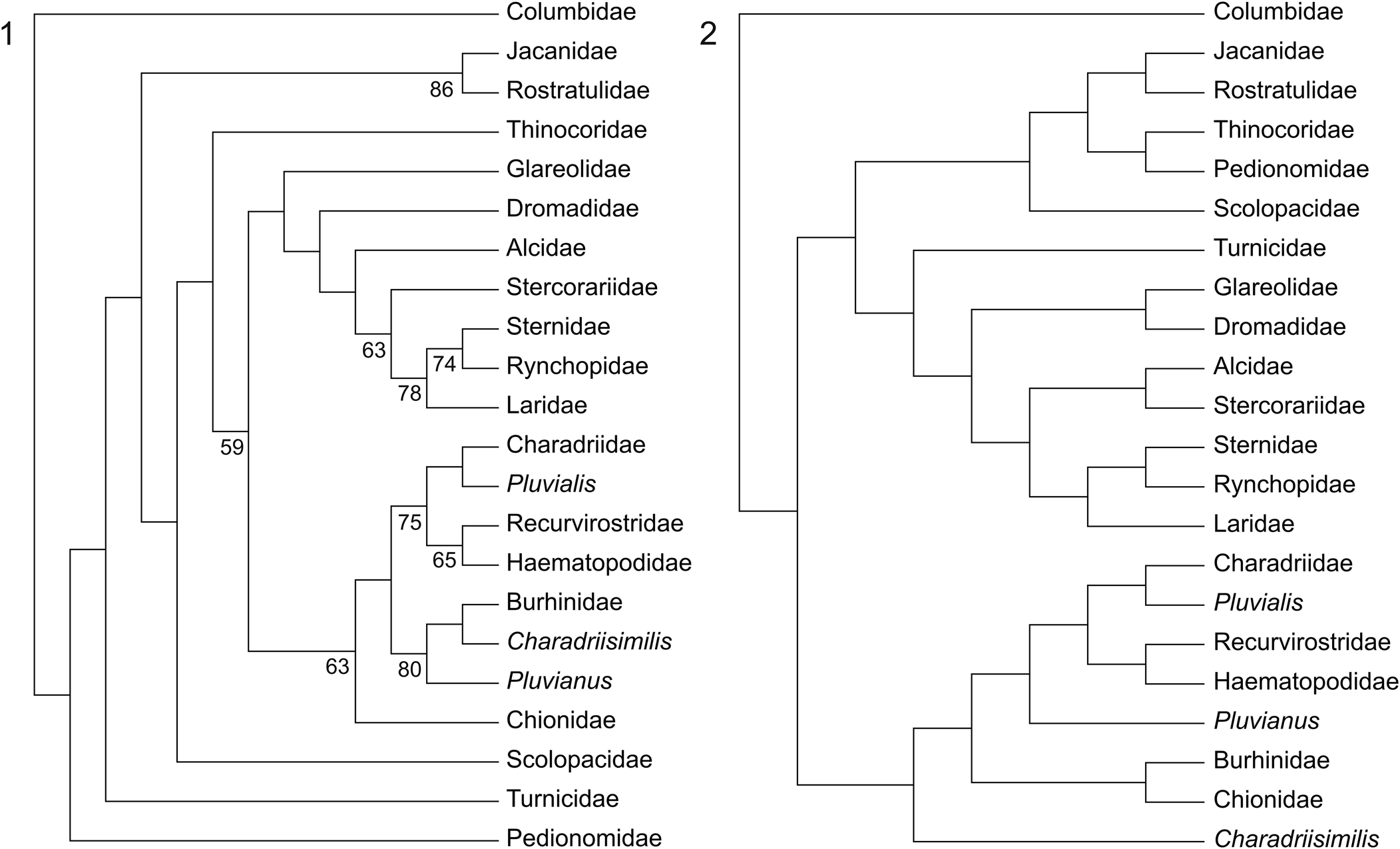
As noted by Mayr (Reference Mayr2022), the Charadriisimilis essexensis holotype exhibits a Charadrii-like morphology, and affinities to the Charadrii are also suggested by our phylogenetic analyses. Analysis of the unconstrained dataset resulted in three most parsimonious trees (L = 143; CI = 0.57; RI = 0.70) and showed Charadriisimilis to be the sister group of the Burhinidae (Fig. 7.1). However, this analysis did not recover various clades that are congruently supported by current sequence-based analyses, and an analysis that was constrained to a molecular backbone phylogeny resulted in a single most parsimonious tree (L = 156; CI = 0.53; RI = 0.63) and found Charadriisimilis to be the sister taxon of crown group Charadrii (Fig. 7.2). Five characters were optimized as synapomorphies of Charadriisimilis and crown group Charadriidae in the latter analysis: condylus medialis of quadratum with markedly concave rostral surface (ch. 17), coracoid with foramen nervi supracoracoidei (ch. 21; reversal into the plesiomorphic condition), coracoid with well-developed projection on margo medialis of extremitas sternalis (ch. 22), and crista deltopectoralis of humerus with concave caudal surface (ch. 32: reversal into the plesiomorphic condition); two further characters that were optimized as apomorphies of this clade are unknown for Charadriisimilis (ch. 41: hypotarsus with centrally positioned sulcus/canal for tendon of musculus flexor digitorum longus, ch. 43: hallux absent). None of these characters represents strong evidence for closer affinities between Charadriisimilis and the Charadrii, which is why our assignment of the fossil taxon is tentative.
(1) Strict consensus tree of three most parsimonious trees (L = 143; CI = 0.57; RI = 0.70) resulting from the analysis of the primary dataset; bootstrap support values are indicated next to the internodes. (2) Most parsimonious tree resulting from the analysis that was constrained to a molecular backbone phylogeny (L = 156; CI = 0.53; RI = 0.63).

Charadriisimilis shares with the Burhinidae a medial projection of the extremitas sternalis of the coracoid. This projection is also present in Pluvianus and was recovered as an apomorphy of a clade including Pluvianus, Charadriisimilis, and Burhinidae in the analysis of the primary dataset. However, close affinities between Pluvianus and the Burhinidae are not supported by analyses of molecular sequence data (Černý and Natale, Reference Černý and Natale2022), and the tree topology found in the primary analysis of our morphological data also conflicts in other aspects with congruently supported molecular phylogenies. A position of Charadriisimilis outside crown group Charadrii is suggested by the fact that the humerus of extant Charadrii exhibits a second (dorsal) fossa pneumotricipitalis (Mayr, Reference Mayr2011), which is absent in Charadriisimilis. Furthermore, unlike in Charadriisimilis, the processus extensorius of the carpometacarpus is enlarged and straight in most Charadrii, which is a derived condition for Charadriiformes and neornithine birds as a whole. Therefore, we consider a position of Charadriisimilis outside crown group Charadrii to be better corroborated by the morphology of the new fossil taxon; a stem group position also concurs with the molecular divergence estimates for crown group Charadrii cited in the preceding.
Charadriisimilis essexensis is larger than the unnamed charadriiform from Messel (Mayr, Reference Mayr2000), with humerus and carpometacarpus lengths being 24.8 and 17.2 mm in the Messel fossil versus 31.7 and 20.8 mm in Charadriisimilis essexensis. In size, the distal humerus of Charadriisimilis essexensis slightly exceeds the specimen from the early Eocene of Mongolia described by Hood et al. (Reference Hood, Torres, Norell and Clarke2019). The distal humerus of the new species is distinctly larger than that of an unnamed charadriiform from the North American Nanjemoy Formation (Mayr, Reference Mayr2016a; Fig. 4.15), but the proximal humerus corresponds to that of another unnamed charadriiform described by Mayr et al. (Reference Mayr, De Pietri and Scofield2022). The occurrence of a concave notch in the proximal humerus from the Nanjemoy Formation and in that of Charadriisimilis (Fig. 4.12, 4.13) is notable and may indicate close affinities of the fossils.
The Charadrii are the sister taxon of a clade including the Scolopaci and Lari and have a scarce fossil record (Bochenski et al., Reference Bochenski, Wertz, Tomek and Gorobets2019; Mayr, Reference Mayr2022). If Charadriisimilis essexensis is a representative of the Charadrii, it suggests the presence of representatives of the clade including the Scolopaci and Lari by the early Eocene. Such fossils still have to be identified, and all early Eocene charadriiforms have a generalized Charadrii-like morphology. The earliest Lari are putative Turnicidae (Lari) from the middle Eocene of Namibia (Mourer-Chauviré et al., Reference Mourer-Chauviré, Pickford and Senut2017), and the earliest Scolopaci are from the late Eocene of Canada (Weigel, Reference Weigel1963). However, the obvious conclusion that a Charadrii-like morphology is plesiomorphic for charadriiform birds is not supported by the morphology of Scandiavis.
Affinities of Scandiavis and the ancestral morphology of charadriiform birds
Most analyses support a classification of Scandiavis as a stem group charadriiform (Bertelli et al., Reference Bertelli, Lindow, Dyke and Mayr2013; Musser and Clarke, Reference Musser and Clarke2020; Heingård et al., Reference Heingård, Musser, Hall and Clarke2021). However, because previous studies were based on the two specimens from the Fur Formation (that is, a well-preserved partial skeleton lacking the wing and pectoral girdle bones as well as a referred skull), critical osteological details of Scandiavis remained unknown.
The new fossils shed light on the morphology of the distal end of the humerus, and the presence of an, albeit weakly developed, processus supracondylaris dorsalis in specimen NMS.Z.2021.40.95 corroborates charadriiform affinities of Scandiavis. This process does not occur in gruiforms and is likely to be a plesiomorphic trait of charadriiform birds, even though it has been secondarily reduced in some taxa nested within Charadriiformes, that is, the Turnicidae and Alcidae among the Lari, the Burhinidae among the Charadrii, and the Jacanidae among the Scolopaci.
The hypotarsus of Scandiavis exhibits a more plesiomorphic morphology than that of crown group Charadriiformes in that there is a shallow sulcus for the tendon of musculus flexor digitorum longus (in crown group Charadriiformes, this tendon runs through a deep sulcus or a canal). In concordance with previous analyses (Bertelli et al., Reference Bertelli, Lindow, Dyke and Mayr2013; Musser and Clarke, Reference Musser and Clarke2020; Heingård et al., Reference Heingård, Musser, Hall and Clarke2021), hypotarsus morphology therefore supports a position of Scandiavis outside crown group Charadriiformes.
The coracoid of NMS.Z.2021.40.98 (cf. Scandiavis) corresponds to that of charadriiform birds in the ventrally protruding facies articularis clavicularis. This coracoid lacks a foramen nervi supracoracoidei, which is present in Charadriisimilis. The foramen was evidently lost in some Glareolidae (Rhinoptilus, Cursorius) and Alcidae (Alle, Brachyramphus, Ptychoramphus, Aethia), which are nested within the Lari, but an ancestral state reconstruction (Mayr, Reference Mayr2011) does not allow an unequivocal decision as to whether a foramen nervi supracoracoidei is a plesiomorphic trait of crown group Charadriiformes or whether it developed within the clade. If NMS.Z.2021.40.98 belongs to Scandiavis, and if Scandiavis is a stem group representative of the Charadriiformes, the absence of a foramen may be plesiomorphic, in which case a foramen nervi supracoracoidei would have developed twice independently in the Charadrii and in non-turnicid Lari in crown group Charadriiformes.
Olson (Reference Olson, Farner, King and Parkes1985) and Olson and Parris (Reference Olson and Parris1987) introduced the term “transitional Charadriiformes” for various fossils from the Cretaceous/Paleogene of North America, which they assigned to the “form family” Graculavidae. Subsequently, remains from other early Paleogene localities were placed in this “wastebasket taxon” (Benson, Reference Benson and Olson1999; Boles, Reference Boles1999). However, charadriiform affinities of these birds are poorly established (Mayr, Reference Mayr2022), and some of the fossils are now assigned to the anseriform Presbyornithidae (Worthy et al., Reference Worthy, De Pietri, Scofield and Hand2023). The affinities of other taxa assigned to the Graculavidae cannot be resolved without the discovery of further fossil material, but none of the specimens appears to show close affinities to Scandiavis.
Scandiavis is certainly the best-represented taxon to be considered as a stem group representative of the Charadriiformes, whereas Charadriisimilis is one of the oldest modern-type charadriiforms. This coexistence of stem and crown group Charadriiformes in the early Eocene London Clay illustrates the fact that these fossils are temporally closer to the evolutionary origin of their respective clades than are the extant representatives. The disparate morphologies of Scandiavis and Charadriisimilis (e.g., concerning the development of the processus supracondylaris dorsalis of the humerus) suggest different ecologies and a divergence of their respective lineages well before the early Eocene. Extant Charadrii have diverse ecological preferences, but most taxa are associated with aquatic habitats. Because the fossils from Walton-on-the-Naze stem from a nearshore marine paleoenvironment, Charadriisimilis may well have had a plover-like way of life, foraging for small invertebrates on beaches and tidal flats. The short and plantarly deflected trochlea metatarsi II of Scandiavis is a feature that enables the toes to be tightly pressed together and is often found in birds that move in water or soft soil (G.M., personal observation). The poor development of the cnemial crests of the tibiotarsus does not suggest pronounced swimming capabilities of Scandiavis, so the taxon is likely to have foraged on the ground. With regard to the limb-bone proportions, especially the fairly short tarsometatarsus, Scandiavis corresponds to, for example, extant Chionidae (Charadrii), Thinocoridae and some Scolopacidae (both Scolopaci), and to many taxa of the Lari. The different sizes of Charadriisimilis and Scandiavis, as well as possible differences in beak shapes (known only for the holotype of Scandiavis mikkelseni), may have ensured niche separation of the two taxa, but owing to the limited fossil material, their ecologies remain elusive.
Acknowledgments
We thank S. Tränkner for taking some of the photographs (additional images are by G.M.). Comments from two anonymous reviewers and J. Kastigar improved the manuscript.
Declaration of competing interests
The authors declare none.
Data availability statement
Data are available from the Dryad Digital Repository: https://doi.org/10.5061/dryad.b2rbnzsn6
Appendices
Appendix 1. Character descriptions (from Mayr, Reference Mayr2011).
1. Beak, configuration of nostrils: holorhinal (0), schizorhinal (1), pseudo-holorhinal (2).
2. Skull, os lacrimale, processus orbitalis contacting os jugale: no (0), yes (1).
3. Skull, os lacrimale/os ectethmoidale complex, os uncinatum: absent (0), present (1).
4. Skull, os frontale, marked circular incision or foramen formed by duct of nasal gland: absent (0), present (1).
5. Skull, orbita, distinct second opening caudal to foramen nervi maxillomandibularis: absent (0), present (1).
6. Skull, processus suprameaticus: not as follows (0), longer than processus zygomaticus (1), absent (2).
7. Skull, processus maxillopalatinus fused with os palatinum: no (0), yes (1).
8. Skull, maxillopalatine strut A sensu Strauch (1978): present (0), absent (1).
9. Skull, functional processus basipterygoidei: present (0), absent (1).
10. Skull, os pterygoideum: caudal end with dorsally directing, hook-like projection: no (0), yes (1).
11. Skull, fossa temporalis, strongly developed, reaching near the midline of cranium: no (0), yes (1).
12. Skull, processus laterales parasphenoidales well developed and ventrally protruding: no (0), yes (1).
13. Skull, fonticuli occipitales: absent (0), present (1).
14. Mandible, dorsally projecting flange of os praearticulare greatly elongated and almost reaching dorsal margin of ramus mandibulae: no (0), yes (1).
15. Mandible, strongly developed processus retroarticulares: absent (0), present (1).
16. Mandible, well-developed fenestra caudalis: present (0), absent (1).
17. Quadratum, condylus medialis with markedly concave rostral surface: no (0), yes (1).
18. Caudal thoracic vertebrae: heterocoelous (0), opisthocoelous (1).
19. Thoracic vertebrae pleurocoelous, i.e., with marked, ovate depressions on lateral surfaces: no (0), yes (1).
20. Ossified tendons along processus spinosi of thoracic vertebrae: absent (0), present (1).
21. Coracoid, foramen nervi supracoracoidei: present (0), absent (1).
22. Coracoid, extremitas sternalis, well-developed projection on margo medialis: absent (0), present (1).
23. Coracoid, extremitas sternalis strongly curved in distal (sternal) view, with medial portion of crista articularis sternalis greatly dorsoventrally widened: no (0), yes (1).
24. Furcula, extremitas omalis with distinct, subovate facies articularis acrocoracoidea that extends over nearly entire width of scapus claviculae: no (0), yes (1).
25. Sternum, margo caudalis: with four incisions/fenestrae (0), with two incisions (1), without incisions (2).
26. Sternum, carina sterni ending distinctly before tip of trabecula intermedia: no (0), yes (1).
27. Humerus, fossa pneumotricipitalis with pneumatic openings: yes (0), no (1).
28. Humerus, caput humeri strongly proximally protruding: no (0), yes (1).
29. Humerus, transverse ridge at beginning (dorsal end) of incisura capitis: no (0), yes (1).
30. Humerus, well-developed second (dorsal) fossa pneumotricipitalis that undercuts caput humeri: present (0), absent (1).
31. Humerus, impressio coracobrachialis very marked, dorsal margin of intumescentia humeri forming a sharp edge: no (0), yes (1).
32. Humerus, crista deltopectoralis, caudal surface: concave (0), convex (1).
33. Humerus, processus supracondylaris dorsalis strongly developed and protruding: no (0), yes (1).
34. Os carpi ulnare, osseous bridge across caudal end of tendinal furrow of crus longum: absent (0), present (1).
35. Os carpi ulnare, marked tubercle at area of insertion of ligamentum humerocarpale: no (0), yes (1).
36. Phalanx proximalis digiti majoris bifenestrated: no (0), yes (1).
37. Femur, distal end, tuberculum musculi gastrocnemialis lateralis very marked: no (0), yes (1).
38. Femur, distal end, crista supracondylaris medialis with distinct caudally projecting tubercle just proximal to condylus medialis: no (0), yes (1).
39. Pelvis, recessus caudalis fossae: absent (0), present (1).
40. Tarsometatarsus, hypotarsus, tendon of musculus flexor digitorum longus enclosed in bony canal: no (0) yes (1).
41. Tarsometatarsus, hypotarsus: sulcus/canal for tendon of musculus flexor digitorum longus medially positioned, i.e., situated directly dorsal to sulcus for tendon of m. perforans et perforatus digiti 2 (0), sulcus/canal for tendon of musculus flexor digitorum longus centrally positioned, i.e., situated dorsolateral to sulcus for tendon of m. perforans et perforatus digiti 2 (1).
42. Tarsometatarsus, foramen vasculare distale greatly enlarged, with very marked and wide sulcus extensorius opening proximal into it: no (0), yes (1).
43. Hallux: present (0), absent (1).
44. Fourth toe, fourth phalanx shorter than third phalanx: no (0), yes (1).
45. Three anterior toes fully webbed: no (0), yes (1).
46. Claw of second toe strongly curved: no (0), yes (1).
47. Enzyme malate dehydrogenase with unusually slow motility (55% that of galliform birds): no (0), yes (1).
48. Color pattern of downy chick: not as follows (0), dorsal surface of trunk with a pair of narrow black stripes along each side of the body that are separated by a broader whitish stripe (1), dorsal surface of trunk with a dark line along each side of the body that extends from shoulder region toward rump (2).
49. Young: precocial or semi-precocial (0), altricial (1).
50. Coracoid, crista articularis sternalis: weakly concave and long, with angulus lateralis reaching much farther laterally than lateral margin of processus acrocoracoideus, and only (0), strongly concave and short, with angulus lateralis reaching not much further laterally than lateral margin of processus acrocoracoideus (1). This character was newly added.
Appendix 2. Character matrix of 50 morphological characters for the 23 taxa included in the analysis. Unknown character states are indicated by “?.” Columbidae were designated as the outgroup taxon.