


Introduction
Health anxiety has been purported to be relevant to repeat and unnecessary attendance in the emergency department (ED; Daniels et al., Reference Daniels, Osborn and Davis2018). This is a common mental health difficulty seen across medical settings (Daniels et al., Reference Daniels, Parker and Salkovskis2020; Tyrer et al., Reference Tyrer, Cooper, Crawford, Dupont, Green, Murphy and Tyrer2011) yet the rate of health anxiety within emergency settings such as the ED has not yet been established. With high rates of presentation of pain in the ED (Todd et al., Reference Todd, Ducharme, Choiniere, Crandall, Fosnocht and Homel2007) and elevated health anxiety seen in chronic pain and other chronic conditions (51.1%; Rode et al., Reference Rode, Salkovskis, Dowd and Hanna2006; Tyrer et al., Reference Tyrer, Cooper, Crawford, Dupont, Green, Murphy and Tyrer2011), it is likely that health anxiety is prevalent in an ED setting, particularly as those with chronic health problems are often high impact users.
ED clinicians may notice behaviours consistent with the cognitive behavioural model of health anxiety (Salkovskis and Warwick, Reference Salkovskis and Warwick1986) whereby strategies such as reassurance seeking provide only temporary relief from distress. This is particularly relevant given previous research suggesting that repeat attendance at the ED may represent a counter-productive ‘safety-seeking behaviour’ in health anxiety (Daniels et al., Reference Daniels, Osborn and Davis2018; Daniels and Sheils, Reference Daniels and Sheils2017). Constructs such as pain catastrophization and anxiety sensitivity (fear of behaviour or physiological sensations associated with anxiety) are established key factors in the maintenance of distress in both health anxiety and pain, and may be relevant in the ED, with respect to recognition and understanding of distress.
Health anxiety in medical settings may provide a barrier to assessment and intervention and a reason for repeat attendance, despite being a condition that is highly responsive to treatment (Cooper et al., Reference Cooper, Gregory, Walker, Lambe and Salkovskis2017). Identification of psychological factors such as health anxiety and associated constructs in this population will increase our understanding of repeat attendance and potentially open avenues for targeted intervention. Indeed, a recent systematic review of psychological interventions in the ED were feasible and acceptable, with some evidence to indicate clinical effectiveness; amongst those included were studies treating health anxiety and non-cardiac chest pain (McGuire et al., Reference McGuire, Daniels and Safiin submission).
This study therefore aims to identify whether health anxiety is prevalent in the ED where 80% of attendances are pain related (Todd et al., Reference Todd, Ducharme, Choiniere, Crandall, Fosnocht and Homel2007), and furthermore, seeks to establish whether the key psychological factors, anxiety sensitivity and pain catastrophizing, predict health anxiety and pain level in this setting. Given the known high prevalence of distress and psychological trauma in pain populations (Lumley et al., Reference Lumley, Yamin, Pester, Krohner and Urbanik2022), these factors will also be examined and accounted for.
Method
Design and setting
The study implemented a cross-sectional questionnaire design with a convenience sample of walk-in patients accessing Southmead Hospital ED over a 4-day sampling period. Southmead Hospital is a Major Trauma Centre in Bristol, UK. The ED has an annual attendance of approximately 100,000 of which approximately 40% self-present via the waiting room. It is predominantly an adult ED with paediatric presentations managed in a nearby Children’s Hospital.
Participants
Participants were all those attending the ED over the pre-specified sampling period who also met the following inclusion criteria: (a) aged 18 or over, (b) able to complete (or complete with assistance) a set of self-report questionnaires, (c) able to give informed consent, and (d) attending via the ED waiting room (only). Participants were excluded from taking part in the study if they were identified as requiring majors/resuscitation care by the triage nurse or there was insufficient data relating to their reason for ED attendance. Those attending via ambulance were excluded from the study as it was deemed inappropriate to administer a battery of questionnaires and consent forms to these patients when they were likely to be in distress or medically very unwell.
Procedure
Recruitment took place on the 15, 17, 18 and 21 July 2019 across four 8-hour daytime or early evening shifts. Participants were recruited at the ED reception desk after registration and brief clinical assessment by an ED nurse. Questionnaires were given to all patients who met eligibility criteria. Participants were asked to complete their questionnaires while waiting to be seen by a clinician and were invited to deposit their anonymized questionnaires to the return box provided on the desk.
Measures
Participants completed a battery of measures and a standard demographic questionnaire.
The Short Health Anxiety Inventory (SHAI; Salkovskis et al., Reference Salkovskis, Rimes, Warwick and Clark2002) is a 14-item measure of health-related anxiety. Each item is scored from 0 to 3 with higher scores indicating higher levels of health anxiety and a score of ≥18 indicating severe health anxiety, consistent with previous studies (Daniels et al., Reference Daniels, Parker and Salkovskis2020). The SHAI has good internal consistency (α = .89; Salkovskis et al., Reference Salkovskis, Rimes, Warwick and Clark2002).
The Patient Health Questionnaire-9 (PHQ-9; Kroenke et al., Reference Kroenke, Spitzer and Williams2001) is a 9-item measure of depressive symptoms scored from 0 to 3; higher scores indicate higher severity. The PHQ9 has good internal consistency (α = .89; Kroenke et al., Reference Kroenke, Spitzer and Williams2001). PHQ-9 score of ≥10 represent case level depression (Kroenke et al., Reference Kroenke, Spitzer and Williams2001).
The Generalized Anxiety Disorder-7 (GAD-7; Spitzer et al., Reference Spitzer, Kroenke, Williams and Löwe2006) is a 7-item measure of anxiety symptoms scored identically to the PHQ-9, with good internal consistency (α = .92; Spitzer et al., Reference Spitzer, Kroenke, Williams and Löwe2006). GAD-7 score of ≥8 represents case level anxiety (National Collaborating Centre for Mental Health, 2019).
The Adverse Childhood Experiences (ACE) Questionnaire (Felitti et al., Reference Felitti, Anda, Nordenberg, Williamson, Spitz, Edwards and Marks1998) asks participants to indicate frequency of adverse childhood experiences, such as growing up in a household which featured domestic abuse, alcohol abuse or mental health problems, and was used in the present study as a measure of psychological trauma This study used the ACE Questionnaire which features a minor amendment in wording and scoring for UK participants (Bellis et al., Reference Bellis, Ashton, Hughes, Fordii, Bishopi and Paranjothy2015; Ford et al., Reference Ford, Butler, Hughes, Quigg and Bellis2016). Both UK and US scoring were used; these were nearly perfectly correlated (r s = .99) and therefore the UK scoring only is reported. The ACE Questionnaire has demonstrated reliability (α = .78; Ford et al., Reference Ford, Merrick, Parks, Breiding, Gilbert, Edwards and Thompson2014).
The Pain Catastrophizing Scale (Sullivan et al., Reference Sullivan, Bishop and Pivik1995) asks participants to rate their agreement with 13 catastrophic statements about painful experiences. A score of 30 or higher indicates a clinical threshold for catastrophizing (Sullivan et al., Reference Sullivan, Bishop and Pivik1995). The scale has excellent internal consistency (α = .95; Osman et al., Reference Osman, Barrios, Gutierrez, Kopper, Merrifield and Grittmann2000).
The Anxiety Sensitivity Index (Reiss et al., Reference Reiss, Peterson, Gursky and McNally1986) is a 16-item measure of negative consequences of anxiety which has acceptable test–retest reliability (r = .75; Reiss et al., Reference Reiss, Peterson, Gursky and McNally1986). A score of 25 or higher represents ‘possible problems’ warranting further investigation (Peterson and Plehn, Reference Peterson and Plehn1999).
A visual analogue scale (VAS) was used for both current pain and anxiety level, with participants asked to record a number between 0 and 10. The VAS is a reliable measure used across populations and commonly used for pain in medical settings (Hjermstad et al., Reference Hjermstad, Fayers, Haugen, Caraceni, Hanks and Loge2011).
Healthcare records were also accessed for each consenting participant to determine number of ED attendances over the preceding 12 months. The GAD-7 and PHQ-9 were used as generic measures of psychological distress, commonly used across health settings.
Patient and public involvement (PPI) statement
Feedback on the questionnaire battery and burden of participation was sought from a PPI representative. Minor amendments arising from the feedback were made; for example, questionnaire titles were removed. The length of the questionnaires was deemed to be acceptable.
Statistical analysis plan
Statistical analyses were carried out using IBM Statistical Package for the Social Sciences (SPSS Statistics) 26.
To assess prevalence of health anxiety, a score of ≥18 was used as a cut-off for definite cases of health anxiety, replicating previous work in similar fields (Daniels et al., Reference Daniels, Parker and Salkovskis2020). Independent samples t-tests were planned to determine whether there was a statistically significant difference between health anxiety level for participants with pre-existing health conditions compared with those without. Correlational analyses (Spearman’s rho due to non-normality within the dataset) would test for associations between age and clinical variables, including anxiety VAS and GAD-7 for convergent validity, and associations with frequent attender status. A significance level of p<.001 was used for correlational analyses due to multiple comparisons.
A stepwise multiple regression analysis was planned to test whether pre-existing health conditions, anxiety sensitivity, history of adverse experiences, pain level, and pain catastrophizing were significant independent predictors of health anxiety. A second stepwise multiple regression with pain level as the outcome variable was also planned. In addition to the psychological variables of interest, the relevant demographic factors, age and reason for attendance, were entered into both regression analyses as control variables.
If 20% or fewer items were missing from questionnaires then the case mean substitution method was planned (Roth et al., Reference Roth, Switzer and Switzer1999). If more than 20% of the items were missing, then the measure for that participant was considered incomplete and excluded from analysis. Regarding the ACE Questionnaire, participants with any missing items were removed from the analysis (n = 1), as recommended. Outliers were screened for data entry error and retained in the dataset.
Results
Descriptive statistics
Of the 178 questionnaires distributed, 118 were returned (66.3%). Twelve participants were subsequently excluded due to insufficient consent (n = 10) and two further for insufficient data relating to reason for attendance reason (n = 2), resulting in a final sample size of 106 (59.6% of possible sample). The mean substitution method was used to impute scores for 22 cases.
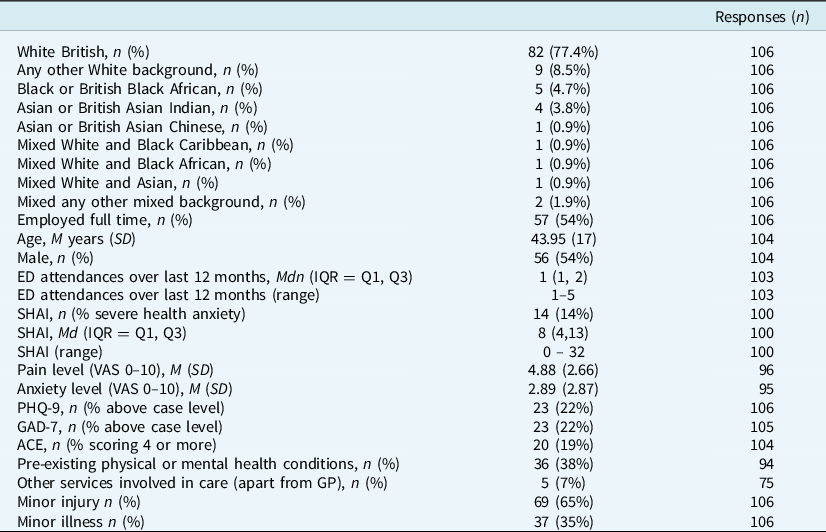
Table 1 summarizes the participant demographic characteristics. Participants were primarily white British (77%, n = 82), 54% were male (n = 56), 54% were employed (n = 57), and 38% reported having a pre-existing medical condition (n = 36). The majority presented with minor injuries (65%, n = 69), with the rest presenting with a minor illness (35%, n = 37).
Participant demographic characteristics

Means and standard deviations of clinical variables are displayed in Table 2. Approximately equal percentages of participants reached case level depression (22%, n = 23) and anxiety (22%, n = 23) as measured by the PHQ-9 (score of ≥10) and GAD-7 (score of ≥8), respectively. In relation to pre-existing medical conditions, 27% (n = 26) reported already having a physical health condition. These proportions reflect standard norms and are unremarkable. Despite this, only 3.2% of participants (n = 3) reported having a mental health condition; 7% of participants (n = 7) reported having both physical and mental health conditions.
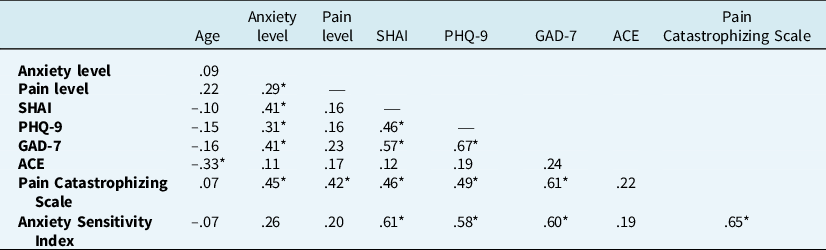
Correlational analyses (Spearman’s rho) of clinical variables

*p < .001; table reports Spearman’s rho correlation coefficients.
Number of ACEs ranged from 0 to 8, with 19% (n = 20) of participants having experienced four or more ACEs. Using the anxiety VAS, nearly a third (32%, n = 30) reported anxiety reaching 5 out of 10 or higher, with 30% (n = 28) reporting no anxiety. In relation to pain VAS, 94% (n = 90) of participants reported some level of pain (rated as 1 out of 10 or higher), with 60% (n = 58) reporting pain reaching 5 out of 10 or higher. Pain as measured by the VAS was normally distributed, with skewness of –0.06 (SE = 0.25) and kurtosis of –0.74 (SE = 0.49).
Of those who completed the SHAI (n = 100), 14% (n = 14) reached threshold for severe health anxiety as indicated by a score of 18 or above. SHAI scores ranged from 0 to 32 (Md = 8, IQR = 4, 13). Reliability was calculated, resulting in Cronbach’s α = .903. Inspection of the histogram and skewness statistic (1.17, SE = 0.24) indicated that the SHAI data were highly positively skewed, with kurtosis of 1.10 (SE = 0.48).
Inferential statistics
Two separate t-tests (with 5000 bootstrapped samples and Welch’s corrected degrees of freedom) showed significantly higher health anxiety for participants with pre-existing health conditions (M = 12.36, SE = 1.59) compared with those without (M = 7.79, SE = 0.66), 95% bootstrap CI [–7.98, –1.22], Welch’s t 43.22 = –2.67, p = 0.01, d z = –0.68 but no significant difference in pain levels in patients with pre-existing health conditions (M = 5.50, SE = 0.43) compared to those without (M = 4.60, SE = 0.37): 95% bootstrap CI [–2.02, 0.20], Welch’s t 74.42 = –1.56, p > .05, d z = –0.35.
Spearman’s rho was performed due to non-normality of SHAI data. Significant relationships were identified between key variables (see Table 2). The moderate strength of the relationship between the anxiety VAS and GAD-7 indicated the measures assess similar but distinct constructs. This is attributed to the discrepancy between measurement of current anxiety (VAS) and anxiety over the preceding 2 weeks (GAD-7) which is likely to have been more variable; anxiety is also likely to be higher in a pre-diagnostic setting. Age was positively associated with trauma, but not any other variables. Strong associations were found in expected directions, including anxiety and depression which co-occur, and anxiety sensitivity and pain catastrophizing which are conceptually linked.
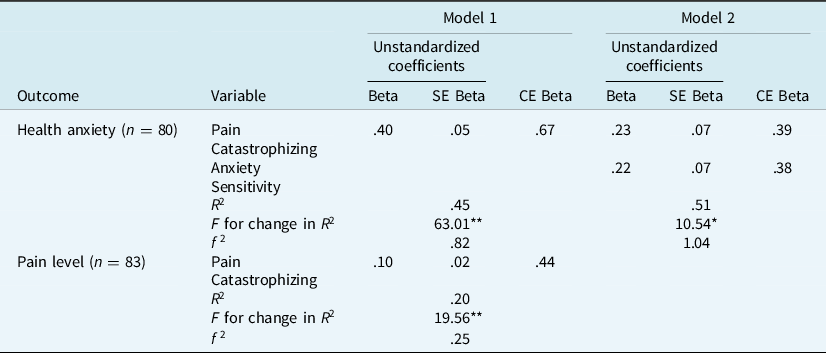
Two separate stepwise multiple regressions were conducted to identify which key factors predicted health anxiety and pain in this setting; results of these regression analyses can be viewed in Table 3. There was no evidence of multicollinearity in either regression analysis.
Stepwise multiple regression coefficients with health anxiety and pain level as dependent variables

*p < 0.01; **p < 0.001. Health anxiety excluded variables: age, pre-existing conditions, pain level, attendance reason, ACE, PHQ-9, GAD-7. Pain level excluded variables: anxiety sensitivity, age, pre-existing conditions, attendance reason, ACE, PHQ-9, GAD-7.
First, considering the outcome variable health anxiety, results show that anxiety sensitivity and pain catastrophizing were significant independent predictors of health anxiety accounting for 51% of the variance explained; variables excluded from the model included age, pre-existing conditions, pain level, attendance reason, ACE, PHQ-9 and GAD-7.
Second, regarding the outcome variable pain level, results show that pain catastrophizing was the sole significant independent predictor of pain level accounting for 20% of the variance explained. Variables excluded from the model include anxiety sensitivity, age, pre-existing conditions, attendance reason, ACE, PHQ-9 and GAD-7.
Despite lower levels of recruitment that anticipated, performance of a post-hoc G*Power analysis indicated that both regression analyses were sufficiently powered to detect significant associations between variables (n = 80, R 2 = 0.51, effect size f 2 = 1.04, power = 0.99; n = 83, R 2 = 0.20, effect size f 2 = 0.25, power = 0.89, respectively), this suggests we can exercise confidence in these findings.
Discussion
This study aimed to determine the prevalence of health anxiety in an ED setting and identify key psychological factors that predicted health anxiety and pain in ED walk-in attendees. Findings indicate that 14% of ED walk-ins reported severe levels of health anxiety; this is similar to the levels seen in medical clinics (Tyrer et al., Reference Tyrer, Cooper, Crawford, Dupont, Green, Murphy and Tyrer2011) but contrasts significantly with the rates of health anxiety observed in chronic pain settings which is around 50% (Rode et al., Reference Rode, Salkovskis, Dowd and Hanna2006). In line with previous research, the present study also found that over 80% of patients presenting to the ED attend with pain (Todd et al., Reference Todd, Ducharme, Choiniere, Crandall, Fosnocht and Homel2007). This may be attributable to repeated use of strategic behaviours to resolve distress or symptoms (Salkovskis and Warwick, Reference Salkovskis and Warwick1986) when experiencing chronic and unexplained pain; extended undiagnosed pain without amelioration or adequate explanation may increase the likelihood of symptom hypervigilance, fear avoidance, catastrophic thinking, and may inadvertently increase or maintain health-focused anxiety. Indeed, those who are presenting with acute pain in this sample may be commencing their journey to chronicity. There is scope here to identify a highly distressing condition presenting in the ED and provide support to re-direct to medical psychology or mental health services, which may bear some impact on repeat attendance (Daniels and Sheils, Reference Daniels and Sheils2017). This can be done using a brief screening measure such as the SHAI, which has now shown good reliability in this setting.
Consistent with the literature (Daniels et al., Reference Daniels, Parker and Salkovskis2020; Rode et al., Reference Rode, Salkovskis, Dowd and Hanna2006; Tyrer et al., Reference Tyrer, Cooper, Crawford, Dupont, Green, Murphy and Tyrer2011), participants with pre-existing health conditions reported significantly higher levels of health anxiety compared with those without any pre-existing health conditions. This suggests that those with pre-existing medical conditions may be more distressed in relation to their presenting health needs in the ED. Redirecting or targeting amelioration of health anxiety symptoms in this patient group could therefore be clinically beneficial, presenting as an opportunity to integrate physical and mental health interventions in existing community health services. However, as identified in this study, only a small minority of participants reported other services involved in their care – perhaps indicating a need to first facilitate access to these specialist community services, a strategy which could in turn help to reduce repeat ED attendances.
Stepwise multiple regression analyses identified that anxiety sensitivity and pain catastrophizing were significant independent predictors of health anxiety, accounting for over half of the variance in health anxiety. This is unsurprising given physiological changes detected within the body serve as both the primary sensory input and reinforcing behaviour which triggers common catastrophic misinterpretations of health stimuli in the health anxiety model. Pain catastrophizing was the sole significant independent predictor of pain; however, the proportion of variance accounted for was much less, at 20%. The relationship between pain catastrophizing and pain has been well documented (Osman et al., Reference Osman, Barrios, Gutierrez, Kopper, Merrifield and Grittmann2000), and is consistent with the health anxiety model; evidently other factors are at play here.
These findings provide empirical support for the utility of the cognitive behavioural model of health anxiety (Salkovskis and Warwick, Reference Salkovskis and Warwick1986) in the ED setting. Those with health anxiety are likely to detect changes in physical sensations, generate catastrophic interpretations related to the pain, experience distress and concern, and consequently employ safety-seeking behaviours (such as attend the ED) as an attempt to reduce distress/anxiety and resolve health concerns (Daniels and Sheils, Reference Daniels and Sheils2017; Rode et al., Reference Rode, Salkovskis, Dowd and Hanna2006). However, attending the ED is likely to elevate rather than ameliorate health anxiety in the long-term (Daniels and Sheils, Reference Daniels and Sheils2017; Rode et al., Reference Rode, Salkovskis, Dowd and Hanna2006). Yet, this short-term, immediate reduction of anxiety offered by medical reassurance is sufficiently powerful to perpetually reinforce ED attendance as a behavioural strategy to alleviate physical and emotional distress. Once identified, health-anxious patients attending the ED may benefit from appropriately addressing this issue in order to better meet need and reduce repeat attendance. Evidence supports the use of CBT for health anxiety in medical populations (Tyrer et al., Reference Tyrer, Cooper, Crawford, Dupont, Green, Murphy and Tyrer2011), and the role of psychology in the ED (McGuire et al., in submission).
Despite previous research and theoretical support for other constructs examined in this study, pre-existing health conditions and history of adverse experiences were not included in the health anxiety and pain final regression models. This was unexpected; it is noted that trauma was also not associated with either pain or health anxiety in correlational analysis. Trauma was associated with age, perhaps reflecting that with age you experience more trauma. This is a logical conclusion to draw; however, the direction of these relationships is hampered by the limitations of a correlational analysis.
Limitations
Due to the low rates of repeat attendance in the sample, the relationship between psychological variables and attendance could not be examined.
It is hypothesized that repeat attenders were not captured in this study as they may be less likely to participate due to common complex psychosocial circumstances, higher likelihood of vulnerability and perceived a higher need for urgent care (Daniels et al., Reference Daniels, Osborn and Davis2018). Data reflect that frequent attenders have a higher propensity to attend during night shifts (Dr Foster 2018), which was not included in our sampling time frame. Future work should focus on capturing this using 24 hour sampling periods. It is noted that measuring health anxiety prior to a medical appointment may be perceived to risk artificially inflating rates of health anxiety; however, the SHAI is based on the previous 2 weeks, offering context outside ED attendance and mirrors methodology in similar studies in medical settings (Daniels et al., Reference Daniels, Parker and Salkovskis2020; Rode et al., Reference Rode, Salkovskis, Dowd and Hanna2006; Seivewright et al., Reference Seivewright, Salkovskis, Green, Mullan, Behr, Carlin and Tyrer2004; Tyrer et al., Reference Tyrer, Cooper, Crawford, Dupont, Green, Murphy and Tyrer2011), allowing comparison across groups.
This study is also limited due to collecting self-reported reason for attendance, meaning it was not possible to associate health anxiety with clinical diagnosis. Further research is therefore needed to better understand the relationship between clinical diagnosis and health anxiety in the ED.
Conclusion
The present study found that health anxiety was common in a convenience sample of ED walk-in patients, but further research must replicate these findings. Key psychological variables were associated with health anxiety and pain in this population, with findings offering valuable insight into the potential role of health anxiety in ED attendances and further empirical support for the utility of the cognitive behavioural model of health anxiety in medical settings. Screening for health anxiety in the ED may help to identify an unmet clinical need in patients who would benefit from a specialist referral to medical psychology or mental health services.
Data availability statement
Data are available on request.
Acknowledgements
Thanks are extended to the University of Bath and North Bristol NHS trust for supporting this study, as well as to participants for their time. Thanks are also expressed to IDS Publishing Corporation, copyright holder of the ASI: ©2008, 1992, 1988, for approved use of the Anxiety Sensitivity Index; IDS Publishing Corporation (all rights reserved).
Author contributions
Hannah Parker: Conceptualization (equal), Formal analysis (lead), Investigation (lead), Methodology (equal), Project administration (equal), Visualization (lead), Writing – original draft (lead), Writing – review & editing (equal); Edward Carlton: Conceptualization (equal), Methodology (equal), Supervision (supporting), Writing – review & editing (equal); Sophie Harris: Formal analysis (supporting), Project administration (equal), Visualization (supporting), Writing – original draft (supporting), Writing – review & editing (equal); Jo Daniels: Conceptualization (equal), Formal analysis (supporting), Methodology (lead), Supervision (lead), Writing – original draft (equal), Writing – review & editing (equal).
The initial concept of idea was developed J.D., H.P. and E.C. H.P. collected and performed the primary analysis of the data; further analysis was performed by S.H. and J.D. Specialist expertise regarding emergency medicine was provided by E.C., expertise on anxiety was provided by J.D. The manuscript presented here was written by H.P., S.H. and J.D., and edited by E.C. J.D. was the primary supervisor of H.P. and had oversight of the project. All listed authors reviewed the final submitted manuscript.
Financial support
This research received no specific grant from any funding agency, commercial or not-for-profit sectors.
Conflict of interest
The authors declare none.
Ethical standards
Ethical approval was granted by the Department of Psychology Research Ethics Committee at the University of Bath (PREC reference number: 19-188). Local approval was obtained through North Bristol NHS Trust information governance processes. The authors have abided by the Ethical Principles of Psychologists and Code of Conduct as set out by the BABCP and BPS.



Comments
No Comments have been published for this article.