Introduction
The European Union (EU) and its Member States have ratified the United Nations Convention on the Rights of Persons with Disabilities (CRPD). The CRPD guarantees equal participation of disabled persons in society and recognises their right to an adequate standard of living and social protection in Article 28. In the EU, this was enshrined in Principle 17 of the European Pillar of Social Rights which stipulates a right to income support that guarantees a dignified life for all disabled persons. The central role of adequate social protection schemes to ensure a decent standard of living is also recognised in the European Strategy for the Rights of Persons with Disabilities 2021–2030 (European Commission, 2021). These ratifications are important, since it is estimated that about 4 per cent of children in the EU have a disability (Eurostat, 2023). Yet, it is unclear to what extent these principles are put into practice.
To properly assess the adequacy of income support measures, the out-of-pocket costs incurred by families to meet their needs must be accounted for. In fact, it is argued that the extent to which children’s costs are compensated is a key indicator to evaluate the generosity of the welfare state towards families with children (Penne et al., Reference Penne, Hufkens, Goedemé and Storms2020). For families with disabled children this is even more vital as the child’s disability incurs higher out-of-pocket costs (Shahat and Greco, Reference Shahat and Greco2021). However, the CRPD indicators to evaluate the implementation and progress on Article 28 currently lack an indicator on the adequacy of cash support (United Nations, 2020). Therefore, Morris (Reference Morris2024) develops a research framework to evaluate the adequacy of disability benefits for working-age disabled persons who are unable to maintain their living standards through employment. Yet, this framework is not applicable to disabled children. Moreover, to accurately judge whether cash support measures are adequate and enable equal social participation, the out-of-pocket costs should be calculated on the basis of what is needed, not what is spent (Mont et al., Reference Mont, Cote, Hanass-Hancock, Banks, Grigorus, Carraro, Morris and Pinilla-Roncancio2022). This has hardly been done in the existing literature. Only Dobson and Middleton (Reference Dobson and Middleton1998) for the UK, UNICEF (2023) for Georgia, and CIP (2024) for Tamil Nadu in India show that disability benefits in these countries fail to cover the essential costs of disabled children. Yet, these studies only cover children with severe care needs or assess the adequacy of a uniform cash support measure. It remains to be examined to what extent a cash support system that is designed to increase with the severity of the child’s care needs offsets the minimum cost of childhood disability for different types of care needs. And if cash support would be inadequate, which needs-based costs of childhood disability are covered by the welfare state.
This article addresses these gaps with a case study on Belgium. We build on recently developed reference budgets for adequate social participation for four hypothetical families with a seven-year-old disabled child in Flanders (Gijbels et al., Reference Gijbels, Vinck and Van Lancker2025). These reference budgets in turn rely on methodologies developed for cross-national comparative purposes (Goedemé et al., Reference Goedemé, Storms, Stockman, Penne and Van den Bosch2015; Mont et al., Reference Mont, Cote, Hanass-Hancock, Banks, Grigorus, Carraro, Morris and Pinilla-Roncancio2022). We examine the adequacy of cash support for families with disabled children to better understand the generosity of the Belgian welfare state towards families with disabled children and whether Belgium is successful in guaranteeing disabled children’s right to an adequate standard of living and social protection.
Literature review
Almost every EU country currently has some form of income support for families with children, through child benefits or personal income tax breaks (Daly, Reference Daly, Nieuwenhuis and Van Lancker2020). Child benefits often serve a dual goal. Their central objective is to compensate families (partially) for the cost of child rearing and limit the loss of welfare compared to families without children. Additionally, child benefits help alleviate poverty and thus have a redistributive effect. The bulk of the existing research has concentrated on the latter (e.g. Immervoll et al., Reference Immervol, Sutherland, de Vos, Vleminckx and Smeeding2001; Corak et al., Reference Corak, Lietz and Sutherland2005; Bäcklan and Ferrarini, Reference Bäckman and Ferrarini2010; Gornick and Nell, Reference Gornick and Nell2017). In this regard, the socio-economic characteristics of families with children, social spending, and the policy design are important to understand cross-national variation (Van Mechelen and Bradshaw, Reference Van Mechelen, Bradshaw, Marx and Nelson2013; Van Lancker and Van Mechelen, Reference Van Lancker and Van Mechelen2015; Popova, Reference Popova2016; Verbist and Van Lancker, Reference Verbist and Van Lancker2016; Aerts et al., Reference Aerts, Marx and Parolin2022).
Few studies focus on whether child benefits adequately compensate the costs of children. Children incur direct and indirect costs for their families, which vary by the number of children, their age, gender and health status, the family’s income position, family dynamics, and the societal and cultural context in which they live (Thévenon, Reference Thévenon, Letablier, Luci, Math and Thévenon2009; Storms and Bogaerts, Reference Storms and Bogaerts2012). Indirect costs include the opportunity costs caused by parents’ lower participation in paid employment and diminished adult time and are beyond the scope of this article. Regarding direct costs, different measurement approaches exist (Browning, Reference Browning1992; Sarlo, Reference Sarlo2013).
Verbist and Van Lancker (Reference Verbist and Van Lancker2016) derive the cost of a child from the Organisation for Economic Co-operation and Development (OECD)-modified equivalence scale. They show that European countries that perform better in covering the costs of children also perform better in terms of child poverty reduction, due to the overrepresentation of families with children in the lower strata of the income distribution (see also Bárcena-Martín et al., Reference Bárcena-Martín, Blanco-Arana and Pérez-Moreno2018). Urban and Pezer (Reference Urban and Pezer2020) and Pezer (Reference Pezer2022) take a similar approach, though they include not only child benefits but also social assistance, housing benefits, and tax breaks in their evaluation of policies to cover the costs of children. Alternatively, Bradshaw and Finch (Reference Bradshaw and Finch2002) compare the level of child benefits to certain out-of-pocket costs families with children face and demonstrate that some high-income countries fail to or just barely cover the actual costs related to childcare, education, and healthcare. Penne et al. (Reference Penne, Hufkens, Goedemé and Storms2020) calculate the total costs of children to satisfy their basic needs and analyse these costs against the welfare state’s cash advantages for families with children for six European countries, including child benefits, social assistance top-ups, housing benefits, and tax breaks, while publicly subsidised goods and services are accounted for in the cost calculation. Similarly, Hirsch (Reference Hirsch2013) compares the needs-based additional costs of children to the UK’s welfare system for families either out-of-work or working on low incomes. Even given the different operationalisations of costs and policies to cover these costs, the existing research reveals that welfare states generally do not fully compensate the costs of children and that substantial variation exists within and between countries. This picture becomes even bleaker when indirect costs are also accounted for (e.g. Vanhuysse et al., Reference Vanhuysse, Medgyesi and Gál2023).
The question whether welfare states succeed in compensating the costs of disabled children is even more vital as their families face higher direct and indirect costs (Stabile and Allin, Reference Stabile and Allin2012; Shahat and Greco, Reference Shahat and Greco2021). Direct costs include the out-of-pocket expenses on disability- and non-disability-related goods and services to cover the child’s medical and care needs (Solmi et al., Reference Solmi, Melnychuk and Morris2018; Gijbels et al., Reference Gijbels, Vinck and Van Lancker2025). Families of disabled children are also confronted with indirect costs in terms of forgone labour earnings, particularly for mothers (Brown and Clark, Reference Brown and Clark2017; Vinck and Brekke, Reference Vinck and Brekke2020).
Welfare states provide a variety of policy measures within their social protection systems to offset the costs for these families (Mont et al., Reference Mont, Cote, Hanass-Hancock, Banks, Grigorus, Carraro, Morris and Pinilla-Roncancio2022): income-replacement benefits for parents who reduce or stop working to care for their disabled child; non-means-tested benefits for disabled children themselves; and help with additional expenses incurred by the child’s disability through cash transfers, service provisions, and tax and social benefits. Most often, the latter is provided through increased child benefits in the EU. These cash transfers for disabled children prove to play an important poverty-reducing role (Stegman and Hemmeter, Reference Stegman and Hemmeter2014; Boat and Wu, Reference Boat and Wu2015; Romig, Reference Romig2017; Luca and Sevak, Reference Luca and Sevak2019; Vinck, Reference Vinck2022). General poverty reduction strategies are important too. In Europe on average, all social transfers together achieve more in terms of poverty reduction for disabled children than for non-disabled children (Vinck, Reference Vinck2024).
The adequacy of cash support for families with disabled children has only been examined in a handful of studies. These studies use different approaches to measure the costs of childhood disability. The ‘standard of living’ approach is most commonly used. It estimates the additional income needed by families with disabled children to obtain the same standard of living as similar families without disabled children (Zaidi and Burchardt, Reference Zaidi and Burchardt2005). It measures costs after benefits have been granted. Burchardt and Zaidi (Reference Burchardt, Zaidi, Strelitz and Lister2008) are the first to apply this approach to childhood disability, showing that disability benefits in the UK do not fully compensate the costs incurred by the child’s disability, which is more pronounced in single parent families. Subsequent research for the UK (Melnychuck et al., Reference Melnychuk, Solmi and Morris2018; Solmi et al., Reference Solmi, Melnychuk and Morris2018; Veruete-McKay et al., Reference Veruete-McKay, Schuelke, Davy and Moss2023) reveals that the inadequacy is greater for (1) vulnerable families, (2) children with mental disabilities, and (3) severely disabled children. In Ireland, to the contrary, only severely disabled children are eligible for disability benefits, leaving children with less severe disabilities less protected by the welfare state, even though their costs are lower (Roddy, Reference Roddy2022). Genereaux et al. (Reference Genereaux, Van Karnebeek and Birch2015) apply the ‘expenditure’ approach and estimate the actual costs borne by parents, including both direct and indirect costs. They show that indirect costs form the lion’s share of the cost of childhood disability and that Canadian cash transfers cover only about 5 per cent of the actual costs.
However, both approaches consider what families with disabled children spend, which may be subject to the issue of unmet needs (Mont, Reference Mont2023). Unmet needs occur when families with disabled children do not purchase certain goods and services because these are unavailable, inaccessible, or unaffordable, or because they are unaware of their existence. This results in a gap between what families spend and what they actually need. If social protection systems are to be inclusive, they must account for the costs of goods and services that are needed for adequate social participation on an equal basis with families of children without disabilities. Hence, a ‘needs-based’ approach is required to estimate the cost of childhood disability in order to assess the adequacy of cash support and to adapt the design of policies to the specific goods and services that entail these costs (Mont et al., Reference Mont, Cote, Hanass-Hancock, Banks, Grigorus, Carraro, Morris and Pinilla-Roncancio2022). Reference budgets are a suitable tool for this purpose. They exist in nearly all European countries and illustrate what families minimally need to spend to adequately participate in society (Goedemé et al., Reference Goedemé, Storms, Stockman, Penne and Van den Bosch2015; Deeming, Reference Deeming2017). Yet, the needs-based approach has hardly been used in the existing literature. Dobson and Middleton (Reference Dobson and Middleton1998) show that the maximum disability benefits in the UK are inadequate to cover the minimum costs of severely disabled children. The same applies to Georgia, and since support for disabled children is uniform and relatively low, the welfare state offsets the costs of children with low support needs better than those with high support needs (UNICEF, 2023). Also in Tamil Nadu (India), only the minority of the goods and services required by disabled children is covered by the government, and coverage is highest for those with physical and visual disabilities (CIP, 2024). Yet, it remains to be examined to what extent a cash support system that is designed to increase with the severity of the child’s care needs offsets the minimum cost of childhood disability for different types of care needs (RQ1), and if cash support would be inadequate, which costs are covered by the welfare state (RQ2). We investigate these research questions with a case study on Belgium.
Policies for disabled children in Belgium
Belgium is a federal state where responsibilities for disability policy are largely decentralised. Here we discuss the main support measures available to families with disabled children in the Flemish region of Belgium. The benefit amounts listed refer to May/June 2022.
Cash support
Cash support aims to improve vulnerable living conditions by increasing family incomes. Disabled children can be eligible for the care allowance. This is a supplement within the child benefits system for children under 21 whose care needs exceed those of typically developing children. It aims to meet the additional costs incurred by the child’s disability. Evaluating doctors of the agency Growing Up assess the severity of the increased care needs and score the child on a thirty-six points scale. The scale includes three pillars that evaluate the consequences of the disability for the child’s physical and mental health, the child’s self-reliance, and the family. Children who have at least six points in total or four points on pillar one are entitled. The benefit amount ranges from €86 to €571 per month.
Children with a recognised disability can also be eligible for the care budget for persons with a disability. Children who score at least twelve points on the care allowance are automatically eligible. It is intended to enable families to organise non-medical care and support for their child in the way they want in order to improve the child’s participation in society. The benefit is a monthly fixed amount of €300. Children who use intensive assistance or support provided by a multifunctional centre or who receive a personal assistance budget (see § Care support) are not entitled.
Additionally, children with long-term intensive support needs can be eligible for the care budget for persons with severe care needs. This care budget aims to meet their non-medical costs. Children who score at least eighteen points on the scale of the care allowance are automatically entitled. The benefit is a monthly fixed amount of €130. Children who receive a personal assistance budget, who reside full-time at a multifunctional centre, or who are enrolled in a boarding school cannot claim the benefit.
Care support
Care support aims to provide suitable support, focusing on the quality of life and needs of the children and their families. The Flemish Agency for Persons with a Disability accredits and subsidises the care providers of disability-specific assistance, day support, and residential support, allocates the personal assistance budget and awards the allowances for assistive technology and adaptations to the home and car. Depending on the frequency of their care need, children can have direct or non-direct access to these care and support services. For intensive assistance or support provided in a multifunctional centre, a personal assistance budget or an allowance to assist with the purchase of assistive technologies and adaptations to the home and car, an application has to be filed with the Intersectoral Access Gate from the agency Growing Up. In general, directly and non-directly accessible care support cannot be combined. Persons who need an aid to get around due to chronic illness, old age, or disability, can be entitled to an allowance for a wheelchair or an adapted bicycle from the Flemish Social Protection Agency. They need a medical prescription that allows them to request the mobility aid from an authorised provider, with specific adaptations if necessary. Another important source of care support for disabled children is organised within the educational system, either in an inclusive or specialised school. To be entitled, children need a recognition from the Pupil Guidance Centre.
Tax and social benefits
Tax and social benefits partially compensate the costs of childhood disability through e.g. exemptions, discounts, and allowances. All children who are entitled to the care allowance are also eligible for a reduction of the property tax and a lump sum for the chronically ill when medical expenses are high. Children who score at least four points on pillar one are additionally entitled to a social tariff for gas and electricity, an increased reimbursement of healthcare (also for fifteen points in total) and a maximum billing for medical expenses (also for fifteen points in total). When children are completely blind, completely paralysed in their upper limbs, or 50 per cent paralysed in their lower limbs, they are also entitled for a reduction of the VAT on cars and an exemption from the road tax and vehicle registration tax.
Families of disabled children can be entitled to an increased refundable tax credit for dependent children within the personal income tax system. One parent’s tax-exempt amount (i.e. tax allowance) is raised with a fixed amount for each dependent child. Children with at least four points on pillar one of the care allowance are counted twice as dependent. When the parent’s income subject to taxes is lower than the tax allowance and the tax credits combined, the unused share of the increased tax allowance is refunded up to €480 per dependent child (FPS Finance, 2024).
Data and methods
To assess the adequacy of cash support for families with disabled children, we compare the cash support these families receive to the minimum extra costs they have to make for adequate social participation. The data represent the situation of May/June 2022. The Social and Societal Ethics Committee of KU Leuven approved the project (G-2022-5250-R2) on 4 July 2022.
Minimum extra costs of childhood disability
The minimum extra costs of childhood disability are measured from a needs-based approach. They are derived from recently developed reference budgets for four hypothetical families with a disabled child in Flanders. Below we summarise the key elements of their methodology, Gijbels et al. (Reference Gijbels, Vinck and Van Lancker2025) provide a more comprehensive discussion.
Gijbels et al. (Reference Gijbels, Vinck and Van Lancker2025) rely on methodologies developed for cross-national comparative purposes (Goedemé et al., Reference Goedemé, Storms, Stockman, Penne and Van den Bosch2015; Mont et al., Reference Mont, Cote, Hanass-Hancock, Banks, Grigorus, Carraro, Morris and Pinilla-Roncancio2022). They add the extra needs and costs of childhood disability to the Belgian reference budgets for families with typically developing children (Frederickx and Storms, Reference Frederickx and Storms2022, personal communication). The Belgian reference budgets start from the theory of human need (Doyal and Gough, Reference Doyal and Gough1991), represent what families in good health need as a minimum to achieve adequate social participation (Storms and Van den Bosch, Reference Storms and Van den Bosch2009), and are rooted in the normative tradition (Deeming, Reference Deeming2017). They include baskets of priced goods and services illustrating what hypothetical families minimally need to spend out of pocket for food, clothing, personal care, healthcare, safe childhood, rest, leisure, maintaining social relations, housing, security, and mobility. To define the extra needs and costs of childhood disability, Gijbels et al. (Reference Gijbels, Vinck and Van Lancker2025) use guidelines, recommendations, and existing scientific research, interviews with twenty-two disability professionals and fifteen parents of disabled children, and a follow-up survey completed by twelve parents. Additional needs are included when multiple sources of information identified these on the basis of substantiated arguments. Input from previous interviews is presented during subsequent interviews to foster discussion and reach consensus on what is minimally needed. To determine the minimum extra costs, Gijbels et al. concretised the additional needs into priced commodities applying various pricing strategies. Reference budgets only allow to estimate direct costs of families, but families with disabled children generally also face high indirect costs. Certain goods and services are included in the reference budgets to reduce these indirect costs as much as possible (e.g. cleaning assistant; occasional respite care to provide relief for the parent(s)).
Four hypothetical families with a disabled child are selected based on the most common diagnosed disabilities among children in Flanders (Agency Growing Up, 2022, personal communication). All children are seven-year-old boysFootnote 1 who experience difficulties on different functional domains (see the vignettes in Appendix A of the supplementary material).Footnote 2 The child with a mild intellectual disability (ID) cannot always articulate himself clearly, needs a lot of support at school and help with personal care. The child with an autism spectrum disorder (ASD) has no other diagnoses, experiences difficulties using language in communication and recognising other people’s emotion, and has weak locomotor skills. The child with a mild ID and an ASD needs a lot of supervision, has communication difficulties and weak locomotor skills, and is incontinent. The child with cerebral palsy (CP) mainly uses gestures to communicate, is unable to walk independently, and needs a lot of support with daily activities.
For each hypothetical family, Gijbels et al. (Reference Gijbels, Vinck and Van Lancker2025) develop four scenarios of the reference budget, differentiating between children in inclusive or specialised education and childcare, and between children using subsidised or private care services. Disabled children cost 1.7 to 2.5 times more than typically developing children (Table 1). The costs are higher for children with greater functional difficulties (i.e. child with ID and ASD, and child with CP), for children in inclusive education and childcare, and when private therapy is needed due to long waiting lists for subsidised care. Appendix B of the supplementary material details the required commodities to accommodate the extra needs of families with disabled children, and the associated costs for each basket of the reference budgets.
Minimum extra cost of childhood disability, four hypothetical disabled children, four scenarios, € per month, 2022

Source: Gijbels et al. (Reference Gijbels, Vinck and Van Lancker2025).
Notes: ID = Intellectual disability, ASD = autism spectrum disorder, CP = cerebral palsy. Typically developing seven-year-olds cost €714 per month.
Cash support for disabled children
The three cash support measures that are designed to meet the extra costs of childhood disability are taken into account (see § Cash support).
To determine whether the hypothetical children are eligible for the care allowance and, if so, for what amount, the vignettes are assessed by evaluating doctors from the agency Growing Up. The doctors evaluate the children’s increased care needs and score them on the thirty-six-point scale. The number of points is partly determined by the education system where children are enrolled and the number of times they have to travel outside school hours for paramedical therapies. Hence, evaluating doctors score the children according to their identified needs in the four scenarios. Eligibility for the care budgets is derived from the number of points the hypothetical children have for the care allowance.
Tax and social benefits that exist to reduce the necessary expenditures are directly accounted for in the calculation of the reference budgets. These include the measures described in § Tax and social benefits, except the increased refundable tax credit.Footnote 3 The reference budgets also take into account the (partial) refunds of healthcare costs from the compulsory health insurance, additional refunds from mutualities, lump sums for incontinence, and allowances for assistive technology, adaptations to the home and car, and mobility aids.
Adequacy
To assess the adequacy of cash support for disabled children, we present two analyses. First, to investigate to what extent the additional costs of childhood disability are compensated (RQ1), we express the cash support the hypothetical families receive as a percentage of the minimum extra needs-based costs of childhood disability. This is comparable to the ‘child cost compensation indicator’ of Penne et al. (Reference Penne, Hufkens, Goedemé and Storms2020) that intends to better grasp a welfare state’s generosity towards families with children.
Second, to investigate which extra costs are covered by the cash support (RQ2), we compare the cash support to the costs incurred in the different baskets of the reference budgets. Although all costs included in the reference budgets are minimally needed for families with disabled children to adequately participate in society, families will adopt certain budget strategies when their resources are limited (Zhang and Sussman, Reference Zhang and Sussman2018). One such strategy is ‘priority planning’, which means giving up spending on items with less important purposes first (Fernbach et al., Reference Fernbach, Kan and Lynch2015). Hence, baskets consisting mainly of lower-priority goods or services will probably be sacrificed first when budgets are tight. We group certain baskets and adopt the following order, from high priority to low priority: (1) food and clothing; (2) personal care and healthcare; (3) safe childhood; (4) rest, leisure, and maintaining social relations; (5) housing and security; and (6) mobility. For example, the cost of childhood disability in the mobility basket is mainly determined by the inclusion of a second-hand car and the trips made with this car. We consider this the first thing families save on when there is not enough money, followed by the cleaning assistant and home delivery of groceries (housing and security basket) and the qualified babysitter with knowledge of the child’s care needs (rest, leisure, and maintaining social relation basket). In contrast, the (limited) extra costs for food and clothing are deemed the most important for families, followed by the additional necessary expenses for incontinence products and paramedical therapies (personal care and healthcare basket).
We show the results for the specialised-subsidised and inclusive-private scenarios in the following section. The results for the specialised-private and inclusive-subsidised scenarios are presented in Appendix C of the supplementary material.
Results
How much cash support are disabled children entitled to?
The composition and level of cash support to which disabled children are entitled depends on their care needs, whether they attend specialised or inclusive education and childcare, and whether they use therapies in subsidised or private care services (Table 2). Monthly cash support is lowest for the seven-year-olds with only ID or only ASD (€114 or €266). It is more than twice as high for the seven-year-old with ID and ASD (€266 or €740). The seven-year-old with CP receives the highest monthly cash support (€666 or €1,001). Children in specialised education receive paramedical therapies in school and do not have to travel outside school hours for this. Therefore, they have a lower point total on the care allowance than children in inclusive education, which often results in a lower benefit amount. When inclusive education is combined with subsidised therapies, fewer points are also awarded because children make fewer trips to a subsidised ambulatory rehabilitation centre where several multidisciplinary therapies can take place on the same day. Moreover, children in the specialised scenarios make use of non-directly accessible care support, which means they are not entitled to the care budget for persons with disabilities.
Cash support for disabled children, four hypothetical disabled children, four scenarios, € per month, 2022

Source: Compiled by the authors.
Notes: ID = Intellectual disability, ASD = autism spectrum disorder, CP = cerebral palsy.
How adequate is cash support for disabled children?
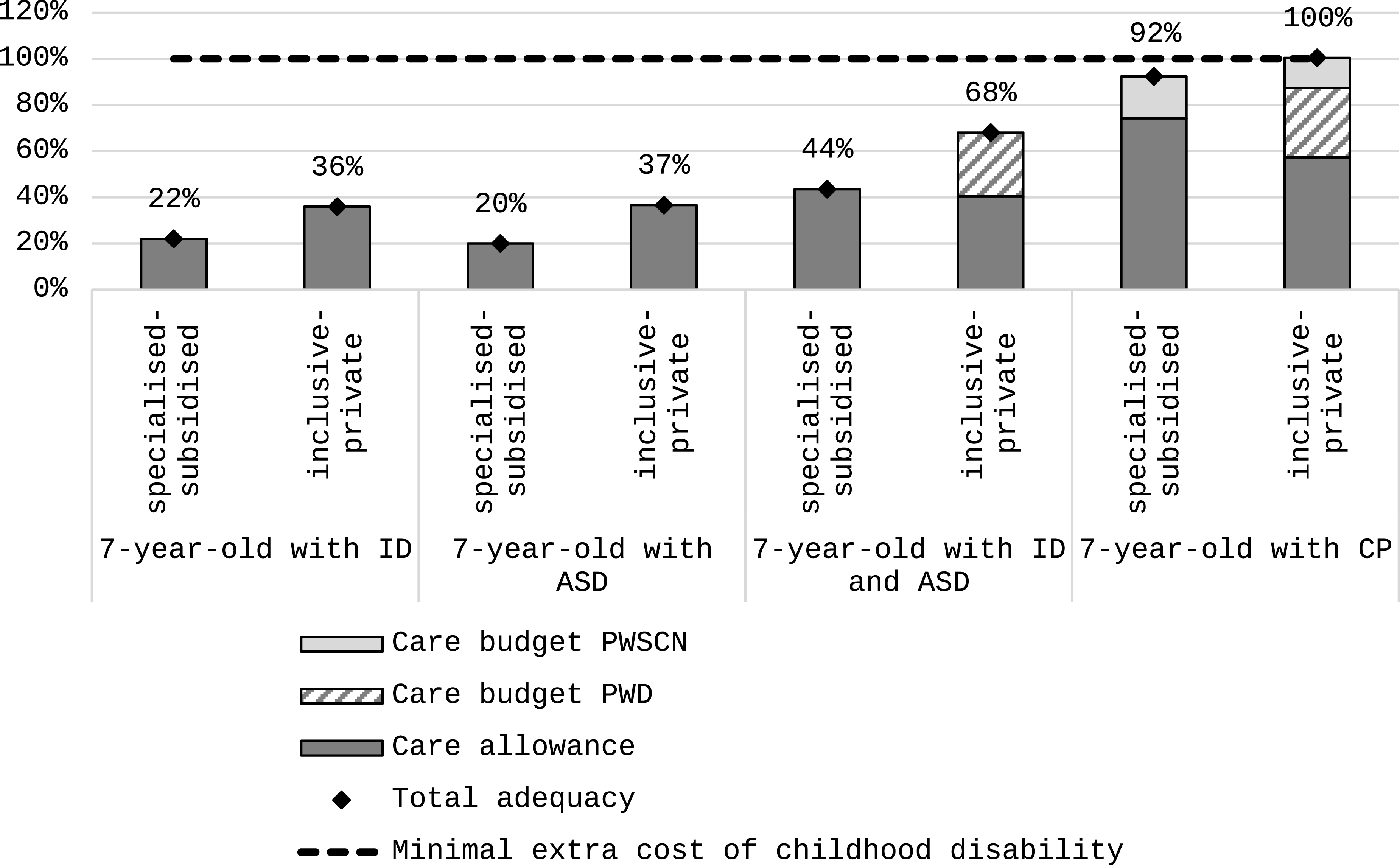
First, we show to what extent cash support covers the minimum extra costs of childhood disability (RQ1, Figure 1, and Appendix C). The results reveal that cash support for the four hypothetical disabled children is insufficient to meet the minimum extra costs incurred by their disability, except for the seven-year-old with CP in inclusive scenarios. The adequacy ratio ranges from 19 to 92 per cent in the specialised scenarios and from 17 to 109 per cent in the inclusive scenarios. Cash support is least adequate for the seven-year-olds with only ID (19 to 36 per cent) and only ASD (17 to 37 per cent). This corresponds to €402 to €551 a month that their families have to pay themselves. For the seven-year-old with ID and ASD, the cash support is also insufficient to cover their minimum extra costs (42 to 86 per cent), but the degree of inadequacy is less great in the inclusive-subsidised scenario. The amount not covered by cash support ranges from €122 to €368 for this child. Cash support is most adequate for the seven-year-old with CP (91 to 109 per cent), especially when he is entitled to the care budget for persons with disabilities in the inclusive scenarios. The monthly costs that his parents have to bear themselves are limited to €55 to €64 in the specialised scenarios.
Adequacy of cash support for disabled children, by support measure, per cent of minimum extra cost of childhood disability, four hypothetical disabled children, specialised-subsidised, and inclusive-private scenarios, 2022.
Source: compiled by the authors.
Notes: ID = Intellectual disability, ASD = autism spectrum disorder, CP = cerebral palsy, PWD = Persons with disabilities, PWSCN = persons with severe care needs.

A comparison between the inclusive and specialised scenarios shows that cash support is generally more adequate for children in inclusive education and childcare. This is because the higher out-of-pocket costs are offset by the higher levels of cash support. However, this pattern does not apply to children with only ID or only ASD who use subsidised therapies as they are not entitled to a higher care allowance. When comparing the private and subsidised scenarios, the adequacy of cash support is lower for children who use private care services, since the higher costs of these therapies are not matched by higher care support, expect for children with only ID or only ASD in specialised settings.
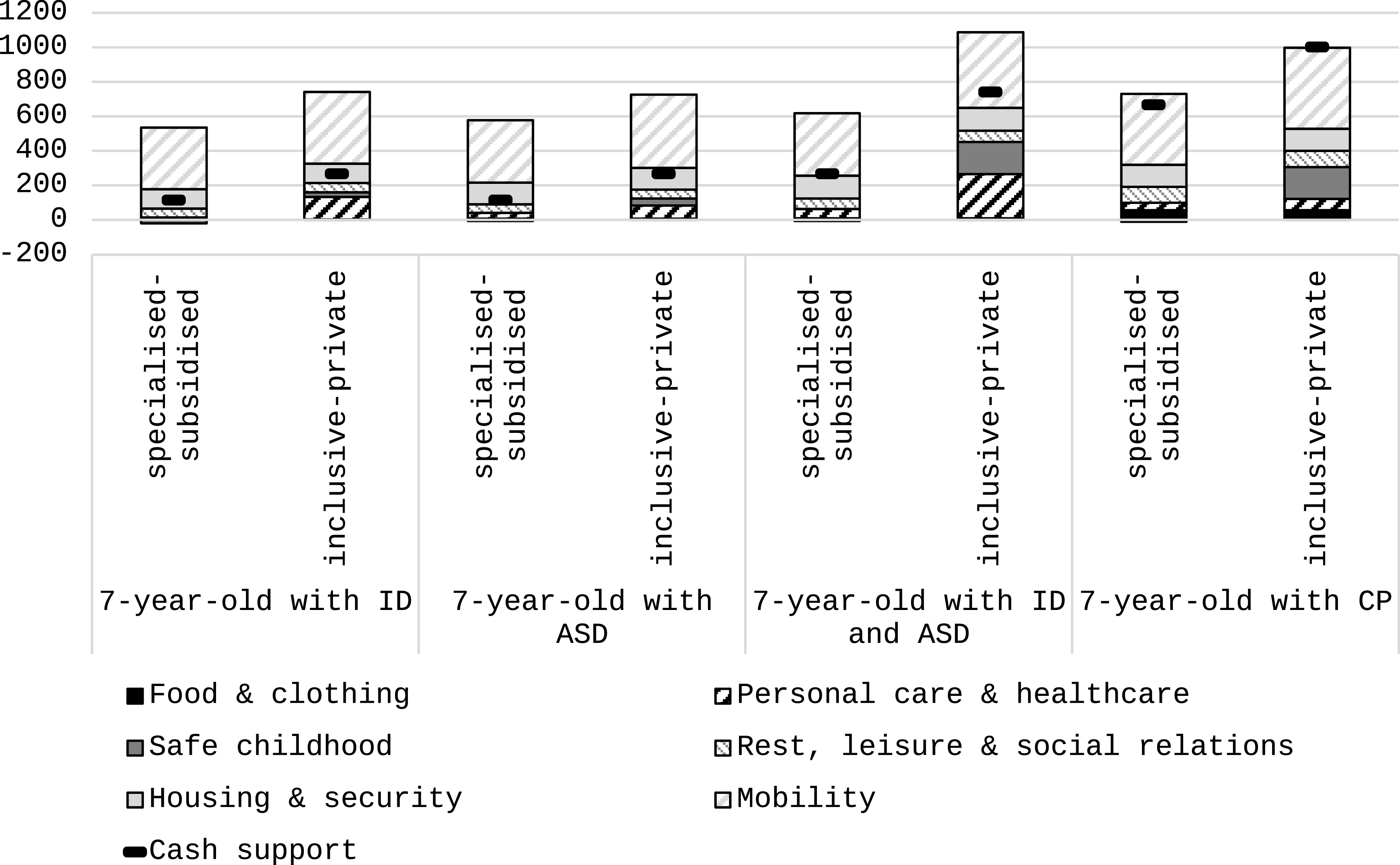
Second, we assess which costs are covered by the cash support (RQ2, Figure 2, and Appendix C). For the seven-year-old with ID, the cash support is sufficient to cover the extra costs for food and clothing, personal care and healthcare, a safe childhood, rest, leisure, and social relations, but it is insufficient to meet all additional needs associated with housing and security, and mobility. For the seven-year-old with ASD, cash support (almost) covers the extra costs associated with food and clothing, personal and healthcare, a safe childhood, rest, leisure, and social relations, and housing and security in the inclusive-private scenario, but it is less adequate in the other scenarios. For the seven-year-old with ID and ASD in specialised scenarios, the cash support is adequate to pay for all the additional needs of the hypothetical family except those related to mobility. The costs related to mobility are partly covered in the inclusive scenarios, though the cash support remains inadequate. For the seven-year-old with CP, the cash support is nearly sufficient to meet all the costs incurred by the child’s disability in the specialised scenarios. In the inclusive scenarios, cash support is even slightly higher than the minimum extra costs for this hypothetical family.
Cash support for disabled children versus minimum extra costs of childhood disability, different baskets, four hypothetical disabled children, specialised-subsidised, and inclusive-private scenarios, € per month, 2022.
Source: Compiled by the authors.
Notes: ID = Intellectual disability, ASD = autism spectrum disorder, CP = cerebral palsy.

Conclusion and discussion
With a case study on Belgium, we measure the adequacy of cash support for families with disabled children by relying on the needs-based costs of childhood disability. These costs are derived from reference budgets for adequate social participation (Gijbels et al., Reference Gijbels, Vinck and Van Lancker2025), which build upon methodologies developed for cross-national comparative analysis (Goedemé et al., Reference Goedemé, Storms, Stockman, Penne and Van den Bosch2015; Mont et al., Reference Mont, Cote, Hanass-Hancock, Banks, Grigorus, Carraro, Morris and Pinilla-Roncancio2022). This approach provides a more accurate assessment of adequacy, as actual spending may be constrained by unmet needs (Mont et al., Reference Mont, Cote, Hanass-Hancock, Banks, Grigorus, Carraro, Morris and Pinilla-Roncancio2022), and enables evaluation of both the generosity of the welfare state towards these families and the extent to which countries succeed in guaranteeing disabled children’s right to an adequate standard of living and social protection. Given the current lack of an adequacy indicator for Article 28 of the CRPD (United Nations, 2020) and the critical role of adequate cash support in enabling equal social participation as enshrined in key EU disability rights frameworks, our findings are highly relevant for Belgium, other countries, and the EU as a whole.
Previous research shows that welfare state support in Belgium is inadequate for typically developing children (Penne et al., Reference Penne, Hufkens, Goedemé and Storms2020). We add that the situation for disabled children is even less rosy. For all hypothetical families and in all scenarios, the minimum extra costs of childhood disability are not covered by the cash support that is intended to meet these costs, except for the seven-year-old with CP in inclusive education and childcare. As such, cash support is generally insufficient to enable equal social participation for families with disabled children in Belgium and the country fails to safeguard Article 28. Even if these families spend their income in an ideal and informed manner, and the parents do not have health problems, as is assumed by the reference budgets (Gijbels et al., Reference Gijbels, Vinck and Van Lancker2025), they do not have sufficient resources to cover the extra costs. This forces families to make choices about which costs are met by the support measures and which costs are borne by themselves. Our results show that the additional costs associated with mobility, housing, and security are at the families’ own expense.
There are two caveats to the results. First, we assess the adequacy of cash support for families with disabled children as intended by the policy. However, not all disabled children receive the cash support to which they are entitled. The non-take-up of the care allowance is at least 6.3 per cent of Flemish children under twenty-one with a recognised disability, mainly children with behavioural, emotional, or psychological disorders (Gijbels et al., Reference Gijbels, Vinck and Van Lancker2023).
Moreover, the cash support, to which the hypothetical children are entitled, is assessed based on their needs regarding paramedical therapies to optimally stimulate their growth and development. In reality, evaluating doctors only consider the therapies actually used. This may underestimate needs, as arranging essential therapies is not always financially or practically feasible for families.
Our approach has two important limitations. First, the additional costs of childhood disability are calculated under strict assumptions. The hypothetical disabled children have no siblings, live at home with one or two working parents who are in good health, attend school full-time, and do not receive a personal assistance budget. The hypothetical families live in quality housing in an urban area, are well-informed, and take up all their rights. If these assumptions are not met, the minimum necessary extra costs will probably be higher and the adequacy of cash support will be lower.
Second, we can only estimate the adequacy of cash support for a limited number of hypothetical seven-year-old disabled children in Belgium. Even though their diagnoses are the most prevalent, our operationalisation into functional limitations cannot be considered as representative for these diagnoses or for the total population of disabled children. Future research should investigate the adequacy for other ages, disability types, severity levels, and functional limitations. Therefore, reference budgets for additional families with disabled children need to be developed. Although this was a time-consuming and complex process (Gijbels et al., Reference Gijbels, Vinck and Van Lancker2025), future efforts can build on the list of additional needs and costs. Moreover, as the reference budgets rely on methodologies developed for cross-national comparative purposes, this method can also be applied to other welfare states. This, in turn, will make it possible to assess the welfare state generosity towards families with disabled children from a cross-national comparative perspective and to compare the performance of countries in ensuring disabled children’s right to an adequate standard of living and social protection.
To improve the adequacy of cash support and enable equal social participation for families with disabled children, policymakers can focus on two fronts. First, they can reduce the families’ minimum necessary costs by improving the affordability and availability of (subsidised) goods and services, by extending tax and social benefits that partially offset the extra costs, and by making our society more accessible. Second, policymakers can increase the cash support for families with disabled children to ensure that they have the necessary resources available to participate adequately in society. This is particularly important for children with less-visible disabilities as the costs borne by their families are high (€400 to €550 per month for children with only ID or only ASD). Moreover, children with these disabilities are more likely not to receive the care allowance, and the thirty-six points scale used to assess the eligibility does not properly capture their care needs (Vinck et al., Reference Vinck, Lebeer and Van Lancker2019; Gijbels et al., Reference Gijbels, Vinck and Van Lancker2023). A revision of the assessment scale is therefore needed. Ideally, the scale would determine eligibility and benefit levels based on the extent and composition of the additional needs-based costs families face (Mont, Reference Mont2023). Likewise, access to the care budgets can be eased by lowering the minimum assessed need for care or by reducing the grounds for exclusion.
Supplementary material
The supplementary material for this article can be found at https://doi.org/10.1017/S1474746426101353
Acknowledgements
The authors are grateful for the critical and constructive feedback on the research process and preliminary results from the Centre of Expertise Budget and Financial Well-Being, participants at conferences of the European Network for Social Policy Analysis (2022), Foundation for International Studies of Social Security (2022), and Nordic Network on Disability Research (2023), colleagues from the Research group on social, political, and population change, and everyone involved in the project of the Flemish Policy Research Centre Well-Being, Public Health and Family.
Author Contributions: CRediT Taxonomy
Julie Vinck: Conceptualization, Funding acquisition, Investigation, Methodology, Supervision, Validation, Visualization, Writing - original draft, Writing - review & editing.
Eef Gijbels: Data curation, Formal analysis, Funding acquisition, Investigation.
Wim Van Lancker: Funding acquisition, Supervision.
Financial support
This work was supported by the Flemish Policy Research Centre Well-Being, Public Health and Family (project number MJP1_04) and the Research Foundation – Flanders (grants 1292622N and 11PLG24N).
Competing interests
The authors declare no competing interests.