Introduction
From the Mercado Común del Sur (Mercosur) to the European Union (EU), the Southern African Development Community (SADC) or the Association of Southeast Asian Nations (ASEAN), regional integration is ongoing. Democratic and democratising states increasingly group together and pool their sovereignty via collective decision making. While the EU undoubtedly represents an outlier in terms of integration depth and scope, it also represents a template of practices best adopted, adapted or avoided (Alter Reference Alter2012; Börzel and Risse Reference Börzel and Risse2012). Similarly, with deeper integration, regional blocks have become contested. Perceptions of supranational projects have shifted from broad, permissive consensus (Inglehart Reference Inglehart1970) to more nuanced, diversified and sometimes polarised positions. Citizen scepticism or enthusiasm have become key variables in the integration process (Hooghe and Marks Reference Hooghe and Marks2009) and élite support more uncertain. While the determinants of individual support for the European project have been well documented, only limited incursions have been made into those of national, supranational and societal élites. Even less, however, is known about the preferences of sub-state governing élites despite the role that they play in the formulation and the implementation of supranational legislation and programmes.
Taking the EU as a forerunner of supranational integration, this article explores the preferences of sub-state élite civil servants (regio-crats) towards the role of one of the most prominent supranational institutions operating in a consolidated multi-jurisdictional system, the European Commission. Apart from some pioneering case study evidence (Mols and Haslam Reference Mols and Haslam2008; Mols et al. Reference Mols, Jetten and Haslam2009), no study has analysed the supranational preferences of such regio-crats on a large scale. Our research question is thus both descriptive and analytical. It asks (1) whether regio-crats favour a stronger, more supranational Commission as opposed to a weaker, more member-state-dominated one and (2) how one can account for such variation in preferences.
Knowing more about regio-crat preferences towards the Commission is not only relevant, because decentralisation reforms have reinforced this level of government and administration in most democratic countries worldwide (Hooghe et al. Reference Hooghe, Marks and Schakel2010), but also because over two-thirds of EU programmes and legislation are implemented at the territorial level. A better understanding of the determinants of regio-crat preferences towards the Commission thus sheds some light on the dynamics at play (in terms of policy formulation and implementation) within multi-jurisdictional polities such as the EU. Improved understanding of the determinants of “support from below” for supranational institutions in consolidated multi-tier polities is likely to gain relevance over time, as states increasingly come together outside of Europe (Mattli Reference Mattli1999; Farrell Reference Farrell2009) and increasingly use the EU as a template for deeper integration (Jetschke and Murray Reference Jetschke and Murray2012; Lenz Reference Lenz2012).
To discover the nature and determinants of regional administrative élite preferences towards the Commission, we interviewed over 300 elites in 60 regions and five countries. The resulting database provided the empirical material to test five explanations about the determinants of such preferences. These explanations range from the more pragmatic to the more ideological or sociological. We find that three main factors are useful to better understand regio-crat preferences. First, pragmatic policy alliances with other institutional players in the policy-making process are paramount. Regio-crat preferences are strongly influenced by who they perceive as their institutional allies. They exhibit weaker pro-Commission preferences when they find other allies useful to influence EU legislation, such as their own central government or the Commission of the Regions (CoR) – useful to influence EU legislation. Second, perceived country benefits from EU membership increase support for a stronger Commission. Third, we find that the characteristics of the regional milieu also help to account for variation in élite preferences. Beyond the argument that “context matters”, we highlight that its partisan and identity makeup is strongly associated with such preferences. Without laying claims to the potential direction of causation, we find that the presence of a regionalist party as well as citizen identification to the EU are positively associated with supranational preferences while the perception of the region as a nation has the reverse effect.
We, therefore, conclude that the supranational preferences of regio-crats are best understood through pragmatic inter-institutional relations, perceived benefits from the integration process and the “identity” characteristics of the regional milieu within which they operate. These findings can be subsumed under the Eastonian diptych of “affective” versus “utilitarian” sources of support (Easton Reference Easton1965, Reference Easton1975) and thereby provide further support for interest- versus value-based approaches to EU integration. The remainder of this article is structured as follows. The first section details our puzzle and research question. The second section outlines five types of explanations that could account for some variation in the observed level of supranationalism. The third section deals with data sources, operationalisation and methodology and is followed by a discussion of our main findings (fourth section). The final section summarises our main claims about regio-crat preferences towards supranational institutions in multi-jurisdictional systems.
Support from below? The puzzle of region–EU relationships
Although there has been much research on individual-level attitudes towards European integration (Gabel and Anderson Reference Gabel and Anderson2002; Hooghe and Marks Reference Hooghe and Marks2005; Boomgaarden et al. Reference Boomgaarden, Schuck, Elenbaas and de Vreese2011), less research has been carried out on élite attitudes both from the political (Egeberg Reference Egeberg1999; Hooghe Reference Hooghe1999, Reference Hooghe2005, Reference Hooghe2012; Beyers Reference Beyers2005; Thomson Reference Thomson2008) and societal spheres (Hooghe Reference Hooghe2003). This dearth of research has meant that the preferences of national élites have mostly been assumed away or measured through very indirect proxies such as country aggregates of individual-level data, party political ideology or a country's economic situation in the EU (e.g. average trade balance in the EU or net contribution to the EU budget as a percentage of gross domestic product). Though such proxy indicators are undeniably useful, they make a number of assumptions about the relation between élite preferences on the one hand, and public opinion, political parties or economic calculi on the other.
The same goes for regional administrative élites. These élites have been rather under-studied, even in comparison to their counterparts at the national and supranational levels.Footnote 1 Hence, their preferences with regards to European integration or the future of EU institutions are mostly assumed away. For example, much of the territorial politics literature has emphasised that European integration means new opportunities for regions, as it creates novel policy arenas where regional representatives can shape policy outcomes away from the oppressive clasp of their member state. This view advocates that European integration has strengthened regions in such a way as to significantly reconfigure power relations and power structures within Europe (Mazey Reference Mazey1995; Hooghe Reference Hooghe1996b; Hooghe and Marks Reference Hooghe and Marks1996; Loughlin Reference Loughlin1996; Le Galès and Lequesne Reference Le Galès and Lequesne1998).
While such views suggest that European integration may empower regional actors, and that these actors are therefore likely to be more pro-integration than not, some research has cast some doubt on the reality of such pro-integrationist preferences. Bourne shows that, though European integration certainly implies new opportunities for regions, this goes hand in hand with significant disempowerment in a number of fields of activity (Bourne Reference Bourne2003, Reference Bourne2004). Taking the example of the Basque Country, she concludes that “European integration created an institutional system that effectively removed, de facto if not de jure, powers granted in the Basque Autonomy Statute from the Basque government's reach. A long list of Basque competences has effectively been lost” (Bourne Reference Bourne2003, 616). While Bourne rightly points out that different dynamics may be at play in different countries, it is equally likely that findings based on the Basque case could be expanded to most similar regions, be they Spanish, Italian, French or Belgian (see Burgess and Vollaard Reference Burgess and Vollaard2006; Fleurke and Willemse Reference Fleurke and Willemse2006; Raccah Reference Raccah2008). Concurrently, a number of authors have similarly questioned the reality of the new opportunities available to regions as a result of European integration. While Jeffery highlights that sub-national mobilisation is certainly not always effective and is affected by numerous constitutional and non-constitutional variables (Reference Jeffery2000), Bomberg and Peterson have stressed the vast diversity of relations between sub-national authorities and EU decision-making, hence highlighting that there is “little evidence to sustain the thesis that a ‘Europe of the Regions’ has begun to emerge, if the concept implies that power is being usurped from national governments” (Reference Bomberg and Peterson1998, 235).
If European integration has had detrimental as well as beneficial effects on regional authority over outcomes, one can wonder how safe it is to assume homogeneously pro-integration preferences in the first place. Indeed, the actual governance preferences of regional élites have never been systematically researched. These élites come in various guises, from local notables to regional politicians (Le Galès and Lequesne Reference Le Galès and Lequesne1998). One key group of actors, however, is that of the top officials populating regional authorities. These senior public servants, because of their relative stability in the territorial landscape and nodal position in the politico-administrative set-up, are at the heart of regional activity. They both serve and incarnate the region in the activities they undertake, facilitate or obstruct.
We are here most interested in their level of supranationalism as captured by their prescriptive preferences for the role of the European Commission, that is, what it “should” be and do. We focus on the European Commission, because it is emblematic of the EU and has come to symbolise both the strengths and weaknesses of the integration process as well as much of what is criticised and lauded in EU policy-making. Beyond its symbolical nature, the Commission plays a key role not only in the EU political system in terms of agenda setting, policy brokerage and arbitration, implementation and compliance, but also in terms of external representation (e.g. multilateral trade negotiations). The European Court of Justice apart, the Commission is inherently the most supranational of all EU institutions. As guardian of the treaties, its official vocation is to defend and promote supranational norms independently of particular national interests.Footnote 2 Finally, much of the literature agrees that, of all EU institutions, regional authorities interact most with the Commission (Hooghe Reference Hooghe1996a; Hooghe and Marks Reference Hooghe and Marks1996). This frequency of interaction has sometimes led to alliances between the supra- and sub-national levels to the detriment of member states (Ansell et al. Reference Ansell, Parsons and Darden1997; Tatham Reference Tatham2008, 502–504). Hence, not only is the Commission a symbolically loaded institution endowed with an explicitly supranational mandate, it is also the European institution with which regional players interact most, sometimes in alliance against their member state. We therefore focus on top civil servants’ preferences towards this specific institution rather than enquiring about vague and general supranational preferences in more abstract terms. The methodological bet here is that concrete questions about a well-known and emblematic institution will better capture the governance preferences of these élites.
Filling this research gap is instructive in a wider context. Regional administrative élites, understood as senior regional civil servants with policy responsibilities, are key players within regional authorities. These regional authorities have been increasingly active at the European level as the overlap between EU and regional competences has steadily grown (John Reference John2000). Not only do they lobby directly at the supranational level (Tatham Reference Tatham2008), they also lobby their own member state, and in countries such as Austria, Belgium, Germany, Italy, Spain, the United Kingdom (devolved governments), Finland (Åland) or Portugal (Azores and Madeira), they can exert much formal and informal leverage on their member state's EU position (Jeffery Reference Jeffery2000, Reference Jeffery2007; Tatham Reference Tatham2011). Additionally, these territorial governments are heavily involved at the post-legislative phase of the policy cycle. Although estimates vary, it is accepted that regional and local authorities implement about two-thirds of EU programmes and legislation (Committee on Constitutional Affairs 2002, 24).Footnote 3 The involvement of these territorial authorities has multiple consequences in terms of the quality and timeliness of directive transposition (Borghetto and Franchino Reference Borghetto and Franchino2010), while much research highlights a generally negative relationship between federalism and different dimensions of transposition and implementation (Jensen Reference Jensen2007; König and Luetgert Reference König and Luetgert2009). In this sense, regional authorities directly affect the EU's policy output and hence its (output) legitimacy.
Considering the depth of involvement of regional authorities at both the pre- and post-legislative phases both domestically and supranationally, knowing more about the preferences of their more senior servants is key to a better understanding of the dynamics at play throughout the EU policy process, from agenda setting to policy implementation via the intricacies of multi-tier inter-institutional relations. By analysing the extent to which regional élites are in favour of greater power diffusion away from the member state and towards the EU, one can tap into a sizeable and indicative portion of their governance preferences.
As an explorative EU case study, the below insights are likely to be indicative of things to come outside of Europe, too. Since democracies are more likely to enter deeper regional integration agreements than their non-democratic counterparts (Mansfield and Milner Reference Mansfield and Milner2008) and democracies have been increasingly decentralising power to their regional level of government and administration (Hooghe et al. Reference Hooghe, Marks and Schakel2010), the relevance of sub-national/supranational interactions is only likely to increase over time. Although the EU is a clear front-runner among regional blocks in terms of depth of integration, its growing use as a template for other regional integration projects such as the Mercosur, the SADC or the ASEAN (Börzel and Risse Reference Börzel and Risse2012; Jetschke and Murray Reference Jetschke and Murray2012; Lenz Reference Lenz2012) means that learning more about regio-crat preferences towards the EU might be instructive for multi-jurisdictional patterns beyond a strictly European context.
Regio-crats and the European Commission: five hypotheses on the determinants of supranational preferences
In order to better understand variation in such preferences, we put five types of explanations to the test. The first three are derived from rationalist frameworks and have to do with policy alliances (H1), the domestic distribution of power (H2) and perceived EU benefits (H3). They can be further subsumed under the umbrella term of interest-based or “utilitarian” sources of support. The fourth considers identity effects (H4), which correspond to more value-based or “affective” sources of support. Finally, the fifth explores transactionalist dynamics (H5). By using such broad research lenses, we hope to break open the black box of regio-crat preferences from a variety of angles.
We dub our first type of explanation “empower your allies”. This explanation stems from the idea that one will wish to grant further powers to an institution if it is perceived as an ally in the policy process. This assumes that regional administrative élites are rather pragmatic. If they perceive the Commission as a helpful partner to influence legislation, then they will exhibit more supranational preferences (H1a). Equally, they might display similar preferences when they find their own supranational representational body, the CoR, useful in exerting policy influence (H1b). Although much literature has derided the CoR as a less-than-useful talking shop, recent studies have highlighted that it is neither without influence or purpose in the EU's institutional set-up (Neshkova Reference Neshkova2010; Carroll Reference Carroll2011; Hönnige and Panke Reference Hönnige and Panke2013). Finally, and along the lines of the intergovernmentalism versus supranationalism debate, one can expect that, if national institutions are perceived as allies in the Brussels policy game, then regional élites will have weaker supranational preferences. Of these national institutions, central government is without a doubt the more relevant across EU countries. We therefore focus on this institution (H1c). The “empower your allies” explanation can be formalised as follows:
Hypothesis 1: Supranational preferences are related to pragmatic policy alliances.
Hypothesis 1a: The more the Commission is perceived as a partner to influence EU legislation, the greater the support for Commission empowerment.
Hypothesis 1b: The more the CoR is perceived as a partner to influence EU legislation, the greater the support for Commission empowerment.
Hypothesis 1c: The more central government is perceived as a partner to influence EU legislation, the weaker the support for Commission empowerment.
The second type of explanation has to do with the domestic distribution of power. Devolution levels have been shown to affect the triangular relation between regional, member state and EU institutions (Jeffery Reference Jeffery1997). In theory, they should also affect regional preferences regarding the Commission's powers. This is because devolution levels already shape regional interaction with the member state both supranationally (Jeffery Reference Jeffery2007; Tatham Reference Tatham2010, Reference Tatham2012) and domestically (Jeffery Reference Jeffery2007; Tatham Reference Tatham2011) as well as direct mobilisation in Brussels (Marks et al. Reference Marks, Nielsen, Ray and Salk1996, 170; Donas and Beyers Reference Donas and Beyers2013; Tatham and Thau (forthcoming)) and interaction with the Commission itself (Keating and Hooghe Reference Keating and Hooghe2006, 281). Devolution levels can be theoretically broken down into two sub-components: self-rule and shared rule. According to Hooghe et al., self-rule can be understood as “the capacity of a regional government to exercise authority autonomously over those who live in its territory”, while shared rule can be understood as “the capacity to co-determine the exercise of authority for the country as a whole” (Reference Hooghe, Marks and Schakel2010, 6). Following the above logic, one can expect that greater self-rule will trigger greater supranational preferences as a means of emancipation from the domestic political-administrative setting and to seek influence over increasingly Europeanized central government policies (H2a). Meanwhile, greater shared rule will weaken supranational preferences, since shared rule implies the co-exercise of decision making between national and regional authorities and therefore regional leverage over political outcomes in the member state as a whole. Already influential in the national sphere, regional élites would gain little from seeing such competences migrate to the more open, less malleable and more unpredictable Brussels arena. To the contrary, greater supranationalism would weaken their domestic position (H2b).
The underlying rationale behind these two hypotheses (H2a, H2b) is that, since integration has monotonically deepened over time (Börzel Reference Börzel2005; Tatham Reference Tatham2013), regions with greater shared rule will prefer a weaker Commission over a stronger one since they have some institutionalised leverage domestically, while regions with greater self-rule will prefer a stronger and more autonomous Commission since the Commission has proved to be more likely to take their interests into account (Greenwood Reference Greenwood2007, 174; Tatham Reference Tatham2008, 502–504), thereby in part compensating for the disempowerment caused by deeper European integration and the competence overlap it implies (Bourne Reference Bourne2003; Fleurke and Willemse Reference Fleurke and Willemse2006, Reference Fleurke and Willemse2007). The “domestic distribution of power” explanation can be formalised as follows:
Hypothesis 2: Supranational preferences are affected by the domestic distribution of power.
Hypothesis 2a: The greater regional self-rule, the greater the support for Commission empowerment.
Hypothesis 2b: The greater regional shared rule, the weaker the support for Commission empowerment.
We summarise the third type of explanation under the colloquial label of “friends with benefits” to highlight its rational, profit-oriented, non-emotional underpinning. In Eastonian terms, such an explanation taps into utilitarian or “specific” sources of political support for an institution as opposed to sentimental or “diffuse” sources of support (Easton Reference Easton1975). In lay terms, the perception or actual receipt of EU benefits will translate into stronger supranational preferences. Such an approach is consonant with individual and aggregate-level research, highlighting that utilitarian cost-benefit calculations affect support for the EU (e.g. Eichenberg and Dalton Reference Eichenberg and Dalton1993; Gabel Reference Gabel1998). Hence, if regional élites believe that their country (H3a) or their region (H3b) has profited from EU membership, they will, in turn, be more supportive of supranational institutions. Similarly, if the region is a beneficiary of region-specific EU monies such as convergence funds, supranational preferences are again more likely (H3c). This Eastonian, output-orientated, “friends with benefits” explanation can be formalised as follows:
Hypothesis 3: Supranational preferences are affected by perceived benefits gained from EU membership.
Hypothesis 3a: The more EU membership is assessed as profitable for the country, the greater the support for Commission empowerment.
Hypothesis 3b: The more EU membership is assessed as profitable for the region, the greater the support for Commission empowerment.
Hypothesis 3c: Regions recipient of EU convergence funds will display higher levels of support for Commission empowerment.
Our fourth type of explanation is antithetical to the above and taps into ideological and identity dimensions of the regional milieu. This “regional identity” explanation seeks to explore whether identification and identity with and within the region can translate in or be mirrored by greater supranational preferences. There are of course many facets to identity and identification. However, a number of factors can give a handle on this latent variable. For example, the presence of a regionalist party (H4a), individual-level identification to the region (H4b), a regional language (H4c), the perception of the region as a “nation” (H4d) or even individual-level identification to the EU (H4e) all contribute to depict the identity-characteristics of the regional milieu in which these administrative élites evolve and of which their administration is the institutional fulcrum. Following work on identity and community politics within multi-jurisdictional polities (Keating Reference Keating2001; Hooghe and Marks Reference Hooghe and Marks2009), one can expect that attributes of stronger regional or European identification will lead to supranational preferences. Indeed, if a region exhibits strong identity values, these might be at odds with those of its member state. Greater supranationalism would then provide an attractive route towards more inclusive, pluralist policies that would reduce the national skew away from the region's specific preferences. In a nutshell, the composition of the “regional identity” milieu as reflected by the presence of a regional party, language, nationhood perception, high regional identification and high attachment to the EU might affect regional élite preferences regarding the distribution of power in Brussels – most likely towards higher levels of supranationalism.
These expectations are in line with past case study research on EU attitudes of regional politicians in the Netherlands and the United Kingdom (Mols and Haslam Reference Mols and Haslam2008; Mols et al. Reference Mols, Jetten and Haslam2009) and large-n work on regionalist parties and the EU (Jolly Reference Jolly2007a, Reference Jolly2007b, Reference Jolly2009). These hypotheses also relate to more “affective” or diffuse sources of system support and therefore correspond to the second part of the Eastonian political support diptych (Easton Reference Easton1975). This explanation can be formalised as follows:
Hypothesis 4: Supranational preferences are affected by regional identity.
Hypothesis 4a: Regions where a regional party is present will display higher levels of support for Commission empowerment.
Hypothesis 4b: The higher regional identification within the region, the greater the support for Commission empowerment.
Hypothesis 4c: Regions where a regional language exists will display higher levels of support for Commission empowerment.
Hypothesis 4d: Regions that are perceived as nations will display higher levels of support for Commission empowerment.
Hypothesis 4e: The higher EU identification within the region, the greater the support for Commission empowerment.
In contrast to strictly utilitarian (H1–H3) or identity (H4) explanations that extend to the territorial level the classic argument about interest- versus value-based approaches to EU integration, one can put forward a fifth type of explanation best subsumed under the generic umbrella of “transactionalism”. Rooted in Deutsch's vision of an integration process driven by international transactions (Reference Deutsch, Burrell, Kann, Maurice Lee, Lichterman and Lindgren1957, Reference Deutsch, Merritt, Macridis and Edinger1967), this explanation seeks to explore whether greater transnationalism can, in fine, lead to stronger supranational preferences. The application of Deutsch's transactionalist theory to regional administrative élites (as opposed to the masses) seems all the more appropriate, as recent research on Euroscepticism has found evidence that increased transnational interactions do indeed lead to greater support for political integration but that these transnational interactions are, in fact, restrictively stratified across society. While they trigger the predicted effect for a highly transnational minority (typically the better educated and those with higher occupational backgrounds), the masses fail to be affected by Deutsch's transactional logic (Kuhn Reference Kuhn2011).
Transactionalism, however, is notoriously difficult to operationalise. Nevertheless, with regards to regional administrative élites, one can expect that the existences of a regional Brussels office (H5a), borders with other EU countries (H5b), borders with non-EU countries (H5c) or direct personal participation in projects with colleagues from foreign regions (H5d) will all participate to higher levels of transactionalism and hence stronger supranational preferences.Footnote 4 In sum, the more transnational the region (antenna in Brussels, foreign borders and projects), the greater the potential for a shift of loyalties from the national to the supranational arena:
Hypothesis 5: Supranational preferences are affected by transnationalism.
Hypothesis 5a: Regions having a representational office in Brussels will display higher levels of support for Commission empowerment.
Hypothesis 5b: Regions sharing a border with another EU country will display higher levels of support for Commission empowerment.
Hypothesis 5c: Regions sharing a border with a non-EU country will display higher levels of support for Commission empowerment.
Hypothesis 5d: Participation in projects with foreign counterparts will lead to greater support for Commission empowerment.
These five types of explanations and choice of specific hypotheses to evaluate their explanatory value are, by all means, non-exhaustive. They nonetheless contribute a first step towards a better understanding the governance preferences of the top civil servants populating Europe's regional governments. Future research may wish to explore different hypotheses related to these specific explanations and more particularly those considering the effect of identity and transactionalism. Different hypotheses may be drawn from the framework they provide concerning, for example, regional trade openness, the export share of the regional economy or regional migration flows in the case of transactionalism – or various dimensions of the cultural and historical milieu of regional authorities in the case of identity. In the meantime, and as a first explorative analysis of the determinants of regional administrative élite preferences towards the Commission, we restrict our analysis to the above five clusters of explanations. Since the directionality of some of our hypotheses (e.g. H2a or H4a) can be contested, we employ two-tailed tests throughout. In the below section, we provide details about our data collection strategy, operationalisation of key concepts and analytical method.
Data and methodology
Since there are no publicly available data on top civil servants at the regional level, we conducted a telephone survey of regional administrative élites in five countries and 60 regions. Interviews were carried out by native speakers in the five languages of the 347 interviewees. Between one and 11 individuals were interviewed in each of the 60 regions, averaging at 5.5 interviewees per region. Overall, 50 to 81 individuals were interviewed per country, averaging at 66.2. Six to 19 regions were selected in each country, averaging at 12 per country.
While we opted for a random selection of top civil servants working within regional authorities with the only constraining criteria being that they are senior and have policy responsibility,Footnote 5 country selection was more purposive. We selected Germany, France, Spain, Poland and Hungary so as to maximise variance in terms of accession waves (two founding, one mid, two post-2004) and geographical distribution (Eastern, Western and Southern Europe). Unfortunately, we did not collect data on Northern countries. Such a non-random selection of countries inevitably bears consequences on the potential for generalisation of our findings. This implies that, while we are confident our findings can be generalised to most similar countries, they should not be extended to different country types such as Scandinavian, Baltic or Anglo-Saxon states.
We collected most of our data through the survey instrument. The dependent variable is captured by two central questions, which have previously proved useful at capturing supranational preferences (Hooghe Reference Hooghe1999, Reference Hooghe2005, Reference Hooghe2012). A first question enquired about whether “the EU-Commission should be the government of the EU” on an 11-point scale (0 = fully disagree; 10 = fully agree), while a second question asked whether “carrying out its tasks the EU-Commission should strictly follow the instructions of the member states” (same scale). By using two different questions related to what the Commission “should” be and do, we hope to better capture preferences that might well be nuanced and multi-dimensional. Additionally, we hope that combining a question framed in more supranational terms (first question) and one in more intergovernmental terms (second question) would decrease measurement error by reducing interview routine and less thoughtful, more mechanical answers. Rather than drawing a principal component score or rescaling these variables, we use a simple additive index reversing the coding of the second question so as to end up with a “supranational Commission” indicator.
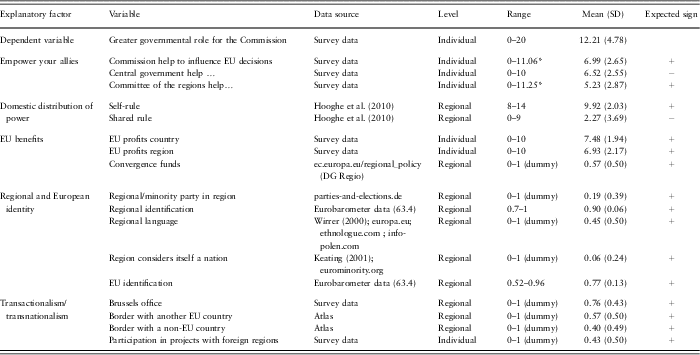
Regarding the “empower your allies” explanation, we asked respondents to imagine a new EU directive about to be adopted that could entail disadvantages for their region. They then had to rate on an 11-point scale how helpful each institution (the Commission, central government and the CoR) is as a partner in influencing the decision in their favour at the EU level. In order to operationalise hypotheses related to the “domestic distribution of power” explanation, we used the most recent and comprehensive indicator available — that of Hooghe et al. (Reference Hooghe, Marks and Schakel2010), which provides regional-level indicators of self-rule and shared rule. Concerning hypotheses related to the “friends with benefits” explanation, we used two questions enquiring whether interviewees perceived their country had profited from EU membership and separately whether their region had profited from EU membership (both 11-point scale, 0 = absolutely not profited; 10 = extraordinarily profited). We used data from the official DG Regio website when coding the attribution of convergence funds. Variables used to test the “identity” hypotheses were drawn from a variety of sources. A combination of web sourcesFootnote 6 and secondary literature (Wirrer Reference Wirrer2000; Keating Reference Keating2001) was used to collect the relevant data on the presence of regional/minority parties, of a regional language and the perception of the region as a nation. Regional identification and EU identification were measured by aggregating Eurobarometer data (63.4)Footnote 7 at the regional level and then rescaling these identification measures from 0 to 1. Finally, regarding hypotheses linked to the transactionalist explanation, the survey instrument allowed for the collection of data on the existence of a Brussels office and on whether interviewees have participated in projects with foreign region counterparts. An atlas was used to code whether the region has a border with another EU or non-EU country. Table 1 provides a summary of data sources, descriptive statistics and expected relationship to the dependent variable.
Summary of variables, data and hypotheses (n = 331)
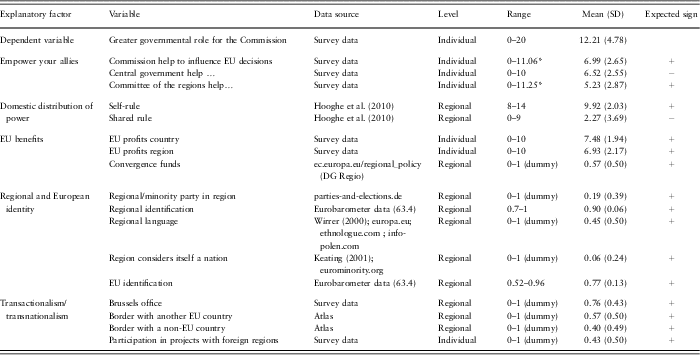
Note: *Range increased beyond 10 due to missing value imputation method.
EU = European Union.
The nature of our research question suggests that observations might not be completely independent from one another but actually nested within regions and countries. In other words, one can theoretically expect that a correlation between observations within a common unit (be it a region or a country) might be higher than the average correlation of observations between units. Calculation of the intra-class correlation indeed reveals that the data exhibit a multi-level structure to the extent that almost 10 per cent of variance is attributable to region clustering while almost 11 per cent of variance is attributable to country clustering. For each measure, the likelihood-ratio test also returns estimates significant at the 0.01 (region) and 0.001 (country) levels, hence confirming that the variance-components model is significantly different from a pooled model. We consequently adopt a three-level random intercept model (maximum likelihood estimation).
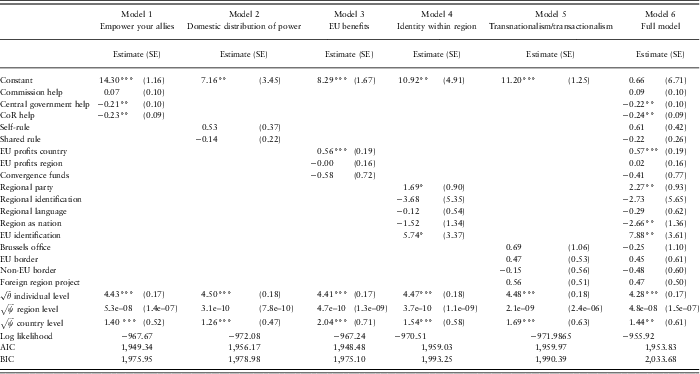
Finally, our last pre-analysis methodological challenge regards missing values. As in all survey research, some questions are not always answered by all interviewees. We lost 16 observations due to missing values on the dependent variable. A further 31 observations had missing values on some independent variables. A study of the distribution of these missing values did not reveal a particular pattern. Considering the rather low n of the analysis overall and our desire to keep the n constant across models, we decided to undertake model-based imputation by way of chained equations. The benefit of such a method is that it does not assume a multivariate normal distribution and has lower sample size requirements than imputation using the multivariate normal model. As reported in the Appendix, however, imputation did not affect results beyond small variation in p-values, probably due to sample size variation. We summarise our main research findings below.
Findings
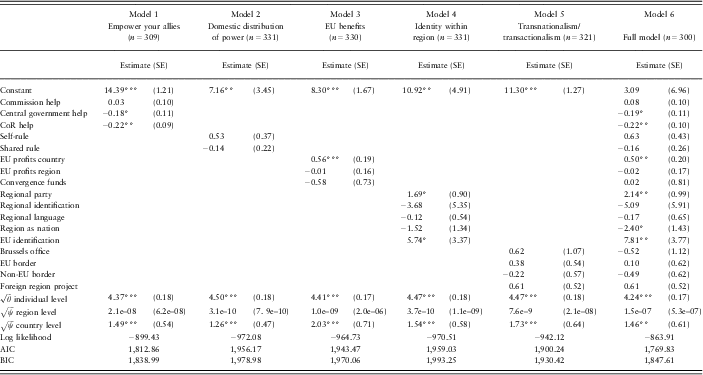
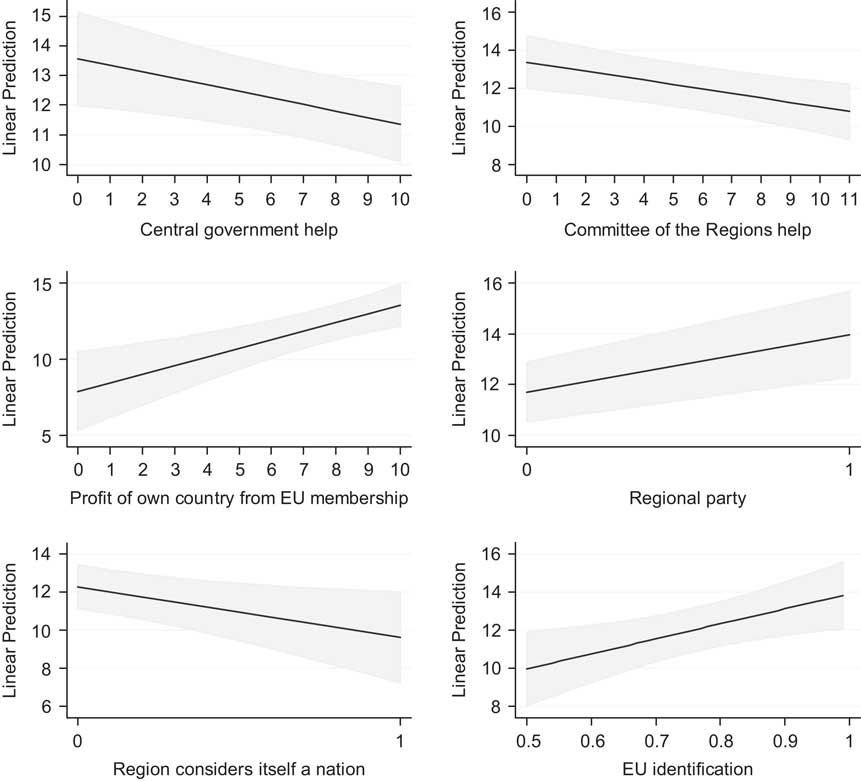
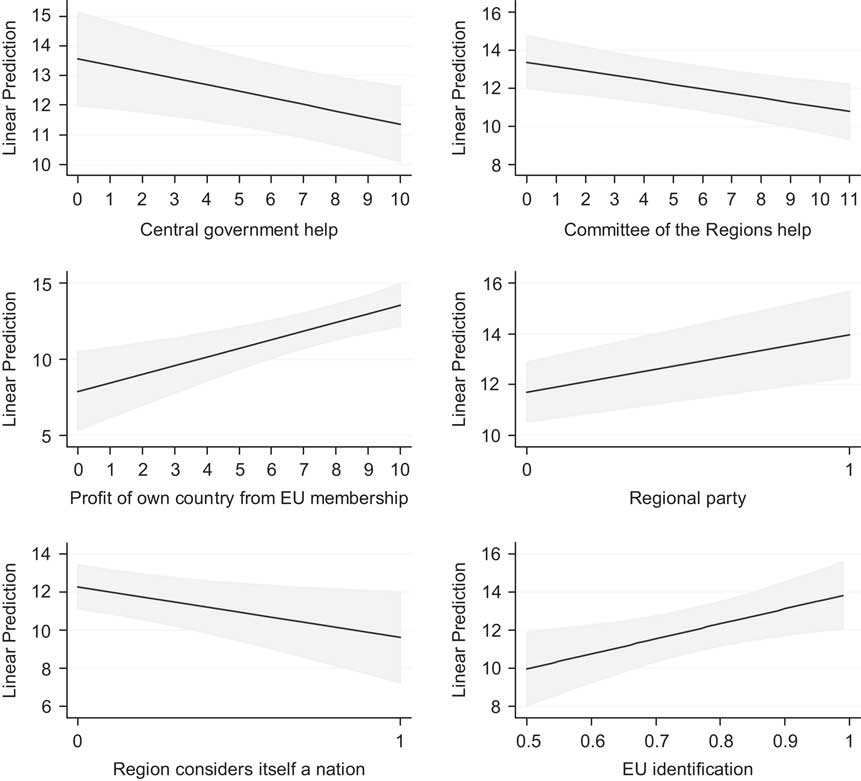
In order to disentangle suppressor effects from individual effects while also assessing how variables behave in a more controlled setting, we first put each explanation to the test individually before testing them concomitantly in a final full model. Since the sample size is rather low, the full model was also bootstrapped (5,000 replicates) as a complementary method for statistical inference.Footnote 8 The bootstrap results (not reported) were strictly similar to those reported in Table 2 with the exception of two variables – shared rule and self-rule, which we further discuss below. Similarly, recalculation of standard errors through the jack-knife procedure reaped highly similar results (331 replicates, not reported).Footnote 9 The robustness of our results to random re-sampling with replacement and jack-knifing increases our confidence in our findings. We summarise those in Table 2 as well as in Figure 1, which displays the predictive margins (change in y for a change in x, holding all other variables constant) for six variables that our analysis singles out as particularly relevant.
Hierarchical linear model of the European Commission's role
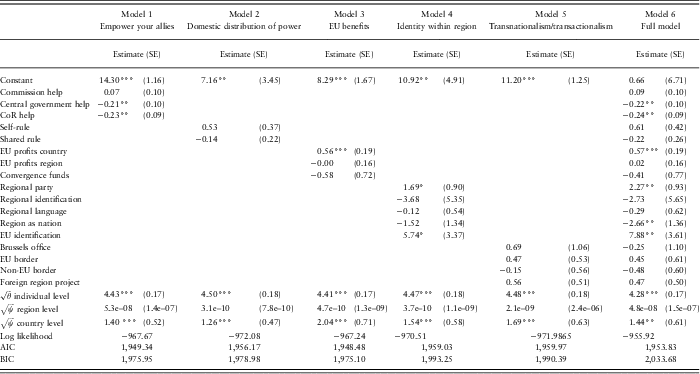
Note: Three-level model of the Commission's role. Unstandardised maximum likelihood estimates. Standard errors between brackets.
***p ⩽ 0.01; **p ⩽ 0.05; *p ⩽ 0.10 (two-tailed, n = 331).
AIC = Akaike's information criterion; BIC = Bayesian information criteria; CoR = Committee of the Regions; EU = European Union.
Predictive margin of six variables.
Note: predictive margins with 90 per cent confidence intervals, based on full model, all other variables held constant.
Two descriptive findings should first be discussed before proceeding to the evaluation of the different hypotheses. First, as indicated in Table 1, the absolute level of regio-crat supranationalism is rather low. On a scale ranging from 0 to 20, the mean and median are lower than one could expect (12.21 and 13, respectively), while the width of the standard deviation suggests much heterogeneity in regional élite preferences. Although top regional civil servants are more supranationalist than not, the literature led us to expect stronger supranational preferences towards the Commission. Interestingly – and this is our second descriptive finding – between-region variance disappears once country clustering is controlled for and covariates are introduced. Between-country variance, however, is persistent throughout. This might in part be due to the relative absence of country-level covariates. It certainly highlights the relevance of national patterns for our research question. We can hence conclude that further research might most fruitfully explore the effects of country-level explanans.
The “empower your allies” explanation fares relatively well but with two surprises. While the Commission variable is in the expected direction, it falls well short of achieving significance. This is rather surprising since we expected that, if such a logic were at play, it would be most visible in the case of the Commission. Although the Commission is perceived as the most useful of all three institutions to influence EU legislation towards regional preferences (
 $$)(--><$>\bar{x}\, = \,6.99 <$><!--$$
), such helpfulness does not translate into significantly more supranational preferences. If much literature had assumed that regional authorities and the Commission maintain a “you scrub my back and I scrub yours” type of relationship, evidence here indicates that such a relationship is less reciprocal than assumed. While the Commission is perceived as a helpful ally to influence legislation, this does not translate into greater support for a stronger Commission.
The second surprising finding is that, while the CoR is the least helpful of all three institutions (
 $$)(--><$>\bar{x}\, = \,5.23 <$><!--$$
), it is significantly associated with weaker support for Commission empowerment. Such a result suggests that, far from generating a general preference for greater supranationalism, CoR usefulness triggers a more zero-sum reaction. The more regional élites can find solace in the CoR, the less they are interested in a more powerful Commission. Whilst the CoR might have initially been created as an ally to the Commission (Marks et al. Reference Marks, Hooghe and Blank1996, 359), and historically originates from it,Footnote
10
top regional civil servants now view these supranational institutions as alternatives rather than complements. The increasing power, autonomy and influence of the CoR might well help to explain these institutional dynamics (Neshkova Reference Neshkova2010; Carroll Reference Carroll2011; Hönnige and Panke Reference Hönnige and Panke2013; Tatham Reference Tatham2013). Finally, although it is perceived as less useful than the Commission to influence policy outcomes at the EU level (
 $$)(--><$>\bar{x}\, = \,6.52 <$><!--$$
), relationship with central government significantly affect the preferences of regional élites. The more central government is helpful in influencing legislation in Brussels, the weaker the preference of regional élites for an empowered Commission. This is very much in line with past research that has highlighted the crucial role of state-region relations to account for regional activity on EU issues (Bauer Reference Bauer2006) and provides further evidence of the shift in regional strategies identified by Jeffery towards greater region-state partnership in European affairs – to the detriment of more supranational strategies (Reference Jeffery2007, 14).
Results are somewhat mixed and perhaps misleading regarding the “domestic distribution of power” explanation. Both self-rule and shared rule affect the dependent variable in the expected direction but fall short of achieving statistical significance. Their (theoretically consistent) effects are not trivial and especially marked in the case of self-rule. They give credence to H2a and H2b and further confirm that different dimensions of regional authority can have contrary effects on the dependent variable. The countervailing effect of self- and shared rule also explains why the aggregate regional authority index (RAI) has next to no effect on the dependent variable, while a simple “federal” dummy is highly insignificant.Footnote 11 This is an encouragement to future research to not only consider the effect of regional authority but to also consider that different dimensions of the same concept, such as shared and self-rule, might have opposing effects. It is, moreover, highly likely that these variables fall short of significance because of sample size and restricted variation within the sample. We suspect that, with more cases and hence greater variation on these variables, we would observe a stronger and significant effect. This hunch is supported by results derived from the random-x bootstrapping (5,000 replicates) and jack-knifing (331 replicates) of Models 2 and 6, which returned significant values for both variables at the 0.001 level concerning self-rule and at the 0.1 level for shared rule.
The “friends with benefits” explanation reaps more straightforward results, the first of which is that funds do not buy support – at least not in terms of Commission empowerment. Indeed, receipt of convergence funds has no significant effect on the dependent variable and the effect in the sample is actually negative.Footnote 12 In this sense, one could argue that, if there is any truth in the “friends with benefits” explanation, then one should certainly not mix money with friendship. Surprisingly, the perception that the region has benefited from EU membership displays no association with variation on the dependent variable. In other terms, whether regional élites believe that European integration has profited their region or not fails to affect their preferences with regards to Commission empowerment. More surprising yet is that the perception that EU membership has profited the interviewee's country is strongly and significantly associated with the dependent variable, hence lending support to H3a that perceived benefits can affect supranational preferences. As illustrated in Figure 1, the variable's predictive margins indicate a substantive positive effect on support for Commission empowerment, shifting from values below 8 to above 13.5 as perceptions of the country's profit from EU membership grow (all other variables held constant).
The puzzle here is that, though they cause no collinearity problems,Footnote 13 the regional and country variables are highly correlated (r = 0.67, p < 0.001).Footnote 14 One possible explanation for their contrasting effect is that regional élites are in a better position to gauge the actual benefits of EU membership for their own region as opposed to their country as a whole. Hence, individual evaluations of perceived country profit from membership are likely to be calked on regional experience but with an ideological deviation. In other words, it is quite plausible that interviewees used their beliefs (and hence ideology) to assess the in-assessable, that is, whether their country as a whole has benefited from EU membership. The ideological bias in their answer might well explain the strength and significance of its association with Commission empowerment.Footnote 15 If regional élites perceive European integration as normatively desirable, they will probably both believe that their country has profited from EU membership and be in favour of a stronger Commission.
Explanations related to regional identity shed some more light on the interaction between regional élite preferences and the regional milieu in which they work. Although aggregate levels of regional identification and the presence of a regional language fail to relate to the dependent variable in any significant way, three other factors display a strong and significant relationship. Elites working in regions with higher levels of aggregate individual attachment to the EU display pro-integrationist preferences. As displayed in Figure 1, the variable's predictive margins indicate a substantive positive effect on support for Commission empowerment. As EU identification grows (all other variables held constant), support for a stronger Commission also grows from values slightly below 10 to almost 14. Whether élite preferences trickle down to the population or whether these élites share or even reflect the preferences of their constituency is open to discussion. One can, nonetheless, safely conclude that a strong association between the regional milieu and the preferences of leading public servants is observable (see also Mols and Haslam Reference Mols and Haslam2008; Mols et al. Reference Mols, Jetten and Haslam2009).
The same conclusion applies to the presence of a regional party. In line with the findings of Jolly (Reference Jolly2007a, Reference Jolly2007b, Reference Jolly2009) regarding the relationship between regionalist parties, their interaction with the integration process and individual-level support for the EU, we here find that the presence of a regionalist party is strongly and significantly associated with supranational preferences (see Figure 1). Again, the direction of causation is open to discussion but the relation is there: when a regionalist party is present, the region's top public servants exhibit stronger supranational preferences towards the Commission.
Counter intuitively, however, the perception of the region as a nation is negatively associated with Commission empowerment. Though the relation is only significant in the more controlled setting of the full model, this relationship is robust to bootstrapping and jack-knifing and suggests a different causal logic to the one spelt out in H4d. Contrary to what one could expect, being a “nation against the state”Footnote 16 does not translate into stronger supranational preferences. To the contrary, the logic at play instead suggests that regions perceived as nations – and which might well aspire to full statehood – will have more intergovernmental preferences. Such an interpretation is supported by case study analyses that highlight that a number of stateless nations have perceived European integration as a threat to their power base (Bourne Reference Bourne2003, Reference Bourne2004; Fleurke and Willemse Reference Fleurke and Willemse2006).
It is not possible to test for the interaction term between the presence of a regionalist party and the perception of the region as a nation due to collinearity problems, as there are no cases within our sample of stateless nations without a regionalist party (though the reverse does occur). One can, however, explore the deductive effect of these two variables with a simple dummy representing regions that are not stateless nations but are endowed with a regionalist party (= 1) as opposed to all other regions (i.e. stateless nations with a regionalist party and regions without a regionalist party = 0). Such a variable is significant in both reduced and full models,Footnote 17 and its positive relationship with the dependent variable confirms our hunch that, while regionalist parties are associated with more supranational preferences in general (Jolly Reference Jolly2007a, Reference Jolly2007b), they tend to weaken such a preference when combined with nation statelessness. Hence, the absence of a regionalist party or its combination with stateless nationalism are associated with weaker supranationalist preferences. Obviously, the generalisability of such findings has to be tempered due to the limited nature of our current sample, which does not include well-studied stateless nations such as Scotland, Wales, Flanders or Corsica. However, our limited analysis does lend some support to findings by Elias and Hepburn who highlight the complex nature of the interaction between regional parties and the integration process (Elias Reference Elias2008, Reference Elias2009; Hepburn Reference Hepburn2008, Reference Hepburn2010; Hepburn and Elias Reference Hepburn and Elias2011). Similarly, our analysis echoes Caramani's finding that, while left-right party families are the most Europeanized, “cultural” parties such as regionalist and ethno-linguistic parties are actually far less Europeanized and drivers for heterogeneity (Reference Caramani2012, 812). We see the countervailing effects of stateless nationalism and regionalist parties as an illustration of this trend.
Results derived from the transactionalist framework were disappointing, as none of the chosen factors displayed a significant association to the dependent variable. One can only remark that civil servant involvement in projects with foreign colleagues as well as a border with another EU country display an effect consistent with our expectations. The effect of a Brussels office, however, is instable across models while – perhaps unsurprisingly – a border with a non-EU country is associated with weaker support for the oft pro-enlargement Commission. Although transactional dynamics might affect regional élite preferences towards the Commission, such dynamics are certainly not captured by our indicators. As pointed out above, future research might wish to explore different hypotheses derived from Deutsch's framework, such as regional trade openness, the export share of the regional economy or regional migration flows.
Conclusions
Despite the relevance of the regional level in the EU in theoretical terms (with regards to discussions of its multi-jurisdictional, multi-layered quality) and in practical terms (as territorial authorities implement about two-thirds of supranational programmes and legislation), the actual preferences of regional administrative élites had never before been explored on a large scale. This study is unique in its scope, depth and width. However, it also has clear limitations, since data were collected in 60 regions and five countries only. Our conclusions therefore apply to our sample and most similar cases. They should not be extended to different country types such as Nordic, Anglo-Saxon or Baltic countries – the more so since between country variance remains persistently significant throughout our analysis. With this caveat in mind, we can safely summarise our findings as follows.
When analysing the determinants of their support for greater Commission empowerment, regional élites come across as relatively pragmatic. If the CoR or central government is considered as useful to influence policy in Brussels, then they have little interest in a stronger, more autonomous Commission even when such an institution helps them to achieve outcomes closer to their own policy preferences. Such pragmatism is also reflected domestically in the effects of shared rule (negative) and self-rule (positive). This logic also comes across in the directionality of the identity measures. While the presence of a regionalist party is strongly associated with that of supranational preferences, aspiration to statehood weakens them. Unsurprisingly, greater aggregate levels of individual attachment to the EU within the region are associated with élite support for a more powerful Commission. Though the direction of causality and possible feedback loops can be discussed, one can safely conclude that the interaction between the regional milieu and its top civil servants is significantly associated with the latter's supranational preferences.
Three sets of factors therefore emerge as particularly relevant to better understand regio-crat preferences for supranational integration. The first concerns inter-institutional relations. Regional actors have no default bias towards the Commission. If central government or other institutions can be allies in the policy game, they will not seek solace elsewhere, be it in terms of direct interest representation in Brussels (Ansell et al. Reference Ansell, Parsons and Darden1997; Tatham Reference Tatham2010), lobbying for constitutional change at the EU level (Bauer Reference Bauer2006; Jeffery Reference Jeffery2007) or governance preferences towards the Commission (this paper). The second concerns perceived country benefits. Regio-crats who estimate that their country has profited from EU integration are more likely to exhibit pro-Commission preferences. The third concerns the pertinence of the regional milieu. This research highlights that identity and identification attributes of such a milieu are relevant to better understand élite preferences in multi-level political systems (Mols and Haslam Reference Mols and Haslam2008; Mols et al. Reference Mols, Jetten and Haslam2009). These three sets of factors extend to the territorial level the classic argument about interest- versus value-based approaches to EU integration.
Whilst previous research has highlighted that assuming pro-integration preferences at the individual level is unsafe since the end of the so-called “permissive consensus” (Inglehart Reference Inglehart1970, 773), this research highlights that it is equally unsafe to assume that key regional actors, in the form of top regio-crats, would not exhibit similarly heterogeneous and varying preferences. As the depth and scope of EU policies have expanded over time, their consequences (in terms of winners and losers) have sharpened attitudes towards the EU and its emblematic institution, the European Commission. This research underlines that regional élite preferences are not only diverse but also less integrationist than commonly assumed. While literature on Euroscepticism and the outcome of recent EU referenda (Garry et al. Reference Garry, Marsh and Sinnott2005; Glencross and Trechsel Reference Glencross and Trechsel2011) has emphasised that the support of the people is key to further integration (Hooghe and Marks Reference Hooghe and Marks2009), we here draw attention to the fact that support by the implementers of supranational policies and programmes is no forgone conclusion but shaped by both pragmatic considerations and the contextual attributes of culturally and politically diverse regions.
The relevance of such acteurs de l'ombre of the integration process will only grow as integration progresses and the various subsidiarity reforms implemented through the Lisbon Treaty come into play. Understanding the determinants of regio-crat support of the Commission is essential for a deeper comprehension of the politico-institutional dynamics underlying supranational policy-making and the process of integration. We argue that such support is driven by both pragmatic and contextual factors and believe the above evidence drawn from 60 regions in five countries is useful to understand – and to some extent predict – “support from below” in highly consolidated multi-jurisdictional systems such as the EU. Continuing decentralisation processes worldwide (Hooghe et al. Reference Hooghe, Marks and Schakel2010) and the growing adoption of the EU as a template for regional integration (Farrell Reference Farrell2009; Jetschke and Murray Reference Jetschke and Murray2012; Lenz Reference Lenz2012) mean that sub-national/supranational interaction patterns can only grow in relevance over time.
Acknowledgements
This paper is based on a research project funded by the German Science Foundation (DFG), whose financial support is gratefully acknowledged. The authors wish to thank Diana Pitschel and Philipp Studinger for their heavy involvement at the data collection phase. We also wish to thank Fabio Franchino, Yvette Peters, Ellen M. Immergut, Arjan Schakel, Lisa Dellmuth, Tarik Abou-Chadi, Konstantin Vössing, Roland Sturm, Michael Keating, Eva G. Heidbreder, John Constantelos and Stefan Götze for feedback on various presentations of our findings. Finally, we would like to thank the journal editor as well as the anonymous reviewers for very detailed and constructive feedback on various versions of the manuscript.
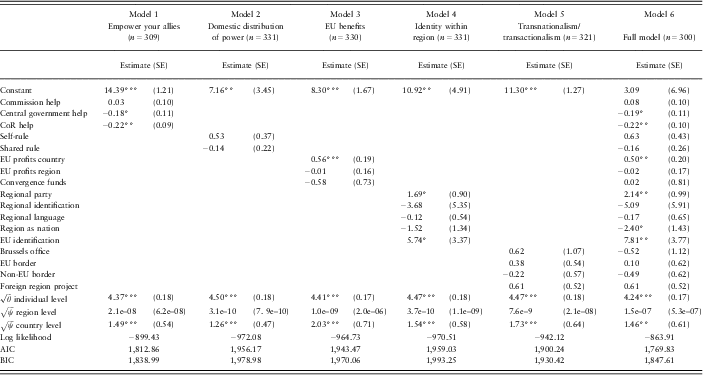
Hierarchical linear model of the European Commission's role – without imputed missing values