Introduction
Granivory describes the consumption of plant seeds by animals. It influences regeneration, colonization as well as abundance and distribution of plants (Janzen, Reference Janzen1971; Crawley, Reference Crawley and Crawley1997; Hulme & Benkman, Reference Hulme, Benkman, Herrera and Pellmyr2002; Forget et al., Reference Forget, Lambert, Hulme and Cander Wall2005). Seed predation occurs in all terrestrial and freshwater habitats populated by higher plants. Compared with other plant tissues, seeds are a food source extremely rich in many nutrients important to the consumers’ development and reproduction, often equalling or even exceeding the levels present in animal prey (Hulme & Benkman, Reference Hulme, Benkman, Herrera and Pellmyr2002; Lundgren, Reference Lundgren2009). This may explain why seeds are highly sought after and granivory is widespread. Seed predators come from a diverse range of taxa, including mammals, birds as well as insects such as beetles, bugs, flies, harvester ants, crickets and parasitoids (Janzen, Reference Janzen1971; Heithaus, Reference Heithaus1981; Lundgren, Reference Lundgren2009). Among beetles, carabids consume substantial amounts of seeds, and are of particular importance in arable land (Tooley & Brust, Reference Tooley, Brust and Holland2002; Honek et al., Reference Honek, Martinkova and Jarosik2003). According to the large-scale study of Bohan et al. (Reference Bohan, Boursault, Brooks and Petit2011), the turnover of the weed seedbank in individual fields is negatively related to the abundance of carabids, indicating their impact of seed predation on the demography of individual weed species (Westerman et al., Reference Westerman, Wes, Kropff and Van der Werf2003).
However, there is a lack of knowledge on the processes that govern which seed species are actually eaten in the field and thus removed from the seedbank. Feeding experiments indicate that carabids selectively feed on specific seed species over others, depending on seed size, hardness, mass, coat strength and even density (Lundgren, Reference Lundgren2009). As these conclusions stem from observations in the laboratory, they do not necessarily reflect the actual dietary choice of carabids in the field (Boursault, Reference Boursault2013). The conditions of the experiments may distort their choice of specific seeds over others (Lundgren, Reference Lundgren2009): In the laboratory, beetles can take what they want, whereas in the field, they do face natural barriers impacting their feeding choice. To date, little direct validation of whether seed species eaten in the laboratory studies are the same as those eaten by a certain predator in the field has been conducted. As such, there is a great need to disentangle the carabids’ choice of particular weed seed species from the effects of seed availability in the field. The direct observation of the in-field food choice of granivorous beetles is practically impossible because of the minuteness of the species, their complex environment or their predominantly nocturnal feeding ecology. Over a long period of time, a satisfactory method to examine the food choice of granivorous carabids under field conditions has been missing, leaving us with laboratory feeding studies and field-based seed baiting experiments as the primary methods of observation (Tooley & Brust, Reference Tooley, Brust and Holland2002). More recently, food-web approaches have been used to predict ecosystem services delivered via seed predation, by inferring trophic links from spatiotemporal analyses of changes in predator and prey (i.e., seed) species abundances, (Pocock et al., Reference Pocock, Evans and Memmott2012); with the limitation that they are rarely quantitative or probabilistic.
DNA-based diet analyses have the potential to expand the abilities of these food-web approaches by verifying consumption of certain species and providing information on the strength of the various trophic links. Thus, they can enhance the predictability of food-web-based models. Among the variety of molecular approaches, next generation sequencing (NGS), which has the potential to reveal many consumed species simultaneously (DNA metabarcoding), has become one of the prime methods of choice for answering questions in trophic ecology (Pompanon et al., Reference Pompanon, Deagle, Symondson, Brown, Jarman and Taberlet2012). Continual improvement of NGS technologies, ongoing decreases in costs and current expansion of reference databases make this approach promising. However, because of the short history of NGS, the examination of potential biases associated with this approach has only started. Especially the implicit assumption that frequently consumed species are reflected in a dominant number of their congenial DNA sequences, cannot be taken for granted. Target-specific differences in PCR amplification efficiency using ‘general’ primers which bind to phylogenetically conserved regions of the DNA, introduce additional variation in sequence numbers (Polz & Cavanaugh, Reference Polz and Cavanaugh1998; Sipos et al., Reference Sipos, Szekely, Palatinsky, Révész, Márialigeti and Nikolausz2007). Diagnostic PCR employing specific primers offers a well-approved alternative for the molecular identification of specific taxa to unravel trophic interactions, especially when the prey spectrum is known and restricted to a certain number of species. The possibility to screen several hundreds or thousands of samples individually, which is still very costly and usually not affordable on a NGS platform, is one of the biggest pros of diagnostic PCR. Only sufficiently high sample numbers will provide robust and representative diet information for whole populations or species and will be able to answer ecological questions. And other than for general primers, reactions using species-specific primers can be optimized to achieve a balanced sensitivity and amplification efficacy for the different target taxa to minimize methodological bias (Sint et al., Reference Sint, Raso and Traugott2012).
Overall, molecular gut content analysis has become a major tool in examining trophic interactions under natural conditions, addressing a wide range of feeding relationships (Traugott et al., Reference Traugott, Kamenova, Ruess, Seeber, Plantegenest, Woodward and Bohan2013; Symondson & Harwood, Reference Symondson and Harwood2014). Besides animal–animal interactions, these methods have been successfully applied for directly assessing herbivory in insects, in aquatic (Nejstgaard et al., Reference Nejstgaard, Frischer, Raule, Gruebel, Kohlberg and Verity2003; Troedsson et al., Reference Troedsson, Frischer, Neistgaard and Thompson2007; Garros et al., Reference Garros, Ngugi, Githeko, Tuno and Yan2008; Händeler et al., Reference Händeler, Wägele, Wahrmund, Rüdinger and Knoop2010) and terrestrial systems, above-ground (Jurado-Rivera et al., Reference Jurado-Rivera, Vogler, Reid, Petitpierre and Gómez-Zurita2009; Pegard et al., Reference Pegard, Miquel, Valentini, Coissac, Bouvier, Franois, Taberlet, Engel and Pompanon2009; Junnila et al., Reference Junnila, Müller and Schlein2010; Navarro et al., Reference Navarro, Jurado-Rivera, Gomez-Zurita, Lyal and Vogler2010; Wilson et al., Reference Wilson, Sheena, LeVan and Holway2010; Pumarino et al., Reference Pumarino, Alomar and Agusti2011; Hereward & Walter, Reference Hereward and Walter2012; García-Robledo et al., Reference García-Robledo, Erickson, Staines, Erwin and Kress2013; Hereward et al., Reference Hereward, DeBarro and Walter2013; Kitson et al., Reference Kitson, Warren, FFB, Baider, Strasberg and Emerson2013) and below-ground (Schallhart et al., Reference Schallhart, Tusch, Wallinger, Staudacher and Traugott2012; Staudacher et al., Reference Staudacher, Schallhart, Thalinger, Wallinger, Juen and Traugott2013; Wallinger et al., Reference Wallinger, Staudacher, Schallhart, Mitterrutzner, Steiner, Juen and Traugott2014), including the detection of scavenged plant food (Wallinger et al., Reference Wallinger, Staudacher, Schallhart, Peter, Dresch, Juen and Traugott2013). As yet, granivory has not been considered by this work.
Food DNA degrades continuously during the digestion process and digestion rates have a strong influence on the time span during which consumption of a certain food item can be tracked molecularly. Thus, before newly developed PCR assays can be used to study trophic interactions in the field, their applicability needs to be assessed in calibratory feeding trials (King et al., Reference King, Read, Traugott and Symondson2008). Such experiments in an environment emulating field conditions provide reliable information on DNA detection limits for specific consumers and prey types and they allow investigating the impact of factors such as consumer biomass and meal size on food DNA digestion rates (Hoogendoorn & Heimpel, Reference Hoogendoorn and Heimpel2001; Greenstone et al., Reference Greenstone, Rowley, Weber, Payton and Hawthorne2007); information that is highly relevant for a correct interpretation of field-derived data.
In the present study, we will test (i) if and for how long post-feeding plant DNA can be amplified from regurgitates of Harpalus rufipes (De Geer, 1774) fed with seeds of either dandelion (Taraxacum officinale F.H. Wigg) or perennial ryegrass (Lolium perenne L.); and (ii) whether there is a difference in DNA detection rates using general and species-specific plant primers, respectively. Furthermore, we examine how the post-feeding seed DNA detection success is affected by beetle biomass, number of seeds consumed and seed species identity.
Material and methods
Species and experimental setup
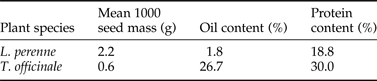
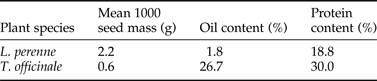
Both plant species, T. officinale and L. perenne, exhibit medium sized seeds which have been reported to be preferred by H. rufipes over large and small seeded species (Honek & Martinkova, Reference Honek and Martinkova2003). The two plant species vary significantly in the mass and nutrient composition of their seeds (table 1); with T. officinale seeds exhibiting an oil-content 13 times higher than those of L. perenne together with much lower seed mass. In many plant species, such as T. officinale what is regularly referred to as the ‘seed’ is actually an achene; a fruit containing a single seed which does not open at maturity. In the case of L. perenne the grain resembles an achene, except that it is a ‘caryopsis’ with a seed coat fused to the seed wall. For reasons of simplicity we will refer to both the achene and the caryopsis as seeds in the text hereafter.
Seed features of the two seed species fed to H. rufipes in the feeding experiments. Data source: Seed Information Data Base SID (http://data.kew.org/sid).
Most carabids are generalist feeders and consume a wide range of food types (Lövei & Sunderland, Reference Lövei and Sunderland1996). With H. rufipes we chose a species that is widespread throughout arable systems (Brandmayer, Reference Brandmayer and Stork1990) and usually occupies a dominant position in ground beetle communities (Luff, Reference Luff and Holland2002). According to Honek et al. (Reference Honek, Zdenka, Saska and Pekar2007) the species of the genus Harpalus eat a greater proportion of seed species compared with other carabids of the same size. A large proportion of its diet is made up of seeds, compared with other food types such as plant parts and invertebrates (Holland, Reference Holland2002; Tooley & Brust, Reference Tooley, Brust and Holland2002).
Adult beetles of H. rufipes were trapped on arable land near Innsbruck (760 m a.s.l.; Tyrol, Austria) in July and August 2013. The beetles were kept individually in a climate cabinet (L:D 14:10 h at 22 and 12°C, respectively) in plastic beakers (71 × 58 mm2, h × Ø, screw top lid), containing a piece of moistened tissue. Beakers were ventilated and the tissues replaced every second day. The beetles were maintained on a diet of Tenebrio molitor L. larvae, which were offered every fifth day. As experimental food, we choose seeds of T. officinale and L. perenne, that are highly abundant in arable land and which are known to be eaten by H. rufipes (Lundgren, Reference Lundgren2009). Prior to the feeding experiments, beetles were starved for 5 days. Fresh feeding containers (60 × 35 mm2, h × Ø) were prepared with a drop of water and five plant seeds. The beetles were weighed to the nearest 0.01 mg, put individually into the tubes, and allowed to feed for 2 h in the dark climate cabinet. Afterwards, the seeds were removed and beetles put back individually in clean beakers in the climate cabinet. Beetles were stimulated to regurgitate in batches of 13–15 individuals at 0 h (n = 14), 4 h (n = 14), 8 h (n = 14), 16 h (n = 13), 24 h (n = 14), 32 h (n = 15), 48 h (n = 14) or 72 h (n = 15) post-feeding as follows: each beetle was transferred headfirst into a 2 ml reaction tube, which was then dipped into 65–70°C hot water for 1–2 s following the recommendations of Straube (Reference Straube2013). Only regurgitates from beetles which had consumed at least one seed were considered for the feeding experiment. While the beetles were transferred in clean plastic beakers and put back in the climate cabinet, regurgitates were immediately frozen and stored at −28°C until DNA extraction. All beetles were set free in their original habitat at the end of the experiments.
DNA extraction, PCR and electrophoresis
Regurgitates were dissolved in 200 µl 1 × TES buffer, 5 µl Proteinase K (20 mg ml−1) and 1 mg polyvinylpyrrolidone (PVP) and incubated for 3 h at 58°C. DNA was extracted with the BioSprint 96 DNA Blood Kit (Qiagen, Hilden, Germany) on a Biosprint® 96 extraction robotic platform (Qiagen) following the manufacturer's instruction, with the exception that DNA was finally diluted in 200 µl TES buffer each. DNA extracts were stored at −28°C. All extractions were done in a separate pre-PCR laboratory using a UVC-equipped laminar flow hood and two extraction-negative controls (PCR-grade water instead of regurgitate) were included in each batch of 48 samples to check for cross-sample contamination during the extraction process. None was detected by testing the controls using the diagnostic assays described below.
First, a diagnostic PCR assay with general plant primers targeting chloroplast DNA was used to test the DNA extracts for the presence of plant DNA. Primer c A49325, situated in the trnL exon (Taberlet et al., Reference Taberlet, Gielly, Pautou and Bouvet1991) and primer trnL110R located in the trnL intron (Borsch et al., Reference Borsch, Hilu, Quandt, Wilde, Neinhuis and Barthlott2003) were combined to amplify a fragment of 120 bp length. The assays and PCR conditions followed the description provided in Wallinger et al., (Reference Wallinger, Staudacher, Schallhart, Peter, Dresch, Juen and Traugott2013). Then the regurgitates were additionally screened with two different multiplex PCR assays specifically targeting DNA of T. officinale (multiplex TAT, fragment length 194 bp) and L. repens (multiplex FLPS, fragment length 254 bp), respectively, which are described in Wallinger et al., (Reference Wallinger, Juen, Staudacher, Schallhart, Mitterrutzner, Steiner, Thalinger and Traugott2012). Both species have a detection limit of 100 template molecules with all assays employed (Wallinger et al., Reference Wallinger, Juen, Staudacher, Schallhart, Mitterrutzner, Steiner, Thalinger and Traugott2012, Reference Wallinger, Staudacher, Schallhart, Peter, Dresch, Juen and Traugott2013). Within each PCR, one negative control (PCR water instead of template DNA) and one positive control (seed DNA) was run to check for DNA carry-over contamination and amplification success, respectively.
All PCR products were visualized using QIAxcel, an automated capillary electrophoresis system (Qiagen), with method AL320 and the results were scored with Biocalculator Fast Analysis Software version 3.0 (Qiagen). Samples showing the expected fragment length with a signal above 0.1 relative fluorescent units were deemed to be positive. The DNA extracts of the regurgitates that tested negative in a first run were re-tested in a second PCR to increase the chances of amplification in samples which contained only minute quantities of plant DNA (Seeber et al., Reference Seeber, Rief, Seeber, Meyer and Traugott2010).
Statistical analyses
Overall plant DNA detection rates were tested for significant differences between the two seed species and the application of specific and general primers using χ 2 tests. The effect of digestion time (=time post-feeding) on plant DNA detection success was tested for both, the general and the species-specific plant primers, employing a PROBIT regression model as the dependent variables were binomially distributed. To identify those parameters with the highest predictive power for seed DNA detection success, backward logistic regressions were calculated with the following variables: time post-feeding, beetle biomass, number of seeds consumed as well as the interactions seed number × species and seed number × beetle biomass. PROBIT regressions with their 95% confidence intervals were calculated using R 3.1.2 (R Core Team, 2012) and the package ‘drc’ (Ritz & Streibig, Reference Ritz and Streibig2005) and non-overlapping confidence intervals for the 50% detection probability were interpreted as significant differences. All other calculations were performed in SPSS 20 (IBM, Armonk, NY, USA).
Results
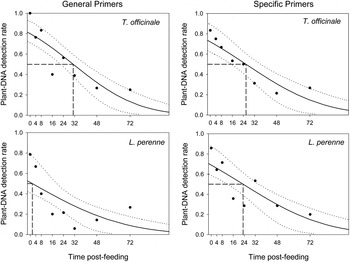
The mean body mass of H. rufipes was 106.13 mg (±27.62 SD; range 31.35–195.41 mg) and 2.42 (±0.79 SD) and 1.87 (±0.80 SD) seeds of T. officinale and L. perenne, respectively, were consumed on average within the 2 h feeding period. The oil content of T. officinale seeds was 13 times higher than for L. perenne. While the seeds of T. officinale were consumed as a whole, those of L. perenne were opened by the beetles and only the inner part was eaten. In total, DNA of 230 regurgitates of H. rufipes was extracted and analysed (116 and 114 fed with T. officinale and L. perenne, respectively). Overall seed DNA detectability was significantly higher for beetles fed with T. officinale (55.2%) than with L. perenne (33.6%). When testing the regurgitate samples with general plant primers, the (χ 2 = 11.01; P < 0.001). Contrastingly, with the species-specific primers there was no significant difference detectable (χ 2 = 0.07; P > 0.05): 50.0% of the regurgitates after feeding with T. officinale and 48.7% of those with L. perenne were tested positive with the respective species-specific primers. DNA of the consumed plant seeds could be detected in regurgitates for up to 72 h post-feeding, the maximum digestion time in our experiments, for both seed species using general and specific plant primers, whereas it was between 20 and 26% of the beetles’ regurgitates that tested positive (fig. 1). The detectability of seed DNA in regurgitates decreased significantly with digestion time for both T. officinale and L. perenne. With the general primers, the digestion time after which a detection probability of 50% was estimated by the PROBIT regressions, was significantly lower for L. perenne (1.5 h; <0–19.2 h 95% confidence interval) compared with T. officinale (31.0 h; 22.0–40.1 h). With the species-specific primers, no significant difference was present (L. perenne 23.2 h; 11.9–34.4 h; T. officinale 25.9 h; 15.3–36.4 h). The results of the backward logistic regressions indicate that neither the parameters tested (meal size, beetle biomass) nor the interactions between them affected the post-feeding seed DNA detection success.
Detectability of seed DNA in regurgitates of H. rufipes fed with seeds of T. officinale and L. perenne at different time points ranging from 0 to 72 h post-feeding. Detection rates are provided for the different time points as circles along with the fitted PROBIT models for the decrease in seed DNA detection success including the lower and upper 95% confidence intervals (dotted lines) and the time points where the detection probability equals 50% (dashed lines). A minimum of 13 regurgitates per time point post-feeding was tested with general- (left panel) and plant species-specific primers (right panel), respectively.

Discussion
We were able to amplify chloroplast DNA from the consumed seeds for up to 3 days post-feeding. The extraction procedure implementing a 3 h lysis step and the use of the Biosprint® extraction robot turned out to be simple, fast, and yield high-quality DNA from beetle regurgitates sufficient for diagnostic PCR. The current study demonstrates that DNA of ingested seeds can be detected in carabid regurgitates via diagnostic PCR at extended times post-feeding, by the example of H. rufipes. An initial testing with seed fed Poecilus versicolor (Sturm, 1824), Poecilus cupreus L. and Amara spp. confirmed that plant DNA can in principle also be amplified from regurgitates of other carabid species (data not shown). This indicates a general applicability of the present approach, which has to be tested in more detail in the future. Similar to experiments of Monzo et al., (Reference Monzo, Sabater-Muñoz, Urbaneja and Castañera2011) and Waldner et al., (Reference Waldner, Sint, Juen and Traugott2013), where H. rufipes was fed animal prey, maximum detection times seem to lie beyond the 3 days tested, indicating that it is possible to identify consumed food with the present approach even if the feeding event has taken place a longer time ago. This fact is highly important when it comes to the analysis of field-collected animals, where the exact time of actual consumption is unknown in most cases.
The present study represents the first attempt to use regurgitates of granivores for the molecular identification of their diet. Hitherto, typically whole-body extracts have been used for identifying trophic interactions in herbivorous arthropods (Nejstgaard et al., Reference Nejstgaard, Frischer, Raule, Gruebel, Kohlberg and Verity2003; Jurado-Rivera et al., Reference Jurado-Rivera, Vogler, Reid, Petitpierre and Gómez-Zurita2009; Pumarino et al., Reference Pumarino, Alomar and Agusti2011; Staudacher et al., Reference Staudacher, Wallinger, Schallhart and Traugott2011; Wallinger et al., Reference Wallinger, Staudacher, Schallhart, Peter, Dresch, Juen and Traugott2013) or their dissected guts (Matheson et al., Reference Matheson, Müller, Junnila, Vernon, Hausmann, Miller, Greenblatt and Schlein2008) entailing several disadvantages connected with the overabundance of non-target DNA, degradation, elevated cross-contamination risk of samples during potential dissection processes and others (Paill, Reference Paill2004; Waldner & Traugott, Reference Waldner and Traugott2012; Straube, Reference Straube2013). In regurgitates, detection rates of seed DNA may not always be 100% even immediately after feeding due to overall low DNA concentrations compared with other samples types (Sint et al., Reference Sint, Niederklapfer, Kaufmann and Traugott2014) which can cause dropouts during PCR (Sint et al., Reference Sint, Raso, Kaufmann and Traugott2011). However, with the present approach we avoid killing the insects which is essential for example in surveys of populations small-sized, where replacement after regurgitate sampling minimizes the impact on the population (e.g., in high Alpine carabid pioneer species (Raso et al., Reference Raso, Sint, Mayer, Plangg, Recheis, Kaufmann and Traugott2014) or in experimental settings where populations size is controlled. In the specific case, the application of this non-invasive approach offers the opportunity to monitoring the dietary variations during the season, which are believed to be characteristic for many carabid beetles (Holland, Reference Holland2002). For example, H. rufipes and Harpalus affinis were found to take mainly plant material early in the season and insect food during summer, which may be ascribed to changes in seed abundance, as well as changes in other food sources and/or granivore densities (Hulme & Benkman, Reference Hulme, Benkman, Herrera and Pellmyr2002). Besides, seed feeding can also differ ontogenetically. Some granivorous carabid larvae and even adult beetles are known to create seed caches by burying seeds (Thiele, Reference Thiele1977; Lundgren, Reference Lundgren2009). However, the function of these caches is not entirely clear (Lundgren, Reference Lundgren2009). While some species seem to consume the seeds, others do not. The molecular approach applied here could help to clarify whether the larvae utilize the stored seeds as food.
Overall plant DNA detection rates ranged between 34 and 61% within a 3-day-digestion period, which is comparable with experiments with the herbivorous Agriotes click beetle larvae (Staudacher et al., Reference Staudacher, Wallinger, Schallhart and Traugott2011; Wallinger et al., Reference Wallinger, Staudacher, Schallhart, Peter, Dresch, Juen and Traugott2013). For seeds of both species, T. officinale and L. perenne, detection of plant DNA was negatively correlated with time post-feeding. This was in accordance with the DNA detection rates observed in click beetle larvae, that fed on roots of T. officinale or Pimpinella major (L.) HUDS (Wallinger et al., Reference Wallinger, Staudacher, Schallhart, Peter, Dresch, Juen and Traugott2013). However, there is evidence for the importance of plant species identity in this context, since no such correlation was present for larvae that fed on other plant species (Staudacher et al., Reference Staudacher, Wallinger, Schallhart and Traugott2011; Wallinger et al., Reference Wallinger, Staudacher, Schallhart, Peter, Dresch, Juen and Traugott2013). Likewise for the consumption of seeds, further experimentation is needed to clarify how seed species identity affects post-feeding plant DNA detection rates. As in other studies on herbivorous (Staudacher et al., Reference Staudacher, Wallinger, Schallhart and Traugott2011) and carnivorous arthropods (Hoogendoorn & Heimpel, Reference Hoogendoorn and Heimpel2001; Juen & Traugott, Reference Juen and Traugott2005; Hosseini et al., Reference Hosseini, Schmidt and Keller2008), also here consumer (carabid) biomass and meal size, i.e., number of consumed seeds, did not affect plant DNA detection. However, since the beetles consumed similar amounts of seeds for both seed species in the present feeding experiments, we cannot exclude that meal size might have an effect if there would be stronger differences in the quantity of food consumed (cf. King et al., Reference King, Moreno-Ripoll, Agusti, Simon, Shayler, Bell, Bohan and Symondson2010).
The trnL intron was successfully applied to detect the consumption of the two seed species tested. It has been promoted by Taberlet et al., (Reference Taberlet, Gielly, Pautou and Bouvet1991) as a plant barcode harbouring its main power in ecological applications, i.e., when working with degraded DNA (Jurado-Rivera et al., Reference Jurado-Rivera, Vogler, Reid, Petitpierre and Gómez-Zurita2009; Navarro et al., Reference Navarro, Jurado-Rivera, Gomez-Zurita, Lyal and Vogler2010; Schnell et al., Reference Schnell, Fraser, Willerslev and Gilbert2010) as in the present case. The trnL-region has been used in studies on herbivory using both NGS techniques (Soininen et al., Reference Soininen, Valentini, Coissac, Miquel, Gielly, Brochmann, Brysting, Sonstebo, Ims, Yoccoz and Taberlet2009, Reference Soininen, Zinger, Gielly, Bellemain, Bråthen, Brochmann, Epp, Gussarova, Hassel and Henden2013) and diagnostic PCR (Staudacher et al., Reference Staudacher, Wallinger, Schallhart and Traugott2011; Wallinger et al., Reference Wallinger, Juen, Staudacher, Schallhart, Mitterrutzner, Steiner, Thalinger and Traugott2012). When applying general plant primers, significant differences between T. officinale and L. perenne were observed in the overall detection rates for seed DNA. These differences disappeared when regurgitates were tested with species-specific plant primers, even though according to sensitivity tests, all primers employed have the same detection limit when tested without consumer DNA being co-present (Wallinger et al., Reference Wallinger, Juen, Staudacher, Schallhart, Mitterrutzner, Steiner, Thalinger and Traugott2012, Reference Wallinger, Staudacher, Schallhart, Peter, Dresch, Juen and Traugott2013). This finding corresponds with the assumption of Morales & Holben (Reference Morales and Holben2009) that the efficacy of general primers can vary significantly between different targets. It may have implications for the use of NGS techniques which have already been adopted for diet analysis in a wide variety of herbivores, including insects, to unravel feeding interactions on the basis of general primers (Soininen et al., Reference Soininen, Valentini, Coissac, Miquel, Gielly, Brochmann, Brysting, Sonstebo, Ims, Yoccoz and Taberlet2009, Reference Soininen, Zinger, Gielly, Bellemain, Bråthen, Brochmann, Epp, Gussarova, Hassel and Henden2013; Pompanon et al., Reference Pompanon, Deagle, Symondson, Brown, Jarman and Taberlet2012; Czernik et al., Reference Czernik, Taberlet, Swislocka, Czajkowska, Duda and Ratkiewicz2013; Srivathsan et al., Reference Srivathsan, Sha, Vogler and Meier2014). As helpful as NGS is in a variety of situations, where only little a priori knowledge of the potential prey spectrum is available, the present findings demonstrate that caution is required when NGS-derived trophic data from field-collected samples are interpreted, as detection success might differ between plant species. In cases of a well-known spectrum of potential prey, i.e., when we do know which seed or animal species are available for a given consumer, the development of species or group-specific primers and diagnostic PCR should be taken into account. Especially, when combining them in a multiplex PCR approach, where more than ten species can be identified in a single PCR (Harper et al., Reference Harper, King, Dodd, Harwood, Glen, Bruford and Symondson2005); once established this diagnostic approach provides the maximum of validity together with a minimum of time and cost effort and is especially suited for surveys where the screening of large sample numbers is in demand. In the near future, we plan to optimize such diagnostic multiplex PCR approaches for granivorous carabids, based on which we will be able to construct semi-quantitative plant–herbivore trophic links, which depict the relative abundances of both the carabids and the food sources screened for (e.g., weed seeds), as well as the consumption frequencies of these seeds in the field-collected carabids.
In conclusion, the present data show that seed DNA can be readily detected in regurgitates of carabid beetles for extended times post-feeding via general and species-specific plant primers. The molecular approach presented here represents an appropriate methodology for tracking actual seed consumption of beetles in their natural environment. Moreover, the results confirm the caution recommended when choosing a molecular tool (diagnostic PCR, NGS or any other approach) in regard to its suitability for a specific application. Detection rates of seed DNA were high in general, indicating that regurgitates are suitable for identifying seed consumption in H. rufipes and probably other carabid species. The approach outlined here is useful for future studies on trophic interactions of plant species and granivorous insects at various scales, circumventing the need of killing those granivores which can be stimulated to regurgitate. Ultimately, the outcomes of this study represent a first step towards an analysis of the dietary choices of granivorous insects to further increase our understanding of seed predation and its ecological significance in both managed and natural systems.
Acknowledgements
Financial support was provided by the project ‘The effect of seed identity and digestion time on molecular detection of ingested seeds in two species of granivorous carabid beetles’ funded by the Mountain Agriculture Research Unit of the University of Innsbruck. We thank Karin Staudacher from University of Innsbruck and Dave Bohan from INRA Dijon for valuable discussion and comments on the paper.