Practical considerations of DNA as a material
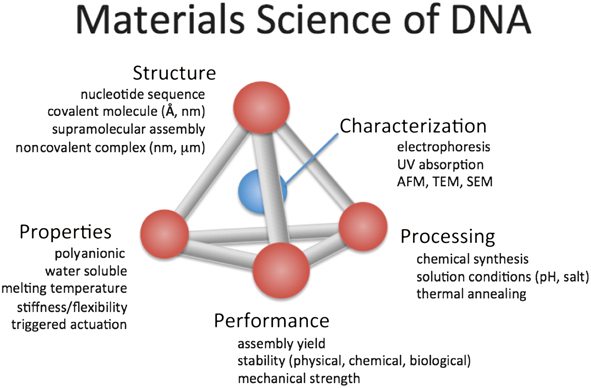
DNA is a biological polymer with a covalent backbone composed of alternating sugar and phosphate groups. The nucleotide side chains come in four varieties: adenine (A), cytosine (C), guanine (G), and thymine (T), and provide the hydrogen-bond donors and acceptors that allow specific base pairing of A to T and C to G of single-stranded DNA (ssDNA) into double-stranded DNA (dsDNA). The DNA sequence provides information storage in the polymer and specifies the complementary sequence and binding partner ssDNA with which dsDNA can be formed. Organisms use DNA to store genetic information, while molecular engineers use DNA to store supramolecular assembly instructions. Figure 1 provides an overview of DNA nanotechnology from a materials science perspective.
Materials science tetrahedron interpreted for DNA-based nanotechnology. Note: AFM, atomic force microscopy; TEM, transmission electron microscopy; SEM, scanning electron microscopy; UV, ultraviolet.
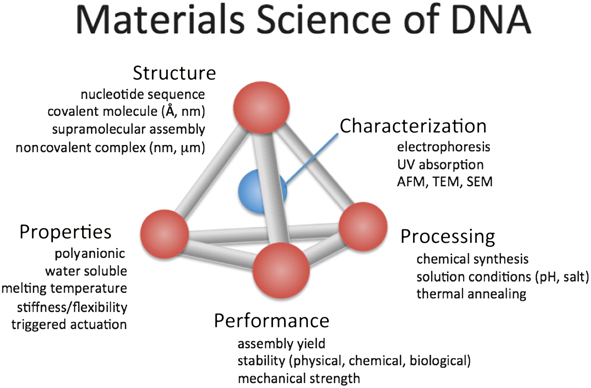
DNA is soluble in water and can be precipitated by alcohols. Standard aqueous solutions of DNA contain a buffer to maintain a near-neutral pH and a salt (e.g., MgCl2) to provide cations necessary for shielding negative charges to allow the highly charged backbone phosphates to pack tightly together. In solution, the dehybridization of dsDNA into its ssDNA strands occurs below the boiling point of water, with specific value dependent upon sequence length and composition. Regarding characterization techniques, the molecular size of ssDNA can be determined by denaturing gel electrophoresis, while supramolecular assemblies can be examined by nondenaturing electrophoresis, atomic force microscopy, or electron microscopy. The absorbance of UV light at 260 nm is used to estimate the solution concentration of DNA with extinction coefficients between 0.020–0.027 (μg/ml)−1 cm−1, depending upon nucleobase composition and secondary structure.
DNA can be synthesized biologically, enzymatically, or chemically. Chemical synthesis is limited to molecules of a couple hundred bases, while biological or enzymatic production requires greater commitment during setup, but can then produce gram or even kilogram quantities of DNA. Hydrated DNA with high concentrations forms a viscous liquid and can be noncovalently cross-linked into a gel. Reference Roh, Ruiz, Peng, Lee and Luo1 Polymer stiffness/flexibility measured as persistence length in solution is less than 3 nm for ssDNA, about 50 nm for dsDNA, and orders of magnitude greater for dsDNA helices aligned and joined noncovalently in nano-assemblies. The applied tensile force required to separate two complementary strands of DNA has been measured at 20–50 pN, depending on sequence length. Reference Strunz, Oroszlan, Schafer and Guntherodt2 Using optical tweezers, a molecule of ssDNA was estimated to have an elastic modulus of approximately 1100 pN. Reference Wang, Yin, Landick, Gelles and Block3 Given these mechanical characteristics, DNA is best suited as a building material for nano- or microscale objects. Further details regarding properties of DNA important to nanotechnology have recently been summarized. Reference Pedersen, Marchi, Majikes, Nash, Estrich, Courson, Hall, Craig, LaBean, Bhushan, Luo, Schricker and Sigmund4
Structural DNA nanotechnology
The fundamental principle for the design of DNA nanostructures is to program complementarity between ssDNA molecules using Watson–Crick base pairing, where A pairs with T and C pairs with G through hydrogen bonding. This molecular programming language has led to the development of different design strategies and a large number of DNA nanostructures. Here, we briefly review the most prevalent design strategies, DNA tile and DNA origami.
DNA tiles are used to denote discrete building blocks that can be assembled into objects or periodic lattice structures. A DNA tile is composed of several short ssDNA of unique sequences with prescribed geometry. The first synthetic DNA tile, the immobile nucleic acid junction, consisted of four synthetic ssDNAs that were encoded to hybridize with two neighboring strands to form a branched four-way junction. Reference Seeman and Kallenbach5 Unlike a natural Holliday junction, which has symmetric sequences and is thus mobile through strand migration, sequence symmetry was minimized in the synthetic junction to avoid branch migration. Five-, six-, eight-, and twelve-way junctions were constructed similarly.
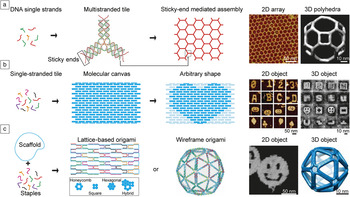
However, none of these first-generation DNA tiles led to successful assembly of higher-order structures due to high structural flexibility. DNA double-crossover (DX) molecules are instead designed to induce structural rigidity by confining two four-way junctions within one tile. Reference Fu and Seeman6 For example, a three-arm tile is assembled from seven ssDNA with each arm containing one DX structure. Single-stranded overhangs (sticky ends) are introduced at the end of each arm. The sticky-end cohesion enables the tiles to further assemble into larger structures, including two-dimensional (2D) arrays and three-dimensional (3D) polyhedra ( Figure 2a). Reference He, Chen, Liu, Ribbe and Mao7,Reference Wang, Wu, Tian, Yu, Jiang, Wang and Mao8 Structures consisting of alternative patterns can be constructed simply by varying the number of arms of the tile to, such as, two, four, five, or six. Three-dimensional DNA crystals can also be successfully grown from DNA tiles. Reference Zheng, Birktoft, Chen, Wang, Sha, Constantinou, Ginell, Mao and Seeman9 Complex structures with multiple polygonal cavities can be realized by using structurally asymmetric DNA tiles Reference Wang, Wu, Tian, Yu, Jiang, Wang and Mao8 or by hybridizing multiple tile designs. Reference Zhang, Liu and Yan10
Summary of DNA tile and DNA origami. (a) Multistranded DNA tile. Each tile is composed of several short DNA strands. Strands of different colors have different sequences. Sticky-end mediated cohesion between tiles leads to the assembly of larger structures such as 2D arrays or 3D polyhedra. Reprinted with permission from References Reference He, Chen, Liu, Ribbe and Mao7 and Reference Wang, Wu, Tian, Yu, Jiang, Wang and Mao8. © 2005 and 2016 American Chemical Society, respectively. (b) Single-stranded DNA (ssDNA) tile. A number of ssDNAs with unique sequences assemble into prescribed objects, which can serve as 2D and 3D canvases to construct arbitrary objects. Reprinted with permission from References Reference Ke, Ong, Shih and Yin11 and Reference Wei, Dai and Yin12. © 2012 AAAS and Macmillan Publishers Ltd., respectively. (c) Scaffolded DNA origami. A long ssDNA template serves as a scaffold that is folded by a number of shorter ssDNAs (staples) into both delicate 2D and 3D objects. DNA duplexes can be organized using parallel lattices Reference Rothemund14,Reference Douglas, Dietz, Liedl, Hogberg, Graf and Shih15 or wireframe structures. Reprinted with permission from References Reference Rothemund14 and Reference Veneziano, Ratanalert, Zhang, Zhang, Yan, Chiu and Bathe18. © 2006 Macmillan Publishers Ltd. and 2016 AAAS, respectively.

A single-stranded tile (DNA brick) Reference Ke, Ong, Shih and Yin11,Reference Wei, Dai and Yin12 is a specific type of tile in which each ssDNA acts like a modular building block and associates with other bricks to assemble into prescribed structures (Figure 2b). A master set of DNA bricks serves as a 2D or 3D canvas that allows the construction of various arbitrary objects by simply omitting certain strands. The modular DNA bricks largely enrich the design toolbox of DNA tiles, and are particularly versatile for building DNA objects of arbitrary sizes and shapes with unique addressability. Infinite-sized crystal structures can also be assembled by bridging the front and end bricks to induce crystallization. Reference Ke, Ong, Sun, Song, Dong, Shih and Yin13
DNA origami produces prescribed 2D or 3D structures by folding a long single-stranded “scaffold” DNA via hybridization to hundreds of short single-stranded “staple” DNA strands. Reference Rothemund14 There are two basic ways of arranging DNA helices (Figure 2c)—lattice arrangement where helices are packed side by side or wireframe arrangement. Honeycomb, Reference Douglas, Dietz, Liedl, Hogberg, Graf and Shih15 square, Reference Ke, Douglas, Liu, Sharma, Cheng, Leung, Liu, Shih and Yan16 hexagonal, or hybrid lattices Reference Ke, Voigt, Gothelf and Shih17 are available for building close-packed DNA origami objects. The lattice style is determined by the relative positions of crossovers between aligned, parallel DNA helices. In a departure from lattice-based DNA origami, wireframe origami was developed to fabricate porous structures that have minimal packing of DNA helices. Reference Veneziano, Ratanalert, Zhang, Zhang, Yan, Chiu and Bathe18,Reference Benson, Mohammed, Gardell, Masich, Czeizler, Orponen and Hogberg19 DNA origami objects built from closely packed parallel helices are generally rigid and serve better as templates for organizing functional materials.
Wireframe DNA origami are well suited to constructing porous or hollow structures of large volume and surface area per number of DNA bases, and are particularly useful for intracellular applications due to enhanced resistance to cation depletion in physiological environments, a benefit due to their lower density of close-packed DNA helices. Longer DNA scaffolds can be produced via biological (e.g., phage DNA recombination, where custom DNA is inserted into the genome of a phage, a virus that infects bacteria, for amplification) Reference Marchi, Saaem, Vogen, Brown and LaBean20 or enzymatic (e.g., polymerase chain reaction) methods for assembling larger discrete DNA origami structures. Alternatively, a cost-effective method to build DNA nanostructures with expanded dimensions is the hierarchical assembly of smaller units, through sticky-end cohesion Reference Wang, Gaitanaros, Lee, Bathe, Shih and Ke21 or shape complementarity. Reference Gerling, Wagenbauer, Neuner and Dietz22 The assembled structures, discrete objects, or infinite-sized lattices are typically composed of repeating units of the precursor structure.
Design software is used extensively to facilitate the design of DNA nanostructures, especially larger structures. Software, such as Tiamat, Reference Williams, Lund, Lin, Wonka, Lindsay, Yan, Yan, Goel, Simmel and Sosík23 UNIQUIMER 3D, Reference Zhu, Wei, Yuan and Mi24 SARSR, Reference Andersen, Dong, Nielsen, Jahn, Lind-Thomsen, Mamdouh, Gothelf, Besenbacher and Kjems25 caDNAno, Reference Douglas, Marblestone, Teerapittayanon, Vazquez, Church and Shih26 DAEDALUS (DNA origami sequence design algorithm for user-defined structures), Reference Veneziano, Ratanalert, Zhang, Zhang, Yan, Chiu and Bathe18 and CanDo (computer aided engineering of DNA origami), Reference Castro, Kilchherr, Kim, Shiao, Wauer, Wortmann, Bathe and Dietz27 has been developed for different applications. Detailed guidelines of the design process can be found in the referenced publications.
Dynamic DNA nanotechnology
In addition to constructing complex static structures, DNA nanostructures can change state in response to interactions with each other and with their environment. Reference Bath and Turberfield28 These transitions can be used to create sensors, computers, and molecular machines.
Actuation and response
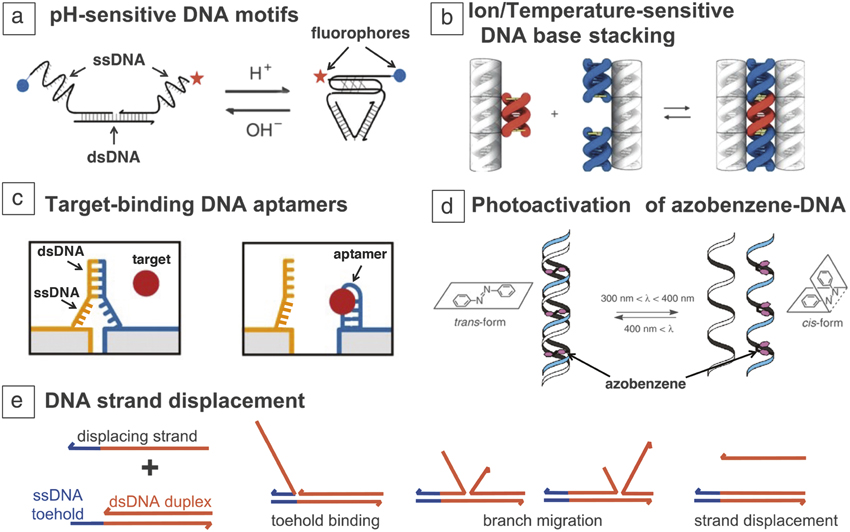
Environmentally responsive structural motifs include guanine- and cytosine-rich sequences that fold into stable quadruplexes Reference Surana, Bhat, Koushika and Krishnan29 in the presence of specific metal ions and low pH ( Figure 3a), ion- and temperature-sensitive base stacking Reference Gerling, Wagenbauer, Neuner and Dietz22 (Figure 3b), and sequences that can be switched from right- to left-handed. Reference Mao, Sun, Shen and Seeman30 Single-stranded aptamers, produced by in vitro selection, Reference Ellington and Szostak31 can bind a wide variety of ligands (Figure 3c). The corresponding structural changes can be used to create a sensor by, for example, modulating interactions between fluorophores or activating a catalyst. Light can trigger motion—planar azobenzene moieties intercalated between base pairs isomerize on ultraviolet illumination to destabilize the duplex; they can be switched back reversibly using visible light Reference Asanuma, Ito, Yoshida, Liang and Komiyama32 (Figure 3d). Structures can also be changed by site-specific enzymatic ligation, cleavage, or degradation. Reference Yin, Yan, Daniell, Turberfield and Reif33,Reference Stojanovic and Stefanovic34 Response times range from milliseconds for quadruplex formation to (typically) seconds or hours for enzymatic modification or optical actuation. Sensors can be interfaced directly to molecular computers Reference Benenson, Gil, Ben-Dor, Adar and Shapiro35 and used to drive simple molecular machines. Reference Liedl and Simmel36
Examples of DNA nanostructure response elements. DNA structure motifs that can respond to biophysical stimuli include (a) cytosine-rich sequences that form a secondary structure at acidic pH. Reprinted with permission from Reference Reference Surana, Bhat, Koushika and Krishnan29. © 2011 Macmillan Publishers Ltd. (b) DNA base-stacking interactions that dissociate with increasing temperature or decreasing counterion concentrations. The helices that stack are indicated in red and blue. Reprinted with permission from Reference Reference Gerling, Wagenbauer, Neuner and Dietz22. © 2015 AAAS. (c) DNA aptamers that bind specific targets and upon binding, undergo a conformational change that can dissociate a dsDNA duplex. Reprinted with permission from Reference Reference Douglas, Bachelet and Church45. © 2012 AAAS. (d) DNA duplexes that incorporate photo-switchable azobenzene molecules, which change conformation in response to light to influence the stability of DNA hybridization. Reprinted with permission from Reference Reference Asanuma, Liang, Nishioka, Matsunaga, Liu and Komiyama46. © 2007 Macmillan Publishers Ltd. (e) (Left to right) Elements designed to undergo toehold-mediated strand displacement where one strand in a duplex is displaced by a new strand that initially binds to a ssDNA region of the complement strand. Reference Yurke, Turberfield, Mills, Simmel and Neumann37,Reference Srinivas, Ouldridge, Sulc, Schaeffer, Yurke, Louis, Doye and Winfree38 Note: λ, wavelength; dsDNA, double-stranded DNA; ssDNA, single-stranded DNA.
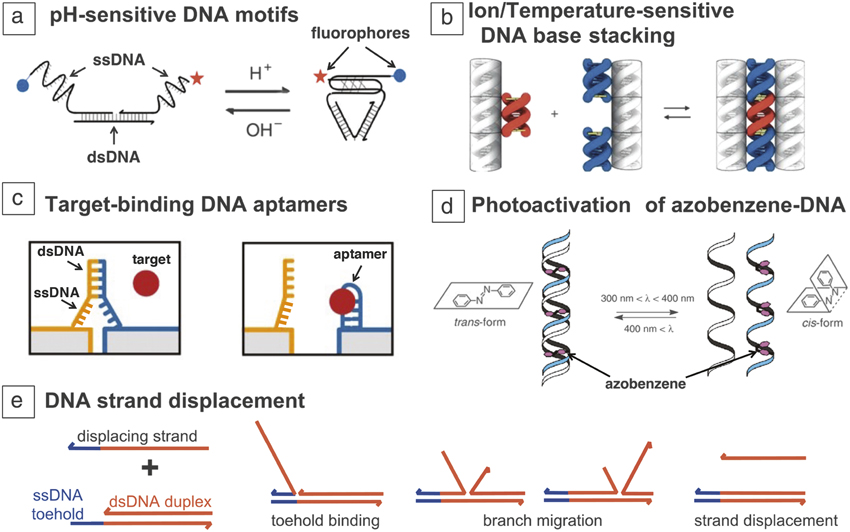
Perhaps the most flexible means of inducing changes in nucleic acid nanostructures is the displacement of one oligonucleotide from a duplex by another Reference Yurke, Turberfield, Mills, Simmel and Neumann37,Reference Srinivas, Ouldridge, Sulc, Schaeffer, Yurke, Louis, Doye and Winfree38 (Figure 3e). Strand displacement is frequently used for signaling and actuation; it can also be used to sense specific nucleic acid sequences for medical diagnosis or to interface natural cellular control mechanisms. The rate of strand invasion can be greatly increased by the use of “toeholds,” single-stranded regions of the target complex to which the invader can bind to initiate the reaction Reference Yurke, Turberfield, Mills, Simmel and Neumann37 forming additional base pairs that provide a thermodynamic driving force for invasion. Strand displacement reactions are relatively slow (typical systems take from seconds to hours), but a high degree of control can be achieved through sequence design. Reference Srinivas, Ouldridge, Sulc, Schaeffer, Yurke, Louis, Doye and Winfree38 Strand-displacement reactions can join and release components, open and close cages, and change shapes; they form the basis of a system for molecular computation capable of calculating a square root. Reference Qian and Winfree39
Dynamic DNA systems often require repeated external stimulation to achieve cyclic motion. They can, however, be designed to run continuously, powered by chemical energy sources such as hybridization Reference Turberfield, Mitchell, Yurke, Mills, Blakey and Simmel40 or enzymatic cleavage, Reference Bath, Green and Turberfield41,Reference Tian, He, Chen, Yin and Mao42 or by light. Reference You, Chen, Zhang, Liu, Wang, Wang, Williams and Tan43 Functions implemented by autonomous DNA machines include motion along self-assembled tracks Reference Bath, Green and Turberfield41–Reference You, Chen, Zhang, Liu, Wang, Wang, Williams and Tan43 and programmable chemical synthesis. Reference He and Liu44 The ability of nucleic acid nanostructures to operate autonomously and to sense, compute, and actuate suggests applications in medical diagnosis and locally controlled drug delivery; Reference Benenson, Gil, Ben-Dor, Adar and Shapiro35 this is a strong theme in the development of the field.
Functional properties beyond geometry
The ability to design a response to the environment is a promising foundation for designing nanomaterials, devices, and machinery that can sense the local environment, transfer motion, forces, and energy, and process information at the molecular scale. From a mechanical standpoint, dsDNA is often treated as a flexible rod with a diameter of 2 nm and a Young’s modulus of ∼300 MPa. Reference Douglas, Bachelet and Church45–Reference Bustamante, Smith, Liphardt and Smith47 While more advanced models of DNA have been developed, Reference Kim and Kim48 the flexible rod model is a useful context to consider the mechanical behavior of DNA nanostructures. The range of accessible mechanical properties in DNA-based design can be expanded by using ssDNA, which behaves mechanically like a flexible polymer, or bundles of many dsDNA helices that exhibit bending stiffness 3–5 orders of magnitude higher, with bundles of ≳50 helices even approaching the bending stiffness of carbon nanotubes. Reference Castro, Su, Marras, Zhou and Johnson49 In addition, the cross-sectional shape of bundles can be controlled to design anisotropic mechanical behavior. Reference Castro, Su, Marras, Zhou and Johnson49,Reference Zhou, Marras, Su and Castro50 This approach to controlling stiffness and deformation degrees of freedom by geometric design is analogous to compliant mechanism design in micro- or macroscale engineering systems. Reference Zhou, Marras, Castro and Su51
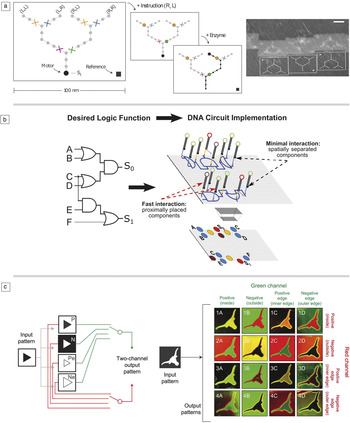
Combined with precise control over geometry, the design of component stiffness and local flexibility enables mechanical and dynamic functions such as controlled motion, Reference Gerling, Wagenbauer, Neuner and Dietz22,Reference Bath and Turberfield28,Reference Marras, Zhou, Su and Castro52 tunable stiffness or compliance, Reference Zhou, Marras, Su and Castro50 bistability, Reference Zhou, Marras, Su and Castro53 conformational dynamics, Reference Hudoba, Luo, Zacharias, Poirier and Castro54 and mechanically propagated conformational changes. Reference Song, Li, Wang, Meyer, Mao and Ke55 Dynamic properties are generally designed by incorporating flexible ssDNA components, Holliday junctions, which are rotationally flexible, or dsDNA, which can deform by bending. DNA motors, for example, achieve motion through a series of hybridization interactions with steps between successive binding sites enabled by thermal fluctuations of flexible junctions or ssDNA. Reference Pan, Li, Cha, Chen and Choi56 DNA motors can achieve functions, including directional motion, Reference Omabegho, Sha and Seeman57 cargo transport, Reference Cha, Pan, Chen, Salgado, Li, Mao and Choi58 and navigating a network of tracks Reference Wickham, Bath, Katsuda, Endo, Hidaka, Sugiyama and Turberfield59 ( Figure 4a).
Dynamic molecular nanosystems operating through DNA-mediated interactions. (a) Left: A DNA track network assembled on a rectangular DNA origami substrate. Starting from position S1, a motor can navigate left (L) or right (R) at the junctions, based on the instruction strands added, and reach the corresponding end positions on the other end. Selective displacement of blocking strands from junction stators (colored crosses) opens just one path (colored circles). Right: Tracks decorated with excess motor visualized by atomic force microscopy. Reference Wickham, Bath, Katsuda, Endo, Hidaka, Sugiyama and Turberfield59 Scale bar = 50 nm. (b) Schematic representation of the spatially localized “DNA domino” circuit architecture. A desired logic function (logic diagram on the left, Inputs: A–F, Outputs: S0, S1) is (right: top) mapped onto the DNA origami scaffold and specific staple strands are modified with corresponding hairpin components. (Right: bottom) A top-view representation of the corresponding localized circuit with the basic components: input (blue circles), intermediate (yellow circles), output (red circles), and threshold (brown circles) hairpins. Reference Chatterjee, Dalchau, Muscat, Phillips and Seelig70 (c) Left: Scheme of the pattern-transformation programs. Note: P, positive image; N, negative image; Pe, positive edge; Ne, negative edge. The resultant two-channel output patterns are detectable through green and red channels as represented in the scheme in green and red, respectively. Right: A total of 16 different two-channel output patterns (1A–4D, corresponding pattern transformations for green and red channels shown on the matrix edges) were generated from the same input pattern through 16 different pattern-transformation programs. Adapted with permission from Reference Reference Chirieleison, Allen, Simpson, Ellington and Chen73. © 2013 Macmillan Publishers Ltd.

Mechanical design of DNA origami has also led to expanded function of dynamic nanodevices, for example, to construct joints for angular motion, Reference Marras, Zhou, Su and Castro52 sliding joints that achieve translation, Reference Marras, Zhou, Su and Castro52 or rotors for continuous rotation. Reference Ketterer, Willner and Dietz60 Integrating these approaches into multicomponent devices has led to DNA origami mechanisms such as devices that couple rotation and translation or compact and expand, Reference Marras, Zhou, Su and Castro52 or complex linkages that couple several rotating elements. Reference Gerling, Wagenbauer, Neuner and Dietz22 Additional design capabilities include devices such as tensegrity structures, Reference Liedl, Hogberg, Tytell, Ingber and Shih61 which integrate and balance components experiencing tension and compression, and devices that exhibit tunable compliance Reference Zhou, Marras, Su and Castro50 or bistable behavior, Reference Zhou, Marras, Su and Castro53 or undergo inherent conformational dynamics that are responsive to the local environment. Reference Hudoba, Luo, Zacharias, Poirier and Castro54 These nanoscale mechanisms provide a platform to design nanomachines that function much like macroscopic engineering machines; or they could be designed with geometries and shape transformations similar to periodic units of structural metamaterials. Reference Bauer, Meza, Schaedler, Schwaiger, Zheng and Valdevit62 Combined with assembly into larger arrays Reference Tikhomirov, Petersen and Qian63 and the ability to integrate other materials, response elements, and computation, DNA nanotechnology presents a foundation to design nano- and microscale materials systems for a wide range of applications.
DNA-based computation
What sets DNA materials apart from other approaches to engineering environmentally responsive or “programmable” materials is the high complexity of the control circuits that could potentially be integrated in such materials and that have already been demonstrated in DNA computing. The idea of DNA-based computation goes back at least to Adelman’s pioneering work, Reference Adleman64 in which he exploited the specificity of DNA hybridization to solve difficult computational problems. However, to be competitive with electronics, unrealistically large amounts of DNA would be required. This recognition resulted in a shift in focus for DNA computing away from general purpose computing toward biomedical Reference Chen and Seelig65 or materials science applications Reference Bhalla, Bajpai and Bharadwaj66 where relatively small amounts of computation could result in considerable improvement in environments that may not be compatible with electronics.
This second generation of DNA computing resulted in a wide range of multi-input molecular circuits that realize, at the molecular level, computing architectures from digital logic circuits Reference Qian and Winfree39 to analog circuits Reference Chen, Dalchau, Srinivas, Phillips, Cardelli, Soloveichik and Seelig67 to neural networks. Reference Qian, Winfree and Bruck68 In these approaches, both the circuit elements and inputs are diffusible DNA strands or multistranded complexes that encounter each other at random in solution and react with one another based on the information encoded in their sequences. Once initiated, computation proceeds autonomously and in a highly parallel manner. Reference Zhang and Seelig69 Because of the predictability of Watson–Crick base pairing and because reactions can be tested in cell-free settings, it has been possible to rapidly scale-up system complexity, and, at least for now, DNA circuits constitute the largest molecular circuits fully rationally designed by humanity.
Still, these circuits were not meant to be integrated with DNA nanostructures or other smart materials. Reactions occur in well-mixed settings rather than as coordinating components of a structured nanomaterial, and computational components were not connected materials. However, recent work that exploits spatial organization as a lever for controlling how computation occurs suggests a way forward toward the integration of complex computational controllers with DNA materials. Reference Chatterjee, Dalchau, Muscat, Phillips and Seelig70 In this approach, logic gates or similar building blocks are attached to a molecular scaffold (the material), and interactions between elements are constrained to occur between adjacent components (Figure 4b). Reference Chatterjee, Dalchau, Muscat, Phillips and Seelig70 From a computational perspective, such spatial organization has two clear advantages. First, identical sequences can be used throughout the circuits, which eliminate the sequence design problem. Second, reactions can be orders of magnitude faster than for architectures with diffusible components because of the high effective concentrations. Reference Dalchau, Chandran, Gopalkrishnan, Phillips and Reif71 Most importantly, because computation already occurs on the surface of a nanostructure, it is easy to imagine how such circuitry could be used to imbue reconfigurable nanostructures, which currently respond to a small number of signals, with complex embedded controllers.
Programmed reaction-diffusion patterns provide an intriguing alternative paradigm for bringing DNA-based embedded control to materials science. Reference Epstein and Xu72 Because pattern formation is based on diffusible materials, it can occur within a matrix of other materials that provide structural integrity to the target system (Figure 4c). Reference Chirieleison, Allen, Simpson, Ellington and Chen73 This could reduce the cost and increase the range of accessible materials characteristics compared to an all-DNA material. Reaction-diffusion patterning is ubiquitous in biology, and there are several examples of chemical systems capable of pattern formation, most famously, the Belousov–Zhabotinskii reaction, resulting in a nonlinear chemical oscillator. Reference Zadorin, Rondelez, Galas and Estevez-Torres74 However, such systems tend to lack the programmability required for creating precisely defined patterns and materials. Engineered pattern formation using cell-free biochemical systems, and in particular, DNA-only systems, provide an intriguing path toward self-patterning materials with macroscopic extension and customizable properties. Reference Chirieleison, Allen, Simpson, Ellington and Chen73
Conclusion
DNA nanostructures have been used as nanopores for sensing or as masks for lithography. Marrying DNA nanostructures to biological or nonbiological materials has resulted in hybrid materials with exciting properties. The other articles in this issue provide detailed introductions to each aspect. In spite of the many exciting studies demonstrated, DNA nanotechnology remains a relatively young area whose potential needs to be fully explored by an increasing number of scientists in materials research.

Pengfei Wang is an AHA Postdoctoral Fellow at the Wallace H. Coulter Department of Biomedical Engineering at Emory University and the Georgia Institute of Technology. He obtained his BS and MS degrees in materials science and engineering from Tianjin University, China, and his PhD degree in biomedical engineering from Purdue University. His research interests include nucleic acid self-assembly and its applications in disease diagnosis and therapy, and metamaterial fabrication. Wang can be reached at pengfei.wang@emory.edu.

Gourab Chatterjee is a former postdoctoral researcher in the Department of Electrical Engineering at the University of Washington (UW). He received his BTech and MTech degrees in biotechnology and biochemical engineering from the Indian Institute of Technology, Kharagpur, and his PhD degree in Bioengineering from UW Seattle. His research focuses on developing novel nucleic acid-based nanoscale computational devices for in vitro and in vivo molecular diagnostics. He was a recipient of the AAAS Emerging Leaders in Science and Society Fellowship in 2015. Chatterjee can be reached by email at gourab@uw.edu.

Hao Yan is the Milton D. Glick Distinguished Professor in the School of Molecular Sciences and the Biodesign Institute at Arizona State University (ASU). He directs ASU’s Biodesign Center for Molecular Design and Biomimetics. Yan received his BS degree in chemistry from Shandong University, China, and his PhD degree in chemistry from New York University. Yan can be reached by email at hao.yan@asu.edu.

Thomas H. LaBean is a professor of materials science and engineering at North Carolina State University. He earned his BS and PhD degrees in biochemistry from the Honors College at Michigan State University and the University of Pennsylvania, respectively. His current research focuses on self-assembling DNA nanostructures for molecular materials, bioinspired nanoelectronics fabrication, and nanomedicine. LaBean can be reached by email at thlabean@ncsu.edu.

Andrew Turberfield is a professor of physics at the University of Oxford, UK. He received his BS degree in natural sciences at the University of Cambridge, UK, and his DPhil degree on hot electron relaxation in GaAs quantum wells at Oxford. His current research focuses on the limits of biomimetic nanometer-scale construction using DNA and other biomolecules, in particular, the operation and applications of synthetic molecular machinery. Turberfield can be reached by email at andrew.turberfield@physics.ox.ac.uk.

Carlos E. Castro is an associate professor in the Department of Mechanical and Aerospace Engineering at The Ohio State University. His received his bachelor’s and master’s degrees from The Ohio State University and his PhD degree in mechanical engineering from the Massachusetts Institute of Technology. He trained as an Alexander von Humboldt postdoctoral research fellow at the Technische Universität München, Germany. His current research focuses on the self-assembly of DNA nanomachines and nanodevices to probe biophysical functions of molecular and cellular systems. Castro can be reached by email at castro.39@osu.edu.

Georg Seelig is an associate professor in the Paul G. Allen School of Computer Science and Engineering and the Department of Electrical Engineering at the University of Washington. He is an adjunct associate professor of bioengineering. He received his PhD degree in physics from the University of Geneva, Switzerland, and completed postdoctoral research in synthetic biology and DNA nanotechnology at the California Institute of Technology. Seelig received a Burroughs Wellcome Foundation Career Award at the Scientific Interface in 2008, an NSF Career Award in 2010, a Sloan Research Fellowship in 2011, a DARPA Young Faculty Award in 2012, and an ONR Young Investigator Award in 2014. Seelig can be reached by email at gseelig@uw.edu.

Yonggang Ke is an assistant professor at the Wallace H. Coulter Department of Biomedical Engineering at Emory University and Georgia Institute of Technology. He received his PhD degree in chemistry from Arizona State University in 2009. He then worked as a postdoctoral fellow in the Department of Cancer Biology at Harvard University from 2009 to 2014. His current research focuses on programmable self-assembly of complex nanostructures and dynamic nanomachines using DNA and other biomolecules, functional nanomaterial self-assembly, drug delivery, and single-molecule biophysics. Ke can be reached by email at yonggang.ke@emory.edu.