Introduction
Among the available options for onboard storage of hydrogen in passenger vehicles powered by a proton exchange membrane (PEM) fuel cellReference Schlapbach and Zuttel1—compressed gas, cryogenic liquid, chemical hydrogen storage, sorbents, and solid hydrides—the latter stand out with several attractive features: low-cost materials, high volumetric and gravimetric densities, compatibility with onboard recharging at practical conditions, and high cycling stability (see the Introductory article in this issue). Waste heat from the PEM fuel cell can be used to supply the energy required for hydrogen release if the equilibrium temperature is tuned to the PEM operating temperature of approximately 80–90°C. First-generation metal hydrides based on LaNi5, a famous alloy that was developed for the NiMH-battery, offer volumetric storage densities exceeding those in cryogenic liquid H2, along with fast kinetics and highly composition-tunable thermodynamics. Unfortunately, the gravimetric density of hydrogen that can be stored in a metal hydride such as LaNi5H7 is only approximately 2%, which is too low to be economically viable for use in passenger vehicles. The fast kinetics and low gravimetric density can be traced to a common cause: hydrogen in these materials occupies interstitial sites so that the maximum number that can be accommodated is almost never larger than one hydrogen per metal atom.
The seminal discovery of reversible hydrogen storage in transition metal doped sodium alanate (NaAlH4) by Bogdanovic and co-workersReference Bogdanovic and Schwickardi2 ignited immense interest in a different class of compounds wherein hydrogen is bound chemically in ionic complexes such as AlH4, BH4, and NH2, bringing about storage capacities exceeding a single hydrogen per metal atom. Contrary to the prevailing wisdom that these complex anions are bound too strongly and the corresponding compounds are completely irreversible, Bogdanovic et al. demonstrated that hydrogen can be extracted reversibly according to the following two-step reaction:
 $${\rm{NaAlH}}_{\rm{4}} \leftrightarrow {\rm{1/3}}\,{\rm{Na}}_{\rm{3}} {\rm{AlH}}_{\rm{6}} + {\rm{2/3}}\,{\rm{Al}} + {\rm{H}}_{\rm{2}} {\rm{,}}$$
 $${\rm{Na}}_{\rm{3}} {\rm{AlH}}_{\rm{6}} \leftrightarrow {\rm{3}}\,{\rm{NaH}} + {\rm{Al}} + {\rm{3/2}}\,{\rm{H}}_{\rm{2}} {\rm{.}}$$
These reactions release more than 4 wt% H2 at 1 bar pressure within a few hours at 160°C and within an hour at 180°C.Reference Bogdanovic and Schwickardi2 Even though the gravimetric density of Reaction I is too low for practical applications in hydrogen fuel cell vehicles (the 2017 US Department of Energy system target is 5.5 wt% H2),3 sodium alanate has served as a model system for understanding hydrogen storage in complex hydrides with polar covalent metal-hydrogen bonds.
The next important discovery was by Chen and co-workers, who found that lithium amide, LiNH2, releases hydrogen above 200°C by decomposing into lithium imide, Li2NH, and lithium hydride, LiH.Reference Chen, Xiong, Luo, Lin and Tan4 Later, work at Sandia National Laboratories showed that the release temperature could be lowered substantially by mixing LiNH2 and MgH2.Reference Luo5 Since then, numerous other hydrides have been investigated using experimental and computational approaches; a review of experimental results can be found in other articles in this issue.
This article will concentrate on the main conceptual developments in the theoretical understanding and prediction of hydrogen storage in complex metal hydrides. We begin by surveying the methods for predicting the structure and energetics of unknown hydrides, followed by methods for calculating reaction thermodynamics and designing new storage reactions, and concluding with a discussion of the current theoretical understanding of reaction kinetics in bulk hydrides. Some key unsolved issues and possible directions for future work are outlined in the summary section.
Structure prediction
The discovery of reversibility in sodium alanate prompted researchers to use density functional theory (DFT) total energy calculations to predict the decomposition enthalpies of other complex hydrides and evaluate their suitability for reversible hydrogen storage. Since DFT calculations require unit cell parameters and atomic positions as input, accurate and complete data on crystal structures are needed. However, due to the difficulty in obtaining hydrogen positions using x-ray diffraction and challenges involved in synthesizing sufficiently large crystals for accurate characterization, crystal structures of many promising complex hydrides were not known. Hence, about a decade ago, there was an urgent need to develop methods that could accurately either predict the ground state or give a metastable structure within a few kJ/mol of the ground state.
Several ab initio techniques have been developed in an attempt to efficiently search the space of possible structures, including methods based on data mining of known compounds,Reference Curtarolo, Morgan, Persson, Rodgers and Ceder6 genetic algorithms,Reference Oganov and Glass7,Reference Trimarchi and Zunger8 swarm colony optimization,Reference Wang, Lv, Zhu and Ma9 simulated annealing,Reference Pannetier, Bassas-Alsina, Rodriguez-Carvajal and Caignaerte10 random searching,Reference Pickard and Needs11 basin hopping,Reference Goedecker12 and others. Many of these methods are entirely general in the sense that they do not require experimental information or physical intuition, but are currently restricted in their applicability to structures with small unit cells (typically 10–20 atoms).
Early attempts at predicting crystal structures of complex hydrides made use of incomplete experimental information about the system in question or incorporated properties from similar systems. The most straightforward of these approaches is to search for crystal structures of chemically similar compounds in a database, such as the Inorganic Crystal Structure Database (ICSD).Reference Belsky, Hellenbrandt, Karen and Luksch13 As an example, consider the prediction of the structure of NaAlH4. In this case, the ICSD could be searched for crystalline compounds with the formula ABX4, which would result in nearly one hundred distinct crystal structure types. Using DFT, a full structural relaxation and total energy calculation would be performed for each candidate, and the crystal structure with the lowest predicted total energy taken as the ground state. In the case of NaAlH4, this search would correctly identify the crystal structure type and symmetry because the database contains the mineral scheelite, CaWO4, which has the same symmetry and atomic topology as NaAlH4. Database searching has been used with great success to predict ground states and, in some cases, metastable low-energy states.Reference Løvvik, Opalka, Brinks and Hauback14,Reference Løvvik15 While simple and efficient, this approach is inadequate at unusual compositions, such as those for the bialkali alanate Na2KAlH6, for which there might only be a few known materials with similar stoichiometry. In other cases, the number of similar structures is too large (e.g., compositions of type AB) to evaluate exhaustively using DFT calculations. To reduce this list, sophisticated data mining techniques may be used to generate a subset of structures that have the highest probability of producing the ground state.Reference Curtarolo, Morgan, Persson, Rodgers and Ceder6 In all cases, there is no guarantee that database searching will find the true ground state because the energy landscape is not systematically explored.
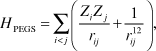
A more exhaustive search to predict new or unsuspected crystal structures using, for example, Monte Carlo sampling or evolutionary algorithms, is a computationally expensive task. In studies of complex hydrides, this search can be made more efficient using the prototype electrostatic ground state (PEGS) search method,Reference Majzoub and Ozolins16 which leverages two important observations about these materials: (1) structures of complex metal hydrides are characterized by an arrangement of positively charged cations (e.g., Na+) and negatively charged complex anions (e.g.,  ${\rm{AlH}}_{\rm{4}}^ -$), where strong covalent bonds exist within each anion unit, which can be treated as rigid groups during optimization, reducing the number of free variables that must be explored and thereby increasing the efficiency of the search; and (2) interactions between the cations and anions are dominated by electrostatics.Reference Majzoub and Ozolins16 These effects are accounted for by the PEGS Hamiltonian:
 $$H_{{\rm{PEGS}}} = \sum\limits_{i < j} {\left( {{{Z_i Z_j } \over {r_{ij} }} + {1 \over {r_{ij}^{12} }}} \right),}$$
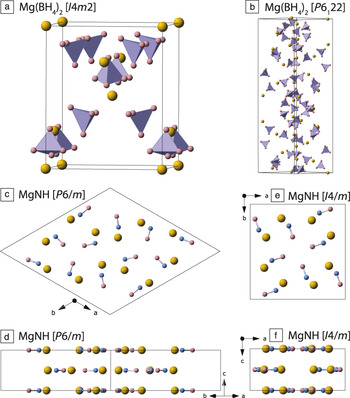
where the interaction between ions i and j depends on their charge, Z, and interatomic spacing, r ij. The sum runs over all ions, and the second term, a soft-core repulsion, is zero when i and j do not overlap. During optimization, the energy landscape is explored using the computationally inexpensive Hamiltonian in Equation 1, which, while not as realistic as the total energy from DFT, is found to produce topologies that are very similar to the DFT ground states. After minima in Equation 1 are located, relaxations using the more accurate, but much less efficient, DFT Hamiltonian are performed. With these improvements in efficiency, system sizes amenable to PEGS are well beyond the reach of more general search algorithms, while providing access to entirely new structure types that are not present in the ICSD. As an example, a novel T = 0 K ground state of Mg(BH4)2 with tetragonal  $I\bar 4m2$ symmetry was predicted using the PEGS search strategy (Figure 1a), which was lower in energy than all other previously predicted structures.Reference Ozolins, Majzoub and Wolverton17 Interestingly, its DFT total energy (calculated within the popular generalized gradient approximationReference Perdew, Ziesche and Eschrig18) is 5 kJ/mol lower than the experimentally determined P6122 structure with 30 formula units per primitive cell.Reference Cerny, Filinchuk, Hagemann and Yvon19–Reference Filinchuk, Cerny and Hagemann22 Subsequently, van der Waals corrections have been proposed to change the energetic stability favoring the denser P6122 structure.Reference Bil, Kolb, Atkinson, Pettifor, Thonhauser and Kolmogorov23 There have been numerous other applications of PEGS,Reference Kim, Hwang, Bowman, Reiter, Zan, Kulleck, Kabbour, Majzoub and Ozolins24–Reference Zhang, Majzoub, Ozolins and Wolverton28 demonstrating the effectiveness and versatility of this simple approach.
(a) Predicted and (b) experimental structures of Mg(BH4)2.Reference Majzoub and Ozolins16 Predicted structures of MgNH in the (c–d) P6/m Reference Kim, Hwang, Bowman, Reiter, Zan, Kulleck, Kabbour, Majzoub and Ozolins24 and (e–f) I4/m space groups. Purple tetrahedra and yellow, blue, and pink spheres represent B, Mg, N, and H atoms, respectively.

Recently, Meredig and Wolverton used a symmetry-constrained genetic algorithm to predict the structure of MgNH.Reference Meredig and Wolverton29 This represents a particularly difficult optimization due to the complexity of the energy surfaceReference Oganov and Valle30 and the large size of the experimental unit cell, which contains 36 atoms.Reference Dolci, Napolitano, Weidner, Enzo, Moretto, Brunelli, Hansen, Orlova, Fichtner and Lohstroh31 Using this method, the search space was constrained to structures in the experimental space group (P6/m), exploring combinations of Wyckoff sites and positions of atoms on these sites. The predicted ground state matched the proposed structure of Dolci et al., which had been determined from in situ neutron diffraction measurements.Reference Dolci, Napolitano, Weidner, Enzo, Moretto, Brunelli, Hansen, Orlova, Fichtner and Lohstroh31 Incidentally, this structure is only a few kJ/mol lower in energy than a simple 12-atom tetragonal structure of I4/m symmetry predicted using PEGS. This shows that even in cases where the true ground states are very complex, structures with smaller unit cells can be used to approximate the total energy to an accuracy that is more than sufficient for practical purposes. Indeed, as shown in Figure 1c–f, the structures are quite similar, with N–H bonds directed toward one another and Mg, N, and H atoms arranged on common (001) planes.
Thermodynamics
Reaction enthalpies
Hydrogen uptake and release is governed by a combination of thermodynamic and kinetic factors. The temperature at which desorption of H2 becomes thermodynamically possible is determined by the famous van’t Hoff equation,
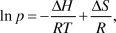 $$\ln p = - {{\Delta H} \over {RT}} + {{\Delta S} \over R},$$
where ΔH and ΔS are the enthalpy and entropy of the dehydriding reaction, respectively. According to Equation 2, there is a linear relationship between ln p and 1/T, where the slope is given by the reaction enthalpy ΔH, and the intercept is determined by the reaction entropy ΔS. ΔH is related to the bond strength between H and the storage material, while ΔS is dominated by the gas-phase entropy of H2 (ΔS 0= 130.68 J/(K mol H2) at T = 20°C and p = 1 bar),Reference Chase, Davies, Downey, Frurip, McDonald and Syverud32 and usually varies between 100 and 160 kJ/(mol H2),33 depending on the changes in the phonon frequencies from the reactants to the products.Reference Grimvall34
Practical requirements of onboard storage systems place limitations on the acceptable range of temperatures and pressures. According to Equation 2, these ranges may be translated into constraints on the desired values of ΔH. The upper temperature limit for hydrogen release, approximately 80°C, is set by the operating temperature of PEM fuel cells. Assuming that ΔS is dominated by the entropy of H2 gas and requires hydrogen release at ambient pressures below 80°C leads to an upper enthalpy limit of approximately 45 kJ/(mol H2). Requiring rehydrogenation at a pressure of a few hundred atmospheres or less gives the lower enthalpy a limit of approximately 20 kJ/(mol H2). The search for new hydrogen storage materials within the 20–45 kJ/(mol H2) range of enthalpies has been one of the main focal points of computational research during the last decade.
If the reaction entropy is lower than the standard state entropy of H2 gas, then the targeted range of enthalpies also becomes lower,Reference Ozolins, Majzoub and Wolverton35 which can have a beneficial effect because lower enthalpy reactions release a smaller amount of heat during exothermic regeneration of the storage material. A rule of thumb for designing complex hydride reactions with low entropies is to use reactants that have complex anions constituted by a small number of atoms (e.g., NH2, BH4), resulting in a high number of low-frequency phonon modes per atom and high vibrational entropy in the hydride. Entropy lowering is especially large if the products are either tightly bound bulk phases (such as NaH) or materials with large complex anions (e.g., B12H12); in both cases, there are few low-frequency phonon branches.Reference Ozolins, Majzoub and Wolverton35
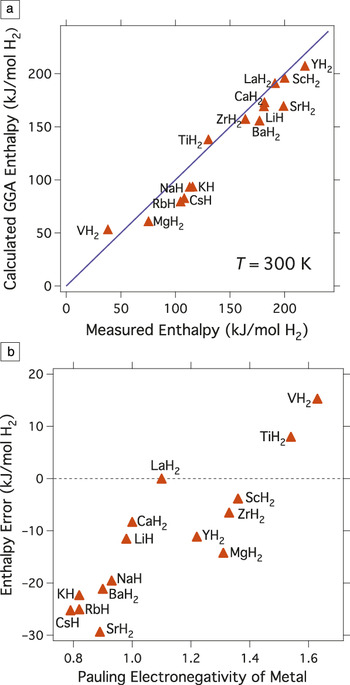
Before attempting to predict new hydrogen storage materials, it is important to address the question of whether current ab initio methods can predict sufficiently accurate values of ΔH. A meaningful comparison with the experimental values requires one to include vibrational contributions, due to both zero-point motion and finite-temperature effects. For instance, in the case of sodium alanate, static DFT calculationsReference Ozolins, Majzoub and Udovic37 using the popular generalized gradient approximation (GGA)Reference Perdew, Ziesche and Eschrig18 predict reaction enthalpies of 34 and 50 kJ/(mol H2) for the first and second decomposition steps, respectively, seemingly in excellent agreement with the experimental enthalpy values of 35–37 and 47–48 kJ/(mol H2).Reference Bogdanovic, Brand, Marjanovic, Schwickardi and Tolle38,Reference Gross, Thomas and Jensen39 However, a physically more realistic treatment, including vibrational contributions, shows that GGA actually underestimates the reaction enthalpies and equilibrium temperatures by approximately 10 kJ/(mol H2) and 100°C, respectively. Calculated enthalpy errors for other complex hydrides are of similar magnitude.Reference Akbarzadeh, Ozolins and Wolverton40–Reference Pozzo and Alfe44 Insight into the source of errors can be gained by considering the calculated room-temperature formation enthalpies of simple hydrides, shown in Figure 2a. Although the DFT calculations perform very well in reproducing trends in the experimental enthalpies, worst-case errors can exceed 10–20 kJ/(mol H2). Furthermore, the magnitude and sign of the error vary with the electronegativity of the metal, as shown in Figure 2b, going from underestimation for the alkali and alkali earth hydrides to overestimation in transition metal hydrides. This suggests that GGA has difficulty describing the different types of bonding encountered in metals and their hydrides—covalent, metallic, and ionic—on an equal basis. Incidentally, careful diffusion quantum Monte Carlo (QMC) calculations for magnesium hydride (MgH2) give a significantly improved formation enthalpy value of 82 kJ/(mol H2), deviating only by 6 kJ/(mol H2) from the experimental value of 76 kJ/(mol H2).Reference Wu, Allendorf and Grossman45 Unfortunately, QMC calculations remain cumbersome for bulk compounds, although they are becoming more common for small nanoparticles.Reference Wagner, Majzoub, Allendorf and Grossman46 These examples show that even though the current semi-local DFT functionals are useful for initial screening of potentially useful hydrogen storage materials, their accuracy needs to be further improved.
(a) Comparison of the calculated and measured formation enthalpies for simple hydrides at T = 300 K, including vibrational contributions.Reference Wolverton, Siegel, Akbarzadeh and Ozolins36 (b) Error in the calculated formation enthalpies at T = 300 K versus the Pauling electronegativity of the metal atom. GGA, generalized gradient approximation.

Destabilized reactions
Most of the recently proposed hydrogen storage reactions are based on the enthalpy destabilization ideas of Reilly and Wiswall.Reference Reilly and Wiswall47,Reference Reilly and Wiswall48 A canonical example of a destabilized reaction is the lithium borohydride (LiBH4) reaction with magnesium hydride (MgH2) demonstrated by Vajo et al. and Bosenberg et al.Reference Vajo, Skeith and Mertens49,Reference Bosenberg, Doppiu, Mosegaard, Barkhordarian, Eigen, Gutfleisch, Klassen, Dornheim and Bormann50 By themselves, neither LiBH4 nor MgH2 are suitable for onboard storage because their decomposition enthalpies are too high: 67 and 76 kJ/(mol H2), respectively. However, the reaction enthalpy can be lowered significantly by mixing the two reactants in a 2:1 ratio, as the formation of a strongly bound magnesium diboride (MgB2) compound “destabilizes” the reactants relative to the new decomposition products. In this way, an entirely new reaction is obtained with an enthalpy value of ΔH = 42 kJ/(mol H2),Reference Vajo, Skeith and Mertens49 much lower than the enthalpies of either of the “pure” reactions and within the desired range for reversible onboard storage systems.
Based on these ideas, a large number of possible destabilized reactions with favorable enthalpies has been suggested by theoretical calculations.Reference Bosenberg, Doppiu, Mosegaard, Barkhordarian, Eigen, Gutfleisch, Klassen, Dornheim and Bormann50–Reference Alapati, Johnson and Sholl53 However, not all such reactions will be thermodynamically reversible and follow the pathway that was initially proposed because there are strict rules that have to be obeyed by properly designed destabilized reactions.Reference Siegel, Wolverton and Ozolins54
The simplest design condition concerns thermodynamic stability, requiring that all reactants should be stable with respect to dehydrogenation below the temperature of the destabilized reaction. Systems where the enthalpy to decompose one or more of the reactant phases is less than the enthalpy of the proposed destabilized reaction violate this simple condition. Assuming that ΔS values are roughly equal in all cases, this can be expressed as a condition on enthalpies: ΔH 1 > ΔH destab and ΔH 2 > ΔH destab.
A second, less obvious, requirement is that both sides of the reaction should contain thermodynamically stable combinations of compounds, such that hydrogen release is not possible before the desired destabilized reaction. For instance, one can write a destabilized reaction for a mixture of lithium borohydride and metallic magnesium as 2LiBH4 + Mg ↔ MgB2 + 2LiH + 3H2. However, instead of following this guessed pathway, the reactants can instead undergo an exothermic transformation into a mixture of LiBH4, MgH2, MgB2, and LiH because one of the reactants (Mg) can extract hydrogen from the other (LiBH4).Reference Reilly and Wiswall47,Reference Reilly and Wiswall48
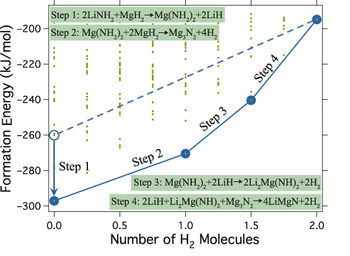
The third rule concerns possible changes to the reaction pathways and thermodynamics by tuning the relative amounts of the reactants. Perhaps somewhat counterintuitively, this rule states that it is not possible to tune the thermodynamics of destabilized reactions by adjusting the molar fractions of the reactants. There is only one stoichiometry corresponding to a single-step reaction with the lowest possible enthalpy; all other stoichiometries will release hydrogen in multistep reactions, where the initial reaction is given by the lowest-enthalpy reaction. An example of this behavior is shown in Figure 3 for the 1:1 mixture of lithium amide (LiNH2) and magnesium hydride (MgH2). Instead of decomposing in a single step as LiNH2 + MgH2 ↔ LiMgN + 2H2, which would have a desirable reaction enthalpy of 32 kJ/(mol H2), the thermodynamically preferred pathway is a complex multistep process where the first (exothermic) step is the ion exchange between the reactants and the formation of magnesium amide (Mg(NH2)2) and lithium hydride (LiH). Successive steps involve the decomposition of Mg(NH2)2 and the formation and eventual decomposition of the mixed lithium-magnesium imide (Li2Mg(NH)2). Only the third step falls in the desired temperature range, while the others are either below or above the targeted enthalpy range.
Convex hull constructed from the calculated static density functional theory energiesReference Akbarzadeh, Ozolins and Wolverton40 for determining thermodynamically reversible reaction pathways in a mixture of LiNH2 and MgH2. Unstable combinations of compounds are shown as dots for rational phase ratios with a common denominator of up to 4, while the stable states are shown as filled circles. The proposed (irreversible) reaction pathway directly into LiMgN and 2H2 is denoted by a dashed line, while the thermodynamically reversible pathway involves four distinct reactions.

Reaction pathways
A formally rigorous construct for determining thermodynamically reversible reactions is the so-called convex hull, shown in Figure 3.Reference Akbarzadeh, Ozolins and Wolverton40 For a given composition of the starting material, one determines all possible combinations of the phases and plots the resulting total energies versus the number of gas-phase H2 molecules; these are shown as dots in Figure 3. The lowest-energy points, marked as filled circles, form a convex hull, the segments of which represent distinct thermodynamically reversible reactions; slopes of these segments give the reaction enthalpies. The convex hull provides a graphical interpretation of the three design rules that are discussed in the previous section. Indeed, the first rule states that reactions follow the convex hull, and any one-step reaction that lies above it will break into multiple steps. The second rule states that the starting mixture of reactants must lie on the convex hull, while the third rule is equivalent to the fact that the number of vertices on the convex hull in the multidimensional composition space is finite.
The aforementioned rules are valuable for checking the correctness of a given candidate reaction, but they do not tell us what all thermodynamically favored reactions are in a given multicomponent system. This problem is addressed by the so-called grand canonical linear programming (GCLP) approach.Reference Akbarzadeh, Ozolins and Wolverton40 GCLP is based on minimizing the total free energy of an open system that can exchange hydrogen with a gas-phase reservoir under a given chemical potential, which is a function of pressure and temperature. The free energy minimization uniquely determines the phase fractions of compounds present at each composition, and possible hydrogen storage reactions are identified from the changes in the phase fractions upon varying the hydrogen chemical potential. GCLP has been used to find all possible hydrogen storage reactions using a large database of known hydrides,Reference Pozzo and Alfe44 and it has been recently applied to identify new conversion reactions for lithium battery anode materials.Reference Kirklin, Meredig and Wolverton55 GCLP, together with the structure prediction tools described previously, constitutes a powerful framework for predicting new materials for energy storage.
An important question is whether practically useful hydrogen storage reactions have to follow the thermodynamically preferred pathway, such as the one shown in the convex hull in Figure 3. While most of the currently known reactions satisfy this requirement, there are interesting exceptions where reversible hydrogenation follows a metastable pathway. In the case of lanthanum nickel hydride (LaNi5Hx), the lowest energy pathway is LaNi5H7 ↔ LaNi5 + 7/2 H2. However, in experiments, one often observes disproportionation into a stable lanthanum hydride (LaH2) and Ni, where the resulting LaH2 is irreversible.Reference Bowman and Fultz56 This is an example where a thermodynamically unstable combination of phases can form during the reaction due to kinetic reasons. The exact mechanism for this process is currently unknown, but methods to suppress it, such as the addition of small amounts of tin,Reference Bowman, Luo, Ahn, Witham and Fultz57 have been devised, suggesting that catalysts, alloying, or other strategies can be used to control kinetic factors. One can surmise that altering thermodynamic driving forces would be much more difficult, and hence a thermodynamically reversible pathway is still a highly desirable, in fact a necessary (but not sufficient), feature of a good hydrogen storage material.
Finite size effects
While the thermodynamics of traditional metal hydrides can be systematically tuned by changing their composition, most complex hydrides are bulk-immiscible ionic compounds, and their decomposition enthalpies cannot be adjusted by bulk alloying. Control over particle size offers an alternative way to tune the thermodynamic and kinetic properties of complex hydrides. In a pioneering work, Wagemans et al.Reference Wagemans, van Lenthe, de Jongh, van Dillen and de Jong58 used DFT calculations to show that the reaction thermodynamics in MgH2 nanoparticles could be lowered significantly due to the different finite-size destabilization energies for the hydride versus magnesium metal. Accurate diffusion QMC calculations of nanoparticle decomposition enthalpies generally agree with the DFT results qualitatively, but not quantitatively.Reference Wu, Allendorf and Grossman45 In a recent study, Wagner et al.Reference Wagner, Majzoub, Allendorf and Grossman46 predicted that for sizes below 1 nm, Al/Mg alloyed hydride nanoparticles are stable relative to the pure compositions, in contrast to bulk hydrides that are practically immiscible. This suggests an interesting approach to tuning reaction enthalpies of complex hydrides by exploiting size and composition effects simultaneously.
Balde et al.Reference Balde, Hereijgers, Bitter and de Jong59 demonstrated that reduction in particle size can accelerate the reaction rate and even change the decomposition pathway. Ultra-small particles of NaAlH4 in the 2–10 nanometer size range showed increased reaction kinetics and dramatically lowered activation energy even without the Ti catalyst. Furthermore, in very small particles, the intermediate Na3AlH6 phase was not observed, and decomposition proceeded directly into metallic Al and NaH.Reference Balde, Hereijgers, Bitter and de Jong59 Theoretical studies generally agree with these observations. Using an innovative cluster expansion technique, Mueller and Ceder have calculated the effect of particle size on the decomposition pathways and enthalpies for sodium alanate nanoparticles.Reference Mueller and Ceder60 They found that the high surface energy of Na3AlH6 destabilizes this phase when the decomposing sodium alanate particles have radii below approximately 50 nm. The PEGSReference Majzoub and Ozolins16 and GCLPReference Akbarzadeh, Ozolins and Wolverton40 methods have been extended to treat finite nanoparticles and used to predict the structures, decomposition pathways, and reaction enthalpies of very small particles (up to 8 formula units) of NaAlH4. These methods also predict a direct decomposition into NaH and Al with reaction enthalpies that are significantly different from the bulk.Reference Majzoub, Zhou and Ozolins27 The intermediate Na3AlH6 phase is avoided because an isolated  ${\rm{AlH}}_{\rm{6}}^{{\rm{3 - }}}$ anion is unstable due to an accidental degeneracy of the partially occupied electronic orbitals of A1g and Eg symmetry.33 Presence of the crystal field in bulk Na3AlH6 lifts the degeneracy and stabilizes
 ${\rm{AlH}}_{\rm{6}}^{{\rm{3 - }}}$, but in very small particles, where a large fraction of the alane groups are under-coordinated, the stabilizing effect is weak, and consequently
 ${\rm{AlH}}_{\rm{6}}^{{\rm{3 - }}}$ breaks up into
 ${\rm{AlH}}_{\rm{4}}^ -$ and two H– anions.
Overall, using nanoscale particles appears to be an interesting route for improving the properties of known bulk hydrides, but much more work is needed in this area both theoretically and experimentally. Almost all theoretical studies of hydride nanoparticles assume isolated gas-phase clusters in vacuum and neglect interactions with the support material, which is usually some form of nanoporous carbon or metal-organic framework (MOF). Future work in this area should settle the question of how the interaction with the support changes the reaction thermodynamics. While size has been suggested to play a stronger role than interaction with the support for NaAlH4 in MOF Cu-BTC,Reference Bhakta, Maharrey, Stavila, Highley, Alam, Majzoub and Allendorf61 experimental results for LiBH4 nanoparticles in porous carbon indicate that the interaction effects are strong.Reference Liu, Peaslee, Jost, Baumann and Majzoub62
Kinetics
Based on the methods described in the previous section, several promising high-capacity hydrogen storage reactions have been designed theoretially.Reference Ozolins, Majzoub and Wolverton35,Reference Alapati, Johnson and Sholl51–Reference Alapati, Johnson and Sholl53 Almost all of these reactions are based on borohydrides and amides, which have very slow H2 release and absorption rates, or completely lack reversibility.Reference Sakintuna, Lamari-Darkrim and Hirscher63 Attempts to improve kinetics have mostly followed the ideas that worked well for alanates: doping with transition metals and reducing particle size. However, this strategy has had mixed success. For instance, in Li4BN3H10, Ti was found to have no effect on the hydrogen release rates, while Ni, which is not an effective catalyst for NaAlH4, was found to work well,Reference Pinkerton and Meyer64 indicating that very different mechanisms are operational. Attempts to catalyze hydrogen storage in borohydrides have achieved modest success, and reversibility remains a challenging goal.Reference Li, Yan, Orimo, Züttel and Jensen65
Theoretical studies have focused on understanding the individual steps in hydrogen release and uptake reactions, so that effective catalysts could be designed based on the microscopic understanding of the kinetic bottlenecks. Most of this work has concentrated on sodium alanate, a prototypical complex hydride, where the addition of small amounts of transition metal or rare-earth catalyst can boost the reaction kinetics by many orders of magnitude.Reference Bogdanovic and Schwickardi2 In spite of voluminous literature, the exact mechanisms of the catalytic effect of transition metal doping are still being disputed. Here we outline some of the better-understood aspects of hydrogen release with emphasis on mass transport and hydrogen dissociation.
Native defects and bulk diffusion
Metal ions in NaAlH4 exist in a 1:1 ratio, but during decomposition, segregate into Al-rich (Al) and Na-rich (Na3AlH6) phases. The long-range metal transport that takes place during this segregation occurs at surprisingly low temperatures, near the boiling point of water and well below the melting temperature of any of these three phases.Reference Bogdanovic and Schwickardi2 Diffusion of Na through bulk Al is negligible at these temperatures, so it can be surmised that mass transport must occur through either NaAlH4 or Na3AlH6. In the following, we discuss the detailed analysis used to study this mass transport process, focusing on the reaction morphology, gradients in both chemical potentials and defect concentrations, and defect diffusivities.
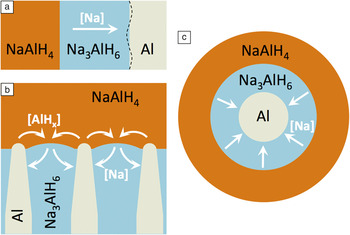
Reaction morphologies (i.e., the arrangement of the reactants and reaction products and the corresponding interfaces) are key for discussing diffusion. There are three basic models shown in Figure 4a–c, in which growth occurs in one, two, and three dimensions, respectively. In the case of 1D and 3D growth, diffusion occurs through the middle phase, which grows or shrinks as the reaction proceeds. This will result in a changing reaction rate with time, whereas a constant rate of hydrogen release is observed in Ti catalyzed NaAlH4.Reference Bogdanovic and Schwickardi2,Reference Sandrock, Gross and Thomas66 This observation is more consistent with Figure 4b, which involves a lamellar morphology in which mass transport can occur through both hydrides simultaneously. Here, the relative thicknesses of the Al lamella increase with the distance from the reaction front until reaching the limiting ratio determined by the volume fractions of the products of Reaction I. During dehydrogenation, there is an outward growth of Na3AlH6 and a gradual widening of Al lamella behind the reaction front. The average diffusion length is determined by the inter-lamellar spacing at the reaction front, which stays constant throughout this process.
Distinct types of reaction morphologies in sodium alanate: (a) One-dimensional morphology where metal mass transport occurs through the growing product phase Na3AlH6.Reference Michel and Ozolins67,Reference Michel and Ozolins68,Reference Michel and Ozolins70 (b) Two-dimensional lamellar morphology allowing simultaneous diffusion of AlHx and Na vacancies through NaAlH4 and Na3AlH6, respectively. (c) Three-dimensional core-shell morphology where Na vacancies diffuse through the expanding Na3AlH6 shell.

For simplicity, the following discussion is given in terms of the morphology shown in Figure 4a, but the concepts are easily generalized to the other morphologies and arrangement of phases within those morphologies. Quantitative progress can be made by assuming that a local equilibrium is established at each interface during Reaction I. The chemical potentials of metal species are then fixed by equilibrium between NaAlH4 and Na3AlH6 at the left (L) interface, and by Na3AlH6 and Al at the right (R) interface. Under these equilibria, the difference in the chemical potential of Al between interfaces is  ${\rm{\mu }}_{{\rm{Al}}}^{\rm{R}} - {\rm{\mu }}_{{\rm{Al}}}^{\rm{L}} = 3\Delta G_r /2,$ while the difference for Na is
 ${\rm{\mu }}_{{\rm{Na}}}^{\rm{R}} - {\rm{\mu }}_{{\rm{Na}}}^{\rm{L}} = - 3\Delta G_r /2,$ where ΔG r is the free energy change in Reaction I.Reference Michel and Ozolins67 At the equilibrium temperature for the reaction, ΔG r = 0, so that the chemical potential gradients vanish and there is no mass transport in the system. Above the equilibrium temperature, ΔG r < 0, which leads to imbalances in the chemical potentials such that
 ${\rm{\mu }}_{{\rm{Al}}}^{\rm{L}} > {\rm{\mu }}_{{\rm{Al}}}^{\rm{R}} {\rm{ and \mu }}_{{\rm{Na}}}^{\rm{L}} < {\rm{\mu }}_{{\rm{Na}}}^{\rm{R}} ,$ driving Al toward the interface with bulk Al and driving Na to the interface with NaAlH4. It is easy to see that these mass fluxes lead to the growth of Al and Na3AlH6 while NaAlH4 is consumed, as expected during the dehydrogenation reaction. Below the equilibrium temperature, during rehydrogenation, ΔG r > 0, so that
 ${\rm{\mu }}_{{\rm{Al}}}^{\rm{L}} < {\rm{\mu }}_{{\rm{Al}}}^{\rm{R}} {\rm{ and \mu }}_{{\rm{Na}}}^{\rm{L}} > {\rm{\mu }}_{{\rm{Na}}}^{\rm{R}} ,$ reversing the mass fluxes and growing NaAlH4 at the expense of Na3AlH6 and Al.
While the chemical potential gradients provide the driving force for mass transport, the reaction rate can be quantified by calculating the flux of Al and Na between the interfaces. With the assumption that these species are transported in the form of point defects, the flux of each defect, d, is given by
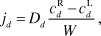 $$j_d = D_d {{c_d^{\rm{R}} - c_d^{\rm{L}} } \over W}\;,$$
where D d is the diffusivity (calculated using kinetic Monte Carlo simulationsReference Michel and Ozolins68), and  $c_d^{{\rm{R/L}}}$ are the defect concentrations at the right and left interfaces, which are separated by a distance W. The defect with the highest flux will be the one that controls the reaction rate. Therefore, the dominant mass transport mechanism can be identified after calculating the fluxes of all defects in all phases (reactants and products) involved in the hydrogen storage reaction.
The concentration of a defect in a fixed chemical environment is a function of its formation free energyReference Van de Walle and Neugebauer69
 $$\Delta G_d^{{\rm{R/L}}} = G_d^{{\rm{sc}}} - G_{{\rm{pure}}}^{{\rm{sc}}} - \sum\limits_s {n_s^d {\rm{\mu }}_s^{{\rm{R/L}}} + q_d {\rm{\varepsilon }}_{\rm{F}} }$$,
where  $G_d^{{\rm{sc}}}$ and
 $G_{{\rm{pure}}}^{{\rm{sc}}}$ are the free energies of the crystal with and without the defect, respectively. The sum in Equation 4 runs over all elements (Na, Al, and H), where
 $n_s^d$ is the number of atoms of element s in defect d. Due to the differences in the chemical potential at the left and right interfaces, the formation energies, and thus concentrations, of a given defect will differ between them, creating concentration gradients that produce net fluxes of Al and Na. The final term in Equation 4 depends on the charge of each defect, q d, and the Fermi level, εF, which can be determined by enforcing charge neutrality. This pinning of the Fermi level has been suspected as a possible route to catalyze the reaction, where the addition of charged dopant ions changes the location of the Fermi level and reduces the formation energy of native defects, increasing the associated fluxes.Reference Michel and Ozolins70 This process is discussed in more detail in the following section.
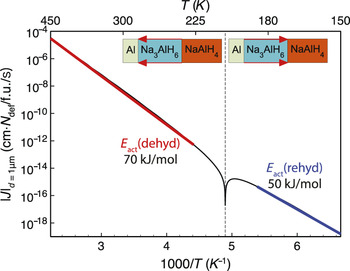
For Reaction I, detailed DFT calculations applied to the methods described show that the flux of negatively charged Na vacancies through Na3AlH6, charge-compensated by a flux of positive hydrogen vacancies, is the dominant metal mass transport mechanism.Reference Michel and Ozolins67,Reference Michel and Ozolins68,Reference Michel and Ozolins70 This is unexpected because previous studiesReference Gunaydin, Houk and Ozolins71,Reference Wilson-Short, Janotti, Hoang, Peles and Van de Walle72 were mostly concerned with diffusion in NaAlH4 and did not consider the possibility that Na3AlH6 could play an important role in the reaction kinetics. The activation energy for mass transport is obtained by fitting the Arrhenius equation to the calculated flux,  $j_d = j_0 \exp ( - E_{{\rm{act}}} /kT)$, where j 0 is independent of temperature. The flux of Na vacancies in Na3AlH6 is shown in Figure 5 along with the Arrhenius fits and calculated activation energies. Under dehydrogenation conditions, the activation energy is predicted to be 70 kJ/mol, near to the experimentally determined activation energy for Reaction I of 80 kJ/mol.Reference Sandrock, Gross and Thomas66 Similarly, the activation energy of 50 kJ/mol for mass transport during rehydrogenation compares well with the measured activation energy of 62 kJ/mol.Reference Luo and Gross73 We note that this formalism naturally accounts for the observed asymmetry in the measured activation energies for hydrogenation and dehydrogenation; the measured difference of 18 kJ/mol is very near the calculated value of 20 kJ/mol.
Flux of negatively charged Na vacancies through a 1-μm-wide region of Na3AlH6.Reference Michel and Ozolins67,Reference Michel and Ozolins68 Fits of the Arrhenius equation are applied to calculate the shown activation energies for dehydrogenation and rehydrogenation reactions. Arrows on the inset reaction morphologies show the direction of this flux under each of the two conditions.

Effect of Ti on native defects
One of the early hypotheses for enhanced kinetics due to Ti doping surmised that Ti substitutes in the bulk of NaAlH4 and accordingly facilitates the charge and mass transport processes required for phase-separating into the reaction products, Al and Na3AlH6.Reference Sun, Kiyobayashi, Takeshita, Kuriyama and Jensen74 Consequently, a large amount of calculations and experimental studies attempted to find signatures of Ti in bulk NaAlH4; these studies have not provided a conclusive answer as to the concentration and location of bulk-substituted Ti or even the existence of an appreciable concentration of such.Reference Brinks, Jensen, Srinivasan, Hauback, Blanchard and Murphy75 Most experimental studies indicate the presence of metallic Ti, likely in the form of a Ti-Al alloy after a few cycles of rehydrogenation.Reference Orimo, Nakamori, Eliseo, Zuttel and Jensen76 Theoretical calculations quickly determined that the energy required to form substitutional Ti defects in bulk alanate is very high, leading to equilibrium concentrations that are negligible.Reference Lovvik and Opalka77,Reference Lovvik and Opalka78 However, it is often argued that above-equilibrium amounts of Ti are incorporated into the bulk alanate during the initial ball-milling process, and that Ti is kinetically trapped during repeated hydrogenation cycles. In what follows, we briefly review the current state of understanding of the structure and electronic properties of bulk-substituted Ti, assuming a concentration that is several orders of magnitude above the equilibrium value, but low enough to remain undetected using current experimental techniques.
In a series of three papers, Michel and Ozoliņš conducted an extensive study of the energetics of bulk defects in NaAlH4 and Na3AlH6, both with and without Ti.Reference Michel and Ozolins67,Reference Michel and Ozolins68,Reference Michel and Ozolins70 In addition to considering defects in the reaction product, Na3AlH6, a broad range of possible structures and charge states for Ti defects was surveyed. One of the main findingsReference Michel and Ozolins70 was that the energetically favored Ti configuration in NaAlH4 is always a substitution of Ti for Al with two added H atoms and an overall charge state of –1, charge-compensated by positively charged AlH4 vacancies. These results demonstrate that the simple structural model of Ti substitution is not realistic due to the high affinity of Ti to bind multiple hydrogen atoms, and much more complicated local arrangements and charge states need to be systematically explored. Existence of only one type of charge state for the Ti defect modifies the magnitude of the Fermi level shift, which was found to be less than 0.05 eV at 350 K, much smaller than the 0.44 eV value suggested by pinning due to the 2Ti0→Ti+ + Ti– processReference Peles and Van de Walle79 and also much smaller than the experimentally observed lowering of the activation energy. Similar effects were obtained for Ti substitution in Na3AlH6, where the two most favored defect types were positively charged Ti substitutions on Na sites and a Ti substitution for Al with an added H atom, forming a neutral TiH7 group. The corresponding effects on the Fermi level were found to be negligible near the decomposition temperatures due to the high concentration of native defects. These results contradict a picture where the catalytic activity of Ti can be attributed to its effect on the Fermi level and associated lowering of the activation energy for charge transport. They also support the results discussed in the previous section (i.e., the formation and diffusion of Na vacancies in Na3AlH6 represents the rate-limiting process in catalyzed samples, and this process is not significantly aided by Ti doping).
Several authors have proposed that the energy required to substitute Ti on the surface is smaller than that in the bulk, and kinetic mechanisms have been proposed to explain the catalytic effect based on surface Ti.Reference Marashdeh, Versluis, Valdés, Olsen, Løvvik and Kroes80 In light of the results for bulk Ti, these models need further refinement by considering different charge states and configurations with additionally adsorbed hydrogen, and it remains unclear whether surface Ti is consistent with the observed decrease in the activation energies.
Hydrogen dissociation
The dissociation of molecular hydrogen has been suspected as another possible kinetic bottleneck for rehydrogenation of sodium alanate. Bellosta von Colbe et al. used H/D scrambling measurements, in which the abundance of HD molecules is measured after deuterium gas has been added to the system, to show that Ti doping is necessary for obtaining significant rates of H2 dissociation.Reference Du, Smith and Lu81 These authors also remarked that in the presence of Ti, the measured scrambling rates were much faster than the hydrogen release rates, suggesting that dissociation is not rate-limiting in catalyzed materials. Measurements of the kinetic isotope effect (KIE) yielded a KIE of 0.93,Reference Lohstroh and Fichtner82 which is significantly higher than the value expected for dissociation-limited processes involving atomic hydrogen. Computational studies on pure Al find an H2 dissociation barrier of 87 kJ/mol on the (100) surface.Reference Du, Smith and Lu83–Reference Wang, Zhang, Stumpf, Lin and Chou85 This barrier is well above the activation energy for rehydrogenation to NaAlH4 in Ti-doped systems (equal to 62 kJ/molReference Luo and Gross73), showing that Ti must indeed catalyze H2 dissociation in some way.
From experimental work it has been suggested that Ti likely forms Ti-Al alloys, such as TiAl3, when added to the sodium alanate system.Reference Graetz, Reilly, Johnson, Ignatov and Tyson86 Wang et al. have studied the possible locations for Ti substitution on and near the Al(100) surface.Reference Wang, Zhang, Stumpf, Lin and Chou85 They found that Ti most easily substitutes for Al in subsurface layers, with a local arrangement resembling TiAl3, in agreement with experimental observations obtained using both ion scattering spectroscopy and LEED measurements.Reference Stumpf, Bastasz, Whaley and Ellis87–Reference Kim, Jona and Marcus89
With the low-energy structure of Ti in subsurface Al, Wang et al. found that the Ti dopant reduces the dissociation barrier to 67 kJ/mol, a decrease of 20 kJ/mol compared to the clean surface. In more recent work, Zhang et al. studied the H2 dissociation barrier on the Al surface with different subsurface dopants.Reference Zhang, Wang and Chou90 The dissociation barrier was reduced from 87 kJ/mol on the clean surface to 77 kJ/mol when Sc was added in the subsurface layer, 36 kJ/mol for V and 20 kJ/mol for Nb, showing that the dissociation process may be catalyzed by elements other than Ti. While it is clear that Ti and other transition metals are effective catalysts for H2 dissociation, activation energies as low as 20 kJ/mol have not been measured in experiments, giving support to the notion that a process other than hydrogen dissociation is rate limiting.
Conclusions and outlook
Significant progress has been achieved in developing theoretical understanding and computational tools for predicting new hydrogen storage materials. The current theoretical tools based on DFT calculations of the total energies and phonon entropies, in conjunction with the structure prediction and grand-canonical linear programming techniques,Reference Akbarzadeh, Ozolins and Wolverton40 provide a robust framework for designing hydrogen storage reactions. It is fair to say that the area of thermodynamics has reached an advanced stage of development where entirely new, unsuspected hydrogen storage compounds and reactions have been predicted theoretically and subsequently verified experimentally. These methods are now being used in other areas (e.g., to design battery anode materials).Reference Kirklin, Meredig and Wolverton55 In contrast, progress in the area of kinetics has been more difficult. Dissociation kinetics and bulk diffusion of metal and hydrogen species are the areas that have seen the most systematic work, but attention is still needed for many other processes. Even the most fundamental question—what are the roles of the Ti catalyst in accelerating the decomposition of sodium alanate—remains unsettled. Areas of research that should be addressed include:
• The kinetic barriers for the breakup and formation of the covalent bonds in complex anions such as
 ${\rm{AlH}}_4^ - ,{\rm{ BH}}_{\rm{4}}^ - ,{\rm{ and B}}_{{\rm{12}}} {\rm{H}}_{{\rm{12}}}^{{\rm{2}} - }$ are poorly understood.
• Nucleation rate modeling for forming the product phases is also required, as this has been shown to accelerate the reaction kinetics in amides.Reference Sudik, Yang, Halliday and Wolverton91
• Reaction morphologies are poorly understood, and both experimental in situ work and continuum level modeling would provide valuable information that could help decipher the diffusion mechanisms and activation energies.
• Attempts to validate theoretical calculations versus experimental kinetics rely exclusively on the comparison of activation energies, while the important problem of calculating pre-exponential factors, which can vary by many orders of magnitude between different processes, remains uncharted.
• Elastic strains that are involved in (de)hydrogenation have not been addressed quantitatively, but their understanding is crucial for maintaining cycling stability of storage materials.
• Quantitative studies of the kinetic processes relevant to nanoscale hydrides, explaining the enhanced kinetics and lowered activation energies often observed in nanoparticles, are needed in order to develop rational strategies for future experimental work in this area.
• Future work in the area of bulk thermodynamics should attempt to gain a better description of the structural and thermodynamic properties of disordered hydrides, where configurational and anharmonic vibrational entropies play crucial roles.
• A deeper understanding and quantitative characterization of nanoscale effects in complex hydrides remains another fruitful area for further research.

Research in these areas will help give a more complete understanding of complex metal hydrides and to aid in the design of new materials.
Acknowledgments
The authors gratefully acknowledge financial support from the US Department of Energy, Basic Energy Sciences, under Grant Nos. DE-FG02–05ER46253 and DE-FG02–07ER46433, and Office of Energy Efficiency and Renewable Energy, Grant No. DE-FC36–08G018136.